Biafra Sounds Off

0

05.13.09

In 1989, a 13-year-old kid approached Jello Biafra, the singer of Dead Kennedys, at the River Theatre in Guerneville. It was dark inside the show, but the young fan recognized his idol through a sea of purple Mohawks and leather jackets, his mind racing to all the hours he’d spent listening to Dead Kennedys cassettes on his Walkman, all the lyrics he’d pored over and memorized. “Excuse me, Mr. Biafra,” he meekly opened, “but I’d just like to say that I love your music, and, uh, the Dead Kennedys had a real huge impact on me . . .”

“Yeah, yeah,” Biafra snorted. “Blah blah blah! Buy a record! Buy a T-shirt!”

The kid was crushed. How could it be that this man who’d written some of the most scathing indictments of capitalism, who’d made fun of money-grubbing new wave bands, who’d assembled brilliantly off-kilter album booklet collages and who’d taken the entire American ideal of consumerism to task as the heart and soul of one of the most important punk bands in the world—how could he so denigrate a genuine expression of admiration by telling the kid to buy some crap?

It wasn’t until a decade later that the resentment among the broken-up Dead Kennedys was unveiled not only to that kid—yeah, it was me—but to the world at large in an ugly series of legal action and allegations between Biafra and East Bay Ray, D. H. Peligro and Klaus Flouride, the other three ex-members of the band. Biafra had been holding out on royalties, the ex-members charged. He hadn’t advertised the albums enough in major music magazines. He hadn’t allowed lucrative licensing of Dead Kennedys’ music. He had mismanaged the band’s catalogue, they said. Most absurdly, they wanted to tour as “Dead Kennedys” with a different singer.

The three ex-members eventually won their six-year lawsuit, in 2004, with Dexter Holland from the Offspring and Howie Klein from Warner Brothers as “expert witnesses.” I read the newspaper article, complete with photos of the band in three-piece suits, and a little piece of idealism inside of me was crushed all over again. I felt bad for Jello Biafra.

I recently called Biafra to dispel widespread rumors that he’d be singing with Dead Kennedys when the band, with current stand-in vocalist Skip Greer, appears at the Harmony Festival in Santa Rosa on June 12. He fields similar calls virtually every time the band plays without him, and by now rumors of his singing for the band are as constant as the chances of it ever happening are impossible.

“It’s the great heartbreak of my life,” Biafra says by phone from his San Francisco house, reflecting on his relationship with his former band mates. “To have something that obviously means way more to me than it does to them, just to be dumbed-down and marred like this. It’s like spray-painting a McDonald’s logo on the Mona Lisa or something.”

Most poignant is the knowledge of how much a real Dead Kennedys reunion would mean to fans. “One band that reformed that I swore I’d never go see but did was the Stooges,” he says. “And I had a great time! It was really good, powerful stuff. It wasn’t lost on me how much that show meant to everybody, and what a real Dead Kennedys show, even at a place like the Warfield, would mean to people.”

Biafra says he’s willing to do it—with conditions. The other three members would have to return the album rights to Alternative Tentacles, Biafra’s label, for starters. They’d have to fire their management and booking agent, and they’d have to stop licensing songs for commercial purposes. “And,” he adds, “Ray would be required to regrow the mullet he insisted on having on our last tour in 1985. No mullet, no reunion!

“It would have to be, in other words, not just the same guys, but the real spirit of the band,” Biafra continues, “where we rehearse until we sound as good as we ever did and work our butts off onstage and mean what the lyrics are saying! That’s why they sued me in the first place, because I stuck to the principles of the band. I didn’t want to be in a Levi’s commercial, let alone wake up several years later and find out that a cover version of a song I wrote was used as the background music to a brutal rape scene in one of the Grindhouse movies.

“That’s how low things have gone with them. I mean, they may claim they’re progressives, but in my opinion they think and behave like Republicans—’Money über alles, and it doesn’t matter who gets hurt as long as there’s more cash for me.’ That whole attitude is exactly what the real Dead Kennedys always stood against.”

Biafra, who’s currently finishing a new album with members of Faith No More and Victims Family at Prairie Sun in Cotati, has kept busy with spoken-word and music projects since his most famous band split up; he’s never thought about forming a new backing band and performing Dead Kennedys songs. (“I don’t want to stoop to that,” he says. “They may be putrid human beings, but I would not be comfortable calling a band Dead Kennedys unless Ray and Klaus and Peligro were in it.”)

And yet through the band’s new partnership agreement, Biafra says he actually helps pay for the Dead Kennedys’ concerts with the “scab” singer while receiving no portion of the proceeds. The albums, some re-released without their iconic booklets by artist Winston Smith, are another thorn. “Instead of disappearing into eBay collectordom, where nobody could find the material, I paid out of my own pocket to keep all Dead Kennedys albums in print for two decades, and made sure everything was paid in full and on time to keep them fed,” Biafra says. “Yes, there was an accounting error on our part eventually. When we found—not they—when we found the cause of it, we paid them in full, and then they sued, charging conspiracy.


“Another thing that galls me is the way they were able to bamboozle the jury into awarding them tens of thousands of dollars in damages for ‘lack of promotion,’ just because they weren’t regularly advertised in Rolling Stone, Spin and Billboard, or in regular rotation on MTV—for 15 straight years after the band broke up! Even though by then, they were claiming they wrote ‘MTV Get Off the Air,’ as well!”

Biafra reiterates that he won’t be singing with the band in Santa Rosa, instead busying himself with “trying to protect the long-term value and integrity of Dead Kennedys’ music and vision,” he sighs. “The brains and heart and soul of the operation has to speak up, no matter how often I get threatened by their legal people.”

Dead Kennedys, without Jello Biafra, appear June 12 at the Harmony Festival in Santa Rosa.


News Blast

0

05.13.09

Bike to work, have a beer

“In just one hour, the average person can save 52 cents a mile on gas, reduce carbon emissions by 15 pounds and burn 450 calories!” So says the Marin County Bicycle Coalition. In order to do this, simply trade in your steering wheel for a set of pedal-powered handle bars.

As our nation trends ever greener, local and regional innovators seem always to be the ones pushing our environmental envelope. So it’s no surprise that North Bay efforts designed to encourage planetary health by choosing fun things—like riding bikes, over blasting around in poison-spewing monsters—synergize when teamed up together in a big event.

This Thursday, May 14, all three North Bay counties celebrate the Bay Area’s 15th Annual Bike to Work Day. Sonoma County boasts 28 widely scattered “Energizer Stations” that day, where volunteers promise to gift bikers with “goodie bags.” Energizer Stations will also be found in both Napa and Marin counties.

Workplace teams throughout the nine-county Bay Area are already racking up miles and contest points by biking to work each day throughout this, National Bike Month. Additionally, each county is honoring a “Commuter of the Year.” Clay Kaufmann, Marin County’s winner, is a 10-year-old third grader who prides himself in biking to school, no matter the day’s inclement weather.

And at the end of a long, hard Bike to Work Day, the Sonoma County Bicycle Coalition has a party on tap, with beer from New Belgium Brewing, food from Toad in the Hole and Bistro 29 and live music by the Spindles. Join the party from 5:30 until 8:30pm at the Trek Store, 512 Mendocino Avenue in downtown Santa Rosa.

Learn more about Bike to Work Day events at www.bikesonoma.org-bike2work.html or www.511.org.

Sheehan at ssu

Antiwar “Peace Mom” and burr-in-Bush’s-behind Cindy Sheehan speaks at Sonoma State University on Friday, May 15, at 7pm in the Sonoma State University Gym. With George Bush exiled to secession-minded Texas, Sheehan shifts focus to how a presumably less barbaric Obama administration should rapidly conclude its inherited Middle East aggressions and occupations.

Sheehan’s lecture benefits Project Censored, Students for Media Democracy, and Media Freedom Foundation’s Investigative Research fund. A $10 donation is suggested. Students get in free, but no one will be turned away at the door for lack of funds. 1801 E. Cotati Ave., Rohnert Park. For more information call Peter Phillips, 707.664.2588, or email [ mailto:pe************@****ma.edu” data-original-string=”x8WZ9BvB2iQ50Wt7O2XVmA==06aXjosoHBCAkTy2fLymBrZ2H71tQrvT/c3ooxgxAupFnHV7j18L5DGYAM1Zes8ZmYCwdgkpCYYq5GaeXDVjUdjv1Vk5F0zstVVztalqlKIUFAYDArEL59vk7qIvlvqrypC” title=”This contact has been encoded by Anti-Spam by CleanTalk. Click to decode. To finish the decoding make sure that JavaScript is enabled in your browser. ]pe************@****ma.edu.


Rock Among the Vineyards

0

05.13.09


Last year, Jakey Lee was frustrated with Napa. All of his skater friends had been harassed by the cops so often that they had stopped skating and just did drugs instead. All of his musician friends had declared Napa a dead town and had moved away or given up. All of the house parties his band played had started getting busted up after the first song.

On the cusp of leaving Napa behind, Lee, just 21 and with plane ticket in hand, made a decision. He was going to help Napa get a scene. His band, Body or Brain, with Robert Bradley, 23, and Taylor Hight, 22, was going to make it. Their lives would become one giant thrust toward putting Napa on the map.

One year later, it’s starting to work. Suddenly, there are dozens of bands in Napa. Suddenly, there are places to play. Suddenly, people under 21—perpetual outcasts in an area dominated by the wine industry—have something to do.

Olivia Everett, who’s organizing a Battle of the Bands at the Napa Valley Opera House on June 12, provides a telling barometer of the shift. “We had 20 bands apply, with only eight slots, and we still have a lot of great bands asking if the selections have been made,” she says. “In total, we’ve had something like 25 bands express interest, and this for a town that, according to itself, constantly complains that there’s nothing going on. I think they’ve just proven themselves wrong.”

On a recent Thursday night, over 150 kids stand between the pool tables at Bilco’s Billiards to catch two local bands, Defying Truth and the Helen Kellers. There are all types of people: guys with dyed hair, blondes in jeans and college sweatshirts, a girl in plaid tights with bright Converse sneakers and a Police T-shirt. The vibe is communal, clique-free and mostly mellow, until the show ends with Helen Kellers frontman Ryan Rushworth diving backward over a brass railing onto a table, various audience members commandeering the microphone, band members switching instruments and the drum set splaying apart while the crowd goes nuts.

Putting their heads together afterward, Napa musicians Brian McKee, Dylan Varner and Mikey Rhinehart, all under 20, join Bradley and Lee to make a list of current Napa Valley bands. They give up after naming 17: Body or Brain, Cloverleaf Drive, Defying Truth, the Subtones, Ove the Garden, Viridian City, the Helen Kellers, Magnanimous, Rumblefish, In These Walls, Planets, Rude Intoxicant, Brazen Bull, Thy Winter Shadow, Serf and James, Nana de Carlo and the Aftermath. “The cool thing is that every band has a different style,” Rhinehart says. “No two bands sound the same.”

In addition to nightlife, the newfound opportunities for bands, they say, has helped curb drug use, which by anyone’s measure is widespread. Pot and speed make the usual rounds, but lately Ecstacy has been the thing in Napa. “I’m not gonna lie,” Varner says, “I saw someone earlier tonight on E who I was talking to. It’s not as big as it was a month ago, but it’s still popular.”

Drugs are easy to get in Napa; I’m given a run-down of where to buy along with somber stories about recent overdoses. “But then these shows started popping up,” McKee adds, “and it gave kids something to do.”

Melody Harris, the girl in the plaid tights, comes by and offers a copy of Napkin News, her zine dedicated to the Napa scene. It’s a photocopied, folded sheet straight out of the mid-’90s, and it contains upcoming shows, interviews, musings and news about Napa bands and venues. “Bands have always been around,” she says, “but they didn’t start coming out of the woodwork until recently because they had no place to play, and that’s all changing. Plus, if you are a teen in Napa, really, what else are you gonna do? This isn’t a ‘youth-friendly’ town, but that’s something else that’s changing.”

What about skating? Doesn’t Napa have a skatepark? “Skaters are hated by adults in this town,” McKee says. “Cops just look for a chance to bust young people. If it doesn’t have to do with wineries making money, they don’t want to have anything to do with it.” Varner agrees: “Once you get your license in Napa, you stop skating.”

Bradley chimes in. “Once you get your license in Napa,” he says, “you leave Napa.”

Later, Lee and Bradley walk me down to the skatepark, a half-block concrete area that’s dimly lit and scattered with litter, next to the city’s sanitation-treatment building. No one’s out tonight at all, other than the occasional car that drives by and yells unintelligible threats at us out the window. We stop at one point, in the middle of downtown at 11pm, and the complete and utter silence is stunning.

“Hear that?” Bradley says. “That’s the sound of nightlife in Napa.”

Lauren Roll, who books the bands at Bilco’s, started inviting younger bands almost as a community service. “Unfortunately, there is absolutely nothing for anyone under the age of 18—even 21 and younger; there’s pretty much nothing for you to do at nighttime,” she says. “I’ve been lucky enough to get a lot of the younger crew coming in, anywhere from 14 to 18, that have some really good music going on.”

Across town and down a long driveway in Napa’s industrial area, past granite and sign shops, is Rockzilla. Named for the myriad rock-climbing walls that fill the 25-foot-high warehouse, the title is also fitting for the band playing. When I walk in, a singer in a basketball jersey is screaming his way through a metal-ska version of Mac Dre’s hyphy anthem “Thizzle Dance,” while three boys stomp around the blue rock-climbing pad in front of the band: one in a spiked leather jacket, one in tie-dye, one shirtless.

The band finish playing, and the kid in the leather jacket comes by to try and sell me the band’s demo, a Sharpied CD-R with no case for five bucks. Audience members try their hand at climbing the rock walls while the next band’s guitarist warms up in a series of technically proficient metal solos that sound like a hundred fax machines arguing with each other. It takes them about 40 minutes to officially start playing, when an amp is finally delivered via an overheated car.

As at Bilco’s the week before, it seems the crowd at Rockzilla rejects class division or social status; everyone seems to get along under the banner of something exciting actually happening in Napa. Along with the blend of cliques here is a noticeable integration of age and race. There are parents, veteran rockers, teenagers and small kindergarteners—and there’s also more black and Latino people here than at any non-hip-hop show over the hill in Sonoma County.

Lee, who is half-black, adopted and raised in a mobile home park, is an active proponent of the “real” Napa and an outspoken critic of Napa’s renown for wine and wine only. He tells of writing to guitarist Chris Walla from Death Cab for Cutie, and receiving a response that still irks him: “How’s Napa?” Walla wrote. “Go taste some wine for me.”

As if funneling this frustration into their instruments, Body or Brain’s performances are mind-blowing demonstrations of the limber gymnastics of youth. Lee plays riffs on the electric guitar with his bare hands, no pick, and he moves like a clock spring that’s frantically uncoiling. He jumps, kicks, slings the guitar around his back, tap-dances, does the splits and moonwalks, all while playing the guitar and not missing a note.

The band’s new EP, Second Star to the Right, could’ve been a dour complaint reflecting the nothingness for kids in Napa. Instead, it creates a whole new Napa, a vibrant, exciting Napa that’s full of energy and tight hooks, a Napa where everyone’s invited to the party. When “It’s Just Like Magic” was played on Live 105 recently, DJ Aaron Axelsen called them an “exciting new local band from the 707.”


Getting played on Live 105 and headlining in San Francisco—50 of their fans drove down last month for a club date—is only the beginning of Body or Brain’s determined promotion plan for Napa. “What’s gonna change this town’s reputation is a band breaking out from here,” Lee confidently predicts. “There’ve been venues and places to play, but honestly, nothing’s gonna last until a band breaks out of here.”

And what if it doesn’t work? “That’s not gonna happen,” Lee says. “We’re gonna do it.”

 The Napa Valley Battle of the Bands, featuring Body or Brain, Cloverleaf Drive, Defying Truth, the Helen Kellers, Nana de Carlo, Serf and James, the Subtones and Viridian City plus guests Flea Face Wash and Magnanimous, goes off on Friday, June 12, at the Napa Valley Opera House, 1030 Main St., Napa. 6pm. $10. 707.226.7372. For more info, see www.wanderingrose.org.


Letters to the Editor

05.13.09

Ombudsman’s compliment

How good it is to know that investigative reporting is still alive, at least at the Bohemian. Gretchen Giles’ recent “The Ombudsman’s Complaint” (May 6) is a remarkable piece of journalism in this day and age.

Our current age of electronic media seems to make it easier for some to “invent” themselves, to by-pass the traditional expectation of integrity and ethical behavior. Losing the assurance that what is printed in the paper is accurate information undermines the goal of an informed public. Truth does matter.

Admitting past shortcomings is never easy, and I think it is even harder in print. You did it with great style. Thank you for that. Also a thank you to Beth Bosk of Mendocino County for contacting you and expressing her concerns. Here is hoping that KZYX will soon follow your lead. Better late than never. Hopefully, they also recognize that truth matters.

Dotty Coplen
Ukiah

Not from her mother

Re: “Big-Box Health” by Jessica Dur (Open Mic, May 6). What an amazing writer! This well-written piece of fact, opinion, humor, reality, insight and information has me filled with gratitude that such a clinic is available for the uninsured! Aside from that, this was enjoyable reading! Gifted writers who take ordinary events and express them using extraordinary talent, painting pictures of everyday events with their words—well, let me just acknowledge that it is an art, a God-given treasure.

Katherine Ray
Lafayette, LA.


Redwood rage

Every time I drive down Highway 101, I feel myself fill with a sense of rage. If you happen to be cruising along the freeway, you are bound to notice the construction underway from Healdsburg to Steele Lane in Santa Rosa but this isn’t what’s fueling my rage. Next time you’re driving along, take a gander to your right. Some may not notice anything abnormal, but for those who do, you will be appalled just as I am.

Due to the freeway widening project, dozens of redwood trees have been removed from the perimeter of the freeway. Many of these trees have been here for well over a 100 years, they’ve stood the test of time, yet in one swift swoop they were gone. And for what reasons have we committed this atrocity? So we can merely accommodate more cars on the already clogged freeway, cars that will inevitably continue to pollute the planet? Does anybody see the irony in this situation?

Carbon dioxide is the primary pollutant in the atmosphere, much of which is derived from cars. As fate will have it, trees and plants are one of few things that can help eliminate carbon dioxide from the environment. It doesn’t make sense to remove the trees so we can put more cars on the freeway when our planet is on the brink of catastrophe. As the destruction has already been, I can only learn to control my anger, hope that those trees will be replaced and, as global warming becomes more evident, trust people will become wiser about their future decisions.

Shannon Connor
Windsor

Dept. of way-hey!

Gretchen Giles, editor of the North Bay Bohemian, finds it to be her great pleasure to announce that Gretchen Giles, editor of the North Bay Bohemian, is one of just 12 writers in the (whole! entire!) United States of America to be chosen to attend the first International Arts Journalism Institute in the Visual Arts sponsored by the National Endowment for the Arts and the U.S. State Department. Twelve other journalists and writers from the Middle East, Northern Africa, Asia and other countries will also participate in this immersion program based at Washington, D.C.’s American University June 11–26.

We hasten to add that this is the third time that a Bohemian staffer or contributor has been honored in this way. In 2006, freelance theater reviewer David Templeton was selected to attend the NEA Arts Journalism Institute in Theater and Musical Theater’s 10-day intensive training at USC at the Annenberg School for Communication. In 2007, then–staff writer Patricia Lynn Henley was invited to participate in the Addiction Studies Program for Journalists, part of the Robert Wood Johnson Foundation’s Substance Abuse Policy Research Program Conference, as a result of her excellence in covering methamphetamine abuse in the North Bay.

Gretchen Giles, editor of the North Bay Bohemian, is pretty darned proud of us all.

Gretchen Giles
Editor of the North Bay Bohemian and NEA recipient kinda thingee


Devil Cups

05.13.09

We are what we drink—and what we drink from. I was once employed by a dysfunctional government organization. I managed to escape, but never forgot that in the main administrative offices of that dark place, everyone was served coffee in Styrofoam cups. That explained everything.

Styrofoam is the brand name of Dow Chemical’s own polystyrene product, which is used for industrial purposes including insulation. The ubiquitous Styrofoam cup is actually just a polystyrene cup. But in the same way that Kleenex became generic for tissues, Styrofoam is the name that stuck to that white substance that can poison food and drink.

Hot coffee with milk or cream in a polystyrene cup is not mere java but actually a cocktail of coffee and styrene. A suspected carcinogen that also mimics body estrogens, styrene migrates into the drinker and takes up residence. The presence of these chemicals is linked to numerous diseases including cancers. The Grinning Planet website (www.grinningplanet.com) reports that an EPA tissue survey showed that styrene was found in 100 percent of human fat samples biopsied. Fatty foods placed hot into (or reheated in) styrene containers greatly enhances the migration of the chemicals from container to human.

As much as I shudder to think I’m carrying styrene around in my body, I feel just as bad contemplating the floating scab of plastic, styrene and Styrofoam that makes up the North Pacific Gyre, a marine debris concentration reported twice the size of Texas and from 10 to 50 feet deep in places. That’s where so many of those packaging peanuts and coffee cups end up.

 Environment California legislative director Dan Jacobson pronounces them “devil cups,” and is circulating a petition to ban polystyrene. “Why should we get 10 minutes of use from a product that sticks around on the planet for a thousand years?” he asks. The organization has challenged Jamba Juice to stop using styrene cups by asking Californians to boycott the popular fruit smoothie chain.

“We are organizing a Styro-strike because we want styrene banned everywhere,” Jacobson says, “starting with Jamba Juice.” Jacobson is aware that Jamba Juice markets itself as a company that promotes healthy living and healthy drinks. Some of its stores promote customers bringing in their own reusable drink cups. But when you go up to the counter and order a drink, you get it in a styrene cup—except in those communities where the citizens have called for a ban. Orange County and Santa Cruz have bans, and next year Palo Alto enacts a recently voted ban.

“If they will stop serving drinks in styrene cups,” Jacobson promises, “I’ll be the first one in line for a mango smoothie.”

The biggest environmental problem with styrene is that it breaks into small pieces that are estimated to last 10 centuries and may never decompose. These bits and pieces defile the landscape and end up on the beach and in the craws of animals that can’t tell food from foam pellets until the object has been swallowed. Not only does styrene offer a toxic stand-in for real food, in the North Pacific Gyre it joins forces with plastic to displace food that would otherwise be present for marine life. Scientists have measured six times more plastic than plankton filling the waters of this area.


On April 13, the New York Times reported an invention to replace Styrofoam—a combination of fungus and volcanic glass invented by Eben Bayer in 2007 for use as insulation. But, like Dow’s Styrofoam, one doesn’t get takeout food in it or drink coffee from it. No one needs to invent a replacement for the foam cup, because it already has been invented: cardboard with wax lining or plant-based plastics that can be tossed in the compost pile to become soil.

I can’t understand why anyone’s still using styrene food and beverage containers when there are biodegradable alternatives. The boycott sounds like a good idea. My second grader will be disappointed about not going to Jamba Juice anymore, but I will be happy to make him smoothies at home served in biodegradable glass.


Regulating Dirt

0

05.13.09

My inbox has been pummeled recently by a slew of emails warning me of the evils of a bill currently working its way through Congress. Sponsored by Rep. Rosa DeLauro, D-Conn., HR 875—aka the Food Safety Modernization Act of 2009—is one of a raft of bills introduced in the wake of the peanut-butter-borne salmonella outbreak.

All of these proposed bills, which ostensibly seek to improve food safety with increased regulation, threaten to jeopardize local food systems with over-regulation. Unfortunately, it’s been difficult to get a grip on the bills’ true dangers because of all the alarmist hype that’s accompanied them—especially, for some reason, HR 875.

 “If [HR 875] passes, say goodbye to organic produce, your local farmers market and very possibly, the GARDEN IN YOUR OWN BACKYARD!!!!!” one email announced.  Another warned that HR 875 would result in the “criminalization of seed banking, prison terms and confiscatory fines for farmers.” Nearly all the emails claim, “DeLauro’s husband Stanley Greenburg works for Monsanto!”

It turns out Stanley Greenberg is indeed the CEO of a polling firm that did, indeed, contract with Monsanto. But it’s no more true to say he works for Monsanto than to say he works for Nelson Mandela—another former client.

“There is a perfectly legitimate conversation to be had about how we can have food-safety regulation without jeopardizing small farms and local food systems,” says Patty Lovera, assistant director of Food and Water Watch, a national nonprofit. “But it’s hard to have a rational conversation via these forwarded emails. It’s not happening in a way that’s going to change the policy.”

Lovera assures that HR 875 wouldn’t regulate seed saving, backyard gardens or farmers markets. It would, however, split the Food and Drug Administration into separate agencies, one for food and one for drugs. Food and Water Watch supports that. Unfortunately, Lovera says, splitting the FDA might be too daunting a task for lawmakers to take on right now, and the proposed bill probably won’t make it to law.

More likely to reach a vote, Lovera says, is HR 759, called the Food and Drug Administration Globalization Act. While this proposed bill has drawn less attention than the others, she thinks it’s more likely to cause big problems for small farmers.

If passed, HR 759 would make recordkeeping requirements that currently apply to food processors extend to farms, and require that such recordkeeping be done electronically. It would also mandate that all farms become certified in so-called good agricultural practices. Following these practices, which are mostly aimed at controlling microbial contamination, turns out to be easier for farms that grow just a few things than it is for diverse, integrated farms—especially if the farm contains livestock. These and other aspects of HR 759 boil down, once again, to rules that would place a disproportionate burden on small, family farms in their attempt to regulate the large factory farms where most food-safety problems originate.

These are but two of several proposed bills (some others are HR 814 and SR 425) that are supposedly aimed at preventing E. coli in spinach, downer cattle in school lunches, feathers in chicken patties and other horror stories we’ve grown all too used to hearing. But by extending these regulations to the small farms that typically are not the sources of these problems, the playing field will further tilt in favor of corporate agriculture. And this is truly cause for concern.

“What people don’t realize is that if any of these bills pass, we lose. All we will have left is industrial food,” says Deborah Stockton, executive director of the National Independent Consumers and Farmers Association, which promotes unregulated farmer-to-consumer trade and the commercial availability of locally grown and home-produced food products.

One of Stockton’s top priorities is ending the controversial National Animal Identification System (NAIS). Implemented by the USDA in 2003 without congressional approval, NAIS is a federal registry program for livestock and for the premises where animals live or visit. The system’s stated purpose is to aid state and federal government response to outbreaks of animal disease.

 “NAIS is a safety net for the corporate livestock industry,” Stockton told me. “They’re the ones with the practices that are creating problems for human and animal health, and they’re the ones who need NAIS to cover their backs when something goes wrong. The main threats to food safety are centralized production, processing and long-distance transportation.”

While she dislikes NAIS, Lovera says the bills currently under consideration are aimed at the FDA, and NAIS is not an FDA program; it’s USDA. While she sees many problems with the current bills, strengthening NAIS isn’t one of them.

Stockton disagrees. If any of these bills pass, she says, it would ratify NAIS and strengthen the USDA’s ability to make it mandatory that all livestock, including your flock of backyard chickens, be registered.

A food-safety bill palatable to locavores will have to protect local food systems with specific language that guarantees small family farms, backyard gardens, personal livestock and farmers markets, and all forms of food self-sufficiency and farmer-direct purchasing are exempted. These regulations need to target the factory farms where the problems lie and not the small farms that could and should be the solution.

I’m hardly alone in believing the right to buy milk from your neighbor or grow your own food is as inalienable as the right to bear arms. And if lawmakers try to take this right away, they’re going to see a backlash to make the NRA seem like a bunch of flower-wagging Hare Krishnas.

Quick dining snapshots by Bohemian staffers.

Winery news and reviews.

Food-related comings and goings, openings and closings, and other essays for those who love the kitchen and what it produces.

Recipes for food that you can actually make.

Little Help from his Friends

0

05.13.09

Since there are no gigs that include medical coverage, musicians must do it for one another. Ron Thompson, one of Northern California’s top blues guitarists for the past 30 years, is recuperating from a life-threatening ordeal with pneumonia in February. Speaking by phone from his Hayward home, he assures that he’s “doin’ all right,” and performing on a limited basis. The only problem is the stack of medical bills on his desk.

To help him get back on his feet, the Last Day Saloon this weekend hosts “Musicians Rally for Ron Thompson” with a dream lineup of local blues performers: Volker Strifler, Michael Barclay, Levi Lloyd, Bill Noteman and the Rockets, Joel Rudinow, Sly and Derek from the Aces, the Blues Burners, the Blues Defenders and Brother Cat.

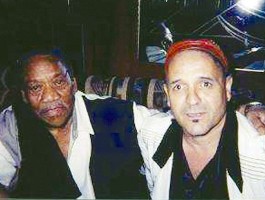
Thompson, born in Oakland in 1953 and pictured above with Bobby Bland, has played every dusty dive, back-alley bar and county fair between Fresno and San Francisco. He began his career playing in a North Richmond club at age 18, where he gained the notice of and was hired by Little Joe Blue. During the mid-’70s, Thompson became John Lee Hooker’s bandleader and made records with Big Mama Thornton. (“I might be able to find them if I searched for about three days,” he says.) In Chicago, he met Eddie Taylor, Jimmy Reed’s guitarist. “Taylor liked my amp, I got to know him, that’s how I hooked up with Reed.”

The next decade found him joining close friend Mick Fleetwood’s band, Blue Whale, and starting his own group, Ron Thompson and the Resistors, whose album Resistor Twister garnered a 1986 Grammy nomination. Recently, Thompson has been getting even more recognition. Mayor Gavin Newsom declared Sept. 5, 2007 Ron Thompson Day in San Francisco. Several other cities, including San Jose, followed suit. The National Heritage Foundation Blues Hall of Fame inducted him in 2008.

Thompson also plays a mean piano and mandolin, “depending on the kind of song I’m doin’,” he says, “but slide guitar is what I really like. Elmore James got me really goin’.” He hopes to be well enough to come to Santa Rosa for the show. “I still get really tired, but I want to be there,” he says. “Music is what I do for a living. I’m blessed to be able to make money playing music.”

Musicians Rally for Ron Thompson on Sunday, May 17, at the Last Day Saloon, 120 Fifth St., Santa Rosa. 2pm. $10. 707.545.2343.


Fame and Futbol

05.13.09

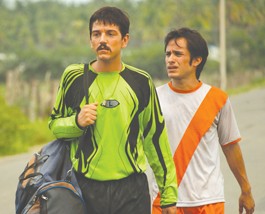
Even with the severely glutted film market, I wish we got three times as many films from Mexico as actually arrive here. Rudo y Cursi will certainly do for now. It is produced by some of the most revered names in new Mexican cinema (Guillermo del Toro, Alfonso Cuaron and Alejandro Gonzalez Iñárritu) and directed by Cuaron’s brother, Carlos. The film reteams Diego Luna and the criminally handsome Gael Garcia Bernal of Alfonso Cuaron’s Y Tu Mamá También.

Like También, the action is narrated, but the difference is in the approach. The narrator in the former was detached, Godardian. In Rudo y Cursi, the narrator is Batuta, “Baton” (Guillermo Francella), who is full of charming fatalistic proverbs about the relation between soccer and life. Baton is essentially a trickster figure, with dyed whiskers and a sports car. Like the devil, Baton looks for mischief where he can find it—and he finds it on a rural soccer field.

Baton discovers Tato (Bernal) and Beto (Luna), who are apparently half-brothers, (some of the U.S. reviews are calling them brothers). The two are classic hijos de chingada, and their parentage is a little uncertain, though each boasts of the superior virtues of his long-gone father. It hardly matters, because their mutual mother’s latest boyfriend is a repulsive cop. The guys work on a banana plantation and are both about to run away to the United States.

The talent scout Baton sees their promise on the field, but figures he can only take one of the pair. That one is Tato, who figures that futbol is just his day job until he can make a fortune as a cowboy-suited accordion player. In Mexico City, Tato rises to the top of the game, and he pressures Baton to sign Beto as a goalie. Beto is a success, ruling the goal posts and shutting out team after team. Unfortunately, his poor sportsmanship gets him the nickname “Rudo.”

For a time the two do well. Tato, now with his own nickname, “Cursi,” meaning “snotty,” gets involved with the wet-dream TV starlet Maya (Jessica Mas). Tato also lands H-2, a fine house and even a few gigs, where he repeatedly massacres Cheap Trick’s “I Want You to Want Me.” But Beto’s degenerate gambling and Tato’s hopeless love for the no-good Maya change both their luck for the worse.

I’m not sure why the subtitles translate Baton’s words into cockney slang; this may have been to please the British market, due to the widely held belief that North Americans don’t care about soccer. (Or maybe it’s to make Baton sound more like Honest John Foulfellow in Pinocchio.) To be fair, this is an extremely idiom-heavy movie.


Rudo y Cursi takes a merry tone to a story in which all roads lead to failure. Ultimately, the one true success is a local narco-thug with an army of bodyguards; he helps himself to the only peaceful spot in the film, a beautiful local beach and he’s a diabolus ex machina who brings in a sort of unhappy-happy ending. Yet it’s troubling to suspect that Rudo Y Cursi is really at heart a cautionary tale of two rural bumpkins who rise above their station. Because of that slight patronization, Rudo y Cursi is only almost really funny and only almost really tragic, though always thoroughly and elegantly moral: “Pity, nowadays, wars are mistaken for games and games are mistaken for wars.”

‘Rudi y Cursi’ opens on Friday, May 15, at the Century Regency 6 (280 Smith Ranch Road, San Rafael; 415.479.5050 ), the Century CineArts at Sequoia (25 Throckmorton Ave., Mill Valley; 415.388.4862 ) and the Rialto Lakeside Cinemas (551 Summerfield Road, Santa Rosa. 707.525.4840).


New and upcoming film releases.

Browse all movie reviews.

Lit Hit

0

05.13.09


A crowbar has fallen out of Dodd’s Delzell’s backpack.

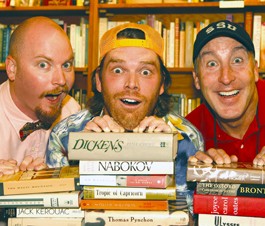
On a recent Saturday afternoon, as actors Keith Baker, Chad Yarish and Delzell gather at the Sonoma County Repertory Theater in Sebastopol to rehearse the upcoming show All the Great Books (Abridged) , a heavy crowbar slips from Delzell’s bag and clatters to the floor with a loud crash. There is a short pause, as everyone stares at the crowbar, each man trying desperately to come up with the first joking response.

Delzell wins.

“Yeah,” he says, “I was just doing a few extracurricular house burglary jobs before rehearsal. Don’t pay any attention to that.”

In truth, the crowbar has to do with a do-it-yourself plumbing job Delzell’s been doing at his house, but it stands as a nifty example of this trio’s attitude after spending the last several weeks immersed in the world of Great Books, a “reduced” comedy by Reed Martin and Austin Tichenor, creators of The Complete History of America (Abridged) and The Bible: The Complete Word of God (Abridged) . As the play gets ready to open this weekend, Delzell, Yarish and Baker have become focused on one thing: how to make a joke out of everything that happens.

“It’s nuts. It’s overwhelming, but it’s a lot of fun,” says Baker of his first appearance in a “reduced” show, this being the fourth such show presented by the Rep under the direction of Jennifer King. “This kind of comedy is pretty much the polar opposite of the serious dramatic stuff I’ve been working on lately,” he says. “This is a true comedy, nothing but laughs for an hour forty-five.”

“This being my second ‘reduced’ show,” says Yarish, who appeared in the Rep’s version of the Bible show two years ago, “it’s great to be getting back into it, just running around and laughing like an idiot. I feel like maybe I’m getting the hang of it now. I certainly know what to expect from the rehearsal process, I know we’re going to be running nonstop for three hours a day until the show opens, and then I’m going to be running nonstop for an hour and 45 minutes every day until the show closes.”

If it closes.

The “reduced” shows tend to have extended runs when they play at the Rep. In preparation for the very real possibility of a held-over run, all of the actors have been asked to keep their schedules open for the next several weeks. Just in case. 

“The first time I directed one of these shows,” King interjects, “it was the Complete Works of William Shakespeare (Abridged) . I learned pretty quickly that with these shows, it’s more like doing choreography than like directing. It’s one big comedic dance.”

In this one, a trio of high school teachers—the coach (Delzell), the professor (Yarish) and the student teacher (Baker)—attempt to give a crash course in English literature by bringing to life 86 of the greatest books ever written. Asked if the performers have learned anything about literature while working on this show, Yarish is the first to jump in.

“Yes! Yes, I have,” he says. “I’ve learned that I don’t need to read Henry David Thoreau’s Walden now, because apparently, it’s just a big boring book about fishing.”

“What I’ve learned,” says Baker, “is the weird, personal way in which most people view literature. People all around the world will say, ‘Ulysses, right, by James Joyce, yes, great book!’ And yet no one has actually read it. They just know that it’s long, it’s unintelligible and it’s about some Irish guy. But that’s enough, and that’s all we need to give you 10 minutes of hilarious theater.”

“I’ve actually gone and read a few of the books, the ones I didn’t know,” admits Delzell sheepishly. “Hearts Desire, The Silent Spring, The Fountainhead—that last one, by Ayn Rand, I had no idea what that was about. The Fountainhead? What the hell’s a fountainhead? I thought maybe it was about a pen. Who knew it was about an architect?”

When invited to mention the novels they most wish had been included in the show, it’s Baker who responds first, but Delzell who gets the funniest joke.

Catch 22,” says Baker.

Catcher in the Rye, ” adds Yarish.

“The Bible,” nods Delzell. “I know that one already has its own show, but as a novel, that’s one funny book.”

‘All The Great Books (Abridged)’ runs Thursday&–Sunday through June 14. Thursday&–Saturday at 8pm; Sunday at 2pm. The Sonoma County Repertory Theater, 104 N. Main St., Sebastopol. $18&–$23; Thursday, pay-what-you-can. 707.823.0177.


Museums and gallery notes.

Reviews of new book releases.

Reviews and previews of new plays, operas and symphony performances.

Reviews and previews of new dance performances and events.

Cold Comfort Farms

0

05.13.09

Last year, I wrote an essay in the Bohemian that stated, “Growth and debt are the cure for everything, but they cannot expand endlessly. We are reaching the limits now.” A year later, we have passed those limits and fallen off a cliff in a grand way. The high and mighty, the wealthy and arrogant, were totally blind. But the hippies saw the abyss. We have crisis on top of crisis now.

Just recently, headlines have announced that difficulties in the dairy industry threaten the existence of our precious family farms. And daily we hear the drum roll of layoffs and rising unemployment, among the most profound dilemmas facing society. Yet few people see how these two problems could fit together to help ameliorate each other.

There once were the beginnings of a “back to the land” movement, and that effort continues on a subdued level in intentional communities, some of them right here in the North Bay. There is greater interest in local, organic, non-factory-farmed food. There is greater interest in ideas of community, reversing the alienation of modern society. There is greater interest in the ethics of service and pulling together to face common problems with “green” solutions. All these impulses dovetail into the notion of the extended family farm, one that is “in service to a culture of conscious kinship,” to quote the local Green Valley Village’s mission statement.

Somehow, when we think of the word “challenge,” we think grandiosely, like going to the moon. If a call went out to fill a colony ship to Mars, thousands of volunteers would line up. Show humans an impossible rock face or high mountain peak, and some have just got to go there. So what about this greatest challenge of all: getting along well enough to share a farm and create a safety net? There aren’t full-time jobs for everyone, not even close, and there are many reasons why we can’t go back to accelerating development.

Here in Sonoma County, we have a specific and immediate challenge. The wonderful St. Anthony dairy farm near Bloomfield is up for sale. The multimillion-dollar price is a pittance compared to the wealth in the county. Is there not a group that would rally to create a live-in school, learning center and country home-assistance center? Are there no patrons who can envision the power of a revitalized “back to the land” movement?

We have books about forming community and connecting with one another, like Diana Christian’s Creating a Life Together. We have the local Occidental Arts and Ecology Center, which specializes in the challenge of how to organize intentional communities.

I myself am a former dairy herdsman and community member with a bit to offer. Sonoma County is special, both visually and intellectually. Preserving our rural heritage with a group effort would shine a light across our country—indeed, across the planet, a world that faces these very same contradictions: disappearing farms, cities crowded with the unemployed, and the need to find creative, friendly, solutions.

Many of us want President Barack Obama to succeed. We believe in the great shift, the time of transformation, the new paradigm. But the president alone cannot do this. There must be some grass-roots action. Entrepreneurs will play a part creating new businesses; another group will have to control some of the farms with lots of people who get food and shelter, and, in return, devote themselves in service to those on the road, the seekers, the ones who are not in the debt system, and others. This would help encourage a culture shift toward generosity and concern, so different from the obsessively selfish and narrow vision of the prevailing culture.

As times get harder, there is a tendency to descend into angry rhetoric and blame. The group that can add something positive, hopeful and helpful will change the face of history. And we need it. The intentional community farms are the ideal vehicle, the necessary element, if a progressive renaissance is to blossom in this stressful time.


It took WW II to put an end to the last giant economic crisis. We’re going to have to do something massively better this time around. The farms are there crying for help. Where are the people who would create something fresh?

 Arthur Kopecky is the author of two books about the New Buffalo commune (portrayed in ‘Easy Rider’), a carpenter and contractor, living in Sebastopol with his family amid many gardens.

Open Mic is now a weekly feature in the Bohemian. We welcome your contribution. To have your topical essay of 700 words considered for publication, write to op*****@******an.com


Biafra Sounds Off

05.13.09In 1989, a 13-year-old kid approached Jello Biafra, the singer of Dead Kennedys, at the River Theatre in Guerneville. It was dark inside the show, but the young fan recognized his idol through a sea of purple Mohawks and leather jackets, his mind racing to all the hours he'd spent listening to Dead Kennedys cassettes on his Walkman, all...

News Blast

05.13.09 Bike to work, have a beer "In just one hour, the average person can save 52 cents a mile on gas, reduce carbon emissions by 15 pounds and burn 450 calories!" So says the Marin County Bicycle Coalition. In order to do this, simply trade in your steering wheel for a set of pedal-powered handle bars.As our nation trends...

Rock Among the Vineyards

05.13.09Last year, Jakey Lee was frustrated with Napa. All of his skater friends had been harassed by the cops so often that they had stopped skating and just did drugs instead. All of his musician friends had declared Napa a dead town and had moved away or given up. All of the house parties his band played had started...

Letters to the Editor

05.13.09Ombudsman's complimentHow good it is to know that investigative reporting is still alive, at least at the Bohemian. Gretchen Giles' recent "The Ombudsman's Complaint" (May 6) is a remarkable piece of journalism in this day and age.Our current age of electronic media seems to make it easier for some to "invent" themselves, to by-pass the traditional expectation of integrity...

Devil Cups

05.13.09We are what we drink—and what we drink from. I was once employed by a dysfunctional government organization. I managed to escape, but never forgot that in the main administrative offices of that dark place, everyone was served coffee in Styrofoam cups. That explained everything.Styrofoam is the brand name of Dow Chemical's own polystyrene product, which is used for...

Regulating Dirt

05.13.09My inbox has been pummeled recently by a slew of emails warning me of the evils of a bill currently working its way through Congress. Sponsored by Rep. Rosa DeLauro, D-Conn., HR 875—aka the Food Safety Modernization Act of 2009—is one of a raft of bills introduced in the wake of the peanut-butter-borne salmonella outbreak. All of these proposed...

Little Help from his Friends

05.13.09Since there are no gigs that include medical coverage, musicians must do it for one another. Ron Thompson, one of Northern California's top blues guitarists for the past 30 years, is recuperating from a life-threatening ordeal with pneumonia in February. Speaking by phone from his Hayward home, he assures that he's "doin' all right," and performing on a limited...

Fame and Futbol

05.13.09 Even with the severely glutted film market, I wish we got three times as many films from Mexico as actually arrive here. Rudo y Cursi will certainly do for now. It is produced by some of the most revered names in new Mexican cinema (Guillermo del Toro, Alfonso Cuaron and Alejandro Gonzalez Iñárritu) and directed by Cuaron's...

Lit Hit

05.13.09A crowbar has fallen out of Dodd's Delzell's backpack.On a recent Saturday afternoon, as actors Keith Baker, Chad Yarish and Delzell gather at the Sonoma County Repertory Theater in Sebastopol to rehearse the upcoming show All the Great Books (Abridged) , a heavy crowbar slips from Delzell's bag and clatters to the floor with a loud crash. There is a...

Cold Comfort Farms

05.13.09Last year, I wrote an essay in the Bohemian that stated, "Growth and debt are the cure for everything, but they cannot expand endlessly. We are reaching the limits now." A year later, we have passed those limits and fallen off a cliff in a grand way. The high and mighty, the wealthy and arrogant, were totally blind. But...
11,084FansLike
4,446FollowersFollow
6,928FollowersFollow