News Blast

0

06.17.09

Loco-motion

Culminating two decades of huffery, puffery and legal acrimony, St. Helena’s city council recently voted 4–1 to allow the Napa Valley Wine Train to begin trial downtown passenger stops on each first Friday of the month through this coming October. While the dual-engine train typically pulls multiple cars and as many as 370 riders, these runs will be limited to one engine and a single car carrying 50 passengers.

Longtime Wine Train nemesis and St. Helena mayor Del Britton cast the sole vote against the proposal, claiming the city has developed no means by which to gauge impacts the stops will have on the town, and further, that the city has yet to issue the train any permits. But the council’s action, taken before a near empty city hall chamber, ends, at least for now, a contentious issue going back to the founding of the Napa Valley Wine Train two decades ago.

The Napa Valley Wine Train commenced service from the town of Napa heading up valley on Sept. 16, 1989. Two years earlier, upon his retirement at age 72, the late Vincent DeDomenico began actively pursuing his dream to utilize the old Napa Valley Railroad’s tracks in order to run an upscale vintage passenger line featuring fine food and wine combined with shopping and winery visits. The 42-mile ride would leisurely transport Bay Area travelers from the line’s original terminus in Vallejo up to where the railway’s first owner, San Francisco pioneer Sam Brannan, had developed Calistoga into a world-class result almost a century and a half earlier.

But DeDomenico—of Rice-A-Roni and Ghirardelli fame—met a hell storm of local opposition, particularly from residents in St. Helena. In 1990, the California Supreme Court ruled 4–3 in favor of DeDomenico, clearing the line’s last significant legal hurdle, but opposition to the Wine Train has persisted. Many upvalley residents have expressed concerns that the line, which has accommodated over 1 million riders to date, floods an already overcrowded Napa Valley with tourists. Local business owners, however, welcome the potential customers the train might provide.

Starting Friday, July 3, the Wine Train will begin dropping passengers off in St. Helena on Railroad Avenue at 6pm each first Friday of the month. They’ll be picked up for their return trip downvalley at 8:45pm.


Close to Home

0

06.17.09


This is an excerpt from author and SSU professor Jonah Raskin’s new book, ‘Field Days: A Year of Farming, Eating, and Drinking Wine in California’ (University of California Press; $24.95).

In 2006, when I began my odyssey across the landscape of California’s organic farms, I was nearly 65 years old and beginning to feel that I had a finite amount of time on earth. I was living in Santa Rosa in an old barn that had been converted into a small house with electricity, plumbing and windows. It sat on a road dotted with barns filled with melons, hay, wool and animals.

The fall semester at the college where I taught writing was drawing to a close. I had time, energy and curiosity. I wanted to get out and explore. Before it was too late, before life passed me by, I wanted to be in touch with the earth again. I wanted to regain something I felt I had lost, and to work alongside men and women who were cultivating the earth. I wanted to eat as though for the first time, with a sense of newness.

I began my quest for the old rural life by going to nearby farms that were on my own road, those that advertised themselves and that I could find without the aid of a map. I went to farms owned by friends, or friends of friends, and there I immediately noticed new directions in agriculture. In the 1970s, when I first arrived in California, farms were often sadly inaccessible, and I had only rarely been able to satisfy my curiosity about crops and barns. Even farmers I knew, such as my parents’ close friend Benedict Sobler—a veteran apple grower who taught me the art of pruning trees—were often reluctant to let outsiders onto their property.

In the 1970s, Benedict owned a beautiful old barn that I coveted, in which he stored his Gravenstein apples, a variety that was the pride of Sebastopol. The barn also served as a garage for his beloved blue Mercedes-Benz. Soon after I arrived in Sonoma, I went to work pruning his apple trees so that sunlight and air might penetrate to their innermost boughs, and now they looked beautiful.

In contrast to Benedict’s farm, there were others that I avoided out of fears for my health and safety. Across the street from my parents’ acres, for instance, there was the farm of a man whose face I rarely saw. Several times each year he used to cover himself from head to toe in protective gear and drive his tractor around his farm, spewing chemicals on the trees and the ground and into the air. Rachel Carson would have been appalled.

Afterward, he posted a sign with a skull and crossbones that read: “Danger. Keep Out.” Of course I kept out! Neither he nor anyone else seemed to consider the fact that the wind blew those toxic chemicals across Morelli Lane and into the fruit trees my father had planted, which neither he nor I wanted to be sprayed. We didn’t want the chemicals on us, either.

That cranky apple farmer, with whom I exchanged heated words on the telephone, felt that he had the right to spray whatever and whenever he chose to, neighbors be damned, and he felt no compunction about chopping down all the stately redwood trees on land he owned. That was the attitude of many old farmers—it was their property, and they could do anything they wanted with and to it. This attitude is slowly changing, thanks to environmentalists, whose hard-fought victories benefit everyone.

The county of Sonoma still insists in official proclamations—mailed with annual tax bills—that citizens have the “Right to Farm,” and that citizens who live near farms must expect to “be subject to inconvenience or discomfort arising from agricultural operations.” But farmers no longer have the right to spray toxic chemicals on crops and into the air.

After moving away from the family farm in 2004, I needed to find a place where I could feel close to the earth. I knew I would be welcome at Windrush Farm. Mimi Luebbermann, a farmer in Chileno Valley, invited me to visit. She is a good example of the new farmers who are far more transparent than the farmers of old. As often as farm operations allow, she opens her Windrush Farm to the public. Every summer, swarms of kids arrive to learn what it means to be a farmer and discover the smell of barns and pastures.

She has also hosted events for adults. I attended one such event, when Mimi made dozens of delicious pizzas in her outdoor brick oven, and Molly Katzen, the author of The Moosewood Cookbook, told stories about her legendary hippie restaurant in upstate New York and her own kitchen in Berkeley. I did not notice a gate at the entrance to the long, shaded driveway that led to the farmhouse, or any barriers to the barns, sheds and pasture. “Welcome” was the watchword, generosity the style.

Mimi had come from Oakland, where she raised rabbits and chickens and grew vegetables. For years, she wanted more open space, more land and friendly neighbors who were farmers, too, to whom she could turn for wisdom about crops and animals. In 1995, she made her big move from an urban to a rural existence, and the change ignited her creativity. In the last decade or so, she has written how-to books with titles such as Pay Dirt: How to Raise and Sell Herbs and Produce for Serious Cash, which offer “simple secrets” for farmers and gardeners on how to make money and find happiness by growing orchids, herbs, heirloom tomatoes, cactus, daffodils, quince and kumquats. In these books, which I heard about as she wrote them, she provides valuable information that is not always accessible but all the more important to anyone who wants to farm successfully.

How much “serious cash” Mimi makes from her books and her farm I do not know, and I did not feel it would have been polite to ask. After all, she was from Virginia and had Southern manners, and I did not wish to encroach on her privacy. I could observe, though, that Mimi keeps her farm going with a combination of old ways and reinvented new ones. In addition to selling eggs, rabbits, lamb and wool at farmers markets, she gives classes in the skills she has taught herself and learned from neighboring ranchers.

She’s always on the go—up at sunrise most days—and everyone who knows her comments on her seemingly inexhaustible energy. One of her sons calls her “a whirlwind mom.” Her vehicles are usually old, often battered and rarely attractive, but they get her and her goods where they need to go, which is to say that she’s practical and efficient and doesn’t care about mere appearances.

Mimi was the first person I got to know who talked vigorously—years before it became popular to do so—about the importance of buying local produce and supporting local farmers.

She was a long way ahead of the curve. Even some of her own family laughed at her ideas and thought she was silly and provincial. They pointed out that almost year-round you could get attractive fruits, vegetables and meat from Argentina, Mexico, New Zealand and elsewhere. It took her family and friends—and me, too—a while to understand that local produce is likely to be safer and fresher and to have more nutrients than produce grown and shipped from far away. Only after outbreaks of contaminated meats, tomatoes, spinach and other fruits and vegetables have many shoppers learned to search out produce grown by responsible farms close to home.

The author most helpful on the vast, complex idea of “the local” is Lucy Lippard. In her groundbreaking The Lure of the Local: Senses of Place in a Multicentered Society, she writes about land, landscapes, art and the balance between urban and rural, public spaces and private ones. There isn’t a single major area of contemporary American life that she didn’t touch on, and her provocative book helped me when I went to farms like Mimi’s.

Lippard insists that it’s important to remember that each individual has a point of view. Indeed, I learned that everyone on a farm—from the owner to the fieldworker, tractor driver and truck driver—sees the farm in slightly different ways depending on a variety of factors, including age, ethnicity, gender and class. Moreover, before you can even see a farm you have to believe in it. Otherwise it will remain invisible to you. This is why tourists from urban places who are unaccustomed to farms often do not see them or notice their beauty. If you associate carrots, peas and potatoes with frozen packages in a supermarket, you may not be prepared to see them actually growing in a field.

I resonated with Lippard’s observation that “understanding the local history, economics and politics is a complex, fascinating, and contradictory business everywhere.” Certainly my part of California seems as rich, complex and contradictory as any place I have ever known. Sonoma has farms and vineyards, a long coastline along the Pacific, majestic mountains and fertile valleys, Indian tribes, settlers, outlaws, writers, movie producers and gourmet restaurants.

What is produced in this specific locality—wine, cheese, wool and olive oil—is sent around the world, and workers and tourists come here from afar. It is connected to the whole world and is an integral part of it. I remember my exhilaration when in the midst of my farm odyssey I met the men who belong to the international circuit of sheep shearers. Mike Donovan, who was born and raised in New Zealand, traveled to California and from there to Utah, Idaho and Wyoming to shear sheep, and then he’d go on to Spain, Scotland and Germany. He was paid $2.65 a head, and he could shear nearly 250 sheep in a day. “Wherever there are sheep, I go,” Donovan told me one afternoon, when he took a break from shearing sheep on a farm close to my own home. “Last year, I sheared more than 50,000 sheep.”

From Mike and Mimi, I learned to respect physical labor and to pay attention to the tasks at hand and the tools in my hands.

On days I did not teach at the college, I worked at Mimi’s Windrush Farm in Marin. I did the simplest of chores. For a couple of months, on cool afternoons in autumn, I dismantled the raised beds just behind the farmhouse; after that, I carted countless wheelbarrow loads of soil to another corner on the property. I wasn’t paid a cent—that was agreed—but Mimi always provided thick homemade soups that were meals in themselves, steaming hot after simmering on a back burner of the old-fashioned stove all day long. Sitting in her warm kitchen, I also tasted the cheeses she experimented with from milk from her own cow. You can’t get more local than that. 

Jonah Raskin will read from and discuss his book on Saturday, Aug. 1, at Windrush Farm to benefit the Sonoma County Book Festival. 2263 Chileno Valley Road, Petaluma. www.socobookfest.org.

  

Quick dining snapshots by Bohemian staffers.

Winery news and reviews.

Food-related comings and goings, openings and closings, and other essays for those who love the kitchen and what it produces.

Recipes for food that you can actually make.

Singin’ the Blues?

0

06.17.09

The crowd is decidedly sparse on a Sunday evening in downtown Santa Rosa, where contemporary jazz band Planet B are swinging through their first set. The coffee grinders of A’Roma Roasters hum steadily in the background, and a handful of both young and old sit around the room, cradling cups of tea and coffee, bobbing their heads thoughtfully. A mostly empty tip jar sits next to stacks of CDs in front of the musicians.

This is the meager new face of the jazz scene in Sonoma County.

Planet B bassist Brett Palm takes a moment between sets to chat about the morose state of jazz appreciation in the community. Planet B is a representation of the veteran musicians who have been playing in the county for years, many working day jobs and some still attempting to play full-time. Palm, who owns a carpet-cleaning company by day, admits that those trying to go full-time are “scratchin’ out.”

“I feel like this is worst jazz scene I’ve ever lived in,” he says, shaking his head. “The Caribbean was great, L.A. had all kinds of clubs going on—you didn’t make much money, but at least there were places to play.” After a pause, he reconsiders. “There was one place I’ve lived that was worse. Arcata.”

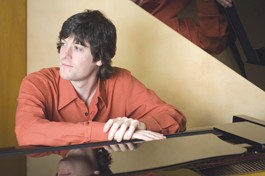
The rise of “cocktail jazz”—tuxedoed quartets playing mood music in the background for winetastings and weddings—is becoming an easy fate for any North Bay musician. Of course, Sonoma County is better off than many places, as 27-year old jazz pianist Noam Lemish points out before taking the stage during the Healdsburg Jazz Festival’s Rising Stars concert.

“I definitely lament the situation in the county,” he says. “But I think in a way we should be grateful that we do live in wine country and that there are actual venues to play in.”

Lemish, after releasing his debut CD Yes, And in October of last year, has no plans of falling into the winery-wedding trap anytime soon, but admits that economic circumstances may require him to.

“If I don’t want to be someone or something, I just won’t,” Lemish says, shrugging his shoulders. “I’ll make sure to carve out my life in a way that if I decide that I’m not going to be able to make a living playing music in the way that I want to, I’ll find a different way to make a living through music.”

After lamenting the loss of diehard jazz club Zebulon’s Lounge in Petaluma, Lemish mentions the Healdsburg Hotel, the Lodge in Sonoma and the Palette Art Cafe in Healdsburg as three major venues available for musicians to perform original works.

“A lot of the gigs are wineries or hotels, where you’re playing a background kind of role,” he adds. “Music is becoming a luxury, really, for a restaurant or a club. They try to use it to bring people in, but it’s not a necessary part of their organization.”

After moving from Israel in his teens and attending Sonoma State University, Lemish immediately began making appearances all over the North Bay, working with some of the greats, including his teacher at Sonoma State University, the late Mel Graves.

“You know, I sometimes feel like I have to stay so busy just to pay the bills,” he admits. “I mean, the whole point of being an artist is not to pay the bills, it’s to create something beautiful. Sometimes, it’s hard to find the time to do the things that I feel that I need to do, like compose and practice.

“But, I’d also like to go to the beach. Or a movie,” he adds. “I love what I do, but the work never stops.”

Back at A’Roma Roasters, Palm nods when the conversation circles back to the economy.

“Money’s always in the way, there’s no way around it,” he says, taking a sip of his coffee. “But with the day job, at least that gives me a little leeway to experiment with a few things. But I don’t make any money. This band isn’t making any money.”

When compared to a starving artist, Palm laughs and adds, “I’m probably a little too comfortable. I should probably be living under a bridge or something.”

Lemish sees the problem rather as a mixture of economic woes and a change in the community-wide attitude towards the arts.

“The arts, musicians in general, are just not valued by society, and musicians are not getting paid what they deserve or what they need to sustain themselves,” he says. “But nurses aren’t getting paid, teachers aren’t getting paid. But musicians . . . I mean, I would die for a salary like a teacher’s.”

Lemish, who at one point a few years ago was playing four or five nights a week, says he now only appears eight or 10 times a month—which for many other working musicians is still a lot to hope for.

“I do the gigs and I teach, and I try to get on other projects. I have to do a lot of things I wouldn’t normally do,” he says. “I’d like to be in a situation where I could support myself and have time to practice and compose. That’s what’s going to allow me to continue to create new music.”

What Lemish describes is, of course, the dream: endless amounts of time with no monetary constraints. For jazz musicians in particular, as Palm mentions, music is more of a personal affair. It’s “music for musicians,” he says. The goal is to have a conversation, not keep crowds dancing, which can be limiting when trying to find a reasonable gig.

“I wouldn’t take [Planet B] and try and do a wedding. It’d be a waste of time,” Palm says. “If the bride’s going, ‘We want to hear “Feelings” . . . I mean, we could go out and do a bunch of standards, if a hotel wanted it, but what we’re looking for are places that want original music.”


Sonoma Valley Jazz Society president Janice King takes a different approach; she says the society is trying to provide as many outlets as possible, still going strong in it’s 20th year. “We’re making it happen,” King says. “I know it’s a decline, but all musicians are complaining. I really think it has to do with arts being the extra.”

King seems confident in the survivability of the jazz community, and emphasizes how many supporters there still are. The crowd may have been sparse that Sunday evening at A’Roma Roasters, but faced with the rebirth of a jazz scene in Sonoma County, it’s a start.

“If we all pull together, we’ll keep it going,” assures King. “We do it for the love of jazz.” 


Postnatal Payroll

06.17.09

Jeanne— had an iron will and a brilliant mind that drew admiration, respect and criticism—but not often love. When she died in her 90s, colleagues at her funeral service eulogized her with shocking bluntness. Only one person said anything kind, and he seemed to be reaching. In the back of the chapel with my infant son in a stroller, I had no answer for the affronted mortuary worker who leaned toward me and whispered indignantly, “What is wrong with these people?”

Most had wondered for years what was wrong with her. Yet months before her death, I photographed Jeanne holding my baby. Wow, did she look different. Being that close to a newborn made her look . . . well, nice. Had she been exposed to more infants during her long, work-driven life, perhaps Jeanne might have softened a little, become a nicer person. Who knows.

Anecdotes abound regarding the transformative powers of a baby. So it doesn’t surprise me that in a small but growing number of workplaces, babies are helping transform bosses and co-workers into more genuinely related communities of people. It’s part of the Babies to Work movement, in which mothers get to work while caring for their babies at the workplace for six months.

“This is going to be a movement that is really good for everybody,” says Joan Blades, cofounder of MomsRising.org, representing mothers (and those born of mothers) in the policy arena. “It offers a work-life integration that makes sense, and companies say that it has been good for their bottom line. It creates community within the workplace. And a lot of those who thought they wouldn’t like it really do.”

The Babies to Work program is only one of dozens of strategies being used to change the way work is done, says Blades, presently writing a book about the need to restructure American work. Many of the changes Blades calls for have to do with the time framework in which people are expected to do their jobs; presently, it doesn’t mesh with many people’s lives.

“My ideal is to bring work into the 21st century,” she says, “because it is not keeping up with the reality of the workers’ lives.” By addressing the issues impacting moms and families in the workplace, Moms Rising is leading a push for change that will benefit everyone, whether or not they have kids. In addition to the ability to take babies to work, suggestions include flexible scheduling, telecommuting, job sharing, career customization, part-time options and “on-ramps” for parents who take time away from work. “We need to think intelligently about how to structure work,” says Blades. “Right now, we are making it really hard.”

Out of 170 countries worldwide, only four do not provide paid leave for new mothers. The United States is one of them. While California was the first state to pass legislation providing paid family leave, Moms Rising, started in 2006 and with now over 1 million members, is lobbying for paid family leave in the rest of the country. Members are also responsible for helping advance the proposed Healthy Families Act, which aims to provide paid sick leave. Sadly, a disproportionately large number of women can’t afford to stay home when they are sick or when a family member is sick.

“There is a profound bias against mothers in hiring, wages and advancement,” explains Blades. “You have to look at how single mothers are earning 60 cents to an equally educated man’s dollar, and married moms are earning 73 cents. So there is a deeper bias against single moms than against mothers who are married, and this has a huge impact on a family’s economic security. It’s a good explanation of why we have so many women and children living in poverty.” When I asked Blades what people could do to help, she said, “I’m telling everyone to join Moms Rising. We’re about changing the culture and policies so families can thrive.”

Meanwhile, I have advice for those workplace infants: Your job is to be yourselves, innocent and disarming, and to help transform the personalities of seemingly unlovable people everywhere. Babies, we need you.


Modern-Day Minstrel

0

06.17.09

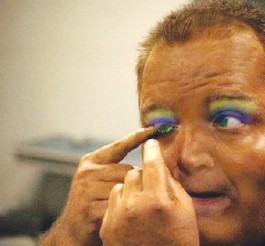
These days, it’s pretty ballsy to appear in public in blackface. Chuck Knipp is just that foolish. His performances have been picketed by protesters in New York, condemned by the mayor of Boston and cancelled coast to coast, from Hartford to Hollywood. He’s been the subject of scorn from radio hosts, from writers at BET and from East Kentucky University, who have banned his act.

Knipp, an overweight white man, appears in drag and blackface as Shirley Q. Liquor, an outdated, offensive stereotype of the black welfare mammy—19 children, muumuu, curly wig, the whole bit. Thick with Ebonics and misspoken words, Shirley Q. Liquor routines operate like a running on-stage diary; her overweight friends and neighbors frequent the local fast food restaurants and cafeterias, watch soap operas, smoke menthols, drink Colt 45 and shop at Piggly Wiggly. On Sunday mornings, Liquor drives her 1972 El Dorado to the Mount Holy Olive Second Baptist Zion Church of God in Christ with her friend Shenelda Jenkins to hear sermons from the Rev. Cleotis Jefferson.

Knipp seems to know how far is too far, stopping short at watermelon and fried chicken, and the 47-year-old Kentucky native maintains that he created the character to actually celebrate black women. “If I have to explain to people what my show is about at its deepest levels,” he told Rolling Stone in 2007, “it kind of takes the fun out of it.” He often performs at gay pride events for “the homosexicals” (in Liquor parlance) and has been fiercely defended by RuPaul, who says that those offended by Shirley Q. Liquor are “idiots.”

Politically, in the wake of Proposition 8 and the disconnect its passage underscored between the gay and black communities, an act like Shirley Q. Liquor probably isn’t helping. Culturally, one has to admire Knipp’s shameless bravado while recognizing his social folly, and financially, Knipp is doing all right, his notoriety helping him get hired by famous actresses and country musicians for private events. But the bottom-line question ignored in all the controversy is if Shirley Q. Liquor is at all funny, an adjective easily interchangeable with “outrageous” when dealing with drag acts. Decide for yourself when Shirley Q. Liquor appears on Saturday, June 20, at the Russian River Resort. 16390 Fourth St., Guerneville. 9pm. $10. 707.869.0691.


Museums and gallery notes.

Reviews of new book releases.

Reviews and previews of new plays, operas and symphony performances.

Reviews and previews of new dance performances and events.

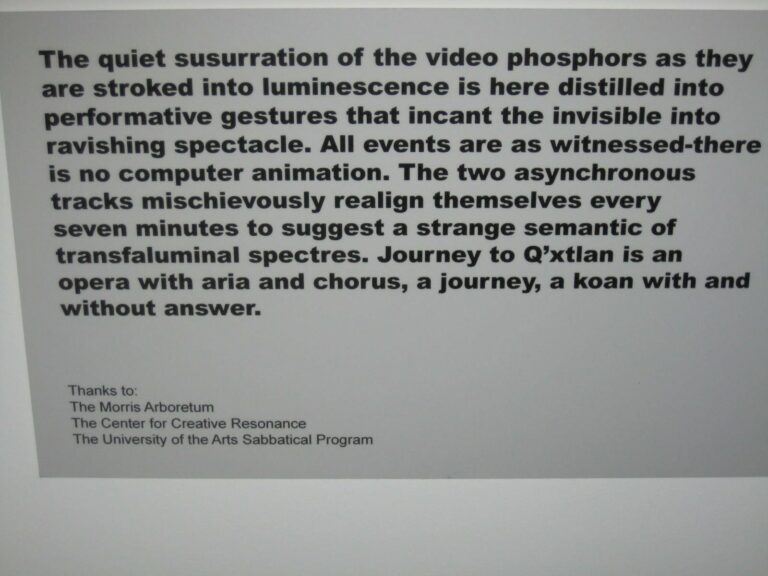
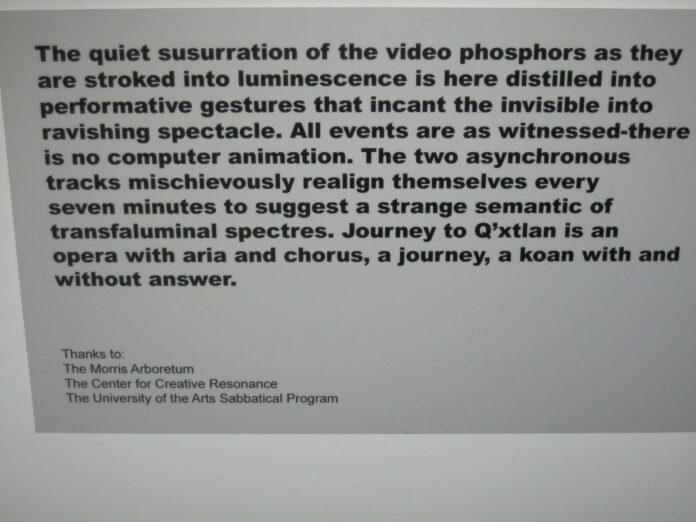
Most Obfuscating (And Irritating) Project Tag, Or: Koan My Ass

0

Pete Rose, Journey to Q’xtlan,

From the otherwise fabulous Fabric Workshop and Museum in Philadelphia.

Olive Magic

06.17.09

Ten years ago, chamise brush grew wild on Healdsburg’s West Dry Creek hills, covering the land. Poking through the gnarly shrub were small, strong olive trees—scattered, as if they’d been planted by birds. Russ Messing, upon discovering this gift, remembers thinking, “If olives can grow in this stuff and nobody tends them and there is no fertilizer, there is no water, what would happen if I pulled out all the chamise and planted some olives?” This is exactly what he did, tending and nurturing what he loves to call the “magic” of the land.

Ten years later, after producing his own olive oil for three years, the resulting Best in Show&–winning Deergnaw olive oil will be honored at the Harvest Fair and Harvest Fair Awards Night gala on Saturday, Sept. 26.

Messing’s small three-and-a-half-acre orchard is home to approximately 675 trees of different varietals that he feels he lucked into, among them Northern Italian casaliva and taggiasca and Southern Italian coraina and nocciara; also included are French picholine and Tuscan pendolino. “If you think about it, if you are in Italy, down in the southernmost part of Italy,” he says, “the trees that grow there are the trees that grow there. You are not going to cross them with some trees from Lombardia in the North. So that is what I did, and it seems to have worked out very well.”

Deergnaw is rich, flavorful and uniquely fragrant, with grassy notes hitting the tongue and a peppery taste waking up the senses. It has been gaining reputation, but Messing sells the oil primarily at his local Healdsburg farmers market. While standing cheerfully at his table at the market, he says that he doesn’t want the company to get too big. “I like coming here,” he enthuses. “It sells out here, I don’t have to be a marketer and I don’t want to do that. This is more fun.”

Ten years ago, Messing’s trees were small, just gallon-sized. Now they grow 10 to 12 feet tall, producing over two and a half tons of olives annually. “The land does have a certain magic to it,” he says. “I thank my lucky stars all the time that somehow I lucked into this piece of property and what my wife has created more than me. She is the architect of it all.” His youthful glow shows that he truly loves his work and connects to the land in a compassionate and rich way. Deergnaw olive oil is a result of his passion and love, tasted in each drop.

Quick dining snapshots by Bohemian staffers.

Winery news and reviews.

Food-related comings and goings, openings and closings, and other essays for those who love the kitchen and what it produces.

Recipes for food that you can actually make.

Sex Crazed

0

06.17.09


Playwright Joe Orton, by the time he died in 1967, had already shown himself to be uninterested in writing nice, safe comedies. As one might expect from a writer who’d spent six months in prison for vandalizing books in the public library (he replaced their covers with eye-opening variations of his own), Orton was an artist who thrived on upsetting people, but also lived to make them laugh. His plays routinely inspired shock, anger and outrage, and only came to be appreciated as comic masterpieces later, after everyone had finally calmed down. While critics and other authors frequently praised Orton’s work (at his funeral, playwright Harold Pinter called Orton “a bloody marvelous writer”), the theater-going public never knew what to think of his plays, calling them debauched, perverse, disgusting and obscene—while never denying that the stuff was also drop-dead funny.

What the Butler Saw, which has just opened a three-week run at Mill Valley’s Marin Theatre Company, was Orton’s last play. He was murdered by his lover Kenneth Halliwell in 1967 less than a month after completing the script, a mad-cap sex romp set in an English insane asylum. When Butler was finally staged in 1969, audiences called it “filth,” often right in the middle of the production, while the critics proclaimed it ahead of its time. Evidently, they were right.

Ten years later, What the Butler Saw (a euphemism for an English “peep show”) was finally recognized as Orton’s masterpiece, and following a successful run in London in the 1970s has gone on to be seen as the groundbreaking comedy that it is. As evidenced by the current MTC production, Butler, even after 40 years, still has the power to shock, and though seriously dated, it is as outrageously, scandalously funny as ever.

Dr. Prentice (Charles Shaw Robinson, channeling a dry, midlife Peter O’Toole) runs a large mental hospital in London as his sexually adventurous wife (the great Stacy Ross) avoids sex with her husband while pursuing it everywhere else. “You were born with your legs apart,” Dr. Prentice tells her early in the script. “They’ll send you to the grave in a Y-shaped coffin.”

The events of the play are set in motion when Dr. Prentice attempts to trick the virginal, none-too-bright Geraldine (Kat Walleck) into having sex with him as part of her interview for a job at the clinic. When Mrs. Prentice arrives on the scene, forcing the good doctor to hide his now-naked would-be assistant, the young woman’s dress is passed on from character to character as a series of increasingly momentous misunderstandings take place.

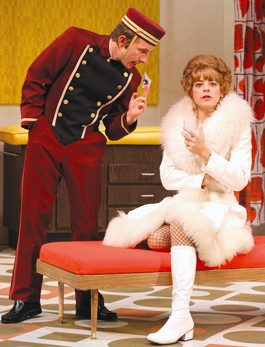
These include the participation of a sexually ambiguous bellboy (Rowan Brooks), attempting to blackmail Mrs. Prentice with photos from a distasteful recent rendezvous; the mad psychiatrist Dr. Rance (Andy Murray), who sees everything in terms of its probable psychological aberrance; and a painfully serious policeman (Kevin Rolston) hot on the trail of Sir Winston Churchill’s enormous missing penis, recently lost after a terrorist bombing that destroyed a statue of the good man.

The missing body part may be in the hands (so to speak) of the increasingly distraught Geraldine, committed to the asylum by Dr. Rance, who believes her to have a psychological disorder causing her to take off her clothes in front of strange men. It gets weirder. Much of the material is so of-its-own-era that it hardly makes sense in 2009, what with references to “white tar babies,” use of the word “rape” as interchangeable with sex and the casual use of the term “nymphomania,” long since abandoned by psychologists as sexist and wrongheaded.

Director Amy Glazer is wise to keep the happenings grounded in the ’60s, with superb costuming, set design, and musical interludes that include Tom Jones’ “What’s New Pussycat.” Though clearly a product of an earlier day, the satire is still frequently apt, and the laughs, which come often, are nearly as big as Winston Churchill’s humbling manhood.

‘What the Butler Saw’ runs Tuesday&–Sunday through July 5 at the Marin Theatre Company. Tuesday and Thursday&–Saturday at 8pm; Wednesday at 7:30pm; Sunday at 2pm and 7pm. 397 Miller Avenue, Mill Valley. $20&–$51. 415.388.5208.


Museums and gallery notes.

Reviews of new book releases.

Reviews and previews of new plays, operas and symphony performances.

Reviews and previews of new dance performances and events.

Letters to the Editor

06.17.09


Protesting the grove

Gabe Meline’s article in last week’s Bohemian (“Passing the Torch,” June 10) was nice to see. Thanks for bringing attention to this year’s events at the “elite retreat.” I am surprised that still, to this day, many Sonoma County residents do not know about the Bohemian Grove and its yearly inhabitants. Many people are shocked to learn that contemporary members include such people as George H. W. Bush, David Rockefeller, Henry Kissinger, Donald Rumsfeld, Colin Powell and other leaders in banking, military, corporate and government structure.

Many of the problems that we as a society face are normally profited from by this same structure in a number of ways. In this sense, we all have a right and responsibility to be at the Grove voicing our complaints.

Corporate and banking influence in our body politic is overwhelming. The “War of Terror” is created and sustained via the events of 9-11. The militarization of police and control of the media has continued in haste since that event. Torture has become a public discussion since 2001. Many of the constitutional erosions seen under Bush because of 9-11 have not been restored by Obama. As ICE raids and Homeland Security continue to spread, their creation from 9-11 has not been checked. Not to mention all the social justice issues that were buried by the events of 9-11.

The official story of 9-11 has been debunked. Steel-framed high rise buildings do not turn to dust from fire. Planes do not fly in our airspace off-course, without transponders, for over an hour and a half unchecked, unless they are allowed to. They want us to believe it was a huge intelligence failure; in fact, it was a huge intelligence success.

Gabe’s article said that there was some worry that 9-11 truth would obscure the corporate-control reasons for protesting at the Grove. I hope now that any worries are quelled. With a new independent investigation, the truth of Sept. 11, 2001, might just be the final piece to the puzzle of understanding how deep we are corporately controlled. Then maybe, just maybe, we can get some peace and justice!

Brian Romanoff
Norcaltruth.org

Fontina, Sweet Fontina

I read your article on Mark Todd (“Meet the Cheese Dude,” May 27), and it made me think of Dr. Peter J. D’Adamo’s statement about why China has not eaten cheese for centuries. Here is the quote from D’Adamo’s first book, Eat Right 4 Your Type:

“If you are of Asian descent, you may initially have a problem adapting to dairy foods—not because your system is resistant to them, but because your culture typically has been resistant. Dairy products were first introduced into Asian societies with the invasion of the Mongolian hordes. To the Asian mind, dairy products were the food of the barbarian, and thus not fit to eat. The stigma remains to this day.”

Maybe Mr. Todd can now help squash the resistance and make China become a nation of cheese lovers!

Susan Evind
Santa Rosa

No more senior discounts

Proposition 13 passed in 1979 and took 30 years to bankrupt the state of California. At the present time, there are insufficient funds to run the schools and prisons, maintain roads and provide a minimum of healthcare for SSI recipients. Filing for unemployment from pink slip to first check takes four to six weeks. The failure in our social welfare system is a consequence of Prop. 13. This inhumanity results in a decline of our public schools, an increase in crime and potholes galore, while license and plate fees increase. People, we are all bearing witness to the richest state in America falling into a banana republic.

Emanuel Marquis
Santa Cruz


Wild Trip

06.17.09

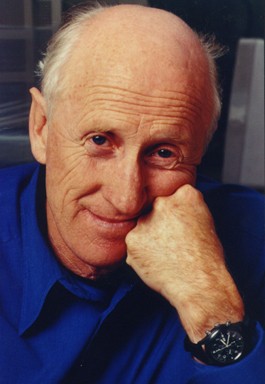
THE INDESTRUCTABLE MR. BRAND: Stewart Brand is impossible to pigeonhole.

He’s just back from TED, the inaugural and widely publicized Technology, Entertainment and Design roundtable for Hillary Clinton’s State Department. He’s fresh off a lively debate on NPR’s Science Friday concerning the future of nuclear energy. And still, Stewart Brand is hardly a main-street household name.

Readers of a certain age and cultural bent might recall Brand for founding, editing and publishing the National Book Award–winning Whole Earth Catalog, or for references to him in Tom Wolfe’s New Journalism psychedelic classic The Electric Kool-Aid Acid Test.

Brand is perhaps the late 20th–early 21st century’s most effective and unorthodox visionary. He’s a 70-year-old white guy living on a tugboat in Sausalito who engages, counsels and bills the world’s wealthiest and most powerful by playing them through “scenarios” at the Global Business Network (GBN) he helped found. Less well-heeled folk, those with stakes in the artistic, cultural, technological, intellectual and political etherscapes, might well know of and either love or dislike Brand, but should they be 45 years of age or younger, they likely don’t know one damn thing about him.

Brand is an Exeter- and Stanford-educated biologist and army-trained Merry Prankster who conceived and organized the Trips Festival, three days of seminal San Francisco ’60s madness featuring Owsley acid, experimental film, dance, guerrilla theater and colorful amoeba-like liquid projections, all melded together with Big Brother and the Holding Company, the Grateful Dead, the God Box, spacemen, a “masturbation sermon,” Allen Ginsberg and the amplified ongoing rant of One Flew Over the Cuckoo’s Nest author Ken Kesey.

The Trips Festival also featured Brand’s own presentation of his multimedia roadshow, America Needs Indians. To create his show, Brand spent time on Warm Springs, Blackfoot, Navajo, Hopi, Papago and other Indian reservations. These days, Brand, via GBN, works with tribes like Dow, Bechtel, ExxonMobil, Microsoft, PG&E, Monsanto and CitiGroup.

First published in 1968, Brand’s Whole Earth Catalog inspired a younger generation to head “back to the land” in order to pursue simpler, more naturalistic and organic lifestyles, leaving crowded cities and consumer-addictive suburbias behind for good. Ironically, Brand now finds the unprecedented and accelerating degree to which humanity is fleeing rural ancestral homes for gargantuan squatter cities as a positive and encouraging trend—and, what’s more, because he feels it’s the way to feed these masses, he’s become an enthusiastic proponent of genetically modified foods.

As a Stanford biology student back in the 1950s, Brand came under the tutelage of entomologist and renowned ecologist Paul Ehrlich. Erlich’s book The Population Bomb inspired Brand to organize a public fast highlighting spiraling world population growth, the consequence of which, Ehrlich forecast, would mean that “hundreds of millions of people are going to starve to death in spite of any crash programs embarked upon now.” Brand says he learned an important lesson from the shattering of Ehrlich’s crystal ball; in fact, the Brand of today goes so far as to suggest that we may require more, not less, people living here on planet Earth.

Brand has long been an advocate and promoter of carbon-free energy development and was an early opponent of nuclear energy. However, for the past few years, he’s fashioned himself into an environmentalist lightning rod. He now advocates for the development and proliferation of nuclear energy plants across the globe. “Micro-reactor designs are coming out fast,” Brand enthused recently on NPR. “These are down [to the] 25 megawatt, 35 megawatt, 50 megawatts level. They cost about a million dollars a megawatt. They’re quick to build. They look like a whole different animal than the 1.2 gigawatt [or] the 1.6 gigawatt reactors.”

Brand, who declined to be interviewed for this essay, seems to delight in these shifting positions, self-identifying, for example, as an environmental heretic. During the June 5 NPR Science Friday debate, Brand explained why he flipped on the nuclear energy issue after addressing human potential for harnessing solar power. “If we get solar coming down from space, where it’s always on, then it’s base-load power,” he noted. “But it’s really expensive to get there, unless we start mining asteroids. . . . So it looks to me like we’re stuck with nuclear as the low-to-no-carbon source of base-load power for some decades to come.”

Progressive critics have flogged Brand for his suggestion that all the world’s spent nuclear rods be reprocessed at a single site, from which fuel would be redistributed. That idea, they say, is a recipe for totalitarian control. Brand, however, says our imminent and growing coal-carbon crisis eclipses that of nuclear waste, proposing that such waste either remain in dry-cast storage or be sent off to an underground salt area in New Mexico.

What Brand doesn’t mention, according to Sourcewatch and the Center for Media and Democracy, is that he may not be an honest broker on this topic. They point out that over a dozen major players—those who stand to make billions should the nuclear phoenix rise again—pay Mr. Brand for his GBN services.

While convolutions and contradictions seem his stock in trade, and while a host of progressives find his latter-day causes disturbing, or even abhorrent, what’s most intriguing is that each of Brand’s flip-flops both make and don’t make perfect sense, depending upon one’s perspective. In fact, much of the controversy and confusion over his opinions derives from the simple fact that Brand deals most prominently in the future—and it hasn’t yet arrived.

In a 1972 article he wrote for Rolling Stone magazine titled “Fanatic Life and Symbolic Death Among the Computer Bums,” Brand noted that “all historians understand that they must never, ever talk about the future. Their discipline requires that they deal in fact, and future doesn’t have any yet.” So since the future doesn’t have any facts, just who’s to say what it will look like?

Well, Stewart Brand, for one. Brand minced few words when, in 2004, he wrote, “Over the next 10 years, I predict the mainstream of the environmental movement will reverse its opinion and activism in four major areas: population growth, urbanization, genetically engineered organisms and nuclear power.”

Predictions have evolved into an industry for Brand. Thirteen years ago, he cofounded the 501c3 Long Now Foundation, dedicated to “creatively foster long-term thinking and responsibility in the framework of the next 10,000 years.” In 2001, he and Wired magazine’s Kevin Kelly spun out their Long Bets project from within the Long Now Foundation. At Long Bets, participants predict and wager on the future, publicly, using their real names.

One contributor’s prediction foresees Google Street View becoming a “Grand Theft Auto–like” gaming platform. Wagers include an $800 bet that Sasquatch will be discovered by 2025, and a $400 bet that in the year 2108 “an independent, sentient artificial intelligence will exist as a corporation, both providing its services as well as making all financial and strategic decisions.”

With Brand’s youthful, unbounded energy, curiosity and ideas spinning constantly in motion, his many-faceted projects were destined to be writ large in the canon of the countercultural 1960s. He was present at the founding of both the ecology and the back-to-the-land movements. It was Brand who largely popularized the metaphor of tools—from reliable ancient and low-tech tools to cutting edge technologies of the mind; from planting organic seeds to planting space colonies on distant planets.

When the time arrived, Brand likewise rode the pulse of the ’70s and ’80s. He wrote, organized, designed and taught. He founded the WELL, the world’s first cyber community, and in the twilight of Reagan, he cofounded the Global Business Network. Almost antithetically, in 1990 Brand joined the board of the Electronic Frontier Foundation, which fights both large corporations and the government, advocating for personal freedom on issues including digital communications, free speech, privacy, anonymity and consumer rights.

Brand abetted the birth of personal computing. He helped transform the internet from an obscure government project to an ever more powerful array of communicative lightning strikes. Brand’s been active in emerging media and technology developments all along. He’s a creative gaming visionary and an intellectual gadfly, placing bets, embracing politics, publishing and establishing the School of Compassionate Skills. And he has engaged and become friends with many of the planet’s movers and shakers by projecting his talent as an envelope-pushing impresario.

Now 70, Brand still attracts great minds of the modern era. From cybernetics pioneers Norbert Wiener and Gregory Bateson to anthropologist Margaret Mead and futurist Buckminster Fuller decades ago; to the Long Term Thinking seminars he’s hosted since 2003, featuring the likes of musician Brian Eno, cyberpunk writers William Gibson and Bruce Sterling, and philosopher and political economist Francis Fukuyama, Brand has exhibited an uncanny knack for connecting with the world’s best and brightest.

One could place an enormous question mark around the being that is Stewart Brand, much like many puzzle that two members of the Grateful Dead, hippiedom’s most revered band and Brand’s own countercultural contemporaries, belong to the ultraconservative, Republican, corporate and military-industrial Bohemian Club. But if anything’s clear in referencing Stewart Brand, it’s that labels like left, right, conservative, progressive and radical are meaningless. Taking an extremely long view of the world’s challenges may not actually provide accurate snapshots of the future, but taking the long, long view surely eats through orthodoxy like acid.


News Blast

06.17.09 Loco-motionCulminating two decades of huffery, puffery and legal acrimony, St. Helena's city council recently voted 4–1 to allow the Napa Valley Wine Train to begin trial downtown passenger stops on each first Friday of the month through this coming October. While the dual-engine train typically pulls multiple cars and as many as 370 riders, these runs will be limited...

Close to Home

06.17.09This is an excerpt from author and SSU professor Jonah Raskin's new book, 'Field Days: A Year of Farming, Eating, and Drinking Wine in California' (University of California Press; $24.95).In 2006, when I began my odyssey across the landscape of California's organic farms, I was nearly 65 years old and beginning to feel that I had a finite amount...

Singin’ the Blues?

06.17.09The crowd is decidedly sparse on a Sunday evening in downtown Santa Rosa, where contemporary jazz band Planet B are swinging through their first set. The coffee grinders of A'Roma Roasters hum steadily in the background, and a handful of both young and old sit around the room, cradling cups of tea and coffee, bobbing their heads thoughtfully. A...

Postnatal Payroll

06.17.09Jeanne— had an iron will and a brilliant mind that drew admiration, respect and criticism—but not often love. When she died in her 90s, colleagues at her funeral service eulogized her with shocking bluntness. Only one person said anything kind, and he seemed to be reaching. In the back of the chapel with my infant son in a stroller,...

Modern-Day Minstrel

06.17.09These days, it's pretty ballsy to appear in public in blackface. Chuck Knipp is just that foolish. His performances have been picketed by protesters in New York, condemned by the mayor of Boston and cancelled coast to coast, from Hartford to Hollywood. He's been the subject of scorn from radio hosts, from writers at BET and from East Kentucky...

Most Obfuscating (And Irritating) Project Tag, Or: Koan My Ass

Pete Rose, Journey to Q'xtlan,From the otherwise fabulous Fabric Workshop and Museum in Philadelphia.

Olive Magic

06.17.09Ten years ago, chamise brush grew wild on Healdsburg's West Dry Creek hills, covering the land. Poking through the gnarly shrub were small, strong olive trees—scattered, as if they'd been planted by birds. Russ Messing, upon discovering this gift, remembers thinking, "If olives can grow in this stuff and nobody tends them and there is no fertilizer, there is...

Sex Crazed

06.17.09Playwright Joe Orton, by the time he died in 1967, had already shown himself to be uninterested in writing nice, safe comedies. As one might expect from a writer who'd spent six months in prison for vandalizing books in the public library (he replaced their covers with eye-opening variations of his own), Orton was an artist who thrived on...

Letters to the Editor

06.17.09 Protesting the groveGabe Meline's article in last week's Bohemian ("Passing the Torch," June 10) was nice to see. Thanks for bringing attention to this year's events at the "elite retreat." I am surprised that still, to this day, many Sonoma County residents do not know about the Bohemian Grove and its yearly inhabitants. Many people are shocked to learn...

Wild Trip

06.17.09THE INDESTRUCTABLE MR. BRAND: Stewart Brand is impossible to pigeonhole. He's just back from TED, the inaugural and widely publicized Technology, Entertainment and Design roundtable for Hillary Clinton's State Department. He's fresh off a lively debate on NPR's Science Friday concerning the future of nuclear energy. And still, Stewart Brand is hardly a main-street household name. Readers of a certain...
11,084FansLike
4,446FollowersFollow
6,928FollowersFollow