Letters to the Editor

06.24.09


More tribal power grabs

The Robinson Rancheria Tribal Council were all voted out during their last election, and they disenrolled the tribal member who won the Tribal Chairman position (“Inner Circle Outcasts,” June 10). The current council will not recognize the last election, like the Iranian government. What’s the difference?

I am a member there but work for a different tribe. My relatives work at the Robinson Rancheria Casino. The current tribal council is micromanaging and fraudulently transferring funds of the Tribal TANF program because there is a lack of or no oversight of that program. These funds are your tax dollars.

I believe the only reason they don’t try to steal casino revenue from the gaming business is because there are much more stricter gaming controls in place to monitor gaming revenue.

The Anderson family is not stepping down from the council, even though they have been voted off in the last tribal election and they have been systematically disenrolling members or firing anybody who does not support them or speaks against them. They do not remove my family members because we are an old original Robinson family.

Michael A
Upper Lake

Whose ass is at Fault?

Lindsay Pyle’s thoughtful article about the proposed asphalt plant (“Tit for Tat,” June 17) captures a fundamental problem with California society today. As a native Californian who has lived or worked abroad and in several other states, I understand California’s “la-la land” reputation. We insist upon a lifestyle whereby we gobble up incredible amounts of the earth’s resources yet moan whenever any project necessary for our lifestyle occurs anywhere near us. People feign concern about global warming yet insist on exporting our trash or importing our asphalt–never mind the huge amounts of wasted fossil fuel and bloated costs.

Kevin Starr, California’s state historian, captured the essence of this problem in his book Coast of Dreams: California on the Edge, 1990-2003. California, he writes, “contained within itself the mind-set of a resort–a society, that is, with little room for the trade-offs, the nitty-gritty, the ambiguities of a real-time American place. California was a society that wanted the good life but was not prepared to deal with the environmental trade-offs the good life demanded.”

We have gotten away with this for several decades, but we won’t much longer. Our budget deficits and sour economy will bring us back to some semblance of reality.

Craig Harrison
Santa Rosa

From the Niece, No Less

I am Robert McChesney’s niece, the daughter of his sister, Mary Ann McChesney Harris. I want to thank you for such a great article on my “Uncle Pearson” (“True Bohemians,” June 10). I hope to be able to make it up for the show during its duration.

He was indeed a colorful character, even as a young man, according to my mother. A maverick in his small town of Marshall, Mo. Too artistic and hearing the call of the wide world, he left as a fairly young man.

A friend who lives in Santa Rosa alerted me to this article, and I want to thank you for writing it.

Roxanne Harris Hill
Westlake Village, Calif.

From the CoFounder, No Less

Please pass on my congrats to Alastair Bland for his excellent article on Transition work (“Cheer Up, It’s Going to Get Worse,” June 17). I found it balanced, engaging and well researched, with lots of characters to liven up the text. One of the best articles on this subject that I’ve read, anywhere.

Ben Brangwyn,
CoFounder, Transition Network
Totnes, U.K.

VOICES Carry

0

06.24.09

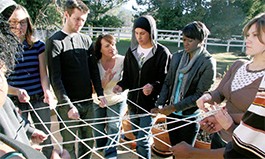
Safety Net: Foster kids who turn 18 suddenly lose support services–a situation the expanding VOICES program remedies with youth-on-youth help.

Most kids look forward to their 18th birthday, when they finally, legally, become adults. But for foster kids, it can be a nightmare.

At the stroke of midnight, they are abruptly no longer eligible for youth-based home and support systems and must instead navigate a dense patchwork of overburdened bureaucracies administering adult services from locations scattered across the county.

Little wonder that a third of California’s “aged out” foster youth wind up homeless within months, or that many develop substance-abuse problems and-or a rap sheet.

Into that void comes VOICES (Voice Our Independent Choices for Emancipation Support), an innovative one-stop, drop-in service model run by and for foster youth. The concept was championed by Leslie Medine, executive director of On the Move, an umbrella nonprofit for VOICES and other youth-leadership development projects. Four years ago, in a summit meeting with the heads of Napa County’s Probation, Child Welfare, Child Social Services and other agencies, she posed the key question: “Could we get the agencies to co-locate staff under our roof, so the kids won’t have to wander all over the place? And people said yes.”

VOICES opened in a funky, refurbished Victorian near downtown Napa in late 2005. “Nobody knew who we were,” recalls Mitch Findley, one of the program’s youth founders. “Nobody was understanding where we were coming from or what we were trying to do.

“That all changed as soon as we started serving the youth, because the youth were coming in, they were enjoying being there, they were getting their needs met, they were talking it up among other youth. So the word spread that we were doing good things.”

Now VOICES itself has spread, opening its second location near downtown Santa Rosa. In a tidy duplex just off College Avenue, the new center is staffed almost entirely by former foster youth and offers visitors a kitchen, laundry facilities, meeting rooms, computers and a growing array of informational resources, all at no charge.

“It really does make a difference when they come in and see young people,” Medine affirms. There are other significant differences, too. Instead of being asked to sit down and fill out an application, “we give them a tour and say, ‘Here are all the different things we do,'” she continues. “We’re not in a big hurry, and that’s really, really important.”

It took VOICES about a year to get established in Napa, but from the outset, Findley says, “It was our dream to have this thing expanded.”

Once it became clear to the surrounding world that their approach was working, “a lot of different counties started getting in touch with us. ‘Hey, we want to come check you out, can you come here? We want to have a presentation,'” Findley says.

But Sonoma County was not among those suitors until Laura Colgate, a board member of the Valley of the Moon Children’s Foundation, played matchmaker. The first conversations quickly led to a youth focus group last August. Five young people attended, Mitch recalls, and “four became founders.”

One of them is Cordero Lee, who now works as the office administrator for VOICES Sonoma. “We went through a whole lot of stuff,” says Lee of the period after his hire, “like getting our group dynamics together, working on each other’s personal skills, getting outreach to certain people, letting them know that VOICES is around.”

In its first month, the Santa Rosa VOICES recorded 47 youth visitors and provided services to 32, reports Findley, now the Sonoma site coordinator. In May, they had 117 visitors and served 53 of them. Those who visit “bring a friend next time,” he notes. “People talk.”

With major support from the Junior League of Napa-Sonoma and two family foundations, the new center launched with a $120,000 annual budget, barely enough to operate three days a week. Medine estimates that a full-time program will require more than three times that much, no small challenge in the current economic climate.

But success breeds support, and the new center is off to a strong start. “In terms of the programs they’re offering at this point, it’s incredibly successful,” says Zach Lawrence, a Social Advocates for Youth employment counselor who spends four hours each week co-located at VOICES Sonoma. “Should the volunteers and funding come through, it could grow and become a much bigger part of these kids’ lives.”

“Being able to expand into a new community is a huge success for us now,” Findley adds. “I almost thought sometimes that VOICES Napa was just maybe a fluke, or a miracle—the moons aligned and VOICES happened in Napa. But now, with the second VOICES, to be able say, ‘Hey look, we’re replicable. This is a model that works, and this is something that can happen in other communities.’ That’s a huge success.”


Up Cycle

0

06.24.09

The other morning on the way to work, my bike and I got four smiles per mile. My commute is about six and a half miles, so that’s 26 smiles total, not to mention all the waves and “good mornings.” That lovely human interaction is one of the many reasons why I faithfully ride my bicycle to work every day. It doesn’t hurt that my commute is mostly on the Joe Rodota Bike Trail that connects Santa Rosa and Sebastopol. I bike down this path rain or shine, winter and spring, summer and fall.

Mid-autumn brings the acrid, earthy smell of harvested grapes. In the rain, I delight in the frogs reveling in the puddles, croaking their appreciation loudly. We are few and far between on the bike path when it’s coming down, but I love the solitude, the shiny, wet stillness. I imagine the oaks’ roots gently soaking up the water as my feet turn the pedals. Winter turns to spring, and I begin to make note of what’s blooming. I watch the bright yellow mustard light up the Laguna and then turn to a darker yellow and gradually fade into green. Flocks of turkey gobble at me as I go by. Purple vetch, golden poppies and sweet peas add swatches of color.

There is a band of black cats that live in the weeds of the bike path between Wright Road and Stony Point; sometimes I startle them as I ride by, and sometimes I am stealthy enough that they don’t hear me and we look at each other in wonder.

My favorite kind of morning is when a pillow of fog lies over the coastal hills, the towns are slowly waking up, and the otherworldly oak trees appear in the mist like wise old creatures watching over us all. Blackberry tendrils reach out to grab me, and wild green fennel cloaks its skeleton from the previous season like the too-small clothes of a kid in a growing spurt. Birds sing sweetly. Then there are those hot days when the stench of manure hangs in the air like a bad dream–and still I love it.

I love beginning and ending my day in the outdoors, moving my body. No matter how I feel when I leave work, any irritation or unhappiness is somehow pedaled away in that half an hour on the bike. My husband thinks himself lucky and praises the bicycle gods when his wife arrives home, refreshed and rosy-cheeked, a huge grin on her face.

I imagine a carless world sometimes. I think of Lewis Mumford, who said, “Forget the damned motor car, and build the cities for lovers and friends.” As I glide down the bike path, I think of all those people on Highway 12 out of their cars and onto bicycles. I think of how much happier we would all be if we stepped out of those noisy metal boxes more often and chose fresh air, a swiftly beating heart, strong muscles and the chance to greet fellow creatures in the eye. I wish I could give everyone this gift, this heartfelt knowledge that the bicycle is the most wonderful way to get around.

Riding a bicycle is like being in love with the whole world; it’s like being a kid again, tasting freedom for the first time. I always look forward to that almost indescribable deeply satisfied feeling I get when I settle into my saddle, grip the handlebars and begin turning the pedals. Stress dissipates, and my whole body breathes a sigh of relief.

On a bicycle, you are right there in it all. There are no walls keeping everything at bay. This is the beauty of it. You are a part of everything you pass. You are not removed. This is why I ride my bike every day, to feel that interconnectedness with the environment in which I live. This world separates us too much. It’s a small thing really, riding a bicycle, but at the same time, it’s huge: think of the enormity of a smile, and multiply that by 26.

Sarah Hadler works for the Sonoma County Bicycle Coalition in the Safe Routes to School program. She recently had the pleasure of leading a group of Brookhaven Middle School students on a 14-mile ride.

Open Mic is now a weekly feature in the Bohemian. We welcome your contribution. To have your topical essay of 700 words considered for publication, write op*****@******an.com.


The Riedel Advantage

0

06.24.09


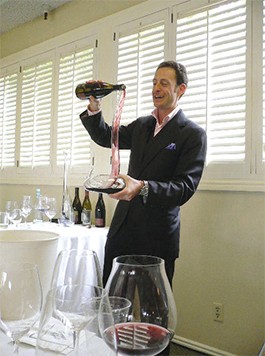
Wine potentate Robert Parker Jr. once said of Riedel stemware: “The effect of these glasses on fine wine is profound.” For 11 generations, the Riedel family has dealt in glass, and in the 20th century, that expertise translated into goblets so deftly designed that the prototype ended up in the Museum of Modern Art. Last month Maximilian Riedel, who heads up the family’s New York office, explained to a crowd of California restaurateurs and winemakers how his glassware enhances the expression of fine wines. He was convincing.

First off, let’s clarify. Riedel makes over 300 different kinds of stemware–glasses to suit specific beverages and wine varietals, hand-blown lead crystal glasses and lead-free, machine-crafted glassware for tasting rooms and restaurants. Glasses, as the whippet-thin Herr Riedel explains, “translate the message of the wine.”

We began with a sharply tapered beauty “designed in response to more dense and concentrated wines.”In this case, a Sauvignon Blanc. Next to it, a lavish goblet with the Burgundian inward pinch about one-half inch from the top was designed specifically for Pinots, and another, with a short stem and tall flowing balloon, was “developed between 1993 and 1995,”Riedel explained, “after tastings in every major Syrah growing region. The winemakers contributed their views, and we came up with this.”He brandished the delicate glass filled with a 2004 Michaud Syrah from Chalone, exuding roses and black pepper.

“Glass has a great impact on the wine,”he intoned, spitting expertly into a nearby bucket. “If we taste wine in different glasses, the perception is going to be different.”And it was. Swirl, look, sniff. We learned about the four taste zones on the palate: sweet, sour, salty, bitter. We were urged to note mouth feel and umami as the angular Sauvignon Blanc glass channeled the wine straight to the tip of our tongue. That way, we first taste the herbal notes, not the wine’s high acidity. Noting the silkiness and aromatic nuance, I swallowed. Sure enough, there was a Granny Smith apple finish. “This is a very good food wine,”he beamed.

The ample curves of the Syrah glass, on the other hand, coaxed the flow of wine to the mid-palate, where the silky mouth feel and sensuous fruit was foregrounded, with tannins following. To make his point–and this was done with each of four different wines–Riedel had us pour wine from his glassware into a thick-rimmed, generic restaurant goblet. The results? “No aroma, very acidic and short aftertaste,”he said, reading our minds. We poured the wine back into the Riedel glass and–voilà! –the complexity returned.

Riedel glassware in each case enhanced the wines–an added value for tasting rooms and restaurants–and for consumers willing to pay from $10 to $50 for something that can always be broken. 


Quick dining snapshots by Bohemian staffers.

Winery news and reviews.

Food-related comings and goings, openings and closings, and other essays for those who love the kitchen and what it produces.

Recipes for food that you can actually make.

Bennett Lane Winery

0

The old trope “beer-drinking NASCAR fans vs. Chardonnay-sipping highbrows” may have lost the lead it once enjoyed, but hasn’t entirely run out of gas. Ours is a nation that reads politics into the provenance of condiments, and supposedly holds sacrosanct the union of cheap beer and high-performance motor sports. Yet a 2007 Nielson survey found that although NASCAR fans ranked last in household wine purchases, their spending was up 22 percent. Increasingly, the question may not be blue or red, but red or white.

When NASCAR comes to wine country, wine clearly has the home advantage. My preference in racing is for both cold beer and kiosks conveniently at hand where I can place a wager on a horse with a funny name. So when I set out to investigate the state of the grape at the Bennett Lane 200 (at the invitation of the winery’s media relations partners), I brought along my father. While he does not closely follow NASCAR–and is a wine convert who has actually owned three French-built automobiles throughout the years–Dad is a longtime car-racing enthusiast who used to bring me to Sears Point (as the track was called when places were named for history and geography) decades ago when little but wind-swept, scrubby hills surrounded the track.

Things have changed–there’s even a Pinot Noir vineyard growing amid all the buildings, tents and permanent bleachers set into terraces on the popular turns. From a vantage point on Turn 2 we leaned into the fence as Bennett Lane’s own car, emblazoned with grapes, spun around the rubber-slicked curve. Founded in 2003 by ad exec Randy Lynch, the winery sponsors a race annually and hosts the wine garden where its wines are available by the glass.

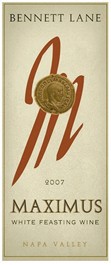
An infamous Roman emperor who appreciated his vino as much as a good chariot race inspired the 2007 White Maximus ($28). Mostly Sauvignon Blanc with Chardonnay and Muscat, the wet honeysuckle aromas and tropical, papaya flavors were fine with a cool day or a hot day in the sun–both of which this Carneros location offered. A plume of heavy toast roared out of the 2005 Maximus ($35) “red feasting wine,” and sweet black cherry and brambleberry zipped past moderate tannin, leaving me ready for the grill: this is your ribs, burger, roast head of boar wine. Dad certainly enjoyed it. After the first 20 laps, he had drained the glass; the next time I looked, he grasped an already half empty second.

Meanwhile, I also fell under the spell of the caterwauling stock cars as they passed time and again. Bennett Lane’s #2 put in a good effort, but finished toward the rear of the pack with a crumpled hood, its grapes slightly crushed. As we trekked back to the car, I saw crumpled cans of beer littered about, and in the parking lot was a minor obstacle course, none of them wine bottles. Could be that those Chardonnay sippers were just more predictably concerned about the environment . . . or, in the transformation of “beer drinkers to wine drinkers one race at a time,” as Lynch aspires to, there are a few laps to go.

Bennett Lane Winery, 3340 Hwy. 128, Calistoga. 707.942.6684. Infineon Raceway, 29355 Arnold Drive, Sonoma. www.infineonraceway.com.


View All

Live Review: Keyshia Cole and The-Dream at the Paramount Theatre, Oakland

0

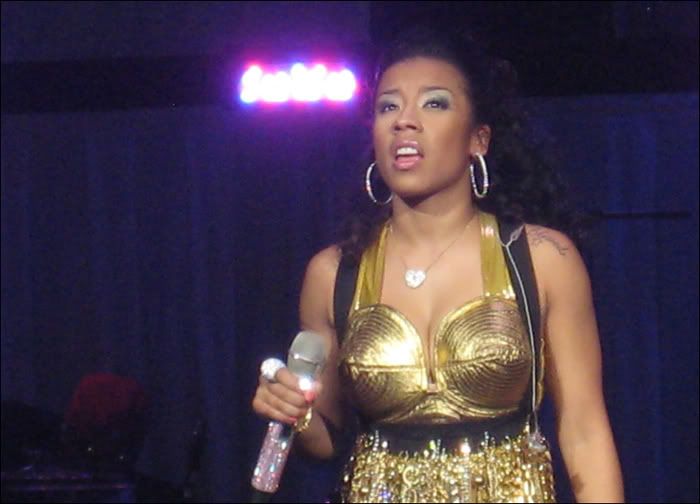
Everything was rolling along nice and fine during Keyshia Cole’s show at the Paramount Theater in Oakland Sunday night when halfway though the set, to join Cole on “Let it Go,” who should grab a mic and emerge from the wings but… Lil’ Kim!
If the City of Oakland ever needs a fairly dependable—and loud—way to reenact the 1989 Loma Prieta earthquake, it should just let Lil’ Kim walk out onto the stage. The 3,000-seat theater went absolutely apeshit. Walls rattled. Fans rushed the aisles. For sixty seconds, it was uncontrolled mayhem, as if an violent act of nature was running its course. Then, with the song over, with a quick hug to Cole and a wave to the crowd, she was gone. Shit calmed down again.

Cole never quite had the crowd in her hands the way Lil’ Kim did, although not for lack of trying. Her nonstop choreography, her three wardrobe changes, her elaborate sets and gymnastic vocals all added up to an impressive display of hard work. But hard work alone is just that, and the sweat and energy Cole expels doesn’t cover up the fact that she’s touring on her weakest album yet. If Cole can get back to having classic material like “Love” and “I Should Have Cheated,” and if she can make performing those songs seem natural and effortless, she’ll be able to achieve her stated dream of headlining arenas instead of opening them—as she did the first two times I saw her, on tours with both R. Kelly and Lil’ Wayne. She’s got more talent than almost any other singer in R&B right now. She should have material to match.
After Lil’ Kim shook things up, a surprise guest visit by Too Short on “Didn’t I Tell You” was a welcome aftershock , and at the end of the set Cole took a few minutes to stop the music and thank her friends, family and fans in her old hometown for their support. She shouted out neighborhoods: “We got Murder Dubs in the house? You know I’m from Oakland when I say somethin’ like that.” It was a genuine moment, made more so at the end of a razzmatazz-filled spectacle. Then some dude took the mic and got the address of the afterparty wrong.

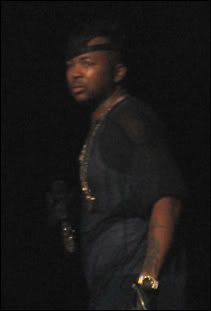
The-Dream is one of the greatest songwriters of the new century, and I’ve written about him a few times now. His records are brilliant in the way that early Prince records are brilliant (one of these days he will have his Purple Rain), and The-Dream’s hits for other people—“Single Ladies,” “Umbrella,” “Touch My Body”—need no introduction. But could he pull it off live, I wondered? Such is the post-ProTools landscape. I didn’t even know if the guy could sing on key.
Color me faithless. The-Dream was incredible live. Yes, he sang on key. More than that, he was simply electrifying to watch. He, too, talked openly to the crowd. Introducing “Falsetto,” a song about the noises one makes in bed, he instructed fans that “if y’all are sitting down for this song, then you’re getting’ old and you don’t know how to fuck.”
The night before the show, I drew up a set of dream Dream songs. My friend balked at “Purple Kisses,” and I felt redeemed that it was played. “Love vs. Money” also matched my expectations by being accompanied by guns fired in time to the intro’s gunshot sounds—a trick I’ve always wanted other bands to do—but died on the vine in the second verse after backup dancers interpreted a clock ticking down. Also: the first verse and the first verse only of “Sweat it Out,” rendered acapella.
The-Dream knows his hits. He interpolated both Michael Jackson’s “Dirty Diana” at the end of “Nikki” and the Force M.D.s “Tender Love” at the end of “My Love.” He took his hat and glasses off and looked more like a completely different person than any other singer I know who takes their hat and glasses off. He swore often when talking about record executives choosing the wrong singles and his enthusiasm for the crowd’s support. His last song was “I Luv Your Girl,” and bearing witness to a theater of thousands of people singing its key line louder than any other line of the night was nothing short of incredible.

More Photos Below.

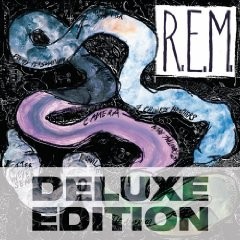
New Release: R.E.M. – Reckoning: Deluxe Edition

0

As expected, the second installment in R.E.M.’s latest 2CD reissue campaign, 1984’s Reckoning, isn’t as revelatory as its predecessor, Murmur. While their classic debut’s remaster job unveiled a wealth of recording oddities – cigarette lighter flicks and billiard ball crashes – their sophomore effort was inherently more straightforward. Meant to replicate the Athens, Ga. quartet’s live sound, Reckoning is comprised of kinetic rockers, with even the lone ballad “Camera” bristling with communal energy. This relegates the remastering to the usual, less exciting results: a louder mix with clearer distinction amongst instruments (especially drummer Bill Berry’s frantic hi-hat).

While not all albums are headphone classics, Reckoning still holds up as a brilliant & playful album from start to finish. From the rocking’ abandon of “Second Guessing” to the country rock of “(Don’t Go Back to) Rockville” to the sweet melancholy of “So. Central Rain”, R.E.M. perfected their jangle pop through nuanced, more sophisticated melodies and richer, more narrative imagery. Reckoning is the zenith of singer Michael Stipe’s and guitarist Peter Buck’s self-taught innovations in their respective crafts. “Harborcoat” alone shows the breadth of Buck’s potent inventiveness, and the gorgeous, unnamed album coda (available on CD for the first time) confirms that Stipe’s impressionistic vocals could at one time transcend the utility of lyrics.

Unlike the Murmur reissue’s live disc, which juxtaposed the densely textured record perfectly, the bonus CD merely presents an average gig from the era, while giving insight into the beginnings of fans’ cult-like devotion. “This song is for the guy that broke his leg coming in tonight, and went to the hospital and came back,” Stipe tells Chicago’s Aragon Ballroom before a rendition of “7 Chinese Brothers” where he abandons the lyrics halfway through. It’s easy to see why college kids loved them back them: endless pop hooks and enough post-punk spirit to open a large headlining show with a Velvet Underground cover (a countrified “Femme Fatale”) before getting their “big hit” over with (a delightfully sloppy “Radio Free Europe”).

The embryonic versions of later gems (a nearly ripe “Driver 8”) provide an accurate account of the R.E.M.’s early writing process, but they pale next to the thought of the era’s oft-mythologized studio experimentation (especially for such an already-heavily-bootlegged group). Where are all the rugged demos and bizarre outtakes? Will the fabled “thrash” version of “Rockville” ever see the light of day? Hopefully, Universal will actually mine the vaults for next chapter, the murky, contentious Fables of the Reconstruction, on which they start significantly tinkering with the formula. In the meantime, Reckoning Disc 1 is still essential listening, if only to quarry why Stephen Malkmus hatesTime After Time” so much.–David Sason

Linkmania!

0

What to look at now.ArtBabble

Video interviews and small short features on the fine arts, featuring everyone from collectors like Indianapolis sweeties Dorothy and Hubert Vogel to such art stars as Brice Marden.C-Monster

In which a smart, anonymous hipster with an acute eye travels to Peru to visit family, eats memorable meals everywhere, makes it to the Venice Biennale and has appropriate disdain for Damian Hirst.Artworld Salon

Edited by András Szántó from New York, Marc Spiegler, the founder of Wired magazine, from Beijing and Ian Charles Stewart, the curator of Art Basel from Switzerland, this highly curated magazine will accept comments only from those over-the-transom writers whom they feel are worthy. Speaking to a group of international arts journalists today, Szántó had no problem shrugging. As for everyone else, well, tough luck. Good luck for readers.

Tony Hawk Skates at White House; Go Skateboarding Day June 21

0

When I was a kid, my parents must have told me 1,000 times to not skate in the house. Today, 20 years later, President Obama invited Tony Hawk to the White House. Of course, what’s the first thing Tony did?

First black president? That’s old news. First person to skate down the White House grand foyer: Tony Hawk. Times are changing, folks.

This Sunday, June 21, is Go Skateboarding Day, a well-placed worldwide holiday that corresponds to the finishing round of professional golf’s U.S. Open. Dad gets to watch Phil Mickelson, the kids get to build a launch ramp, Mom goes to see The Proposal and everyone’s happy on Father’s Day.

Locally, Revolution Skateboard Shop in Santa Rosa is having a free barbeque and local skate contest with free food, drinks, and an obstacle course set up in the parking lot. It starts around noon; food is first come, first serve. 1240 Mendocino Ave., Santa Rosa. 707.546.0660.

Revolution proprietor Jon Lohne, who’s also an experienced cinematographer, was on hand at the Harmony Festival’s MegaRamp Eco-Cup this past weekend, shooting footage of Omar Hassan, Pierre-Luc Gagnon, Bob Burnquist, Andy MacDonald, Lincoln Ueda and more. I interviewed Christian Hosoi and Steve Caballero about the MegaRamp concept before the contest, and although Hosoi had to drop out at the last minute, Cab brought along his old Bones Brigade pal Lance Mountain as guest judge.

The stuff these guys were pulling off 30 feet in the air is just insane. Lohne’s slow-motion footage below of the Best Trick Contest captures every millisecond of suspense, every impulsive mid-air decision, and every moment of what seems like total gravity loss. Check it out:

Eco Cup Best Trick. from jon lohne on Vimeo.

Fabric Museum and Workshop in Philadelphia

0

[Note: I am currently on a NEA fellowship with the Visual Arts Journalism Institute, which brings 12 U.S. and 12 international journalists together for a two-week intensive at American University in D.C. This is the second assignment.]Several ThreadsFour from Philly take to the walls at the Fabric Workshop and Museum

By Gretchen Giles

Talk about your fish out of water! OK, not a fish but neither a mammal, Mocha Dick, Tristin Lowe’s 52-foot whale at Philadelphia’s Fabric Workshop and Museum is a sculptural dynamo that fills a full third of the FWM’s eighth floor gallery with the irresistible pulse of its presence. Prompted by Herman Melville’s epic comic novel Moby Dick—itself prompted by apocryphal tales of the killer albino whale said to have terrorized 19th century whalers in the South Pacific Ocean with an eerily human intent—Mocha Dick is a harmless, even benign being stuck far away from the ocean and placed high above city streets.

Made of white industrial wool felt and animated with a tight bladder that inflates during the day with a noisy fan, Mocha Dick is vulnerable to all exploration, and that is one of its many delights. Working with FWM staff, Lowe directed the museum’s seamstresses to mark the body with divets and scars, barnacles and the other random abrasions that come from a long life in the sea. The animal’s eyes are appropriately anthropomorphic, the viewer guiltily stopped by their sad silent stare before moving on (we, after all, are alive and it is not! sings the relieved cheer). Cleverly, the sculpture’s “skin” zips off the internal bladder, allowing the piece to be easily shipped in an ordinary crate, the zipper lines themselves adding structure to the whale’s fully tamed self.

Curious to a new visitor, Lowe’s massive woolen piece is only one of two installations in the FWM’s new exhibit to actually use fabric in its execution. Founded in 1977, the FWM has excitingly elasticized its mandate from the early post-macramé days to encompass work done in all media, some with nary a thread in sight. The FWM also seems to have tapped into some uncanny fount of funding that allows it to richly experiment. Sometimes, as with Mocha Dick, that money is delightfully spent; at other times, as with Pete Rose’s work, it is merely lavishly expended.

Letters to the Editor

06.24.09 More tribal power grabsThe Robinson Rancheria Tribal Council were all voted out during their last election, and they disenrolled the tribal member who won the Tribal Chairman position ("Inner Circle Outcasts," June 10). The current council will not recognize the last election, like the Iranian government. What's the difference?I am a member there but work for a different tribe....

VOICES Carry

06.24.09 Safety Net: Foster kids who turn 18 suddenly lose support services--a situation the expanding VOICES program remedies with youth-on-youth help. Most kids look forward to their 18th birthday, when they finally, legally, become adults. But for foster kids, it can be a nightmare. At the stroke of midnight, they are abruptly no longer eligible for youth-based home and support systems...

Up Cycle

06.24.09The other morning on the way to work, my bike and I got four smiles per mile. My commute is about six and a half miles, so that's 26 smiles total, not to mention all the waves and "good mornings." That lovely human interaction is one of the many reasons why I faithfully ride my bicycle to work every...

The Riedel Advantage

06.24.09Wine potentate Robert Parker Jr. once said of Riedel stemware: "The effect of these glasses on fine wine is profound." For 11 generations, the Riedel family has dealt in glass, and in the 20th century, that expertise translated into goblets so deftly designed that the prototype ended up in the Museum of Modern Art. Last month Maximilian Riedel, who...

Live Review: Keyshia Cole and The-Dream at the Paramount Theatre, Oakland

Everything was rolling along nice and fine during Keyshia Cole’s show at the Paramount Theater in Oakland Sunday night when halfway though the set, to join Cole on “Let it Go,” who should grab a mic and emerge from the wings but... Lil’ Kim! If the City of Oakland ever needs a fairly dependable—and loud—way to reenact the 1989 Loma...

New Release: R.E.M. – Reckoning: Deluxe Edition

As expected, the second installment in R.E.M.’s latest 2CD reissue campaign, 1984’s Reckoning, isn’t as revelatory as its predecessor, Murmur. While their classic debut’s remaster job unveiled a wealth of recording oddities – cigarette lighter flicks and billiard ball crashes – their sophomore effort was inherently more straightforward. Meant to replicate the Athens, Ga. quartet’s live sound, Reckoning is...

Linkmania!

What to look at now.ArtBabbleVideo interviews and small short features on the fine arts, featuring everyone from collectors like Indianapolis sweeties Dorothy and Hubert Vogel to such art stars as Brice Marden.C-Monster In which a smart, anonymous hipster with an acute eye travels to Peru to visit family, eats memorable meals everywhere, makes it to the Venice Biennale...

Tony Hawk Skates at White House; Go Skateboarding Day June 21

When I was a kid, my parents must have told me 1,000 times to not skate in the house. Today, 20 years later, President Obama invited Tony Hawk to the White House. Of course, what's the first thing Tony did?First black president? That's old news. First person to skate down the White House grand foyer: Tony Hawk. Times are...

Fabric Museum and Workshop in Philadelphia

Several ThreadsFour from Philly take to the walls at the Fabric Workshop and MuseumBy Gretchen GilesTalk about your fish out of water! OK, not a fish but neither a mammal, Mocha Dick, Tristin Lowe’s 52-foot whale at Philadelphia’s Fabric Workshop and Museum is a sculptural dynamo that fills a full third of the FWM’s eighth floor gallery with the...
11,084FansLike
4,446FollowersFollow
6,928FollowersFollow