NEW ANTHOLOGY FROM THE WRITE ON MAMAS
by Leilani Clark
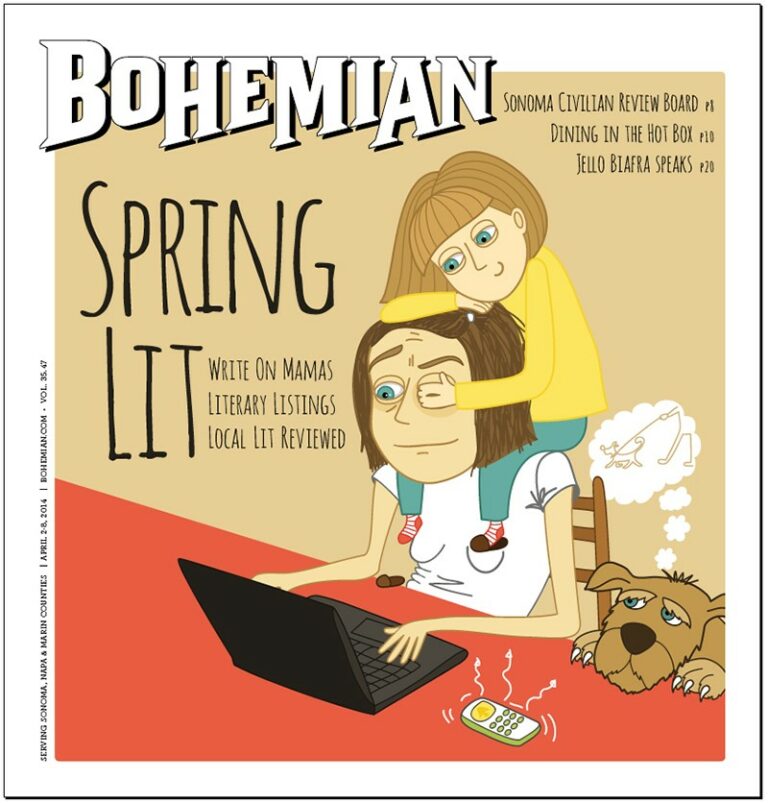
The first ninety minutes of the Write On Mamas’ monthly meeting are virtually silent. No writing prompts. No casual talk about the latest, greatest novels. The only sounds in the room are fingers clacking across computer keyboards and pens scratching away on notepads.
“It’s a precious 90 minutes,” says Write On Mamas founding member Janine Kovac, by phone from her home in Oakland. A mother of three, including four-year-old twins born months premature, Kovac understands the need caregivers and providers have to get away from the daily grind and write.
“The goal is to provide fertile soil for parents who are also writers,” says Kovac. “That comes in the form of the meeting that starts with time to write, speakers, our online community that exchanges writing opportunities, submission opportunities, writing residencies. We also break into small groups to give each feedback on a piece or a grant or proposal.”
The group also works to enhance visibility for its 55 members. The Write On Mamas host an evening of readings at LitQuake, the hip and popular literary festival that takes over San Francisco each October. And this month the group releases its first book through its publishing arm, Bittersweet Press.
Mamas Write, an anthology of essays centered on the theme “Why I Write,” was edited by Kovac, Joanne Hartman and Mary Hill, and takes the reader on a moving journey through what it’s like to be a parent who writes and a writer who parents. Launch parties are scheduled for April 27 at Napa Bookmine in Napa and May 4 at Book Passage in Corte Madera.
The collection offers a mix of humor and pathos. Lorrie Goldin’s “From Conception to Empty Nest” finds a funny and clever comparison between the development of a writing life and the development of a child, and in “Not Afraid of Words,” Steven Friedman (Write On Mamas is an inclusive group) writes about his need to document the story of his wife Verna’s diagnosis of breast cancer. She died in 2010.
The anthology also has a fair share of pathos, including “There Was a Before,” a devastating piece by Teri Stevens about the pre-term birth of her son at 24 weeks. A former marketing director at the Napa Valley Opera house, Stevens lives in Napa and is now a mother of three. (The piece, excerpted in full, follows.)
The anthology has been in the works for more than two years. The process was more challenging than first anticipated, since it was decided early on to include quality prose from everyone “who turned their submissions in on time,” says Kovac.
Most contributors signed up for a 10-week online workshop with Kate Hopper, a Minneapolis-based teacher and author who encourages honest writing about what it’s like to be a mom—while combating myths about motherhood that refuse to die. Hopper helped the writers shape their essays, since, as Kovac says, the group tended to be “too nice” to each other. Self-published books can sometimes come across as amateurish, but Mamas Write is polished and profound, and many of the pieces would be comfortable in the pages of established literary journals.
“A lot of writing about motherhood is still considered ‘mommy memoir’ or ‘mommy blogging’ and isn’t seen as serious memoir,” says Kovac. “Even the word ‘mother’ is so loaded. There are some in publishing that are just like, ‘We don’t want motherhood stories.'”
Kovac adds that whatever literary space there is for moms tends to be taken up by well-known writers like Anne Lamott and Ayelet Waldeman. The stigma has led to an ongoing conversation among the Write On Mamas about whether or not “Mamas” should stay in the name.
The answer is always a resounding yes, says Kovac.
“Isn’t this how we take it back?” asks Kovac. “We’re writing, and we take it seriously; we’re parents, and we take it seriously.”
[page]
Book Excerpt: There Was A Before
By Teri Stevens
(excerpted from Mamas Write, with permission from the Write On Mamas)
I am reminded of it every time my three children and I go to the library to “buy” books. The Treadway and Wigger Funeral Chapel is across the street and a few doors down. The kids don’t even know it’s there. But I do. I was there once before—before we were blessed with a beautiful, healthy, happy son whom we adopted from Guatemala and brought home when he was just six months old, and before we were doubly blessed with twins who were carried to term by my sister because my breast cancer meant that I could not.
In other words, before our lives came to appear idyllic to those on the outside looking in, there was great sorrow.
I remember being in pain. This was nine years ago. It was a Thursday. I had been in pain for four days. I had gone to the doctor that Monday, but he couldn’t find anything wrong and said that the pain I was experiencing was most likely due to fibroids. Since I was in my 24th week of pregnancy, six months along, he advised me to take Tylenol. I didn’t. I remember thinking that the pain could be caused by Braxton Hicks contractions, about which I had recently read.
At the time, I was the marketing director for the Napa Valley Opera House. Continually on the computer writing press releases, answering emails or putting together one of the many marketing collateral pieces the job required, I would grasp the arm of my chair whenever I felt pain coming on.
My husband, Bill, was out of town on business for the week. Since I was feeling so awful, I decided to go to bed early that Thursday night, thinking the pain would subside if I just lay down. It didn’t. I called my doctor at about 9:30pm.
“It’s Teri Stevens,” I said into the phone. “I’m in a lot of pain.” I let him know what had been happening since Monday’s office visit—the grasping of the chair, the bending over in pain every now and then when I walked.
“Well, if you think it can wait, I can see you in the morning.” He sounded tired. “Or you can go to the emergency room at the Queen, it’s your decision.”
I said I’d see him in the morning and hung up. I lay in bed grimacing and thought, I’m going to get premature wrinkles if this continues. I got up to use the restroom, but once there my body felt like pushing, not like urinating. Not a good sign.
“Don’t worry little one,” I said to him or her, “it will be OK.” We had chosen not to find out the sex until the birth, but then for some reason the thought “I’m going to name you Jeffrey” crossed my mind. “Don’t worry, Jeffrey, it’s going to be fine. You stay in there,” I coaxed. Maybe by talking, I was trying to calm myself, tell myself it was going to be OK.
I knew I had to go to the emergency room, but didn’t think I should drive myself, even though it was only two miles away. I called 911 and asked them not to use sirens; I didn’t want to wake the neighbors. I was struggling to put on my shoes when the doorbell rang. The fire department arrived first, in a quiet truck, red light flashing a bright circle of alarm in the dark. At the door, a fireman helped me put on my second shoe and then the two men picked me up and carried me down the few small steps to the driveway and put me on a waiting gurney. The ambulance had arrived. I remember tossing my keys at one of the firemen, asking him to lock the front door. There was a light spring rain. It was Feb. 18, 2005.
I don’t recall the ambulance ride, but I do remember the bright light of the stark white hospital room they wheeled me into. Someone removed my glasses. I wasn’t there for more than a few minutes when I gave birth to our son. I remember pushing myself up on my elbows in an attempt to see what was happening.
“Is he OK, is he breathing?” I asked the doctor and nurse who were moving quickly, talking together in hushed tones, their medical jargon going over my head. Without my glasses, the room was a blur, and all I saw clearly was the look on the face of the ambulance paramedic who turned away from what was happening at the end of the gurney.
“Yes, he’s breathing,” someone said, but then he was whisked away to the intensive care unit. I didn’t get to see him. A nurse was cleaning me up from the birth, which had happened so fast that I was simply numb. At the time, the thought didn’t cross my mind, though it has many times since: what if I didn’t call 911? I would have had Jeffrey at home, by myself, the outcome of his life in my hands. It would have been the same, but it would have been my fault.
My doctor arrived. Someone had called him. “I am sorry, Teri,” he said quietly. “Your son did not make it; his small lungs were not developed enough. Just one more week, and it could have turned out differently.” I didn’t say anything, just cried. I felt deflated, all the hope I had that it would be OK, gone. I remember thinking that just days before I had read in What to Expect When You’re Expecting that babies born after 24 weeks can and do survive. So how could this be? For whatever reason, the pediatrician on call made the decision not to step in and try to save his young life.
I didn’t want to call my husband, sleeping in a San Diego hotel room, with this life-altering news; I wanted him to sleep. I told the hospital staff that I would wait until morning. Ultimately, the doctor came in with a phone and gently prompted me to call.
[page]
“Hi, I’m sorry, I know it’s the middle of the night. I’m at the hospital, something terrible happened. The baby was born early. It was a boy, and he didn’t make it.”
Shock on the other end of the line. “What? How?”
I looked around the hospital room, unable to believe I was having this conversation.
“I was in pain,” I explained through my tears, “I called 911, and I wasn’t in the emergency room for more than a few minutes and I gave birth.” Bill told me he was so sorry and that he would be home as soon as possible and asked to talk to the doctor. I don’t remember what was said. Thankfully, I fell asleep, escaping the reality of what happened for a short time.
I remember the nurses telling me what a beautiful baby he was, that his hair was blonde, like mine. It didn’t look like that when the nurses brought him in to me, since his head had been bruised from the quick delivery; I thought his hair was dark, like his father’s.
Later, while lying alone in the hospital room, I heard a knock on the door, and an older woman who was some sort of grief counselor came into the room. She sat at the side of the bed and told me she was sorry for my loss.
“Don’t lose hope, it will get better,” she said fiercely, as if her tone had the ability to make me believe. “Spring always brings new life after winter.” Usually a polite person, I turned away from her attempt to comfort me and asked to be left alone.
And then Bill was there, crying with me and holding my hand, sorry that he had been away. Before coming to my room, he had met and held our son. What he thought in those moments, I’ll never know. I told Bill I named him Jeffrey, after my cousin who had passed when we were children.
Before I was discharged, I asked to see Jeffrey again. Bill thought it might not be a good idea, but I was adamant. I had experienced so many emotions in such a short time: fear that I would give birth, heartbreak that I did too soon, guilt that it was my fault, loss of the child I would never know. I realized I should have been spending time with the one I would never see again. He was so tiny, dressed in baby blue, lying in a small basket. I kissed his cool forehead. So did Bill. Our goodbyes.
In the dark months after Jeffrey passed, I never thought I would have a family. These thoughts were compounded when we did get pregnant a few months later, only to lose the pregnancy due to complications. And then I was diagnosed with breast cancer. My whole being was saturated in grief. I am grateful that ultimately I was determined to create a family, and had the support of a loving husband who was open and willing to pursue other options.
Today, I feel that somehow, even though he is gone, Jeffrey was looking out for us. Two years and one day after Jeffrey’s due date, our adopted son, Alex, was born. And then three years and one day after Jeffrey was born and passed, his sisters, Emerson and Mikayla, were born. Which means, strangely enough, that right now I have three children who are all six years old.
I watch their heads bob up and down as they peruse the children’s library DVD section. I think about Jeffrey and wonder how different my life would be had he survived. Certainly it would be full and rich. But it would be different.
Jeffrey is not here in the physical sense, but through writing about him and the family that resulted from his presence, I am able to make some sense as to why he isn’t here, and to keep the memory of my son Jeffrey Thaddeus Stevens alive.
There was a before. But now there is also an amazing and full after.
[page]
LOCAL LIT ROUNDUP
‘The Aftermath of Forever: How I Loved and Lost and Found Myself—The Mixtape Diaries’ Summing-up a book of 10 break-ups in a couple paragraphs is akin to summing up 10 break-ups in a 155-page book. But for anyone who’s ever suffered a chest-imploding break-up, the kind that leaves you on the floor in a puddle of tears, whiskey and absolute despair, The Aftermath of Forever ($12.95; Microcosm Publishing), is a good place to start the healing process.
After getting married at age 21, and subsequently divorced a few years later, North Bay native Natalye Childress documents her journey of self-discovery through her eventual marriage to (this time) the right man. The resulting essays in this collection are accompanied by a mix-tape to describe the experience. The songs lean in the direction of indie-rock and feature Sonoma County standouts the Velvet Teen and the New Trust.
The reader is not spared the juicy details of Childress’ Bay Area romances, which lend a voyeuristic feel to Aftermath—similar to a relationship she describes in one of the book’s essays. This is a naughty, logical and well-written collection with a built-in appeal to men and women in their 20s and 30s.—Nicolas Grizzle
‘Dendrophilia and Other Social Taboos: True Stories’ Bohemian contributor Dani Burlison has released a book of essays written over four years for other publications. Burlison’s readers have been clamoring for a collection of her work in one artfully designed package for a while, and those who haven’t yet experienced the snark, the wit, the perfectly placed profanity of her writing should prepare for an afternoon of fun and empathetic schadenfreude.
Largely comprising pieces from Burlison’s McSweeney’s column of the same name, Dendrophilia ($12.95; Petals and Bones) is the perfect waiting-room time killer, especially if you’d like to be thinking about something other than what you’re waiting for. Essays include “It’s not Cannibalism If Nobody Died,” “I’m Dreaming of an Anne Frank Christmas” and “One Settled Comfortably in the Cukoo’s Nest,” and those are just the catchiest titles. The pieces themselves are entertaining and thought-provoking—even when those thoughts are “What’s a cuddle party?” or “Where can I get adult-sized footie pajamas?” And just this week, Burlison was contacted about optioning it for a television series (which would be perfect for this set of stories).—Nicolas Grizzle
‘Another Way of Seeing: Essays on Transforming Law, Politics and Culture’ Peter Gabel is president of the Arlene Francis Center for Spirit, Art and Politics in Santa Rosa, and an editor-at-large at Tikkun, the journal of progressive Jewish thought. Gabel has put together a collection of essays, Another Way of Seeing (Quid Pro Books; $23.99) drawn from Tikkun and elsewhere that highlight his interest in what he describes as the “spiritual dimension of social life—from the desire for things to the desire for love, community, solidarity and connection with others.”
Gabel sets out to infuse critical discourse on law and politics with his “spiritual-political way of seeing,” and he engages that rubric in essays that, by turn, take on the Supreme Court’s ruling for George Bush in Bush v. Gore (“by going so far beyond the legitimate limits of constitutional interpretation, the court made transparent what is usually mystified”), to the dust-up over then-candidate Barack Obama’s apparent failure to wear an American flag lapel pin during a presidential debate.
The flag-pin “controversy” was seized upon by the Washington commentariat, left to right, as some kind of a telegraphed signal from Obama about his patriotism and lack thereof. Gabel’s got another way of seeing it: “I like the way Obama sometimes wears the flag pin and sometimes does not,” he writes, “showing respect for the cultural achievements of the historical community that he seeks to represent while resisting any fixed and robotic deference to a false image of community that traps all of us in a painful spiritual isolation.”
That really does sound quite painful.—Tom Gogola
‘World of Change’ “Forget your own problems, here’s what poets think is wrong with the world today.” That’s the idea behind World of Change ($20; New Way Media), a new poetry anthology edited by David Madgalene, who brings the best of the North Bay together in one letter-sized book. Contributions come from several Sonoma County poet laureates—and from several others who write about why they wrote their poem for Madgalene’s latest compilation.
Topics include social injustice, murderous climate change, money, for-profit organ harvesting and Jack Kerouac. Compared to Madgalene’s own stream-of-consciousness style, the pieces here are more traditional free verse poems, and each has a distinctive voice.
Some pages are reminiscent of John Cage’s collection of lectures and writings, Silence, at least in appearance. Care is taken to preserve the line breaks determined by the poets, and other formatting details are honored, such as a memorial to Andy Lopez in the shape of a cross made of asterisks and names of the slain 13-year-old’s family, a poignant example of concrete poetry.
An overarching feeling of doom and gloom pervades the book, but that’s to be expected in any poetry collection dealing with society’s problems. Are we ever going to fix any of these things? We await Madgalene’s next anthology for an answer.—Nicolas Grizzle
[page]
LITERARY EVENTS AND READINGS
by Charlie Swanson
Mark Twain once wrote, “To get the right word in the right place is a rare achievement.” We couldn’t agree more. And over the next few months, a host of authors from near and far are scheduled to share their rare achievements at readings throughout the North Bay. Here’s your chance to get right with their words.
Primate ambassador Jane Goodall appears at an already sold-out event at Angelico Hall in San Rafael on April 4. Goodall’s latest, Seeds of Hope, carries with it an enthusiasm and passion that’s perfect for launching an ambitious season of readings such as this.
On April 10, Napa Valley College writing professor Iris Jamahl Dunkle shares the poetry of Gold Passage, her new award-winning collection, at Copperfield’s Books in Santa Rosa. The next day, Bay Area poet Gail King reads from her new book, Hello Life, at the Occidental Center for the Arts. The week also includes two appearances from Sisterhood of the Traveling Pants author Ann Brashares, who reads from her latest, The Here and Now, at Book Passage on April 10, and at the Tudor Rose English Tea Room on April 12.
No time to take a breath yet, because Sonoma County poet laureate Katherine Hastings reads on April 17 from her works Nighthawks and Cloud Fire at Copperfield’s in Santa Rosa. The 17th also sees Pixar production vice president Jim Morris in conversation with author Ed Catmull, who presents his upcoming book, Creativity, Inc., at Book Passage. The next night, April 18, former U.S. poet laureate Billy Collins reads from his new poetry collection Aimless Love, with singer-songwriter Aimee Mann accompanying on acoustic guitar, at the Wells Fargo Center for the Arts.
Book Passage throws down with three popular events running back-to-back-to-back. On April 21, photographer Andrew Knapp shares his adventures with his border collie in Find Momo. On April 22, actress and new mom Alicia Silverstone (Clueless, Batman & Robin) talks about her parenting guide The Kind Mama. Then, on April 23, Under the Tuscan Sun author Frances Mayes reads from her memoir Under Magnolia. She hosts a dining event at Spinster Sisters restaurant in Santa Rosa on April 24.
And there’s more in store in the coming months, as heavyweights from various fields come to the North Bay to promote their literary offerings. New Yorker cartoon editor Bob Mankoff reads from How About Never—Is Never Good for You? on May 1 (Book Passage). Sen. Elizabeth Warren reads from her new book, A Fighting Chance, on May 10 (Angelico Hall). Gourmet magazine editor Ruth Reichl reads from her novel Delicious! on May 20 (Book Passage) and May 21 (Spinster Sisters). Cult film director John Waters (Pink Flamingoes, Crybaby) reads from his hitch-hiking memoir Carsick on June 7 (Book Passage). Finally, outlaw author Tom Robbins reads from his upcoming memoir Tibetan Peach Pie on June 7 (Book Passage) and June 8 (Copperfield’s Books in Sebastopol).
And that’s just the tip of the literary iceberg. For full listings, check our weekly Readings calendar. Get lit!