Dirt Diamonds

0

Dogs love them, hogs love them and humans love them most of all. Just saying the word “truffle” has been known to raise ordinary meals into culinary experiences, and this week the Napa Valley, the mecca of culinary wonders in the North Bay, hosts the fifth annual Napa Truffle Festival Jan. 16–19.

The Truffle Festival showcases the two top species widely considered delicacies: the black winter Périgord truffle and the summer Burgundy truffle, and the world’s top chefs and scientists will explore these multifaceted fungi. Friday starts right at the beginning with a day-long seminar on truffle cultivation, presented by the American Truffle Company’s chief scientist Paul Thomas.

The weekend brings with it two special truffle food and wine pairings. On Saturday, dine at Peju Province Winery with chef
Tony Esnault of Church & State Bistro in
Los Angeles; and on Sunday enjoy truffles at St. Supery Estate with chef Roberto Donna of Al Dente Ristorante in Washington, D.C.

On Saturday, there’s also the popular truffle orchard tour with a dog training demonstration at Robert Sinskey Vineyards and a breathtaking truffle and wine dinner at La Toque with not one but four Michelin star chefs on hand for a night of refined and exquisite tastes. Sunday allows you the chance to go into the field, literally, for wild mushroom foraging in the woods. Finally, Monday brings a truffle marketplace to Oxbow Market. Prices vary by activity. For more info, visit www.napatrufflefestival.com.

Shot Down

Director Clint Eastwood’s new film, American Sniper, has been called a neo-Western, but is that fair? When was the last Western made where all the Indians were bad Apaches?

Texan Chris Kyle, nicknamed “the Legend,” was a Navy SEAL sniper with a reported 150 kills during his four tours of duty in Iraq. In American Sniper, Eastwood envisions Kyle (Bradley Cooper) as a barrel of movie tropes: cowboy, rodeo rider, lone gunman, gruff soldier uncomfortable with womenfolk and the settled world, and uncomplicated country boy who was simply taking the advice of his father (Ben Reed): “There are three kinds of people in the world: wolves, sheep and sheepdogs.” This Pink Floyd–level reductionism passes for profundity.

From boot camp to the front line, American Sniper follows the rut of all bad war movies. Kyle goes back and forth between stateside and this undifferentiated Hajiland in which he hunts men. And of course he only shoots people who deserve it—they’re all caught red-handed.

Cooper, beefed-up and bearded-out, keeps gazing off camera like a ruminative Chuck Norris. There may have been little for Cooper to grasp in Jason Hall’s script. Kyle saw himself as a Christian soldier, carrying a Bible and a tattooed cross into the fray. Recall that George W. Bush himself had to apologize for referring to his war as a “crusade,” but let it pass.

As Kyle’s wife Taya, Sienna Miller deserves the Congressional Medal of Honor for the lines she’s forced to utter. She’s there to be the sniper’s conscience, but her insights evolve from snap-judgment to absolute whine. Finally, the primordial movie-wife threat: “I don’t think we’ll be here when you get back.”

If useful patriotic lies really make the nation stronger, Kyle’s father is sadly right and America is full of sheep. Despite the varied opinions on the war, it ought to be understood by all that American Sniper beats stiff competition to become the most bullshit biopic of the year.

‘American Sniper’ is playing in wide release.

Battling Censorship

0

On Jan. 7, 2015 Paris endured its deadliest attack in modern times. That morning, three Islamist gunmen tore through the office of satirical magazine Charlie Hebdo. This cowardly and barbaric attack was thought to be perpetrated in response to a 2011 issue that carried a caricature of the prophet Mohammad. Visual depictions of Mohammad are forbidden by Sunni Islamic teachings.

Despite the arrests of seven suspects connected to the attacks, the two brothers thought to be the gunmen, Cherif and Said Kouachi, remained at large for three days until two separate standoffs occurred on Jan. 9.

Friday, sustained gunfire followed by explosions echoed through a warehouse where the Kouachi brothers had taken a hostage. Not far away, a second confrontation was developing at a Kosher Market in eastern Paris. Another man said to be connected to the brothers threatened to kill others if there were any attempts made to capture Cherif and Said Kouachi. More died on this day, including the Kouachi brothers.

 In total, 17 people lost their lives during this stretch of chaos. On Sunday morning, an organized march, the largest in France since the end of WWII, drew a crowd of 1.6 million in the streets of Paris.

 Charlie Hebdo‘s creative professionals waged a war against censorship. Throughout history, and across the world today, censorship is used as a means of social control. Freedom of expression is an ongoing struggle.

 As opinions are shaped and shifted by those who say what’s right and wrong our choices no longer become ours. The 12 artists and professionals at Charlie Hebdo lost their lives in a fight for freedom. Let’s continue their fight by having our voices heard and by letting every decision we make be our very own.

Greyson Gibson is a Sonoma County writer. His first novel is ‘Nowhere to Go but Everywhere.’

Open Mic is a weekly feature in the ‘Bohemian.’ We welcome your contribution. To have your topical essay of 350 words considered for publication, write op*****@******an.com.

Crossing Swords

0

You’d be hard pressed to find an article—outside one written by a CrossFit enthusiast—that reviews this exercise phenomenon without asking some real tough questions about its safety, effectiveness, cost and even the philosophy behind it.

Shouldn’t all products, whether good or bad, be held up to such scrutiny? Maybe General Motors, Comcast and Apple grudgingly accept this, but CrossFit—both the corporation and its acolytes—can’t seem to take criticism in stride. And there’s been a lot of it going around lately.

The New York Times Magazine was the latest publication to take issue with CrossFit and other extreme fitness programs, likening them to nothing more than labor camps you pay a king’s ransom to join. “Why not join a roofing crew for a few hours instead? Surely there’s a tunnel somewhere that needs digging,” sniffs Times columnist Heather Havrilesky.

In response, commenters, many of them CrossFitters, swarmed the online version of the article, posting more than 800 messages. Many were sharply critical of Havrilesky’s assessment of the workout routines.

The Times article is only one in a recent wave of brickbats hurled at the sports-fitness brand, which now boasts an estimated 10,000 affiliates. Its critics are as diverse as medical researchers, fitness organizations, sportswriters and social commentators. They’ve all found a bone to pick with CrossFit, and, no, they’re not joining them for a Paleo diet dinner.

Critics and online commenters have likened CrossFit to a cult, insinuating that it’s not much more than a paramilitary, post-apocalyptic wet dream. They’re fitness preppers ready to take on whatever catastrophe awaits mankind.

CrossFit’s own website hints at this on its “What is CrossFit?” page: “We have sought to build a program that will best prepare trainees for any physical contingency—not only for the unknown, but for the unknowable.”

CrossFit’s founder, Greg Glassman, takes the rhetoric a step further in his CrossFit newsletter, stating “nature, combat and emergency can demand high volumes of work performed quickly for success or for survival.”

THE GOSPEL OF CROSSFIT

In her Times Magazine article, Havrilesky describes the austere and formidable environment of the typical CrossFit gym:

“Those stunned by CrossFit’s growing popularity are often surprised, given its high price, to discover its spartan ethos: Each ‘box’ (its lingo for gym) is often just a big empty room with medicine balls, barbells and wooden boxes stacked along the walls. Workouts rotate daily but tend to involve free weights, sprints and enough squats to cripple Charles Atlas. In keeping with its apocalyptic mission statement, the program encourages camaraderie under duress (CrossFitters coach each other through the pain) and competition (names and scores are scrawled on a wipe board and sometimes posted online).”

A former certified fitness instructor and CrossFit participant, who wished not to be identified for this article, said much of the atmosphere she witnessed seem contrived, right down to the grungy workout gear worn by instructors and long-time CrossFitters.

The CrossFit workout is like Navy SEAL physical training taken to an extreme. It’s group exercise, done in classes where the workout itself is a competition. There are typically time trials where participants strive to perform the exercises faster than their workout companions.

“The warmup is usually inadequate. It could be jogging around a little bit in the parking lot followed by a little dynamic stretching, which can cause injury by itself,” says the former fitness instructor, describing a CrossFit gym she attended.

“Good CrossFit instructors,” she said, “will assist in picking appropriate weights for members, but the competitive nature can result in amateurs pushing themselves too far.”

However, the fitness instructor said the CrossFit regimen does have some redeeming qualities. “It’s a good workout,” she says. “The competitive atmosphere makes it fun and motivating. It encourages people to push themselves, but for some it can be too much.”

AGRESSIVE DEFENSE

CrossFit does not take kindly to criticisms about its workout regimen. Recently, it sued the National Strength and Conditioning Association (NSCA) for publishing a study by Ohio State University researchers led by Steven Devor, an exercise physiology professor.

In the Journal of Strength and Conditioning Research, the Ohio State researchers said that while there were some notably positive results obtained from CrossFit exercises, it hinted that injuries could possibly be an issue.

“Of the 11 subjects who dropped out of the training program [out of 54], two cited time concerns with the remaining nine subjects (16 percent of total recruited subjects) cited overuse or injury for failing to complete the program and finish follow up testing.”

[page]

While the study was very complimentary overall (some even likened it to pure advertising), it touched a raw nerve with CrossFit, which complained that the research was “at best the result of sloppy and scientifically unreliable work, and at worst a complete fabrication.”

In response to the study, CrossFit says it sought out the research participants who said they didn’t complete it because of injury and overuse. CrossFit claims that when they contacted the participants, they denied failing to finish due to injuries. CrossFit claimed the researchers were guilty of dropping the ball in following up with them.

In its lawsuit against NSCA and the research team, CrossFit further maintains that the fitness organization, which is one of several groups that certify fitness professionals, was going after the company because it certifies its own instructors. The NSCA, it claimed in the lawsuit, had a vested interest in discrediting CrossFit.

This is a brand that seems highly motivated in protecting its reputation. Media opinion that is deemed hostile to CrossFit is often met head on, and aggressively.

The people who participate in CrossFit happily call it a “cult,” says Ryan Parker, co-owner and head coach at CrossFit NorthGate in Santa Rosa. “There are a lot of people who call CrossFit a cult when they’re on the outside looking in, and when they are on the inside looking out.”

CrossFit participants, he says, “are proud of the cult. And that speaks to the experience people have in a CrossFit gym. It’s a supportive environment of people pursuing health and fitness, and sharing the experience.”

Parker argues that the camaraderie, which can be expressed as competitiveness, “helps people to be really consistent with it over time.”

He adds that the camaraderie extends all around the country, to those thousands of affiliates. “You are welcome like family around the country. I don’t know what other kind of community has that kind of camaraderie. If that’s cultish, then count me in.”

Parker acknowledges that given an emphasis on competitiveness, the risk of injury in CrossFit is “absolutely a valid concern. In this environment, people can overextend themselves.”

But, he says, that’s why there are coaches and trainers on-hand to make sure CrossFitters don’t hurt themselves. He blames a lot of recent online depictions of CrossFit training for the misperception. Those videos, he says, emphasizes the intensity of the workout over proper form and mechanics, which is how you don’t get hurt.

In December 2013, Outside magazine published an article called “Is CrossFit Killing Us?” It cited the findings of the Ohio State University study and maintained that the competitive nature of the workouts could result in a slew of injuries, from slipped disks to torn rotator cuffs and even more serious conditions such as rhabdomyolysis, a potentially fatal condition in which muscle tissue breaks down and is released into the bloodstream.

CrossFit’s acolytes attacked the credibility of the writer, Outside and Steven Devor. Writer Warren Cornwall responded to the jousts in a follow-up article, “Crossing Swords with CrossFit,” in which he wrote about his experience as a target of the wrath of the workout’s legions.

“The CrossFit community went berserk. While many commenters chimed in about their own injuries from workouts, many more criticized both the statistic and the study itself. Lengthy rebuttals appeared in CrossFit Journal—the organization’s newsletter. One of CrossFit’s chief PR people, Russell Berger, rang up the study director, professor Steven Devor, and grilled him until the scientist refused to talk to him any more. The upshot was a collective pile-on attempting to discredit the study, its directors—and Outside—while spinning public opinion away from the idea that the insanely popular workout program was any more hazardous than jogging in your neighborhood.

“And yet no one was making up the stories about people getting hurt. So what was the deal? Was CrossFit inherently dangerous? And if so, were the hordes of newbies with beach-body dreams flocking to CrossFit ‘boxes’ aware of the risks?”

Devor told Outside that the 16 percent figure in the Ohio State study is a soft number and never intended to represent global injury rates, and he says CrossFit’s ambush on the study is misguided. “It’s a fricking paragraph in the paper,” said Devor. “There’s no way I will ever do research with that workout again. It’s just not worth it.”

Cornwall continued to fire back in his follow-up article, stating that it’s understood there is no conclusive data to define injury rates from CrossFit, yet. However, he went on to cite several surveys and other notable sources to help readers make their own judgments about CrossFit’s safety.

CrossFit’s reputation took another unfortunate—and perhaps undeserved—hit when one of its top competitors, Kevin Ogar, severely injured himself during a major CrossFit-style competition in California earlier this year. Ogar was paralyzed from the waist down after he could no longer hold a bar carrying weights over his head during a “snatch” lift and let them plummet to the ground. The barbell then hit Ogar in the back, severing his spine.

While Ogar’s injury is arguably a freak accident that could happen to anybody performing the lift, CrossFitter or not, the tragic event did not help CrossFit’s dubious reputation with the media, as websites such as Deadspin, Buzzfeed and Gawker jumped on the story, prompting CrossFit critics to take to their message boards to question whether the fitness craze was to blame for the accident.

The judgment of whether CrossFit is a beneficial and viable workout is not for this writer to make. Former and current CrossFitters who spoke to us and even the Ohio State study indicate that this high-intensity training has many benefits. Clearly, the rigorous debate over its merits and demerits is being held in the public forum, and kinesiologists will likely weigh in on it someday soon.

The bigger problem is CrossFit’s reputation, a creation of its innate aggressiveness and hive survival instinct. It has spilled over as combative rhetoric directed toward the world outside its “boxes.” This is a movement that’s past due for an image makeover and perhaps some contemplative meditation.

This story originally appeared on Alternet.com. Tom Gogola contributed reporting to the article.

John Brown Lives

0

‘They wrote me with pure heart,” recalls San Francisco filmmaker Joe DeFrancesco, as he describes how he came to make the landmark documentary, ‘John Brown’s Body’ at San Quentin.

DeFrancesco was describing letters that were sent to him by some of the San Quentin prisoners who had been in his production of John Brown’s Body at the Marin County prison, back in 2002. James “J. B.” Bennett was serving out a murder sentence at San Quentin when he was tapped to play the martyred abolitionist John Brown himself in the play, among other roles.

Bennett was one of the cast members who subsequently wrote DeFrancesco, after the curtain had gone down on their years-long project in the making. “I told him it was one of the best things that has ever happened to me,” says Bennett, who now lives in Oakland. His comparison reaches to the very heights of enlightenment, and you can appreciate why DeFrancesco was moved to make his movie.

“This is kind of corny, but we have this idea of ‘heaven’ in the Judeo-Christian ethic,” says Bennett. “Most of us have an idea and a concept of what it will be like. It’s nice, you’ll be floating around, maybe there will be a choir. There’s nothing but beauty and development and growth. And that’s what doing this play was like; it was kind of like dying and going to heaven.”

DeFrancesco had wanted to stage the play for decades to honor an old schoolteacher, Father Clarence Rufus Joseph Rivers Jr., from his days as a Cincinnati Catholic schoolboy. But he didn’t have any money to pay actors, he says, and admits that his initial motive for approaching the prison was pretty selfish: you didn’t have to pay the actors.

DeFrancesco spent two years just getting permission to stage his play at the prison, and then plunged in for another three years of rehearsals. The result, as Bennett eagerly attests, was well worth it. John Brown’s Body went on to a highly successful two-night “run” at the prison, with 500 attendees each night.

When it was over, DeFrancesco went back to his day job editing films for others, including George Lucas. He was broke, he says, and certainly had no plans to document the experience. But the prisoners wouldn’t let him forget about the effect this production had had on them, amply demonstrated in the documentary, which cuts between footage of the two nights of performance and subsequent interviews with the prisoners.

The story of how this film came about is almost worth a film itself, except that the story is artfully embedded within the arc of the final documentary. “It was 10 years in the making,” says DeFrancesco. “I had no intention to make the documentary film. It didn’t even occur to me that we could do anything like that.”

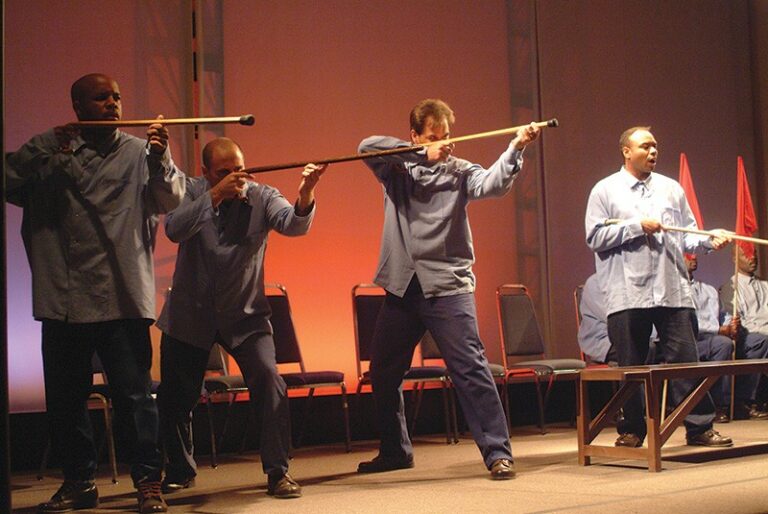
The film, which unspools at the Congregation Shomrei Torah in Santa Rosa on Saturday, Jan. 17, features a cast of eight prisoners performing a staged version—with very minimal props and scenic backdrop—of the 1928 epic poem of the same name, written by French poet Stephen Vincent Benét.

The challenges were vast and presented numerous opportunities to bail on the whole project. Women weren’t allowed onstage, so their roles were pre-filmed and the onstage actors had to ace their cues to ensure narrative continuity. Tricky stuff, and amazing to watch.

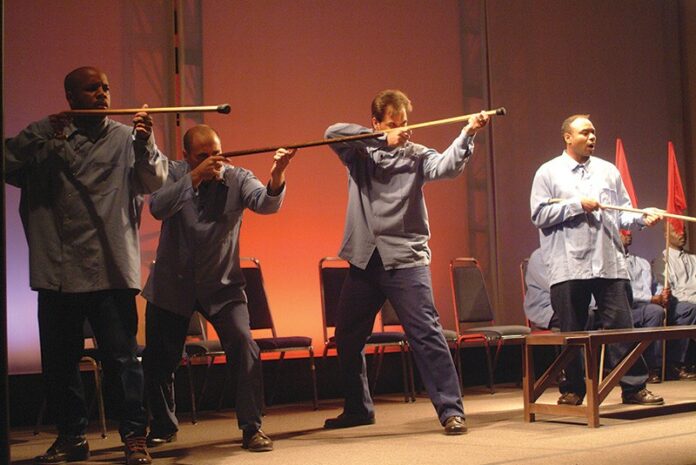
Because it was an ensemble, black prisoners played Confederate soldiers, among other roles—and speak freely in the film about their mixed feelings when it came to “sympathetically” portraying the slavers. The cast used canes borrowed from the infirmary to indicate guns.

In its grand, Homeric sweep of the American Civil War, the poem details the pre–Civil War attacks on slavery by John Brown, proto-abolitionist, and his efforts to trigger a slave rebellion in the South by attacking Harper’s Ferry in October 1859. The attack was a disaster and Brown was captured and killed. The rest? History.

DeFrancesco says he wanted to honor John Brown—and, through him, honor his Catholic school teacher who had given him his first taste of the Benét poem as a student in Cincinnati.

“There’s a phrase in it,” says DeFrancesco, “and I was unable to forget it when I first heard it.” Benét describes the state of the antebellum South as being a land of “graciousness founded on a hopeless wrong.” The line is highlighted in the film.

James Bennett recalls the first day of rehearsal. “I was reluctant at first,” he says. A female prison employee had approached Bennett and told him about DeFrancesco’s plan. “She said to me this man from San Francisco wants to do a stage performance of a poem called John Brown’s Body. I didn’t want to do that, I told her. Too much work.”

But Bennett was convinced otherwise, and went on to play Brown himself in the performance. “I went to the first rehearsal and I met Joe,” he recalls. “He showed us that famous opening monologue of George C. Scott in Patton, and tells us, ‘This is the level I expect you guys to get to.’ I thought that was kind of neat.”

The rehearsals went on forever.

Then, after getting the OK from prison brass, he employed high-tone cinematographers and sound men to film the two-hour production. There was an off-stage choir, brought in from San Francisco, that provided an ethereal, soulful backdrop to the onstage action.

The choir’s arrival marks a turning point in the film, where prisoners see for themselves the lengths to which DeFrancesco was going to bring the powerful stage performance home. They are, frankly, blown away.

But none of it would have happened were it not for those letters DeFrancesco was getting. He had moved on and gotten back to making a living. “I thought, that was it,” he says. “I had no money, I was broke and exhausted. Then I got hired as an editor, as part of the team George Lucas put together to do a series of 100 documentaries on people and events that shaped the 20th century.”

But the prisoners wouldn’t let it go. In their letters, the prisoners didn’t ask for anything, says DeFrancesco, but their passion and emphasis on how the experience had changed and moved them—and in turn moved him. “Most of them were in for murder, capital crimes, he says. “The letters were very eloquent,” he says, even if the men who wrote them lacked in education. “These men have achieved very little in their lives, and this was so odd, and so above some of them, they couldn’t get over it.”

DeFrancesco then set out to interview the men who’d starred in the play. By now, some had been paroled-out of the prison, others had been transferred and others were still serving out their time at San Quentin. By 2011, he’d nailed the interviews. “Around the middle of 2011, I got the last one and thought, ‘I can make a film.'”

They loved it at the Mill Valley film festival in 2013. For Bennett, the experience has continued to inspire him as he makes his way through life as a free man. When we spoke, he was sitting at the Franco Gallo Plaza in Oakland, enjoying a sunny winter afternoon.

“It gets more and more wonderful,” he says. “With each passing day, it just gets better.”

Sweet Leaf Shaking Sonoma County Again

By Eddie Jorgensen
It’s been 33 years since Sonoma County’s longest running band, Skitzo, started its reign of sickening, barf-encrusted, thrash metal terror and vocalist/guitarist Lance Ozanix shows no signs of slowing down. Ozanix’s annual side project, Sweet Leaf, an Ozzy Osbourne and Black Sabbath tribute act, will be celebrating their 20th anniversary together and will play one last show in the area before they reconvene again in December.
Sweet Leaf features a veritable who’s who of the metal scene. Guitarist Steve Smyth has done countless national and international tours playing with the likes of Testament, Nevermore, Vicious Rumours, Forbidden, Dragonlord, and currently lives in England with his wife and dog where he teaches guitar to over 60 students. Drummer Chris Newman played with Intense, one of the largest drawing speed / thrash metal bands in the late 80’s and also played with local hard rock outfit, Ariah. The group is rounded out by the ultra-talented bassist, Steven Hoffman, from the defunct Esseness Project.
Nowadays it’s just one practice and go” said Ozanix in a recent phone interview. “This year because of the 10 year anniversary of Dimebag Darrell’s death, we have added some some Pantera songs into the set. Of course, when we run out of material during shows, we will throw in some Accept, Judas Priest, Dio, or even some AC/DC tunes.”

Guitarist Steve Smyth and Lance Ozanix channel Black Sabbath. Photo by Kris McDonald.

I tried in 1989 to get Sweet Leaf going but I couldn’t get my shit together,” said Ozanix of the band’s humble beginnings. “People were in the band for only a couple of months at a time. All the current guys came together in 1994.”
This will actually be an interesting return to Spancky’s in Cotati, as it’s the first time in nearly twelve years since we’ve been back to play there,” said guitarist Steve Smyth. “The last time we were there, the power surged onstage and blew out Steve Hoffman’s amp so we couldn’t continue from there. We managed to get through nearly an hour set though, so that was a great thing.”
Although Ozanix’s loves the annual Sweet Leaf shows, he made certain to mention the status of Skitzo, his main band. “We just finished our 19th album, ‘Dementia Praecox,’ but have not planned a release date since we don’t have a drummer.”
And while Skitzo may be a bigger name in Sonoma County, Sweet Leaf has quite the following of its own and plays shows in the Bay Area, Sacramento, Fresno, and anywhere else in between.
We just played Livermore (Pine Street Bar and Grill), Sacramento (On The Y), as well as our hometown area shows in Rohnert Park (Quincy’s Pub) and Santa Rosa (Sprenger’s Taproom). We did our second annual acoustic show there at Sprenger’s. It was a lot of fun!” said Steve. “ We average a handful of shows per year with Sweet Leaf due to the fact I live out of the country now, but we still can manage around eight shows a year.”
Metalheads who love Ozzy Osbourne’s body of work along with the entire heavy metal genre will be thrilled with Saturday’s show however unrehearsed it may be. “ Expect surprise, I would say!” said Steve. “Of course, there are the usual fan favorites one can expect and the songs we love to play as well, but there are songs in those band’s back catalogs that seem to get called out a little more.”
Sweet Leaf (Ozzy Osbourne and Black Sabbath tribute band) play Saturday, January 10th at Spancky’s in Cotati, with Lord Mountain opening. 9:30pm. No cover charge but donations accepted. 8201 Old Redwood Highway, Cotati. 707.664.0169.

Jan. 10: Comedy Benefit in Santa Rosa

0

It’s a new year and you’ve made resolutions to help out more but don’t know where to start. How about with some laughs? That’s the plan this weekend, when the Sonoma County YMCA teams up with local standup comedians for their third annual comedy event, Stand Up for Youth. The show features North Bay headliner Steve Ausburne and everyone’s favorite “uncle” Charlie Adams, hosting and performing along with veteran funnyman Ricky Del Rosario and surprise guests. Best of all, the night benefits kids, providing financial help for camp, mentoring and even swim lessons. Cocktails open the night and the humor is geared toward adults, so only bring the big kids when you see Stand Up for Youth on Saturday, Jan. 10, at Odd Fellows Hall, 545 Pacific Ave., Santa Rosa. 7pm. $15–$20. 707.545.9622×3113.

Jan. 10: Songs of Ella in Napa

0

Over the course of 40 millions album sales and 60 pioneering years as a vocal recording artist, Ella Fitzgerald is rightly referred to as the First Lady of Song. While no one will ever be able to top that voice, this week the songs of Fitzgerald are brought to life by beloved Napa singer Kellie Fuller. Fuller’s career is full of breaking through barriers with a soulful style and effortless power. Inspired by Fitzgerald in her phrasing and storytelling flair, Fuller presents a night of music from a classic American performer when she joins the Mike Greensill Quartet in Ella I Sing on Saturday, Jan. 10, at Silo’s, 530 Main St., Napa. 8pm. $15. 707.251.5833.

Jan. 11: Big Cats Live in Sebastopol

0

Formed 20 years ago in west Sonoma County, the Wild Cat Education and Conservation Fund is dedicated to educating people about the decreasing wild cat populations in the world and helping keep these beautiful animals safe. Every year, the fund averages 100 presentations, sharing their cats and their message with students around the greater Bay Area. Now the whole family can meet some big cats at the upcoming Wild Cat Adventure show. Five live wild cats will be on hand, and the presentation will show off their abilities in a safe and informational session. Come see the fund’s cougar, cheetah and other big cats on Sunday, Jan. 11, at the Sebastopol Community Center, 390 Morris St., Sebastopol. 3pm. $5–$10. 707.874.3176.

Jan. 14: Gleaning Film in Healdsburg

0

It’s as old as agriculture, though not everyone is aware that it’s still happening today. Gleaning is the act of harvesting surplus produce, like collecting “seconds” after the initial harvest, for needy members of the community. Local organization Farm to Pantry uses this method to offer fresh, healthy food to hungry families in Sonoma County, and this week they present award-winning documentary, ‘The Gleaners and I.’ French filmmaker Agnès Varda takes the title from the 1867 painting by Jean-Francois Millet depicting women in a field collecting kernels in a harvested field. The film explores gleaning as an expression of community and sustainability, and the event benefits Farm to Pantry. The Gleaners and I screens on Wednesday, Jan. 14, at SHED, 25 North St., Healdsburg. 6pm. By donation. 707.431.7433.

Dirt Diamonds

Dogs love them, hogs love them and humans love them most of all. Just saying the word "truffle" has been known to raise ordinary meals into culinary experiences, and this week the Napa Valley, the mecca of culinary wonders in the North Bay, hosts the fifth annual Napa Truffle Festival Jan. 16–19. The Truffle Festival showcases the two top species...

Shot Down

Director Clint Eastwood's new film, American Sniper, has been called a neo-Western, but is that fair? When was the last Western made where all the Indians were bad Apaches? Texan Chris Kyle, nicknamed "the Legend," was a Navy SEAL sniper with a reported 150 kills during his four tours of duty in Iraq. In American Sniper, Eastwood envisions Kyle (Bradley...

Battling Censorship

On Jan. 7, 2015 Paris endured its deadliest attack in modern times. That morning, three Islamist gunmen tore through the office of satirical magazine Charlie Hebdo. This cowardly and barbaric attack was thought to be perpetrated in response to a 2011 issue that carried a caricature of the prophet Mohammad. Visual depictions of Mohammad are forbidden by Sunni Islamic teachings. Despite...

Crossing Swords

You'd be hard pressed to find an article—outside one written by a CrossFit enthusiast—that reviews this exercise phenomenon without asking some real tough questions about its safety, effectiveness, cost and even the philosophy behind it. Shouldn't all products, whether good or bad, be held up to such scrutiny? Maybe General Motors, Comcast and Apple grudgingly accept this, but CrossFit—both the...

John Brown Lives

'They wrote me with pure heart," recalls San Francisco filmmaker Joe DeFrancesco, as he describes how he came to make the landmark documentary, 'John Brown's Body' at San Quentin. DeFrancesco was describing letters that were sent to him by some of the San Quentin prisoners who had been in his production of John Brown's Body at the Marin County prison,...

Sweet Leaf Shaking Sonoma County Again

By Eddie Jorgensen It's been 33 years since Sonoma County's longest running band, Skitzo, started its reign of sickening, barf-encrusted, thrash metal terror and vocalist/guitarist Lance Ozanix shows no signs of slowing down. Ozanix's annual side project, Sweet Leaf, an Ozzy Osbourne and Black Sabbath tribute act, will be celebrating their 20th anniversary together and will play one last show...

Jan. 10: Comedy Benefit in Santa Rosa

It’s a new year and you’ve made resolutions to help out more but don’t know where to start. How about with some laughs? That’s the plan this weekend, when the Sonoma County YMCA teams up with local standup comedians for their third annual comedy event, Stand Up for Youth. The show features North Bay headliner Steve Ausburne and everyone’s...

Jan. 10: Songs of Ella in Napa

Over the course of 40 millions album sales and 60 pioneering years as a vocal recording artist, Ella Fitzgerald is rightly referred to as the First Lady of Song. While no one will ever be able to top that voice, this week the songs of Fitzgerald are brought to life by beloved Napa singer Kellie Fuller. Fuller’s career is...

Jan. 11: Big Cats Live in Sebastopol

Formed 20 years ago in west Sonoma County, the Wild Cat Education and Conservation Fund is dedicated to educating people about the decreasing wild cat populations in the world and helping keep these beautiful animals safe. Every year, the fund averages 100 presentations, sharing their cats and their message with students around the greater Bay Area. Now the whole...

Jan. 14: Gleaning Film in Healdsburg

It’s as old as agriculture, though not everyone is aware that it’s still happening today. Gleaning is the act of harvesting surplus produce, like collecting “seconds” after the initial harvest, for needy members of the community. Local organization Farm to Pantry uses this method to offer fresh, healthy food to hungry families in Sonoma County, and this week they...
11,084FansLike
4,606FollowersFollow
6,928FollowersFollow