Unsettled Science

0

Forty years ago our first child was born at home. A progressive and intelligent friend was very upset that we had “endangered the life of our unborn child” by ignoring “the consensus of the scientific community” with this decision.

We pointed out to him that Holland, where 99 percent of births occur at home with midwives, had the lowest infant mortality in the world and the United States had the highest rates of medically questionable caesareans. We mostly pointed out that the “consensus of the scientific community” is always the most conservative position available. In the 19th century, any doctor who washed his hands between autopsies and childbirth could and would be driven out of the profession.

Ignaz Semmelweis, the father of antiseptic procedures, was hounded into an insane asylum for these views. In the mid-20th century, any doctor who suggested a link between diet and cancer was ipso facto a quack, according to the AMA, FDA and American Cancer Society, and should be stripped of his license and sent to jail.

Today, we are told that vaccination safety and efficacy is “settled science,” and that every reputable doctor and scientist is leveling the finger of blame at parents who refuse to vaccinate their children. This scares me to death. There is no such thing as “settled science.” It is against the nature of the scientific enterprise to suggest such a thing. It is akin to closing the patent office because everything has already been invented.

Levels of asthma and autoimmune diseases in children have increased exponentially over the past several decades. We don’t have to worry about measles, mumps and rubella. We have to worry about celiac, Type 1 diabetes and a myriad of other autoimmune conditions. Is it possible that the old diseases of childhood played some role in stimulating the auto-immune system in ways that protected children in later life? I do not know. I do know that if I were a doctor, I would be very hesitant to raise the question. I would never get any research money and would likely be drummed out of the profession for making such an absurd suggestion. I might even end up in jail. Or an insane asylum.

Abraham Entin is the father of three grown children, all born at home and none vaccinated. He is also a longtime activist for positive social change.

Open Mic is a weekly feature in the ‘Bohemian.’ We welcome your contribution. To have your topical essay of 350 words considered for publication, write op*****@******an.com.

Stage on Stage

0

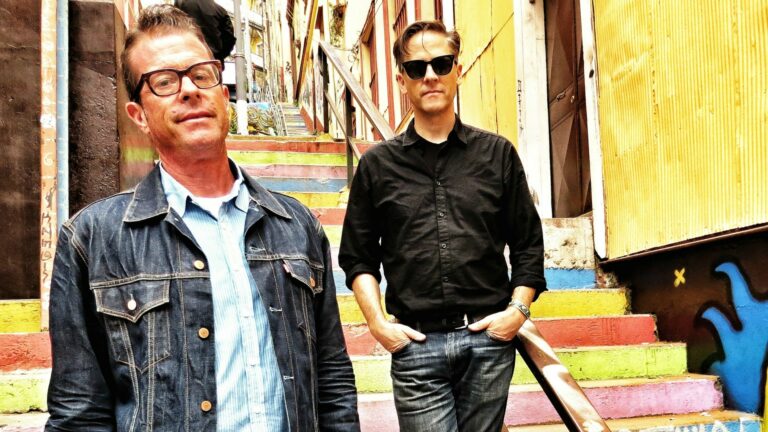
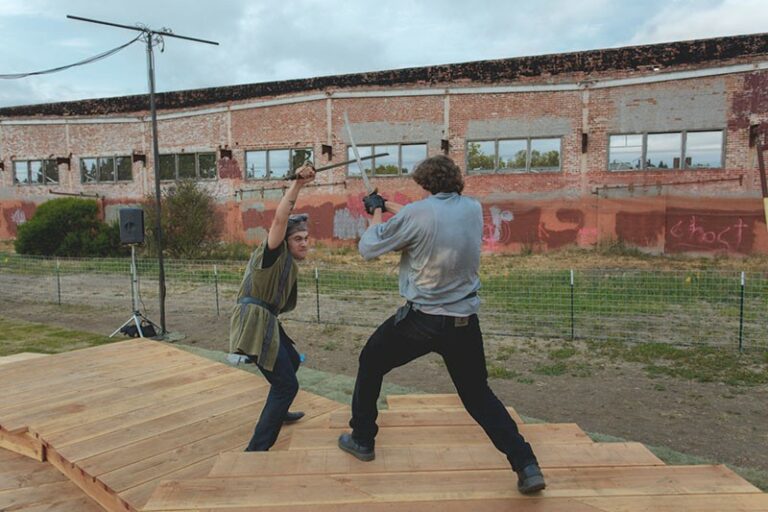
[title of show] is a play about two guys writing a musical about two guys writing a musical,” explains Fernando Sui, shouting to be heard above the din of 300 happy theater people.

It’s 9:30pm at the Victoria Theater in San Francisco, where the San Francisco Bay Area Theater Critics Circle awards have just ended. Sui, who was nominated for his role as a nonexistent teenager in Next to Normal, takes a moment to talk about his next show, opening this weekend at Belrose Theater in San Rafael.

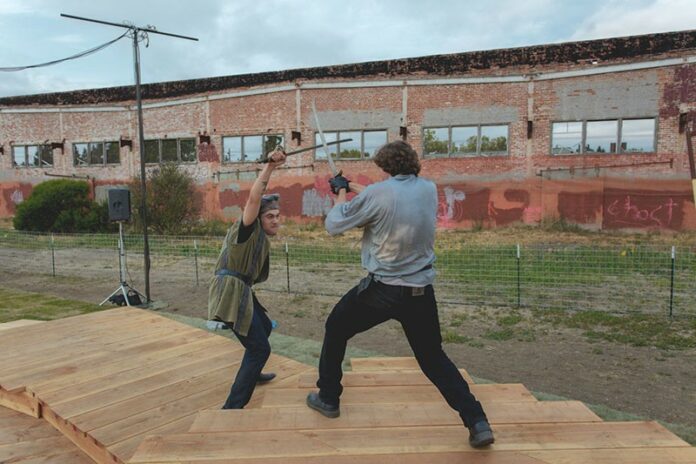
“It’s kind of crazy,” Sui says, describing [title of show], written by Jeff Bown and Hunter Bell, and presented by Marin Onstage.

Sui raises his voice again to be heard above the nearby Carl Jordan, the director of [title of show], who just won for directing last year’s Return to the Forbidden Planet.

“It’s really a show about creating something out of thin air,” Sui says. “A lot of times, when you start a new creative project, your expectations are low, but then, little by little, you start to believe that something really special might be happening.”

As it so happens, Sui’s three co-actors in [title of show] were all nominated tonight. Abbey Lee took home a win for her supporting role in 6th Street Playhouse’s Victor/Victoria. Phillip Percy Williams and Amanda Morando were both nominated for roles in Forbidden Planet, with Williams winning for playing a dashing rock-singing space captain.

“Half of the songs in the show are about what it’s like to be a theater artist, desperately hoping someone notices what it is we’re doing,” says Sui.

“It’s nice to be noticed for the work you do. I really think audiences will leave [title of show] totally inspired to do whatever it is they want to do, to make what they want to make—to just take a chance and see what happens.”

Medium-Plus Toast

0

The booze flows both ways between the Golden State and the Emerald Isle. While Americans clink pints of Guinness while trying to slur “sláinte,” the Irish are tanking up on top-selling Blossom Hill from a wine factory near Hollister. Either way, Diageo wins—the multinational beverage giant owns both brands.

No shocker that Chardonnay tops the list of favorite white wine flavors. Reflecting on a recent tasting of local Chardonnays, however, the genre seems directionless. Seeking to distinguish theirs from the big, oaky-buttery style that is dismissed in all corners and that sells like hotcakes, wineries are toning it down through the use of targeted yeast strains and sophisticated barrel programs. But what’s left? At least you can dye it green.

Silver Palm 2013 North Coast Chardonnay ($15) As tropical as the sharp labeling suggests, this has pineapple aromas over dusty oak, Meyer lemon plus butterscotch, and a sweet-bodied finish. Not complex, but it’s got personality and drive at a good price point.

Matanzas Creek 2012 Sonoma County Chardonnay ($26) It’s got a little of the frank toastiness of singed oak, but winemaker Marcia Monahan has banished the winery’s famed malolactic strain, so the wine only hints at baked apple and buttery pie crust, and is more woody, austere and dry than you might expect. It’s at the top of the list for elegance.

Angeline 2013 Signature Reserve Russian River Valley Chardonnay ($16) The aroma veers from wood to green weeds and back, but the palate is consistently semi-rich and glycerin-like, with some citrus zest sharpening up the “this is pretty varietal Chardonnay for the price” finish.

Arrowood 2013 Sonoma County Chardonnay ($25) Bitter melon and lemon flavors betray a wispy hint of caramel and well-seasoned oak, and it’s fairly dry. But where’s the fruit?

Rodney Strong 2013 Sonoma Coast Chardonnay ($20) Lime, grapefruit acidity, and so crisp, it’s almost like an unoaked style, which is a great way to showcase pure, fresh, fruit. Would that it were so.

Cuvaison 2012 Carneros Chardonnay ($25) High marks for quality oak aroma, with hints of bay leaf and savory lees. Elegant, with a light, lemony, citrus spritz on the palate, it looks like an intense and focused, if lean, Chardonnay, but it slacks off on the finish. Sub it for a Fumé Blanc.

Sharp Metal

0

For nearly eight years, the Central Valley’s WRVTH have been hoping to break through to a larger audience. Though the band’s new progressive death metal opus isn’t set to be released until June 16, WRVTH are playing the material on the road. WRVTH play Santa Rosa’s Arlene Francis Center on March 14.

“The tour has been going good and the shows have been fun,” says drummer Joseph Serrano, speaking while on tour driving through Denver. “We have been playing a whole new set, with each song being a new song from our new album. Looking forward to playing Santa Rosa, of course. Our show there last time was so awesome.”

The band’s new songs feature some serious guitar wizardry and double bass calisthenics amidst the usual flurry of calculated screaming and growls. Go see WRVTH now, since all indications say they’re headed in the right direction. Most importantly, buy a damn T-shirt! These guys gotta eat.

WRVTH play March 14 at the Arlene Francis Center in Santa Rosa with Inanimate Existence, Water into Blood, the Know Nothings, Damascus, Eyes of Mara, Aberration and Abominous. 8pm. $10 advance; $13 at the door. All ages. 99 Sixth St, Santa Rosa. 707.528.3009.

Power Play

0

Something looked amiss to Santa Rosa resident Ethan Wilde as he scanned his first electricity bill of the new year.

Wilde is one of thousands of Sonoma County residents who recently switched his power company from the investor-owned utility Pacific Gas & Electric to Sonoma Clean Power (SCP), the local power company formed out of a national push toward what’s called “community choice aggregation” models of greener, more localized energy generation.

But PG&E is still responsible for the transmission of electricity in the county. Wilde, for one, would like to pull the plug on that arrangement. PG&E transmission charges showed up as a $136 “delivery charge.”

This was the first bill Wilde got as a new SCP customer, and it seemed out of whack with what Wilde had been paying: his total bill from the previous month had been $155, when he was still with PG&E for generation and transmission of electricity.

Curiously, PG&E sent the transmission part of the bill separate from the SCP generation bill of $63.84, even though they covered the same time period.

The PG&E delivery bill was dated Feb. 4; the SCP bill for the same period was dated Jan. 13. They both roughly covered his December usage. This was confusing to Wilde, and to the SCP employees he showed it to. “They thought it was very strange that they were splitting the charges across two bills.”

None can deny that SCP is fulfilling its mission to provide power that’s cheaper and cleaner than PG&E. Wilde says his bill is cheaper under SCP. But it could be cheaper still, says SCP CEO Geof Syphers—were it not for PG&E.

Even as SCP customers are seeing their bills reduced by between 6 and 14 percent, “it’s frustrating that PG&E is raising their rates that much when wholesale markets are actually down,” says Syphers.

The utility giant is delivering electricity to SCP ratepayers and remains the “provider of last resort.”

While paying for the transmission of electricty is unavoidable, CCA supporters would rather pay their local utility than PG&E. Beyond that, critics of PG&E point to other charges utility customers feel are less justified—and less visible.

Some of the promised SCP savings to ratepayers are being absorbed by PG&E, thanks in part to actions taken by the California Public Utilities Commission. (Commission president Michael Peevey was forced to resign in January after his cozy relationship with PG&E was revealed in a massive email trove.)

As he was scanning his bill, Wilde paused over the line item for the “power charge indifference adjustment,” or PCIA. It’s not a big charge, about $9, but it’s a persistent one that the CPUC re-upped in October on behalf of PG&E.

Wilde called SCP and was told the PCIA was a fee PG&E charged customers who had jumped ship to SCP, and is based on prior contracts it had signed on their behalf.

Syphers says the issue with the PCIA isn’t the propriety of it, but the duration. It’s one thing to recoup charges—especially when the state told PG&E to enter into the contracts—but the utility has foisted up to 20 years’ worth of charges onto ratepayers, depending on the length of a procurement contract associated with a particular meter.

“The big debate is over whether [the charges] should phase out as those contracts start ending,” says Syphers.

Critics say PG&E could end the PCIA through better forecasting its future energy needs—and engage in a good-faith forecasting of the rapid growth of CCAs in the state while they are at it.

Jeremy Waen is a regulatory analyst for Marin Clean Power, the other local CCA that’s grappling with PG&E’s presence in the new power mix. That PG&E could possibly charge a fee to a customer for 20 years of power it will never deliver, he says, “is mind-boggling.”

The company, says Waen, should do a better job of estimating its future procurements, “so they are not buying excessive amounts of energy.”

Marin Clean Energy expanded its service into Napa County in February, he says, and PG&E could “shift contracts and supplies so they are bringing less energy on.” It hasn’t done so.

There’s another part of Wilde’s power bill that PG&E has its thumb on, but it doesn’t show up in the fine print: charges associated with the cost allocation mechanism, or CAM.

This charge is to ensure that there is sufficient capacity in the power grid to account for fluctuations or emergencies. The CAM is a legacy of past energy crises in the state, and critics say it needs to go.

But the state has decreed that PG&E is the so-called energy provider of last resort. As such, “our resources are not counted by the CPUC’s planning process,” says Waen. That restricts the ability of SCP and MCE to build-in extra capacity into their systems for emergencies or fluctuations. “We’re forced to buy the capacity that the utilities are buying on our behalf,” says Waen.

This arrangement cripples any CCA’s ability to procure extra capacity on its own, says Waen, since the local CCA is compelled to rely on electricity generated by PG&E. “It cuts down on our ability to procure resources for our own customer base,” he says, “and on our ability to have autonomy over the procurement.”

In other words, this dynamic stymies exactly the innovation that SCP ratepayers had hoped for when they signed on to this far-reaching plan for locally controlled and created energy.

“What could be possible with changes to the CAM is that we could have the ability to build combined heat and power units within Sonoma County,” says Syphers, who adds that the effects would include economic stimulus, the creation of local jobs and other benefits.

“We would like to be localizing power sources and making them as clean as we can,” says Syphers.

But under the CAM? “We’re compelled to not do that—that’s the situation today.”

Waen notes that persistence of the PCIA and the CAM indicate what PG&E would like ratepayers to believe—that these CCAs aren’t as reliable as PG&E, and no matter what, the big power company will be there for you.

Yet Marin Clean Energy doesn’t plan on going anywhere soon, says Waen, except to expand into Napa.

Furthermore, Syphers notes that the nascent CCAs in the North Bay are the tip of a growing CCA movement stateside. Sacramento lawmakers are getting used to the idea, he says, that the CCAs weren’t created to destroy a monopoly, but to complement it and create savings for ratepayers.

Syphers points to a recent comment from a CPUC official that broached the possibility that the future of power in California may be the decoupled generation and transmission dynamic at play in the local CCAs.

The best way to ensure that PG&E doesn’t ride herd over the state regulators charged to protect ratepayers?

“Good oversight at the CPUC,” says Syphers, “and more CCAs, so that we have more people watching what happens over there—so that we make sure our customers’ needs are being taken care of.”

PG&E did not get back to the Bohemian in time for our deadline.

Letters to the Editor: March 11, 2015

Ghost Hunter

Right before Tom Gaffey took over the Phoenix Theater, my friend’s dad was the manager (“Ghost Stories,” Feb. 25). We were about 11 or 12 years old at the time, and basically lived there and helped him with everything from ushering to selling concessions. I saw many things while hanging out there before and after hours. The projection booth ghost was seen many times. I’ve also have seen someone in the balcony on several occasions. I’ve never been afraid, though. Hanging at the Phoenix was partly responsible for me being a ghost hunter myself. Good times!

Via Bohemian.com

Cures for Cancer

Tom, you certainly are a solid writer, even a decent journalist, but what you ain’t is a doctor, so stop playing one in your paper. The next time you make the statement that turmeric has the power to kill cancer (“Turmeric, Wonder Spice,” Feb. 4) please feel free to mix in the words “maybe” or “might,” otherwise what your playing is the part of a charlatan.

I’m a third-generation cancer survivor of lymphoma B cell. My grandmother had it back in the ’30s when all they had was cobalt, which didn’t work for her, but I know from the research I’ve done that cobalt did work for some. My mom had the same cancer twice and beat it both times; once with radiation, the other with chemo. In 2000, when I turned 45, I also received the news. Again, lymphoma on my liver. Doctors gave me a 10 percent chance of making it. I did a month of research because I sure as shit wasn’t going to put the poisonous garbage in my body after 40-plus years of doing heroin. But in the end, I decided that chemo gave me my best chance.

Last year, my brother’s wife was diagnosed with cancer. Doctors told her that she had a good chance of survival if she did the juice. If she didn’t, she’d die. She decided to go the holistic route, because a friend of hers, who was in his late 70s, terminally ill from cancer and given only months to live did both cannabis oil and turmeric, and his cancer was gone in three months. Coincidence? My brother’s wife was dead within six months.

I knew a guy who claimed that by using a trampoline, his tumor was broken up. His doctors could only shake their heads. BS? Coincidence? Should we all run out and buy trampolines?

My point is, in the world of cancer there are no absolutes. Don’t you think that if turmeric or any other of the alternatives medicines absolutely worked, every cancer patient would be doing it? Because in the end, it’s all about luck.

Sonoma Valley

Editor’s Note: Tom Gogola’s statement that turmeric cures cancer was written with a grain of salt. The next line says the “anti-inflammable qualities are less debatable.” Meaning, the cancer-curing claims are debatable.

Write to us at le*****@******an.com.

Liven-Up

0

If there’s one thing the folks in Yountville know how to do right, it’s throwing a world-class party. And this month, it looks like everybody in the valley is pitching in for a four-day immersion of food, wine and live music.

Taking place March 19–22, Yountville Live is a moveable festival that incorporates the small though sophisticated burg’s best restaurants, wineries and venues, and hosts renowned local chefs and national headlining acts like O.A.R., Aimee Mann, Colbie Caillat and others.

This is the inaugural year for the festival, organized by the same team that puts on the Taste of Yountville every spring. That 20-plus year tradition takes place on March 21, though now it’s incorporated into Yountville Live.

The festivities kick off March 19 at Brix Restaurant & Gardens where the French-inspired cuisine pairs with local estate wines. A special acoustic performance by alternative rock band Blue October will fill the intimate space. The platinum-selling group announced last month that they were entering the studio to record their eighth record, and hinted at a slew of new songs in the works.

March 20, begins with several afternoon concerts, each complemented with food and wine pairings. At the Vintage Inn’s historic Barrel Room, Austin-based rock outfit Alpha Rev perform. Jessup Cellars hosts British indie pop group Scars on 45. And in the Generations Room of the Yountville Community Center, young indie folk singer Noah Gundersen brings a resonant and passionate depth to songs of faith and recklessness.

There will be no shortage of delectables with chefs like Michael Chiarello of Bottega Ristorante and caterer extraordinaire Richard Visconte. But how about some real rock and roll?

Yountville Live’s main stage performances are filling the seats at the Napa Valley Performing Arts Center at Lincoln Theater with some of the North Bay’s favorite big-name bands. First up on Saturday, popular singer and songwriter Aimee Mann and Maryland rock band O.A.R. take the stage.

Mann has been focusing on her collaborative duo, the Both, with songwriter Ted Leo. Their self-titled debut album, released last year, is a bona fide rock and roll gem and Mann’s foremost foray into the genre, as she’s usually stayed on the folk side of the sound. O.A.R. is all rock and roll, and their latest release, last year’s

Rockville LP, saw the group return to their roots.

If Saturday is a little bit rock and roll, then Sunday, the final night, is a little bit country, featuring acoustic star Colbie Caillat and country rocker Matt Nathanson. Caillat has recently expanded her palette, working out of her comfort zone with R&B producer Kenneth “Babyface” Edmonds. Nathanson has made his name with dynamic performances and songwriting, both of which he brings as the closer for Yountville Live.

Mortal Sin

Wild Tales is a masterfully filmed cautionary tale in the form of a half-dozen stories of terrorism, revenge and extortion. The film presents a roster of crimes in a society gone rotten as old cheese.

This banquet of bad behavior, directed by Damián Szifron and co-produced by the Almodóvar brothers, shows artisanship in the complexity of the shots, with such fresh points of view as the inside of a luggage compartment on a jet and the keypad of an ATM. After a blackout, we come to in a dark tunnel, lined with flashing blue lights; it turns out to be the floor of a grain silo about to be blown up. Rather than banal film-school slickness, Szifron demonstrates that same assuredness that makes Hitchcock a pleasure to rewatch—he insists on surface beauty in these anecdotes of human nastiness.

While the half-dozen episodes are apparently unrelated, they have rhyming motifs about drivers, cakes and explosions. A weird plausibility underscores these events, as if they were all copied from a newsfeed. Strangely, for all the vile, carnal things that go on in Wild Tales, you feel Szifron trusts in his audience’s gentleness, their belief in reconciliation after the hurt.

Yet Wild Tales gets us right in the carnivore part of our brain. Early on, a female airline traveler regards a magazine photo of a pack of cheetahs surrounding a nervous gazelle. In voiceover, the man two seats over asks, “Business or pleasure?” Does he mean the lady’s travel plans, or is he asking a question about the motives of predators?

Despite his ardor for mortal sin, Szifron always picks out something elegant. A woman considers suicide on a tower’s roof, and a boom of heat lightning on the far horizon amps up the madness. Two skulls left over from a mutual homicide, cheekbone to cheekbone, have lovely smiles of satisfaction.

‘Wild Tales’ is playing at the Christopher B. Smith Film Center (1118 Fourth St., San Rafael. 415.454.1222) and opens at Summerfield Cinemas, March 13
(551 Summerfield Road, Santa Rosa. 707.522.0719).

Wild Meets Mild

0

The picture seems to tell the story. A tule elk bull stands on the coastal prairie at Point Reyes National Seashore, head lowered, open-mouthed, his towering antlers tangled in a mess of barbed wire.

Some might say the wire is hurting the elk, but the photo was taken in October, during the rut, and he might just as well be bugling a lusty call to available females. Others see an elk that just wrecked a fence.

This bull’s real problem is that he’s tangled up in a controversy that has dairy and cattle ranchers, environmentalists and the National Park Service asking far-reaching questions about the future of the seashore.

David Press is familiar with “Barbed Wire Guy,” as he calls him.

“Fortunately, if he can make it for another couple months,” Press says cheerily, “he’ll drop his antlers, and then—problem solved!” But if the situation worsens, says Press, the park’s wildlife ecologist, they’d “dart him down,” remove the wire and send him on his way.

I’m riding along with Press and Point Reyes National Seashore (PRNS) outreach coordinator Melanie Gunn to find tule elk in the pastoral zone, a large slice of the seashore where, unique to Point Reyes, ranches established 150 years ago continue to operate per agreement with the park.

The elk that live at Point Reyes were more legend than reality to me until one day last year when a friend posted a picture on social media. Look, she said, elk are everywhere. As soon as I got the chance, I cycled down the picturesque peninsula, mainly to visit the annual elephant seal colony. But I kept an eye peeled for herds of wild tule elk.

I saw no elk. Instead, I saw cows, lots of cows, black and white Holsteins backgrounded by the glimmering blue Pacific Ocean like a commercial for happy California cows. So I took pictures of cows.

According to Point Reyes ranchers, there are plenty of elk here—an “elk invasion,” some call it, claiming that elk are eating grass meant for their cows and cattle, and threatening their organic certification. As PRNS prepares to extend ranch leases at the direction of former secretary of the interior Ken Salazar after he allowed the 40-year lease of an oyster farm in Drake’s Bay to expire, a free-ranging herd of tule elk has become a sticking point in the park’s attempts to develop a “ranch comprehensive management plan,” the park’s first-ever master plan for ranching.

“We’re sort of on the front end of the process at this point,” says Gunn.

Although the park accepted scoping comments from April to June last year (a call for public feedback on what the plan should include), wildlife advocates say they’ve been largely shut out of the discussion, and that removing the elk to appease ranchers would run counter to the mission of the National Park Service.

THE ELK ZONE

At D Ranch, we meet up with Tim Bernot, a park wildlife biotechnician. Bernot has been counting elk all morning for the annual census. It’s not that easy. “They still surprise me every day,” says Bernot. “They’re not as dumb as they look, sometimes. They’re pretty interesting animals.”

Gesturing to a ridge that looks half a mile away, Press says, “You see those three elk bedded down there? They’re all on areas that are not permitted for grazing currently, so that’s kind of where we want them to be.”

Where? In a few seconds I count 60 dairy cows, but it seems like the rangers have eyes like raptors where elk are concerned. Then I see them, beige dots scattered in the brush. An older one, Bernot says, has separated from the rest because she’s on her way out. One of the original elk from a herd relocated in 1999, she’ll be dead before the end of the year.

But I came here to see an elk invasion.

At C Ranch, we find a bachelor group, just where they were supposed to be—well, not supposed to be, but expected to be. Outside of the rut, most male elk hang out together in noncompetitive groups.

“Ten elk today isn’t so bad, but when you have 60 animals over there as well,” Press gestures to D Ranch, “and those other guys on that far ridge, you’ve got close to a hundred animals.” The argument that ranchers are making, says Press, is that there’s only so much grass to go around. “Even though they spend a fair amount of time over in those nonleased areas, there’s nothing keeping them from coming and going.”

Though they’re mostly laying around, they are striking. The core group of four prime bulls have massive antlers, with downward-curving tips. Antlers are shed every year, but grow back bigger than ever, requiring calcium, phosphate and selenium from the environment in the process.

Quite unlike cattle, the elk are alert and aware of our presence at a distance of several hundred yards. The word majestic is no cliché for this sight, which is unfamiliar in the California I’ve known all my life, and unmistakably wild—almost exotic.

They are anything but exotic.

[page]

HERDS OF THE PAST

In 2007, the park set its sights on hundreds of axis and fallow deer then roaming the seashore. Exotic in the biological sense, these non-native species hailed from India and the Near East. In the 1940s and 1950s, before PRNS was established, a few dozen were introduced for sport-hunting enthusiasts. They’d become invasive, the park said, competing with native mule deer and tule elk.

When a controversial eradication plan turned from contraception to professional riflemen—although park rangers had culled deer in the past—Sen. Dianne Feinstein and other lawmakers were besieged by outraged constituents and rushed to intervene. Too late for the last luckless axis deer, but the park has a remnant, declining population of about 60 fallow deer.

Tule elk are endemic to California, meaning that their historic range was confined to this state. One of four surviving subspecies in North America—two in the east were rubbed out—tule elk are slightly smaller than their relatives. But before 1800, their numbers were huge.

On the coastal prairie from Santa Barbara to Sonoma County, and throughout the Central Valley, an estimated half-million tule elk were the dominant grazers in California. Over a hundred years of hunting, habitat loss and cattle ranching brought them to the brink of extinction.

Because elk are bigger than deer, gather in herds and live in open grassland, they were targeted by Californios for hides and tallow during the Spanish period.

“They would come out on big hunts,” says Press, “where they’d take down 40 or 50 at a time.” Later, teams of hunters serving Gold Rush–era meat markets “finished up,” in the words of one, all the elk from wide swaths of the state.

Tule elk were thought extinct by 1874, when a wealthy rancher spared a few survivors he discovered while draining one of the Central Valley’s once-vast marshlands. All of the approximately 4,000 tule elk in 22 herds on public and private land are descended from those.

WELCOME TO POINT REYES

The establishment of a herd at Point Reyes was no lark. “It was a real long-term goal at the time,” Press explains. “It was very well thought out.”

In 1971, in response to decimating hunts when the main herd in Owens Valley still numbered only in the hundreds, State Sen. Peter Behr sponsored legislation that banned hunting of tule elk until the population reached 2,000. Congress passed a companion bill in 1976 that instructed the secretary of the interior to work with the state to identify potential elk habitat on federal lands, including Point Reyes National Seashore.

Ten elk were placed in a 2,600-acre preserve at Tomales Point in 1978. By 1998, the population had expanded, and the park prepared a management plan that was mixed on the carrying capacity of the narrow reserve, but recommended relocation of some animals to the Limantour area of the park’s wilderness. The environmental assessment for the plan anticipated “no significant impact.”

Within weeks, two females left the wilderness and found their way to the pastoral zone across Drakes Bay. One of those, nicknamed “White” for her radio collar, is still a herd matriarch. They returned for the rut, but came back with a calf in tow. According to the park’s 2014 census, this splinter herd now numbers 92, while 120 remain mostly in Limantour. The elk total 498 in all.

Elk have no natural predators in the area. Mountain lions prefer deer, coyotes mostly don’t dare and California’s only wolf chose to raise his family in Oregon.

Over the decade leading up to the ranch management plan process, ranch and dairy operators have increasingly voiced their frustration with the free-ranging herd. Pointing to the 1998 plan, they say the park is obligated to manage the elk should they impact neighboring properties.

How the park responds to their concerns may depend on how one defines a neighbor.

The ranches at Point Reyes have their origins in chaotic litigation that followed the dissolution of Mexican land grants. When the dust settled, the only folks left standing were the lawyers. The partners of San Francisco law firm Shafter, Shafter, Park & Heydenfeldt diced the peninsula into ranches (later named A through Z), leased them back to tenant farmers and founded a name-brand dairy empire.

The properties were sold to ranchers between 1919 and 1939. A generation later, a historic deal was struck between ranchers, environmentalists and the National Park Service to establish Point Reyes National Seashore, in 1962.

As funds became available, the park purchased the ranches at market rate and offered the sellers a reservation of use and occupancy of not more than 25 years, or until the death of the owner or spouse.

Today, the North Bay’s renewed food culture celebrates the products of Point Reyes farms, from gourmet cheese to grass-fed beef. But the long-term leases have termed out.

“We made it clear from day one,” Gunn says. “It’s not a question of if there’s going to be ranching, but how we do it.”

In an attempt to build consensus around the Ranch CMP and the tule elk issue, PRNS invited the community to a series of workshops.

[page]

It was a packed house at the Dance Palace Community Center in Point Reyes Station on Nov. 21, 2014. Beaming under their iconic wide-brimmed hats, park employees and officials ringed the room while a team of professional facilitators set the stage. A convivial buzz settled when David Press, who grew up in Inverness, began a PowerPoint overview of the tule elk situation.

After explaining that habitat enhancement efforts had concentrated animals in an area outside of ranch boundaries from July 2013 to July 2014, Press detailed the pros and cons of the park’s available options for managing tule elk in the pastoral zones. Then Press asked the crowd to “put your flat hats on,” and they broke up into groups to discuss ways that the PRNS might best resolve the issue.

At first, you might have split the crowd into West Marin stereotypes—farmers wearing ag-branded ball caps, bearded environmentalists in L.L. Bean parkas. But upon prompting from the facilitator, people left their cliques and crossed the room to meet with the other side—most everyone knows who’s who.

Chairs closed. People leaned forward into heated discussion. Markers were scrawled on flip charts and pages went flying as if blown by the wind to the walls of the Dance Palace. The community’s impassioned, but civil debate looked like a success.

After the tightly scheduled sessions, group spokespersons presented their findings. Many declared that the elk must go, and there was some support for trophy hunting. But mostly they found that they didn’t agree: “Our group was fairly split” and “I want to make it clear, there was no agreement among our group” were typical sentiments.

At least everybody had his say. But as one spokesman in camouflage hunting pants summed up what he said was his group’s position, a bearded gentleman opposite him seemed to glare into the middle distance, eyes narrowed, tight-lipped. Perhaps I wasn’t getting the whole picture.

SAVE THE ELK

“It seems the workshops were a failure, at least to the extent the park was hoping to find consensus on any topics,” Jim Coda complained in a follow-up letter to park superintendent Cicily Muldoon. Coda, a wildlife photographer who attended both meetings, says that the workshop started from the assumption that elk must be removed from the pastoral zone without discussion about why cattle should have precedence over them.

In his view, there’s something missing from the debate: national parks have a different purpose than ranching. “They are special lands that are set aside for the preservation of natural resources and the scenic beauty there,” Coda says.

Coda used to enjoy hunting, until he took up photography and bought a big telephoto lens. “And I’m glad I did that,” he says. “I could never hunt today. Except with a camera.”

He hadn’t been out to Point Reyes for years, but after returning from Yellowstone National Park, he gave it a try. He was surprised. “I saw bobcats and coyotes pretty regularly, and I thought, this is pretty cool—this is my Yellowstone at home.”

The problems that ranchers are having with fences, says Coda, are more the fault of the fence than the elk. He points to guidelines the Bureau of Land Management uses, both to reduce injury and death caused to elk and deer by “scissoring” when their legs catch improperly spaced wires, and to reduce damage to fencing. “Those wildlife-friendly fences are supposed to be adequate for cattle,” says Coda. “That’s the whole point!”

None of the 21 fences that Coda measured at PRNS met Land Management standards. “I just find that it’s astounding that a national park would take such a position on wildlife-friendly fencing,” he says.

The last thing that the park needs, says Tule Elk Foundation’s Julie Phillips, is another eight-foot fence like the one at Tomales Point. Phillips, a tule elk biologist, says free-ranging elk are not an aberration, but the “natural next step” in keeping with the park’s mission to restore natural processes.

“The vision of allowing tule elk to help in the restoration of California’s native grasslands, coastal prairie, oak woodlands and more is gaining momentum,” Phillips says in an email. Instead of ramping up farming activities, she suggests, “tule elk should take priority over non-native domestic livestock especially within federally owned national lands.”

Nothing against organic farming, says West Marin resident Jeff Miller, a conservation advocate for the Center for Biological Diversity (CDB). “Ranchers can make a living, and make a good living,” Miller says, “and continue to provide organic food, without demanding that the public get rid of the wildlife. I don’t see how any business that is sustainable and touts itself as being good for the environment would want to remove the native wildlife.”

Based in Arizona, the CBD encouraged its members to comment on the ranch management plan. While the environmental group touted the results of its web campaign, others said that “outsiders” had butted in on a local matter. But there’s nothing locals-only about a national park, according to Miller.

“The ranchers like to frame the issue as, ‘the elk are somehow trespassing on the pastoral zone,’ when in fact the elk are supposed to be there,” Miller says. “The proposal to fence these elk in and have them as an exhibit is contrary to what the national park is supposed to be about.”

Furthermore, Miller alleges that ranchers are stocking more animals than they are allowed to, while paying below-market rates for the land ($7 per animal unit month; dairies have a different arrangement), and then blaming the elk for overgrazing during the drought. “The elk are being scapegoated for those conditions,” says Miller.

“Having been around the West, I don’t think there’s a shortage of cattle operations,” says Karen Klitz, a board member of the Western Watersheds Project. “You can go many places and see those.” In contrast, says Klitz, the public does have an interest in “a real national park with native animals.” She says that a park docent recently affirmed to her that the public is excited about the wildlife. “But nobody asks to see the cows.”

Some advocates for free-ranging elk envision a fenceless coastal prairie where visitors could experience a landscape that existed for more than 10,000 years before European settlement.

But most are resigned to compromise—or hopeful for it. Edward Loosli, president of the Wildlife Trust, based in Walnut Creek, which is now focusing on Point Reyes wildlife and habitat restoration, and also operates in Kenya, offers this: “The Maasai rancher pastoralists in Kenya, East Africa, have been co-existing with wildlife for many hundreds of years. If they can do it, so can we.”

[page]

BOOT THE ELK

No such compromise is likely, says Albert Straus, president of Straus Family Creamery and a leader in organic dairying. “That’s not sustainable. It’s not going to work either short-term or long-term.”

Straus does not lease land in Point Reyes, and his own herd is across Tomales Bay in Marshall. But he recently contracted with the Mendoza dairy on B Ranch, and is sympathetic to their concerns.

“As a stakeholder in the park,” says Straus, “I’m going to all the hearings, put in public comments, and am meeting with public officials to advocate for organic farming and the sustainability of farming in our community.”

Summarizing the position of ranchers in the pastoral zone, Straus says that elk were never meant to be there. “They’re not supposed to be on that land, that’s the basic thing—there’s a management plan that had them in the wildlife area, not the pastoral zone.”

Straus blames the park for neglecting the elk. “Last winter, they had a third of the elk die in the wilderness areas because they starved to death or didn’t have enough water. In my mind, that’s not a sustainable management system.”

Straus supports the park’s proposed long-term lease plan, saying it will improve ranchers’ business relationships and ability to get loans from banks. “I think there’s a huge opportunity for the park to work with the farms, to make them a model for how it can work,” he says.

Back on D Ranch, David Press shows me a livestock pond that the park is filling from 3,000 feet of pipe connected to the Drakes Beach water system, in an effort to provide better habitat for the elk, away from nearby dairies.

When elk graze in a lush pasture that’s adjacent to one dairy’s milking barn, Bernot and other rangers “haze” them away. A little arm-waving goes a long way.

On Drakes Beach Road, Press points out elk crossings they installed after identifying key corridors of movement within the park. Lower than the fence and reinforced with two-by-sixes, the crossings minimize fence damage.

Some elk are fitted with GPS collars to monitor the herd’s range. Information on the elks’ movement is collected every three hours and beamed to a satellite that downloads it to a server that spits an email to Press’ cell phone.

When I call Press at his office later and ask about White, he says, “Hang on a second, I’ll pull up her file.” So far, I’m seeing more wildlife micromanagement than mismanagement.

MENDING FENCES

The park is exploring several options for removing the free-ranging herd from the pastoral zone, should they find a need to
do so.

Simply putting them somewhere else in California is not simple at all. The tule elk at Point Reyes are the only herd known to carry Johne’s disease (“yo-nees”), a gastrointestinal bug that affects ruminants. Even this has become politicized: ranchers smear the elk for carrying “the dreaded Johne’s disease,” while Miller says, “The elk are not a reservoir for the disease; it’s almost guaranteed the elk got it from the cattle.”

Ultimately, any movement of elk outside of PRNS is up to the state of California, says state elk and antelope coordinator Joe Hobbs: “The state is going to take a cautious approach, that they get a clean bill of health, wherever they’re going.”

Meanwhile, park staff are out there collecting elk feces to send to a lab at the University of Wisconsin.

Capturing and providing contraception to the elk would be labor-intensive, may induce undesirable behavioral changes and would have little effect for five to 10 years.

The construction of an elk-proof fence across the Phillip Burton Wilderness may be the most popular option. One challenge is that a wide buffer zone would have to be slashed through the wilderness in order to construct and maintain such a fence.

Another problem is that it wouldn’t be elk-proof.

“We brought some of our Park Service ungulate-management specialists from Colorado to consult with us on this matter,” says Press. They had concerns. Elk will follow fence lines until they can get around, and nothing would stop them at the eastern end of the fence. Also, elk can swim.

Press has some experience with fencing fiascos. Once, he attempted to build a seal-proof fence to keep elephant seals from an area at Drakes Beach. They made short work of it. “It was just a whole bunch of splintered boards,” Press says ruefully.

Another option: shoot the elk. The positive spin on having park staff or contractors do the killing is that elk meat could be distributed to homeless shelters or the California Condor Recovery Program.

A state program for private landholders would provide another model. After developing a five-year plan to improve wildlife habitat in cooperation with the state, landholders are permitted to sell elk hunting tags worth up to $15,000.

“It’s a nonstarter,” Miller says. “First off, the park service would never go for it. This is a park with millions of visitors, hikers, birders—it’s a pipe dream for the ranchers.” But thus far, it’s on the table.

“What I’ve been trying to communicate from day one with this issue,” Press says, “is that there are really no easy solutions.”

THORNY ISSUES

That’s surely an understatement. But even identifying the problem is a tough call, too.

Is there such a thing as an “unauthorized elk herd,” as characterized in a scoping letter submitted by the Point Reyes Seashore Ranchers Association?

The argument is that the 1998 tule elk management plan designated an 18,000-acre elk range within a defined boundary. The plan does include a map with a shaded area marked “proposed tule elk range.”

“We didn’t anticipate that there would be elk in the pastoral area,” says Gunn, “but I wouldn’t call them unauthorized. It’s a wild population, and migration occurs.” Where it holds the park responsible for mitigating impacts on neighbors, the plan’s language explicitly refers to landowners outside the seashore.

“There’s no question that they are consuming forage on these pastures,” Press says of the pastoral zone elk. “What we don’t know is whether there is a level of competition between cattle and elk.”

“As a scientist, I’m interested in evidence,” says Hall Cushman, professor of biology at Sonoma State University. Cushman—who is at pains to emphasize he does not advocate for one position or another, but would like to play a positive role in the discussion—has been studying a tule elk exclosure experiment at Tomales Point since 2002, and has studied the impact of elk across the West.

“There really isn’t a lot of strong evidence that elk are negatively affecting cattle,” Cushman says. “It doesn’t mean that it’s not happening,” he cautions, “but I’m not aware of studies that propose such data,” he says about Point Reyes in particular.

Arguing that their expertise should count for more than that of National Park Service range ecologists, ranchers have also requested that park managers remove “arbitrary” limits on how many animals they may stock. By packing more animals on pasture, the ranchers association letter goes on to suggest, they will improve the ecosystem.

According to the park’s estimate, Point Reyes hosts a fluctuating population of 5,000 to 6,000 beef and dairy animals, depending on the season. “We simply don’t have the capacity to go out there and count cows,” says Gunn.

They do count elk. There are 92 in the D Ranch group, and a few dozen more from the Limantour herd wander into ranches to the north.

A Holstein weighs around 1,500 pounds; Tule elk weigh from 325 to 700 pounds, and are considered the foraging equivalent of about half a cow. In that sense, then, there may be 100 times more cows than cow-equivalent elk using the pastoral zone—albeit in some areas more than others.

Organic certification requires that cows get 30 percent of their forage from pasture for a minimum of 120 days. In February of 2014, responding to the drought emergency, the USDA authorized a temporary variance in organic standards allowing certified operators to relax grazing requirements.

Wildlife advocates say there is a different organic standard that the park must consider: the Organic Act of 1916, which established the national park system.

“Based on the Organic Act and the park’s enabling statute,” Coda states in his scoping letter, “the Park Service’s overarching responsibility is to preserve and protect the natural resources of the park. There is no statutory right to ranching in the park.”

Coda’s perspective is interesting, not just because he likes to take pictures of wildlife—that’s his retirement career—but because of his earlier gigs at the Department of the Interior, the Navy and as an assistant U.S. attorney representing federal agencies in land-management issues. Now he’s just speaking his mind as a private citizen.

The Center for Biological Diversity, however, has a history of suing PRNS, and boasts a long scroll of lawyers on its website. And the Western Watersheds Project regularly mounts a new trophy of litigation—wolf killing, grizzly-culling schemes stopped in their tracks—on theirs.

At this stage, nobody wants to discuss possible actions. “For now, we’re letting them know we exist,” says Klitz.

Meanwhile, local lawmakers who have intervened on the side of ranchers include Feinstein, erstwhile champion of exotic deer. But are ranchers willing to bet the farm that Democratic politicians won’t waver if their nature-loving Bay Area supporters hear the crack of rifles once again around the hills of the seashore?

If the environmental assessment does not find a need to pursue an environmental impact statement, the park will open another comment period, and a decision is expected in late 2015.

“We wouldn’t start on this track if we anticipated a finding of significant impact,” says Gunn.

WAITING GAME

Finally, to see what elk look like behind a fence, I drive up to the Tule Elk Reserve. What first captures my attention is not the elk, but the fence. On the pastoral side, the grass is brilliant green, but grazed to the ground. On the elk side, the landscape abruptly shifts to a random patchwork of grass and scrub. Asked if one is better than the other, Cushman says no. “They are just different situations.”

In silhouette against ocean and sky, a bull elk nudges a group of cows onward, while a second bull attempts to sidle up. Two more visitors stop their cars to watch the scene.

On a bluff nearby, a peaceful group rests in the grass, looking out over Pierce Point Ranch. This historical resource is exactly that—history. If brightly painted and picturesque, it’s also permanently shuttered, and no one farms there. This is the domain of 286 elk.

When I try to tiptoe close to take a picture, the cows stand up, more wearily than warily. These elk know how this goes. They only have to wait for the humans to leave.

Debriefer: March 10, 2015

0

SALMON IN SALMON CREEK?

On Feb. 26, a worker at the Osmosis Day Spa in Freestone plucked a dead male coho salmon from Salmon Creek.

So what? Apparently it’s the first time a coho has been spotted in the creek in decades.

The fish had a California Department of Fish & Wildlife tag attached. The spa posted photos of the expired creature on its Facebook page—and not long after, you could hear the celebratory ooohs and aaahs: As if through osmosis, news of the coho spread throughout the county.

The spa has been going for 30 years and is located on six acres that run along Salmon Creek. Osmosis president Michael Stusser says they see lots of steelheads come through, and that it’s “quite a sight to see.” But a steelhead is not a salmon, it’s a trout, and the creek is not called Trout Creek, now is it?

“In ancient times, the Miwoks said Salmon Creek was so full of salmon you could cross the creek on the backs of the fish,” Stusser says. “They disappeared in the 1960s.”

Speaking of the 1960s, Stusser recalls the time Beat writer Gary Snyder came to the property: “We lamented the absence of salmon and all that it signified.”

Stusser called the phone number on the tag—the guy who tagged the fish was excited to hear the news, he says.

And where’s the fish now? Stusser says the raccoons probably ate it.

SMOOTH SAILING

Debriefer was a little worried there for a minute. About two weeks ago we got an email from the North Coast congressional delegation saying that they’d written a letter to the White House Office of Management and Budget, asking it to referee an interagency dispute between the National Oceanic Atmospheric Administration (NOAA) and the U.S. Coast Guard.

The NOAA had just carved out a set of new rules for an expanded Farallones Islands Marine Sanctuary, which nearly trebled the size of the protected zone. It had also doubled the size of the Cordell Banks National Marine Sanctuary.

But now the whole deal was in jeopardy—just as the new sanctuary was to be unveiled. The Coast Guard had asked for an “exemption” from new federal rules as they applied to the expanded marine zone under consideration. The request put the deal on hold.

Debriefer checked the proposed NOAA rules and discovered that the Coast Guard already had numerous exemptions in the protected areas. The only point of departure seemed to be over some language that could have restricted routine training exercises in the new area.

Richard Charter at the Ocean Foundation told Debriefer to not worry about it, which only made us worry about it.

“Everyone is continuing the pressure to get this freed up, and every indication is that it’s going to forward soon,” Charter said, adding that interagency disputes are par for the course. Charter, who is based in Bodega Bay, has worked on four marine sanctuary projects.

Debriefer hit up the Coast Guard about this “exemption” they are asking for. Coastie Chad Saylor wrote to say, sorry, “I called our environmental law division, but they, unfortunately, have nothing more to add.”

Saylor, fortunately, did have something to add: “However, they did say the rule is ‘done,’ and that it should be online in the Federal Register on or about March 12.”

Yet we still don’t know why this was delayed.—Tom Gogola

Unsettled Science

Forty years ago our first child was born at home. A progressive and intelligent friend was very upset that we had "endangered the life of our unborn child" by ignoring "the consensus of the scientific community" with this decision. We pointed out to him that Holland, where 99 percent of births occur at home with midwives, had the lowest infant...

Stage on Stage

is a play about two guys writing a musical about two guys writing a musical," explains Fernando Sui, shouting to be heard above the din of 300 happy theater people. It's 9:30pm at the Victoria Theater in San Francisco, where the San Francisco Bay Area Theater Critics Circle awards have just ended. Sui, who was nominated for his role...

Medium-Plus Toast

The booze flows both ways between the Golden State and the Emerald Isle. While Americans clink pints of Guinness while trying to slur "sláinte," the Irish are tanking up on top-selling Blossom Hill from a wine factory near Hollister. Either way, Diageo wins—the multinational beverage giant owns both brands. No shocker that Chardonnay tops the list of favorite white wine...

Sharp Metal

For nearly eight years, the Central Valley's WRVTH have been hoping to break through to a larger audience. Though the band's new progressive death metal opus isn't set to be released until June 16, WRVTH are playing the material on the road. WRVTH play Santa Rosa's Arlene Francis Center on March 14. "The tour has been going good and the...

Power Play

Something looked amiss to Santa Rosa resident Ethan Wilde as he scanned his first electricity bill of the new year. Wilde is one of thousands of Sonoma County residents who recently switched his power company from the investor-owned utility Pacific Gas & Electric to Sonoma Clean Power (SCP), the local power company formed out of a national push toward what's...

Letters to the Editor: March 11, 2015

Ghost Hunter Right before Tom Gaffey took over the Phoenix Theater, my friend's dad was the manager ("Ghost Stories," Feb. 25). We were about 11 or 12 years old at the time, and basically lived there and helped him with everything from ushering to selling concessions. I saw many things while hanging out there before and after hours. The projection...

Liven-Up

If there's one thing the folks in Yountville know how to do right, it's throwing a world-class party. And this month, it looks like everybody in the valley is pitching in for a four-day immersion of food, wine and live music. Taking place March 19–22, Yountville Live is a moveable festival that incorporates the small though sophisticated burg's best restaurants,...

Mortal Sin

Wild Tales is a masterfully filmed cautionary tale in the form of a half-dozen stories of terrorism, revenge and extortion. The film presents a roster of crimes in a society gone rotten as old cheese. This banquet of bad behavior, directed by Damián Szifron and co-produced by the Almodóvar brothers, shows artisanship in the complexity of the shots, with such...

Wild Meets Mild

The picture seems to tell the story. A tule elk bull stands on the coastal prairie at Point Reyes National Seashore, head lowered, open-mouthed, his towering antlers tangled in a mess of barbed wire. Some might say the wire is hurting the elk, but the photo was taken in October, during the rut, and he might just as well be...

Debriefer: March 10, 2015

SALMON IN SALMON CREEK? On Feb. 26, a worker at the Osmosis Day Spa in Freestone plucked a dead male coho salmon from Salmon Creek. So what? Apparently it's the first time a coho has been spotted in the creek in decades. The fish had a California Department of Fish & Wildlife tag attached. The spa posted photos of the expired creature...
11,084FansLike
4,606FollowersFollow
6,928FollowersFollow