
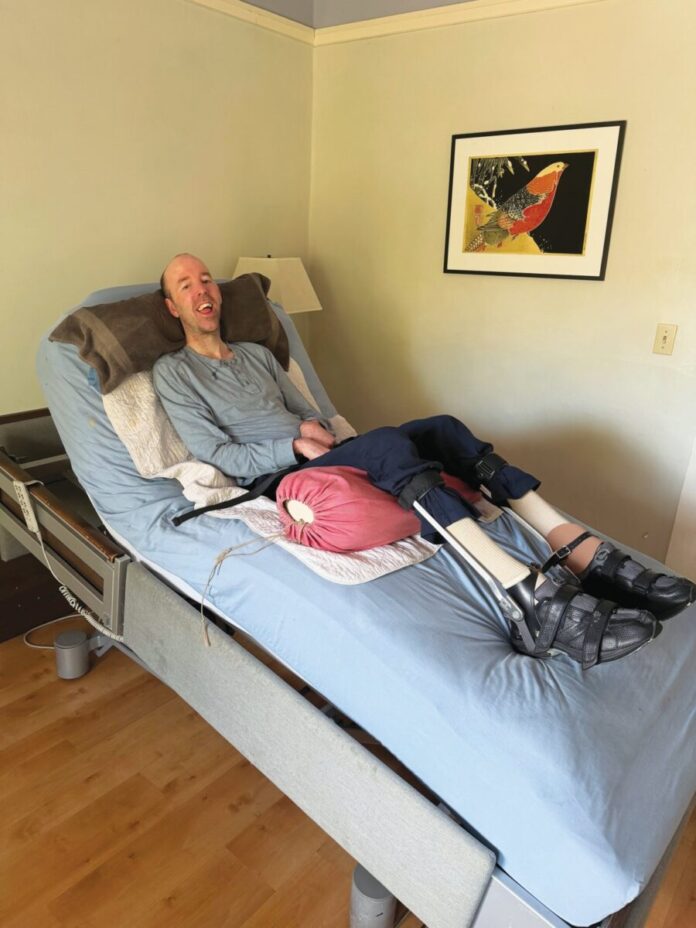
I have met James Freebury only twice. And both times after his accident. Our relationship was carried out over correspondence.
My first visit was along with local musician and impresario Josh Windmiller, who introduced us. We went to pantomime for James, a passage from the Scandinavian epic Beowulf of all things. We performed the scene where the hero confronts his monster.
The second visit I went alone—to establish a personal trust. I remember his room—I imagine he is waiting there now. Except for his bed and two art prints, the room is quite bare. It faces away from the sea into a garden and beyond it, a slanting street. I remember Freebury’s stillness; I remember the long pauses between my questions and his replies. But what I remember best are his eyes. They alone express his inner life and freedom now. Yes, I remember his eyes…
A Man Falls Down
What James Freebury can remember of his aneurysm was a blinding headache. He had just finished working a shift at the museum. Before putting himself to bed, he happened to tell his parents. That saved his life. James Freebury has not risen from his bed since. It’s been four years.
He remembers waking up some days later in the high tower of a hospital. It was grey outside and dreamlike. It brought to his mind the pleasant association of fairy tales.
In the next moment, Freebury found he could not move. He could not shift in bed to relieve some pressure. He could not reach his arm for his phone or for water to relieve his burning thirst. He found he could not speak. He could not rise. He could not escape. He could not even scream. Freebury was helpless—helpless as a baby. But a baby without a future—his future was in flames. James Freebury, age 38, awoke paralyzed from the neck down.
It is impossible for me to imagine his devastation in those early days. James Freebury had woken up in my own personal nightmare. Is it unprofessional for me to write that? Maybe. It’s honest. Be honest—through James Freebury we confront one of our greatest fears. That’s why his story is gripping. And that’s why we need for it to have “a happy ending”—for ourselves more than him.
In his hospital bed, James Freebury made an inventory. He found that he could still move his eyes—and he could still blink. He could turn his head from right to left. James Freebury found that he could still weep. And he could still hold his head up. These are small but defining human expressions.
And James Freebury found that he could still smile. He still had his mind and his memory. And he smiled as he remembered the fifth book of The Odyssey—it was the first part of that myth that he had set out to learn by heart. He had once performed it in epic style, striding the ruins of Sutro Baths like a hero. Reciting the fifth book to an audience as the crashing waves beat the rhythm and the white gulls screeched overhead, wheeling.
In the fifth book, Troy is a smoking ruin and Odysseus is sailing home after 10 long years. Caught in a storm of divine proportions, his ship—his vessel—is smashed to a thousand pieces and he washes to shore, alone. Odysseus awakes to find himself cast away on a desert island—with nothing to do but rage the gods that had forsaken him.
New strength flowed into Freebury at the recollection. In some sense, he was Odysseus now. Deviser of the Trojan horse. He of cunning and stratagem. Odysseus has escaped his island of solitude. Freebury too would escape, and like Odysseus make it home to Ithaca. Within himself, he discovered inner resources. He had a Proustian memory to mine (he likens himself to a tunneling white rabbit). And his imagination was as free as Jean-Do Bauby’s butterfly. Perhaps, fatefully, James Freebury had been unknowingly preparing for his trial…
Adaptation
And so it was that James Freebury learned to speak for the second time in his life. The first time, as a child, was with his mouth. The second time, as an adult, James Freebury learned to speak with his eyes. A miracle device called the Tobii Dynavox tracks his eye movements as they range over a keyboard. It synthesizes for him his new half-robotic voice. Freebury now has a wheelchair—and the future prospect of one that he himself can steer with only his eyes. He dreams and devises other adaptive technologies for people in his locked-in condition.
It’s hopeful. But these themselves define the hard limits to his personal autonomy against which he struggles. He wrote to me a few days after our cordial second meeting, describing a “rough day” he spent “shaking and weeping with the physical and psychological affront” of his situation. He had been stuck down by fate in the full flood tide of his life.
Escapism
Our inner faculties of memory and imagination combine in the defining human act—the creation of story.
Freebury had written before his paralysis. But he had never considered himself a writer—he confessed that he lacked the discipline. But now, he notes with wry irony, “All I can do is write.”
James Freebury had first conceived of A Man Comes Down after he graduated college (with a degree in medieval lit). Inspiration came as he was reading Peter Carey’s novel, The True History of the Kelly Gang. The setting was Old West, but through the fundamentally Celtic quality of the Irish-immigrant Kelly, Freebury discerned deeper roots in Icelandic sagas. From there, tendrils stretched back to Greece and to Homer.
He loved the idea of playing up this connection in an original story. He had tried to write it before the paralysis. In his struggle with writer’s block, he had gradually grown to hate the project.
Why Freebury chose to take up this project during his convalescence he didn’t quite say—many of my questions went unanswered in our large but incomplete correspondence. I can guess that it was in part to mend the back broken continuity of his professional life. He would re-enter the arts with a major literary accomplishment. And in the long process of writing the novel, escape his paralysis into an imagined world in which he was a dangerous man of action. And, I can’t but think that in accomplishing what he was unable to when he was able-bodied but blocked, James Freebury would prove that in some narrow sense it was his old self that was paralyzed and himself the free man.
A Man Comes Down
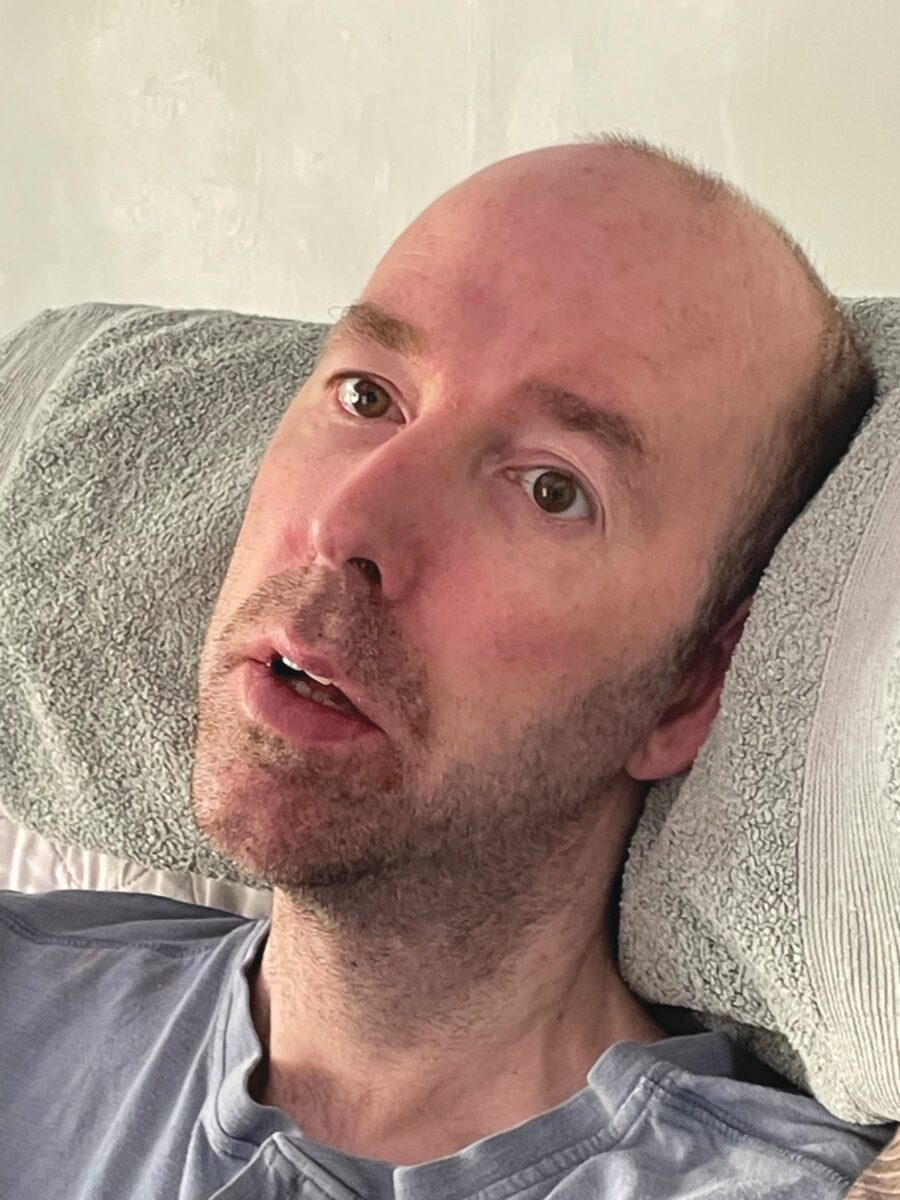
A Man Comes Down was published as a 20-part Substack serial over one year. Each letter of it held his gaze the one second required for the Tobii to register a keystroke.
As one reads the novel, Freebury names the camera shots that frame his scenes. And he embeds a contemporary folk and rock soundtrack to amplify key dramatic moments.
The setting is “The Coast,” a mythologized California of the lawless 1850s. As the story opens, a wounded gunfighter named Ezekiel rides down from the mountains with his ex-gang in pursuit. Fatefully, he collapses at the gate of Rowena, a lonely lighthouse keeper whose outlaw husband, Ned (think Kelly), has been Ezekiel’s employer and best friend for years.
Something compels Rowena to take him in during his convalescence. Set across three days and eight years, the story moves between intimate interior drama and wide landscape cinema. Its two central characters are people of unusual intelligence and restraint, whose slow-burning recognition of one another is the story’s engine. Oh… And it has a happy ending for Ezekiel.
A Man Comes Down is a novel that yearns to be a screenplay. With the right producer, it could be a new American classic. As a film, imagine McCabe and Mrs. Miller meets Secret of Roan Inish. As a cinematic TV series, imagine Poldark meets The Proposition. I would pair the adaptation with a documentary about Freebury himself—think The Diving Bell and the Butterfly meets The Burden of Dreams.
If he sold it into film, A Man Comes Down could carry James Freebury sailing into realms unknown.
Myth
Entertainments provide escapism, worlds and lives we can project ourselves into when we need to escape (the rooms where we live locked with our trauma). Escapism is important. But story elevated to myth is more than simple escapism.
My mentor once told me that with higher literature and film—like the myths and folktales they superseded—we return to our lives with a new understanding of how to be a human. Freebury has written a fine story. But has he achieved mythogenesis?
My question for him was what does his story teach us about life—how to survive the
trials of life—how to thrive?
He had this to say, “The point or the lesson, is that the person or the thing you most need, may not come from the direction that you expect, hopefully, you can be yourself three dimensionally enough that you can pivot to meet the positive chances to come your way, that is true in my very difficult circumstances as well…”
I would add, with some poignancy, that I detected the theme of escaping the stories others impose on us. It is the plight of both the central characters.
Ithaca
James could see me from his window as I left through the garden gate. Then I turned and disappeared from his fixed view.
I was newly mindful of each step I took as I climbed his hill to the VA hospital to take in the view of Ocean Beach. I needed to clear my head. It had been taxing for him to write his answers. It was taxing for me to wait for his replies in that close room.
His answers touched my questions but often flew off on his own flights of fancy. Had I seen him? Or was I mythologizing him with this article? Was I trapping him, or was I setting him free? I was in a black mood. Dark clouds raced across the dome of the sky as I climbed higher. I stood on his peak and watched the waves wash ashore.
There I remembered his answer to my last question: “James, if this story is your Odyssey, what is your Ithaca? What is your happy ending?”
He answered severally, ruefully mindful that one of the lessons of The Odyssey is that one can never go home again. He answered: His Ithaca was to lift himself from his hospital bed and “go upstairs to my old apartment and have a cup of tea in solitude again, with a view of the sea from above.” So small a journey and yet, so impossibly vast. Twenty thousand leagues for Odysseus and 20 steps for James are but the same.
A white butterfly flashed by, tumbling on the currents of wind that stung my eyes. How can we survive? The answer is surely in our myths.
Learn more: James Freebury has published ‘A Man Comes Down’ on his Substack, ‘Analysis by Paralysis,’ at analysisbyparalysis.substack.com. He hopes to have it made into a movie. Between the chapters, he has published autobiographical reflections dating from his aneurism. He welcomes collaborators to facilitate his adaptations.










Very interesting story.