Napa Sunset

0

The traffic is horrendous, especially on weekends. The noise can be deafening on country lanes where big machines rip up the earth. Vineyards have spread everywhere, Pinot and Cabernet have never been more plentiful, and pesticides and herbicides have shown up in creeks and streams.

In a nutshell, that’s the Napa County story, though the Mondavi clan and the folks at Yountville’s Domain Chandon—which is French- owned—along with David Abreu and the notorious John Bremer, insist that they bring culture and civilization to a backward land and hand out millions to community groups. To be sure, Napa makes great wine. But at what cost to the land and to the people? That’s the question.

James Conaway’s muckraking tour de force Napa at Last light: America’s Eden in an Age of Calamity recounts the secrets, the backroom deals and the hillside devastation that has shocked citizens and persuaded some winemakers and grape growers to call for reform. The book arrived in stores in March, three months before the June 5 ballot on Measure C. Widely read, it has strengthened the pro-C forces, though it has also helped fuel the anti-C folks. Where Conaway’s books are concerned, there’s no neutrality. Indeed, his words can be intoxicating, especially when he writes about wine as the beverage that “sustains kings, poets, politicians, priests, lovers, idealists, the sick, the stricken, and all manner of rascals.”

Measure C—known as the Napa County Watershed and Oak Woodland Protection Initiative of 2018—aims to limit hillside development for grape vines and “protect the water quality of Napa County’s streams, watersheds, wetlands and forests, and safeguard the public health, safety and welfare of the County’s residents.”

Ironically, Conaway—arguably the author who has done more than any other single writer to raise awareness about the environment in Napa—can’t cast a ballot on June 5. Born and raised in Memphis, he divides his time between Virginia and Washington, D.C., though he often explores Napa County, where he has friends and some enemies too. He has been drawn to Napa because of its spectacular beauty, and also because he sees Napa as emblematic of California. In 2002’s The Far Side of Eden, the second in the trilogy, he writes that “Napa Valley was California in microcosm.”

In his latest book, he gives voice to the chorus of citizens who want to take back their county from what some see as the dominating influence of the wine industry. “To some, I’m a local hero,” says Conaway. “To others, I’m an enemy of the people.”

The battle over Measure C, which could have implications for vineyard development in Sonoma and Mendocino counties, has been a hard-fought campaign with its share of mudslinging. Misinformation, disinformation and outright lies have defined much of the campaign. So it’s not surprising that Conaway has been demonized in some, though not all, viticultural circles.

A dozen high-profile grape growers and winemakers support the initiative. They include Andy Beckstoffer, one of the largest landowners in the county, and Warren Winiarski at Stag’s Leap, which was one of the winners at the 1976 Paris tasting that put Napa Valley on the international wine map.

Opponents of Measure C have insisted that if it passes it will undermine private property rights and prevent future farming in agricultural watersheds. Vintner Stuart Smith, who created a website called Stop Measure C, says, “The initiative was written by two people and lawyers in a backroom.” Smith adds that you have to have “economic wealth” in order to create “effective environmental protection.” (See this week’s Swirl, p12, for more from Smith.) Conaway calls comments like Smith’s “environmental McCarthyism.”

Grassroots supporters of C have launched their own counter-offensive. In April, lawyer and Soda Creek Vineyards owner Yeoryios C. Apallas, filed a lawsuit that prompted the Napa County Superior Court to order the removal of false statements from the official voter information pamphlet. “I could not sit by while opponents deliberately misstated the facts to confuse voters into rejecting this important measure,” Apallas said.

Among the most blatant misrepresentations was one which claimed that “measure C will prevent homeowners from making even the smallest changes to their land.” That statement, and others like it, were removed from the pamphlet for Napa voters, though not all the misstatements were removed. Moreover, the campaign against the ballot measure agreed to pay $54,000 for the legal fees incurred by the “Yes on C” forces.

But the court ruling didn’t prevent the proliferation of “No on C” signs that dot the landscape and which insist that, if enacted, the law would lead to more traffic, higher taxes and negative impacts on farmers and agriculture.

The signs for and against the ballot measure haven’t surprised Conaway. Napa at Last Light completes the saga he began in 1990 with Napa: The Story of an American Eden and continued with The Far Side of Eden: New Money, Old Land, and the Battle for Napa Valley. In the second volume, Conaway notes that “tourists devour the thing they love.” Sixteen years later, he says Eden is now all but lost, though if Measure C passes, he believes it will help to restore some of the original paradise.

[page]

Reviewers of the book, such as San Francisco Chronicle‘s wine, beer and spirits writer Esther Mobley, have insisted that Conaway’s voice is now louder and angrier than it has been in the past. Attentive readers will also notice that Conaway is sadder than before about the triumph of money and power in the Napa Valley. One might subtitle Napa at Last Light, not “Grapes of Wrath,” but “Grapes of Sorrow.”

In the third volume of the trilogy, Conaway uses his skills as a writer of fiction—he’s the author of three novels—to create memorable, real-life folk heroes, such as the aristocratic, French-born global wine baron Jean-Charles Boisset, who owns dozens of wineries, including the famed Buena Vista in Sonoma. His wife, Gina, belongs to the legendary Gallo clan.

Some of Conaway’s sources are on the record, though not all. He calls one man “Deep Roots” and intentionally conceals descriptions that would give away his identity. He calls another source “the attorney.” Outing him would cost the lawyer his reputation.

Geoff Ellsworth was a willing and a candid source. A St. Helena council member, artist and supporter of Measure C, Ellsworth has lived in Napa County for 50 years. For decades, he watched the slow, steady chipping away of the forests, the privatization of watersheds and the spread of roads, vineyards, wineries, tasting rooms, event centers and estate homes. Like Conaway, Ellsworth decries what he calls the “erosion of democracy” in Napa. He worries that if the dominance of the industry goes unchecked in his hometown, it can happen anywhere in the United States.

On a hot afternoon, as I tour the valley with him, Ellsworth says that while he believes the ballot measure will pass, he also argues that “neither drought, nor flood, nor fire will keep corporations from gobbling up resources in Napa.”

As a kid and young man who grew up in St. Helena—his parents supplied equipment to the wine industry—Ellsworth assumed that Napa County would accept limits on tourism and stop the expansion of vineyards on steep slopes. He also assumed that citizens would decry the loss of habitat for endangered species like the spotted owl.

“We’re nearly at the point where advocating for clean water for everyone is beginning to look revolutionary,” Ellsworth says. “It looks like Napa is turning into the ‘valley of the oligarchs.'”

His friend and feisty ally, Kellie Anderson—who once worked for the wine industry as well as for the Napa County agricultural commissioner—describes some wineries as recreational playthings for wealthy owners and absentee landlords.

“Sometimes a vineyard comes with a Ferrari and a trophy wife,” Anderson says. “Meanwhile, watersheds are destroyed and citizens are screwed.”

Like Ellsworth and Anderson, Conaway wants to stop, or at least slow down, the runaway wine and tourism juggernaut before more of what makes Napa special is lost. “The time has come to say ‘No More,'” Conaway writes in his new book.

During a phone conversation in which his Memphis accent gives away his Southern roots, he says, “I like Pinot, though I can’t afford Napa Cab, which wine makers now call ‘rocket juice.'” (A bottle of premium Napa Cabernet can easily cost $100.)

Conaway is optimistic, but he can’t help but see doom and gloom. He wants things to be right, but he imagines they’ll go wrong. So he’s divided in his feelings about Napa, and both pleased and alarmed at what he sees in neighboring grape-growing, winemaking counties.

“Sonoma County still feels rural, and that’s good,” Conaway says. “But Sonoma will probably go the way of Napa. It’s just too damned attractive for big money.”

Indeed, whether C wins or loses, pockets of Napa’s beauty will endure. Is that enough?

Napa at Last Light ends with the sound of a screaming hawk and a prophetic view of a time when “many are likely to pass though these lovely mountains and will pause as they do now, nature-struck, all momentarily struck by the beauty of this place.”

Debriefer: May 30, 2018

0

FIRE FILE

Late last week, Cal Fire announced that its investigation into four of the wildfires that hit California last year has ended, and that the fires were caused by downed PG&E wires coming into contact with trees. The state agency determined that fires in Butte and Nevada counties—the La Porte fire, the McCourtney Fire, the Lobo Fire and the Honey fire—were all caused by the power lines.

In a statement, Napa State Sen. Bill Dodd (pictured) says, “It confirms what we’ve known all along: that downed power lines can be the source of devastating fires.” Dodd has pending litigation that would compel utility companies to strengthen their infrastructure. “We have an obligation to ensure the utility companies do what’s right to protect Californians.”

No word as yet from Cal Fire on the cause of the Nuns, Tubbs, Adobe and Pocket fires that scorched vast portions of the North Bay last year.

In an extensive release, PG&E defended its vegetation-removal protocols as it highlighted the “new normal” of climate change and its impact on wildfires. The long and short of the PG&E public relations push: “Based on the information we have so far, we believe our overall programs met our state’s high standards.” In March, the investor-owned utility hired Platinum Advisors to lobby on its behalf in Sacramento as bills targeted at PG&E were being introduced by lawmakers, including Dodd. Platinum Advisors was founded by Sonoma County developer and Democratic power broker Darius Anderson.
—Tom Gogola

GRAPE NEWS!

Our local congressional representatives, Mike Thompson and Jared Huffmann, were in Petaluma on Tuesday to drink wine and celebrate the creation of the newest American Viticultural Area—the Petaluma Gap. The AVA designation is sort of a big deal, in that the Petaluma Gap is now an official wine-growing region, joining some 240 others around the country, according to the U.S. government, whose Treasury Department and Bureau of Alcohol, Tobacco and Firearms are the agencies who delineate the bountiful boundaries on behalf of grape-growers. Other AVAs in the region include the Moon Mountain District, Napa Valley and numerous others. It is not known whether the congressmen departed the Tuesday ceremony with a tipsy swagger to their step.—Tom Gogola

LETHAL REJECTION

Jarvis Jay Masters, the Buddhist author and death row inmate on San Quention, has linked up with the American Civil Liberties Union and the organization Witness to Innocence and is suing the state of California over its new lethal injection regulations. Master has maintained his innocence in a capital charge that stemmed from the murder of a corrections guard at San Quentin. In a statement, the Committee to Free Jarvis Masters says the inmate “would like everyone to look at this case in a way that makes it personal—he will be the human being that all these ‘protocols’ will be done to kill him. He wants to make it real and urgent.” Earlier this year, the state unveiled a new single-drug protocol that would use either pentobarbital or thiopental to execute the condemned. —Tom Gogola

GLASS HALF-FULL

“Good evening and welcome folks, I will be your waiter tonight,” I say to my guests as I greet them. “Can I get everyone started with some water?”

“Sure, I’m fine with regular ice water,” says the first patron. “Water is fine for me, too, but can I please have no ice?” another guest asks. “I’d actually like a hot water with lemon,” another chimes in. “And I’d like sparkling water,” requests the final person at the table.

It’s getting hot out there, so from a health perspective, which is best? Is one type or temperature of water better or worse than the others?

There is evidence that different temperatures confer health benefits and drawbacks. Especially during exercise, cool water may be best. A 2013 study published in the International Journal of Clinical and Experimental Medicine found that cool tap water of about 61 degrees Fahrenheit led to less sweating and higher water consumption in the exercising and dehydrated subjects, leading the authors to conclude that this temperature was best at mitigating dehydration.

While drinking ice water may help with weight loss, because the body uses energy to heat this water up to the homeostatic 98.6 degrees Fahrenheit, the effect is quite small. Studies have shown that the body will burn about eight more calories heating up a glass of ice water relative to a glass of room-temp water. Multiplied over, say 8 to 10 glasses a day, this adds up to about 70 calories a day.

Ayurvedic and traditional Chinese medicine practitioners recommend drinking warm to hot water on a regular basis, based on the belief that warm water helps with digestion, whereas cold water leads to sluggish digestion.

Beyond the temperature of water, another bubbling trend right now is sparkling water; industry data shows a major increase in U.S. consumption over the past decade. U.S. sparkling water sales are projected at more than $6 billion by 2021, spurred largely by Americans’ desire for carbonation without the sugar. And guess what? Sparkling water may provide multiple health benefits, according to a 2002 report in the European Journal of Gastroenterology & Hepatology. Regardless of your preference, stay hydrated, people.—Andrew Steingrube

Brown’s Bag

0

‘It’s not because I’m conservative,” California Gov. Jerry Brown once quipped. “It’s because I’m cheap.”

With the reports of historic lows in unemployment and record highs in the stock market, it is unconscionable that the governor suggested stuffing even more into the already bloated rainy day fund.

In his budget, Brown called for the state’s rainy day fund to be fully funded with an injection of more than $4 billion, to bring it to $13.8 billion.

But many residents in fire-scorched Sonoma County don’t have the means to get out of the rain now. As the Mercury News noted in early May, when Brown released his revised budget, “Anyone hoping that $9 billion surplus—up from the $6.1 billion projected in January—would translate into a windfall for California’s public universities, affordable housing development or healthcare might be disappointed by Brown’s budget plan.”

The paper also noted that there’s time for lawmakers
to insist that Brown’s
$190 billion spending plan do a better job of tending to the needs of the state’s poorest, even as his revised budget ramped up spending on education and funneled some of the surplus to housing and mental-health programs. His current plans calls for most of the budget surplus to be split between the rainy day fund and another reserve fund.

The U.S. Census Bureau reports that 20.4 percent of Californians live in poverty. That’s higher than the national average (14.7 percent) and the highest poverty rate in the nation.

California also has the highest child-poverty rate in the nation. The wealthiest state in the wealthiest country in the world is also home to 25 percent of the country’s homeless.

That’s a crisis which has come home to roost in Sonoma County. The county already had an affordable-housing crisis before the October wildfires, and the recent shuttering of several homeless encampments around the county served to highlight a systemic failure in the state and county to come up with long-term housing solutions. The crunch has been cruelly borne by veterans, and the governor is responding to this crisis by hoping the voters will approve a bond in November, the Veterans and Affordable Housing Bond Act of 2018.

Brown is being true to his claim of being cheap when it comes to the poor. The 2017–18 Health
and Human Services budget was $161 billion, and the governor
is recommending it be cut to $158.7 billion.

It might serve the governor to remember what Martin Luther King Jr. once said: “Whatever comes to you in a cheap way will vanish in a cheap way.”

Jeff Green is a research and policy analyst for the California Partnership, an economic justice coalition of low-income residents and people of color.

Tom Gogola contributed reporting to this story, a version of which originally ran in the San Jose Metro.

Take the Trail

0

For a decade and a half, the small northern Sonoma County town of Cloverdale has been a hidden gem of art, thanks to the Cloverdale Sculpture Trail.

This summer, the sculpture trail invites locals and tourists alike to stop in downtown Cloverdale and view nearly 20 large art installations that dot the town’s main boulevard. The trail also celebrates its 15th anniversary with a special artist reception that is open to the public on June 2 at the Cloverdale Performing Arts Center.

At the head of the sculpture trail is longtime Cloverdale resident Joyce Mann, who first conceived of the project in 2003 during a major construction project to redevelop Cloverdale Boulevard.

“The whole idea was to bring people downtown during construction,” says Mann, who coordinates the now-annual exhibit with a group of mostly volunteers working under the umbrella of the Cloverdale Historical Society.

After the first 10 years of exhibits, funding from the city dried up for the trail. “I did not want to see my baby disappear,” says Mann, who joined forces five years ago with representatives from the neighboring town
of Geyserville to create the
101 Sculpture Trail, offering public art in both locales.

Last year, Mann says the philosophy of how the trail should be handled differed between Cloverdale and Geyserville.
“Our two communities are so diverse; it was not possible to satisfy both with what we were doing,” Mann says.

Now Mann’s baby is back to being called the Cloverdale Sculpture Trail, and the 2018–19 lineup of sculptures on display is a compelling collection of engaging art.

“What we like to do is bring in a lot of new sculptures for our community and visitors,” Mann says. This year’s batch of 12 new sculptures, showing alongside seven permanent works, includes pieces that are whimsical, weighty and otherworldly, such as the tall, looming sculpture Alien by Laytonville artist David McChesney. The piece is an old double-trunked tree that was dug up and positioned upside-down, giving it the illusion of a being with tall legs and an odd rootlike head and appendages.

Other new works include Pigasus by Santa Rosa sculptor Michael Seymour, an intricately designed steel-rod work depicting a winged-pig, and reclaimed-metal work Chief Steel Feather, an homage to North America’s indigenous people built by Watsonville sculptor Pierre Riche.

“We want to have something on display for everybody,” says Mann, who is currently finishing work on a self-guided audio tour for this year’s exhibit that will soon be available on the Otocast mobile app.

“The community is really dedicated to continuing to have sculptures here,” Mann says. “Hopefully, we’ll have sculptures in town for another 15 years or more.”

Time of Your Life

0

High atop Mt. Tamalpais sits the Cushing Memorial Amphitheatre, where the Mountain Play has been produced for the past 105 years.

Your all-day adventure includes a slow, winding ride up the mountain, a hike to the 4,000-seat amphitheater and a trek down to your seat lugging coolers full of food and adult beverages (they’re allowed.) You get your umbrella and seat cushions arranged, unpack your goodie basket and just as you start to enjoy a pleasant afternoon picnic, a show breaks out.

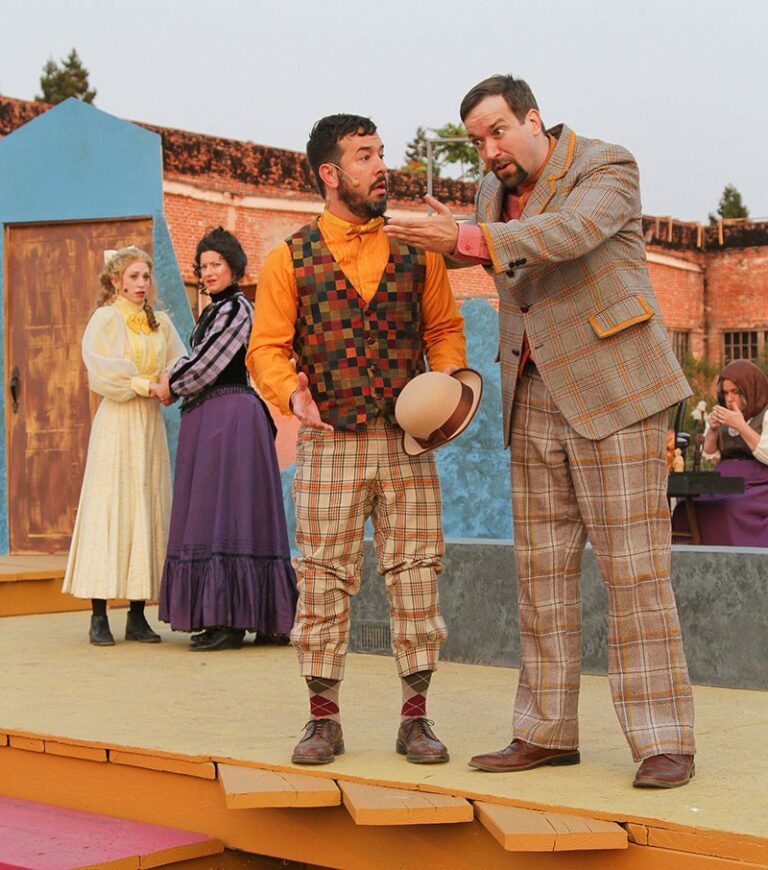
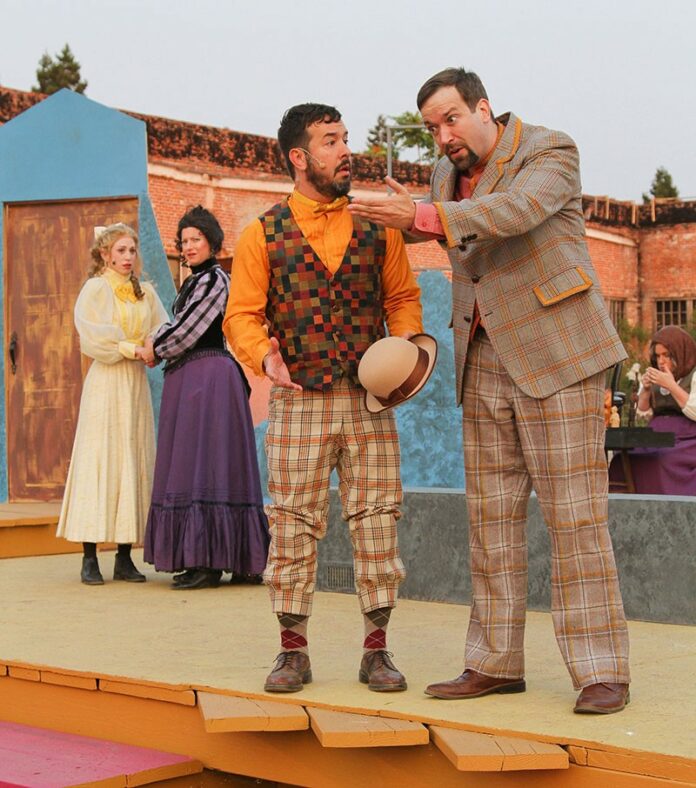
Ah, yes. There is a show. This year’s production is Mamma Mia!, the 1999 jukebox musical that uses the slightest of stories as an excuse to perform the catalogue of pop supergroup ABBA.

Set at a Greek island taverna run by Donna Sheridan (Dyan McBride), the story centers on the circumstances of her daughter’s upcoming wedding. Sophie (Carrie Lyn Brandon) is about to get married to a slab of British beefcake (Jake Gale) and wants to invite her father to her nuptials. The problem is, she doesn’t know who her father is!

A quick trip through her mother’s diary leads her to three possibilities: Harry (Sean O’Brien), an uptight British banker; Bill (David Schiller), a travel writer and adventurer; or Sam (Tyler McKenna), an architect and, the other two notwithstanding, her mother’s true love. Sophie decides, in proper musical theater tradition, to invite them all and sort everything out later. Chaos, hilarity, singing and dancing ensue.

Folks don’t go to shows like Mamma Mia! for the complex storylines or deep subtext; they go for the songs. Put no thought into why the story leads to particular songs being sung, just enjoy the 20-plus tunes, including “Chiquitita,” “Dancing Queen,” “SOS” and the title song.

Director Jay Manley gets generally solid performances from the large cast, but it took a couple of songs for the vocals to really hit their stride, culminating in a very powerful delivery of “The Winner Takes It All” by McBride. There’s colorful and clever scenic work by Andrea Bechert, some nice energetic choreography by Nicole Helfer and Zoë Swenson-Graham, and the ABBA songbook is well played by Jon Gallo and a nine-piece band.

The Mountain Play provides a unique Bay Area theatrical experience. Where else can you catch a pleasant Broadway musical that comes with a pre-show warning about ticks and rattlesnakes?

Rating (out of 5): ★★★½

Moment in Time

0

Folk singer-songwriter Clementine Darling says she was chasing the sunshine when she busked her way from Seattle to the Bay Area in 2010, living in Santa Cruz and Berkeley briefly before moving to Sonoma County, where she’s lived the last seven years.

“The initial thing that brought me to Sonoma County was the connection to nature—it was such a beautiful place,” Darling says. “And the people have been what kept me here.”

Last year, Darling stepped out of her busking shoes and took to a stage for the first time ever at the 2017 Next Level Music Industry Conference, hosted by Creative Sonoma. Darling’s onstage debut coincided with her participation in a songwriting workshop with nationally recognized producer Sam Hollander, in which she and Hollander shaped one of her original songs, “Choose Love,” into a strong acoustic number in the tradition of alt-folk heroines like Ani DiFranco and Cat Power. “Choose Love” wound up being the first track on Darling’s forthcoming debut EP,

11:11, available on June 1.

“It seems like I can’t get a plane ticket or look at the clock without seeing an 11,” says Darling of the EP’s title. “That number has always been important to me.”

Originally planned as a four-song EP, 11:11 was half recorded when the Tubbs fire forced Darling from her Mark West Springs area home in the late hours of Oct. 8. Darling adds that after escaping the flames and reaching safety, she looked at the time; it was 11:11pm.

Coincidentally, one of Darling’s few remaining possessions was her guitar, as she had left it at a storage unit earlier that afternoon rather than leave it in her car. After finding a new rental on the Russian River and picking the guitar back up, Darling composed a fifth track for the EP, “Fire Map,” that originally began life as a poem about last summer’s fires in the Pacific Northwest.

“For the most part, it’s a song of gratitude,” Darling says. “As much loss as I experienced, I didn’t lose any of the people I love.”

Many of those people will be on hand this week when Darling officially releases 11:11 at a concert event, dubbed Bohemian Groove, in Santa Rosa with support from Petaluma songwriter Ismay, one-man-band Banjo Boombox and anti-folk outfit Django Moves to Portland. “The dress code is denim and floral, or whatever makes you feel groovy,” Darling says. “It’s going to be a celebration of life.”

Bohemian Groove happens on Friday, June 1, at the Arlene Francis Center, 99 Sixth St., Santa Rosa. 7pm. $10. 707.528.3009.

Limited Capacity

0

Two-thirds of gun deaths are suicides, but that is not why we demand gun control. We want control because of the decades of mass murder-suicides, often carried out by and against young adults. Unlike disease or old age, death by gunshot is swift and robs us of our chance for goodbyes. For parents and siblings, losing a loved one that way is torture.

Guns have always been available in America, so what caused mass murders to skyrocket since the turn of the century?

For that answer we have to see what else changed this century: fame, easily obtained by likes and followers. Youth today believe that fame and attention is more important than achievement or character. Look at who is popular on TV, internet channels and magazines.

We adults are guilty too. Mass shootings dominate the news and social media, the killer’s story read by millions. We click and share, teaching big media this is what we want.

Lately, I’ve stopped clicking, stopped reading about the latest tragedy. I want these shootings to stop. I want gun ownership to be considered reasonable and responsible again. For that point, I think the latest legislation proposed will be ineffective, if it even passes Congress.

As cleverly worded as any banning legislation is, greed will find ways past the definition of “bump stock,” “assault rifle” or “magazine.” Search online for “non-NFA firearm,” and you will find that manufacturers already market firearms that fall under no regulatory definition.

Our country already accepts that for safety, the FDA approves drugs before they are sold, and the FAA approves airplanes. So it makes sense that if anyone wants to sell a gun or gun accessory,
a to-be-created federal agency with industry, police, gun rights and public safety oversight would determine whether the product’s primary purpose is hunting or home/self-defense. If it passes, that design is legal for sale.

Would this cultural and regulatory shift stop shootings immediately? I doubt it. But maybe in our lifetimes, we’ll reach
Dec. 31 and cheer our first year this century without a mass murder carried out by gunfire.

Iain Burnett lives in Forestville.

Open Mic is a weekly feature in the ‘Bohemian.’ We welcome your contribution. To have your topical essay of 350 words considered for publication, write op*****@******an.com.

Letters to the Editor: May 30, 2018

Nauseous
About Nazis

I felt profound shock and nausea when I read the two racist and anti-Semitic letters to the editor my local paper chose to give a platform to on May 16 under the headline “Say No to Nazis.”

The first letter makes unsupported blanket accusations about Koreans and Korean-Americans being bigoted and ignorant. The second brought out a hateful and unfounded anti-Semitic conspiracy theory using “America First” rhetoric in a way eerily reminiscent of American Nazi sympathizers before WWII.

In the United States, we value an individual’s right to free speech, and yet as thoughtful and caring citizens, we are under no obligation to give a platform and megaphone to hate speech. The Bohemian has a responsibility to choose which voices to amplify more carefully.

Via Bohemian.com

Fearless Voting

I would like to share my experience of Napa as a relative newcomer with fresh eyes. Placing my children into elementary school here, it was clear that there are families in the wine industry, and those who are not. Those not in the wine business are often invisible, and don’t speak out for fear of not being included.

Many belonging in the wine industry blindly support what is happening, even when it is not in their best interests, for fear of ridicule. Often those who work for the industry are afraid to make waves, and be shunned by the community. Worst of all, those working in the vineyards do not speak for fear of losing their livelihoods.

People being afraid to speak is, sadly, the way Napa County likes it. I am voting yes on Measure C because citizens are being bullied so that unsustainable corporations can deforest the land and use up water for profit.

I oppose No on C because—what’s in it for me? I’m not voting for someone else to make billions of dollars while simultaneously stealing our future’s water and trees.

Despite our county government catering to Big Developers, we still have the freedom to vote. Fear not! How you vote is no one’s business but your own, and counts now more than ever.

Napa

Mutz Is the Man

We are so excited to have met and now to support a truly inspiring leader! This dynamite candidate will be on our June 5 ballot running for a most important position, that of Sonoma County Sheriff.

We are so moved by his sincerity and professionalism, and his commitment to all the people of Sonoma County—both those in the department and the community at large.

John Mutz is a team player who listens to the concerns of the public about law enforcement and will ensure that the outcomes are fair to all. He can bring change, which may be necessary in the department, and he will encourage staff and community members to work together bringing creative ideas to resolve conflicts and make us all proud! We know he is the man for the job. Please vote for John Mutz as our next Sonoma County sheriff.

Sebastopol

Write to us at le*****@******an.com.

Why So Low?

California is on track to generate $1.9 billion in legal marijuana sales this year, according to New Frontier Data, a financial analysis firm tracking the market. That’s a lot of weed, but it’s only half the amount the firm earlier estimated the state would rake in.

New Frontier Data bases its estimates on tax revenue from pot sales, which so far have fallen dramatically short of projections. According to the firm, the state collected $33.6 million in pot taxes between Jan. 1 and March 31, which makes it extremely unlikely tax revenues will meet original expectations of hitting $175 million in the first half of the year.

New Frontier had earlier estimated that the state would see $3.8 billion in marijuana sales this year, and this latest estimate slashes that number by a whopping 50 percent. The company also slashed its projections for the size of the legal industry by 2025. Instead of the $6.7 billion in sales it earlier estimated, it now says it thinks sales will only hit $4.7 billion, a hefty one-third reduction.

What happened? New Frontier has an idea.

“It is quite clear that the new adult-use regulations have made it more difficult than anticipated for the legal market to get established and for consumers to transition from the illicit market,” says New Frontier founder and CEO Giadha Aguirre De Carcer.

State and local licensing fees for marijuana businesses can range from $5,000 to $120,000 per year, depending on the type and scope of the business. There’s also a serious lack of buy-in by a good portion of the state’s cities and counties, which means that a big chunk of the state has no access to local legal marijuana.

If there’s no governmental support locally, “then there’s no option for a state license, and that’s why most people are being shut out at this point in time,” California Cannabis Industry Association (CCIA) executive director Lindsay Robinson told the Marijuana Business Daily.

According to CCIA spokeswoman Amy Jenkins, only about one-third of the state’s 540 local governmental entities have approved commercial marijuana activity. Lack of legal access is “forcing consumers to turn to the illicit market,” she told the Los Angeles Times.

Or return to it. Or stay in it, if they never left it.

Ultimately, the only way to end the black market is to legalize marijuana nationwide, but we’re not quite there yet. In the meantime, California’s transition to a legal marijuana regime is facing some unhappy realities.

Phillip Smith has been a drug policy journalist for two decades. He is currently a senior writing fellow at the Independent Media Institute.

Do You C?

0

Cycling is a great way to tour Napa Valley’s vineyards and woodlands, and it also facilitates a closer read of the many political signs that have sprouted along its highways and backroads, most of which are either for, or against, Measure C, the Watershed and Oak Woodland Protection Initiative that Napa voters will decide on June 5.

While riding in the CampoVelo Gran Fondo this April, I was treated to a variety of competing claims along the way: the few “Yes on C” signs candidly say what proponents claim the measure will accomplish.

“No on C” presents a more piquing suite of succinct warnings: C will hurt farmers, increase traffic, threaten hillsides, and also is bad. I was content to stay out of the fray until, rounding a corner on a remote slope south of Angwin, I saw a rarer anti-C sign that said something like, “Doesn’t Save Trees.”

Say what you will about the potential negative downstream effects of not cutting down trees in a watershed—stay with me, now—but can’t we just agree that C is about saving some trees? Yes, campaigns are arguments, but this one increasingly reminds me of the “argument sketch” from Monty Python: “Look, this isn’t an argument,” says Michael Palin. “Yes it is,” counters John Cleese. “No it isn’t,” Palin replies, “it’s just a contradiction, the automatic gainsaying of whatever the other person says.”

It does not surprise Angwin resident Mike Hackett, co-author of the initiative. “We’ve entered this era, starting with the national election, of these alternate truths.” Hackett says it’s all about polling. After the Napa Valley Vintners turned against the measure they’d initially helped craft—in part because polling results showed they’d almost certainly lose such a fight, according to Hackett—they turned to polls showing that traffic, hillsides and water were among Napa residents’ top concerns.

“They took them and flipped them 180 degrees,” Hackett says. “It doesn’t matter that it isn’t real or true; they just say it to confuse voters.”

One contrary voice not just gainsaying is that of Stuart Smith, co-founder of Smith-Madrone Vineyards. For Smith—who says, “My dog isn’t in this hunt,” since C would not apply to his property—it’s a matter of principle. “What they’re taking is the right to plant a vineyard,” says Smith, who offers property-rights views on his website.

Hopefully, Napa voters will make an informed decision after reading up on both sides, never mind the signs. As for me, as Palin says at the end of the sketch, “I’ve had enough of this.”

For: protectnapawatersheds.org. Against: protectnapa.com.
Stu Smith: stopmeasurec.com.

Napa Sunset

The traffic is horrendous, especially on weekends. The noise can be deafening on country lanes where big machines rip up the earth. Vineyards have spread everywhere, Pinot and Cabernet have never been more plentiful, and pesticides and herbicides have shown up in creeks and streams. In a nutshell, that's the Napa County story, though the Mondavi clan and the folks...

Debriefer: May 30, 2018

FIRE FILE Late last week, Cal Fire announced that its investigation into four of the wildfires that hit California last year has ended, and that the fires were caused by downed PG&E wires coming into contact with trees. The state agency determined that fires in Butte and Nevada counties—the La Porte fire, the McCourtney Fire, the Lobo Fire and the...

Brown’s Bag

'It's not because I'm conservative," California Gov. Jerry Brown once quipped. "It's because I'm cheap." With the reports of historic lows in unemployment and record highs in the stock market, it is unconscionable that the governor suggested stuffing even more into the already bloated rainy day fund. In his budget, Brown called for the state's rainy day fund to be fully...

Take the Trail

For a decade and a half, the small northern Sonoma County town of Cloverdale has been a hidden gem of art, thanks to the Cloverdale Sculpture Trail. This summer, the sculpture trail invites locals and tourists alike to stop in downtown Cloverdale and view nearly 20 large art installations that dot the town's main boulevard. The trail also celebrates its...

Time of Your Life

High atop Mt. Tamalpais sits the Cushing Memorial Amphitheatre, where the Mountain Play has been produced for the past 105 years. Your all-day adventure includes a slow, winding ride up the mountain, a hike to the 4,000-seat amphitheater and a trek down to your seat lugging coolers full of food and adult beverages (they're allowed.) You get your umbrella and...

Moment in Time

Folk singer-songwriter Clementine Darling says she was chasing the sunshine when she busked her way from Seattle to the Bay Area in 2010, living in Santa Cruz and Berkeley briefly before moving to Sonoma County, where she's lived the last seven years. "The initial thing that brought me to Sonoma County was the connection to nature—it was such a beautiful...

Limited Capacity

Two-thirds of gun deaths are suicides, but that is not why we demand gun control. We want control because of the decades of mass murder-suicides, often carried out by and against young adults. Unlike disease or old age, death by gunshot is swift and robs us of our chance for goodbyes. For parents and siblings, losing a loved one...

Letters to the Editor: May 30, 2018

Nauseous About Nazis I felt profound shock and nausea when I read the two racist and anti-Semitic letters to the editor my local paper chose to give a platform to on May 16 under the headline "Say No to Nazis." The first letter makes unsupported blanket accusations about Koreans and Korean-Americans being bigoted and ignorant. The second brought out a hateful...

Why So Low?

California is on track to generate $1.9 billion in legal marijuana sales this year, according to New Frontier Data, a financial analysis firm tracking the market. That's a lot of weed, but it's only half the amount the firm earlier estimated the state would rake in. New Frontier Data bases its estimates on tax revenue from pot sales, which so...

Do You C?

Cycling is a great way to tour Napa Valley's vineyards and woodlands, and it also facilitates a closer read of the many political signs that have sprouted along its highways and backroads, most of which are either for, or against, Measure C, the Watershed and Oak Woodland Protection Initiative that Napa voters will decide on June 5. While riding in...
11,084FansLike
4,606FollowersFollow
6,928FollowersFollow