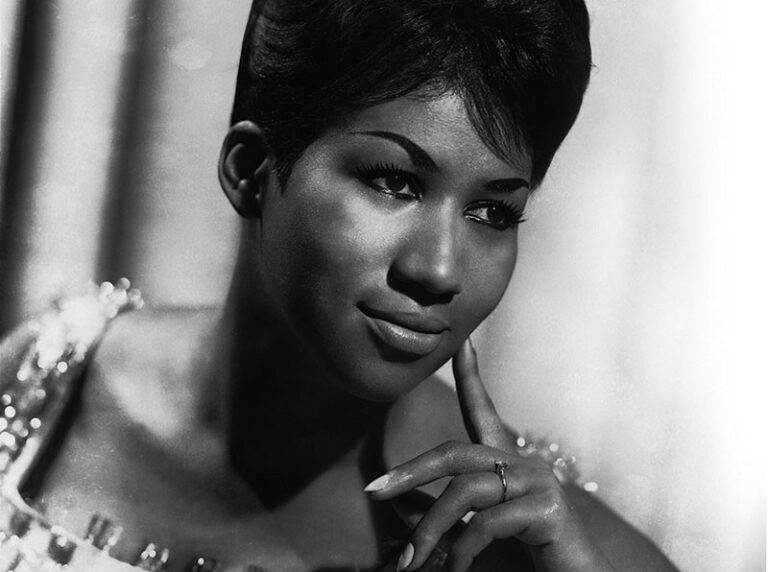
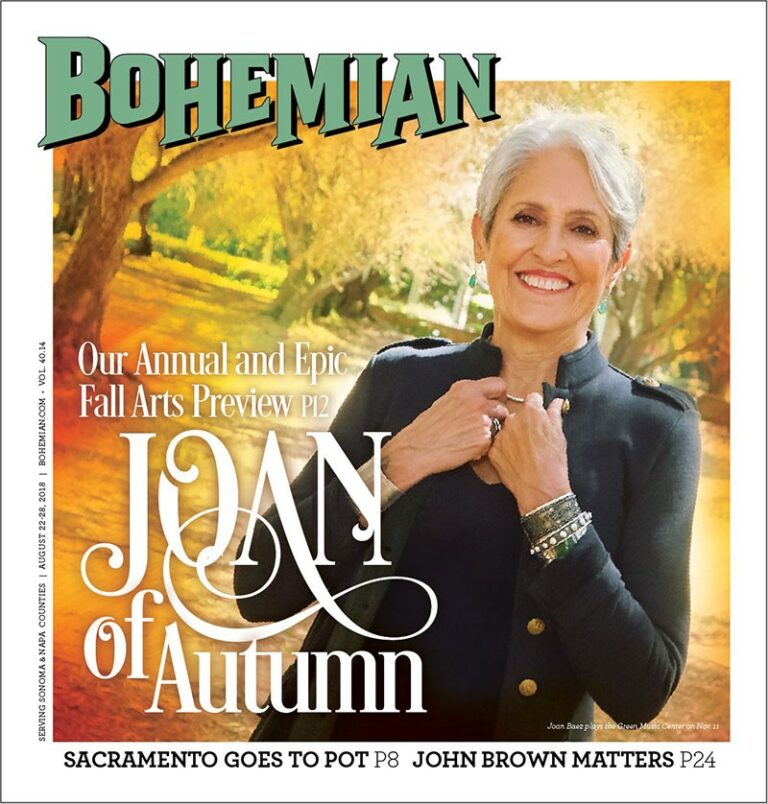
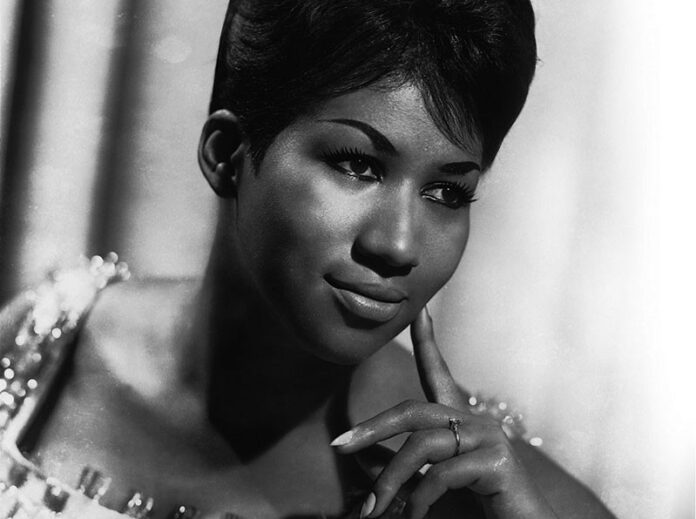
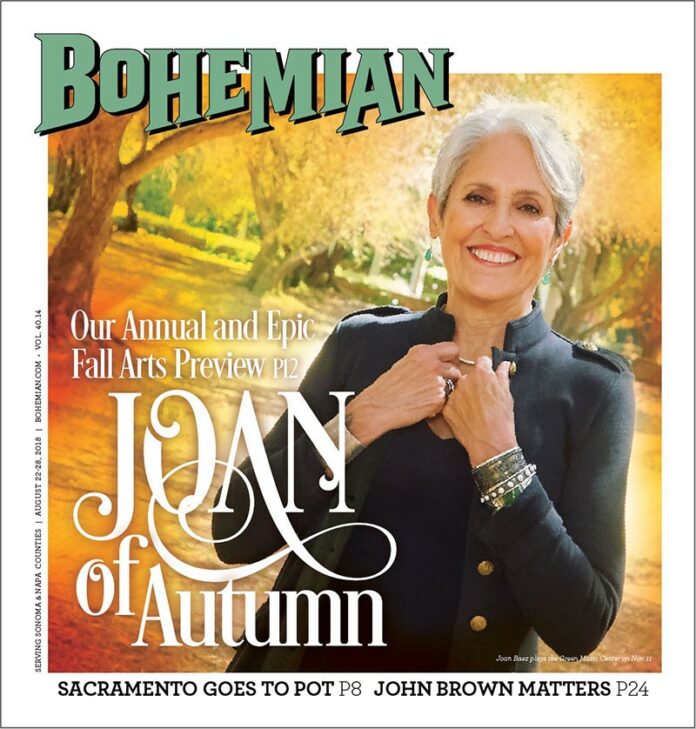
Joan Baez, who graces our cover this week, is touring this year on what she’s calling the Fare Thee Well Tour, but we editorial scribes at the Bohemian sure hope the legendary folk musician and heroine of ’60s counterculture doesn’t retire just yet—well, at least not until she’s taken a righteous spin through our annual and epic fall arts preview produced by stalwart arts editor Charlie Swanson! Joan blows through the North Bay for a show at the Green Music Center in November—which reminds us to highlight our gratitude for autumn in the North Bay.
It’s an absolutely stunningly beautiful time of year (horrific wildfires notwithstanding), and to recall a lyric from Baez’s wonderful cover of the classic and haunting “Autumn Leaves”: “Only when the high winds blow,” she sings, “that I wish my hair was long / Sailing through the autumn leaves / Singing an ancient song.” So sing along with Joan, and sail your ancient souls through our annual preview of all the great culture offerings on deck this season.—Tom Gogola
EVENTS
September
Taste of Sonoma Sonoma Country Weekend’s annual tasting event has all the looks and flavors needed to celebrate the region throughout Labor Day weekend. Taste of Sonoma once again takes over the lawn at Sonoma State University’s Green Music Center, with thousands of glasses of wine on hand and chefs from around the county preparing delectable bites. Live music, chef demos, seminars and more round out the premier event on Saturday, Sept. 1, at the Green Music Center, 1801 E. Cotati Ave., Rohnert Park. Noon to 4pm. $180. sonomawinecountryweekend.com.
Fishstock There will be fun and food—and of course, fish—at Fishstock, the annual fundraiser for the Jenner Community Club. Enjoy chowder tasting, barbecued salmon, offerings from local wineries and breweries, live music by Dgiin and others, an ice cream parlor, a raffle and lots more in a Summer of Love–themed day by the sea. Sept. 2.
10398 Hwy. 1, Jenner. 11am–5pm. $5; kids free. visitjenner.com.
Broadway Under the Stars Gala Celebration Transcendence Theatre Company closes out its 2018 season of shows in the winery ruins at Jack London Park with their biggest party of the year, featuring an all-star cast of singers and dancers who will delight audiences of all ages with fresh takes on classic Broadway hits. Sept. 7–9. Jack London State Park, 2400 London Ranch Road, Glen Ellen. Pre-show picnic, 5pm; showtime, 7:30pm. transcendencetheatre.org.
National Cowboy Poetry Gathering Rooted in ranching and farming traditions, this touring event intersects the cowboy life with music and entertainment. Performers include Gail Steiger, Stephanie Davis, Amy Auker and Rodney Nelson, all of whom embody the history and modern relevance of cowboy culture. Yee-haw! Sept. 8. Lincoln Theater,
100 California Drive, Yountville. 7pm. $20. lincolntheater.com.
National Heirloom Exposition Dubbed the “World’s Pure Food Fair,” this massive expo of food providers and enthusiasts brings together chef demonstrations, pure-food displays, live music, a giant-pumpkin contest, antique tractors and plenty of tasty tidbits, all to benefit school gardening programs. Sept. 11–13. Sonoma County Fairgrounds, 1350 Bennett Valley Road, Santa Rosa. $15–$30; kids free. theheirloomexpo.com.
Chautauqua Revue The revue is back and still finds ways to include new twists with musicians, dancers, storytellers, performers and clowns to keep audiences on their toes while honoring the traditions of the original Chautauqua events from a hundred years ago. This event always sells out, so act fast. Sept. 12–15. Occidental Arts and Ecology Center, 15290 Coleman Valley Road, Occidental. Wednesday–Saturday, 7:30pm; children’s matinee, Saturday, 2pm. Evenings, $25 and up; matinee, $10 and up. 707.874.1557.
Sonoma Film Institute The oldest film repertory in the North Bay hosts another season of screenings featuring classics of contemporary cinema. The Academy Award–nominated German film
In the Fade, screens on Sept. 14 and 16. Renowned documentary filmmaker Frederick Wiseman appears in person to screen his classic doc High School on Sept 28. Several experimental-animation films show in the “Music for the Eyes” program on Oct. 5 and 7, and other films on the fall schedule include 1953’s Tokyo Story, 1997’s Eve’s Bayou and the 1944 musical Meet Me in St. Louis. See you there. Sonoma State University, 1801 E. Cotati Ave., Rohnert Park. Fridays, 7pm; Sundays, 4pm. Free admission; $5 donations welcomed. sfi.sonoma.edu.
Petaluma River Craft Beer Festival As its namesake implies, this event is all about the beer—
the crafty stuff from our parts.
A short list of North Bay brewer participants includes HenHouse, Lagunitas, 101 North, Fieldwork, Headlands, Heretic, Plow, Fogbelt and Bear Republic. Quaff a pint, eat some food and listen to
the live music. Then go jump in the river—this event is guaranteed to be hot and full of hops. Sept. 15, Water Street, Petaluma (21 and over only). 1–5pm. $40;
$20 for designated drivers. petalumarivercraftbeerfest.org.
Art for Life 2018 Support the Face-to-Face/Sonoma County AIDS Network in their mission to end HIV in the North Bay, and get some fine art from hundreds of generous donors at this annual auction and party. Sept. 15. Sebastopol Center for the Arts,
282 S. High St., Sebastopol. 2–6pm. $50 and up. 707.544.1581.
Old Grove Festival It’s hard to find better acoustics in the heart of the Armstrong Woods than the 1930s-era, open-air Redwood Forest Theater, home of the annual Old Grove Festival. New Monsoon headlines the event, with the Kathy Kallick Band opening the night. Do you need still more music? Well, this year, San Francisco’s Noise Pop is bringing veteran indie rockers Built to Spill to the redwoods for a concert—with surprise guests also on tap. Bring flashlights, seat cushions and warm clothes. Sept. 15–16. Redwood Forest Theater, 17000 Armstrong Woods Road, Guerneville. 5pm. $35–$80. 707.869.9177.
Napa Valley Aloha Festival The Manaleo Hawaiian Cultural Foundation hosts this 11th annual event, which covers two days and includes live music and dance from the Hawaiian and Polynesian communities, Hawaiian food,
and arts and crafts. Added bonus: no flaming chunks of lava.
Sept. 15–16. Napa Valley Expo,
575 Third St., Napa. Saturday, 10am–6pm; Sunday, 10am–4pm. Free (bring a canned food for donation). nvalohafest.org.
Petaluma Poetry Walk The popular bipedal-powered literary event is back for its 23rd year. More than 20 regional poets and authors offer readings throughout downtown Petaluma, all within easy walking distance of each other. The day kicks off at Hotel Petaluma’s Ballroom and wraps up at Aqus Cafe. Sept. 16. 11am–8pm. Free. Check website for full list of venues and schedule. petalumapoetrywalk.org.
Fiesta de Independencia Celebrate Mexico’s independence and Latino Heritage Month with a daylong fiesta with all the campañas y silbatos: authentic food, music, games and activities for the entire family. Dance to live mariachi bands and swing at piñatas—and do not miss out on the salsa contest! Sept. 16. Luther Burbank Center for the Arts,
50 Mark Springs Road, Santa Rosa. 1pm–7pm. Free. 707.546.3600.
Santa Rosa Toy Con Nerd-tastic convention offers three buildings stuffed with comics, toys, games and collectibles from over 200 vendors. Special guests include original Star Trek: The Next Generation and Reading Rainbow star LeVar Burton, cult actor Lou Diamond Phillips, Breaking Bad star RJ Mitte, former Creature Features host John Stanley—and dozens of award-winning comic book writers and artists. There’s also the annual cosplay competition, the Lego exhibition and more in store. Sept. 22. Sonoma County Fairgrounds, 1350 Bennett Valley Road, Santa Rosa. Early-bird opening at 9am. $25; regular opening, 10am. $15. santarosatoycon.com.
Open Studios Napa Valley Art studios from all stretches of the Napa Valley are open for this 31st annual event, taking place over the last two weekends in September. Self-guided tours feature encounters with dozens of diverse artists working in several media. The event is juried, and unlike other open studio tours in the North Bay, the artists run the entire affair. Many of the artists also show their work at Jessel Gallery, 1019 Atlas Peak Road, Napa. The tours run Sept. 22–23 and 29–30. 10am–5pm. Maps and info at artnv.org.
Sonoma County Philharmonic Community-based nonprofit organization revels in its 20th season of orchestral performances—and has a full season of fun and fanfare in store. First, conductor Norman Gamboa leads the symphony in the “Celebration!” program, with mezzo-soprano vocalist Sonia Gariaeff on Sept. 22–23. Next, special guest oboist Jesse Barrett joins the philharmonic for “A Hero’s Life” on Nov. 17–18. Santa Rosa High School Performing Arts Auditorium, 1235 Mendocino Ave., Santa Rosa. Saturday, 7:30pm; Sunday, 2pm. $10–$15; students, free. socophil.org.
[page]
Sonoma Harvest Music Festival The music lovers at B.R. Cohn Winery in Sonoma Valley teamed up with the festival aficionados at BottleRock to conjure up this intimate weekend of live music, food, wine and communal vibes. Saturday’s lineup includes music by indie-folk sibs the Avett Brothers and upbeat ensemble Lake Street Dive, while Sunday’s lineup features sets by harmonizing indie-rockers the Head & the Heart and instrumental duo Rodrigo y Gabriela. Sept. 22–23. 15000 Sonoma Hwy., Glen Ellen. Tickets are sold-out; ticket exchange information is available at sonomaharvestmusicfestival.com.
Sonoma Bach Choir Led by musical director Robert Worth, the classical collective presents a season titled “Light Out of Darkness,” which sets out to celebrate music as a torch of inspiration in troubled times. And, boy, are we living in those. The opening recital, “Tokens of Peace,” features the Live Oak Baroque orchestra and countertenor Christopher Fritzsche on Sept. 23. For Thanksgiving, the Sonoma Bach Choir joins the orchestra for “I Fear Namore (No More) the Night,” which features several selections from the Bach man himself on Nov. 16–17. Schroeder Hall, Green Music Center,
1801 E. Cotati Ave., Rohnert Park. 707.303.4604.
Valley of the Moon Vintage Festival One of the oldest and biggest parties in the Sonoma Valley is back for its 121st year. As ever, there’s lots of live music, amazing food, spectacular wines and family-friendly activities—including the opening-night gala, the traditional grape stomp, a light-up parade and more. The Vintage focuses on local culture and community, and is wholly organized by local volunteers to benefit several Sonoma County nonprofits and projects. Sept. 28–30 at Sonoma Plaza, First St. E., Sonoma. valleyofthemoonvintagefestival.com.
Hands Across the Valley Benefiting Napa Valley food programs, including the Food Bank, Meals on Wheels, the Table, the Salvation Army and more, the 26th annual event features tastings from many noted Napa chefs and winemakers, silent and live auctions, and dancing under the stars with Bay Area party band Neon Velvet. Sept. 29. Charles Krug Winery, 2800 Main St.,
St. Helena. 4pm. $125 and up. handsacrossthevalley.com.
Harvest Celebration Kendall-Jackson’s second annual Harvest Celebration, formerly the Heirloom Tomato Festival, syncs fine food, good wine and great entertainment in support of the UC Master Gardener Program of Sonoma County. Outdoor painting sessions, live music, educational seminars and more compliment the tasty array of culinary delights. Sept. 30. 5007 Fulton Road, Fulton. 11am–4pm. $150. 707.571.8100.
October
Sonoma County Harvest Fair Hit up the World Championship Grape Stomp competition, sip some wine in the Grand Tasting Pavilion, go local and peruse the Wine Country Marketplace or simply get down to some swingin’ music at this 44th annual event. Oct. 5–7, Sonoma County Fairgrounds, 1350 Bennett Valley Road, Santa Rosa. Friday, 4–9pm; Saturday–Sunday, 11am–5pm. $5; kids 12 and under, free. Tasting Pavilion tickets, $60. harvestfair.org.
Santa Rosa Symphony The acclaimed symphony’s 91st season features new music director and conductor Francesco Lecce-Chong, who leads the orchestra in the classical program “Passion & Power,” with guest violinist Amaud Sussmann, on Oct. 6–8, followed by “Dancing Across Time,” with guest guitarist Sharon Isbin, on Nov. 3–5. The performances include a pre-concert talk with the conductor. Weill Hall at Green Music Center, 1801 E. Cotati Ave., Rohnert Park. Times vary, $24 and up. srsymphony.org.
Sebastopol Craft Brew Bash The Rotary Club of Sebastopol invites all to sample the best beers, wine, food and music in the civic organization’s new fundraising extravaganza. Oct. 13. Holy Ghost Society, 7960 Mill Station Road, Sebastopol. 2pm–8pm. sebsunriserotary.org.
Sonoma County Art Trails This annual tradition offers a self-guided opportunity to enjoy the abundance of creative local talent, and to buy directly from artists while peeking into their workspaces—there are 170 participants this year. Oct. 13–14 and 20–21. 10am–5pm. Preview exhibit at Sebastopol Center for the Arts, 282 S. High St., Sebastopol. Tuesday–Friday, 10am–4pm; Saturday, 1–4pm. Free. sonomacountyarttrails.org.
A Food & Wine Weekend The Culinary Institute of America and Food & Wine Magazine team up for a powerhouse weekend of edible excellences. Immerse yourself in savory flavors, learn cooking and kitchen skills and enjoy a culinary spectacle. You won’t have your security credentials revoked at this CIA. Oct. 19–21, CIA at Copia,
500 First St,. Napa. 707.967.2500.
November
Wine & Food Affair Nearly a hundred local wineries from the Alexander, Dry Creek and Russian River valleys open their doors for another delicious extravaganza featuring two of the best things in the world. Wine samples are met with a special food pairing to go with the pours. Hosted by Wine Road, the event always sells out, so nab tickets as early as Aug. 29, when they go on sale. The affair commences Nov. 3–4. Various locations in Sonoma County. 11am–4pm. $30–$80. wineroad.com.
Napa Valley Film Festival The North Bay’s top film-food-wine triumvirate of joy returns to Napa Valley with 120 films playing in four towns over the course of five days. Do the math: it’s awesome. Red-carpet screenings, sneak previews, industry panels, gala parties and appearances by A-list Hollywood types are only the beginning. The festival also boasts several culinary and winery events to satisfy any taste. Nov. 7–11. nvff.org.
Art & Exhibitions
Arts Guild of Sonoma “Art in an Age of Anxiety” is a juried group show that features artists who chronicle, illuminate and cope with the angsty moment we’re in. Reception: Sept. 1 at 5pm. 140 E. Napa St., Sonoma. 707.996.3115.
Napa Valley Museum Paintings by Melissa Chandon and Matt Rogers, as well as surfboard art by Tim Bessell, comprise the “California Dreamin'” exhibition that captures the spirit of the Golden State that took hold of the American imagination in the 1960s—thanks to the Beach Boys, the Summer of Love and Jerry Garcia’s beard. Reception: Sept. 1. 55 Presidents Circle, Yountville. 5pm. $20. 707.944.0500.
Healdsburg Center for the Arts “Figure study,” the human form, has been the subject of artistic expression since the cavemen days, and this juried exhibit displays several artists’ interpretations of the figure as a narrative tool in storytelling. Reception: Sept. 8. 130 Plaza St., Healdsburg. 5pm. 707.431.1970.
Riverfront Art Gallery The high-end gallery, run by artists Lance Kuehne and Jerrie Jerné Morago, marks its 11th year with a group show featuring 20 artists. They’ll be on hand hand for the show’s reception, as will a variety of Sonoma County wines and music from Kevin Loewen. Sept. 8.
132 Petaluma Blvd., N., Petaluma. 5pm. Free. 707.775.4278.
Agent Ink Gallery The contemporary screen-print
and poster-art gallery hosts a mouthful of an art show this fall:
“2 Troglodytes Swimming Upstream in a River of Breakdancing Flies.” Translated: the wildly colorful works of Ricky Watts and Chris Jehly. Reception: Sept. 15. 531 Fifth St., Santa Rosa. 7pm. agentinkgallery.com.
Sebastopol Center for the Arts Sculpture Jam Sebastopol collaborates with the SCA to present a seven-month outdoor sculpture installation, “Art on the Lawn,” opening Sept. 23. The gallery also hosts the “Sonoma County Art Trails Preview Exhibit” beginning on Sept. 28. Curated collections of art and poetry, “Reverberations: A Visual Conversation,” opens Oct. 25. 282 S. High St., Sebastopol. 707.829.4797.
Museums of Sonoma County The Art Museum of Sonoma County hosts its annual Gala & After-Party, this year themed “Reimagine the Future,” on Sept. 29. The neighboring History Museum of Sonoma County hosts a Día de los Muertos exhibit, which opens with a family-focused day of activities, on Oct. 21. 425 Seventh St., Santa Rosa. 707.579.1500.
Sonoma Valley Museum of Art See and hear the stories behind 20 Sonoma art collectors, who share their art with SVMA as part of the gallery’s 20th anniversary. Also showing, “From Fire, Love Rises,” which features stories from artists effected by the October 2017 fires. Reception: Sept. 29. 551 Broadway, Sonoma. 6pm. $10. 707.939.7862.
Clubs & Venues
Gundlach Bundschu Winery Hard to pronounce and easy to love, Gun Bun winery makes the most of its outdoor space, redwood barn and wine cave to bring the best indie rock acts from today and yesterday. Bay Area singer-songwriter Nicki Bluhm, best known for leading the rock band the Gramblers, performs a solo show in support of her latest album, To Ride You Gotta Fall, on Sept. 1. Synth-pop mainstays Future Islands gets the beat going on Sept. 14. Guitar god—and founding member of the Smiths—Johnny Marr plays a solo show on Sept. 28. Indie-rock veteran Conor Oberst & the Mystic Valley Band return to Gun Bun on Oct. 7. Eclectic indie stars Ty Segall and White Fence share the show on Oct. 11. Swedish pop sensation Lykke Li gets a groove going on Oct. 18. 200 Denmark St., Sonoma. 707.938.5277.
[page]
Mystic Theatre & Music Hall Petaluma’s historic venue and former movie house offers a lineup of headlining performers from across the musical spectrum. Santa Rosa rock ‘n’ roll veteran John Courage leads his trio in a single-release show on Sept. 1. Iconic British psychedelic pop legends the Zombies perform
Sept. 8. L.A. folk-rockers Dawes hit the stage on Oct. 4. Former New York City subway “Brasshouse” buskers (and now nationally touring trio) Too Many Zooz roll in on Oct. 9. Pioneering classic-rock outfit Y&T return to the Mystic Nov. 17–18. 23 Petaluma Blvd. N., Petaluma. 707.775.6048.
Green Music Center Sonoma State University’s world-class music center, centered by the stunning Weill Hall, hosts another season of top-tier artists from around the world. Lyle Lovett brings his Large Band to perform on Sept. 8. Americana act Bumper Jacksons headline the Banjos & Bourbon benefit for music programs at the center on Sept. 15. R&B powerhouse Tower of Power celebrate their 50th anniversary, with special guest the Average White Band in concert on Sept. 22. Afro-Mexican outfit Las Cafeteras moves to the rhythm on Sept. 28. South Africa’s Soweto Gospel Choir returns to Rohnert Park on Oct. 12. And last but definitely not least, folk icon Joan Baez appears as part of her Fare Thee Well Tour on Nov. 11. 1801 E. Cotati Ave., Rohnert Park. 866.955.6040.
Luther Burbank Center for the Arts The Burbank welcomes an array of veteran talent from the world of music and more this fall. Music-producer extraordinaire
T Bone Burnett takes audiences on a tour of his work and collaborations with musicians across all genres, in a special storytelling program on Sept. 9. Nineties rockers Gin Blossoms and Big Head Todd & the Monsters share the bill on Sept. 13. Singer-songwriter Norah Jones croons to the crowd on Sept. 20. Roots and country star Alison Krauss appears Oct. 6. Dance and pop superstar Paula Abdul returns to the stage in a new tour that stops in the North Bay on Nov. 7. 50 Mark West Springs Road, Santa Rosa. 707.546.3600.
Uptown Theatre Napa’s Art Deco landmark welcomes musicians and comedians from all parts to the region, through the fall. Genre-defying rockers the Mavericks perform Sept. 12. Late-night TV host Craig Ferguson appears as part of his Hobo Fabulous tour Sept. 16. Guitar virtuoso Robben Ford lays down the blues on Sept. 22. Rock & Roll Hall of Famers and ’60s pop icons Ronnie Spector & the Ronettes throw it back to the good old days on Oct. 9. Filmmaker Kevin Smith, recently recovered from a heart attack, and Ralph Garman appear for a live recording of their podcast Hollywood Babble-On, rescheduled form earlier this year, on Nov. 16. Todd Rundgren gets characteristically unpredictable in concert, Nov. 18. 1350 Third St., Napa. 707.259.0123.
Blue Note Napa The Napa emporium of fine music offers close-up and personal performances by an array of musicians from genres that include blues, jazz, funk and soul. Chart-topping vocalist Brian McKnight offers three nights of musical harmony Sept. 27–29. Acclaimed jazz experimenter Rachel Eckroth plays an album-release show on Oct. 18. Songwriter-producers Claude Kelly and Chuck Harmony, who’ve worked with the likes of Celine Dion and Bruno Mars, step behind the mic for the first time as Louis York for a Halloween party Oct. 31. Comedy vet and actress Sandra Bernhard appears for two nights as part of her latest “Sandemonium” standup tour, Nov. 16–17. 1030 Main St., Napa. 707.880.2300.
Theater
Main Stage West The Sebastopol theater house kicks off its fall season with a world premiere of the raucous comedy Savage Wealth, in which two brothers run into all sorts of obstacles trying to sell their Tahoe home, Aug. 31–Sept. 16. Then, David Lear directs the warm and humane drama
The Night Alive, about two rundown individuals who try to make more of their lives together, Oct. 12–28. 104 N. Main St., Sebastopol. 707.823.0177.
Cinnabar Theater The revered Petaluma theater presents the infamous Kit Kat Klub in pre-WWII Germany, which serves as the backdrop to the blockbuster musical Cabaret, Aug. 31–
Sept. 16. Then, director Taylor Korobow returns to Cinnabar to helm the deeply emotional story of The Great God Plan, Oct. 12–28. 3333 Petaluma Blvd. N., Petaluma. 707.763.8920.
Lucky Penny Productions Napa’s theater-production house opens its season with Stephen Sondheim’s contemporary-classic musical Into the Woods, Sept. 7–23. Then, Noël Coward’s beloved comedy Blithe Spirit is resurrected in the North Bay, Oct. 19–Nov. 4. 1758 Industrial Way, Napa. 707.266.6305.
Left Edge Theatre Continuing in the tradition of the longtime Santa Rosa company Actors’ Theatre, Left Edge presents a season of imaginative productions that push the envelope on a local level. British comedy hit The Naked Truth makes its U.S. premiere
Sept. 7–30. Multi-award-winning comedy Hand to God, featuring a hand puppet possessed by the Devil, runs Oct. 19–Nov. 11. Unhand me, Satan! 50 Mark West Springs Road, Santa Rosa. 707.546.3600.
Spreckels Theatre Company The semi-pro resident theater company has a knack for producing critically acclaimed straight plays and show-stopping musicals. A 15-year-old amateur sleuth is on the case in the international sensation The Curious Incident of the Dog in the Night-Time, running Sept. 7–30. Then, the creepy, kooky and delightfully spooky Addams Family musical celebrates the Halloween season Oct. 12–28. 5409 Snyder Lane, Rohnert Park. 707.588.3400.
6th Street Playhouse Housed in the heart of Railroad Square, the popular playhouse continues to engage the community with plays and musicals designed to delight and entertain. Classic Broadway musical Guys & Dolls rolls the dice and rocks the boat Sept. 14–Oct. 7. Everyone’s favorite orphan, Annie, sings about tomorrow, the sun
and how it’s coming out, Nov. 23–Dec. 16. 52 W. Sixth St., Santa Rosa. 707.523.4185.
Raven Players The players present a gamut of shows that range from hilarious to heartbreaking. The topical gun-violence study Church & State and the foreign-correspondent drama Time Stands Still alternate on every other show day between Sept. 20 and Oct. 7. They’re followed by the Irish drama Outside Mullingar, Oct. 25–
Nov. 4. 115 North St., Healdsburg. 707.433.6335.
SSU Theatre & Dance Sonoma State University’s dramatic arts department presents several, well, dramatic works this fall. Go figure. First, a poor soldier in a small German town suffers a breakdown and begins experiencing apocalyptic visions in the stark and fragmentary Woyzeck, running Oct. 4–13. Then, a collapse in the U.S. energy grid leads a band of post-apocalyptic survivors to share their memories of pop culture before the lights went out in Mr. Burns, running Oct. 31–
Nov. 4. Things take a decidedly upbeat turn for the university’s Fall Dance concert, which features student works in motion, Nov. 29–Dec .2. 1801 E. Cotati Ave., Rohnert Park. 707.644.2474.
Sonoma Arts Live The theater company’s 2017–18 season is themed “A Toast to the Classics,” and it doesn’t get any more classic than the Broadway musical Hello, Dolly! Directed by Michael Ross, the production features Bay Area theater stars Dani Innocenti Beem and Tim Setzer, recognized by local critics for their work in Sonoma Arts Live’s previous production of Gypsy. Say hello to the beloved musical Oct. 5–21.
276 E. Napa St., Sonoma. sonomaartslive.org.
SRJC Theatre Arts While the Santa Rosa Junior College’s Burbank Auditorium is undergoing renovations, the 2018–19 season is moving around a bit to various venues, but with no letdown in sight as far as quality goes. The charming and relatable comedy, How the García Girls Lost
Their Accents, runs Oct. 5–14 at SRJC’s Newman Auditorium,
1501 Mendocino Ave., Santa Rosa. Then, Shrek: The Musical warms the heart Nov. 16–Dec. 2, at
Maria Carrillo High School,
6975 Montecito Blvd., Santa Rosa. theatrearts.santarosa.edu.