As the North Bay inches towards the reopening, several groups keep the distancing going with virtual event offerings this weekend. Here’s a sample of what’s coming up online.
Virtual Reception
Under the supervision of art instructor Ginny Geoghegan, Tomales High School’s art program remained a bedrock of creativity for students navigating the course of the past year’s unprecedented distance-learning ordeal. This month, several of those students participate in Gallery Route One’s exhibition, “Tomales High School Artist Showcase 2021,” featuring paintings, drawings, photography and mixed-media works. The show opens with a virtual reception on Friday, May 14, and will be viewable online as well as in-person through May 23 at Gallery Route One, 11101 Highway One, Point Reyes Station. Thurs–Sun, 11am to 5pm. galleryrouteone.org.
Virtual Art Walk
The poet John Keats famously declared, “Beauty is truth, truth beauty.” Several ceramic artists from Pacific Rim Sculptors ponder that logic and other ideas related to the exhibit, “Beauty or Truth,” now on display at San Rafael’s Art Works Downtown and online. This weekend, the gallery hosts its monthly Virtual Art Walk and Reception to offer a digital tour of the show and presentations that enrich the work. Tune in on Friday, May 14, at 6pm. Art Works Downtown is open for in-person viewing at 1337 Fourth St., San Rafael. Fri, 5–8pm; Sat and Sun, 1–5pm. artworksdowntown.org.
Virtual Family Event
While the theater remains closed for live events, Luther Burbank Center for the Arts continues to host events online, and the center’s season-long Clover Sonoma Family Fun Series entertains and educates children and their families from the comfort of their homes with free virtual performances. This weekend, bilingual kids’ music sensation Sonia De Los Santos (pictured) shares her cheerful, inspiring and award-winning music, sung in Spanish and English, and families can get a sneak peek into how Sonia and her friends make music with special demonstrations. Tune in any time between Saturday, May 15, and Sunday, May 16. Free. lutherburbankcenter.org.
Virtual Festival
For the last decade, the Sonoma County Matsuri! Japanese Arts Festival has showcased traditional Japanese dance, music and cultural presentations in downtown Santa Rosa. This year, the 11th annual Festival will be held virtually due to the pandemic. Yet, the arts, music and culture will still be on hand with featured artists like master musician Riley Lee from Australia performing the Shakuhachi (Japanese flute), Sonoma County Taiko and TenTen Taiko both offering drumming performances, the DeLeon Judo Club from Petaluma sharing their martial arts skills and others appearing over Zoom on Saturday, May 15, at 6:30pm. Registration required. sonomamatsuri.org.
Virtual Concert
Santa Rosa Symphony concludes its 2020–2021 virtual concert season this weekend with a show that celebrates Sonoma County. Acclaimed San Francisco–based pianist Elizabeth Dorman joins the orchestra for a performance of composer and Santa Rosa Symphony Artistic Partner Ellen Taaffe Zwilich’s “Peanuts Gallery.” Continuing with the local theme, the concert also features a performance of “Sonoma Strong,” with a new arrangement by Santa Rosa–native Paul Dooley to accommodate the smaller orchestra necessitated by Covid restrictions. The concert premieres on Sunday, May 16, at 3pm, with a pre-concert talk at 2pm. Free, donations gratefully accepted. Srsymphony.org.
Driving is one of the most stressful things we do—and it brings out the worst in us. Most of us don’t progress to road rage, but still, our anger and frustration take a toll on us and on those around us.
I have thought a lot about this and have come up with some tips to make it less stressful.
First, it helps if you can leave rested and relaxed. If you meditate, try meditating for a few minutes before you take off. Also, give yourself more time than you think you will need. This way red lights, traffic jams and road construction won’t be as stressful.
Try to avoid anger. When you get angry whose heart rate goes up, whose blood pressure increases, whose gastric acidity increases, whose catecholamines increase, whose cortisol level rises? Yours—with immediate, short-term and long-term negative consequences to your health and wellbeing.
If you find yourself getting angry, try to distract yourself, as you would distract a two-year-old who is about to have a tantrum. Sing your favorite song, turn on some music, notice the natural beauty around you. Remind yourself: “This is not who I want to be, this is not how I want to interact with the world and this is not what I want to do to my mind, my heart and my body.”
It helps to take some deep “belly breaths.” This is a relaxation technique in which you take slow, deep breaths that expand your belly. You can also remind yourself that everyone around you is in the same awful traffic. Do a “loving kindness” meditation in which you wish everyone around you—and yourself—peace and happiness. It helps to do these two things at the beginning of your trip and also intermittently, especially as you encounter frustrating situations.
Last but not least, smile and be courteous to other drivers. Let someone cut in front of you, let a pedestrian cross, try to be patient and forgiving of others’ less than perfect driving. Who knows, maybe they are having a bad day. Remember that we, too, are less than perfect. The Golden Rule applies here.
Ann Troy lives in San Anselmo.We welcome your contribution. To have your topical essay of 350 words considered for publication, write op*****@******an.com.
While embattled Windsor Mayor Dominic Foppoli still clings to his seat despite facing numerous allegations of sexual assault, at least one company he invested in last year fell apart last month.
On April 8, the day the San Francisco Chronicle first published four womens’ allegations about Foppoli, politicians and companies raced to distance themselves from the now-toxic politician. Among them was Whitestar Security Group, a Santa Rosa-based company in which Foppoli invested between $100,000 and $1,000,000 last year, according to a financial disclosure he filed on April 1.
While interviews with two of the company’s founders indicate that the growing company faced internal problems for at least the past six months, it was the Chronicle’s investigation into Foppoli that led to the company’s sudden death—and the loss of an as yet unknown number of jobs for its employees.
Whitestar Security Group was formed last May after a group of young professionals approached Mark Adams, a 55-year-old private investigator with a background in law enforcement. Clayton Taylor, a former Teamsters organizer, came to Adams with a proposal to form a new security company using Adams’ state security license. Taylor’s business partner, Brandon Rojas, a former employee of the homeless services nonprofit St. Vincent de Paul, would offer the new company insight into working with local homeless care providers.
Adams agreed to allow the new company to use his state security license. He also agreed to let the new company, Whitestar Security Group, use the name and branding of his longstanding, but entirely separate, private investigations company, the Whitestar Group.
A combination of the company’s focus on compassionate care for homeless clients, its well-connected founders and a global pandemic which increased demand for the company’s services made Whitestar Security Group something of a quick success. In the first year of business, the company landed contracts with two nonprofits and the Sonoma County Department of Health Services.
In interviews, Taylor and Adams’ accounts of the company’s internal problems differed in some regards. However, both acknowledged that there had long been tensions at the company. Late last year, Adams informed the company’s board and investors that he planned to revoke his security license from the company in June 2021.
When the Foppoli story finally did break in early April, the company’s clients began to flee, and Adams decided to pull his security license at the end of April instead of in June.
Taylor, who managed the company’s day-to-day business, says he was left with the task of informing dozens of employees that they would lose their jobs within 48 hours. Some of the company’s 70-or-so employees have been hired by other security companies who picked up Whitestar’s contracts, but many were suddenly left unemployed, Taylor says.
“The employees had no idea who the investor was because he wasn’t involved [in day-to-day operations]. There wasn’t one job site that he [Foppoli] showed up to,” Taylor told the Bohemian.
In an interview, Adams said that he gave the company’s founders ample time to apply for their own state security license. But, because they never did so, the company was left to scramble when the Foppoli story broke and Adams decided to pull his license earlier than originally planned.
Trauma Informed Care
Taylor says he partnered with Rojas, who worked for St. Vincent de Paul for two and a half years, with the idea of building a socially-conscious security company by combining Taylor’s background as a security manager and Teamsters organizer with Rojas’s experience working for a homeless service provider.
In addition to paying their workers better than the industry standard, Taylor says the company planned on training its employees in “trauma-informed care” to improve the services the guards provided to people experiencing homelessness and other clients.
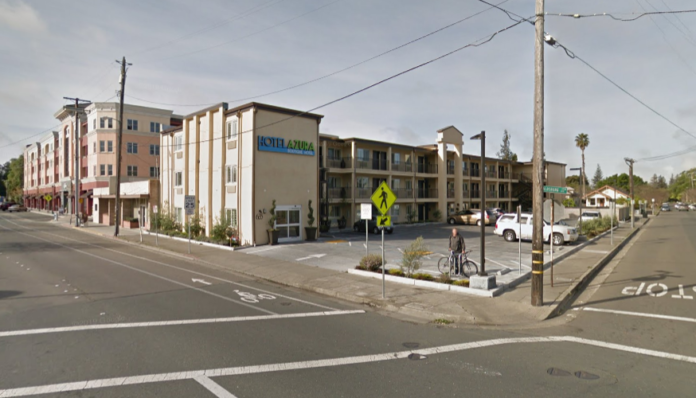
Late last year, the company lined up two contracts with the Sonoma County Department of Health Services. Under the larger contract, records obtained by the Bohemian show, Health Services paid Whitestar a total of $439,680 between Dec. 7, 2020, and April 30, 2021 to provide security services at two local hotels which the county purchased to offer shelter for people experiencing homelessness during the Covid-19 pandemic.
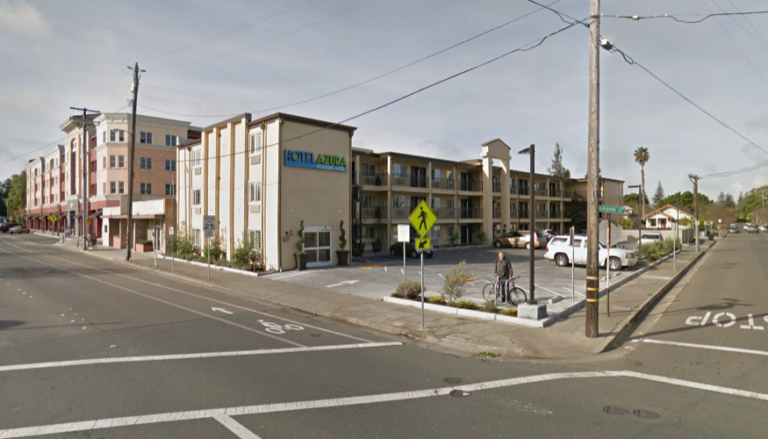
The county contract called on Whitestar to provide three unarmed security guards at Hotel Azura in downtown Santa Rosa, and the Sebastopol Inn on the outskirts of Sebastopol. If things ever got particularly dangerous, Whitestars’ guards were expected to call on the nearest law enforcement agency to manage the situation, according to the company’s contract with the county.
Jennielynn Holmes, Catholic Charities’ chief programs officer, says that the nonprofit hired Whitestar without a bid last year as the nonprofit scrambled to meet the increased demand for services caused by the Covid-19 pandemic.
Jack Tibbetts, the executive director of St. Vincent de Paul, the former employer of Rojas, says Whitestar was selected to provide security services at St. Vincent’s Los Guilicos encampment after the nonprofit conducted a competitive-bidding process.
Tibbetts, who also serves on the Santa Rosa City Council, acknowledges he’s a friend of Rojas but insists he followed proper procedures when it came to hiring Whitestar.
When the Foppoli story broke, both Catholic Charities and St. Vincent de Paul immediately replaced Whitestar with other security companies in an effort to distance themselves from the unfolding scandal. Emails obtained through a public records request show that Taylor and the Sonoma County Department of Health Services amended Whitestars’ contracts to end on April 30, the day Adams revoked the company’s license.
New Company
When Rojas left Santa Rosa to join the Navy late last year, Tibbetts served as his proxy on Whitestar’s board in February and March. Tibbetts says that he was not paid by Whitestar and that he received permission from St. Vincent’s board of directors to serve as Rojas’s proxy.
He resigned from his position at Whitestar on April 6, two days before the Chronicle published its first story about the allegations against Foppoli.
On March 26, Adams filed paperwork to form a new security company, Whitestar Protection Group, in order to start the process of creating a new security company after he revoked his license from the company in June.
When the Foppoli story broke, Adams says he approached Rob Muelrath, a local political and public relations consultant, for advice about how to distance his pre-existing Whitestar Group from the Foppoli-backed Whitestar Security Group. Muelrath, who runs Muelrath Public Affairs, has a long list of clients, including many local politicians.
Adams says that after talking to Muelrath and Tibbetts during the past month, he offered both men positions on the board of his new company due to Muelrath’s business acumen and Tibbett’s knowledge of the local system of care for the homeless.
Muelrath and Tibbetts both confirmed that Adams offered them positions at the company, however both say they have not responded to Adams’ offer.
In an email, Tibbetts said he hasn’t had time to fully consider Adams’ offer or to receive legal advice about whether working for the company might conflict with his position on the Santa Rosa City Council.
“At this point, I have not signed anything. I am not a partner, and I have accepted no compensation,” Tibbetts said.
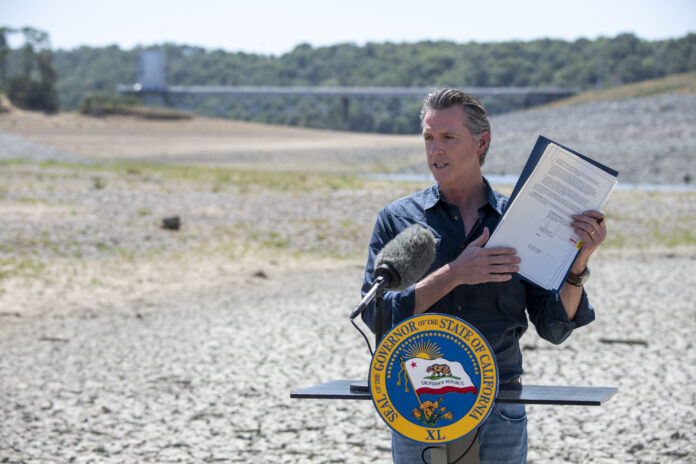
Gov. Gavin Newsom announced Monday that his proposed state budget includes a $5.1 billion investment in water infrastructure and drought resilience as the state faces critical water shortages in major reservoirs.
The proposed allocation would be spent over four years and includes $1.3 billion for improved drinking and wastewater infrastructure, $60 million to help the agriculture industry reduce its water use and greenhouse gas emissions and $200 million for habitat restoration.
Newsom, announcing the investment at the San Luis Reservoir in Merced County, said the state has lost some 500,000 acre-feet of runoff over the last three weeks compared to what state water officials expected.
That total is equivalent to the water usage by 1 million households for a year.
“What we’ve experienced is what some had predicted but no one had necessarily experienced,” Newsom said. “And that was snow melt so acute that it didn’t actually run off into reservoirs or rivers, but it actually seeped into the dry, parched ground underneath, much of it evaporating completely.”
Newsom’s announcement of the water infrastructure funding, part of the governor’s annual May budget proposal revision, came on the same day that he added 39 counties to the state’s emergency drought proclamation, including four in the Bay Area.
Alameda, Contra Costa, Napa and Solano counties were added to the proclamation. Newsom signed the initial proclamation last month, declaring a drought emergency in Sonoma and Mendocino counties due to historically low water levels in the Russian River watershed.
“It’s self-evident to many folks that the hots are getting hotter in the state, the dries are getting a lot drier,” Newsom said. “We have to recognize that we live in a world that we were not designed to live in. We have a conveyance system, a water system, that was designed to a world that no longer exists.”
Newsom is expected to tease out other portions of his May budget proposal revision this week before unveiling the full proposal on Friday.
Newsom and the state legislature will then have until June 15 to approve the budget before the new fiscal year begins on July 1.
The North Bay knows Napa-based artist and educator Nancy Willis for her landscapes and other paintings inspired from trips to Europe and especially the French countryside.
In addition creating to her own work, Willis inspires others to create art, and she normally offers art classes throughout the year and leads annual educational “Path of an Artist” tours abroad.
Although she could not make it to Europe in 2020 or this summer due to pandemic-related travel restrictions, Willis has expanded her local plein-air painting classes to several locations throughout Napa and Sonoma counties.
Willis is also currently showing work as a resident artist at the Solera Courtyard Gallery at the Westin Verasa Napa, which is just down the street from her Napa studio.
The hotel recently became an asset to the artist, as she took refuge there when the 2020 Glass Fire forced her out of her home. She and her cat Smiley lived at the hotel for a full month.
“For thirty days, I found a lifeline away from the smoke, the devastation and the trauma, and a safe place to regroup and recharge,” Willis wrote in a recent statement.
Willis will be displaying her work in the Solera Courtyard Gallery throughout the year, changing themes with each season. Currently, she is exhibiting “Summer Color,” featuring over a dozen works of art from her catalogue that speak to summertime activities or memories.
Willis also created some of the exhibition’s images during “guerrilla plein-air” sessions near Lake Hennessey or trips to Mendocino. According to Willis, the exhibition celebrates a brighter outlook, studying multiple motifs through the lens of color.
“The world is opening again and beauty is waiting to be discovered,” writes Willis in a statement.
For those seeking to paint their own summer landscapes, Willis has upcoming offerings that include wine and cheese pairings at Coursey Graves Winery, Old Faithful Geyser and Charles Krug.
“Summer Color” is on display through August 2021 at the Solera Courtyard Gallery Westin Verasa Napa, 1314 Mckinstry Street, Napa. For more information on Nancy Willis’ art and art classes, visit nancywillis.com.
Bay Area-based nonprofit organization Bluegrass Pride lifts up LGBTQ+ musicians and creators within the bluegrass music community; largely through concerts, jam sessions, showcases, festivals and parades.
In 2020, after the pandemic forced Bluegrass Pride to cancel in-person Pride programming, the organization made the pivot online, hosting a two-day livestream festival that raised more than $23,000 for the LGBTQ+ and allied artists on the lineup.
This year, the Bluegrass Pride Board of Directors has expanded that two-day livestream into a month-long virtual festival and fundraising event, Porch Pride, which will take place online throughout June.
Over the course of Pride month, Porch Pride will feature performances by bands and artists like Lavender Country, Rainbow Girls, Gangstagrass, Po’ Ramblin’ Boys, Jake Blount, Sunny War and others. The festivities will also include a virtual Bluegrass Pride brunch and open house, a beginner-friendly jam, and more.
The virtual Porch Pride event kicks off on Sunday, June 6, with Lavender Country Live, hosted by acclaimed musician, scholar, and Bluegrass Pride board member Jake Blount.
The following weekend, Bluegrass Pride hosts its popular and informal brunch gathering and open house on Saturday, June 12. The next day, virtual participants can join a friendly jam session featuring protest songs and movement music led by queer Nashville-based singer-songwriter Luisa Lopez on June 13.
The final two weekends of Porch Pride 2021 will feature two virtual festivals. On Saturday, June 19, Bluegrass Pride partners with Brandi Pace and Decolonizing the Music Room for Juneteenth: A Rainbow Revival. The three-hour series of performances highlights the trailblazing contributions of Black queer folks and trans folks to the Pride movement as well as to bluegrass and roots music.
Juneteenth: A Rainbow Revival is a proud recipient of the IBMA Foundation’s inaugural Arnold Schultz Fund grants. The International Bluegrass Music Association created the IBMA Foundation in 2007, and the foundation recently established the Arnold Shultz Fund to support activities increasing participation of people of color in bluegrass music. Arnold Shultz (1886–1931) was an African American musician from western Kentucky who had a profound influence on Bill Monroe and the development of bluegrass.
June’s final weekend will see a return of Porch Pride proper, this time celebrating Bluegrass Pride’s fifth anniversary and once again featuring two days of live music, performances, songs, and more, featuring headlining sets from Gangstagrass on June 26 and Rainbow Girls on June 27.
All of the event’s virtual programs are free to view and attend, and will be available to view online after airing. The nonprofit encourages fans, followers and listeners to donate to support the musicians and the ongoing work of Bluegrass Pride.
Beginning this week, the Sonoma-Marin Fairgrounds in Petaluma kicks off two months of fair activities, both online and in-person, that recognizes and adapts to the changing Covid restrictions and recommendations.
“It’s time to have some fun, but in a responsible way that supports the health and safety of our friends and neighbors in Marin and Sonoma Counties,” Fairgrounds CEO Allison Keaney says in a statement.
The schedule of festivities kicks off on Friday, May 7, with the first of four Drive Thru Fair Food weekends. Guests will be able to pick up classic favorites like funnel cakes, corn dogs, cotton candy, and giant curly fries.
By poplar demand, an enticing selection of smokehouse sandwiches, ribs, and giant turkey legs will also be on the menu. Drive Thru Fair Food will be open May 7-9, May 14-16, June 18-20, and June 25-27, from noon to 8pm.
“June 25th through 27th also happens to be our traditional Fair weekend, and we’ll be celebrating with added entertainment on the concourse for our drive-thru patrons,” Keaney states.
Fair rides are also coming back to the fairgrounds when Butler Amusements presents a pop-up carnival May 13–16 in the main parking lot. Once again, the fairgrounds states that Covid protocols will be in place to ensure a safe reopening. The carnival opens at 5pm on May 13 and 14 and at noon on May 15 and 16.
The Sonoma-Marin Fair will also present a streamlined exhibits program this summer to showcase the talents and accomplishments of Marin and Sonoma County residents, especially the youth.
Entries opened online on May 1 and exhibits are being be dropped off and judged in person at the fairgrounds. Youth will present their small animal and livestock projects in person as well. The grounds will not be widely open to the public, but the staff is working on plans to showcase exhibitors’ work, including a plan to allow exhibitors time to visit the hall with family and friends.
“We have a community of creative and talented people. Many have spent time at home in the last year trying new things or improving their craft. That needs to be celebrated,” Keaney states.
Virtual walk-throughs of the exhibit hall will be shared online, and the fair is also hosting an online Vendor Expo where the public can peruse goods and services and even interact live with vendors at scheduled times during the summer.
In addition, the Fair’s “North of the Gate” wine competition has moved to August and the Fair will be holding a ticketed tasting event in September.
“Our Fair theme this year is ‘Moovin’ On’ and while our world is still transitioning to the other side of the pandemic, it is great to be headed in the right direction and seeing the community come back together,” Keaney states. “We are excited to be a part of that.”
On April 22, the California Coastal Commission held a virtual hearing to discuss the impact of dairy and cattle ranching at Point Reyes National Seashore. Superintendent Craig Kenkel began his presentation with the words, “Point Reyes is the ancestral home of the Coast Miwok.”
Kenkel spent the rest of his talk advocating for a Park Service proposal to increase the terms of ranching leases from five to 20 years. This, despite the findings of an Environmental Impact Statement released by the National Park Service last year which revealed multiple harms caused by 150 years of bovine-centric agriculture at the seashore. The ongoing damage includes water pollution by cow urine and feces, atmospheric pollution by carbon and methane gas emissions, and the extinction of native plant and animal species. [See “Apocalypse Cow,” Dec. 9, 2020]
Kenkel said that extending the leases is necessary to “preserve multi-generational ranches” that are protected by the National Register of Historic Places. He did not mention that in 2015 the Park Service terminated a proposal to protect the archeological remains of Coast Miwok habitation using the National Register.
Rep. Jared Huffman came online and told the Commission, “Ranching is part of the Seashore’s DNA.” Five commissioners disclosed that Huffman telephoned them before the meeting, asking for a vote in favor of the proposal. But the congressman did not reach out to Theresa Harlan, whose family’s actual DNA is embedded throughout the Seashore.
In her testimony to the Commission, Harlan asked, “Why is a 100-year-plus dairy-ranching history more valuable than a Coast Miwok history of 10,000 years? You have a decision to either protect Coast Miwok archeological sites, or to add to the erasure of the Coast Miwok archeological record.” The Commission voted 5-4 to approve the Park plan to protect and preserve commercial agriculture at the endangered national seashore.
Tomales Bay Indians—Tamáls
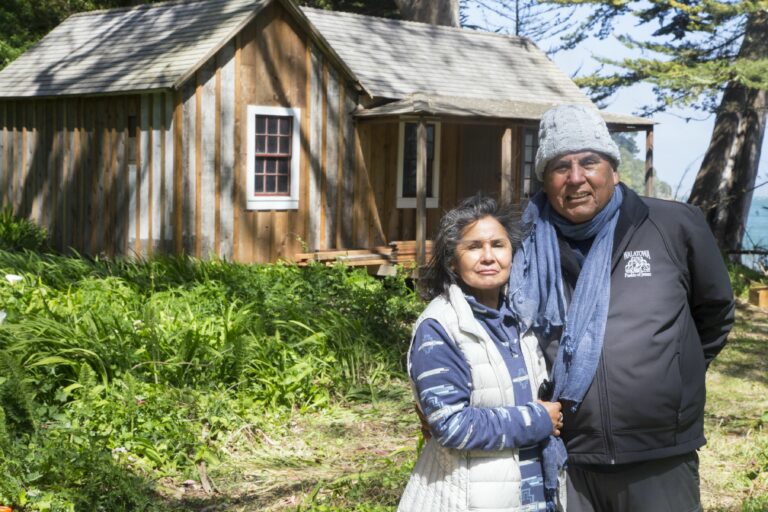
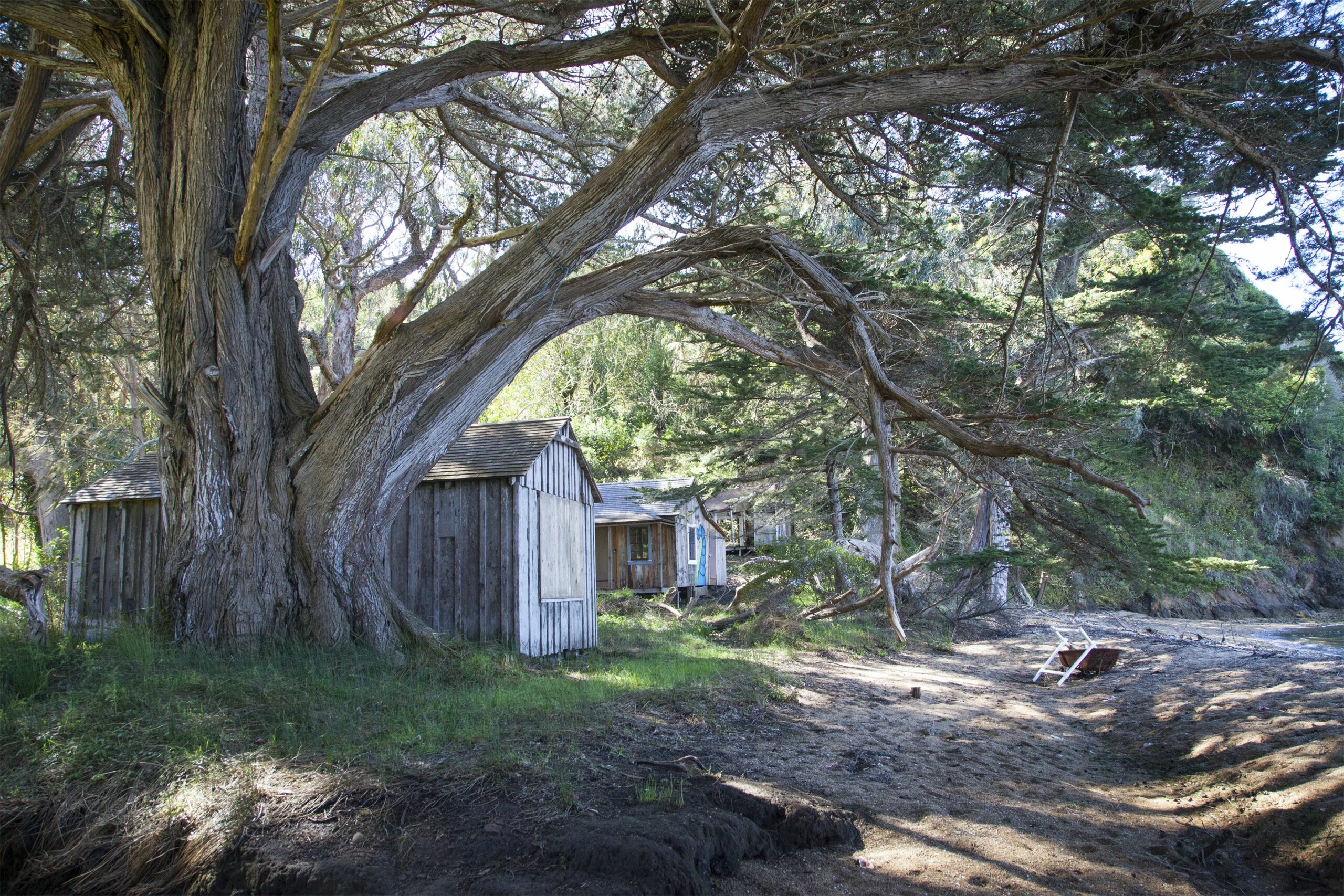
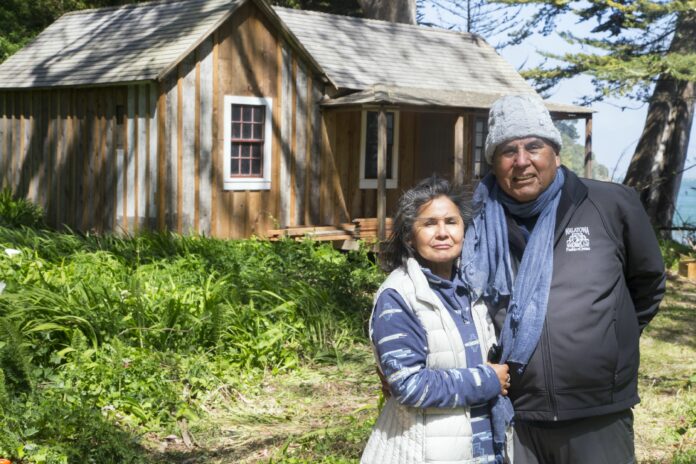
This reporter first met up with Harlan and her husband, Tiger, at Point Reyes. On a windy March afternoon, the two Indians and I hiked a dirt road as it curved into a tree-shaded cove on the west side of Tomales Bay. Revealed were wooden houses built by a Coast Miwok family during the late 19th century. A stream trickled onto the beach. Hanging from a tree, a frayed rope that once anchored a row boat danced in the wind. The place was Harlan’s ancestral home.
Harlan, 61, told me, “There is a myth that the Indigenous people simply walked away, and the land was empty, and the settlers came, and took title to it, and developed it, and there wasn’t any contest.” She channels a force greater than herself. “My people are still here. All public land is native land.” As the Indigenous saying goes, the people are the land.
In the language of the Coast Miwok people, Tomales Point is Calupetamál or Hummingbird Coast, and Point Reyes peninsula is Tamál-Húye, Coast Point. Ten thousand years ago, trekkers from Beringia settled in the fog-watered meadows of Tamál Húye, founding long-lasting, intelligently-managed societies that left an imprint on the land.
The modern descendants of these first peoples call themselves Tomales Bay Indians, Tamáls. Tamáls have survived Ice Ages, a 500-year-long drought, and rising seas, but it was industrial-strength colonization by Europeans at the turn of the 19th century thatproved to be near-fatal. Carrying guns, crucifixes and diseases, the potola-inigo, white people, despoiled Yówa, the land. They installed Western-style property “rights” that liquidated aboriginal presence. In an unrestrained search for profit, they felled oceans of redwood forests, slaughtered bears, wolves and tule elk, and began dairying.
Displacement and starvation propelled Coast Miwoks into virus-infected, Catholic-run plantations to work as slaves and concubines. After the San Francisco and San Rafael agricultural mission lands were secularized and sold in 1834, Tamáls made their way back home. But Tamál Húye was changed. “Point Reyes became Rancho lands, with huge herds of cattle initiating the destruction of the Native resource base,” the National Park Service wrote in a 2008 report to the National Register of Historic Places.
Making matters worse, after California was awarded statehood in 1850, the U.S. Army and gold- and cattle-crazed vigilantes murdered and terrorized natives by the thousands. Indians were legally classified as subhuman. “Native Americans were denied citizenship, voting rights, and were not allowed to testify in court against white defendants … any [orphaned] Indian up to 18 years old could be assigned to a white family for up to 14 years of labor,” wrote anthropologist Lynn Compas in a 1998 report to the Park Service assessing hundreds of Indigenous archeology sites throughout Point Reyes.
The coves of Tomales Bay offered shelter from the holocaust of Manifest Destiny and institutionalized racism. Some returnee Tamáls, including Harlan’s great-great grandmother, Euphrasia, married non-Indian laborers. And for a century, cove-dwellers raised children, fished, hunted and tended Tamál Húye as best they could under colonial conditions. They worked as cooks and fieldhands for European immigrant ranchers who barb-wired the commons, dammed the streams and polluted beaches as they reshaped Tamál Húye to suit burgeoning beef and dairy industries. Colonial governments outlawed the controlled burning of forests and fields as practiced by the Indigenous for the benefit of all beings.
And yet, despite the destruction of Tamál Húye, and despite the price of being known as Indian in a white-dominated world, many 19th- and 20th-century Tamáls self-identified as Indigenous. They did what they had to do to survive, but they also passed the ancestral ways and traditions on to their children through storytelling.
More than a family saga
Harlan’s mother, Elizabeth, was raised at the cove which is mapped as “Laird’s Landing,” after a butter-and-cheese dealer who ran K Ranch up the hill. Elizabeth’s mother, Bertha Felix Campigli, was born at the cove in 1882 to Joseph and Paulina Felix, both of Tamál ancestry.
Joseph’s parents were Domingo Felix, a Filipino, and Euphrasia Felix, a Coast Miwok who had left Mission Dolores when San Francisco was nothing but “forest and a log house,” she reportedly told a friend. Euphrasia, Domingo and their children had moved to Tomales Bay around 1860 after a Marin County Tax Assessor named James Black bought the Miwok rancheria in Nicasio where they had resided, and expelled the people.
At the cove, generations of Felixes built residences, sheds, gardens and chicken coops and quietly lived off the land. Calvin Coolidge was elected president, and Bertha married her fifth husband, Arnold Campigli, a hunter, farmhand and jack-of-all-trades. Campigli’s Swiss-Italian parents tenanted a dairy ranch near Coast Camp. They disowned him for marrying an Indian, and he did not look back. In 1925, Bertha gave birth to Elizabeth, the youngest of her eight children. With teenagers spilling out of the one-room house, Campigli built a second one-room dwelling. They had no electricity, gas heat or telephone. “We were poor, but not hungry,” Elizabeth said in an oral interview with a Park Service historian.
Tamáls fought in wars, married, moved to cities and returned to Tomales Bay. After World War II, Elizabeth married John Harlan and they made a home in Napa, where Theresa and her sister, Beverly, were raised. Harlan, of the Kewa Pueblo tribe based in New Mexico, was adopted by Elizabeth and John as an infant, and raised as a Tamál.
Theresa Harlan’s grandmother, Bertha Felix Campigli, was born at Laird’s Landing in 1882. Photo courtesy of Theresa Harlan.
After Bertha died in 1949, S.A. Turney, the owner of K Ranch, evicted the Felix family from the cove and put their homestead up for sale. Court records document how the Felix family fought back, providing testimony from community elders that their family had resided at the cove before K Ranch was deeded, which meant they could own it under common law. But because Marin County had never billed the family for property taxes, an appellate court ruled in 1954 that they had to leave. Campigli moved in with daughter Elizabeth in Napa.
Harlan grew up hearing hilarious stories about the hard-easy life. There was Babe, a cow who cow-paddled around Tomales Bay scouting for bulls when in heat. And then there was the afternoon when Elizabeth had finally had it with racial taunting, and beat up a pack of white boys who bullied her. She cherished the memory because the school’s only teacher had defended her against outraged parents, saying that the rancher-kids deserved it.
In the early 1960s, an itinerant artist named Clayton Lewis moved his family into the Felix’s empty houses, with the K Ranch-owner’s blessing. When the Park Service bought the cove in the early 1970s, it allowed Lewis to stay. Treating the land as his private property, he remodeled the houses to suit his “countercultural” tastes. He built a foundry where he fashioned jewelry and sculpture. He threw wild parties. He dug privy and trash pits. Once, he uncovered and displayed a human skull, until giving it to the University of California. “I want the remains returned to my family,” Harlan said.
After Lewis died in 1995, the Park Service allowed the buildings to decay, to become snarled with vines and cracked by tree limbs. As Harlan, Tiger and I peered into the broken houses, we saw tags and cartoons defiling walls. There was a pile of trash and construction rubble on the lawn, left there by the Park Service in 2017 after it demolished the foundry. For Harlan and her family, the trash, graffiti, weeds and jungle of vines desecrate a place inhabited for thousands of years, a place made sacred because people are the land.
On April 2, Kenkel met privately at the cove with Harlan and a dozen of her relatives. Family members took turns speaking about why the place is special. Elder Arlene Delahoussaye, of Daly City, shared, “I think of this place as my true home. And I always bring my children and grandchildren here to picnic.” The family is asking that Laird’s Landing be reinvented as a living cultural center celebrating the Indigenous practices of managing the land for the common good. The superintendent promised to consult with the family on a restoration of the houses, Harlan told me.
Days later, the Park Service hauled away the pile of rotting garbage. The agency assigned a team of youthful carpenters from a national nonprofit to work on restoring the vandal-shattered structures, and there are some signs of progress.
Harlan has a degree in ethnic studies from Berkeley. She is a professional art curator, and worked as a legislative analyst for the California Department of Public health before retiring last year. Her goal is that all of Point Reyes, the land of the Tamál people, be given over to the ministrations of future-conscious caretakers. Lessons for the healing of Earth are encoded in the human-shaped lands of Tamál Húye, and the ancient guidelines are needed now more than ever. But at the Park Service, politics rules the day.
Playing shell games with historic districts
Since 1976, a series of archeological “reconnaissance” studies commissioned by the Park Service have determined that a combination of natural erosion processes and cattle ranching and park construction activities are destroying the land’s record of Indigenous history. Sonoma State University anthropologists collaborating with the Park Service to monitor the condition of ancient Tamál habitations have repeatedly urged it to protect all of Point Reyes National Seashore as an Indigenous Archeological District on the National Register of Historic Places.
In 2008, using more than a decade’s worth of Sonoma State research, the Park Service nominated an Indigenous Archeological District to the Register, which is a division of the Park Service. The proposal languished in bureaucratic limbo for seven years with no action. Meanwhile, in 2013, the Register quickly protected the Drakes Bay Historic and Archeological District, which was created to celebrate the 16th century pirate Francis Drake; more on that story below.
Here is the shell game: In 2015, the Park Service withdrew the Indigenous District nomination and replaced it with an application for a Historic Dairy Ranching District to protect 17 spreads. The Register rapidly approved the newly created Dairy Ranching District, even as the Indigenous District proposal was taken off the table.
The anointing of the park’s dairy and cattle ranches as “historic” by the Register serves to prioritize funding the preservation of commercial ranching infrastructure over preserving Indigenous archeology. It creates federal tax credits for ranchers. It is also a key element in the Park Service’s public relations campaign supporting the lease extensions. But, as Harlan observed, the politician- and business-powered campaign for “preserving ranching culture” is predicated on erasing the cultural and scientific significance of 10,000 years of Tamál habitation.
Tsim Schneider is a professor of anthropology at the University of California, Santa Cruz. He is also a member of the Federated Indians of Graton Rancheria, whose homeland includes Tamál Húye. Schneider researches the ways in which Coast Miwok people survived existential crises through the millennia. Most importantly, he views research that focuses only on the harm done to Indigenous societies as a tacit form of “taking the accomplishments of the colonial elites for granted.” Coast Miwoks were written out of the anthropology textbooks, he says, with “terminal narratives that reinforce the logic of settler colonialism by eliminating narratives of Indigenous survivance” and an “outdated colonial-Indigenous dichotomy that essentializes landscapes along tidy, racialized boundaries.”
Tomales Bay was a refuge for “Indians unwilling to be converted [to Catholicism]” where Tamáls engaged in “creative cultural resistance, preservation of identity, linking memory and physical surroundings,” Schneider says.
Two related misperceptions about the Coast Miwok have informed scientific research, Schneider says. One is the mistaken idea that the Coast Miwok were extinct by the 1920s. A related error is that science tends to “conflate chronology with identity. It treats ancient people as frozen in time, as fossils trapped in amber.”
Obsessing with pinpointing the dates of a pot, bone, bead or house pit breaks the living link between past, present and future. Focusing on dating and classifying objects compartmentalizes the flow of the human story and fails to reveal the continuity of social systems and of human agency from time immemorial to now.
Speaking as a Coast Miwok, Schneider says, “Our knowledge of these places, our memories of these places, have always been secondary to science. There is a saying among Indians that archeologists borrow our watches to tell us the time.”
Schneider tells the story of an archeologist digging at Laird’s Landing in 1934. The scientist “recorded ‘broken mortars’ and ‘a good specimen of a spear head’ in the artifact description, while casually mentioning that an ‘Indian woman, [Bertha] Campigli, has lived on this site for many years.’” It did not occur to the man that it was the living woman’s ancestors who fashioned the spearhead and hunted with it, who processed meal with the mortar and who lived for thousands of years in relatively stable societies. “The presence of Harlan’s grandmother was a living sign that Tamals stayed on ancestral lands because the people are the land,” Schneider says. Tamáls were not eager to assimilate into an alien, racialized society. They knew their ancestors had created the once-vibrant ecology of Tamál Húye, and hoped those lessons would not be forever lost. Today, Harlan stands in the place of her grandmother.
After demolishing a foundry in 2017, the National Park Service left piles of trash and construction rubble on the lawn of the Felix homes at Laird’s Landing. The trash was finally removed in April. Photo by Peter Byrne.
The trail of the dead
The first archeologists to explore Tamál Húye envisioned the story told by the land through the thick lens of settler colonialism. They assumed nothing of much importance happened to the people whom they named Coast Miwok until 1579, when Drake supposedly “discovered” Punta de los Reyes, Point of the Kings. It turns out that decades of Drake-obsessed archeological research at Point Reyes was based upon a lie.
In 1936, the social club E Clampus Vitus claimed to have found a 16th-century “Plate of Brass” near Drakes Breach. “Despite initial authentication, the plate was ultimately determined to be a hoax, a prank … For at least two decades, however, belief in the plate’s authenticity perpetuated nearly exhaustive excavation at Point Reyes in search of Drake’s campsite and other evidence of his stay,” the Park Service reported to the Register.
The settler-colonial mindset still prevails at the Park Service. The agency claims that the Drakes Bay Historic and Archeological District is deserving of the Register recognition it rendered in 2013, because Sir Francis Drake “strengthened England as a maritime power and gave England a stake in western North America,” and the District “includes 15 California Indian sites that provide material evidence of one of the earliest instances of European contact and interaction with native peoples on the west coast of the United States.”
In the 1920s, University of California, Berkeley archeologist Alfred Kroeber declared the Coast Miwok were no more. That erroneous assumption guided his doctoral students, James Beardsley and Robert Heizer, during the 1940s, as they shoveled shell mounds all over Point Reyes looking for artifactual evidence of Drake’s passage. The scientists unearthed 122 human skeletons and hundreds of charm stones, beads, knives, arrowheads, awls, whistles, mortars and pestles fashioned by ancient human hands. Many of the grave-related artifacts are still stored at the Phoebe Hearst Museum in Berkeley.
For the Berkeley anthropologists, the real treasures were the non-Indian artifacts found mixed with human remains—shards of blown glass, spent cartridge shells and fragments of blue-and-white Ming china. They theorized that because the Indigenous people were unable to comprehend European technology, they had repurposed shattered china as cutting tools, iron spikes as awls and glass as ornament. The 16th-century inhabitants of Tamál Húye may very well have been awed, perplexed and even frightened by machine technologies foreign to their world. But it was a culture-laden mistake for scientists to presume that Indigenous people were not capable of taking an active role in the history of the world until they absorbed the miracles of the West.
Only recently has it occurred to anthropologists that the Indigenous were potent scientists, keenly observant of the forces connecting trees, rocks, fire, water, plants, animals, life and death. In the early 1930s, an observant ethnographer named Isabel Kelly recorded Coast Miwok elders speaking of ancient technologies and beliefs. Tom Smith and Maria Copa spoke of where, at Tamál Húye, “a place of rock about two feet long marks the spot where the dead jump into the ocean. They go down there. They said that was the trail of the dead. Over the land they traveled on a cloud path. They go there to be with Coyote where the sun goes down. They never come back—maybe in night time.”
Maybe in night time
Laws and ethical codes guiding 21st-century archeology recognize that the bodily remains and belongings of Indigenous people must remain undisturbed. Government agencies are urged to accept tribal leadership in all matters that are principally Indigenous. In short, Tamál Húye is not the property of the Park Service, just as it was not the property of European settlers. And yet, the Park Service has long acted as if it is the indisputable lord of hundreds of Indigenous villages, food-processing camps, rock shelters, house pits, hunting blinds and lithic scatters endemic to the 71,000-acre Seashore. It acts as if preserving the archeological story is compatible with dairy and cattle ranching, which is demonstrably not the case.
The aforementioned Environmental Impact Statement strongly prioritizes protection of ranch history over preserving Indigenous archeology. While confirming that cattle have been and continue to disturb “sensitive” archeology sites, the statement promises, in the future, to “take measures … to exclude cattle.” However, it will allow “targeted” grazing at known locations, and unrestrained grazing on the many that are undoubtedly unknown, and therefore, subject to inadvertent destruction.
Kevin Lunny’s family has run cattle on a ranch overlooking Abbotts Lagoon since World War II. Lunny told the Bohemian/Pacific Sun that obsidian flakes are abundant on lagoon beaches, but his cattle are fenced off. He said it is possible that cattle may be damaging archeological sites on other ranches. “Ranchers are willing to work with the Park Service and the Graton tribe to protect Indigenous sites,” Lunny said.
The Federated Indians of the Graton Rancheria represent the Miwok and Pomo peoples of Sonoma and Marin Counties and Point Reyes. According to Chairman Greg Sarris, the tribe is negotiating a confidential agreement with the Park Service to protect archeological sites.
But last year, the Park Service failed to consult with the Graton tribe, as it is required to do by law, when it released the Environmental Impact Statement calling for extending cattle operations in perpetuity.
In December, the tribe informed the Park Service of the oversight. The tribe wrote, “We are disappointed that the National Park Service did not reach out to us and provide an opportunity for our Tribe to consult with the agency, as is required under Executive Order 13175.” The tribe continued, “We need to revisit the ranching lease program and look for ways that enable the landscape to heal. This should be done with the Tribe and using our traditional ecological knowledge and understanding of the land.”
TheresaHarlan’s family is asking that Laird’s Landing be reinvented as a living cultural center celebrating the Indigenous practices of managing the land for the common good. Photo by Jocelyn Knight.
Cattle trample Indigenous history
Federal laws require the Park Service to protect Indigenous archeological sites. By the agency’s self-assessments it is failing to do that at Point Reyes. Documents obtained by the Bohemian/Pacific Sun under the California Public Records Act reveal that many Indigenous archeological sites inside park boundaries have long been violated by ranching and the construction of roads, trails and facilities serving tourists.
In the 1990s, the Park Service began working with anthropologists based at Sonoma State University to engineer a preservation plan for more than 150 Indigenous sites. The resultant field work formed the scientific underpinning of the Park Service’s later withdrawn nomination of the Indigenous Archeological District.
In 1998, Sonoma State graduate student Lynn Compas reported that many of the Indigenous sites were damaged by “ranching, visitors, and construction. … [C]attle grazing causes damage to archeological sites. … [R]emains may be obliterated or obscured.” She observed that the Park Service could prevent further destruction by “extensive cattle grazing” by curtailing ranching activities. Realistically, though, she mused, “Ranching is a source of revenue for [the Park Service] and will continue, therefore impacts to archeological sites from cattle must be evaluated before more archeological data is lost.”
Compas reported that while the Park Service substantially funded the preservation of settler-era ranching culture, there was little or no funding for preservation of Indigenous culture. She said that the stories revealed at the Indigenous sites are important because, “One of the dominant paradigms of the past has been that ‘interactions between Native Americans and Europeans were governed and structured by European objectives and that the role of Native peoples was passive and easily explained.’” She observed that a core group of Tamáls had resisted colonization and survived at Tamál Húye through the generations, physically, spiritually and culturally.
Uniting the past and present, Compas noted that at Laird’s Landing “the buildings and the archeological site are in good condition. … The mixture of artifacts demonstrates that the Coast Miwok strategically retained traditional lifeways while accepting new ones in order to survive.”
Compas identified Tamál families who in the early 20th century resided in the Tomales Bay coves: Ouse, Alcantra, Campigli, Sandoval, Jewell, Felix, Friase, Elgin, Sanchez, Goosman, Zopie and Weber. She reported archeological evidence that the coves were homesteaded for thousands of years, and that sites with prehistoric human remains were disturbed or vandalized by campers, and that “a request for funding to remove the burials to a safer place was made by PRNS in 1997, however the funding request was denied.”
Compas suggested that money for protecting the Indigenous sites would be forthcoming if the sites were placed on the National Register of Historic Places.
Subsequently, Sonoma State graduate student, Barbra Polansky, conducted “the inventory, research, and analysis necessary to nominate the PRNS Prehistoric Archeological District.” The proposed district encompassed the entire acreage of the park “in the hopes that [the site’s] significance and tremendous research potential may be recognized.”
Polansky defined patterns of how Coast Miwok adapted to climate and social stresses by “exploiting the richest area of resources that require the least amount of energy.”
She researched how the Tamáls used plants, game and shellfish to sustain large populations at Tomales Bay, Drakes Estuary and Abbotts Lagoon. Ducks, sandpipers and mud hens were lured by decoys stuffed with grass, and then trapped with nets. Hunters felled birds on the fly with bolas made of string-wrapped heavy bones. Owls were downed with bow and arrow. “Miwok did not generally eat bears, because a bear was considered to be a person.”
Polansky cautioned, “Cattle grazing and current and historic ranching activities can mix the soil or midden deposit and obscure features such as house pits.” She noted, “PRNS is one of the finest, most intact examples of California Coast archeology,” and even though the sites are threatened by “cattle grazing, plowing and past archeological excavations. There is still much information to be gained.”
Building on Compas’ and Polansky’s research, a bevy of Sonoma State professors led by Suzanne Stewart contracted with the Park Service during the aughts to craft a formal application for an Indigenous Archeology District. According to Stewart, “By about 10,000 years ago, California’s Paleo-Coast peoples were traveling in seaworthy boats, using fish hooks and other fishing tackle, hunting marine mammals and sea birds, weaving cordage and basketry from sea grass, and making shell beads for ornamental use and exchange with interior peoples.” She detailed the existence of four large villages and more than 100 sites, one-third with “human skeletal remains, some with moderate to abundant grave goods … the sheer size and relative wealth of [village] site constituents suggest a focus of activity—perhaps serving as a ceremonial and political center for the locality.”
Stewart called for examining ancient plant and animal remains to learn from responses to extreme climate variations by prehistoric populations. She lamented, however, that at fragile archeological sites, “non-native, domestic range animals have … exacerbated erosion [of sites] by over-grazing and trampling.”
Decades of research shows that the Coast Miwok’s non-patriarchal social system encircled Tomales Bay and spread throughout the Point Reyes peninsula. There were large villages at the mouth of the Bay and at Olompali. Drakes Estuary was basically a larder. The largely peaceful Tamál economy was collectivized, with limited, family-oriented property rights to defined food-bearing areas. But, mostly, they strove to co-exist with Yówa and all of Coyote’s creations, adapting to environmental stresses by intelligently managing energy resources in ways we are at risk of forgetting.
Autopsy of the Indigenous District
In California, nominations to the Register must be approved by the state Office of Historic Preservation. On May 12, 2008, the Office acknowledged receipt of the Indigenous Archeological District application and promised to review it. And then, nothing.
Until March 5, 2015, when the Office returned the nomination to the Park Service, “with brief comments to inform a future resubmittal.” The Park Service did not resubmit it.
In fact, “The Park Service withdrew the nomination,” Julianne Polanco, State Historic Preservation Officer, told the Bohemian/Pacific Sun. Why?
In Harlan’s opinion, “The Park Service pulled the Indigenous Archaeological District nomination because the protections of a historic place listing would interfere with rancher interests. The Park would be forced to re-direct resources to tell the story of 10,000 years of Coast Miwok land stewardship, thereby diminishing the 150 year rancher history.”
Case in point: the park’s website falsely asserts, “The dairy and cattle ranches on Point Reyes peninsula represent the single largest cultural landscape.” In fact, the Indigenous landscape is more than three times the area of the ranching district. Indigenous culture is vastly older and more venerable than the capitalist byproducts of imperial Christianity.
Even as it aborted the Indigenous district in 2015, the Park Service asked the state to sign off on the demolition of all of the buildings at Laird’s Landing as unsafe. The preservation officer forbade the demolition of the Coast Miwok houses. But instead of moving to preserve Laird’s Landing as an example of thousands of years of continuous Indigenous presence, the Park Service incorporated the Felix buildings into the historic ranching district nomination, “as a reflection of how native populations adapted to European cultural ideals and practices and for its association with the history of tenant laborers.”
Looking towards the future, the Graton Rancheria released its Tribal Perspective on Climate Change in 2013. The tribe speaks of the hundreds of sacred sites throughout the park that are threatened by erosion and submergence as the seas rise again. “In the traditional and historical cultural order, the destruction of cultural resources occurred and this loss was permitted because the spirits in nature have power over them. Now, natural climate change and its effects cannot be separated from … pollution from modern life and industry.” Human action is required if Tamál Húye is to heal from human action.
And the dead abide.
Craig Kenkel and Point Reyes National Seashore staff did not respond to multiple calls and emails requesting comment on the facts presented in this story.
Fourteen months into the Covid-19 pandemic, the North Bay remains in the Orange Tier, designated by California’s “Blueprint for a Safer Economy.”
As venues and business slowly open up for in-person events, several groups keep the distancing going with virtual event offerings this weekend. Here’s a roundup of what’s coming up.
Virtual Reading
Pioneering scientist Dr. Suzanne Simard has changed the way we understand forest ecosystems, and her work in studying plant communication and intelligence is often compared to the works of Rachel Carson. Now, in her debut book, Finding The Mother Tree, Simard illuminates the intimate world of the trees, and the complicated underground networks by which trees communicate. Simard reads from FindingThe Mother Tree and speaks with Pulitzer Prize–finalist David Haskell, author of The Songs of Trees, in an online event hosted by Point Reyes Books and co-sponsored by Emergence Magazine on Friday, May 7, at noon. Registration required at ptreyesbooks.com.
Virtual Event
Bay Area–based nonprofit organization California Trout works to ensure resilient wild fish thrive in healthy waters throughout the state. This week, the group marks a milestone in conservation with the 2021 Trout Camp Gala, which celebrates 50 years of action and success. The gala boasts a high-energy virtual showcase hosted by CalTrout Executive Director Curtis Knight, and CalTrout board member and owner of Lost Coast Outfitters George Revel. Tune in to see the innovative conservation work across the state, cameos from CalTrout staff and more on Friday, May 7, at 6:30pm. Free; RSVP required at caltrout.org.
Virtual Talk
May is Mental Health Awareness Month, and this month is also the 60th anniversary of the first time that Peanuts comic-strip character Lucy put “The Doctor Is In” sign on her psychiatry booth—from a Peanuts strip first published on May 4, 1961. In that context, the Charles M. Schulz Museum is hosting a virtual panel discussion, “The Doctor Is In: Exploring Mental Health Through Comics,” moderated by cartoonist and medical professional Dr. Ian Williams and featuring cartoonists Brick—a.k.a. John Stuart Clark— Gemma Correll and Ellen Forney on Saturday, May 8, at noon. Free; pre-registration required at schulzmuseum.org.
Virtual Class
The Sonoma County chapter of nationwide nonprofit group Cake4Kids launched in August of 2020 to provide underserved children and at-risk youth with a cake on their birthday as a memorable and impactful positive experience. This weekend, Cake4Kids offers everyone a positive experience with a virtual Family Bake-A-Long led by Sonoma County pastry chef Mimo Ahmed. Born in Ethiopia, Ahmed is best known in the North Bay for her blog, The Empty Plate, and she teaches participants how to make classic chocolate-chunk cookies and snickerdoodle cookies from scratch while raising money for Cake4Kids on Sunday, May 9, at 11am. $25. Register at cake4kids.org.
Virtual Concert
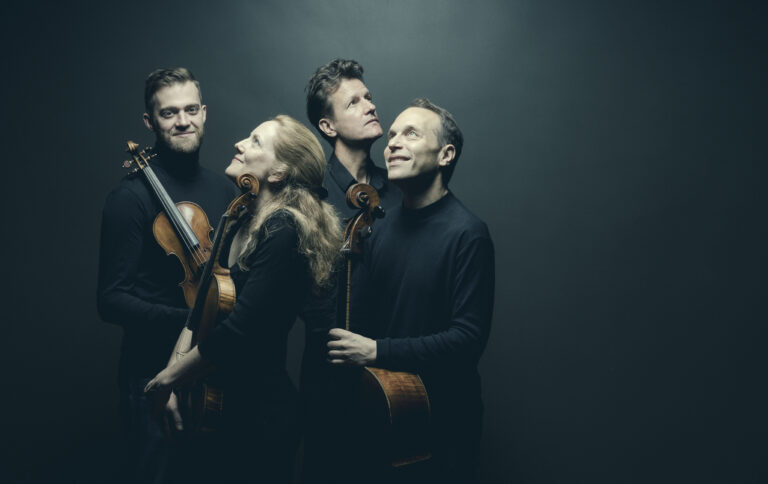
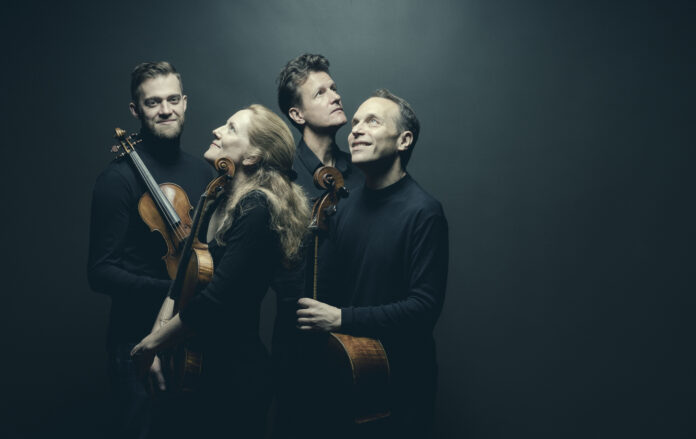
Beginning last fall, the Green Music Center–Sonoma State University’s world-class live music venue–has offered two semesters’ worth of online shows in lieu of live events. Dubbed ‘The Green Room,’ this virtual program of events comes to a close this weekend when Green Music Center hosts a virtual concert experience from the renowned St. Lawrence String Quartet on Sunday, May 9, at 3pm. $10. Get tickets at gmc.sonoma.edu.
It was not my first. At the other two services, my mind and emotions shut off. I don’t remember them, more than arriving, feeling weird and feeling no connection with anyone else present, alive or underground, although I was related to the celebrants.
I didn’t know what to expect from a funeral service, much less that it was being held in a cemetery, at her gravesite. A friend asked, “Where else would it be held?” “Uh, I don’t know,” I answered.
The lady was a gracious, gentle soul who delighted in life and in nurturing life around her. Her joy at being alive was unmistakable; that she revered life in all its forms was obvious.
I suppose I had some preconceived notions about size being important. “The bigger the better.” “The one with the most toys when he dies, is the winner!“ (or, in this case, “she”). The greater the number of people who show up for the service, indicates how “good” a person they were or “how well-loved” or “how many points they had accumulated in their lifetime” …
Achievements are often listed pompously and at great volume; her achievements were palpable in the loving gentleness and the humorous laughter shared by her family members and friends present for their last farewell, a remembrance of her kindness and encouragement to all. A life well lived and well loved.
The feelings were authentic, as was she. The sadness I experienced among the witnesses at her last resting place and felt at the service was mixed with the elation her loved ones held close to their hearts at remembering how much joy she brought to all, each day she walked with us.
I had no clue that a funeral remembrance service could be so fulfilling, so uplifting, so honoring of her enjoyment of life and overflowing with unifying community spirit. Could we but exchange those feelings with each other every day, remembering that each moment of life is a gift, and hoping that we can all tune into sharing the “present.”
Joy Appleby lives in West Marin. We welcome your contribution. To have your topical essay of 350 words considered for publication, write op*****@******an.com.
As the North Bay inches towards the reopening, several groups keep the distancing going with virtual event offerings this weekend. Here’s a sample of what’s coming up online.
Virtual Reception
Under the supervision of art instructor Ginny Geoghegan, Tomales High School’s art program remained a bedrock of creativity for students navigating the course of the past year’s unprecedented distance-learning ordeal. This...
By Ann Troy
Driving is one of the most stressful things we do—and it brings out the worst in us. Most of us don’t progress to road rage, but still, our anger and frustration take a toll on us and on those around us.
I have thought a lot about this and have come up with some tips to make it...
The North Bay knows Napa-based artist and educator Nancy Willis for her landscapes and other paintings inspired from trips to Europe and especially the French countryside.
In addition creating to her own work, Willis inspires others to create art, and she normally offers art classes throughout the year and leads annual educational “Path of an Artist” tours abroad.
Although...
Bay Area-based nonprofit organization Bluegrass Pride lifts up LGBTQ+ musicians and creators within the bluegrass music community; largely through concerts, jam sessions, showcases, festivals and parades.
In 2020, after the pandemic forced Bluegrass Pride to cancel in-person Pride programming, the organization made the pivot online, hosting a two-day livestream festival that raised more than $23,000 for the LGBTQ+ and allied artists on...
Beginning this week, the Sonoma-Marin Fairgrounds in Petaluma kicks off two months of fair activities, both online and in-person, that recognizes and adapts to the changing Covid restrictions and recommendations.
“It’s time to have some fun, but in a responsible way that supports the health and safety of our friends and neighbors in Marin and Sonoma Counties,” Fairgrounds CEO Allison...
Fourteen months into the Covid-19 pandemic, the North Bay remains in the Orange Tier, designated by California's "Blueprint for a Safer Economy."
As venues and business slowly open up for in-person events, several groups keep the distancing going with virtual event offerings this weekend. Here’s a roundup of what’s coming up.
Virtual Reading
Pioneering scientist Dr. Suzanne Simard has changed the...
By Joy Appleby
I just attended a funeral.
It was not my first. At the other two services, my mind and emotions shut off. I don’t remember them, more than arriving, feeling weird and feeling no connection with anyone else present, alive or underground, although I was related to the celebrants.
I didn’t know what to expect from a funeral service, much...