
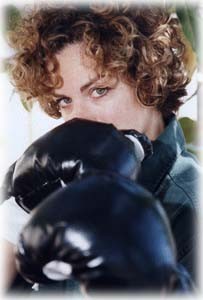
Shann Nix

0

Putting the Nix on Radio


Photos by Janet Orsi.

If sisterhood is so powerful, why is radio talk-show host Shann Nix one of the only airwave sisters with power?

By David Templeton

WITH her head wrapped in a turban of headphones and both hands on the gleaming control board before her, radio talk-show host Shann Nix aims her voice and attention at a tall, stainless steel, table-mounted microphone into which she vehemently–passionately– argues with an unseen late-night opponent.

“That’s all well and good, ma’am,” she says curtly, her eyes fixed straight ahead on the reflective glass window that contains the darkened and vacant KGO news room. “That would be lovely! It would be wonderful if people waited until marriage to have sex. But the truth is, people don’t! It would also be nice if there were no stupid people. Or no ugly people. It would be nice if there were no poverty, too, and no ignorance. But this is the real world, ma’am, and guess what? That just ain’t the way it is. So let’s work with what we’ve got instead of whining about what we’d like to have.

“Thanks for your call. Now let’s hear from Jerry in San Jose. Jerry, you’re on KGO with Shann.”

During this fiery, 22-second retort–overheard by more than a million Bay Area insomniacs and graveyard-shift radio listeners–Nix successively acknowledges my presence with a welcoming wave; motions me to a seat across the control board from her; receives elaborate pantomimed instructions from producer Beth Rimby; looks up to check the clock (it is 11:55 p.m., five minutes till the midnight news break); and finally rolls her eyes in amazement and dismay at the sad simple-mindedness of people like “ma’am.”

Next into the ring: poor, unsuspecting “Jerry in San Jose,” who has called expecting Nix to affirm his decision to let his teenaged daughter entertain overnight boyfriends, “as long as her grades remain high.” Nix demurs, and Jerry instead reels from a volley of aphoristic rabbit-punches that will result in a classic Nix knockout.

As the caller is being rendered retortless, I glance around the studio. It’s a small place, crowded with high-tech accoutrements, but blessed with a massive window that exposes a mostly darkened San Francisco skyline and the even darker bay beyond.

In this room, I can almost feel the cast-off energies of other notable KGO celebrities–people like Bernie Ward, Ronn Owens, Dr. Dean Edell, Rich Walcoff, the long-since-defected Michael Krasny, and the late, great Duane Garrett–talented, sometimes irritating men who’ve sat in the very chair in which Nix now pivots, deftly pissing off some of the very same listeners.

WELCOME to the ferocious, gladitorial arena known as KGO NewsTalk (810-AM). It’s a high-stakes player in a high-stakes industry; a statewide ratings giant, comfortably housed in the monolithic West Coast headquarters of the Walt Disney­owned American Broadcasting Co. Unlike mere music or news stations, news talk is a business that demands far more than articulation and velvet-voiced smoothness from its on-air performers; as demonstrated by the likes of liberal Tom Lykis, conservative Rush Limbaugh, and apolitical shock-jock Howard Stern, these performers are under a mandate to get people steamed, to go for the throat: in short, to get the damn phones ringing.

After three years in the business, the 30-year-old Nix is still considered the new kid on the talk radio block. Working hard to develop her taste for the raw jugular vein while honing her own style–passionate, edgy, defiant, sexy in an intimidating sort of way–Nix is winning fans and enemies across Northern California and beyond. This after having spent her 20s achieving a fairly high level of recognition as an undercover reporter for the San Francisco Chronicle, having become a well-reviewed novelist, and–most notoriously–as a much ballyhooed “expert” on the youthful Generation X, an expertise she now admits she offhandedly improvised, though she is credited with having coined the term.

Nothing she accomplished, however, prepared Nix for the knock-down-drag-out slings and arrows of this very public, very confrontational occupation.

A self-described “Southern belle”–she was born and raised in rural Texas, the daughter of media-spurning artists–Nix has had to learn to fight while attempting to carve her vocal signature on a medium long dominated by the voices and sensibilities of men.

This is an industry with static growth in the number of female talk hosts, newscasters, and commentators. A recent survey by the Radio-Television News Directors Association shows that women have held firm to a 31-35 percent share of the overall news radio workforce for several years in a row, making Nix’s high visibility especially important. And then there’s that other factor: At her tender age, Nix holds the distinction of being the youngest full-time, mainstream, female radio host in America.


AS THE MORNING co-host and news director of KPFA (94.1-FM) in Berkeley, Chris Welch has been prominent in Northern California’s morning audio landscape for over a decade, though on a much smaller scale, in terms of listeners, than that of KGO.

“For a woman to be on the air at all on a station with as many listeners as KGO is, in itself, a somewhat political act,” observes Welch. “If the voices of women and minorities are absent from the airwaves, then, obviously, we end up with only the white male perspective of the world.

“It is much richer to have a variety, and Shann Nix, if nothing else, is providing that woman’s voice.”

Declining to comment directly on Nix’s abilities or viewpoint–the early-rising Welch is usually asleep by the time Nix’s program begins–she admits that Shann Nix’s name comes up not infrequently in conversation among her associates. “The general buzz is that, though she’s not as politically savvy as she might be, she means well. And when the only women’s voices you ever hear are those of people like Dr. Laura Shlessinger [syndicated nationally, the ultraconservative psychologist is also heard on KGO], it’s good to have anyone who represents a more thoughtful perspective.”

Radio host Michael Krasny, creator of KQED’s (88.5-FM) cerebral morning program “Forum,” suggests that, all hype aside, “There is an honesty about this business.” Krasny should know, having left KGO–where he held the same 10 p.m. to 1 a.m. slot that Nix now occupies–in order to stretch his creative wings. A longtime acquaintance of Nix, he is reticent to offer any critique of her program, though he does have this to say in her support: “You can’t fake honesty. If you are good at stirring people up, genuinely, you will last in this business. Nighttime, especially, tends to make for an intimate relationship between radio listeners and their host.

“As she develops her voice more and more, I think we can only expect to see her ratings grow.”

And it does come down to ratings. Arbitron, the Maryland-based company that monitors ratings for radio and television programming around the country, reports that KGO’s evening programming–constituting the back-to-back packaging of Nix and former priest Bernie “Lion of the Left” Ward (in the 7 to 10 p.m. slot)–is the top-rated station in Sonoma County for that time period, Monday through Friday. In San Francisco, the Ward-Nix package is ranked No. 3.

“Our ratings are good,” says Beth Rimby, who produces and screens callers for both programs. “Shann is testing things out right now, she’s playing a lot with the format. The station is happy with the show. And,” she grins, “from a producer’s end, this is a fun show to do. It’s very high-energy.”

HAVING BEEN RAISED in rural Texas, my upbringing does not suggest that I would end up doing what I do,” Nix remarks after leaping up to stretch during the seven-minute national news break. “We Southern belles have a deep-seated horror of confrontation. Believe it or not, I was trained to make people feel happy.”

Laughing at my expression of disbelief–after all, I’ve just watched her lend rope to a veritable parade of callers eager to hang themselves with her verbal assistance–she insists, “Really! I was always told that a good hostess avoids topics that create controversy–things like religion and politics. In my first year on the radio, I really had to struggle with this. I was appalled by the thought that, not only was there supposed to be confrontation on the show, but I was supposed to spark it!

“I used to call my mom up every night and cry, ‘Mom! Everyone hates me!'”

Nix takes her break time to step outside for a breath of air, returning to the booth 90 seconds before she’s back on the hot seat.

“When I came into this, I came in wanting to make everyone like me,” she confesses, swiveling into her chair. “But I quickly realized that that would be really boring–no one wants to listen to that, and no matter what I said or did, half of the people were going to hate me anyway.

“That’s the rule of radio: Half of the people are always going to hate you.

Slipping her headphones around her neck, she scans the computer screen. There are a number of calls already waiting.

“You know what?” she asks, pulling the headphones back over her ears for her final hour in the ring. “I don’t mind it as much as I used to.”


Desk Set: Nix’s mementoes range from tomes on affirmative action to such all-girl radio concerns as Barbie, money, and puppy love.

NIX LIVES just outside the town of Sonoma with her husband, Sam Nix-Davis (they each took one another’s name; when not on the air she is introduced as Shann Nix-Davis). There she gardens, avoids reading newspapers on her days off, and spends her time writing. Though her radio work has given her a high degree of celebrity, Nix thinks of herself mainly as a writer.

Having studied under novelist Isabelle Allende at UC Berkeley, Nix was in her early 20s when she was hired by the San Francisco Chronicle. While there, she dabbled in undercover work, once posing as a freshly converted Moonie to investigate the cult’s “indoctrination camps.” Her impersonation of a San Francisco high school student for a series on safety conditions in the inner-city school system sparked a riot of controversy and ethical questions, while her ballsy crashing of Hugh Hefner’s wedding only solidified her anything-goes reputation.

Her other mandate was to bring in young readers, and, as she once related to the Examiner magazine, “‘To explore the hitherto unexplored land of young people, of deranged and depressed, melancholy but still strangely marketable, styles and attitudes.'” In short, Gen X.

Nix has an oft-derided skill at self-promotion, a talent she employed to propel herself onto numerous national talk shows to discuss the “Posties,” the other name that she coined for the post­baby boom generation. It was all, she says, “a lot of bunk.” Relentlessly pragmatic, Nix defends her role as the public definer of a generation that she now says cannot be defined by shrugging, “Hey, it was a gig.”

Hosting a radio show was a fluke. While promoting her first novel–the mystically tinged, semi-autobiographical epic Wildcatting (Ballantine, 1993)–she was offered a fill-in position on KGO. The public relations people at the station were reportedly so taken by her attitude and pyrotechnic verbal ability while hawking her book that they told her, “You should have your own show.”

Retained as an on-call substitute, Nix quickly gained fierce supporters–including the mentorship of legendary political commentator Duane Garrett–and at least as many critics. Listeners were appalled by her brash incitement of people to refrain from voting on the grounds that “it only encourages the politicians.” (A passionately patriotic listener actually succeeded in changing Nix’s mind on this issue, right on the air; in last November’s election there was no fiercer supporter of the voting process than Nix.)

Listeners were also shocked by her suggestion that in wartime, the front lines should be staffed solely with women suffering from PMS, who would be rotated onto the lines “based on their level of crankiness.”

In rapid succession, Nix gained her own regular weekend show on KGO, shaved her head, and bleached herself blond (fulfilling a promise to those listeners who pledged large sums at the station’s annual leukemia fundraiser), then switched to sister station KSFO (1250-AM) for a short-lived, daily, noon-to-3 show called “The Naked Lunch.”

A wild and loopy endeavor–that show included strange weekly segments phoned in from such elegant locales as pig farms–it was canceled without warning when the station was given over to a conservatives-only format. She returned to fill-in duties on KGO, entertained offers from other stations in the area, and waited for a full-time job.

Ironically, the opening came only after the 1995 suicide of Garrett. When Bernie Ward moved into Garrett’s spot, suddenly, Nix had her own nightly show on the station that had given her her first break.

ON A BRIGHT, chilly afternoon, Nix sits far from her radio booth, stirring hot chocolate in a Petaluma cafe. “His death really shook me up,” Nix says of Garrett. “Duane was so supportive of me, and his death made me very angry. He was a lovely guy.”

She tells of the time Garrett, a literal heavyweight at over 300 pounds, came into the studio with a picnic basket during her first week of “The Naked Lunch,” stripped to his underwear, and served her a meal as she sparred with callers.

“What’s been happening lately, partly because of Duane, is that I feel I’m waking up. I’m growing up. I’m finally getting that this … “she spreads her arms, “doesn’t go on forever. What is really important to me right now is my writing and my family and my gardening.”

She is at work on a second novel, though she writes, she says, more for pleasure than to produce publishable material. “Writing is my secret garden,” she says. “It keeps me sane.” That said, Nix admits that she’d someday like to take the insanity of her radio show nationwide. “There isn’t a talk-show host alive who doesn’t [want that],” she admits. “But I’m still learning what it is I do and how I do it. It would be nice, but I’m not hungry for it. That goal is a Holy Grail, way off in the future.”

As one of the few women in America hosting the airwaves for so large an audience, Nix is aware that many pairs of eyes are watching her. To risk overstatement, the immediate future of women in radio–at least locally–may be affected by her performance.

“It’s been a man’s gig for so long,” she sighs. “Probably because both men and women prefer to hear a man’s voice on the radio. This is awful but true! It’s part of our conditioning or something. Women will complain and say, ‘How come there aren’t more women on the air?’ But at the same time, when I get attacked–I mean really viciously attacked, character assassination stuff–it is almost always by women.”

She laughs. “When I came in to this I was expecting the whole sisterhood thing, women supporting women. On the other hand, I do make people mad. I make them nuts! So why should I expect women to keep calm just because I’m a woman, too, right?

“There is no road map to this job,” she continues. “Part of the problem of being a woman in a man’s field is that I know how Duane Garrett did it, I know how Bernie Ward does it, but I can’t do it that way. I’m still in the process of figuring out what my voice is. What I’m trying is to find an issue to talk about that taps into a larger social issue. To make people think.

“I had a boss tell me once, ‘Don’t get too smooth. It’s important that you are vulnerable, and that people experience you as a real person.” Standing in preparation to leave the cafe, Nix scoops up her belongings and laughs.

“It’s like taking your clothes off in Grand Central Station, and saying, ‘Hey! Here I am. What do you think?'”

From the April 24-30, 1997 issue of the Sonoma County Independent

This page was designed and created by the Boulevards team.
© 1997 Metrosa, Inc.

Welfare Reform

0

New ‘Deal’


Protest Vote: After spending 30 years in government fighting poverty in America, Peter Edelman resigned last summer in protest of President Clinton’s multibillion-dollar cut in welfare. The new law, he says, will hurt millions of poor children.

Photo by Janet Orsi


Rocking the Boat: Notes from an ex-Clinton appointee

By Peter Edelman

LAST SUMMER, President Clinton signed welfare legislation that radically altered the way we approach public assistance for families with children, and took some huge budget whacks at a number of other vitally important programs for low-income people. I was assistant secretary for planning and evaluation at the Department of Health and Human Services then, and I resigned in protest because I disagreed profoundly with that legislation.

This new law is not welfare reform. It does not promote work effectively, and it will hurt millions of poor children by the time it is fully implemented. It has transformed our six-decade commitment to low-income families into a block grant with no floor of minimum protection, and it has imposed an arbitrary lifetime time limit of five years for federally financed help regardless of continuing need.

And it doesn’t stop there.

The new law also cuts a wide swath through the federal help available to legal immigrants, makes deep cuts in the federal food-stamp program, takes a swipe at help for disabled children, and cuts a number of other nutrition and social services programs. After all the budget drama of the winter of 1995-96, with government shutdowns and Speaker Newt Gingrich complaining of being forced to exit by way of the back steps on Air Force One, the $55 billion cut (over six years) from programs for low-income people was the only multiyear budget-cutting accomplished.

The Defense Department actually received $12 billion (for one year) more than the president requested.

Six months have now passed since the signing of the bill, and state legislatures all across the country are putting the finishing touches on their plans to implement the new welfare structure (except for a few that had acted anticipatorily and have a head start). Existing legal immigrants will be cut off from Supplemental Security Income (for the elderly and disabled) and food stamps over the next few months.

Though we haven’t seen the terrible effects yet, we will start seeing these effects on legal immigrants shortly, and then, more gradually, we will see the effects on poor children and families as the time limits hit.

Obviously, the impact will be exacerbated whenever a recession comes along.

None of this stops the political spin machines from operating, though. The welfare provisions are not fully operative, but we keep hearing that they are already working beautifully. We are told we know this because the nation’s welfare rolls have declined by 2.8 million people in the last two years.

The welfare rolls are indeed down, and that is a good thing, but this in fact tells us little about what is going on and what lies ahead as the new law goes into full effect.

The rolls shot up during the recession of the early ’90s, and the declines have brought them back down, but not even to where they were when the bubble started to form. The rolls were at 10.8 million people in 1989; they went up to 14.3 million people in 1993; and now they are down to about 11.5 million. Why the drop? Common sense says it is for largely the same set of reasons as the increase. We have had sustained pretty low unemployment for quite a while, so people are finding jobs.

The welfare rolls are composed of roughly two groups–the people who cycle on and off, and the people who stay on for a long time. My strong hunch is that the people who are getting off now are those who go on and off–they are getting off faster and holding on to jobs longer.

This is all to the good, but it does not tell us much, except that prosperity is better for employment than recessions. There are still nearly 4 million adults on the welfare rolls (and more than 7 million children). Around half are long-term recipients, on the rolls for over five years. They are the ones who are the target of the new bill.

And we have not begun to make a dent in their situation.

THE ARBITRARY time limits in the new law dictate that, by five years from the date it went into effect and thereafter, only 20 percent of those getting federally financed help on any given day can be people who have received a total of five years of help during adulthood. That is going to be tough to pull off.

I believe strongly in work, and I believe strongly in a serious effort to maximize employment, but I do not think the new law constitutes such an effort. It seeks to accomplish its aims by bumper-sticker slogans and arbitrary strictures, not by a serious effort to ascertain what is really required to attain maximum success.

There are three major questions that trouble me deeply. First off, where are the jobs? Where are the entry-level, geographically accessible jobs? Virtually every metropolitan area has been losing jobs in the last few years, although very recent trends are in the other direction now that we are at the top of the business cycle. But there still is a mismatch, and what happens when we are confronted by a recession?

Virtually no one is addressing the obvious question: If there are not enough private-sector jobs, we have to be talking about either investing in public jobs or relaxing the work requirements. The five-year lifetime limit says to people that it doesn’t matter if they play by all the rules; if they use up their five years of eligibility, whether that moment is five years or 15 years from now, they are simply out.

There are millions of people who struggle and struggle, going on and off the welfare rolls as they get and lose marginal jobs. The time limit applies to them as well. It just may take a little longer for them to reach it.

Second, how many states will invest in the major effort that it takes to help long-term recipients get and keep work? People without a lot of work experience bounce from one job to another until they stabilize. In Project Match in Chicago’s Cabrini Green public housing project, 71 percent of the participants who went to work had lost their initial job by the end of the first year. With a lot of coaching on the job, and support and pushing to help people get the next job, 54 percent of the people were working all year by the fifth year. This costs money. One cannot just wave a magic wand.

Adequate child care and health coverage have to be available, too. Otherwise, people will find it difficult to stay on the job when they are unable to find affordable child care or when the year of transitional Medicaid coverage runs out. This revolving door was bad enough before, but now, with time limits, it will be disastrous. And if people are going to be able to make ends meet, it will be necessary for states to let people keep a part of their welfare payment after they go to work in a low-wage job.

The earned income tax credit, even as expanded by Congress in 1993, does not add enough to help all low-wage workers out of poverty. People–all people–should be assured of a living wage for their work. This should be true for people coming off welfare, and it should be true for people who have never been on welfare. Very few states are paying adequate attention to these issues as they implement the new law.

Third, are the states taking the individual circumstances of people into account: the women who are victims of domestic violence; those taking care of chronically ill children or other relatives; those whose mental or emotional problems or learning disabilities make it very difficult for them to function in a job?

Although this varies widely, I believe–and many professionals in the field agree–that the 20 percent exception is quite inadequate.

THE STATES are making decisions about all of this right now. Such states as Oregon, Minnesota, and Vermont are making serious efforts to do real welfare reform. Others are adopting or proposing time limits shorter than the federal five years, reductions in their state contribution of funds to the task, and patently inadequate child-care funding that sets up a destructive competition for subsidy between people already working and new entrants to the workforce.

Indications exist that workfare jobs are being used in a number of places to substitute for existing jobs.

This displacement sets up an even more destructive and unjust competition between the already working poor and those just now entering the job market.

The overall picture does not lend itself to great optimism. One can only hope that people will make some sensible adjustments before too much damage is done.

Some of those people who voted for President Clinton last fall believed he would propose significant changes in this high-risk, forced-march, one-size-fits-all framework. That was never in the cards. He and others want to see how the new welfare provisions work in practice before they propose changes. He has proposed some limited, but worthwhile, budgetary changes that would restore some of the cuts in the legal immigrant and food stamp provisions that make the bill even worse.

These have been less than enthusiastically greeted by Republicans on Capitol Hill, leaving the impression that even these modest suggestions will go nowhere unless the president presses hard for them in the budget negotiations that are beginning now. And there is no proposal on the table to make any significant change in the radical new welfare structure that is at the heart of the new law.

The action now is in the states. People across the country need to pay careful attention to what is going on in their state capitals right now.

The poor children of America would greatly appreciate it.

From the April 24-30, 1997 issue of the Sonoma County Independent

This page was designed and created by the Boulevards team.
© 1997 Metrosa, Inc.
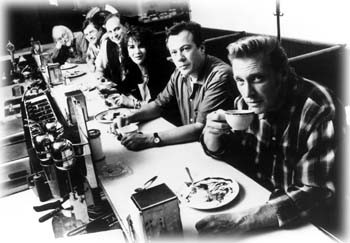
Talking Pictures

0

Writer David Templeton takes interesting people to interesting movies in his ongoing quest for the ultimate post-film conversation. This time out, he hooks up with unpredictable New York poet Maggie Estep to see the poetry-world comedy love jones.


So, I’ve got these cups of coffee, one for me and one for poet Maggie Estep, and I’m carrying them out to the patio, when I notice that the furniture–huge, ornate tables and chairs made of cast iron–is chained to the cement. I am struck by the lyrical paranoia of chaining an already immovable object to the ground.

Estep, already occupying one Gibraltar-like chair, peers sleepily down at the ominous shackles. She smiles.

“In New York, I don’t care how heavy it is, if you don’t tie it down it’s gone,” she says. “I stole a big wooden bench once. Just carried it off. It was beautiful.” I guess the statute of limitations is up on that particular crime; I know it is on mine.

“I stole a bench once, too,” I admit, inwardly marveling at the strange things people find to bond around. I needed a bench for a party, dragged one away from a business park, and always intended to sneak it back to its rightful place.

“See,” my she nods. “Chains are a good thing.”

My confessor this afternoon is a celebrated New York performance artist best known as MTV’s “spoken-word” poster girl. She performed on various unplugged shows and then with the station’s “Free Your Mind” poetry tour, before performing at Woodstock II and hitting the road with the Lollapalooza festival. Her work has been seen on PBS’ United States of Poetry, and she’s released a number of sensation-causing records. Estep first encountered success in the early ’90’s, gaining a loyal audience hungry for her stark, angry, self-revealing, uncompromisingly funny poetic rants.

She is currently in the midst of a national reading tour to promote her first novel, Diary of an Emotional Idiot (Knopf, 1997) . The book is pure Estep, a sharp, satirical series of first-person accounts told by Zoe–a writer of smut who part-times as a receptionist for a surly dominatrix–that becomes a spot-on illumination of the sicknesses by which human beings often tend to define themselves.

Awake since 4 this morning, Estep started her day in Seattle, rushed to catch her California-bound plane, landed in San Francisco, met her ride, stopped to pick up a sandwich to smuggle into the theater, and arrived looking exactly as if she’d just done all that. After making my acquaintance, she displayed her sandwich and announced, “If I don’t fall asleep during the movie, I can at least eat.”

“Tell me again why we saw this movie,” Estep demands, sweetly enough, displaying little of the dangerous, “I’m-an-angry-sweaty-girl-so-bite-me” attitude for which she is famous.

“It was a fallback,” I admit. “Just in case Crash–the weird, kinky car-sex movie –wasn’t playing. It isn’t.”

“Right,” she nods. “Now I remember.”

What love jones does have going for it is poetry. It’s an amiable enough tale about a group of friends, black professionals, that takes place amid the teeming poetry-slam cafes of modern-day Chicago. It disappeared from theaters almost as soon as it arrived, but stands as one of the few films in recent memory to highlight the power of poetry and to show black characters outside the violent “gangstas in the hood” genre.

So how was the poetry in love jones?

“It sucked!” Estep shouts. “I don’t know why they didn’t get some better poetry, because there is plenty of it out there to get. There’s good poetry everywhere, in every city in the country. I think they should have had one of my contemporaries write those poems, Tracy Morris or Sam Korbell. There are all these great young black poets that would have served it better.”

I remind her of a conversation in the film in which the friends debate the gender of God, adding, “I’ve had that conversation a zillion times.”

“Oh, so have I,” she shoots back. “Who hasn’t?”

“So, what gender is God?” I ask.

“Well, it changes, of course,” she jokes. “God switches from boy to girl, depending.”

She takes another swig of coffee. “God and spirituality and everything is a fascinating subject, isn’t it?” she goes on. “I cry a lot when I see beautiful paintings. That somehow is a form of spirituality, crying at paintings. There’s spirit there, there’s verve.

“The first time I cried was at a Francis Bacon show, at the Modern in New York, about six or seven years ago. And then it was in Rome, getting to seeing Caravaggio’s paintings, in person. My favorite was Judith severing the head of Holofernes.

“Judith has this detached look on her face, and she’s holding his head on this platter. Its the most bizarre and yet moving painting. Its amazing. I stood there in Rome and just cried. That was a very spiritual moment.

“Did you know that Caravaggio was the first person to paint Jesus and the Madonna with dirty feet?” she says. “There is a lot of beauty in those real details, in dirt. It’s humanity! I love those details.

“We’re a dirty species–dirty in a good way,” she offers, kicking absently at the chains that bind her chair. “In my mind, being dirty is a beautiful thing. It means we’re alive.”

The Scoop

0

Hey, Sport …

By Bob Harris

MY OLD CLEVELAND buddy T. (you might know the name, and he prefers privacy) and I recently went to Anaheim to watch the Indians play the Angels. We sat up high and made our predictions. We agreed that (a) while Matt Williams is easier to like than Albert Belle, so are necrotic skin viruses, and (b) given the team’s recent roster of clanky, oft-injured has-beens like Robby Thompson, Pat Borders, and Kevin Seitzer, Jacobs Field now has more pure fracture potential than a matinee of [Crash].

We also made book on how long before “black” Jack McDowell–who hasn’t pitched decently since Gingrich was popular–is forced to get a real job. T., who is black, mused that if McDowell really was similarly shaded, he’d have been out of baseball long ago. We joked about it a bit and the conversation wandered elsewhere.

We had to talk loudly. In the highest row of the upper deck stood the Massillon High baseball team of Massillon, Ohio, screaming unison chants at full teenage volume. A dozen Ohioans actually out-lung-powered 24,000 Angelenos combined. This was cool.

Soon, beer did what beer does. The jocks got even louder, and the crowd got annoyed. Finally, as the game concluded, the Massillon guys offed their shirts and did that naked-white-guy-screaming-in-the-cold thing, all of them at once.

The effect was almost blinding. Their pasty Cleveland flesh damn near glowed. And so, at last, the California crowd mustered a hearty response–a laughing, vengeful chant of beachfront pride:

“Get-a-tan! Get-a-tan!”

The whole upper deck joined in, laughing and clapping. The jocks took it well. And T., capping the joke, stood up to take [his] shirt off–so the Massillon guys would have a tan indeed. “After all,” T. shouted, “it [is] Jackie Robinson Week.” Cleveland’s victory was now complete. We laughed all the way home.

We’ve been friends since I was 10, so it feels bizarre to me to notice T. in terms of stuff like skin tone. But he really was the only black guy in the whole upper deck that night, as far as I could see. And, checking a few stats, it turns out he was right about McDowell, too. I thought about that while watching the Shea Stadium tribute on TV.

Y’know, there aren’t a lot of folks we can truly admire without hesitation. Jackie Robinson was damned close. He’s one of the few real heroes in American history.

But now that the celebration is over, let’s be honest: How much of it really honored Jackie, and how much was just feel-good window-dressing?

I mean, there’s Bill Clinton–Sister-Souljah-baiting, Lani-Guinier-abandoning, affirmative-action-backpedaling, racist-drug-policy-advocating Bill Clinton– denouncing racism. And there’s Jackie’s old team, the Dodgers, who’ve never had a black manager, general manager, PR director, trainer, or even equipment manager, for crying out loud.

Here are over 1,600 daily newspapers–only 10 of which employ a black sports columnist.

There’s Deion Sanders and the Reds, cutting their sleeves in cosmetic “homage” (never mind that Jackie never did any such thing) while getting rich by playing for racist Marge Schott. There are the Braves–whose fans sing war chants and do the “Tomahawk Chop” (popularized by, yep, Mr. Sensitivity, Deion Sanders); here are the Indians, whose Chief Wahoo logo “honors” Native Americans the way Angels fans might “honor” Catholicism by wearing foam mitres on their heads, crossing themselves during rallies, and singing “Hail Marys” during the seventh-inning stretch; and here are fans of both teams, regarding outraged Native Americans pleading for respect a mere nuisance. And they are all denouncing racism.

Folks, we’re celebrating social changes that haven’t yet occurred. Have we not eyes? What if all those Third World kids working 60-hour weeks making sports shoes looked like murdered Jon-Benet Ramsey? We’d stop this child labor nonsense in a week, tops. Yet everyone’s applauding Tiger Woods as the emblem of our new racial enlightenment, even though he literally sells his own head as ad space, wearing the Nike “swoosh” cap to endorse Asian-children-dying-in-sweatshops footwear.

If we can’t separate image from reality in sports, what chance do we have overcoming racism in the real world? You line up all the black owners, CFOs, and general managers in baseball combined, and you still need two more guys just to sing backup to Gladys Knight. Bad enough? The real world is worse: Carol Moseley Braun is just the second black senator of this entire century.

Jackie’s fight isn’t over. It has barely begun.

From the April 24-30, 1997 issue of the Sonoma County Independent

This page was designed and created by the Boulevards team.
© 1997 Metrosa, Inc.
Prairie Oyster

0

Blue Plate Special


Senor McQuire

Pass the Hot Sauce: Prairie Oyster likes their music traditional and country-style.

Prairie Oyster serves up some tasty C&W licks

By Greg Cahill

There is a haunting moment on “She Won’t be Lonely Long,” the plaintive opening track on Prairie Oyster’s new Blue Plate Special (Vel Vel) disc, in which singer and bassist Russell deCarle evokes a high, lonesome wail that for just a second sounds for all the world like the late, great Graham Parsons–the ex-Byrd and tragic godfather of country rock–risen from the ashes of his Joshua Tree funeral pyre.

“He wasn’t that much of an influence actually,” says deCarle, during a phone interview from his 140-acre ranch outside of Toronto, Canada, “though I did listen to the Byrds a little bit. I mean, we were playing when those guys were still around. And I was influenced by many of the same traditional singers as Parsons: Merle Haggard and the like.”

OK, so deCarle isn’t channeling the dearly departed–he’s still got a serious lock on the spirit of traditional country music.

Prairie Oyster–whose new CD shifts easily from honky-tonk shuffles to Tex-Mex reveries to Orbisonesque ballads–is hardly a household name in the lower 48 states. But this hard-working Canadian sextet has garnered six coveted Juno Awards (the Canadian equivalent of the Grammies) since 1986, and is generating quite a buzz stateside. Of late, music critics are lumping in Prairie Oyster with such sizzling New Country revivalists as BR5-49–country bands marked more by their love of twangy guitars and the joy of a crying pedal steel.

These are prime cuts.

In the mid-’80s, such neo-traditional country artists as Dwight Yoakum and Steve Earle infused new blood into a pop-country genre bloated by slick crossover acts like Barbara Mandrell and Kenny Rogers. By 1992, Nashville had settled into the bland pop pretensions of Garth “I’ve got an MBA and I’m gonna use it” Brooks, Billy Ray “I really wish I was a Chippendale dancer” Cyrus, and other country posers.

“You mean, that Barry Manilow in a cowboy hat thing?” deCarle asks, sizing up the competition. “I’ve always listened to country music, though I also listened to tons of rock and pop and R&B. But there’s just something about it. I hear a Ray Price shuffle and–who knows what it is?–it tweaks a mysterious thing in your brain and turns you on.

“But it’s all soul music to me. I mean, I love the Stanley Brothers just as much as I love Aretha Franklin.”

It hasn’t been easy finding the limelight. DeCarle co-founded the original Prairie Oyster band in 1974, a short-lived regional hit. “That was more of a western swing, honky-tonk sort of a thing,” he explains. In 1982, the band reunited for a few gigs and has been at it ever since. In a surprise move, Prairie Oyster became the first band signed to ex-CBS bigwig Walter Yetnikoff’s new label, which most assumed would revolve around rock and pop acts. “We’re real excited,” says deCarle, adding that Vel Vel has marketed the band in an aggressive manner rarely seen in the country side of the business. “For whatever reason, they get what we are all about. In most cases, you record an album, and if the single doesn’t do that good–bang!–you’re stuck with an album that you feel very good about but that is just sitting there.

“We really didn’t want to end up spinning our wheels again.”

Instead, Prairie Oyster is bringing pure country to the table and sweetening fans who’d gone sour on the country music industry. “I think it’s always there,” deCarle says of the traditional influences. “People who love country music are always playing it. They may not be heard on the radio and they may be hidden out there, but they’re always out there doing it. I think that no matter what happened, we’d all be playing some form of this music in some incarnation.”

So is the world finally catching up to Prairie Oyster? “Hopefully,” he laughs. “I mean, one thing we have in common with the Dwight Yoakums or the Ricky Skaggses is that we hold that tradition in very high regard.”

Prairie Oyster opens for country singer Kathy Mattea on Friday, May 2, at 8 p.m. at the Luther Burbank Center for the Arts, 50 Mark West Springs Road, Santa Rosa. Tickets are $24.50­$32.50. Call 546-3600.

From the April 24-30, 1997 issue of the Sonoma County Independent

This page was designed and created by the Boulevards team.
© 1997 Metrosa, Inc.
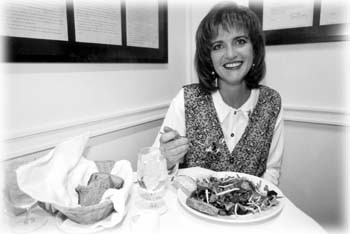
Intuitive Eating

0

Know Thyself


Janet Orsi

Salad Days: Intuitive eating expert Barbara Birsinger trusts her gut instinct about foods.

Chewing the fat over body language

By Gretchen Giles

SHE’S A LITTLE SURPRISED, but Petaluma nutritionist Barbara Birsinger is willing to show me her lunch. She has her smaller bag with her today; after all, she’s only here for the afternoon. Were it a full day away from the home fridge, Birsinger would have the larger thermal bag that accommodates two small Blue Ice packs, a thermos, and any number of edible whimsies to satisfy the flitting demands of her appetite. Forget former Cosmo editor Helen Gurley Brown’s admonition that a good lunch for ladies is one small smelly can of un-mayo-ed tuna packed in water.

It’s only food, but I stare in undisguised awe. Birsinger has packed enough in the bag lying unzipped on the floor of her office to feed the average weight-obsessed American woman for two full days.

“Let’s see,” she says as she rummages. “I had a Reeses peanut butter cup, but I ate it. I ate four of these,” she says, holding up a bag still containing several raspberry-filled newton bars. “I had a yogurt,” she smiles. “But I ate it.” She picks up a bag with two large homemade chocolate chip cookies in it. “I have these.” She flashes part of a deli sandwich, the lettuce pressed against the plastic. “I ate the other half of this.”

She sets a juice-flavored Calistoga water on the rug. She pulls out a bag of oversized ripe red strawberries. We both look at them. “It’s more than I can eat,” she admits. “But I feel so good. I feel like I’m taking care of myself.”

Does Birsinger tip the scales to their limit, shop large, or tax a chair? Nope. Tall and slender, Birsinger eats exactly what she pleases when she pleases and doesn’t gain a pound. What’s more, she avers that if we all did the same thing, neither would we.

“I think that everybody should dump their scales,” says Birsinger, leaning forward in her chair and laughing. “Scales are for fish. It’s absolutely meaningless, it doesn’t tell you anything. A little metal box,” she flourishes her hand, “that tells you whether you’re good or bad or whatever.”

So you want to be thin? Don’t weigh yourself. What’s more, forget everything you know about fats and carbohydrates and white sugar. “I tell people to throw out all of their nutritional knowledge, and I’m a registered dietician,” says Birsinger, who also holds a master’s degree in public health. “Knowledge isn’t it; it’s your knowledge of yourself.”

What Birsinger is discussing is something that she claims we all already know, something that we’re born with: intuitive eating. She cites studies that claim that young children, given free rein to eat a large variety of foods–both those considered healthy and downright dreck–will, over a period of seven to 10 days, choose a balanced diet. Sure, one day may be nothing but Cheetos and pop, but over that long week, their choices will balance.

“It’s innate,” she says. “Infants and young children eat intuitively, instinctively. And studies show that the more regulation that the main caretaker has over meals, the less self-regulation that children will have.” Not only do admonitions that children in Pakistan (or Berkeley, depending on the politics of your household) are starving and you’re damn lucky to even have those overcooked lima beans serve to qualify food–the portions and strictures surrounding mealtimes can warp your perceptions of food for life.

This is the bread and butter of women’s magazines. This is the page-turning wonder of Thin Thighs in Thirty Days; it’s the relish that some of us baser types felt when Jean Harris finally turned the gun on the Scarsdale Diet. Ask a woman what she likes about the simple humanness of her very own body and expect the short list. Query faults and be prepared to listen for hours. With affluence, ease, and idle time, the relatively leisured are daily more unsatisfied about the wobble, dimple, and time-marching sag of themselves.

Unthinkable in many countries–and in this country as late as World War II–the ballooning gain in overfed American waistlines exactly matches the ballooning gain in the overfed diet industry, one that stuffs itself with roughly 50 billion thin green bills each year.

“I have people coming to me all the time saying ‘Tell me what to eat. Tell me how much. I don’t know when to stop,'” says Birsinger, who was recently featured in an Esquire magazine article on male vanity. “Somewhere along the line we lost the belief and the trust in our own bodies to tell us what’s good for us.

“I think food was our very first comfort in life. Children learn very young that if you have a discomfort, go to food. It doesn’t really fix the problem, it’s temporary, and that’s not a bad thing. You never go to food for the wrong reasons: it’s always to take care of things. Part of my goal is to help people stop judging what they’re eating.

“Intuitive eating is picking up signals from your body,” she continues. “Eating when you first feel hungry, and not waiting until you’re ravenous–because then it doesn’t matter what you eat–and really listening to when you’re body is hungry.

“Disordered eating always starts with a diet,” says Birsinger, citing such rattling statistics as that 80 percent of fourth-grade girls have flirted with dieting. “Young girls wouldn’t start a diet unless they thought there was something wrong. It starts with the thought that ‘I’m not OK.’ That’s what we have in this culture: there is a perfect way to look, there is a perfect female body, and yours isn’t it. Maybe 1/10th of 1 percent of women in this nation have it. So what we start to do is to fix our bodies when, really, that’s not the issue.”

To eat intuitively, you must first identify your hunger: Are you “mouth hungry”–when your stomach says no but your mind says yes yes yes–or are you actually physically hungry? If the answer is a true “yes” to either–and it’s important not to neglect the avarice of the mind–then you must visualize all of the possibilities in your own fiscal and gastronomic universe. Deciding upon something, you then envision how you will feel after that food is eaten. If the feeling is, as Birsinger puts it, “ugh,” then either reduce the portion or choose something else, until your tummy says “um.” That done–simply remember to chew with your mouth closed.

“Either you decide that it’s worth the ‘ugh’ feeling or you explore other foods that have some of the same qualities that you’re craving until you make a match,” she explains. “This exercise becomes instinctive after a while; you don’t have to sit and think about it for a long time.”

But what if you’ve checked in with your body and discovered to your horror that all it really wants is chocolate cake for breakfast ?

“If you want that for breakfast and you’ve checked it out with your body and your body says OK, so what?” she shrugs. “It’s frequency and amount [that matter]. I don’t believe there’s any forbidden food. I have a master’s degree in nutrition, and I know what happens to food in your body, and I know that everything that you eat becomes a part of you in some way, but I also know that my body doesn’t want to eat lots of chocolate cake–bodies don’t want too much fat or sugar or salt or caffeine or alcohol. It’s not allowing my body to have it and then eating other things throughout the day chasing that desire.

“That,” she says, leaning back in her chair, “is not OK.”

From the April 24-30, 1997 issue of the Sonoma County Independent

This page was designed and created by the Boulevards team.
© 1997 Metrosa, Inc.

Art Films

0

Screen Dream


Maria Madrigal

Police Brutality? Branch Davidian members show signs of life in ‘Waco: The Rules of Engagement.’

If they show them, will you come?

By Gretchen Giles

TIRED OF WATCHING major American cities get blown up on national holidays? Had enough of natural disasters that turn the coast to toast? Feeling tepid about Hollywood’s lingering obsession with the Cold War? Don’t care if you never again see Meg Ryan do that little puppy-smile wrinkly thing with her nose that causes her gums to show? Friend, you need pine no more.

Because sitting in the dark just got that much better. Dave Corkill–owner of Petaluma’s Washington Square Cinema 5, the Sebastopol Cinemas, and the Sonoma Cinemas, as well as Marin’s Tiburon Playhouse and the Fairfax theaters–is finally making good, very, very good, on his promise to bring art films to his Petaluma and Sebastopol theaters.

“Don’t blame Dave,” laughs independent film booker Jan Klingelhofer by phone from her East Bay office. “I sort of put him off,” explains the overbooked booker, who has been busy programming theaters in the Midwest. “There’s so much film out there right now and we were coming up on the Academy Awards.” Klingelhofer–who is also responsible for the mini-fests and thought-provoking cinema shown at Marin’s Lark Theatre and for the programming at Sonoma’s Sebastiani Theatre–has contracted with Corkill to bring her brand of off-run films to the county.

Beginning May 2 with Gwyneth Paltrow and Samuel Jackson at the Washington Square in , and May 2 at the Sebastopol Cinemas with Kenneth Branagh’s stunning adaptation , look for weekly festivals, and such brushed-up re-releases as Alfred Hitchcock’s to hit Corkill’s theaters.

Of particular interest is the April 25 Sebastopol debut of Waco: The Rules of Engagement, a seldom-screened documentary whose launch this January at the Sundance Film Festival caused a firestorm of its own. Playing a limited engagement at a few theaters and festivals throughout the country–last seen in California at San Francisco’s Roxy Theatre earlier this month–Waco posits the disturbing theory that the government, not David Koresh’s Branch Davidian cult, set the fire that immolated more than 80 occupants of that compound in 1993, a structure already undermined by the ramming of federal tanks.

Using infrared imagery and in-depth interviews, Waco does not decide the facts for the viewer, but rather sets a strong case that botched plans, FBI stupidity–surely you’ll remember that agents performed such professional acts as dropping their pants and mooning the trapped residents of the sect–and a wanton disregard for human life all colluded to create this tragedy. According to Corkill staffer Scott Neff, a new copy of Waco has been struck just for the Sebastopol screening, as interest in this important film grows.

Of the mini-fests planned, the Washington Square 5 begins with an American independents’ night each Friday, featuring Nick Cassevetes directing his mother, Gena Rowlands, in Unhook the Stars (May 9), followed by the county premiere of monologuist Spalding Gray’s serio-humorous Gray’s Anatomy (May 16), the day-from-hell comedic encapsulation of (May 23), and the mockumentary of community theater, (May 30). The second weekend in June has been dubbed Mafia Week, with leading the dirge on June 13, and the brilliance of Francis Coppola’s restruck version of honoring Father’s Day weekend.

Over in Sebastopol, things go en français with a Wednesday night series of French films that begins with the French-Canadian insect documentary (May 7), and continues with the bourgeois politics of (May 14), the quiet loveliness of Juliet Binoche’s widow in Blue (May 21), the tomfoolery of court life in (May 28), and the sharing of a lover by Catherine Deneuve and Daniel Auteuil in (June 4). The whimsical doings of a Downs syndrome group in The 8th Day (June 11) wraps up this Cinema Français series.

Klingelhofer tosses off the admission that while the programming at these two theaters will be very good, it may not be as adventurous as that shown in art houses in San Francisco. When pressed on that point, she promises, “When the feet march in, we’ll give programming to match it.”

Sonoma County film enthusiasts, tie up your laces. Hup, two, three, four.

From the April 24-30, 1997 issue of the Sonoma County Independent

This page was designed and created by the Boulevards team.
© 1997 Metrosa, Inc.

Jug Wines

0

Big Boys


Field of Dreams: The James Arthur Field brand of signature wine is the ideal vino for group feeds.

Photo by Janet Orsi


In appreciation of cheap jug wine

By Steve Bjerklie

JUG WINES, ALAS, have a reputation only a skosh above former Clinton adviser Dick Morris’ (I mean, he is pond scum), a dismal condition I attribute to three important factors: 1. Zillions of bottles of cheap Chianti wrapped in straw. The Italians shipped them over here by the fleet in the ’50s and ’60s. The wine tasted just like the straw–in fact, it tasted just like the bilge water in those damned ships. What did we ever do to Italy to deserve this? And then, as if the wine wasn’t bad enough already, Italian restaurants across the country used the bottles for candlesticks. Wax drips all over the bottles looked just like multicolored bird droppings and were supposed to tell you the food was “authentic.” Go figure.

2. Guilt by association. Up until fairly recently, virtually all American jug wines were made by the same folks who brought you Boone’s Farm, Annie Green Springs, and Ripple. This isn’t what one would call a viticultural pedigree.

3. A photo published in Rolling Stone in January 1970 of a Hell’s Angel at Altamont happily swigging from a giant jug of Red Mountain burgundy. On the next page, a photo of the same guy beating people over the head with a pool cue. Dinner-party hosts took note of the cheap wine/behavior relationship.

Despite all, I love jug wines. Well actually, I love the idea of jug wines–their unpretentiousness, their common-man forthrightness, their wine-for-calloused-hands soul. When the quality of a good jug wine matches the idea, well, that’s what everyday wine-drinking is all about. And the truth is, humble as jug wines may be, they are the key to getting this country to drink more wine. If the wine industry wants more people to enjoy more wine with more meals (and it surely does), then the way to do it is by producing more and better low-cost jugs, not more and better $20-a-bottle-and-up wines for the elite.


Janet Orsi

A Jug and Thou: Mass-market wines do well toward serving a full house.

The key to liking them is keeping expectations low. Jugs aren’t Rembrandts, they’re house paint, but you wouldn’t want to cover your garage door with masterpieces, would you? Unfortunately, because jug wines are made from juice that no one wants for something better, and because the wine industry right now is beset with a juice shortage, the quality of jug wines at the moment is, frankly, as low as it’s ever been. Thus, a few shopping rules:

Never buy jug varietals: jug cabernet sauvignon, chardonnay, merlot, etc. Stick with the blends, which are labeled (for a red wine) “table red,” “vintner’s red” or, yes, even burgundy. Turning cab into a jug wine is like putting a BMW engine into a Winnebago. The only possible exceptions to this rule–emphasis on possible–are zinfandel and sauvignon blanc.

Reds tend to be better than whites.

Generally, you get what you pay for. Don’t look for deals in jugs. A $10 jug’s going to taste $5 better than a $5 jug every time.

Here are three jugs I’ve lately enjoyed when I wasn’t shooting pool:

James Arthur Field
California Red Wine

Jim Field up in Healdsburg has dedicated his life to making a better jug wine, which is sort of like dedicating your life to making a better boxer short–but, hey, we need those, too. “Basic” is the descriptive word here: Field’s red is all brick and no filigree. He doesn’t say on his elegantly simple label (which features only his signature) what’s in this wine, but I taste quite a bit of ruby cabernet and maybe some petite sirah. He’s probably got some zin in there, too. Whatever it is, it has the acidity to accompany heavy tomato sauces and ribs gooey with barbecue. This is an ideal wine for group feeds. Another admirable trait: Both Field’s red and white are remarkably consistent from year to year. Two stars. $6.99.

R.H. Phillips Dunnigan Hills
“Night Harvest” Sauvignon Blanc

The label says, “We pioneered night harvesting to protect the delicacy and freshness of our grapes and preserve their varietal character.” So how come no one else is doing it? Night or not, this is an above-average jug white showing surprisingly good varietal character. Some call sauvignon blanc “poor man’s chardonnay,” which is not necessarily a slight–this Phillips has the apricot sweetness of a well-balanced sauvignon blanc hiding behind a tart forward presentation. Enjoy a glass while preparing dinner, and then another with dinner. It won’t impress your friends, but it will make your salad taste oh-so-much better. Two and a half stars. $9.75.

Valley of the Moon
“Harvest Nights” California Red Table Wine

So maybe this night thing is spreading. Whenever its grapes are picked, this is a jug red for folks who need something soft and easy at the end of the day. You won’t overexercise your taste buds or tax your brain with this as you might with some fancy varietal, you won’t chop through tannins as you must with some of the cheap big boys, and yet you won’t mistake this for a white. This Valley of the Moon blend is as soft as your favorite chair–fuzzy at the edges, warm in the center. Smells good, too. I think a tasty piece of beef might knock it out with a single punch, but it’d go great with bread and cheese or light pasta. Two stars. $7.49.

From the April 17-23, 1997 issue of Metro

This page was designed and created by the Boulevards team.
© 1997 Metro Publishing, Inc.

The Scoop

0

Cut the Deck

By Bob Harris

ONCE AGAIN, casino gambling hit the ballot last fall in such exotic resorts as Cleveland, Springfield, and Spokane. If you believe the used-car dealers, real estate moguls, and other various leeches financing these campaigns, the hot cash will provide the townfolk with better schools, libraries, snake oil, and lounge bands.

Of course, gambling produces no tanglible product to which labor and ingenuity add value. All-night Keno, free piña coladas, and community college girls dressed like a Joe Eszterhas stroke fantasy aren’t the same as a rebuilt manufacturing base. The best this casino/skybox/trade-zone bullshit can do is rearrange wealth, not create it. Which means that the minute Toledo and Fort Wayne offer looser slots, the money blows town.

What to do when the city council bets your future on a roulette wheel? Simple. Beat them at their own game. Play their blackjack, count their cards, and use their own money against them. It ain’t as hard as you’re supposed to think. Besides, revolution is supposed to be fun.

Here’s your things-to-do list:

Learn the basic strategy. Computers long ago figured out the optimal play in each situation, and the grid is published in a half-dozen books at the mall. My Cliffs Notes version: Hit anything up to 9. Split only 8’s and aces. Double on 10 or 11 if the dealer has a low card (2-6). Otherwise hit. Stand on 12-16 if the dealer has a low card (2-6). Otherwise hit. Stand on 17-21. This oversimplifies the computer model, but it works OK, and–bonus–you can actually remember it.

Start your count at zero. Add one for every low card (2-6) in play, and subtract one for every high card (10-ace). Ignore 7’s, 8’s, and 9’s; reset at zero when they reshuffle. Since dealers have to hit bad hands and you don’t, you win more often when the undealt deck is rich in face cards. The count is how you keep track.

Start with minimum bets. When the count is higher than the number of undealt cards, bet more (but keep it at twice minimum until you’re flush). If the count gets below minus-5 or so, wander away for a while. That’s it.

(OK, here’s No. 4: don’t listen to anybody nearby who seems to know better. If they were that smart, they wouldn’t be in a casino.) Of course, the house has pit bosses and surveillance cameras watching everybody. No fear. Think “mall security guard.” Still, if you sense heat, stroll. If they narc you, just pick up your chips and leave quietly.

Advanced tip: in Vegas, Atlantic City, or any other festering sleaze pit where Howie Mandel headlines, you can save time by meandering the blackjack area as if looking for a friend. Slow down if there’s a table with a ton of low cards in play. If the next hand is equally faceless, sit your keester down. Play a few hands, then hit the next casino. You’ll save time, improve your odds, and never get caught.

Your town will probably have only the pathetic little riverboat, so you’ll need patience. However, the dealers are usually way slower, and the spread between the minimum and maximum bets is much higher. Enjoy.

It’s perfectly legal, but about as exciting as Charo doing the Macarena. The novelty wears off, and counting by 1’s probably got old about the time you learned not to chew on other people’s furniture. It eases the monotony to think of it as a sit-in with card games.

Just promise to be creative with your loot. Set up a Gamblers Anonymous chapter. Buy newspaper ads explaining why gambling sucks. Start a voter registration drive. Post card-counting info on light poles outside the casino. Run the bastards out of town.

Have fun and do nice things.

My dad bought cigarettes and Lotto tickets at the corner for 20 years. He never won anything. I was working near Tahoe when his lungs gave in. His casket was purchased with blackjack money from Caesar’s.

We figured it was about time he won something.

From the April 17-23, 1997 issue of the Sonoma County Independent

This page was designed and created by the Boulevards team.
© 1997 Metrosa, Inc.

Sonoma County Public Library

0

Virtual Stacks


Janet Orsi

Digital Data: The library system’s Website is getting 10,000 hits a month, growing 10 to 15 percent a year.

Public Library’s Internet branch comes of age

By Bruce Robinson

SURE, SURFING THE WEB is great entertainment. But when you positively need to find out something absolutely, specific right now, plodding through lists of links in hopes of stumbling onto the facts you seek is not such an appealing enterprise.

Who ya gonna call?

How about Bo Simons? “After you get tired of clicking around and you really want to get somewhere, that’s when some kind of expertise and knowledge of how knowledge works is useful,” offers Simons, the Internet librarian at the Sonoma County Public Library.

“The one thing librarians offer to the world of the Web is experience in dealing with people finding information for millennia,” he elaborates. “What I bring to it is a feel for the way information travels, an instinct for what constitutes a good reliable source, being able to check currency and accuracy pretty quickly.

“It’s easy to click from here to there–finding things is what’s tough.”

In order to facilitate such searches, Simons has developed a home page for the Sonoma County library. The site has been in operation for nearly three years, but it is now getting expanded just in time for National Libraries Week. The service offers immediate access to many of the library’s reference works, as well as connections to other sources elsewhere on the Internet.

The local resources include the entire Sonoma County Public Library catalog, an index of periodicals and their contents (with links to the full text of many of the articles), the full community resource library, an index of local groups and organizations that the library has developed, and the archives of the Wine Library in Healdsburg, plus data about local employers and other useful information for job-seekers.

You can also find the locations and hours of operation of all county library branches. The access to the library’s catalog allows library patrons to reserve books and to see if those books placed on hold are awaiting pick-up–two heavily used services. These services can also be reached without going through the Internet; computer users can “dial up” the library directly via their modems and local phone lines. Internet users need a “telnet” utility in order to connect to the catalog files.

“Our goal is to make the library more usable to more people,” explains Roger Pearson, director of Library Services for Sonoma County. “With more people buying computers every day, we also want to make as much of the library as possible available 24 hours a day. The computer is tireless, and its capacity is just phenomenal. Even if we get 20,000 people dialing in, we don’t have to hire more staff.”

“I really see this as an answer to our problems of providing more access.”

Pearson says that the library’s Website registers 10,000 to 11,000 “hits” a month, “so we know that a lot of people do use it.” But he adds, “We don’t know what their success rate is in finding what they’re looking for.” Still, use of the digital data services is growing 10 to 15 percent annually, which he considers “good and healthy, considering our check-outs are going down 2 percent.”

Right now, computer users can make more use of the library’s online resources from home than is possible from within the library itself, although the library is working hard to change that situation. “We offer text-based Internet access through our public access, but our current cabling is not adequate for graphics,” Pearson says. “Even at the Central Library [at the corner of Third and E streets in downtown Santa Rosa], we only have one terminal that’s offering Netscape access.”

Upgrading the electronic infrastructure costs about $12,000 at each branch, money that is not available in the library’s operating budget. Instead, local Friends of the Library groups have been working to raise funds for that work, through such innovative efforts as the “Virtual Auction” held at the Sebastopol branch last month, which raised nearly $30,000. Rohnert Park obtained a grant from Longs Drugs to support the upgrading of two branches, while O’Reilly & Associates, a computer publishing and software firm in Sebastopol, has “been helping us with some of the cabling, and even doing some of the work,” Pearson says.

As a result of all these interlocking efforts, he adds, “Sebastopol will probably be up and running with four or five Netscape PCs in the next three or four months, and Petaluma is just about ready to go.”

Meanwhile, there are grand plans for the unseen technical side of the Internet site, too. “We would like to put in a CD-ROM server that has subscriptions to major reference works,” such as Consumer Reports, says Pearson, “so that at 10 at night you can do some research on buying a washing machine or a new car.”

Online access to investment information via the library is another goal.

However, says Jim Rosachi, manager of the library’s technical services, adding these types of services “can be $20,000 to $30,000 just for the equipment, and who knows how much more for the license for the information,” money that is not in the library budget.

“We don’t have a timeline for that,” he adds. “It’s just something we know would be useful information.”

From the April 17-23, 1997 issue of the Sonoma County Independent

This page was designed and created by the Boulevards team.
© 1997 Metrosa, Inc.

Shann Nix

Putting the Nix on RadioPhotos by Janet Orsi.If sisterhood is so powerful, why is radio talk-show host Shann Nix one of the only airwave sisters with power?By David TempletonWITH her head wrapped in a turban of headphones and both hands on the gleaming control board before her, radio talk-show host Shann Nix aims her voice and attention at a...

Welfare Reform

New 'Deal'Protest Vote: After spending 30 years in government fighting poverty in America, Peter Edelman resigned last summer in protest of President Clinton's multibillion-dollar cut in welfare. The new law, he says, will hurt millions of poor children.Photo by Janet OrsiRocking the Boat: Notes from an ex-Clinton appointeeBy Peter EdelmanLAST SUMMER, President Clinton signed welfare legislation that radically...

Talking Pictures

Maggie Estep speaks up on dirt, Caravaggio, and bad poetry

The Scoop

Hey, Sport ...By Bob HarrisMY OLD CLEVELAND buddy T. (you might know the name, and he prefers privacy) and I recently went to Anaheim to watch the Indians play the Angels. We sat up high and made our predictions. We agreed that (a) while Matt Williams is easier to like than Albert Belle, so are necrotic skin viruses, and...

Prairie Oyster

Blue Plate SpecialSenor McQuirePass the Hot Sauce: Prairie Oyster likes their music traditional and country-style.Prairie Oyster serves up some tasty C&W licksBy Greg CahillThere is a haunting moment on "She Won't be Lonely Long," the plaintive opening track on Prairie Oyster's new Blue Plate Special (Vel Vel) disc, in which singer and bassist Russell deCarle evokes a high,...

Intuitive Eating

Know ThyselfJanet OrsiSalad Days: Intuitive eating expert Barbara Birsinger trusts her gut instinct about foods.Chewing the fat over body language By Gretchen GilesSHE'S A LITTLE SURPRISED, but Petaluma nutritionist Barbara Birsinger is willing to show me her lunch. She has her smaller bag with her today; after all, she's only here for the afternoon. Were it a...

Art Films

Screen DreamMaria MadrigalPolice Brutality? Branch Davidian members show signs of life in 'Waco: The Rules of Engagement.'If they show them, will you come?By Gretchen GilesTIRED OF WATCHING major American cities get blown up on national holidays? Had enough of natural disasters that turn the coast to toast? Feeling tepid about Hollywood's lingering obsession with the Cold War? Don't...

Jug Wines

Big BoysField of Dreams: The James Arthur Field brand of signature wine is the ideal vino for group feeds.Photo by Janet OrsiIn appreciation of cheap jug wine By Steve BjerklieJUG WINES, ALAS, have a reputation only a skosh above former Clinton adviser Dick Morris' (I mean, he is pond scum), a dismal condition I attribute to three...

The Scoop

Cut the Deck By Bob HarrisONCE AGAIN, casino gambling hit the ballot last fall in such exotic resorts as Cleveland, Springfield, and Spokane. If you believe the used-car dealers, real estate moguls, and other various leeches financing these campaigns, the hot cash will provide the townfolk with better schools, libraries, snake oil, and lounge bands.Of course, gambling produces no...

Sonoma County Public Library

Virtual Stacks Janet OrsiDigital Data: The library system's Website is getting 10,000 hits a month, growing 10 to 15 percent a year.Public Library's Internet branch comes of ageBy Bruce RobinsonSURE, SURFING THE WEB is great entertainment. But when you positively need to find out something absolutely, specific right now, plodding through lists of links in hopes of stumbling...
11,084FansLike
4,606FollowersFollow
6,928FollowersFollow
