
William O’Keeffe

0

Ground Level


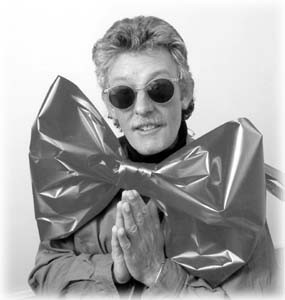
Taking a Bow: William O’Keeffe ties together the west coasts of California and Ireland.

Photo by Janet Orsi


William O’Keeffe captures Ireland’s fragrant wasteland

By Gretchen Giles

At 10:30 a.m. on a Friday morning, acclaimed Irish abstract painter William Horton O’Keeffe still has his dignity. And if memory serves, keeps it for about 10 more minutes. That’s when fellow artist Poe Dismuke wraps him like a gaudy general in party ribbon salvaged from the dump, tapes epaulets on his shoulders, cummerbunds him in lavender, and presents him to a photographer. Actually, even after he’s donned sunglasses and an oversized Mickey Mouse­ styled bow tie, O’Keeffe’s still got his dignity–and an attitude.

“I’m known as Willie ‘I don’t paint scenes’ O’Keeffe,” he declares with mock haughtiness in his regional accent. “If you want scenes, buy a Nikon.”

By “scenes” O’Keeffe means landscapes, which is odd, considering that he lives in one of the most remarkable landscapes in the world. Odder still, he has been madly painting almost nothing but landscapes, albeit those of the world at ground level, scenes most of us never see.

Spread around him on the floor in the Painter’s Eye Gallery–artist Susan Wolcott’s Petaluma studio and alternative exhibition space–are works on paper, paintings that O’Keeffe has prepared to hang in Wolcott’s space. In a wonderfully synergistic collision of two west coasts, the intricacies of Ireland’s sea-strung Burren coast will wash along the barren walls of a California studio. Entitled “Coastal Labyrinth,” these works hang May 15 through June 1 at the gallery, in an artist’s exchange created last fall when Wolcott and Dismuke traveled O’Keeffe’s green native land and struck up a friendship with the painter. The three are hoping that this cultural swap has only just begun.

“East coasts aren’t the same, west coasts are … frontiers, you know?,” says O’Keeffe, seated on a folding chair in the grubby grandeur of the studio, which features Dismuke’s leering dolls and Wolcott’s elegantly constructed canvases. “You’re right on the edge, right on the cutting edge. Hopefully, we can get this going on a bigger scale, a grander scale, because what I’d really like to do is to get some California artists, [Susan], Poe, whomever, and get them to come over and do a big show. I’d actually like to bring musicians over and writers as well–this is just a preliminary.”

Based on O’Keeffe’s early training as an architect, his love of the chaotic clarity of geology, and the beauty of his home–the limestone wastes in County Clare are known as ‘the Burren’–his suitcase-sized paintings contain their own worlds, a downsizing of linear considerations and color comparable to the microclimate of the 350-square-mile Burren itself. “What this show is about is archaeology, geology, and biology,” he says.

“It’s a fragrant wasteland,” O’Keeffe continues, talking of his home. “And the Burren looks like a wasteland until you actually get very close, and the thing about it is that it’s such a minute landscape. When you actually get down on your hands and knees and get really close, it’s like Yosemite, but it’s only that big,” he says measuring small with his fingers.

“It’s the biggest Zen rock garden in the world, you know? It’s unbelievable, because you’ve got the strata on such a tiny scale. The Burren has Arctic plants and Mediterranean plants growing side by side, orchids and plants from Greenland, so I have a lot of plant paintings. They’re very strange; those are carnivorous succulents over there,” he says, pointing to an evilly squiggled pen-and-ink series. “There are,” he states with authority, “approximately 700 different plant species growing there. If you just drove through it, you’d think that nothing’s there. But if you get into the heartland of it, it’s its own universe.”

Having spent a year exploring the water-carved subterranean limestone caves of the Burren in preparation for an exhibit in 1994, O’Keeffe knows his subject above ground and below. Previous paintings have included peat and other natural materials massed into the surface of the canvases, creating topographies that beg the fingertips like a relief map. The works collected in “Coastal Labyrinth” find deeply hued blank spots cornered onto the page by O’Keeffe’s consistent use of cool-eyed lines.

Walking the exhibit with O’Keeffe is like taking a trip through the surface of the paintings and monotypes into the grass-high world that concerns him.

Finessing the literal lay of the land into an abstract that is imbued with the natural construction of the rocks, some of the land’s unnatural constructions also influence O’Keeffe’s works, most notably the Celtic forts, dolmans, and graves of Neolithic peoples.

“You can still see all of the forts from 5,000 years ago,” says the Irish native. “What’s 5,000 years?” he pshaws at the reporter’s surprise.

“I think that people just cruise around and see only the big picture,” O’Keeffe says seriously. “They miss the little micro things, and it’s the micro things that happen. People tend to forget that, and we tramp around and destroy [those things] and the bulldozers move in and it’s not just the big field you’re destroying, you’re destroying all of this life.

“That’s where it’s happening, down there at ground level.”

“Coastal Labyrinth” opens with a reception on Friday, May 16, from 6 to 9 p.m. Painter’s Eye Gallery, 522 Cleveland Lane, Petaluma. Gallery hours are Saturday-Sunday, noon to 5 p.m., through June 1. Admission is free. 762-3458.

From the May 8-14, 1997 issue of the Sonoma County Independent

This page was designed and created by the Boulevards team.
© 1997 Metrosa, Inc.
Why Has Bodhi-Dharma Left for the East?

0

Buddha Boy


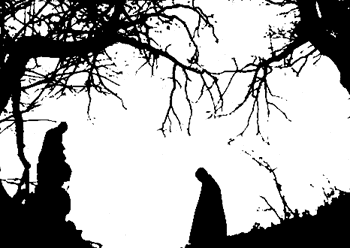
The Eightfold Path Less Traveled: ‘Why Has Bodhi-Dharma Left for the East?’ is spiritually uplifting.

Zen and the art of filmmaking

By Greg Cahill

ALPHA WAVE ALERT! South Korean filmmaker Bae Yong-Kyun’s stunning 1989 film Why Has Bodhi-Dharma Left for the East? is rife with Zen Buddhist doctrine, haunting visual allegories, and mystical imagery. No sex. No chase scenes. No explosions. No gratuitous violence. Just a subtle lesson about the meaning of life.

Its cryptic title, taken from an ancient Zen koan, or riddle, is a starting point for cinematic truth-seekers prepared to receive the magnificently photographed–and often glacially slow–scenes that serve as the primer for the elusive Zen mode of perception. The film–which screens May 8-10 at the Sonoma Film Institute–breaks down preconceptions about life and religion and flirts with the higher reaches of the mind in a way one never would have thought possible from gradations of light and color flickering on a silver screen.

It is widely regarded as one of the most visually stunning films ever made.

“I am convinced that Zen offers the possibility of discovering the reality of things and the foundations of the soul with only intuition, which is possible when we have cleared all the accumulated concepts from our consciousness,” says filmmaker Bae Yong-Kyun, who wrote, directed, produced, photographed, and edited this impressive work.

Welcome to nirvana with a box of ju-ju bees.

Bodhi-Dharma is a cinematic triumph that has earned un certain regard at the Cannes Film Festival and the coveted Golden Leopard at the Lorcarno Film Festival, the first-ever international directors’ award in the 70-year history of Korean filmmaking.

The film’s minimal plot tells the story of an aging monk, Hye Gok (Yi Pan Yong); his adolescent student, Ki Bong (Sin Won Sop); and an orphaned child, Hae Jin (Huang Hae Jin), representing the three ages of man. They live together in a remote Zen monastery on Mount Chonan in South Korea. Several of the film’s most striking scenes involve Ki Bong’s rites of passage and his difficult childhood spiritual journey.

The poetic shots of misty meadows, darkened forests, and translucent rock pools evoke the splendor of Ansel Adams’ pastoral photographs and create a seductive bond between the viewer and the film’s stark natural settings and gentle Zen beliefs.

And Yong-Kyun shows a real gift for understatement.

At one point, Ki Bong conducts the ritualistic cremation of his teacher, scattering the ashes in a mountain pool flecked with colorful autumn leaves. The fallen ashes dust his arms and clothes, cling to floating leaves, and intermingle with reflections of overhanging foliage.

It’s a mystical moment in which all things seem to unite. The scene underscores the Zen tenet of harmonious existence with the world. It also serves as a simple, yet powerful, metaphor about life, death, suffering, and transformation. Bernardo Bertolucci wasn’t half as effective as this with 1995’s laughable Little Buddha, starring the gawkish Keanu Reeves as a young truth-seeker.

Clearly, Yong-Kyun has earned his kudos.

“Again and again, the film finds visual analogues for the oneness of the universe and the enlightenment to be found through the renunciation of earthly desires,” the New York Times marveled. “In gazing into the physical world with a fixity, clarity, and depth rarely found in the cinema, Why Has Bodhi-Dharma Left for the East? goes about as far as a film can go in conjuring a meditative state.”

The result is a state of bliss unparalleled in the film world.

Why Has Bodhi-Dharma Left for the East? screens Thursday, May 8, through Saturday, May 10, at 7:30 p.m. Sonoma Film Institute, Sonoma State University, Darwin Hall, 1801 E. Cotati Ave., Rohnert Park. Tickets are $2.50-$4.

From the May 8-14, 1997 issue of the Sonoma County Independent

This page was designed and created by the Boulevards team.
© 1997 Metrosa, Inc.
Charlie Musselwhite

0

Blue Mood


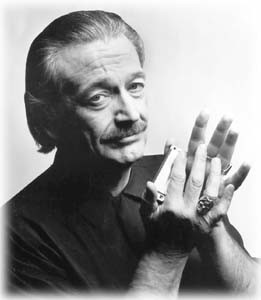
Blues Survivor: Charlie Musselwhite performs next week at LBC.

Photo by Peter Amft


Charlie Musselwhite back on top

By Greg Cahill

THE TURNING POINT came unexpectedly. Charlie Musselwhite–a harmonica player with a gift for the low-down, dirty blues and with a drinking habit that was legendary in blues circles–was driving to a nightclub in 1987 when he heard a radio news report that Texas toddler Jessica McLure had tumbled into an abandoned well.

Rescuers were fighting to save her life.

“That really moved me,” Musselwhite recalls. “I mean, here she was with her whole life in front of her and a real problem. And here I was whimpering about not being able to climb onstage without having a drink, which compared to her dilemma was no problem at all.

“As a prayer for her, I decided I would not drink until she got out of that well. After she was rescued, I just never drank again–so we both got out of the well,” he adds with a hearty laugh.

What a difference a day makes. Or a decade, for that matter. For more than 20 years, booze and blues had proved a potent mix that fueled the gin-soaked vocals and grinding music of this Memphis native, perhaps today’s greatest white harmonica player of the blues. But a life of excess had brought Musselwhite’s career to a virtual halt. He was dogged by bad luck and hamstrung by lackluster sidemen at shows that left the impression he was a lost soul teetering on the brink of an unseen abyss.

That’s all changed. Musselwhite, a 52-year-old Sonoma County resident, has cleaned up his act and is reaping the rewards of his efforts. After four critically acclaimed albums with a blistering blues band on a Chicago-based independent label, Musselwhite has released Rough News (Virgin/Pointblank), his major label debut.

In the past few years, Musselwhite’s return to form has proved formidable. In 1990, he won a national W.C. Handy Blues Award for Instrumentalist of the Year. The following year, he guested on John Lee Hooker’s Grammy-winning comeback The Healer, and joined Bonnie Raitt and others in a Showtime cable special and Madison Square tribute to Hooker. A couple of years ago, he popped up in the pages of Rolling Stone with Australian pop stars INXS after recording two tracks on their hot-selling X (Atlantic) album. And in 1995, he signed a potentially lucrative deal with Dan Aykroyd’s House of Blues label, which fell through but made way for his current record deal.

“I’ve just been staying on the path,” he says. “Toiling on. Things keep getting better and better. New doors are opening and everything is falling into place. Things are working out. Going according to plan.”

That’s good news for someone who seemed destined to become a bluesman. Born in Mississippi in 1944 at a time when blacks and the blues were migrating from the rural South to the bustling smokestack cities of the North, Musselwhite moved to Memphis at an early age and became immersed in that city’s diverse musical culture. He went to elementary school with Johnny Cash’s brother, Tommy, and lived down the street from rockabilly legends Johnny Burnett and Slim Rhodes.

“It was the first time I ever noticed a whole houseful of people with bloodshot eyes,” he says of those late-night jam sessions at the Burnett household.

At 18, he packed a harmonica and headed north on Highway 51 to search for a factory job in Chicago. Instead, he found urban blues, in all its soulful, gritty glory, reigning supreme at such famed black South Side nightclubs as Pepper’s Lounge, the Blue Flame, and C&J’s Lounge. Sitting in with the likes of Muddy Waters, Howlin’ Wolf, and harmonica great Little Walter Jacobs, who took the youth under his wing, Musselwhite soon became a much sought-after session player.

He learned his lessons well.

Onstage, Musselwhite is a blues powerhouse who electrifies audiences with sheer virtuosity and soaring, robust solos that range from a fiery wail to a beautiful melancholia. He’s constantly “reaching and stretching,” he says, not only mentally but with his heart.

The results transcend mere blues performance.

“For me, when I’m soloing, there’s this thing I’m looking for,” he once explained. “You’ll be rolling along and all of a sudden there’ll be this spark; it’s not a conscious thing that you’re doing. Like Charlie Parker said, ‘I just hold it and let it sing.’

“I guess you could say it’s a spiritual kind of plane.”

Charlie Musselwhite performs Saturday, May 17, at 8 p.m. with blues guitar great Elvin Bishop at the Luther Burbank Center, 50 Mark West Springs Road, Santa Rosa. Tickets are $19.50. For ticket information, call 546-3600.

From the May 8-14, 1997 issue of the Sonoma County Independent

This page was designed and created by the Boulevards team.
© 1997 Metrosa, Inc.
Nuclear Power

0

No Nukes is Good Nukes

Born more than 50 years ago as an instant luminary, you’re still going strong today. This is your life, Atomic Flackery!

Some call you a has-been. No way. Just the other night, Mr. Flackery, you triumphed again when the PBS program “Frontline” hoisted you on its broad public-TV shoulders. The New York Times cheered, and so did the nuclear industry.

But that’s nothing new. In the 1950s, you came up with President Eisenhower’s oratory about “Atoms for Peace.” Ever since, you’ve been telling Americans not to be scaredy-cats.

During the spring of 1979, you inspired George Will to write a Newsweek column denouncing “The China Syndrome”–which dramatized a nuclear reactor accident–as hysterical Hollywood propaganda. “Nuclear plants,” he scoffed, “like color-TV sets, give off minute amounts of radiation.”

A few days later, however, a lot of people in Pennsylvania stopped laughing at nuclearphobia when the Three Mile Island plant came close to turning much of the state into a nuclear wasteland.

It was a setback, Mr. Flackery. But as a great counter-puncher, you never took unfortunate events lying down. And you’re still slugging away.

The New York Times has published many dozens of editorials extolling the virtues of nuclear power. So, Times television critic Walter Goodman was in sync April 22 as he praised the “Frontline” nuclear documentary right before it aired on PBS.

“Frontline” recycled themes from a pro-nuclear hour that NBC News produced in 1987, soon after NBC was bought by General Electric–the nation’s second-largest vendor of nuclear power reactors. These days, CBS News employees are also in no position to scrutinize nuclear matters now that CBS belongs to Westinghouse, another firm heavily invested in atomic power.

TV viewers might have hoped that PBS–“public television”–would be different. But you, Mr. Flackery, didn’t miss a beat. Echoing what NBC/GE provided 10 years ago, “Frontline” proclaimed that nuclear power works in France, where people “trust their experts.”

The narration was soothing. It contrasted sober “risk analysis” with fearful “risk perception” by “ordinary people.” Overall, “Frontline” depicted worries about nuclear power as functions of ignorance.

I spoke with the producer in charge of the documentary, Jon Palfreman, the day after it aired. He admitted that he hadn’t bothered to interview a single anti-nuclear scientist for the program, which showcased several scientists enthusiastic about nuclear power.

Palfreman told me he’d stuck to “credible, mainstream scientists”–in other words, the ones accepting the rosy assumptions of the nuclear industry.

In the glowing spirit of Mr. Flackery, the “Frontline” narrator Richard Rhodes intoned that “no one was injured or killed in the accident” at Three Mile Island. Later, he widened the assertion: “In America, there have been no deaths or injuries from nuclear accidents in commercial power plants.”

But two months before that claim went on the air as supposed fact, the Washington Post published a very different news report: “Researchers have linked radiation releases from the Three Mile Island nuclear plant to higher cancer rates in nearby communities.”

The findings appeared in the Feb. 24 edition of the journal of the U.S. National Institute of Environmental Health Science. As the Post reported, the study concluded that neighbors who were exposed to radioactive releases “suffered two to 10 times as many lung cancer and leukemia cases as those who lived upwind.”

When I asked Palfreman about those findings, he said they were not worth mentioning in the “Frontline” documentary.

Also judged irrelevant was the Ukrainian government’s estimate of at least 8,000 deaths due to the 1986 Chernobyl nuclear plant disaster. Acknowledgment of that figure would have made it tough for “Frontline” to stick with its script: “The actual death toll from Chernobyl is surprisingly low. Thirty-one firefighters died in the accident. So far, leukemia and adult cancers have not measurably increased.”

And so it goes, Mr. Flackery. You’re still on the case. And your favorite pro-nuclear hat trick is still in use: “Frontline” showed a piece of paper blocking plutonium’s radioactive rays. No need to explain how tiny particles of plutonium, cesium, strontium and many other isotopes do horrendous damage to human bodies if swallowed or inhaled.

This is your life, Atomic Flackery! There’s so much more to say about your achievements, but we’re out of time.

Web exclusive to the May 1-7, 1997 issue of the Sonoma County Independent

This page was designed and created by the Boulevards team.
© 1997 Metro Publishing, Inc.

Patricia Ireland

0

Be Here Now


Woman Warrior: For more than 30 years, Patricia Ireland has been fighting for women’s rights.

Photo by Janet Orsi


NOW President Patricia Ireland takes her show on the road

By Gretchen Giles

PATRICIA IRELAND is dismayed. The usually fiery president of the National Organization for Women has just been told that one of her staffers has dismissed as “old news” the possible damage to be wrought by the litigated anti­affirmative action ban imposed by Proposition 209.

Ireland is apologetic.

“Unfortunately, we can’t say that Prop. 209 is old news,” she says emphatically of NOW’s position in the facing of this threat, during a phone interview from her Washington, D.C., office. “While we didn’t win in California, we so substantially closed the gap over the course of the year by about 20 points that by the time the election came around, consensus was shifting. I see very clearly that if 209 is implemented [pending an appeal to the U.S. Supreme Court], we will lose a lot of important programs that opened doors for women and minorities, whether it’s the women’s center on campus, or, particularly, recruiting programs, or outreach and mentoring programs. All of these could be argued to be preference-based. If you want to leave it in the hands of some judge to decide what is preference, I think we’re taking a pretty big risk.

“We face attacks on all fronts, but I think that what happened with 209 is part of a bigger picture,” she continues, “and part of that bigger picture is that some folks still think that they benefit from discrimination–employers who still pocket that 29 cents when women only make 71 cents on every dollar.

“I think that there’s a challenge on all fronts,” she adds. “The good news is that I think that we’re up to the challenge.”

Ireland’s autobiography of her own struggle for empowerment reads like a story of the women’s movement itself. Married fresh out of high school, Ireland–who appears Tuesday, May 13, at Sonoma State University to discuss her career, goals, and life-tracing book, What Women Want (Dutton; $23.95)–worked as a waitress and a can-can dancer, using her looks and her legs to earn her way. Hiring on in 1967 as a stewardess for Pan American Airways, she flew the South and Central America route, a lucrative but short-lived career for woman who expected to be terminated when she got “old” at age 32.

When Ireland’s husband got a toothache that wouldn’t go away, the two investigated her corporate health plan. What they discovered didn’t shock many at the time: while her male colleagues had coverage for their wives, benefits for female employees didn’t swing toward male spouses. Ireland surprised herself and fought back. Her next surprise was for Pan Am. With the help of a local chapter of NOW (which had just been founded in 1966), and on the strength of the infant installation of the affirmative action program, Ireland won.

Encouraged by the win, she enrolled in law school, hired into a prestigious firm, and began her long climb up the ranks of the largest women’s organization in the United States, winning its presidency in 1991.

Up for re-election to a last term this July, Ireland oversees the political actions, protests, and campaigns of some 250,000 NOW members in over 500 chapters nationwide. In 1994 she devised the plan and won the right to use federal racketeering laws to insist on safety zones around family planning clinics, protecting women with abortion appointments from the often violent onslaught of anti-choice protesters. She has overseen the gradual focus on wide-scope humanism within the feminist movement, serves on Rev. Jesse Jackson’s Rainbow Coalition, and has been an ardent gay and lesbian activist.

Of paramount concern to her are the continued protection of women’s reproductive rights and access to birth control, an end to sexual harassment in the workplace, and the nurturing of the next generation–male and female–of feminists.

IRELAND CHUCKLES at the suggestion that feminism is the new F-word, attributing complacency among some women to the syndrome she calls “I am woman, I am strong, I am exhausted,” and enmity from others as a reaction against an upswell of power. Under her leadership, NOW has targeted the Smith Barney brokerage house and Mitsubishi motors as “merchants of shame,” citing records on workplace harassment as warranting an outright boycott. She dismisses the partial-abortion controversy that involves 600 procedures nationwide each year as a hoopla devised by those who would prefer that women have no right to abortion at any time, and perhaps no access to birth control.

Media savvy, Ireland becomes downright real when asked about the humanist direction the woman’s movement is taking, encompassing a passionate desire for rectitude among all peoples.

“I’ve always thought that feminism is a broader politics than just women’s rights,” she says. “It’s really a form of politics opposed to oppression, and we come to understand oppression as a model of this very fundamental relationship between men and women. If we don’t include all people, if we don’t meet all of the ways that oppression works and all of the dynamics of power, how will we help change institutions from the inside as part of creating a better world?

“There has to be something beyond the aggrandizement of a small group of privileged women.”

Patricia Ireland speaks on Tuesday, May 13, at 8 p.m. SSU, Person Theatre, 1501 E. Cotati Ave., Rohnert Park. Tickets are $5-$7. For details, call 664-2382.

From the May 1-7, 1997 issue of the Sonoma County Independent

This page was designed and created by the Boulevards team.
© 1997 Metrosa, Inc.
Talking Pictures

0

Snake Bits


K.C. Bailey

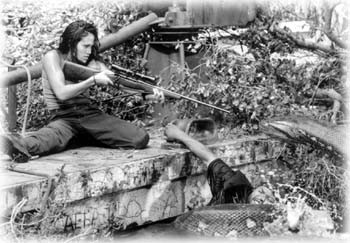
Snake Pit: ‘Anaconda’ scales back the truth in favor of sensationalism.

Reptile expert Ken Howell sheds light on ‘Anaconda’

By David Templeton

Writer David Templeton takes interesting people to interesting movies in his ongoing quest for the ultimate post-film conversation. This time out, he visits fearless snake-keeper Ken Howell to discuss big reptiles and the new film Anaconda.

“THIS WAY!” Ken Howell threads his way through the cavernous foyer of San Francisco’s venerable California Academy of Sciences in Golden Gate Park. He sidesteps a squealing throng of tourists, turns right at the Tyrannosaurus rex, and plummets down a staircase while I hurry to keep up. We rush through the museum’s cafe, duck past a “staff only” sign, and descend another, noticeably darker, staircase. Only now does my guide slow down a bit, clearly relieved to be back in his own domain.

“So, is that a normal crowd for a weekday?” I ask, cocking my head upwards as Howell leads me past a series of offices and classroomlike work areas, stacks of rocks and tubing, and cages swarming with baby-pink rats.

“I wouldn’t really know,” he shrugs. “I seldom go up where the people are. I prefer to hang back with the reptiles.”

Ken Howell, a muscular, soft-spoken yet wry-humored kind of guy, is the official snakekeeper here at the academy’s renowned Steinhart Aquarium, where he’s worked for over 18 years. His charges include rattlesnakes, boa constrictors, and pythons. He understands them; they understand that he feeds them. It is a mutually satisfying relationship.

Earlier this week, Howell ventured out to see the popular fright-flick Anaconda, a neat yarn about a ravenous 40-foot-long river snake with an appetite for clueless documentary makers (played by Jennifer Lopez, Eric Stoltz, and rapper Ice Cube). A gloriously evil snake hunter (Jon Voight) is involved, but the real star is the snake itself–Jaws without the fins–a critter so fond of killing, we are told, that it will regurgitate its prey just so it can put the squeeze on something else.

“My phone has been ringing off the hook ever since this movie appeared,” Howell says, as we arrive at his office. He waves me to a seat beside an aquarium containing a dozen week-old baby boas, gently undulating in and out of knotlike sibling embraces. “People want to know if anacondas really get that big, which they can, and then they want to know if they really upchuck their food just so they can eat again, which, of course, is very false. But people seem to want to believe that.”

I sit quietly a moment.

“So, snake bulimia is not a big problem, then?” I ask, attempting to hide my disappointment.

“No, not as such,” he grins. “Sometimes when you know a little too much about natural history, it takes away some of the fun of the movie. Like in Tarzan movies: suddenly Tarzan is fighting piranhas or something. In Africa! Piranhas are a South American species. I try to roll with it.

“There are instances when an anaconda might regurgitate a prey item,” he says, perhaps sensing that I’m not quite satisfied about this whole upchucking thing. “Particularly if the snake is disturbed right after it has eaten. If you start spooking them, often times they will regurgitate, simply because they know they can get away a lot faster without it. But they don’t do it, you know, just for yucks.”

Howell counts off the other bits of misinformation that made Anaconda fun–if not exactly factual. Included: snakes don’t grab people with their tails, they don’t snatch falling prey in midair, and they don’t make dinosaur noises when they get peeved.

“Aaiieeeeeeeeeeee!” Howell squeals, accurately duplicating the movie snake’s voice. “Snakes don’t do that. They don’t vocalize. Some might sound like they hiss, but all they’re doing is exhaling air very quickly.”

For years, the Steinhart had an anaconda on display upstairs; it was a popular site with the visitors. At a length of 13 feet, it was certainly much smaller than the King Kong­ sized critter in the film, but, as Howell recalls, it wasn’t much friendlier.

“They tend to be very nasty,” he admits. “They are a ‘bitey’ kind of snake. When you open the door, these are the kinds of animals that know that they are going to be fed, and they’re right there in your face. He was not my favorite snake.”

There is a knock at the door. “Excuse me, I’ve got a case of frozen mice,” a delivery man announces. “Can someone sign for it?”

Howell pauses to take care of business, and returns to see me eyeing the baby boas. He asks if they, you know, scare me.

“Not especially,” I reply. Growing up, we always had snakes, salamanders, rats, all those things.

“Me too,” he enthusiastically nods. “My room was a zoo. Every jar in our house had a lid with holes punched in it. Young people don’t do that anymore. I think most people have become a little too removed from natural history. That’s why places like this,” he waves his hand at the ceiling, “are so important.”

“So, you’re obviously not afraid of snakes,” I note. “Is there anything that does scare you?” Tourists, perhaps?

“Oh no,” he grins, stating firmly, “I never tell people what I’m afraid of.” He pauses a minute. “Then again, there’s not much I am afraid of. The world is a really very amazing place. Instead of fearing it, I’d rather just be fascinated.”

From the May 1-7, 1997 issue of the Sonoma County Independent

This page was designed and created by the Boulevards team.
© 1997 Metrosa, Inc.

Medical Marijuana

0

Pot Deal


Janet Orsi

Green Party: Protesters have argued that county law enforcement officials were ignoring the state’s new medical marijuana law.

County officials tackle Prop. 215

By Maria Brosnan

IN SONOMA COUNTY–home of the first court case to test the new medical marijuana initiative–law enforcement officials, health officials, the district attorney, and medical marijuana supporters are trying to hash out a plan to implement Proposition 215, which legalizes marijuana for medical use with a physician’s recommendation but doesn’t specify how the law should be applied.

“The statute itself doesn’t explain how [marijuana] is supposed to be distributed,” says District Attorney Michael Mullins. He and medical marijuana supporters Paul Klopper and Alan Silverman have been working on a mission statement to establish the Medical Marijuana Research Foundation.

Silverman thinks the MMRF should consist of a Cannabis Health Maintenance Organization to identify bona fide patients and research the effects of cannabis, a Medical Marijuana Research “Farmacy” to provide growing equipment and nutrients, a Medical Marijuana Outreach Program to educate patients and physicians, and a medical marijuana “dispensary” to disperse cannabis to patients in a safe, regulated environment.

Mullins does not support a cannabis club such as those set up in San Francisco and Ukiah because it’s too difficult to ensure they’re not cultivating pot for the black market. He agrees that legitimate patients should be allowed to cultivate their own marijuana for personal consumption.

Silverman says that’s not enough. However, the district attorney contends that for him to approve of such a plan, the definitions of a patient, a caregiver, and a serious illness would need to be clarified.

The group of officials and pot supporters, which is seeking input from the Sonoma County Police Chiefs Association, met again Monday. “It’s still looking like everything is going to be handled on a case-by-case basis,” Silverman said afterward. “The law officer’s judgment is going to play a key role–and how an officer’s judgment is shaped is what we’re working on.”

The district attorney is prosecuting what is apparently the first medical marijuana case. Alan Martinez, 39, an epileptic, and his caregiver John Miller were arrested last year for cultivation and possession of marijuana plants but their court cases were delayed until after last November’s election. Mullins, who insists that the physician would need to be identified in patient cases, says the problem with the present case is that Martinez won’t disclose the name of his doctor. However, Silverman says doctor information falls under patient confidentiality.

Some Sonoma County law enforcement officials, including Sheriff Mark Ihde, had announced they would report doctors who prescribe marijuana to the Drug Enforcement Administration. But the issue of doctors recommending marijuana to patients has been relaxed a little since a U.S. District Court recently barred the government from prosecuting doctors from doing so.

The Martinez case, which is being closely watched by the rest of the state, is scheduled for further proceedings on May 22.

Staff reporter Paula Harris contributed to this article.

From the May 1-7, 1997 issue of the Sonoma County Independent

This page was designed and created by the Boulevards team.
© 1997 Metrosa, Inc.
Tea Time

0

Tea for Two


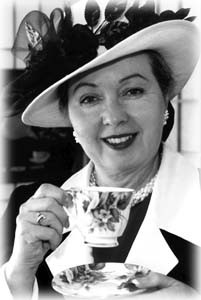
To the Tea: Manners maven Dana May Casperson is a firm believer in the quiet elegance of teatime.

Photo by Janet Orsi


Savoring the agony of the leaves

By David Templeton

DANA MAY CASPERSON has come to tea. Breezing in to the Independent‘s cluttered reception area, she carries herself with an air of culture and sophistication most of us here have not observed or attempted since last year’s Christmas party. And as I recall, no one showed up that evening wearing a hat like the classic, flower-bedecked adornment that Ms. Casperson sports today.

As she is escorted to the lunchroom at the rear of the building, her hat actually appears to be forming a fan club, snapping up adulations from several members of the staff. In keeping with her station as a manners maven, Ms. Casperson responds to each new praise as if it were the first time she’d heard it, warmly replying, “Well, thank you,” adding, somewhat conspiratorially, “I have come to tea, you know.”

Known variably as “Ms. Etiquette” and “Miz Tea”–Dana May Casperson is the founder of Everyone’s Cup of Tea and of the Professional Resource Institute of Etiquette and Protocol, in Santa Rosa. She has earned a steadfast reputation as one of the nation’s leading experts in the field of etiquette and good manners, placing a special emphasis on the recently resurrected ritual of taking tea. A trainer within the hotel, restaurant, and bed & breakfast industries, for which she teaches the nuances of tea service, she is in demand around the world for her lectures and seminars.

At home in Santa Rosa, Ms. Casperson has come to the aid of countless parents with her manners classes for children and teens, offering instruction on everything from handshakes and introductions to table setting, dining skills, and appropriate behavior at the theater.

After a three-minute phone conversation with Ms. Casperson–during which she made taking tea sound so civilized and simple–I found myself inviting her to a tea party, even though I prefer to drink strong coffee, had never hosted a formal tea party, and indeed had never even been to such a thing. It seemed the proper thing to do.

And here we are.

The lunchroom is understatedly decorated with a redwood picnic table, elegantly covered with a green vinyl tablecloth. I’ve spruced it up with a sprig of something flowery that I tore from a tree hanging over the parking lot. The table is set with a mix of Bavarian china left to me by my grandmother, a teapot with matching ceramic cups and saucers, mismatched metal and plastic flatware scrounged from around the office, and a whimsical sugar-and-cream set shaped like a cabbage and a bunny rabbit.

Having gleaned just enough from Jane Austen movies to know that snacks are a must, I’ve obtained a number of decadent treats. The forks and paper napkins are arranged in a manner I chose after quizzing the first five people to walk into the room.

“How nice everything looks,” Ms. Casperson exclaims kindly, as I invite her to sit down on a redwood bench.

After a few minutes of civilized chatting, it is time to make the tea.

Yikes. No stove. My calico-cat teakettle has no place to work. How could I not have noticed that?

“Um,” I cringe, “as a tea expert, what would you do if faced with a choice between microwaving your water or taking it from the hot-water side of the water cooler?”

“Let’s find a third choice!” she laughs. “There is a way to make a perfect cup of tea. Today certainly doesn’t have to be the big fancy spiel, but to eke out the best flavor of the leaves, the water needs to come to a boil, so you have to heat it up to 212 degrees. It’s called ‘the agony of the leaves,’ the moment when the tea releases its richest flavor.”

I am experiencing a different form of agony. How can I serve tea made with leaves insufficiently tortured? The party is saved when our associate editor runs to the Mexican restaurant next door for a pot of boiling water.

That was a close one.

“It is probably a good thing that much of the minutiae and endless details of tea serving has been lost,” Casperson suggests later, after the tea (Earl Grey, “a splendid afternoon tea”) has been steeped the requisite five minutes and I have been coached in the art of pouring: ladies first, then myself, lifting the saucer–not just the cup–to the pot. “After all, there are more important things to be concerned with than how to hold the teacup and whether you stick your pinky out or not. If you want to be fussy-dussy about it–if you were going to have tea with the Queen of England–I suppose those are considerations you should know. But tea is more about conversation and civility than it is about rules.” As I am now deftly demonstrating.

“On the other hand,” she continues, having finished a dainty bite of her cake, “we live in a world full of phone messages and e-mail and faxes; we are becoming layered with more and more reasons to communicate. And taking tea brings us back the times that you sit down with people and you talk, and you appreciate the plates that grandmother gave you, and you appreciate the cakes that came from a nice bakery.

“You just add some civility to your life, because we’re losing it.”

Ms. Casperson tells of taking tea as a child with her grandmother, who would improvise a veranda setting on her Healdsburg roof, and of sipping afternoon tea with her mother, who used the civilized setting to casually induce her teenaged children to tell her what was going on in their lives.

“As we pull closer to the millennium, we are a bit fearful, I think,” Ms. Casperson continues, setting down her cup. “That’s why I think you see a re-embracing of things from our past, things that give us comfort, things that give us a connection to each other and to our roots.

“Things like tea,” she smiles. “I’m so delighted you invited me.”

From the May 1-7, 1997 issue of the Sonoma County Independent

This page was designed and created by the Boulevards team.
© 1997 Metrosa, Inc.
Classical Music Season

0

Just Classic


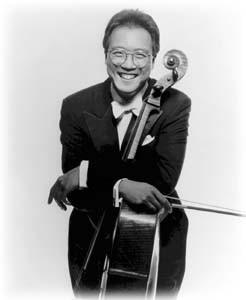
Bass Man: Yo-Yo Ma returns to Santa Rosa.

Photo by J. Henry Fair


Concert season reaches crescendo

By Greg Cahill

I HAVE a private joke,” says New Century Chamber Orchestra concert master Stuart Canin. “My fondest hope is that we’d last until the next century, just to fulfill the promise of our name.

“It looks like we’ll make our mark,” he adds with a laugh.

Five years ago, the NCCO was something of an anomaly–a conductorless, strings-only ensemble that stayed on its collective feet and engaged the audience in intimate, often intense performances. Some critics wrote them off as a gimmick.

They’re no fluke.

The orchestra’s first recording, 1996’s Written with the Heart’s Blood (New Albion), a remarkable collection of Shostakovich pieces, garnered a coveted Grammy nomination this year, and the Mill Valley­based orchestra is touring further afield.

NCCO returns to the North Bay on Sunday, May 4, at 5 p.m. to wrap up its exciting 1996-97 concert season with the world premiere of NCCO violist Kurt Rohde’s “Oculus,” Grieg’s “Holberg Suite;” Alberto Williams’ “Segunda Suite Argentina para Instrumentos de Arco,” and Britten’s “Variations on a Theme of Frank Bridge” at the Osher Jewish Community Center, 200 N. San Pedro Road, San Rafael. Tickets are $10-$22. For details, call 415/479-2000.

“In these days, with arts organizations struggling for their lives, you never know how long you’ll be around,” says Canin. “But we’ve made an impression. We seem to have touched a nerve.”

Random notes: Cello great Yo-Yo Ma, violinist Pamela Frank, and Santa Rosa Symphony conductor and pianist Jeffrey Kahane reunite Friday, May 16, at a gala evening of chamber music at the Luther Burbank Center for the Arts. The program features selections of works by Schubert, Ravel, and Brahms. Tickets are $35, $50, and $125 (including a champagne reception with the guest players). Call 54-MUSIC for information.

Meanwhile, pianist Eldar Nebolsin performs Rachmaninoff’s Piano Concerto No. 2 with the Santa Rosa Symphony on May 10, 11, and 12. Music director Kahane also will lead the orchestra in Bach’s Suite No. 3 and Bartok’s “Dance Suite” in the final concerts of the 1996-97 season.

The Santa Rosa Symphony Youth Ensemble, under the baton of Asher Raboy, will present its 38th annual Spring Concert on Sunday, May 4, at 4 p.m. in the concert chamber at LBC. The program features three young award-winning soloists from the orchestra: cellist Jonathan Beard, pianist Grace Ho, and pianist Carol Kim. Tickets are $6 adults and $4 students.

On Monday, May 12, the Youth Orchestra performs two free concerts for schoolchildren in kindergarten through third grade, at 9:30 and 11 a.m. at LBC. Students from public and private schools are welcome. Special reservations are required (546-7097, ext. 19).

The symphony’s Youth Wind Ensemble, directed by Andy Collinsworth, presents its third annual Spring Concert on Tuesday, May 6, at 7:30 p.m. at the Performing Arts Auditorium of Maria Carrillo High School, 4999 Montecito Blvd., Santa Rosa. Tickets are $6 adults and $4 students/seniors.

The Sonoma County Bach Society presents its season finale on May 9 and 10 with “Comforts and Praise,” a program that includes three Bach motets. The performances will be repeated at the Holy Family Episcopal Church in Rohnert Park and St. Vincent’s Catholic Church in Petaluma. Tickets are $12 general; $10 SSU faculty, alumni, staff, and seniors; $6 students. For details, call 664-4234.

If you heard the heavenly sounds of the Anonymous 4 at their recent St. Vincent’s Church performance, check out the Monteverdi Singers in a program of early polyphony from the 12th and 13th centuries, on Saturday, May 3, at 8 p.m. at the Holy Family Episcopal Church in Rohnert Park. Tickets are $4 general, $3 fans, $2 students, and $1 SSU students.

For a slightly different spin, the Redwood Arts Council presents the innovative Modern Mandolin Quartet, Windham Hill recording artists, on Saturday, May 3, at 8:30 p.m. at the Occidental Community Church, Second and Church streets, Occidental. Tickets are $15. Call 874-1124 for information.

Other key events include Baroque Sinfonia’s concert finale on Friday, May 2 (at LBC), and Sunday, May 4 (at the Sonoma Community Center, 276 E. Napa St., Sonoma; call 546-4504 for details); the Russian River Chamber Music Society’s free Kids Konzert on Saturday, May 3, at 10 a.m. at the Federated Church, 1100 University Ave., Healdsburg (524-8700); and the Santa Rosa Symphonic Chorus presentation of Handel’s dramatic oratorio “Solomon” on Friday, May 2, at 8 p.m. at the St. James Catholic Church, 125 Sonoma Mountain Road, Petaluma; Saturday, May 3, at 8:15 at Our Lady of Guadalupe, 8400 Old Redwood Hwy., Windsor; and Sunday, May 4, at 2 p.m. at St. Eugene’s Cathedral, 2323 Montgomery Drive, Santa Rosa; tickets are $10 general, $8 seniors and students (573-9506).

From the May 1-7, 1997 issue of the Sonoma County Independent

This page was designed and created by the Boulevards team.
© 1997 Metrosa, Inc.
Judy Stone

0

Life in Review


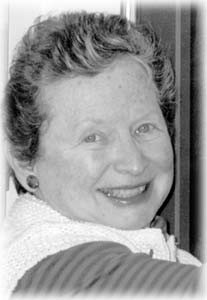
Stopped the Presses: ‘Chronicle’ reviewer Judy Stone has lived a life in print.

Photo by Janet Orsi


Judy Stone’s 60 years in newspapers

By

JUDY STONE, late of the San Francisco Chronicle, would like to distance herself from her former co-worker, the Little Man. The Little Man is the Chronicle’s four-star film mascot and probably the best-known member of the Chron‘s staff now that Herb Caen is gone, even though he does only one of four things: jump up in his seat, lean forward with interest, slump listlessly, or doze.

“I hate the Little Man,” says Stone, seated in lobby cafe of San Francisco’s Kabuki Theater during a break from press screenings at the San Francisco International Film Fest. “People just look at what the Little Man is doing, and don’t read the reviews–reviews that someone spent a lot of time working on.”

Stone, a physically small but quite formidable lady in her 70s, is at the film festival to be honored on the release of her book Eye on the World: Conversations with International Filmmakers (Silman-James Press; $35). She appears Thursday, May 8, at North Light Books to discuss her book and career.

The book collects interviews with some 200 directors Stone has encountered, including local heroes Francis Coppola and George Lucas, and the lesser-known but just as important San Francisco film director Philip Kaufman (The Unbearable Lightness of Being). Stone also talked to such titans of cinema such as Luis Buñuel, John Huston, Jean-Luc Godard, and Louis Malle.

Capping Stone’s nearly 30-year-long tenure as the most powerful print film critic in the Bay Area, Eye on the World reflects Stone’s best assets as a film reporter: a strong sense of social responsibility and a lack of prudery–a fault quite common in daily critics–that allowed her to see beyond the raw subject matter of such films as Jean-Claude Lauzon’s surreal story of an insane Montreal family, the 1992 Leolo, and Dusan Makavejev’s 1974 scatalogical Sweet Movie. “I really understood what Makavejev was doing,” says Stone. “I worked really hard writing about Sweet Movie; it got dumped-on here.”

The title Eye on the World honors one aspect of foreign film–its ability to give a periscope view into parts of the earth you’d never see otherwise. “Writing about these films was all a learning process,” says Stone. “I didn’t go to these films always knowing about the countries they came from. It was a lot of work. Critics ought to provide some context for the American audience. Often I’ll see critics, and I won’t mention their names, who wrote about films concerning the Irish troubles without knowing anything about the situation in Ireland.”

The child of Jewish immigrants from Russia, Stone is the sister of famed investigative journalist I. F. Stone. “I have three older brothers who are journalists, and they’re all influences,” she replies crisply when asked if “Izzy” Stone had led her into the newspaper business.

Before Stone was out of junior high school, she’d written her first movie review, of the 1936 The General Died at Dawn with Gary Cooper and Akim Tamiroff. Before she left high school, she’d interviewed scientist Madame Curie, writer William Saroyan, and the actor and singer Paul Robeson. “I saw his Othello in Philadelphia and I could never see anyone else in that role. Robeson was unfairly rejected by black people because of his pro-Soviet ideas. That voice was magnificent. He was wonderful to interview,” says Stone, adding with her characteristic sharpness. “I can’t say the same for his wife. “

Stone dropped out of Temple University during World War II to work in a radio factory as her part of the war effort. There she acted as managing editor for the Square Dealer, the newspaper of the United Electrical, Radio and Machine Workers of America CIO. This began her journalistic career. Before joining the Chronicle, Stone worked for the Marin Independent-Journal as a reporter during the early 1950s.

Among Stone’s big stories is one that eventually became a book–meeting the reclusive author B. Traven (The Treasure of the Sierra Madre). Or did she meet him? “Hal Croves,” the man Stone interviewed, was a regular pose assumed by Traven (who, to make matters more confusing, is generally thought to have been one Otto Feige or, possibly, the Bavarian revolutionary Ret Marut–the name Marut itself being assumed).

“Croves said he wasn’t Traven,” says Stone. “He kept denying it, saying that he was Traven’s agent. Croves’ widow says her husband was the illegitimate son of Kaiser Wilhelm II, for that matter. I don’t think we’ll ever really know if B. Traven was one man–a great literary mystery, still. Read Traven’s jungle books,” she exhorts, “Man of the Jungle, Bridge on the Jungle, all about the exploitation of Indians–and you’ll learn a lot about what’s going on in [Chiapas, Mexico] today.”

Since Stone received a buyout offer from the Chronicle three years ago, she’s retired from daily reporting. Some would say she’d gotten out when the going was good, by missing–or rather not seeing–Independence Day and the newest cycle of natural disaster films. When asked her opinion of what the single worst influence on movies was in the last 50 years, she replies immediately. “It was the success of Star Wars. I hate to say this, but from that point on the studios went for blockbusters. For the amount of money Star Wars made, it had a bad influence.”

To Stone, covering film was covering a beat, and she is undazzled by star power. “I consider myself a reviewer, not a critic. When you work for a daily paper you don’t get a chance to go into depth; I leave that to Kael [ex-Petaluman and former New Yorker magazine critic Pauline Kael]. I’m not a film buff,” she says briskly. “I don’t want to see every movie ever made. There’s a lot of garbage out there.”

Judy Stone reads from and discusses Eye on the World Thursday, May 8, at North Light Books. 95 Fifth St., Santa Rosa. 7 p.m. Admission is free. 579-9000.

From the May 1-7, 1997 issue of the Sonoma County Independent

This page was designed and created by the Boulevards team.
© 1997 Metrosa, Inc.

William O’Keeffe

Ground LevelTaking a Bow: William O'Keeffe ties together the west coasts of California and Ireland.Photo by Janet OrsiWilliam O'Keeffe captures Ireland's fragrant wastelandBy Gretchen GilesAt 10:30 a.m. on a Friday morning, acclaimed Irish abstract painter William Horton O'Keeffe still has his dignity. And if memory serves, keeps it for about 10 more minutes. That's when fellow artist Poe...

Why Has Bodhi-Dharma Left for the East?

Buddha Boy The Eightfold Path Less Traveled: 'Why Has Bodhi-Dharma Left for the East?' is spiritually uplifting.Zen and the art of filmmaking By Greg CahillALPHA WAVE ALERT! South Korean filmmaker Bae Yong-Kyun's stunning 1989 film Why Has Bodhi-Dharma Left for the East? is rife with Zen Buddhist doctrine, haunting visual allegories, and mystical imagery. No sex. No chase...

Charlie Musselwhite

Blue MoodBlues Survivor: Charlie Musselwhite performs next week at LBC.Photo by Peter AmftCharlie Musselwhite back on topBy Greg CahillTHE TURNING POINT came unexpectedly. Charlie Musselwhite--a harmonica player with a gift for the low-down, dirty blues and with a drinking habit that was legendary in blues circles--was driving to a nightclub in 1987 when he heard a radio news...

Nuclear Power

No Nukes is Good NukesBorn more than 50 years ago as an instant luminary, you're still going strong today. This is your life, Atomic Flackery!Some call you a has-been. No way. Just the other night, Mr. Flackery, you triumphed again when the PBS program "Frontline" hoisted you on its broad public-TV shoulders. The New York Times cheered, and...

Patricia Ireland

Be Here NowWoman Warrior: For more than 30 years, Patricia Ireland has been fighting for women's rights.Photo by Janet OrsiNOW President Patricia Ireland takes her show on the road By Gretchen GilesPATRICIA IRELAND is dismayed. The usually fiery president of the National Organization for Women has just been told that one of her staffers has...

Talking Pictures

Snake BitsK.C. BaileySnake Pit: 'Anaconda' scales back the truth in favor of sensationalism.Reptile expert Ken Howell sheds light on 'Anaconda'By David TempletonWriter David Templeton takes interesting people to interesting movies in his ongoing quest for the ultimate post-film conversation. This time out, he visits fearless snake-keeper Ken Howell to discuss big reptiles and the new film Anaconda."THIS...

Medical Marijuana

Pot DealJanet OrsiGreen Party: Protesters have argued that county law enforcement officials were ignoring the state's new medical marijuana law.County officials tackle Prop. 215By Maria BrosnanIN SONOMA COUNTY--home of the first court case to test the new medical marijuana initiative--law enforcement officials, health officials, the district attorney, and medical marijuana supporters are trying to hash out a plan...

Tea Time

Tea for TwoTo the Tea: Manners maven Dana May Casperson is a firm believer in the quiet elegance of teatime.Photo by Janet OrsiSavoring the agony of the leaves By David TempletonDANA MAY CASPERSON has come to tea. Breezing in to the Independent's cluttered reception area, she carries herself with an air of culture and...

Classical Music Season

Just Classic Bass Man: Yo-Yo Ma returns to Santa Rosa.Photo by J. Henry FairConcert season reaches crescendoBy Greg CahillI HAVE a private joke," says New Century Chamber Orchestra concert master Stuart Canin. "My fondest hope is that we'd last until the next century, just to fulfill the promise of our name."It looks like we'll make our mark," he...

Judy Stone

Life in ReviewStopped the Presses: 'Chronicle' reviewer Judy Stone has lived a life in print.Photo by Janet OrsiJudy Stone's 60 years in newspapers By JUDY STONE, late of the San Francisco Chronicle, would like to distance herself from her former co-worker, the Little Man. The Little Man is the Chronicle's four-star film mascot and probably the best-known...
11,084FansLike
4,606FollowersFollow
6,928FollowersFollow

