Talking Pictures

0

Double Dose of Durst


David Templeton

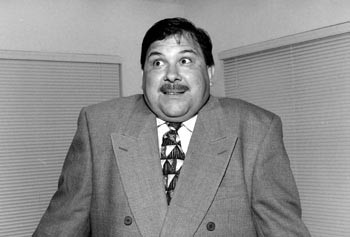
Two of a Kind: Political satirists Will and Debi Durst ham it up after viewing the sick-flick fest that is ‘Con Air.’

Will and Debi Durst shout out about nothing (and ‘Con Air’)

By David Templeton

Writer David Templeton takes interesting people to interesting movies. This time out, he takes political satirists Will and Debi Durst to see the sick-joke thrill ride Con Air.

IT IS! IT IS! It’s a sick fucking movie!” laughs political comic Will Durst, hollering to be heard above the bar’s deafening high-decibel music. Durst is reiterating the succinct observation he made just a few moments ago–from the balcony of a packed San Francisco theater–as the gleefully tasteless new film, Con Air, murdered its last bad guy and came screeching to a grand and noisy close.

“Oh, it was not sick!” Debi Durst disagrees, in a loud but amiable shout. “It’s a movie about convicts, for goodness sake! They were bad, right? And you knew it was going to turn bad, and they were all going to die bad.”

Will opens his mouth to reply, taking a deep breath in order to achieve the appropriate volume, and is suddenly interrupted by our waitress, presenting a round of beers sent over by a smiling, waving patron across the room. As Will ambles over to thank his fan, Debi leans over and whoops, “See? It kinda pays to pal around with somebody famous!”

This night out together is a somewhat rare occasion for the Dursts, who are so increasingly in demand that with their active schedules and constant touring–individually and as a team (Debi is a comedian in her own right)–they’re seldom both home at the same time. Will, perhaps best known for his sharp, satirical programs on PBS–The Durst Amendment and the series Livelyhood–also writes a syndicated political humor column and performs his insightfully grumpy stand-up act around the world.

Con Air stars Nicholas Cage as a nice parolee on a very lousy day, when his prison transport plane is taken over by the world’s worst convicts (John Malkovich, Ving Rhames, and Steve Buscemi). It’s a thoroughly modern action film, the kind in which audiences are encouraged to laugh every time someone is killed or horribly mutilated.

“I still think it was kinda sick,” Will announces upon his return. “Americans sure love to see shit blowed up good, don’t they? Did anyone count how many people died in this thing? Movies are only gonna get worse, though. I read some interview with Jan De Bont [the director of Twister and Speed]. He said, and I quote, ‘Movies are going to get a lot bigger, and a lot louder.'”

“Hey, go ahead and make ’em bigger and louder!” his counterpart counters. “It’s only a movie, right? It’s not supposed to be Shakespeare!”

“It’s only a movie!” Will nods, pounding on the table. “I always forget that!”

In quick succession, the Dursts list dozens of memorably violent movies; point out that Dana Carvey’s wife looks exactly like Dana Carvey; and confess to a penchant for sneaking from one movie to another in multiplex theaters.

“Remember Reno?” Debi smiles, as Will rolls his eyes in remembrance. “We’d seen some action thing,” she explains, “and we’d ducked into Home for the Holidays. There were maybe five people in there, and the manager kept coming in and kind of looking at us.”

“But then the movie started, and there was no picture!” Will laughs. “We sat through three previews and the first few minutes of the movie–with only the sound on.”

“We were afraid to do anything about it,” says Debi.

Suddenly, Will reaches over and snatches the tape recorder.”Hey!” he yells. “There’s no tape in here! Oh my God!”

“No tape,” Debi moans. “We’ll have to repeat everything. What have we been talking about, anyway?

“Uh,” Will grabs his head as though thinking. “I know! The future of movies is ‘Blow shit up even bigger!'”

“The more money you spend on explosives, the more money you make at the box office!” Debi adds.

“There was something else,” he insists.

“Only a movie?” Debi prompts.

“That’s right!” he crows. “It’s only a movie. And a sick fucking movie at that!”

From the June 19-25, 1997 issue of the Sonoma County Independent.

© Metro Publishing Inc.

Spins

0

Spins


Rage Against the Machine: Skunk Anansie remains unpredictable.

Skin and Bones:
Skunk, Feelings & Sweet Horses reviewed

Skunk Anansie
Stoosh (Epic)
BRITAIN’S SKUNK ANANSIE is a punk-metal band led by a black female named Skin, so its very presence on a major label adds to its political statement. Its 1995 debut Paranoid and Sunburnt was adamantly political, and not merely because the lyrics railed against racism and piety–Skin deserves attention because she repossesses ferocious metal from white males and tweaks the feminine topics of the neo-folk poet grrls. These basic virtues seem diminished on Skunk Anansie’s follow-up release Stoosh. Veering away from the punk-funk of Rage Against the Machine and into the trip-hop textures of Portishead, the band scores points for being unpredictable. The letdown isn’t the softer sound, but the lesser songs. Skin won’t impress anyone by writing about tortured romance, and the few “message songs” like “Yes, It’s Fucking Political” simply lack the debut’s incisive reach. Still, Skin’s whole idea with Skunk Anansie may be expectation reversal; so perhaps it’s appropriate that the most socially sensitive new track is “Pickin’ on Me,” a slow acoustic number.
(KARL BYRN)

David Byrne
Feelings (Luka Bop/Warner)
THREE YEARS AFTER his much-touted eponymous return to the spare and twitchy style that he forged during the ’70s as headman of the Talking Heads, David Byrne is back with a nearly perfect synthesis of pop and world music. Feelings is Byrne’s least self-conscious attempt yet to fuse the two influences, ranging from straight-ahead rock to Brazilian samba. Recorded at home studios in a variety of international cities and in collaboration with the likes of Devo’s Mark Mothersbaugh, Feelings is an often engaging experiment that works, well, at least most of the time. Byrne–obviously having a helluva good time–deftly blends samples and shows that the master has a few tricks to teach Beck and other trip-hop happy studio freaks on the current pop scene. His use of pop star Paula Cole and R&B diva Betty Wright (“The Clean-up Woman”) as back-up singers is inspired stuff. And who else can combine Cajun fiddle and sitars in an ambitious track that just seems so right?
(GREG CAHILL)

Robert Cray
Sweet Potato Pie (Mercury)
IN THE HIT-ORIENTED, star de jour world of modern pop music, bluesman Robert Cray is something of an oldies act–his only bona fide Top 10 hit, “Smoking Gun,” burst onto the pop charts a whopping 11 years ago. But rather than try to replicate that unexpected success, this purveyor of stiletto-sharp guitar riffs and dreamy, someone-done-somebody-wrong songs over the years has quietly continued to refine his craft, putting his imprint on a distinctive sound that resonates with the tuneful gospel and soul of mentor O. V. Wright, all bolstered by those phat Memphis Horns. Sweet Potato Pie–sweet and sticky? Not on your life, but a real treat nonetheless.
(G.C.)

Neil Young & Crazy Horse
Year of the Horse (Reprise)
GRUNGE GODFATHER Neil Young has about a million hours worth of outtakes and live concert material in the vault, and he plans to release a lot of it in the next couple of years. Meanwhile, this soundtrack to a new film chronicling the hippie icon and his favorite band on the road is yet another lo-fi, feedback-frenzied foray into the ozone squall still crackling with the raw power of 1991’s blistering Arc/Weld. If you prefer to bathe in the light of the Harvest Moon, sit this one out.
(G.C.)

From the June 19-25, 1997 issue of the Sonoma County Independent.

© Metro Publishing Inc.
Lomax Collection

0

Song Hunter


Jak Kilby

Big Muddy: Alan Lomax’s discoveries include blues legend Muddy Waters.

Lomax Collection is a wellspring of roots music

By Steve Bjerklie

MISSISSIPPI FRED McDowell, who wrote “Kokomo” (Bonnie Raitt performs a splendid version) and a thousand other seminal blues songs, is famous among those who know his music for having said, “I do not play no rock and roll.” He wasn’t trashing the upstart idiom–indeed, Eric Clapton and Michael Bloomfield, who together with Jimi Hendrix virtually invented modern rock guitar playing, loved his work. McDowell was simply acknowledging that he plays deeper in the water than the kids, below the currents of trend and popularity. On his song “61 Highway” the singer calls on friends to “please see somebody for me” and tell her “that life is all right with me.

“I say please!” McDowell cries out over his slippery guitar, the bottleneck throbbing furiously on the strings. “Pleeeeease!”

This isn’t Bob Dylan’s metaphorical Highway 61, where God and Georgia Sam and Mack the Finger and the fifth daughter of the first father run, hide, sell, and kill. For Fred McDowell, Highway 61 is “the only road I know,” the one that runs “from New York City right on by my baby’s door,” the place he wants to be with his baby “before you think my time has come” because then “I want you to bury my body down on Highway 61.” The real pavement, in other words: the hard, bloody, shining blacktop of raw life melting like a mirror in the Mississippi heat.

Yet, “61 Highway” is but one gem among literally thousands collected and taped in the field by Alan Lomax, the indispensable music archivist. Now the entirety of those recordings, most of them made in America in the 1930s and ’40s for the Library of Congress but also made by Lomax in the ’50s and ’60s in the British Isles, the Caribbean, Spain, Italy, Eastern Europe, Japan, Bali, and Canada for the BBC, Columbia Records, and other organizations, are being released in a monumental series of CDs by Rounder Records under the title “The Alan Lomax Collection.” When the final CDs in the set are released in five to six years, the collection will comprise more than 100 discs.

Overestimating the importance of the collection is impossible. The music in these recordings is the floor beneath the ocean of all of the earth’s folk and popular music (save, perhaps, for instrumental classical music, though go back far enough and classical, too, is rooted in naive traditions).

The Lomax collection contains not only the bedrock of rock and roll but the foundations of jazz, R&B, bluegrass, country & western, Tin Pan Alley, parlor songs, American musicals, church hymns, and Italian opera. You name it, and Alan Lomax found it at its source. He discovered astonishing talent and material just about everywhere he looked. Just one early example is Leadbelly, the writer of “The Midnight Special,” “Goodnight Irene,” and “Rock Island Line,” whom Alan and his father, John (the essential inventor of field musicology), found languishing in a Texas jail during the Depression.

Later in the ’30s, Alan Lomax recorded the fantastic (and at times a little fantastical) oral history of jazz as told by one of the founders of the form, Jelly Roll Morton. And in the ’40s Lomax discovered and was the first to record McKinley Morganfield–aka Muddy Waters.

Beyond the blues, Lomax is responsible for introducing broad American radio and concert audiences to the sounds of Tex-Mex and norteño corridos, Balinese gamelan music, Mediterranean folk songs, chain-gang chants, and traditional shape-note singing, among dozens of other styles and genres. It is fair to say that without the Lomaxes, we would have almost no knowledge at all of the roots of what we hear. Popular music would be completely insubstantial.

An even deeper significance resonates throughout the collection, however. Virtually every recording, no matter where Lomax made it, is a call, in one way or another, for freedom–freedom to be the master of one’s own destiny, freedom to live and love and worship as one wants to beyond the reach of government and power. Freedom, that is, to express and interpret the human experience as one sees fit. Now in his 80s, Lomax told a reporter in 1991, “I found out that what I was really doing, and my father was really doing, was giving an avenue for people to express themselves and tell their side of the story.”

The collection will be released by Rounder in segments, and the first group of recordings, a six-volume set titled Southern Journey, arrived in stores a couple of weeks ago. My favorite at the moment is Volume 5, “Bad Man Ballads: Songs of Outlaws and Desperadoes,” in which we meet not the bank robber Jesse James, but Jesse James the tragic family man, as interpreted by a clear-voiced grandmother named Almeda Riddle (who says in a little introduction while the tape rolls that her great-grandfather and Jesse’s father were brothers). “Jesse had a wife who mourned for his life, and his children too were brave,” sings Mrs. Riddle in her sweet ballad (later reworked by Woody Guthrie into the bitter “Jesus Christ”), “but a dirty little coward they called Robert Howard laid Jesse James in his grave.”

Volume 6, “Sheep, Sheep, Don’tcha Know the Road: Southern Music, Sacred and Sinful,” also offers wondrous music that walks the line between the soul and the devil. But all of Southern Journeys is marvelous: Volume 1 focuses on a broad range of Southern styles; Volume 2 comprises ballads and breakdowns collected by Lomax in Southern mountain communities; Volume 3 is work-songs and blues (including “61 Highway”); and Volume 4 is Southern white spirituals.

A Lomax Collection sampler CD is also available but maddeningly, if necessarily, incomplete. Listening to it is like trying to deduce all of Bach from a couple of toccatas, sonatas, and fugues. However, the sampler comes with an excellent 72-page booklet introducing the Lomaxes, their work, and the collection; it also includes a wonderful article, “Saga of a Folksong Hunter,” that Alan originally published in 1960. Photographs, too, grace the booklet, including one gripping shot of a pensive, nearly angry Woody Guthrie playing the guitar that’s pasted with my favorite bumper sticker of all time: “This Machine Kills Fascists.”

It’s not often such a trove of cultural wealth can be brought into your home. Other collections of the past–the Folkways, Caedmon, and Columbia World Library LP catalogs, for example–provided good introductions to world music, and now the Smithsonian has an excellent program, but nothing on the scale of “The Alan Lomax Collection” has ever been made available. Buy the first six volumes and the sampler now, and begin saving for the rest of the series.

These recordings are the pure, human wellsprings from which have flowed nearly every kind of music, and every kind of musical yearning for freedom, we have ever heard.

In music, this is who we are.

From the June 19-25, 1997 issue of the Sonoma County Independent.

© Metro Publishing Inc.

Kendall-Jackson

0

Wine Wars

By Bruce Robinson

THE KENDALL-JACKSON winery made many headlines in the past year–none of which had anything to do with wine. This fast-growing, Santa Rosa­based operation drew criticism for building a warehouse without a county permit; cutting native oaks to make way for vineyard planting; planning an enormous, active winery facility in the quiet Alexander Valley; and proposing to log some recently acquired property near rustic Occidental.

Most conspicuously, the company went out on a limb against wine industry giant E&J Gallo in a high-profile copyright dispute over label imagery. Claiming that its falling-leaf emblem was unfairly grafted by Gallo, Kendall-Jackson filed a suit that, like Gallo’s leaf, turned against the firm, ending in a decisive defeat for it.

Unfazed, K-J still is quietly growing like a grapevine in the hot summer sun, buying more small local wineries, creating new ones in other parts of California–last week the company unveiled plans to erect a controversial $18 million facility in the Napa Valley–and even establishing a winemaking presence on two other continents.

This unprecedented growth has attracted industrywide notice, but K-J appears to have leapt into prominence without alienating the community of smaller winemakers from which it has emerged. Even its recruiting of talented winemakers and acquisition of struggling local labels may be a good thing, says Rich Cartiere, editor of the Sonoma-based Wine Business Monthly. “Those brands would be nonexistent if [Jess Jackson, who co-founded the winery with his former wife, Jane Kendall] did not buy them,” he says. “He has poured a huge amount of money into them and made them better wines.”

Becoming the county’s second largest winemaker–after Sebastiani, which still outpaces in its output of cases–in just five short years, K-J has enjoyed sales now estimated at $200 million annually. From producing a modest 18,000 cases in 1983, its first year, the firm went on to triple its volume within two years, tripling sales again in another two years. Ranked sixth in the Bay Area by the San Francisco Business Times for sheer case volume, K-J now projects sales of a whopping 2.7 million cases this year.

Industry observers credit the company’s meteoric growth to founder Jess Jackson’s decision to blend grapes from multiple California vineyards in K-J’s tremendously popular Vintner’s Reserve Chardonnay, and to his success in pricing his wines at an affordable $11-$20 a bottle midpoint between bulk wines and premium vintages.

As sales have soared, so have K-J’s landholdings, which range from 2,000 acres in Sonoma County to 10,000 acres statewide. “We’re buying vineyards to sustain our growth, and I’m not sure how far it’s going to go. We want to get so we have about 60 percent of our needs satisfied from our own vineyards,” says Tom Selfridge, K-J’s vice president of production and marketing. “We acquire vineyards, but then we keep growing, so the percentage doesn’t change very much.”

About 40 percent of the grapes now come K-J’s own vineyards.

So just how big does K-J want to get? Even Selfridge is not sure. “When I started in 1990, we were at 600,000 cases and I thought, ‘We’ll get a little bigger, but not much.’ Well, now we sell 2.7 million cases,” he says. “We want to focus on quality, and if the consumer still demands our product, we’ll grow with that. If it means we can grow from 2.7 [million cases] to twice that, we’ll probably take that.”

But Selfridge, a former winemaker at Beaulieu Vineyards, insists that getting still bigger will not change K-J’s approach to winemaking. “We’re trying to make wines in the style of a little winery. That’s been the hallmark of the wines we make, and I think that would be the same if we were double the size we are now.”

A LESS VISIBLE ASPECT of the company’s expansion has been its growing acquistion of smaller, localized wineries. Managed collectively as Artisans and Estates, these are more than a dozen premium estate vineyards that each produce a handful of specialized wines. While most are new operations K-J established, several are existing labels that were acquired and retooled under K-J management.

These include Edmeades in Mendocino’s Anderson Valley, and La Crema, which is now produced in western Sonoma County. Kendall-Jackson also has absorbed Santa Rosa’s former Chateau de Baun winery (off Highway 101 at River Road), which now serves as the main K-J tasting room, and Forestville’s Domaine Laurier, rechristened Hartford Court.

Further afield, the K-J portfolio also includes estate labels in the Napa Valley (Robert Pepi, Lokoya) and Santa Maria Valley near Santa Barbara (Cambria, Camelot, Kristone), as well as Chile, Argentina, Italy, and France.

“I like to think that we’re doing this right,” says Selfridge, noting that other large American wineries also are expanding abroad. “We’re not just buying bulk wine and bringing it into the United States and bottling under a label in this country,” he explains, but actually making the wine where the grapes are grown.

“Chile has some great vineyards, it has some great wineries, but no one was taking the grapes from the great vineyards down there and putting them into a great winery,” he elaborates. “I think we were the first.”

In part because of his extensive acquisitions, Jackson is seen by others in the industry as “somewhat of a lesser Ernest Gallo,” says Cartiere, who characterizes both men as “very aggressive, very dominating business people.”

But local winemakers view K-J’s spurting growth with mixed feelings. Winery owner Michael Topolos sees it as a positive thing. “I think they’re going to end up doing us a lot more good than ill,” he says, “because they’re going to be putting a lot more [Sonoma County] wine in front of people than we’ll ever do.”

George Davis, owner and winemaker at tiny Porter Creek Winery, agrees. “Kendall-Jackson is raising the awareness of the difference between coastal wines and Central Valley wines,” he says. “As their customers become more sophisticated, they might want to try a few wines from some of the single-vineyard wines, so we might benefit from that.”

But Davis also sees a downside to the lengthening shadow of the big boys. “It’s scary because of their potential effect when the industry downturns” and investors in the large companies pull out, he says. “When the price of grapes changes and the wine market takes its inevitable downturn, these guys will go running for cover,” Davis frets. “It can exacerbate any kind of a situation that develops on the bust part of the boom-and-bust cycle.

“Last time we had a bust, we had a bunch of insurance companies invest very heavily in vineyards and wineries and as soon as their profit margin started eroding, they got out–sold their shares for a low price and depressed the market even further.”

That depressed market, Davis contends, is one big reason K-J was able to expand its holdings so rapidly in the early ’90s. Selfridge acknowledges that the steep upward curve on the K-J sales charts cannot continue at its current pace, but he expects the market and his company to grow. Meanwhile, they are hoping that some new public relations experts will help stave off more of those annoying negative headlines. The bad press “made us all more aware of making sure we were more responsive to the community and we were getting our story out,” Selfridge says.

“Our ultimate product is something we want people to buy,” adds K-J spokesman Jim Caudill. “If they’re angry at us, they’re not going to buy our wine.”

From the June 19-25, 1997 issue of the Sonoma County Independent.

© Metro Publishing Inc.
Car Racing

0

Speed Demon

By Dylan Bennett

MY FATHER’S waving arms grabbed my full attention the first time I soloed behind the wheel of a motorized go-cart on a simple tire-lined oval track in north Berkeley. I wondered what he wanted until I sped off the road in the first turn, hit a fence, and split my 5-year-old lip on the steering wheel.

“Why were you waving at me?” I pleaded through tears of frustration.

“I was trying to tell you to look at the road,” he explained.

Twenty-five years later, I’m making my comeback. But this is no lawnmower-powered child’s play. I’m driving a Formula Ford–a revved-up, four-cylinder, four-speed, open-wheel, open-cockpit, rear-engine, fat-tired racing machine with a noisy white fiberglass body cowling.

And I’m challenging the laws of physics through 12 gnarly turns at Sears Point Raceway, the serpentine international speedway tucked in the rolling hills 10 miles south of Petaluma near Highway 37.

Move over, Mario Andretti.

I’m enrolled at the Russell Racing School, where a squad of savvy instructors has three days to teach me the tricks of the trade.

I just hope I don’t fly off the track if they wave their arms at me.

Redemption

FROM THE OUTSIDE looking in, motor racing looks like so many rednecks doing the same thing, round and round, in overpowered machines steeped in a megacorporate, yahoo culture of beer, cigarettes, and machismo. Concerned as I am with the environment, beauty, social relevance, and the meaning of life, this seems at first largely unappealing. But I’m here to have fun.

I’ll give the priesthood of motor sports a chance to make a new convert.

I’m searching for redemption twice over: to put that childhood go-cart crash behind me and to glean something decent and admirable from this convergence of fast cars, cheap booze, and chain-smoking.

My classmates and I, wired with anticipation, crowd into a cramped, bland briefing room in a portable building at the sprawling raceway. We are decked out in spiffy blue racing suits adorned with sewn-on corporate logos, crash helmets at our feet.

This car course, designed for aspiring racers and rich guys, normally costs $2,000, but most of these road warriors aren’t paying full price. There’s a pack of young wrenchers from the Russell Racing School’s mechanic training program–they’re in for free. Then there’s a pro-stock car driver named Tommy Fry, a middle-aged Brazilian guy, and a cocky, wide-eyed, tough-talking racing fanatic from Brooklyn named Sal. They’re paying.

There also are two women in the group: a well-groomed anchorwoman from Cable Channel 14, the Spanish-language TV in San Francisco, and a young Canadian mechanic who says there is just one female crew chief in the world of big-time professional racing for her to emulate.

Oh, yeah, and there’s a passel of free-loading media types.

“Driving a race car involves a lot of finesse,” lead instructor T. J. Dersch says during the morning orientation. He’s a good-looking, wiry man, maybe pushing 40. His easy smile and blond, feathered hair make me wonder if I’m not actually preparing to learn to surf. But this is definitely Racing 101. And the curriculum is nearly flawless: careful step-by-step leaps accelerating in difficulty, from simple braking to downshifting to cornering, and finally high-speed lapping complete with butt-puckering passing.

“Okay, start ’em up,” shouts T.J. out on the track after 90 minutes of class time. Fifteen miniature formula cars in two rows rumble to life. One by one, we roll out and quickly hit full throttle. No stop signs. No cops. No Sunday drivers. Tailgating allowed. Speeding required.

I marvel at the joy of hitting the S-turns while gazing at the sweeping view of San Pablo Bay and the grimy oil refineries that dot the distant Vallejo skyline. The winding course, as compared to a simple oval track, snakes across the wistful hills along Sonoma County’s most southern point.

These grasslands might just as easily be the home of Clo the Cow as a mecca for motor heads.

Indeed, the quiet early morning is a little bizarre. Huge, bright-colored billboard ads for beer, cigarettes, and cars decorate desolate buildings and grandstands that dot this burgeoning 800-acre facility, hosting 100,000 spectators for the deafening thunder of drag races and NASCAR’s Winston-Salem big-time stock-car slam. But when the cars aren’t rolling, the air is filled with the music of songbirds. One blistering session is halted by a few deer approaching the raceway: men and machines stopped cold by a few gentle four-leggers.

Inside a training-level race car, I retain my social skepticism about racing culture, but my perspective shifts from spectator to participant. Adolescent excitement over a fast toy changes to pronounced respect for the basic task of downshifting without a synchronized transmission. At 95 mph around a concrete-walled 180-degree turn, with your butt four inches off the blacktop, your leg heaving on the brakes, simultaneously downshifting a growling takes hours of practice and a mountain of self-confidence.

Respect metamorphoses into a surging will to drive, moving to another level of exaltation as I lap the majestic 2.54 miles of spaghetti pavement.

By the third day, I’m dancing through corners in a high-speed, blurry petroleum-powered ballet. And it’s true what T.J. says: finesse, sensibility, and awareness make the difference between merely grinding the rubber off the wheels and letting the horse run its fastest.

NASA Pilots

BIG-TIME CAR RACING is analogous to the world of pop music, where a horde of talented musicians starve for every millionaire on the hit parade. If you really want to play, you can always gig on the club circuit. For the mere mortals of motor sports, this means flooring your Mazda, Datsun, Porsche, BMW, or whatever at a weekend amateur club race like those sponsored by the National Automotive Sport Association–NASA.

“We’re NASA pilots,” quips John Pagel, the lanky, blond owner of Mike’s Auto in Santa Rosa, as he inspects the rear-axle housing of a Mazda RX7. Pagel, my neighbor during high school, is my mechanic. He is the kind of can-do guy who rebuilt a sporty Triumph TR6 sports car at age 16 while I built a new definition of juvenile delinquency.

Pagel, 33, and his racing partner, Mark Welch, 47, have raced to victory at Sears Point in their Mazda, which sports a black-and-white cop car paint job emblazoned with a gold-badge decal bearing the number 54 and the slogan “To Swerve and Protect.”

In a strange twist of automotive history, those modest-looking Mazda RX7s, built between 1979 and 1985, have reignited the amateur racing scene. According to Pagel, the car’s complex and expensive exhaust system commonly rusts out. The repair literally costs more than the car is worth; the bodies and motors are very cheap, if not free. Free and fast. The rotary engine is powerful and light.

Voila! The poor man’s race car.

“People drop them off in my front yard. Donations. Free,” says Pagel. “Before that, we paid $150 for two RX7s.” For guys like Pagel, owning an auto repair shop offsets most of the $10,000 a NASA racing season consumes in parts, labor, and transportation. And the best part is that Pagel paints his company name on the car and writes it off as a tax-deductible advertising expense. For a professional mechanic, it’s a simple recipe: strip car, rebuild car, race car.

“It’s a very cheap way to get a serious adrenaline rush,” says Welch, an animated computer salesman with 20 years of experience as a BMW mechanic.

Cheap and increasingly popular, too; this spring, Pagel took orders to build three RX7 race cars.

Zen of Cornering

THE JOB OF A RACE CAR DRIVER is to maximize a car’s speed by putting the pedal to the metal and driving the correct “line”–the most efficient path to the checkered flag. Driving the line, as I learned it, means steering into a turn late in order to hit the apex with the correct alignment. This allows the driver to accelerate early out of the turn while unwinding the steering wheel.

For the best control, the driver maintains a balanced throttle throughout the turn, so the car neither gains nor loses speed. Timidity and hesitation are anathema. Taking your foot off the throttle at high speeds, in a turn, or cresting a hill is the surest way to lose traction and spin out.

“It reverts back to the still-standing philosophy that’s been in racing for a long time,” T.J. says of the Zen of cornering. “And that’s the slow-in, fast-out type of scenario–within reason, of course. Going into a turn, you still have to carry a fair bit of momentum, but you’re definitely slowing the race car down a little bit more than you think you might need to, which is going to give you a chance to put the car in a position to accelerate earlier out.”

Driving the line at Sears Point is a fine line, indeed. Even the instructors say they cannot hit the same line in the same corner five out of 10 times. But they know what they are looking for: that elusive level of modest perfection that motivates race car drivers and intoxicates the millions of racing fans who tailgate this expensive and exclusive sport.

And more of those fans will be coming to Sonoma County. Recently, Sears Point’s new owner announced a multimillion dollar spruce-up job to better host NASCAR’s Winston-Salem circuit race.

According to Russell’s Kjell Kallman, car racing is the world’s second largest spectator sport after soccer. That’s fine, but right now, I’d rather drive than watch, and I’d rather win than lose, so I’ve gotta pass somebody.

There is nothing better than the tension when cars bunch up at high speeds, separated by inches, each looking to bust a move out of the pack. Lock wheels with somebody and class is over for you, pal.

The power surge of passing is almost better than sex.

The next car that passes you tempers that momentary thrill. Until you learn to drive, racing is more a matter between you and your car than between you and the guy who just whizzed by.

Rolling Climax

“WHAT’S THE LAST WORD in Russell Racing School?” a slightly gray-haired instructor named Rick McCormick asks rhetorically. “School,” he patiently replies from behind a pair of cool sunglasses, a white turtleneck, and leather racing gloves.

“This is not racing–this is schooling.”

Yeah, right. No matter what anybody says, most of us are racing. Tire to tire, turn to turn, this wheel-squealing dogfight is the world’s funnest re-enactment of a war game. The rear-view mirrors vibrating in the fiberglass body are pathetically useless, and I can’t take my eyes of the road, so I just can’t see behind myself at 90 mph. I think I’m ripping fast until several cars blow past.

The Formula Fords have rev-limiters, so you can’t win on hard throttle down the straightaway–only with skill.

“Can I drive well?” I ask myself late on the second day. Sort of. Even in my fastest laps, I get consistently passed by the lightning professional Tommy Fry, daring Brooklyn Sal in his telltale orange helmet, a talented young red-haired mechanic, and the experienced Brazilian guy. My fastest lap is 2:15.4. Tommy Fry is only 10 seconds faster. The faster one goes, the more difficult it is to shave off seconds. .

In a real-life race, 1 mph is often the margin between victory and defeat.

The level of concentration is intense and gets company from a palette of emotions. Shortly before each takeoff, as drivers, instructors, and pit crew swarm around the long double row of racers, my nerves turn to a dull fear over the next impending bronco ride. My mind and body want to relax, but racing is not about relaxing. Driving involves terrific physical strain inside that cramped cockpit, combined with the absolute mental stress of total attentiveness. I tighten the four-way seat belt, my right hand on the gear shift, left hand on the tiny steering wheel. My butt feels as though it’s barely clearing the pavement. I listen to my breath inside the racing helmet and attempt to wipe the bugs from my visor. T.J. waves me onto the humming track.

Courting intense G-forces through the turns is a mental concentration meltdown. Fear morphs into a high sense of being in The Now whenever I accelerate toward the rolling climax of my top speed. I enter a mini-universe of rattling fiberglass and groaning pistons, staring through two fat tires into my own private wind tunnel. Legs flex against the hard-steel frame and the constantly heaving centrifugal assault. My left arm aches from the constant tension of steering. My right wrist flicks the tiny stick shift continually. Give gas, go like hell. Hit the turn, brake like hell. Steer like an artist, and go like hell again. Give gas and shift like a rattler.

Reality Check

ON A BREEZY, NEON SPRING Sunday afternoon at Sears Point, the NASA scene is going full blast. Mazdas, Datsuns, Porsches, and Beamers galore. This RX7 thing is out of control. As many as 40 of these rotary racers, destined never to become classics, line up for battle. Many are sponsored by auto repair shops and small computer companies. The teams range from the affluent baby-boomer with slick car and shiny accessories to the low-budget young guy wrenching on a Ford Escort.

Even at this amateur level, many of these people are Reichian symbolic analysts, earning fat bank in the computer industry. And this is definitely amateur racing. Many can really drive. Others qualify only as public nuisances. Their cars buck, spit, fart, and backfire.

I’m sitting on an observation platform above Turn Seven with a crusty old rail-thin bugger from the motor trade named Joe who’s videotaping the cars clawing their way through this challenging hairpin. It was in this same turn during a recent race that Pagel’s Car 54 plowed into the muddy countryside.

I expect deafening noise. I even bring industrial-strength ear protection. It’s not needed–like midweek racing class, the birds chirp louder than the Mazdas.

The scene is peaceful and mostly quiet. And, notably, NASA racing is free for spectators–at last, a democratic side to car racing. Crusty old Joe and I notice a yellow RX7 seriously out control in Turn Seven. The driver narrowly avoids several other cars. “He’s been doing that all day,” says Joe hoarsely. “He’s a place looking for an accident.”

“What seems to be the problem with that car?” I ask, determined to learn more about the finer points of racing.

“Can’t drive worth shit,” Joe snaps.

Indeed, most of the NASA drivers can’t drive that well. Having fun is what they do best. And here, after the thrill of high speeds, lies the great appeal of racing:the track is home to a dozen tight races, only one of which is for first place.

The Last Lap

BACK AT NORMAL SPEEDS, I’m riding shotgun in a late-model sports utility vehicle packed with flight-suited students and instructor McCormick. Learning to drive at the Russell Racing School includes a careful reconnaissance by foot and by car of every turn and blacktop nuance of the line. Thankfully, I’m still sober and skeptical enough to sift for a flaw in all of this euphoria.

“Hey, Rick,” I holler, “nothing personal, but who’s a better driver, you or T.J.?”

“That’s hard to say,” waffles McCormick with admirable professional discretion.

“Who has raced at a higher professional level?” I press.

“T.J. has raced pro-2000 and I’ve raced Trans Am, so I guess I have,” confesses McCormick.

“What does it take to race Trans Am?”

“About $1.4 million.”

“What for?”

“The car, the crew, engines, repairs, fuel, per diems. Everything,” he explains. “Each race might cost you $25,000 and you might race twice on a weekend.”

“Wow, where do you get the money?”

“You need a sponsor.”

“What if you don’t have a sponsor?”

“Then you don’t race,” he says. “The best driver in the world will probably never get a chance.

“The saying is,” T.J. adds, “there are more potential winners in the stands at the Indy 500 than on the track, since it’s a money-controlled sport.”

A sobering notion for this Russell Racing School grad.

From the June 12-18, 1997 issue of the Sonoma County Independent.

© Metro Publishing Inc.
Emmylou Harris

0

Grace Notes

By Greg Cahill

THE CALM VOICE stirs gently over the phone line like a soft summer breeze. It’s country star Emmylou Harris calling from Nashville. Proving that old adage that still waters run deep, Harris–a Grand Ol’ Opry member and past president of the staid Country Music Foundation–unleashes (calmly, of course) on the country music establishment, all in defense of singer, songwriter, and country music renegade Steve Earle.

“Steve is so understanding of all that great core tissue that is the real pulse of country music,” Harris says, “and that is completely invisible in what is happening in country music right now, at least on that hugely successful scale. You know, that generic, bloodless stuff that is churned out? I’m completely mystified by it. We’ve now become musical producers of what is comparable to the Big Mac–you know what you’re going to get every time you open up the wrapper.”

She pauses and then adds with a faint chuckle, “Actually, it doesn’t even taste as good as a Big Mac.”

The most admired and influential female vocalist in modern country music, Harris, 50, is anything but predictable. Under the guidance of New Orleans producer Daniel Lanois (U2, Neville Brothers), her latest disc, Wrecking Ball (Reprise), deftly melds the heartfelt yearnings of country music’s pathos for people with the moody passion of alternative rock.

The hypnotic disc marks a radical shift from the traditional country albums that preceded it.

Those include 1992’s hoedown Live at the Ryman, a far-flung assortment of acoustic covers performed at the original home of the Grand Ol’ Opry and featuring bluegrass patriarch Bill Monroe, and 1994’s plaintive Cowgirl’s Prayer, an introspective collection of folksy covers that featured songs about “that inner search that we all find ourselves in.”

But Wrecking Ball also moved away from the Nash Ramblers, the awesome quartet of Music City pickers that backed Harris for four years. “They were a great band and had given me a renewed live performing existence,” Harris says of her old bandmates. “But as for going back into the studio [with them], I felt two ways: I could go back to a more traditional country record or I could go even further into the frontier and the fringes, an area I’ve always courted.”

She chose the latter.

The result is a compelling sojourn into the human spirit. Harris says that her latest project grew out of a series of songs she wanted to record, including Neil Young’s title track and “Orphan Girl” by folk waif Gillian Welch. But, more important, it was a chance to work with producer Lanois, who enlisted the rhythm sections from U2 and the Neville Brothers to help out on the album.

“He has such a gift,” Harris says of Lanois. “He stirred me and moved me in ways that no other producer ever has. There was no questioning about whether this was going to turn people off or what impact it would have on my career. I knew that my true audience was plugged into my more eclectic side anyway–they are the ones who have stuck with me through all my zigs and zags.

“So there was never any doubt that I wanted to enter into this experiment.”

FOR NEARLY 30 YEARS, Harris–a six-time Grammy winner–has straddled the fence between the traditional Nashville establishment and the so-called progressive, or New Country, movement–the only country artist welcome in both camps.

She began as a student of country rock pioneer Gram Parsons, a onetime Byrd who blended elements of country’s down-home past with the back-to-the-earth sentiments of ’70s rock. Actually, it was ex-Byrd Chris Hillman who discovered Harris and introduced her to Parsons. Harris struck up a close friendship with the troubled musician before Parsons’ 1973 death, contributing her trademark sad soprano harmonies to a pair of records–G.P. and Grievous Angel–that included some of the finest duets ever recorded.

Harris went on to record with Parson’s Hot Band, releasing her first true country album, Pieces of the Sky, in 1975. Over the years, she has forged a soft country-rock sound, sometimes lending her immaculate tone to folk and bluegrass settings and at times even flirting with rock.

Harris takes little credit for her successes, choosing instead to call her career a series of “fateful incidents. “Things just seem to happen,” she says of her serendipitous nature. “You try and keep yourself open to that. I mean, certainly having Gram Parsons fall into my life had a huge impact on me. And then being able to work with the Hot Band and Rodney [Crowell], coming out of nowhere and having that kind of musical soulmate come along at a period when I suddenly found myself at center stage was just an extraordinary blessing.

“So I was really lucky.”

FATE STEPPED IN again when Harris underwent what she calls a creative dry spell a few years ago. “[Bluegrass mandolinist and Nash Ramblers frontman] Sam Bush all of a sudden became available and I was able to go to bluegrass school for a while,” she marvels, “and to get back to focusing on the vocals and to plow some new ground there with a project that was new and exciting.”

When the opportunity arose to work with Lanois, Harris knew that she was on to something that would prove creatively challenging and rewarding.

Ask her what drives that serendipity and Harris laughs gently. “If I knew that I would probably be writing a book,” she says. “You just accept it. There’s certainly some power out there that is moving in and out and you just have to respect that.”

So why is Harris here?

“To sing,” she says solemnly. “I look at my voice and my abilities as a gift. I don’t feel that I can even take any credit for it, but it’s such a huge presence in my life. It is my life. It’s my identity, it’s everything. And it’s given me a great deal of joy and a sense of purpose–I can’t imagine my life without it. So when times get tough I just think, ‘Well, I know I’m supposed to be doing this,’ so I’ve just gotta keep plugging away and eventually I’ll end up doing what I’m supposed to be doing.

“I have a blind faith that I’m doing what I’m supposed to be doing, and that my job basically is to pay attention and be ready when the call comes, whenever that may be.”

How does it feel when she’s hitting the right notes? “It’s marvelous,” she says. “I mean, those are the moments of joy that you are grateful for. You know, you have to be prepared for the worst [in life] and then be gracious enough to accept the joyful times when they take you by surprise.”

Emmylou Harris performs Sunday, June 29, at 8:30 p.m. at the Mystic Theater & Music Hall, 21 Petaluma Blvd. N, Petaluma. Tickets are $20. Call 765-6665 for information.

From the June 12-18, 1997 issue of the Sonoma County Independent.

© Metro Publishing Inc.
Brilliant Traces

0

Whiteout

Actors Theatre Traces Brilliance

By Gretchen Giles

I’M A PERSON in serious trouble,” says Rosannah, lurching road-drunk around the small, messy perimeter of a snowbound Alaskan cabin. Dressed only in a filthy wedding dress, barefoot after ruining her nuptial slippers by walking miles through a storm, having driven God knows how many miles, subsisting solely on candy bars and Coke, Rosannah is not understating her case.

Bursting into Henry’s snow-shrouded home, found by its light as her only salvation in the blankness of a blizzard, Rosannah (Jill Wehrer) speaks and weeps and passes out, all while Henry (Brad Thomsen) cowers in amazement beneath a blanket. While she sleeps, Henry undresses and bathes her with the sweetness of a parent, guards her sleep, and steels himself to meet her when she awakens.

Playwright Cindy Lou Johnson’s intelligent Brilliant Traces–playing at Actors Theatre through June 28–illuminates in two acts a time caught in the middle of the trouble that is life. Henry is a loner, a chef on an oil rig who spends his off-weeks in the harshest landlubber isolation he can find. Rosannah is unmoored: floating, a bride who simply took five steps backwards on her wedding day and found herself unsteadily outside the chapel door, then in the car, and then so strangely in Alaska.

Full of ellipitical language and poetic imagery–as well as a few good belly laughs–Brilliant Traces flares like a northern light on Rosannah and Henry’s lives only to fade as quickly, leaving the audience with the real-time remembrance that no one can ever know everything about another. In fact, it’s the small secretions of knowledge and the slowness of their drawing out that form the entire second half of this seamless production.

Wehrer and Thomsen have their work cut out for them in the intimate sphere of this play; there is little to distract from the sound of their voices and the lives that they briefly project onto the stage. Disheveled and wet, Wehrer has some unnecessarily actress-y moments at the play’s beginning, but soon settles into a believable groove. Save for the constant workings of her hands in her hair, Wehrer’s composure and focus create a believable form from the playwright’s words.

Thomsen’s Henry is the more enigmatic character, and Thomsen has Henry so close as to offer a glimpse of what could really be done with the part, given more rehearsal time. He handles the revelation of Henry’s chosen hermitage with a controlled grace that saves the play from falling, like a brick wall on a kitten, into pathos.

Director Celeste Thomas makes some gorgeous choices in this production, most notably the scene of Henry bathing Rosannah’s sleeping beauty. She floats on a cot, voluptuous and lost while Henry so tenderly dampens her clean. In this scene–erotic, yet lacking the sharp dark ferocity that can come with sexuality–Thomas manages to convey as much about love as the playwright does through an hour and a half of talk.

While Johnson ends her play abruptly, slamming the lights off on these traces of brilliance, the cast conspires to guillotine it further, speeding up the finale so that one is unprepared for the last words so rapidly spoken before Rosannah and Henry are Wehrer and Thomsen, taking their bows.

Their abrupt departure forgiven, the characters in Brilliant Traces glow beyond their time on the stage.

Brilliant Traces plays Thursday-Sunday through June 28. Actors Theatre, Luther Burbank Center, 50 Mark West Springs Road, Santa Rosa. Thursday-Saturday at 8 p.m.; Sunday at 2 p.m. Tickets are $6-$12. 523-4185.

From the June 12-18, 1997 issue of the Sonoma County Independent.

© Metro Publishing Inc.
Surfing Mom

0

Perfect Wave

By Dian Sousa

SIX-THIRTY AT NIGHT. Sunday night. Giant apricot sun behind low fog. Clean, glassy 3- to 4-foot swell. Heaven has arrived. We all move down to the sea. Martie, Mark, Johnny, Haley, and I. We’re a nursery rhyme in the making, a stoked new family, a nuclear, board-swapping tribe, a cheap, easy, preapproved national holiday. No turkey, no napkins; just silky corduroy sets lining up on the horizon.

Martie, an ex-gymnast and local Twister champion, always gets her wet suit on first while I’m still showing the surrounding homeowners my butt.

“Wayne, are you watching CNN?”

“No. Butt.”

Tonight, though, there’s no lag. I’m right behind her.

6:40. The five of us are lined up outside. The Renn and Stimpy song is stuck in my head. “Happy. Happy. Joy. Joy.” Here we go. The first wave I paddle for is a sweet little waist-high peeler. I catch it and go right. I do the wide, spread-eagle arm pose that’s the closest thing I can imagine to flying without wing implants. Also, because I am in the ocean and therefore in mystic philosopher mode, I see the spread eagle as a metaphor for stretching out your arms and feeling what needs to be felt.

I feel like screaming, “I am the all-exalted, unparalleled queen of the sea.” I don’t, though, because the last time I said that I got sucked over the falls backwards and then pounded by a shore break. Ocean-going ego-control lesson No. 1: Never approach the sea with anything but awe and caution. As world champion surfer Tom Curren says, “It plays for keeps.” Just say “Thank you.”

If I didn’t surf, I’d be either a concealed-weapons expert or a pro-bowler; something that engages my naturally playful malevolence or my closet desire to wear ugly pants and knock things down. Fortunately, however, for me and for everyone I come in contact with, I’ve admitted myself, voluntarily, to a strict regime of surfing psychotherapy. Two to five sessions a week of negative-ion bombardment help me work out most of my anti-social instincts.

If it is a particularly great session, I not only become a nicer mother, wife, lover, friend, voter, shopper, pet owner, dishwasher, and driver, I also become a humanitarian, a mystic philosopher in love with everything. Washing my hair in the cold water of eternity. Dropping in quoting Dante, “It is that sea/ to which all moves . . .”

6:50. Mark, Martie, and I paddle on the same wave. We’re so close together, from shore we must look like some kind of quick-moving neoprene paté. Mark is on his new 10-foot classic single fin, so he’s up and on the face first. Go right, young man, go right. Martie is on a 9-foot and I’m on an 8-foot fun shape that I love with all my heart and plan on marrying at the end of August.

7:15. The water is silver on top and dark underneath. Mercury and onyx. The low fog has lifted, the sun is setting, and the quality of the light is so holy and mesmerizing it would have made Einstein put down his calculations, paddle out, and rethink relativity. Everything I do and everything I believe is relative to surfing: Know where you are, don’t hesitate; sometimes you feel like the queen of Makaha, sometimes you feel like a nut.

7:20. Johnny, who surfs like the flowing-haired Christ incarnate walking on the water, snakes me. I am blessed.

7:23. I am still blessed and make the drop into a velvet, chest-high roller. I go left and then turn up the face and go right. I move from blessed to ecstatic. Haley has also caught the wave on the 9-foot Mike Armstrong with the Silver Surfer on the bottom. She goes flying left down the line, strong and smiling like some kind of benevolently vegan aikido goddess.

7:30. We’ve all lost count of how many waves we’ve caught. We’re giddy. We decide to swap boards. I get to try Mark’s 10-foot cruiser, and glide effortlessly onto the shoulder of a stretchy little wave. I stroll around the yacht-sized board, and put my arms behind my back. I enter into the time zone described by novelist Paul Bowles as “the perfect moment.”

8:05. The sun is out of sight. An ash. The perfect moment is making us tired. We’re all reciting our end phrases. “Just one more wave.” “That was epic.” “You won out there.” I just saw God.” “I just saw God get barreled.”

We come out of the water in a joyous, straggling line, like visionaries coming out of a vast, rollicking cathedral. Maybe that’s a bit much, but an excellent session like that, full of camaraderie and perfect little waves, always makes me feel that I’ve done something amazing, seen something wondrous. It makes me travel deeper than a normal psychotherapist ever could. Tonight I go in deep and come back with the idea that a great surf session, like making great music, like any other soulful thing a person does, always changes you just a little bit for the better.

Back at the car, Martie already has her wet suit off.

I’m just standing, frigid, in mine, looking at the ocean, trying to remember the rest of the line from Dante: “It is that sea/ to which all move, all that itself creates/ and Nature bears through all Eternity.”

Wayne sees my butt.

I see Eternity and I say, “Thank you.”

From the June 12-18, 1997 issue of the Sonoma County Independent.

© Metro Publishing Inc.

Primus

0

Cheese Wiz

By Gil Kaufman

YOU’VE HEARD OF the Beatles’ classic White Album and, of course, both Prince and Metallica have their infamous Black albums. But the Brown Album? Whether you like it or not, that’s the name of the latest odd affair from Primus, the acid-drenched punk-funk outfit headed by Sonoma County resident Les Claypool. The new album is scheduled for release July 1. It’s the first recording with their new drummer (and ex-Limbomaniac) Bryan “Brain” Mantia, who made his concert debut last month at the Phoenix Theatre.

Brain, as his friends affectionately refer to him, replaced departed member Tim “Herb” Alexander in the Bay Area weirdo prog trio last year before the recording of the 15-track effort. With Alexander gone, Primus has focused on its more eccentric side; for the new album it has slipped further into an oddball musical abyss not unlike that of its more conceptual cross-town homeboys, the Residents.

Packed with a raft of new characters, hard-to-decipher scenarios, and plenty of band leader/ bassist Les Claypool’s signature nasally vocals, the Brown Album is one of Primus’ hardest-funking, high-energy albums to date.

Claypool and Brain connect in lock groove on “Golden Boy” for a meaty, bass-heavy groove, while the seesaw tempo of “Over the Falls” is dictated by Claypool’s swaying bass and Brain’s off-kilter drumming for a song even creepier than their 1993 hit “My Name Is Mud.” The self-produced album was recorded at Claypool’s Sonoma County compound, Rancho Relaxo, this past March using all analog equipment. That accounts for the rich, earthy sound of “Camelback Cinema,” a driving, edgy number that features thick, fuzzed-out guitar from Larry LaLonde and a metronomic steady beat from Brain or the live, organic jam feel of the hard fusionlike “Bob’s Party Time Lounge.”

Primus manager David Lefkowitz says “the band is the most excited they’ve ever been about an album and the prospect of touring.”

Primus will unveil the new creations during a two-week European tour from mid-June to early July, followed by a summer-long stint on the Main Stage of the Horizons of Rock Developing Everywhere (H.O.R.D.E.) tour.

From the June 12-18, 1997 issue of the Sonoma County Independent.

© Metro Publishing Inc.

BBQ Secrets

0

Saucy Secrets

By Gretchen Giles


SUMMERTIME, and the livin’ is supposed to be easy. Your chances stand well ahead of Porgy and Bess’s if you plan on cooking al fresco this summer, abandoning the stove and standing outside of the heat of the kitchen. And what better place to go than your own backyard? Better, that is, if it’s equipped with plenty of fire power.

Because grilling ain’t just for those who are trundled into joke-emblazoned aprons, wearing silly white hats exploding like Parker rolls gone insane from their heads, busy hardening perfectly good ground beef into regulation-density hockey pucks.

From escarole to cabbage rolls, just about anything except goldfish can hit the grill and come out just fine. (And really, it’s just finding a poacher for Goldie that’s difficult; grilled fish is divine.)

With our ordinary seasonal perversity, we at the Independent decided that it was high time to call up some local chefs and harangue them endlessly about one of our favorite topics: the finger-licking, chin-greasing, happy-tummy loveliness that is barbecue.

Rob Larman used to serve delicately arranged California cuisine meals on fine-boned china strewn with organic flowers for garnish and enlivened with small chunks of heat-softened chèvre for taste. Formerly a white-linen chef working such high-end gigs as opening San Francisco’s acclaimed Kuleto’s restaurant, Larman now does nothing more ornate than strew meat and fixin’s onto a paper plate–proud to call this, er, food.

And the only flowers found on his creations now might have fallen there from the garden where diners can sit comfortably picking their teeth at picnic benches. Rest assured that there is no concierge and a no-tie policy at Larman’s joint. Bibs, on the other hand, are not necessarily frowned upon. Even for babies.

Operating his elegantly named Rob’s Rib Shack in Sonoma for three years, Larman first began devising down-home meals for his upscale kitchen crews. Fact was, they liked it, eschewing to chew even escargots for the meaty, smoky wonder of his ribs. Larman thought he might be on to something.

And on he is, as the county and the country experience something akin to the crockpot phenomenon, with rib joints and grill shacks popping up all over like a chicken’s wingtip when it’s done. “I spent 25 years putting things perfectly on plates, and now I slap ribs on a paper plate and it’s like I invented the Holy Grail,” Larman chuckles.

While meat cooked over an open fire is older than the Grail itself, Larman’s method might cause a few Crusaders to pause. Purchasing wine-infused oak chips discarded from local wineries’ casks, Larman gives his meat a good, dry rub of spices and lets the foodstuff hang free for 24 hours in a no-fly zone. Once properly aged, his ribs and chicken are immersed in the brick smoker and infused with the burnt offerings of the winey oak.

Finally, they are ready to be tendered upon the grill, cooked through, slathered with his homemade sauce, cooked some more, and served with garlic mashed potatoes and homemade slaw. “And that,” Larman concludes with satisfaction, “is why we’ve been so successful.”

Matt Palter, head chef at Massés Poolside Cafe in Santa Rosa, prefers to soak his meat in an herb and peppercorn brine for smoking.

But he can grill a mean plate of ribs and chicken as well, slathered to perfection with tasty homemade sauce.

For home grilling, Palper stresses the basics: grill over an even heat, not too hot. Sear in juices and spread the coals to the side of the family Webber to slow- cook meat. Never use barbecue sauce over a high heat because the sugars will ignite and cause a flameup; so spare the sauce until the end when the heat has died down. For store-bought sauce, Palter recommends Fireman’s brand.

Jerome Schwartz has found more than a modicum of success for himself through his self-named eatery, which he established in Petaluma some 14 years ago. Partial to tenderizing his meat with a dry rub of spices, he then smokes it slowly over mesquite in the oversized Webber-type grills that dominate the outside area behind Jerome’s.

But Schwartz has a secret.

“There’s nothing tougher than a beef rib,” he proclaims. “You can cook ’em for a week, but if you figure out how to cook ’em, which I have, then it’s the best thing in the world.”

Schwartz, whose barbecue was voted the best in the Bay Area by listeners of the late Duane Garrett’s talk show on KGO radio, shared his secret with Garrett. Aw, c’mon, Mr. Schwartz. Unfair, unfair.

He hesitates.

“All right,” he says with finality, “I told him, I may as well tell you.

“Score the back along the length of the ribs,” he begins rapidly. “There’s a thin membrane that will pull off [as the meat cooks].”

Next, Schwartz rubs the meat with a Lawry’s type of seasoned salt (he concocts his own, featuring onion and celery salts, paprika, and other seasonings whose names he tossed off too quickly to note; buy the Lawry’s and fool around for yourself) and throws it on a stoked-up Webber until the meat is cooked to medium, about one hour.

The next step is the magic: With a sharp knife, cut out every other bone from the rack–the previous removal of the membrane has made this wonderfully easy.

“It makes it like a meat lollipop,” Schwartz says of his every-other method. “And the meat there is wonderful–if you can get to it.”

Then dredge the ribs in your favorite sauce, put in an ordinary shallow pan, cover with foil, and bake at 225 degrees for about two hours. Finally, sauce the meat once more and grill until the sauce caramelizes.

“I like the homestyle method where the outside gets all crispy and sweet,” Schwartz confides. “Now,” he says seriously, “I’m not going to give you any more. That’s how it’s done.”

From the June 12-18, 1997 issue of the Sonoma County Independent.

© Metro Publishing Inc.

Talking Pictures

Double Dose of DurstDavid TempletonTwo of a Kind: Political satirists Will and Debi Durst ham it up after viewing the sick-flick fest that is 'Con Air.'Will and Debi Durst shout out about nothing (and 'Con Air')By David TempletonWriter David Templeton takes interesting people to interesting movies. This time out, he takes political satirists Will and Debi Durst to see...

Spins

SpinsRage Against the Machine: Skunk Anansie remains unpredictable.Skin and Bones: Skunk, Feelings & Sweet Horses reviewedSkunk Anansie Stoosh (Epic)BRITAIN'S SKUNK ANANSIE is a punk-metal band led by a black female named Skin, so its very presence on a major label adds to its political statement. Its 1995 debut Paranoid and Sunburnt was adamantly political, and not merely because...

Lomax Collection

Song HunterJak KilbyBig Muddy: Alan Lomax's discoveries include blues legend Muddy Waters.Lomax Collection is a wellspring of roots musicBy Steve BjerklieMISSISSIPPI FRED McDowell, who wrote "Kokomo" (Bonnie Raitt performs a splendid version) and a thousand other seminal blues songs, is famous among those who know his music for having said, "I do not play no rock and roll." He...

Kendall-Jackson

Wine WarsBy Bruce RobinsonTHE KENDALL-JACKSON winery made many headlines in the past year--none of which had anything to do with wine. This fast-growing, Santa Rosa­based operation drew criticism for building a warehouse without a county permit; cutting native oaks to make way for vineyard planting; planning an enormous, active winery facility in the quiet Alexander Valley; and proposing to...

Car Racing

Speed DemonBy Dylan BennettMY FATHER'S waving arms grabbed my full attention the first time I soloed behind the wheel of a motorized go-cart on a simple tire-lined oval track in north Berkeley. I wondered what he wanted until I sped off the road in the first turn, hit a fence, and split my 5-year-old lip on the steering wheel....

Emmylou Harris

Grace NotesBy Greg CahillTHE CALM VOICE stirs gently over the phone line like a soft summer breeze. It's country star Emmylou Harris calling from Nashville. Proving that old adage that still waters run deep, Harris--a Grand Ol' Opry member and past president of the staid Country Music Foundation--unleashes (calmly, of course) on the country music establishment, all in defense...

Brilliant Traces

WhiteoutActors Theatre Traces BrillianceBy Gretchen GilesI'M A PERSON in serious trouble," says Rosannah, lurching road-drunk around the small, messy perimeter of a snowbound Alaskan cabin. Dressed only in a filthy wedding dress, barefoot after ruining her nuptial slippers by walking miles through a storm, having driven God knows how many miles, subsisting solely on candy bars and Coke, Rosannah...

Surfing Mom

Perfect WaveBy Dian SousaSIX-THIRTY AT NIGHT. Sunday night. Giant apricot sun behind low fog. Clean, glassy 3- to 4-foot swell. Heaven has arrived. We all move down to the sea. Martie, Mark, Johnny, Haley, and I. We're a nursery rhyme in the making, a stoked new family, a nuclear, board-swapping tribe, a cheap, easy, preapproved national holiday. No turkey,...

Primus

Cheese WizBy Gil KaufmanYOU'VE HEARD OF the Beatles' classic White Album and, of course, both Prince and Metallica have their infamous Black albums. But the Brown Album? Whether you like it or not, that's the name of the latest odd affair from Primus, the acid-drenched punk-funk outfit headed by Sonoma County resident Les Claypool. The new album is scheduled...

BBQ Secrets

Saucy SecretsBy Gretchen GilesSUMMERTIME, and the livin' is supposed to be easy. Your chances stand well ahead of Porgy and Bess's if you plan on cooking al fresco this summer, abandoning the stove and standing outside of the heat of the kitchen. And what better place to go than your own backyard? Better, that is, if it's equipped with...
11,084FansLike
4,606FollowersFollow
6,928FollowersFollow