
Seniors & Weight-Lifting

0

Slow and Easy


Michael Amsler

Feeling the Burn: Trainer Hans Roth, left, prompts lifter Jim Price.

Seniors finding fast results from super-slow lifting

By Dylan Bennett

AT 77, BETTYLOU SUTTON, a retired homemaker from Glen Ellen, looks beautiful and feels even better. Her wispy tangerine hairdo, shiny round silver earrings, and light blush lipstick accent a broad smile and twinkling eyes. Sutton’s good humor belies her recent encounter with breast cancer and the rigors of radiation treatment. Thankfully, the hard times are behind her, partly because she has a dynamic new hobby: weightlifting.

But the exercise that gives Sutton more in common with Arnold Schwarzenegger than her bridge-playing peers is not your typical back-breaking affair with a pile of hefty steel donuts. Sutton is a pioneer in the area of super-slow resistance training, a trend in exercise that achieves tremendous results for seniors, busy professionals, and anybody seeking greater physical strength while avoiding injury, unrealistic time commitments, and the intimidating gym scene.

“I came in here hunched over and shuffling. I was always tired,” says Sutton. “I couldn’t stand up straight. In about three weeks I started feeling better, and I’ve progressed ever since. I lost 14 pounds without dieting. I didn’t even want to eat. Before, my posture was terrible. We seniors get this hump in our backs, and it just went away.”

“Now I can go all day from morning till night. It’s incredible.”

In a fast-paced information society, resistance training weighs in as one of those things in life–like playing the slide guitar, drinking vintage wine, spending an amorous afternoon, or working for the bomb squad–that’s better done slowly. In Santa Rosa, about a dozen personal trainers–including Darren Howey at Parkpoint Club and Hans Roth, owner of Fitness Intelligence Training (FIT)–preach the blessings of super-slow lifting. They recommend the regimen for clients who want to work out intensely, safely, and efficiently.

Roth’s gym specializes exclusively in super-slow under the guidance of a personal trainer, offering a quiet, almost clinical, atmosphere with cozy Nautilus machines and soft classical music.

“Super-slow is the next advancement in exercise,” says Roth, “just like big leaps in medicine and computers and cars.”

Super-slow techniques derive from the Nautilus tradition of slow-lifting on sophisticated weight machines that use oblong cams to create variable resistance. According to Roth, an osteoporosis study at University of Florida medical school at Gainesville found extra slow-weight training dramatically increased muscle strength in old people.

That discovery and a subsequent self-book titled Super-Slow: The Ultimate Exercise Protocol by Ken Hutchins, an exercise innovator and Nautilus veteran, put the “slow” in super-slow and established the technique’s reputation for safety.

“There’s an element of control with this that is vitally important,” suggests Howe. “If you don’t have that control, the scary part is you can really damage your body.”

Dr. James Price, a Santa Rosa cardiologist and FIT client of super-slow, says injuries in the knees and other joints often come from a lack of supportive muscle. As well, some body types don’t change much in size, only in their ratio of muscle to fat. Thus, muscle gain brings weight loss. He credits the program for his trimmer figure and better health that allowed him to stop blood pressure medication.

“It helps you stay young and arrests the aging process to some extent, by maintaining reasonable muscle strength,” explains Price. “You don’t get that from most aerobic exercise. You can get strong legs, but that’s not going to help your rotator cuff, your quads that help support your knees, lower back, and things like that.”

Ironically, pumping iron in slow motion is perfect for busy people. The super-slow “protocol” of taking 10 seconds to raise a weight and five seconds to lower it requires only a brief–but intense– session in the gym. Strength is gained by fatiguing a muscle to the failure point, something that occurs quickly with super-slow lifting.

“It’s short, sweet, and to the point,” says Parkpoint’s Howey.

Poetically, success comes with the failure to go on, rather than pushing for a maximum weight.

A good slow workout includes one uncomfortable ingredient: pain. By the eighth repetition a tiny weight fills muscles with a searing hot burning sensation. “These are masochistic people,” says Howey. “They are feeling pain.”

For this reason, super-slow lifting for many requires the coaching and encouragement of a personal trainer.

Getting started can mean a six-week, $300 investment.

While the pain is intense, it’s possible to train without the acute soreness normally associated with weightlifting. “I never once had sore muscles,” exclaims Sutton. “This is the feel-good place,” she says, looking around the FIT gym. “And I’m happier than I was before.”

For Price, who works long hours, the efficiency counts. “It’s kind of hard to go out and bike and jog,” says Price.

“If you do a good hard 30 minutes with super-slow, that’s a good workout.”

From the January 15-21, 1998 issue of the Sonoma County Independent.

© Metro Publishing Inc.
Washington Watch

0

Don’t Get Fooled

By Doug Ireland

AS THE 1998 MIDTERM congressional elections loom, the indictment of former HUD Secretary Henry Cisneros once again raises the question: When will establishment liberals realize that any reconstruction of progressive politics is doomed unless it incorporates zero tolerance of corruption? In the Reagan/Bush years, it was the liberal Democrats in Congress who, supported by the Beltway punditocracy, insisted on the need for the independent counsel statute, and the GOP that opposed it. In the Clinton administration, those roles have been reversed–and the example most often cited as “inappropriate” or the “criminalization of political differences” has been the independent counsel in the Cisneros case.

The White House’s defenders have long encouraged the notion that the probe of Cisneros was nothing more than sordid scratching around in the secretary’s tangled private life. But the $250,000 in payoffs Cisneros made to his ex-mistress–who was also his former fundraiser–and then concealed from both Congress and the FBI, has always raised the possibility that the HUD chief could have been the target of blackmail and coercion.

Then there’s the problem of where Cisneros, not a wealthy man, got the money. Part of it came from an influence-buying, wheeler-dealer Texas real estate developer of shady reputation who had business before HUD. Cisneros was caught on tape admonishing his ex-mistress for having accepted one hush-money payment that he had borrowed from the developer in the form of a traceable check instead of cash. In that same conversation, Cisneros revealed that he was aware the developer was under federal investigation at the time of the loan.

This much has been known for some time. But the indictment revealed a new shocker: Cisneros promised jobs at HUD to two former employees if they’d lie to investigators about all this. That’s witness tampering and the subornation of perjury by anyone’s definition. Every school kid is taught that a public office is a public trust. Cisneros’ actions violated that trust, and his lies about them made a mockery out of the constitutionally mandated Senate confirmation process. In any case, it’s hard to have much sympathy for a man who betrayed the poor people–who were his base in Texas politics–by authoring the outrageously anti-civil libertarian “one strike and you’re out” rule for public housing. Cisneros deserves what he gets.

Meanwhile, Ostrich General Janet Reno’s testimony before the House Government Oversight Committee provided more strong evidence of the need for an independent counsel to investigate campaign financing. Among other things, she was forced to admit that her Justice Department has so far failed to conduct even a preliminary investigation into the money-laundering activities of one Antonio Pan.

Pan is a former executive of the infamous Indonesia-based Lippo group, which sent John Huang off to be its mole in the Commerce Department with a million-dollar bonus and later secured, at Clinton’s direction, Huang’s appointment as Democratic National Committee finance vice-chair. Huang was one of the Clinton operatives in soliciting money for the Democrats via Clinton’s 50th birthday bash. Two weeks before that fabulous fete, according to the Los Angeles Times, Little Rock restaurateur Charlie Trie (now a fugitive in Beijing) received $200,000 from the Bank of China account of the mysterious Macao casino billionaire known as “Mr. Wu.” A week later, Trie wired $80,000 to a California account controlled by Antonio Pan, who picked up the money in cash.

Pan then found seven straw “donors”–none of whom had ever previously contributed to the Democrats–who wrote $5,000 and $10,000 checks to the DNC. They were reimbursed by Pan, in cash, of course. Pan is also implicated in a separate scheme by which he reimbursed Trie’s sister for a $25,000 donation in her name to the DNC.

FOR THE $60,000 that Pan laundered for Clinton’s birthday fundraiser, DNC records list Trie as the “solicitor” and Huang as the “contact.” Even though Huang was hand-picked by Clinton for his DNC job, Janet Reno continues to insist that there are “no reasonable grounds to believe that a further investigation is warranted” into whether Clinton and his top White House aides knew of or condoned the illegal scheme.

And by admitting that she has yet to probe Pan, Reno illustrates the pertinence of the independent counsel statute’s conflict-of-interest provision: Reno can’t credibly investigate her boss, and in fact has not done so.

Most polls show Americans are about evenly divided on Reno’s decision not to seek an outside prosecutor for Donorgate. But among registered independent voters, a substantial majority disapprove of her choice. Those are precisely the voters who will determine the outcome of congressional races in some 60 swing districts. That’s bad news for Democrats–and for the liberals who keep pooh-poohing the corruption issue.

Bob Harris has cashed in his Jeopardy winnings and is on a lost weekend.

From the January 8-14, 1998 issue of the Sonoma County Independent.

© Metro Publishing Inc.
Sand-Painting Monks

0

Buddhist Beauty


Michael Amsler

Sandbox: Visitors marvel at the nitty gritty work of sand-painting monks.

Monks create mutable mandala

By Gretchen Giles

WITH A CHOCOLATE CHIP cookie stuck solidly out of his mouth like an elongated third lip, a young boy of about 10 with sandy-colored hair and a freckled face stretches his hands out over a clear sheet of Plexiglas, momentarily oblivious to the steamy press of the crowd or the sweatshirted friend standing beside him.

Protected below the sheet is a religious icon, a sacred mandala made completely of colored sand, on which two Tibetan monks have labored at Santa Rosa’s California Museum of Art five days a week, eight hours a day, for over a month, using small brushes and slender metal tubes to gentle their materials into place.

Resting on a raised platform some four feet above the ground, atop a six-by-six-foot red pedestal built by local painter Alv Wilenius, the circular mandala features reproductions of skulls, tigers, flames, billowy white scalloping, rainbowed gradations of color, and mysterious images relevant to Buddhism. At opposed corners of the square pedestal are Tibetan words elegantly scripted in black sand on the red surface.

In the mandala’s center is a small square blue box, rising some three inches from the work’s surface. The grit of the sand glitters under the strong focus of the museum’s track lighting, giving the mandala an appealing sugary quality. In fact, seen from a step back, the piece has the sweet-toothed beauty of a gorgeous topping to a party cake.

“Cool,” says the boy, as he points down to the Plexiglas. “No glue, no nothing. Just sand.”

Taking a sip of sparkling apple cider from a paper cup, his friend nods, their two blonde heads close together for a second. “Cool,” he echoes solemnly.

ACTUALLY, it was anything but cool Jan. 5 in the museum’s main gallery as hundreds of people hotly pressed in to view the two monks from Kathmandu destroy the work that they had so painstakingly created.

As a tribute to the members of Sebastopol’s Healing Buddha Foundation–a local sangha devoted to Lama Shakya Zhangto’s integration of ancient tantric principles and healing techniques–who have raised some $100,000 to help the monks of the Segyu order purchase the land on which their languishing monastery is situated, the mandala was erected and destroyed in the name of beauty.

Established in 1419, the Segyu monastery was ravaged in 1959 when the Chinese invaded Tibet. Forty monks survived the razing and fled on foot across the Himalayas to India. Eight of those monks are alive today, able to accommodate only a few novices in their cramped and reduced quarters in Kathmandu, their lineage of learning endangered. When Lama Zhangto learned of their plight, he helped two of the order travel here to raise funds.

The fleeting glory of the mandala is their thanks.

Suddenly the monks, clad in red and gold robes, appear alongside their creation. Speaking no English, they firmly rub the cheeks of the “Cool” kids, moving the children gently aside to get close to the mandala. Zhangto motions the men to join him in the center of the room, and after a brief introduction he begins to speak of the importance of recognizing the small brilliant beauty of each and every moment. The crowd, peopled with children, seekers, older folks, and local artists, quiets down on the floor or leans against the walls.

“To be human is not to just carry a head or hair or clothes,” Zhangto says, “but to have a mind and to see. You can see in various ways: You can see with a mind full of afflictions or you can see in a state of joy. If you see with your mind afflicted, you see nothing, just distraction.

“America is the most wonderful country in the world, but we are not happy. Maybe we can be happy for a couple of hours–maybe,” he says with a mischievous grin, adjusting his red- and saffron-colored robes, “when we have a pint of Ben & Jerry’s ice cream–but the rest of the time, we are seeking more.

“All of this work,” he says, gesturing toward the mandala, “was done with joy and happiness, with love and care. In a few minutes it will be gone with love and care. But the experience will remain.”

Exhorting the listeners to absorb the “seeds of beauty” planted in the mind by viewing the mandala, Zhangto motions the monks to the pedestal to begin the destruction. The Plexiglas lid is removed, and the younger of the two carefully works at a smudge of black sand left near the Tibetan writing, honing it down as though the whole piece weren’t poised for erasure.

The older monk rings a bell and begins pinching off small piles of sand, taking from each side with geometric precision. He places these small grains onto a slender silver disc now held by the younger man. Next, holding a silver globe reminiscent of an incense dispenser used in the Russian Orthodox tradition, the older monk begins to score the mandala. The grit grinds loudly against the table.

The crowd, heretofore so silent and respectful, grows oddly restive as the sand images are ground down. Perhaps it is the horrible thrill of seeing something of such rarity and time being literally rubbed out.

“Down in front!” a woman demands. “Can you please move somewhere else?” another asks a video camera operator. “I can’t see!” someone complains from the back.

On grinds the sand, raising a fine powdery dust from the table as the monk vigorously scrapes each scallop, each tiger, each brilliantly wrought flame down into a fine grey mass.

Fireplace tools are brought to the pedestal. All three monks, Zhangto included, sweep and fine down the sand, piling it up like a homemade crematory for deposit in an ordinary florist’s vase. The vase is wrapped in white silk, tied, and double tied–Zhangto pulling scarves from his sleeves like a magician. Thus shrouded, the vase is placed back upon the blue box, the lone surviving artifact of the mandala. Tradition dictates that the sand be returned to the sea.

Zhangto turns to the crowd. “Those beautiful colors when mixed together are grey,” he observes. “If we cloud our mind with conflicted emotions, it is grey. But,” he pauses to smile at the hundreds of faces looking expectantly at him, “if we allow ourselves to think clearly, we can see all of those beautiful colors.”

All in the mind.

From the January 8-14, 1998 issue of the Sonoma County Independent.

© Metro Publishing Inc.
Robert Burns Dinner

0

Chieftain of the Pudding


Michael Amsler

Potatoes and Mash: Transplanted Scot Steven Blamires honors Robert Burns with haggis and poetry.

Haggis, poetry, and music celebrate Scotland’s laureate Robbie Burns

By David Templeton

AUTHENTIC SCOTTISH cuisine has much in common with Scottish athletic games: They both seem to have risen from an intense and heightened level of reckless bravado. Scottish dress, too–the wearing of loin-flaunting kilts with animal heads dangling from the belt–seems born of the same good-natured, swaggering, I-dare-you mindset that led our burly Scot ancestors to start flinging 100-pound poles through the air and call it a sport, or to boil a sheep’s stomach stuffed with leftovers and serve it up as food.

Robert Burns–the beloved, 18th-century national poet of Scotland, whose vernacular poems sang the praises of every aspect of Scottish life and land–wrote numerous odes to the brazenness of his homeland’s cuisine.

The most famous of these is the brash “To a Haggis,” a giddy delight that praises that most famous of Scottish dishes–traditionally a puddingesque assemblage of “pluck” (various sheep organs), oatmeal, and savory spices cooked inside a sheep’s belly–with words so lofty and appreciative as to raise the much-misunderstood haggis to the level of myth.

The haggis, in fact, is reportedly named after a mythical Highland beast with two long legs and two short legs, and has become so enmeshed in Burns’ own legend that it is the centerpiece of the annual Scottish bashes known as Burns Night suppers, held on or around the bonnie bard’s birthday on Jan. 25 (he was born in 1759 and lived just 37 years).

Wherever Burns Night is observed, the steaming haggis is always served with a ceremonial splendor, carried triumphantly to the table as a bagpiper plays a rousing tune and the cook follows behind, wielding a pair of whiskey bottles crossed before him like swords. The platter is placed before the host or guest of honor who, turning to face the haggis itself, grandly recites Burns’ famous poem that begins, “Fair fa’ your honest sonsie face/ great chieftain of the puddin’ race!/ Weel are ye wordy of a grace/ as lang’s my arm.”

“Then he pulls a knife from somewhere and slashes open the haggis,” explains author and historian Steven Blamires, himself a Scot now residing in Sebastopol, “as a huge cloud of steam billows up from the table and everyone cheers. It’s a pretty good show, that’s for sure.”

Blamires, who was born three miles from Burns’ own birthplace in Ayrshire, will be putting on just such a show when he hosts a massive Burns supper Jan. 16 at Sebastopol’s Masonic Center. A benefit for the Highland Clearances Memorial Fund–Blamires’ own educational group that seeks to raise awareness of the genocidal attacks on Highland Scots at the hands of the British beginning in the early 1800s–the event will hit all the proper marks of a traditional Burns blowout, including the haggis.

“We’ll be serving around 120 people, we hope, which is about 35 haggises altogether,” he relates happily, his thick brogue wrapping itself around every spoken syllable. “So there’ll be plenty of the stuff to go around.” Not an easy entrée to come by in squeamish America, the haggis will be provided by the Scottish Meat Pie Co. in Davis, one of the few such operations this side of the Atlantic. “They make a good haggis,” Blamires says. “Good and spicy, the way I like it. In Scotland, every butcher makes their own version, and they all claim theirs is the only haggis worth eating.”

For non-haggis-eaters, other fare will be served as well: sizzling servings of “neeps and tatties” (turnips and potatoes), Scottish shortbreads, oatcakes with cheese, and other authentic dishes. In true Burns Night form, the plentiful food and drink will be interspersed with speeches–“I’ll begin with a short bit about the Clearances and then be done with all the depressing stuff,” Blamires laughs–most of them honoring the self-educated farmboy whose writings include one of the most often-sung songs in the world, “Auld Lang Syne.” Following the depressing stuff is “The Immortal Memory,” as it has come to be known, an often lengthy recitation of the many fascinating facts of Burns’ life. Blamires–who is also a co-founder of Sebastopol’s annual Celtic Festival–promises that this will be observed in greatly condensed form.

“I must say,” he says, lowering his voice, “but I’ve been to Burns suppers that are absolutely tedious. They dissect every word that the man wrote. There’s certainly a place for that, but my rule of thumb for these events is to ask, ‘Would Robbie Burns himself have enjoyed it?’ If he wouldn’t have, then I’m not about to be a part of it.

“Robert Burns was a man who liked to enjoy himself,” Blamires says. “He liked good food and good company and good strong drink, so let’s remember the man, and have fun doing it.”

It’s fair to say that the thing most likely to be etched into the immortal memories of the partygoers–especially to non-Celts and first-timers to such events–is the haggis itself. With its hearty nature and inexpensive ingredients, haggis was once a dependable necessity for the hard-working farmers and peasantry of Scotland. Though often described as tasting somewhat like sausage, haggis has a puddinglike texture and a surprisingly non-meaty flavor that place it in a different category entirely.

“Haggis is haggis. And I’m certainly partial to the stuff,” Blamires robustly says. “It was a regular part of our diet growing up. I know that some people find it strange or odd or downright disgusting.”

And what about leftovers?

“Oh, leftovers are one of my perks,” he says brightly. “The stuff actually keeps very well, so I expect to be eating haggis for quite a few days afterward. I’m a very lucky man.”

The traditional Scottish Burns Supper is slated for Friday, Jan. 16, at 7 p.m. Masonic Center, 373 N. Main St., Sebastopol. Tickets are $12, and benefit the scholarship program established by the Highland Clearance Memorial Fund. 523-9967.

From the January 8-14, 1998 issue of the Sonoma County Independent.

© Metro Publishing Inc.

Why Has Bodhi-Dharma Left for the East?

0

Buddha Boy

By Greg Cahill

Alpha wave alert! South Korean filmmaker Bae Yong-Kyun’s stunning 1989 film Why Has Bodhi-Dharma Left for the East? is rife with Zen Buddhist doctrine, haunting visual allegories, and mystical imagery. No sex. No chase scenes. No explosions. No gratuitous violence. Just a subtle lesson about the meaning of life.

Its cryptic title, taken from an ancient Zen koan, or riddle, is a starting point for cinematic truth-seekers prepared to receive the magnificently photographed–and often glacially slow–scenes that serve as the primer for the elusive Zen mode of perception. The film–which screens January 9-10 at the Sonoma Film Institute–breaks down preconceptions about life and religion and flirts with the higher reaches of the mind in a way one never would have thought possible from gradations of light and color flickering on a silver screen.

It is widely regarded as one of the most visually stunning films ever made.

“I am convinced that Zen offers the possibility of discovering the reality of things and the foundations of the soul with only intuition, which is possible when we have cleared all the accumulated concepts from our consciousness,” says filmmaker Bae Yong-Kuan, who wrote, directed, produced, photographed, and edited this impressive work.

Welcome to nirvana with a box of ju-ju bees.

Bodhi-Dharma is a cinematic triumph that has earned un certain regard at the Cannes Film Festival and the coveted Golden Leopard at the Lorcarno Film Festival, the first-ever international directors’ awards in the 70-year history of Korean filmmaking.

The film’s minimal plot tells the story of an aging monk, Hye Gok (Yi Pan Yong); his adolescent student, Ki Bong (Sin Won Sop); and an orphaned child, Hae Jin (Huang Hae Jin), representing the three ages of man. They live together in a remote Zen monastery on Mount Chonan in South Korea. Several of the film’s most striking scenes involve Ki Bong’s rites of passage and his difficult childhood spiritual journey.

The poetic shots of misty meadows, darkened forests, and translucent rock pools evoke the splendor of Ansel Adams’ pastoral photographs and create a seductive bond between the viewer and the film’s stark natural settings and gentle Zen beliefs.

And Yong-Kyun shows a real gift for understatement.

At one point, Ki Bong conducts the ritualistic cremation of his teacher, scattering the ashes in a mountain pool flecked with colorful autumn leaves. The fallen ashes dust his arms and clothes, cling to floating leaves, and intermingle with reflections of overhanging foliage.

It’s a mystical moment in which all things seem to unite. The scene underscores the Zen tenet of harmonious existence with the world. It also serves as a simple, yet powerful, metaphor about life, death, suffering, and transformation. Bernardo Bertolucci wasn’t half as effective as this with 1995’s laughable Little Buddha, starring the gawkish Keanu Reeves as a young truth-seeker.

Clearly, Yong-Kyun has earned his kudos.

“Again and again, the film finds visual analogues for the oneness of the universe and the enlightenment to be found through the renunciation of earthly desires,” the New York Times marveled. “In gazing into the physical world with a fixity, clarity, and depth rarely found in the cinema, Why has Bodhi-Dharma Left for the East? goes about as far as a film can go in conjuring a meditative state.”

The result is a state of bliss unparalleled in the film world.

Why has Bodhi-Dharma Left for the East? screens Friday and Saturday, Jan. 9 and 10 at 7 p.m. at the Sonoma Film Institute, Sonoma State University, Darwin Hall, 1801 E. Cotati Ave., Rohnert Park. Tickets are $2.50-$4. 664-2606.

From the January 8-14, 1998 issue of the Sonoma County Independent.

© Metro Publishing Inc.
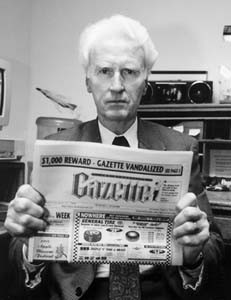
Brian Routh

0

No Kiddin’


Michael Amsler

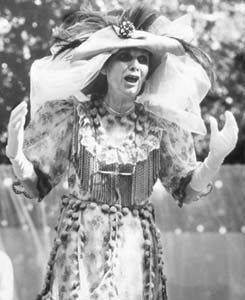
Dollface: Proud to be one half of the Kipper Kids, Guerneville actor Brian Routh poses with one of his fruity buddies.

Theatrical innovator Brian Routh remains steadfastly eclectic

By David Templeton

BRIAN ROUTH, one half of the groundbreaking twosome known as the “The Kipper Kids,” has stood solidly at the vanguard of the modern experimental theater world since the glory days of that amorphous art form’s unsettling emergence in the early 1970s. From his unique perspective both as a revered performer and as a teacher of avant-garde theatrical methods–often termed “performance art,” a label Routh finds misleading and pejorative–this deceptively soft-spoken Englishman has observed some awfully strange things.

None so awful or so strange as what occurred during the final session of a class he’d been teaching at San Francisco’s Academy of the Arts a few years back.

“Everyone had been asked to prepare one final bit to be performed for the class and their invited guests,” he recalls in a calm, Essex-accented voice. Routh had already disappointed one student when he refused to allow a live sheep to be slaughtered onstage as part of the show. “Then this other student, without telling anyone what he intended to do, suddenly poured petrol all over himself, with his parents sitting there watching, and set himself on fire.”

Though teachers often talk of setting their students’ artistic visions ablaze, Routh felt this was going a bit far, even for the man who’d once horrified audiences by literally beating himself to a bloody pulp during the Kipper Kids’ notorious one-man boxing matches.

“The student wasn’t badly hurt,” Routh explains, “though I had to chase him down the street and throw him to the ground in order to put the fire out. My students can do whatever they want to themselves after they get out of school, but there’s only so much alternative expression I’ll allow.”

Now a resident of Guerneville (“As a child of rural England,” he says, “I’ve found Sonoma County’s peace and quiet to be quite soothing”), Routh expects no such pyrotechnics when he brings his teaching act to Petaluma’s Cinnabar Theater at the end of the month. “I’m never quite certain what to expect from these workshops, though,” he adds. The class, simply titled Adult Acting, will focus on freeing the actor’s imaginations with a series of exercises and rituals. “A lot of the exercises I’ve pinched from a class I once assisted with at a psychiatric hospital in Los Angeles,” he says, adding, “and no, I was not a patient.”

To those who wonder what an internationally renowned performer and acting coach such as Routh is doing at the relatively rustic environment at Cinnabar, he says, “They wanted me. That was enough. I’d been looking for a local spot to teach at while working on Kipper Kids projects and my own solo shows.

“I get very excited about teaching and never like to stay away from it for long.”

Routh will be debuting a new work titled Psychic Attack, an improvisational romp through the world of New Age spirituality, at Cinnabar’s second annual Eclectic Theatre Festival, an assemblage of experimental works by a roster of local and international artists.

Under the direction of Lucas McClure–whose own piece, the deconstructionist The Lear Project, will be part of the show–the Eclectic Festival is expanding from last year’s two-week stretch and will include works by Jan Monroe (Nothing Human Disgusts Me, just finishing a successful nine-month run in Los Angeles), L.A. Mime Co. co-founder Mitchell Evans (Me & Her: Tales of Love, War & Housecleaning), and Deborah Eubanks (A Lady of Letters).

After its premiere at the festival, Routh’s show will move to San Francisco’s Yerba Buena Center for the Arts.

He declines to give many details about the show, other than to say that it is “a performance about information, masturbation, inspiration, dedication, and confirmation”; that it is the culmination of a 10-day countdown during which he and other players (including wife Jeana Routh) will explore books, texts, and songs and create video images; that it will skewer a bevy of sacred cows; that every word will be made up on the spot; and that it will feature a supporting cast of weather-beaten dolls he’s picked up at thrift stores over the last few years.

The dolls are Routh’s co-stars, and they often end up upstaging the ad-libbing human who gives them voice.

“I’ve been using the dolls for years, and I have a whole cast of recurring characters,” he explains. There is a square-headed teddy bear, a banana, a pair with lipstick and white socks, and a knit rag-doll of a rat in a yellow dress and hat. “She’s a bit of a Cockney. She always has a lot to say,” Routh chuckles. He is also looking forward to debuting a few new members of his inanimate troupe, particularly a blue teddy bear with a severely stained belly.

“She’s called Dirty Dolly,” he proudly states. “She’s going to feature quite a bit in the new show. I think she’s going to be my up-and-coming star-is-born. I’m looking forward to the show because I do enjoy live performance and haven’t done so much of that with the Kipper Kids.”

In recent years, his work with longtime partner and fellow Kipper Kid Martin von Haselberg (who happens to be married to Bette Midler) has been moving confidently into the realm of innovative museum installations–including the Whitney’s upcoming 25th anniversary retrospective exhibit–a far cry from the anarchic shock operas of their youth. The two met while attending England’s experimental East 15th School, a hotbed of avant-garde theater that proved not hot enough when Routh and von Haselberg joined forces.

“We were kicked out, more or less,” Routh laughs. Not long after, they concocted the act that would make them famous, across Europe if not so much in America or at home in England.

Taking their name from a fellow student who was nicknamed Kipper Face, the twosome took to the stage wearing only jockstraps and shaved heads, jabbering in a language all their own while performing mysterious, vaudevillelike rituals and, in the aforemenioned boxing bit, taking turns beating themselves up.

“The fact that the beatings resulted in real blood flying about led some purists to conclude that what we were doing was not truly ‘theater,'” he says, “and thus were related to the realm of ‘performance art,’ which unfortunately has come to mean ‘bad theater.’ The truth is just that we were always a bit too dark and a bit too weird for the mainstream.”

While von Haselberg has been busy infiltrating New York City’s art world and practicing his burgeoning skills as a film director, Routh has been alternating among his own shows, his teaching, and his numerous collaborations with a roster of high-profile performance-art stars, including the NEA-busting Karen Finley, Ann Magnusen, Annie Sprinkle, and monologuist and writer Eric Bogosian, who often points to the Kipper Kids as the very essence of what performance art should be.

Routh shrugs off such praise. “Ultimately, those kind of labels don’t amount to very much.” As to the improvisational nature of his newest work, he compares it to standup comedy.

“It’s the only way I can work, because if I work out a show to the point of having lighting cues and all, it threatens to become so contrived that I get bored with it,” he explains. “The second night is likely to be quite different from the first, and I like that.”

“Humor is really a good device to make people think,” he continues. “I’d rather make them laugh than just trying to shock. I spent a long time doing that in my earlier career, and I’m not really into that anymore.

Although,” he laughs, “I would say the show is not for children, and people are sometime still shocked by what comes out of my mouth. If you are shocked, I assure you, it was entirely an accident.”

Eclectic Theatre Festival Schedule

CINNABAR THEATER will present six unique theater pieces over three weeks. Those performances are:
Jan. 16, 17: Nothing Human Disgusts Me, a personal monlogue by acclaimed playwright Jan Munroe.
Jan. 16, 17, 23, 24: L.A. Mime Co. co-founder Mitchell Evans and Donya Giannotta in the new vaudevillian slapstick romance Me & Her.
Jan. 23, 24: Eugene Ionesco’s modern classic The Chairs.
Jan. 23, 24, 30, 31: The Lear Project, a Shakespearean deconstruction directed by Lucas McClure.
Jan. 30, 31: Deborah Eubanks in A Lady of Letters, a solo piece from the author of The Madness of King George III.
Jan. 30, 31: Brian Routh in Psychic Attack.

All shows are at the Cinnabar Theater, 3333 Petaluma Blvd. N., Petaluma. 8 p.m. Admission is $5-$10. For details, call 763-8920.

From the January 8-14, 1998 issue of the Sonoma County Independent.

© Metro Publishing Inc.
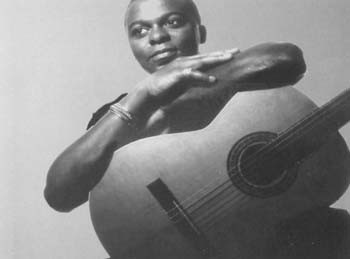
Councilwoman Jane Hamilton

0

Fighting Trim


Michael Amsler

Eyes on the Prize: In five years, Jane Hamilton has built solid support from Petaluma’s progressive and environmental communities. Now she has set her sights on the soon-to-be-vacated 2nd District supervisorial seat.

Petaluma Councilwoman Jane Hamilton ready to spar with the good ol’ boys

By Paula Harris

JANE HAMILTON SITS at the oversized, wooden table in her cozy, rambling kitchen as the rain drizzles outside. The scent of citrus wafts sweetly in the air as Petaluma’s vice mayor–and aspiring county supervisor–peels herself an orange for lunch.

Outside, Hamilton’s old West Side house near the Foundry Wharf along the Petaluma River has a funky feel, punctuated by peeling paint and rangy plants. Inside, it’s a warm cluttered haven. A piano peeks from the corner, a sleepy Siamese cat reclines on a stuffed armchair, and the country kitchen is decorated with strands of dried chili and garlic, ripe plump persimmons, and ancient pans. On the wall hangs a huge, intricate quilt–in copper, blue, and olive–made by Jane herself.

The scene is a study in peaceful homeyness.

But that impression is belied by a large, solid punching bag hanging in one room. It serves notice that Hamilton, 47, has recently taken up the assertive sport of kick boxing.

“I love it,” she says of the sport. “That’s how I’m going to get through this campaign,” she adds with a laugh, her eyes glinting in semi-seriousness.

To make her point, Hamilton delivers an impromptu kick, an ideal photo op. “I just have to change out of my skirt … ,” she offers until her son Jay, 17, rapidly intervenes to dissuade her.

“I don’t think Sonoma County is ready for that,” he remarks, a tinge of worry in his voice. His mother shrugs good-naturedly. “I asked Jay to show me how to throw a punch one day. Now I can do it and it feels great,” she explains. “It’s very therapeutic.”

Hamilton is mentally, if not physically, preparing for combat. On June 2, as a candidate for the 2nd Supervisorial District, she will take on an established old-boy network in a bid to become only the third woman ever to grace the male-dominated Sonoma County Board of Supervisors. To do so, she must beat fellow challengers Dave King, ex-Petaluma City Councilwoman Bonnie Nelson (who has just announced her candidacy), and any other candidates yet to be announced.

In a surprise twist, Hamilton will not face the challenge of unseating veteran incumbent Jim Harberson, who has held the seat since 1984. In the past three elections, Harberson has faced only modest opposition, from such rivals as an eccentric pig farmer and a construction worker. On Tuesday, Harberson bowed out of the race, citing a bad back and other health problems.

Hamilton, who has strong support from the city’s increasingly influential progressive and environmental communities, is convinced her five-year tenure on the Petaluma City Council will stand her in good stead for the supervisorial race, something she’s been thinking about for the last year. “I want a different level of responsiveness and accessibility to the county,” she says. “As a Petaluma councilperson, I’ve found county government to be unresponsive, hard to reach, and hard to communicate with through our current supervisor. I want that to change.”

Hamilton pulls no punches when talking about Harberson’s record. “I think Harberson [was] working on a different level. He [had] been there for some time and [was] looking so much at the big picture that [he’d] lost touch with … the 2nd District,” she says, adding that if elected she would open up communications by regularly attending Cotati and Petaluma city council meetings, setting regular office hours in Petaluma for south county residents on an appointment and drop-in basis, and acting as liaison for small neighborhood groups within the area.

“This is common fare,” Harberson says of the accusations. “When someone is aspiring to office they always say things like this all the time. … I was not afraid of who is running and, yes, I could win, but I don’t know if I could hold up physically.”

Petaluma Councilman Matt Maguire is among those who applaud Hamilton’s candidacy. “I’ve termed Harberson ‘Casper the Ghost’ because he can’t be found at critical junctures. Jane, on the other hand, is very capable and accessible and has the right priorities and values for the 2nd District,” he says.

“And it’s an added benefit that she’s a woman, because the board is all male and it can do nothing but benefit from her perspectives.”

A purchasing manager for a local data communications company, Hamilton hopes to bring her experience as a working mom to the all-male board.

“It’s a deep commitment of mine to have a working mother on that board, because I know that my perspective on every policy issue comes from my life experience and my life experience is completely different from that of any male,” says Hamilton.

“It’s important that something as powerful as the Board of Supervisors not be all men. A lot of things that are considered women’s issues are really human issues, but it’s just important to have female representation.”

Among her concerns are the poor track records of the Sonoma County District Attorney’s Office and the Sheriff’s Department in handling domestic violence and sexual assault cases, as well as numerous sexual harassment charges within the Sheriff’s Department. “We need more women in positions of power [in this county], so those things aren’t tolerated anymore,” she says. “In the area of domestic violence, we need a victim’s advocate in the south county. I know the south county doesn’t have a [battered women’s] shelter, and also I’d like to see the domestic violence court extended to Petaluma.”

BUT THE TOPIC that seems to rile Hamilton most is the ill-fated proposal to swap city-owned Lafferty Ranch for an old dude ranch owned by millionaire Peter Pfendler. The failed swap, which Hamilton battled, caused a political rift that nearly paralyzed city government for five years. In 1996, local voters defeated the swap, but not before a huge voter-fraud scandal that led to the indictment of Harberson’s longtime aide Marion Hodge and several others.

“Lafferty cost us our innocence,” steams Hamilton. “Lafferty was symbolic of how issues were handled [under the previous council majority], and that in itself became eye-opening.”

More recently, Hamilton has openly blasted Harberson for his support of the Lafferty swap and for his actions in the ensuing months. “Once the fraud was exposed, and both he and Supervisor Paul Kelley knew that their aides were deeply involved, [Harberson] needed to take the lead in the investigation to restore public trust. Instead he sat in silence, hoping to get by just saying nothing,” she says. “It should have been a major concern of his–after all, his aide was working on illegally distorting the election process–but Harberson was forcefully trying to make his own agenda work, as well as Peter Pfendler’s agenda.

“And Pfendler was a major contributor toward [Harberson’s] campaign,” she says with a hollow laugh.

Harberson has since denied any wrongdoing or any knowledge of illegal activity that spawned a 16-month state voter-fraud investigation, and he insists that his decision not to run wasn’t influenced by the fallout from the scandal.

Meanwhile, Hamilton [was] busy “distilling” the barrage of background on all kinds of county issues, including the preservation of open space and agricultural lands, and the need for more youth services. And she’s gradually getting used to the idea that she has entered the ring and can throw a punch or two.

“It feels strange being a candidate, because I’m no good at self-promotion,” she confides. “I’m cautious and receptive.

“I listen to people and I’m really terrible at B.S.”

From the January 8-14, 1998 issue of the Sonoma County Independent.

© Metro Publishing Inc.

Savoy Swingers

Retro Hip


Michael Amsler

Backstage Pass: Members of the local jumpin’ jazz band Savoy Swingers prepare for a recent gig.

Savoy Swingers aren’t old news

By Christian M. Chensvold

COOLNESS is a curious quality that, like liquids, takes on the shape of its container. Anything can be cool as long as cool people say it is. For example: A band of local 20-somethings enthusiastically straddling the stage at Petaluma’s Mystic Theater plays the sentimental World War II tune “Don’t Sit Under the Apple Tree.” Incredibly, the audience offers the ultimate seal of approval: they get up and dance–wildly. “If people see you’re excited about something,” explains singer Heather Ellison of the Savoy Swingers, “they’re not going to put you down, because then they‘ll look dumb.”

Since the sad demise last year of the talented Tiny James and the Swing Kings, Sonoma County had been without a band for the retro-hip to rally around. That was until last fall, when members of the avant-garde jazzsters Cannonball (who are also in several other bands) decided to form yet another subsidiary, but not one for passively listening. This music would be dance-till-you-drop interactive.

The Savoy Swingers crank out their own, often spontaneous, arrangements of swing standards, tunes made famous by Glenn Miller, Benny Goodman, and others. Bassist/trombonist Adam Theis, who has won national recognition from Jazziz magazine, founded the band, which includes Jeremy Hartley on trumpet, Jason Robinson on sax, Paul Spira on drums, and two alternating pianists: Jason Sherbundy and Ethan Herr.

Ellison and other diva Emily Schmidt (affectionately known as the Pin-Ups), are the featured vocalists–two platinum blondes who don evening gowns and costume jewelry and writhe coquettishly in their best impersonations of Betty Grable. One can almost picture them immortalized on a fighter jet.


Michael Amsler

Swing Things: Pin-up Heather Ellison and trumpeter Jeremy Hartley.

Within a month of its inception the band began gracing some of San Francisco’s hippest swing venues, including the Hi-Ball Lounge and Coconut Grove. But to help ease Sonoma County through the tricky transition from free-form nightclub gyrations to cooperative swing dancing, the Savoy Swingers have dance instructors on hand at every show to teach during breaks. They’ve even revitalized that long-dead tradition known as the Dance Contest, complete with prizes. “With so many bands it’s about their ego,” says Ellison. “But we are just servants to the dancers. We wouldn’t be anything without them.”

Theis is quick to dub swing “real” music, as distinct from the fabricated variety that dominates radio frequencies. “It requires all the musical training you’ve had,” he says. “You can’t nonchalantly play this music,” he adds. “It engulfs you.”

The engulfing goes far. Ellison is an outspoken apologist for the good old days when life’s coarseness was mitigated by elegance and civility. In describing the appeal of swing, her words create a blurry distinction between fantasy and reality, as if she were simultaneously an ironic role-player escaping her postmodern milieu and a heartfelt arbiter on a mission to reform the masses through taste.

Indeed, a few musicians playing at a local club can rarely claim to be a part of something larger. But swing has risen to the status of a full-fledged movement pregnant with its own rituals (cheeks get kissed); fashions (two-tone shoes are everywhere); magic potions (gin and tonic); and philosophies–chief among them the belief that something very precious, some exquisite cultural gem saturated with style and substance, got lost somewhere along the path of time.

No generation ever aspires to the conventions of its parents, but grandparents are fair game, and perhaps swing is the homage, however circuitous, that youth must inevitably pay to age.

And so, now the young–society’s most ravenous consumers of popular culture–have an enthusiastic and organized following extolling music and fashion that is not new but old. Ultimately, however, historical context evaporates like yesterday’s rain, and what remains is the cheerful rainbow of swing’s upbeat tempos and witty lyrics. “You can listen to a song and forget your troubles,” coos Ellison. “It’s uplifting, instead of ‘I hate the world.'”

And it should come as no surprise that swing, the quintessential music of American optimism, can bring a smile to the cynically curled lips of Generation X.

It already got us through a war.

Savoy Swingers jump Saturday, Jan. 3, at the Inn of the Beginning, 8201 Old Redwood Hwy., Cotati. 9 p.m. Admission is $5. 664-1100.

From the December 31, 1997-January 7, 1998 issue of the Sonoma County Independent.

© Metro Publishing Inc.

Sonoma County Teen Curfew

0

Curfew Snafu


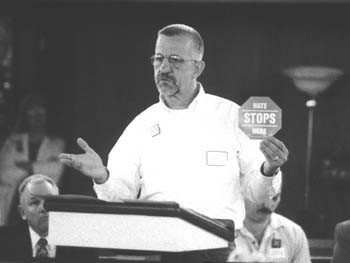
Back on Board: Former county Supe Ernie Carpenter spoke out against a proposed teen curfew at a Dec. 7 hearing before the Board of Supervisors.

Photo by Michael Amsler


County curfew would curb daytime teen activity–and parents are hopping mad

By Paula Harris

“IT NOW MAKES my oldest son Jess sick to his stomach when he sees a policeman,” says Rosemary Harrahill, mother of two teenage boys in Monrovia, a city just east of Pasadena and one that has become known as the model town for daytime teen curfews.

These days, local observers are watching that Southern California city closely because county officials want a similar controversial daytime curfew law–and they’re asking local cities to follow suit.

Sonoma County District Attorney Mike Mullins, who recently withdrew the youth curfew plan pending further review, now says he’s ready to reintroduce the daytime restrictions, despite complaints from parents and no solid documentation on the general effectiveness of youth curfews.

Monrovia began enforcing the 8:30 a.m. to 1:30 p.m. curfews, during the 1994-95 school year. The law continues today–much to the dissatisfaction of parents like Harrahill, who say they have been plagued by its negative impacts.

Harrahill says her sons, aged 16 and 14, were stopped and interrogated by police 22 times in eight months while walking from supplemental public school classes to home school. “I made an effort to let officers know [the boys] had permission to be on the streets and to please leave them alone, but they told me ‘as long as minors are on the streets of Monrovia, they are subject to being cited, questioned, or detained.’

“I was appalled,” she angrily recounts.

Harrahill says police suggested a radical solution: to issue home-schoolers “bright fluorescent orange ID cards, bigger than index cards, with big black numbers on them” to flash at patrolling officers. “When in history has a group of individuals been numbered to have permission to move around in a free society?” asks Harrahill.

In April, Harrahill and several others filed a lawsuit against the Monrovia chief of police and the city challenging the constitutionality of the daytime curfew ordinance. Their court hearing comes up in March.

“They say Monrovia is a model city for daytime curfews, but, my God, that’s where it could go here,” says Santa Rosa resident Glen Wiemeyer, one of several concerned parents who have begun Sonoma County Citizens Against Daytime Curfews.

The group contends that the proposed countywide youth curfew–spearheaded by Mullins and supported by Sonoma County Schools Superintendent Tom Crawford, which includes both daytime and nighttime restrictions–would trample on the rights of young people.

Critics contend that slapping a curfew law on teens is merely a surface solution to a deeper, more complex problem–a quick fix by officials who want to appear tough on crime–instead of a probe into the underlying causes of youth concerns.

Critics also point out that while recent studies have claimed that curfews result in a 25 percent drop in youth crime, criminal activity overall has plummeted proportionately nationwide.

A recent MTV documentary called Fight for the Right reported that in New Orleans, where a tough youth curfew law is in place, juvenile crime dropped by 27 percent between 1993 and 1995. However, in New York City, crime dropped by 25 percent between 1993 and 1995–and that city has no curfew.

Most cities in Sonoma County have some kind of nighttime curfew on the books–although most aren’t strictly enforced. Only Rohnert Park’s teen curfew extends to daytime hours. It restricts teens from loitering in public places between 8:30 a.m. and 1:30 p.m. Parents of violators can be fined up to $500 or jailed up to 60 days.

The proposed county law would for the first time affect the county’s far-flung unincorporated areas and would also set daytime restrictions. If both are enforced, teens would have to stay out of sight for a good portion of each day and evening.


Other Side of the Story: County officials argue that a stricter curfew will curtail such teen crime as vandalism at Petaluma’s Putnam Plaza. Petaluma teen Alison Anderson, 16, left, told the Independent this spring that it is wrongheaded to punish all youths for the rash actions of a few. Curfew critics agree.

Photo by Janet Orsi


MULLINS, who helped draft the Sonoma County measure, says the law would help deal with a supposed increase in juvenile violence and gang activity and address the problem of truancy. But Wiemeyer disagrees. “We believe the daytime curfew goes about the problem from the wrong perspective. It essentially penalizes law-abiding citizens who bear the responsibility of proving their innocence for simply having been out in public,” he says. “It’s totally unnecessary for our youth to have to prove their innocence.”

If adopted, the Sonoma County ordinance, which would affect more than 60,000 students, would make it illegal for anyone under 18 years old to be in “any public or unsupervised area” between the hours of 11 p.m. and 6 a.m. Sundays through Thursdays. The curfew would run from midnight until 6 a.m. on Friday and Saturday nights.

In addition, minors would be prohibited from being out of school between 8:30 a.m. and 1:30 p.m. on days when school is in session. There would be certain exemptions, such as when a minor is accompanied by a parent or guardian or is on a legitimate errand or other activity: returning home from a “movie, play, sporting event, study group, religious activity, or school activity.”

Last month, the proposal seemed to be making headway and was slated for public comment, but during a recent Sonoma County Board of Supervisors meeting, Mullins abruptly withdrew the proposal pending further examination after outraged parents presented him with an information packet detailing their concerns.

In addition, Sonoma County Schools Superintendent Tom Crawford says that while he and other local educators support the idea of a curfew to reduce daytime crime and boost attendance, he’s been taken off guard by the parental outcry. “I’ve had a significant number of calls and some letters from people worried about police harassment–it’s been very surprising to me,” says Crawford.

Meanwhile, Mullins says he needs to review the information, but adds: “My inclination is to put [the ordinance proposal] back on the calendar.” Next week he will meet with a representative from Sonoma County Citizens Against Daytime Curfews.

Meanwhile, parents of home-schooled students–and students in a range of activities, including those who take independent study classes, attend day classes at Santa Rosa Junior College, participate in school-to-work programs, have staggered school schedules, or attend year-round schools–are beginning to worry about potential impacts if the law is passed.

Daytime-curfew opponents say existing truancy laws should be able to adequately deal with the problem of errant teens. “It doesn’t have to be a blanket thing thrown over all the young people in Sonoma County,” says Wiemeyer.

“This is a symptom of a county that’s given up,” former county Supervisor Ernie Carpenter recently told the Board of Supervisors after he read the proposal. “We need to stop suspending kids from school–this indicates a failure to deal with young people.

“I also take issue with the whole gang thing,” Carpenter adds. “I bet fewer than 100 people are on the Sonoma County gang list, and for that all the young people in the county will have to suffer. When I saw this [proposal] on the [board’s] agenda, it made my toenails curl.”

Sonoma officials are slated to discuss the tougher curfew on Jan. 7, and it is expected to pop up soon on the city council agendas in Petaluma, Healdsburg, and Santa Rosa.

Santa Rosa Police Chief Mike Dunbaugh supports the curfew proposal, seeing it as “a tool to keep people safe,” adding that “most victims of juvenile crime are juveniles.

“We’d like to see responsible daytime curfews. There’s a problem with kids not being in school when they should be. Truancy laws leave a lot to be desired, particularly when you’re dealing with parents who don’t care,” says Dunbaugh.

But he adds that the use of a curfew has to be a discretionary tool and has to be balanced with legitimate concerns. “We have to be careful that when youngsters are doing legitimate things we don’t unjustly interfere,” he says, adding that he favors getting input from the Santa Rosa Teen Council before enforcing such a law.

But Santa Rosa City Councilwoman Noreen Evans wonders about the efficacy of a countywide daytime curfew law. “Most criminal activity by teens occurs between 3 p.m. and 5 p.m. after school is out and before parents come home from work, so you have to wonder, How much sense does this [proposed curfew] make?”

Harrahill, the Monrovia parent, agrees. “The whole thing is outrageous. If you treat children with dignity, honor, and respect, they will respond in kind. You can’t do that by setting curfews.

“We’re not going to stop fighting this until the constitutional freedoms of every child in Monrovia are restored.”

From the December 31, 1997-January 7, 1998 issue of the Sonoma County Independent.

© Metro Publishing Inc.

Classic Cars

0

Motor Dudes


Michael Amsler

Making Lemonade: Derek Irving, guitarist for local faves the Aces, sometimes feels that all he does is to throw money into his car, only to hear it emit a metallic belch and demand more. Undaunted, Irving is saving up to have his ’67 Chevelle Malibu painted.

Classic cars for cool cats–on the cheap

By Christian Chensvold

SO YOU’RE YOUNG and cool and shopping for a set of wheels and it’s gotta be hip cuz you’re not about to cruise through life on the Highway of Anonymity in a Honda Accord. Your tastes are notably esoteric and a tad vintage, and you know that nothing causes uncontrollable drooling quite like a classic car. But since you’re still paying off your student loan, you’re not about to splurge on a 1932 Aston-Martin. Actually, by “classic” you simply mean something older than you are.

Say you’ve got five thousand bucks. Can you do it?

At age 17, Ryan Powers did. His cherry 1960 Chevy Impala is red and white with chrome shiny enough to mirror the grease in your hair, sports whitewall tires (the automotive equivalent of a top hat), and truly deserves the fuzzy dice that dangle from the rear-view mirror.

This is his first car. His parents bought him the Impala, which makes him sound even more spoiled. In fact, the car was had for a mere $3,500 from a co-worker, and had only 40,000 miles on it. Except for a slight quirk when shifting into second gear, this older car runs splendidly.

With its good ole American confidence and charm, Power’s impeccable Impala puts him way ahead of his high school peers in the coolness department. The rich kids are driving their shiny-new practical and efficient Japanese imports while everyone else drives whatever he or she can. Powers admits to being slightly spoiled, and knows there’ll be no settling for a Honda after a car like this.

Powers was drawn to the car’s classic cut after tooling around for several years in his older brother Brennan’s 1965 Chevy Impala, a burly, masculine car that mom and pop bought him five years ago for $4,500. “It’s big and it’s old,” Brennan says fondly. “And I’ve grown to appreciate the simplicity of it: no computers or anything.”

Brennan performs much of the maintenance himself, he says, because older cars are easy to work on. He took an auto-shop class and can now resurface the car’s brake drums, plus perform a host of other technical tinkerings that most of us wouldn’t dare attempt for fear of endangering our lives.

The car had only 800 miles on a new engine when he got it five years ago, and 83,000 miles on the rest of it. “All my friends say I’m lucky to have it,” Brennan says, “and I am.” Both he and Ryan are constantly asked for rides, and whether they’re selling.

They’re not.

Depreciation Appreciation

It is one of those terribly misguided myths that classic cars are expensive to own and insure, says John Mohar, owner of Petaluma’s Showcase of Motorcars. In fact, he says, classic cars are an all-around better value, and people are finally catching on to this. In the past two years Mohar’s average customer profile has grown gradually younger, and now a full half are buying the old cars as their primary form of transportation.

This change has been sparked by an extreme increase in the price of new cars, combined with rapid depreciation, says Mohar. Classic cars keep their value and can even go up, while new cars will only go down, including their initial depressing plunge of 30 percent the moment they’re driven off the dealer’s lot.

Besides the moral uplift from recycling old steel and practicing historic preservation, maintenance is cheaper on old cars, with most of them tuning up for only about $100, in contrast to $400 for a new car. “The new ones are so complicated and so computerized,” says Mohar, “that [mechanics] have to spend more time,” racking up their bill in the process. And while insuring a new car, because of its greater expense, generally runs $1,000-$2,000 per year, the average classic car costs about $400. “Insurance companies realize that the people who buy these cars take better care of them–they protect and watch them,” he says.

Mohar stocks about 100 cars at a time, a third of which have been restored, often in mint condition. They frequently have new engines with only a few thousand miles on them. Surprisingly, most of his to-die-for cars are priced in the $10,000-$15,000 range. What’s more, Mohar offers financing at competitive rates. He sells an average of 17 cars per month, and confesses to owning “a lot” of cars himself.

Is there a greater risk for theft with classic cars? Probably not, since the most stolen make of car is the Honda. Arguably, the more exotic a car is, the less likely a criminal would be to try to drive it away since it would be so easy to spot (then again, thieves are not known for their great mental perspicacity). Most cars are stolen for parts, since a thief can get three times the car’s value by peddling it piecemeal.

Lastly, there is the prestige factor of having a car that’s poetic and not prosaic, cool and not common. “They’re special interest, limited production, and disappearing all the time,” says Mohar. His most popular make and model is the Ford Mustang convertible, which seems to be Middle America’s idea of the ultimate set of wheels in which to escape from itself.

Mohar admits that most of his customers are motivated more by nostalgia than the perception that classic cars are a better value. For baby boomers, Mustangs, Corvette Stingrays, and ’57 Chevys rekindle fond memories of those pre-sexual revolution days of drive-ins, sock hops, and necking sessions at Inspiration Point.

“The newer cars don’t have anything to relate to,” says Mohar.


Michael Amsler

While the French have managed to make their mark in everything from philosophy to cheese, automobiles have never been their forte. Yet there are no fewer than trois Citroëns in Brisebois’ extended family.

Thunder Road

Lou Greene is a car-reanimator, a kind of shaman-mechanic who brings Ford Thunderbirds back from the dead. In his hands, some 20 cars have risen from their ashes like rusty phoenixes, and in 1991 one of these won Best of Show in a national classic-car competition. That’s best of show in the entire country. And then he got rid of it.

Greene is a member of the Thunderbirds of Sonoma County, one of over two dozen car clubs in the North Bay that offer the chance to schmooze and gab about one’s favorite make and model. Group members gather monthly to show off their Fords made between 1955 and 1957.

Greene, an appliance repairman by profession, buys dilapidated T-Birds for $9,000-$18,000, spends up to a year restoring them, and then, like an artist severing the umbilical cord of creation, sells them, garnering $16,000-$42,000. With the high cost of restoration, Greene says he hardly makes a profit: this is simply his idea of fun.

Huh? “You could call it midlife crisis,” he grins. “It gives me something to do.”

A rather informal, blue-collar group, the Thunderbirds of Sonoma County, like other car clubs, nevertheless practice a kind of cliquish tribalism. Car connoisseurs are interested in meeting with their own kind, and the club becomes a support group for mysterious knocks and pings. You can almost picture them telephoning each other in the middle of the night and gasping, “It’s my carburetor! What should I do?”

Ford Thunderbirds belong on that list of sacred Americana that includes mom and apple pie. The two-door “small birds,” as they are affectionately called, were in production for only three years, during which time some 60,000 were manufactured. Today they can be had, restored, for about $20,000.

The Thunderbirds of Sonoma County boast 40 members and 25 cars. Their monthly meetings usually involve a caravan around the county, and the group often shows its cars at various cultural activities. Most members use the cars as recreational vehicles on the weekends, but a few use the T-Birds as their everyday vehicle.

Members describe the pride of ownership as a “big ego trip,” and how could it not be? Some have a license plate designating the car a historical vehicle. Besides making the driver look important, the license plate, which is available from the DMV for any car 20 years or older, lowers registration costs when the car changes hands.

Club president James Arieta bought his T-Bird out of a newspaper ad for $15,000 five years ago, and has since put another $10,000 into it. Members have been known to splurge $5,000 on paint jobs. Insurance is still very reasonable for these show-quality cars. Arieta pays a miniscule $225 per year for full coverage, though his car is listed as a recreation-only car.

Sisyphus and the Citroën

“It’s not quite a cartoon car,” says Ray Brisebois of his ’56 Citroën, “but it’s warm and fuzzy and people like it and kind of want to hug you for it.”

Brisebois owns a car that is actually less classic than it appears. “When you look at it from the front, it looks like a ’34 Ford,” he says. “So it’s like living in the ’30s with ’50s production.” Indeed, the auto is stately in a rather exaggerated way: The headlights stick out like miniature street lamps, and the back seat is roomy enough for an amorous couple to perform half the positions in the Kama Sutra.

And while the French have managed to make their mark in everything from philosophy to cheese, automobiles have never been their forte. Yet there are no fewer than trois Citroëns in Brisebois’ extended family. He bought his for $7,000 in 1990 and has since been on the road to restoring it–an arduous path that is as long and winding as the road to salvation.

Brisebois, who owns a small picture-frame manufacturing business, has done no work on the car himself. He has put another $7,000 into it, part of which is due to his own poor luck in choosing mechanics. “There are people who want to take your money,” he offers as a caveat. “They think this is spare income, so they’re merciless.” However, he does admit that the car has only 1,000 miles on its new engine and runs just swell.

One of the Citroën’s curiosities is its three gears. Then there’s the air-conditioning system, which consists of turning a knob to open the front windshield, and the wipers, which have a manual overdrive allowing you to wipe away a few drops of precipitation by hand-cranking the wiper knob.

Like Richard Wagner, the composer who took 25 years to polish up Der Ring des Nibelungen, Brisebois has been restoring his car for over seven years and still isn’t finished. This is not only frustrating, but pangs at the very heart of ownership: “Until you get everything redone,” he says, pausing emphatically, “you don’t have the feeling that it’s yours.”

Brisebois also owns, in contrast to the Citroën, another oldie, a 1970 Jaguar XKE that he bought for $11,000 and has successfully restored. “It’s lean and sleek and a very sexy car,” he says of the silver, retro-space-age set of wheels.

But, of course, he’s put enough money into the Jaguar to buy a small mansion in the Midwest. “That’s what happens when you start at one end and finish at the other,” he says, punctuating his words with a faintly audible moan.

Beautiful Suffering

Being cool has its price. The French have a saying for this (the French have a saying for everything): Il faut souffrir pour être belle–”One must suffer to be beautiful.”

After all, when you buy a lemon there’s nothing to do but make lemonade. Derek Irving isn’t completely soured, but at times he feels a bit like Tom Hanks in The Money Pit, throwing money into his car, only to hear it emit a metallic belch and demand more.

Four years ago Irving, a shipping clerk and the guitarist for local blues boys the Aces, bought a white ’67 Chevelle Malibu with 170,000 miles on it for $3,500 through a newspaper ad. Irving enjoyed a brief honeymoon with his new wheels–big and burly and faintly suggesting a racing stock car–until the engine went kablooey. Seems there was that little matter of changing the oil. “I always check it now,” he assures. A new engine carried a price tag of $2,200. Then, practically moments later, the transmission went. Replacing that cost $1,100, leading Irving to ruminate, “Am I restoring this or just keeping it running?

“Unfortunately with older cars,” he adds, “unless you can work on them yourself or have a lot of money, they’re a problem.”

Fate can be cruel. Irving once had a ’57 Chevy but found it so expensive to maintain that he sold it. Now he’s thrown so much into the Malibu he says he might as well have kept the Chevy.

Irving’s next aspiration is to get the car painted. But given the cost, “that might take five to 10 years,” he sighs. “I’m serious. Every time I have some money there’s a new noise to get checked out.”

Looking cool makes up a little for all the trials and transmission tribulations, Irving says. At stop signs he is frequently flashed the thumbs-up seal of approval. “But if they only knew!” he laughs.

In the four years since buying the Malibu, Irving has learned a lot; more about life than cars. He admits his knowledge of his automobile is rather limited: He knows how to fill it up. Which, incidentally, runs about $25.

Boy Toys

The reader would have to be asleep at the wheel to fail to notice that car enthusiasts are virtually all men. For the male of the species, says Santa Rosa psychologist Bruce Denner, the car is “invested with a power and meaning way beyond its utility. It’s a symbol of freedom, especially sexual freedom.

“Men have always resisted socialization into family, home, and job,” Denner adds, saying that the car offers freedom from domestication with its overtones of emasculation.

For the middle-aged classic-car buff, the restored (read: rejuvenated) car comes to represent his vanished youth. And for the young male, the first car brings to him freedom of mobility combined with a lack of parental supervision. Women seem to respond accordingly. Stag films from the roaring ’20s, that heyday of the newly liberated and hot-to-foxtrot flapper, often made use of the car as the ultimate, well, vehicle for sexual abandon.

Says Denner, “The ’20s were a great period of sexual freedom for women, and they were willing to do things in the car that they weren’t willing to do in the parlor.”

Indeed, owning a car has always boosted the young male’s chances of getting lucky. And owning a cool car would seem to boost them even more.

But who is it really that men are trying to impress with their cool cars?

Legend has it that the fairer sex is swayed by peacock-y displays of wealth, bravura, and style–those things that symbolize power, confidence, and virility. But a deeper investigation into the nature of masculine competitiveness reveals that the cool car is something a man takes pride in not because it impresses women, but because it impresses men.

And no car is cooler than the classic car. Its retro-hip style shows that its driver is one step ahead of–or behind–the others, and it confers upon him a dashing quality symbolizing sexual readiness. Big, powerful, and ready to conquer, the classic car is an expression of lust. And its destination?

The garage.

From the December 31, 1997-January 7, 1998 issue of the Sonoma County Independent.

© Metro Publishing Inc.

Seniors & Weight-Lifting

Slow and EasyMichael AmslerFeeling the Burn: Trainer Hans Roth, left, prompts lifter Jim Price.Seniors finding fast results from super-slow lifting By Dylan BennettAT 77, BETTYLOU SUTTON, a retired homemaker from Glen Ellen, looks beautiful and feels even better. Her wispy tangerine hairdo, shiny round silver earrings, and light blush lipstick accent a broad smile and twinkling eyes. Sutton's good...

Washington Watch

Don't Get FooledBy Doug IrelandAS THE 1998 MIDTERM congressional elections loom, the indictment of former HUD Secretary Henry Cisneros once again raises the question: When will establishment liberals realize that any reconstruction of progressive politics is doomed unless it incorporates zero tolerance of corruption? In the Reagan/Bush years, it was the liberal Democrats in Congress who, supported by the...

Sand-Painting Monks

Buddhist BeautyMichael AmslerSandbox: Visitors marvel at the nitty gritty work of sand-painting monks.Monks create mutable mandalaBy Gretchen GilesWITH A CHOCOLATE CHIP cookie stuck solidly out of his mouth like an elongated third lip, a young boy of about 10 with sandy-colored hair and a freckled face stretches his hands out over a clear sheet of Plexiglas, momentarily oblivious to...

Robert Burns Dinner

Chieftain of the PuddingMichael AmslerPotatoes and Mash: Transplanted Scot Steven Blamires honors Robert Burns with haggis and poetry.Haggis, poetry, and music celebrate Scotland's laureate Robbie BurnsBy David TempletonAUTHENTIC SCOTTISH cuisine has much in common with Scottish athletic games: They both seem to have risen from an intense and heightened level of reckless bravado. Scottish dress, too--the wearing of loin-flaunting...

Why Has Bodhi-Dharma Left for the East?

Buddha BoyBy Greg CahillAlpha wave alert! South Korean filmmaker Bae Yong-Kyun's stunning 1989 film Why Has Bodhi-Dharma Left for the East? is rife with Zen Buddhist doctrine, haunting visual allegories, and mystical imagery. No sex. No chase scenes. No explosions. No gratuitous violence. Just a subtle lesson about the meaning of life.Its cryptic title, taken from an ancient Zen...

Brian Routh

No Kiddin'Michael AmslerDollface: Proud to be one half of the Kipper Kids, Guerneville actor Brian Routh poses with one of his fruity buddies.Theatrical innovator Brian Routh remains steadfastly eclecticBy David TempletonBRIAN ROUTH, one half of the groundbreaking twosome known as the "The Kipper Kids," has stood solidly at the vanguard of the modern experimental theater world since the glory...

Councilwoman Jane Hamilton

Fighting TrimMichael AmslerEyes on the Prize: In five years, Jane Hamilton has built solid support from Petaluma's progressive and environmental communities. Now she has set her sights on the soon-to-be-vacated 2nd District supervisorial seat.Petaluma Councilwoman Jane Hamilton ready to spar with the good ol' boysBy Paula HarrisJANE HAMILTON SITS at the oversized, wooden table in her cozy, rambling kitchen...

Savoy Swingers

Retro HipMichael AmslerBackstage Pass: Members of the local jumpin' jazz band Savoy Swingers prepare for a recent gig.Savoy Swingers aren't old newsBy Christian M. ChensvoldCOOLNESS is a curious quality that, like liquids, takes on the shape of its container. Anything can be cool as long as cool people say it is. For example: A band of local 20-somethings enthusiastically...

Sonoma County Teen Curfew

Curfew SnafuBack on Board: Former county Supe Ernie Carpenter spoke out against a proposed teen curfew at a Dec. 7 hearing before the Board of Supervisors.Photo by Michael AmslerCounty curfew would curb daytime teen activity--and parents are hopping madBy Paula Harris"IT NOW MAKES my oldest son Jess sick to his stomach when he sees a policeman," says...

Classic Cars

Motor DudesMichael AmslerMaking Lemonade: Derek Irving, guitarist for local faves the Aces, sometimes feels that all he does is to throw money into his car, only to hear it emit a metallic belch and demand more. Undaunted, Irving is saving up to have his '67 Chevelle Malibu painted.Classic cars for cool cats--on the cheapBy Christian ChensvoldSO YOU'RE YOUNG and...
11,084FansLike
4,606FollowersFollow
6,928FollowersFollow