The Scoop

Geriatics Gene

By Bob Harris

THIS JUST IN: Some researchers at Cal Tech are screwing around with the genetic blueprint of the Drosophilia melanogaster fruit fly. These fruit fly geeks have discovered that the little buggers’ life spans and ability to react to stress both seem to be linked to a specific gene, a mutation they call the “Methuselah” gene.

Methuselah fruit flies live about a third longer than your average fruit fly, although that’s still not long enough to get an operator when you call an airline. And it turns out they also survive stress a lot better, which is probably why they live longer.

The scientists discovered this by subjecting the poor things to starvation, heat, and various horrifying toxins, thus proving conclusively that scientists need to get out more.

Anyhow, it turns out there’s a similar Methuselah gene in worms–I mean, some of these science people could really use some sun–and so a lot of aging experts now think that a similar gene might exist in humans.

Or at least that’s the opinion of one of the directors of the National Institute on Aging, Dr. David Finkelstein.

Dr. Frankenstein–excuse me, Dr. Finkelstein–thinks that if they can find the human Methuselah gene, then they can play with it and tweak it and build on it and thereby create a better, stronger überhuman.

I do not like where this is going.

Suppose they eventually find this Methuselah gene in humans. Suppose they figure out how to get it turned on. And suppose the procedure is available outside the laboratory.

Who’s gonna benefit? Working people like you and me, or the same bunch of banker wankers and Beltway bandits who benefit from everything else?

If you’ve seen the movie Cocoon, yes, sure, it’s fun to imagine a good long soak in the longevity pool.

But who wants to live forever if you have to spend eternity next to Pat Buchanan wearing a Speedo?

AND NOW for something completely different …

As you probably already know, I’m opposed to both recreational drug use and almost all of the anti-drug campaigns I’ve ever heard. When I see some actress swinging a frying pan, I don’t learn anything. I just flashback to this cute little nut-case chick I dated in Brooklyn 10 years ago. One minute I’m the man of her dreams, the next minute I’m Snuffy Smith and she’s Loweezy with a rolling pin. Boink.

Anyhow.

I talk to college kids about drugs all the time. And you get a lot more mileage just by telling the truth.

A 20-year-old guy already knows that marijuana probably isn’t going to cause him to have unprotected sex and die of AIDS, which is an actual anti-drug message seen on billboards in many major cities. But if you tell him that long-term use is associated with increased breast growth in men–which it is–all of a sudden you’ve got his attention. No guy wants to have a bigger cup size than his girlfriend. At least outside of prison.

There are spectacularly strong reasons not to screw around with drugs. And honesty is the only way to get to the other side.

OK. So on the off chance anybody out there is young enough to do the rave scene and dabble around with the street drug Ecstasy, listen up.

A big study from Johns Hopkins has just shown that Ecstasy use can permanently alter your brain chemistry in a way that can screw up your ability to experience the sensations that we call happiness, possibly for life.

How happy you feel is largely related to your brain’s ability to manufacture and react to the neurotransmitter serotonin. Lots of mood-altering drugs, including prescription stuff like Prozac, act by manipulating various aspects of your serotonin levels and reactions.

When people mess around with various recreational additives, what they’re often doing (without realizing it) is trying to forcibly adjust their serotonin levels. Which works to a certain extent, although usually with the same subtlety and long-term efficacy as changing TV channels with a brick.

This new study shows quite strongly that if you use Ecstasy, there is a dose-related decrease in your brain’s ability to transport serotonin. And then you’re looking at long-term and possibly permanent risk for depression, anxiety, or even dating me.

Fortunately, there’s also some good news on the subject.

If you’re already subject to depressions, there’s substantial evidence that you might be able to raise your serotonin level by increasing your dietary intake of 5-hydroxytryptophan, which is present in lots of veggie foods, tofu, and other stuff you should already be eating anyway but probably aren’t. Which is not to say that tofu is an antidote to Ecstasy. No matter how much some of you carnivores out there might feel as though it is.

In any case, see your doctor before you go mucking about with your brain chemistry. Sure, bizarre side effects are entertaining and all, but you don’t want to live with them permanently.

Trust me.

I tried that once in Brooklyn.

From the November 12-18, 1998 issue of the Sonoma County Independent.

© Metro Publishing Inc.

Mariposa

0

Windsor Winner

Spreading their (butterfly) wings: Mariposa co-owner Shawn Kearney-Tang, above, has brought a splash of sophistication to Windsor.

New restaurant serves stylish, unfussy fare

By Paula Harris

IT’S EVENING and we’re in the car heading for the old part of town. Driving slowly along a quiet neighborhood street, we spy a small patio enclosed with a white picket fence, where tiny lights beckon from the trees and a few diners relax beneath white canvas umbrellas, nursing glasses of something sparkly. In the background is an old frame house fashioned into a sophisticated restaurant, where the appetizing smells of gourmet cuisine and the sounds of mellow jazz waft from the open door.

Are we in Sonoma? Healdsburg? Glen Ellen, perhaps? Nope, guess again. It’s Windsor. Mariposa, a 5-month-old restaurant on Windsor River Road, is changing the face of the county’s youngest town, hitherto regarded as a culinary wasteland.

Chef Ray Tang–formerly of Postrio and Boulevard in San Francisco, and Lespinasse in New York–is now treating Windsor to his talents. Mariposa means “butterfly” in Spanish, but the menu is French with shades of Asian. The restaurant is tiny, only nine or so indoor tables, so reservations are recommended. Inside, the minimalist decor is offset by a warm wood floor, low ceiling, and tea lights, which glimmer through colorful glass holders on each table. Our server brings us good crusty bread and we prepare to feast.

First up is a sublime potato leek soup with asparagus and truffle oil ($5.75). The pistachio green soup features two white asparagus spears crisscrossed atop. The subtly flavored and creamy broth holds a hidden surprise: tender-crisp chunks of leeks lurk within.

Next, we try the sweet garlic and chive gnocchi with a ragout of chanterelle mushrooms and fingerling potatoes ($7.75). These are melt-in-the-mouth pillows with a toasty exterior. The gnocchi, ultra-thin potato coins, snipped chives, garlic flecks, drizzles of parsley coulis, and the delicate meat of chanterelle mushrooms blend seamlessly into an amazing layer of flavors.

The sizzling black mussels with a sweet pepper curry and sautéed pea sprouts ($7.50) sizzle indeed. They arrive in a small (but very noisy) square cast-iron skillet. A taste of those plump, rosy-coral-shelled mussels is like a blast of sea spray. Thin red pepper strips, pea sprouts, and a thin sauce with a gentle bite of curry give the dish an Oriental twist. Flirting with gluttony, we next order the butternut squash risotto ($12.75), a large bowl of steaming yellow rice scattered with a few lusty red pomegranate seeds, a generous dollop of mascarpone cheese, and some wilted greens.

The one low point of the meal is the red wine braised-beef back ribs ($16.50). The dish features two large beef stick-to-the-ribs ribs, a pool of rich gravy, and a smooth purée of mashed potato with a horseradish kick. While the meat from one rib falls off the bone, the meat on the other is fatty and tough. The dish also tastes overly salty.

Though the wine list is small, it includes some great selections. Eleven wines are offered by the glass. While the service seems a bit harried at times, it is good overall. The servers are quite laid back (they even wear jeans), and add to the stylish, yet casual, atmosphere.

From the tiny dessert list, we choose the blackberry zinfandel sorbet ($3.75), which is an intense icy treat–vividly colored and brimming with fruit flavor. We also try the lemongrass and cardamom crême brûlée ($5.25), a spicy, creamy concoction with a flavor reminiscent of chai tea.

Our parting advice? Give those trendy gourmet towns a miss this time. Get in the car and head for Windsor. Just be sure to make a reservation first.

Mariposa 275 Windsor River Road, Windsor; 838-0162 Hours: Open Tuesdays through Saturdays 5:30 to 9 p.m. Food: French with Asian influences Service: Good though a bit rushed Ambiance: Stylish, but casual Price: Moderate to expensive Wine list: Great quality, mid-priced selection, and several good wines by the glass Overall: ***1/2 stars (out of 4)

From the November 12-18, 1998 issue of the Sonoma County Independent.

© Metro Publishing Inc.

Book Picks

Book Picks

By Michelle Goldberg and Christine Brenneman

Girl Walking Backwards By Bett Williams St. Martins Press; $12.95

BETT WILLIAMS’ Girl Walking Backwards is one of those novels that I want to foist on every woman I know because it’s so poignant and funny and sad about growing up smart, female, and miserable. Skye is a Southern California high school student whose mother is a prescription-drug-addicted, New Age-obsessed mess. An inexperienced lesbian, Skye falls for a crazy Goth girl with a habit of self-mutilation. Although Girl Walking Backwards is full of drugs and teenage sex–both cynically casual and sweetly exhilarating–it’s neither exploitative nor cautionary and condescending. Instead, the novel manages to be gripping, astonishingly insightful, and so refreshing it feels as if you’re reliving the frustrating, naive, and emotionally amplified days right before you finally get out on your own.–M.G.

Like Never Before By Ehud Havazelet Farrar Straus & Giroux; $23

THIS STUNNING collection of interlinked stories follows a Jewish family from Nazi-era Europe to present-day Manhattan. Like a family photo album, Ehud Havazelet’s spare, restrained prose captures the Birnbaums at decisive moments, sometimes returning to them decades later as they move in and out of each other’s lives. In “Lyon,” a boy sees his brother rounded up by the Nazis and has to ignore him to avoid being taken himself. “Ruth’s Story” puts us inside the head of a dying woman as she resigns herself to her life. By telling the Birnbaums’ story in these vignettes instead of in an epic novel, Havazelet achieves a kaleidoscopic perspective, in which each of his deftly drawn characters is seen through the eyes of the others. –M.G.

Friendly Fire By Kathryn Chetkovich University of Iowa Press; $15.95

WINNER OF the 1998 John Simmons Short Fiction Award, Kathryn Chetkovich’s Friendly Fire manages the difficult trick of being at once deeply comic and emotionally profound. This selection of finely wrought short stories centers around the ties that bind us to the people we love. The deep pain and terrible joy of such relationships emanates from these tales as Chetkovich explores the interactions between women and their friends, lovers, and family. Seamlessly woven together, this collection takes the reader on a fascinating journey into another person’s world of mishaps, encounters, and moving moments. The author has a wonderful way with metaphor and manages the flow of her prose with a deft hand. Although common human experience constitutes the subject matter of Friendly Fire, Chetkovich makes the ordinary seem extraordinary.–C.B.

From the November 5-11, 1998 issue of the Sonoma County Independent.

© Metro Publishing Inc.

Transit Tax Plan

0

Gridlock

Watchdog: Transit activist Richard Gaines participated in a recent transit forum. This week, Gaines and other successful opponents of Measures B and C were planning their next move in a bid to create an effective rail system.

Local environmentalists pick up the pieces after defeat of transit tax plan

By Greg Cahill and Paula Harris

THERE COULD BE a rocky road ahead for North Bay transit. The overwhelming defeat this week of sales tax measures in Marin and Sonoma counties that would have funded nearly a billion dollars in transportation improvements threatens to unravel the fragile coalition of environmentalists, business leaders, and public officials that spent eight years constructing the transit fix.

“There’s definitely a danger that the special interests might go back to their respective corners,” says Mark Green, executive director of Sonoma County Conservation Action, a leading environmental group that had lobbied for the passage of Measures B and C. SCCA had viewed the transit package as a last chance to construct a passenger rail service, agreeing to the plan under the condition that the business community, which wanted two extra freeway lanes on Highway 101, would in turn back a start-up rail system on the old Northwestern Pacific Line between Santa Rosa and San Rafael.

The coalition arose after the 1990 defeat of similar sales tax measures in the North Bay. Public opinion polls have shown that there is not enough support for just extra freeway lanes or merely a passenger-rail package. “The environmental community would have been dumped by the business community a long time ago if that weren’t the case,” says Green. “We all have to be bedfellows if we’re going to get our packages accepted by the public. That’s the nature of consensus politics.”

Separate ballot measures that spelled out a wish-list of more freeway lanes, a passenger rail service, beefed-up bus service, additional bike trails, and other transit improvements won by a landslide in both counties. But Sonoma and Marin voters rejected by a 2-1 margin a pair of companion advisory measures that would have authorized a 1/2-cent, 20-year sales tax increase to pay for the improvements. In an effort to skirt a state law requiring a two-thirds vote to enact such tax increases, county officials had placed non-binding, advisory measures on the ballot that would have requested but did not require the boards of supervisors in the North Bay communities to spend the tax revenue on transportation improvements.

In Sonoma County, the transit measures were at the heart of a contentious battle, and became a major focus in the 2nd Supervisorial District race in which Petaluma Police Sgt. Mike Kerns defeated Petaluma City Councilwoman Jane Hamilton for a seat on the board. Backers of Measures B and C outspent opponents by a 28-1 margin, spending nearly $400,000 on mailers, billboards, and radio spots while opponents laid out a mere $14,000 on a single mailer.

“Now we just have to go back to the drawing board,” says veteran Sonoma county conservationist Bill Kortum. “The encouraging thing is that 72 percent of the voters want that transit package, both rail and freeway improvements. Now we have to figure out how to finance it.”

Yet the sales tax measures may have been doomed from the start. “[The rejection of the tax measures] reflects an attitude that’s a nationwide phenomenon,” says Sonoma State University assistant professor of political science Catherine Nelson. “People are making more demands of government, but they don’t want to pay for them.”

But some observers think the defeat says more about distrust than stinginess. “I don’t think the defeat of the taxes says anything about people’s lack of willingness to pay for these improvements,” concludes Green. “I don’t think [opponents of the measures] can take any comfort in this as a mandate from the people. There is a legitimate concern about trust. If this had been a binding measure [in Sonoma County], I think it would have passed.”

Others agree that the advisory measure was a weak link in the transit package and may have been viewed as a sneaky attempt by county officials to get a blank check from voters. “I think the message is clear: People are wary of the split-vote idea,” says Greenbelt Alliance North Bay field representative Chris Brown. “The campaigns that opposed the transportation measures focused on the notion that you couldn’t trust supervisors to spend the revenue on the intended purpose, and voters responded.”

Richard Gaines of the Citizens Against Wasting Millions–the loose-knit coalition of environmentalists and tax watchdogs that successfully opposed the sales tax measure–says county officials need to learn that voters simply won’t support a regressive sales tax to fund transit improvements. “People don’t want to see the sales tax as a way to fund transportation, since highways have been traditionally funded through the gas tax since the Eisenhower administration,” says Gaines. “People don’t want to get taxed on toilet paper to get highway fixes.”

So what’s next? Sonoma County Supervisor Paul Kelley says the county board will consider placing a binding sales tax measure on a ballot sometime in the future. “We’re going to get as much state and federal funding as possible and try to analyze what’s happened here [in the election],” he says. “I understand the reluctance of the public to pay a big sales tax increase when they’re already paying a big gas tax.

“This result means it’s practically impossible to get a commuter rail system up and running at this point.”

Kortum suggests that county officials will have to resolve themselves to finding multiple sources of funding, including a proposed Bay Area-wide special gas tax that could be used for highway changes and rail, toll lanes in the Novato Narrows area, and maybe a 1/4-cent sales tax increase.

ONE THING most conservationists on both sides of the Measures B and C debate agree on is that they will rally to push jointly for an even more ambitious passenger-rail service. “What we really need to do is get a coalition on high-speed rail and make sure the funding comes from the gas tax,” says Gaines. “If this country wants to compete with Europe and with efficient rail systems, we need to be competitive. We need a campaign to increase the federal and state gas tax to a responsible level and fund high-speed rail.”

If the local rail plan is scrapped altogether, the county stands to lose $28 million in state transportation funds earmarked for a passenger train. “We would need a rail plan by January 2000 that would provide for a start-up within three years and specify funding sources and timetables,” explains rail advocate Lionel Gambill, adding that state and federal rail funds will be made available locally only if the county kicks in additional revenue.

“The big question is whether there’s any way we’ll be able to get enough [local funding] to be classified as a self-help county,” says Gambill. “If not, we won’t get federal or state funds, period. We’re could be left out in the cold, and we don’t really have anything to fall back on.”

Gaines wants the county to get busy right away on a two-track, high-speed passenger-rail service that could feed into a similar statewide system planned for the next decade. Greenbelt Alliance, which remained neutral on the Sonoma County transit measures but backed their Marin counterparts, plans to start working in the next few weeks with environmentalists on both sides of the Measures B and C debate to see if there is support for a more ambitious rail plan.

“There is a lot of energy here,” says urban planner Laura Hall, who helped organize opposition to the local ballot measures. “We are ready to move forward with the people who have been working on [passenger rail] for years. I believe that we can come forward with a rail system that is more effective than the one proposed in Measure B.

“We can make it work.”

From the November 5-11, 1998 issue of the Sonoma County Independent.

© Metro Publishing Inc.

Spins

0

Young Gods

New CDs from Beck, Bob Dylan

By Greg Cahill

Beck Mutations DGC/Bong Load

I GOTTA ADMIT, I never really got bitten by the Beck bug. Sure, the wry singer-songwriter has produced some of the most interesting pop music of the past decade–“Loser” was clever as all get out, winning mainstream attention for the Kansas-born punk/rock folkie who once described himself as “bursting on the scene like a pathetic, gold-plated sperm.”

Over the years, Beck has toyed with the do-it-yourself sensibility, goofed on the whole white-boy hip-hop attitude, and unleashed a host of CDs that blended rock, pop, punk, hip-hop, country, trance-pop–it all ended up in the eclectic Beck mix.

The result of that toss-it-against-the-wall-and-see-if-it-sticks approach: a handful of utterly infectious, hook-heavy numbers that include the 1997 MTV hit “The New Pollution.” But for the most part, you could never accuse Beck of being tuneful.

Until now.

Mutations reveals that inside this rock-‘n’-roll jester is a Ray Davies just dying to get out. And by and large, Beck lets that inner child run free on an album that reportedly started out as something of a joke until Beck discovered that he’d produced some damn fine work that features reflective Kinks influences with an occasional splash of Syd Barrett thrown in for good measure. There are even some out-and-out blues (check out the self-effacing “Bottle of Blues”) and a New Orleans-style R&B arrangement that offset the obligatory and trendy Brazilian lounge-act stuff.

The bottom line is that Beck, at the ripe old age of 28, has produced his most cohesive-sounding CD to date–and you know that can’t be bad.

Bob Dylan Live 1966, The Royal Albert Hall Concert, The Bootleg Series, Vol. 4 Columbia/Legacy

THIS NEWLY RELEASED two-CD set finally makes available (legitimately) one of the most important bootlegged historical documents in rock history–you know, the kind of stuff that rock critic Greil Marcus can wank on about ad nauseam. It’s important because this material captures an often combative Dylan performing in England shortly after his breakthrough electrified set at the Newport Folk Festival, at which his manager allegedly grappled backstage with axe-wielding folkie Pete Seeger, who was intent on cutting the power to Dylan’s electric guitar–you see, children, folk-music purists supposedly were greatly offended by that racket. Of course, all this–including the 1966 Royal Albert Hall show–is a big part of the Dylan myth. While they were landmark performances, Dylan already had made it clear he was launching headfirst into folk-rock. His in-your-face slam at Newport and later in jolly old England–where amidst the catcalls you can hear one audience member yell, “Judas!”–simply made it clear there was no looking back.

On disc 2 you get to hear Dylan, sounding sloshed and accompanied by members of the Band and soon-to-be Monkees drummer Mickey Jones, in all his ragged glory. It’s great stuff. But the real treat is disc 1, which offers stunning solo acoustic versions of “Visions of Joanna,” “Just Like a Woman,” “Desolation Row,” and other tunes, all sung in a pleasant low register reminiscent of his countrified vocals in Nashville Skyline.

It’s not that Dylan shouldn’t have forged ahead with his bold folk-rock vision, but the first disc makes you realize just why those folk purists felt so betrayed by this young pop god.

From the November 5-11, 1998 issue of the Sonoma County Independent.

© Metro Publishing Inc.

Alvin Ailey & Michael Smuin Companies

New Wave

Sueños Latinos, coming Nov. 21 and 22 to Spreckels.

Michael Amsler


Visiting dance companies are bent on flouting conventions

By Patrick Sullivan

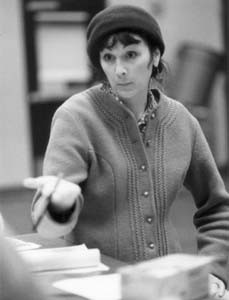
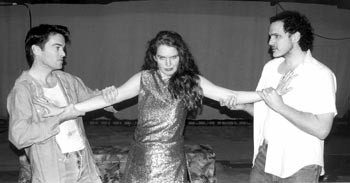
HERE ARE a few scenes from the front lines of dance: A lithe young woman conducts a sizzling solo performance of passion with a chair. A half-dozen agile bodies roll with astonishing, gravity-defying grace over one another, from floor to bench and back again. A costumed couple juggles sombreros, guns, and bandoleers full of bullets as they fly with casual grace above the stage.

Face facts: This is not your father’s ballet. Bored by old conventions, dance has changed, adapted, mutated. Some would say that companies such as Smuin Ballet/SF and the Alvin Ailey Repertory Ensemble, the two dynamic dance troupes about to roll into Sonoma County this month, have more in common with a music video than The Nutcracker. But this is not, as some critics have called it, dance for the MTV generation.

“I don’t think that’s very accurate,” says Michael Smuin, founder and director of Smuin Ballet. “I think MTV is for people who can’t concentrate on any one image for long. That’s why there’s all that fast cutting and fades and trickery.”

But then the head of the small but wildly popular five-year-old San Francisco dance troupe relents a bit.

“I guess what they may mean is that my work is accessible to a lot of people,” Smuin says. “That it’s not just tutus and swans and fairy-tale people, that a lot of the work is based on what’s real. And then there’s the music that I use: I use everything from Willie Nelson to Bach. So there’s a variety.”

Smuin’s colorful career has certainly prepared him for eclectic creativity. Of course, he has all the standard credentials in classical ballet, including over 10 years as director of the San Francisco Ballet. But he’s also worked as a choreographer on everything from ice shows to circus acts to Hollywood movies (including The Return of the Jedi) to shows on Broadway, where he won a Tony Award for his work on Cole Porter’s Anything Goes.

“I’ve done it all,” Smuin says with a laugh. “It wasn’t necessarily a matter of choice; it was a matter of survival, of working. You went where the work was, and that was good, because it was really an education.”

Smuin’s latest creation will soon hit the stage at Spreckels Performing Arts Center, just a few weeks after the work’s premiere in San Francisco. Sueños Latinos was inspired by music written by composer Aaron Copland during his travels through Mexico and Cuba. Smuin describes the new 30-minute dance production as a Cubist mosaic of sounds and images.

“It’s a collage of bulls and charros and sombreros and Day of the Dead and all those kinds of things put together,” Smuin says. “And the only form really is the form of the music. It’s quite exciting and very dreamlike.”

Both Sueños Latinos and the sexy Carmina Burana, the other work Smuin Ballet will offer in Sonoma County, are dramatically non-traditional. That, according to Smuin, is the key to keeping audience entertained in an age dominated by Hollywood blockbusters.

CAPTURING an audience through innovation takes on added importance in these days of declining public funding for the arts. That’s a lesson that the Alvin Ailey American Dance Theater has learned the hard way.

The venerable dance institution, founded in 1958 by the African American dancer Alvin Ailey, has faced deep cuts in its funds from the National Endowment for the Arts in recent years. But ticket sales have pulled the company through that financial crisis, and one look at their dynamic performances goes a long way toward explaining their box office popularity. It should be no surprise that pop star Madonna once studied with the Alvin Ailey dance troupe: The company aims for accessibility, trying to bring in folks who might otherwise be going to rock concerts.

That smooth accessibility holds especially true for the work of the Alvin Ailey Repertory Ensemble. The young dancers of Alvin Ailey’s second company perform to music ranging from classical to jazz, and their passionate moves and high-energy choreography are anything but traditional.

But will all the revolutionary innovation in the world be enough to make dance converts out of the young audiences of the future? And how can artists keep dance fresh and hip without becoming just a live-action version of a music video? These are challenges that the dance world is struggling to meet, according to Smuin.

“I think there’s not that much new work being done that’s significant, and the ballet boom is definitely over,” he says. “So you really have to come up with interesting, demanding, entertaining work to capture an audience and keep them.”

The Alvin Ailey Repertory Ensemble performs at 7:30 p.m. on Thursday, Nov. 12, at the Luther Burbank Center, 50 Mark West Springs Road, Santa Rosa. Tickets are $22, $20 for seniors, $17 for students. 546-3600.

Smuin Ballet/SF appears at 8 p.m. on Nov. 21 and at 2:30 p.m. on Nov. 22 at the Spreckels Performing Arts Center, 5409 Snyder Lane, Rohnert Park. General admission is $25, $22 for seniors. 584-1700.

From the November 5-11, 1998 issue of the Sonoma County Independent.

© Metro Publishing Inc.
Mexican Deli Sandwiches

0

Courting a Torta

Michael Amsler


One man’s newfound romance with the Mexican deli sandwich

By Dylan Bennett

AS A WORKING-CLASS gringo transplanted last month to central Mexico for a week, my mind reeled with the new experience of being rich. My guides showed me how to eat chilaquiles for breakfast at a big hotel in Guanajuato, and steak drenched in garlic sauce for lunch at a casual yet upscale restaurant. “Whatever you do,” they said, “don’t eat anything from the street vendors. A gringo like you, only here for a week, could get sick.

“And you probably shouldn’t eat anything from the mercado either.”

Ah, yes. But the mercado, the market, a short labyrinthine walk from the white linen and suited waiters at the gringo-safe hotel, held myriad temptations. Just getting there you passed a giant clicking, hissing, chicken rotisserie laden with a hundred pumpkin-colored birds spinning like some primordial socket wrench in hell.

The mercado is a cavernous building teeming with bakers, cooks, and butchers, and another eating establishment every 15 feet. Stacks of deep-fried pork rind made me think over and over of George Bush, who confessed to a weakness for the fattening snack. Plucked chickens snoozed in uncooled glass cases; mosaics of soda pop, sombreros, brass figurines, and a zoo of farm vegetables seduced the eyes.

And there, near the entrance to the mercado, ladies stood beside mounds of pork ribs that glistened under a cluster of heat lamps.

“Cha,” my guide sniffed. “You want to avoid any heavy greasy stuff.”

“I do?” I asked myself, glancing back at the carnitas ladies. I watched as a woman with gold teeth sliced open a bread roll and reached for the glowing case of shiny pork. Silently, I plotted my return. Day-tripping with my gracious hosts, a couple of well-heeled west county vegetarians, left little time or social opportunity for scarfing pork in the marketplace. But if any meal had to be eaten, it was there at the carnitas booth with the gold-toothed woman.

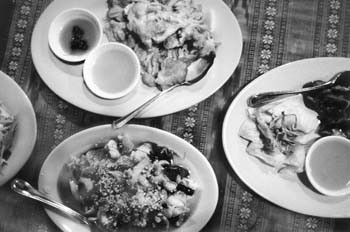
A day later I was back, this time in the company of an approving carnivore. With barely adequate Spanish, I bellied up to the empty bar stools and ordered: “I’ll take one of those, please.” Sensing this was my first time dining without a waiter in Mexico, the friendly lady selected a choice chuck of meat, deboned it, and chopped it pedantically in a wooden pestle. Then she smoothly sliced open a roll, tucked in the meat, spooned a drink of fresh spicy salsa down the middle, and handed me lunch with a can of cold beer. ” Cómo se llama esta comida?” I asked the matron. “What do you call this food?”

“Una torta,” she replied.

A TORTA. A ROAST pork sandwich on a crusty roll, reminiscent of bratwurst in Baden-Württemberg. In the ambiant light and humid warmth of the mysterious mercado where gringos shouldn’t eat, I wolfed down this deeply gratifying but unsung classic. I had “discovered” the Mexican deli sandwich–bread, flesh, and salsa unfettered by distracting garnishes.

In California, where burritos, tacos, and enchiladas dominate the Mexican menu, tortas are the invisible entrée, something odd, unchosen; something gringos pass on when they see Latinos eating at the local taqueria. The world of tortas offers new worlds for appetites. Indeed, in central Mexico, where I never saw a burrito, tortas are a mainstay.

Back in Santa Rosa, I was a fervent torta guy determined to find the real thing close to home, but I was frustrated by what I found. Places like Santa Rosa Taqueria that I hold in high esteem put out a torta soaked in refried beans, iceberg lettuce, and tomato all on a soft, tasteless bread that felt like a hamburger bun. Sonoma Taco Shop was much the same. One Healdsburg taco joint topped it off with an unsavory portion of mayonnaise. The flavors are lost.

And, as Andy Barnett at Centro Espresso in downtown Santa Rosa often says: You need a signed release form from your cardiologist to order one of these. To boot, important names in local Mexican food like Rafa’s in Cotati and the ubiquitous Viva Mexico don’t even carry the touted torta on their menu.

IN MY QUEST for the Great Northern Torta I found a spirited and sensible sandwich at El Favorito, the working-class taco shack on Sebastopol Road in the multicultural Roseland district of Santa Rosa. Favorito serves a respectable torta on a hearty roll that compresses a marriage of carnitas, cheese, and thick slices of avocado.

Also at Cotija on Western Avenue in Petaluma I got a tasty torta, prepared with sour cream and lettuce, but not too far from the Platonic ideal of bread, flesh, and hot sauce.

A review of the available literature on tortas reveals that those smothering their meat with extras are rightfully exercising a variety of traditional torta styles. My favorite, the minimalist “torta ahogada,” is only one option, because in truth a torta is still a sandwich–you get out what you put into it.

Still, several local tortas fail in my mind, and to my palate, because the soft amorphous bread is an immediate disappointment. And these days, lettuce and tomato from large commercial farms don’t pack much flavor.

That slice of heaven that the gold-toothed lady sells for 75 cents in the mercado is not available here.

Happily, torta ahogada, as well as the other more complicated varieties, is an open invitation to the home cook. Find a chewy white roll from a good local bakery, cut lengthwise, pull out some of the fluffy part, add your own home-roasted meat, and top it off with a sensible salsa.

The only limitations are those of your imagination and a lack of willingness to stray from the burrito-eating pack.

From the November 5-11, 1998 issue of the Sonoma County Independent.

© Metro Publishing Inc.
Albini Family Vineyards

0

Family Affair

In the fertile valleys of Sonoma County, all small wineries are not created equal

By Marina Wolf

IN FRONT of their miniature winery building on the outskirts of Windsor, Don and Lynne Albini perch atop of ladders, pouring clusters of purple grapes into the hopper of the lone crusher, which collects the pulp for the 1998 Albini Family Vineyards merlot. Below, Lynne’s mother, Marie, rakes aside the stems that spill out into a platform cart, while her Marie’s husband, Ted, sprays out the emptied crates and chats amiably about his hernia and their old neighborhood back in Ohio.

For all this hard work, Lynne’s parents get some good times and a few bottles of the Albini annual output, one of the smallest for an individual bonded site in Sonoma County: 500 cases.

Approximately 25 miles to the north in Geyserville, Mike Draxton and his wife, Carol, are starting up their harvest of some 90 acres of merlot and sauvignon blanc. That’s a fair amount of grapes, but most of it is being sold to other winemakers. Mike holds back just enough to take up to the Associated Vintage Group facility in Hopland, where he will use the fully equipped crushing facility to produce one of the smaller labels that AVG works with. The Draxton label this year will cork just 1,400 cases.

Meanwhile, in a sun-dappled vale in Forestville, fresh green rows of newly planted vines and an explicit sign–no tasting room, no visitors–guard the road to Hartford Court Winery, one of the smallest and brightest jewels in the Kendall-Jackson crown. The buildings visible through the trees hold the beginnings of the 1998 harvest, which will ultimately be transformed into fewer than 6,000 cases of high-end, sought-after bottlings of pinot noir and zinfandel.


Michael Amsler

Fruits of their labor: For Windsor winemakers Dan and Lynne Albini, with daughters Eva, far left, and Danielle, far right, small independently owned wineries are synonymous with family.

All of these wineries fall into the general category of “small wineries”: producing under 10,000 cases annually. In Sonoma County alone, there are about 60 wineries producing under 5,000 cases a year, according to the calculations of the Wine Industry Symposium in Napa. Small wineries constitute over a third of the licensed wineries in the county, and some, like the Rafanelli and William Selyem labels, have risen to fame as “boutique wineries,” with their wines virtually impossible to get, and well worth the search.

But the varying origins of these small-output wines beg the question: What does “small winery” really mean?

For Don and Lynne Albini, the term translates into “family.” Their two teenage daughters are bent on joining the business after college, and already join in on the vineyard chores between school and a social life. And the three-acre farm swarms with relatives and friends during the fall harvest and crush, and later the bottling. Though there are a few investors, and Lynne still takes hairdressing clients on the side, the Albinis are, in fact, making most of their living off of 500 cases a year, sold through the mail to a dedicated list of individuals and restaurants around the country.

It wouldn’t be possible, says Don, but for the fact that they built it all from the ground up over the course of 20 years: the house, the winery, the vineyard, everything. His uncle built the fireplace, his father helped build the house. The equipment is all paid for, and all the storage is on-site. “Most people don’t have that opportunity,” Albini says simply. “They’re making payments because they had the winery built and the vines planted [for them].”

The barn-raising approach to building a winery not only saves money, but is also essential to the Albinis’ way of life. They moved to the area when it was still all country, so that they could be raised in an agricultural environment. “The United States was all agrarian to begin with,” he points out. “And I don’t think anything can tie you closer to the earth and to family values than ranching and farming.”


Michael Amsler

Grape expectations: Lynne Albini inspects what comes out the other side of the crusher.

THIS IS THE WAY wine always has been produced until recently. Many of the region’s winemaking giants–Mondavi, Sebastiani–are still owned and operated by family members, working in marketing, as vice presidents, or even as resident winemakers. But as business realities change in the face of growing consolidation, so does the world of family-owned wineries.

Locally, several branches of the sprawling Kendall-Jackson family tree fall well within the definition of small wineries. There’s Hartford Court, for one, plus Cardinale and Lokoya, which annually produce only 5,000 cases and 3,000 cases, respectively, and command upwards of $70 a bottle. On paper, and in most functions, these wineries each stand on their own as independent businesses. But members of the K-J family of small wineries operate differently from the traditional small winery in several important ways.

First of all, the small wines are marketed collectively in an Artisans and Estates portfolio, which gives them prime placement in the well-lit tasting room in the palatial–and very busy–Kendall-Jackson Visitors Center in Fulton. Outside of tasting-room sales, the powerful K-J marketing and distribution machine can push the wines far more vigorously than any single winery of that size could manage or justify on its own.

Then there are the recurring expenses–the barrels, the bottles–which hit small wineries harder than large ones. The old saying–“You have to start out with a large fortune to make a small fortune in winemaking”–isn’t much of a joke, though small winemakers still laugh. Most of them don’t have even a small fortune, so they’re happy just to stay afloat.

Graham Parnell, editor of Vineyard and Winery Management magazine, recalls talking to a small winery owner who felt stretched by buying four French oak barrels at $700 apiece. “Then I took a group on a tour to Rodney Strong, with 23,000 barrels,” recounts Parnell. “They’re replacing at least a third of them with new oak. So we’re talking big, big money.”

Jim Caudill, vice president of public relations at Kendall-Jackson, mentions glass purchase specifically when asked about the material advantages that the K-J small wineries might have over their independent counterparts. “When we buy bottles and can get a better deal buying as a unit, we do,” says Caudill.

Michael Amsler


He believes, however, that small wineries still have the edge. “The wine business is not like any other business. There’s nothing worse than being successful,” he says. “The wine industry is based on discovery and romance. Any advantage gained by working together as a coalition sort of evaporates against that.”

Don Albini would disagree with that assessment, and it isn’t sour grapes: His merlot inevitably sells out. But he still is vociferous on the subject of larger wineries that own smaller wineries. One problem, he alleges, is that newly purchased small wineries may have their output slowly increased, and possibly change their product as well, so that people may think they’re still buying from a 2,000-case winery when in fact the count is now closer to 10,000, while the taste may have gradually mainstreamed. Since case counts are not listed on labels and in reviews as much as they once were, he says, “people don’t know that instead of being a little handmade wine, it’s now more of a commercial entity.

“These are the kind of things that threaten small wineries that are actually small wineries. We kind of disappear,” adds Albini. “As big corporations buy up small wineries, we suddenly become one out of a thousand small wineries.”

THE PROLIFERATION of small-output labels may be a problem for the handcrafted, family-owned establishments, but it’s not malicious, says Gerald Boyd, who is the wine writer for the San Francisco Chronicle and has a fairly pragmatic take on the big winery/small winery connection. “The reason why [the wine companies] are buying these wineries is to diversify their portfolio,” he explains. “They want a [small] winery in Sonoma, they want a sparklingwine producer, they want something on the central coast. This is the idea of having a complete portfolio so that you can cover all ground.”

Furthermore, he says, the large companies want to keep making high-quality wines through those small labels: “They’re not in it to dumb down the business.”

One problem in discussing the small-winery arena is that it’s impossible to determine the extent to which small wineries have been bought up or created by larger establishments over the years. Nobody keeps track of labels and case counts except the federal Bureau of Alcohol, Tobacco, and Firearms, which is not conducting any sort of longitudinal study on the subject, and declined to supply statistics. But many wine experts would agree that the number of small labels, defined by case count alone, has increased over the past decade.

One factor may be the emergence of custom-crush facilities such as the Associated Vintage Group. The main office in Graton, occupying several blocks of downtown space, has the polished appearance of many a larger winery, with meeting rooms and a calm, spacious lobby drawing one’s attention away from the gear-grinding and grape-crushing that is transpiring out back.

Allan Hemphill, president and managing director, was going to give a quick tour of the compound, but was called away to an emergency at the Hopland facility. He did arrange, however, to leave his visitor a publicity packet, which describes a huge organization offering smaller winemaking entities the chance to profit, as Kendall-Jackson wineries do, from economy of scale. With four facilities in Sonoma and Mendocino counties, AVG offers a wide range of production, marketing, and administrative services to winemakers and wineries, effectively lowering the threshold of capital investment to allow start-up wineries to get in on the ground floor.

Michael Amsler


That’s how Mike Draxton got started. Though he and his wife owned their property and vineyard outright, they just couldn’t see their way clear to buying pricey equipment for such small lots, when a perfectly good set-up was available just down the freeway. Draxton’s ambitions may be irritating to other winemakers–“We really just wanted our own label to have in the restaurants that we go to,” Draxton confesses shyly in a phone conversation–but he is gallons away from the dismissive stereotype of a bored rich guy who doesn’t know Chianti from spumante: Draxton received his degree in oenology from UC Davis in 1986 and has been working as a winemaker ever since.

Draxton believes his wines can compete with other small wines; in fact, he believes that the professional setup at AVG may make his wine even better than self-processed wines of the same output. This is another issue over which disagreements emerge between the more traditional market economy and purists like Albini and other makers of “handcrafted” wines, who stake their livelihoods on the premise that the means create the end result. “The wine industry has become a commodity. It’ll be a Wal-Mart,” Albini says forcefully. “That’s exactly the opposite of why I’m in the business. I’m in it to make something that’s unique, different, done in my own style. I put a lot of credence in doing it the old-fashioned way.”

However the wine gets made, one thing is for sure: Small wineries nestled amid a dozen diverse appellations are an essential part of Sonoma County’s booming wine economy. They may be the best possible use of the county’s land as well. Graham Parnell contrasts Sonoma County’s small-winery orientation with Napa County’s big-winery environment. “We have more climates that can support more varietals,” says Parnell. “The cost of land is $40,000 [per acre] in Napa; you have to be big to support paying for land. Here it’s $15,000 to $20,000, but it still behooves us to run smaller case counts and higher prices because the fruit is very good.”

Retailing at around $22 a bottle, the Albini merlot fits the formula and then some. The posh Postrio restaurant in San Francisco is one of many distinguished clients, while individuals on the Albini mailing list are clearly staunch supporters, as evidenced by their calls and correspondence that reads like letters to friends or family rather than to the supplier of high-class wine. But what satisfies Don Albini’s soul more than almost anything else is when people visit and are inspired enough to go home and start their own wineries, as two customers from the Pacific Northwest have already done.

“A lot of people who buy wine from us are really excited and pleased that this can still happen,” says an satisfied Albini, sitting forward on the edge of the bench of the grapevine-laden gazebo that he built himself. “You actually can have a small winery and make a living and exist in a small-farm environment.” *

From the November 5-11, 1998 issue of the Sonoma County Independent.

© Metro Publishing Inc.
The Scoop

Fat Chance

By Bob Harris

YOU’VE SEEN those TV ads promising miracle products that block your body’s ability to absorb fat, magically transforming your figure from Wilson Phillips to Peta Wilson to a Phillips screwdriver, and all in even less time than it takes Jerry Seinfeld to hit on a prom queen.

Y’know what? They all work, every single one.

By taking your money and making you poorer, instant weight loss products have the definite effect of making it harder to buy food, so if you buy enough of them–bingo!– you lose weight.

That said, scientists up at UC San Francisco have discovered a key enzyme that your body uses to produce fat molecules, and coming up with a way to block that enzyme may not be far behind.

The enzyme is called DGAT, which stands for a chemical name that contains every letter of the alphabet, two bird calls, and a wide range of high-pitched clicking sounds. For weight-loss purposes, let’s assume DGAT stands for Don’t Get Another Taco, and we’ll be just fine.

DGAT normally combines with other molecules to form compounds called triglycerides, which make up about 95 percent of your excess flesh and 100 percent of Lawrence Taylor’s head.

So blocking DGAT would make it impossible for your body to manufacture fat.

What would come out of you instead isn’t exactly clear yet, although I strongly suspect it’ll show up in the next John Waters movie, possibly wearing eye shadow.

Anyway, actual skinny pills may only be five years away.

Which means side effects, mutations, and premature deaths are only 10 years out. Lawsuits are 15 years away, and self-help books for relatives in recovery should pop out around 2020.

By which time, John Waters will receive a lifetime achievement Oscar, Lawrence Taylor will be out of prison, and Jerry Seinfeld will be dating a 30-year-old.

Never let it be said that this space won’t predict a long shot.

ACCORDING to a new study from Washington University in St. Louis, some depressed folks are simply missing a few brain cells.

That doesn’t mean the converse is true: not everyone with missing gray matter is necessarily depressed. Otherwise there wouldn’t be so much cheering at tractor pulls.

But doctors have known for a while that some cases of inherited depression may be caused by getting shortchanged in your subgenual prefrontal cortex, a dime-sized piece of brain behind the center of your forehead–right where you’d put a bull’s-eye on someone else, assuming you got one of the small ones.

And the new study indicates that in many people with manic depression, there’s a shortage of glia, which are cells that schlep around and get coffee for your thinking neuron cells, and whose response to the neurotransmitter serotonin is a major factor in whether you feel like hugging that Jehovah’s Witness or scoring his aorta with a steak knife.

So there’s a definite genetic component to some forms of depression, and it’s one that many current drug therapies simply aren’t yet designed to cope with.

Not that this is all such a surprise. I mean, look: Aaron Spelling. Tori Spelling. See? Obviously, the cause of depression can be reproduced.

Except we’re the ones getting depressed.

FINALLY: computers cannot possibly get any smaller. Probably.

You already know how annoying it is that absolutely any computer thing you ever buy is completely obsolete within a matter of months, and whatever replaces it is newer, half the size, and much more attractively packaged.

A lot like Donald Trump’s wives.

I once spent over a thousand dollars on a Commodore 64 computer, which was really exciting because it had enough memory to contain … a graphic. Singular.

The entire processing power of that thousand-dollar computer is now contained in an ordinary pager that they give away free just to sell you the service. Nothing in the world loses value as fast as technology. Other than an NBA season ticket, Godzilla merchandise, and Whoopi Goldberg’s film career.

Anyway, scientists in Copenhagen have created literally the smallest microprocessor possible: a computer chip where a single atom jumps back and forth to generate binary code, much the same way Anne Heche generates publicity.

The four-man team of goggleheads who accomplished this used a scanning-tunneling microscope to remove one of a single pair of hydrogen atoms from the surface of a silicon chip, leaving the remaining hydrogen atom available for further use.

Not surprisingly, not one of them has ever touched a girl.

What this means is that in 10 years, storage density will increase by a factor of over a million. Within our lifetimes, it’s actually possible that the entire sum of literature, art, music, and literally all human expression might eventually be stored on a single disc.

Which Bill Gates will own.

From the November 5-11, 1998 issue of the Sonoma County Independent.

© Metro Publishing Inc.
Talking Pictures

0

Final Days

By David Templeton


Writer David Templeton takes interesting people to interesting movies in his ongoing quest for the ultimate post-film conversation. This week, he meets up with introspective Vermont author Chris Bohjalian (Midwives; Water Witches) to experience the powerful adaptation of Anna Quindlen’s bestseller One True Thing.

IN THE WINTER of 1994, author Chris Bohjalian learned that his mother, Annalee Bohjalian, was dying of lung cancer. He had just begun work on his fourth novel, Midwives, anticipating that he’d be writing a light, somewhat glib and ironic exploration of the wildly varied ways of birth in our current American culture. Annalee’s diagnosis, however, changed all that. During the harrowing weeks and months of his mother’s illness–during which Bohjalian traveled often from Lincoln, Vt., to his parents’ place in Ft. Lauderdale, Fla.–his novel began to shift in tone and substance. Considerably darker now, the story Bohjalian found himself telling–an experienced midwife is put on trial for manslaughter after performing an emergency C-section on a woman she believed to have died in labor–was far different from what he had first intended.

“Midwives have often said to me, ‘Why didn’t you write about a beautiful birth, instead of a birth that goes tragically wrong and a mother dies?'” Bohjalian says, shifting his chair a fraction closer to the table. “Sometimes I’ll say, ‘Well, it just happened to be a year of dead mothers.'”

He glances down at the table.

“What’s clear to me,” he says after a few silent seconds, “is that Midwives would have been a very different book if [my mother] hadn’t become sick and died that year that I was writing it. Which is why it’s dedicated to her.”

The restaurant, nearly deserted so late in the evening, seems to grow even quieter as Bohjalian softly speaks these words, as if the room itself–sensing that certain raw emotions have risen to the surface here–is paying its respects. Even the waiters have intuitively withdrawn, leaving us uninterrupted for nearly an hour. (No offense is taken at their absence; we are here to talk, after all).

What has stirred Chris Bohjalian’s emotions enough to share such intimate musings with a total stranger–we only met three hours ago, in a movie theater lobby–is the powerful new film One True Thing. It’s based on Anna Quindlen’s best-selling, memoirish novel about an ambitious journalist (Renee Zellwegger) who returns home to care for her cancer-stricken mother (Meryl Streep); her father (William Hurt), unable to accept that his wife is dying, becomes increasingly distant. Like Bohjalian’s Midwives–a book of remarkable beauty and frankness–Quindlen’s tale is invigorating in its emotional details. Both stories share a similar, aching spirit, shaped by their authors’ recollections of saying goodbye to the one who brought them into the world.

And in both cases–Quindlen’s and Bohjalian’s–the father’s denial played a part in how events unfolded.

“My father, on the one hand, was a great cancer coach,” Bohjalian admits. “He rose to tasks I had no idea he could accomplish. I never thought my father was capable of the kind of tenderness he showed. On the other hand, up until the bitter end, he was Knute Rockne. He was going to ‘Rah! Rah!’ right through everything. ‘You’re going to beat this. You can’t give up.’

“I think,” he speculates, “that if he’d been able to say to her, ‘It’s all right, you can give up now,’ she might have died at peace a lot sooner.”

“We tend to praise people for ‘not giving up,’ though, don’t we?” I ask. “People who live the longest with a terminal diagnosis are considered heroic.”

“There was a guy named Bob Wicket,” he replies, “who battled cancer for 18 years. I was around 12 years old when he was diagnosed and was 30 or 31 when he died. He’d been considered terminal several times during those 18 years; he just always kept going into remission. When he finally died, everyone was saying, ‘Bob was such a great guy. He fought death for 18 years!’ And I said, ‘If Bob had died in 1975, he still would have been a great guy.’

“What I dislike about it the most is that in praising someone for living a long time with some terminal condition, you end up saying that anyone who died six months after their diagnosis was a failure.

“Our family wasn’t much better,” he allows, quietly.

THE SILENCE creeps back in for a few moments. Neither of us speak, until Bohjalian says, “There’s a moment toward the end of Quindlen’s book, and in this film, when the mother says to her daughter, ‘I will not be shushed! I’m tired of everyone avoiding this.’

“Well, my mother and I had a very similar conversation. I was doing my own Knute Rockne: ‘You can still beat this, Mom.’ That kind of thing. And she suddenly said, ‘Stop it! I’m controlling this conversation. I’m putting on the table what we’re going to talk about, and I want to talk about this!’

“My mother was a very strong person,” he says, slowly, “and it was very strong medicine for me to hear. That I was so monumentally out of touch with what she was feeling, and that I had been so unwilling to let her say what she felt needed to be said. So that was the part in the movie that was hardest for me, because my family loves each other very, very much–but we were rotten with death. We just couldn’t deal with death well at all.”

As if sensing that the conversation is about to shift, the restaurant becomes suddenly more festive: people at the bar burst into laughter over some unheard joke; the piped-in music, recently silent, is turned on and up. It feels like time to go.

But Chris Bohjalian has one last thing to say.

“You know what I love?” he asks. “When mother died at 65, she’d amassed four and a half decades of costume jewelry. Loads of it. And Grace, my wonderfully funky daughter, loves that stuff–so she ended up with all of it after my mom died. For her third birthday party, she gave all her guests bags of plastic jewelry.

“So now,” he begins to grin, “when I drop Grace off at her after-school program, or when my wife and I are taking her and her friends somewhere, I’ll see all of these kids wearing some gaudy necklace that had been my mother’s.

“It’s kind of wonderful to see that,” he says, “to know that in this odd little, wonderful way–part of my mother lives on.”

From the November 5-11, 1998 issue of the Sonoma County Independent.

© Metro Publishing Inc.
The Scoop

Geriatics Gene By Bob Harris THIS JUST IN: Some researchers at Cal Tech are screwing around with the genetic blueprint of the Drosophilia melanogaster fruit fly. These fruit fly geeks have discovered that the little buggers' life spans and ability to react to stress both seem to be linked to a specific gene, a mutation...

Mariposa

Windsor Winner Spreading their (butterfly) wings: Mariposa co-owner Shawn Kearney-Tang, above, has brought a splash of sophistication to Windsor. New restaurant serves stylish, unfussy fare By Paula Harris IT'S EVENING and we're in the car heading for the old part of town. Driving slowly along a quiet neighborhood street, we spy a small...

Book Picks

Book Picks By Michelle Goldberg and Christine Brenneman Girl Walking Backwards By Bett Williams St. Martins Press; $12.95 BETT WILLIAMS' Girl Walking Backwards is one of those novels that I want to foist on every woman I know because it's so poignant and funny and sad about growing up smart, female, and miserable....

Transit Tax Plan

Gridlock Watchdog: Transit activist Richard Gaines participated in a recent transit forum. This week, Gaines and other successful opponents of Measures B and C were planning their next move in a bid to create an effective rail system. Local environmentalists pick up the pieces after defeat of transit tax plan By Greg Cahill ...

Spins

Young Gods New CDs from Beck, Bob Dylan By Greg Cahill Beck Mutations DGC/Bong Load I GOTTA ADMIT, I never really got bitten by the Beck bug. Sure, the wry singer-songwriter has produced some of the most interesting pop music of the past decade--"Loser" was clever as all get out, winning mainstream attention for...

Alvin Ailey & Michael Smuin Companies

New Wave Sueños Latinos, coming Nov. 21 and 22 to Spreckels. Michael Amsler Visiting dance companies are bent on flouting conventions By Patrick Sullivan HERE ARE a few scenes from the front lines of dance: A lithe young woman conducts a sizzling solo performance of passion with a chair. A half-dozen agile bodies roll...

Mexican Deli Sandwiches

Courting a Torta Michael Amsler One man's newfound romance with the Mexican deli sandwich By Dylan Bennett AS A WORKING-CLASS gringo transplanted last month to central Mexico for a week, my mind reeled with the new experience of being rich. My guides showed me how to eat chilaquiles for breakfast at a...

Albini Family Vineyards

Family Affair In the fertile valleys of Sonoma County, all small wineries are not created equal By Marina Wolf IN FRONT of their miniature winery building on the outskirts of Windsor, Don and Lynne Albini perch atop of ladders, pouring clusters of purple grapes into the hopper of the lone crusher, which collects...

The Scoop

Fat Chance By Bob Harris YOU'VE SEEN those TV ads promising miracle products that block your body's ability to absorb fat, magically transforming your figure from Wilson Phillips to Peta Wilson to a Phillips screwdriver, and all in even less time than it takes Jerry Seinfeld to hit on a prom queen. Y'know...

Talking Pictures

Final Days By David Templeton Writer David Templeton takes interesting people to interesting movies in his ongoing quest for the ultimate post-film conversation. This week, he meets up with introspective Vermont author Chris Bohjalian (Midwives; Water Witches) to experience the powerful adaptation of Anna Quindlen's bestseller One True Thing. IN THE...
11,084FansLike
4,606FollowersFollow
6,928FollowersFollow


