Summer Repertory Theatre

0

Sizzling Stages

Dark designs: Ailene King and Jeff Mattlin negotiate a devilish deal in The Visit.

Summer Repertory Theatre cooks up five hot plays in seven short weeks

By Daedalus Howell

IT’S SUMMERTIME and the livin’ is easy–unless, course, you’re involved with repertory theater and facing the rigors of five productions over seven brief weeks. Such is the lot of the 21 players from all across the country–said to represent the crème de la crème of college actors–who make up this year’s company at Summer Repertory Theatre.

An annual mainstay of the local summer stage, SRT, in its 28th season, cools down the dog days on two stages with a full bill of musicals, farces, comedies, and absurdist dramas–and occasionally does all at once.

Grease The pre-eminent ’50s-inspired rock ‘n’ roll musical, Grease sets the war of the sexes at Rydell High School, circa 1959, where bobby soxers and pedal pushers clash with leather jackets and DAs (back when the term was a hairstyle and not a legal career).

“We’ve been trying to get Grease for about three years. Until it revived itself, you could get it all the time,” says SRT’s associate artistic director Mollie Boice. “Once it became a such a big revival piece, they weren’t letting out the rights to anybody.”

But SRT’s vigilance has paid off, and the Pink Ladies and T-Birds are at it again in a crowd-pleasing, well-oiled production that has kicked off the action-packed season and continues through Aug. 6 at the Burbank Auditorium at Santa Rosa Junior College.

Charley’s Aunt It’s farce, 19th-century style: Jack loves Kitty and Charley loves Ms. Spettigue; the young men invite the ladies to meet Charley’s millionaire aunt, who at the last minute, postpones her visit. So as not to compromise the young women’s reputations or forgo a chance to profess their love, the duo convince Oxford chum Lord Babberly to masquerade as the dollared dowager. Chaos ensues when the real aunt (who else?) unexpectedly arrives in playwright Brandon Thomas’ timeless door-slammer.

“Thomas wrote Babberly for a particular actor, who in turn trained all of his replacements and all the people who toured the show,” says Boice. “He trained these actors to perform the role exactly like him, and sometimes he would go out and do the first act and have an understudy complete the play.”

Boice gives assurances that no such shenanigans will occur in SRT’s production, which is directed by Squire Fridell, whom she describes as the “king of farce” (he directed last year’s old-time serial parody Bullshot Crummond). Charley’s Aunt opens June 26 and runs through July 31 at the Santa Rosa High School auditorium.

The Visit Swiss avant-garde playwright Friedrich Dürrenmatt pays a call this summer through his stage-borne examination of justice, revenge, and virulent venality in The Visit.

“It’s about a woman who is returning to a town that was once the cradle of culture and is now bankrupt,” says Boice of the award-winning play. “She was railroaded out of town, but now she is the richest woman in the world.”

The hook? The wealthy returnee will finance the town’s fiscal recovery for a price. She requires the murder of the man who disgraced her and forced her to leave. The idea is at first dismissed, but eventually the townsfolk’s tenuous morality becomes eclipsed by avarice in what many critics believe is Dürrenmatt’s finest work. The Visit opens July 2 and runs through July 31 at the SRJC Burbank Auditorium.

Laughter on the 23rd Floor Writers’ alter-egos often turn into altar-egos, ready-made for self-worship. Playwright Neil Simon avoids that pitfall in this work by turning his insightful comic eye not only on himself but also on the gaggle of gag men with whom he spent his salad days penning television comedy.

“It’s Simon’s tribute to Sid Caesar and Your Show of Shows,” says Boice. “He and his brother Danny, Mel Brooks, Carl Reiner, and even Woody Allen were writers on the show.”

Posited as a fictional memoir, this play has Simon riffing on his illustrious cronies, detailing their comic one-up-manship and the Caesar-inspired comedian Max Prince’s attempt to subdue nervous network honchos who think his shtick goes too far for Mr. and Mrs. Middle America. Laughter opens July 8 and runs through Aug. 4 at the Santa Rosa High School auditorium.

The Will Rogers Follies–A Life in Revue Will Rogers once remarked he never met a man he didn’t like, and such bonhomie bodes well for former Sonoma County actor Scott Hayes, who faces the daunting task of resurrecting the homespun humorist in The Will Rogers Follies–A Life in Revue.

The musical uses the open variety format of the Ziegfield Follies to recount the populist philosopher’s life story. Hayes’ homecoming performance–he’s a veteran of stages across the country (and is also a theater professor at Florida State University)–marks his fifth season with the company and the first year SRT has appointed an artist-in-residence. The Will Rogers Follies opens July 14 and runs through Aug. 7 at the SRJC Burbank Auditorium.

Of course, the success of this ambitious season depends on more than the skill of the thespians involved. The audience, too, plays a key role. After all, it takes more than summer heat to warm theater seats.

The Summer Repertory Theatre season runs through Aug. 7. Shows begin at 8 p.m., Tuesdays and Saturdays; and at 2 and 7:30 p.m. on Sundays. Tickets are $6 to $14. Santa Rosa’s Burbank Auditorium is on the SRJC campus, 1501 Mendocino Ave., and the Santa Rosa High School auditorium is at 1235 Mendocino Ave. For details, call 527-4343.

From the June 24-30, 1999 issue of the Sonoma County Independent.

© Metro Publishing Inc.

Spins

0

Global Groove

Chip off the old block: Anoushka Shankar, 17, makes an impressive debut.

New CDs offer world of sound

By Greg Cahill

Anoushka Shankar Anoushka Angel

SITAR GREAT Ravi Shankar once said it would take more than one lifetime to master his multistringed instrument. If reincarnation is a reality, Shankar may get his chance to forge ahead with his work. But at least the Shankar family will get a couple of generations to explore that complex artform. The debut recording by Anoushka Shankar, Ravi’s 17-year-old daughter, proves that his progeny has not only talent, but the name and enough good looks to snare a major label recording contract in the United States. That’s something that has eluded most Indian classical players over the years, despite the barriers surmounted by Ravi Shankar, who, as a mentor to George Harrison of the Beatles and a performer in the landmark 1967 concert “Monterey Pop,” introduced Indian music to mainstream U.S. audiences. Anoushka reverently performs only compositions by her famous father, a series of five ragas. And even if she is yet to be blessed by his spellbinding speed, the younger Shankar shows that she’s got the stuff.

Various Artists The Bali Sessions Rykodisc

GRATEFUL DEAD drummer Mickey Hart journeyed to the Indonesian island of Bali last year with his family in search of a little R&R, but the trip turned out to be a busman’s holiday. Recording equipment in tow, Hart took full advantage of his visit to this musically rich region, culminating in what he describes in the liner notes as a “magical” marathon session taping local gamelan players. The result is a three-CD collection of trancelike rhythmic percussion by world-class gamelan orchestras. Mesmerizing metallic and wooden instruments (occasionally accompanied by voices, flute, or two-string fiddle) are played in complex cycles that chime their way into the consciousness–what Hart calls “a rainbow of sound,” alternately peaceful and exhilarating. While most gamelan songs are tightly arranged and allow for little improvisation (the driving, unified force of the music is part of its powerful beauty), Hart includes a disc of experimental music that echoes his own ’70s-era Diga project and his electronic explorations. A fascinating audio travelogue.

Ibrahim Ferrer The Buena Vista Social Club Presents Ibrahim Ferrer World Circuit

THE FOLKSY 1998 recording The Buena Vista Social Club, produced by Ry Cooder, captured some of Cuba’s finest veteran players in a stripped-down backyard setting. That album, featuring players who rarely if ever had been heard by U.S. audiences, helped launch the Cuban music craze. It also was one of the year’s runaway hits. The title of this recording suggests The Buena Vista Social Club II, but it’s a distinctive recording in its own right. Ferrer often is hailed as the last of the great bolero singers, crooning rich romantic ballads in a sort of lo-fi ballroom style that is absolutely seductive. This is the debut recording for the 72-year-old vocalist, who is accompanied by the cream of the Cuban music kingdom, including pianist Ruben Gonzalez, tres guitarist Papi Oviedo (who released a great 1997 album on the Rohnert Park-based Tinder label), and dozens of top Cuban jazz players. Ferrer is a real treasure–wish him a long life and many more chances to charm us.

DJ Cheb i Sabbah Shri Durga Six Degrees

ONE OF the summer’s hottest global beat CDs is a historic collaboration of Indian DJ Cheb i Sabbah and a host of Hindustani classical musicians, weaving traditional ragas and Muslim prayers with contemporary dance beats in a postmodern tour de force. And, yes, avant jazz and rock producer and bassist Bill Laswell has his imprint all over this project. The spiritual and sensual clash is a suitable soundtrack for tantric sex–or maybe just for lounging around on a lazy day.

Amadou et Marian Sou ni Tile Tinder

THEIR STORY is the stuff of legends: Both blind, they meet, fall in love, travel together, write gorgeous melodies together, perform together, raise three children together. Marian Doumbia and Amadou Bagayoko–known throughout West Africa as the Blind Couple of Mali–pen and perform songs that exude a warmth so intense you feel as if you’ve known them all your life, yet the material is so rich that even after repeated listening you are still filled with wonder. Celine Dion should be so lucky–or talented.

Various Artists The Rough Guide to the Music of Eastern European World Music Network

NOW THAT the U.S. government has spent billions of tax dollars bombing the bejeesus out of Yugoslavia, you might want to plunk down 15 bucks to savor the rich cultural diversity of that war-torn region. This is one of the most recent compilations in the Rough Guide series–other recent recordings focus on Cajun and zydeco, and the music of Portugal, Native Americans, and English roots–and, as with other Rough Guide releases, it is an effective primer to the region’s music. Actually, you won’t get to hear any Serbian songs (which are quite beautiful and well worth pursuing), but there is plenty of other music from the Balkans region, which is as Balkanized musically as it is politically. The Turkish-flavored dance tune “Spune, Spune, Mos Batrin,” a contagious folksy number by the Romanian gypsy band Taraf de Haidouks, is worth the price of admission alone. Let’s hope Romania will stay in our good graces and out of our bombsights.

From the June 24-30, 1999 issue of the Sonoma County Independent.

© Metro Publishing Inc.

Martha Honey

Head Trip

Michael Amsler


New book evaluates the power and politics of ecotourism

By Bill Strubbe

VACATIONERS escaping bleak northern winters often know little about who owns the beach on which they’re tanning their hides. Many could care less, of course, but if they did ponder the deeper significance their brief sojourn had for the local reef or the chamber maid who changed their bed linens … well, it just might spoil their holiday.

For the privileged, travel serves as an escape. For much of the Third World, tourism is a vital means of survival that often carries with it the heavy price of environmental and cultural degradation. In Ecotourism and Sustainable Development: Who Owns Paradise? (Island Press; $25), author Martha Honey argues that travel consumers can make choices that help save the world–leaf by leaf, rainforest by rainforest, village by village.

This is no dry armchair dissertation. Martha Honey, an award-winning journalist who worked for 20 years in Central America and Africa, enlivens her research and data with colorful anecdotes from her globetrotting experiences.

Substantiated by extensive footnotes, the first three chapters of Ecotourism and Sustainable Development explore the mechanics of the tourism industry, the evolution of ecotourism, and its appropriation by conventional tours. The later chapters present engaging case studies of seven popular ecotourism destinations, including the Galápagos, Costa Rica, and Kenya.

Tourism, the world’s largest legitimate business, accounts for about 10 percent of global jobs. It was once envisioned as a non-polluting industry that would foster employment, but it soon became clear that mass visitation encouraged environmental decline, cultural invasion, prostitution, and low-paying jobs. In 1980, a conference of religious leaders in Manila went so far as to issue a statement arguing that tourism does more harm than good to people in the Third World.

Partly in response to those concerns, the concept of ecotourism evolved simultaneously in Latin America and Africa, cross-fertilized, and is now utilized as a tool for benefiting fragile ecosystems and local communities. The benefits have been real. For example, in Kenya’s Mara Game Reserve the “preservationist” method of separating the Masai from their native lands was a failure. A new “stakeholders” theory posited that ecosystems would be best protected if indigenous peoples benefited economically from parklands, and the Masai now successfully manage the area.

But soon enough, “eco” became a corporate buzzword, and we were assailed with a green-washed version of the former panacea. When it comes to providing examples of this phenomenon, the book does not shy away from citing names and organizations. Honey details one shameful case of ecotourism exploitation: The president of the World Travel and Tourism Council instigated the “Green Globe” program, whereby a travel company sending a statement of their commitment to environmental improvement–along with a $200 check–received the right to use the Green Globe logo in promotional materials. To test this procedure, a London television station simply sent in an application (and a check) from “Greenman Travel.” Without further fuss, they promptly received a certificate.

To counter this pervasive green-washing, the Ecotourism Society devised a seven-point definition of ecotourism in 1991. These rules included some obvious notions–that ecotourism must involve travel to natural destinations, minimize impact, and build environmental awareness. But the definition also called for such programs to foster respect for local cultures and support democracy.

Honey concludes that it’s not enough to identify “ecotourism lite.” We must also, she says, discover ways in which authentic ecotourism can move from being simply a niche market to becoming a broad set of principles that transform the way we travel and the way the tourism industry functions. For those who love the earth’s natural glories and diverse peoples, one only hopes Honey’s sentiments are not a pipe dream. Indeed, the earth’s well-being may depend it.

From the June 24-30, 1999 issue of the Sonoma County Independent.

© Metro Publishing Inc.

Sonoma Valley Shakespeare Festival

0

Howdy, Bard’ner

The Comedy of Errors.

Michael Amsler


The Sonoma Valley Shakespeare Festival gears up for the new millennium

By Patrick Sullivan

FOR A GUY who’s been dead some 400 years, the late William Shakespeare is pretty damn lively. The playwright’s actual corpse is as quiet as Yorick’s skull, of course, but his enormous body of work can’t be entombed in classrooms and libraries; it keeps spilling out onto stages, turning up in novels, and creeping out into popular culture at movie theaters across the country.

Hollywood, for one, just can’t seem to get by without the old guy. The past year has seen big-screen versions of A Midsummer Night’s Dream, The Taming of the Shrew (retold in the teen flick 10 Things I Hate about You), and, most notably, the playwright’s own life in Shakespeare in Love.

Audiences of live theater can’t get enough of him either. In the United States alone there are over 100 active Shakespeare festivals, including nearly a dozen in Northern California.

Not bad for a man once dismissed by Tolstoy as “insignificant and immoral.” Criticism can’t kill the Bard, and neither can too much love–his vividly drawn characters have even survived being played by the likes of Mel Gibson and Leonardo diCaprio. Attacked or embraced, the Swan of Avon sails blithely on, preparing to greet the new millennium as the most-produced playwright in the English language.

So what’s the secret? How do 400-year-old plays about homicidal kings and suicidal princes continue to pack theaters and movie houses?

Carl Hamilton, co-founder and artistic director of the Sonoma Valley Shakespeare Festival, which kicks off its eighth season on July 2, offers one answer, but it’s got nothing to do with what your English teacher taught you about iambic pentameter. The plays continue to succeed, Hamilton says, because they have a lot in common with daytime television.

“They were the soap operas of their day,” explains Hamilton. “There’s love, there’s passion, there’s violence, sex, humor … You just sit there and say, ‘God, this guy wrote this stuff 400 years ago, and he’s saying exactly what I feel about love and hate and philosophy.”

Since 1992, without corporate sponsors or grant money, Hamilton, who is 42, and his crew of collaborators, including his wife, Jamie, have been staging Shakespeare’s work amid the rolling vineyards of the Gundlach-Bundschu Winery, pouring a considerable amount of time, energy, and cash into their endeavor (Hamilton estimates that he has put some $30,000 of his own money into his company over the years).

The result has been a modest but steady audience of tourists and locals who sprawl out in lawn chairs to enjoy the company’s low-key approach to the Bard’s work. You won’t find special effects or big-budget productions here; you will find a casual atmosphere that includes a celebratory glass of wine for the cast after performances.

“We could get much higher attendance if we wanted to be aggressive in our marketing and put some money into advertising, but we just don’t have that kind of style,” Hamilton says. “My philosophy is that we’re a local coffee-shop kind of thing. We’re not real interested in becoming this huge organization. That would really ruin it.”

Festival Schedule

This year, the festival is staging The Tempest and Rosencrantz and Guildenstern Are Dead, playwright Tom Stoppard’s absurdist take on the lives of two minor characters in Hamlet, which is the festival’s annual “Shakespeare on the Fringe” show. Hamilton, who works a day job as a counselor for troubled kids, will direct a farcical production of The Comedy of Errors set in the rough-and-tumble atmosphere of the mining town of Virginia City.

“Setting it in the West somehow makes it more accessible to people–they’re not intimidated,” Hamilton explains.

Of course, not everyone enjoys seeing new interpretations and settings for Shakespeare’s work. Hamilton recalls getting an angry letter six years ago from a staunch traditionalist from Windsor who was upset about a production of The Comedy of Errors.

“My director did it in sort of a vaudeville routine, which really worked, but [the Windsor lady] hated it,” Hamilton recalls with a laugh. “She said, ‘I brought my children to see Shakespeare, and what do I get? The Three Stooges running around onstage!’ What she didn’t understand is that The Comedy of Errors is a vaudeville routine. It’s slapstick, it’s incredible, it’s absurd.”

It’s that kind of rigidity with regard to Shakespeare that Hamilton is determined to fight. He speaks with considerable heat about what might be called the English-class approach to the playwright’s work, an attitude he often encountered while studying theater at UC Davis. The plays are meant to be performed, not read, Hamilton says, and they’re meant to be enjoyed by ordinary people, not endlessly vivisected by college professors.

“I think we have to battle those cultural snobs out there who put Shakespeare in this elitist, high-culture niche,” he says. “We’re always going to have to fight that. What I try to do with theater, both with Shakespeare and with contemporary theater, is bring it down to this level of ‘This is not brain surgery. This is theater; we’re here to entertain you, and hopefully we’ll make you think, too.’ And if we don’t, well, that’s OK.”

Of course, there are those who wonder what Shakespeare’s fate will be in the new century. Will Hollywood and the theater community run out of new ways to reinterpret the plays that have, after all, already been monkeyed around with for 400 years? Hamilton, who is already planning for next year’s millennium festival, doesn’t think so.

“The more I do Shakespeare, ” he says, “the more I realize that every time you look at it, you find something new. As old as it is, as many times as you see a production, you can come back to it over and over again. I think that’s why people keep coming out to the festival. It’s a good time.”

From the June 24-30, 1999 issue of the Sonoma County Independent.

© Metro Publishing Inc.

Eel River

D’Eel Denial

By Janet Wells

WHILE SANTA ROSA city officials mull over an ordinance to prohibit water waste, a far bigger water issue is brewing that may ultimately make Santa Rosa wish that it hadn’t agreed to ship 4 billion gallons a year of highly treated, highly usable, and potentially highly valuable wastewater to the Geysers steam fields.

The Eel River diversions to the Russian River, a neat engineering trick that steals from one river to feed another, has had environmentalists fuming for years. What started in 1908 simply as a small PG&E power-generating program in Potter Valley has expanded to the point where there isn’t enough water to sustain the Eel River’s ecosystem.

So why not just stop the diversions? Because they are the lifeblood for much of Sonoma County and some of Marin County as well.

“The Potter Valley Project is killing the Eel River to provide excess water to fuel unsustainable growth in Sonoma and Marin counties,” says Margaret Pennington of the Sierra Club.

Because of pressure from environmentalists and federal agencies, the Federal Energy Regulatory Commission is expected to adopt at least a 15 percent reduction in the amount of water diverted, with more substantial reductions over time.

“We believe it is preferable for water users in the Russian River basin … to begin adjusting their water-use patterns and planting less water-dependent crops in anticipation of an eventual end to water diversions from the Eel River,” the federal Environmental Protection Agency states in its comments on the draft environmental impact statement on the Potter Valley Project.

Here’s where Santa Rosa’s wastewater comes in: With less water available to fuel Sonoma County’s anticipated growth, why not use that water for crops and urban irrigation? the critics of the Geysers solution say.

“There are some questions about water supply and the main transportation system, yet they’re slapping in subdivisions faster than ever,” says Mark Green, executive director of Sonoma County Conservation Action, the North Bay’s largest environmental group. “There are some very strong arguments that could be made that Santa Rosa should not be issuing any permits anytime soon until they get this stuff nailed down. But there doesn’t seem to be any indication of that.”

CHANGES TO the Eel River diversions undoubtedly will most affect the northern part of Sonoma County. South of Healdsburg, much of the county relies on Lake Sonoma, which is fed by Dry Creek. The diverted Eel River water is considered “extra” to keep the lake full for recreational use. Lake Mendocino, however, relies almost completely on the diversions.

While water experts predict catastrophe for the agricultural economy of northern Sonoma and southern Mendocino counties should the Eel River supply dry up, when it comes to the impact on Santa Rosa, officials say it’s all speculation.

“Everybody’s [municipal] general plans are about to go through reworkings. Until the dust settles on all that, it’s hard to say what the implications are,” says Bill Mailliard, water resources committee chairman of the Sonoma County Alliance.

The city seems, however, to be bracing itself for impact, since it is evaluating expansion and upgrade of its eight water wells as a future back-up system, even though one of the wells is contaminated and the others have less than optimal quality and taste.

“It’s so sad that they are looking at older methods of going out and drilling groundwater in areas that potentially have toxic plumes, instead of using wastewater on urban areas,” says Krista Rector, a Sierra Club Executive Committee member.

“They are looking for more water and at the same time treating [wastewater] to a very high level and giving it away,” she adds. “They could look at very creative ways of using wastewater instead of bleeding money on both ends.”

From the June 24-30, 1999 issue of the Sonoma County Independent.

© Metro Publishing Inc.

Natural Foods

0

Sonoma, Naturally!


Michael Amsler

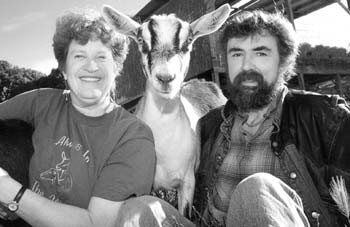
Got their goat: Cheesemakers Javier and Patty Salmon of Bodega Goat Cheese make products that don’t taste goatsy.

A generation of local entrepreneurs find their place in the sun amid Sonoma County’s thriving natural and organic packaged-foods industry

By Paula Harris

IT’S NOT JUST a flash in the pan. The days when the only organic or natural processed foods available were plain-packed, plain-tasting, or just plain weird-tasting offerings sold by tie-dye-clad clerks at the local health food store are long gone. These days natural and organic foods packaged for convenience have become so creative and full-flavored–even bordering on gourmet–they now stock supermarket-sized natural food markets and even occupy a permanent space alongside familiar, additive-laden products on mainstream grocery store shelves.

By 1995, mainstream consumers had become more health conscious, and mass market demand for natural foods soared. Even established companies, among them household names in the food industry, recognized these trends and diversified into natural foods. There are now wholesome replicas of familiar junk-grub–even Pop Tarts and tater tots have their healthful equivalents.

“In general, whole organic-food sales are jumping significantly each year nationwide because people are very concerned about the perceived quality of foods,” says Betsy Timm, executive director for Select Sonoma County, a non-profit agricultural marketing group that develops promotions, education programs, and marketing opportunities for Sonoma County’s agricultural producers.

“Even large corporate farms are getting into the organic area. Natural foods are growing in tandem also and are becoming linked to big companies,” continues Timm. “When Kraft jumps on the bandwagon, you know it’s a trend.”

Local purveyors and manufacturers of natural and organic products are riding this wave of widespread acceptance, and natural packaged fare from the county is increasingly turning up in supermarkets and kitchen cupboards around the nation and, in some cases, internationally.

Think that’s an exaggeration? Take a peek inside your own kitchen cabinets. A quick perusal of my pantry was like taking a quick jaunt around the county. I encountered a bag of Timber Crest Farms organic sun-dried tomatoes (Healdsburg); a box of Fantastic Classico Risotto (Petaluma); Barbara’s Bakery Natural Choice toaster pastries (Petaluma); a can of Muir Glen organic diced tomatoes and one of pizza sauce (Petaluma); a bottle of Kozlowski Farms honey mustard salad dressing (Forestville); and a box of Traditional Medicinals Gypsy Cold Care herbal tea (Sebastopol).

“We nurture the natural foods industry through our general campaign of ‘Sonoma Grown’ and ‘Sonoma Made’ logos that identify products grown or produced in Sonoma County,” says Timm.

“The whole location of Sonoma County is really exciting,” says Tim Schrock, natural foods buyer for Petaluma Market, a crossover grocery store selling both natural and mainstream products in west Petaluma. “The county is really trying to be a player in the nationwide natural foods industry. This relatively new industry has flourished locally in the last 10 years.”

Schrock adds that some local family businesses that started modestly are becoming huge companies. “Before, [the local natural foods companies] were small and privately handled. Now they are corporate and have evolved into big business,” he says. “The natural foods companies are becoming structured like large conventional food companies were back then.”


Michael Amsler

Tofu kings: Bill Bramblett and Jeremiah Ridenour of Wildwood Foods.

FOR EXAMPLE, he cites Fantastic Foods in Petaluma, a purveyor of natural dehydrated foods and rices, founded by Jim and Joan Rosen in 1975. Recently the firm was acquired by Small Planet Foods, a Sedro-Woolley, Wash., company formed and controlled by Trefoil Capital Investors II LP. Trefoil is an investment partnership affiliated with Roy E. Disney’s Shamrock Holding Inc.

Small Planet–which is anything but “small”–was established in 1997. The corporation has also acquired Cascadian Farms, a Washington-based natural frozen foods manufacturer, and Muir Glen, the country’s largest producer of organic tomato products. Muir Glen recently moved its headquarters into the Fantastic Foods facility in Petaluma, consolidating the company’s operations, finance, and marketing departments. Fantastic Foods products are now sold throughout the United States in both natural and mainstream retail grocery stores and in about 15 foreign countries.

Another national leader is Santa Rosa-based Amy’s Kitchen, a frozen-foods manufacturer that was started in 1987 by a local couple as a healthful, preservative-free alternative to the high-fat, high-sodium TV dinners and convenience meals offered by the big guys like Stouffers. Now, Amy’s has grown into one of the county’s largest employers, with some 500 workers on the payroll.

But is the commercialization of organic products a sellout? Is what started as an alternative agriculture losing its underlying values? Although some natural foods purveyors are becoming huge corporate enterprises, Schrock believes the products, for the most part, are not suffering. “Quality standards are still there,” he says. “It’s just the structure of the company that’s different.”

Indeed, these products are now extremely well marketed, with slick literature, attractive packaging, and websites. Company representatives offer support at the retail level, and manufacturers are increasingly targeting their items toward mainstream groceries. Yet it’s still possible to discover companies so small they can fully participate in the community: the jam maker who still picks his own berries to make organic fruit preserves to sell at the local farmers’ market; the young woman who’s handing out samples of her sister’s secret all-natural barbecue sauce recipe slathered on crusts of bread at a natural food market on a Saturday morning.

Here is a sampling of the smorgasbord of natural and organic packaged foods and beverages produced in Sonoma County, from wholesome organic goat cheese, five-alarm all-natural tequila-based BBQ sauce, and medicinal teas to gourmet tofu. We’ve included companies both large and small, old and new.

Expanded list and contact numbers for providers of natural and organic packaged foods.

Amy’s Kitchen
It’s hard to believe that little Amy, the baby whose birth in 1988 inspired the famed local all-natural frozen foods company, will be 12 in November. Proud parents Andy and Rachel Berliner started the namesake Amy’s Kitchen in Petaluma after their daughter was born, and out of necessity. They wanted healthy, tasty, and easy-to-fix alternatives to the frozen convenience foods and TV dinners packing the grocery freezers. Thus their line of vegetarian organic frozen foods was born. Now Amy’s Kitchen is the biggest-selling natural frozen-food line in the nation. The company has moved its operations to Santa Rosa and has about 500 employees, although the Berliners are still very much at the helm. “A chef develops the dishes, but Andy, Rachel, and Amy are still the taste buds of Amy’s Kitchen,” explains a company spokeswoman. Everything is made on the premises. Favorites include vegetable pot pie, vegetable lasagna, and black bean enchiladas. In addition, the company has introduced a line of organic canned soups, and a new selection of pasta sauces will be available this summer. 578-7188.


Bodega Goat Cheese
One hundred and twenty goats roam and forage in the pastures at the rolling farmland located in the town of Bodega near the coast. Count ’em. Their “parents,” cheese makers Javier and Patty Salmon, hope soon to begin operating one of the first organic goat dairies in the country. “We’re in the process of applying for organic status,” says Patty Salmon. The Salmons have carved canals and terraces over the entire eight-acre hillside to catch rainwater and extend the pasture’s growing season, installed irrigation ponds, and planted trees with a high-protein content to return the goats to a natural diet. Their happy herd also benefits from organic alfalfa and grain. The end results of all this care, says Patty, are delightfully fresh cheeses that “pick up the flavor of the pasture.” Husband Javier, whose family owned a cow dairy in Peru, brought family recipes to the states, and the couple used them, substituting goat milk. The South American process is unlike the French method of making chèvre, says Patty. “We make the milk into cheese within one or two days, so the flavor isn’t very goaty,” she adds. “People who don’t normally like goat cheese often love ours.” Their six products include a Spanish-style manchego and queso fresco, a cheese from the Andes that Patty describes as similar to Greek feta but less salty. 876-3483.


Da Vero Olive Oil
“As with wine, it goes back to what you start with,” says Da Vero co-owner Colleen McGlynn. “We start with cuttings from Tuscany planted in 1990.” The Dry Creek Valley appellation oil produced by this Healdsburg company was the first American oil to earn the prestigious extra-virgin designation in Europe. Two years ago, the Sonoma County oil won over Italian and French equivalents during a blind tasting in Imperia, Italy. McGlynn, who works the oil biz with her husband, Ridgely Evers, describes the four Italian varietals produced as condiment oils for finishing and dressing food rather than for heat cooking. “Sautéeing would burn off all the fruit flavors,” she explains. According to McGlynn, who is an accomplished chef, the pure oil contains a harmony of flavors that needs no extra additives. “There’s a green freshness, a pepper taste, and a little bitter tone,” she says. “It all comes from the fruit–the olive–and it all adds complexity and structure to a dish.” During harvest time, two tons of olives per day are picked from trees on 22 acres, transported to Marin County, and pressed with a stone and hydraulic press in Frantoio Restaurant in Mill Valley. “The oil is ready the next day,” McGlynn says. 431-8000.

Michael Amsler


La Casa Food Co.
It all started when customers began requesting recipes for the housemade tamales, the salsa, and the tangy salad dressing all served at the venerable La Casa restaurant in Sonoma. Although the restaurant was established in 1967, it took 20 years of customer requests before the food company was launched, explains Angela Cuda, general manager of the La Casa Food Co., which is owned by her father, Ron Cuda. The Cudas purchased the company five years ago. Their line of meatless packaged products includes tamales, burritos, chips, salsa, and salad dressing. Among the favorites are Calabaza tamales stuffed with zucchini, garlic, and spices; and tamales filled with black beans and cheese. “We make everything at the food company,” explains Cuda. “It’s all handmade fresh daily.” The food really is prepared by hand and not by machine, and the small business is continuing to grow–in fact, Safeway supermarkets recently picked up the La Casa line. 996-7524.


Mayacamas Fine Foods Inc.
“There are 12 of us,” says Walter Ranzau, president of Mayacamas Fine Foods Inc., a business owned by a family and its friends. The 30-year-old Sonoma company produces all-natural low-fat dry mixes for pasta sauces and soups. “One of the owners is a certified chef. We collaborate to come up with new flavors that he’ll make fresh, and then we’ll duplicate that with dry-mix-ingredients know-how,” explains Ranzau. The company’s latest line is called Skillet Toss Pasta Products. “You add the vegetables and you stir it up–hence the name,” he says. “You add the fresh ingredients, and we supply the spices and seasonings to make a dish taste the way it’s supposed to.” 996-0955.


Mendocino Pasta Company
Don’t let the name fool you: this pasta purveyor is actually located in Rohnert Park. “There’s a Mendocino Avenue in Santa Rosa, so don’t let our name confuse your readers,” says owner Dan Luber when asked about his biz. “The company started in Mendocino–my home–but we kept growing and needed to be closer to our resources.” The company moved to Sonoma County in 1988, and continues to make batches of natural and organic specialty pastas in a variety of flavors on-site. “The tastes in the marketplace are constantly changing,” says Luber. “Our goal is to follow trends, stay abreast, and bring top culinary trends and styles into our product.” What are the current pasta trends? “Definitely Southwest-y,” says Luber. “We’re working on flavors we call Southwest-California, using chipolte chilies and fire-roasted peppers. But the classic Italian flavor blend of garlic and basil will always be popular.” As an added bonus, the pasta packaging features recipes by Toni Robertson, executive chef of the Sonoma Mission Inn and Spa. The company also produces a line of pasta sauces. 584-0800.


Pool Ridge Herbals
Feelin’ frail? Brew up a nice pot of tea. That’s the advice from Donna Burch, owner of Pool Ridge Herbals, an up-and-coming tea company located in Forestville. Pool Ridge Herbals produces a line of 16 medicinal blends. “These are loose, whole herb teas that you brew yourself,” Burch says. All the ingredients are organic or wild-crafted, meaning they were gathered from the wild when available. Burch, a nutritional consultant and a clinical herbalist, began the company five years ago by growing a lot of the herbs herself. “I’ve always been interested in alternative health approaches, playing with herbs, understanding the body systems, and talking to clients,” she says. “My teas are geared for specific health areas such as the thyroid, memory function, and joint function.” A couple of her popular specific blends are Live-Clean, which Burch says helps liver function better by cleansing, detoxing, and aiding food digestion, and Kidni-Clear, which she says helps keep kidneys functioning properly and prevents bladder infections. “The herbs are full of trace minerals, vitamins, and nutrients,” says Burch. 632-6509.


Sartain’s Menu
“Some people run screaming and some say, ‘Oh, that’s nothing,’ when they taste my barbecue sauce,” says James Sartain, owner of Sartain’s Menu in Petaluma, a small but growing company. Sartain works for the phone company by day, but has parlayed his love of cooking into a second career. His sole product, called simply The Sauce, consists of a palate-rousing blend of chipolte chili peppers, soy sauce, lime juice, honey, garlic, tequila, and sesame oil. “It’s an Aztec-Szechuan combo,” says Sartain with a laugh. His recipe took six months to perfect. His focus groups were friends who participated in dinner parties to sample sauce variations and rate the competition. “I thought about it a long time, hemmed and hawed, and people kept asking, ‘When’s the sauce gonna be ready?’ So I just decided to call it The Sauce,” he explains. Later this year, Sartain will be branching out into marinades with an alcohol theme: tequila-based for poultry, ale-based for beef, and white wine-based for seafood. “It’s a small company, but we’re sold in Seattle, Alaska, Florida, and New York,” says Sartain. “Word of mouth has been good to us.” 763-6335.


Solana Gold Organics
John Kolling, president of Solana Gold in Sebastopol, left his engineering career at Hewlett-Packard and became an organic-apple farmer and manufacturer. The 20-year-old company produces five flavors of organic apple juice and 11 flavors of applesauce (including blackberry-apple and Island Passion), and has just introduced natural cider vinegar. All the products are organic and made from the area’s famed local apples. “The organic industry is just growing leaps and bounds,” says Solana Gold national sales manager Janielle Marie, who adds that the company’s products are even exported to Canada and Japan. “You used to just find the products in health food stores. Now they’re in crossover markets and mass markets, which are all responding to consumers asking for organic products. It’s more than just a trend.” 829-1121.


Tierra Vegetables
“The first thing I tell people is that we’re not a company, we’re a small family farm,” explains Evie Truxaw, of the Healdsburg-headquartered operation. The multifaceted farm, owned by the sister and brother team of Lee and Wayne James (Evie is Wayne’s wife) began in 1980 and grows a wide variety of veggies. But Tierra is also known for its packaged smoked and dried chipolte chilies, which are grown locally sans pesticides or herbicides. The packaged chilies are a spicy staple of chefs at several local restaurants, including Equus in Santa Rosa. The plain dried chilies are great in enchilada sauce, chili rellenos, and mole sauce, says Truxaw, while the smoked ones liven up black beans and chicken dishes. “The smoked version has been smoked for five days and has a beautiful aroma,” she adds. “And don’t just use it in Mexican and Southwest dishes–try a few snippets on a pizza!” 837-8366.


Wildwood Natural Foods
OK, so we cheated a tad here. Wildwood is actually located in Fairfax, Marin County, but Wildwood’s general manager, Billy Bramblett, is such an effusive character, and he does live in Petaluma … The 19-year-old company produces gourmet tofu products, which are made from organic soybeans and are available in many local stores. Gourmet tofu? “A lot of people had a bad tofu experience as a child,” admits Bramblett, who used to guide a cooperative natural foods restaurant in Fairfax. “It’s my job to make tofu taste great and reverse that experience.” He and his partner, Jeremiah Ridenour, call themselves the “Jer and Billy” (as opposed to Ben and Jerry) of soy. There’s a line of baked tofu in four flavors, including Royal Thai (lemongrass, ginger, cilantro, and red curry) and Aloha (ginger and pineapple). There’s also a line of tofu salads, tofu veggie burgers, soy milk, and such Middle Eastern products as hummus and tabbouleh. The company is working on several new lines, including a vegan aioli spread and drinkable soy yogurt in various fruit flavors. Bottoms up! 415/459-3919.


From the June 17-23, 1999 issue of the Sonoma County Independent.

© Metro Publishing Inc.

Russian River Blues Festival

0

Russian River Blues Festival

THE Sonoma County Independent presents the fourth annual Russian River Blues Festival on Saturday and Sunday, June 26 and 27, on the sun-drenched sands at Johnson’s Beach in Guerneville.

This year’s stellar roster includes some of the cream of the blues–both Etta James and Koko Taylor won national W.C. Handy Blues Awards on May 27 as Soul Blues Female Artist of the Year and Traditional Blues Female Artist of the Year, respectively–a reunion of the original Booker T. & the MGs, and a rare Bay Area appearance by Chicago bluesman Magic Slim, one of the last of the real Southside blues players.

The two-day festival includes a winetasting offered by several of the region’s finest wineries, plus gourmet food, and arts and crafts. Gates open at 10 a.m.; music runs from 11 a.m. until 6 p.m. Tickets are $35-$65 (gold-tier seating is $75). For details, call 510/655-9471.

Here is this year’s complete lineup: On Saturday, performers are Etta James & the Roots Band, Tower of Power, Joe Louis Walker, Magic Slim & the Teardrops, and the Sy Klopps Blues Band.

On Sunday, catch Booker T. & the MGs, the Fabulous Thunderbirds, Koko Taylor & her Blues Machine. Tommy Castro, and Dan Hicks & the Delta Devils.

From the June 17-23, 1999 issue of the Sonoma County Independent.

© Metro Publishing Inc.

The Guilty Mother

0

Judgment Day


Chris Murphy

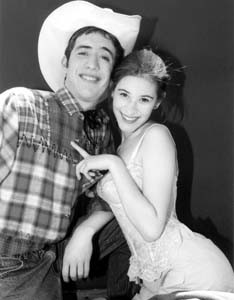
Young love: Jereme Anglin and Mikka Bonel star in The Guilty Mother.

‘The Guilty Mother’ leaves questions

By Daedalus Howell

IS THE THIRD TIME the charm, or are three a crowd? The question lingers after the end of The Guilty Mother, the final installment of the Cinnabar Theater’s Figaro Fest–a two-year exploration of three Figaro plays of 18th-century French playwright Pierre Augustin Caron de Beaumarchais.

Directed by Robert Currier, The Guilty Mother continues the saga begun in The Barber of Seville, in which the rapscallion hairdresser Figaro aids his employer, Count Almaviva, in wooing the comely Rosine. In the Marriage of Figaro, the title character saves Rosine’s handmaiden Suzanne, his bride-to-be, from Almaviva’s lecherous invocation of “seignorial rights.”

The Guilty Mother finds the same cast relocated to France some 20 years thence and in the company of the dubious Major Honore Begearss, who underhandedly sets about trying to acquire Almaviva’s fortunes as well as his beautiful young ward Florestine. The facts that the ward is secretly Almaviva’s illegitimate daughter and that his son Leon is actually the progeny of Rosine and a randy page also serve as fodder for Begearss’ nimble-witted malfeasance.

Kudos go to Cinnabar’s Quicksilver II theater company for being the first to bring Beaumarchais’ final Figaro vehicle to the American stage. However, it seems there are actually two plays in this production–the wan and ponderous one that opens the evening, and the spry, light-on-its feet show that begins after intermission.

Though mercifully trimmed by Currier, the 200-year-old play has forgotten whether it’s a light-hearted comedy or a heavy-handed drama. The first act suffers from the wooden exposition of a convoluted plot and the fact that the melodrama is, well, mellow.

The second act–which is rife with comic asides and often campy delivery on the part of players–works wonderfully, and the audience’s response takes a dramatic turn for the better. It’s as if the ticket-holders are dying to boo and hiss the villains and cheer the heroes in a manner appropriate to an old school vaudeville show.

Mother gives them what they want. Lucas McClure’s Begearss, described by Figaro as “a complete army of demons stuffed within a single shirt,” dons such mock-sinister trappings as a facetious little smile and haughty guffaws from the wings. He was merrily booed by the audience during his curtain call–an excellent indicator of his character’s success.

Though Figaro is relegated to the background for much of this play, actor Sean Casey brings him to life in a decidedly blustery performance complemented by Laura Jorgensen’s portrayal of Suzanne, his saucy wife.

Jereme Anglin’s Leon, the earnest young swain, is well paired with Mikka Bonel’s fresh-faced Florestine.

Though The Guilty Mother is not Beaumarchais’ greatest play, this premiere American performance marks a triumph for the Cinnabar’s efforts to revive the obscure. With this production’s nurturing, The Guilty Mother will undoubtedly re-enter the world an improved work.

The Guilty Mother plays June 17-19 at 8 p.m. at 3 p.m., at the Cinnabar Theater, 3333 Petaluma Blvd. N. Tickets are $14 general, $12 for seniors and students. 763-8920.

From the June 17-23, 1999 issue of the Sonoma County Independent.

© Metro Publishing Inc.

Magic Slim

0

Blues Storm


Magic Slim whips up a ‘Black Tornado’ on newest CD

Nicky Baxter

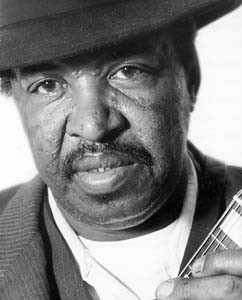
MEATY and somewhere north of six feet, bluesman Magic Slim is a large man. His voice is, if anything, even larger. The native Mississippian is a better-than-average guitarist as well. On 1998’s Black Tornado (Blind Pig), an excellent disc showcasing Magic Slim’s aggressive, take-no-prisoners style, those two attributes are fully evident. After spinning this disc for just a short while, I know why Westside Chicago blues pioneer Magic Sam anointed Morris Holt “Magic Slim.”

The album is ripe with high-voltage Chicago blues power.

Scattered throughout the album are numbers scripted by Magic Slim himself. The title track is a chugging, country-spiked instrumental that sounds more like a train leaving the station than anything else.

Things get off to a pepper-hot start with “Jealous Man,” with Slim shouting out a lyric clearly designed to let his woman (and everybody else) know the ground rules of a relationship–it’s his way or the highway. When he roars, “You can look at my woman, but man, you better not touch,” there is no doubt he means every word.

“I Can’t Trust My Woman” is another exercise in paranoia on which Slim & the Teardrops perform with bone-chilling ferocity. Equally fearsome is Slim’s guitar playing; he is an awe-inspiring technician. More significantly, he uses that facility to extract every conceivable emotion from his instrument. One moment, it’s sharp and brazen; the next it plunges deep into Muddy Waters country with low, menacing bass notes.

“Crazy Woman” is a slow-paced tour de force. Slim’s guitar sets up the all-blue scenario. This track more than any other demonstrates why Magic Slim has attained legendary stature. His guitar moans, whines, and pleads. By the time Slim utters the opening line, the teardrops have already commenced to flow. His lyric is seemingly bereft of all hope.

Nevertheless, Tornado‘s final tune, “Love Like I Wanna” is positively cheeky, shuddering with braggadocio. The song is a declaration of emotional independence. Magic Slim & the Teardrops may sometimes get low-down, but nothing can keep them there.

From the June 17-23, 1999 issue of the Sonoma County Independent.

© Metro Publishing Inc.

Talking Pictures

0

Talking Dirty

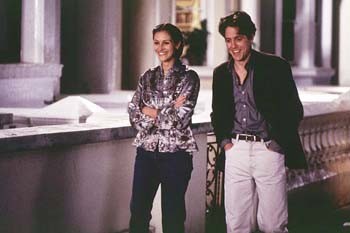
Double trouble: Julia Roberts and Hugh Grant try to find true love in Notting Hill.

Novelist Ciji Ware on true love, untidy apartments, and ‘Notting Hill’

By David Templeton

Writer David Templeton takes interesting people to interesting movies in his ongoing quest for the ultimate post-film conversation. This column is not a review; rather, it’s a freewheeling, tangential discussion of life, alternative ideas, and popular culture. (The following conversation marks a milestone for Templeton: it’s officially his 200th such cinematic téte-â-téte.)

IT WAS FILTHY,” remarks award-winning novelist Ciji Ware, author of A Cottage By the Sea and Island of the Swans, halfway through lunch. “It was disgusting.”

“It was horrible,” agrees Susan, my wife, accepting a refill of iced tea. “Revolting.”

“I was pretty comfortable with it,” I interject.

Both women turn, treating me to a bemused and silent gaze.

Hmmm. I seem to have stumbled into one of those battle-of-the sexes situations. All because of Hugh Grant’s living room. Allow me to explain.

About midway through Notting Hill–the otherwise charming new romantic comedy from the writer of Four Weddings and a Funeral–there’s a scene in which a thoroughly smitten, low-wage English bookseller (well played by Grant) escorts a sheltered, world-famous Hollywood movie star (even better played by Julia Roberts) into his spectacularly untidy house. (He’s just spilled orange juice on her in a “meet cute” way, and has offered her a place to clean up.) Sadly, the bookseller’s home–in part because of Spike, his peculiar Welsh “flat-mate”–is an icky, smelly mess.

I thought it had a nice, cozy, lived-in feel to it.

“I suppose it’s a guy thing,” Ware patiently murmurs.

I glance around the restaurant. Unfortunately, Ware’s husband–Tony Cook, managing editor and publisher of Quicken.com–is next door getting a haircut, and is thus unavailable to help defend our gender.

“I was glad, at least, that when Hugh Grant went upstairs to his own room, it was very nice and neat,” Susan points out.

“That’s right,” Ware nods. “And there was that shot of the blackboard in the apartment: ‘Spike! Clean Up!‘”

So it’s Spike’s fault. Good.

At least the film’s romantic lead can avoid the sharp sting of domestic unacceptability. Unfortunately, that still leaves poor Spike–and me, I suppose–to lurk uncleanly among the ranks of the slobs and clutterers.

CIJI WARE, a newly arrived resident of San Francisco, stands among the ranks of a far loftier group, that of best-selling authors with Emmy awards on their mantles.

Formerly a high-profile TV journalist in Los Angeles (thus the Emmy), Ware also co-hosted a popular drive-time radio show in L.A. for over 16 years. After writing a well-regarded book on stepparenting, she turned her efforts to historical fiction, crafting a series of colorful time-traveling adventures that have gone on to become a brand-name staple of supermarket checkout stands. (This is no slight; commercially speaking, the supermarket is where the majority of Americans now find their reading material.).

Ware’s latest effort is Midnight on Julia Street (Fawcett Gold Medal; $6.99), an engagingly romantic, slightly mystical drama, following Corlis McCullough, a burned-out TV reporter in New Orleans, who tackles a long-forgotten mystery after she begins reliving the 150-year-old memories of her own ancestor and namesake, the passionate and secretive Corlis Bell McCullough.

ASIDE FROM the aforementioned housekeeping deficiencies, Ware loved the love story at the heart of Notting Hill.

“There was no cynicism. Just truth,” she observes. “We need films like this these days. I think a love of romantic fiction is hard-wired into our species. It’s part of our drive to perpetuate the species. Stories like Notting Hill are a good sign, because it means our species still stands a chance of continuing.”

So many modern love stories, Ware believes, are laced with cynicism. She cites The Bridges of Madison County and Message in a Bottle. In each case, once true love is discovered, something occurs to force the lovers apart.

Ware feels this is no coincidence.

“I think, as a culture, we are really unsure and doubtful that we can sustain emotional intimacy,” she explains. “And guess what? The only way you really can sustain it is to work at it, to gain the knowledge you need, knowledge about your own self, so you are somebody who is fit to be in a sustainable intimate relationship.

“I think a lot of people in our lives don’t even recognize that as a goal. They never say, ‘Gee, I guess it requires work on myself to become fit company. Maybe I want to start out on a path where I try to become the best I can be, to learn who I am and what my boundaries are.’

“In the movie, Julia Roberts has to come to that point,” she continues. “The famous actress has to learn who she really is, and to admit how empty she is, and to find a way through that.”

“So what about love at first sight?” I ask. “Soul mates. Prince Charming and all that?”

“I don’t believe in instant compatibility,” she replies. “Love is the process, it’s not the person. It’s all about how you work your way to the point where you find, not your ‘other half,’ but–and this really, really is romantic–you find the person who is walking a parallel path.

“In the movie, she’s a movie star and he’s a bookseller, but ultimately, their paths are the same paths. And now they have to go through a similar process, where they define who they are, for themselves, then have to find where they meet and they each have to change a little in order to get there.”

That’s for sure. For one thing, Hugh’s got to get rid of Spike.

“Ultimately, I think Notting Hill might end up helping relationships,” Ware concludes, approvingly. “It would certainly make a great date movie.”

With a laugh, she adds, “It could end up being a very good date.”

From the June 10-16, 1999 issue of the Sonoma County Independent.

© Metro Publishing Inc.
Summer Repertory Theatre

Sizzling Stages Dark designs: Ailene King and Jeff Mattlin negotiate a devilish deal in The Visit. Summer Repertory Theatre cooks up five hot plays in seven short weeks By Daedalus Howell IT'S SUMMERTIME and the livin' is easy--unless, course, you're involved with repertory theater and facing the rigors of five productions over seven...

Spins

Global Groove Chip off the old block: Anoushka Shankar, 17, makes an impressive debut. New CDs offer world of sound By Greg Cahill Anoushka Shankar Anoushka Angel SITAR GREAT Ravi Shankar once said it would take more than one lifetime to master his multistringed instrument. If reincarnation is a...

Martha Honey

Head Trip Michael Amsler New book evaluates the power and politics of ecotourism By Bill Strubbe VACATIONERS escaping bleak northern winters often know little about who owns the beach on which they're tanning their hides. Many could care less, of course, but if they did ponder the deeper significance their brief sojourn had...

Sonoma Valley Shakespeare Festival

Howdy, Bard'ner The Comedy of Errors. Michael Amsler The Sonoma Valley Shakespeare Festival gears up for the new millennium By Patrick Sullivan FOR A GUY who's been dead some 400 years, the late William Shakespeare is pretty damn lively. The playwright's actual corpse is as quiet as Yorick's skull, of course, but his enormous...

Eel River

D'Eel Denial By Janet Wells WHILE SANTA ROSA city officials mull over an ordinance to prohibit water waste, a far bigger water issue is brewing that may ultimately make Santa Rosa wish that it hadn't agreed to ship 4 billion gallons a year of highly treated, highly usable, and potentially highly valuable wastewater to the Geysers...

Natural Foods

Sonoma, Naturally!Michael AmslerGot their goat: Cheesemakers Javier and Patty Salmon of Bodega Goat Cheese make products that don't taste goatsy.A generation of local entrepreneurs find their place in the sun amid Sonoma County's thriving natural and organic packaged-foods industry By Paula HarrisIT'S NOT JUST a flash in the pan. The days when the only organic or...

Russian River Blues Festival

Russian River Blues FestivalTHE Sonoma County Independent presents the fourth annual Russian River Blues Festival on Saturday and Sunday, June 26 and 27, on the sun-drenched sands at Johnson's Beach in Guerneville.This year's stellar roster includes some of the cream of the blues--both Etta James and Koko Taylor won national W.C. Handy Blues Awards on...

The Guilty Mother

Judgment DayChris MurphyYoung love: Jereme Anglin and Mikka Bonel star in The Guilty Mother.'The Guilty Mother' leaves questionsBy Daedalus HowellIS THE THIRD TIME the charm, or are three a crowd? The question lingers after the end of The Guilty Mother, the final installment of the Cinnabar Theater's Figaro Fest--a two-year exploration of three Figaro plays of 18th-century French playwright...

Magic Slim

Blues StormMagic Slim whips up a 'Black Tornado' on newest CDNicky BaxterMEATY and somewhere north of six feet, bluesman Magic Slim is a large man. His voice is, if anything, even larger. The native Mississippian is a better-than-average guitarist as well. On 1998's Black Tornado (Blind Pig), an excellent disc showcasing Magic Slim's aggressive, take-no-prisoners style, those two...

Talking Pictures

Talking Dirty Double trouble: Julia Roberts and Hugh Grant try to find true love in Notting Hill. Novelist Ciji Ware on true love, untidy apartments, and 'Notting Hill' By David Templeton Writer David Templeton takes interesting people to interesting movies in his ongoing quest for the ultimate post-film conversation. This column is not...
11,084FansLike
4,606FollowersFollow
6,928FollowersFollow