The Scoop

The Revised 3 R’s

By Bob Harris

THANKS to the way Congress spends the educational budget, the three R’s are apparently now Reading, ‘Riting, and Re-election campaigns. In a given year’s federal budget, the federal Department of Education is able to allocate only about 10 percent of its resources to discretionary stuff–innovative programs, reforms, research on new teaching techniques, and so on.

It’s pretty obvious that really trying to figure out some new approaches in education wouldn’t be a bad idea. I perform at colleges all the time, and I swear to you that more than half the time, the student introducing me is barely able to read my printed introduction. Anyway, it turns out that precious little innovation is actually happening. Instead, according to a recent nice piece of work in the Los Angeles Times, most of the discretionary money in the national education budget is getting diverted into pork-barrel local stuff that serves only the interests of a few well-connected contributors or the members of one senator’s district.

In the last year, you and I have had the privilege of helping to pay for the Paul Simon Public Policy Institute in Carbondale, Ill., and the Robert J. Dole Institute for Public Service in Lawrence, Kans., neither of which is probably going to change the way kids are taught to read in the 99.96 percent of America not located in these two throbbing metropoles.

We’ve paid hundreds of thousands of dollars to assemble an oral history of labor unions in Iowa, the home state of Sen. Tom Harkin, a ranking Democrat on the Appropriations Committee, and about $10 million for an exhibit on the Constitution in Philadelphia, the bailiwick of Sen. Arlen Specter, the ranking Republican. So what do we do about it? Well, before we can act and vote and raise a ruckus, the first thing we have to do is educate ourselves. Which, if we don’t do anything about it, is exactly what we’ll all wind up doing anyway.

EXCEPT FOR ABOUT a half-dozen things no one in their right mind would do (like, say, swallowing a sewing kit, bobbing for lobsters, dating a fashion model), there’s nothing worse than guilt by association.

That’s what McCarthyism was about. Somebody would merely say they saw you talking to a communist, and then next thing you know all the good writers in Hollywood get blacklisted, and pretty soon The Waterboy is No. 1 at the box office.

But it’s different if the person in question, say, actually chooses to attend communist party meetings, contributes a column to a communist journal, and lets his name be used to promote communist causes, all with full knowledge of what it’s about. Then it’s no more of a stretch to say he supports the communist party than it is to say that Castro supports the cigar industry, Casey Kasem supports pop music, and Pauly Shore supports comedy. None of them have anything directly to do with the enterprise, but their efforts suggest more than a passing interest, futile though it may be.

With me so far? There’s something just like that, but different, to talk about.

There’s a group called the Council of Conservative Citizens you might want to know about. They call themselves conservative, but check their website at www.cofcc.org, and you’ll see that they’re a direct descendant of the White Citizens groups who so bitterly fought against civil rights and equality for all Americans. One click from the CCC homepage brings you to screeds exposing the alleged dark secrets of Abraham Lincoln and Martin Luther King and even calling for a second Civil War to preserve the white race. The page also maintains direct links to the National Front, an openly and unashamedly fascist group, and a bunch of white-supremacist newsletters and organizations.

Suppose for a minute that some prominent national leader endorsed that group, had close family who belonged, spoke several times at their functions, and contributed to their newsletter. And suppose that the guy’s spokesman misled the press to cover it up?

Wouldn’t you want to know?

And suppose that the information was publicized in one of the biggest newspapers in America. Wouldn’t you expect there to be a firestorm of protest from the “liberal” media? Wouldn’t the decent people who make up most of this country demand a full explanation and possibly a resignation? You’d think, so, wouldn’t you?

OK. Trent Lott. The Senate majority leader. He’s really tight with the Council of Conservative Citizens.

That’s every bit as newsworthy as who–anybody is sleeping with, isn’t it?

I mean, isn’t it?

From the January 21-27, 1999 issue of the Sonoma County Independent.

© Metro Publishing Inc.

Mud Baths

0

Down ‘n’ Dirty

Michael Amsler


A little mudslinging does a body good

By Paula Harris

HERE WE ARE,” announces “Ramona,” my white-uniformed, pink-lipsticked spa attendant as we round a corner from the changing room to the mud baths at Dr. Wilkinson’s Hot Springs in Calistoga–the volcanic-mud capital of Northern California. She gestures to the tubful of thick brown glop bubbling and splattering nastily across the white tiles, then takes a shovel and turns the steaming mess over a few times.

Omigod, I think, it has bits in it.

“Hand me your bath towel and hop in,” she coos with a barely disguised smirk of amusement. Yeah, um, right. Hesitating, I try to purge my mind of all the filthy thoughts that surface as I look into the murky depths: slimy ditches, barnyard troughs, exploding septic tanks.

The mud continues to belch and Ramona continues to look amused.

Naked, apart from a white towel turban, I sit on the edge of the tub, gingerly slide in one leg, and feel the hot muck squelching between my toes and then ooze boldly everywhere else. “Don’t worry, you’re not going to sink,” assures my trusty attendant, noticing my worried glance. I swear I see her lips twitch. “It’s only three feet deep.”

Once I’m immersed, Ramona piles more mud on top of my torso, packing it down with her hands. By the time she is done, her palms are almost black. The mud feels heavy, like a warm, wet blanket. “Be right back,” she chortles and is suddenly gone.

I am immobile, left to contemplate this strange sensation that’s touted as an ancient health and beauty treatment. The basis for the traditional mud bath used at Dr. Wilkinson’s is volcanic ash left over from the eruption of Mt. St. Helena. The mud is brought in dry each morning and mixed with the boiling mineral water from the gurgling geothermal well on the property. A little peat moss is added for texture.

I know that the mud is kept in the tubs and reused several times over, boiling water being used to sterilize it between clients, but still I hope this is a fresh batch. Before I can dwell on this any further, Ramona reappears. “Water?” she inquires like a good sommelier, placing a plastic tumblerful on the side of the bath. Luckily, the bent straw reaches my mouth, because there is no way I can extricate my arms.

Next, Ramona applies a peppermint mask to my face, places cucumber slices over my eyes, and suggests I drift off for a few minutes. Lying motionlessly suspended in the goop, like a bug caught in amber, I begin to feel tensions slipping away. I inhale the dank, fresh earth smells seeping up from the concoction.

The bits no longer bother me.

ALL TOO SOON, Ramona helps pull me out of the glop. A warm, tangerine- and lavender-scented mineral whirlpool bath, a steam bath, a shower, and a brief nap while I’m swaddled in warm blankets top off the treatment.

While mud-wallowing is definitely a down ‘n’ dirty experience that can even seem off-putting to the uninitiated–just recall how your mother always told you not to play in it–mud baths endure as a popular aesthetic treatment.

The main benefit, say spa practitioners, is that the mud is detoxifying and thus cleansing. It is usually administered as a heat treatment used in tangent with steam or hot water, and so encourages a high amount of perspiration, which purifies the system and leaves the skin cleansed, smooth, and refreshed. In addition, sufferers of muscular aches and arthritis may find the mud bath soothing because it eases muscle and joint pains.

“People have been taking mud baths all over the world for centuries traditionally and historically for arthritic and rheumatic ailments,” explains Dr. John Wilkinson, a sprightly former chiropractor and founder of 46-year-old Dr. Wilkinson’s Hot Springs. Now age 84 and thriving, Wilkinson reveals, “Yes, I do still take a mud bath now and again, I read the newspaper in there. It’s total relaxation.”

According to Wilkinson, mud treatments also provide a much-needed respite from a fast-paced world, and are part of an overall alternative health-care trend. “Mud baths and hot springs fit right into that total alternative health-care picture,” he says.

Although the mud is a natural resource rich in minerals, Wilkinson is cautious when asked about its curative and beautifying properties. “We don’t claim that the mud has any magic chemicals,” he’s quick to point out, adding that many clients, women in particular, have remarked that their skin “feels milkier or creamier” after the treatment.

My own skin feels a bit softer, my body lighter and relaxed after the treatment. As I leave the spa, I think, “This could be addictive,” and note a distinct a sense of well-being. I sleep exceptionally well that night.

But, be forewarned: Expect to find tiny mud-pie remnants behind the ears the next day.

Dr. Wilkinson’s Hot Springs is located at 1507 Lincoln Ave., Calistoga; 942-4879. A one-and-a-half hour treatment costs $55. Golden Haven Hot Springs is at 1713 Lake St., Calistoga; 942-6793.

From the January 14-20, 1999 issue of the Sonoma County Independent.

© Metro Publishing Inc.
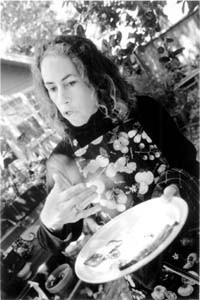
Cucina Paradiso

0

Heaven’s Gate

Simply divine: Cucina Paradiso in Petaluma blends Old World charm and fresh local ingredients for a winning mixture.

Two young Italian chefs stake out their own small corner of paradise

By Marina Wolf

IT’S EARLY on a weekday afternoon and Cucina Paradiso is slowing down. Small clusters of people bask in the setting winter sun, sipping coffee and toying with their desserts. The show, for the moment, seems to be over. But in reality, the action has simply moved next door, to an empty storefront. There, chef/owner Dennis di Branca and co-chef Mario di Paola wander the dusty space. Ghosts of counters and tables and shelving spring up around their slow, considered movements.

The two men’s intentions are as clear as the blank glass: expansion.

Di Branca purchased Cucina Paradiso just last August with his wife, Malena Hipolito, and bought out a previous partner’s shares in November, but they already are hoping to add space to their compact kitchen and dining area sometime in the first half of the year. “The owner says, yes, but ah, it takes time, six months … “Di Branca’s voice trails off, not from uncertainty but because his English is still too halting to express the drive that brought him and di Paola over the course of years from their homes in Sicily to a plain-faced riverfront building in a nondescript shopping mall near downtown Petaluma. Here their fresh, light-handed interpretations of Old World Italian cuisine have been garnering enthusiastic reviews from the local press and restaurant-going public.

Di Paola, who held down an executive-chef position at a restaurant in San Bruno until this month, is glad to get praise for his hard work. Of course, he’s used to the work, having been in the kitchen for two decades. Not too bad for a 34-year-old. “In Sicily, it is totally different from America or North Europe,” he says in broken English and a mellifluous accent. “We are not so poor people, but we need to go to work at young age.” In 1979, at age 15, di Paola entered a three-year cooking institute in Palermo; in the summertime he and his fellow students were sent out to work in hotels and village restaurants around the region.

Di Branca, on the other hand, started out in an engineering program in Italy. His efforts in science ended early–“Sometimes you just know when something is not right,” he says simply when asked why he changed his mind. Di Branca started all over as a busboy and worked his way up through restaurants in both Italy and the United States.

ITALY IS KNOWN as a country where everybody, even busboys, seems to know and live good food. Liking food, and learning to work with it, is as easy as breathing. The food both men remember as their first dishes, omelets, are intimidating to grown people here, but the ingredients and preparation are simplicity itself, literally kids’ stuff–in Italy.

“Lots of kids [in Italy] know how to make things to eat,” says di Paola. “Here, in America, kids go out, they go to McDonald’s.”

There are McDonald’s in Italy, he says, but the fast-food chain is only just starting to catch on. Twenty years ago nobody went to McDonald’s. “Sinsa lira,” interjects di Branca in a shy mumble. The meaning is apparent even before Mario translates for the Italian-impaired: no money.

“But now people in Italy, they buy a lot of McDonald’s,” adds di Paola. “It’s something different.”

Di Branca nods in agreement. “They like to try. It’s something new, you go to try it.”

The men’s open-mindedness about the meaning of new food in an increasingly global culinary culture is an interesting contrast–or complement–to their own dedication to Old World traditions. Most of their basic groceries–cheeses, dried pasta, oils–are imported from Italy. Fresh pasta is made daily by hand. And between the two of them, di Branca and di Paola have worked in very traditional kitchens with some masters of Italian cuisine, learning the old ways. Among his words of admiration for his mentors, di Paola says, “They are very strong because they learn in a different age. Maybe [because] in that time they don’t have mixers.”

FEW PEOPLE in the modern-day United States understand, as di Paola does, that a kitchen without electric gadgets means laborious work. Pesto is made with a pestle (the two words come from the same root, meaning to crush). Bread dough, elastic and lively, must be wrestled into loaves every day. Produce is chopped/ minced/grated by hand, and the loudest noise is when somebody drops a lid. Technological advances have made things different. “Before in the kitchen there were 20 people,” di Paola explains. “Now you can do with six or seven people the same food.”

Using fewer people means using less space, a particularly relevant point for the staff of Cucina Paradiso. Walled off in one corner, di Branca and di Paola need to get by with two or three people. In spite of their space constraints, the two are happily reproducing the flavor and feel of their home region’s cooking, using only a few “newfangled” machines–a pasta machine, a food processor. They want to incorporate even more of the handcrafted tradition, when they have more room.

And as di Branca and di Paola eye the storefront next door, new possibilities seem, well, right around the corner.

From the January 14-20, 1999 issue of the Sonoma County Independent.

© Metro Publishing Inc.
Petaluma Domestic Partner Benefits

0

Howdy, Pardner

Michael Amsler


In a landmark move, Petaluma has approved domestic partner benefits. Is the county next?

By Janet Wells

DEPUTY COUNTY Counsel Sheryl Bratton figures she loses about $10,000 a year because the county won’t cover health and retirement benefits for her partner of two years. Bratton is a member of a committee working to persuade the county Board of Supervisors to join a dozen Northern California cities and counties that offer domestic partner benefits. The supervisors dodged the issue almost four years ago, but it is coming around again. On Jan. 26 the board is scheduled to vote on forming a subcommittee to study the fiscal impact of offering benefits to the unmarried county employees who are in long-term partnerships.

A vote on offering benefits could come as early as March.

“If you’re married, the county will contribute a certain amount for payroll benefits for your spouse,” Bratton says. “So my neighbor in my office, who has the same qualifications as I do, makes more money.”

Bratton would be celebrating instead of lobbying if she worked for the city of Petaluma, which last week became the first city in Sonoma County to approve domestic partner benefits.

“The best thing we could do for our employees to equal the playing field is to provide protection to people they are committed to, whether they are married or not,” Petaluma City Councilwoman Jane Hamilton says.

Petaluma resident Jim Spahr, president of the North Bay chapter of Parents, Families, and Friends of Lesbians and Gays, brought the domestic partners issue to the city last year. “I’m doing this because it’s the right thing to do. There is major discrimination of lesbian, bi, gay, and transgender folks,” says Spahr, a married insurance agent.

“My ex-wife is Janie Spahr, a lesbian evangelist. I knew Janie when she thought she was a straight woman. I knew her and loved her until she came to accept the fact that she wasn’t a straight woman,” Spahr continues.

“I have two beautiful sons by Jane. I have a stepdaughter who gave me two gorgeous grandkids. They’re my family. There’s no difference between family A and family B.”

Petaluma’s domestic partners resolution offers dental and vision coverage to partners of city employees who are in long-term relationships and sharing living expenses and financial responsibility. The resolution likely will benefit fewer than six of Petaluma’s 275 municipal employees, costing the city about $1,000 per domestic partner annually. Medical and retirement benefits for city employees are contracted for through the state, which does not cover domestic partner benefits. Medical and retirement benefits to domestic partners would add about $10,000 per person to the city’s annual $3.6 million employee benefits price tag.

Absorbing the additional cost of covering medical and retirement benefits would be fine with the council, Hamilton says. “Most of us felt like that was appropriate. We are offering the best kind of protection plan, so we stay competitive as an employer.”

Councilman Matt McGuire, who lives with his partner, could benefit personally from the resolution. “If I so chose, we could register. But we’re planning on getting married this year, and she already has full medical benefits at her job,” he says. “My interest in it has always been that gay, lesbian, transgender, and hetero non-married people are discriminated against in terms of benefits.”

PETALUMA’S resolution passed with a unanimous 7-0 vote, but the issue was not without opposition. “Providing legal recognition to partnerships that are other than a legal marriage between a man and a women essentially undermines marriage and the traditional family, and that’s harmful to society,” says Kurtis Kearl, bishop at the Church of Jesus Christ of Latter-Day Saints in Petaluma, who spoke at the council’s public hearing.

Petaluma Christian Church Pastor Wayne Bigelow agrees: ‘I want to do everything we can to build up marriage rather than undermine it. One of the illnesses plaguing America is lack of commitment. Marriage says, ‘I make a commitment to you.’ Being a domestic partner could mean commitment, but often it’s just an escape clause,” Bigelow says. Both Kearl and Bigelow are more concerned about the registration portion of the resolution than about the actual benefits to domestic partners.

“It says our philosophy in Petaluma is that living together is equivalent to marriage, and that just isn’t so,” Bigelow says. “The U.S. Justice Department in 1992 said that female partners in domestic partnerships are 62 times more likely to be assaulted than in a marriage. That’s just one of the downsides.”

Vocal opponents are “afraid that marriage as an institution is in trouble,” Hamilton says. “With a 50 percent divorce rate, obviously it is. But it’s not in trouble because of this. I feel we need to support the essence of family, not the narrow model of family.”

While approving domestic partnership benefits, Petaluma still lags behind several large, local private employers, including AFC, SOLA Optical USA, Kaiser, and Hewlett Packard. Spahr says he intends to take the issue to the Petaluma School Board next, while Santa Rosa attorney Caren Callahan is fronting domestic partnership at the county level.

THE COUNTY has 4,080 employees eligible for benefits, and a domestic partnership resolution would likely affect 40 to 80 people. Callahan says there are enough votes to support a board subcommittee study of the issue, but it won’t be unanimous. “I think the family unit is something that’s important, and I consider the family unit to be a man and a woman,” says Supervisor Paul Kelley, who has opposed county domestic partner benefits in the past. “I don’t feel any necessity, at least on a local level, to make any changes.”

Domestic partnership registration, which is available in Berkeley, Oakland, Palo Alto, Sacramento, Davis, San Francisco, and Marin County, is not likely to find a welcoming political climate in Sonoma County. “I have problems with the registry,” says Supervisor Mike Cale, who otherwise supports domestic partner benefits. “The fundamental issue in the way that it’s written is anyone who’s 18 or over can come in and benefit. I can’t condone two 18-year-olds to set up house just by signing a paper. In three months you get tired of each other and you sign another piece of paper.

“That’s not how a relationship develops.”

From the January 14-20, 1999 issue of the Sonoma County Independent.

© Metro Publishing Inc.
Fitness Fads

0

Fitness Fads

Michael Amsler


Muscle in on a multitude of new exercise options

By Paula Harris

WITH CHRISTMAS stockings, turkeys, and bellies all suitably stuffed for another year, the next round in the annual ritual is here. Overindulgers everywhere are resolving to coax themselves off the couch. “Shed flab, get fit, feel fantastic” is again the mantra of the moment. The road from pig-out to workout may well be paved with sweat, tears, and garaged treadmills, but there are plenty of fitness alternatives out there.

Here are a few local favorites:


Pretzel Logic

IN THE ’80S, Jane Fonda embodied the ideal when she pulled on her shiny turquoise leotard and urged us to “feel the burn!” These days, multimedia icon Madonna has become the latest exercise “expert” by applying a Vaishnava tilak (sacred Hindu facial marking), donning a sari at the MTV Awards, and touting the Eastern mysticism of Ashtanga power yoga. People are listening.

These days, the studio at Santa Rosa’s Airport Health Club is humming with rigorous activity. But it’s not weightlifting that has the participants grunting and breathless like barefoot Charles Atlases–it’s yoga. If you’ve pegged this exercise as placid and low-key (and perfect for a lazybones like you), think again. Instructor Alexei Brown is working the heck out this group of eager students with his strenuous blend of Hatha and Ashtanga yogas.

“It’s not supposed to be a cakewalk,” says Brown. “I don’t try to tone down the class. If it’s not a challenge, it’s boring.”

He leads the students through a succession of increasingly demanding poses and demands that they hold their contortions for several punitive moments. During these power yoga workouts, the dimly lit studio is silent except for soft recorded music, a few creaking joints and quiet groans, and one woman who hisses “Jee-sus!” to herself whenever the going gets too tough.

According to Brown, yoga will improve flexibility, strength, stamina, and balance, and will keep the spine flexible. “Yoga keeps your mind calm and focused when everything around you may be wavering,” he says.

“It’s the greatest gift I’ve found for myself so far.”

Several local health clubs have added yoga classes because of Madonna’s flirtation with the discipline, and there are classes offered at community centers and elsewhere. Shop around. For details on the Airport Club’s classes, call 528-2582.


Atten-shun!

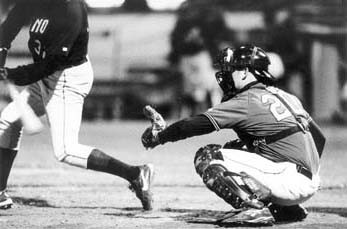
“MY WORKOUT can be so hard you’re puking,” says Renee Scott, a trim, muscular woman with a blond ponytail and clad in army fatigues, black sports bra, biker jacket, and combat boots as she lugs gym equipment at Body Central Fitness Club for Women. Scott is preparing for her first GI Jane workout, a basic training-type class at the club. Part tough-cookie, part comedienne (she plans to play Loony Toons music during the workout), Scott, who has spent several years in the Navy and the U.S. Coast Guard, looks amused as word of her upcoming military moves begin freaking out some of the health club regulars.

“I decided not to do [the GI Jane workout]. It looks too tough,” confides one woman. But, military-style workouts that promise peak physical condition are all the rage. “These workouts remind me of high school PE classes,” says Kim Ryan, general manager at the Park Point Health Club, which offers similar classes, called Boot Camp, for men and women (patrons there can get sissy cards that waive any exercises deemed too tough). “There’s drilling, chanting, and marching to army music. People love it because they’re motivated by the instructor, and there’s teamwork and camaraderie.”

“Military workouts are simple on the mind,” says Scott. “And really good if someone’s been working all day.”

Scott’s workout (taught at Body Central for women and Stan Bennett’s Health and Fitness in Rohnert Park for men and women), which incorporates calisthenics, push-ups, jumping jacks, weight lifting, and Tae Bo-type moves, burns more calories in 45 minutes than a step class does in an hour. “You’re gonna be tired when you leave, but not so that you can’t drive home,” she says.

For info on Body Central’s GI Jane workout, call 525-8663. For details on Scott’s class at Stan Bennett’s Health and Fitness, call 585-3232. For info on the Park Point club’s Boot Camp, call 578 -1640.


Peddle Pushers

OVER AT Montecito Heights Health and Racquet Club, 10 people are clinging to stationary bicycles, their toned legs whirring like frantic egg beaters. They’re Spinning, which is one of the hottest and most strenuous new fitness crazes. “Spinning has been big for the last couple of years,” says A. J. Maldonano, fitness director and Spinning instructor at Montecito Heights. “But now it’s going gangbusters.”

Geared particularly for those in pretty good shape, the Spinning workout is a high-intensity, group, indoor-cycling session on a set of modified stationary bicycles that allow the riders to control pedaling resistance. But unlike the bikes in the old days of individual riding, these are fanned out in a semi-circle around the instructor, who can monitor each rider on a control panel and offer, well, encouragement to those that lag behind.

So don’t expect to sit placidly and catch up on your reading or watch your favorite TV cooking show–this is a real workout.

“It’s a group situation with an instructor or leader who takes you through valleys and hills and puts on resistance as if you’re going up regular hills,” explains Maldonano.

A Spinning session burns between 500 and 800 calories an hour. “I’ve heard that it’s like cramming a grueling three-hour “Tour de France” ride into a 45-minute workout,” pants a sweaty Spinner named Jeff.

Spinning not only works legs, buttocks, and heart, but enthusiasts say it tones all the muscles, including arms, stomach, and chest. Plus, one experiences an endorphin-infused sense of serenity when it’s over!

Many health clubs offer Spinning classes, so call around. For more info about classes at Montecito Heights Health and Racquet Club, call 526-0529.


Michael Amsler

Put a bounce in your step: KanGoo Jumps are portable trampolines.

Jump Start

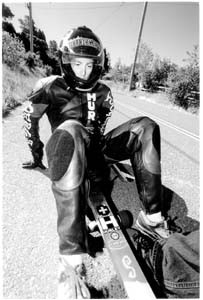
“AHHWWOOOO!,” yowls Daniel Taylor, startling a woman with two tykes in tow in the middle of Santa Rosa Plaza Mall with his ear-piercing werewolf impersonation. “Whatcha all doing walking the old-fashioned way?” he demands. The wary woman ushers the kids forward and rapidly scurries on, trying to ignore the bearded man in bouncy boots who’s goading them all to try his strange footgear. Taylor, unperturbed, bounces after them in his KanGoo Jumps. “C’mon, let’s jump!” he enthuses, then shrugs good-naturedly as they duck into a store. He begins scanning the concourse for the next approaching victim.

“Once the endorphins kick in, I get downright goofy here,” he confides. “This releases the inner child.”

The shiny plastic boots with springs attached may look dangerous as hell, but Taylor says they’re actually very stable, once you get used to them.

The manufacturer claims that KanGoo Jumps reduce the impact shock to joints and that bouncing in them burns calories and tones the body. “I used to weigh 260 pounds and could hardly pull my ass off the chair,” confides Taylor with a grin.

“Now, I’m soooo buff.”

On the feet, the jump boots are strange, indeed, and not entirely easy to get used to. Still, the biggest attraction of this new health toy has to be one’s newfound ability to ricochet around town like a demented springbok. “Most people quit their exercise routine because it’s not fun, it hurts, or it’s boring,” explains Taylor. “This really is fun, it gets your endorphins crankin’–and it finally gets you moving again.”

KanGoo Jumps cost $129 for kids, $199 for adults. For details, call 566-9262.


Hip Action

LEILANI MARINO exudes a warmth she describes as “Aloha Spirit.” With her quick smile and sincere greeting, you almost expect Marino, who is a nurse and Hawaiian dance teacher, to place a lei around your neck at the first meeting. The sign outside her Santa Rosa studio reads: “Hulacize. No dancing experience necessary, only enthusiasm, positive attitude, and a working body.”

If the prospect of wiping down the sticky equipment in a sweaty gym gives you the heebie-jeebies, the gentle art of hula may be just the answer.

Not that the island dance form is as easy as it looks, mind you.

“People think [hula] is really simple, that you just get out there and wiggle your hips,” says Marino. “But it takes a lot of leg-muscle control, strong arms, upper body strength, and coordination. It’s not quite as simple as it seems.”

Marino coined the term “hulacize” to appeal to people who love Hawaiian music and culture, but are leery about performing. “I do exercise routines using hula steps, and it still gets people involved,” she explains, adding that hulacize benefits include greater flexibility and toning of thighs, upper arms, and abdominals, as well as improved posture. The classes include a 10-minute warm-up with chanting, 30 minutes of dance, and 10 minutes of cool-down using visualization and meditation. Marino, who grew up in Oahu and Kauai, says hula is more than just a tourist attraction. “It’s a philosophy, an attitude,” she says.

To reach Marino, call 576-8184; or call SRJC community ed at 527-4371.


Kick Some Butt

WHEN Heather Hardy, 24, first became a kickboxing instructor three years ago, her students dubbed the tough, 5-foot-4-inch, 120-pound martial arts expert “Little Hitler.” Not that the nickname fazed her. These days, Hardy is a much-sought-after instructor of kickboxing at Body Central Fitness Club for Women and the North Bay Kung Fu Academy.

Kickboxing, a combination of Western-style boxing and karate that offers a great aerobic workout, is red-hot right now. “[Kickboxing] is different, new,” Hardy says.

“It’s not like step classes, lifting weights, or walking on a treadmill–people get bored with that stuff.”

Hardy says the empowering sport appeals to many women. “It gets out a lot of aggression, punching and kicking–things women aren’t ‘supposed’ to do,” she explains. “Some women are intimidated about throwing a punch, but they find the power. I love to see the change when that comes out.”

A typical kickboxing workout consists of five minutes of jumping rope, 10 minutes of foot drills, 15 minutes of kicking and punching drills, five minutes of abdominal workouts, and five minutes of sheer, unleashed aggression on the punching bag.

This intensive cardiovascular workout increases range of motion and really burns calories. “Anyone can do kickboxing,” Hardy says. “I don’t think anyone should be intimidated.”

Many clubs in the county offer kickboxing classes. For details about classes at Body Central, call 525-8663. For information about classes at North Bay Kung Fu Academy, call 576-3911.


From the January 14-20, 1999 issue of the Sonoma County Independent.

© Metro Publishing Inc.
More Fun Than Bowling

0

Hit and Miss

More Fun Than Bowling.

Alan Armstrong


‘More Fun Than Bowling’ delivers strikes and spares

By Daedalus Howell

YES, IT WOULD be poor form to reveal the nature of actor Dodds Delzell’s groundbreaking entrance in More Fun Than Bowling, now playing at Actors’ Theatre. Suffice it to say, the secret handshake between Houdini and Ed Wood is an admirable feat of peat and a plot twist par excellence. It’s a dirty job Delzell does with aplomb, and you’ll dig it.

Directed by Celeste Thomas, More Fun Than Bowling is playwright Steven Dietz’s seriocomic nod to small-town love and destiny refracted through the unlikely crystal ball of bowling.

Meet Jake Tomlinson (the earthy Delzell), a buffoonish bowling alley proprietor whose love life is riddled with gutter balls. Two of Jake’s three young wives died in freak bowling-related accidents–the other left him lovesick and single-handedly raising his firecracker daughter Molly (Rebecca Miller). The play finds Jake keeping a graveside vigil with a tattered copy of Reader’s Digest, pondering his predicament, further addled by a prophecy of his own untimely demise.

Skulking in the shadows throughout is the ominous Mr. Dyson (a hilarious Al Liner), who sports a mafioso’s fedora, dark glasses, and a pistol as he alludes to his inevitable confrontation with Jake. Constantly spouting a barrage of silly-ass automotive metaphors, Mr. Dyson speaks directly to the audience, leading it by the hand through Dietz’s convolution of confessionals and whimsical encounters with the dead.

If only the plot were laid out as plainly as the plots dominating the set (real dirt was wheelbarrowed in to create graves). The play’s knotted through-line is the result of an unconventional and often muddled experiment in storytelling, as the playwright shirks linear development for a circuitous unraveling that almost works, thanks to director Thomas’s keen sense of pacing.

Most of the play seems to linger at the periphery of the slightly unhinged Jake’s memory as he communes with his dead wives through a convoluted series of flashbacks corralled by discursive tête-à-têtes with the audience.

Throughout, Dietz comically proves bowling jargon an effective emotional vocabulary as Jake touts his homespun philosophy–at once fatalistic and direly romantic–revealing he is equal parts lovable lug and Zen master. Indeed, bowling does have its own protocols and perspective, the humorous sanctity of which Delzell conveys with wholehearted zeal. Therein lies what is perhaps the play’s most profound message: The universe offers an infinite amount of portals through which to understand its workings. For Jake this window is bowling. Who hasn’t had a 7-10 split in their life?

Kristen Greer is wonderful as the sweet-hearted hairdresser Loretta, wife No. 3, who briefly helps reset Jake’s pins after the death of her predecessor and best friend Lois (Janice Ray) before she too is snuffed by the bowling gods. Greer infuses Loretta with such genuine warmth and vigor that one easily empathizes with Jake’s pain at her loss.

Such onstage synergy continues with Ray’s distinctly drawn Lois, who provides a crisp, sensible balance to Jake’s off-kilter demeanor. Pugnacious teenager Molly is likewise given a nuanced portrayal by Miller. This promising young actress’ earnest portrayal of the exasperated teen is a near perfect score.

Routinely stealing the show, Liner’s Mr. Dyson confidently clears the chancy chasm between character and caricature. Liner’s cool manner and matter-of-fact delivery are a perfect complement to an otherwise frenetic stage.

Though the first act leaves some spares (the playwright drops the ball with his meticulous attention to back-story), the second ably knocks down the pins and ends with a strike. AT’s More Fun Than Bowling is more fun than bowling, and you don’t even have to change your shoes.

More Fun Than Bowling plays at 8 p.m. Thursdays through Saturdays and at 2 p.m. on Sundays through Feb. 13 at Actors’ Theatre, 50 Mark West Springs Road, Santa Rosa. Tickets are $5 -$12. 523-4185.

From the January 14-20, 1999 issue of the Sonoma County Independent.

© Metro Publishing Inc.
Rolfing

0

Cry for Joy

By Dylan Bennett

IN AN AUSTERE aisle of screws and nails at the new Yardbirds on the hill in Santa Rosa I was almost in tears. It wasn’t because I’d missed the turn going north on Mendocino Avenue. Or that I’d gotten lost in the bleak social realism of upper-crust suburbia while trying to find the godforsaken entrance of this colossal hardware store.

And no, it wasn’t any intellectual epiphany, a childhood ghost returned, or even PMS. Only this: Within myself I could feel the pure salty tears that flow when my black heart dares to acknowledge love for another person. Not a lover, just love; love unrestrained amid the nuts and bolts of a misplaced city on a hill.

Such an emotional deluge should have come as no surprise. I’d been warned this could happen. Just the day before I’d been Rolfed, a specialized form of bodywork known to straighten the body through the deep manipulation of muscles and connective tissue. It also releases the repressed emotions that hide buried in our body. Certainly, I was too jaded and road-tested to fall prey to any such quaint emotionalism.

I was wrong, and there I stood, glazed over in aisle No. 54.

Biochemist Ida P. Rolf developed the basis for Rolfing before World War II. But the alternative therapy first entered the public realm in the ’50s and ’60s at the Esalen Institute, the New Age center and think tank in Big Sur, where Rolf collaborated with celebrated psychologists Frederick (Fritz) Perls and Abraham Maslow.

In recent years Rolfing has gained acceptance as a growing list of professional athletes have used Rolfing to improve performance, speed recovery, and bring relief from injuries. Big-name devotees include ice skater Michelle Kwan, basketball powerhouse Charles Barkley, country star Willie Nelson, and concert pianist Leon Fleisher, who credits Rolfing with returning him to his craft after tendinitis had sidetracked his career for many years.

What took off as an alternative therapy in the Age of Aquarius now may be the perfect antidote for the human carnage of the computer age. For aching workers suffering from repetitive-motion syndrome and the stress of hunching over a computer, Rolfing holds a tempting carrot: better posture, more relaxation, ease of movement, and often the end of nagging migraines and lower back pain.

“I had chronic shoulder pain for the last eight years,” says Kory Sessions, a Santa Rosa travel agent who works in a busy corporate environment. “Chiropractic didn’t help it. Regular massage didn’t even do much. After the first Rolfing session I was free of pain. It was really startling, the difference that I felt after one session.”

The Associated Press reports that the world’s largest custom hearing-aid manufacturer, Starkey Laboratories Inc., in Minnesota, saved over $1 million in worker compensation costs for repetitive-motion stress injuries with the help of Rolfing

Here’s how it works. Rolfers ply their knowing hands on the soft tissue in the act of “structural integration”: the bodily alignment of muscles, ligaments, tendons, and the fascia, a matrix of thin, stretchy tissue that runs through the whole body. These tissues stiffen and limit both movement and, according to Rolfing practitioners, emotion. Rolfers pay attention to their client’s personal history and say our bodies have a “physical memory.” Thus, in my case, a wall that crushed me on a construction site 15 years ago may still affect how I hold my chest.

Historically, Rolfing has had a dubious reputation for being quite painful.

ON THE MASSAGE table of Petaluma Rolfer Debbi Stone, the part that was supposed to hurt didn’t. Instead, it was the slow, deep, patient massage I’d longed for; the kind of treatment your spouse is unlikely to share at the end of a workday. It felt like the kind of body tune-up that seems lacking in some professional massages that feel good but don’t get past the surface while trying to cram a “full body massage” into an insufficient hour.

Stone says advancements in Rolfing have eliminated much of the pain for which it was known in the past. “Sometimes it’s mildly uncomfortable,” says Laura Sandoval, a Santa Rosa website developer. “Sometimes you are extremely happy that Debbi is so nice to talk to because you think you’ll die from the pain. The interesting thing is, after she loosens you up, that spot that hurt before doesn’t hurt anymore, so it’s beneficial pain.”

According to Sue Seecof, publicist for the Rolf Institute in Boulder, Colo., the amount of pain really depends on how skillful the touch of the individual Rolfer is. Also, she explains, the therapy has improved with age. Instead of pushing hard on the soft tissue to release tension, Seecof says Rolfers now wait instead, applying a gentle touch and staying within each client’s pain threshold.

Seecof reports there are only 1,002 certified Rolfers in 26 countries, with 676 in the United States. Of those, 125 are in California. Most Rolfers start with a background in bodywork of some kind, and Seecof reports that doctors, nurses, physical therapists, and Olympic athletes are among the new generation of Rolfers.

“It’s hard work,” responds Stone when asked why there are so few Rolfers worldwide. “Training is a big commitment financially, and there are a lot of prerequisites such as college-level anatomy and physiology. After you are certified, you must do advanced training and continuing education.” Seecof acknowledges a Rolfing education takes two rigorous years of study and can cost $6,000 or $7,000. This compares to only a few months of training and less than $1,000 to become a certified massage therapist.

“You have to really want to be a Rolfer,” says Stone. “It’s like getting a master’s degree.”

HAPPILY, Rolfing is not an open-ended therapy, but a set program of 10 intensive bodywork sessions, followed by occasional tune-ups if someone really suffers from repetitive-motion stress.

Still, it’s the psychological side of Rolfing that crowns its clear physical success; Rolfing unleashes a semi-mystical, bug-eyed metamorphosis as never-seen creatures are hauled from the psychic deep. “Whatever emotions are repressed will probably come to the surface,” muses Sessions.

Sure enough, 20 minutes after my own single session with Rolfer Stone I was rolling around the floor in animated childlike excitement. By nightfall I was wiping my tears alone in the garage. “I had a really bad emotional trip after the second visit,” says Sandoval. “I felt like I was in a grouchy mood for two weeks–on and off–but still in a grouchy mood. On my third visit I didn’t have any emotional response aside from feeling good.”

Stone notes that Rolfing can work well in conjunction with yoga and psychotherapy. “A lot of people just feel like it’s changed their life. They’ll quit their job, get a boyfriend, start making movement in their life. I don’t know what it is exactly. A couple of things happen: People feel really good being in less physical pain. Pain really drains people’s energy. [After Rolfing] they realize, ‘I can move.’ It creates movement in their bodies, and that echoes into other aspects of their lives.”

From the January 14-20, 1999 issue of Metro.

© Metro Publishing Inc.

Mad Dog

0

True Fact Alert!

By Mad Dog

IT’S HARD NOT TO categorize people. I’m sure you’ve heard the stereotypes, if not uttered them yourself: Italians are gangsters, Mexicans are lazy, Arabs are terrorists, feminists are men-haters, loners in Montana are militiamen, yuppies are scum, presidents lie, politicians care only about re-election, and TV programmers live to insult our intelligence. But, as rational human beings, we know that not all the people in a given group fit the stereotype.

Well, except for presidents, politicians, and TV programmers.

While we know it’s not good to stereotype people, we do it anyway, largely because it makes us feel superior, since as a rule stereotypes aren’t flattering. Sure, there are exceptions to this, like Brazilian women are beautiful and Asians are exceptional in math and science, but how many more can you think of?

We also stereotype people because, well, sometimes it’s true. The French, for example, are generally regarded as being rude, arrogant, and smelling bad. It turns out they are.

Before you get your pate in an uproar, the proof comes from the highly regarded French newspaper Le Figaro (Motto: “Sure, we’re named after an Italian opera written by an Austrian composer, but we’re so arrogant and rude we can get away with it”), and if they don’t know, who would? Among a batch of recently published surveys, the newspaper revealed that fewer than half of the French take a bath or shower every day, 40 percent of the men and 25 percent of the women don’t change their underwear daily, and only half of the French bother to use deodorant.

Besides demonstrating that their national cleanliness is nowhere near anyone’s sense of godliness, this lack of basic personal hygiene also proves that the French are indeed rude and arrogant, since they obviously don’t care what the rest of the world thinks. They figure that if we’d stay away from their country and leave them alone we wouldn’t have to smell them, so that makes it our fault.

Their neighbors in Germany, on the other hand, have a different set of stereotypes to battle. Like being neat-freaks. This also turns out to be true, as borne out by those same surveys that found that the Germans use twice as much soap in a year as the French. They’re so obsessed with being neat, in fact, that some of them have banded together to form (True Fact Alert!) Messies Anonymous, a zwölf-step program designed to help the 10 percent of the population who are in danger of being ostracized because they’re vacuum cleaner-challenged, miss appointments, misplace their belongings, have a messy house, or inadvertently smile in public, especially to a foreigner.

HERE IN the United States we have out own stereotype problems. People around the world think we have a poor work ethic, we eat lots of junk food, and we’re all rich. Well, it should come as no surprise then that they’re pretty close to the truth, since unscheduled employee absenteeism is at a 7-year high, breakfast cereal turns out to be the main source of vitamins and minerals for children, and Bill Gates just bought the rest of the world, which will teach them to laugh at us again.

Luckily, there are still stereotypes that we can believe in, like the sanctity of mom, apple pie, and the Mouseketeers. Well, two out of three ain’t bad. Yes, I’m sorry to have to break the news, but the image of Mouseketeer as Purity is dead.

I’m sure you remember the Mouseketeers. They were those happy, bubbly, impossibly clean-cut kids who starred in the “Mickey Mouse Club”. The first batch started in 1955, followed years later by some impostors–I mean new members–in 1977. The original shows can still be seen on the Disney Channel. The New Mickey Mouse Club can be seen only in your worst acid flashbacks.

Now it turns out that original Mouseketeer Darlene Gillespie, who broke as many hearts –though not as many box office records–as Annette Funicello, has single-handedly blown the Mouseketeer stereotype by being convicted of stock fraud, mail fraud, obstruction of justice, perjury, and conspiracy. And she wasn’t even an elected official! She’ll be sentenced in March, but it’s a safe bet they’ll strip her of her ears, digitally erase her from the tapes of the show, and make her stand guard over Walt’s frozen body until she learns to behave.

By now your head is probably spinning as fast as a Whirling Dervish, since all this makes it very difficult to know whether to believe a stereotype or not. So the safest thing you can do is what you were taught growing up: don’t stereotype people. Well, except for presidents, politicians, and TV programmers. Everyone knows they lie, care only about re-election, and live to insult our intelligence.

From the January 7-13, 1999 issue of the Sonoma County Independent.

© Metro Publishing Inc.

Tom Foolery

Foolin’ Around

Highbrow humor: Michael Fontaine, Elly Lichenstein, and Dwayne Stincelli mine humor from the periodic table in Tom Foolery.

‘Tom Foolery’ makes a comic success out of Lehrer’s dated musical humor

By Daedalus Howell

GOOD CLEAN FUN. Unless he was being facetious, those are surely three words Harvard-bred mathematician (qua satirical songwriter) Tom Lehrer never associated with his black-humored ditties “Poisoning Pigeons in the Park” and “The Masochism Tango.” Yet that’s what they have become.

Penned during Lehrer’s brief sojourns from academia in the mid-’50s and again in the early ’60s, the University of Santa Cruz professor’s oeuvre has undergone the test of time. The diagnosis? What was once thought malignant and anti-establishment has become benign, adolescent, and silly. And that might be precisely what the doctor ordered.

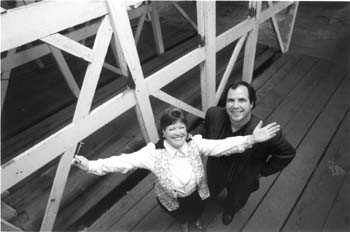
The Cinnabar Theater’s Quicksilver II Theater Company administers a healthy dose of the unabashedly puerile material in the form of Tom Foolery–The Words and Music of Tom Lehrer, brought to the stage by director Michael Fontaine and musical director Jason Sherbundy.

Framed as a quasi-seminar of the prof’s work, the production features Cinnabar triumvirate Michael Fontaine, Elly Lichenstein, and Dwayne Stincelli traipsing through nearly 30 tunes, alighting on canned segues replete with ye olde quips, and one-liners between numbers. The shtick is thick, the patter patent, but the quaint revue works splendidly, though Lehrer’s gallows humor does leave some ring around the collar.

At their best, Lehrer’s songs recall Mad Magazine’s studied riffs on popular culture, sporadically crackling with Monty Python-like surrealism. However, clammy humor of the Weird Al variety abounds, and some attempts to put schisms in one’s isms fall short, owing to the relaxed social mores of the ’90s. Somewhat antiquated, many songs are little more that the lyrical equivalent of a Bronx cheer, but others are buoyed by Fontaine’s efforts to update them. “Smut” (an ode to all things prurient), for example, gets a face-lift with an apt reference to the Starr Report.

Fontaine shows off his splendid, croon-to-loon vocals in his rendition of the Mr. Rogers-like “My Home Town,” a ballad of neighborly decay that recalls author Sherwood Anderson’s grotesques. Fontaine’s deadpan delivery sells the campy tune.

Lichenstein’s performance of “The Irish Ballad,” a protracted narrative relaying the exploits of a Gaelic Lizzie Borden, is well executed, as is her torch-song solo “Wienerschnitzel Waltz,” which she performs with an appropriate nod to Marlene Dietrich.

Likewise, Stincelli stops the show with his solo, “The Masochism Tango,” replete with riding crop and copious acts of self-flagellation.

The three performers complement one another well, and their onstage enjoyment occasionally rises to infectious heights. Ultimately, Tomfoolery, it seems, is a preservationist effort–required viewing for students of counterculture, past and present.

Cinnabar Theater’s Tomfoolery–The Words and Music of Tom Lehrer plays through Jan. 23 at 3333 Petaluma Blvd. N., Petaluma. Thursdays, Fridays, and Saturdays at 8 p.m.; matinee at 3 p.m., Oct. 4. Tickets are $9 to $15. 763-8920.

From the January 7-13, 1999 issue of the Sonoma County Independent.

© Metro Publishing Inc.

Mishandled Rape Cases

0

A Case of Rape

Michael Amsler


Four years ago, DA Mike Mullins pledged to get tough on rape. But a pending case raises doubts about that promise

By Janet Wells

A SONOMA COUNTY deputy district attorney has been removed from a rape case less than two weeks before trial in the midst of accusations from a women’s advocacy group that he and his department have “willfully” mishandled domestic violence and sexual assault cases.

After more than eight months of letters and phone calls from the Women’s Justice Center complaining about “lying,” “demeaning” behavior and “prosecutorial misconduct” in the handling of a recent rape case, Assistant District Attorney Greg Jacobs last week abruptly removed Deputy District Attorney Brooke Halsey from the case, which was scheduled to go to trial Jan. 11 in Superior Court.

“We’re happy with the results in this particular case, although it came way too late and with much pain and disruption to [the victim’s] life,” says Marie De Santis, director of the Women’s Justice Center in Santa Rosa, a private non-profit victims’ advocacy group. “While Greg Jacobs cares about and knows about violence against women, he has completely failed to monitor what is at times abusive conduct by his attorneys.”

Jacobs acknowledges that removing an attorney from a case is a “serious matter,” but declines to go into specifics about Halsey’s handling of the case, which has been continued to March 15 with Deputy District Attorney Robert LaForge as the newly assigned prosecutor.

“After confirming how the victim felt about the case, I felt there was a strong enough concern not to force people to be together,” Jacobs says. “In the meantime, I’m still looking into it as an internal matter to see if there’s anything to be done further with Mr. Halsey or with anyone else. I’m taking steps to formalize a lot of procedures in our office regarding domestic violence.”

Halsey, who was asked by Jacobs not to comment on the case and did not return calls, has worked in the District Attorney’s Office for eight years, and has spent more than a year on the department’s Domestic Violence, Adult Sexual Assault, and Child Abuse Team. “Mr. Halsey is a very dedicated attorney” who has handled “very difficult sexual assault cases,” Jacobs says. “I would strongly dispute [De Santis’] characterization of his handling of the case as ‘malicious.’ “

Jacobs adds: “This is not the first time that a victim or a victim’s advocate has been dissatisfied with the way we handled a case. Things happen. I try like heck to determine that attorneys don’t do anything inappropriate or make a wrong decision. You want to avoid it, but sometimes it’s unavoidable. Now we will take the case, start fresh, and do our best.”

The rape victim who pushed for Halsey to be taken off her case says she is satisfied with the resolution, but “appalled” at the way the case has been handled.

“Valerie,” who asked that her real name not be used to protect her three children, says she felt both demeaned and ignored by the District Attorney’s Office. She received little response to letters or phone calls on behalf of her case, she claims, and had to rely on reporters or advocates for information about her case’s status.

“Brooke Halsey shouldn’t be within 100 yards of a rape case. Apparently he doesn’t take them seriously,” Valerie says. “He makes me feel that I’m the one on trial, that I’m the one who’s done something wrong. I feel like if I go on the stand with him as my DA. he’s not going to fight for me.”

A TALL, ELEGANT 34-year-old with hazel eyes and auburn hair, Valerie has accused her brother-in-law of raping her about a year ago. Living with her mother while going through a divorce, Valerie says she endured a year of sexual assaults from her brother-in-law, who, while living in the same house, married to her sister, would sneak into her room and put his hands under her clothes.

“He would do it even when the kids were in bed with me,” she says. “I told my mom, but she said it was hard to believe, that it must be the way I look, the way I act.”

Valerie, a Sonoma County native, says she began barricading her door, and eventually moved out, even though she wasn’t making enough money in her part-time job as a sales consultant for a home insurance company to cover her family’s expenses. When her brother-in- law moved out of her mother’s house, she and her kids moved back in. Within a month, her sister and brother-in-law moved back in as well.

One night, in early 1998, the three, along with Valerie’s new boyfriend Jimmy, went out to hear a friend’s band play at a Rohnert Park nightclub. The two couples shared a motel room. “I thought it would be safe since I was with Jimmy,” Valerie says, wiping her eyes. She and Jimmy went to bed while her sister and brother-in-law stayed downstairs socializing with members of the band.

“I woke up after about two hours, and felt someone one top of me. I thought it was Jimmy. When I opened my eyes I saw it was my brother-in-law.

“I was paralyzed, in shock. I turned over and woke Jimmy up. Jimmy says, ‘You just got raped. You have to call the cops,'” says Valerie, her voice breaking as she starts to cry. “I was afraid of the family politics. I was still trying to protect my sister.”

After the incident, Valerie says, her brother-in-law went downstairs and “tried to tell my sister that he had mistaken me for her. There’s no way. He wasn’t drunk, and she weighs about 100 pounds more than me.”

The police took her brother-in-law into custody, and took Valerie to the hospital for a standard rape examination. “In the middle of it my sister and mother called the hospital,” Valerie says. “Instead of asking ‘Are you OK?’ they said, ‘Why are you doing this to the family? You’re destroying us. We could have handled it.'”

The family, Valerie says, has continued to back her brother-in-law.

BROOKE HALSEY was assigned to Valerie’s case. Their first meeting, apparently at Halsey’s insistence, was in the lobby of the District Attorney’s Office, a constrained, heavily trafficked, and highly public place in the county administration building.

According to Valerie, as well as victim’s advocates, Halsey tried to dissuade her from testifying, refused to bring essential testimony into the case, and told her that he wanted to “keep it short and sweet” and “get the family back on track.”

“All the DA’s office can do is worry about my family,” Valerie says. “It’s just really degrading. I almost felt victimized all over again when I got done talking with him.”

Halsey also apparently tried to persuade Valerie to agree to a reduced charge against her brother-in-law of felony sexual battery. Valerie was adamant about pursuing a charge of rape.

According to De Santis, another victim’s advocate heard Halsey make the sexual battery plea bargain offer in court to the defendant, who apparently declined. “[Halsey] said he hadn’t made an official deal on the record, and he did,” De Santis says. “He lied.”

VALERIE’S CASE is just one of many mishandled by the District Attorney’s Office, De Santis says, despite departmental reforms that were supposed to toughen the prosecution of sexual assault cases. “This is daily fare. This is how they dump rape cases. They isolate the victim, tell her there’s no case, give a lot of legal mumbo jumbo. Rape victims are very easy to intimidate,” she says.

Three years ago, in response to the murder of Maria Teresa Macias by her estranged husband, Sonoma County District Attorney Mike Mullins assigned a new chief deputy district attorney to coordinate a team to handle all cases of domestic violence, sexual assault, and child abuse. In addition, he promised that he would double the number of prosecutors assigned to such cases from two to four, and provide additional training in the proper handling of paperwork related to those cases.

For most of the past year, there have been only three district attorneys–Halsey, LaForge, and Scott Jamar–on the team. The team has been downsized because of office shortages on other criminal matters and a 25 percent decrease in the number of domestic violence cases referred to the office by law enforcement staff, Jacobs says.

Marie De Santis has a different take on the reason: “They don’t care about women,” she says. “[Jacobs] brags about it, but the fact is that team is so ragged that those cases get handed off all the time. What happens to the majority is that they get filed out as misdemeanors and it gets kicked off the felony team.”

In late 1996, Sonoma County’s Municipal Domestic Violence Court was established to handle all misdemeanor domestic violence cases after the state eliminated deferment programs. The District Attorney’s Office handles only felony domestic violence cases.

Jacobs disputes the idea that cases are wantonly dumped onto Domestic Violence Court to get them off his office’s agenda. In a criminal charge, the law has provided the option of a “wobbler”–filing a felony or a misdemeanor, depending on the evidence and circumstances. Says Jacobs: “When we pick a case to go to Superior Court, we try to pick a case where the facts provide persuasive evidence. To hope for a felony conviction is not ethical for a district attorney.

“If you think you can prove the case, that’s when you go for it.”

And Domestic Violence Court–where there is a 74 percent conviction rate–is no picnic, Jacobs says. “You’ve got a guy who’s immediately prosecuted, Polaroids taken by law enforcement laid on him, two domestic violence counselors contacting the victim by phone and giving reports to the judge,” he explains.

“The probation department investigates the guy for his record and reports to court as well. The judge has all this a few days after it happened, and there’s a lot of pressure [for the defendant] to plead guilty.”

Once the defendant is convicted, he must be tested regularly for alcohol or drugs and attend a mandatory 52-week batterers’ program. “Now, with rigorous sentencing in Domestic Violence Court, they are getting as stiff a punishment as they might get in Superior Court,” Jacobs says.

What happens to cases once charges have been filed isn’t the only issue, says De Santis. Another is the numerous cases that are never prosecuted.

During 1998, the District Attorney’s Office received an average of about 228 domestic violence cases a month referred by local and county law enforcement, Jacobs says. The average number of misdemeanor charges filed was 88 a month, with another 15 felony charges each month. The number of cases that resulted in formal charges decreased from 56 percent in 1997 to 45 percent in 1998, according to Jacobs.

In addition, in 1998 an average of six adult sexual assault cases were referred each month, with charges filed in about half of the cases.

So what happens to all of the cases that are dropped before they get out of the District Attorney’s Office? “They have broad discretionary powers,” De Santis says. “They can look at the penal code and treat it like a menu in terms of which crimes to prosecute. They have no legal obligation to try a rape case or an auto theft. And they don’t have to answer why.

“When they dump a rape case, they dump a lot of work,” she adds. “When you do a drug felony all you need is a baggie full of stuff and a police officer’s statement–and, boom, a felony conviction. Easy. When you do a rape case, you have to make a relationship with the victim, you have to investigate, you have to talk to a lot of human beings about very sensitive subjects and talk to very upset women and children.

“They can’t handle it.”

JACOBS, a 24-year veteran of the District Attorney’s Office, vehemently disputes De Santis’ opinion of his team’s conduct. “Each attorney looks at the cases, uses state training, a checklist, the domestic violence handbook, and looks at what we can prove,” he says. “My take on this is that Marie [De Santis] has ideas on how we should be handling cases. Sometimes I can’t make her happy. But she always knows where to find me and she always has my ear.”

As a result of a two-hour meeting with De Santis on Valerie’s case, Jacobs also agreed to work with the Women’s Justice Center on new guidelines for attorneys, have the center do a training for prosecutors on handling domestic violence and sexual assault cases, and hire a half-time bilingual victim’s advocate.

“The proof is in the pudding,” De Santis says. “We’ve had these conversations before. The improvements need to be institutionalized and not just a whim of a few months and we’re back to where we were before.”

From the January 7-13, 1999 issue of the Sonoma County Independent.

© Metro Publishing Inc.

The Scoop

The Revised 3 R's By Bob Harris THANKS to the way Congress spends the educational budget, the three R's are apparently now Reading, 'Riting, and Re-election campaigns. In a given year's federal budget, the federal Department of Education is able to allocate only about 10 percent of its resources to discretionary stuff--innovative programs, reforms, research on...

Mud Baths

Down 'n' Dirty Michael Amsler A little mudslinging does a body good By Paula Harris HERE WE ARE," announces "Ramona," my white-uniformed, pink-lipsticked spa attendant as we round a corner from the changing room to the mud baths at Dr. Wilkinson's Hot Springs in Calistoga--the volcanic-mud capital of Northern California. She gestures to...

Cucina Paradiso

Heaven's Gate Simply divine: Cucina Paradiso in Petaluma blends Old World charm and fresh local ingredients for a winning mixture. Two young Italian chefs stake out their own small corner of paradise By Marina Wolf IT'S EARLY on a weekday afternoon and Cucina Paradiso is slowing down. Small clusters of people bask...

Petaluma Domestic Partner Benefits

Howdy, Pardner Michael Amsler In a landmark move, Petaluma has approved domestic partner benefits. Is the county next? By Janet Wells DEPUTY COUNTY Counsel Sheryl Bratton figures she loses about $10,000 a year because the county won't cover health and retirement benefits for her partner of two years. Bratton is a member of...

Fitness Fads

Fitness Fads Michael Amsler Muscle in on a multitude of new exercise options By Paula Harris WITH CHRISTMAS stockings, turkeys, and bellies all suitably stuffed for another year, the next round in the annual ritual is here. Overindulgers everywhere are resolving to coax themselves off the couch. "Shed flab, get fit, feel...

More Fun Than Bowling

Hit and Miss More Fun Than Bowling. Alan Armstrong 'More Fun Than Bowling' delivers strikes and spares By Daedalus Howell YES, IT WOULD be poor form to reveal the nature of actor Dodds Delzell's groundbreaking entrance in More Fun Than Bowling, now playing at Actors' Theatre. Suffice it to say, the secret handshake...

Rolfing

Cry for Joy By Dylan Bennett IN AN AUSTERE aisle of screws and nails at the new Yardbirds on the hill in Santa Rosa I was almost in tears. It wasn't because I'd missed the turn going north on Mendocino Avenue. Or that I'd gotten lost in the bleak social realism of upper-crust suburbia while trying...

Mad Dog

True Fact Alert! By Mad Dog IT'S HARD NOT TO categorize people. I'm sure you've heard the stereotypes, if not uttered them yourself: Italians are gangsters, Mexicans are lazy, Arabs are terrorists, feminists are men-haters, loners in Montana are militiamen, yuppies are scum, presidents lie, politicians care only about re-election, and TV programmers live to...

Tom Foolery

Foolin' Around Highbrow humor: Michael Fontaine, Elly Lichenstein, and Dwayne Stincelli mine humor from the periodic table in Tom Foolery. 'Tom Foolery' makes a comic success out of Lehrer's dated musical humor By Daedalus Howell GOOD CLEAN FUN. Unless he was being facetious, those are surely three words Harvard-bred mathematician (qua satirical songwriter) Tom...

Mishandled Rape Cases

A Case of Rape Michael Amsler Four years ago, DA Mike Mullins pledged to get tough on rape. But a pending case raises doubts about that promise By Janet Wells A SONOMA COUNTY deputy district attorney has been removed from a rape case less than two weeks before trial in the midst of...
11,084FansLike
4,606FollowersFollow
6,928FollowersFollow


