
Java Jive Writing Contest

0

Hungry Hearts

6th annual Java Jive writing contest winners

LISTEN to the damn scientists long enough and you could start to think the human heart is pretty simple. Four chambers, a few tubes, a lot of liquid: it doesn’t seem too different from the water pump in your car, though it’s a bit more expensive to replace. But the poets know better. Inside that fist-sized organ, they never tire of pointing out, lies an endless capacity for emotion–usually, of course, various flavors of suffering, ranging from mild regret at unrequited love to bitter rage at betrayal to the lingering burn of true love lost.

So why does that long-suffering organ keep pumping its way through the world? Because the heart is a lot like the stomach: it always gets hungry again.

Enter Java Jive 6, the latest installment of this publication’s annual coffeehouse writing contest. For this year’s Jive, the Bohemian asked writers across the North Bay to write about “Hungry Hearts and Unnatural Chemistries.” We wanted 500 words or less on human relationships in all their puzzling pathology and complicated glory.

We got it–in spades. Turns out there are more takes on love (and its opposite) than there are romance novels on the shelf–though most of our writers were infinitely more interesting than Danielle Steele. We actually had trouble picking five winners, so we picked six, all of which you’ll find below. And don’t forget to join us on Wednesday, Nov. 1, for a public reading by the winners (see “Jive Reading,” p. 17).

First Place

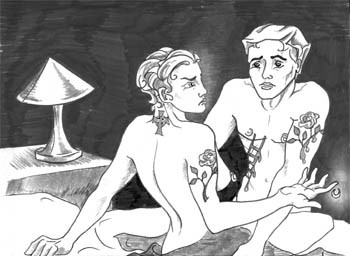
Tête à Tattoo By Eliot Fintushel

I ask you, what are the odds of meeting someone whose tattoos match yours? Red rose on the biceps, butterflies on the palms, yin-yang above the navel, Celtic cross on the nape of the neck, bull’s eye on the lumbar, et ever-loving cetera. And our perforations: ringed nose, studded tongue–wouldn’t you extrapolate? Wouldn’t you want to compare less accessible regions?

She amenable to same. “Maybe we are, like, twin souls.” Her eyes blazed. She touched my hand. I squeezed. Your place or–“Mine,” she said. I said, let’s go.

I never do this.

Italic curlicues wrap her ankle. About her calves hamadryads frolic; if she stands on tiptoe, their tunics ripple. Her knees have faces, tragedy on the left and comedy on the right. Me the same.

My trousers fall. Above tragedy, an eagle. Above comedy, a snake. She the same.

“Look.” Her blouse is gone. Undergarmets boil away. “Do you have nipple rings like these?”

“Yes.” Buttons spray. Tee flies. Silk flutters. “And you have Jacob climbing the ladder up your ribs to the heaven of your aureoles . . .”

“Just like you!”

We lock emblems, appendages, accessories. Our four breasts, her two celestial, mine rudimentary, clink. Our ink mingles. Our tongues knot stud to stud. The butterflies of my palms alight on the calla lilies of her nether swells. She me likewise.

Above, lids tickle. Below–our sole dissimilarity–her bearded Jove swallows the serpent uncoiling from my Hermes’ caduceus, red, blue, and green.

“Lord,” I sigh, “was Cliff ever right!”

“Cliff? You know my ex-boyfriend Cliff?”

Jove disgorges.

“Who?”–spelunking in the counterpane, burrowing into the percale–“No. Who?”

That’s when my left nipple ring slid off. The right was removed by force. She spat on Jacob, rubbed him with one of her butterflies before I could pull away–and he vanished along with half the ladder. She flung the covers from the bed and re-examined my hamadryads: smeared. Tragedy drooped. Comedy dripped.

“All fake! I’ll kill Cliff. I’ll kill you.” Her tears dissolved my roses.

“I wanted you all over me.”

Horrified: “He showed you those photographs, didn’t he?”

Adamant: “It was love at first sight.”

“You cheap liar, no needle ever touched you. You just wanted to get laid. Tomorrow it’ll be a different set of fake piercings and phony tattoos. Get out.”

She was wrong. My only fault had been impatience.

I skulked. I guttered. Tattoos drenched my argyles. Get out. She was still sobbing when the tumblers in the door lock clicked.

Now, prick by prick, the tattoo artist lays in color, and the pain intensifies my love. My caduceus is the hardest. With every next image I think of its twin on her. As soon as my tongue heals, I’ll go to her. Let her tug, spit, weep, rub now. My love will never fade.

Second Place

Northern California Teenage By Leonore Wilson

The flag-draped coffin moved by like a slow barge. Another boy dead from the war in Vietnam. Behind it, Jackie lookalikes: dark glasses, soft cowls. Bawling bruised the air. Slow clack of heels on concrete. Rosaries hung from mourners like lassoes. Nuns crowed in Gaelic, bringing up the rear. We were told to bow our heads in prayer, stare into our blond shiny desktops as if into ponds of holy water, and recite the glorious mysteries. If we threw our eyes to the cortege, we’d see history inside those facets of glass, we’d see the entire future disappearing like snow in a paperweight.

But what made us look up, disobey? The snake of wisdom muttered to us, Stay Awake. During those moments notes were thrown or slid as Sister stood, eyes glued, her body like a candle narrowed before the window. In the late 1960s most of those notes had one message. Uptown after school. Meet at six. Without uniforms. Bring lipstick. Tease hair.

The Beatles were on the big screen. The Fab Four running through London on their way to L.A. wailing It’s Been a Hard Day’s Night, Once in a Life, Michelle, Eight Days a Week. Every teenage girl was owl-mouthed. Desire was sticky there in that place. Rock, the great aphrodisiac. Invisible sisters in the dark we screamed out of a blood-sense of duty. We sat in plush red velvet not hearing a word. We were heartbit, giddy for sex. Popcorn dropped like spermatozoa. Ice clattered like necklaces. Here we were in our summertime flowery shifts, our lips smeared pink as aureoles. Here we loved the tale of Red Riding Hood best, the wolfish dread. The panic of want was unstoppable. The wolf-want inside the female.

These boys were from Liverpool, from the other side of the world, the underworld. They were Samson-like knaves with identical hair, tailored suits. They motioned us with their guitars, their hands and mouths and microphones. We drowned in them. We were stoned animals clinging to each other’s elbows. We were paralyzed like weights on a table. Love beaded and peace signed, we were not prepared for this contagion, this British invasion. The want, want, wannas. This claim they put on us. In the end we were transfixed, transfigured. A fire mounted in us. Thrust and ache, we saw we were naked, exposed; bride-crying to heaven like gulls.

Third Place

A Love Story By Nancy Long

I walk into the apartment. Throw my bag down, yell to my roommate, “Come on, girl. Put on your dancing shoes. We’re going out!”

“Yeah, sure. We got no money. How are we gonna get drinks?”

“Don’t worry about it. I’ll take care of it.”

I peel off my waitress whites, let the shower spray off the grease, grime, sweat of eight-hour burger cookin’. Can’t wait to get out of that shit-eatin’ hole. Away from that son of a bitch boss. I need the money. Got to put up with his crap for a little while longer . . . but, for now, I’m free. Gotta go out tonight!

My roommate and I hit the road. Clubs line the boardwalk. It’s Saturday night. Everybody’s out. Gotta get out tonight. Gotta get out.

Two guys stop us for a match. Tell us we look good. Me in my red, my friend all decked out in black. “Hey, where are you going?”

Our heels click in the night as we walk away, laughing, leaving smoke trailing. Two guys’ eyes following close behind. Gotta get out tonight.

We enter the club. . . . The smell of tobacco, light flashing, music blaring. I can hear the lines of coke being cut up on plates of glass with sharp-edged razor blades in bathrooms, on toilet lids, doors closed. Three girls in a stall, all ready for something, ready for a Saturday night.

The pool tables are packed. The smell of chalk rubbing across rubber tips on long thin sticks gets my blood flowing again. I feel alive. I’m out tonight. Feelin’ hot tonight.

“I’ll get us drinks tonight,” I say to my friend as my eyes scan the room. I put my name down for a game of pool. I smell money ready to be taken, wallets opening and snapping shut in back pockets of men who are too stupid, too drunk, to see beyond the sweetness of my raspberry-flavored lipstick.

I watch on the sidelines. Sit on the barstool, cross my legs, look dumb. That’s how you rope them in. Suckers. Every man is an asshole in my mind. Just like my boss. Tease them a little, but promise them nothin’. Get what you can, then get the hell out. He’s always tryin’ to get a little ass out of all of us. But I know how to play the game. Smile, act dumb, and get what you can.

“You’re up!”

One guy points to me. I slowly stand. Start out easy. Get a few shots in on purpose. Miss a couple. He wins. He smirks.

“How about another. This time some $?”

“Sure,” he shrugs.

This time, I win. Good. Got some bucks for drinks. He gets pissed, wants another game. It’s always the same. Their big heads dig out their own graves. Dumb suckers. His buddies are watchin’. I say double or nothin’. He says, yes. Figures. I am out tonight, feeling hot tonight.

The slap of balls in holes rings in my head. Sticks fly high from one end of the table to the other. The game gets faster. We’re dancin’. He and I, but I’m not in it for the romance.

We get toward the end. The score is tied. He is good. Better than most. I like the way his fingers move. His eyes never leave the cue ball. I’m gonna win this game. Get my $ and get the hell out. There are white lines waiting for me. Maybe we’ll try the next joint down the block. I am hot tonight.

The ball just glides in, like a hand fitted in a perfect glove. His friends cheer. I pick up the $ and walk away.

“Hey, want a drink? Another game?” He smiles.

I turn around. Hesitate. This one seems different . . . smarter . . . sweeter. . . Maybe there’s something to this guy, something I could like.

“Sure.”

As I walk to the bar with him, I shake off those dumb feelings. Don’t be gettin’ in any trouble tonight, girl. Next thing you know you let yourself get roped in . . . then get shitted on. I smile my sweet raspberry smile, cock my head to the side, pretend like I love every word he’s saying . . . and think, what can I get out of this one tonight?

Honorable Mention

Velvet Crush By Ariane S. Conrad

Dear Like One,

When I first saw you in the shop, my lips began burning. I fingered crushed velvet and asked about business out loud while I thought about your lips in quiet. The shop’s walls were lined with yielding, feminine clothes, and we were alone.

I asked whether you’d ever played underneath the clothes racks in stores when you were little, the jackets and skirts swinging in your wake like ghosts at a party. Of course you had. You remembered the prim salesladies who dowdily interfered with the fun. I’d had the same thing happen. Of course. We giggled, mirthful girls. You commented on the setting of my wedding ring. Do you remember me now?

I turned back to the clothes, fingers on weaves and fabrics, eyes spying to see if you were watching me. You were. Don’t we all want to be pored over? I imagine you stalking me, glimpsing: how I stretch catlike, mornings; how I lick off spoonfuls of yogurt; how I sway before the stereo.

You asked whether there was anything in particular that I was looking for. I wondered what you were asking. Dresses, I said, as a question. Dresses? you repeated. To tell the truth, I was looking for something like me. With velvety skin, small hands, and a giggle. Something girly, with endless patience for girl things: hair clips, blouses, touches . . .

I tried on a blue wool dress. In the fitting room, my every inhalation was expectation, out was relief. Fervently I hoped the motions in the curtain would reveal your hands, then your eyes, and that you’d walk in, pulling the curtain closed behind you.

Breathing hard, I hoped it, I hoped against it.

As I left the fitting room, you were reaching to hang the unwanted dress. I gazed at your breasts, arms, curves, against linens, mohair, silks. You turned and smiled. I had let you see me watching. I smiled back. Now you knew that I knew that you knew that I admired you.

You returned to your seat behind the counter. I mused over jewelry and couldn’t think of anything to say. Your hands worked at a piece of magenta paper, folding and turning. I said I guessed I should be going. You handed me the origami flower, said it was something to remember you by. I took your hand and kissed it. To remember me by.

Since that day, the world has been relentless in reminding me of you: onions, turquoise, cowboy boots do. Relentless also in reminding me that it is wrong to want you. I do have a husband, my Loved One.

You are my Like One. Can’t it be enough, the likeness, and that I like you? Our connection is prehistoric, instinctive. The judgment and ostracism the world would inflict upon each of us three is barbaric, chauvinistic.

If I told you we could be correspondents, with my husband’s sanction, to our passion’s content, able to make any world of our letters’ paper, would you write back?

Honorable Mention

Love Shorn: A Fringe Fairy Tale By Jordan Rosenfeld

Rapunzel now calls herself Pansy. The name has a quirky, seductive edge; it’s a wild flower, and since the sickness, she feels a bit wild herself. Oh, she can remember the girl she used to be. The pride. The glory. How men from around the world came in search of her, how ubiquitous their show of affection once was. Love words. Imported foreign candies filled with special liqueurs and potions to make a girl crazy with desire. But what girl doesn’t grow tired of awkward hands treading on her tresses? Oh they all knew how to get up. They all knew the Witch went unconscious from too much brandy after 9.

Rapunzel is bald, suffering after chemotherapy, trying to find a way to attain a lover, now that the crowds of admirers have gone. What would draw him to her now, up in that lonely tower, without the socially glamorous locks of hair she once had? Not to mention eyelashes, batting them now a thing of the past. Would he have to be drawn by the music of her voice, scent the private human pheromones she gave off like small white moths into the balmy nights, learn to levitate himself to reach her?

Chestnut ripples of hair is what she first notices about him. After all, who isn’t envious of what they don’t have? Then it is the contours of his body, so male, so everything she is not herself that keeps her watching. He is a nighttime sweet talker, a teller of fantastic tales, and near-sighted from years of straining in the distance for gorgeous females. Outside her window he comes in her dreams, makes her wild with passion at night, makes the skin of her body itch with static for his hands to soothe.

She’ll get him there all right.

He is noticeably distraught at first, after his poorly constructed catapult allows him entry, bruised and scraped, into Pansy’s portal. He isn’t prepared for the remaining spikes of hair, frail and tender like sea urchins being born, the leftover dark circles of near-death in her eyes. He’s uncertain about touching the frail peach-colored skin of her face. What will happen when he presses his princely intentions against her frail bones? Where is the golden hair of rumor?

Where are her voluptuous curves?

That’s when she shows him a thing or two about love. With complicated maneuvers and techniques surely honed from years spent practicing on imaginary lovers.

But lovers never prepare for the storm, the windy nauseating road of chaos that surely comes to mix with trysting. As Pansy and her Prince didn’t think about the Witch. Surely not, that badgering, bad-breath harbinger of all things spoiled.

Honorable Mention

Silk Kimono By Leslie Cole

You enter the bedroom dressed in my silk kimono, chestnut hair pulled up into a floppy topknot, your hairy legs placed wide apart, your face solemn and whitened with flour from the kitchen. “Samurai mama!” you declare. You thrust a book-shaped brown paper bag at me through the driver’s side window of your still moving car.

It is Valentine’s Day, and I happen to be walking alone down the eucalyptus-lined road where you hardly ever come. You wag the package at me. “Here. I got you something.”

You sit leaned back in your chair, the bar not that dark and just a little noisy. We talk. You peel the label off of your beer bottle. Very cleanly, in the same way someone might pull down a blanket from a bed. I peel off my label as well. Secretly, and then I try to fix it back onto the sweaty bottle. You hug me because I hug you first. You are solid but nervous, your hand patting my back as if I were an elderly relative. Your hips are in Cleveland. Mine are in Santa Rosa.

You have now woken up after we have finished.

You walk by me, smiling just slightly, your robe swirls around you, open to your waist, as if you are walking in a faint summer breeze, although all the windows are closed and it is well past sunset. Your golden body is unbearable to look at. You meet me on the causeway at 5 o’clock. Without a word, you peddled around me and tucked in just ahead, taking the headwind that was wearing me out. You woke me up in the early morning to have sex. It was fast and not great, kind of like a drive-through. Then you said you have to remember to call your mother. You stripped off your clothes, starting with your jeans, and pulled my bike up close to the bed and let me watch you fix it naked.

You told Lake Michigan it was over between us while I stood by in surprise. I pissed in the lake after you’d gone, you thinking I’d stayed behind to cry. You covered my pillows with purple iris. Later you chopped my bed in half with an ax. You sat still as a mountain in your lifeguard chair, hood pulled over, golden eyes too beautiful to bear, and you said you could hear me growling underwater. You were almost right–I was singing, though. You told me it was over while making a bologna sandwich on white bread.

You left me a valentine on my car, in the mailbox, strangely stuffed into my baked potato, and then written in magic marker across your sweet white ass.

You pulled in hard and just dropped in on the same blue wave as me.

The water is beyond blue and stretched tight and moving.

Our eyes meet, and we are both ridiculously delighted.

From the October 26-November 1, 2000 issue of the Northern California Bohemian.
© Metro Publishing Inc.

The Wide-Eyed Gourmet

Purging the pantry and freeing the fridge

by Marina Wolf

I WATCHED the liquor swirl down the drain, steady streams from a double-fisted pour of old tequila and vodka. They mingled in the middle, chasing the traces of piss-vinegar “cooking wine.” We were moving, which gave me license to kill: any item in the liquor cabinet (OK, the stuffy cupboard above the refrigerator) that wasn’t a valuable vintage or at least half full had to be drained and recycled. The sink smelled like a cheap party for days. But the smell made me feel strangely sad.

Moves are tough, and cleaning the kitchen is downright traumatic for people like me who live there. I shed a lot of dreams during those final days of cleaning and packing. A pound of 8-year-old mint leaves hits the trash, a mute and musty testimony to the fact that I was never going to practice herbal medicine in any systematic way. Rancid tahini hinted that I wasn’t really serious about investigating Middle Eastern cookery (can I help it if my girlfriend doesn’t like hummus?). Bags of old bones and cheese rinds emerged from the freezer, revealing both an abundance of freezer burn and a complete lack of forethought about making simple homemade soup stocks.

GARBAGE as psychosocial index is not a new idea. Hell, half of archaeology is just someone’s old garbage. As a culture, we manage to avoid the implications of our detritus by sending it down the disposal or putting it out in neat little carts. But my moment of truth came on moving day, when I had the support of triple-ply industrial-strength garbage bags to hold whatever I threw out.

Full-bore fridge-purging is liberating, but unsettling at the same time. It’s the flip side of those refrigerator readings that pass for pop psychology, I thought, staring at the bags of slimy lettuce and overripe Brie and ancient Tupperware filled with solidified soup: this stuff is my shadow self, the true me asserting itself in spite of my best intentions. Rotten lettuce: I wanted to eat more salads, but haven’t. Overripe Brie: I wanted more glamorous dinner occasions, but didn’t have the time. Moldy leftovers: I wanted to be more thrifty, but craved more exciting tastes, like pizza and pad thai, the containers for which sit smugly empty in the recycle bin.

And never mind the moldy stuff, the stuff I ruined through neglect. I had to take a good look at the stuff that was still usable and admit that I was never going to use it. I didn’t count the half-empty jars of mustard, salad dressings, and Chinese hot-pepper pastes that got tossed, but the garbage bag that held them was a heavy-enough indictment. “It’s the kitchen corollary of the one-year rule on clothes,” I told myself while meditating on a jar of sun-dried tomato tapenade that had been with us two houses ago. “If I haven’t needed it in all this time, then what’s the problem?” The problem is that I didn’t want to let go of the culinary desires that had inspired me to buy the tapenade in the first place, but now lay congealed like a layer of olive oil. I gently placed the jar in the now-bulging garbage bag.

Heaving the bag out to the curb, I realized the truth: I’m a kitchen explorer who bites off way more than I can chew, and there’s no shame in clearing out time-worn plans and dreams to make way for practical considerations. Sure, I could have kept that leftover liquor. I just wanted to be reminded of my carefree college days. But I don’t drink like that anymore, and neither does anyone else I know.

Anyway, I need to make room in the new liquor cabinet for the Pernod that’s going to go in my next seafood stew. I can’t remember, does that recipe call for sun-dried tomatoes?

From the October 26-November 1, 2000 issue of the Northern California Bohemian.
© Metro Publishing Inc.

Election Endorsements

0

Here are select endorsements:

Santa Rosa City Council

The pro-growth slate–Sharon Wright (the Queen of Exclusionary Public Process), Mike Martini, Jane Bender, and Bruce Codding–won’t build a healthy business environment in a city that is seen as openly hostile to new small businesses needed for the revitalization of the downtown. Vote for Noreen Evans, Carol Dean, Susan Gorin, and Rick Meechan.

Petaluma City Council

After the bad old days of late Mayor Patti Hilligoss–remember Poison Patti?–an environmentally conscious majority gained control of city hall and helped usher in the UGB and challenge the county’s $140 million water expansion plan. Now two of the council’s champions–Jane Hamilton and David Keller–are bowing out of public service. Vote for Pamela Torliatt, David Glass, and Jim Mobley.

Rohnert Park City Council

Big expansion plans dominate a small city with a feisty political past. Vote for Jake Mackenzie, Shawn Kilat, and Paul Stutrud.

Cotati City Council

Talk about a contentious political climate. Vote for Janet Orchard, Janet Kurvers, and Will McAfee.

Sebastopol City Council

Only one incumbent up for re-election–Kathy Austin–but lots of green issues on the agenda. Vote for Craig Litwin and Sam Spooner.

Windsor Town Council

Recall fever has subsided, but there’s no shortage of dicey growth issues. Vote for Debora Fudge and Bill Patterson.

Sonoma City Council

Jim Ghilotti, the construction magnate who helped bankroll last spring’s failed transit-tax measure, is running for office. Vote for Joseph Costello and just about anyone else.

Measure I: Rural Heritage Initiative–Yes.

Measure M: Healdsburg Growth

Management Ordinance–Yes.

Measure N: Rohnert Park UGB–Yes.

Measure S: Sonoma UGB–Yes.

From the October 26-November 1, 2000 issue of the Northern California Bohemian.

© Metro Publishing Inc.

Open Mic

0

By Gretchen Giles

ELEVEN-YEAR-OLD Walter W. “Trey” Atkin III was killed last windy Saturday while at a birthday party. He was retrieving a ball from under a tree when a limb broke, hitting him on the back and crushing his skull. His parents, Petaluma residents Chip and Margie Atkin, bravely made the decision to donate their only child’s organs to others. These are just the facts; the deep impact of Trey’s death upon his parents cannot be imagined. I can barely peer over the lip of this Grand Canyon of grief–it is too hugely large to comprehend.

When something this illogical happens, when the universe snaps to send a limb from the sky or a bad man in through the back door, we cast about for a moral. But like the abduction and murder of 12-year-old Polly Klaas, Trey’s death offers no good story of wrong actions to warn against. Don’t go to birthday parties on windy days? Don’t have a slumber party in your own home with your mother present? I think not.

My first reaction upon reading of Trey’s death was to tell my own children that they could never go outside again. Indolent boys with Game Boy calluses on their fingers, they were delighted. They whooped. They knew that I was kidding. Sort of. And I was kidding, sort of. Because my druthers were indeed to scoop each child up in a balloon, set them upon my knees, and hold them tightly forever. There they’d be, graying and bearded, unmarried and uneducated, still sitting on my bony lap where I could guard them.

But the dry rigors of daily life demand that I stand up and they slide off. So I uneasily let them go to school all alone and sleep in rooms with electricity pulsing through the wires. They can attend birthday and slumber parties. They may carry scissors, use knives, and flirt with the homely threats of the bathtub. They do, occasionally, step outside. Somehow we all learn to live with the knowledge that this big entire world is an irrationally dangerous place. Yet maybe there is a small good story in the Atkins’ tragedy.

Trey’s death brings a poignant and real immediacy to the old saw of living each day as though it were your last. Change the vowel: Love each day as though it were your last.

From the October 26-November 1, 2000 issue of the Northern California Bohemian.
© Metro Publishing Inc.

Julian Lage

0

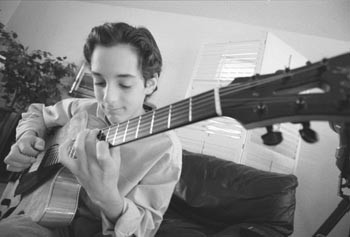
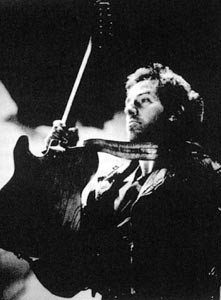
Youth brigade: Twelve-year-old Santa Rosa jazz guitarist Julian Lage improvises with the skill and grace of a seasoned performer. He performs Oct. 29 at the San Francisco Jazz Festival.

Young Gun

Preteen guitarist Julian Lage takes center stage

By Bill English

SOME SAY soul takes time–that you have to pay your dues to play the blues. But maybe soul has nothing to do with time. Maybe it resides in a place beyond age and reason.

Julian Lage of Santa Rosa began playing guitar when he was 5 years old. Now 12, he has already recorded with David Grisman, played in front of a international audience at the 2000 Grammy Awards telecast, and had an Academy Award-nominated documentary made about his precocious talents.

“I really wanted to start playing when I was 4,” Julian says as he sits on a leather chair in his family home. His handmade Manzer guitar seems like part of his body as he accents his words with gentle and serene jazz riffs. There is nothing flashy or contrived about his efforts–they’re easy and smooth.

“I saw my father playing the guitar, and I wanted to join him,” he continues. “But my mom and dad made me wait until I was 5.”

His parents, Mario and Susan Lage, both felt that Julian’s desire to take up the instrument at such a young age might be a passing fancy.

“We thought there might be physical constraints,” Mario explains. “Perhaps Julian’s hands wouldn’t be large enough. When I first took him to a music store, and showed him some small guitars, he didn’t like them. He said their tone wasn’t right. That tipped me off that maybe he had an ear.”

Within a year of getting his first guitar Julian was already playing in front of audiences. His father often took him to music stores, where he would jam with other musicians.

“As a parent it’s difficult to judge your child’s talent,” Mario says. “But I was immediately impressed with Julian’s work ethic. He’d practice five or six hours a day. Teachers would ask us if we were forcing him to practice. We told them, ‘We have to force him to stop.’ ”

Julian–who performs Oct. 29 at the San Francisco Jazz Festival–accepts his talent with little fanfare. He’s been playing the guitar for almost as far back as he can remember, and the act seems like a natural extension of his personality.

“If I have a gift, it’s the chance to make music and play with other musicians,” Julian says. “I never really think about why it comes so easy. To me it has never been about technique. It’s more about the feeling I get from the music. I’m just trying to be the best musically that I can be.”

Although Julian’s musical interests began with the blues, his current passion is jazz. His influences include pianist Bill Evans, saxophonist Sonny Rollins, and guitarist Pat Metheny but also embrace people like the late jazz violinist Stephan Grapelli and Indian sitar player Ravi Shankar.

“I think as you play you eventually discover a spiritual element in the music,” Julian says. “I meditate, and I find that this centers me and allows things to happen. You can’t force the music. You can’t force yourself into a groove.”

Nevertheless, Julian seems able to fall under the spell of his own music almost at will. Watching him play up-close is a transforming experience. There’s no awkwardness or hesitation. His fingers dance along the frets as if guided by some hidden force. He clearly loves playing and says he wasn’t intimidated performing at the Grammy Awards.

“I really enjoyed the experience,” Julian says. “I wasn’t nervous. I knew what I was there to do. It wasn’t like they were asking me to play the saxophone. I was there to play the guitar. It was very simple.”

Julian improvises with the grace of a seasoned performer. His ability to go beyond merely cloning the licks of older musicians has gained him respect and afforded him the opportunity to jam with the likes of Carlos Santana.

“If you take a song like ‘Autumn Leaves,’ ” Julian says, “and start improvising on a solo, what makes it interesting is the contrasts you create with the song’s basic form. You have fun with it.”

Because of a demanding rehearsal and appearance schedule, Julian has a home tutor provided by Santa Rosa’s Mark West Springs School District. He also studies music with Sonoma State University instructor Randy Vincent (with whom he’ll be performing at the S.F. Jazz Fesiival). Although Julian plays a number of different instruments, including an Indian drum called a tabla, his primary focus remains the guitar.

“I went to the dentist and they had this form to fill out,” Julian says with a smile and a riff. “They wanted to know if I played any instruments. I just filled in everything I’d ever touched until I ran out of space on the form.”

From the October 26-November 1, 2000 issue of the Northern California Bohemian.
© Metro Publishing Inc.

2000 Elections

0

Sprawl Brawl

Behind the big lie, and other North Bay issues. Plus select endorsements for local races

By Greg Cahill

DULLSVILLE. That’s how most North Bay residents wrongly view the upcoming general election. Indeed, the local races, for the most part, are a snorefest compared to last spring’s heated primaries. At that time, Sonoma County voters were treated to a knock-down drag-out fight between county Supervisor Tim Smith (amid allegations that Smith used campaign funds to purchase perfume and panties at Victoria’s Secret for his secretary) and Santa Rosa City Councilmember Noreen Evans; the bitter judicial battle worthy of MTV’s Celebrity Deathmatch.; and don’t forget the last-minute withdrawal of Sonoma County Conservation Action’s endorsement of golden boy Joe Nation because Nation (a member of the Marin Municipal Water District board of trustees) supports pro-development water policies.

This time around: No dirty laundry hanging at the Board of Supervisors’ chambers (silky or otherwise), no judicial jugular assaults, and as for Joe Nation, well, he’s amassed a huge $300,000 war chest in his quest for power.

At the Polls: The Bohemian’s select endorsements.

But the most important decision on Nov. 7 is the future of North Bay sprawl and protection of the environment. That’s especially true in Sonoma County, where Marin land-use policies–or more precisely, the lack of usable land in Marin–has led to a northward exodus of workers and businesses, squeezing environmental resources and pressuring Sonoma County communities to transform pristine farmlands into acres of suburban cul-de-sacs.

And that leads us to the most important question: Will you fall for the big lie being propagated by opponents of Measure I?

If approved, Measure I–or the so-called Rural Heritage Initiative–would require voter approval for the next 30 years of any amendment to the Sonoma County General Plan calling for significant development of agricultural land.

Proponents of the initiative–the most contentious issue on the current North Bay political landscape–point out rightly that the measure supports urban growth boundaries passed by an overwhelming majority of voters in several Sonoma County municipalities and enforced in unincorporated areas of the county adjacent to those cities. The RHI also supports the goal of compact, city-centered development, where services are most efficiently available and mass transit is most readily accessible.

The RHI is modeled after a similar initiative–Measure J–adopted 10 years ago by Napa County voters. That measure effectively helped preserve Napa County agriculture by halting the construction of a mega-resort and major housing subdivisions of 100 or more units. Measure J proved that a region can retain its natural heritage while accommodating growth.

The RHI can achieve the same goal.

It has the support of every major environmental organization–including the Sierra Club (both the Sonoma and the Napa County chapters) and Greenbelt Alliance–as well as west county Supervisor Mike Reilly and environment-friendly city councilmembers from five communities throughout the county.

The initiative would help save open space that contributes to the scenic beauty of the county and helps draw tourists to the region to the tune of nearly $1 billion a year. It would help protect the county’s agricultural heritage–which contributes $3 billion to the local economy, one-fifth of the region’s overall economy–and would help forestall the kind of nearly unchecked sprawl that has marred Silicon Valley. Proponents emphasize that the Sonoma County Agricultural Preservation and Open Space District estimates that 60 percent of land in the county is at risk from urban sprawl and that growth pressures could overwhelm Sonoma County within the next 30 years.

At the same time, the initiative accommodates steady growth and housing needs for all economic sectors of the county by requiring that future growth be focused within city limits as intended under UGBs approved by voters in Santa Rosa, Sebastopol, Petaluma, Healdsburg, Windsor, and Cotati. On Nov. 7, voters in Rohnert Park (which already approved a limited UGB) and Sonoma will decide on new UGBs.

Opponents of the initiative–which include the politically powerful Farm Bureau (which fought Measure J in Napa County) and some of the wine industry’s biggest and most aggressive agribusinesses–are running a well-funded and deceptive campaign charging that the initiative would be bad for farms and eliminate new parks. Actually, the initiative would protect farmlands for future generations–especially the precarious dairy industry–and it makes allowance for new parks as well as fire, police, and other public service facilities.

One of the loudest opponents of the initiative is the Press Democrat, the Santa Rosa-based daily that relies heavily on real estate advertising and often serves as the mouth organ for the development community.

The paper’s Oct. 15 endorsement of RHI opponents is little more than a hollow defense of speculators and future developers posing as farmers. The PD arguments can be characterized as fear of the unknown, sowing fear, uncertainty, and doubt about unspecified “unintended consequences” (repeated four times in the editorial) and “ambiguities” (read the text of the measure–it’s clear enough); attacking the authors, their competence, process, and motives, especially the supposedly “poor preparation,” and regurgitating the oft-cited complaint that the RHI was “written by a San Francisco law firm” without any input from farmers in a fashion intended to create “full employment for lawyers,” always an easy mark; and claiming that the measure is unnecessary because county residents can take it as “an article of faith . . . that future development will occur only within existing urban boundaries.”

Yet the editorial fails to name a single specific bad or terrible thing that would result if the measure is approved. Instead, it takes cheap shots at lawyers and asks residents to trust the good intentions of developers without explaining the mounting pressures for sprawl and the worsening traffic congestion on Highway 101 and the county’s secondary roads.

Without strict controls in place to check sprawl, there will always be a reason to develop farmlands: In Silicon Valley, powerful forces have managed to push through development in recent years by claiming economic necessity–either the area is slumping and needs tax revenue, or it’s booming and citizens need housing and entrepreneurs will go out of business without more development.

The PD–and other RHI opponents–would have you believe that there is “no immediate threat” and “no big developments waiting in the wings.” Don’t buy into the big lie–vote yes on Measure I.

From the October 26-November 1, 2000 issue of the Northern California Bohemian.
© Metro Publishing Inc.

Newsgrinder

0

Newsgrinder

Important events as reported by daily newspapers and summarized by Daedalus Howell.

Tuesday 10.18.2000

The Argus-Courier reports that a Petaluma police officer investigated a charge of assault by a woman whose husband had burned her with a cigarette butt during an argument. The firebug hubby said that his wife had thrown a drink on him (boohoo), so he threw a lit cigarette at her. The cop, doing the math in his head, determined the woman to be the “primary aggressor,” perhaps because, statistically, more people are harmed in liquid-related incidents (i.e., drowning) than in those that involve flame. The wife was arrested for domestic violence, and progress continued unfettered.

Sunday 10.22.2000

Petaluman Kathie Hewko knows how to stroke. Voted the most likely local to escape from Alcatraz, Hewko braved the murky waters of San Francisco Bay when she swam from Fort Point in San Francisco to Lime Rock in Sausalito for the 25th time last weekend, reports the Press Democrat. The perks? Seeing the underside of the Golden Gate Bridge while doing the backstroke. The 54-year-old Hewko swam the mile span in just under 40 minutes. No word if she’ll next brave the H20-way of her hometown slough, the Petaluma River.

“We Have Issues,” blared a sign spied at the first Sonoma County Youth March on Saturday that ended with a rally at Courthouse Square in downtown Santa Rosa. When interviewed by the PD the teenager toting the sign recapitulated her plight, “I have a lot of issues.” By far the youth with the most issues, however, was the lone Republican problem-child adrift in the sea of aspiring Democrats (just gotta be different, don’t ya?). The 16-year-old, bedecked with a Bush/Cheney pin on an epaulet of his crisp brown shirt, pulled a swath of blond hair behind his ear, fixed his piercing blue-eyed gaze, and decried his classmates for being “liberal by default.” The drone added, “In California, young people are supposed to be liberal.” At least young people who expect to become old people–the PD failed to report whether or not the Bush Youth droid survived the suffusion of positive energy wafted his way by his peer group. Though turnout was a far cry from the 200 expected, the event’s 17-year-old organizer wasn’t fazed. “I believe apathy is a habit,” she said. Apparently, most of her comrades had the jones. Rep. Lynn Woolsey, D-Petaluma, was on hand to siphon some of the young blood, commenting that “young people have so much to add to our political life.” Like another four years in office–when they can vote.

Napa skate rats can exhale a collective bong-hit of relief–their skate park was spared becoming a much-needed parking garage for an expanded Cinedome because it’s too expensive to move a sewage pump station that shares the park’s block, reports the Napa Valley Register. Interestingly, before civic-minded city officials recognized that skaters had needs too, “parking garage” in local skaters’ jargon roughly translated as “skate park.” “Sewage pump station,” however, still means “the big shit machine we blithely frolic near.”

Monday 10.23.2000

The Santa Rosa daily reports that beachcombers looking for a cheap high are advised to forgo Bodega Bay clams, which state officials believe are contaminated with a natural strychninelike toxin that can cause drunklike symptoms–and death. A quarantine of the shellfish has been in place since September, but may be lifted as soon as scientists figure out a way to make money off of them. A director of environmental health services for the Sonoma County Health Department says clam imbibers will often “feel funny,” though most “weather through it, and there’s nothing more to it.” Except the telltale shells of a clam habit.

Strange habits die hard, continued: Terra Linda High School Trojans tight-end Steve Carter admits he tucked a miniature chocolate football into the waistband of his pants at the start of the 2000 season, reports the Marin Independent Journal. The little brown pellet had been sitting in a glass on Carter’s dresser since a victory over a rival team at the end of last year’s season. “I don’t think I’m going to be eating it–I’m holding on to this one,” Carter said of the talisman after recently besting the same rival team. Donations for Carter’s psychological counseling fund can be sent in care of Terra Linda High School.

Tuesday 10.24.00

Thin-skinned Naderistas, who have a hissy fit every time this publication breathes so much as a word about Green Party presidential candidate Ralph Nader’s impact on the upcoming general election, will love this Associated Press item that ran in the PD. In an article that advises, “The race in California is less stable than anyone expected,” the AP notes that “Nader’s effect on the re-election has not been lost on GOP strategists.” Indeed, California Republican Party spokesman Stuart DeVeaux proclaimed in a recent news release, “Go Nader Go.” Sure, you can vote your conscience, just don’t whine too loudly when your conscience suffers a setback after eight years of Bush-league governance.

From the October 26-November 1, 2000 issue of the Northern California Bohemian.
© Metro Publishing Inc.

‘Lear’s Shadow’

0

Bright ‘Shadow’

Fred Curchack reworks ‘King Lear’ with dazzling results

By Daedalus Howell

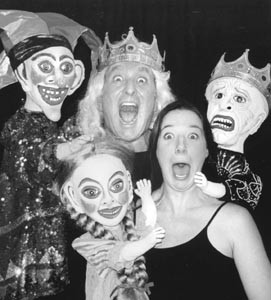
“A PESTILENT GALL!” Shakespeare purists may cry upon seeing Fred Curchack and Shannon Kearns’ riveting redux of King Lear, the Bard’s paean to family dysfunction–brought to Petaluma’s Cinnabar Theater as Lear’s Shadow. But what fools they would be! This “Daddy Dearest” is a sublime theatrical alchemy of acting, video, movement, puppetry, original texts, and profound invention.

Depicted as the lunatic musings of a salty theater impresario with a waning memory, Lear’s Shadow is cast over a professional and romantic relationship that shipwrecks on an unanticipated pregnancy. When the cigar-gnawing Scully (one of several roles exquisitely executed by Curchack) learns that his collaborator and lover, Binky (played with tragic allure by Kearns), is pregnant, he forbids her to have a child for fear of losing their investment in a staging of King Lear.

Curchak and Kearns use this Chinese-box device like a booby trap to ensnare their audience in a web of verisimilitude and artifice that delightfully confounds even as it explores to the hilt the myriad relationships that might exist between a man and a woman.

Imagine Jorge Luis Borges’ short stories onstage, with a tip of the hat to Broadway golden boy Bob Fosse’s autobiographically inspired All That Jazz. Then mix in equal parts Monty Python and Antonin Artaud and down it all with a Woody Allen chaser and you have a fair approximation of the intoxicating delights of Lear’s Shadow.

Curchack’s Cinnabar appearances are usually one-man atomic explosions, but this time he is aided and abetted by an accomplished accomplice–the equally combustible Kearns. No mere magician’s assistant, Kearns proves she is more Curchack’s partner than protégé–she offers a canny cocktail of talent, verve, and a chameleonlike ability to transform absolutely into her various characters. The stage-borne magnetism that crackles between her and Curchack is one of the production’s greatest assets.

Lear’s Shadow brims with Curchack’s characteristic one-liners, as when he croaks, “I still give myself a hard-on!” while watching himself dressed in drag as one of Lear’s daughters in a projected “rehearsal video.”

Throughout, Curchack and Kearns create compelling stage-pictures: for instance, Kearns (as Lear’s wayfaring daughter Cordelia) crosses her shadow into a projected close-up of the caterwauling Lear’s gnashing teeth. The interplay between video and live action (a mainstay in Curchak’s solo work) also includes slapstick bits that are feats of comic timing.

By far the most haunting (and hilarious) image appears when Binky, lamenting her unborn children, cries, “They keep trying to be born and we keep killing them,” while a pair of skull-headed kewpie-doll puppets with pink and blue wings chirp, “Mama, Dad-da.” Kearns belts out an earsplitting scream, and the scene is burned indelibly into one’s memory.

Lear’s Shadow is an inspiring experiment that buoys the soul while illustrating its limitations. As a character counsels, “We that are young will never see so much or live as long.” But no worries, theatergoers, Curchack and Kearns have brought the Cliff notes.

‘Lear’s Shadow’ continues on Friday-Saturday, Oct. 27-28, at 8 p.m. at the Cinnabar Theater, 3333 Petaluma Blvd. N., Petaluma. Tickets are $12-$15. For details, call 707/763-8920.

From the October 26-November 1, 2000 issue of the Northern California Bohemian.

© Metro Publishing Inc.

Spins

0

Boss Tones

Springsteen tribute re-examines a masterwork

by Greg Cahill

AT HIS BEST, Bruce Springsteen’s songs are mini morality plays, chronicling the lives of what music writer Robert Santelli has called “good people . . . poisoned by bad luck and malice.” For these misfits–whose hard-luck tales, shattered dreams, and broken lives resonate with Sprinsteen’s legion of fans–it is a hard road to the promised land.

As a rock-and-roll working-class hero and plainspoken visionary who rode the downbound train to fame and fortune, Springsteen plumbed his darkest side as a songwriter and storyteller on 1982’s Nebraska, a noncommercial solo acoustic set of 10 songs that serve as the focus of a newly released big-name tribute featuring Los Lobos, Aimee Mann and Michael Penn, Dar Williams, and Ani DeFranco, among others.

The stark original, recorded at home on a four-track tape recorder, was fraught with losers, desperadoes, and killers caught in the cold glare of the headlights and recounted in stripped-down folk arrangements and with no apologies.

Badlands: A Tribute to Bruce Springsteen’s Nebraska (Sub Pop) never tops the original, but plenty of highlights make this worthwhile for any rock fan. (The 13-track CD adds three songs–including two from Born in the U.S.A., Springsteen’s hyper-commercial 1984 release–originally recorded during the Nebraska sessions.)

Some artists manage to reinterpret the songs in interesting fashion–as should the best of any tribute album–bending and reshaping the original songs to their own distinctive style. Others–the Crooked Fingers version of “Mansion on the Hill,” for instance–leave you wondering if the Boss himself wasn’t behind the mic.

Chrissie Hynde and Adam Seymour of the Pretenders kick off the tribute with a dreamy and somewhat dreary rendering of Nebraska‘s title track, a first-person account of mass murderer Charlie Starkweather’s killing spree–filmmaker Terrence Malick had told the same tale in his 1973 film Badlands (a name later used as a Springsteen song title).

But arguably the best track on the CD is Hank Williams III’s take on “Atlantic City,” a full-blown hillbilly reverie replete with country fiddle and passages from Hank Sr.’s oeuvre. In fact, the successful countrified transformation of these Americana classics–Hank III’s aforementioned showstopper, Deanna Carter’s “State Trooper,” Son Volt’s “Open All Night,” Ben Harper’s “My Father’s House,” and Johnny Cash’s “I’m on Fire”–makes you wonder why Nashville has been slow to drink from Springsteen’s well in the past.

Indeed, it’s the songs at the core of these remakes that shine throughout Badlands. As heartland rock, this tribute succeeds in showing why Nebraska remains one of the most challenging recordings ever released by a major rock act.

From the October 26-November 1, 2000 issue of the Northern California Bohemian.

© Metro Publishing Inc.

Green Scene

0

BRAVING cloudy skies and brief drizzle, a large crowd of music lovers and journalists gathered Oct. 20 to watch Sonoma State University President Rubin Armiñana break ground for the construction of the much-anticipated Donald and Maureen Green Music Center.

Some might have taken the stormy weather as a bad omen, but Armiñana was looking on the sunny side: “In Greece, rain during a ceremony means success,” he quipped as the shower forced him to cut short his opening speech.

The rain dried up as telecom millionaire Donald Green (for whom the center is named) took the stage. Green–who, along with his wife, Maureen, donated $10 million to the project in 1997–reminded his audience that fundraising for the $43 million center is far from complete. About $18 million is needed to complete the capital campaign.

“We have a number of millions of dollars still to raise, so you will continue to be touched by this project,” Green told the crowd. “But we’re confident we will succeed.”

The ceremony also featured brief performances on the makeshift stage by the Santa Rosa Symphony Brass Quintet and the SSU Chamber Singers. The rudimentary production values during the performances stood in stark contrast to the state-of-the-art concert hall that will soon occupy this 53-acre field at the intersection of Rohnert Park Expressway and Petaluma Hill Road.

With construction now under way, the project–which promoters describe as a “cultural hub for the North Bay”–is expected to be completed in the fall of 2003. Explicitly modeled on the world-famous Tanglewood Music Center in Massachusetts, the Green Music Center is the result of a collaboration between SSU and the Santa Rosa Symphony, which will move its performances there from the Luther Burbank Center.

There were plenty of jokes and smiles on and off stage during the ceremony, but the project does have a few quiet critics in the university community.

It’s tough to find anyone willing to say so publicly, but some faculty and students express fears that the music center–along with other large construction projects at SSU like the Schulz Information Center–could permanently transform the school’s quiet atmosphere by delivering such problems as traffic woes. Indeed, the groundbreaking itself was marred by a serious traffic accident that occurred as an SSU student was waiting to turn off Rohnert Park Expressway into the construction site.

Other members of the SSU community privately express a concern that the Green Music Center is too oriented toward classical music. They wonder if the concert hall–which is principally designed for acoustic acts–will be able to pay its operating costs without featuring pop acts to draw a larger crowd.

But the Green Music Center will probably play host to a wide array of acts and events, ranging from jazz to lecture series to business conferences to dance acts, according to Floyd Ross, the music center’s executive director. “We’re not excluding anything at this point,” Ross explains.

The center will feature a 1,400-seat concert hall, a small recital hall for choral and chamber music, and an outdoor sound system to permit open-air concerts in a space that allows a 3,000-member audience direct sight of the stage.

From the October 26-November 1, 2000 issue of the Northern California Bohemian.

© Metro Publishing Inc.

Java Jive Writing Contest

Hungry Hearts 6th annual Java Jive writing contest winners LISTEN to the damn scientists long enough and you could start to think the human heart is pretty simple. Four chambers, a few tubes, a lot of liquid: it doesn't seem too different from the water pump in your car, though it's a bit...

The Wide-Eyed Gourmet

Purging the pantry and freeing the fridge by Marina Wolf I WATCHED the liquor swirl down the drain, steady streams from a double-fisted pour of old tequila and vodka. They mingled in the middle, chasing the traces of piss-vinegar "cooking wine." We were moving, which gave me license to kill: any item in the...

Election Endorsements

Here are select endorsements: Santa Rosa City Council The pro-growth slate--Sharon Wright (the Queen of Exclusionary Public Process), Mike Martini, Jane Bender, and Bruce Codding--won't build a healthy business environment in a city that is seen as openly hostile to new small businesses needed for the revitalization of the downtown. Vote for Noreen Evans, Carol...

Open Mic

By Gretchen Giles ELEVEN-YEAR-OLD Walter W. "Trey" Atkin III was killed last windy Saturday while at a birthday party. He was retrieving a ball from under a tree when a limb broke, hitting him on the back and crushing his skull. His parents, Petaluma residents Chip and Margie Atkin, bravely made the decision to...

Julian Lage

Youth brigade: Twelve-year-old Santa Rosa jazz guitarist Julian Lage improvises with the skill and grace of a seasoned performer. He performs Oct. 29 at the San Francisco Jazz Festival. Young Gun Preteen guitarist Julian Lage takes center stage By Bill English SOME SAY soul takes time--that...

2000 Elections

Sprawl Brawl Behind the big lie, and other North Bay issues. Plus select endorsements for local races By Greg Cahill DULLSVILLE. That's how most North Bay residents wrongly view the upcoming general election. Indeed, the local races, for the most part, are a snorefest compared to last spring's heated primaries. At...

Newsgrinder

Newsgrinder Important events as reported by daily newspapers and summarized by Daedalus Howell. Tuesday 10.18.2000 The Argus-Courier reports that a Petaluma police officer investigated a charge of assault by a woman whose husband had burned her with a cigarette butt during an argument. The firebug hubby said that his wife...

‘Lear’s Shadow’

Bright 'Shadow' Fred Curchack reworks 'King Lear' with dazzling results By Daedalus Howell "A PESTILENT GALL!" Shakespeare purists may cry upon seeing Fred Curchack and Shannon Kearns' riveting redux of King Lear, the Bard's paean to family dysfunction--brought to Petaluma's Cinnabar Theater as Lear's Shadow. But what fools they would be!...

Spins

Boss Tones Springsteen tribute re-examines a masterwork by Greg Cahill AT HIS BEST, Bruce Springsteen's songs are mini morality plays, chronicling the lives of what music writer Robert Santelli has called "good people . . . poisoned by bad luck and malice." For these misfits--whose hard-luck tales, shattered dreams, and broken...

Green Scene

BRAVING cloudy skies and brief drizzle, a large crowd of music lovers and journalists gathered Oct. 20 to watch Sonoma State University President Rubin Armiñana break ground for the construction of the much-anticipated Donald and Maureen Green Music Center. Some might have taken the stormy weather as a bad omen, but Armiñana was looking on the...
11,084FansLike
4,606FollowersFollow
6,928FollowersFollow