
Wide-Eyed Gourmet

Food, not famine, now and forever

By Marina Wolf

OK, NOT REALLY. Not until May 6. But I just wanted to give everyone enough time to round up some bathroom scales and a sledgehammer with a comfortable grip.

No pressure. It’s a new holiday, so there are still lots of no-diet traditions left to be invented. I’ve heard of assertive sorts having picnics on the lawns in front of weight-loss centers. A few years ago I myself slipped anti-diet bookmarks into all the diet books at my local bookstore and library. That was the most activism I’d done in a long time, but as a writer who is interested in how food affects our lives, I am also concerned with the opposite: how lack of food affects our lives.

Whether hunger is voluntary or externally imposed, the effects are the same: the mind becomes less efficient, while the body suppresses its metabolism to make more efficient use of a perceived food shortage. Chronic dieters tend to worsen these effects by yo-yo dieting–on again, off again–with the end result being a permanently messed-up metabolism and a fuzzy brain.

Is my scientific language confusing you? Well, then let me appeal to you under the quality of life defense: Diets suck. (I’m talking anything that makes you feel deprived, or that takes you below, say, 1,500 calories a day.) They suck the life out of you as easily as you suck up those chalky protein liquids. Diets are particularly bad for women, making them focus on low-fat cooking tips rather than the fight for equal pay or abortion rights, or anything else that women might want to get riled up about.

Hungry people do not make good social-change activists. They have other things on their mind.

So what would happen if we as a country stopped dieting, stopped angsting about what we ate? Well, if we were to get a little exercise and feed ourselves according to our new, healthy intuition about what we need, we’d probably all settle our weights somewhere and get on with life. Sure, a whole genre of women’s columns would be wiped out–hell, women’s magazines would be, like, eight-page booklets without all the diet tips–but I think we could live with the loss. In the absence of body-hating banality, we’d have to find new and more interesting conversations in the women’s locker rooms, but I have faith in our latent creativity.

That’s the dream. But here and now, what does a No-Diet Day look like? That depends on how diet-ful your life is right now. I always imagine it as starting the night before, on No-Diet Day Eve, future generations will call it, when we purge our refrigerators of anything with “low-fat” or “no-fat” on the label, and then went shopping with our taste buds in mind.

Breakfast on No-Diet Day morning might be in bed or sitting out on the patio with a steaming rich latte. You might try milk that is 1 percent higher than what you normally drink. You’d scrape a little bit of butter on your toast, instead of smearing it with a slick butter substitute. You’d eat until you were satisfied and ready to meet the day.

In a No-Diet Day world, the pre-lunch ritual would be a few short seconds with closed eyes and a smile, alone with your taste buds to figure out what you want. If your sweetheart packed your lunch, check inside: surprise! A cookie or a luscious pear with some Roquefort cheese, there where the bag of celery sticks usually is! For dinner, eat something good. Chew it slowly and savor the taste of quality food. Have some ice cream to round off the meal. It isn’t going to kill you. Really.

Whatever you do, don’t think about it too much. Don’t freak. Give it a try until the end of the day. Dieting, like smoking, is addictive. And we can stop, just one day at a time.

From the April 26-May 2, 2001 issue of the Northern California Bohemian.
© Metro Publishing Inc.

Manzanita

0

Touch Wood

Manzanita sizzles in downtown Healdsburg

By Paula Harris

WE ARE transfixed by the goings-on at the next table. A serious-faced man is holding the small flame from his cigarette lighter against the side of a red wine bottle, while a waiter painstakingly pours out a slow stream of the garnet liquid. The other diners at the table look with a concerned and worshipful silence at this decanting ritual.

We stifle the urge to snigger. You may call the impromptu floor show pretentious, but wine is serious stuff here in Manzanita, the chic new restaurant in downtown Healdsburg.

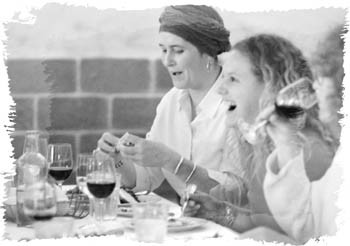
Take, for example, the great and varied wine list with about 70 selections, the willingness of the staff to give complimentary tastings and to offer excellent pairing suggestions, and, not least, the large glass-walled wine cellar in full view next to the bar. Hey, the staff even remembered which wine we had ordered on our first visit (a luscious Marimar Torres pinot noir) when we went back a couple of weeks later. Impressive.

The location of Manzanita, off Healdsburg Plaza, used to house a Chinese restaurant, but now the look is transformed into airy, comfortable avant-garde elegance, with recessed lighting, candles, and a high ceiling in the center of the dining room with rafters painted soft eggshell white. The wall is partly brickwork with a couple of oversize paintings, but the most obvious decorating touch is the racks heaped with manzanita wood, which serve as partitions.

Although there is a wood-fire oven in view (complete with a chef tossing pizza dough into the air), our server tells us the manzanita wood is too hot to burn and that they use almond and oak to heat the ovens that turn out many of the restaurant’s specialties.

A word about the service here. At Manzanita they have it down cold–but with a warm touch. It’s rare to encounter such thoughtful and completely attentive service without it becoming annoying, but the whole thing is choreographed to the last detail, and, as a diner, it makes you feel great. Can the food live up to the expectations?

The appetizer of fritto misto ($5.75) is superb, a crisp, barely battered mix of sweet Maui onion slices, gorgeous spring garlic, and delicate slices of fennel, as thin as potato chips. Everything as light as air and not a whisper of grease, although on another visit this dish was less successful–heavier, oilier, and seeming to feature scallion in place of the spring garlic.

The baked black mussels ($8.75) are a success. The shellfish are smallish and full of flavor heightened by the rich, saffron-spiked broth and awakened further with slices of spicy chorizo. Some accompanying toasted garlic bread is dipped into the fragrant bowlful and gone in a trice.

A seasonal pizza ($9.95) is studded with cinnamon cap mushrooms (small enoki-style fungi with long stems), caramelized onions, and creamy Crescenza cheese. The crust is light and delicious.

Another choice for vegetarians is the Yukon Gold potato gnocchi ($15.75). The dish comes with asparagus and truffled Pecorina Toscano cheese. It’s the fresh taste and crisp bite of young asparagus that’s the star here–it’s a good complement to the full fluffiness of the gnocchi–and the pleasing cheesy sauce is sweetish but not at all cloying.

The server recommends the grilled rabbit ($19.95) for a light entrée. This is an unusually prepared dish featuring pieces of rabbit breast stuffed with polenta, plus a leg and thigh, all grilled and accompanied by black chanterelle mushrooms, prunes, and an Armagnac sauce. It’s very tasty, the one complaint being that the meat is not cooked thoroughly and is too pink and fleshy in the center.

Since we can’t wait for a chilly winter night to materialize to try the wood-oven cassoulet ($18.95), we order it now. The dish is rich, rustic, and highly satisfying. It includes a leg of duck confit stuffed with greens, pieces of apple-smoked bacon, and hearty white beans with a bread-crumb top, all served sizzling from the wood fire in a terra cotta earthenware casserole. Excellent.

We are full but cannot pass up dessert. A chocolate pavé with raspberry sauce ($6.95) is as rich as fudge, and the raspberry sauce is intense. But our favorite is the apple-rhubarb crisp ($6.25). It’s the epitome of simple comfort food, chunks of sweet stewed fruits under a glorious pastry-crumb topping crowned with a scoop of luscious vanilla ice cream. Mmmm.

You don’t have to be a vintner to enjoy Manzanita, but it sure won’t hurt if you enjoy good food, wine, and great service.

Manzanita Address: 336 Healdsburg Ave., Healdsburg; 707/433-8111 Hours: Dinner, 5:30 to 10 p.m., Wednesdays-Sundays Food: Eclectic Service: Excellent Ambiance: Avant-garde but comfortable Price: Moderate to expensive Wine list: Great selection and helpful recommendations if needed Overall: 3 1/2 stars (out of 4)

From the April 26-May 2, 2001 issue of the Northern California Bohemian.
© Metro Publishing Inc.

Bubblegum Pop

0

Chew on This

Buddah label reissues bubblegum classics

By Greg Cahill

YOU CAN SCOFF, sneer, or turn a deaf ear, but bubblegum pop is a sticky part of the American cultural fabric from which you can never free yourself. Incessantly perky, often whimsical, and infused with a high fun factor, these summery songs just won’t go away. These days, you can thank the Mouse for a lot of the current crop of teen pop–the Disney empire is the breeding ground for many chart-topping pop princesses and boy bands. Britney Spear–who owes her success, in part, to porn filmmaker-turned-rock video director Gregory Dark–is a Mickey Mouse Club alum. Two members of ‘N Sync–singers JC Chasez and Justin Timberlake–both have roots in Orlando (owing their early success to the Backstreet Boys’ Svengali-like producer Louis J. Pearlman) and both were card-carrying Mouseketeers. Backstreet Boy Kevin Richardson served as a tour guide at Disney World. And pop princess Mandy Moore is another Orlando girl.

All of them owe a nod to the Monkees, AKA the pre-fab four, who were invented in 1966 by Burt Schneider and Bob Rafaelson, a team of TV producers who were looking to cash in on the madcap zaniness of the Beatles film A Hard Day’s Night. Now (surprise, surprise) the Monkees are back for their millennial edition. The band, sans Michael Nesmith, is touring Europe and the United States, and Rhino Records–which, as the All Music Guide once pointed out, treats the Monkees catalog with the respect usually accorded jazz great Charlie Parker–has just released yet another four-CD box set of Monkees alternate takes, The Monkees Music Box.

“Within the rock canon, the Monkees have the same problem as those tofu hot dogs you stumble across at the supermarket. They look like the real thing. With the proper accouterments, they’d probably even taste like the real thing. But deep down, you just know they’re not the real thing,” the Washington Post recently observed. “Never mind the fact that Monkees albums routinely featured session work by the likes of Neil Young, Hendrix drummer Buddy Miles, and Elvis Presley guitarist James Burton. Never mind that they scored four consecutive No. 1 albums in the ’60s–more than the Rolling Stones, the Who, and the Kinks combined (the Stones had one, the others none). And never mind that they earned enough respect from their peers that a Monkee, Michael Nesmith, joined Mick Jagger and Donovan as invited guests when the Beatles recorded ‘A Day in the Life.’

“All of which raises the question: Is it really a fatal flaw to be a fabricated boy band?”

Of course not.

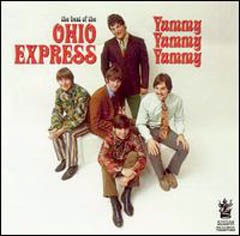
IN FACT, it’s not even a fatal flaw to be a fabricated studio boy band. Case in point: the 1910 Fruitgum Co., a faceless studio assemblage created in 1968 by producers Jerry Kasentz and Jeff Katz for Buddah Records, just in time to cash in on the then fading Monkees phenom. The band’s 1968 hit “Simon Says” heralded the arrival of bubblegum pop. Now digitally remastered, The Best of the 1910 Fruitgum Co. (which includes their Top 10 hit “1, 2, 3, Red Light,” once recorded by the Talking Heads) has just been reissued by the newly revived Buddah label, along with The Best of the Lemon Pipers: Green Tambourine and The Best of the Ohio Express: Yummy, Yummy, Yummy, which includes their effervescent ode to oral sex and the countryish pop single “Sausalito (Is the Place to Be).”

That latter band shared vocalist Joey Levine with the 1910 Fruitgum Co., which disbanded in 1970.

But that wasn’t the end of bubblegum in your life–even if you don’t own any Mandy Moore CDs and avoid Britney like the plague. Levine is now a successful ad writer, whose “greatest hits” include the Almond Joy theme (“Sometimes you feel like a nut, sometimes you don’t”), “Just for the taste of it (Diet Coke)!,” and a dozen more popular jingles rattling around in your brain.

Resistance is futile.

From the April 19-25, 2001 issue of the Northern California Bohemian.

© Metro Publishing Inc.

Sahara Sunday Spain

Youthful Endeavor

Nine-year-old poet finds sudden fame

By Christine Brenneman

OVER APPLE JUICE and quesadillas in her West Oakland loft, 9-year-old published poet Sahara Sunday Spain talks seriously about her latest project: to help fund the schooling of the Kah-Mono girls in the African country of Mali. When she visited the region this past December, she was outraged that many girls couldn’t afford to pay for school supplies and were therefore excluded from an education.

After speaking eloquently on the subject, Sahara suddenly jumps up to grab a head of lettuce from the fridge–turns out she almost forgot to feed her beloved guinea pigs. It’s a telling moment. Perhaps, as some have said, Spain is part prodigy. But she is also a goofy, exuberant third grader.

Lately, the delightfully complex child has come to the media’s attention as something of a publishing sensation. See, Sahara has been writing and illustrating her own poems since age 4 and, with the help of her mother, Elisabeth Sunday, secured a hefty deal with HarperSan Francisco to publish her creative musings.

Released in January, If There Would Be No Light documents Sahara’s poetry and drawings since the age of 5. Spirited and childlike, her depictions of fish, butterflies, trees, and women accompany the words, which run the gamut from fairly ordinary to quite touching.

An excerpt from one poem, “Inner Self,” reads: “My heart swings with agitation/ and I fly within the boundaries of my heart. / And I meet with you, my angel of my wisdom–my heart, my everything.” Impressive prose for a small girl, though some of the poems inspire a bit less awe. “The Dog,” for example, reads in its entirety: “No matter what you do, you’ll always be friends with the dog.”

Describing what compels her to write poems, Sahara cites a litany of inspiration. “My mommy, dreams I have, stars, sunrises, love, and hearts inspire me,” she says. “Or, if somebody gave me a flower out of nowhere, that would touch me and I would write something. Whenever something touches me, I write a poem.”

This unjaded perspective, along with the poet’s incredibly young age, may be what attracted editors to her work in the first place.

“A lot of her poems are quite good for a girl her age,” says Calla Devlin, publicist with HarperSanFrancisco. “Then she has, in my opinion, moments of brilliance. Phrases pop out that are so mature and remarkable for anyone.”

But some have suggested that her well-connected mother, who is an accomplished photographer with some very famous friends, had more to do with Sahara’s lucrative book deal than her poems or drawings. The introduction to If There Would Be No Light was written by none other than Gloria Steinem. And the book’s jacket blurbs were provided by celebrities Bill Cosby and Bonnie Raitt. Apparently, Alice Walker is also a friend of the family, but has not been associated with plugging the book.

Devlin denies that these big names influenced HarperSanFrancisco’s decision to publish: “We chose Sahara’s works on their own merit, and we certainly weren’t the only publishing house that was interested,” she says. “But, of course, Sahara’s connections [to celebrities] have helped us promote the book.”

Elisabeth Sunday also considers this notion to be “nonsense and absolute rubbish.” “People want to hang easy tags on us, and that’s the most obvious, easy answer to why Sahara could be published,” she explains.

To believe this, it’s important to understand how Sahara was discovered. Her foray into publishing began when she made books of poems and drawings for her friends and family. The response was so overwhelmingly positive that Elisabeth then got the idea to sell the self-published collections at a local bookstore. Finally, Liz Perle, an editor with HarperSanFrancisco, happened to attend an art show that included Sahara’s works and got to talking to her mom. As fellow single mothers, they bonded–and the rest is publishing history.

If there’s one dark spot in Sahara’s seemingly perfect existence, it’s her long-absent father, Johnny Spain. A former Black Panther, Spain spent time in San Quentin in the 1970s and participated in a much-publicized uprising there. He and Sahara’s mother have been divorced since the child was 1, so Spain has had almost no presence in her life for the last eight years, according to her mother. They have no contact with him now, though he still lives in the Bay Area. But in spite of this fact, and much to Elisabeth’s chagrin, the press has considered him an alluring side-note to Sahara’s story.

Undoubtedly, the child is the moment’s media darling, interviewed by reporters from the New York Times to the San Francisco Chronicle and appearing on TV shows to promote her book. At such a young age, one wonders how she’s weathered the storm of publicity.

“I protect her from as much of it as I can,” her mother says. “Plus, she’s not allowed to see any press [clippings] until she’s 13. That way, the experience remains in the moment. And it’s just natural for her; she’s never been afraid of addressing a crowd. I tell her, ‘When you’re an artist, it’s part of what you do.'”

ALL THIS attention has briefly interrupted Sahara’s placid existence, but nothing can change the fact that she is still a third-grade girl. Sure, she has accompanied her mother on photo shoots around the world, is a published poet at age 9, and attends the prestigious Nueva School for the gifted in Hillsborough. But when describing her classmates, she giggles about a boy who had threatened to show her his underwear. And she conducted the majority of the interview for this article with a guinea pig on her lap.

Is Sahara Sunday Spain the only 9-year old who jots down her thoughts as words and pictures? Of course not, and even the young author herself says that what she did was not extraordinary.

Still, Sahara did have the good fortune to be born into a family that prizes art and creativity, and some of her poetry and drawings possess a wisdom beyond her years. A prodigy, though? Not in this writer’s estimation. Simply an extraordinarily encouraged child, given the mental space to hear what her mother calls an imaginative “inner voice.”

According to the young poet herself, the secret of her success is easily explained: “I didn’t work for the public. I worked from my heart,” Spain says. “I wasn’t drawing nudes to impress the kids in my class. That they liked it was good, but it came from my heart and that’s why I did it.”

Sahara Sunday Spain reads from ‘If There Would Be No Light’ on Monday, April 23, at 7:30 p.m. at Readers’ Books, 130 E. Napa St., Sonoma. 707/939-1779.

From the April 19-25, 2001 issue of the Northern California Bohemian.
© Metro Publishing Inc.

‘Glamour’

0

Glamour.

Friendly Fascism

‘Glamour’ sheds light on history

By Yosha Bourgea

THE HUNGER for power carries with it a distinct odor of insanity. No one in his right mind wants to take the tiller of the ship of state; the people motivated to assume a position of such grandeur are customarily delusional. And as a character in Glamour observes, “That is the irritating thing about crazy people: you can’t blame them for anything.”

Perhaps not, but Glamour, which premiered last week at the Cinnabar Theater in Petaluma, demonstrates impressively just how dangerous it can be to consort with powerful people.

Writer and director John O’Keefe, now in a two-year residency with Cinnabar, describes his play as “a taut, nasty little drama of quite large dimension.” Using historical events as a springboard, O’Keefe has fashioned a dark, sometimes amusing story of conflicting relationships as a metaphor for the rise of fascism and the invasion of Europe that began World War II.

In the summer of 1939, the poet and novelist Robert Graves and his companion, the poet Laura Riding, were obliged to flee their home in Spain when Francisco Franco came to power. They landed in America as guests at the farmstead home of Kit and Schuyler Jackson. Schuyler, a writer for Time magazine, had favorably reviewed some of Riding’s poetry, and he invited her and Graves to stay. Before the summer was over, Riding had seduced Schuyler and driven his mentally unstable wife, Kit, into an insane asylum.

Graves, who is best known today for I Claudius, a fictional autobiography of the Roman emperor that was serialized for television by the BBC, was already famous when he arrived in America. Riding, an intensely charismatic woman who inspired cultlike devotion among her friends, was not; she resented Graves’ success as a writer, yet was drawn to him. Graves in turn worshipped her and considered her the superior writer, although he was also aware of her self-centered, predatory nature.

The charged, ambivalent relationship between Graves and Riding is juxtaposed in the play with the drab marriage of Schuyler and Kit , who are practically American Gothic by comparison. Both couples are deeply wounded, but the Jacksons seem wary and exhausted where their European counterparts are melodramatic.

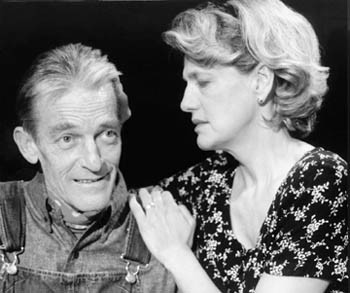
Schuyler, played by Chris Murphy, is an unsuccessful farmer (he plants soybeans 30 years too soon) and an underwhelming writer (Graves labels his attempts at poetry “volcanic”) who hungers for acceptance. Riding perceives this and toys with him, alternating insult and encouragement.

Elly Lichenstein plays Riding as a hyperverbal harridan of the Glenn Close school, gasping for breath as she rattles through her speeches. Language is her weapon, which she uses to belittle and beguile the others as it suits her needs. “All soldiers are war criminals,” she proclaims at one point in a dig at Graves, who served in World War I. Later, in a middle-of-the-night frenzy, she intimidates Kit into removing all the tableware from the house because it is aesthetically unpleasing.

The character of Riding is obviously meant to parallel the fascist dictators of her time– as when she discusses plans to create a new dictionary with only one definition for each word. But it is a credit to Lichenstein and O’Keefe that her megalomania never seems contrived. Although Riding is a repugnant figure, she is also fascinatingly human. “I have known fear, fear of my own mind,” she says. “And I have conquered it.”

LUCAS MCCLURE, playing Graves, seems almost wooden at first. But as the truth about his character is revealed over the course of the play, the emotional distance makes more and more sense. Graves’ deference to Riding prompts Schuyler to sneer: “He wipes the crumbs from her mouth. He’s her napkin.” Of course, Schuyler wants to be her napkin, too.

In his quiet way, Graves is also a charismatic figure, but he is also shellshocked and tormented by horrific memories of life in the trenches of the Great War. His façade cracks during a riveting, stomach-turning speech to Kit that is perhaps more vivid in its description of rats and corpses than strictly necessary.

While everyone on stage is clearly a pro, Laura Jorgensen gives an outstanding performance, vanishing seamlessly into her role. As Kit, her face takes on a haggard, subtly disturbed appearance, as if she is beset by forces of evil she cannot identify. Her tragic victimization at the hands of her husband and Riding is at the center of the play, and Jorgensen imbues her final moments of defeat with an awesome clarity.

The show on opening night was nearly flawless, aside from a few minor verbal stumbles and one lighting miscue that had a crew member quickly scuttling offstage as a scene began. Where it counted, all four actors came through with performances of emotional resonance and depth. Glamour leavens its dark themes with just the right amount of humor, and the effect can only be called a success.

‘Glamour’ runs April 20-21 and 26-28 at 8, and April 22 at 3 p.m., at the Cinnabar Theater, 3333 Petaluma Blvd. N., Petaluma. Tickets are $15. 707/763-8920.

From the April 19-25, 2001 issue of the Northern California Bohemian.
© Metro Publishing Inc.

Open Mic

0

The Men’s Club

By Jonah Raskin

TONY SOPRANO needs a New Age men’s group: As almost every adult in America knows, the new season of The Sopranos is here, and Tony is in therapy with Dr. Jennifer Melfi. The therapy seems to suit Tony, and yet what he really needs, I think, is a New Age men’s group like the one to which I belong. The seven of us who have been getting together in Sebastopol on Thursday nights for a decade think there’s nothing odd about our relaxed get-togethers, though elsewhere in the country–and in conventional Sonoma County circles, too–the idea of a men’s group prompts suspicion. No doubt, Tony Soprano would find the idea highly irregular. After all, we’re not cutting deals or planning to cut out the competition.

I call the Sebastopol men’s group “my group,” but it doesn’t belong to me or anyone else. We’re between the ages, roughly, of 40 and 60. We’re teachers, doctors, investment brokers, musicians, fathers, sons, husbands. On Thursday nights we gossip, write, read, tell jokes, laugh, eat ice cream, flex our egos, bare our breasts, give support and get it too. Most of all we talk about what men supposedly don’t talk about –feelings. Usually, we don’t try to fix things, though we can fix household appliances and mend backyard fences when we need to. We’re still guys.

Sometimes the group has an identity crisis; we’re not sure if we’re a writing group or a therapy group. Yet we keep coming back month after month, year after year. The continuity and the kinship enable us to survive one crisis after another: illness, divorce, separation, and the death of a friend or family member.

Every so often we get together with a woman’s group. But getting together with women isn’t the main event. What makes my men’s group work is that it’s about men, for men, by men, without being pushy or aggressive about it. Sometimes being separate seems to be the best way to stay sane.

Is the rest of the country ready for men’s groups? Probably not. By and large, the rest of the country still thinks that when men get together it ought to be for baseball, beer, and business. Mind you, I’m not opposed to baseball, beer, and business, but men everywhere–even tough guys like TV mobster Tony Soprano and his associates–might benefit from the sense of brotherhood I get from my close-knit, nonviolent men’s group.


Jonah Raskin, a communications professor at Sonoma State University and frequent contributor to the ‘Northern California Bohemian,’ subscribes to HBO.


From the April 19-25, 2001 issue of the Northern California Bohemian.

© Maintained by .


George W. Bush and the Environment

0

Green Thoughts

The state of the environment under George W.

By Mary O’Brien

A FEW WEEKS AGO, a professor I know said, “I’m not political. I guess it’s because I’m comfortable.” I thought of that today after coming indoors from three hours of digging in the garden. A mist had been falling, the dogwood was leafing out, and geese were heading north. Comfortable and comforting.

I picked up an article and saw a photo of a seal pup. It was traveling across sand, holding its head up expectantly, like any youngster. But it was starving. Its flank was ribs, not fat, and its shoulders were bony knobs. It wasn’t comfortable. The article said, “Two years ago, hikers found hundreds of seal pups dying of starvation on the beaches of northern California. Investigators concluded the pups were starving because the fish on which they feed were driven to depths beyond the range of the young seals by warming surface waters.”

Meanwhile, President Bush, who is only distantly related to seals, is un-signing the United States from the International Global Warming treaty.

Next Tuesday, a friend is coming over for dinner. Less than two weeks ago, his partner, Kathie Madsen, 44, died of breast cancer. She was not one of the comfortable people when she had a mastectomy at age 38, nor during the last two and a half years as breast cancer invaded her brain and she endured radiation and chemotherapy.

President Bush, who will likely never suffer from breast cancer, has just nominated a dioxin apologist, John Graham, to be his “regulatory czar.” The position Graham will have is director of the Office of Information and Regulatory Affairs. Thanks to unconscionable powers given to that position by Presidents Nixon, Carter, Reagan (especially), Bush Senior, and the U.S. Congress, Graham will essentially stop, gut, or interminably delay agency regulations that are necessary to implement the occasional congressional law that calls on Americans and corporations to act with some degree of environmental or public health responsibility.

Until now, Graham has headed the corporate-funded Harvard Center for Risk Analysis (the funding amounts are kept secret). Upon hearing that the Environmental Protection Agency estimates dioxin may be causing cancer in one of every hundred Americans, economist Graham responded that dioxin’s cancer risk is not “out of the norm” for Americans, as it is comparable to their chance of dying in a car crash. Meanwhile, Graham opposes regulating use of a cell phone while driving, which results in drivers being four times more likely to get in a car crash. Graham’s reasoning?

Driving with cell phones benefits corporate productivity.

IT’S IMPOSSIBLE to put one’s heart and brain simultaneously around comfortable professionals, starving seal pups, oil presidents, 38-year-old women with breast cancer, and one Harvard economist with appalling power to make sure corporate profits aren’t touched.

Bush will feel self-righteous and smug for the next four years while he wreaks local, national, and worldwide suffering. But we can’t afford to spend those four years breathlessly recounting to each other the latest Bush outrage. Bush is merely the logical outcome of the ideology that rich people, corporations, and nations getting richer matters more than responsibility, democracy, air, water, climate, community, well-being, common sense, decency, or the future of all our relations.

He is the inevitable result of our having given corporations the legal status of “persons,” and obscenely huge campaign donations the legal status of “free speech.”

For the next four years, those who believe in democracy and decency have to be political. We must restore and advance the health of public lands, air, water, education, responsibility, science, and law. We need to challenge deceitful language, such as referring to an air polluter as a “private” company, or justifying murder and ecological devastation as “jobs.”

Just thinking hard about what is going wrong in the world doesn’t constitute doing something about it; and merely working hard to do something about it doesn’t constitute being effective. Politically effective action requires organizations and coalitions; visionary thinking linked to practical action; and strategies for years-long campaigns. We are bigger in number, wisdom, and heart than Bush and his comfortable cronies. Now we have to act bigger.

Mary O’Brien has worked as a public-interest scientist for the past 19 years. Her new book, ‘Making Better Environmental Decisions: An Alternative to Risk Assessment,’ has been published by the MIT Press. She can be reached at mo*@*fn.org.

From the April 19-25, 2001 issue of the Northern California Bohemian.

© Metro Publishing Inc.

Kenneth Cleaver

Consumer Correspondent

Sir Christopher Meyer, KCMG British Embassy 3100 Massachusetts Avenue Washington, DC 20008

Dear Sir Meyer:

Living in New York is not easy for a young bachelor. Throw a rock in any direction and you will hit a man who is better looking, better dressed, better educated, and just plain better than yourself. Sit at any given barstool and you’re rubbing shoulders with the poet laureate of Lithuania or the bungee-fishing champion of Norway. This is what makes this town great. But how many times must I go out to find the finest examples of American womanhood married to, coupled with, or shamelessly fawning over some dogfaced “bloke” from Devonshire?

“I hear that accent and my knees get weak,” my female friends say. Mind you, these women tear apart Proust like so many Tinkertoys. But unleash a British drawl, be it Liverpudlian, Cockney, or the crisp cadence of an Eton Boy, and their critical faculties fly out the window: from urbane sophisticate to swooning sycophant in seconds. The weak knees, the so-called British charm, are nothing more than a continuation of the colonial relationship. Our country had a successful political revolution without a cultural one to follow, and it’s men like me who foot the bill.

At risk of seeming unduly xenophobic, I ask that you require all British males to be chaperoned by spouses, financées, or their mums while in this country. I can compete with bungee-fishers; I can run circles around investment bankers; but I cannot compete with that accent! Have you any idea what it’s like trying to construct an exotic mystique for yourself when you’re a native of Westchester County? Do you have any idea!

Help a brother out.

Sincerely, Kenneth H. Cleaver

Kenneth H. Cleaver P.O. Box 810 Bedford, NY 10506

Dear Mr. Cleaver,

Thank you for your letter of 17 November.

I feel your pain, as they say here. I did not realise, until I had received your letter, that my married state had deprived me of a cornucopia of conquests that would have avenged New Orleans, Yorktown and the rest.

Do not despair. You too can have a knee-weakening accent. Just get a subscription to BBC America and take your pick of the plethora of British accents on display. It is easier than learning German. Do tell me when you have your first success and which British accent most helped.

Sincerely, Christopher Meyer

From the April 19-25, 2001 issue of the Northern California Bohemian.
© Metro Publishing Inc.

‘The Widow of Saint-Pierre’

0

Capital Ideas

Death takes a holiday in ‘The Widow of Saint-Pierre’

By Nicole McEwan

“MEN CAN be bad one day and good the next. I’m sure of it.” So says Madame La, the indefatigable heroine of The Widow of Saint-Pierre. Played with typical effortless grace by Juliette Binoche, Madame La is a woman propelled by the courage of her convictions–even if her ideology places all that she holds dear in jeopardy.

Cloaked in cardinal red, the energetic beauty cuts a fiery figure in the provincial island village of Saint-Pierre, off the coast of Newfoundland, where she is stationed with her equally formidable husband, Le Capitaine (Daniel Auteuil), a well-respected but unorthodox captain in the French army. The couple’s intense passion for each other, paired with their modern attitudes, sets them apart–both from the community’s haughty ruling class and the from beaten-down islanders.

When a local man kills another in a drunken rage, it becomes the talk of the town. The controversy multiplies when the killer, Neel Auguste (Yugoslav director Emir Kusturica), is sentenced to die for his crime. In 1849, capital punishment was meted out in perfunctory fashion with no hope of appeals. The method of choice was the guillotine, (nicknamed “the widow,” hence the film’s title).

Only one problem: Saint-Pierre has no guillotine, forcing the town elders to demand one from France, a bureaucratic process that takes many months. Until its arrival, the convict is to be kept under lock and key by Le Capitaine in a prison adjoining his living quarters.

When Neel, a burly, rag-clad giant, is delivered to the prison, he immediately attracts the attention of Madame La. A humanist to the core, she feels that keeping the man in darkness and isolation for many months would be cruel and unusual punishment.

Her solution is to enlist his aid in the construction of a greenhouse. The structure is designed to shelter a collection of plants as strange and exotic as she–species that are having a similar difficulty adapting to Saint-Pierre’s dank and chilly clime.

To his credit, director Patrice Leconte (The Girl on the Bridge, Ridicule) creates a suitable tension in these early interactions–it’s a Beauty and the Beast scenario, to be sure, and Madame La (shot lovingly by Eduardo Serra) is certainly ravishing to behold. We know too little about Neel to gauge whether he, too, is be trusted. This ambiguity allows us to see Madame La as most would–as a bit of a flake, initially, but soon her logic and compassion are too compelling to resist.

As the months pass, Madame La extends Neel’s activities to doing odd jobs in the village. One day he performs an act of such heroism that no one (except a few politicos who fear losing face) can support his execution. This dilemma centers the film’s argument for rehabilitation. Unlike the much-ballyhooed Green Mile, which depicted an innocent man being sent to an unjust death, The Widow of Saint-Pierre adds many more shades to its anti-death penalty stance by choosing to tell the story of a basically good man who made a single fatal mistake.

With The Widow of Saint-Pierre, Leconte delivers a riveting, provocative film with big themes, extraordinary performances, and a visual elegance that defines it as one of the finest films to hit American screens this year. And considering the pro-capital punishment stance of the current leader of the free world, its timing just couldn’t be better.

‘The Widow of St. Pierre’ opens Friday, April 20, at Rialto Cinemas Lakeside, 551 Summerfield Road, Santa Rosa. For details, see , or call 707/525-4840.

From the April 19-25, 2001 issue of the Northern California Bohemian.

© Metro Publishing Inc.

‘Night Waltz’

0

Long Kiss Goodnight

Uneven ‘Night Waltz’ a slow but appealing tribute to Paul Bowles

THE LATE Paul Bowles was a certified 20th-century legend, a label he earned in part through the harsh and enduring beauty of his writing, especially his 1949 novel The Sheltering Sky. Bowles was also famous, of course, for the beatnik-inspiring radicalism of his lifestyle as an expatriate American in Morocco.

But the writing and the lifestyle sometimes obscure the third area into which Bowles’ poured his creativity. Long before Bowles pulled up geographic and spiritual stakes, moving from New York to Tangier in the late 1940s, he had enjoyed a full and rich career as a Manhattan composer. Trained by Aaron Copland, Bowles the composer worked with the cream of the New York crop, including Orson Welles, Tennessee Williams, Leonard Bernstein, and Merce Cunningham.

Then, on a trip abroad in 1947, Bowles discovered Morocco, and his life changed overnight. He never went back to the states. When Bowles abandoned America, he also abandoned composing, focusing instead on the writing that would eventually eclipse the public’s recollection of his one-time musical successes.

His music, if not entirely forgotten, became a mere footnote to his legend.

Now that footnote has now become a film.

Night Waltz: The Music of Paul Bowles is San Francisco filmmaker Owsley Brown’s award-winning homage to Bowles’ unsung mastery of eclectic musical composition. This uneven but eye-opening documentary alternates between up-close interviews with Bowles (shot in Tangier shortly before his death at age 88 in 1999) and “visual essays” set to seven of Bowles best compositions.

These passages place Bowles’ meditative, frequently joyous musical pieces against the famous short films of filmmaker Rudy Burckhardt (who also acted as Night Waltz‘s cinematographer) and Nathaniel Dorsky (who served as editor). The sequences are dominated by shots of New York of the 1940s: business people scurrying to and fro, neon lights towering over the skyline, little boys skinny-dipping beneath the Brooklyn Bridge.

While the music is the heart of the film, the interviews with Bowles are its head. Bundled-up and scarfed, propped up in bed or sipping tea at his table, Bowles analyzes his life and music and tells wonderful stories. Clearly delighted that his music is beginning to receive attention again, he talks about the time Orson Welles and John Houseman stiffed him, and the time he stiffed Sergei Prokofiev.

Eccentric and irascible, Bowles appears alternately charming and irritating–much like the film itself, which is often padded with mediocre material.

While I suppose the sequence where Bowles does nothing but sit there smoking kef and staring into space has some journalistic merit, much of the film’s artlessly extraneous slice-of-life footage does more to irritate than enlighten.

Having already established that Bowles is aging and barely ambulatory, what excuse is there for the endless sequence where Bowles walks into a building? Guided by a servant, he shuffles from his car to the sidewalk–and we’re given close-ups of his feet negotiating the curb. Then he makes his way into the lobby, where he stands by the elevator shooting awkward glances at the camera until the doors open and we watch him amble in and stand there till the doors close.

Even then, the camera continues to hold the shot on the closed elevator doors for an additional several seconds.

The film is crammed with such moments. Thankfully, Night Waltz is also full of indelible moments, unexpected images, and witty, curmudgeonly insights–and the truly unforgettable music of this one-of-a-kind legend.

‘Night Waltz’ opens Friday, April 20, at the Rafael Film Center, 1118 Fourth St., San Rafael. For details, see , or call 415/454-1222.

From the April 19-25, 2001 issue of the Northern California Bohemian.

© Metro Publishing Inc.

Wide-Eyed Gourmet

Food, not famine, now and forever By Marina Wolf OK, NOT REALLY. Not until May 6. But I just wanted to give everyone enough time to round up some bathroom scales and a sledgehammer with a comfortable grip. No pressure. It's a new holiday, so there are still lots of no-diet traditions...

Manzanita

Touch Wood Manzanita sizzles in downtown Healdsburg By Paula Harris WE ARE transfixed by the goings-on at the next table. A serious-faced man is holding the small flame from his cigarette lighter against the side of a red wine bottle, while a waiter painstakingly pours out a slow stream of the...

Bubblegum Pop

Chew on This Buddah label reissues bubblegum classics By Greg Cahill YOU CAN SCOFF, sneer, or turn a deaf ear, but bubblegum pop is a sticky part of the American cultural fabric from which you can never free yourself. Incessantly perky, often whimsical, and infused with a high fun factor, these summery...

Sahara Sunday Spain

Youthful Endeavor Nine-year-old poet finds sudden fame By Christine Brenneman OVER APPLE JUICE and quesadillas in her West Oakland loft, 9-year-old published poet Sahara Sunday Spain talks seriously about her latest project: to help fund the schooling of the Kah-Mono girls in the African country of Mali. When she visited...

‘Glamour’

Glamour. Friendly Fascism 'Glamour' sheds light on history By Yosha Bourgea THE HUNGER for power carries with it a distinct odor of insanity. No one in his right mind wants to take the tiller of the ship of state; the people motivated to assume a position of such grandeur...

Open Mic

The Men's ClubBy Jonah RaskinTONY SOPRANO needs a New Age men's group: As almost every adult in America knows, the new season of The Sopranos is here, and Tony is in therapy with Dr. Jennifer Melfi. The therapy seems to suit Tony, and yet what he really needs, I think, is a New Age men's group like the...

George W. Bush and the Environment

Green Thoughts The state of the environment under George W. By Mary O'Brien A FEW WEEKS AGO, a professor I know said, "I'm not political. I guess it's because I'm comfortable." I thought of that today after coming indoors from three hours of digging in the garden. A mist had...

Kenneth Cleaver

Consumer Correspondent Sir Christopher Meyer, KCMG British Embassy 3100 Massachusetts Avenue Washington, DC 20008 Dear Sir Meyer: Living in New York is not easy for a young bachelor. Throw a rock in any direction and you will hit a man who is better looking, better...

‘The Widow of Saint-Pierre’

Capital Ideas Death takes a holiday in 'The Widow of Saint-Pierre' By Nicole McEwan "MEN CAN be bad one day and good the next. I'm sure of it." So says Madame La, the indefatigable heroine of The Widow of Saint-Pierre. Played with typical effortless grace by Juliette Binoche, Madame La is...

‘Night Waltz’

Long Kiss Goodnight Uneven 'Night Waltz' a slow but appealing tribute to Paul Bowles THE LATE Paul Bowles was a certified 20th-century legend, a label he earned in part through the harsh and enduring beauty of his writing, especially his 1949 novel The Sheltering Sky. Bowles was also famous, of...
11,084FansLike
4,606FollowersFollow
6,928FollowersFollow
