‘Anton in Show Business’

Stage Rage

‘Anton in Show Business’ plays for keeps

By Patrick Sullivan

Is theater culturally important enough to be the subject of a play?” asks an ersatz audience member as she smashes through the fourth wall to interrogate the cast of Anton in Show Business. And the real audience can’t help seeing her point. A piece of theater about the state of modern theater? That’s gotta be as annoyingly self-indulgent as an ’80s hair band singing about how tough it is being a rock star, right? Seems like a safe bet. But it turns out to be wrong, wrong, wrong.

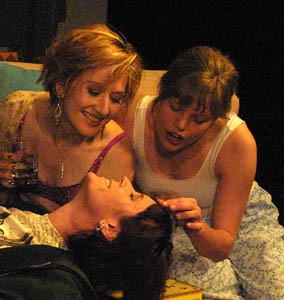
The action in the Actors Theatre production of Anton in Show Business, directed by Joe Winkler, starts where it always does in theater–amid the heartbreaking uncertainties and perverse humiliations of auditions. Three very different actresses beat the odds to join a production of Chekhov’s Three Sisters at a backwater Texas theater. Lisabette Cartwright (Sigrid Sutter) is a pink-cheeked newbie naive enough to dream of using art to change people’s lives. Casey Mulgraw (Sheri Lee Miller) is a bitter veteran who has wracked up 200 shows without ever being rewarded with a paycheck. And last, but definitely not least, is Holly Seabe (Danielle Cain), a surgically enhanced television star who looks fresh off the set of Sex and the City. She’s hoping to pad her resume with a serious part so she can score a movie role where she doesn’t have to take off her clothes. “Chekhov, Shakespeare–that stuff gets you respect,” Holly explains. “Then you’re a classic actress with really great breasts.”

On their way to opening night, this trio encounter a horrific array of theatrical bogeymen: egoistic directors, culturally illiterate corporate funders, arrogant theater critics, indifferent audiences, and all the other ills that modern stagecraft is heir to. There’s no missing the point. As one cruelly misused creative type puts it, “[Theater] fascinates you, it seduces you, it leaves you penniless by the side of the road.” And just to be sure we get it: “The American theater is in a shitload of trouble,” someone else explains.

But this is not a pity party. Jane Martin’s script is too good to be self-indulgent–too funny, too unpredictable, too insightful, and too evenhanded in its scorching satire of everyone in the biz. Martin’s script finds the acting skill it deserves. As Holly, Cain is the obvious standout, strutting and lisping and laying about with a razor-sharp tongue like a demonically possessed Barbie doll. But as fun as that kind of behavior is to watch, Cain doesn’t take it over the top. The actress deftly hits the more subtle notes of her character, the sadness and desperation of a woman who has been under the scalpel 17 times to achieve the natural feminine beauty required for television.

Matching her blow for blow is Miller, who brings the right mix of cynical wit and genuine pain to the role of Casey, an actress so determined to beat the cruel odds of showbiz that she’s supporting her financially fruitless artistic career by working the night shift in a slaughterhouse.

Just about every character in Anton in Show Business wants theater to do something different: provoke laughter, peer into the human soul, examine the big social issues, make actors look good, improve the community’s quality of life, and so on. And yet, even as the play presents this lengthy list of apparently irreconcilable goals, it is quietly reconciling the hell out of them by being flip and funny and humane and insightful and wildly imaginative and painfully realistic. If that’s some postmodern riddle, then it’s the kind we’d like to be puzzled by more often.

‘Anton in Show Business’ continues through Aug. 31 at Actors Theatre in Santa Rosa. For details, call 707.523.4185.

From the July 25-31, 2002 issue of the North Bay Bohemian.

© Metro Publishing Inc.

‘Ansel Adams Centennial’

0

Afterimage

Sonoma State’s ‘Ansel Adams Centennial’ gives us the whole man

By Sara Bir

From malls to museums, the majesty of an Ansel Adams image is instantly recognizable: billowing clouds, shimmering lakes, and razor-sharp definition come together to form impressions of nature so pure in spirit that they transmit the chill of frost on a leaf or the spray of a wave breaking across a rocky coast. Ansel Adams’ work remains so loved not only because it is striking, but because it reminds us of the awe that nature inspires. Sonoma State University’s “Ansel Adams Centennial Exhibition” contains over 70 of the photographer’s original prints, including many of Adams’ best-known works as well as images from Sonoma County and Northern California.

“You could not know any photographers at all, and you’ll know some of Ansel Adams’ photographs. It is popular through the broadest range of people,” says Jim Alinder, who with his wife, Mary Street Alinder, curated the exhibit.

The Alinders are natural curators for the show. Besides being perhaps the greatest living Adams scholars, they worked closely with the photographer as assistants during the latter part of his career, from 1979 until his death in 1984. Mary Alinder edited and compiled Adams’ 1985 autobiography and later wrote Ansel Adams: A Biography, acknowledged as the definitive Ansel Adams biography.

“What we wanted to do was show who Ansel was and the journey that he made in life, as a person and an artist,” says Mary.

The exhibit includes some of Adams’ everyday personal artifacts, touches that bring us into a fuller understanding of Adams (a factor whose absence from the San Francisco MOMA’s 2001 exhibit “Ansel Adams at 100” left a vast, gaping hole).

The exhibit goes in roughly chronological order with extensive, insightful didactics at many points. Considerable space is devoted to showing the stories behind two of Adam’s most beloved masterpieces: 1927’s Monolith and 1941’s Moonrise. The Moonrise section features a copy of the negative and the only straight print Adams ever made from it. (“It took me two years to get him to make that, because he didn’t think anybody would be interested,” says Mary.) Rather than simply looking at a striking image, we are able to see Adams’ process of visualization.

In Portfolio I, according to Mary, “you can see it as the breadth of his photography. It’s not just concerned with big landscapes.” Ropelike tree roots, a Mormon temple, a ridged Saguaro cactus, and a portrait of friend and mentor Alfred Stieglitz give us a side of Adams that we may not be so familiar with, intimate compositions no less striking in their detail than his landscapes are in their grand scope.

“It’s so rare in an exhibition that you can see a whole portfolio put together, and we have two full portfolios in this exhibition,” says Mary.

Besides the panoramic and inspirational views of national parks and monuments, the “Centennial Exhibit” houses examples of Adams’ commercial work and copies of the many books Adams produced. Through these we experience Ansel the conservationist, Ansel the innovator, and Ansel the tireless worker.

What’s so compelling about Adams? “That’s a big question,” Mary says, after a pause, “and the answer’s bigger than the question. I think he reminds me of how very special this world is–that’s a simple thing to say, but how we should look at all times with fresh eyes and not take things for granted. Also, that one man or one woman can make a difference. That’s one of the things he taught me. He was a great teacher. He shared everything; he had no secrets.

“Some of his greatest pieces were things that no one else had ever done in photography. In truth, most of his great pieces wouldn’t look like that if you were standing next to him. It’s because the way Ansel decides at one point that he can manipulate reality. A lot of the things he does are not reality, but filtered through his passion.”

The ‘Ansel Adams Centennial Exhibition,’ Sonoma State University, through Aug. 18. Tuesday-Wednesday, noon-6pm; Thursday- Sunday, noon-8pm. Closed Mondays. Reservations and advanced tickets recommended: $8 adults; $6 seniors and students. Tickets at the door as available: $10 adults; $8 seniors and students. Sonoma State University’s Art Gallery, 1801 E. Cotati Ave., Rohnert Park. 866.54.ANSEL.

From the July 18-24, 2002 issue of the North Bay Bohemian.

© Metro Publishing Inc.

Tomatoes

0

It won’t be long before backyard bounties burst into ripeness

By Sara Bir

A tomato out of season can be a most spiteful fruit, a ghastly aberration with a mealy texture, unconvincing color, little discernible flavor, and as unnaturally hard as the ass of a woman who spends too much time at the gym on the StairMaster. And yet eat out-of-season tomatoes we do, all fall and winter and spring, in salsas, on burgers, and atop salads. We love tomatoes so much that our impatience gets the best of our appetites, perhaps because a tomato’s watery tang is the epitome of freshness, a thing we crave in the steely winter months. Tomatoes, when they are good, are very, very good. But when they are bad, they are horrid.

When tomatoes are very, very good–as in homegrown, backyard tomatoes–they are also prolific, to the point that some gardeners throw up their hands to the overabundance and let the fruits ripen to a seeping, rotten squish on the vine. And to all of you people who do just that, I am jealous. I look at the red and orange and yellow orbs languishing in your garden, and I want to come rescue them.

I even did, once or twice (or maybe six times), plucking a tiny handful of diminutive cherry tomatoes from the plants that some law office down the street from my house had put in front of their practice for, I assume, decoration. No one from the office had been picking the fruits steadily ripening just beyond their door, and I finally got to the point where, facing a dismal tomatoless meal alone, I gave in and sneaked away with four or five. There in the upturned palm of my hand, they were so perfect and delicate and fragile, more precious than a tiny cargo of shrunken Fabergé eggs.

I took them home and subjected them to my all-time favorite tomato treatment: tomato eggs. Which is really just scrambled eggs with tomato, but since I like my scrambled eggs on the soft and custardy side and rarely expose them to the pan for more than 30 seconds, the tomatoes are just heated through and still maintain their sweetness, their earthy acidity blanketing the willing canvass of egg.

The reason I steal tomatoes from strangers’ yards for tomato eggs is that I grow no tomatoes myself. I am a hypocrite, stricken not with a black thumb but a thumb marked with whatever color the color of laziness is. Someone has always grown my tomatoes for me, and yet I long for tomatoey bushels and all the glories they imply: panzanella, gazpacho, salsas and relishes galore, and a never-ending succession of tomato eggs for lunch.

Summer is heaven for tomato fanatics, and now is almost our time. As you read this, a green tomato is turning gold or red or a greener, watermelon-striped green. It’s happening all over–go put your face to the dirt and you can feel it, the fertile rumbling of all those nubile tomato fruits, yearning for the pluck. In a day or a week or even a month, neighbors, co-workers, and farmers markets will have rainbow-hued heirloom tomato gems, ridged bulbous things giant as a grown man’s fist, and itty-bitty currant tomatoes just a hair larger than a hummingbird’s egg. And they are all just waiting for you to use them up!

Anyone feeling particularly determined and resourceful can put their tomato bounty to good use with a round of home canning or in a batch of ketchup, a very tomato-intensive concoction (it takes about five pounds of fresh tomatoes to make four cups). Or you can just casually incorporate tomatoes into every meal of the day, which is not difficult at all since tomatoes are so adaptable. Tomato eggs for breakfast, a sandwich with a big, juicy, perfectly round cross-section of tomato in the middle for lunch, and a tomato salad with dinner. Just remember to eat them soon, while they are still hot from the sun and rife with the taste of summer.

Tomato Bread (Pan con Tomate)

This Catalan dish, a Spanish staple, delivers deep satisfaction in its utter simplicity. Big, fat, almost mushy garden tomatoes are best suited for pan con tomate, as they smear across the bread so willingly. It’s a bit of an unrefined notion, but I like that pan con tomate is so rustic that you don’t even bother with slicing the tomatoes. There’s some kind of primal glee in mutilating them over the bread. You can serve this as a tapa, although if you are alone and feeling very lazy, a couple slices of tomato bread make a lovely and wholesome, if high-starch, lunch or dinner.

Broil or grill a thick slice of white country-style bread until it is nice and toasty. (Traditionally, tomato bread is grilled over a wood fire, but to sate our modern, erratic cravings for tomato bread, it cannot always be thus.) Rub the bread with a peeled garlic clove. Cut one very ripe red tomato in half and smear the cut side of the tomato across the surface of the toast. Drizzle the whole affair with a fruity olive oil, season with salt (unrefined sea salt elevates tomato bread to a whole other level) and pepper, and eat. Ha! It’s really good, isn’t it? I told you.

Tomato Eggs

The acidic sweetness of the tomatoes breathes life into otherwise humdrum eggs. With a slice or two of toast, you are in for a heavenly meal. Properly made tomato eggs look like puke, even if you cook the eggs lightning-fast so that they are creamy and soft. A lot of good foods look like puke, though.

Put a skillet over high heat. Break the two or three eggs into a bowl, season with salt and pepper to taste, and whisk until nice and homogenous. Add a few teaspoons of olive oil to the skillet, allow to heat, and add one large or several small chopped tomatoes. Cook, stirring, for about 30 seconds or until the tomatoes start to release their juice and begin to look slouchy. Add the eggs and cook, scrambling as per your own preference. Turn out onto a plate and top with any or all of the following: a few dashes of Tabasco, crumbled feta cheese, and a generous pinch of the Middle Eastern herb blend za’taar. Mmm! Heaven! The Lord will now smile upon you, seeing you have wed the bliss of eggs and tomato.

From the July 18-24, 2002 issue of the North Bay Bohemian.

© Metro Publishing Inc.

Open Mic

0

Sonoma County’s water woes run deep

By Shepherd Bliss

Water, water everywhere,” Samuel Taylor Coleridge wrote. Water is so present that we tend to take it for granted. “But not a drop to drink,” the poet adds.

Coleridge’s words came to mind as I drove up Highway 116 in rural Sebastopol a couple of miles from my small organic farm and passed Elphick Road–another contaminated well site. The North Coast Regional Water Quality Control Board convened a public hearing on Elphick Road in June. Nearly 200 concerned citizens attended–what we learned was not reassuring.

Some wells in south Sebastopol are so polluted by industrial products and/or chemical agriculture that people cannot safely drink from them. When water goes bad, life can go bad, for water is the source of all life. Polluted water can cause cancer and numerous other problems.

Unsafe levels of the chemicals PCE and TCE have been discovered in some wells–probably from dry cleaning and machine shops. TCE, according to material circulated at the meeting, “may cause nervous system effects, liver and lung damage, abnormal heartbeat, coma, and possibly death.” Not the kind of thing one wants to drink or even breathe.

Nitrates and nitrites have also been discovered, probably coming from agriculture. A California Department of Health Services flyer reveals that nitrates and nitrites come from “animal waste run-off from dairies and feedlots, excessive use of fertilizers, or seepage of human sewage from private septic systems.”

Ten experts sitting at a long table admitted that they did not yet know much about how the wells were polluted. Officials advised residents in the contaminated sites to use bottled water for drinking, brushing teeth, and cooking. Even inhaled vapors can be harmful; opening windows for ventilation when showering or doing dishes was recommended.

In recent years, contaminated sites have been discovered throughout the county. A water specialist at St. Joseph Health System, Sharon Marchetti, is currently working on eight contaminated local sites.

“We have already lost two city wells to PCE and TCE,” Sebastopol City Councilmember Larry Robinson noted. “Our city well in that neighborhood has so far tested free of contaminants, but we are concerned and monitoring the water carefully.”

Many residents at the meeting were upset. Some complained that the county knew about the problem for at least three years but did not inform the neighborhood. Officials responded that funds have not been available for investigating and communicating. The tax-paying audience did not appreciate this response.

“I’m getting the hell out of here,” muttered an old man sitting behind me. “I’ve been here over 40 years. Now they tell us our water is bad. I’m out of here.” The nervous energy in the room felt that it might fuel a water uprising.

Later in June, I attended a Blue Circle gathering. It drew together government officials, professionals, and water activists to network. County Supervisor Mike Reilly implored, “We need to keep the water bags off the Gualala River.” He was referring to the scheme of Ric Davidge, once Alaska’s top water official, to export North Coast water. He wants to put it in giant sacks and tug it down the Pacific Ocean to sell in San Diego.

The Davidge proposal exemplifies the growing trend of multinational corporations seeking to buy water in one region and sell it elsewhere. Water, like air, has traditionally been understood to be part of the public trust, what some call “blue gold.” Now enterprising corporations want to commodify it in order to profit from its sale.

Geologist Jane Nielson spoke about water to the June meeting of the Blucher Creek Watershed Council, located south and west of Sebastopol. Nielson volunteers her scientific skills to the watershed group. Such citizens groups may be part of the solution to our mounting water problems. They gather various stakeholders in a water drainage area to collaborate on problem solving. There are around 300 watershed councils in California.

Nielson reported various areas in the North Coast where people are having a variety of water problems. Penngrove citizens, for example, have taken the city of Rohnert Park to court because it wants to expand to the east. The aquifer that serves Rohnert Park is diminishing, and the additional people will consume the water now used by people in Penngrove.

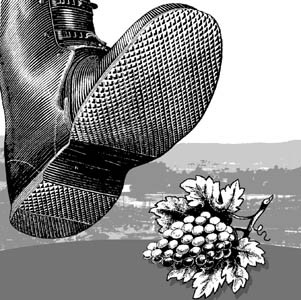
The rampant growth of water-consuming vineyards also presents problems. Vineyards tend to put in deep industrial wells, which can draw down the water table. Nonnative grape plants join another alien species, eucalyptus trees, to consume a lot of water, thus depriving native plants and streams.

Brock Dolman, a wildlife biologist with the influential Occidental Arts and Ecology Center, has been working with others to write a water resources element into the Sonoma County general plan. It is currently being revised and would set the policies that guide our future. Our new general plan may be the first in the state to have a water element.

“We must learn to think like a watershed and understand how human development impacts the water cycle,” Dolman commented to me.

“Considering the current degraded state of Sonoma County’s water resources, we must act now to ensure high quality and optimum quantities of pure water for future generations of all species.”

From the July 18-24, 2002 issue of the North Bay Bohemian.

© Metro Publishing Inc.

‘Book of Days’

Small Town Politics: Bobby (John Wallis) and James (Matthew Hammonds) scheme and manipulate.

Blank Pages

‘Book of Days’ has nothing new to say about middle America

By Patrick Sullivan

God save us from small towns. Back in the day, everybody thought these quaint little burgs were simple places full of quirky personalities, warm apple pie, and rock-solid moral values. But if decades of American theater have taught the country one thing, it’s that the sunny streets of Anytown, USA, hide a bubbling sewer of corruption and hypocrisy.

The latest attempt at educating us: Lanford Wilson’s Book of Days, now onstage in a Summer Repertory Theatre production directed by Leslie McCauley. The quirky characters remain, of course; where would we be without them? The population of Dublin, Mo.–an apparently bucolic place where, as one visitor explains, “the grass is so green it hurts your eyes”–includes a bumbling redneck sheriff à la Don Knotts, a former far-out hippie turned dean at a conservative Christian college, and a cheese factory employee so obsessed with creating the perfect cheddar that he delivers passionate monologues about his quest.

But–surprise!–a darkness lurks on the edge of town. When a bizarre hunting accident claims the life of gruff-but-good-hearted factory owner Walt Bates (played by William McNeil), one of his employees suspects foul play. Accountant Ruth Hoch (the perky Marian Partee) sets out to investigate, in between rehearsing for her starring role in a community theater production of St. Joan, George Bernard Shaw’s classic ode to Joan of Arc.

Ruth soon finds that her onstage role as the persecuted idealist is dismayingly good preparation for telling the people of Dublin that one of their leading citizens has been murdered. Everyone prefers to believe the accident theory: Walt’s mournful wife Sharon (Valerie Rachelle), his good-for-nothing son James (Matt Hammonds), and even Ruth’s own husband, the cheese-obsessed Len (Christopher Trice). Ruth’s thirst for the truth soon makes her a pariah.

This murder mystery/passion play is complicated by several subplots, including a sleazy political scheme hatched by James, who hopes to make it to the state House with the help of a wily fundamentalist preacher. Unfortunately, these plot threads come together to form an ugly, crazy quilt of a play. True, the Pulitzer Prize-winning Wilson is a giant in American theater, justly acclaimed for earlier works like The Mound Builders. Also true, Book of Days is one of his weakest efforts. Wilson doesn’t even deliver an adequate murder mystery. For instance, Act I concludes with Ruth discovering a clue about Walt’s death that’s so obvious that any cop who missed it would be busted back to dogcatcher.

On the plus side, the SRT production features some good performances. Hammonds is convincingly slimy as James, a spoiled rich kid with a passion for power. And John Wallis is a wonder as the Reverend Bobby Groves. Looking and sounding eerily like former Christian Coalition frontman Ralph Reed, Wallis slides through his scenes with Teflon-coated menace. Unfortunately, Partee is not as effective in the crucial role of Ruth. The actress has good comic timing, but when other characters discuss Ruth’s passionate intensity, the audience wonders if it missed a scene. Still, it’s hard to blame anyone for having difficulty with this script, which is riddled with clichés, irritating tangents, implausible developments, and cheesy dialogue.

In this age of Ashcroft, Wilson’s themes of religious fanaticism and moral hypocrisy in middle America are timely enough. All the more reason to wish one of our leading playwrights had something new to say about them.

‘Book of Days’ continues through Aug. 7 at Burbank Auditorium, 1501 Mendocino Ave., Santa Rosa. For details, call Summer Repertory Theatre at 707.527.4343.

From the July 18-24, 2002 issue of the North Bay Bohemian.

© Metro Publishing Inc.

Insider’s Guide

Our yearly Insider’s Guide offers up some of our favorite places and things

By Sara Bir

This will be brief–because little room can be wasted when so much lies ahead. This is what we call our Insider’s Guide, but the truth is that we’re no more inside than you are. So here we share a few of our favorite places and things that cover the basic necessities–food, clothing, music, and the outdoors.

Give Us This Day Our Daily . . .

You can’t swing a dead cat around these parts without hitting some kind of dense, crusty artisan loaf. Do you understand what that means? We are in a hotbed of some of the world’s richest bread reserves. Bread is the staff of life, as they say, and we here in the North Bay are living the good life.

Remember when bread meant mushy sliced and bagged Wonder loaves from the grocery store? Sometime in the ’80s that all began to change, when a wave of interest in brick ovens, prolonged fermentation, sourdough starters, and quality milled organic flours began to hit bakers across the country. It’s interesting–in Europe, longstanding baking traditions are beginning to take a hit from the modern homogenization of foods, but here in the States, our truly American (sliced white bread aside) baking traditions–based on an old-world model–are just getting started.

You probably have a favorite bakery, and it may not be on this list. Which does not mean it is not good; it just means that with so many impressive artisan bakeries around here, we don’t have enough space to list them all. How’s that for luxury?

Della Frattoria This family-owned Petaluma bakery only does wholesale, but when I worked at Dean and Deluca in St. Helena, they sold dense, beautifully shaped Della Frattoria loaves there–and I got to have the day-old loaves for free. It was my job to make croutons (well, that was part of it), and I always reached for the stale Della Frattoria loaves. The garlic and Vella Dry Jack loaf, with its whole, unpeeled garlic clove embedded in the crown of the boule like a beauty mark, was stupendous. Della Frattoria uses organic flours, and they bake their breads in a wood-fired oven. You can find their bread at decent grocery stores. 707.762.1722.

Basque Boulangerie Cafe Another place I discovered through my illustrious stint of food-service-industry grunt work–this time through a caterer in Sonoma, who served their Dutch crunch rolls at parties. Basque makes the best Dutch crunch rolls ever, although they tear up your mouth pretty good. The bakery is a terrific place to grab a sandwich for an uber wine country lunch on Sonoma’s plaza. 460 First St. E., Sonoma. 707.935.SOUR.

Artisan Bakers More great bread from the inimitable hamlet of Sonoma. Artisan’s heavyweight claim to fame is that owner Craig Ponsford won the highest international honor in 1996 for his baguette. This, naturally, cheesed off some French people, but I think they got over it. 750 W Napa St., Sonoma. 707.939.1765. 1139 Magnolia Ave., Larkspur. 415.461.7343.

The Model Bakery Isn’t this a great name for a bakery? If you are cruising through downtown St. Helena, their picture-perfect array of loaves in the window is sure to catch your eye. Model Bakery has 75-year old brick ovens and is known for its sourdough. 1357 Main St., St. Helena. 707.963.8192.

Brother Juniper’s Bakery Brother Juniper’s is known for its sometimes daring breads, which flirt with additions such as wild rice and raw polenta. 463 Sebastopol Ave., Santa Rosa. 707.542.6546.

Village Bakery 7225 Healdsburg Ave, Sebastopol. 707.829.8101. 1445 Town and Country Dr., Santa Rosa. 707.527.7654.

Alvarado Street Bakery 500 Martin Ave., Rohnert Park. 707.585.3293.

Nifty Thrifty

I’m not against barn sales; my budget is. The difference between used and vintage is oftentimes just a case of where the goods are purchased and how many armpit stains or chips and scratches mar whatever you are purchasing. So for purposes of this spiel, vintage goods come from tag sales, and used junk comes from thrift stores.

It’s a good idea to buy used junk whenever you have the option, unless you need underwear or sleeping bags. Consider the benefits of buying used: it’s cheaper, it qualifies as recycling, and used junk often looks cooler. It pisses me off that the government wants us to revitalize the economy by spending money on pointless new crap. What a tawdry way to revitalize an economy! It’s more noble to spend your money in ways that are more direct, and with used junk, you save your own money, and often a portion of what you do spend goes to some nonprofit organization. In reality, this line of logic probably does not pan out at all, but it’s a good way to give that doofus George W. a tiny middle finger. Take that, you abysmally unconvincing public speaker! The only admirable thing about our president is that he stays in pretty good shape.

The Dig The Dig is a strange, strange place. It’s not really called the Dig, but the nickname has stuck because it makes the most sense. At this Goodwill donation center, they have several rows of tables and a half-dozen huge clothing bins where they dump junk completely randomly. Literally, you dig through it. This factor makes the Dig both effort-intensive and highly rewarding, even if the probability of scoring great stuff at the Dig is pretty low. Everything there is insanely cheap; you pay for clothing by the pound. It’s fun to go, because you can act very rude and throw stuff around and ravage the whole place and it makes no difference at all, since it’s already a gigantic mess to begin with. At the end of the day, they trash everything and the next day they have a whole new batch of junk, which is one drawback to the Dig: it’s pretty depressing to think that there’s is so much pointless crap in the world. Plus, when you leave, you get this overwhelming urge to take a shower. Still, it’s worth it. As It Is Store (The Dig), 651 Yolanda Ave., Santa Rosa. 707.523.0550.

The Church Mouse, Sonoma Sonoma is home to three Church Mouse thrift stores–let’s call them the Church Mice Trilogy. The Church Mouse on the Plaza is full of boring and overpriced boutique stuff (on the Plaza, go figure). Skip it. The Church Mouse in Boyes Hot Springs is larger, less expensive, and still very clean. Hit and miss. The best Church Mouse is on Highway 12 at the end of town. It’s sloppy, but it has good deals on as-is furniture and household items. I got a great $6 lamp made from driftwood there. 15 E Napa St., Sonoma. 707.938.9797. 10 Boyes Blvd., Boyes Hot Springs. 707.938.9839. 18068 Hwy. 12, Boyes Hot Springs. 707.938.0188.

Goodwill The Goodwill in Sonoma is my favorite, with lost of furniture and quality cookware. The furniture, however, is often overpriced. It’s supposed to be a thrift store! Geez. Perseverance will pay off, however. I found a very comfortable $40 sofa there. Goodwills are best for clothing, though, and sometimes cookware.

My housemate swears by the Goodwill on Sebastopol Road and goes there at least twice a week. 3535 Industrial Dr., Santa Rosa. 707.545.2492. 645 Sebastopol Rd., Santa Rosa. 707.570.2392. 172 Petaluma Blvd. N., Petaluma. 707.778.7485. 18615 Sonoma Hwy., Sonoma. 707.996.4097. 513 Healdsburg Ave., Healdsburg. 707.431.8408. 1683 Imola Ave. W., Napa. 707.257.6610. 809 Lincoln Ave., San Rafael. 415.456.5273.

St. Vincent de Paul Thrift Store, Monte Rio Cheap, crammed, and diverse. Lots of old vinyl and stereo equipment, plus the staff is super friendly. Worth a trip to Monte Rio. 9869 Main St., Monte Rio. 707.865.1339.

Church Rummage Sales Best-ever for everything. Church rummage sales blow the competition out of the water. Usually they are run by very friendly old ladies who sell everything for cheap and bring clothing in excellent shape that’s been hanging in their closets in plastic garment bags for 30 years. Lots of vintage T-shirts and cowboy shirts and denim and house dresses at these sales. Oftentimes donuts too. Mmm. Watch for signs on the street; check classifieds.

VNA Hospice Thrift Store 421 E St., Santa Rosa. 707.528.9310 6350 Commerce Blvd., Rohnert Park. 707.588.8015 748 Gravenstein Hwy. N., Sebastopol. 707.824.4712

The Salvation Army 200 Lytton Springs Rd., Healdsburg. 707.433.3334. 136 Petaluma Blvd. N., Petaluma. 707.762.4880. 1290 Sebastopol Rd., Santa Rosa. 707.528.2520. 1020 Third St., Santa Rosa. 707.578.3924. 1326 Main St., Napa. 707.224.8220. Fourth and Mary streets, San Rafael. 415.454.7201.

For the Record

Growing up, we didn’t have a record store in my town, and I had to get my mom to drive me to the mall in West Virginia where I would get a cassette tape of whatever British band I had seen and fallen in love with on MTV’s “120 Minutes” that Sunday. Since MTV usually only played videos of bands whose albums were available at the mall, this was not a problem. I was 15, and I thought the two record stores at the mall were the bee’s knees.

Once you go to college, that idea is shot to shit, and it’s the greatest revelation in the world. Independent record stores abound, and they sell used stuff too, and good-looking members of the opposite sex shop there and you can look at them while looking through stacks of Pulp EPs. It’s bliss! Good record stores have a special smell, a heady mingling of glossy posters and aging album sleeves. Looking through everything is a treasure hunt, and when you find an out-of-print import, it’s like the guy you have been waiting for years to ask you out suddenly calls.

Mall record stores can suffice. But why settle for suffice? Why settle for indifferent teenage clerks in silly matching polo shirts? Real music can come from the mall, but it feels better when it comes from a real record store.

Red Devil Records Vinyl galore in this Petaluma store with mouth-watering array of 7-inches (most of them punk). Record collectors make special trips to Red Devil to plonk down major buckaroos on stacks of rare goodies. Owner Barry Lazarus is friendly, helpful, and knows his way around jazz, salsa, blues, and underground (read: not pop-punk) punk rock. Great small-press rock and roll books and magazines to boot, and you can get records cleaned here too. Not many CDs, but good ones. 170 Kentucky St., Petaluma. 707.769.8999.

Backdoor Disc and Tape Rohnert Park may have a college, but it’s Cotati that is, by default, the college town. And no college town is complete without a decent record store. Backdoor has tons of used CDs (which are very roughly alphabetized, so you have to search for your stuff) and a pretty inclusive selection of new CDs, with a section of local bands. The great thing about Backdoor is that you can listen to the CDs first, so you can figure out if that Royal Crescent Mob disc is really worth $4.95 or not. 7665 Old Redwood Hwy., Cotati. 707.795.9597.

Last Record Store Proprietor Doug Jayne and company keep a cozy store that’s not terribly big but still packed with a thorough range of indie, jazz, country, pop, blues, etc. Few times have I gone there looking for something and they didn’t have it. The used CDs are not super bargains, but the amount of good used stuff there highly outnumbers the junk, so it’s worth it. Covering the checkout counter they have a few decades of concert tickets under glass, so while you are waiting to buy CDs, there’s always something interesting to look at. And everyone there has always been very amiable, and not surly-record-store-clerkish like in High Fidelity or at Amoeba. 739 Fourth St., Santa Rosa. 707.525.1963.

Village Music A semireliable source (not affiliated with the store) told me that Village Music is Mick Jagger’s favorite record store in the whole world. Perhaps he and George Lucas are buddies and when Mick is chillin’ at Skywalker Ranch, he pops over to the Valley of Mill to check out Village Music. Perhaps Mick has a villa in Marin himself? Some Insider’s Guide this is: we can’t even verify Mick Jagger’s alleged affinity for Village Music. Elvis Costello, for the record, has said that Village Music “may be the greatest record collector store in the world.”

That should be telling. Besides lots of legendary musicians’ visitation of and praise for Village Music, the real reason to go there is because it’s a record store (meaning they sell great records for lovers of records). Plus, they sell really old copies of Rolling Stone for very cheap. Who wants to look at some cruddy new Rolling Stone when you can look at a Britney- or Creed-free old one? 9 E. Blithedale Ave., Mill Valley. 415.388.7400

Santa Rosa Friends of the Library Book Sale Not a record store per se, but this biannual used book sale has plenty of crates of old records, many of them super old. Lots of classical, plus ’50s Montovanni-type stuff, and some buried rock classics. Also records that you may have had as a kid, like Sesame Street and Disney titles. If you look hard enough, you can fine weird and obscure novelty stuff, the kind that you buy just for the cover. The selection is large, and the prices are low. April and October. Check www.sonoma.lib.ca.us/bkfr.html for details.

Land of 1,000 Taquerias

Here’s a funny trick you can pull on someone who sends you to get a burrito for them: get a lengua burrito and don’t tell them (hopefully, your friend is not a vegan). Just say it’s chicken. Maybe this will make a lengua convert out of them; who knows? Lengua is really, really good, but I think it’s best in tacos, not burritos. It’s kind of gray, though, and looks suspicious on a taco; you need it wrapped up in a burrito for the trick to work. It’s really a seventh-grade-level stunt to pull, secretly slipping someone the cow’s tongue.

We have really good taquerias here, though, and we can do that. Not everyone has lengua at their fingertips. I think there must be some kind of law in California that says every shopping center has to have a taqueria in it, just like every gentrified downtown area has to have a Barnes & Noble and a Starbucks. The great thing about the plethora of taquerias is that there are so many kinds, and each one has its own personality and at least one thing they do really well. Imagine if the taqueria with the good tortas merged with the taqueria with the good tamales with the taqueria with the good menudo. . . . It would be a whole new breed of super-taquerias, like a genetically altered designer test-tube baby. Kind of scary, actually. For the meantime, go to these places.

Juanita! Juanita! The interior here is just great. You can come with no newspaper or book and still have plenty to read. Sit at the counter, where they have dog-eared Trivial Pursuit cards. Tip: get the bowl of beans, which comes with sour cream, lettuce, and salsa, dump a whole bunch of hot sauce on it (they have a big selection), and grab a handful of the tortilla chips from the plastic bins on the counter. Presto! Economical vegan nachos. 19114 Arnold Dr., Sonoma. 707.935.3981.

Papas and Pollo Southwest Mesquite Grill The name would lead you to think Papas and Pollo was a potato-and-chicken shack of some sort. Nope. They have a long menu of specialty burritos named after famous people. You can get things like artichoke hearts in burritos here. 915 Gravenstein Hwy. S., Sebastopol. 707.829.9037.

Rubio’s Baja Grill Not really a taqueria, since it’s a fast-food chain. Rubio’s deserves a listing anyway, based on the strength of their rightfully famous fish tacos. Jane and Michael Stern wrote about the San Diego-based Rubio’s chain in Gourmet a few years ago, and it’s been a budget foodie destination ever since. Now you don’t have to go all the way to San Diego to enjoy a fresh fish taco (beans are solid too). Stay away from the evil knockoff franchise, Baja Fresh! It is a faker. 1016 Santa Rosa Plaza. 707.546.3267.

Joe’s Taco Lounge and Salsaria Also not really a taqueria (with a name like that, how could it be?), Joe’s Taco Lounge is a sit-down, table-service place with yuppiefied Mexican food. They have tasty seasoned fries, good pizzas with crazy toppings, and jazzed-up taqueria food. About as authentically Mexican as I am, but it’s fun and funky, so who cares? 382 Miller Ave., Mill Valley. 415.383.8164.

Pepe’s Taqueria Very good burritos, and breakfasts too. 2000 Sebastopol Rd., Santa Rosa. 707.545.7425. 1079 Fourth St., Santa Rosa. 707.571.7478.

El Patio The namesake patio is the winning factor here. 901 Fourth St., Santa Rosa. 707.571.2222.

Taqueria Santa Rosa 791 Montecito Ave., 707.538.2642.

Martha’s Old Mexico 305 N. Main St., Sebastopol. 707.823.4458.

Taqueria el Tapatio Excellent grilled chicken. Hot, hot salsa. 6364 Commerce Blvd., Rohnert Park. 707.586.2826.

Run Away! Run Away!

At 6:30 in the morning, a few friends of mine and I were hiking up the Grand Teton in Wyoming. The sun had just come up, and the sleep was flaking out of our eyes. I was beginning to feel very hardcore and badass and proud of my supposed buffness when this woman, all suited up in a sports bra and matching running shorts, came zooming up the trail like nobody’s business. She zipped right past us effortlessly. It was humbling but inspirational; I wanted to be her.

Running on a trail, there are no speeding trucks or stoplights or crosswalks to contend with; no exhaust from cars and no sidewalks that radiate fingers of heat under the sun, as hot as a baking stone. The trees (where there are trees) provide shade, and the only vehicles to dodge are bikes, the drivers of which are usually very considerate. And it smells better and looks prettier–all that good stuff. The only drawbacks are poison oak, ticks, and many rocky opportunities to sprain an ankle. Besides, the communal spirit between nature, body, and mind is a thing not often achieved. So get a pair of shoes with good treds and a bottle of sunscreen, and you are in for a workout that John Muir (and that one lady who ran up the Grand Teton) would approve of.

Annadel State Park Trails, trails, trails! So many trails in such a compact place, and right in sprawling Santa Rosa. It’s so comforting. You can run your heels off over Annadel’s terrain all day and still not cover all of the trails. However, they are not always marked so well once you get into the park’s interior. This may make for a longer run than you planned. I tried to chalk out a route using the little maps they provide for you, but these are confusing too. It’s maybe best to intrepidly go in and chart your own route. Starting from the Channel Drive entrance is the best, and the W. P. Richardson Trail makes a good base to branch off. I guess there are rattlesnakes here sometimes, but I have not yet stepped on any. Don’t you, either. 6201 Channel Dr., Santa Rosa. 707.539.3911.

The Shell Beach-Pomo Canyon Trail No wonder this is a popular trail: It offers the best of everything, from redwoods to meadows and then to the ocean. Or ocean to meadows to redwoods, your pick. Either way, it’s three miles. The elevation gain and loss is gradual, relatively painless, and makes for stellar views of the Russian River, the kind of vista that makes you think, “Damn, I’m glad I live here.” Trivia: Pomo Indians used to roll up bay leaves and stick them up their noses as an antihistamine (at least that’s what my boyfriend told me, but he’s not a Pomo Indian). So if you spot a bay tree along the way, you can take a quick break and stick a bay leaf up your nose just to see what it’s like. Pomo Canyon Environmental Campground. Going south on Highway 1 past Jenner, turn left just after the Indian restaurant. Or on the east side of Highway 1, directly across from Shell Beach.

Mount St. Helena This is the highest point in the North Bay, and won’t you feel like a stud when you run right up it! The elevation gain is steady and undemanding. Running this in the summer is a dumb idea, because it gets unbearably hot, so unless you are training for an ultramarathon, wait a season or two. This makes for a very solid 10-mile run with lots to look at once you get to the peak (where there is some kind of unsightly radio transmitter thing, but that’s not what you go there for). Taking the Silverado Trail, you’ll run right past Robert Louis Stevenson’s honeymoon spot. Just think, you can combine history, literature appreciation, and fitness!

To use the fire road all the way, go a few hundred yards past the state park parking lot and look on your left for an access road with a gate across it. Pull over on the northbound side of the highway and park. Robert Louis Stevenson State Park, eight miles north of Calistoga on Highway 29. 707.9942.4575.

Bartholomew Park Winery The best place to run in Sonoma. You can fashion a loop by going down Gehricke to Castle Road, which will lead you to a dead-end at Bartholomew Park Winery, who have a modest but lovely network of trails open to visitors. Just consult the map at the trail’s entrance. Since the trails are very pretty but not so long, this run is best combined with Sonoma backroads–so it’s a trail/street run actually, but so what. 1000 Vineyard Lane, Sonoma. 707.935.9511.

Instrumentally Minded

There are enough music stores up here to make you wonder how they all stay in business. Santa Rosa’s 4th Street alone must house, oh, 30 or so (well, maybe not that many). But then, considering how many people up here are musicians, I guess it’s no small wonder. What a splendid thought!

As a band girlfriend, I have leaned how dangerous it is for a nonmusician to accompany a musician (especially a drummer!) to a music store. I’m a listener, not a player. For those of you who are both, here are some shops to keep your bank account low for years to come.

Epiphany Musical Instruments This newcomer is a hands-on treasure chest of exotic ethnic and rare instruments from around the world–harmoniums, gongs, and many things that look cool but that I do not know the name of, plus plenty of assorted percussion toys. Fun even for nonmusicians. 640 4th St., Santa Rosa. 707.543.7008.

The Magic Flute Woodwinds, strings, guitars, brass, and drums (i.e., band and orchestra instruments), plus plenty of printed music. Sales and rentals. 206 Northgate One Shopping Center, San Rafael. 800.200.3112.

People’s Music First began as a record store. Specialization in acoustic instruments with a world flavor–kotos, autoharps, koras, sitars, etc. Repairs, rentals, and lessons. 122 N. Main St., Sebastopol. 707.823.7664.

Tall Toad Music New and used instruments with a focus on guitars. Lots of sheet music too. Lessons and repairs. Buy, sell, and trade. 43 Petaluma Blvd. N., Petaluma. 707.765.6807.

Zone Music and Recording “Run and overrun by musicians.” (Owner Frank Hayhurst is also creator of Musicians Helping Musicians, a nonprofit charitable organization that aids with medical costs incurred by often uninsured players or their families.) Electric and acoustic guitars, basses, rare and vintage instruments, amps, keyboards, software, drums and percussion, sound systems, and a complete 24-track recording studio. 7884 Old Redwood Hwy., Cotati. 707.664.1213.

Bananas at Large Despite the strange name, a store with much to offer for those involved in music and video production. Band instruments, percussion, sound systems, computer music, recording, and more. 1504 4th St., San Rafael. 415.457.7600.

A Drummer’s Tradition Extensive selection of vintage drums and hardware. Buy, sell, and trade. 1619 Fourth St., San Rafael. 415.458.1688.

Stanroy Music Center Well-rounded store for general music needs: band instruments, drums and percussion, pianos, keyboards, guitars and basses. Repairs, rentals, lessons. 741 4th St., Santa Rosa. 707.545.4827.

Rhythm Matters Drum circle heaven, with a focus on community and ethnic drums. 109 4th St., Santa Rosa. 707.523.DRUM.

From the July 18-24, 2002 issue of the North Bay Bohemian.

© Metro Publishing Inc.

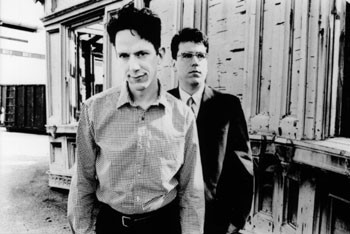
They Might Be Giants

0

Giant Step

It’s a family affair for kooky alt-popsters

By Greg Cahill

Their songs often had a certain childlike charm, so when the college-radio hits dried up for They Might Be Giants, the quirky alt-pop band made a natural shift in strategy–they recorded a straight-ahead album of children’s music.

The resulting enhanced CD, No! (Rounder), is a family-oriented disc that features special interactive sequences allowing fans of all ages to both listen to the music and play along to animated segments. The songs are a kooky and contagious mix of infectious melodies, skewed humor, and all-around goofiness (reminiscent of the Eels but without the social angst) and include such science-obsessed ditties as “Where Do They Make Balloons?”, “The Edison Museum,” and an ode to those rare souls blessed with supertasting taste buds. There’s even a song written from the point of view of a grocery bag.

No!, which marks the band’s 20th anniversary, is a career move that hasn’t surprised longtime fans. After all, TMBG picked up a Grammy Award earlier this year for the sweetly defiant “Boss of Me,” the theme song to the hit Fox-TV comedy Malcolm in the Middle.

Originally a duo, the band hails from Brooklyn. In the beginning, cofounders John Linnell and John Flansburgh played all the instruments in the studio themselves–an eclectic blend that ranged from keyboards and accordion to guitar and woodwinds. On the road, they were backed by synthesizers, drum machines, and tapes.

In 1986, the duo enlisted the help of band mates and released an eponymous debut. The album generated the surprise college-radio hit “Don’t Let’s Start,” which made waves on MTV thanks to an experimental music video. Two years later, the band matched its success with the song “Ana Ng” from the Lincoln album, capturing the attention of major labels.

In 1990, TMBG signed with Elektra Records and released the quintessentially quirky alt-rock album Flood, which produced the hits “Birdhouse in Your Soul” and “Istanbul (Not Constantinople),” the latter being a remake of the 1953 hit by the Four Lads.

During the ’90s, interest by MTV and mainstream rock radio fell off, especially after the release of 1994’s experimental John Henry album, but the band continued to tour on the college circuit and consolidated a core of cult fans.

Having made the world safe for such campy bands as Weezer and the Bare Naked Ladies, TMBG are so comfortable with their status that the band has no qualms about putting the following warning label on their latest CD: “The end of the album’s song sequence is specially designed to expedite slumber, so listeners should not operate machinery or plush animals while listening to the last three songs.”

Can you imagine Smash Mouth making that statement?

Random Notes

When the North Bay club and concert scene is good, it’s very good, and when it’s bad . . . ah, who even wants to contemplate that? Jamaican dancehall legend Yellowman and the Sagittarius Band bring their crucial dance riddims to the Last Day Saloon in Santa Rosa on July 21. The show is part of a scintillating series of top reggae acts hosted by DJ Sister Yasmin (try and catch Rasta troubadour Prezident Brown and the Orchestra of Judah at the Last Day Saloon on July 24) . . . Folk and blues great Geoff Muldaur comes to the Powerhouse Brewing Co. on July 21 . . . Brazilian rock guitar sensation José Neto, inspired by Hendrix and Santana, rocks the house July 27 at 19 Broadway in Fairfax. Meanwhile, this tiny venue has landed the world-music coup of the year: the Mighty Sparrow, the undisputed calypso king of the world, shakes it up there on July 27 . . . Telecaster master Bill Kirchen, who has recorded with the likes of Nick Lowe and Commander Cody and His Lost Planet Airmen, rides the steel breeze into Sweetwater on July 27 . . . And Cuban jazz piano great Gonzalo Rubalcaba headlines the Green Music Festival on Aug. 4 at Sonoma State University.

They Might Be Giants perform Tuesday, July 23, at 9pm, at the Mystic Theatre, 21 Petaluma Blvd. N., Petaluma. Tickets are $23. 707.765.2121.

From the July 18-24, 2002 issue of the North Bay Bohemian.

© Metro Publishing Inc.
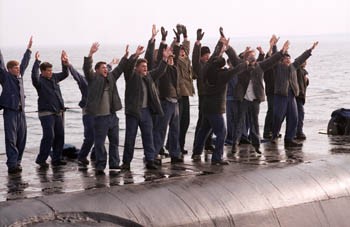
‘K:19: The Widowmaker’

Dive, Dive

Harrison Ford and Liam Neeson reenact ‘Mutiny on the Bounty’ on the submarine ‘K:19: The Widowmaker’

By

Because of the breakthrough opening sequence in Saving Private Ryan, the modern war film can be a lot more frank about what happens to human bodies in battle. But other films following the lead of Saving Private Ryan, such as Black Hawk Down and Windtalkers, also suffer from the same problem as Private Ryan‘s ending. After showing such carnage, it’s hard to wrap up the film nicely in the flag, even when, as in the case of K-19: The Widowmaker, the flag has a hammer and sickle on it.

This story of the Soviet hellboat is shaped by screenwriter Christopher Kyle as a 1961 Cold War version of Mutiny on the Bounty. Harrison Ford plays Capt. Alexi Vostrikov, a by-the-book martinet like Captain Bligh in the more enlightened versions of the Bounty story. For political reasons, Vostrikov has been sent by the Kremlin to override Capt. Mikhail Polenin (Liam Neeson), the trusted skipper beloved by his crew.

The new sub’s mission is psychologically important. The U.S.S.R. hopes that this nuclear-powered submarine will rival the U.S. boats within firing distance of the Soviet borders. However, the sub is bug-ridden. (The bow is held together with trim that looks suspiciously like duct tape.) On the maiden voyage, the nuclear core sprouts a leak, a condition worsened by a lack of emergency planning and a grass-green reactor technician (Peter Sarsgaard). The sailors risk a horrible death by radiation poisoning to fix the problem. If they fail, the movie argues, a meltdown might convince the Americans that the Soviet Union is attacking a nearby NATO base with nuclear weapons.

Ford’s proven appeal doesn’t fail him. Vostrikov is another old-movie heroic role, tailored to a ’70s dropout, now aging, and once again we see the slight discomfort with authority that’s Ford’s hallmark (trouble is always thrust upon him). Neeson’s also a perfect fit in the Fletcher Christian part, and the film adds some nightmarish new details to the submarine ordeal movie.

Still, Kyle’s script makes the plot as simplistic as the characters. And proposing the fate of the sub as an incident that might trigger World War III seems suspiciously like an overstatement of the case. Plus, the film’s upbeat ending ignores the fact that the sub killed 28 sailors in 1972 during an undersea fire.

Director Kathryn Bigelow has had experience with horror (the influential 1985 vampire film Near Dark) and science fiction (Strange Days). Certainly K-19 goes beyond an ordinary war film into the realms of, first, science fiction and then horror. When it tries to loop back into the stirring they-died-with-their-boots-on finale every self-respecting war movie needs, the film can’t recapture that military spirit: everything we’ve seen has been too horrific.

The story of the submarine K-19 isn’t so much about legendary heroism as it is about hidden injustice. As always, the version we hear is the officers’ version, in which the word “honor” is supposed to make up for the lives lost under their command.

‘K-19: The Widowmaker’ opens Friday in the North Bay. See Movie Times for showtimes.

From the July 18-24, 2002 issue of the North Bay Bohemian.

© Metro Publishing Inc.

Affairs of the Vine’s Wine Boot Camp

0

Wine-Ho!

A boot camp offers a crash course from vine to wine

By Charyn Pfeuffer

There are few true faux pas in today’s society. Hardly anything is off limits, and what once may have raised eyebrows–obscure fetishes, unconventional childbirth tactics–has today become lively cocktail party chatter. But tolerance has its limits, and nothing stops a cocktail party deader in its tracks than ignorance of one of the North Bay’s most precious commodities: wine.

Wine appreciators everywhere–educated or not–could take a lesson from some savvy educators operating Sebastopol-based Affairs of the Vine’s Wine Boot Camp. Part tourist-driven “wine country experience” and part genuine educational program, Wine Boot Camp whips its recruits into shape so that the once mysterious characteristics of chocolate in a Merlot or the hints of honey in a Chardonnay no longer terrify.

Soon after registering for duty, I received an e-mail from “Major” Barbara Drady, president and event mastermind of Affairs of the Vine: “Be dressed for battle: We’ve requested perfect weather for April 20.” I was instructed to bring sunscreen, a hat, and rain gear in case of rain.

On Wine Boot Camp day, I arrived at the designated meeting spot (the Safeway parking lot in Sonoma), and the training officially began.

0830 HOURS–The recruits assemble at forward command post dressed for battle in casual clothes. There is no whistle blowing or yelling, and no mandatory push-ups–just 31 recruits gathered around three vans, anxiously awaiting instruction. Once everyone has arrived, we are shuttled in appropriately red and white vans to the square in Sonoma.

0850 HOURS–Rookie recruits and wine mavens join ranks for induction, orientation, and issuance of uniforms. The attendees range from married couples to single folk, event planners to stockbrokers, young surfers to wealthy, aging yuppies. Some people are pondering a career change in the wine industry, while others received Wine Boot Camp as a gift. Drady and her officers set out heaping baskets of croissants, muffins, and juice boxes before calling “Atten-shun!” for an initial briefing. The recruits gather around Maj. Drady, a spunky, middle-aged blonde woman–a cross between a Jewish grandmother and a Girl Scout–with an unstoppable sense of humor. Plump packets containing a three-ring binder with the “Orders of the Day,” a T-shirt, and baseball cap are efficiently distributed. We are also supplied with water and a box full of healthy and not-so-healthy snacks to sustain us through the day and, I suspect, to soak up some of the wine we will be drinking.

0900 HOURS–The platoon is transported to our first mission, a vineyard and winery tour at Gundlach-Bundschu Winery conducted by Lt. Col. Towle Merritt, assistant viticulturist. The recruits are handed brown paper bags crammed with Gundlach-Bundschu goodies, and loaded onto hay-filled trucks. Once we arrive and are unloaded, Lt. Col. Merritt briefs us on the vineyard.

0940 HOURS–Lt. Col. Merritt initiates and directs the group in a vineyard exercise called “suckering.” This precise pruning ensures the proper growth of next year’s grapes while also helping the current vines to spread evenly. As much as I’m opposed to performing hard labor, I quickly refine my careless gardening skills and find suckering to be quite meditative. I suppose if I were doing tens of thousands of vines in the hot Sonoma sun, I’d feel differently, but for a brief period, I am at peace with the activity.

1045 HOURS–Field exercises were continued by Capt. Stuart Young, wine educator and tour guide extraordinaire, with a tour of the winery and 10,000-foot wine tunnel. Capt. Young eloquently explains the winemaking process and conducts a barrel tasting of several of Gundlach-Bundschu’s red wines.

1130 HOURS–Aromatic Workshop. Several long picnic tables are set up beneath a lattice wooden awning nestled among the hills. Laminated sheets, sectioned into 21 spaces with 21 small containers sit before us. The paper containers hold items like honey, strawberry jam, pineapple, cinnamon, and vanilla. Two wine glasses sit before each of us, labeled “One” and “Two.” We proceeded to taste five rounds of two wines each. First we swirl the wine (I am the first to break a glass), taking note of its clarity, brilliance, tone, and depth. Next, we inhale the aromas. Finally, we taste. Each time we perform this drill, we compare what our noses detect with the different aromas placed before us. Maj. Drady says this task will help us “make the connection” when identifying a wine’s characteristics. In no time, I am able to identify characteristics of apple, honeysuckle, apricot, and gooseberry, which has a remarkable cat-urine-like smell.

1230 HOURS–Mess hall. We gain sustenance for the afternoon by feasting on panini, asiago pasta, and homemade cookies–washing it all down with Gundlach-Bundschu 2000 Chardonnay and 2001 Gamay Noir, both from Rhinefarm Vineyards. With full bellies and a warm, fuzzy feeling, we are granted permission to hike up the knoll for a spectacular view of the Sonoma Valley before boarding the transports for the next site.

1345 HOURS–Maj. Drady has an unexpected surprise in store for us, and our convoy proceeds to a secret mission site. We pull into the driveway of Tantalus, a small artisan winery located on Sonoma’s west side. Headed up by Jim Harwood, Chris Clemens, and local KRSH 95.9 radio personality Ziggy Eschliman, award-winning Tantalus produces only 2,500 cases of ultrapremium wine annually. Ziggy, an animated dynamo, and Jim, the yin to her yang, conduct a brief tour (the winery is just a few acres) and unique winetasting. Among the wines that tickle our taste buds are a 1999 Semillon (Russian River Valley), a 1999 Syrah (Lodi), a 1997 Cabernet Sauvignon (Sonoma County), and a 1998 Cabernet Sauvignon (Sonoma County).

1500 HOURS–Maneuvers continue at Benziger Family Winery, a friendly winery that produced a 1994 Late Harvest Reisling some claim to be “better than sex.” Lt. Nathaniel Reynes, a tanned, no-nonsense man with a sizable stomach, leads us on an educational vineyard tram tour. Benziger takes care of the land above and below the surface–they also don’t use herbicides or pesticides. Our education efforts are rewarded with a winetasting, and by this point, I am feeling comfortably numb.

1600 HOURS–Participants are advanced into the rank of winemaker, guided by cellar rat Col. Terry Nolan. Nolan dishes the ins and outs of winemaking from inside one of Benziger’s barrel-filled garages. We are soon unleashed around tables with test tubes, beakers, funnels, and bottles of Benziger’s 2000 Reserve Cabernet Sauvignon, Merlot, and Petit Verdot (which Nolan refers to as the “ugly step-kid”). The mad scientist in us taking over, we mix different variations of the three reds to create individualized bottles. I finally settle on a blend of 85 percent Cab, 10 percent Merlot, and five percent Petit Verdot before labeling, corking, and sealing the bottle with melted red wax.

1715 HOURS–Tired and hungry from our exhausting day, we head to Benziger’s wine cave. Over hors d’oeuvres, we sample some predinner wines, including Kunde and Kaz. Kaz (the winemaker’s real name), a completely kicked-back wine buff, was on hand to share his wine savvy. Kaz Winery produces organic and sulfite-free wines.

1800 HOURS–Graduation ceremony. Applause breaks out as, one-by-one, we recruits are awarded our honorable discharge papers.

1815 HOURS–The evening detail is the “Taste of Sonoma Valley” dinner, featuring Sonoma Valley food and wine pairings. We all relax and revel in our wine-induced buzzes, savoring the well-earned food. Not only have we gained an invaluable amount of information during the day, I’m sure we gained a few inches to our collective waistline.

2000 HOURS–Dismissal and issuance of discharge orders. Now officially a member of the wine military elite, certified in the art of wine small talk and a master at pairing, I feel assured that any mission ahead of me will result in success. The shelves of the wine store no longer contain enemies but compatriots.

Affairs of the Vine’s Wine Boot Camp, 696 Elliott Lane, Sebastopol, 707.874.1975, www.affairsofthevine.com. Upcoming Wine Boot Camp Missions: Napa Valley, Aug. 3; Santa Barbara County, Aug. 24; Monterey County, Sept. 14; Sonoma County, Sept. 21. The cost of Wine Boot Camp includes all workshops and educational materials, lunch in the vineyard, dinner paired with appropriate wines, extensive winetasting, a bottle of wine created by the recruit, transportation to all food and wine events, and an “I Survived Wine Boot Camp” T-shirt. $350 per person.

From the July 11-17, 2002 issue of the North Bay Bohemian.

© Metro Publishing Inc.
‘Vagina Project’

0

What’s in a Vagina?

J. Eric Cook’s ‘Vagina Project’ aims to find out

By Sara Bir

Actor J. Eric Cook isn’t trying to prove anything with The Vagina Project, only that he had a hair up his ass and that he loves women. “I call it The Vagina Project because why the hell not? They called it The Vagina Monologues, and that seems to be totally acceptable,” says Cook, who wrote most of the show and performs all of it. “I think with the name, which is purposely provocative, people may think it is something that it is definitely not.”

What it is is a kaleidoscope of gods, goddesses, men, and Jewish mothers; what it is not is a feminist rant, a misogynist rant, or a garish drag show. “Being a young white guy, I know I have a pretty privileged position in the world,” Cook reflects. “But when somebody says, ‘You can’t do this,’ I tend to strike out. My way of slapping back was, ‘Well, they’ve got The Vagina Monologues, I’ll do The Vagina Project.’ I wanted to do something that honored women and yet remained true to my bastard self. So this is what came out of it. Good, silly, clean fun.”

Cook first performed The Vagina Project three years ago. “Actors Theatre was doing a whole Women’s History Month thing,” says Cook, “and it was all women all the time–which is great, and I’m all for that. But it was male-exclusive, and I said, ‘I’m gonna do something by a man that’s about women.'”

Mollie Boice (the current production’s director), wrote the poem “What’s in a Vagina?” that opens the show. Cook wrote most of the rest and wound up adding 20 minutes of new material for this revival.

What prompted Cook to bring the show back now? “I like doing it,” he says. “It’s a fun piece. It’s reverent and irreverent, [and] there are some characters that I really get a kick out of doing.”

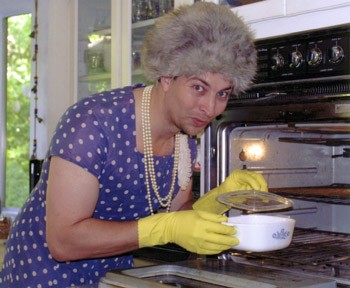
The Vagina Project is “a one-woman-man show,” a series of monologues and stories, with Cook assuming both male and female roles. “I probably do about four women,” he says. “But it’s not in drag, I don’t do any costume changes; I just sort of assume these characters.”

Writing the characters proved to be harder than performing them. “I didn’t want to write parody characters. I wanted to write comedy, so people could walk away and go, ‘Ah!’ It’s mostly finding the truth and having it be fun and entertaining. Hopefully, they forget that it’s a guy performing.”

One of the show’s more challenging segments is “Tansy,” a monologue by Boice. “It’s a black woman who is telling a story of when her husband is lynched by the KKK,” says Cook. “As an actor, that was difficult, because you don’t want to come off as Mammy or anything. I had a couple people ask me, ‘Why did you have to do a piece about a black woman?’ It’s in there because it presents a point of view–this is my experience of what it is to be a woman, just from having a mother and girlfriends and a wife and a daughter.”

Another segment, “The New Frontier of Feminism,” recounts Cook’s real-life ordeal when he was a moderator for a teen panel and “interested community folks,” one of whom accused Cook of discriminating against men. The story then weaves in the killing of Galina Starovoitova, a prominent Russian politician and human rights advocate who was assassinated in 1998. “For every laugh, I like to give a slap across the face and keep people on guard,” Cook says. “I think [the story] encapsulates different things about the truth of being a woman in America and what you’re up against.”

“The Quicker Picker Upper” segment is Cook’s take on a Hindu myth about Durga, the goddess of universal energy, who in the monologue appears in a fur hat as the consummate Jewish mother/grandmother.

Cook, 34, has been acting since he was just out of high school. Since then, he’s been in over 100 productions. He helped start Sonoma County Repertory Theatre, where he was artistic director, and he served as associate artistic director at Actors Theatre. Currently, he’s tackling four roles in two different shows, Sylvia and The Pension Grillparzer, with Summer Repertory Theatre.

“I think it’s easier for women to cross the other side than it is for men,” Cook says. “Men could care less if women cross back and forth, but a man crossing the other way faces opposition and arms akimbo and ‘How dare you think that it’s appropriate!’ I’m not doing this on behalf of all men. I’m doing this because I think it’s interesting and stimulating, and I think it’s an important dialogue to have.”

‘The Vagina Project’ by J. Eric Cook plays Saturday, July 13, at 8pm, at the Mystic Theatre, 23 Petaluma Blvd. N., Petaluma. $18. Reservations recommended. 707.765.2121.

From the July 11-17, 2002 issue of the North Bay Bohemian.

© Metro Publishing Inc.
‘Anton in Show Business’

Stage Rage 'Anton in Show Business' plays for keeps By Patrick Sullivan Is theater culturally important enough to be the subject of a play?" asks an ersatz audience member as she smashes through the fourth wall to interrogate the cast of Anton in Show Business. And the real audience can't...

‘Ansel Adams Centennial’

Afterimage Sonoma State's 'Ansel Adams Centennial' gives us the whole man By Sara Bir From malls to museums, the majesty of an Ansel Adams image is instantly recognizable: billowing clouds, shimmering lakes, and razor-sharp definition come together to form impressions of nature so pure in spirit that they...

Tomatoes

It won't be long before backyard bounties burst into ripeness By Sara Bir A tomato out of season can be a most spiteful fruit, a ghastly aberration with a mealy texture, unconvincing color, little discernible flavor, and as unnaturally hard as the ass of a woman who spends too much time at the gym on...

Open Mic

Sonoma County's water woes run deep By Shepherd Bliss Water, water everywhere," Samuel Taylor Coleridge wrote. Water is so present that we tend to take it for granted. "But not a drop to drink," the poet adds. Coleridge's words came to mind as I drove up Highway 116 in rural Sebastopol a...

‘Book of Days’

Small Town Politics: Bobby (John Wallis) and James (Matthew Hammonds) scheme and manipulate. Blank Pages 'Book of Days' has nothing new to say about middle America By Patrick Sullivan God save us from small towns. Back in the day, everybody thought these quaint little burgs...

Insider’s Guide

Our yearly Insider's Guide offers up some of our favorite places and things By Sara Bir This will be brief--because little room can be wasted when so much lies ahead. This is what we call our Insider's Guide, but the truth is that we're no more inside than you are. So here we share a...

They Might Be Giants

Giant Step It's a family affair for kooky alt-popsters By Greg Cahill Their songs often had a certain childlike charm, so when the college-radio hits dried up for They Might Be Giants, the quirky alt-pop band made a natural shift in strategy--they recorded a straight-ahead album of children's music. ...

‘K:19: The Widowmaker’

Dive, Dive Harrison Ford and Liam Neeson reenact 'Mutiny on the Bounty' on the submarine 'K:19: The Widowmaker' By Because of the breakthrough opening sequence in Saving Private Ryan, the modern war film can be a lot more frank about what happens to human bodies in battle. But other...

Affairs of the Vine’s Wine Boot Camp

Wine-Ho! A boot camp offers a crash course from vine to wine By Charyn Pfeuffer There are few true faux pas in today's society. Hardly anything is off limits, and what once may have raised eyebrows--obscure fetishes, unconventional childbirth tactics--has today become lively cocktail party chatter. But tolerance has its...

‘Vagina Project’

What's in a Vagina? J. Eric Cook's 'Vagina Project' aims to find out By Sara Bir Actor J. Eric Cook isn't trying to prove anything with The Vagina Project, only that he had a hair up his ass and that he loves women. "I call it The Vagina...
11,084FansLike
4,606FollowersFollow
6,928FollowersFollow