Valerie Brown

0

Valerie Brown’s gender may prove a nonissue

By Greg Cahill

Three weeks after the election of Valerie Brown to the Sonoma County Board of Supervisors, it is unclear what effect the first woman to hold that position in more than a decade will have on local women’s issues.

The Board has been criticized for being insensitive to a wide range of women’s issues, including sexual harassment, domestic violence, and employment discrimination within county departments.

In recent years, female challengers have been unable to unseat incumbent males. In 1995 gay rights advocate Maddy Hirchfield failed in her supervisorial bid. In his past two reelection campaigns, Supervisor Tim Smith has held off two women challengers, Noreen Evans and Maureen Casey. Veteran supervisor Mike Cale–who retired in August, leading Governor Gray Davis to appoint Brown to his seat–defeated Dawn Mittleman two years ago, and Supervisor Mike Kerns of Petaluma defeated former Petaluma City Councilwoman Jane Hamilton in 1998 to win his first term.

Coincidentally, the last woman to serve on the board, Janet Nicolas, also was a Sonoma Valley resident. She held the seat from 1985 to 1991. During the 1970s and 1980s, the board had at least two women supervisors at any given time: in addition to Nicolas, Santa Rosa’s Helen Rudee served from 1976 until 1989, and Petaluma’s Helen Putnam served from 1978 to 1984.

So the election of a woman to the board has been highly anticipated in some quarters as the Holy Grail of county politics. That anticipation heightened in the late ’90s after the county sheriff’s department and district attorney’s office were rocked with allegations of discrimination and sexual harassment in a series of highly publicized cases that resulted in millions of dollars in settlements paid out of county coffers.

Earlier this year, a federal court in San Francisco awarded a $1 million settlement in a federal civil-rights lawsuit against the sheriff’s department to the family of Maria Teresa Macias, a Sonoma Valley housekeeper slain in 1996 by her estranged husband. Macias had contacted sheriff’s deputies at least 20 times seeking help in the domestic violence case. Her death led to a shakeup in the county ranks and resulted in widespread organizational restructuring and reforms of the processes for filing a restraining order.

The settlement also marked the first time a California law enforcement agency has been ordered to make a monetary award for failing to protect a domestic-violence victim.

But local women’s rights advocates appear to be taking a wait-and-see attitude toward the newly elected woman supervisor. Local firebrand Tanya Brannan, head of the Guerneville-based Purple Berets women’s advocacy group and a highly vocal critic of the formerly all-male board, declined to comment about her expectations of Brown.

Still, Brown’s track record may speak for itself. During her seven-year tenure as a liberal Democrat in the state Assembly, she supported increased spending on domestic violence programs and often championed other women’s issues. Brown, who termed out of the Assembly in 1999, was appointed later that year by the state legislature to the California Medical Assistance Commission, a decision that didn’t sit well with antiabortion forces. In commenting on the appointment at the time, the Los Angeles Lay Catholic Mission newsletter criticized Brown for her pro-choice background and quoted one Republican operative who assailed the former state lawmaker for her “militant pro-abortion voting record.”

In addition to what the newsletter called “her rigid pro-abortion stance,” Brown infuriated some state Catholics when she carried the state bill that makes clergymen, including Catholic priests, mandated child-abuse reporters.

Brown’s male counterparts on the board also are downplaying their colleague’s gender. In a published report, Supervisor Kerns recently said that Brown’s greatest asset may be her Sacramento connections, who can help county officials navigate the labyrinth of bureaucratic red tape.

“I think Supervisor Brown will fit into the Board as a moderate, and could be a progressive on some select issues, hopefully on environmental issues,” said Supervisor Mike Reilly of Sebastopol, the board’s lone progressive. “Supervisor Brown is an experienced, pragmatic problem solver who I believe will seek to balance competing interests in her decisions. While I think she will be strong on women’s issues, the board already has established a strong direction on domestic violence and other issues of importance to women.”

For her part, Brown–who won the endorsement of the North Bay Council, a business and development group–has said she will focus first on increasing problems related to growth in the rural Sonoma Valley.

“The key to Sonoma County politics is always growth and development,” says Reilly. “We will have to wait and see what track record Supervisor Brown establishes on these issues.”

From the December 5-11, 2002 issue of the North Bay Bohemian.

© Metro Publishing Inc.

Bacon

0


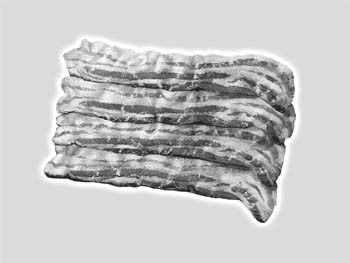
Sizzlin’: Bacon, that most un-PC of lovers, proffers a fat reward.

Baby Got Back

Confessions of a bacon addict

By Gretchen Giles

As if things weren’t bad enough already, brace your lettuce, your tomatoes, and your toasty slices of bread for yet another piece of relentlessly ugly news: We as a nation suffer somewhat silently from a bacon shortage. Retail prices have risen from an average of $2.32 a pound to over $4 as hot slices of fat and meat splatter the fiscal roof.

Commodities brokers and industry journalists blame the shortfall on the uncanny popularity of the stuff as married to cheeseburgers or in the hands of high-end chefs, who apparently sneak it into everything from fudge to ravioli. While we can all applaud the certainty that a bacon crisis has nothing to do with the nation of Islam, some analysts have pointed quavering fingers in one true direction: my house.

Ask any of the cardiologists currently camped out on my lawn, dreaming away the hours envisioning the Bermuda golf trips to be enjoyed after outfitting myself and my two children with pacemakers–we eat a lot of it. While a full 70 percent of you eschew to chew it except at breakfast, we like it three times a day, six on the weekends.

What a happy addition to soups and stews; what a delightful mouth-holiday it provides to grilled cheese; what crunchy-yummy-salty pleasure it gives to a humble pasta. And my, how we’ve grown.

With a weakening economy, things look good for the stout–and stout of heart–at the dented-can food stores, which are currently lousy with three-pound bags of bacon. No shortage there, where high-end chefs fear to tread! And no more separating the skinny fraternal line of brothered rashers–this is a melee, a free-for-all of glistening white-and-pink chewy nubs, a jolly satchel offering a cheerful surprise each time one dips in.

“Bits and ends” the packages boast, not a cheek-to-jowl jostle, but rather anonymous pork backsides begging the pan. After all, bacon as we know it here in the colonies is the plump fatty side of the swine. Canucks like the square middle of the back. Italians prefer it rolled in herbs. And my Lithuanian ex-mother-in-law took with her to the grave a field-plowing idyll that I may one day possibly be able to resurrect. The major ingredients are bacon, mushrooms, shallots, broth, wine, and butter. Is this not a poem?

The phrase “bringing home the bacon” has its own poetic origins. Allegedly born from a 12th-century English custom, great fortune was awarded that uxorious fellow who could truthfully declaim in church that he had not argued with his wife for a year and a day. Such reticence earned the good man the favor of the congregation in the form of a side, or “gammon” of bacon.

Truly, the English are to be admired for their contributions to bacon’s long and illustrious history. Is it a coincidence that both their finest statesman and finest painter shared this noble surname? I think not.

But the English don’t stop with the meat. A nation that can put chips (French fries) between two pieces of buttered white bread and affectionately pronounce it a “butty,” also indulge in that egregiously vein-clogging treat, the “dipper.”

A dipper commences when a perfectly fine piece of ordinary, and preferably stale, bread is rested in hot bacon fat and then swirled out with a fork to be eaten swiftly over the pan. Oh, the curl, the seduction, the sop, the smoke!

As a nation of deniers, we Americans yearn secretly for bacon, having eliminated tobacco, whiskey, Valium, and fresh creamery butter from the collective diet. This obsession with health inexorably leads to that exclamatory moment known as “hellwith,” when the tofu gets tossed, the cruciferous vegetables are damned, and the bulgar becomes simply too vulgar to contemplate. This Private Moment of the BLT causes much unnecessary sadness for poor North American souls.

Do we see the French doing this? Oh no, we do not. The French consume an average of 2.5 bottles of wine per day, per person. They flavor coq au vin with the coq’s blood. Parisian public swimming pools feature Gitanes burning with patient dampness at the end of their lanes. But their bacon intake? Sane, measured, comme çi comme ça, un petite peu. They allow and even celebrate their vices, consuming them in those proud measured amounts that promote long life and happiness.

It’s time to stop the madness and be more like me–an over-the-top pretend French person without a taste for chicken blood. Yes, my porcine passion is a bit de trop for the French, a decidedly more American fervor for excess, a jingoistic bent of which I’m proud.

And as our national tragedy has driven a rush to so-called comfort foods, we need to embrace the common sense that there is little food more comforting than bacon. (The key, evidently, to avoiding such unhappy words as “nitrates” is to slow-cook the strips, avoid burning them, thereby trapping whatever cancer-causing elements within.) Thus prepared, bacon is–to salute Captain Beefheart–as safe as milk.

Safe or not, I frankly don’t care. Bacon is a blood source, in the D. H. Lawrence lust-for-the-groundskeeper sense. Its grease hotly welcomes a quick chop of yellow onions and garlic, the fragrant perfume that seems sweetly and permanently to scent my hair. Creamy spinach pasta simply has no life without bacon. Corn chowder is positively vegetarian without it. Nay, clam chowder too!

The humble salad screams silently for crumbled Gorgonzola, toasted walnuts, fresh pear, dried cranberries, and the salubrious crunch of our topical friend. Green beans can be cooked and served without bacon, but the existential question remains: Why would you? That road leads terribly to cream of mushroom soup and canned shoestring onions.

Perhaps bacon’s greatest allure is in the naive innocence of the cooked stuff, be they proper rashers or the merry jumble from the dented-can store. Draining on a paper towel, unprotected and weary due to the metamorphosis from the cold and oily to the warm and crunchy, bacon trusts that it will find its way to its correct end animating soups, salads, sandwiches, and stews.

How is such faith rewarded? By being pinched savagely up and eaten whole, on the spot, over the kitchen sink. Few of us deserve this responsible cooking honor and far fewer nibs, bits, rashers, or strips survive it. But as my inner French woman would murmur, delicately wiping spots of grease from her chin, “C’est la vie.”

From the December 5-11, 2002 issue of the North Bay Bohemian.

© Metro Publishing Inc.

‘Solaris’ / ‘Daughter from Danang’

Lost in Love Space

‘Solaris’ and ‘Daughter from Danang’ take different paths in search of past ties

By

This week and next, theaters offer two serious warnings against idealized love: the highly recommended documentary Daughter from Danang, and the feature film Solaris, which I can’t urge on anyone. Both suggest that love is a fiction that we weave around someone lost or unknowable.

Solaris is Steven Soderbergh’s remake of the 1972 Russian cult classic. It features George Clooney as Kelvin, a scientist of the near future. After three bleak years grieving for his dead wife, Kelvin is ordered to space station Prometheus, in orbit around the planet Solaris, where an exploration mission has gone drastically wrong.

Kelvin hears cryptic warnings of trouble from the survivors. Solaris, a blurry, blue orb, manifests lost loved ones by reconstituting them. Shortly, Kelvin’s dead wife, Rheya (Natascha McElhone), appears at his bedside alive, happy, and simple-hearted, as she wasn’t in life. Kelvin fears a trick, a psychological weapon, as anyone might who’s read Ray Bradbury’s Mars Is Heaven or seen various knockoffs of this story on Star Trek. It’s a science-fiction plot so familiar its next destination ought to be Futurama.

In flashbacks, we see how Rheya and Kelvin found and lost each other. The couple squabbled. She was fatally depressed, her religious faith mocked by Kelvin’s cynical friends. Now that Rheya’s back, Kelvin’s uncertainty makes her question her own existence. Since Solaris–acting out of mercy or malice–can only reconstitute Rheya from Kelvin’s memories, the new creature is confused. She realizes she’s composed out of a string of incidents and has no inner life (“I’m suicidal, because you’re remembering me as suicidal”).

In Daughter from Danang, the lost woman who rematerializes is the Vietnamese birth mother of an adopted girl. Brought to America in 1975 as part of Operation Babylift, Heidi Bub grew up in Tennessee and South Carolina. Heidi’s new mother urged her adopted daughter to keep her Eurasian-ness a secret. After a seemingly permanent break with her adopted mom, Heidi travels to Vietnam to visit her real mother, Mai Thi Kim.

Bub is a chubby, guileless Southern woman who had probably never seen a spring roll in her life. Arriving in the land of her birth, Heidi can’t match her happy, vague childhood memories with the crowded city and its overwhelming heat. As we see Vietnam through Heidi’s eyes, we hear Mai Thi Kim’s tale. During the war, she had to concubine herself to survive after her husband went to fight with Ho Chi Minh.

What follows isn’t a hugfest. Mai Thi Kim is deluded too. She has an unreal vision of her daughter’s life that has sustained her during the hard years. Mother Mai makes the assumption that every American is rich. Bub certainly isn’t; she’s married and lives in Navy housing in Rhode Island.

Naturally, Mai assumes that Heidi is going to be the angel who will help her long-lost family. Since Heidi doesn’t respond to hints, the family has to get a little more insistent–you are taking Mom back to America, aren’t you? You grieve both for the hardships of Bub’s Vietnamese family and for Bub’s good-hearted American ignorance.

Solaris probably deserves a few tears of frustration too for its noble but doomed attempt to re-create director Andrei Tarkovsky’s chilly style. Clooney is one of the few actors with the old-movie confidence and handsomeness–the American-ness–to carry a romance. But it’s hard to look at Clooney and fear for his rationality, as you must for Kelvin’s.

Soderbergh uses McElhone’s Bette Davis eyes for their uncanniness, not for the usual glamour. Still, McElhone doesn’t suggest hidden reservoirs. The two leads never seem to click. Of course, this may be deliberate; just because Kelvin loves Rheya doesn’t mean she has to be profound, or even real.

Solaris and Daughter from Danang draw their power from that emotion felt in our dreams–that 3am recollection of unfinished business with the dead–with lovers or family who are out of the picture and aren’t coming back. At their most pessimistic, these films indicate that love boils down to guilt. Clooney surrenders to the gravity of guilt, in accordance to Tarkovsky’s Russian fatalism. Yet that surrender is given an upbeat, feel-good note: it’s a wonderful afterlife. Heidi Bub, in contrast, frees herself from her dreams at a painful cost, and it’s her story that seems the most jagged and authentically sad.

‘Solaris’ opens Friday, Nov 29. ‘Daughter from Danang’ opens Dec. 6 at the Rafael Film Center.

From the November 28-December 4, 2002 issue of the North Bay Bohemian.

© Metro Publishing Inc.

Mirepoix

0

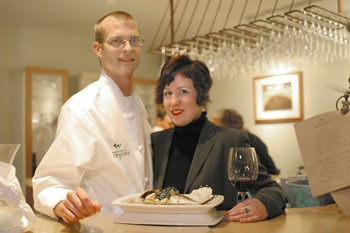
Media Frenzy: Mirepoix wins, thanks to chef Matthew Bousquet and hostess Bryan Dempsey.

Do Believe the Hype

Is Mirepoix really that good? Yeah!

By Sara Bir

If you want to skip to the nut of this review right now, at this very instant, go to paragraph five. Oh–you’re still here? Good for you! In order to fully understand why Mirepoix is worthy of attention, it’s important to know that the Datebook section of last Wednesday’s Chronicle had a sizable article about the so-called Nordic rock invasion.

Have you heard about this Scandinavian pop takeover? The Hives, the (International) Noise Conspiracy, the Hellacopters, and a whole bunch of other bands from Europe’s great white north have been putting the ROCK back in rock.

One band in particular, Sahara Hotnights, keeps creeping up in glossy magazines and shoddy newsprint. They sounded promising–four young and attractive Swedish girls who play Ramones-y rock and roll–and when the chance arose to see them play live, I was pretty excited.

The sold-out show in San Francisco was OK, but something was lacking. After all of those hyping blurbs, there was no way the girls could have met my bloated expectations. I got bored with their sincere but formulaic 4:4 shout-alongs after five songs.

Much-praised restaurants fall prey to that pattern too, just like bands. Ever read a luminous review of a place only to eat there and have your high hopes dashed bite after overpriced bite, and to discover that the place is only OK? Is “just OK” now acceptable as “stupendous”? It’s frustrating to pay 20 bucks for an entrée that is underseasoned, overcooked, or unevenly conceived when better, less high-concept food is available elsewhere for a much more agreeable price.

But take heart, for this is not always so. At least two other reviewers have so far bestowed accolades upon Windsor’s Restaurant Mirepoix. According to the other, more timely reviews (which I only read after eating there, so as not to be swayed by the media hype), Mirepoix is smashingly excellent in almost every aspect: food, service, all that.

And yes, after going there ourselves, we found that it is that good, and consistently good, each part of each plate, and all of the things that bring them there.

Mirepoix is housed in the very spot that once held the much-lauded Mariposa. A dear friend told me repeatedly that Mariposa was the best restaurant ever. I never made it over there myself, since I could only afford to eat grits at the time, but I trust him.

This cult of jilted Mariposa lovers, with torrid dinner encounters there still fresh in their memories, means Mirepoix has a lot to live up to. Bryan Dempsey and chefs Matthew Bousquet and Greg Houhoulis are doing a fine job of fulfilling the expectations of excellence implicit in the location while recasting the place in its own unique image.

Mirepoix (a French term for the mixture of onions, carrots, and celery used to add flavor to countless soups, stocks, sauces, and braises) does sound very similar, as a name, to Mariposa. The restaurant itself is tiny and looks more like a well-heeled but unassuming house than a font of gourmet dining. Inside, it’s stylishly subtle and comfortable, with white walls and steel-gray banquettes that echo the cool, smooth slate inlay on the tables.

The amuse-bouche, a purée of white root vegetables with clove oil and small cubes of honeyed turnip, sang with flavor, allowing the too-often lowly winter root vegetables to shine with their true, sweet character. If this soup had a school portrait, I’d carry it around in my wallet and look at it for a quick perk when I was down.

A bowl of mushroom-potato potage with crème fraîche, lardons of bacon, dry aged jack crisp, and garlic chips ($7) was dark, velvety, refined, and balanced, with the mushrooms creating the soup’s backbone rather than bludgeoning the integrity of its other components–almost. What with the crème fraîche and bacon, it was too rich and intense to finish, which was saddening, because it was so wonderful.

The mixed baby greens salad with goat cheese fritters, fresh herb vinaigrette, and balsamic syrup ($7) was equally indulgent but less cloying. The vinaigrette dressing on the greens exploded with flavor, while the fritters–which were almost more like pillowy croquettes–still rang with the delicate tang of goat cheese after deep-frying.

Mirepoix’s entrées leaned heavily toward seafood that night, with three out of five originating from the water. The adventurous sort can spring for the roasted daurade in saffron broth with truffles, glazed rutabaga, pearl onions, wilted spinach, and mashed potatoes ($20).

Daurade, sometimes called dorado, is a bony fish with white, flaky flesh. It has several rows of bumpy little teeth studding its jaws, which you get to see up-close since it’s served whole in a generous pool of what resembled a sauce more than a broth. Saffron permeated the daurade’s fishy flesh, and the flavors of all the other goodies on the plate melded together in a refined-rustic way–except the mashed potatoes, so rich were they with fatty dairy goodness.

Order the roasted pork loin with vanilla-mustard sauce ($18), and order it medium-rare (thank you). Lean but moist and bright-tasting from brining, the pork wielded gentle notes of autumn spice that were echoed in the sour-sweet braised cabbage with figs and fuji apples. Hiding underneath this all was a disk of potato-cheddar gratin that had been assembled with generous amounts of very good and very pungent Redwood Hill Farm goat cheddar (the cheese maker herself, we later found out, was dining alongside us that night). Every potato should hope to meet such a glorious end.

The wine list is, for a place so swanky, on the short side, since Mirepoix is too small to allow for much storage. The regular wine list is well-chosen, with lots of local representation from the Russian River, Dry Creek, and Alexander valleys in particular. That list is augmented with a “Bookmobile list,” the idea being that it’s an ever changing supplement to their wine library. For a refreshing stray from the California norm, try the slightly cedary Boncaillou le Rouge 2000 from the Corbieres region of France ($22 bottle; $6.50 glass), which is served slightly chilled and pairs ideally with the lighter meats on the menu.

Mirepoix has butterscotch pudding. I am assuming this is good stuff, because (a) it’s butterscotch pudding, and (b) they were all out the night we went. So instead Amie du Jour and I shared a saddened chocolate cake ($6). The sad little cake resembled so many of the now standard warm chocolate cakes from so many other restaurants, but it made us happy.

With the exception of a tiny incident involving spilled saffron broth, our server was attentive and courteous, and the dishes emerged from the kitchen perfectly paced. We felt taken care of but not fussed-over.

Dempsey, who oversees the front-of-the-house operations, regularly floats from table to table, delivering explanatory spiels about the wine list and the menu, and her liaison efforts do keep the show running smoothly. Some might see this as clingy, but we were never in need of anything or left waiting for a spoon or more water or another glass of wine.

I’d go to Mirepoix again in a heartbeat. Their dishes are lively, but it’s the food itself that’s inspired, not the elaborate wording of the menu. So often menus at other, potentially recommendable fine restaurants promise the sky and fail to deliver.

Mirepoix might not be hyped as much as Sahara Hotnights have been, but I know whom I’d much prefer to spend an evening with–and it’s from Windsor, not Sweden.

Restaurant Mirepoix, 275 Windsor River Road, Windsor. Dinner, Tuesday-Saturday. Reservations encouraged. 707.838.0162.

From the November 28-December 4, 2002 issue of the North Bay Bohemian.

© Metro Publishing Inc.

American Security and Civil Liberties

Let Freedom Reign

More Americans are willing to trade freedoms for security

By Joy Lanzendorfer

The terrorists hate our freedoms: our freedom of religion, our freedom of speech, our freedom to vote and assemble and disagree with each other. –President George W. Bush, Sept. 20, 2001

On Sept. 11, 2001, America awoke to its vulnerability. Dangers previously associated with foreign nations were suddenly in our midst. Deliberate attacks targeting the most innocent of citizens and news of constant violence overseas continue to be reminders of our newfound weaknesses. Fear has infiltrated the nation, lurking in the back of people’s minds. A shadowy enemy could be anywhere and could attack at any time.

A cry for new security measures followed the 9-11 attacks, and the government responded by passing a flood of new laws and policies, many of which impinge on our civil liberties. So, for the first time in generations, Americans are faced with some uncomfortable questions: Should we give up personal freedoms to ensure security? Is our society too free?

A new survey indicates that a sizable number of Americans believe that the answer to those questions is yes. One in two Americans think that the First Amendment gives us too much freedom. That and other survey answers indicate that we may be becoming ambivalent about our liberties, especially when it comes to the war on terror. Governmental intrusions are becoming accepted as a necessary measure. Last week, two separate appeals courts made decisions that grant the Justice Department the ability to use wiretaps and allow police to obtain e-mail messages of accused criminals.

While many of us seem unsure about our civil rights, there is a growing concern that laws and policies adopted since Sept. 11 erode the very foundation our country stands upon.

The fifth annual State of the First Amendment survey was given by the First Amendment Center near Washington, D.C., in collaboration with the American Journalism Review, and conducted by the Center for Survey Research and Analysis at the University of Connecticut. The survey polled 1,000 people by telephone in June and July.

The survey has been conducted yearly since 1997. Though the number of us willing to restrict some civil liberties jumped this year, over the past few years the center has seen a trend among the population toward tolerating restricted freedoms. For example, in 2001, 39 percent of people surveyed thought the First Amendment gave too many freedoms, compared to 22 percent in 2000.

Tiptoeing through Land Mines

“This attitude toward the First Amendment has been building for a while,” says Gene Policinski, deputy director of the First Amendment Center. “In the last couple of years, through the surveys and additional focus groups, we have seen a growing sense among Americans of wanting to avoid offensive language toward other groups. And then this year, because of Sept. 11, people are more afraid of terrorists and are more willing to restrict freedom based on that as well.”

In the past, more Americans have said that they would be willing to exchange liberties for less interpersonal conflict. This year, political correctness–or at least sensitivity to other groups–still influenced answers on the survey.

Two-thirds of those polled said they would restrict public statements that might be offensive to certain racial groups, and over half rejected the right to display offensive art in a public place. Yet nearly 60 percent thought it was OK to make public statements that are offensive to certain religious groups, and another 60 percent thought that musicians should be allowed to sing offensive songs.

The American view toward freedom of religion, particularly Islam, remains mixed. Americans support the right of Muslims to rally for causes that may be offensive to other groups. But on the other hand, 42 percent said the government should have more power to monitor Muslims than it should have to monitor other religious groups.

“Here’s where the fear comes in,” says Policinski. “People would allow the government to monitor Muslims more closely than they are allowed to monitor anyone else, which seems like an anti-Islamic statement. Yet they are also willing to allow Muslims to hold rallies. Well, a rally is a public event and you can see what’s going on.

“While Americans generally respect other groups,” Policinski adds, “there is also a fear of the unknown lurking here, which is probably related to terrorism.”

Of the five freedoms presented in the First Amendment, the freedom of the press was the least popular. While an overwhelming number (94 percent) support the right to say something offensive and three-quarters consider the right to free speech essential, almost half said the press has too much freedom in the United States.

While 57 percent think that newspapers should be allowed to criticize the U.S. military about the war on terror, 48 percent said that the press is too aggressive in asking officials for information on terrorism. Yet, most of those polled wanted more access to all kinds of information.

So although we support freedom of the press and access to information in the abstract, we seem unhappy with the press’ actual conduct, explains Policinski. The numbers from past surveys indicate that this may stem from leftover sentiments from the 2000 presidential election, where incorrect early projections and other blunders shook the public’s general trust of the media.

Aside from the view of the press, Americans seem to hold more than one contradictory belief about the First Amendment. Some of this may be due to a general lack of education. The majority finds current educational levels of civil liberties to be inadequate. Of those surveyed, 63 percent said the school system was doing a “fair” to “poor” job of teaching the First Amendment to students.

The survey itself seems to back this up. Roughly 60 percent of those polled could only name one of the five freedoms guaranteed under the First Amendment: freedom of speech. After that, only 18 percent could name religion, and very few could name the other three, which are freedom of the press, the right to peaceable assembly, and the right to petition the government.

“Americans know their major rights in general,” says Steve Estes, a history professor at Sonoma State University. “They may know that they can sit on a stump in the middle of campus and say what they think, but they don’t always understand the legal ramifications of laws that are passed.”

The survey’s message is that while people generally support the abstract idea of rights, they may not support or understand the actual application of them, and therefore may not always recognize when those rights are being violated.

“Americans are upset about their civil liberties, but they don’t really seem to know what it is they are upset about,” says Policinski. “The combination of fear and a lack of information leaves the circumstances vulnerable to exploitation, since in this current situation, Americans are unlikely to question if their liberties are being threatened.”

Playing to Fears

A few days after Sept. 11, government leaders, presenting themselves as a united front, passed a rash of new laws and policies without a lot of debate. The Lawyers Committee for Human Rights, a 25-year-old nonprofit and nonpartisan human-rights organization, recently released a report looking at the implications of these new regulations. While the organization calls some of the laws “smart, right, and inevitable,” it says others have eroded or disregarded some of our basic liberties.

“Taken incrementally, none of these new tactics look that bad, but when you start to connect the dots, a new picture emerges,” says David Danzig, spokesperson for the LCHR. “The new picture shows that some of the rights that we once thought were untouchable are now being taken away.”

Danzig is quick to point out that not all of the new regulations are bad. Many of the new laws pose no threat to civil liberties, from providing police and intelligence agencies with state-of-the-art computer technology, to enhancing coordination and communication among law enforcement agencies, to increased security in public buildings.

But according to the LCHR, other regulations do violate some of the basic civic virtues taught in American middle schools today. The areas that are threatened include the balance of power between the three branches of government, the openness of the government, the right to a hearing before a judge and access to legal council, the right of privacy, and the idea that immigrants are “persons” under the Constitution and have certain basic rights.

Directly after Sept. 11, Attorney General John Ashcroft issued new regulations allowing federal officers to carry out surveillance on pretty much anyone they want without the slightest suspicion of wrongdoing. Activities like Internet surfing, for example, can now be used to generate suspicion of criminal activity, where before it was reversed. An individual had to be suspected of a crime before the government could use Internet surfing as a way to track illegal behavior.

In addition, there’s the Terrorism Information and Prevention System, or Operation TIPS, which is slated to recruit 11 million civilians with contact to people’s homes–such as delivery truck drivers, mail carriers, or your cable delivery person–to encourage them to report any “suspicious activities.” The Pentagon’s Defence Advanced Research Projects Agency has just introduced the Total Information Awareness program, which aims to be a repository for huge amounts of personal information.

Another trend with dark implications is the right of the government to detain people for extended periods of time without filing charges. Noncitizens suspected of terrorism can be tried in military tribunals–without a jury or public hearing.

After Sept. 11, more than 1,200 immigrants were detained by the Department of Justice, many of them longtime residents, taxpayers, and some married to U.S. citizens. Of that number, 129 were held on criminal charges. After Nov. 8, 2001, the Department of Justice said that it would no longer release the number of individuals detained.

“Too often the way the government is approaching this problem is curtailing our rights without making us any safer,” says Danzig. “Of the 1,200 immigrants that were detained after Sept. 11, very few were charged with anything. So here you have this massive violation of human rights, and it didn’t even make us any safer.”

On top of the 1,200 immigrants are the approximately 600 suspected Taliban and al Qaida members being held at Guantanamo Bay in Cuba, who are from more than 43 countries and who are being held without any outside communication with the world.

All-Seeing Eyes

The government has also seen fit to find new ways to gather information on citizens. Librarians may now be forced to hand over records of what their patrons are reading. In some cases, federal officials can monitor communications between lawyers and their clients. The government’s ability to conduct secret searches has also been expanded. Ashcroft can now designate domestic groups as terrorist organizations and can deport noncitizen members of the group.

And the list goes on.

Some argue that the liberal language of the Constitution allows for a fluid approach to rights. A lack of definition of critical terms used in the Constitution (what does it mean when the Bill of Rights talks about “due process of law” or “unreasonable” searches and arrests? for example) leaves them open to interpretation by the courts.

And the decisions of those courts are meant to change with the times, especially during wartime or national crisis. Thus, this line of reasoning goes, during war it is normal for rights to be curtailed; we should expect our government to be more active and to step-up security.

“Well, given the horrors that happened on Sept. 11, we wouldn’t expect our government to have its head in the sand,” says Danzig. “Some of the actions it has taken have been right and justified. But that doesn’t mean we shouldn’t still be cautious when it comes to something like our liberties. In times where the U.S. has removed rights, history hasn’t looked too favorably upon it.”

History in the Making

There have been many precedents for today’s civil rights curtailments. Abraham Lincoln, for example, suspended civil rights during the Civil War, specifically habeas corpus, which protects Americans from unjust imprisonment. During World War II, Japanese-Americans, most of whom were American citizens, were held in internment camps.

“Historically, civil rights were curtailed when we were threatened from abroad and felt fearful and helpless, much how we feel right now as a nation,” says SSU’s Estes. “It happens less when the nation is actively at war because then we feel like we’re doing something.”

Perhaps the most apt comparison to today’s situation is the Red Scare of 1919-1920 and the 1950s. America suddenly became aware of an insidious enemy lurking in its midst–communism. Then as now, the government took unprecedented actions in investigating those suspected of aligning with the enemy.

During the Red Scare of 1919-1920, Attorney General Mitchell Palmer and his assistant, a young J. Edgar Hoover, enacted the Palmer Raids. Officials rounded up and arrested thousands of immigrants, similar to what the Department of Justice has recently done with the detainment of 1,200 immigrants.

Historically, laws restricting civil rights have not been permanent but can sometimes remain on the books for years, often until there is another crisis that calls for re-examination of those regulations. Cold War legislation, for example, stayed on the books until after Watergate in the early 1970s, when new distrust of U.S. leadership led to a reinvestigation of the government.

The historical precedents, the fearful atmosphere, the attitude some Americans have about civil liberties, and the lack of debate over new policies and laws could be adding up to a serious problem in the future.

“We’re also concerned because this appears to be the beginning of something,” says Danzig. “The war on terror is not likely to end soon, and if the government has curtailed freedom this much this quickly, what is going to happen in the future? This mode of operation will continue unless people start to say it’s wrong.”

From the November 28-December 4, 2002 issue of the North Bay Bohemian.

© Metro Publishing Inc.

Nicolas van Krijdt

0

Heavy Metal

Nicolas van Krijdt’s ‘Inland Ocean’ not for those afraid of the water

By Gretchen Giles

Students wandering the dry, brineless floor of Santa Rosa Junior College’s Herold Mahoney Library on the Petaluma campus may be surprised to learn that they’re actually navigating an ocean. But when they look up from their studies, the sealine is clearly demarcated in a stream of pages from a disemboweled reference book.

The parchment-and-string vessels that float its airy waters hang high, borne up to the firmament on tall, highly polished steel stands. And sometimes, when the artist is there, this buoyant project sings an eerie cello sound that harkens the high chirps of whale and dolphin calls, the deep sad bass of sonar, and the metallic rasp of airplane wire.

For his conceptual installation The Inland Ocean, exhibiting through Dec. 20 at the Petaluma SRJC library, Petaluma sculptor Nicolas van Krijdt has created an experience in which he’s aimed to stimulate every sense except smell–and that’s a “yet,” according to van Krijdt’s own laughing admission.

Primarily a minimalist sculptor, van Krijdt shines very brightly right now, having just finished a prestigious commission for Santa Rosa’s new Vineyard Creek Hotel, Spa, and Conference Center, and an arch for Petaluma’s McNear Park. He’s also just finished six months designing a prototype for the Pentagon monument to 9-11 featuring an obelisk tragically tilted from the earth, angled so that each Sept. 11 at 9:37am, the time the Pentagon was hit, the sun would strike a steel shadow. Though his design was ultimately not accepted, this maquette nonetheless lead van Krijdt further down his own thoughtful road to a deeper level in his work.

Meticulous in concept, construction, and finish, The Inland Ocean is designed to be both an homage to the library within which it sits and to rock us in the unconscious arms of the invisible sea that salts us all.

If this all sounds like heady stuff, that’s because it is.

The Mahoney Library features large, mullioned windows and curved inside arches. New housing subdivisions can be seen roughing the south field and a row of yellow-leafed trees mask the eastern side. On these windows’ sills, van Krijdt has very quietly placed his own houselike or chairlike vessels, reflecting his private, inside world against that which was constructed by humankind on the outside. The north wall is hung with his handsome encaustic panels, each featuring a dictionary definition for such verbs as “start,” “think,” “build,” and “see.”

The sealine itself is made solely from one ’60s-era reference book that patiently explains the countries then composing the United Nations. By a coincidence pleasing to van Krijdt, the book begins with Afghanistan and ends, due to space strictures on the Mahoney walls, with the Persian Gulf, both places often in today’s news.

Wherever mention is made on these pages of libraries or museums, van Krijdt has pinned the rasp of a long contiguous piece of string. From the linear “notation” of the strings’ progress, he and his studio assistant Joseph Ramey have composed music.

Using the arbitrary decision to highlight centers of art and learning through language to create music, van Krijdt–who with Ramey will perform his piece on Dec. 6–works instead with sound and form in order to reject standardized speech and linear thought. If the sea as an overall metaphor for nature is a beautiful, utterly ordered chaos that is perfect unto itself, why even rely on our ordinary constructs of communication? They’re flawed, cause confusion and unhappiness, and even prompt wars and death.

On Dec. 6, armed with cello bows, the pair will haul two special vessels, each formed in van Krijdt’s distinctive canoe shape, to the Mahoney. One is of finely burnished steel, so delicate that a hand’s rough sweat discolors it; the other is of thick, rusted, corporeal steel. Each is tightly strung with airplane wire, which is used both to hold the vessels together and to act as a musical string.

Utilizing the delicate one, van Krijdt will make music based on the wall strings’ notation; using the rusty one, Ramey will make music using the relentless march of an ordinary wall clock. Time is essential to nature, van Krijdt insists, yet this too is something that we strive to codify and contain with little success.

But what does all this nonlinear thought sound like? Dec. 6 awaits.

‘The Inland Ocean’ shows through Dec. 20 at the Herold Mahoney Library, SRJC Petaluma campus, 680 Sonoma Mountain Parkway. A special reception is slated for Friday, Dec. 6, from 5-7pm. Admission is free. Library hours are 8am-8pm. 707.778.3974.

From the November 28-December 4, 2002 issue of the North Bay Bohemian.

© Metro Publishing Inc.
LiveWire Literary Salon

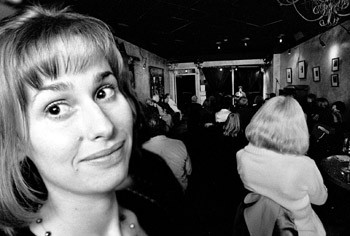
All Lit Up: Jordan Rosenfeld is the powerhouse behind the LiveWire Literary Salon at Zebulon’s Lounge.

On the Write Path

Jordan Rosenfeld’s LiveWire Literary Salon hits a nerve

By Davina Baum

Jordan Rosenfeld is a writer, make no mistake about it. And she likes it that way. A few thwarted lit mag attempts and a postcollegiate stab at massage therapy haven’t distracted her from her one true path, and she’s now perfectly happy to claim her rightful place in the pantheon.

That’s where the path gets thorny. Because although competition may be tough in the world of massage therapists, writers are granted a special place in professional hell. But Rosenfeld has a passion, and she’s determined to see it get somewhere.

Her latest endeavor, successful by any standard, is the LiveWire Literary Salon, ongoing biweekly at Zebulon’s Lounge in Petaluma. It’s a classy affair–Zebulon’s being a classy place–and Rosenfeld has put her personal imprint on the event. Each evening has a theme–from “Split at the Seams: Humorous Writing” to “Blurred Edges: Where Truth and Fiction Meet”–and Rosenfeld curates the events as if they were each an individual exhibit.

The 28-year-old Petaluma resident is one of those people who has wanted to be a writer her whole life, though at eight years old she thought of herself more as an authoress–conveying more nobility, certainly. Her life is a study in the serendipitous turns a dedicated writer takes on that labyrinthine path to book publication.

In college at Sonoma State, Rosenfeld tried other things, just to make sure she was on the right track. She finished three-quarters of a minor in communications, and hated it. She toyed with the idea of getting a masters in journalism but found that the imagination was a more powerful tool than the facts. “I find I can tell a real story better when I can switch the details around,” she says. So massage therapy became a way to support herself as a fiction writer.

Rosenfeld is a doer: she likes to have irons in every fire, hands in lots of pots, trains in every station. After graduation, she and a friend started a magazine called H.E.R. It suffered that specific anemia so familiar to starry-eyed editorial types: too many story ideas, too little money. After two issues were published, the venture folded. She caught the bug, though: “I got a taste of creating something. . . . It gave me access into a world that I hadn’t had access to.”

A few more failed attempts at publishing ventures didn’t faze Rosenfeld; after all, writers are a resolute breed, and fallen journals are like prison tattoos–a mark of pride. “I always have longed to start and create something that’s mine, that’s contributing to culture and literature,” she says, “particularly literature because that’s my bent, and I just never have been able to pull it off, because no one ever has the money.”

Perhaps LiveWire is her pulling-off. It’s been going–and going strong–since August. Rosenfeld came to Zebulon’s via a typically Rosenfeldian route: a combination of serendipity and tenacity. She was selling her homemade jewelry at the Petaluma Farmers Market, and she started talking to Karen Ford, co-owner with Trevor Cole of Zebulon’s. Ford told her about the plans–good jazz, wine, art, and atmosphere–and Rosenfeld asked if they planned on doing literary events. Ford said probably, yes, and then Rosenfeld “completely forgot about it.”

After Zebulon’s opened, she strolled in one day and asked Cole about the literary possibilities of the space. “He looked at me like I was the archangel come to save him,” she laughs. “They had a literary event started and the guy who did it completely dropped it. But the calendar was all planned, the next event was two weeks from the day I walked in, and I said, ‘OK, I’ll get something together.'”

So Rosenfeld sent out an e-mail to every writer she knew and tapped into that vast network of Sonoma County writers. Within two days, she says, she had about 300 e-mail addresses which she used to send out a call for readers. It took her three days to sort through the responses.

The readings are structured around themes. An environment was what she was after–and the owners of Zebulon’s were on the same environmental page, as it were. “They wanted to create an ambiance and a place with a vision, and I feel the same thing about a reading–it should have a feeling to it.”

The first night was titled “Tall Tales and Short Stories,” and featured writers Terry Ehret, Bebek McGhee, Chris Mastin, Liz Hannon, and Rosenfeld. The event drew more people than she, Ford, and Cole had expected. Somehow, Rosenfeld had hit upon a need.

Rosenfeld sees that need as the intersection of two worlds: the obscure yet active writer “who’s at home struggling, maybe in writers’ groups, maybe goes to writers’ conferences,” and the regularly published writer. “What about the entire world in between?” she asks.

Rosenfeld, who has had a few pieces published but not a book, relates to that in-between world. “What if I never make it? What if I sell one book, and that’s it and my tour is over and no one ever hears about me again?” It’s a worry familiar to any writer. So in creating this space where writers can feel confident and in good company, and where they can get up on the stage–which can be quite empowering–and read their work, Rosenfeld plays not only to her own needs but to those of a community.

The need is there not only for the readers but for the listeners too. Zebulon’s is a sublimely calm place, its soft lighting playing with the brick-colored walls and the sparkles enameled into the tables. LiveWire is free, meaning the $6 entry fee you might have paid elsewhere can go toward a luscious glass of wine.

And LiveWire doesn’t get in the way of Zebulon’s promise of nightly music; the Emmanuel Vaughan Lee Trio follow LiveWire at 9pm on Tuesdays. The themed evenings allow listeners to sink into the atmosphere, as if in an underwater snorkeling adventure. Each reader is bound to have a different style, and not all will play to the listener’s tastes. But the overall effect is of a sea of tropical colors.

The North Bay is awash with writers, and the stage at Zebulon’s has been graced by some of the brightest lights in the North Bay literary community. Susan Bono, Jane Love, Dan Coshnear, Michele Anna Jordan, Rebecca Lawton, and Jonah Raskin are only some of the familiar names who have appeared. Each evening is carefully calibrated to adhere to the theme and to introduce a number of writers, six or seven at the most. Rosenfeld admits that she has high standards in choosing the writers, but she’s aware of differences in experience.

“I like the atmosphere where you come in and you have seven readers,” she says, “and two of them are less polished or a little rough around the edges, and a couple of them are really stellar. . . . I think sometimes it makes the polished stuff shine more brightly, and sometimes it makes the raw stuff–you see the potential in it. I like that rugged juxtaposition of kinds of writing.”

As a writer with ambition, of course, Rosenfeld doesn’t intend to shepherd other writers to greatness while she sinks into Zebulon’s booths. Rosenfeld describes her style as being “on the ornate side”–and she has big, unformed plans. She wonders out loud about being able to put together an anthology of LiveWire readers or a small journal. “My goal now is to keep it alive and to keep interesting topics, readers, and audiences.”

In the meantime, she’s just “won” National Novel Writing Month by writing a 50,000 word novel in 30 days, she’s dealing with the hoards of publicity hounds that LiveWire has unleashed on her, and she’s planning the next few months’ worth of salons. She also edits the fiction section of Word Riot, an online literary magazine, and conducts an editorial consulting business.

In a world where writers so often labor at uncreative day jobs, Rosenfeld has finagled an impressive synthesis. “I have been wanting for a really long time to have my work life and my writing life merge in one way or another so that everything I do is writing-related.”

Take heart, writers: tenacity pays off.

LiveWire is two to three Tuesdays a month, 7-9pm, at Zebulon’s Lounge, 21 Fourth St., Petaluma. 707.769.7948. See www.thewritelife.com for a full schedule of upcoming readings.

From the November 28-December 4, 2002 issue of the North Bay Bohemian.

© Metro Publishing Inc.

Hassel Smith

0

Smith and Messin’

Two exhibits to thrill and delight

By Gretchen Giles

Hassel Smith at SCM

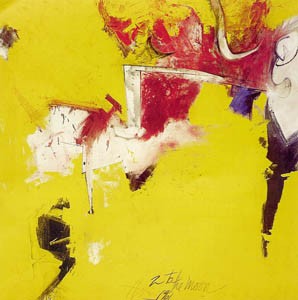
My paintings are intended to be additions to rather than reflections upon ‘life,'” the artist Hassel Smith wrote in 1952. And indeed, a good, long look at the muscular and joyful works on display at the Sonoma County Museum remains a definite addition. Intended as a mini retrospective and titled “Hassel Smith: 55 Years of Painting,” this exhibit, showing through Jan. 26, also focuses in great part on the years 1953 to 1959 that Smith spent living and painting in Sebastopol. Now 87, Smith resides in England, but while he was in the Bay Area, he and such colleagues as Clyfford Still and Richard Diebenkorn helped to change painting forever.

Seemingly as fresh and lively today as when they were painted, the pieces in “55 Years” fill all three exhibition spaces of the museum with stages and periods of Smith’s oeuvre, from the oversized abstracts of his years at the California School of Fine Arts (now the San Francisco Art Institute), to the drawings he rendered as a young socialist working for the New Deal, to his pop-art phase–even allowing a rare look into more current work such as the return to abstraction heralded with Nil by Mouth (1997).

To represent or not represent seems to be the question, one that Smith hassled with throughout much of his career, his canvases veering from the nonobjective to the figurative to the nonobjective with figurative elements. Culled from collections around the nation, most notably John Natsoulas’ gallery archive in Davis, this is an uneven show. Superbly moving works are hung alongside pure head scratchers (and yes I mean the odd pin-up juvenilia of Leda and the Swan). But perhaps that too is consistent with the painting labor of 55 years; no one hits it out of the park every time.

The main gallery on the bottom floor is the chief attraction of this exhibit, the canvases literally pulsing with paint and movement and color, and a real masculine juice. Now, journalists aren’t supposed to admit that they get their ideas from publicists, but SCM publicist Ariege Arseguel nonetheless put it best.

“Do you remember the old San Francisco Museum of Modern Art?” Arseguel asked. I nodded. “Remember how it was downstairs off of Van Ness and was sort of dark, with that great modern art on the walls?” More nodding. “This,” she said, sweeping her arm to the Smith-filled room, “reminds me exactly of that.”

Me too. Just as one stooped downstairs to visit the old SFMOMA, coming off the glare of the street into a mostly testosterone-fueled underworld of free thought, here one climbs up from the glare of the street to the wooded excesses of the SCM to discover an upper world of testosterone-fueled free thought. There remains an excitement to Smith’s paintings that is reminiscent of the near-illicit pleasure of peeking into the vigorous modern work that the SFMOMA used to house in a basement, one that is enduringly lovely to behold.

Perhaps most exciting of all, this is exactly the kind of exhibit that the SFMOMA might mount, basement or not, and with nary a bridge to cross.

SSU’s Voice of the Trees

This column might more appropriately be titled the “Six Degrees of Schwager,” as Sonoma State University art professor Michael Schwager both sits on the board of the SCM and is the director of the University Art Gallery, now showing “Wood: Six Artists/One Medium” through Dec. 15. Whatever his contribution to the Smith exhibit, he is to be lauded for continuing to bring the routinely splendid to his own gallery.

Perhaps the first sense to be awakened in the gallery’s airy space is that of smell. Fresh, fragrant tree sap defines the air, while the many uses of timber are staggeringly delineated in the rooms. Swiftly second in sensual perception is Jeff King’s reappropriation of trees, sliced as thinly as wooden prosciutto and then reformed into a massive x, the full hollow of a fallen tree (Empty Log) or a giant’s tire swing (Erso). The late Alvin Light has rough-cut his wood (Untitled), in some places lusciously impastoed with paint, into an upward yearn that bespeaks a trumpet’s long be-bop wail. His one contribution leaves a taste for more.

Bay Area sculptor Walter Robinson’s smart, witty work rethinks the static limits of his material. Such pieces as Sluggo (two yellowish worms of wood nestled up to each other with remarkable elasticity) and Digital Benches (a set of four index fingers featuring lavish nails polished with glittering auto paint) are laugh-aloud wonderful. Robinson also contributes two bas-relief wooden “portraits” (Untitled), the redwood Meteorite, and the Dr. Seuss spectacle of mammoth, unpainted wooden flower heads titled Marguerite.

The late Dennis Leon built rocklike structures that tower far above the viewer, are layered with plywood, and are burned and scratched and painted and nailed up with their own organic force. Such a work as Rockface has the power of a slab of Richard Serra’s steel, is just as uncanny in its ability to stand upright, and appears to literally undulate or breathe when one comes close.

Bernie Lubell and Kyoung Ae Cho round out the exhibition, Lubell offering several conceptual contraptions and Cho rethinking wood’s process from forest floor to humanity’s mundane use. She tracks her small wood squares from cut down to sewn up in three panels of silk organza (Inner Scapes), finally just nailing a representation of a tree’s heart to the wall (Grid).

‘Wood: Six Artists/One Medium’ exhibits through Dec. 15 with a closing reception Saturday, Dec. 14, 2-4pm. University Art Gallery, SSU, 1801 E. Cotati Ave. Gallery hours are Tuesday- Friday, 11am to 4pm and Saturday-Sunday, noon to 4pm. Admission is free. 707.664.2295. ‘Hassel Smith: 55 Years of Painting’ exhibits through Jan. 26. 425 Seventh St., Santa Rosa. Museum hours are Wednesday-Sunday, 11am to 4pm. Admission is free. 707.579.1500.

From the November 28-December 4, 2002 issue of the North Bay Bohemian.

© Metro Publishing Inc.

Caetano Veloso

0

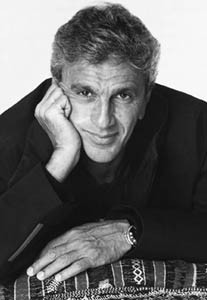
Photograph by Anthony Barboza

Tropical Truth

Caetano Veloso gets long deserved nod

By Greg Cahill

In the summer of 1969, the Beatles sang about revolution but did little to quash the status quo that showered them with fame and fortune. That same year, the Rolling Stones pranced across stages on their way to a personal Waterloo at the Altamont Speedway, children of luxury feigning street radicals with the hit single “Street Fighting Man.”

Meanwhile, Brazilian pop stars Caetano Veloso and Gilberto Gil–architects of the tropicalia movement, a vital cultural force comprised of poets, musicians, and artists opposed to the nation’s newly minted military dictatorship–were arrested by police in a midnight raid. No charges were filed. Separated and confined in a cramped solitary cell with nothing but a dirty blanket and filthy toilet, each musician endured brutality, confinement, and an uncertain future.

Two months later, Veloso and Gil were put on an airplane and exiled to London.

“It seemed the real reason for their imprisonment was a mixture of protest songs, long hair, and strange clothes,” writer Will Hodgkinson noted in recent Mojo music magazine article on the lost history of such tropicalists as Os Mutantes and Tom Zé.

Since then, Veloso, to some extent, and especially Gil have gained a modicum of international fame, thanks largely to the efforts of David Byrne, who has recorded Gil’s bossa nova compositions and included Veloso and Gil’s own recordings on a series of high-profile Brazilian music compilations on Byrne’s eclectic Luaka Bop label (both appeared on 1998’s Beleza Tropical 2).

Now Veloso is poised to turn up the heat and greet the burgeoning American world-music audience. In a bold move, Nonesuch Records this month has released a two-CD live-concert recording, Live in Bahia, that captures all of the sides of this complex performer. Meanwhile, Alfred A. Knopf has issued Veloso’s memoir Tropical Truth: A Story of Music and Revolution in Brazil, which already has spawned the revelatory 1997 CD Livro, also on the Nonesuch label, released after the book’s initial Brazilian publication.

While the infatuation with Latin pop is wearing thin with mainstream American audiences, Veloso is well worth checking out. The timing couldn’t be better–in a landslide Oct. 27 victory, president-elect Luiz Inacio Lula da Silva became Brazil’s first radical leftist to win that nation’s highest post. The bad old days of the junta are over and Veloso is a very visible reminder of the resistance that helped topple the regime.

Indeed, Veloso’s topical music is that rare mix of sensuality and substance, poetry and polemic. With its tropicalismo, samba, bossa nova, and samba rap, as well as a backup band of Brazilian superstars, Live at Bahia “is a thrill,” Billboard recently opined. “This is an altogether extraordinary live performance. The musicianship is top-notch, the recording is excellent, and Veloso is a creative force to be reckoned with, both as a vocalist and a tunesmith.”

Bahia, recorded live in São Paulo and Salvador de Bahia, is a most compelling example of art and politics, song and social activism. Part of that attraction is Veloso’s almost mystical ability to move deftly from an ode to Brazilian soccer champion Pelé (“Two Naira Fifty Kobo”) to a biting romantic ballad (“Mimar Você”) to a celebration of the historic end of slavery (“13 de Maio”) to an homage to the tropicalist movement (“Tropicália”).

While there is plenty of machismo in his lyrics–“Who can expect a woman to live without make believe?” he asks in “Dom de Iludir” (“The Art of Deceit”)–the tradeoff is the playful poetry of “Lingua” with its light-hearted challenge, “Let’s be imperialists of the tongue and ride the word train set rolling by Carmen Miranda.”

You won’t get an invitation like that anytime soon from Ricky Martin.

From the November 28-December 4, 2002 issue of the North Bay Bohemian.

© Metro Publishing Inc.

Kenneth Adelman

0

Watching Closely: This image, just south of Bodega Bay, was taken on Nov. 14, 2002.

Coast Watcher

Photographer documenting the California coastline stirs up controversy

By Joy Lanzendorfer

“How would Ken Adelman feel about someone hovering in a helicopter over his home taking pictures?” says Santa Rosa resident Jeanette McFall. “That man is a peeping Tom!”

McFall is one of many people concerned about the California Coastal Records Project, an ambitious undertaking by retired techie Ken Adelman to post detailed photos of the California coastline on the Internet.

For the past year, 39-year-old Adelman and his wife, Gabrielle, have flown their helicopter up and down the coast taking pictures with a digital camera. Now, over 12,000 pictures can be accessed on the project’s website (www.californiacoastline.org).

The pictures cover every inch of the coastline except for an Air Force base near Santa Barbara, which Adelman is waiting for permission to photograph. Since the pictures were taken from only 500 feet, details such as plants, cars, and figures can be seen, as well as private property and homes.

But Adelman’s intention isn’t to invade anyone’s privacy. His goal is environmental. By preserving a record of the coast, he is providing a wealth of “before” pictures to be used in land-use arguments and as evidence against environmental violations.

In 1997 Adelman took aerial photographs of an 18-mile stretch of coastline the Hearst Corporation wanted to use for a golf course. Mark Massara, director of the Sierra Club’s Coastal Program, used the photos in a campaign against the golf course. The California Coastal Commission eventually denied Hearst’s plans.

The success the photography played in stopping that project and the need in subsequent disputes for “before” photos led to the idea of photographing the entire coastline.

The Sierra Club claims that California has lost over 90 percent of its wetlands and 90 percent of its coastal sage scrub. But some are afraid that the California Coastal Commission will use the photos to micromanage private property owners.

“The ‘spy in the sky’ project will give ammunition to the commission’s bureaucratic laws,” says Harold Bloom, attorney for Sacramento-based Pacific Legal Foundation. “What kind of damage does backyard landscaping or the size of a house do to the environment? Those are the kinds of things the commission goes after.”

But the photographs show much more serious environmental violations, according to Massara, including beach access, illegal seawalls, spills, and bulldozing on the beach. He forwards violations to the Coastal Commission, which is slowly following up.

“It’s an overwhelming task,” he says, “but we will get to every one of those violations.”

There is nothing illegal about the photos; the law generally allows pictures taken from public places to be published without permission. Yet many still feel that the project is too intrusive.

McFall knows that her home is not in Adelman’s camera sights (she doesn’t live on the coast), but she feels the photos violate coastal homeowners’ privacy.

“Adelman may have good intentions, but other people can use those pictures to do damage,” she says. “Someone could use those pictures to rip someone off or do other types of harm. And who wants their pictures on the Internet without their permission?”

Adelman doesn’t have much sympathy for people living on the coast who don’t want their homes photographed.

“People move to the coast because it’s beautiful, but they don’t want anyone else to have its beauty,” he says. “I’ve heard it likened to a beautiful woman wearing revealing clothing and then complaining when men stare at them.”

From the November 28-December 4, 2002 issue of the North Bay Bohemian.

© Metro Publishing Inc.

Valerie Brown

Valerie Brown's gender may prove a nonissueBy Greg CahillThree weeks after the election of Valerie Brown to the Sonoma County Board of Supervisors, it is unclear what effect the first woman to hold that position in more than a decade will have on local women's issues.The Board has been criticized for being insensitive to a wide range of women's...

Bacon

Sizzlin': Bacon, that most un-PC of lovers, proffers a fat reward.Baby Got BackConfessions of a bacon addictBy Gretchen GilesAs if things weren't bad enough already, brace your lettuce, your tomatoes, and your toasty slices of bread for yet another piece of relentlessly ugly news: We as a nation suffer somewhat silently from a bacon shortage. Retail prices have risen...

‘Solaris’ / ‘Daughter from Danang’

Lost in Love Space 'Solaris' and 'Daughter from Danang' take different paths in search of past ties By This week and next, theaters offer two serious warnings against idealized love: the highly recommended documentary Daughter from Danang, and the feature film Solaris, which I can't urge on anyone....

Mirepoix

Media Frenzy: Mirepoix wins, thanks to chef Matthew Bousquet and hostess Bryan Dempsey. Do Believe the Hype Is Mirepoix really that good? Yeah! By Sara Bir If you want to skip to the nut of this review right now, at this...

American Security and Civil Liberties

Let Freedom Reign More Americans are willing to trade freedoms for security By Joy Lanzendorfer The terrorists hate our freedoms: our freedom of religion, our freedom of speech, our freedom to vote and assemble and disagree with each other. --President George W. Bush, Sept. 20, 2001 ...

Nicolas van Krijdt

Heavy Metal Nicolas van Krijdt's 'Inland Ocean' not for those afraid of the water By Gretchen Giles Students wandering the dry, brineless floor of Santa Rosa Junior College's Herold Mahoney Library on the Petaluma campus may be surprised to learn that they're actually navigating an ocean. But...

LiveWire Literary Salon

All Lit Up: Jordan Rosenfeld is the powerhouse behind the LiveWire Literary Salon at Zebulon's Lounge. On the Write Path Jordan Rosenfeld's LiveWire Literary Salon hits a nerve By Davina Baum Jordan Rosenfeld is a writer, make no mistake about it. And she...

Hassel Smith

Smith and Messin' Two exhibits to thrill and delight By Gretchen Giles Hassel Smith at SCM My paintings are intended to be additions to rather than reflections upon 'life,'" the artist Hassel Smith wrote in 1952. And indeed, a good, long look at the...

Caetano Veloso

Photograph by Anthony Barboza Tropical Truth Caetano Veloso gets long deserved nod By Greg Cahill In the summer of 1969, the Beatles sang about revolution but did little to quash the status quo that showered them with fame and fortune. That same year, the...

Kenneth Adelman

Watching Closely: This image, just south of Bodega Bay, was taken on Nov. 14, 2002. Coast Watcher Photographer documenting the California coastline stirs up controversy By Joy Lanzendorfer "How would Ken Adelman feel about someone hovering in a helicopter over his home taking...
11,084FansLike
4,606FollowersFollow
6,928FollowersFollow