Propositions 57 and 58

0

SOS: Save Our State

North Bay politicians make the case for Propositions 57 and 58

By R. V. Scheide

The counties are reeling, the cities are screaming and the consensus among North Bay elected officials is nearly unanimous: if voters fail to approve Propositions 57 and 58 on the March 2 primary election ballot, the “Armageddon cuts” promised by Gov. Arnold Schwarzenegger will decimate government services in the North Bay.

The two propositions comprise the governor’s plan to shore up the state’s sinking financial ship, which was torpedoed by the 2000-2001 stock market crash and the excessive state spending that accompanied the preceding run-up in equities.

If passed, Proposition 57, the Economic Recovery Bond Act, will permit the state to issue $15 billion in bonds to address California’s current budget deficit. However, in order for it to be enacted, voters must also approve Proposition 58, the California Balanced Budget Act.

So far, it’s not clear that voters understand the linkage between the two propositions. A Field Poll released Jan. 15 found that statewide 53 percent of likely voters favor Proposition 58, but just 33 percent support Proposition 57. A substantial number of voters, 27 percent, remain undecided on Proposition 57. If the governor is unable to sway enough of them to pass his economic package, local legislators predict disaster.

“It’s going to be devastating if the bond doesn’t pass,” says Diane Miller, Third District Supervisor for Napa County. “I hate to borrow money. I’m not a person who likes to use credit, but dealing with the alternative is too radical. If the worst happens and the bond fails, there are going to have to be major program cuts.”

Sixth District Assemblyman Joe Nation, who represents Marin and southern Sonoma counties in the state Legislature, agrees.

“If this does not pass, the situation will be worse,” he predicts. Nation strongly supports both propositions, although the size of the $15 billion bond did cause him some concern. But without it, he says, “I think there will be cuts that are horrible across-the-board.

According to supervisor Miller and many of her colleagues in Napa, Sonoma and Marin counties, the cuts, if the propositions fail, will be harsh, as much as 20 percent for some programs. Miller worries that programs which save government money in the long term, such as preschool, substance-abuse-recovery and gang-interdiction programs, will be scrapped in order to balance the budget in the short term. In fact, monies for some programs, such as Napa County’s gang task force, have already been cut in the governor’s proposed 2004-2005 budget.

“I’ve been told by the district attorney that those grants are not a part of our future,” she says.

“I think people are most concerned about public safety,” Nation says.

Seventh District Assemblywoman Pat Wiggins, who represents all of Napa County and parts of Sonoma and Marin counties, was reluctant at first to sign on to the deficit bond issue.

“I don’t like the idea of a bond,” she says. “You don’t get parks, you don’t get transportation, you don’t get environmental protections. It’s basically just buying the state some breathing space.” Nevertheless, she supports Propositions 57 and 58 now. If the measures fail, she says, “The collapse and harm that will come to everybody will be horrendous. Somebody you know will be hurt if they don’t pass.”

On Feb. 4, the Marin County Board of Supervisors endorsed both propositions. While the Napa County Board of Supervisors hasn’t publicly endorsed the measures, Miller and Second District Supervisor Mark Luce said the propositions are supported by a majority of the board members. Likewise, the Sonoma County Board of Supervisors hasn’t publicly endorsed the measures yet, but Fifth District Supervisor Mike Reilly says, “I assume that if it comes before the board, we’ll be able to find three or more votes to support it.”

“It’s probably the only pragmatic thing to do considering the current environment,” agreed Sonoma County Third District Supervisor Tim Smith.

Susan Adams, First District Supervisor for Marin County, was one of few local politicians who opposes the propositions. A Democrat and self-described fiscal conservative with a social agenda, she’s concerned that the propositions don’t tackle the state budget’s “big structural problems.”

“It’s a one-time fix; it doesn’t address the structural problems,” she says. “I think we should be starting with structural changes first.” The Marin County representative for the California State Association of Counties, she recently attended a meeting where she says that the “final vote came down to supporting the bills and holding their noses.”

Fairfax mayor Frank Egger, a longtime supporter of progressive causes in Marin and Sonoma counties, also opposes the propositions.

“There’s no guarantee local governments are going to be better off if it passes,” he says. “There is no guarantee that government services are going to be kept intact. But there is a guarantee that our children and our grandchildren are going to pay the price for this bailout.”

Asked why the majority of local elected officials, Democrats and Republicans alike, are supporting the propositions, Egger says, “They’re probably scared to death to speak out against it.”

As the saying goes, politics makes for strange bedfellows, and for the most part, liberals and conservatives are teaming up to support Propositions 57 and 58.

“We’re normally reluctant to support bond measures,” says Fred Levin, executive director of the conservative Sonoma County Taxpayers Association. That’s because a bond is essentially a tax that citizens have to repay with interest. Still, the association is advising its members to support Propositions 57 and 58.

“We’re hoping that this is a one-time event, and that the $15 billion will help the state get back on track,” Levin says. “We’re not particularly thrilled about it, but as a one-time effort, it’s worthwhile.”

Meanwhile, the 2004-2005 budget looms, with a projected deficit of $6 billion to $15 billion, according to the California State Legislative Analyst. North Bay politicians are caught between supporting measures they don’t necessarily agree with or facing even more draconian cuts to services.

“I would compare Sacramento to a heroin addict,” says Sebastopol City Council member Larry Robinson. Like most of the local legislators the Bohemian talked to, Robinson was incensed with the shift of more than $1 billion in property tax from cities and counties to the state in Gov. Schwarzenegger’s proposed budget. Still, Robinson feels there’s no alternative but to support Propositions 57 and 58.

“Sometimes,” he shrugs, “a methadone program is preferable to cold turkey.”

From the February 12-18, 2004 issue of the North Bay Bohemian.

© Metro Publishing Inc.

Rickie Lee Jones

0

Swing Out Sister: Rickie’s in love with the human race.

Balms Away

Rickie Lee’s latest soothes the soul

By Greg Cahill

Don’t that beat all? In the aftermath of the 9-11 terrorist attacks, I wondered in these pages who would step forward to help make sense of the stifling life during wartime and the prickly political repression that swept America. Most recording artists–including Neil Young, Bono and the Boss–rallied around the flag. Then, in an unexpected move, Rickie Lee Jones stepped up to the plate.

In October, almost two years to the day after the attacks, the consummate bohemian singer best known for her 1979 jazz-inflected hit single “Chuck E.’s in Love” delivered The Evening of My Best Day (V2), a meditation on love, life and death in the post-9-11 era. It’s her first album of new studio tracks in six years. Three of the songs–“Ugly Man,” “Little Mysteries” and “Tell Somebody (Repeal the Patriot Act Now)”–are grounded in political expression and set the tone for this rather amazing album.

When asked about her reemergence after a lengthy hiatus from the studio, Jones told writer Paul Zollo in the April issue of Acoustic Guitar magazine, “I was listening. I was waiting. I was praying to be restored. And that’s what happened. I feel powerful now. Intact. Ready to heal the world.”

Indeed, the songs are a soothing balm for these strange days.

Yet the album finds Jones viewing the harsh realities of life, including death and despair, through the eyes of a dreamer who evokes a childlike fascination while offering an existential perspective on the big picture. It’s little wonder that The New Yorker once said of Jones that “Her music is the aural equivalent of painter Georgia O’Keeffe’s most rigorous and beautiful canvases.”

Many of these songs are sonically imbued with what Joni Mitchell might call the hissing of summer lawns, an intoxicating ride through a scintillating and sometime sensuous soundscape stripped of all clichés and polemic. Others, like the wistful “Sailor Song” and “A Tree on Allenford,” are dark, transcendent ballads that rival anything Jones has recorded in the past.

These pop arrangements are often tinged with splashes of late-’60s and early-’70s soul, jazz and gospel, aided by a crack core band and such guests as guitarist Bill Frisell, David Hidalgo of Los Lobos, jazz master Nels Cline, bassist Mike Watt, and singers Syd Straw and Grant Lee Phillips. Sometimes, Jones’ voice flutters above the evocative instrumentation like a leaf floating on the summer breeze. At other times, she and co-producer David Kalish blend the vocals tightly with horn arrangements that give her words significant punch.

Lyrically, this is Jones at her best. In “Ugly Man,” a laid-back jazz song that opens the album, she shreds George Bush, excoriating the president for his bullying ways and extoll-ing the listener to take back the country. In “Little Mysteries,” with its engaging ’70s soul-funk rhythms, Jones prowls on cat paws as she takes on the Republican Party and “the boys from Texas” for stealing the 2000 presidential election. “Tell Somebody (Repeal the Patriot Act Now)” is a Tony Joe White-style southern blues, a sort of politicized “Polk Salad Annie,” that urges her fans “to tell somebody what happened in the U.S.A.” and points out that “it only took a moment” for free speech to fade under this administration.

And when was the last time you heard a pop song that contains a line like “Tell somebody that democracy is only as good as the voices of protest that she protects” and makes it sound funky?

Yet ultimately, it is the mix of soul-searching ballads and strong political material that makes this such a brave and compelling album. “This [CD] addresses love for the human race,” music critic Thom Jurek has marveled. “It is alternately intimate and cinematic–in an indie-film way–and it is breathtakingly, unapologetically and unmistakably moving and true and elegant. And does it ever swing!”

Rickie Lee Jones performs Saturday, Feb. 14, at the Marin Center, 20 Avenue of the Flags, San Rafael. 8pm. $32-$40. 415.499.6800.

The Holmes Brothers, Simple Truths (Alligator)
New York-based blues and gospel singers the Holmes Brothers–Sherman and Wendell Holmes, and Popsy Dixon–are nothing short of revelatory on this follow-up to their critically acclaimed 2001 Joan Osborne-produced CD Speaking in Tongues. Craig Street (who produced Norah Jones’ Come Away with Me) gives the Brothers plenty of room to breath while hitting just the right groove on this collection of mostly rootsy covers by Bob Marley, Hank Williams, Townes Van Zandt, Willie Nelson and Gillian Welch, among others. A serious shot of soul salvation.
–G.C.

From the February 12-18, 2004 issue of the North Bay Bohemian.

© Metro Publishing Inc.
Cauliflower

0

So Sweet and So Cold: This is just to say that different foods find their way into winter’s icebox.

Winter Plates

The hunt for dark-days dinners

By Heather Irwin

It’s cold and dark outside, and I’m suddenly craving cauliflower like I’ve never craved anything before. I must have it at any cost. That very same vile, bedeviled stinkweed of my youth, steamed to a gag-inducing texture and smothered with Velveeta, has just become unbearably alluring. Then again, I’ve always been a sucker for hype.

Cauliflower, it seems, is the “it” vegetable of the winter season, the J.Lo of the cruciferous set. Caramelized, roasted, mashed, au gratin-ed, fried or shacked up with a bowl of creamy macaroni, the albino flower usually relegated to dip trays and bad casseroles is walking the culinary red carpet.

Hawked everywhere from upscale eateries to hip grub stops like Underwood Bar and Bistro (9113 Graton Road, Graton, 707.823.7023) and Willi’s Wine Bar (4404 Old Redwood Hwy., Santa Rosa, 707.526.3096), cauliflower has become almost inescapable on local winter menus. Underwood offers it au gratin ($6), while Willi’s serves it caramelized and carefully disguised amidst cheesy pasta and black truffles ($7.50). Even the beer and buffalo-wing die-hards have adopted the low-carb darling (only about six net carbs per serving). Ruby Tuesday, the Northwest’s suburban strip-mall staple, has incorporated cauliflower into its menu, with a recipe landing in my e-mail in box from well-meaning carbless friends no less than three times in the last month.

So, what’s with all the chou fleur amour?

Mark Twain called it cabbage with a college education. Loaded with antioxidants, fiber and crunch, cauliflower has been embraced by chefs as the side of the season, relegating garlicky mashed potatoes to the back burner and whipping up a side of slightly lumpier mashed cauliflower that many say tastes just as good, if not better, than the tired tubers. Then again, load up anything with enough butter, cream and salt, and it’s bound to gain a following.

Cauliflower’s story is a rags-to-riches tale, truly. Rising up from the steamer, steadfastly denying its former associations with sprayed cheese food and fending off tart vinaigrettes, cauliflower now basks in the warm glow of many a kitchen broiler. No one, however, has thought enough of the shy, unassuming little bouquet to write much about its history, though cauliflower has been cultivated since Roman times. We have little idea how it was prepared until the French brought it to the table in the 17th century–loaded up with butter and cheese, of course.

Though the humble cauliflower has had a cult following among the foodie set for years (that gastronome haven the Daily Gullet has several threads at www.egullet.com devoted to its care, preparation and flavor characteristics, and even Emeril has a recipe for mashed cauliflower), most casual diners are relative newcomers, eyeing it with more than a little curiosity and trepidation. After all, everyone hates an ugly duckling, and the sun-starved, dirt-crusted winter produce face an uphill battle in the looks department.

But while they may admittedly lack the showy curb appeal of their flashier summertime counterparts, there’s something so much more endearing about the nubby, wrinkled, rooty vegetables of winter’s harvest. Maybe it’s because these late-blooming veggies never had their looks to go on. Instead, the homely carrots, chards, onions, yams and rhubarbs have worked on their personalities.

It’s an inner-beauty thing.

Carefully paring cauliflower florets beneath a wet tent, Healdsburg’s Ron Love is just one of a tiny handful of farmers steadfastly sticking out winter at the Santa Rosa farmers market. Without the crowds, the market is a gentler, more contemplative place, laden with rich, thick-veined, hearty kales and collard greens, tender broccoli and, of course, mounds of cauliflower.

Love, who operates Love Farms Organic Produce (15069 Grove St., Healdsburg, 707.695.1632) does a pretty brisk cauliflower business, hawking three varieties at the Wednesday market: the ubiquitous white, a purple and a green variety. He says the purple and green types are milder, less peppery versions of their white cousin that cook a bit faster and bring a surprising bit of color to the table. But he admits that his winter stock is sometimes a little less, er, sexy than the summer fruits and veggies.

“We’re in the dark times,” he says half wistfully, as he pares a few more florets. Not discouraged, he rambles off recipe after recipe for delicious, warming winter foods, such as steamed kale with garlic, roasted cauliflower and so on. But that’s what seasonal eating is all about, and from October through April, tubers and roots rule, with cabbages, beets, cauliflower, broccoli, carrots, early mushrooms, fennel and hearty, leafy greens loving the cold, wet climate.

Don’t be a hater. Because to hibernate through these last few weeks of winter seeking out pallid, unripe fruits and veggies from odd and exotic foreign lands is to pass up some of the richest, most soulful flavors of the year. And would you really be able to respect yourself in the spring?

To get in on the hot, steamy winter action, we sussed out a bevy of amazing goodies hitting peak season right now:

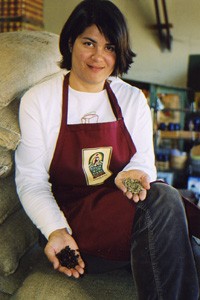
No self-respecting winter soup eschews beans. From navy to kidney, nearly every menu in town features a gut-filling stew or soup that ladles in the legumes. Rancho Gordo‘s new world beans (707.363.0993) are quickly becoming a local favorite, featuring beans native to the Americas (sorry, no lentils).

With many heirloom varieties grown locally, Rancho Gordo owner Steve Santo has branched out to include dried chiles, dried pozole and preservative-free tortillas. Without a storefront of his own, Santo can be found each Sunday morning from 8am to 1:30pm at the Marin County farmers market in the Civic Center parking lot, and several of his bean varieties are available at St. Helena’s Dean and Deluca outlet (607 S. St. Helena Hwy., 707.967.9980). . . .

Zazu (3535 Guerneville Road, Santa Rosa, 707.523.4814) is featuring plenty of Hog Island oysters on its menu (now in season), along with an “Ode to Pork” plate featuring cider-braised pork cheek, apple-jack cabbage and turnip-potato gratin. Along with nine other members of the Artisan Restaurateurs of Sonoma County, Zazu will offer a prix fixe dinner ($29) Sunday through Thursday, starting Feb. 15, as an introduction to their artisan cooking and unique plates. . . .

Though the growing season for many native mushrooms runs through May, black chanterelles are some of the most delicious of the season. But picking whatever spores happen to be growing in the yard might not be such a bright idea. The North Bay has an expert legion of mushroom enthusiasts who foray into the wilds once a month to seek out native ‘shrooms, talk spore prints and cook up what they find. Sonoma County Mycological Association president Mark Todd (who happens to consult on cheese for a living) says the postgathering gatherings are some of the best eating in the county.

The next outing is Saturday, Feb. 21, at Fisk Mill Cove in Salt Point State Park. Go to www.somamushrooms.org for details. And if you don’t pick your own, the Culinary Institute of America (2555 Main St., St. Helena, 707.967.1010) offers mini cooking demonstrations throughout the month, concentrating Feb. 21-24 on the preparation of a potato and mushroom soup with bacon. . . .

At Mom’s Apple Pie (4550 Gravenstein Hwy. N., Sebastapol, 707.823.8330), rhubarb pie is in season. The oft-shunned veggie actually hits its peak right around Valentine’s Day. If you’re new to rhubarb, its cooked consistency is much like celery but with a creamier, intensely tart flavor. Mixed with lots of sugar and baked, the rhubarb becomes tender and juicy, and is less cloying than many other pie fillings. Not ready to commit? Rhubarb (and other flavors like apple) are baked in handy single-dish servings for about $5. Call ahead to see if they have any just out of the oven, and be sure to grab a few extra napkins for your shirt. . . .

From the February 12-18, 2004 issue of the North Bay Bohemian.

© Metro Publishing Inc.
‘Win a Date with Tad Hamilton’

0

Attitude Platitudes: Kathryn Hahn (not pictured) is the weary bartender and Kate Bosworth (right, with Ginnifer Goodwin) is the dewy ingenue in ‘Tad Hamilton.’

Sex Tips

Author Sherry Argov explains why you should never listen to a lonely bartender

In its ongoing quest for the ultimate postfilm conversation, Talking Pictures takes interesting people to interesting movies.

“It’s one of the best movies about human nature I’ve ever seen in my life,” exclaims Sherry Argov. “It’s about learning who’s going to propel you forward in life and who isn’t. I love this movie!”

Argov, a Los Angeles-based writer, relationship expert and talk-show darling, is the author of the bestselling book Why Men Love Bitches and its forthcoming sequel, Why Men Marry Bitches. We have connected via telephone to discuss the recently released romantic comedy Win a Date with Tad Hamilton.

Unfortunately, that’s not the film she’s just been talking about. That would be Seabiscuit, the Oscar-nominated horse-racing drama for which she has nothing but kind words. As for Tad Hamilton, the words she comes up with are not so kind, being words like “boring,” “stupid,” “ridiculous” and, ahem, “bullcrap.”

This is the kind of movie in which the characters constantly stop the action to swap pithy maxims. Apparently, no one in the little town of Frazier’s Bottom, W.Va., where the film is set, ever engages in actual conversation. Instead, people rattle off slogans like overcaffeinated booth workers at a bumper-sticker convention.

“There are three kinds of love,” we learn in the film. “Love, big love and great love. Love lasts two weeks; big love lasts two years; but great love changes your life forever.”

“What total bullcrap,” Argov remarks. “Either you love someone or you don’t. There are no degrees and levels to love, no ‘I love you but I’m not in love with you.’ When you’re in love, you don’t waffle. Period. End of story. If someone is separating love into different little categories, making distinctions between, you know, love with a cherry on top and love with, I don’t know, a cherry and whipped cream, then that’s not love. And if you think it is, you’re being duped.”

In the movie, that “three kinds of love” speech is delivered by Angelica the tattooed bartender (Kathryn Hahn), who openly lusts after brainy grocery-store manager Pete (Topher Grace), who secretly longs for pretty check-out girl Rosie (Kate Bosworth), who’s a big fan of fatuous Hollywood hunk Tad Hamilton (Josh Duhamel), who offers himself up as a fundraising prize and is promptly won by none other than Rosie.

Complications ensue as Pete and Tad compete for Rosie’s affections, with Angelica appearing every now and then to flex her tattoos and recite more proverbs: “If you feel something and you don’t do everything in your power to make it happen, it’s slapping life in the face” or “Once a man closes the door on you, it’s shut, nailed, cemented, boarded up forever.”

“More bullcrap!” laughs Argov. “Spoken just like a woman who doesn’t have a man.”

Hmmm. At this point, one might have to say Argov was being somewhat . . . bitchy. She’d be the last to deny it.

“To me, the word ‘bitch’ is a positive thing,” she explains. “I never mean it in a pejorative way, because I don’t think there’s anything wrong with a woman sticking up for herself. I don’t think there’s anything wrong with having a voice or being a confident person. In my view, a bitch isn’t a woman who steps on other people; she’s a woman who won’t allow herself to be stepped on by others.”

By that measure, it’s good-natured Rosie–though scripted as a nice, sweet girl-next-door–who turns out to be the best example in Tad Hamilton of an Argovian bitch

“She isn’t easily manipulated,” Argov allows. “She’s an independent thinker. She looks at a person’s soul and intentions, not just at their promo package. And though she thinks about giving the movie star some booty, she’s too smart for that. She knows that to him, she’s just another toy, and a bitch isn’t willing to just be anyone’s property–even if it’s the property of a king.”

Asked whether she approves of the movie’s ending, in which (yes, it’s true) one of the two men does end up gaining access to Rosie’s booty, Argov stands her ground.

“Neither of them deserves her,” she snaps.

From the February 12-18, 2004 issue of the North Bay Bohemian.

© Metro Publishing Inc.

Fantasy Reissues

0

Fantasy League

Berkeley-based jazz label unleashes two waves of classic SACD titles

By Greg Cahill

Fantasy Records’ vast treasure trove of sanctified jazz material (encompassing the Riverside, Prestige, Pablo and Original Jazz Classics labels, among others) ranks among the Holy Trinity of jazz reissues, right alongside Blue Note and Verve.

So the recent release of two massive waves of Fantasy super-audio compact discs, including several classic jazz titles, is reason to celebrate. The new SACDs mark a commitment by the Berkeley-based label to release, on its own banner, titles that in some cases were licensed to small audiophile labels. Among the artists represented by these hybrid stereo and mono SACDs are Miles Davis, John Coltrane, Thelonious Monk, Charlie Parker, Charlie Mingus, Bill Evans, Sonny Rollins, Dave Brubeck, Cannonball Adderley, Wes Montgomery and Eric Dolphy.

All of Fantasy’s reissues employ the new recording process called Direct Stream Digital, which samples sound 64 times faster than the sampling rate used for standard digital recordings.

Here is a look at what’s newly available:

Cannonball Adderley Quintet, In San Francisco (Riverside RISA-1157-6): The quintet on this SACD is the second operated by alto saxophonist Cannonball Adderley, who regrouped with his cornet-playing brother Nat after making his name as a sideman in Miles Davis’ most popular bands. This 1959 live recording finds the then-new Adderley quintet at the Jazz Workshop in San Francisco with legendary producer Orrin Keepnews in tow. The resulting album–a hard-bop masterwork that also includes the landmark soul-jazz hit “This Here”–is widely regarded as one of the most successful live recordings in the jazz canon due, in no small part, to a powerful, driving rhythm section that featured Bobby Timmons (piano), Sam Jones (bass) and Louis Hayes (drums). (Hybrid stereo)

Dave Brubeck Quartet, Jazz at Oberlin (Fantasy FSA-3245-6): Yup, overlooked and under-appreciated, this 1953 date is one of pianist and composer Dave Brubeck’s earliest recordings–his wife came up with the idea of getting college gigs at a time when most jazz musicians were struggling to be heard, and Oberlin College in Ohio, with its acoustically tuned chamber-music recital hall, provided the perfect venue for a live jazz recording. Jazz at Oberlin has some of Brubeck’s and alto saxophonist Paul Desmond’s finest playing. Three of the five tracks are ballads that underscore the lyrical mastery of these players, but there also are lots of exciting moments to make the case that Brubeck was one of the most inventive pianists of his day. (Hybrid mono)

Kenny Burrell and John Coltrane, Kenny Burrell & John Coltrane (New Jazz NJSA-8276-6): John Coltrane began his association with the Prestige label as a sideman with Miles Davis and continued there as a sideman for several other jazz greats. When Coltrane’s own star rose, the label began repackaging these sessions on recordings that claimed Trane served as the leader. Actually two of the tracks on this release, recorded between 1957 and 1958, were recorded with pianist Tommy Flanagan as the leader. That said, Coltrane and Burrell play a prominent role in these sessions. The lyrical “Why Was I Born” brings their melodic talents to the fore. Buoyed by Flanagan, bassist Paul Chambers and drummer Jimmy Cobb, Coltrane and Burrell also explore a couple of blues numbers: Burrell’s interesting composition “Lyresto” and the 1925 classic “I Never Knew.” (Hybrid mono)

John Coltrane, Lush Life (Prestige PRSA-7188-6): Regarded as one of the best played and best sounding albums of Coltrane’s career, 1958’s beautiful Lush Life (with pianist Red Garland) finds this ballad master sounding decidedly Parkeresque as he glides through four standards and the original “Trane’s Slo Blues.” Trane would return to the title track five years later on a classic Impulse! label duo album with jazz singer Johnny Hartman, but this recording has a special quality all its own. (Hybrid stereo)

Miles Davis Quintet, Relaxin’ (Prestige PRSA-7129-6): The greatest small group in the history of jazz featured Miles Davis, tenor saxophonist John Coltrane, pianist Red Garland, bassist Paul Chambers and drummer Philly Joe Jones. This album was one of four-the others are Cookin’, Steamin’ and Workin’–culled from two marathon 1956 Prestige studio sessions with producer Rudy Van Gelder. Featuring joyous, straight-ahead swinging and melodic improvisation, this is a near-perfect album. It contains “If I Were a Bell,” “It Could Happen to You,” “I Could Write a Book” and several others. (Hybrid mono)

Eric Dolphy, Out There (New Jazz NJSA-8252-6): While the free jazz pioneered by Ornette Coleman, Cecil Taylor, Horace Tapscott and a handful of others was rejected at the time by many musicians and most listeners, the visionary saxophonist, bass clarinetist and flutist Eric Dolphy found a way to bring it into the mainstream This 1960 album featured a piano-less quartet that included Ron Carter’s bass and cello to incorporate the spirit of adventure and abandon with which free jazz at its best infused freshness into jazz. And though Dolphy worked from chord patterns developed within structures that depart from ordinary 32-bar jazz and popular song forms–including 30-bar, 35-bar and 18-bar structures–he also observed standard practice with 12-bar blues, “Serene.” This remains a post-bop milestone filled with intriguing explorations. (Hybrid stereo)

Bill Evans Trio, Portrait in Jazz (Riverside RISA-1162-6): The liner notes make a strong case that this is the album that redefined the piano trio, changed the way modern jazz pianists used harmony and influenced the course of jazz in the last half of the 20th century. Bill Evans’ introspective chord voicings, his strength and lyricism, his melodic conception, all were major elements in the landmark Miles Davis’ groundbreaking Kind of Blue recorded in November 1959 (and on which he shared keyboard duties with Wynton Kelly). The next month, Portrait in Jazz found Evans leading the ideal trio he had been conceptualizing for years. He was joined by virtuoso bassist Scott LaFaro and drummer Paul Motian, whose interplay made them near equals with Evans. This album arrived during a highly creative period that shifted two years later with the death of LaFaro in a tragic car accident. (Hybrid stereo)

Gil Evans, Gil Evans and Ten (Prestige PRSA-7120-6): As an arranger, Gil Evans contributed three pieces to Miles Davis’ 1949 landmark recording Birth of the Cool and later produced three LP-length recordings for the jazz trumpet great. In return, Davis convinced Prestige to give Evans a shot as a bandleader. Evans responded with an acclaimed album that featured innovative and textured arrangements written for 11 instruments but sounding like a full orchestra. Among the soloists are trombonist Jimmy Cleveland and saxophonists Steve Lacy and Lee Konitz. Evans makes his first recorded appearance as a pianist. This SACD for the first time offers the full spectrum of these masterpieces from original stereo tapes presumed lost for decades. (Hybrid stereo)

Wynton Kelly Trio & Quartet, Kelly Blue (Riverside RISA-1142-6): Jamaican-born pianist Wynton Kelly was a favorite accompanist of Miles Davis (one of those two pianists heard on Kind of Blue) and Cannonball Adderley. He recorded 15 trio albums for Blue Note (employing former Davis sidemen Paul Chambers and Jimmy Cobb), including the 1965 classic Smokin’ at the Half Note with Wes Montgomery. While Kelly was a strong bop-based soloist, his ballad work was impeccable. This sextet features Kelly, Nat Adderley, tenor saxophonist Benny Golson, flautist Bobby Jaspar as well as Davis section mates Chambers and Cobb. (Hybrid stereo)

Thelonious Monk, Thelonious Monk with John Coltrane (Jazzland JZSA-946-6): Monk and Trane spent six months in 1957 working together at New York’s Five Spot Cafe, a historic event that convinced critics of Monk’s genius but that was never documented (a recently discovered live tape of a 1958 session there at which Trane subbed for Johnny Griffin has been released on Blue Note). That earlier collaboration was later immortalized in the three remarkable quartet selections that highlight this album; producer Orrin Keepnews managed to record those three studio tracks–“Ruby, My Dear,” “Trinkle, Tinkle” and “Nutty”–though they did not see the light of day until the 1960s. Additionally, “Off Minor” and “Epistrophy” find Monk and Coltrane in a septet that included the great Coleman Hawkins. This CD also includes “Functional,” an unforgettable Monk solo blues. Featured are Hawkins, Ray Copeland, Gig Gryce, Wilbur Ware, Art Blakey and Shadow Wilson. A remarkable recording. (Hybrid stereo)

Wes Montgomery, Incredible Jazz Guitar (Riverside RISA-1169-6): This is the album that put the jazz world on notice that one of its greatest, and soon to be most influential, guitarists had arrived. Signed to Riverside at the request of Cannonball Adderley, Montgomery wasted no time making his mark with such originals as “D-Natural Blues” (which quotes the opening line to “Heartbreak Hotel”), “West Coast Blues,” and “Four on Six.” Flanagan’ astonishingly evocative work on “In My Own Sweet Way” makes the case for him being one of the most woefully underrated jazz players of all time. This 1960 album belongs in the library of every serious jazz lover. (Hybrid stereo)

Art Pepper, Art Pepper + Eleven = Modern Jazz Classics (Contemporary CSA-7568-6): One of the most idiosyncratic alto saxophonists of the post-Bird era, Art Pepper bridged the East Coast/ West Coast divide with this 1959 big-band recording that featured a red-hot 11-piece band and Marty Paich’s great arrangements of songs by Parker, Gillespie, and Gerry Mulligan. This was a fertile period for Pepper, a heroin addict who had spent several years languishing in jail during the early- and mid 1950s. A cool-jazz masterwork. (Hybrid stereo)

The Quintet, Jazz at Massey Hall (Debut DSA-124-6): Talk about a jazz super group: Dizzy Gillespie, Charlie Parker, Bud Powell, Charles Mingus and Max Roach. This spectacular session–recorded in Toronto in 1953 and easily one of Parker’s most accessible recordings–teamed Gillespie and Bird for the last time on record. These guys swing hard from the get go, as heard on the opening track, “Perdido,” and never look back. Parker’s burning solo on the Gillespie trademark “Salt Peanuts” is absolutely electrifying. An essential recording. (Hybrid mono)

Sonny Rollins, Tenor Madness (Prestige PRSA-7047-6): Tenor Madness is probably most famous for its title piece, a celebrated collaboration between Sonny Rollins and John Coltrane–the leading new tenor saxophone stylists of the mid-1950s in their only recorded meeting. Throughout this face off, Rollins and Coltrane played the blues with, at and around one another in an exhilarating and inventive pace. This 1956 encounter helped set standards toward which players of the instrument have strived for decades. (Hybrid mono)

Zoot Sims, Zoot Sims and the Gershwin Brothers (Pablo PASA-2310-744-6): Few could swing like tenor saxophonist Zoot Sims, who honed his skills as a star soloist with such bandleaders as Benny Goodman, Buddy Rich and Stan Kenton. This late date–1975–is chockfull of Gershwin standards and features pianist Oscar Peterson and guitarist Joe Pass. Music critic Scott Yarnow has hailed the album as one of Sims’ most exciting. No argument there. (Hybrid stereo)

Web extra to the February 12-18, 2004 issue of the North Bay Bohemian.

© Metro Publishing Inc.
‘Touched’

0

Photograph by Laurel Chiten

Walk on By: What if extraterrestrial beings regularly visited our planet? Would that explain tales of fairies and ghouls?

Alien Lovers

Documentary explores human side of meetings from beyond

By Gretchen Giles

Karin, an attractive woman in her late 20s with short-cropped hair and a quick smile, is fairly certain that her first experience with extraterrestrial beings came when she was just two and a half. Playing with a new gumball machine in a dry creek bed outside of her Florida home, Karin remembers a small being with large, black eyes coming out from behind a tree. He asked her to accompany him; she did. She remembers that they entered an “egg-shaped” vehicle.

The being introduced her to a boy slightly older than she and asked if she would share her gumball machine with him. She did. The next thing she knew, she was “mid-frame, running towards the house.” She and her mother hunted all around the creek bed for that gumball machine. They never found it, though over 20 years later, Karin found the young boy whom she believes was in the egg-shaped vehicle with her, now a man living in his native Scotland.

As an adult, Karin has frequently been awakened by an intense feeling of electric current coursing through her slim frame. She’s seen an eerie blue light, an unnatural screaming hue, repeatedly illuminate her bedroom windows. She’s been aroused from deep slumber only to find herself completely unable to move. She is certain that her ovaries have been pierced, eggs removed. She believes that she’s met her half-alien children, small “young beings” who are also tinged an uncanny blue. She cries as she says this. She appears to be perfectly sane.

Karin is one of the estimated hundreds of thousands of people who claim to have experienced alien abduction. As featured in filmmaker Laurel Chiten’s latest documentary, Touched, Karin is just one of a handful willing to tell her story. Startled by such remarkable tales, most of us tend to scoff at them. When a Harvard professor of psychiatry gravely researches them as being true, opinions sometimes change.

Dr. John E. Mack is one such psychiatrist. The Pulitzer Prize-winning author of a biography on T. E. Lawrence, Mack has devoted the last decade to working with subjects who believe that they have been abducted, writing about them (resulting in at least two nonfiction works, Abduction and Passport to the Cosmos) and defending himself for his research against colleagues at Harvard, who launched a two-year investigation of his work before finally exonerating him as worthy of his tenure.

Mack invited Chiten, whose work he was familiar with from her earlier documentaries (Twitch and Shout, about Tourette’s syndrome, and The Jew in the Lotus, an autobiographical study), to make a film about his patients and their experiences. She resisted until he dangled a free meal. Arriving for a dinner in honor of Mack’s clients, many of whom spoke at eloquent length of their experiences, Chiten became struck by the simple force of each person’s humanity. These weren’t raving lunatics, but rather ordinary people whose lives had unwillingly, it seems, been irrevocably changed.

“I was abducted by John Mack,” she laughs by cellphone, caught having a Saturday morning breakfast at a cafe near her Boston home. “I basically kicked and screamed and dragged my heels in. But there’s something about John that’s so completely endearing; he’s so naïve. He does this work and publicizes it, and then doesn’t understand what the big brouhaha is. He’s actually quite fascinating to listen to.”

Those interested can listen to Mack on Saturday, Feb. 21, when he and Chiten appear at the Sonoma Film Institute’s screening of Touched (Chiten also appears on Sunday, Feb. 22).

Touched focuses primarily on Karin and another alleged abductee named Peter, who believes that he was used as a sperm resource while in his 20s for alien half-breed production. Peter, a handsome man who trains as an acupuncturist during the course of the film, is married to the long-suffering Jamy, a therapist.

We hear tapes of Peter’s regression therapy with Mack, in which he reports feeling that the alien with whom he believes he has repeatedly mated is his real wife, his real soul partner in life. For her part, Jamy tries to see Peter’s experiences as authentic, as possibly springing from an episode of childhood abuse, or as a spiritual quest. She strives not to write her husband of 17 years off as a nut case, though the strain certainly shows.

Remaining skeptical, Chiten trained her lens on the human aspect of this underground drama. “I am someone who is completely outside the experience,” she says. “Jamy is me; she’s the audience. I think that the major thing that I wanted people to walk away from the film with is that it is purposefully ambivalent [about the subject of alien visitation], because I am. I’m agnostic about it. It’s real; it’s not real. I believe them; I don’t believe them. You’re never quite sure. But it’s not really just about alien abduction per se; it’s about the human drama, what happens when something comes into your life.”

Given that both Karin and Peter are attractive, outgoing people, one begins to wonder if they’ve sought publicity in order to somehow enlarge themselves. Chiten disagrees. “A lot of people will think that these people are trying to get attention. Peter was very hesitant to be in the film. Having these experiences is traumatic enough, but how the media has treated him is much more traumatic. He’s been so misinterpreted by the media so many times. My feeling is that he was being very courageous by coming forward. Most people are shy about it; they don’t want people to know.”

Perhaps most brilliantly, Chiten interviews thinkers outside of Mack’s field, speaking to the Vatican’s own demonologist and to a myth and folklore expert whose specific discipline is daimonology. Speaking in Italian through an interpreter, the Vatican priest reveals that the Catholic Church is heartily ready to embrace the idea of alien visitation. Explaining that the fallible art of human narrative forms the basis of our shared history and certainly of the Christ tale itself, the elderly priest leans forward in his chair and says, “Who are we to believe that we are the only life in the universe? It’s stupid,” his voice trailing the translator: “stupido.”

As Mack patiently explains earlier in Touched, Westerners have the only culture in the world that doesn’t readily accept the duality of an alternative existence to the human one. “The alien-encounter experience seems almost like an outreach program from the cosmos to the spiritually impaired,” he marvels.

Ghosts, goblins, fairies; ghouls, gargoyles, brownies; little people, giants, elves–what if, the daimonologist posits, the parallel world of traditional Western legend in fact painted a rich and vibrant ancient history of interaction between ourselves and beings from beyond?

“As much as I love to think that there are such things as angels and gods, I don’t want to think that there’s something in this world that can hurt people,” Chiten says. “It makes me feel out of control. But in the four to five years I’ve been working with this subject matter, no one has been made any sense to me–except the daimonologist.

“There might be 100 people who have a psychological explanation; there might be 12 people who have a neurological explanation; there might be hundreds of people who have sleep paralysis–but that still,” she says, her voice rising slightly, “doesn’t explain all the rest of the people who have experienced this.”

‘Touched’ screens at the Sonoma Film Institute on Saturday, Feb. 21, at 7pm at Darwin Hall, Room 108. Both Laurel Chiten and Dr. John Mack will be in attendance. A second screening is offered Sunday, Feb. 22, at 4pm in Warren Auditorium, Ives Hall, with filmmaker Chiten in attendance. SFI, Sonoma State University, 1801 E. Cotati Ave., Rohnert Park. $3-$4.50. 707.664.2606.

From the February 12-18, 2004 issue of the North Bay Bohemian.

© Metro Publishing Inc.

Fight Like Fight

0

TKO: With a new CD just released, Fight Like Fight call it quits.

The Good Fight

With an album in the can, Fight Like Fight give a long kiss goodnight

By Sara Bir

This friend of mine is always sending me e-mails asking if I have heard of this band or that band. He’s under the impression that I know about these things, when in reality I’ve spent the last week listening primarily to the boxed set of songs from Sesame Street.

“Do you know anything about a band called Escape Engine?” he wrote a few months ago.

“That depends,” I replied. “Which Escape Engine are you talking about?” There’s currently an Escape Engine in New Jersey, but there was also an Escape Engine in Santa Rosa who, upon realizing that they shared their name with another band, switched theirs to Fight Like Fight.

A few days later, I got this e-mail from him: “I downloaded songs from both Escape Engines. I like the one here better. The girl sings like she’s about ready to cry.”

That girl–Ashley Scheiding, Fight Like Fight’s vocalist and guitarist–does sing like she’s about ready to cry. Either that or punch someone’s lights out. In raspy tones that go from pleading to demanding in split seconds, Scheiding’s spur-laden vocals are the embodiment of a dangerous vulnerability on the point of breaking. They’re one of the most distinctive elements of the album Your Critics Desperately Need You, which the band released early last month.

The album will be around for a while; the band, however, won’t be. After putting in a few good years, Fight Like Fight is throwing in the towel. Not to be melodramatic, but FLF’s gradual demise is a sadly common story among bands: rock out, work hard, seek outside support and don’t get it, spend money to put a recording out yourselves, decide to call it quits not long after said recording hits the streets and wind up with a few hundred CDs in your closet.

“We’re not good at doing the behind-the-scenes stuff,” says guitarist Greg Kelly. “Either we can’t do it or won’t do it, but after two and a half years of having band meetings and talking about everything that needs to happen and generally having nothing happen, I got burned out. I think a lot of bands don’t know what has to go into it to actually move up in the world.”

That’s not to say that Fight Like Fight are lazy. They’ve played a steady stream of shows in the Bay Area, toured the Northwest and built up a strong local following. And Your Critics Desperately Need You (recorded last March at Grizzly Studios) froths at the mouth with potential. It’s got the frustrated introspective lyrics, angular guitars and complex drumming that the emo kids, in all of their despondency, so crave. The songs show a greater level of musicality and experimental finesse than their 2002 split EP with the Set Up (who likewise had to change their name and are now the Polar Bears), and there are calmer, almost postrock recesses of sound hiding out in between the aggressive screeches.

Before forming Escape Engine in 2001, Scheiding and Kelly had played together in Sometimes Y, while drummer Ian Anderson and bassist Jamal White were in the almost hyperactively eclectic Life in Braille. While gearing up for Your Critics Desperately Need You, the band underwent the name change to differentiate them from that other Escape Engine.

One of Fight Like Fight’s biggest setbacks was that prior to the album’s release, their label, Trash City Unlimited, went under and the band had to finance the record themselves. Still, before playing their last shows in early spring, they plan to record five more songs in the home studio of the Rum Diary’s Daniel McKenzie. “In theory, it’s probably some of our best stuff,” Kelly says.

Another hallmark of the breakup cycle: just when a band starts to get really good, they call it quits. But at least they’ll leave a goodbye present.

Fight Like Fight perform as part of a benefit at the Phoenix Theatre on Saturday, Feb. 21, at 8pm. 201 Washington Blvd., Petaluma. $10. 707.762.3565. www.fightlikefight.com

From the February 12-18, 2004 issue of the North Bay Bohemian.

© Metro Publishing Inc.

Sex Notes

Ars Botanica: Detail from Kristy Rawson’s drawing ‘God’s Favorite Angels.’

Sex Notes

Out and about in the life of the body

By Gretchen Giles

As it is with so many other things, such as apples and children named Maya, Sebastopol is naturally enough also the center of tantra. An ancient lovemaking technique that involves the mind as much as any other pulsing body part, tantra has received a round-heeled rap of late, being overused as a bogus New Age password for heightened sex and the enlightened dude who intends to prove it. But tantra has never just been a pickup jag; it’s actually a form of religious worship in which two people meld to form a temple. Or something like that.

Such mumblings of confused authority are generally when Tantra.com founder Suzie Heumann hopes folks will come to her. Offering easy-to-understand philosophy, background and education on tantric techniques, Tantra.com certainly has loads of things for sale, but also offers loads of things for free, including a personals section that’s worth great big gobs of time-wasting pleasure.

While based in West County, Tantra.com seems to appeal to an inordinate amount of men in Arizona, London and Belfast. Perhaps they’re lured by the delights of those such as Tantralady, who says that she’s 28 and from San Diego. Looking suspiciously like a familiar-faced model, Tantralady raises eyebrows because she lists her occupation as “artist” and her income as over $100,000.

Maybe she’s able to stash the dosh due to her modest hobby habits, which are encompassed, she states, in “music, having satisfying sex [and] tub-baths.” Whether or not she’s the real thing, beware, gents–because she definitely has hygiene issues, a fussiness not otherwise seen in the smart environs of www.tantra.com. . . .

On other tantra fronts, author Tim Ward swings by Copperfield’s Books and Open Secret Bookstore to read from and sign his nonfiction account Arousing the Goddess: Sex and Love in the Buddhist Ruins of India. While on a six-month tour of India, Ward fell in love with a beautiful German academic, became her research assistant and felt his limbs to be on fire with irrepressible tantric and sexual energy such as he’d never felt before.

Arousing the Goddess is one of those books I longed to hate, yet Ward’s voice is so intelligent and friendly, his observations so human and humble, that I found myself unwillingly willing to go along for the ride, fiery limbs and all. He appears Thursday, Feb. 12, at 7pm at Copperfield’s (138 N. Main St., Sebastopol, 707.823.2618) and Thursday, Feb. 19, at 7pm at Open Secret Bookstore (923 C St., San Rafael, 415.457.4191). Both events are free. . . .

Free is always good, as little–and not so little–red-headed girls are bound to discover Feb. 14-15 at the Charles M. Schulz Museum. In deference to Charlie Brown’s preferred crush-type, the museum admits all red-haired women at no charge Saturday and Sunday of the Valentine’s weekend. Tom Everhart, the only artist authorized to use Schulz’s images, gives a slide lecture on his original artwork Feb. 14 at 2pm; Patrick McDonnell, the creator of the “Mutts” comic strip, appears Feb. 15. 2301 Hardies Lane, Santa Rosa. Weekend hours are Saturday-Sunday, 10am-5pm. Admission is $5-$8 for blondes, brunettes, the raven-haired and, of course, the male. 707.579.4452. . . .

Meanwhile, things go a bit blue at the Redwood Branch of the California Writer’s Club, which hosts erotica author and editor Marcy Sheiner at a dinner lecture. The current editor of the Best Women’s Erotica series and author of Sex for the Clueless, Sheiner will, over steaming platters of taut, sizzling meat, show how to “spice up your prose with well-written sex scenes,” which lawd knows is a talent many of us could use some pointers on. Or at least a dab of hot sauce. Sheiner appears on Saturday, Feb. 14, at 4:15pm. Hunter Steak House, 3785 Cleveland Ave., Santa Rosa. Event, free; dinner, your discretion. 707.206.0109.

For those whose sex life is presumably spicy enough, even when not found in print, but whose after-dinner-before-bed life could use a shot of fun, the Raven Theater in Healdsburg unveils its masterful Cheap Date Night. Targeting those North Bay couples who are so bored as to believe that a five-buck screening of Fast Times at Ridgemont High (Feb. 18), a reunion with the questionable cinematics of The Lost Boys (Feb. 25), another go-round of the giddy pleasures of The Adventures of Baron Munchausen (March 3) or the my-pretty-pony hero’s journey of Mr. Prince in Purple Rain (March 10) will enliven them . . . well, shucks, the Raven’s probably on to something. 115 North St., Healdsburg. Films screen at 8pm. Admission is $5 (discount to those who arrive costumed to theme). 707.433.5448. . . .

And from our “Workshop before You Leap” files, we present the doctors Gannon. San Rafael residents with a San Francisco practice, Drs. Michelle and Patrick Gannon lead wildly successful weekend workshops on the hard, dirty work of beginning and maintaining a successful marriage. With the five-year mark finding many divorces among the newlywed, the Gannons provide Marriage Prep 101 workshops outlining all of the many troughs, valleys and ruts that even the most passionate partnership can expect to bump directly down into. Love, they sadly remind, simply isn’t enough.

Reporting that it’s not unusual for an engaged couple to cancel their wedding plans after having completed a Marriage Prep weekend, the Gannons concentrate on giving skill sets to the engaged that allow them to navigate the murky waters of sex–as in having none. With 46 percent of first marriages and 56 percent of second marriages dissolving, a major culprit is the lousy dwindling of intimacy.

The Gannons estimate that some 44 percent of married men and 25 percent of married women are indeed having sex, but with someone other than their legally wedded spouse. Stressing the importance of honest communication, regular date nights, children who go to bed before their parents do and vacations blissfully free of progeny, the Gannons’ February workshop is sold out, but slots are still available in April. For details, call 415.905.8830 or go to www.marriageprep101.com. . . .

From the February 5-11, 2004 issue of the North Bay Bohemian.

© Metro Publishing Inc.

Sergei Nakariakov

0

Rhymes With ‘Knock Your Socks Off’: Horn prodigy Sergei Nakariakov puts his lips together and blows.

Top Brass

Sergei Nakariakov deserves all the trumpeting

By Greg Cahill

Nothing is easy to do well in this life, I suppose,” says 26-year-old classical trumpet and flugelhorn phenom Sergei Nakariakov, who makes the most heavenly sounds seem deceptively simple. “Of course, it can be great performing in front of an audience, but this is a very demanding profession that requires me to stay in shape all the time.”

Since Nakariakov first took to the stage at age 10, the combination of enormous talent and dedication has dazzled critics and audiences alike. In concert, Nakariakov displays a pure, heavenly tone and exudes an air of confidence that belies his youth. His press clippings show the media is smitten by this virtuoso with boyish good looks. “God was looking for a trumpet player,” French music critic Jean-Jacques Roth has enthused. “He chose Sergei Nakariakov.”

Adds Lloyd Dykk of the Vancouver Sun, “Nakariakov has been called ‘the Paganini of the trumpet,’ and he deserves all the trumpeting. He’s a poet, his unbelievable technique matched by lucid clarity, exquisite phrasing, pin-point attacks at high register and a line as eloquently shaded as you’d hear from the most sensitive singer.”

Nakariakov is unfazed by all this hyperbole. During a midnight interview from a Phoenix hotel room, he is soft-spoken, polite and self-effacing about his relaxed stage persona. “Well, most of the time, yes, I feel confident,” he says with an infectious laugh. “But sometimes it happens that I don’t have time to prepare for certain concerts, and at those times I can feel very tense.”

The former child prodigy, who resides in Paris, performs about 50 concerts a year and visits the United States annually. On Sunday, Feb. 8, and Tuesday, Feb. 10, Nakariakov will join the Marin Symphony, under conductor Alasdair Neale, for a performance of Arutiunian’s Concerto for Trumpet and Orchestra. The concert will be broadcast on Tuesday, Feb. 24, at 1pm on KRCB radio 91.1 FM.

“That is one of the most important concertos ever written for the trumpet,” he says of the classic work by 20th-century Armenian composer Alexander Arutiunian. “The music is very tonal, so it’s easy listening.”

While Nakariakov embraces the standard trumpet repertoire, he is known to plunder concertos written for other instruments in search of interesting material. Those include a trumpet transcription of the famous Mendelssohn Violin Concerto arranged by his father, Mikhail Nakariakov.

“I play a lot of arrangements [from outside the standard trumpet repertoire],” he explains. “I like the music written in the 18th and 19th centuries, and at that time Mozart, Schumann, Brahms and Schubert, for example, didn’t write for trumpet as a solo instrument.”

In August he plans to record Mozart’s concertos for flugelhorn for the Warner Classics label, the lone remnant of the now-defunct Teldec/Erato group that originally signed Nakariakov under the watchful gaze of his father. “It’s a pity that they could not keep the classical division going,” he says, echoing the sentiment of so many classical music lovers dismayed over the wholesale dismantling of a once-prominent part of the recording industry. “Obviously, it was a financial decision.”

Born in Gorky in the former Soviet Union in 1977, Nakariakov studied the piano as a young child (his sister, Vera, plays it professionally), but moved on to trumpet in 1986 after a spinal injury caused by a car accident curtailed his piano studies. His father, Mikhail, a highly regarded piano teacher, plays a pivotal role in his son’s career, remaining Sergei’s manager and sole teacher. “Our opinions don’t always correspond,” the trumpeter says, “but nevertheless, he is the one who made of me what I am now.”

Most recently, Nakariakov has entered a new phase in his career, commissioning new works for his instruments. “I will begin playing them in concert within the next three years,” he says.

When asked whom he admires among his peers, Nakariakov names several big-name classical players, including Russian cellist Mischa Maisky, but no classical trumpet players. “There are so many, actually, and in naming those few I immediately start to think about jazz, because jazz is my passion. I don’t play jazz, but it is something that gives me lots of inspiration.”

Has he ever thought of playing jazz? “I do not improvise,” he says, adding that even his cadenzas are scored, “so I can just listen and enjoy others playing.”

But would he like to learn improvisation, so he can join the jazz world? “I’d like to say yes, but I don’t know when,” he concludes. “Maybe that’s another challenge I will face soon.”

The Marin Symphony with Sergei Nakariakov perform Sunday, Feb. 8, and Tuesday, Feb. 10, at 7:30pm. The Marin Center, Avenue of the Flags, San Rafael. $22-$49; students, half price. 415.479.8100.

From the February 5-11, 2004 issue of the North Bay Bohemian.

© Metro Publishing Inc.

Chocolate

0

Candy Is Dandy: Some 240 Whitman’s Samplers are sold during the six minutes that the typical American male spends in, um, completion.

Box of Love

The famed Whitman’s Sampler is one solid pound of history

Valentine’s Day, that annual celebration of love, commitment and (hoped-for) Richter-scale sex, has, over the years, become inextricably linked to certain gift-giving traditions. Chief among them are the ritual swapping of heart-shaped paper-lace products, the offering of long-stemmed roses and the presentation of chocolate, chocolate and chocolate. These are customs we have grown fond of, and who can blame us?

Still, one must assume that such extravagances as flowers and chocolate were entirely absent from the thoughts of good St. Valentine on that cold Feb. 14 in Rome, A.D. 270, as the kindhearted priest was being bludgeoned and beheaded, his punishment for conducting illegal wartime weddings in bold defiance of rules set down by Claudius the Goth, the nasty Roman emperor who reportedly believed that matrimony made his warriors weak.

Now, no one knows what poor trembling Valentinus was thinking just then as the executioner’s sword was rudely slicing through his neck (“Hey, you know what would be good right now? Chocolate!“), but he probably could not have imagined that one day we’d all be celebrating that messy moment with Whitman’s Samplers. Yet every year, millions of us do just that.

Prior to Valentine’s life and death, the randy Romans honored the middle of February with a sexy celebration called Lupercalia, a high-spirited, libidinous love-fest involving the sacrificing of stray dogs and goats, the swapping of sexual partners and the gentle whipping of young maidens using romantic strips of bloody goat hide. It was to stop such pagan-pleasing antics that Pope Gelasius in A.D. 495 declared Lupercalia officially “out” and something new called St. Valentine’s Day officially “in.”

While this decision marked a definite upturn in the fortunes of local dogs and goats, it was an even greater boon to the enterprising candy makers of the future. There is no record of Pope Gelasius ever proclaiming “Let the chocolate addictions begin!” yet such endorsement must surely have been implied, because today Valentine’s Day is as tied to the giving of cacao-based confections as the Fourth of July is linked to fireworks.

On Feb. 14, without fail, millions of chocolates, boxed and beribboned and ready for love, will be handed from one sweetheart to another. As our collective calorie-consumption rate rises, every major candy maker in America–See’s, Cadbury, Ghiradelli, Willy Wonka–will vie for a piece of this action, facing off in a competition fierce enough to frighten off Claudius the Goth. By the 14th, our stores are brimming with a shimmering array of attractive, chocolate-packed gift boxes from which we all will have to choose.

And according to the company’s own statistics, most of us choose the Whitman’s Sampler.

Though popular enough year-round in its famous rectangular, stitching-topped incarnation, the Whitman’s Sampler is downright omnipresent come February, when the heart-shaped version makes its annual appearance. Last year, more than 4 million of the specialty samplers were sold, along with several million of the basic yellow box with the little tasting map inside (so you can tell the vanilla butter creams from the molasses chews). While the quality of the chocolates themselves may be no match for the hand-dipped art candies crafted by the new breed of small, boutique chocolate makers, mainstream America couldn’t care less. That yellow box is the clear favorite.

“The one-pound Whitman’s Sampler is the No. 1 selling box in America, and it has been ever since its inception,” proclaims John O’Hara, vice president of marketing for Russell Stover Candies Inc., which now owns Whitman’s. “We’ve figured out that, at the rate they sell today, someone buys a Whitman’s Sampler every 1.5 seconds. This includes all the different types of Whitman’s products, of course–the classic one-pound box, the Valentine heart-shaped box–all of them.”

By this reckoning, in the same time it takes to watch Lord of the Rings: The Return of the King, 8,040 Whitman’s Samplers will have changed hands somewhere in the world. Two hundred forty Samplers are sold during the six short minutes (according to Cosmopolitan magazine) that it takes the average American male to reach orgasm during sex, and 1,440,000 Whitman’s Samplers are sold over the average 600 hours the typical person spends engaged in having sex between the ages of 20 and 70. Though 600 hours might not seem like a whole lot of sex for one lifetime, it’s definitely one hell of a lot of chocolate.

The Whitman’s Sampler first appeared in 1912, but Stephen F. Whitman had been putting chocolates in boxes since long before the Civil War. The company was founded in 1842, making Whitman’s the oldest continuously operating chocolate company in America. An ambitious, marketing-savvy Quaker, Whitman was 19 when he opened Whitman’s Confectionery and Fruiterer Shoppe near the waterfront in Philadelphia. Twelve years later, after making a name as a seller of individual treats, he introduced his first box of candies: Whitman’s Choice Mixed Sugarplums, in a frilly pink container.

Seventy years later, with Whitman long dead but with Whitman’s Candies having become a major producer of chocolates, the first Sampler was born, the brainstorm of the company’s then president Walter P. Sharp. Legend has it that Sharp was inspired by an actual stitching sampler–a framed bit of fabric featuring various bravura stitching samples–that hung on the wall of his grandmother’s house. This explains the famous Whitman’s Sampler box cover, with the embossed faux stitching and the little needlework-esque flowers and birds.

“The Whitman’s Sampler is an important piece of America,” O’Hara says. “Everybody has an old Whitman’s Sampler somewhere–in their mom’s closet or their grandmother’s attic, filled with old buttons or photographs,” he says. “For some folks, it means an awful lot to get a box of candy, even today.”

Joan Freed, a Portland, Ore., writer, actress and self-described “chocolate obsessive,” adamantly agrees. “Growing up,” she says, “I always thought of Whitman’s Samplers as the classic Valentine’s Day gift.” Freed is the creator-performer of Chocolate Confessions, a long-running one-woman show about a chocolate shop owner named Coco Bliss and the, uh, sampler of customers she serves each day.

“When I was young,” Freed says, “I’d always dreamed that some boy I had a crush on would honor me with a big box of Whitman’s chocolate. Even as a girl, my fantasies were in chocolate!” Sadly, that Valentine’s Day fantasy never became reality, no doubt attributing to her staging a whole show about, to quote the posters, “life, love and chocolate.”

“There was one Valentine’s Day, though, years later,” Freed recalls, “when my son gave me a small Whitman’s box of chocolates. I was so thrilled! I still have the box.”

“Whitman’s is one of the great mainstream American chocolates, but the wonderful thing about the Whitman’s Sampler,” says Mickey McGowan, a Northern California dealer in collectible items and memorabilia, “is that it’s become a kind of multigenerational thread, weaving in and out of a family, grandparents giving them to grandkids, passing on warm associations. For most of us, the Whitman’s Sampler has always been there and it will always be there. A lot of people collect the boxes and keep them because of all the associated memories, some of which are associations to the chocolate and the rest are associations with love and family. The boxes are kind of beautiful.

“That said,” adds McGowan, “I’ve always been more of a See’s kind of guy, myself.”

Tom Ward, president and CEO of Russell Stover, talks about the Whitman’s Sampler in the same respectful tones that Superbowl coaches use to describe their star quarterback. His take is similar to McGowan’s.

“The biggest part of the Sampler tradition,” says Ward, “is the giving and receiving part, and the memories that go along with that. It’s all about tradition. After Christmas, our second biggest holiday is Valentine’s Day, and the tradition of the Whitman’s Sampler is a huge part of that. There’s a lot of emotion and romance involved in the giving of chocolates on Valentine’s Day.”

With a chuckle he adds, “Though sometimes I think people hope to get a little more out a $9 box of candy than they end up getting.”

From the February 5-11, 2004 issue of the North Bay Bohemian.

© Metro Publishing Inc.

Propositions 57 and 58

SOS: Save Our StateNorth Bay politicians make the case for Propositions 57 and 58By R. V. ScheideThe counties are reeling, the cities are screaming and the consensus among North Bay elected officials is nearly unanimous: if voters fail to approve Propositions 57 and 58 on the March 2 primary election ballot, the "Armageddon cuts" promised by Gov. Arnold Schwarzenegger...

Rickie Lee Jones

Swing Out Sister: Rickie's in love with the human race.Balms AwayRickie Lee's latest soothes the soulBy Greg CahillDon't that beat all? In the aftermath of the 9-11 terrorist attacks, I wondered in these pages who would step forward to help make sense of the stifling life during wartime and the prickly political repression that swept America. Most recording artists--including...

Cauliflower

So Sweet and So Cold: This is just to say that different foods find their way into winter's icebox.Winter PlatesThe hunt for dark-days dinnersBy Heather IrwinIt's cold and dark outside, and I'm suddenly craving cauliflower like I've never craved anything before. I must have it at any cost. That very same vile, bedeviled stinkweed of my youth, steamed to...

‘Win a Date with Tad Hamilton’

Attitude Platitudes: Kathryn Hahn (not pictured) is the weary bartender and Kate Bosworth (right, with Ginnifer Goodwin) is the dewy ingenue in 'Tad Hamilton.'Sex TipsAuthor Sherry Argov explains why you should never listen to a lonely bartender In its ongoing quest for the ultimate postfilm conversation, Talking Pictures takes interesting people to interesting movies."It's one of the best...

Fantasy Reissues

Fantasy LeagueBerkeley-based jazz label unleashes two waves of classic SACD titlesBy Greg Cahill Fantasy Records' vast treasure trove of sanctified jazz material (encompassing the Riverside, Prestige, Pablo and Original Jazz Classics labels, among others) ranks among the Holy Trinity of jazz reissues, right alongside Blue Note and Verve.So the recent release of two massive waves of Fantasy super-audio compact...

‘Touched’

Photograph by Laurel ChitenWalk on By: What if extraterrestrial beings regularly visited our planet? Would that explain tales of fairies and ghouls?Alien LoversDocumentary explores human side of meetings from beyondBy Gretchen GilesKarin, an attractive woman in her late 20s with short-cropped hair and a quick smile, is fairly certain that her first experience with extraterrestrial beings came when she...

Fight Like Fight

TKO: With a new CD just released, Fight Like Fight call it quits. The Good FightWith an album in the can, Fight Like Fight give a long kiss goodnightBy Sara BirThis friend of mine is always sending me e-mails asking if I have heard of this band or that band. He's under the impression that I know about these...

Sex Notes

Ars Botanica: Detail from Kristy Rawson's drawing 'God's Favorite Angels.'Sex NotesOut and about in the life of the body By Gretchen GilesAs it is with so many other things, such as apples and children named Maya, Sebastopol is naturally enough also the center of tantra. An ancient lovemaking technique that involves the mind as much as any other pulsing...

Sergei Nakariakov

Rhymes With 'Knock Your Socks Off': Horn prodigy Sergei Nakariakov puts his lips together and blows. Top BrassSergei Nakariakov deserves all the trumpetingBy Greg CahillNothing is easy to do well in this life, I suppose," says 26-year-old classical trumpet and flugelhorn phenom Sergei Nakariakov, who makes the most heavenly sounds seem deceptively simple. "Of course, it can be great...

Chocolate

Candy Is Dandy: Some 240 Whitman's Samplers are sold during the six minutes that the typical American male spends in, um, completion.Box of LoveThe famed Whitman's Sampler is one solid pound of history Valentine's Day, that annual celebration of love, commitment and (hoped-for) Richter-scale sex, has, over the years, become inextricably linked to certain gift-giving traditions. Chief among them...
11,084FansLike
4,446FollowersFollow
6,928FollowersFollow