Fall Foods

0

Can’t Beat It: Roasted beets drizzled with a touch of vinaigrette welcome fall.

By Stett Holbrook

The University of Vermont has some interesting data about the growth of the organic market. The organic foods industry alone grew by a whopping 17 percent in 2005 to reach $14.6 billion; nonfood products that are organic—including household cleaners, skin-care products and pet food—leapt forward 32 percent to $744 million in sales. That’s starting to sound like real money.

True, many organic companies are owned by large, less-than-righteous corporations, and some argue organic standards are being watered down by agribusiness, but it’s hard to dispute the benefits of an industry that uses no pesticides, herbicides and other nasty stuff that’s better left off your food.

To make shopping for organic and sustainably produced products easier, the Global Resource Action Center for the Environment (GRACE), a New York–based environmental advocacy group, has relaunched its excellent Eat Well Guide at www.eatwellguide.org. The concept behind the website is to link consumers looking to buy meat, poultry, dairy and eggs with local farmers and markets.

“Often, families who want to eat sustainably feel locked into buying mass-produced meat from factory farms because they don’t know where to find healthier alternatives,” says GRACE president Alice Slater. “As families prepare for the upcoming holiday season, the Eat Well Guide provides an easy way for them to exercise more choice in what they feed their families for the holidays.”

To use the site, you simply enter your ZIP code, and up pop several producers in your area. Another great, map-based site for locating sustainably produced products is at www.localharvest.org.

As the summer produce begins to wane, you needn’t turn to canned vegetables or out-of-season produce from Chile. Winter vegetables will soon abound, and they complement the slow-cooked, heartier foods that are so satisfying when it’s cold outside.

Brussels sprouts These golf-ball-sized members of the cabbage family have suffered more abuse than civil rights under John Ashcroft. Treated properly, they’re delicious and high in Vitamin C. The main crime against them is overcooking, which makes them bitter. The best method is to blanch them and then sauté in butter or olive oil. Sautéing with chopped bacon and Dijon mustard is especially good.

Butternut squash The great thing about this peanut-shaped squash is that it’s so easy to prepare. Split in half, clean out the seeds, dab with a little butter, cinnamon and nutmeg, and bake at 375 degrees for about 40 minutes. Eat and enjoy.

Beets Unlike the purple slabs that come in cans, fresh beets come in a variety of colors like gold, pink, candy-striped and red. Chiogga beets are some of the best. Steamed and served hot with just salt and pepper or cold in vinaigrette, beets are a star vegetable.

Broccoli raab Also called rapini, broccoli raab has vaulted from its status as Italian peasant fare to a trendy vegetable. Sautéed with garlic and olive oil, it’s great coupled with Italian sausage for pasta.

Parsnips Parsnips are carrots’ more interesting cousin. Their subtly, spicy-sweet flavor makes them a great winter vegetable. Roast to a golden brown or steam and purée and add to mashed potatoes.


SEARCH AVAILABLE RESERVATIONS & BOOK A TABLE

View All


Quick dining snapshots by Bohemian staffers.


Winery news and reviews.


Food-related comings and goings, openings and closings, and other essays for those who love the kitchen and what it produces.


Recipes for food that you can actually make.

Profile: Punk flourishes at Santa Rosa Christian venue

0

10.03.07

<

Your brain is clay, what’s going on? / You picked up a Bible, and now you’re gone / You call it religion, you’re full of shit—Minor Threat, “Filler”

Michael Conrad stands outside the Light concert house on a recent Friday night, watching a friend’s hardcore band through the windows and expressing his hesitation about the downtown Christian venue.

“I just think it’s disturbing,” he says, explaining his refusal to give a $5 cover charge to fund a possibly missionary program. “Somewhere in there,” he worries, “the goal has got to be for the people running this to interest kids in coming out to church and becoming Christian.”

Conrad’s sentiments echo concern among local underground bands about what has emerged as the latest all-ages venue in Santa Rosa. The Light has existed for over three years presenting contemporary Christian music, but Epiphany Music’s demise has brought a sudden outreach to a younger, non-Christian demographic of hardcore, metalcore and rock bands. Conrad, guitarist and frontman for the band Litany for the Whale, calls it infiltration.

In a city where all-ages venues are a valuable commodity, many young bands like those on tonight’s largely non-Christian bill are willing to trade the Light’s religious bent for stage time. But Litany for the Whale (among others, including Polar Bears and the New Trust) have turned down the chance to play, citing the oxymoronic nature of “Christian hardcore.” Historically, the very fabric of punk and hardcore music has been woven with an antiauthoritarian ideal of the autonomous self rising above the conformity of religion, and mixing the two is a recipe for hypocrisy.

Stephen Saucier, the booker for the Light, doesn’t see it that way, citing the hands-off nature of his concerts—no prayer circles, no preaching, no pamphlets or scriptures on the walls. “I’m really here to just do something for these kids,” he says while the next band warms up. “This is the ministry I feel called to, to be here and build relationships with these kids and love them. I’m not shoving anything down their throats. I’m not pressuring anybody to change anything about what they do. I’m really just here to try to be an example of the love I feel to them.”

Saucier, 21, speaks with an easygoing, metered determination, wearing jeans and a black Social Distortion T-shirt. A musician himself, he volunteered at the Light for a year before he convinced those in charge to let him book younger, more aggressive bands, hoping to create a haven for kids who are alienated because of the kind of music they listen to. “They’ve been ostracized and really kind of left in the cold,” he says, “not loved the way I feel like Jesus Christ would have loved them.

“The people Jesus associated with,” he ruminates, “were the people who were ostracized in that day—the drunk people, the prostitutes, the people who nobody else loved, the people who felt alienated. I see a correlation here.”

In an earlier hardcore era, this would sound absurd, as keynote bands like Born Against, Econochrist and Christ on Parade completely disemboweled Christianity. Yet the Christian hardcore scene has managed to flourish into a nationwide movement largely indistinguishable from its secular counterpart. With names like As I Lay Dying, With Blood Comes Cleansing, Underoath, Hopesfall, Haste the Day and It Dies Today, the genre’s best-known bands play music full of screaming, volume and anger. It’s even acceptable, almost encouraged, to intentionally obscure religious affiliation. (Saucier insists that “most good hardcore bands are Christian.”)

“I know that the punk scene, as per my knowledge, is kind of nonexistent right now,” says Saucier. “And it’s a bummer to me, because it’s the music that I like. I come from an old-school sort of punk, real hardcore background—Minor Threat, stuff like that. I love that music. And I think a lot of the ideals it was founded on probably do go against the grain of Christianity. But I don’t believe that Christianity is my savior, I believe that Jesus Christ is.”

Bands need not be Christian to play the Light, but they’re nonetheless expected to be positive in their content. Saucier asks the bands to try not to swear, with varying results. Saucier admits to worrying that a prankster band will hit the stage and unleash a torrent of obscenity. “Every night,” he says, “I think, ‘OK, someone’s gonna do it.'”

Later, Saucier gets more than he bargained for when Alphabetix, a female hip-hop duo from Portland, storm the stage unannounced. Though the raps are mostly obscenity-free, the final song does the trick: both girls completely unzip their pants to reveal oversized tufts of fake pubic hair before launching into “Fur Bikini,” a song explicitly touting the pleasures of avoiding the Brazilian wax. Saucier looks nervous, but the crowd goes nuts, and no parents complain.

Most bands more typical of the scene are toned-down, almost harmless. A Christian screamo band from Concord, Dreams Die First, are also on the bill tonight, with singer Jon Leyden replete in tight pants, eye makeup, studded belt and early MySpace haircut. “I don’t know if this club has a rule about dancing,” muses Leyden. “Can you guys do that here?” The crowd of about 50 cheers, but when the song starts, no one moves; instead, they hold digital cameras, looking bored, waiting to go home to upload the photos online.

The band blister with volume and speed, and Leyden’s fierce growl fills the room. But between songs, he’s coy and affected. He apologizes pointedly for his fly being down, and in the same quasi-ribald fashion teases the guitarist with a suggestion to strip off his clothes. It’s about as tame as tame can get—except that between songs, he sometimes utters the word “hell.”

Back outside on the sidewalk, Conrad rolls his eyes. “In the hardcore scene especially, Christians have been invading for a while,” he rues. “They’re trying to play this music which is based on rebellion and always has been. It’s a little frightening.”

Hazel & Vine, Waive, Days into Years, and Ashes Ashes play this Friday, Oct. 5; Five Victims Four Graves, By His Stripes, Awaiting the End, All Teeth and Hear the Sirens play Saturday, Oct. 6. The Light, 525 Fifth St., Santa Rosa. 8 pm. $5. www.lightconcerts.com. By unholy coincidence, the Rock of Ages Christian music festival rolls it out Oct. 6 in Calistoga. www.rockofagesfestival.com.


Clark Wolf’s Napkin Notes

0

Photograph by Ed Troxell
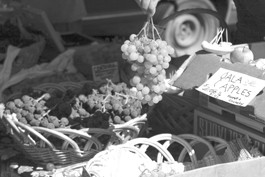
Dangle: Grapes and Galas at the Sebastopol Farmer’s Market.

By Clark Wolf

Splitting his time between Guerneville and Manhattan, acclaimed consultant Clark Wolf graces these pages with the occasional diatribe from the periodic local.

Have an apple. Have a pear. For goodness sake, have a handful of recently harvested grapes! As September ends, yet another brilliant peak harvest season turns toward the next crop and the crunchy fallen leaves beyond.

I really am done with peaches for the year, focusing on dry farmed tomatoes and dreaming of pomegranates and Pixie tangerines. In the wonderful film Postcards from the Edge, Meryl Streep’s Carrie Fisher-inspired character complains that instant gratification “takes too long.” But with ripe fruits, anticipation seems just right.

The last year or so has also seen a hefty crop of what I can only call publishing-related stunt farming. You know, where a writer gets a contract for a book or an article that requires him or her plus family to live for a year on the crops grown in their basement bathtub or out of their rooftop flower pot collection or even from their previously overgrown and somewhat frightening Brooklyn backyard, so they can tell (and sell) the story of magic and woe relating to what humans have been doing for thousands of years. Namely, growing food.

It’s like publishers have just discovered that food comes out of the dirt and that&#8212what a shock!&#8212dirt (known socially as “earth”), is all around us.

Compelling writing though it may be by bestselling novelist Barbara Kingsolver, her popular book, Animal, Vegetable, Miracle: A Year of Food Life doesn’t change, for me, the fact that there is a sort of moral high-ground of opportunism involved. It’s a bit like Salman Rushdie’s soon-to-be ex-wife Padma Lakshmi kicking her Manolo Blahnik stiletto-heeled toe in water while the wind machine blows her hair and she undulates her lips in the introduction to the Bravo TV’s hit show, Top Chef. As a TV exec recently explained to me, “These are television values, not food values.” So, too, with stunt eating.

I appreciate the enthusiastic sense of discovery and am pleased that more men and women aged 15 to 55 are discovering the pleasures of public (and low-cut) cookery. But for those of us who treasure the common sense of at least somewhat natural living, paying attention to the seasons as they come and go year after year, the term “big whoop” comes firmly to mind.

That said, some of this is simply good writing and storytelling, both to be respected and enjoyed. If it is the current fashion to idealize&#8212or even make indie films of&#8212working the land, then it’s a fad-let I can swallow. Just as greening things is all the rage, thoughtful foodism can have lasting and meaningful results if we can work through the dross. There’s nothing wrong with going along with the crowd if the crowd is going somewhere swell.

Ms. Kingsolver says, “No matter what else we do or believe, food remains at the center of every culture. Ours now runs on empty calories.” She adds, “A lot of us are wishing for a way back home, to the place where care-and-feeding isn’t zookeeper’s duty but something happier and more creative.” I wholeheartedly agree.

I suppose it’s really the blogsters that have me cranky. I’m all for free speech but editors are one of the great gifts of the civilized world. So too are editorial meetings, where the Straight Face Test (“Are you kidding me? Another story about purslane?!) weeds out embarrassment before they can go public.

That said, the reasonably ingenious website www.locavores.com is full of interesting information and resources for learning more. But www.eatlocalchallenge.com makes me chuckle. First, why does food need to be a competition? We’re not exactly vying with the mountain lions for life-sustaining kill. And really, how challenging is it to eat locally in the North Bay in September? It’s a treat, a treasure, a privilege and not nearly as challenging as 10 minutes in a Costco.

More interesting to me us the growing movement, or rather return, of raising chickens out back. Not surprisingly, this practical and logical phenomenon is showing up in places like Oakland, Austin, Brooklyn, Seattle and Portland. But it’s the flocklets in Chicago and Houston that catch my eye. “Chickens are the gateway animal for urban farming,” says our own former REV columnist Novella Carpenter as quoted in the New York Times. And there are all those good eggs. Carpenter’s writing a book too, about her “menagerie” of urban Oakland birds and rabbits, turkeys, duck and the occasional pig that should have enough how-to&#8212both husbandry and interpersonal&#8212to be of real use. Check out her posts on yourcityfarmer.blogspot.com as well as thecitychicken.com and backyardchicken.com for more. When live animals are involved, the experience moves quickly from stunt to real life to, well, Sunday supper, a trajectory I can warmly embrace and enjoy.

So, this harvest season make an extra effort, if you can, to relish and rejoice. Let flavor and freshness guide your nose to good foods, some&#8212but perhaps not all&#8212raised by your neighbors and friends, by farmers you know or ranchers you trust. It doesn’t have to be a challenge or a game. Better yet, make it a party.

Clark Wolf is the president of the Clark Wolf Company, specializing in food, restaurant and hospitality consulting.


SEARCH AVAILABLE RESERVATIONS & BOOK A TABLE

View All


Quick dining snapshots by Bohemian staffers.


Winery news and reviews.


Food-related comings and goings, openings and closings, and other essays for those who love the kitchen and what it produces.


Recipes for food that you can actually make.
Planet Organics

0

Photograph by Richard Quinn
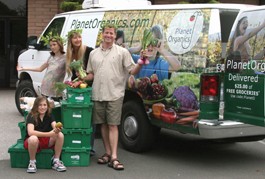
Family Passion: Lorene Reed, Larry Bearg and their two daughters form the nexus of Planet Organics.

Back in the late 1990s, online food delivery companies were supposed to revolutionize how people got their groceries. All someone had to do was order online and it would be brought to the doorstep, just like milkmen used to dos.

But despite the dotcom venture capital, those companies folded one by one&#8212except for Planet Organics. This year, Planet Organics celebrated its 10th anniversary by moving headquarters to Sonoma, where it leased the old Nicholas Turkey facility, hired more employees and expanded delivery deeper into the North Bay.

“It’s the tortoise and the hare story,” says Larry Bearg, who co-owns Planet Organics with his wife Lorene Reed. “Those other companies thought they would take over the world in a year. We’re a family business, and we’ve gone about things very slowly. Those other guys had a ton of money and they came and went. We kept putting one foot in front of the other, doing what we could do, and we’re still here.”

This slow-moving philosophy suits the locally grown, small-scale food that Planet Organics specializes in. On its website, customers can choose from a variety of food boxes starting at $32. They can also choose what food they are getting or let Planet Organics choose the food for them. What they can’t control is when their package will be delivered, since routes are scheduled on certain days for certain zip codes. However, the boxes are designed to be left on doorsteps or in garages if someone is not there to receive them.

As much as it can, Planet Organics offers customers local food. In fact, the North Bay’s growing organic food market was part of the reason the company relocated here from the East Bay. North Bay farmers they use include Clover Farms, Petaluma Poultry and Wine Country Cuisine.

“The farms were certainly an added attraction,” Bearg says. “We knew they were here and we were already buying from some of them. Being up here and close to them is much easier.”

By negotiating directly with local farmers and cutting out the middleman, Planet Organics is able to offer food at a reasonable price. Of course, buying local produce can be more difficult in the off-season. Lorene Reed, who handles produce for Planet Organics, sometimes has to go out of state, or even out of the country, to get certain foods.

“I still stay in California as much as possible,” she says. “But with bananas and mangos and things like that, I have to go out of the country because people want them. And they are yummy and they should have them.”

First and foremost, Reed and Bearg are food aficionados, and Planet Organics is a way for them to share their love of food with other people. They delight in introducing their customers to growers they had never heard of or new foods they have never tried.

Recently, for example, Reed included burdock root in the vegetable box. In the newsletter, she explained what burdock root is, what farm it came from, its nutritional value and recipes for people to try with it.

“Some of the most fun of what I do is introducing people to new food,” she says. “Most of the comments and feedback we get from people are things like, ‘We would never have tried this if it weren’t for you. Thank you for turning us on to this groovy new food.'”

In a time when product recalls are rampant for everything from spinach to pet food, offering people an alternative food source is proving a successful business strategy for Planet Organics. But it started out, well, more organically than that. In 1996, Reed was working as a hairdresser in San Francisco when she learned about Matt’s Organics, a small home business a hippie couple was running out of their garage, delivering boxes of organic veggies to 80 Bay Area customers.

At the time, Reed was pregnant with her second child and thinking a lot about the harm pesticides might do to her children. She was also ready to get out of hair styling and trying something new.

“I loved the concept,” she says. “You open this box and you get all this groovy stuff inside. So I called the couple up for an interview and ended up buying the company.”

By buying almost exclusively from small organic farms, Planet Organics is rejecting the wide-scale corporate food system that stocks most of the grocery stores in the United States.

“There are a lot of problems with our food supply,” Bearg says. “And that stems from food being grown on such a huge scale. If one small part of a field becomes contaminated, then it contaminates thousands and thousands of acres of plants.”

It took Reed several years to understand the wider impact of the business.

“I was kind of innocent going into this,” she laughs. “I wanted to support sustainable agriculture, but when I got into it and learned all about the impact industrial farming is having, I realized&#8212this is serious business, man!”

These days, she’s proud to offer a more sustainable food system, one that is full of higher quality food with fewer chemicals. It’s a system Reed believes is good for the body and the earth.

“Small farmers work with nature, there’s a connection to the earth, with trees and insects,” she says. “That’s the world I want and that’s the world I want my children to grow up in.”


Wal-Mart approved for American Canyon and Fairfax residents plead with the city

not to fix a bridge felled by the 2005 New Year’s flood.

BIG BOX BATTLES

After three years of legal opposition, a 24-hour Wal-Mart Supercenter opened Sept. 19 in American Canyon. That’s good news for American Canyon’s bottom line, says city manager Richard Ramirez. Because the project faced stiff courtroom opposition, he says, “we did not budget for any additional revenue.” The city is predicting more than $600,000 in additional sales tax from Wal-Mart and the surrounding shopping center. The city will monitor its actual income and adjust its budget accordingly.

But does a “big box” like Wal-Mart generate new revenues or just cannibalize the sales taxes once collected by local businesses, asks Marty Bennett, co-chair of the Living Wage Coalition of Sonoma County. Opponents of the American Canyon Wal-Mart unsuccessfully argued that another environmental impact report was needed. Bennett and others would like to expand the planning process to include a community impact report (CIR) for large projects.

CIRs are already being used in San Jose to access impacts on small businesses, employment, housing, smart growth design, community services and public healthcare, as well as potential fiscal costs and benefits to the city. Wal-Mart currently has no super centers in Marin or Sonoma counties, but its plans call for adding more than 40 of these extremely large stores throughout Northern California, Bennett asserts. A CIR “doesn’t mandate any mitigations but it does supply good information to decision-makers,” he explains. While no Wal-Mart super centers are currently proposed for Petaluma, that community is reviewing plans for Target and Lowe’s store locations. A community forum to discuss a potential CIR ordinance will be held on Tuesday, Oct. 2, at the Petaluma Public Library, 100 Fairgrounds Drive, from 6:30-8:30pm.

The Creek Road Bridge in Fairfax was damaged in the 2005 New Year’s Eve floods and closed to all traffic; early this year it was opened only for bicyclists and pedestrians. Rather than clamoring for repairs to finally get done, at least some nearby residents like the lower traffic loads on their streets and want to keep the bridge off limits to all motor traffic except emergency vehicles. Other residents&#8212especially those along the detour route&#8212don’t like the higher level of traffic in their area and want the bridge restored to its former state. Fairfax can’t afford the $500,000-plus repair bill without state and federal funding, which mandate that the bridge be open to all vehicles, says Town Manager Linda Kelly. Plus, Kelly says, equal numbers of neighbors support and oppose reopening the bridge. So the town is considering other traffic-calming measures.


Stage review: ‘Tuesdays with Morrie’

0

09.26.07


Death is not a dirty word. I’m dying&mdashand I can live with that.” So quipped the real-life professor Morrie Schwartz, whose affectionate words of wisdom and humorous observations were the heart and soul of journalist Mitch Albom’s bestselling book Tuesdays With Morrie, now adapted into a stage play by Albom and playwright Jeffrey Hatcher. Tuesdays is a month-long record of conversations that Albom had with his old sociology professor in the final weeks of his battle with Lou Gehrig’s disease, conversations that had a profound effect on Albom and how he chose to live his life.

That “death” line is a funny one, simultaneously playful and realistic, and Tuesdays with Morrie&mdashrunning through Oct. 28 at the Sonoma County Repertory Theater&mdashis crammed with similar ones. As in the book, in the play it is Morrie’s one-liners and artful questions that one is likely to remember the longest after leaving the theater&mdashthat and the performance of Joe Winkler as Morrie. Supported by the dependably excellent Dan Saski as Albom (who does a lot with what could have been a simple straight-man role), Winkler delivers what may go down as the finest North Bay stage performance of 2007. Both emotionally and technically&mdashwith all the little physical details of Morrie’s deterioration recreated with astonishing accuracy&mdashWinkler is a commanding presence, made all the more remarkable given that most of his lines have to be delivered from a sitting or lying position, with very little physical movement. Winkler does what he does with his voice, his face and his eyes. He takes every line, the juicy ones along with the simpler stuff, and mines them for depths of humor, affection, tension and pain that is often far richer than what was written on the page.

Director Jennifer King does a first-rate job of staging the most intimate moments of the play&mdashand this play has a lot of them&mdashwithout allowing the actors to either shape it too safe or jump the line into melodrama. Directing material like this is a dangerous game, and by anchoring the show with such pitch-perfect performances and finely tuned staging, it never strays into sappiness or preachiness, as could have easily happened.

I only wish the play itself were so good.

Since the book on which the play is based is essentially one long conversation between two men, whenever Saski and Winkler are engaged in debate or playful interrogation, everything remains engaging and Morrie’s delightfully philosophical musings are given the spotlight, as when Albom questions Morrie on his belief in God: “I used to be an agnostic, but now I’m not so sure.” Unfortunately, as adapted into a two-actor play&mdashit premiered Off-Broadway in 2002 has been staged by hundreds of small companies ever since&mdashthe whole structure of the thing is unwieldy and rather sloppily crafted, giving the sense that the script was thrown together in a hurry.

Especially problematic is the inconsistent way that other characters are brought to life, sometimes having Saski morph into another role (suddenly donning doctor’s garb to play Morrie’s physician giving his patient the bad news), sometimes having Saski and Winkler pantomime the presence of other people, pretending they are there when they are not. This will bother some more than others, but I found it jarring and unnecessary, the fruit of a playwright not willing to make stronger decisions toward a more coherent visual logic.

I found the set design by David R. Wright to be similarly jarring, mixing the nuts-and-bolts details of an old man’s apartment with whimsical autumn leaves (Morrie is in the autumn of his life, get it?), which dangle overhead and even protrude up from the floor, as with the enormous leaf that stands behind Morrie’s living room recliner.

In the end, the Rep’s production of Tuesdays With Morrie&mdashwhich negotiates through some of the script problems without being able to obscure them&mdashstill works well, packing a powerful emotional punch, mainly through the magnificent performances of Saski and especially Winkler. At the close, I was sorry to have to let Morrie/Winkler go, and, like Mitch Albom, was grateful for the short time I was able to spend in his presence.

‘Tuesdays with Morrie’ runs through Oct. 28 at the Sonoma County Repertory Theater. Thursday-Saturday at 8pm; Oct. 21 and 28 at 2pm. $15-$20; Thursday, pay what you can. Sonoma County Repertory Theater, 104 N. Main St., Sebastopol. 707.823.0177.


Museums and gallery notes.

Reviews of new book releases.

Reviews and previews of new plays, operas and symphony performances.

Reviews and previews of new dance performances and events.

First Bite

0

Editor’s note: First Bite is a new concept in restaurant writing. We invite you to come along with our writers as they&#8212informed, intelligent eaters like yourselves&#8212have a simple meal at an area restaurant, just like you do. This is not a go-three-times, try-everything-on-the-menu report; rather, this is a quick snapshot of a single experience.

There’s a gorgeous patio with stunning views of the water at Claudio’s Trattoria in Bodega Bay. It’s decorated with bistro tables charmingly complete with yellow umbrellas despite the glass roof, as well as lush plants and flowers.

On a recent early evening visit, the sun was setting, and the bay was dancing into darkening navy pools struck with brilliant red. No matter how long I live here, I’ll never fail to be smitten by that sight, and this Tuscan cafe is one of the best places to catch it.Inside, the ambience is equally enticing. Claudio’s has been open for about a year, yet it feels like it’s been there for a much longer, well-loved time. Owners Betsy and Claudio Capetta previously operated a restaurant of the same name in Sebastopol in the mid-1990s. Its cottage interior soothes with warm buttercup walls, bistro-style chairs, and a home-fashioned décor of potted plants, kitschy Italian art and even empty Chianti bottles turned into tabletop vases. The owners greeted us at the door, then bid us farewell as we wander out at meal’s end.

Pretty perfect? Yes, and especially for the low-key dinner I wanted after a long, hectic week of way too much work and too much thinking.

This cooking isn’t cutting edge, and it’s not rock-the-world, but it’s plenty competent, and friendly for its familiarity: sturdy spaghetti and meatballs ($16.95), eggplant parmigiana ($16.50), veal Marsala ($18.75) and the like. In a nod to its waterfront setting, it’s a fine option for ocean-minded folks seeking a tasty cioppino (brimming with calamari, mussels, clams and shrimp in just spicy-enough marinara over linguine ($22.95), or an admirably tender calamari steak ($18.50) sautéed simply in lemon butter.

Ravioli casalinga ($16.95) is pleasant, too, tucked with cheese in an earthy mushroom cream sauce, while lasagna ($16.75) is wonderful to keep warm with as the bay breezes start to kick in. I’d expect a wedge salad in an old-style spot like this, and it’s here ($6.75), topped with chopped tomatoes and better only if it came with big fat crumbles of real bleu cheese instead of bleu cheese dressing.

And though it’d be a more mom-and-pop meal if entrees included salad for the relatively high price, or a more interesting basket of bread, those are minor quibbles when the chef sends out such a savory dish as veal Claudio ($18.75), layered with prosciutto, fontina and peas in a sweet sherry wine sauce.

The true highlight, though, is the antipasto della casa ($10.25). I painfully crave, as I recount this now, the enormous sampler blossoming in a pretty starburst pattern with tangy marinated artichokes, assorted olives, roasted red peppers, assorted cured meats and mild cheeses, bracingly salty anchovies, and a centerpiece of gorgeous bruschetta buried in lots of great gutsy garlic.

For dessert, classic cannoli ($6.25) fills the bill, stuffed with sweet ricotta and chocolate bits. Sipping a strong espresso alongside, out on the patio, with the full moon sending silver streaks across the black waters of the bay, it’s a perfect ending.

Claudio’s Trattoria, 1400 Highway One (Pelican Plaza), Bodega Bay. Open Saturday and Sunday for lunch; Tuesday through Sunday for dinner. 707.875.2933.


View All

Quick-and-dirty dashes through North Bay restaurants. These aren’t your standard “bring five friends and order everything on the menu” dining reviews.

Stephen Marley

0

09.26.07

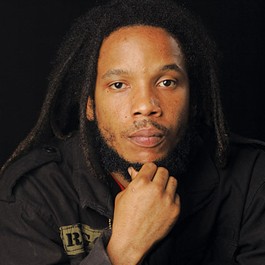
Considering that Bob Marley had 11 children by nine different women, it’s tough to reconcile his philandering with status as rastafari prophet to college students everywhere; nonetheless, he made sure the Marley name would inhabit the most shelf space of any record store’s reggae section. With the economic cachet and cultural heft that the Marley DNA carries, five of his offspring have recorded albums of their own with varying results. The latest, Stephen Marley’s Mind Control, features guests like Ben Harper and Snoop Dogg. Though it would be easy to cite the album’s invisible overseeing guest as Bob Marley, Stephen does a good job of stepping out, both lyrically and musically, from his dad’s shadow. He appears Sept. 30 at the Mystic Theatre.

Two particular tracks very nearly call out the old man, in a call-and-response that is hard to separate from Bob and Rita Marley’s not-always-rosy marriage. “Fed Up” describes a disregarded woman’s point of view (“She said how could you treat me this way? / What we had was more than words could say”) while “Hey Baby,” aided by a smooth-talking verse by Mos Def, seems to be the lamely executed answer (“Everyday I pray to Jah that one day you will see. . . I must fulfill my destiny / I hope you’ll find it in your heart and know these words are true / And please don’t cry, you know that I must do what I must do”).

With five Grammy awards to his credit and vast production experience, the younger Marley could have churned out Mind Control in a heartbeat; instead, through various title changes and rewrites, he waited for it to be perfect. Though not quite charting on the Billboard level of his brothers Damian or Ziggy, sales have nonetheless been brisk for Stephen, which is good. He’s got eight kids of his own to feed, after all.

Stephen Marley performs on Sunday, Sept. 30, at Mystic Theatre, 23 Petaluma Blvd. N., Petaluma. 9pm. $30-$32. 707.765.2121.


Mindy Smith

0

09.26.07

Mindy Smith is not cool, and she’ll be the first one to tell you so. Adopted by a minister and his musically gifted wife, Mindy was raised in the northern part of Long Island. Her first influence was her mom, the choir director at the church. The family listened to Christian music in the house, with an occasional John Denver record spun on the turntable. Smith took to singing whenever the spirit moved her, which caused some raised eyebrows. “I had to learn how to not be excited about singing as I was walking through the mall,” she remembers. “My teachers hurt me a lot too, when I’d do it in class. That led to learning how to not love having music stuck in my head.” Like many high schoolers, Smith tried to be invisible, immersing herself in the Cure during the week and singing in her mama’s choir on the weekends. “I wasn’t even cool enough to be Goth,” she says with a laugh.

At 19, Smith left home for a Cincinnati bible college and, when her mother passed away, relocated to Knoxville to be with her father. A late bloomer, Smith didn’t pick up a guitar until she was 23. With a wistful soprano that is somehow both worldly and childlike, she began writing songs. Soon she scooted westward to Nashville. Her first break came when she was asked to appear on the 2003 Dolly Parton tribute album, Just Because I’m A Woman, the only unsigned artist to be approached. Her eerie cover of “Jolene” became a hit, with Dolly claiming Smith’s version outshone even her own.

Smith’s 2004 debut One Moment More brought more accolades. With songs about faith, including the single “Come To Jesus,” Smith’s internal struggle between the secular and the divine fueled her songwriting like therapy does a Manhattanite.

With her sophomore release Long Island Shores, Smith, now 35, has produced another fine collection of tunes, returning to her birthplace to exorcise old ghosts in the title track, but to also embrace her adopted home, as with “Tennessee.” Often compared to the likes of Patty Griffin and Alison Krauss, Smith has made the circuitous route from Nesconset, N.Y., to Nashville seem pretty darn cool.

Mindy Smith appears on Wednesday, Sept. 26, at the Mystic Theatre. 23 Petaluma Blvd. N., Petaluma. 7pm. $20; all ages. 707.765.2121.


Electro Group’s ‘Good Technology’

0

09.26.07

Electro Group’s first album, A New Pacifica, came out in 2001. I own three copies, and I never get sick of listening to it. Which is fortunate, because it’s taken six years for the Sacramento trio to release its follow-up full-length album, Good Technology.

Underwhelming neo-shoegaze bands are a dime a dozen, but Electro Group&mdashwhile they do owe the Boo Radleys and My Bloody Valentine a debt&mdashfirst and foremost sound like Electro Group. Sure, they’ve got the thick layers of fuzzed-out bass and distorted guitar and semi-buried vocals, there’s something punky about Electro Group; their songs are generally short, direct and driving rather than gauzy and dreamy. Melodically, they get in there and out of there without messing around, though their economy offers no less of an atmospheric payoff.

Guitarist-vocalist Tim Jacobson, bassist Ian Hernandez and drummer Matt Hull have been a band since 1994, but Ian and Tim go back even further. “Ian and I became friends over the Cure,” Jacobson says. “‘Lullaby’ was the first song we played together. We were called Graham Cracker Cyclone.” Hull, who was primarily a guitarist at the time, joined the band later on, shortly after he’d acquired a drum kit from an ex-roommate who’d slagged off on rent.

Electro Group are the kind of guys you want to sit around and drink beer with, but because of logistics (Hernandez now lives in Seattle), we made due with a conference call. A lot of what we discuss boils down to the dirty (and terribly unromantic) little secret of the underground music universe: sometimes it’s the nitty-gritty stuff, like access to certain types of recording, that dictates what happens to a band and when it happens.

“When you record yourselves, it’s a blessing because you can take as much time as you want…but it’s a curse, because you do take as much time as you want,” says Jacobson. “We were committed to recording with old-school tape machines…the songs on Good Technology were probably recorded within the span of a year, but the mixing took so long. Because every time you mix with a tape machine in a traditional mixer, you have to start over again. It’s not like your computer, where it’s saved.”

Hernandez described the mixing board they used on A New Pacifica as “a big steaming pile of crap.” (Indeed, the somewhat crappy sound quality of A New Pacifica is one of the things I love most dearly about it.) Good Technology sounds like the same old Electro Group, but better&mdashliterally. Over the years, the guys have greatly improved the quality of their recording and mixing, resulting in a less sludgy sound.

It contains songs the band has been playing live for years, but they are brighter, crisper. The glory of Good Technology is “Hong Kong Blues,” a new mix that improves vastly upon the 7-inch version released by the band a number of years ago. After a goofy sing-song intro, out of nowhere the song bursts into overdrive, with a dizzying, crunchy guitars and growling bass. “Periphery” begins unassumingly enough, but after a few seconds sneaks into a beautiful chorus that balances the counterpoints of aggressiveness and loveliness that make Electro Group so appealing.

Words are not of utmost importance in Electro Group’s musical universe, which is why I was surprised to see that Good Technology includes a lyric sheet. “I’m not a big fan of lyrics&mdashI don’t even know the words to most of my favorite songs,” Jacobson says. “I try to make it coherent in a very vague way, but really I don’t give a shit. I think it’s cool that people read stuff into it or whatever, but it doesn’t make or break the song for me.”

With Hernandez in Seattle, the band has switched over to a long-distance songwriting and recording via computer. “We have much less defined roles,” Matt Hull says. “I’ve actually played more guitar in the last six months we’ve been recording than I’ve played drums, Tim’s got a lot of drums on some of the songs. We’re all throwing down whatever sounds good.”

When will we get to hear this new stuff? Experience has taught us fans not to hold our breath, but considering I’ve been listening to it multiple times daily with no signs of stopping, six years of Good Technology seems like not such a poor fate.


Fall Foods

Can't Beat It: Roasted beets drizzled with a touch of vinaigrette welcome fall. ...

Profile: Punk flourishes at Santa Rosa Christian venue

10.03.07<Your brain is clay, what's going on? / You picked up a Bible, and now you're gone / You call it religion, you're full of shit—Minor Threat, "Filler"Michael Conrad stands outside the Light concert house on a recent Friday night, watching a friend's hardcore band through the windows and expressing his hesitation about the downtown Christian venue. "I just...

Clark Wolf’s Napkin Notes

Photograph by Ed Troxell Dangle: Grapes and Galas...

Planet Organics

Photograph by Richard Quinn Family Passion: Lorene...

Wal-Mart approved for American Canyon and Fairfax residents plead with the city

not to fix a bridge felled by the 2005 New Year's flood. ...

Stage review: ‘Tuesdays with Morrie’

09.26.07Death is not a dirty word. I'm dying&mdashand I can live with that." So quipped the real-life professor Morrie Schwartz, whose affectionate words of wisdom and humorous observations were the heart and soul of journalist Mitch Albom's bestselling book Tuesdays With Morrie, now adapted into a stage play by Albom and playwright Jeffrey Hatcher. Tuesdays is a month-long record...

First Bite

Stephen Marley

09.26.07Considering that Bob Marley had 11 children by nine different women, it's tough to reconcile his philandering with status as rastafari prophet to college students everywhere; nonetheless, he made sure the Marley name would inhabit the most shelf space of any record store's reggae section. With the economic cachet and cultural heft that the Marley DNA carries, five of...

Mindy Smith

09.26.07Mindy Smith is not cool, and she'll be the first one to tell you so. Adopted by a minister and his musically gifted wife, Mindy was raised in the northern part of Long Island. Her first influence was her mom, the choir director at the church. The family listened to Christian music in the house, with an occasional John Denver...

Electro Group’s ‘Good Technology’

09.26.07Electro Group's first album, A New Pacifica, came out in 2001. I own three copies, and I never get sick of listening to it. Which is fortunate, because it's taken six years for the Sacramento trio to release its follow-up full-length album, Good Technology.Underwhelming neo-shoegaze bands are a dime a dozen, but Electro Group&mdashwhile they do owe the Boo...
11,084FansLike
4,606FollowersFollow
6,928FollowersFollow