Farce Field

0

10.17.07

As a theatrical art form, farce is not as easy to pull off as it often looks. A director once told me that, in her opinion, a well-played farce requires six things: three from the script and three from the production itself. In the script, there must be numerous misunderstandings and/or mistaken identities; there must be characters running in and out of rooms, preferably slamming doors as they do; and there must be a ridiculous conclusion in which all the damage previously done is repaired with an improbable speech taking place with all the characters onstage at the same time to hear it.

As for the production, a successful farce requires a cast and crew with relentlessly high energy, a director with impeccable comic timing and actors who play their characters broadly enough that they never seem like real human beings (otherwise we’d hate them for the stupid and cruel things they do), but not so broadly that we can’t identify with them at least a little.

Sonoma State University’s current production of Georges Feydeau’s 1907 farce A Flea in Her Ear meets five out of six of these requirements, as well as one additional factor that I feel is necessary: the actors must appear to be enjoying themselves, because when they do, the fun is usually infectious. That is mostly true of this production, which on opening night landed two or three laughs for every missed opportunity.

The still-hilarious, 100-year-old play, updated slightly to the mid-1950s in this raunch-filled, pun-packed translation by David Ives, begins in the middle-class Parisian home of M. Chandebise (Peter Warden, recently seen as Caesar in Narrow Way Stage Company’s Julius Caesar), an unassuming if somewhat high-strung businessman whose wife, Raymonde (Rebekkah Patti), is alarmed by a recent lack of libido on her husband’s part, made more suspicious when a package arrives from a disreputable establishment known as the Frisky Puss Hotel. Upon opening the package and discovering.

M. Chandebise’s favorite suspenders, Raymonde assumes that her formerly faithful spouse is now romping among the cheating kind and has left his suspenders behind after a tryst with another woman. With the help of her unhappily married friend Lucienne (Margot Parrish), Raymonde sets out to catch him in the act.

Things become complicated, as they must, by a series of mix-ups involving various friends, employees and family members, including Chandebise’s previously unknown identical twin, Poche (also played by Warden), a jealous Spanish madman named Homenides (Arturo Spell) and a hapless young man named Camille (Ryder Darcy) whose bizarre speech impediment (he can’t form consonants, only vowels) does not stop him from making long, unintelligible speeches.

That everyone should end up at the Frisky Puss at the same time is a foregone conclusion. A gaudy establishment designed for quick assignations, the Puss is owned by M. Feraillon (Nick Christenson), a coarse, quick-tempered man whose hotel is not the classy franchise he thinks it is. Consistent with this type of French farce, there is a great deal of bed-hopping but a surprising lack of actual sex, as everyone becomes too consumed with avoiding and deceiving one another—and accidentally tripping the switch on a spectacularly revolving, hidden door bed—to actually stop and do the deed.

Under the experienced direction of guest artist Hector Correa (the artistic director of the Pacific Alliance Stage Company), the pacing and comic timing of all those entrances and exits is very well done, and the sets, by Eric Reed, are delightfully full of entertaining detail and moving parts.

The only problem lies in the way the actors, or most of them, fail to step up to the level of fantastic, outsized cartoonishness required for effective farce. With the exception of Warden’s dual performance (he always seems to be flying in 10 directions at once), Darcy’s desperately incoherent Camille, Kelly Dixon’s hot-to-trot housemaid Antoinette and Spell’s wacky turn as the demented Spaniard (I especially liked the way he pronounces the name Chandebise as “chande-bitch”) most of the actors, even when “acting big,” seem a little too grounded in reality to elicit the laughs the script laid out for them. All they need is an additional dash of inspired mugging, and this Flea will be biting in all the right places.

‘A Flea in Her Ear’ runs Wednesday&–Sunday through Oct. 21 at the Evert B. Person Theater at SSU. Oct. 17&–18 at 7:30pm; Oct. 19&–20 at 8pm; Oct. 21 at 4pm. 1801 E. Cotati Ave., Rohnert Park. $8&–$15. 707.664.2353.


Museums and gallery notes.

Reviews of new book releases.

Reviews and previews of new plays, operas and symphony performances.

Reviews and previews of new dance performances and events.

KSRO wants your tamales

0

Just in time for the holidays, the recipe contests are rolling in. And here at the Bohemian, we’re not wasting your time with the simple stuff (cookies, cakes, pies). Oh no, they’re too easy. Stretch your culinary muscles with these two skill-testers, and plan your time accordingly; if these recipes are done properly (every bit from scratch), they’re achingly labor-intensive. Suffering, er celebrating, in the kitchen—isn’t that what the season is all about?

Calling All Tamales KSRO 1350-AM is hosting its 21st Annual Good Food Hour Recipe Contest and this year they want your masa masterpieces. According to Sonoma top chef and Food Hour co-host John Ash, “Unwrapping a beautifully made tamale is like opening a Christmas present. Colorful banana leaves or corn husks peel away to reveal a delectable corn dough followed by the aroma of the steamed filling and an explosion of flavors.” Indeed.

Making a tamale, though, can easily be a two-day affair, from fashioning the dense dough with homemade stock, roasting the highly seasoned meat and/or veggie filling, rolling the layers into lovingly soaked fresh husks, then slow-steaming the little bundles for several hours with a careful eye so they don’t dry out.

Rules: Pretty much none. Tamales can be savory or sweet dessert style. Add a sauce if you want. Bonus points for “tamales with personality.”

What to do: Recipes must be received by Wednesday, Oct. 31, 2007. Mail, fax or e-mail recipe entries to NEWSTALK 1350 KSRO Tamale Contest, P.O. Box 2158, Santa Rosa, CA 95405. Fax: 707.571.1097. E-mail: jo*****@**ro.com.

Fourth Annual Gingerbread House Extravaganza Contest Got a flair for confectionary construction? Your winning entry can win you some serious dough, and the respect of über–pastry chef/contest judge Gunter Heiland, a multi-time gold medal winner of the West German Culinary Olympics. Just toss together some fresh-baked gingerbread, craft it into an architectural fantasia (hmmm, a mini Quixote or trellised Hall Winery, perhaps?) and walk away with prizes from host Cedar Gables Inn in Napa.

Rules: There’s a whole packet of ’em, including a contract, exhibit-space rental agreement, measurement criteria and material restrictions (think “edible”). Check it all out at www.cedargablesinn.com.

What to do: Read the rules on the website and pay your $10 nonrefundable sign-up fee by Nov. 1. Judging takes place at the Inn on December 1.

How to do it: Need we repeat? Go to CedarGablesInn.com.

Why do it: Slapping together gingerbread siding is usually fun, and the Inn is an inspiration for any lover of elaborate architecture. A 10,000 square-foot mansion built in 1892 in the Shakespearean style by Ernest Coxhead, it’s a virtual Disneyland of intriguing rooms, winding staircases, an old English Tavern and secret passageways. Guest rooms are replete with luxury known to few in the late 1800s, however, such as two-person whirlpool tubs.


SEARCH AVAILABLE RESERVATIONS & BOOK A TABLE

View All


Quick dining snapshots by Bohemian staffers.


Winery news and reviews.


Food-related comings and goings, openings and closings, and other essays for those who love the kitchen and what it produces.


Recipes for food that you can actually make.

Kate Kennedy and Sonoma’s Avalon Theater

0

the arts | stage |

Photograph by Robbi Pengelly
To be, to be: Kate Kennedy has no hesitation when it comes to Shakespeare.

By Patricia Lynn Henley

Her eyes flashing with humor, Kate Kennedy perches in a royally upholstered chair in the living room of her Sonoma Valley home. “I’m sitting on my Hamlet chair,” she explains happily. Undaunted by the fact that she knew next to nothing about upholstery or chair construction, a few years ago Kennedy crafted two gold-corded, round-cornered creations for one of her annual summertime Shakespeare productions.

“It’s only four legs and a seat,” she says modestly.

Her can-do attitude lets her accomplish more than most people.

“I like being busy. I think that when you passionately love what you do, you can’t wait.”

And Kennedy loves Shakespeare—enough so that she delights in playing around with the Bard’s comedies, throwing in a bit of Elvis here or a reference to modern-day politics there. She tends to stick to the scripts for the tragedies, but the comedies are fair game. “You can mess with those all day long,” Kennedy asserts with a grin, her short haircut accentuating the pixie-like quality of her face.

But of course she also makes sure that her actors know their stuff. “It’s sort of like a Picasso. You want to get exactly what you know perfectly first, then go off the script.”

Kennedy is founder and artistic director of the Avalon Players theater troupe, now in its 27th year performing Shakespeare in the Sonoma Valley. She also teaches drama at North Bay schools and produces a variety of productions throughout the year. Each summer she runs a musical theater and a Shakespeare camp for kids, as well as helping with the longtime performing-arts camp she cofounded at Sonoma’s Sebastiani Theatre.

Kennedy is a like “a female Robin Williams,” says Diana Rhoten, a performing-arts camp cofounder. Even a quick conversation with Kennedy involves a rapid succession of various humorous accents.

“The way her mind goes—she’s so clever and she’s just constantly thinking of something else.” Rhoten’s particularly impressed by Kennedy’s ability to get children immersed in Shakespeare. One of the secrets, Rhoten adds, is that “Kate is a kid herself.”

The middle child of nine, Kennedy grew up in a rural setting outside Minneapolis. In kindergarten, she played Dorothy in The Wizard of Oz. Kennedy attended Catholic schools, including boarding school during her four years of high school.

Pursuing her love of theater, she toured the northeast and Canada for two years with a commedia dell’arte company, then moved to California and spent another two years as a lead actress for the San Francisco Shakespeare Company. She settled in Sonoma, and in 1980 founded the Avalon Players.

Working with children and with actors is wonderful, Kennedy says. “I’m most pleased when people that I have mentored or worked with or nurtured are happy and successful and confident. When they do well, that’s the best feeling. It’s really wonderful. You think, ‘Good on you, mate.’ And if I have a little bit to do with that, bravo.”

One of Kennedy’s many success stories is Aidan O’Reilly, who started acting in her productions when he was 11 years old. Now 22, he’s a recent graduate of England’s Royal Academy of Dramatic Art.

“I’m always careful about using the word ‘artist,’ because it kind of reeks of pretension, but I think with Kate it is very appropriate,” O’Reilly says. “An artist to me is someone who doesn’t do it for the money or necessarily for the love of it but because they have to, it’s a force that drives them. That’s true of Kate. She’s one of the few people I’d classify as a genuine artist.”


View All


Museums and gallery notes.


Reviews of new book releases.


Reviews and previews of new plays, operas and symphony performances.


Reviews and previews of new dance performances and events.

2007 Boho Awards:

0

silicon valley |

By Gretchen Giles

Such worries. Choosing the five recipients of our 10th annual Boho Awards, which honor those people and institutions whom we think have made a particularly stellar contribution to the community in the field of the arts, is tough work. Tough, because there are so many wonderful and deserving people and institutions to select from. Once we start discussing the possibilities, we are regularly astounded at the North Bay’s good fortune in having within its slim geographic boundaries so many artist and visionaries contributing regularly to our rich communal life.

But we constrain ourselves to just five, this year pulling the Marin Theatre Company and Kate Kennedy and her Avalon Players from the robust theater community; Santa Rosa’s Dance Center from the distinctly underserved field of fine art movment; Napa’s utterly flooring slate of goodness also known as the Festival del Sole, just completing its second year and already legendary for the breadth and value of its performing slate; and the kids of the Shop, a Sonoma-based music and teen center entirely run by its young participants with little need for such as adult oversight.

We fete our winners and the public at large with an awards party, scheduled for Thursday, Oct. 18, at the Glaser Center (within the Universal Unitarian Church, 547 Mendocino Ave., just south of College Avenue, Santa Rosa), from 5:30pm to 7:30pm. Porch punk rockers Stiff Dead Cat will perform, chef Tai Olesky of Forestville’s Mosiac Restaurant and Wine Bar is kindly handling the food and surprises are guaranteed. This event is free and open to the public. We hope you’ll come down and help us celebrate this year’s roster of stars.


Essay: Mingering Mike and Beirut

0

10.10.07

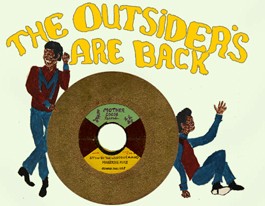
The most striking music story of the year, the one that’s inspired thousands of blog posts and indie press odes, is the tale of a musician who has not released a single note of recorded music. He’s never performed live, either, because he does not exist.

The tale of Mingering Mike broke several years ago, when a crate-digger named Dori Hadar stumbled across a treasure trove in a Washington, D.C., flea market. While flipping through old records, he came across an unusual hand-painted cardboard sleeve for The Mingering Mike Show—Live from the Howard Theater. It contained not a vinyl LP but a cardboard stand-in with a homemade label glued on. Hadar searched further, finding dozens more of these curious nonreleases. He bought them all and, both puzzled and beguiled, posted pictures of some on the forum Soulstrut.com.

The pretend records struck a chord with readers, and Hadar set out to find the real man behind this Mingering Mike fellow. After a decent amount of private detective&–style legwork, he located a meek but guarded middle-aged man: the real Mike.

The book Mingering Mike: The Amazing Career of an Imaginary Soul Superstar (Princeton Architectural Press; $24.95), which came out this summer, ties together the loose ends for people who heard about Mingering Mike on the radio or read about him in the New York Times. It contains images of Mike’s records—hundreds of them—that create a testament to the soothing power of private fantasies and the depth of seemingly ridiculous, unattainable dreams.

The appeal of the Mingering Mike saga is its odd mix of familiarity and futility. How many of us doodled logos for our own imaginary bands on notebook covers or sang off-key songs a cappella into a tape recorder? But most of us stopped at that. The astounding thing about Mingering Mike’s vaporous enterprise is the scope of it. Flipping through the LPs and singles and album gatefolds in the book, you realize what a delicious escape Mike created for himself, an empire of music so elaborate that no amount of actual songwriting and recording could match its perfection.

Mingering Mike is heartbreaking in a way, because even though its artwork and faded black-and-white snapshots of the real Mike are captivating, a reader can never fully get inside them; it’s a constructed world too sprawling for an outsider to feel fully comfortable visiting, because he didn’t craft it with the intention of sharing it with the outside world. If Mike really wanted to be the superstar Mingering Mike, he’d have pursued an actual musical career, which has many pitfalls and few breaks. In his fantasy, Mike had total control.

Actual music starts out in the same way, though—in an artist’s cloistered headspace. And with many iconoclastic songwriters, the coziness and intimacy of creating music alone in a bedroom or basement will always be part of their image. Zach Condon is one such fellow.

Condon performs as Beirut with a shifting ensemble of musicians, eschewing the standard drums-bass-guitar setup for accordion, glockenspiel, strings and horns. By the time he dropped out of high school at age 16, he’d already recorded reams of songs in his bedroom, where he also recorded the majority of last year’s Balkan-happy Gulag Orkestar, which charmed the NPR and indie-music blog set. That he was only 19 at the time simply added another layer of color to the package.

Condon has lightened up the Gypsy fetish of Gulag Orkestar, and on Beirut’s new album, The Flying Club Cup, moved on to the France of cafes, chain-smoking, berets and baguettes. Condon’s use of melancholy horn arrangements in particular reflects an affection for the consummate French pop storyteller, Jacques Brel. Unlike Brel, whose keen lyrics could prompt tears and laughter in the same verse, Condon prefers to emote not in words, but in a warble recalling another neo-vaudevillian, Tiny Tim, albeit with the falsetto unplugged. It’s Beirut’s best asset and worst enemy, sometimes sweet and sometimes cloying.

Beirut isn’t about authenticity, but rather cherry-picking certain elements to establish a nostalgic sound-picture of the Europe that exists solely in the minds of overimaginative Americans. Condon has spent time in France, but The Flying Club Cup is more about the idea of France.

And perhaps Beirut is not about Condon, and Mingering not about Mike, but our idea of an artist: precocious, naïve and dreaming big in the bedroom.


The Shop in Sonoma

0

ISSUEDATE


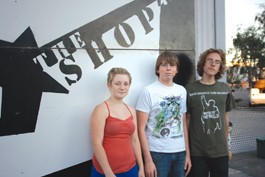
To the casual passerby, the Shop doesn’t look like the crown jewel that it is; it’s pretty much a dingy warehouse in the middle of nowhere. But for almost 10 years now, it’s served as a haven for the area’s teenagers, providing a stage for budding young bands and a drug- and alcohol-free hangout on weekend nights. Far from the stifling environment of a city-run, adult-mandated “teen center,” the Shop is run almost entirely by its own teenage volunteers.

For this reason, we honor those known as “the Shop kids”—past, present and future—who work extracurricular hours creating an environment with lasting effects to benefit not just the kids who frequent its corrugated steel walls, but also the entire community at large.

On a recent Saturday night on the outskirts of Sonoma, outside the warehouse before the show, the kids pass the time by reminiscing about the craziest things that have gone down at the Shop.

“This one band—I don’t wanna say the band name—but the drummer is just fuckin’ crazy!” says soundman Will Wedell, 16. “It was their last song, and he was just really riled up, so he started playing the cymbals with his snare drum, and totally just punched over his whole set! And then another time, they came back, and the same guy started to play cymbals with his head, and got a big cut on his head, and there was blood everywhere!”

Other hijinks abound: “I went to sit on the couch once,” adds Jessica Grimm, also 16, working the door, “and about 20 people piled on top of me.” Fifteen-year-old events booker and concession manager Will Doran chimes in. “We had a big rap show once,” he explains, “with a costume contest for whoever could have, like, the most old-school kinda outfit, and there was some 60-year-old lady with a clock around her neck!”

With its emphasis on wine, food, and festivals, Sonoma isn’t exactly the most stimulating city for a teenager; both Doran and Wedell speak the words “wine country” in the same sort of resigned tone that baseball fans reserve for the Yankees. Opportunities to get involved locally usually require serving the adult community, either by volunteering at festivals or working retail jobs for tourists. For the kids, the ability to create their own community is vital.

“A big factor for teenagers,” says Shop co-director Dave Robbins, a bona fide grownup, “is that they have to feel that most of what they’re involved in is theirs, that they’re a part of it.” There’re always older chaperones at the shows, ready to assist if needed, “but there’s not a whole bunch of adults monitoring them,” Robbins stresses. “We just let them be themselves, and generally, that’s the best way to go.”

In addition to the way the Shop has changed local attitudes toward youth in general, the kids of Sonoma themselves are all obviously better off. “I like being able to come out here,” says Doran. “I like music a lot, and now I can get into shows for free, even if I have to work outside all night.”

Grimm says if she weren’t working the door tonight, she’d be listening to music and talking on the phone with friends; instead, she’s listening to music and talking to people in person, “which I like a little bit better.”

Perhaps Wedell has seen the most positive change. “Right now,” he testifies, “if I didn’t have the Shop, I would probably be sitting in a corner crying about how there’s nothing to do in Sonoma.

“Because there really is nothing to do in this town.”


Essay: Rock and Roll Hall of Fame 2008 choices

0

10.10.07

In August 2006, some 200-plus KISS fans massed at the Rock and Roll Hall of Fame museum in Cleveland, protesting the classic rock band’s eight-year-long omission from the Hall’s annual induction ballot. The KISS Army didn’t protest this year, when the Hall recently announced the nominees for its spring 2008 induction ceremonies, which include Madonna, the Beastie Boys, Donna Summer and Leonard Cohen. But there’s already blog talk of a KISS Army protest next year, as if fans have already accepted future neglect.

Why are certain acts consistently ignored by the Rock and Roll Hall of Fame? The present list of snubbees includes big names like Neil Diamond, Chicago, the Spinners and King Crimson. Like any modern institution, the Hall sets a standard that’s subject to the slippery area between personal tastes and historical truths. With its committee of powerful industry insiders (the likes of Rolling Stone publisher Jann Wenner and major patron Bruce Springsteen), the Hall has so far successfully created a rich preserve for our tremendous 20th-century American tradition of blues, gospel and folk-based music. But the Hall currently stands at a crossroads, where its solid track record of acknowledging known boomer-based critical favorites is at odds with the very expansiveness that ongoing rock culture has created.

As the Hall begins to recognize newly eligible punk and hip-hop acts (the rule is 25 years since an act’s first released recording), every fan of this or that older artist is bound to feel snubbed—or, in correct punk fashion, will make a point of choosing to not care. This year’s Beastie Boys nomination seems like a pick that tries to cover all bases. It’s more noticeable than ever that the Hall’s bias toward American roots music and industry tradition has found it consistently ignoring trailblazers of metal, progressive rock and indie punk.

The loudest outcry to this year’s nominees has come from Metallica fans, who feel incensed by the omission of the thrash titans in their first year of eligibility. I don’t have much sympathy here; most great artists don’t make the ballot in the first year they qualify. Besides, once a band inducts a forefather, as Metallica did with Black Sabbath at the 2007 ceremonies, they’re a future shoe-in.

Rush fans are the next most vocal anti-Hall group. They feel the bile of the missed nominations for both metal and prog. But no worries. Rush are Canadian and had ’80s pop-rock hits, so they stand a much better chance with the Hall than snubbed British classical concept-rockers like Yes and Jethro Tull. Indie-rockers shouldn’t worry about upcoming props, either. This year’s nomination of the Dave Clark Five, who made last year’s ballot but weren’t inducted, shows that the Hall is willing to go back and pick up marginal acts who had a damn bright 15 minutes of fame.

Can you or I or the Rock and Roll Hall of Fame really say what is great? I recently posed this question to a friend at a local bar, insisting that some rock music is obvious, objective Hall of Fame material. I asserted that the Rolling Stones, for example, absolutely must be in the Hall of Fame. “Or not,” he responded.

Which brings us back to KISS. I didn’t really care for them in high school, growing up in Arizona in the ’70s, when they were a current band. But I experienced them as a potent piece of culture. We used to ditch seventh period and take a 12-pack and as many joints as we could roll down to the Gila River in Leo Mercado’s truck, and we always blasted out KISS Alive and Destroyer. But I only really learned to love KISS later in college, during their decline, when I purchased a used vinyl copy of KISS Alive, complete with all the posters, for a mere 25 cents.

While a nominating committee in Cleveland decides which rock musicians it will honor this year or next year, KISS, like prog and punk, are already a part of rock’s continuum of historical fame because they have contributed to and spurred this great musical debate in the first place.


Review: ‘My Kid Could Paint That’

10.10.07

On camera, Marla Olmstead is one of the cagiest abstract expressionists artists ever interviewed. Olmstead makes a chronically tight-lipped painter like Jackson Pollock seem like a chatterbox. Facing queries about her work habits, the meaning of her paintings or her technique itself, she demurs and tries to turn the microphone over to her brother. When pursued by questions she’d rather not answer, she retreats and gives the camera wide yet shut-off eyes and a thin, enigmatic smile. Even at four years of age, Olmstead knows the right way to deal with the press.

In the documentary My Kid Could Paint That, director Amir Bar-Lev tries to crack the case of the four-year-old artist, whose canvases sold for over $300,000 on the New York art market. Instead, it is Bar-Lev who ends up cracked, baffled by two contradictory propositions.

One is that Marla is a genius who can’t be seen at work, whose true creative process is as hidden from view as Schrödinger’s cat. The other is that Marla is the point-child in a delicious fraud that hoodwinked everyone from the New York Times art page to NPR, as well as serious connoisseurs beguiled by the notion of a pure child working in the cynical and egomaniacal art world.

Maybe we should take Marla’s guidance and concentrate on the art. They are good paintings, whoever did them. Trying to make an abstract painting is an instructive process. After such an attempt, one tends not to echo the philistine comment Bar-Lev uses as his title. Moving paint around is a technical challenge; making the paint do what you want takes time and learning. The canvases we see toward the film’s end are the work of someone with a fine sense of color, depth and motion. They have some value outside of the hysteric and status-driven art market.

But is it all a fraud? The investigative program 60 Minutes 2 suggests so, causing a huge crisis in the Olmstead’s life. The broadcast spurs a flurry of disgustingly vicious hate mail aimed at Marla’s apparently guileless mom, Laura, a dental hygienist, and father, Mark, the night manager at a Binghamton, N.Y., Frito Lay plant. There is a whiff of rat here. Mark does some figurative painting and is seen urging Marla on and Marla keeps insisting that her little brother Zane does paintings as well.

One feels for Bar-Lev, who took on the project as an innocent and ended up as forlorn as Albert Brooks expelled from the family unit in Real Life. Meanwhile, this utterly fascinating and naturally colorful enigma gives one as much to talk about as any movie this year. On a simpler level, one is charmed by the little artist.

My Kid Could Paint That opens on Friday, Oct. 12, at the Smith Rafael Film Center, 1118 Fourth St., San Rafael. 415.454.1222.


New and upcoming film releases.

Browse all movie reviews.

Letters to the Editor

September 26 – October 3, 2007

Lamb dressed as lamb

Hannah Strom-Martin’s points about the bias of the fashion industry against the well-endowed (“My Two Breasts,” Oct. 3) are well taken. The designers have decided that bodies should fit their clothes, not the other way around. Shame on them. Women don’t really have to put up with that, and yet, for some reason, we do.

But do you get the idea, based on the perceived accusing looks that Strom-Martin says she receives, that she may dress somewhat . . . well, have you heard the phrase “mutton dressed as lamb”?

Strom-Martin may be seen as less a slut than as a case of badly misguided taste. Nobody but skinny teens look good in skinny-teen outfits. Everybody else runs the risk of coming across as kind of pathetic.

And while it is true that modern fashion may hold little for Strom-Martin in terms of flattery and prettiness, it was not always so. Clothing used to be designed with a more realistic woman’s body type in mind. I’m thinking that perhaps a vintage shop might be a good resource. And talk about a chance for real style, nobody ever called Lana Turner tacky. (Well, nobody classy did, any way.) They called her sexy.

And one final word: don’t be mean. The flat-chested are not losers any more than are the well-endowed, so don’t call names. Be nice.

Definitely mutton,

Andi PerrySanta Rosa

Hannah Strom-Martin, who first wrote to us offering to be our movie critic when she was 14, is now perhaps all of 28. She’s still firmly on the “fluffy lamb” side of the fence.

Tough love

Regarding the article on Community Pulse, “Doing the Math” (News, Sept. 19): I find these sorts of articles rather useless, a bunch of feel-good BS.

Would people like to help the environment? For starters, stop overpopulating. Stop building and stop paving over the land. If you want a family, have only one child or, better yet, don’t have any and adopt or become a foster parent. Teach your children about their local watersheds, how many species we have lost in the last 200 years, what we lose each year and why.

Stop illegal immigration. Get the churches in Latin America to stop supporting oppression and support economic justice, women, human rights and family planning.

Repeal NAFTA.

There are around 1 billion people in the world currently living in total crowded squalor, and more are being born into, or moving into, wretched slum life every year. The question is, will so-called self-appointed environmentalists quit trying to convince people to put bandages on a broken leg or will they aggressively address the issues of overpopulation and economic disparity that many religions and political systems choose to ignore?

Lynn RockholdSanta Rosa

Interfaith thanks

Last year, a small group of concerned people gathered to put together an emergency winter shelter for the homeless in Guerneville. There are no shelter facilities at the river for when it gets really cold. Several people in the past did not survive the temperatures below 35 degrees F.

St. Elizabeth’s Church was generous enough to make the St. Hubert Hall available and are considering doing that again for this coming winter. Some members of this initial group decided to make sure that funds would be available early on for a winter shelter for this year so that resources were in place by the time the shelter was needed. Several other people joined this initial group, putting together a spaghetti dinner with a silent auction on Sept. 22. Proceeds were to go to the Russian River Interfaith Coalition to be used specifically for winter shelter. The event was held at the Guerneville Community Church, which kindly donated the space and utilities.

The evening was a great success because of the incredible effort of Mindy, Betty, Jan, Ila, Nancy, Kathy and Ed, Zach and many others. More then 200 tickets were sold as the local community showed their support for this endeavor. The Love Choir from Sebastopol came to sing, there was a raffle and door prizes and people had a wonderful time. The winter shelter committee raised over $4,500! The Russian River Interfaith Coalition wants to thank the committee for their tenaciousness and passion in putting together this first annual spaghetti dinner for the homeless. Thank you on behalf of the community and on behalf of those who really need the shelter. You have done an amazing job in bringing the resources and the community together in raising this much money.

the Rev. Elisabeth Middelberg Co-Chair, Russian River Interfaith Coalition

The Ed.,
Covered in cardboard cuts and odd bits of tape


The Green Zone

10.10.07

On Sept. 21, I attended the Climate All Stars Conference in San Francisco. Organized by the Climate Protection Campaign (CPC), a nonprofit located in Sonoma County’s small town of Graton, this conference was an ambitious effort to bring together a lineup of resources and individuals actively working to save the planet from the effects of global warming. The CPC is a stunning example of the type of organization that just might, when everything else seems to be failing, rescue the world from its no-uncertain doom.

Climate Protection Campaign president Ann Hancock and her host of committed volunteers and few staff members are perhaps best known for their work in implementing the adoption of a plan by all nine Sonoma County cities and the county government to reduce greenhouse gas emissions to 25 percent below 1990 levels by 2015. This fall, the CPC will release the results of an extensive study which will lay out in detail its findings on CO2 emissions, as well as a detailed plan for what must be done in order to meet the 2015 goal.

I spoke with CPC development director Barry Vesser about this huge undertaking and what it will take to get the action plan out into the community and into effect. Among other things, we discussed the importance of semantics. When it comes to green issues, Vesser encouraged me to think about the environment not in terms of “carbon constraints” and “sacrifice,” but in terms of a “green renaissance” and “new possibilities.” Vesser, perhaps sensing my dark side, reassured me that Sonoma County is rich in progressives, human resources, talent and business economy. He believes that Sonoma County is perfectly poised to be the forerunner in climate control, and that it can meet its goal of emissions reduction.

With over 300 participants, the All Stars Conference is an example of exactly the type of widespread engagement Vesser was referring to. To be surrounded by so many people who not only care deeply about climate change but who are motivated enough to take action was both inspiring and educational.

My first stop was a break-out session, sponsored by the Cool Schools program, which is just one more program developed by the CPC. High school students were scattered throughout the group, and when one student raised his hand and asked the room full of adults when the last time was that any of them had actually ridden the bus, I felt a flicker of hope for humanity.

When I was in high school, all I knew about global warming was that it could be a myth, but if it wasn’t, it was my best friend’s fault because she used too much Aqua Net hairspray. Thanks to Cool Schools, which provides materials to high schools like Analy and Windsor, students have the chance to study their school’s carbon footprint, and figure out ways to minimize it. Youth awareness is obviously on the rise.

One of the most memorable moments of the day, other than the surprisingly excellent food, was when keynote speaker Ed Mazria stepped up on the stage and began to work a “fear of the end of the world” spell. The lights went down, and so began a slide show of what the United States will look like in 2035, when the oceans finally begin to swallow us up. This is it, I found myself thinking, of all the ways to go, death by drowning.

Mazria informed the crowd that there are currently 151 new coal-fired power plants in various stages of development in the United States In China, Beijing will have to shut down its coal plants prior to the Olympics in a desperate attempt to make the air clean enough to breathe, at least while jogging. Even if we all start riding the bus every day, we may be helping, but the coal plants will negate our efforts, and then some. In just 10 days of operation, the CO2 emissions from one medium-sized coal-fired plant will negate the planting of 300,000 trees.

Just as I was about to relinquish that splinter of hope brought on by the youth action and the composting bins that were placed next to all of the dish-busing stations, Mazria gifted us with a solution. By reducing the amount of energy used by buildings, we can negate the need for coal plants. Our future lies not just in how we ride but, most importantly, in how we build. The answer to global warming is no more coal. Up until now I had secretly considered the entire situation rather hopeless, because most of us would rather die than not drive, or at the very least, die while driving. There are times when I love being wrong. This was one of them.

For an All Stars toolkit, as well as videos of the conference and a plethora of other resources, visit www.climateallstars.org. For more information on the Climate Protection Campaign, as well as the Cool Schools Program, visit www.climateprotectioncampaign.org or call 707.823.2665. For more information on getting rid of coal and the 2030 challenge, go to www.architecture2030.org.


Farce Field

10.17.07As a theatrical art form, farce is not as easy to pull off as it often looks. A director once told me that, in her opinion, a well-played farce requires six things: three from the script and three from the production itself. In the script, there must be numerous misunderstandings and/or mistaken identities; there must be characters running in...

Kate Kennedy and Sonoma’s Avalon Theater

the arts | stage | Photograph by Robbi Pengelly To...

2007 Boho Awards:

silicon valley | By Gretchen Giles ...

Essay: Mingering Mike and Beirut

10.10.07The most striking music story of the year, the one that's inspired thousands of blog posts and indie press odes, is the tale of a musician who has not released a single note of recorded music. He's never performed live, either, because he does not exist. The tale of Mingering Mike broke several years ago, when a crate-digger named...

The Shop in Sonoma

ISSUEDATETo the casual passerby, the Shop doesn't look like the crown jewel that it is; it's pretty much a dingy warehouse in the middle of nowhere. But for almost 10 years now, it's served as a haven for the area's teenagers, providing a stage for budding young bands and a drug- and alcohol-free hangout on weekend nights. Far from...

Essay: Rock and Roll Hall of Fame 2008 choices

10.10.07In August 2006, some 200-plus KISS fans massed at the Rock and Roll Hall of Fame museum in Cleveland, protesting the classic rock band's eight-year-long omission from the Hall's annual induction ballot. The KISS Army didn't protest this year, when the Hall recently announced the nominees for its spring 2008 induction ceremonies, which include Madonna, the Beastie Boys, Donna...

Review: ‘My Kid Could Paint That’

10.10.07On camera, Marla Olmstead is one of the cagiest abstract expressionists artists ever interviewed. Olmstead makes a chronically tight-lipped painter like Jackson Pollock seem like a chatterbox. Facing queries about her work habits, the meaning of her paintings or her technique itself, she demurs and tries to turn the microphone over to her brother. When pursued by questions she'd...

Letters to the Editor

September 26 - October 3, 2007Lamb dressed as lambHannah Strom-Martin's points about the bias of the fashion industry against the well-endowed ("My Two Breasts," Oct. 3) are well taken. The designers have decided that bodies should fit their clothes, not the other way around. Shame on them. Women don't really have to put up with that, and yet, for...

The Green Zone

10.10.07 On Sept. 21, I attended the Climate All Stars Conference in San Francisco. Organized by the Climate Protection Campaign (CPC), a nonprofit located in Sonoma County's small town of Graton, this conference was an ambitious effort to bring together a lineup of resources and individuals actively working to save the planet from the effects of global warming. The CPC...
11,084FansLike
4,606FollowersFollow
6,928FollowersFollow