Pinhead Gunpowder at Gilman Street

18


“One request: ditch the cell phones and digital cameras. If they weren’t here, fuck ‘em.”
Apparently something happened tonight called the Grammy Awards, a bloated, self-congratulatory clusterfuck which, as a music journalist, I should probably attempt to care about. But even if for some sadomasochistic reason or another I followed the Grammys like a hawk, I’d have to opt instead for witnessing an event infinitely more electrifying and significant: Billie Joe Armstrong’s grand return to the stage at 924 Gilman Street.
Gilman in itself holds a big place in my heart; from 1990-1995 I played there, slept there, volunteered there, and went to more shows there than I can count. And of the 20 or so times I saw Green Day—including the time they fulfilled a request to play my own high school in 1991—none was as special as seeing them at Gilman, because it was and still is the most miraculous and amazing club the world has to offer.
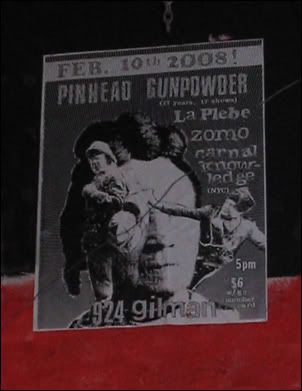
Billie Joe, now a decorated Grammy alumnus himself, suffered the psychological blow of not being able to perform again at Gilman—essentially his home and breeding ground for six formative years—when Green Day signed to Warner Bros. in 1993 (the club explicitly bars major-label bands from its lineups). In a number of songs and interviews, he made the scars public; yet skirting back to the venerable warehouse fifteen years later, his less-mentioned but no-less-brilliant “other band” Pinhead Gunpowder was added onto tonight’s hush-hush Sunday evening show. (Judging from the long line that snaked around the block as the doors opened at 5pm, the news that Billie Joe was playing didn’t exactly escape the wildfire of Message Boards and MySpace postings like the organizers hoped.)
Pinhead Gunpowder does not play a lot of shows. In fact, they’ve only played 17 shows in 17 years. And though the band had just finished up a round of Southern California dates the previous week, tonight’s show carried a particular historical weight.
“We’ve played some shows, like down in San Pedro, the kinds of shows I haven’t played in 15 years,” he explained to me, hanging around the side door before the doors opened. “It’s been fuckin’ great. But this place…”—he paused, stared nervously at the club—“I haven’t played here in a long time.”
Playing Gilman again for Billie Joe is probably a lot like getting dumped by an amazing girlfriend, only to have her call up years later out of the blue for a roll in the hay; strange, kind of awesome, and more than slightly nerve-racking. Nearby, some people arrived with video equipment; “What are they filming for?” asked Billie Joe, no doubt concerned that his private communion with Gilman could be turned into a documentary critique.
But if the love showered on him tonight was any barometer, then Billie Joe needn’t have worried. Two girls at the front of the line, who’d arrived at 7:30am, came around the corner and approached him; some gushing-adolescent conversation and a couple of hugs later, the girls ran back to the line shaking, shuddering, and coming precariously close to throwing up in excitement.
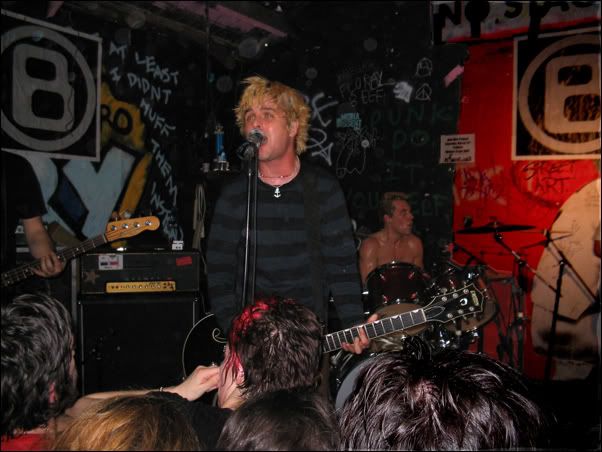
And onstage, after setting up his own equipment and adjusting his own mic stand, Billie Joe had the world in his hands, from the opening chords of “Find My Place” to luminous chestnuts like “MPLS Song” and “Losers of the Year.” Not a drop of animosity remained from 1993. Bodies crushed, heaved, and lurched as one in the wonderfully chaotic fray of the crowd, where I and hundreds of others tried to stay on two feet. Gilman staffers on either side of the stage, most of them in grade school when Green Day were banned from Gilman, all sang along.
“Welcome home!” someone yelled.
“Welcome home!” replied Billie Joe, in a sort of gleeful amazement at the phrase, and then began singing, “Welllll-come hoooo-me, wellll-come hoooo-me!”
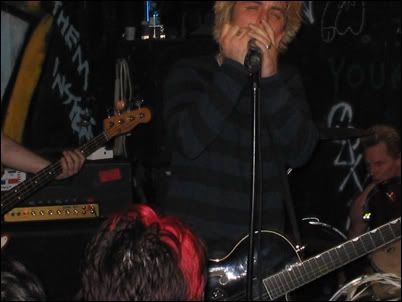
Obviously enjoying the shit outta the occasion, Billie jumped around like a madman, quoted John Denver and Don McLean lyrics, and slashed away at his black Gretsch guitar. Through “Reach for the Bottle,” “Before the Accident,” and, in a dedication to Pinhead Gunpowder’s old guitarist Mike Kirsch, “Future Daydream,” he couldn’t have appeared more inspired on Gilman’s well-worn stage. Being tangled in the sea of people up front, I swayed and sweat and gasped for air along with every goddamn beautiful moment of it all.
After “Mahogany,” the lights came up, the side door opened, and Billie Joe Armstrong ambled out onto Eighth Street. I caught up with him, steam emanating from his drenched body, in the same spot where beforehand he’d expressed uncertainty.
“That,” he told me, “was great.”
—————————————————————-
P.S. Pinhead Gunpowder brought out a lot of faces I haven’t seen in a while. Jesse Luscious, Robert Eggplant, Paul Curran and Patrick Hynes: nice seeing you all. You too, Aaron. And massive kudos to the opening band, Zomo, who were almost as great as the headliner.
Burger Joints in the City Designed For Living

0

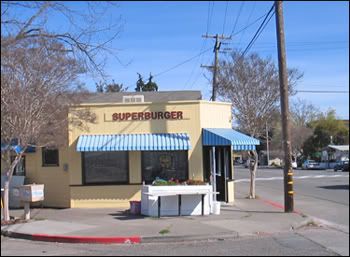
In the middle of last week’s completely soaked Friday, I left the Bohemian office around lunchtime, intending to quickly grab something to eat a block, maybe two blocks away. Instead, and without an umbrella, I wound up running in the pouring rain for a full half-mile.
Why on Earth would I do such a thing, you ask? Because I’d remembered, unfortunately at the last second, that January 31st was Superburger’s last day in business.Gayle’s Superburger, as it’s rightfully known, has been in its little corner hovel on 4th & St. Helena since 1974, and a longstanding outpost of mine ever since I started hanging around downtown at age 13. It’s what my friends routinely remind me is “my kind of place”—a well-worn horseshoe counter with stationary stools, antique fixtures that’ve been on the walls since they were brand new, and a teeny-tiny kitchen serving up tantalizing burgers big and small (but mostly big). Like many places I’m drawn to, it’s the little touches that matter: like the fact that open containers of relish, onions, and mayonnaise are conveniently placed at every seat, or that a healthy pile of newspapers is always waiting on the counter right as you walk in.

Remember Falco

0


Today I am listening to the Bad 13 Challenge entries. A propos of nothing, Falco (the Austrian popster best known for 1986’s “Rock Me, Amadeus”) popped into my mind.

And I’ll be damned: Falco died ten years ago today, when he was struck by a bus. So, to remember Falco, as well as get in gear for the Bad 13 Challenge results, here is his 1982 video “Der Kommissar”. The song is good for real. The video sort of blows, which is why it is so compelling, but why blame Falco? This was back in 1982. We didn’t know any better.

Fred’s Faith

0

02.06.08

W hether Fred Eaglesmith is singing about a farmer confounded by a changing world in “Time to Get a Gun” or an old horseman winding out in the retirement home in the song “Rocky” on last year’s Milly’s Café , his songs ring true. But they don’t ring the same tone. Like Faulkner, who populated his fictional Yoknapatawpha County with a recognizable cast of characters, Eaglesmith has a “little musical universe” of people who could easily be, like he is, from a small town in Ontario, their lives buffeted by heartbreak, hard times and inexplicable changes. He appears locally Feb. 6 and 10.

“They’re definitely there,” he says of his characters, speaking by phone while on tour. “Sometimes they move out. Sometimes I move out. That’s what happened in [1997’s] Lipstick, Lies and Gasoline . The whole album, I took it closer to town. Before that I’d been really, really rural.”

The fans don’t always like it, he says. It usually takes them four or five years to come around. One radio station wouldn’t play 50 Odd Dollars , his rock-influenced 1999 release, when it first came out; a couple of years ago he learned it’s a mainstay. “I just smirked,” he says.

Eaglesmith’s next CD, Tinderbox , due out in March, could be one of those albums. Most surprisingly, Eaglesmith says the new album is about spirituality.

“Now I went somewhere else again,” he says. “This one’s about gospel—gospel without Jesus. I think, especially in North America, a lot of us are thinking about spirituality and we’d love to have that, but we can’t believe in religion, you know? We can’t believe in fundamentalism and not even in the mythology, but at the same time we have this faith, right? So everybody prays, but nobody admits it.

“It’s affecting the whole world and nobody’s dealing with it,” he adds.

It’s clearly rich territory for Eaglesmith, who escaped a stifling fundamentalist Protestant household on the day he turned 15 and spent the next five years hitchhiking and train-hopping throughout western Canada. He went “criminally wild,” he says. But running away so young gave him authentic confidence, something he sees as being in short supply.

“Most people, their issue is confidence,” he says. “I always say there’s too much self-esteem in this world but no confidence. Self-esteem says, ‘I can’t wait for that person in front of me at the gas station’ and honks the horn. It says, ‘I’m worth it.’ But confidence says, ‘I’m a little late and the people who are waiting for me will deal with it.'”

Fred Eaglesmith makes two North Bay appearances. On Wednesday, Feb. 6, he’s at Last Day Saloon, 120 Fifth St., Santa Rosa. 8:30pm. $7&–$10. 707.545.2343. On Sunday, Feb. 10, look for him at the Rancho Nicasio, Town Square, Nicasio. 8pm. $18&–$20. 415.662.2219.


Eat Me

0

02.06.08

A h yes, the romantic dinner. Every year around this time, any glossy cooking magazine worth its fleur de sel offers a sumptuously photographed menu for two, usually culminating in a petite dessert involving chocolate and/or raspberries. How many readers who recreate these intimate feasts at home wind up capping off their evening with the physical act of love is anybody’s guess, but its implications hang, cupidlike, over the whole works.

Eating is a sensuous act, and one that can be sexy. The feeling of a very full belly generally isn’t. But sex and eating don’t have to occur simultaneously to have a close and entangled relationship. Both involve the whetting of, insertion into and expulsion of items from orifices. And they are each a messy business, ones into which we put lots of emotional and cultural stock.

Consider the movies we watch. Food on film can preclude sex or replace it. To supplement your Valentine’s menu for two, here is a handful of sexy food scenes that may leave viewers hungry or horny, or both.

An all-time favorite food movie, ‘Tampopo,’ the 1985 gem from director Juzo Itami, offers an abundance of memorable vignettes that celebrate the ways we interact with food. In one of the most famous, a nameless, suave gangster in a white suit cavorts with his lover in a hotel, giving the room service a run for its money. He breaks a raw egg, carefully separates the yolk from the white and initiates a mouth-to-mouth passing game with his lover; when the yolk’s delicate membrane breaks, she climaxes, and the yolk slowly dribbles down her face and onto the lace frill of her evening dress.

But Tampopo’s most picturesque scene is when the white-suited man watches a group of young girls diving for oysters on a rocky beach. He asks the prettiest of the girls if he can buy an oyster from her, and she opens it for him with her perfect, thin-fingered hands. He holds the quivering mollusk to his mouth but cuts his lip on the jagged shell, so the girl cuts the remaining flesh from the shell and he sucks it ravenously from her hand, leaving behind a fat drop of his blood. The girl giggles; then, her senses awakened, she licks the remaining salty blood from his lip as the other girls look on, bobbing in the waves like a school of mermaids. The moment teems with a bizarre mixture of chastity and eroticism.

It’s a fleeting image, but also the most indelible from ‘Tess,’ Roman Polanski’s 1979 adaptation of Thomas Hardy’s Tess of the D’Urbervilles: Poor country girl Tess (Nastassja Kinski) can’t, despite her valiant efforts, seem to keep her virtue intact. After being dispatched to the estate of ersatz relative and incurable cad Alec D’Urberville (Leigh Lawson), she initiates her downfall with the consumption of a plump strawberry that Alec dangles before her from a long, supple stem—she’s literally eating right out of his hand. It’s not one of those fat, pulpy strawberries you find at the grocery store, either, but a compact and ruby-red thing that the prop director must have singled out of a thousand perfect little farmers market strawberries. Who can blame Tess? I’d have eaten it, too.

Far less dainty are the eating habits of Julie Christie in Robert Altman’s 1971 quasi-Western ‘McCabe & Mrs. Miller.’ World-weary Cockney madam Mrs. Miller (Christie, looking bewitchingly haggard) arrives in a cold, muddy Pacific Northwest backwater logging town to run the “sporting house” of enterprising John McCabe (Warren Beatty). It’s been a six-hour journey and she’s starving, so McCabe takes her to the local saloon, where she orders four fried eggs, stew and strong tea. The two talk business until the food arrives, at which point Mrs. Miller mannishly and wordlessly devours her hearty plateful of frontier grub, grease dripping down the side of her dainty hand. The repulsion on McCabe’s face is mixed with a flowering of affection—he’s falling in love without even knowing it.

Perhaps the best-known food foreplay is found in the farcical 1963 romp ‘Tom Jones,’ in which young squire Tom (Albert Finney) and older aristocrat Lady Bellaston (Joan Greenwood) likewise dine in a dark tavern, where they take their sexual urges out on their courses.

The opening credits of ‘Saturday Night Fever’ are famous for the Bee Gee’s “Stayin’ Alive” and the sidewalk strut of John Travolta at the peak of his youthful dreaminess. But what about the pizza? Travolta’s character, Tony Manero, is loutish and cocky because he doesn’t know any better, but he’s doing his best in a working-class world where he has few role models. En route to deliver a can of paint, Tony stops at his favorite pizza joint and orders his usual: two generous wedges of glorious Brooklyn pie, which he stacks atop one another and then folds up, tacolike, before inhaling them in about three bites. The scene reveals Tony’s immaturity and utter lack of social manners, but it also throbs with virility; this guy even looks hot gobbling pizza with one hand and holding a paint can in the other.

Milos Forman’s ‘Amadeus’ treated us to a few sexless food-sex nibbles. Near the beginning of the film, the dour composer Salieri (F. Murray Abraham) sneaks into a cloistered buffet in hopes of sneaking a tasty treat, but he is forced to hide when the horny Mozart (Tom Hulce) and his fiancée, Constanze (Elizabeth Berridge), burst into the room and loll on the floor, indulging in frenzied, pie-eyed tomfoolery. The lovers cavort under a table groaning with outlandish confections, and Salieri cowers in the corner, bereft of both sex and dessert.

Later, after her marriage to the spendthrift Mozart runs aground, Constanze dresses fetchingly and arrives at Salieri’s office with her husband’s scores in tow. Salieri offers her capezzoli di Venere— “nipples of Venus,” Roman chestnuts in brandied sugar—while he browses the scores. Plump and white as her own bosom, the sweets are irresistible to her, and while Salieri is seduced by the beauty of Mozart’s music, Constanze is seduced by sugar, and she furtively reaches for seconds from the ornamented platter on Salieri’s desk.

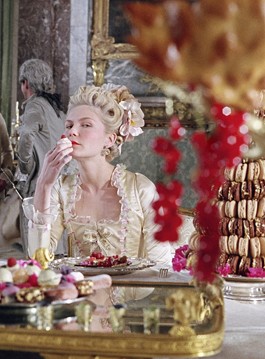
The frippery of sweets also plays an important supporting role in Sofia Coppola’s ‘Marie Antoinette.’ The young queen and her court happily deck themselves in pastel fashions and down pastel pastries, signifying frivolity in the face of encroaching reality—empty calories, if you will. But none look so fetching eating pastries in tall wigs as Kirsten Dunst, whose Marie fills the void of a sexless marriage in part with cream and sugar.

Whatever affinity—on film or in real life—sex and food may have for each other, the act of eating and the act of screwing remain distinct. Said one siren of the small screen: “There is something very sexy about food, but sex is sexier. If you need to let the food do it, then there could be a problem.” Those are the words of television’s culinary Venus, Nigella Lawson, who, based on the looks of it, knows more than a little about both.


Cooking with TJ’s

0

01.06.08

F rom the “I should’ve thought of that” files, longtime Trader Joe’s fans Deana Gunn and Wona Miniati have come up with the first-ever Trader Joe’s cookbook, Cooking with All Things Trader Joe’s . Using ingredients that all come from the popular chain, they’ve created one of the few cookbooks geared toward time-starved home cooks that is actually decent.

If you’re a seasoned home chef, some of the recipes, like the stuffed red peppers, “blue corn taco salad olé” and cheese fondue will seem a little amateurish and geared toward kitchen newbies. However, if you really are culinarily challenged, check out the “Bachelor Quickies” chapter, a list of ridiculously easy heat-and-eat recipes. But experienced chef or not, there’s nothing wrong with a little help on those nights when you don’t feel like spending a lot of time in the kitchen or shopping at several stores for your groceries. The book also includes suggestions for pairing food with Trader Joe’s famously cheap (and sometimes even good) wine.

The book treats Trader Joe’s as your personal prep kitchen by utilizing the store’s array of prepared items, sauces and mixes to create pretty decent meals in 15 minutes or less. I cooked a couple of recipes from the book and was pleasantly surprised at how good and easy they were. I recommend the better-than-it-sounds “black bean and ricotta-stuffed portobellos” and the “peanutty sesame noodles.” I love a good peanut sauce, and the one in this recipe is very good.

You could just stick with frozen burritos or canned soup, and call it a night. But with just a bit more work, Cooking with All Things Trader Joe’s allows you to create a decent meal in about as much time as it takes to bake a frozen pizza. There’s no shame in taking a few shortcuts now and then if it means getting food on the table faster.

Quick dining snapshots by Bohemian staffers.

Winery news and reviews.

Food-related comings and goings, openings and closings, and other essays for those who love the kitchen and what it produces.

Recipes for food that you can actually make.

First Bite

0

02.06.08

E ditor’s note: First Bite is a new concept in restaurant writing. This is not a go-three-times, try-everything-on-the-menu report; rather, this is a quick snapshot of a single experience. We invite you to come along with our writers as they—informed, intelligent eaters like yourselves—have a simple meal at an area restaurant, just like you do.

What is it with the French? French president Nicolas Sarkozy has an affair, divorces his wife, who’s also having an affair, and then takes up with a young, gorgeous actress. No one blinks an eye. Call it arrogance, self-confidence or je ne sais quoi, but it’s real, and you can see it and taste it at Chloe’s French Cafe, which opened just before Christmas.

The French themselves would probably say Chloe’s offers “un gout de France. ” The food is authentically French, though the setting, in the Landmark Executive Building, doesn’t make one think of France. Off the beaten track in the northwest corner of Santa Rosa, it’s worth the detour. Renee Pisan, who’s originally from Cleveland and who studied French cooking in Dallas, makes the hearty French fare: soups, sandwiches and salads. Her husband, Alain, who was born and raised in St. Tropez, makes the pastries the same way his parents did in their cafe, and, as Renee says, croissants are in his DNA. Alain’s brother, Marc, who has selected some of the best French and California wines, serves as the sommelier.

Chloe’s is charming. The menu is in French and in English, and the people who work at the counter really like what they’re doing. On the walls, there are photos of French street scenes, and the pastry counter, with its éclairs and fondants, is bound to bring back memories of French cafes.

The hot and cold sandwiches are made with slices of thick, tasty French bread, and there’s lots of cheese, especially in the Croque Monsieur ($6.75), with baked ham, Gruyère and a béchamel sauce. The tarragon turkey sandwich comes with thinly sliced turkey breast, sharp cheddar cheese and mustard ($6.75). There’s the soup du jour, in a cup or bowl ($3.75&–$4.95) made fresh everyday. The coffee is excellent, and the desserts, especially the fondants ($1.75), are as decadent as a chocolate cake can be.

The words “local” and “organic” aren’t on the menu, and the food isn’t uniquely Californian, but Chloe’s French Cafe is a definite addition to the local restaurant scene, and it seems likely that its reputation can only grow. Years ago, a billboard for a local winery on Highway 101 read, “Don’t Leave Sonoma Without Seeing France.” Now, Chloe’s gives that slogan new meaning. If local chefs haven’t already discovered it, you can bet they will. The French, it seems, still have a thing or two to teach us.

Chloe’s French Cafe, 3883 Airway Drive, Landmark Executive Building. Open for breakfast and lunch, Monday&–Friday. Happy Hour, with selected French cheeses and wines, Fridays, from 4pm to 6pm. 707.528. 3095.


Quick-and-dirty dashes through North Bay restaurants. These aren’t your standard “bring five friends and order everything on the menu” dining reviews.

Head Shots

0

current reviews |

Model Artist: Lee Miller in Man Ray’s ‘Electricity,’ 1931.

By Richard von Busack and Michael S. Gant

Lee Miller: Through the Mirror’ ($29.95; Facets Video) Pioneer female photographer Lee Miller led one of the 20th century’s most glamorous lives: she was a Vogue cover model in the 1920s, posed for Edward Steichen, learned to make her own pictures while living with Man Ray, appeared in Cocteau’s The Blood of a Poet, and wrote and illustrated powerful magazine articles about the liberation of the concentration camps. This 55-minute French documentary by Sylvain Roumette offers an introduction to Miller’s life, based on the archival work of Miller’s son, Antony Penrose (Miller was married to British surrealist Roland Penrose).

Most of the film consists of stills of Miller and her work discussed by Antony, along with a long reminiscence by American magazine photographer David Scherman, who enjoyed an affair with Miller (whose relationship with Penrose was extremely open) that he’s obviously never gotten over.

Too bad, though, that the son’s protective instincts seem to hide Miller from us. We see her mostly through the eyes of others, as if she where still the model who used to alternately fascinate and infuriate Man Ray. I don’t know if any film of Miller herself actually exists, but her own voice is missing from this biography. The set comes with a booklet containing two interesting pieces about Miller, including the director’s essay linking Miller to Stendhal’s heroine Lamiel. —M.S.G.

‘Shadows of Forgotten Ancestors’ ($29.95; Kino) Soviet-Armenian director Sergei Paradjanov’s 1964 masterpiece of life in the Carpathian Mountains, “forgotten by God and people,” tells the story, somewhere in the past, of the peasant Ivan (Ivan Mikolajchuk), who loses the love of his life, wanders in exile and participates in celebrations and lamentations. Eventually, Ivan marries a bright-eyed, faithless villager (Tatyana Bestayeva) who cannot lure him back from the ghostly appeal of the woman he lost. The Georgian filmmaker’s extraordinary sensuality combines the dreaminess of Vigo with the feeling for the natural world of Herzog.

Kino’s print of this much-mutilated film is very good, if not visually restored, and includes scenes that didn’t make it on to earlier video issues. The coming attractions include the good news that Paradjanov’s Legend of the Suram Fortress is also being reissued by Kino. A slideshow of the director’s fine art is beautiful as it is enlightening; less so is the underwhelming 2002 documentary Islands, comparing the career of Paradjanov with that of his great friend Andrei Tarkovsky (Solaris, Andrei Rublev) . Out-of-context film clips try to illustrate both artists’ sufferings at the hands of Soviet censors and judges. In Paradjanov’s case, they knew who they were after—Shadows of Forgotten Ancestors is perhaps the least Soviet movie ever made in the U.S.S.R. —R.v.B.

‘Slings & Arrows’ ($59.95; Acorn Media) The Canadian TV comedy Slings & Arrows ran for three seasons (2003–2006), totaling just 18 45-minute episodes. The box set (with an extra disc of interviews) will leave you wanting more but admiring creators Mark McKinney, Susan Coyne and Bob Martin for knowing how to bow out on top. Combining The Office and Waiting for Guffman, the show follows the fortunes, egos and libidos of the New Burbage Festival of Shakespearean Theatre.

McKinney plays the bumbling executive director with the ultimate nondescript name, Richard Smith-Jones. His administrative assistant, Anna (Coyne), is an overstressed but chipper office enabler who fixes the copy machine, rides herd on the interns and begrudgingly serves coffee. Artistic director Geoffrey Tennant (Paul Gross) suffered a breakdown during a performance of Hamlet seven years before and now lives in the theater’s storeroom. His one-time lover, Ellen Fanshaw (Martha Burns), is a neurotic diva.

The festival’s emeritus director, Oliver Welles (Stephen Ouimette), is run over by a ham-delivery truck early on but returns as a ghost giving Geoffrey staging advice. Visiting director Darren Nichols (Don McKellar of Twitch City) hates theater and favors Roland Barthes–style deconstructions, including a Romeo and Juliet in which the leads never look at each other.

Each season follows a single main play—Hamlet, Macbeth and King Lear— with the offstage antics mirroring the onstage text. In my favorite subplot, Richard, worried that the festival’s aging subscribers are literally dying in their seats, hires a New Age ad agency headed by a visionary named Sanjay (Colm Feore), who embarks on an ad campaign featuring billboard come-ons like “Bite Me” and “Piss Off.”

The show manages to be raucous, profane, witty and, best of all, really in love with the agony and ecstasy of putting on a play. —M.S.G.


Silicon Valley | Santa Cruz County |


New and upcoming film releases.


Browse all movie reviews.

Whale Safe

0

02.06.08

For large baleen whales, the approach of a vessel once meant great danger, and those that knew better dived for the depths. Today, the threat of the harpoon is gone in most waters, yet whales must still contend with the vessels themselves. Prop-powered, steel-hulled and ever in a hurry to meet the demands of the global economy, open-ocean ships travel faster and in greater abundance today than they ever have before, and collisions between vessels and water mammals are on the rise. In virtually all cases, the animals lose.

This accelerating trend has been starkly obvious along California’s busy coastline, where an alarming number of dead humpback and blue whales have washed ashore in recent months with injuries almost certainly caused by bows and propellers. High underwater noise poses an issue of concern, too, and while there is no easy way to monitor the doings of ships far from shore, in Marin County one small nonprofit organization—Seaflow, based in Sausalito’s Fort Cronkhite—demands that within our coastal state and federal marine sanctuaries, large ships put on the brakes for whales.

Founded in 1999, Seaflow aims to protect whales, dolphins and porpoises from the negative effects of boats and their noise. This March, the organization launches its Vessel Watch Project, a volunteer watchdog effort to monitor ships as they enter and leave San Francisco Bay. Seaflow plans to charter small fishing vessels and take volunteers out the Golden Gate to both observe passing ships and to take readings of underwater sounds and their volumes and frequencies with subsurface microphones. Sentinels may also be stationed on the Marin Headlands with binoculars and cell phones.

“We want to involve the public while educating and informing them, as well as the policy makers,” says Seaflow executive director Robert Ovetz. “By bringing out citizens and getting them involved—letting them hear what the underwater soundscape is like, see how fast these vessels are going and how they’re treating our marine sanctuaries like superhighways—we think that’ll have a tremendous impact on the progress we make.”

According to a 2006 paper published by Mark McDonald, John Hildebrand and Sean Wiggins with the University of California, the ocean’s global fleet of commercial vessels more than doubled from 41,865 in 1965 to 89,899 in 2003. In the same 38-year period, the gross tonnage of ships grew from 160 million to 605 million. Port turnaround has grown more rapid, too, meaning that each of these ships spends more time than before on the water. An increase of about 10 decibels in the 30 Hz to 50 Hz frequency range at a recording site near San Nicolas Island off of Santa Barbara correlates with this fleet growth, and many scientists believe that such noise disturbs and possibly injures marine mammals like whales.

In fact, underwater measurements with microphones at the same spot have detected what appears to be a shift in the vocalization strategy of blue and fin whales. Megan McKenna, a graduate student at the Scripps Institution of Oceanography and a scientific correspondent for Seaflow, says that the animals’ calls have increased by about seven decibels from 80 to 87 in the past 40 years, an increase of five times the intensity (it’s a logarithmic scale).

The increase in volume closely resembles the increase in general ambient ocean noise, most of which comes from ships, and McKenna suggests that the whales may be vocalizing more loudly to make themselves better heard and understood by their peers amidst the din of boat noise. “It begs the question,” he says. “Is there a threshold where whales can no longer hear each other through this background noise?”

Sound carries with great ease under water. In the “deep sound channel,” a layer of water characterized by a particular range of pressure and temperature parameters and which hovers as much as a thousand meters below the surface, noise may carry literally across oceans.

“Mankind has made the ocean a very noisy place, and most of it is due to commerce,” says Toby Garfield, a professor of oceanography at San Francisco State University. “The biggest change the ocean has seen has been with the development of the diesel engine and fast freighters.”

According to Ovetz, ocean noise has approximately doubled every decade for the past 40 years. Observations are inconclusive, but many scientists believe that low frequency vibrations generated by ships can deafen and disorient marine mammals as well as drive them from their breeding and feeding areas. The noise may also lead indirectly to the flustered whales being struck by the ships.

Such occasions have historically been rare. Between Los Angeles and the Point Reyes Peninsula from 1986 to 2004, only 12 whales are known to have been hit by ships.

But between September and October of 2007, three blue whales and two humpbacks were found dead on Southern California beaches with cracked skulls and other injuries plainly suggestive of violent interactions with big metal objects. Another humpback was found in similar condition at Point Reyes this fall.

The abrupt increase in ship-whale collisions cannot be ignored, says Ovetz. “This is a record number of highly endangered species being killed by shipping traffic,” he charges.

Research by Woods Hole Oceanographic Institution has found that when a ship reduces its speed from 20 knots to 10 knots, it also reduces the risk of collision with whales by 40 to 50 percent. The National Oceanographic and Atmospheric Association has proposed implementing a speed limit outside Boston Harbor and other ports, but the suggestion has been opposed by the World Shipping Council, which argues that such impediments to ship travel would cost captains and maritime companies money.

Currently, the Channel Islands National Marine Sanctuary (NMS) imposes a voluntary speed limit of 10 knots, but whether any vessels follow the suggestion is not clear. Seaflow holds the opinion that a required 10 knot speed limit in local waters would protect marine mammals while generating other benefits.

“Reducing the speed limit to 10 knots in the sanctuaries would not only lessen the risk to whales, but save fuel for the ships and reduce emissions into the air,” Ovetz says. “It’s a win-win-win situation.”

According to Matt Zolnierek, lieutenant with the Coast Guard’s Vessel Traffic Service, a strict code of rules regulates the bay’s boat traffic, which includes approximately 400 daily “transits,” many of which are roundtrips by ferries or fishing vessels. Radar surveillance ensures that boats obey a speed limit of 15 knots. Outside the Golden Gate, however, vessels are largely free to act and move about as they wish, says Zolnierek. The only safety rule is one of traffic lane separation, which the Coast Guard monitors as inbound and outbound ships maneuver past one another near the Golden Gate Bridge.

Ninety percent of all imported goods arrive in the United States by ship, and every day 10 large vessels come streaming through the Golden Gate, according to stats from the San Francisco Marine Exchange. Unavoidably, these vessels plow right through the Farallones and the Monterey NMS, which, like other areas established by the Sanctuaries Act of 1972, is designed to protect resources and marine life. Ovetz believes it is the federal government’s obligation to assure that within such zones—as well as state-monitored Marine Protected Areas—ships do not create a hazard for wildlife, either by striking animals directly or blasting them with their tremendous volumes of low frequency noise.

Seaflow’s Vessel Watch Project has received a boost of interest and support following the November Cosco Busan oil spill. Plans to begin a watchdog program of local boat traffic are accelerating, and the calendar has been marked with five tentative cruise dates on which chartered vessels will motor volunteers out the Gate to conduct vessel-watching activities. Using underwater microphones, cables and headphones, volunteers will listen to the endless subsurface rumblings with which whales must contend. Seaflow will also measure the speed of passing ships and consider what hazards such boat traffic may present to marine mammals.

Also on Seaflow’s agenda is construction of a database of the large vessels that regularly visit San Francisco Bay. Coast Guard records, says Ovetz, will reveal which boats have been involved in local accidents or have violated traffic codes. Vessel Watch observations will then discover whether any such ships repeat their offenses and whether authorities respond with a crack of the whip or just a slap of the hand. Large cargo vessels regularly enter the bay carrying over a million gallons of tarlike bunker fuel, and these boats cannot be allowed to put the public and the public’s resources at risk, Ovetz says.

“Sanctuaries have a responsibility to protect natural resources within their boundaries. That’s not always being done out here, and someone needs to call them on it. With the Vessel Watch program, we will be the eyes and the ears of the ocean.”

For more information on Seaflow, visit [ http://www.seaflow.org ]www.seaflow.org.


Letters to the Editor

02.06.08

Yes We Can!

I think it is amazing how huge Barack Obama’s grassroots movement has become. One underlying and enduring truth is that Obama’s campaign has inspired a movement of people who really believe in our power and responsibility to make a difference in our community. Something like 700,000 donors have donated to his campaign overall, and 90 percent of those in the last month (around 200,000 people) have given less than $100. An unprecedented number of citizens have volunteered for his campaign. This is an amazing model of a grassroots campaign, and I hope it persists after this election.

Sky Nelson

Santa Rosa

middle-class poor

I wonder how many people are in the exact same situation (“Wage Slaves in Paradise,” Jan. 23). How about 80 or 90 percent of us? The bottom line for most hard-working middle-class poor is that we actually do want to pay our bills on time and in full. We are not extravagant, and if those credit limits are maxed out, they were more than likely used to pay PG&E and the water bill. If we were not being continually gouged by rising interest rates on our credit cards and mortgages we could pay our bills in full and on time. Why is no one discussing this in the political arena?

J. Earnest

Santa Rosa

Mccain is dangerous

John McCain is a known quantity, but should never have entered the race, with his age, psychological and physical conditions being major impediments to his campaign. Certainly McCain was courageous during wartime—so were thousands of others—yet this does not necessarily make them good presidential candidates. McCain’s ferocious temper should be enough to scare people, and his unpredictable emotions actually scare me if our country was in a time of peril. Does anyone really believe that he will be able to stand the rigors of the campaign until November against firecrackers like Obama or Clinton? Give me a break. I know the media wants a Democrat to win, so that is why a lot of them support McCain, because they know he won’t win. Let’s be fair about the race.

sara Rainone

Mr. Fix-It?

So, Gabe Meline advocates drilling holes in the floor of rental units and damaging the ceilings of property owned by others, and the Bohemian thinks that’s fit to print (“Deposit Security,” Jan. 30)? Come on. As a long-time landlord, I’ve dealt with all manner of human waste and carelessness, but rarely do I see such activities actually recommended in print.

Max Murphy

Forestville

Mr. Murphy, dude—it was a joke. Ish. You know: a joke-ish. Anyway, he did strongly advocate for putting everything back the way you found it (in order to get money, of course). What are a few holes among friends? Ish.


Pinhead Gunpowder at Gilman Street

“One request: ditch the cell phones and digital cameras. If they weren’t here, fuck ‘em.” Apparently something happened tonight called the Grammy Awards, a bloated, self-congratulatory clusterfuck which, as a music journalist, I should probably attempt to care about. But even if for some sadomasochistic reason or another I followed the Grammys like a hawk, I'd have to opt instead...

Burger Joints in the City Designed For Living

In the middle of last week’s completely soaked Friday, I left the Bohemian office around lunchtime, intending to quickly grab something to eat a block, maybe two blocks away. Instead, and without an umbrella, I wound up running in the pouring rain for a full half-mile.Why on Earth would I do such a thing, you ask? Because I’d remembered,...

Remember Falco

 Today I am listening to the Bad 13 Challenge entries. A propos of nothing, Falco (the Austrian popster best known for 1986's "Rock Me, Amadeus") popped into my mind.And I'll be damned: Falco died ten years ago today, when he was struck by a bus. So, to remember Falco, as well as get in gear for the Bad 13...

Fred’s Faith

02.06.08W hether Fred Eaglesmith is singing about a farmer confounded by a changing world in "Time to Get a Gun" or an old horseman winding out in the retirement home in the song "Rocky" on last year's Milly's Café , his songs ring true. But they don't ring the same tone. Like Faulkner, who populated his fictional Yoknapatawpha County...

Eat Me

02.06.08A h yes, the romantic dinner. Every year around this time, any glossy cooking magazine worth its fleur de sel offers a sumptuously photographed menu for two, usually culminating in a petite dessert involving chocolate and/or raspberries. How many readers who recreate these intimate feasts at home wind up capping off their evening with the physical act of...

Cooking with TJ’s

01.06.08F rom the "I should've thought of that" files, longtime Trader Joe's fans Deana Gunn and Wona Miniati have come up with the first-ever Trader Joe's cookbook, Cooking with All Things Trader Joe's . Using ingredients that all come from the popular chain, they've created one of the few cookbooks geared toward time-starved home cooks that is actually decent....

First Bite

02.06.08E ditor's note: First Bite is a new concept in restaurant writing. This is not a go-three-times, try-everything-on-the-menu report; rather, this is a quick snapshot of a single experience. We invite you to come along with our writers as they—informed, intelligent eaters like yourselves—have a simple meal at an area restaurant, just like you do. What is it with...

Head Shots

current reviews | Model Artist: Lee Miller in Man...

Whale Safe

02.06.08For large baleen whales, the approach of a vessel once meant great danger, and those that knew better dived for the depths. Today, the threat of the harpoon is gone in most waters, yet whales must still contend with the vessels themselves. Prop-powered, steel-hulled and ever in a hurry to meet the demands of the global economy, open-ocean ships...

Letters to the Editor

02.06.08Yes We Can! I think it is amazing how huge Barack Obama's grassroots movement has become. One underlying and enduring truth is that Obama's campaign has inspired a movement of people who really believe in our power and responsibility to make a difference in our community. Something like 700,000 donors have donated to his campaign overall, and 90 percent...
11,084FansLike
4,606FollowersFollow
6,928FollowersFollow