First Bite

E ditor’s note: First Bite is a new concept in restaurant writing. This is not a go-three-times, try-everything-on-the-menu report; rather, this is a quick snapshot of a single experience.

This is really a two-bite review. I had to try it twice to fully appreciate the differences between the lunch and dinner experience. Let’s just say, with apologies to the cliché police, it’s like night and day. My lunch at Charizma was so wonderful, I hurried back to have dinner. I wish I could say it was as good.

The place sure looks lovely, with rich burgundy tones on the walls and the couches in the corner, a long curvaceous canoe suspended over the spacious dining room, lots of wood and stone accents, antiques, original artwork. It’s a wonderful combination of funky and elegant, a nice surprise on Guerneville’s Main Street. The choice of music is intriguing. The day we went, old jazz and Portuguese fados emerged from the speakers.

There are nine sandwiches ($6.50–$8.25) offered daily and include such enticing offerings as the Ab-Fab (tri-tip with melted pepper jack, mushrooms, sautéed onion and bell pepper, and peperoncini on a baguette) and the Swede (shrimp salad, hard-boiled egg, avocado and dill on rye). Charizma has salads ($6.00–$7.75), soups ($3.50–$5.50) and one hot plate per day ($8.50) For lunch, the ingredients were fresh and the service was quick and friendly. The owner Helena Giesea was very much in evidence, and we felt we were getting a good value for our money.

Then came night. Settling on couches by the window, we ordered glasses of wine ($6.50–$8 for large pours). During a long wait, which felt longer given the empty off-season, we were able to take in our surroundings: a great view of Guerneville’s nightlife through the storefront window and the big cursive “C” on the far wall. My daughter said the whole place seemed like it was written in cursive, and it does, if a little outside the lines.

We’d gone on a Tuesday, purportedly “game night.” How perfect, I thought: a way to engage the kiddies while sneaking in some adult conversation, snuggled under lap rugs. Our waitress, who was certainly sweet and personable, if inexperienced, produced the only game she could find: “Wineopoly.” Who knows, it might be totally fun for enophiles who know the percentage of Cabernet Franc in Bordeaux, but come on. Why have game night, if you have only one game?

The food also went a little awry. The New York steak with blue cheese, fried potatoes and roast tomato ($19) filled the dining room with its aroma while cooking, and was delectable—true to its promising smell. The mixed greens with brie, celery, grapes and toasted almonds served with a fig-honey vinaigrette ($15) was less so. The brie was ice cold from the fridge, the almonds untoasted, the dressing cloying and sweet. The hot chile wok chicken with garlic, vegetables and rice noodles ($16) was bland and one-dimensional. We did have a half-price dessert (actually, we had to remind our waitress of the special) a decent chewy mocha cake with vanilla ice cream ($7), which ended things on a sweeter note.

Charizma is a great lunch (and, I hear, breakfast) spot, but I so wanted to love the nighttime incarnation. Guerneville needs a nice, upscale yet affordable dinner choice. Charizma could become that, but it’s going to take some day classes to get their ascenders, descenders and loops just right.

Charizma Wine Lounge and Deli. Breakfast and lunch, daily; dinner, Thursday–Sunday. 16337 Main St., Guerneville. 707.869.0909.


View All

Quick-and-dirty dashes through North Bay restaurants. These aren’t your standard “bring five friends and order everything on the menu” dining reviews.
Haunted by Hills

0

02.13.08


I was born at sea level, and I am still just several feet above the sea. It’s not like I’ve never been anywhere, for my life has been full of ups and downs. Hills, I mean. I hunger for them, and the steeper the slope, the tastier. I helplessly crave hills. Living in San Francisco, my hunger is easily satisfied. I log about four vertical miles of climbing each week without going more than three miles from my front door.

As a connoisseur of all things that go up, I take a natural interest in other cyclists and their own relationship with hills. And though I haven’t met one yet, the idea of another rider stronger than I am troubles me deeply.

Thus, when it comes time again for all those Euro riders and that guy from Santa Rosa to come gaggling over from the prologue in Palo Alto, huffing and puffing and raising a fuss over their Tour of California, I just can’t help bristling my fur, especially when they get to talking about the climb over Trinity Road, that itty-bitty little hump north of Glen Ellen.

The newspapers will discuss, inevitably, how the cyclists destroyed the Santa Rosa-Sacramento stage, and how the pack of athletes started their ride to the capital by sailing over the “seemingly endless,” the “grueling,” the “vertical” Trinity Road.

Frankly, I can’t stand it.

So this year, amidst all the hoopla over the tour and that little grade that all the riders seem so afraid of, I decided to get out there, and even conduct a little science while I was at it. I wanted to see precisely how steep and formidable Trinity Road actually is and compare it to a few of the other Bay Area slopes I ride most days. My suspicion was that the feared hill is an easy one, highly overrated and not really very steep at all.

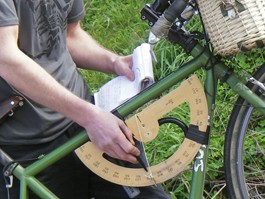
A responsible scientist, of course, never approaches an experiment bearing an agenda, prejudice or opinion—but I do. To verify my theory that Trinity Road is a sissy bump in the road, I mounted a large wooden protractor to the frame of my Surly Crosscheck and fixed a dangling plumb bob from the midpoint of the instrument. With this simple contraption, I would be able to take precise measurements of the slope beneath my wheels with hardly more than a glance.

Loading my wicker handlebar basket with basic bike tools, a notebook, aviator sunglasses, some organic dried figs and a North Coast Russian Imperial Stout, which I never ride without, I conducted my research expedition two Saturdays ago. I rideshared to Sonoma, then rode the seven miles north along Highway 12 to the intersection of Trinity Road, turned right and began my experiment.

The road impressed me. Indeed, it impressed with its gentle, easy grade, fit for any half-assed weekend rider wearing a pair of Spandex shorts.

“Why, 12th Avenue is steeper than this hill!” I exclaimed halfway up, referring to my own San Francisco street.

At two particularly steep slants, I hopped off the bike to take protractor readings. Neither exceeded 8.5 degrees—a mild 15 percent grade; in other words, 15 feet up for every 100 feet forward. I reached the top, the fire station at Cavedale Road, in about 21 minutes. The pros could have beaten that time by half, but they have several advantages: 14-pound bikes, no U-lock and no protractor or plumb bob. Their beer is in the support vehicle, as are their figs, notebook and bike tools.

Down the other side I went. It is steeper than the west slope, and I braked hard all the way down on the wet asphalt. I stopped in the forest on what was apparently the sharpest slope, and found it to be 10 degrees, a 17 percent grade. At the bottom, at the bridge over Dry Creek, I turned around and charged back up again. I feverishly wished for a team of semi-pros in Spandex, sucking on their corn-syrup, power-gel goop and staring down the world through their orange-tinted goggles to pass as they chugged weakly up the slope. After all, heaven hath no pleasure like sailing past a team of young urban professionals when your bike weighs 25 pounds and carries a wicker basket on the handlebars.

But the weather was poor, all the rich boys had stayed home and I was alone to entertain my fantasies. I reached the top in 16 minutes, and just like that my experiment was over, the great mountain conquered, the sky kissed. I’d been defrauded.

All my measurements were taken—they were unimpressive—there were no other cyclists to humiliate and I’d hardly broken a sweat. So I took my Surly on up Cavedale Road another few hundred vertical feet to drink my Imperial Stout on a log beneath a large oak. I savored the heavy oatmeal-and-toffee essence and absorbed the calories and the warmth of the alcohol. I descended to Highway 12 again and turned back and rode up to the fire station once more, wondering if perhaps last time I’d slept through the most slanted segment. But no: every foot of the way smelled of wimps, weekend riders, Subaru roof racks, blinding Genentech jerseys, energy bars and Gatorade.

Back in my apartment, I analyzed the data. West slope of Trinity Road: 3.2 miles with an estimated average grade of 5 degrees, or about 8 percent, equaling a climb of approximately 1,350 feet times two. The east slope: 2.5 miles from the beginning of the descent, with an estimated average grade of 7 degrees, or 12 percent, equaling a climb of approximately 1,000 feet. Cavedale to the summit: about two miles, nothing beyond 8 degrees by my protractor. Gain of 500 feet. For the day, 4,200 feet total gain over 10.9 miles of ascent. An average grade of 7.3 percent. Hmm.

The next day I scouted the Marin Headlands with my bike and instruments. I found several streets in residential Sausalito that reached over a 20 percent grade. The long ride up from Bridgeway to the peak of the Headlands overlook is 826 vertical feet, but in the course of 3.5 miles it boasts a mere 4.5 percent average slant. In San Francisco dwell the real monsters. There, I measured the steepest hills I could find. Seventeenth Street coming out of the Castro (not actually very steep, but a well-known yardstick): 17.5 percent; 14th Avenue between Quintara and Rivera: 21 percent; Dalewood Street on Mount Davidson: 25 percent; Duncan Street between Diamond and Douglass: 28.5 percent. And the most prohibitively steep slope I’ve ever gone up, the very southernmost block of Stanyan above Cole Valley? A staggering 33.5 percent.

Trinity Road was not half as steep. I could have ascended it drunk on one leg while sending a text message.

But what’s a hill even worth in the end? At the finish line of this meandering race that we call life, even the biggest mountain cancels out to zero, glory had and just as soon forgotten. At 29, I’m too old to be much of a cyclist anymore, though I often stay out riding and climbing until late in the day. Then, in the cool of the evening, after most of the other cyclists have returned home, I’m left alone with just the sound of the hilltop sirens calling me upward—and the hope that my chain won’t snap.

I know that somewhere out there is a regal 35 percent grade, and a road runs up it. Alongside are the footprints of the poor saps who had to push their bikes to the summit, and beside them are the treads of one Surly with a basket that bullies past them all. Though I will never get off to walk, I can still never reach the top.

I am haunted by hills.


Wine Tasting Room of the Week

0


W hile a gold medal is no guarantee that you’ll like the wine, a pavilion of 1,500 gold medal winners has got to have more appeal than a roomful of also-rans. At the San Francisco Chronicle Wine Competition tasting, all the top wines will be available for sampling at the public’s leisure at Ft. Mason on Saturday, Feb. 16. The nation’s largest wine competition held its judging last month in Cloverdale and benefits Santa Rosa Junior College’s culinary and viticulture programs. Expect many local notables, as well as winners of such exotic categories as “White Native American,” featuring the top Norton and Catawba wines from lands far east of the Sierras.

Meanwhile, if I can arbitrarily hand out tasting-room golds, this week goes to Dutton Estate. Not to be confused with Dutton-Goldfield down the road, Joe and Tracy Dutton run this winery with the help of winemaker Mat Gustafson. It’s fronted by a nicely refurbished 1930s stucco house just off Gravenstein Highway, and I must have passed it up on a hundred rainy days. One recent rainy day, I dropped in.

Lovely wines all around. The 2006 Kylie’s Cuvée Sauvignon Blanc ($17) has an aroma of jasmine and forward tropical flavors of mango and pineapple. Wow, I’m guessing that some proactive leaf management kept as much golden sun on these grapes as is possible in the cool Green Valley. The 2005 Dutton Palms Chardonnay ($42) has a noseful of Parmigiano-Reggiano, baked aromas of quiche and custard, and is mellow on the finish.

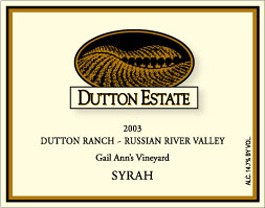
The strawberry-jammy 2006 Karmen Isabella Pinot Noir ($32) is not complex, but bright and tasty. Best of all are three Syrahs, their characteristics varying from red plum and grape steeped with tobacco leaf in the dry but smooth 2003 Three Blocks Syrah ($30), to cola nut and graham cracker with a silky mouth-feel in the 2003 Dutton Ranch Syrah ($30). Finally, the 2004 Gail Ann’s Syrah ($36) is all cherry and vanilla, opulent raspberry syrup and cherry notes. Dessert? The 2006 Sweet Sisters Late Harvest French Columbard ($18) starts out like fresh apple juice, matures to fermenting apples in the amber light of an autumn afternoon and then unforgettably suggests olive trees crying tears of honey.

Dutton Estate is a great spot for a visit, and for those who regularly hit the Gravenstein trail commute with a Jackson and change, it’s a can’t-go-wrong bet for a special dinner wine.

Dutton Estate and Sebastopol Vineyards, 8757 Green Valley Road at Highway 116, Sebastopol. Open 11am-5pm. Tasting fee $5. 707.829.9463. For details on the San Francisco Chronicle tasting, go to [ http://www.winejudging.com ]www.winejudging.com.


View All

Power of the 113

0

02.13.08

A new research study completed at Sonoma State University shows how health and disability insurance companies are systematically cheating the American public.

Michael Moore’s top-grossing movie Sicko is but one example of the growing concern surrounding healthcare in the United States. The number of Americans without health insurance reached 47 million at last count, 16 percent of the population. The cost of health insurance is rising two to three times faster than inflation and is the number one cause of personal bankruptcy in the country. We pay more and get less medical care than the rest of the industrialized world. The total per capita healthcare cost in the United States exceeds the healthcare expense per person in all other full-care countries.

The Institute of Medicine estimates that as many as 18,000 Americans die prematurely each year because they do not have health insurance. This figure does not include those who die prematurely each year because their insurers delay, diminish or deny payment for promised benefits. Reports about people who die unnecessarily from services denied or delayed by insurance companies seldom receive broad coverage in the corporate media. Lack of media coverage has led to a nation of people uninformed about how national health and disability policies are controlled by the private insurance industry and how government regulators are powerless to do anything about it.

If industrialized countries around the world offer healthcare as a basic right, why is full healthcare not happening in the United States? Private insurance companies are motivated to make as much money as possible and do so by systematically delaying, diminishing and denying payment for promised services, and blaming individuals for their own misfortune.

On the boards of directors of the nine largest insurance companies are 113 people. These directors are some of the richest people in the world. They hold 150 past and/or present positions with major financial or investment institutions in the United States, including such major firms as JPMorgan, Citigroup, Lord Abbett, Bank of America and Merrill Lynch. Additionally, these board members have connections to some of the largest corporations in the world, including General Motors, IBM, Ford, Microsoft and Coca-Cola. The combined affiliations among these 113 health-insurance directors represented revenue of over $2.5 trillion in 2006.

As some of the richest, most powerful people in America, healthcare executives dominate health policy with their campaign donations and active lobbying efforts. They spend millions to keep themselves in the health-insurance delivery business despite overwhelming evidence that we would all be better off without them. They use these profits to propagandize the American public and influence voters through the scare tactic of invoking some Soviet-era form of “socialized medicine” and predicting long delays in service, supposedly a bane of single-payer systems.

The single-payer advocacy group, Physicians for a National Health Program, reports that private insurance corporations spend an enormous amount of money on business-oriented expenses rather than health-related investments. A 2003 study in the New England Journal of Medicine estimates that spending for administrative costs associated with healthcare amount to over $320 billion per year, or about 31 percent of healthcare costs in the United States overall. The administrative costs in the Canadian national healthcare system amount to 16.7 percent, or about half of the administrative overhead in the United States.

Countries with common pool or single payer healthcare systems provide similar levels of service to every person. In such countries, it is the responsibility of society as a whole to provide healthcare for each individual.

People in the United States have a choice. We can continue with a high-cost, profit-driven private-insurance healthcare system leaving millions to languish without care and millions more to face the frustrations of systematic delays, diminished care and denials of promised benefits. Alternatively, we can build a common pool healthcare system that provides necessary health care goods to everyone for less than what we are now paying.

Let’s find and support the politicians who will provide healthcare for all outside of corporate fat-cat control.

Peter Phillips is a professor of sociology at Sonoma State University and director of Project Censored. Bridget Thornton is a graduate student in the Interdisciplinary Studies. All statements above are fully documented in their new study “Practices in Health Care and Disability Insurance: Delay, Diminish Deny and Blame.” To learn more, go to www.projectcensored.org.

Open Mic is now a weekly feature in the Bohemian. We welcome your contribution. To have your topical essay of 700 words considered for publication, write op*****@******an.com.


Whirling Back-porch Punk

0

music & nightlife |

By Gabe Meline

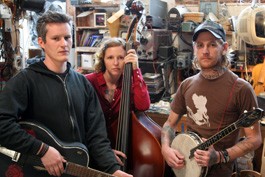
Success couldn’t be sweeter for the Devil Makes Three, a rough-edged bluegrass trio who specialize in selling the soul of country and ragtime music to the devils of punk rock and hard blues. A rare breed in a squeaky-clean, post–O Brother bluegrass world, the band nonetheless carries a hopeful, wide-angled wisdom that reflects the tumultuous world around them.

“I’ve never hopped a freight train, but I’ve definitely done a hell of a lot of traveling,” said 28-year-old frontman Pete Bernhard in a 2007 Bohemian interview. “I grew up in Vermont, and I drove across the country to California, then I moved to Nashville, then to Olympia . . .

You know, I just didn’t really know what the hell I was doing. I was driving around in circles, basically.”

Whatever he picked up along the way has certainly been propelling the band, which features the sturdy upright bass of Lucia Turino and the stunning banjo and guitar work of Cooper McBean, both also Vermont natives. And while the Devil Makes Three are fast becoming a well-known headliner at large clubs, the trio started out like any good band: playing cramped house parties, a tradition that came to an end when simply too many people began showing up. “It just sucked,” Bernhard said without too much regret in his voice. “A lot of people would come and break shit, and then the person who owned the house is pissed off at you, and you’re like, ‘I don’t know who these people are!'” The Devil Makes Three’s self-titled debut album, re-released on Milan Records last year, is a deft crosspollination of the austere and the animated. Bernhard’s always been into older music, from the time his brother bought him a Willie Dixon box set on Chess Records when he was 10 years old. “But a lot of the stuff that I write is political, and that definitely comes from punk,” he said. “Hopefully, the energy of our show emulates the feeling of a punk show—just high-energy and fun.”

The Devil Makes Three perform on Friday, Feb. 15, at the Phoenix Theater. 201 E. Washington St., Petaluma. 8pm. $15. 707.762.3565.


FIND A MUSIC REVIEW

Letters to the Editor

02.13.08

Pay Attention, Please

Sometimes we innocently value something because it has been costly and the effort would feel futile if the result were found lacking. In the case of the Northeast Area Plan (NEAP), Sebastopol City Council members have made earnest deliberations, giving of their time and skills. The cost of the plan and the draft EIR is $470,000. Is the dubious result so vigorously protected because it has cost so much? It is not too late to modify the plan.

If citizens aren’t in favor of four-story buildings—including 300 homes—on up to 10 feet of fill in a flood/liquefaction zone and unnecessary commercial spaces with unknown and unexplored economic impact on Main Street merchants and a mighty increase in traffic, it would be a good idea to attend the next meeting of the city council on Feb. 19 as they discuss the NEAP’s proposed amendments to our general plan. For more information, contact the Sebastopol Preservation Coalition: sh****@***ic.net. It is all possible.

Gayle Bergmann

Sebastopol

No Thanks, Joe

I met Joe Nation a long time ago when he first took a shot in the political arena, then running for Marin County Supervisor. Joe is a nice guy who seemed to have a desire to do good. When Joe miraculously won the assembly seat in an all-too divided race, Joe had his opportunity to show his stuff and represent Marin and southern Sonoma counties.

Joe’s service to his district was ineffectual at best. Joe always seemed to be heralding legislation that went nowhere or certainly didn’t represent either the needs or interests of his constituency.

Joe’s lack of continued success in politics was a signal that the fit wasn’t right; Joe wasn’t for us and we weren’t for Joe. The will of the voter had spoken, the message was clear then.

Joe took a poorly calculated risk running against Lynn Woolsey for the congressional seat in 2006. Joe didn’t stand a chance. It didn’t take a seasoned political pundit to see that. And once again, Joe is running for State Senate Third District.

Nothing really has changed except for the date on the calendar and the number of gray hairs some of us exhibit. Joe’s politics and his support aren’t those of this community’s. Joe has the looks of a superhero but not the powers required of the title.

I wish Joe would stop charging that windmill that doesn’t exist and just quietly and permanently remain in private practice and private life. We have far better representation than Joe ever gave us and a far better candidate than Joe could ever be running for State Senate. I know who my money is on.

Thanks Joe, but really, no thanks.

Ted Newman

Mill Valley

paper trail

I want to thank Secretary of State Debra Bowen for decertifying voting machines that might be faulty. Touch-screen machines are vulnerable to tampering. That’s what computer-security experts concluded in the “top-to-bottom” review she convened.

I’m glad they won’t be used to count my vote. Our Founding Fathers didn’t use electronic voting machines, and many democracies around the world still use paper ballots. Paper ballots got us George Washington. Electronic voting machines got us George W. Bush. We all know what a disaster that’s been.

Joyce T. Naylor

Santa Rosa

negative reinforcement

I read your recommendations every election cycle and appreciate your commentary on the issues. Especially for the initiatives, which are always suspect in what’s supposed to be a representative democracy, your thoughts help clarify.

But what you wrote on the first two initiatives actually convinced me to go against your recommendation! When will we stop earmarking funds for specific projects in the Constitution? Aren’t we already totally hamstrung by past initiatives? What’s the use of an annual budget or even a legislature when almost all their decisions are locked in by temporarily swayed voters?

Anyway, thanks for convincing me on those two and making me feel better for not totally aping your recommendations overall.

Paul

via e-mail


Will Power

0

music & nightlife |

Hands: Will Bernard plays ‘the funk shit, the jazz shit, and he’s just killing,’ according to Stanton Moore.

By Andrew Gilbert

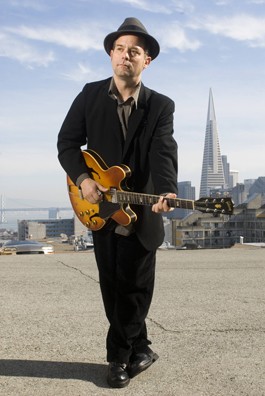
Will Bernard is taking a bite out of the Big Apple, and so far it’s tasting mighty sweet.

Before he decamped to Brooklyn last year, the Berkeley-raised guitarist was a mainstay on the Northern California music scene for more than two decades, acquiring an avid following through his work with the funk-laden cooperative quartet T.J. Kirk (featuring fellow guitars lingers Charlie Hunter and John Schott, along with drummer Scott Amendola) and Bernard’s own groovalicious combo Motherbug.

His latest album, Party Hats, was tapped for a Best Contemporary Jazz Album Grammy nomination, and he just recorded a follow-up with keyboardist John Medeski, bassist Andy Hess and drummer Stanton Moore focusing on original tunes—except for one cover Bernard describes as “a dub/ska version of ‘Gonzo,'” a tune by Crescent City R&B legend James Booker.

A highly versatile player, Bernard hits the Mystic Theatre Sunday, Feb. 17, as part of the Sonoma roots reggae band Groundation. It’s his third year touring with the group, which was founded in 1998 by Marcus Urani, Ryan Newman and Harrison Stafford (who taught one of the only college courses on the history of reggae at Sonoma State University from 1999 to 2001). The band has honed an infectious sound informed by jazz and dub, but steeped in reggae history. This performance is their annual tribute to Bob Marley.

Bernard joined Groundation in 2006 when they were touring with Leroy “Horsemouth” Wallace, the veteran Jamaican drummer immortalized in the 1978 film Rockers. “I was a big fan of the movie Rockers, and it was exciting to get to know Horsemouth, who’s a fantastic drummer, and get to know all about the history of reggae from one of the inventors,” Bernard says from his apartment in Park Slope. “All the players in Groundation are fantastic musicians. Ryan Newman and Paul Spina both played on Party Hats. They come from a lineage of Sonoma County people, guys I play with a lot.”

Bernard has always had a knack for finding his way into creatively charged ensembles. The mild-mannered guitarist first made his mark with fellow Berkeley High alum Peter Apfelbaum’s stylistically sprawling Hieroglyphic Ensemble, which presented its cornucopian musical feast at clubs and jazz festivals around the region. Bernard gained national attention with T.J. Kirk; at the same time, his band Medicine Hat was also signed to a major label.

In recent years he’s toured widely with Galactic drummer Stanton Moore and Greyboy All-Stars organist Robert Walter. Hammond B3 legend Dr. Lonnie Smith is another regular employer. And when the brilliant New York jazz clarinetist Don Byron performed at Yoshi’s last February and needed a guitarist to play the instrumental R&B of Junior Walker, he gave Bernard the call. Bernard can also be found supplying a rock edge to percussionist Anthony Brown and the Asian American Orchestra’s Gershwin project “American Rhapsodies,” and playing French cafe music with Odile Lavault’s whimsical Baguette Quartette. “I’m a little bit of a Francophile,” Bernard says.

It was Bernard’s knack for blending into any musical context and elevating it with his deft rhythm work and stinging single-note lines that impressed Stanton Moore when they first played together at JazzFest in New Orleans.

“When he sat in, he’s one of the few guitar players who didn’t showboat,” Moore says. “He wasn’t trying to make his personal mark as much as making the music better. He’s got a great ear and a tremendous knowledge of different styles. He’s probably the most versatile guitar player I’ve ever worked with. Anywhere we try to go, he can cover that area better than anyone. Will plays the funk shit, he plays the jazz shit, and he’s just killing.”

Groundation featuring Will Bernard plays Sunday, Feb. 17, at 9:30pm at the Mystic Theatre, 23 Petaluma Blvd. N., Petaluma. $18–$20. 707.765.2121.


FIND A MUSIC REVIEW

Heart and Hand

02.13.08

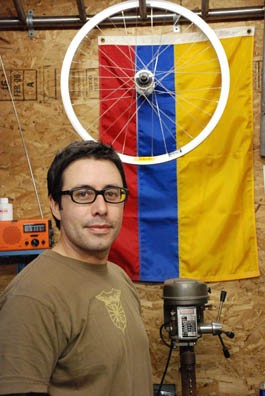
It’s tempting to say that Mauricio Rebolledo’s bike-building shop feels like a museum or an art gallery. One can sense the reverence Rebolledo has for the objects he creates, and the bikes posed variously around his Glen Ellen garage make it feel almost like an exhibition space. Held aloft by a stand is a classic pink touring bike he’s building for his wife; over there is a muted-green track bike with no gears or brakes, a vehicle built simply for speed.

But this is a shop in motion, a work environment where Rebolledo takes the time—two weeks for each bike—to create tailored machines that also happen to be works of art.

The son of Colombian immigrants, Rebolledo, 38, has a deep respect for the cycling tradition, and builds that appreciation into each of his bicycles. He makes throwback lugged-frame bikes, an artisanal process in which bicycle tubes are joined by sleevelike lugs that can be carved with unique designs.

“It’s an aesthetic choice—I like being able to embellish the joints,” Rebolledo says, pointing to such designs as small hearts. Most bicycles today are TIG-welded, a functional fix that’s much quicker to fabricate but whose filler material is visible at the joint, a contrast to the elegant lug weld that Rebolledo fashions.

Most big companies don’t make lugged, steel bikes anymore. Today’s composite racing bikes, like the ones riders will mount the upcoming Tour of California, are “like Formula One cars,” he says. “They’re not made to last.” By adding a few ounces, Rebolledo makes bikes that are comfortable and last for many years.

Rebolledo’s love of bikes began when he was a boy spending summers with his grandparents near the Colombian town of Cali. His grandparents ran a bicycle parking garage that repaired bikes while their owners were at work. The boy listened to live coverage of the Vuelta a Colombia, imagining himself climbing up the country’s rugged mountains.

Rebolledo went on to earn a master’s degree in anthropology and got a job with a San Francisco nonprofit. But his love of cycling endured, and he spent his days off at a San Francisco rec center, teaching kids to repair their bikes. This led to a job at San Rafael’s Trips for Kids, an innovative shop that teaches teens to refurbish broken-down bikes.

And then something happened that shows how a lot of good can sometimes come from something that feels really bad: Rebolledo’s hand-built mountain bike was stolen. A colleague suggested that he get a new one built by her cousins, Jay and Jeremy Sycip, who now create bikes in Santa Rosa.

Rebolledo not only got his new bike made by the Sycips, he ended up apprenticing with them. “They taught me everything,” he says. Over time, a one-day-a-week internship became a full-time job. Six years later, Rebolledo was a master builder.

“He’s very attentive, determined and detail-oriented, very passionate about the craft,” says Jay Sycip. “A lot of care goes into each frame. He has integrity—that’s important for this product.”

Rebolledo Cycles opened in 2006, and the bikes are built in the sheds adjacent to the home he shares with his wife and 13-month-old son. They cost about $2,500.

Rebolledo starts by meeting with a client to discuss everything from the bike’s geometry to what designs they’d like on the lug cutouts. Every bike is made to measure, and Rebolledo considers body type and his or her flexibility.

“Since every customer is different, every bike is different,” he says. Each is “a reflection of who I’m building it for, which I really enjoy. I like building with intention, building a bicycle for someone.”

For color suggestions, Rebolledo brings out automotive paint-chip books from the 1950s and ’60s, the days of pre-metallic paints. The tri-color band on his insignia represents the Colombian flag, another nod toward tradition. He builds one bike at a time, devoting his full focus to tailoring each one to fit the client.

Part of Rebolledo’s goal is to change North Americans’ perception of Colombia, using his bikes as ambassadors. “We’re bombarded by negative stuff [about Colombia’s drug problems] all the time,” he says, “but I want my bikes and my brand to connect to the better part of [Colombia’s] history—the passion for cycling, the passion for living.”

In his shop, Rebolledo is clearly a man who has found his calling. “I never thought I’d be doing anything like this. I’m glad I found it,” he says. “I enjoy working on bikes, working with my hands, working with people. But it’s funny to be in the Tour of California issue, because these [bicycles] are the antithesis of racing bikes.”

For more information on Rebolledo Cycles, call 707.293.3062 or go to www.rebolledocycles.com.


Torture Bearer

0

02.13.08


M arin Theatre Company is to be commended. Few financially responsible theater companies in the North Bay would dare tackle a play about war, terrorism, torture, rape, cultural genocide, revenge and political dissent for fear that no one would show up. Even fewer would award a full production to a new play that has rarely been given a full production before, written by a playwright unfamiliar to local theatergoers.

So kudos to MTC for producing the West Coast premiere of Kenneth Lin’s intense, provocative Said Saïd , the story of a Nobel-winning Algerian poet at the end of his life who is forced to remember and relive his brutal imprisonment 40 years earlier, during the Battle of Algiers, when he was accused of being an anti-French terrorist. By giving Lin’s play a prominent spot in its current season, MTC is not only stepping up to artistic director Jasson Minadakis’ pledge to program more socially challenging plays, it is also contributing to the development of a writer who shows every sign of one day becoming a major American playwright.

It’s just too bad that this play isn’t better.

Ambitious, literate, angry and crammed with passion, Said Saïd is overlong and unfocused, clearly the product of a young writer, who, while a brilliant observer of human nature, is so bursting with observations, ideas and accusations that he doesn’t know when to stop writing them down.

Said Saïd has a confusing structure that, after two hours of reasonably grounded action and dialogue, suddenly takes a turn into the Shakespearean. Unfortunately, the play ultimately careens toward the overwrought, over-the-top theatrics of Titus Andronicus , which, while enjoyable on a certain Grand Guignol level, is simply impossible to take seriously. And Lin—not to mention director Minadakis and a superb, astoundingly committed cast—clearly intends this play to be taken very, very seriously.

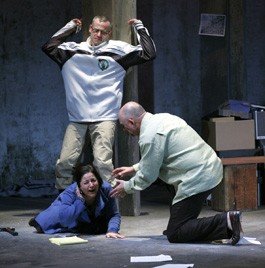
André Saïd (Jarion Monroe, never better) carries the scars of his imprisonment on his body, in his sly, vain, life-loving soul and indirectly through the suppressed memories of his daughter, Sarah (Delia McDougall, delivering a shattering explosion of raw, open-throttle emotion sure to be remembered as one of the great performances of 2008).

Sarah, now in her late 40s and living with Saïd in Vermont, has no memory of the time her father was in prison or of the circumstances that led to deaths of her mother and brother and her own lengthy childhood hospitalization for unexplained wounds. Saïd, now quite ill, prefers to keep his daughter in the dark about their unhappy past, while enjoying the occasional flirtations of star-struck journalists and flattering female poetry students.

It is a visit from one such student, the sweetly duplicitous Emily (Danielle Levin), that triggers a series of flashbacks to his year-and-a-half long imprisonment and his cat-and-mouse interrogation by French intelligence officer Michel Garcet (Marvin Greene). Emily, obtaining an audience with Saïd on the pretense of working on a paper about him, presents photographs of the prison cell he was kept in and the mysterious, indecipherable, floor-to-ceiling writing he scratched into the cement walls during his stay.

The aging Garcet, Emily tells him, is on his way to Vermont with “proof” that the secret language contains Saïd’s confession to having been a terrorist. It is the confrontational battle of wits between these two old adversaries—and the unanticipated involvement of Sarah, once she starts remembering what actually happened to her all those years ago—that leads to Lin’s violently melodramatic climax.

On a cleverly austere set by John Wilson—complete with magically appearing and disappearing writing on the walls—Minadakis leads his actors in and out of ethical and spiritual hell, a trip that might have been more illuminating had there not been so many confusing side trips. Ultimately, MTC’s first production of 2008 works not as a finished product, but as a beautifully acted, achingly promising work in progress. Here’s hoping Lin will keep crafting and stripping away at this piece; someday, like the poetry of poor tortured Saïd, it might actually become a masterpiece.

‘Said Saïd’ runs Tuesday&–Sunday through Feb. 24 at the Marin Theatre Company. Tuesday and Thursday&–Saturday at 8pm; Wednesday at 7:30pm; Sunday at 2pm and 7pm; also, Feb. 23 at 2pm. Feb. 13, preshow happy hour. Feb. 14, preshow lecture. Feb. 17 at 6pm, preshow reception for LGBT community. Marin Theatre Company, 397 Miller Ave., Mill Valley. $20&–$50; Tuesday, pay-what-you-can. 415.388.5208.


Museums and gallery notes.

Reviews of new book releases.

Reviews and previews of new plays, operas and symphony performances.

Reviews and previews of new dance performances and events.

Where to Watch

0

02.13.08

Muir Beach Breathtaking views abound at the Muir Beach overlook, near the Pelican Inn at the intersection of Highway 1 and the Muir Woods turnoff. Though most of the dramatic action in the peloton will have already occurred coming over the hill through Muir Woods, it’s hard to imagine a more scenic place to watch the racers whiz past. ETA: 11:27am&–11:32am.

Point Reyes Station Point Reyes’ sprint line, a race-within-a-race whose winner scores time credits and is often laurelled for the Most Aggressive Rider award, offers West Marin residents a chance to catch some action in an otherwise flat section of the day’s route. Residents and employees are out in full hooting, screaming, cow-belling force to cheer the victor. Other sprint lines are located in Tomales and Bodega Bay. The only downside is that the race will go by very, very fast. ETA: 12:14pm&–12:27pm.

Stage 1, Feb. 18: Sonoma County

Coleman Valley Road Parking is sketchy and restrooms nonexistent, but from certain locations along the roadside, it’s possible to watch the entire peloton’s ascent from the ocean to the top of this vigorous climb. The diehards are in force, scrawling chalk messages for their favorite riders on the asphalt, and the views are incredible. Don’t plan on being anywhere soon thereafter, though—the tiny, winding road is jammed with cars afterward. ETA: 1:33pm&–1:58pm.

Downtown Santa Rosa With the circuit route looping around the entire downtown area, there’re plenty of places to watch the thrilling final moments of Monday’s Stage I. Rooftops and parking garages, particularly near the Third Street finish line, fill up quickly; street-level viewing along Fourth Street offers thinner crowds. Complete strangers commune in front of large LED television screens, mapping the race’s live progress together—”Have they passed Occidental yet?” “Yeah, there’s Gravenstein Highway!”—until the furious circuits, riders narrowly avoiding utter catastrophe in a two-wheeled competitive ballet. Tents, booths, live music and food options abound, and community spirit skyrockets to the red zone. ETA: 2:23pm&–2:58pm. Stage 11 starts from Santa Rosa’s Railroad Square on Feb. 19 at 10am.

Stage 11, Feb. 19: Napa County

Trinity Road Near the top of Trinity Road is a fire station marking the final stage of a seemingly endless 2.5-mile, 1,200-foot climb. Parking, once again, is tricky, but in contrast to downtown Santa Rosa’s smooth morning start, this is the grueling make-or-break vertical battle—with hardly any shade—that hardcore enthusiasts won’t want to miss. (Trivia fact: Gavin Chilcott, general manager of Santa Rosa’s own BMC team, famously cycled this climb during the Coors Classic in the 1980s.) ETA: 10:40am&–10:46am.

Lake Berryessa On the easternmost border of Napa County, riders will skirt the Monticello Dam along Lake Berryessa—a good viewing spot—although there’re also a number of places along Highway 128, before the dam, to watch riders duke out a Category 4 climb. ETA: 11:58am&–12:17pm.

Television

TV-50 in Santa Rosa hosts a live broadcast of the Stage One race with erudite commentary and interviews by Jim Keene, owner of NorCal Bike Sport (11am&–4pm); that night, cable channel Versus will air condensed highlights at 8pm.

Internet

Maps, trivia, times, tips and etcetera are at [ http://www.amgentourofcalifornia.com ]www.amgentourofcalifornia.com.


First Bite

Haunted by Hills

02.13.08I was born at sea level, and I am still just several feet above the sea. It's not like I've never been anywhere, for my life has been full of ups and downs. Hills, I mean. I hunger for them, and the steeper the slope, the tastier. I helplessly crave hills. Living in San Francisco, my hunger is easily...

Power of the 113

02.13.08A new research study completed at Sonoma State University shows how health and disability insurance companies are systematically cheating the American public. Michael Moore's top-grossing movie Sicko is but one example of the growing concern surrounding healthcare in the United States. The number of Americans without health insurance reached 47 million at last count, 16 percent of...

Whirling Back-porch Punk

music & nightlife | By...

Letters to the Editor

02.13.08Pay Attention, Please Sometimes we innocently value something because it has been costly and the effort would feel futile if the result were found lacking. In the case of the Northeast Area Plan (NEAP), Sebastopol City Council members have made earnest deliberations, giving of their time and skills. The cost of the plan and the draft EIR is $470,000....

Will Power

music & nightlife | Hands: Will Bernard plays 'the...

Heart and Hand

02.13.08It's tempting to say that Mauricio Rebolledo's bike-building shop feels like a museum or an art gallery. One can sense the reverence Rebolledo has for the objects he creates, and the bikes posed variously around his Glen Ellen garage make it feel almost like an exhibition space. Held aloft by a stand is a classic pink touring bike he's...

Torture Bearer

02.13.08M arin Theatre Company is to be commended. Few financially responsible theater companies in the North Bay would dare tackle a play about war, terrorism, torture, rape, cultural genocide, revenge and political dissent for fear that no one would show up. Even fewer would award a full production to a new play that has rarely been given a full...

Where to Watch

02.13.08Muir Beach Breathtaking views abound at the Muir Beach overlook, near the Pelican Inn at the intersection of Highway 1 and the Muir Woods turnoff. Though most of the dramatic action in the peloton will have already occurred coming over the hill through Muir Woods, it's hard to imagine a more scenic place to watch the racers whiz past....
11,084FansLike
4,606FollowersFollow
6,928FollowersFollow