

Funny because it’s true.


FOLLOW US
Funny because it’s true.
Something that us longtime Santa Rosans are known for is calling things by their old names. It’s a little game we play, a sort of secret handshake, delivered with unspoken bond. Call it The Old-Name Game.
For example, here’s two lifelong Santa Rosans discussing traffic:“Oh, man, I had to drive on Santa Rosa Avenue last Saturday,” says Rick Moshier. “Once you get past Zumwalt Magrini and the Ponderosa, it’s just a mess.”“You’re tellin’ me!” replies Jason Kelley. “I got stuck in front of the El Rancho Tropicana for a half hour! I had to stop at Everybody’s Talking afterwards just to calm my nerves!”
Of course, there’s also the “Confuse-a-Tourist” variation of the game, where one gives correct directions based on landmarks that existed fifty years ago:“Hey, you, can you tell me where the library is?”“Sure! Go up Third Street here, you’ll pass the ‘Til Two, and then hang a left on Hinton, you’ll pass the Topaz Room. Go right on Fourth Street, then walk past the Brothers 4 and Rosenberg’s and the Tower Theater, and you can’t miss it!”
Most people find this game juvenile and immature, but what “most people” think is not the point. When you’ve stuck it out in Santa Rosa—while so many that you love have moved away, and so many others have moved here and wrecked things—you need something to hold onto that’s yours. For those who were born here, it’s a way of retaining a handle on their hometown as the city’s identity is either slowly sold off or crushed under the wheels of progress.
Here’re a few new contenders for the calling-things-by-their-old-name game. 1-2-3 Billiards: The rumor on the street from those in the know is that 1-2-3 Billiards, Santa Rosa’s oldest pool hall, is slated to close. This is a heavy blow to Santa Rosa’s working class, especially after the shuttering two years ago of our last remaining bowling alley, Continental Lanes in Roseland. There’s whispers that the building will be converted into a Trek Bicycle concept store, which seems superfluous considering the great job the Bike Peddler does. To us, it’ll always be 1-2-3 Billiards. File next to: The Wherehouse, Leatherby’s, Acapulco.
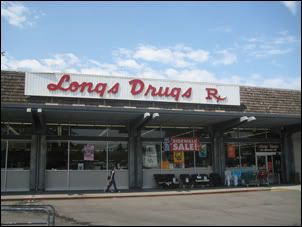 Longs Drugs: Now that the little drug store chain that could has been sold to CVS Pharmacy, one can only imagine what’s going to happen to the old spot on Mendocino Avenue. Will the checkout lady who always asks what “treasures” you found still be there? Will they replace the late ’60s shingles on the roof? Will they still stock 900 different pairs of flip-flops in May? I know, I know. . . it’s a chain, and two of the best things about the place are already gone (the drop-cup vending machine for 35-cent soda and the great jingle, “Take the Longs way home, Longs belongs to everyone”). But no matter what kind of overly sterile environment moves in, to us, it’ll always be Longs Drugs. File next to: MacFrugal’s, Rainbow Records, Arctic Circle.
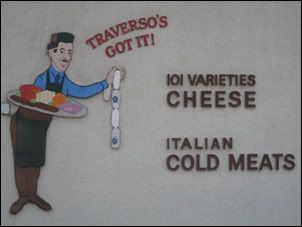 Traverso’s: It makes sense for them to be across the street from a lot of old people with money, but Fountaingrove’s gain is downtown’s loss. Now who will spend all day politely dealing with people asking for change for the bus? I was talking with Michael Traverso, one of the friendliest check-out clerks in the world, after they sold the building and started looking for a new location. Here’s my favorite thing about the move: Michael says they’re completely planning on taking the store’s hardwood floor with them. “Really? You can do that?” I asked him. “Sure!” he said. “It’s the original floor! We moved it from our old location when we moved here!” You gotta love stuff like that. I have no idea what the hell they’ll put on that corner, but to us, it’ll always be Traverso’s.
 Kinko’sCopies: A tough one here, on two levels. First of all, the real Kinko’s location is on Third and D, no doubt. And secondly, its current location on Fourth and D, according to the game, should always be called the Brothers 4, or the Rosenberg’s Men’s Department, or, by all means, Copperfield’s. So what of the announcement that Kinko’s is changing its name to “FedEx Office?” And of the fact that their company policy has been restructured over and over again to inconvenience the customer? Tell you what: let’s not even honor ‘em in the old-name game. File next to: Farmers Drug, Prez Records, Fourth Street Franks.
 China Light: And so it is closed, the dingiest little Chinese restaurant in Santa Rosa. The best thing about China Light, of course, was the beautiful misspelling on its corner sign: “Lunch Specil.” Anyone remember when a car crashed through the front of the building, and it took the owners 8 months to patch up the gigantic hole? Seriously, for 8 months there was just a pile of bricks and a sheet of cardboard covering the wall. I checked their health code violations on the Sonoma County Food Inspection website once, and they had about 5 or 6 critical violations. No matter—the corner of College and Cleveland Avenues will always belong to China Light. File next to: Black Sparrow Press, Yardbirds’ Distribution Warehouse.
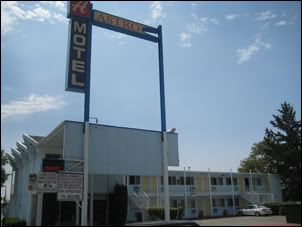 The Astro Motel: It is, by far, the funniest sign we’ve seen in a long, long time. Currently posted outside of the Astro Motel, well-known as a hotbed of illicit activity, is this gem: “Coming in 2009! The Wine Country Inn and Suites!” For real! Never mind that the last time I was there, there were razor blade chop marks on the nightstand and a syringe behind the TV, or that people have tried to jump off the roof, or that the cops show up there on a weekly basis. “The Wine Country Inn and Suites”—sounds classy. To us, it’ll always be the Astro Motel. File next to: Brother Juniper’s, Me & Em’s Liquors.

First of all, the prize of the night I think goes to the young kid in a wheelchair who, while his friends formed a wall around him to guard him against flailing bodies, tilted his head back and sang along to every line of “Born to Die.”
Never mind that MDC slowed the song down to half-speed, or that they changed the lyrics to “I Remember,” or that they said fuck it to the iconic bass intro to “John Wayne Was a Nazi,” or that they sang entirely different lyrics to “Chock Full of Shit,” or that they kinda mangled “Chicken Squawk” or that in fact they played their first five songs acoustically. MDC were still great, and despite revisiting just about all of side one of their first and best album, 1982’s Millions of Dead Cops, they didn’t have the pathetic reliving-the-past feel like so many other old punk bands still on the touring circuit today.
Personal data: Dave Dictor is almost as old as my dad.
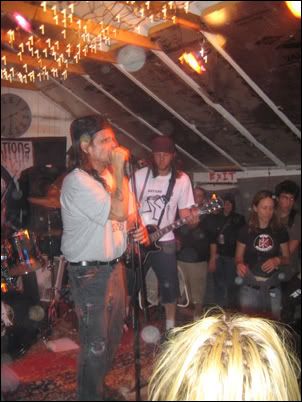 “I spent most of the late ’90s in a methamphetamine haze,” Dictor announced to the crowd, about 4 or 5 songs into the set. “Walking around the streets of San Francisco, wearing this big yellow rubber poncho, pushing a shopping cart. Those were my peeps. But you know, I got into rehab“—spitting out the word like it was an obscenity—”and got myself straightened out.”
How could we have not guessed that Dave Dictor was gay? “America’s So Straight,” “My Family is a Little Weird,” his flamboyant costumes and incessant prancing around on stage in the ’80s? “There’ve been people coming up to me tonight,” he told the crowd, “reminding me about playing the Cotati Cabaret in 1988. And apparently I took all my clothes off, and traded underwear with a girl.” See?
Personal data: One of the first songs I learned on the guitar was the entire flamenco solo intro to “Chock Full of Shit” from Millions of Damn Christians.
Even when MDC ditched their acoustic guitars and started playing loud, it still wasn’t, uh, “loud.” But listen to their records—they’re not loud either. MDC: the sheep in wolf’s clothing. They always were kind of a hippie band. The message of health food and sustainability in the liner notes to the Millions of Dead Children 7″? Ahead of its time.
Some guy brought a zucchini the size of a bazooka from the gardens and stood in front of the stage, beaming. It wasn’t long before it wound up smashed and battered on the floor under the shoes of the pit. “My mom always told me not to play with food,” quipped Dictor. The pit wasn’t too out of control.
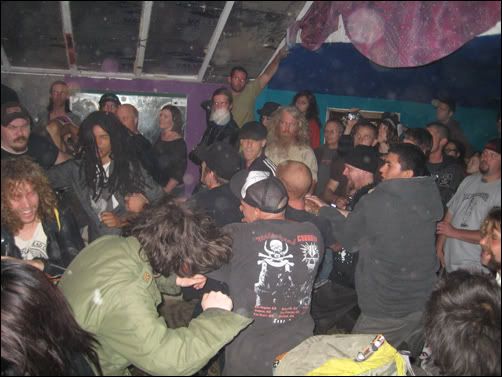 Personal data: One of the first shows I ever went to, at the River Theater in Guerneville, was MDC playing with All, Nuisance, and a very young and very stoned opening band called Green Day. It was September 23, 1989. I was 13.
I wandered outside near the set’s end. MDC has a reputation for playing long-ass sets, and I figured I’d try to stave off potential boredom. Plus there was some crazy acoustic music emanating from the campfire, like there usually is, so I walked over and there it was: a bongo player, a trombone player, a saxophone player, and a beatboxer. A small kitten meowed along. The Boogie Room is amazing. Amazing, I say!
Quotes of the Night:
Young punk girl, with a cigarette, to a mellow-looking guy in blonde dreadlocks: “Hey! Are you the hippie who told me not to smoke?”
40-year-old guy to MDC’s drummer, before the show: “I graduated in ’86, and I listened to you every day! You guys are the best, man!”
Guy to another guy, outside after the show: “Consider that you might not be allowed to come back here, okay?! Do you realize what you’re doing?”
Girl, leaning out of her car: “Hey, do you want to punch me in the face for $8?”
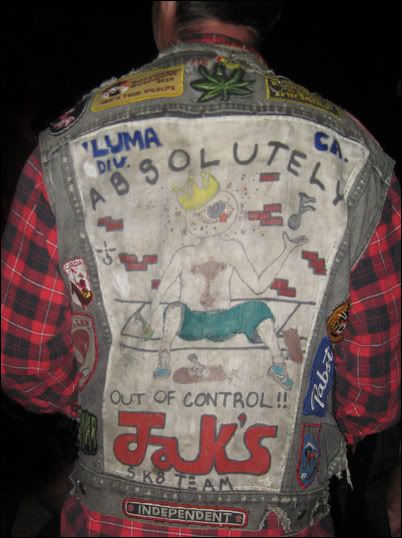
And it’s not a quote, but I’m always heartened—I don’t know why, I’m too young to legitimately care—to see a Jak’s jacket in the throng:
I bought a Millions of Dead Cops cassette for $5 and walked back to my car. Came home and listened to Horace Silver. The next morning, I smelled like shligs and had weeds in my hair. Right on.
One of the reasons, I’ve finally discovered, why I love Nellie McKay’s “I Wanna Get Married” so much is that while it operates as a satire, it doesn’t operate as a blatant, overt satire. It’s just a 19-year-old girl reacting to the idea of the 1950s housewife, that’s all—nothing more, nothing less. Young precociousness has a long tradition of successfully regurgitating the world’s own ideas back in its face without trying to color or polarize them with extemporaneous messages. The regurgitation itself is the message.
Here’s Nellie McKay, on The View, singing “I Wanna Get Married”:
I can think of no way Nellie McKay could have written “I Wanna Get Married” without having first heard Gertrude Niesen’s trademark of the same name, although considering McKay is such a dizzying creative force, well, hell, anything’s possible. Niesen’s “I Wanna Get Married” follows a similar meter, and it, too, is vaguely satirical. It comes from her smash role as the stripper Bubbles LaMarr in “Follow the Girls,” opposite Jackie Gleason, among others.
It took me forever to find this record, but click on the cover below to hear Gertrude Niesen, in 1944, singing “I Wanna Get Married”:
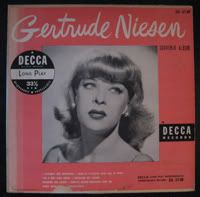
The liner notes of the Gertrude Niesen record tell of Niesen’s side career in flipping houses, a story that brings to mind the housing boom of 2002 as much as it recalls 1944: “Gertrude has been successfully dabbling in real estate for a number of years, buying a piece of property here and selling one there—at a substantial profit. People joked about her “white elephant” when Gertrude picked up a 50-room $2,000,000 Newport, RI mansion for $21,000 a few years ago. They laughed even more when the water pipes froze and burst. But Miss Niesen had the last laugh when she sold the estate a short time later for considerably more than she had paid for it.”
After releasing her stunning debut album, Get Away From Me, Nellie McKay, as this week’s Bohemian interview by Joy Lazendorfer points out, soon felt Sony’s enthusiasm for her brazenly inventive tin-pan-alley songwriting dwindle. She got dumped quickly. She’s put out a couple of not-as-good albums since, and she’s been appearing on and writing songs for Broadway. I’ve seen her live twice, and she’s fucking incredible. Go see her when she comes to town on Monday, August 18 at the Mystic Theater in Petaluma.
08.13.08
Owner Downer: Could 80 percent of Sonoma’s mobile-home park’s residents be classified at the poverty level should MHP condo conversion be pushed through?
Sonoma resident Sam DiGiacomo is worried about losing his home. “We are currently under a total frontal attack—senior citizens and low-income families alike,” he says.
DiGiacomo retired in 1996, after 30 years serving as a maintenance instructor with the Department of Defense; these days he’s passionate about protecting mobile-home park (MHP) rental spaces for persons of limited means. DiGiacomo, a chapter president for the statewide organization Golden State Manufactured-Home Owners League, also sits on the Tri-Park Committee, representing the city of Sonoma’s mobile-home owners.
“If it [MHP condo conversion] should happen here,” DiGiacomo says, “I am sure that 80 percent of our residents would almost immediately be classified as poverty level.”
Last September, California AB 1542, a bill sponsored by Santa Rosa assemblywomen Noreen Evans, was passed, only to be vetoed by the governor. Had the legislation been signed into law, it would have allowed manufactured-home owner-occupants statewide to retain their rent-controlled status, even if neighboring homeowners choose to purchase their lots.
Then came Proposition 98, which was designed to wipe out rent control altogether and pave the way for massive condo conversions of apartments and mobile-home parks across the state. Heavy hitters like Chicago developer Sam Zell, cited in the May 21 issue of the Bohemian as a major financial backer of the Prop. 98 initiative, tried to convince voters to pass the proposition in order to presumably protect basic property-ownership rights. But it got cold-cocked in this past June’s primary, garnering just 39 percent support, while over 65 percent of the voters gave the nod to rival Proposition 99, conceived specifically to counteract 98’s draconian strictures.
But even with Prop. 98 dead and buried, manufactured-home owners still face hurdles in a seemingly inexorable drive by the MHP industry to sell as many asphalt lots as mobile-home park owners care to offer. Present state law provides fewer protections to manufactured-home owners than do many county and municipal ordinances. This is certainly the case in Sonoma County, where over 50 percent of a mobile-home park’s resident owners must first opt to purchase what lies below them in order to convert, or, in the parlance that has emerged, condoize the entire park.
Now the fight to preserve low-income MHP rental space has shifted back to a municipality, in this case to Sonoma. On Wednesday, Aug. 20, the Sonoma City Council will vote on an ordinance that DiGiacomo claims will be “a tiny bit stronger” than the present Sonoma County protections. The ordinance is expected to pass, perhaps unanimously, but that doesn’t mean DiGiacomo or the city of Sonoma are out of the woods yet.
L. Sue Loftin is a San Diego County–based attorney for Preston Cook, the owner of Rancho de Sonoma mobile-home park. Cook’s park is situated just inside the city limits, and his intentions are clearly stated. “What I want to do with my park is make it a resident-owned community,” he says, “so the residents of Rancho de Sonoma have an opportunity to own the land, instead of just their homes.”
To realize his goal, Cook filed a claim on Aug. 6 against the moratorium on condo conversions. This claim appears to be the first step in a process that could lead to a lawsuit demanding big bucks from Sonoma, if, Loftin says, “we can’t resolve the issues with the city.”
Loftin says that Cook’s conversion plans include $2 million in park renovations, affordable loans to low-income residents choosing to purchase and continued rent control for those who choose not to buy until such time as they either die or move away.
Meanwhile, the media have portrayed a divided MHP population, the majority of whom are over 55 years of age and living on fixed incomes. An ABC television report that aired last month, as well as articles in various regional newspapers, stress that there are mobile-home owners who either favor or will consider purchasing the property beneath their units.
DiGiacomo says there’s no such rift. “It is notorious that they come up and try to disrupt the homeowners organization, and that is exactly what happened,” he explains. “An ad hoc committee got together to unseat the current board and the current president—which never happened.”
Close to 700 persons live in Sonoma’s three mobile-home parks. Monthly rents range from $350 to $800. But, DiGiacomo says, “We have heard quotes that they’ll charge upwards of $225,000 per space.” Whether that figure is inflated or not, one thing is sure: by adding monthly condo fees to mortgage payments, this once affordable form of housing is, as Cook himself told the Sonoma Index-Tribune recently, “an endangered species. I would say there will be thousands of park closures in the next 10 to 20 years.”
Editor’s note: First Bite is a new concept in restaurant writing. This is not a go-three-times, try-everything-on-the-menu report; rather, this is a quick snapshot of a single experience. We invite you to come along with our writers as they—informed, intelligent eaters like yourselves—have a simple meal at an area restaurant, just like you do.
When Taverna Santi owner Doug Swett opened his new Diavola trattoria in Geyserville in July, he doubled his bets that the sleepy burg of just 2,100 souls and a couple dozen tractors would be a coveted destination for extraordinary Italian food.
And indeed, occupying a space that was the former Geyser Smokehouse just a few doors down from his acclaimed Santi (which means “saint”), Diavola (which means “devil”) feels like a personal find. It’s got the requisite components of charm: a rustic-chic bosom of scuffed hardwood floors, stark wood tables set with paper place mats, 100-year-old brick walls cut with archways and a gorgeous Virgin of Guadalupe statue above the bar that lights up in Christmas tree colors.
There are two long rooms side by side, but choose the first, where chef Dino Bugica hand-pulls pizza dough at a wood burning oven topped with a growling, tusked pig sculpture. Seating is scarce, and walk-ins can expect a substantial wait, scoring, if they’re lucky, a perch at the bar beneath a curving meat rack dangling with old Smokehouse hooks and new Diavola salumi. House wine comes from a jug, but it’s pleasant Hawkes Nero di Campo ($5 a tumbler), and once you settle in, you’ll want to linger a good long time, nibbling on crisp, ultraskinny complimentary breadsticks served in parchment paper.
The food is reliably exquisite, particularly anything pizza. Bobbing like a boxer in front of his oven’s flames, Bugica produces near-perfect crust, alternating the charred and golden, the crisp and pillowy. These aren’t flimsy creations either, but generously decorated rounds like the salsiccia ($14) of housemade sausage chunks, red onion, flurries of white pecorino cheese shavings and delicious drips of honest piggy grease. For the Bagna verde ($15.50), juicy Lingurian clams and broccoli raab are laid out like a mosaic, laced with parsley, tomato, pecorino, herbs and a wallop of sharp garlic. A quattro formaggio ($13.50) is creamy and complex, marrying strong pecorino, mild mozzarella, cacio and grano with sage and green olives that really sings with a splash of chile oil. Yes, the pies are big, but it’s better to be a glutton than to take it home; the crust is best when fresh.
Antipasti isn’t for dainty appetites, either. A big bowl of shiny red beet chunks ($10.75) is summery gratification sweetened with sheep’s milk ricotta, while seafood alla Diavola ($13.75) threatens to capsize its huge soup dish. Citrus-kissed squid looks like little purple and white troll dolls sprinkled with fresh herbs, tossed with curled shrimp, black-eyed peas, mushy-mild anchovies alla povera and buttery cannellini. It’s almost too pretty to eat, but you’ll manage.
When the waitress apologizes for the basil panne cotta ($6.75) not being perfectly set-up, it seems silly. The dessert may flop on the plate, but absolutely not in the mouth, with stunning creaminess, firm grilled peaches and a stab of lavender flower. Like everything on the menu, it’s a good bet you’ll finish every last bite.
Diavola, 21021 Geyserville Ave., Geyserville. Open for lunch and dinner, Wednesday–Monday. 707.814.0111.
Quick-and-dirty dashes through North Bay restaurants. These aren’t your standard “bring five friends and order everything on the menu” dining reviews.

08.13.08
Face Foliage: Eight-year-old Sylvan Talavera is just one of those who gamely dons our fake fur.
Eric Fiore, a mustached 26-year-old video editor, was lounging on a sidewalk on a recent sunny Saturday afternoon, munching a slice of pizza—the vegan veggie kind, extra spicy, with a dash of special hot sauce that he keeps in his messenger bag. Out of the many mustache monikers to choose from (“face foliage,” “cookie duster,” “flavor saver,” “soup strainer,” “nose neighbor,” “mouth brow”), Fiore likes to call his the “lip tickler.”
“Because it’s hilarious, all the time,” he explains. “It makes people laugh every time they see me.”
Fiore wore black cut-offs, a mustard-yellow T-shirt and a block of dark brown facial hair over his lip that would make him appear rather walruslike if he wasn’t so rail thin. “I hope the mustache is making a comeback,” he says. “More people should appreciate it. I’m saying it has magical powers.”
There’s no question that the mustache is having a moment. Walk through any hipster neighborhood, and many twenty- to early thirty-something guys will saunter by sporting some kind of lip awning. Whether big, thick, bushy beasts or filmy, sparse little squiggles, mustaches are rising once more from the stubble.
And who is that mustached man? He appears to be a pretty ballsy breed, having bypassed the beard, that bush of whiskers grown by professors, hippies, urban wannabe lumberjacks and lazy guys who read too much Nietzsche. He’s not afraid to bust in on the territory of blue-collar workers and cops, villains (think: Hitler), old-timey bank robbers and creepy dudes to claim his very own parcel of hair-land. And he’s willing to express himself, whether with a pencil-thin growth above the lip à la John Waters, or a broom-bottom Mr. Monopoly number that looks like a disguise.
Socratis Mamalis Jr. wears what he calls a “molester ‘stache,” a sparse, slightly pubescent mustache that lends him a striking resemblance to JD Samson, the guitarist from feminist dance-punk band Le Tigre, who cultivates a patch of pitch-black peach fuzz above her lip. Mamalis, 24, who goes by “Soci” or “Crates,” explained during a recent indie rock show that he started growing his mustache about a month ago from “boredom slash the fact that I look like I’m 12.
“Basically, I grew it so I could ask, ‘Who wants a mustache ride?'” he adds with a wicked grin. He works in sales for a printing company. “I’ve noticed the ladies love it.”
Really? Not according to Cara Graff.
“They’re such a turnoff,” says Graff, 29. “I want a guy to take care of himself, and, yeah, it definitely gives a guy an ‘I don’t give a fuck’ attitude.” She adds, “It’s one thing to have confidence, but to make yourself look hideous just for kicks? That’s stupid.”
Mitch Goldman, 32, grows a mustache for the charity Mustaches for Kids, which benefits the Make-A-Wish Foundation, each fall. When he first told his girlfriend his plan, Goldman says over the phone from his job as a home nurse, “It was like I told her I had a sexually transmitted disease. Literally head in her hands, just shaking her head.
“But I don’t know, some people like it,” he continues. “It gives guys a little swagger of masculinity or something.”
There is something about the mustache. It adds mystery. Having one says, “I’m masculine!” or “I’m a rebel!” A few years ago, the mustache was largely referred to as ironic, as in “ironic mustache,” since (besides baseball players, of course) it showed up mostly on sleazeball celebs like photographer Terry Richardson and American Apparel’s notorious founder Dov Charney, both of whom seemed eager to look as repulsive as possible. But recently, the novelty of the ironic lip sweater has faded. The mustache has perhaps become a more stately, classic, even admirable facial fashion. Like high-waisted short shorts or a muscle shirt, it takes guts to wear one.
“Anybody who wants attention, there’s nothing like a mustache to make people start talking about you,” says Jay Della Valle, 28, chairman of the American Mustache Institute, a joke organization started in 2006 that somehow turned legitimate once the mustache became popular.
Della Valle’s own mustache is puffy in the middle, but he uses wax to make it curl at the ends. “That’s like [Jason] Giambi. The power of the mustache is behind him.”
The Yankees slugger’s mustache has transformed him from sleazy steroid-taking pariah to hometown hero. Fielder Johnny Damon and Giambi started growing their mustaches as a joke during Giambi’s slump in the early spring. But now the first baseman has 19 home runs and 55 RBIs. In an attempt to raise support to get him voted onto the American League’s All-Star team, the Yankees handed out 20,000 fake bushy mustaches to fans at a recent game, transforming the crowd into a sea of Swedish Chefs. (Remember the Muppets?)
“I didn’t really think I was going to turn into a fashion icon,” Giambi told reporters.
But he’s only one celeb rocking the lip caterpillar. In movies, of course, Daniel Day-Lewis, Josh Brolin and Ryan Gosling (in Lars and the Real Girl) all wore them last year. Matt Damon added one (as well as some extra pounds) for his role in Steven Soderbergh’s Informant. Sacha Baron Cohen wore an especially unwieldy ‘stache as the slapstick foreigner Borat (but has since shaved the “sexytime” cookie duster to redefine his career), and Mark Ruffalo, Jack Black, Sean Penn, Will Ferrell, Terrence Howard, Leonardo DiCaprio and Orlando Bloom have all been known to sport them on the screen and off. And, if these examples aren’t proof enough that the mustache has gravitas, even Obama’s top aides are mustached men, including senior Obama campaign adviser David Axelrod and Eric Holder, a former deputy attorney general.
The mustache, of course, has a rich and storied history. In the 1840s, mustaches were prominent among politicians and dignified cultural types like Charles Dickens and poet Henry Wadsworth Longfellow. But by the early 1900s, they could signify that you were a soldier; the British Army actually made them mandatory. The mustache became a symbol of militarism during both of the world wars. Hitler’s style of mustache—a rectangular brush just above the center lip—carries the stigma of sinisterism today and is rarely, if ever, seen. Though of course, surrealist artist Salvador Dali tried to lighten things up in this era with his handlebar.
The ’60s sexual revolution revamped the mustache style, as porn stars and musicians from the Beatles to Jimi Hendrix to Frank Zappa wore them proudly. So did Martin Luther King Jr. After the 1969 Stonewall riots garnered national attention for gay rights, homosexual men warmed to the mustache as part of the Christopher Street clone look, which also included flannel shirts, snug jeans and cropped hair.
In America, of course, the nose broom eventually became most strongly associated not with cops or firemen, but with baseball players. This began in 1971 when Charlie Finley, the ‘stache-loving owner of the Oakland A’s, paid his players (including star pitcher Rollie Fingers) $300 to allow their upper lip hair to grow so that the team would look different from the rest of the league. Over the years, Yankee players including Thurman “I Am the Walrus” Munson, Rich “Goose” Gossage, Reggie Jackson and Jim “Catfish” Hunter have all sported a mustache.
But the mustache first became associated with pure, unbridled machismo thanks to ’70s box office king Burt Reynolds. He thrashed around onscreen with a ‘stache in the second largest grossing movie of 1977, Smokey and the Bandit (Star Wars was No. 1). Today, Reynolds’ facial-hair style is still revered. His mustache has an unofficial Facebook page, and there is a band, a record label and a blog called “Burt Reynolds’ Mustache.” Tom Selleck brought the big bushy style through the ’80s as debonair detective Magnum P.I.
But from the ’90s to now, the mustache has lacked a true mascot (though Jason Lee, on My Name Is Earl, is a decent candidate). Perhaps this has made it free enough from association for any confident young man to grow one out, try one on, to experiment.
Thirty-year-old Frank Deleon-Jones, a lanky guy with a crown of frizzy black curls, explained that growing a mustache is just a way to change up his looks, like getting a new haircut or seeing if shorts are his style. Others, however, have different motivations.
“Sometimes there is a peacock factor there,” he says. “They maybe need to compensate for something.” Like what?
“Personality, confidence . . . other things.”
Della Valle, the American Mustache Institute chairman, made a feature-length documentary in 2005 about his quest to encourage men his age to grow mustaches. In the Glorius Mustache Challenge (sic), he issued this challenge to twenty-something men across the country: grow a mustache for one month. He got 50 people to participate. In New York, he held a “protest march” for mustache rights in Union Square. Each year, Della Valle and the American Mustache Institute host a Stache Bash challenge to determine which mustache reigns supreme in the states.
Della Valle grew a mustache for the first time when he started shooting the film. “I’m in a band. I’m a rocker. I don’t give a fuck,” he says. “But [people] gave me so much shit.” He shaved as soon as the movie found a distributor. “The next day, I felt like my best friend went away. Every time I would shave it, I was like, I need to grow it back. I’m like a lifer now. My girlfriend says it looks ridiculous. I don’t listen.
“These guys with ‘staches, they’re not thinking about chicks,” Della Valle continues. “They’re thinking, I’m going to have fun with this. I’m gonna do this and this is my thing. They’re so happy, they’re walking around with a little more skip to their step.” Then, he points out, “chicks react to that.”
Favorably, too.
He describes a scene in the movie in which one mustache grower explained that the mustache is like a filter for girls. The ones who wouldn’t be interested in a guy with a mustache are probably too stiff to be around anyway.
What about guys who are repulsed by mustaches? “It’s because you’re jealous,” Della Valle calmly explains. “It’s like, it’s the one thing you can’t do. You’re just mad because you can’t do this.”
Spoken like a true mustache man.
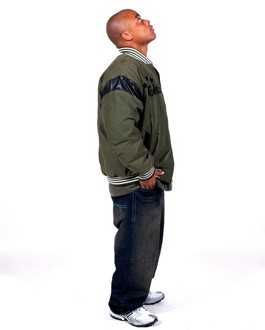
In his apartment up near the airport, with a hand stamp still on the back of his palm from the Giants vs. Dodgers game the day before, Shaya explains the impetus behind his music. “I want people to take away something they can relate to,” he says. “It’s sorta like thought-provoking music. I’m trying to revive the thought-provoking stuff instead of it just bein’ somethin’ that goes in one ear and out the other.”
With Fallen Awake, released last month, the 30-year-old Santa Rosa MC has more than hit that goal. Full of positive vibes and earthy production, the album is a severely promising first step into the arena that even he himself acknowledges is overpopulated. “Everyone raps, everywhere you turn,” he says. “But I didn’t know anything about the industry except for what I read inside CDs. Most people don’t read the notes inside of the insert, but I would read them and write down on paper who I wanted to work with.”
It worked. With G-Unit producer Jake One behind the hard-hitting “Fall Back” and a slew of other up-and-coming producers on other standout tracks, Fallen Awake is a 14-course serving of East Coast&–style hip hop—Philly-soul string breaks lie smooth above scattered Dilla-esque beats. But it’s Shaya’s natural command of the mic that elevates the album from just another indie-rap release. Shaya acquired the talent at a young age, in unusual fashion: by transcribing L. L. Cool J lyrics in a notebook, and then replacing the words, one by one, with his own.
Never one for trends (best dis in 2008: “You the past, bro / Gone like hyphy”), Shaya opts for the classics, reclining in a Jimi Hendrix T-shirt and citing Q-Tip of A Tribe Called Quest as his favorite MC. But it was Los Angeles rapper Ras Kass, whom Shaya met outside S.F.’s Maritime Hall, who gave the up-and-comer his best advice. “I was talkin’ to him about my stuff, telling him, ‘I’ll be the next you,'” says Shaya, “and he was like, ‘No, man. Be the next you.'”
One song, “Thinking Cap,” tells the story of Shaya’s self-discovery. In a series of questions to himself, he settles on the album’s spiritual core: “Someday, I want to fly and let my wings spread wide / I survive with lazy vision so they tell me love is blind / They say this is my best shit, but I don’t really know / Maybe writin’ what I feel’ll give me character to grow.”
Personal growth and artistic growth go hand in hand, but in hip-hop, it’s career growth that’s the most elusive. On “Industry Life,” Shaya raps that “my album’s the biggest secret in the Bay on the unda.” If even the smallest whisper of it gets out, it won’t be for long.
Shaya performs at Organic North on Saturday, Aug. 30, at Jasper O’Farrell’s, 6957 Sebastopol Ave., Sebastopol. 9pm. Free. 707.829.2062.
08.13.08
Until recently, I didn’t know much about permaculture. I only knew that it had something to do with sustainable gardening practices, and that I was hearing about it with increased frequency. On one hand, I was correct in that permaculture is very much concerned with the growing of food, and that it is indeed a rapidly spreading movement. But this is hardly an accurate definition. Permaculture, as I learned at the recent North Bay Permaculture Convergence, is actually an ecological design system for sustainability, one that spirals into all aspects of life.
Benjamin Fahrer, permaculturalist and educator, was up from Big Sur for this three-day event in west Sonoma County, attended by some 150 people. The Convergence, the fifth of its kind for the North Bay, attracts permaculturalists from Monterey to Mendocino County and moves to a different location each year.
Think of “permaculture” as meaning “permanent culture,” Fahrer tells me, where the goals are “Earthcare,” “Peoplecare” and “Fairshare.”
The first two concepts, Earthcare and Peoplecare, are pretty self-explanatory. There’s really no reason that everyone in the world can’t have a safe place to sleep, clean water to drink and enough food to eat. Yet as a culture, we seem to accept extreme disparities in lifestyle—some are millionaires, while others starve. This is where Fairshare comes in. Fairshare creates a cycle, a feedback loop that sets limits to consumption and churns our surpluses back to the earth and its people.
Currently, we live in a culture that throws things away, and according to Fahrer, we are temporary and complacent. Until we begin to put our egos in check by considering what we need and not what we want, then there will be a continued lack of surplus. Fairshare comes from understanding these concepts and from living a life that is not based on throwaway ideology and self-obsessed ultraconsumption.
Fahrer says that permaculture founders Bill Mollison and David Holmgren studied indigenous cultures in order to discover how they managed to exist in harmony with their surroundings. During their studies, Mollison and Holmgren found a consistent pattern. Successful indigenous cultures across the planet lived by three ethics: a reverence for the earth, a reverence for each other and a practice of giving back the surplus. Permaculturalists around the world have a vision of creating abundance—and by abundance they don’t mean a red Ferrari and a pair of thousand-dollar jeans. They mean a full stomach, clean water and a sense of community that’s more sustaining than the fanciest stick shift.
For his part, Fahrer is about to begin a tour of permaculture schools and sites from Baja to British Columbia. There is a shift happening, Fahrer assures. The masses are looking for solutions, and those solutions are appearing all over the world. With this shift in consciousness comes the potential for the permaculture movement to shift and change as well, but there needs to be the least change for the greatest effect; existing institutions need to remain or become sustainable, and personal agendas have to be put aside.
This brings us to a critical point in my learning process. I am sensitive to the human capacity for egotistical behaviors, and everything about this permaculture thing reeks of the potential for self-congratulatory carrot planting. Fahrer acknowledges this risk, which is why before eco-restoration, we must have ego-restoration. An integral aspect to permaculture is the relinquishment of power; the strength of permaculture lies within the network, not just the individual. The only way a movement can have true strength and resiliency is if the people within it are helping each other.
When disaster strikes, Fahrer asks me, where are you going to go? He has community all over the world—and in that community, people are making their own food, saving their own water and harnessing their own energy. These are places where people are learning to put their egos aside and to live and work together.
Driving home, I consider Fahrer’s question. Where will I go when the shit hits the fan? Sadly, I know where I’ll be. While Fahrer and his permaculture crew are eating goat cheese on some epic piece of land somewhere with a rainwater catchment system and a fully functioning composting toilet, I’ll be at the North Bay equivalent of the New Orleans Superdome. I can already see myself, a small plastic bottle of emergency water clutched in my sweaty fingers, while I stand in a spiraling line of exhausted and desperate people waiting to use a reeking Port-a-Potty. This image fills me with a wave of sadness, and for the first time, I feel ready to reassess my self-imposed limitations and to seek change.
For more information on permaculture, visit www.permaculture.org.
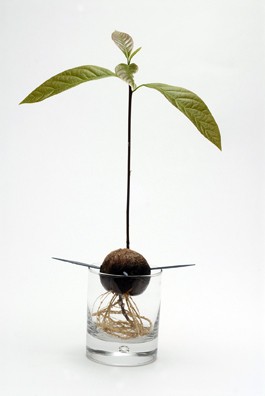
Frost, fire and water cutbacks have delivered a mighty punch to the gut of the California avocado industry. Yield is down, as are the farmers. Fruit-set for next season is looking grim, and while growers struggle to regain their feet, a nonstop stampede of Mexican, Chilean and other foreign avocados is flooding the market and deceiving consumers into thinking all’s gravy in the avocado biz.
But it’s not. The base of the problem stems back to Jan. 1, when an emergency court order, intended to protect the threatened Sacramento Delta smelt from death by pumping, called for a 30 percent cutback on water flow from the delta to Southern California. Farmers, in turn, received a prompt 30 percent reduction in irrigation water.
Avocados, a jungle fruit being grown in the desert, require between three and four acre-feet of water per acre per year to remain vibrant and fruitful. (Grapes, by contrast, require just one, as do blackberries.) Thus, the men and women who grow avocados have been put in tight quarters, and to keep at least a portion of their orchards healthy, many have had no choice but to cut down as much as one-third of their trees.
They call it “stumping,” and word has it that throughout rural San Diego County all winter, spring and summer, the buzz of chainsaws could be heard in the distance. To stump a tree does not kill it, but merely leaves it dormant. The action also halts the tree’s photosynthetic processes immediately. Water consumption nearly ceases, so that for neighboring trees still bearing foliage, fruit and flowers, life may go on. The reckless farmer who decides not to stump in such a time as this would simply wind up with a withered canopy across the property and perhaps enough scrapings for a bucket of guacamole.
As stumped trees are not dead, they quickly bounce back to life; new leaves and buds sprout from the sawed-off stump and, generally, within three years the branches hang heavy again with fruit.
That is, if there’s water. Gary Arant, general manager of the Valley Center Municipal Water District, doesn’t believe there will be. While droughts may end within two or three years of their inception, legal matters involving water, desert cities, farmers and endangered species are liable to linger for a decade or more.
“These farmers are in this for the long haul, and eventually their trees will have to just come out,” he predicts.
Economically, he says, there is little sense in stumping as a long-term course of action; the trees still require some water—a monetary expense—while producing no fruit at all. Stumped trees are dead weight and a financial drain on a farm.
That is why brothers Noel, Jerome and Al Stehly, who run their family’s certified organic ranch near Valley Center, stumped only 40 of their 800 total acres of avocados and have instead directed their efforts toward seeking a new source of water. They’re going underground. However, the local subsurface supply of groundwater is relatively salty and unsuitable for avocados. A study by Dr. Gary Bender, farm adviser with the UC Davis extension in San Marcos, showed reduced yields of 27 to 40 percent in avocado trees irrigated with brackish water. Even blending 30 percent groundwater with the remaining allowance of fresh district water to fill the current water void, says Bender, would not sufficiently dilute the salt.
But the Stehlys have purchased four nanofiltration pumps, each of which can desalinate as many as 300 gallons of briny water per minute and could alleviate the water shortages faced by their crops, which include blueberries and citrus. However, Jerome Stehly concedes that the pumps are very expensive. He believes Northern California “is letting a surplus resource run out to sea.” That, of course, would be the Sacramento River.
“It’s ridiculous,” he says. “They have extra water, and we can’t get it. There need to be compromises to keep agriculture alive in California, and though I don’t believe extremists are trying to stop agriculture—they’re trying to stop urban growth—what they’re stopping is farming.”
Tom Markle, 71, has grown avocados for 36 years near Escondido with his wife, Mary, but the future is looking grim. The Markles’ groves total 29 acres and approximately 3,400 trees. In October, fires damaged or entirely torched about 1,700 of them. The winds generated by the heat reached 100 miles per hour and knocked much of the rest of the crop from the branches. Current fruit-set is low, as it is across the county’s 26,000 acres of avocado trees, and, like most other farmers, Markle stumped a few trees to meet the water availability. Next season, he foresees a crop yield just 25 to 30 percent of his usual 300,000 to 400,000 pounds.
“Small farmers are hurting,” Markle says. “We need more water, and it’s not going to come from the sky.”
It may not come from the north either, due to environmental concerns for salmon, the delta smelt and the Central Valley ecosystem as a whole.
“And that’s a reasonable concern,” Markle allows, though Arant believes that water pumping has been overrated as the sole cause of declining fisheries. He says that the Chinook salmon collapse, for example, was due in large part to ocean fishing and river pollution.
Farmers Bill and Carol Steed are struggling, too. They grow avocados, berries and citrus near Valley Center, in the north of San Diego County, and had just put 25 new acres of blueberries in the ground when word of the January water cuts arrived in November. They now have only 25 percent of their total water needs.
“An immediate solution,” Carol Steed points out, “would be if all residential users cut back their intake by 3 to 4 percent.”
After all, agricultural use of water in San Diego County runs just one-seventh the volume of what urbanites use, much of which fills pools, makes cars shine and otherwise goes down the drain.
“I’d like to see San Diego start sending its reclaimed water up to the groves, but getting it there is the main problem,” says Dr. Bender, who believes that treated sewage water could be “the future” of Southern California farming.
Meanwhile, water officials expect the cuts on agricultural water use to increase next year to 40 or even 50 percent of farmers’ 2006 intake. Some farmers are bailing out of the business, and Markle recently put two-thirds of his family’s avocado acreage up for sale as their financial problems mount. Markle expects that whoever buys the land will remove most of the trees.
Avocado production in California took a heavy hit beginning with the frosts of January 2007. The fires of last October and the widespread stumping has since spurred a rapid loss of acreage, which has nose-dived from 65,000 to 58,000 acres in the past 18 months. Yet nationwide demand for the creamy fruit, once called “poor-man’s butter,” is higher than ever, and acreage overseas is expanding as avocado imports pick up the slack for lagging domestic farmers. The North American Free Trade Agreement opened the doors in the 1990s to fruit from Mexico, Chile and elsewhere, and today foreign avocados dominate the marketplace.
Consumers might think twice about buying Mexican avocados. While Mexico’s tropical avocado groves don’t face water shortages, in Michoacan, the center of production, avocados have directly replaced abut 30,000 acres of rainforest since 1997, when NAFTA opened the American market to Mexican avocados and spurred the acceleration of the already growing Mexican industry.
Today, Michoacan avocado groves cover 228,102 acres, generate 2 billion pounds of avocados yearly and provide the United States with approximately half of its consumption, which hit 1 billion pounds last year. Chile provides about 15 percent of the American demand, Peru may enter the market in 2010, and California now supplies just 30 percent of domestic avocado use.
“What are we going to do, grow all our food offshore?” asks Jerome Stehly.
Carol Steed hopes that people will take a greater interest in conserving water at home and in protecting California’s farmers.
“We’re hopeful—and maybe this is naïve—that the state and the public will eventually appreciate the value of locally grown food. Eventually, we have to decide how important it is to grow our own food in our own country.”
Quick dining snapshots by Bohemian staffers.
Winery news and reviews.
Food-related comings and goings, openings and closings, and other essays for those who love the kitchen and what it produces.
Recipes for food that you can actually make.

FOLLOW US
Copyright © Weeklys All rights reserved.
Our Publications
