The Roots of Razor-Pop: Toya’s “I Do”

0

A footnote to my article this week in the Bohemian about the current rush of razor-pop singles is this largely-forgotten jam, Toya’s “I Do.” It’s singlehandedly responsible for forcing me to give pop radio another chance back in the dark days of 2001; while large-scale productions from the Backstreet Boys and Cher clogged the airwaves, this confection of minimalism hit like a beautiful, breathe-easy dream—just some blips, hi-hats, a bass line, and minor-key harmonies spitting out fresh turn-of-the-century slang. It preceded a lot of the tiny, razor-pop songs you’ll hear on the radio today by Beyoncé and Ciara, and I still fall in love with it every time I hear it.
About that bass line: it doesn’t start on the root note, like most all pop songs. Instead, it hangs on the five, stopping at the minor third before a cursory thud on the root brings it back up to the five again. The song’s entire eerie element of suspense comes from this trick, and it’s one I haven’t heard duplicated since.
Toya was barely 18 when this song was made. She stopped making music shortly afterward, married an NFL quarterback, and had a baby. She lives somewhere in Georgia now. Watch the video below:


[display_podcast]

Does Aretha Franklin Make Up For Rick Warren?

1

This is what we’ve been waiting for. Forget the Cabinet picks. The real question has been: Who will Obama pick to perform at his inauguration?
The inauguration schedule is in, and the winner is Aretha Franklin.
Does the Queen of Soul make up for Obama’s pick for the ceremonial invocation? Rick Warren, anti-gay, pro-life, co-conspirator in the fake “cone of silence” debate? No, it doesn’t. Picking one of the greatest singers ever to live (the greatest, if you read Rolling Stone) to sing at the inauguration is a classy move, but Rick Warren? Wha th’ fu?
Also performing are Itzhak Perlman, Yo-Yo Ma, Gabriela Montero, and the usual collection of military bands and childrens’ choruses. Full schedule here.

Tarnished Gold

12.17.08

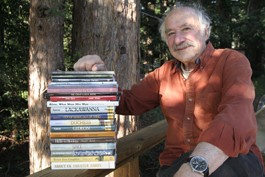
Born in 1858 on a Santa Rosa cattle ranch, Al Chamberlain just couldn’t find his way into the 20th century, even when it found its way into him. He kept his horses on Sonoma Avenue where the courthouse now stands until the city cited him for unsanitary maintenance and did the ol’ eminent domain grab on his land. Bereft of four legs, Al tried to use four wheels but never really got the hang of driving, one day knocking down a female pedestrian when he bumped over a curb and onto a sidewalk. She was unharmed and, according to Sacramento historian David Kulczyk’s 2007 book California Justice: Shootouts, Lynchings and Assassinations in the Golden State (Quill Driver; $15.95), “laughed” the incident off, but Santa Rosa police chief Charlie O’Neal saw to it that Chamberlain made jail time for the infraction.

Sentenced to 30 days and $100, Chamberlain handed out business cards after his release proclaiming himself to be a jailbird and an outlaw. Financially ruined, publicly mocked, a joke even to himself, Chamberlain decided to die like an Old West renegade and, on July 15, 1935, loaded up two revolvers and walked through Santa Rosa’s bustling downtown. He started by putting eight shots into the harmless body of the man who had bought his ranch. Then he set out for O’Neal, shooting him three times. Next up, the sheriff. But Sheriff Harry Patteson was too wily for Chamberlain and outsmarted the old cowboy. The day ended with Chamberlain being remaindered to San Quentin by Patteson. The landowner survived his eight shots; chief O’Neal died two days later of his three.

Speaking to the Sacramento News and Review in 2007, Kulczyk said that this story most resonates with him from the many gathered in his compilation of California’s seedy underside. “He was an honorable man,” Kulczyk said of Chamberlain. “A man who knew nature, who could live out on his own. He was a cowboy. He was the last of his kind, and the technology around him changed so rapidly that his skills and his knowledge meant nothing anymore. . . . I’m like the old cowboy.”

Kulczyk, who describes himself as a college drop-out, former bike messenger, ex&–music critic and washed-up goth musician who has more tattoos than any historian dead or alive, appears at Copperfield’s Books to read from and discuss many of the other North Bay&–related tales of woe captured in California Justice on Saturday, Dec. 20, at 1:30pm. 140 Kentucky St., Petaluma. Free. 707.762.0563.


Museums and gallery notes.

Reviews of new book releases.

Reviews and previews of new plays, operas and symphony performances.

Reviews and previews of new dance performances and events.

I Still Make Tapes

0

12.17.08

I still make tapes. Step into my car, and there are cassette tapes all over the floor. I suppose that’s weird, but weirder still is that they’re not just from older artists of the golden cassette era, like Bruce Springsteen and Huey Lewis. The sight of modern band names like Deerhunter and Girl Talk written on cassette spines always gets comments. It’s a jarring collision of the old and the new, people say, like watching a Pixar film on a 16mm classroom projector. And I’m always asked the same question: “Why do you still make tapes?”

I still make tapes because I have always made tapes, and I tend to continue to do things that I have always done. But it’s more complex than that. Forget mix tapes—that’s a whole other story, one explored a thousand times over. I’m talking about the act of fitting whole and complete albums on to cassette, a process that gratefully involves the inquisitive mind of a human being.

I still make tapes because making tapes connects me to albums in idiosyncratic ways. Setting the recording level and finger-winding through the leader. Concentrating on the guitar solo to determine exactly where it’s most appropriate to fade the song before the tape cuts off. Asking myself if it’s worth it to re-record a song that skipped and then deciding not to, and then getting used to the skip, and then hearing the same song elsewhere and actually missing the skip. Imprinting activity on the final product, a precursor to the laptop remix, as a way of saying this is my music as much as theirs.

I still make tapes because I believe in the beauty of confines and the patience of enjoyment. I’m not convinced that the ability to immediately jump to the next song is an asset. I absolutely loathed lots of my favorite albums at first. I waited it out. I recorded them on a cassette and didn’t fast-forward, and I fell in love with them.

I still make tapes because christening a new cassette with your own artwork is like lending your personal stamp of approval to an album. “You have graduated to cassette status,” goes the ceremonial speech, “and you shall now receive a knighthood of rub-on lettering and watercolor.” Don’t forget the spine, and finding new ways to cover up the cassette’s brand name, although the jacket and the label are important too, with perhaps just enough paint on the shell so it won’t get stuck in the stereo.

I still make tapes because I love the challenge of getting two albums to mesh successfully on two sides of one cassette. Wilco’s Yankee Hotel Foxtrot, please meet Jets to Brazil’s Perfecting Loneliness. The Mountain Goats’ Tallahassee and Crooked Fingers’ Red Devil Dawn; Broken Social Scene’s You Forgot It in People and Against Me’s As the Eternal Cowboy; M.I.A.’s Arular and Edan’s Beauty and the Beat—these are albums permanently conjoined in my mind. (There are the failures, too. Gillian Welch’s Soul Journey on the same tape as Pete Rock’s Petestrumentals. What was I thinking?)

I still make tapes for the brutality of listing songs on the jacket, resulting in the absolute tiniest handwriting ever exhibited by humankind. Should I try to fit “Last Night I Dreamt Somebody Loved Me” on one line of writing or two? I’ll count the songs—should I list them on the inside to make room for artwork or on the outside, and if so, do I need to maximize space on the lines? Can I list “Move the Crowd” and “Paid in Full” on the same line, separated by a dash? Can this album even fit on a 90-minute tape? If not, which songs do I cut?

I still make tapes because making tapes forces me to ask these questions—dozens more questions about an album than I would have ever asked myself otherwise, and the answers point me to a greater understanding. It’s not how much music you have, it’s how well you know it.

I still make tapes because I don’t believe the old line that the medium is the message—not with music, at least. I scored another 100-capacity Napa Valley Wood Cassette Rack at the Salvation Army last week, and I’ve got a pile of new LPs and CDs that I’m dying to pore over and commit to cassette for the car, for the boombox or for the Walkman. Yeah, I still own a Walkman. Yeah, it’s almost 2009. The music’s the same. What gives?


Letters to the Editor

12.17.08

Um, But it’s the Mormons who Did It

Re: “Outlawed Love” (Dec. 3): I am so proud of these fine gentlemen. They have opened their homes to children that others have closed their doors to—how can that be wrong? How is it wrong to love? Others would like to take the gay lifestyle and compare it to the extreme; i.e., pedophiles, polygamists. I even heard someone say, “If you can marry same sex, why can’t I marry my dog?” which I’m sure the dog would have something to say about, if it had a choice.

We’re supposed to be the land of the free. America came to be because of people fleeing from their own countries due to religious persecution. I know that gay freedom was not something that our forefathers thought about back then, since gay folks have always had to hide. This country has faced so many obstacles, civil wars, terrorism. When it comes to fighting, it’s don’t ask, don’t tell—but we’ll let gays fight. On taxes: we’ll take the gay money. How about civil rights? Oh no, hold on now, we can’t have that!

I am so surprised at the African-American population. It was not too long ago when they couldn’t marry white folk. That was about civil rights and freedom, yet for gay people, it’s different. Because gays are not people, right? Different from the last group of people who fought for their rights, correct? Why are people so hateful that they don’t understand, no matter what background they’re from. Quick to forget and quick to judge—and hate—and kill. And Jesus wept . . .

Arlene Jimenez

San Jose

Wine Swoon

I, too, had the similar experience at Williamson Wines (“Swirl ‘n’ Spit,” July 30). However, I walked out with $400 in wine and a new member of the wine club.

Bill Williamson’s wine and company are peerless. We were spellbound on our first visit, and had the pleasure of tasting everything on the second. You should go back for the Malbec challenge. When complete, you’ll be $68 lighter in the wallet, but you’ll be happy.

Bill and Dawn Williamson made our annual trip to Napa and Sonoma one to remember. Passion for what you do is not made, it just is.

 Mark Pilarski

Westminster, Colo.  


Clearcutting not Clear-Cut

California’s fish are seriously imperilled. Unfortunately, other California ecosystems are going to be reaching collapse, too. Do a web search on “clearcutting” + “California” + “Sierra Pacific Industries” (SPI), and you will find shocking pictures of the massive amounts of clearcutting throughout Sierra Nevada forests.

SPI is in the process of clearcutting or nearly clearcutting almost 1 million acres of critical forest. Most people in California are shocked to find that clearcutting is even legal in California. How can California continue to allow clearcutting after it has become a “leader” in climate change, and after our governor has stated that logging methods like this are not “sustainable” and that our forests in this and Third World countries are critical to climate change?

The California Department of Forestry and Fire Protection and the forest industry keep telling us that clearcutting is sound—didn’t our officials just recently also just tell us our economy was sound? Call your legislators and tell them to stop “greenwashing”—stop clearcuttting forests in California, before it is too late.

Susan A. Robinson

Arnold


&–&–>

Past Is Present

12.17.08


Knowing Chester Aaron has been one of the genuine pleasures of my life, one I surely share with dozens of folks around the country. The charismatic Occidental writer and garlic king has lived an extraordinary life and, at 85, remains one of our best writers and storytellers.

I met Aaron in the early ’70s at St. Mary’s College in Moraga. It was his first year of teaching college and he was closing in on 50. Not long before, a New York publisher had released his marvelous first novel, About Us, the semi-autobiographical tale of a Jewish family in a western Pennsylvania mining town.

Aaron grew up scrapping in such a family. He fought in the streets and had numerous Golden Gloves bouts. In his early 20s, Aaron was a machine-gunner with the 20th Armored Division, fighting through Germany and participating in the liberation of the concentration camp of Dachau.

Following the war and his military discharge in Los Angeles, Aaron attended UCLA and began writing. The rich cultural climate of postwar L.A. was studded with luminaries recently flushed out of Europe. Aaron got to know Bertolt Brecht, Christopher Isherwood and the powerful activist poet Thomas McGrath, who famously stood up to the House Un-American Activities Committee. He even met Greta Garbo in the kitchen of a house filled with Hollywood intellectuals. After he replied to a question about his age, Garbo muttered, “Too young.”

In the ’60s, Aaron moved to Northern California, where he worked at Alta Bates Hospital in Berkeley as an X-ray technician, a job he was fired from in the early ’70s for his exposé of the overradiation of African Americans in U.S. hospitals.

In 1999, Aaron retired as professor emeritus from St. Mary’s College, where he’d taught for 25 years. By then, he’d published more than a dozen books and was growing more than 90 varieties of garlic at his Occidental home.

After the publication of his book Garlic Is Life, Aaron became a legend in the world of the stinking rose, trading stories and rare cuttings with growers from around the world. He also had the bittersweet experience of seeing his gardening books far outsell his literary work.

At present, Aaron has become obsessed with memories of the concentration camp at Dachau. He is no longer able to write about much else. For decades, he had effectively repressed the experience. But in 2004, he unearthed long-stored photographs he had taken in Dachau of freight cars filled with bodies and parts of bodies.

Since that day, Aaron has been working on a collection of 10 stories to be titled After Dachau. Aaron hopes to finish the collection in 2009.

In the story “Past Is Present,” 83-year-old Abe Kahn shoots at wild turkeys that have been eating his crops:

One of the five has dropped just beyond Box 2 and lies on the ground, flopping about, trying desperately to scream for help but only coughing. Coughing and gagging. Flopping and coughing and gagging. Abe, standing over the body, sees not the dying turkey but the dying German soldier coughing and gagging and flopping about. The dying German soldier trying to call to his comrades for help.

“You son of a bitch.”

Is he talking to the turkey or to the young blue-eyed German soldier lying at his feet?

Looking down at the purple head and the almost beautiful black-red feathered wings, Abe hears one last coughing gasp. He waits and watches with a sense of mission-accomplished as the black-red wings that have been beating rapidly beat slowly, then stop beating.

Continuing to watch, he continues to see not the turkey but the German soldier . . . 19 years old? 20? . . . gray-green jacket pouring blood, black bucket helmet in the mud near the blond head.

The 83-year-old Abe Kahn observes the 19- or 20-year-old German soldier the 20-year-old Abe has shot in the chest. The soldier closes and opens his fingers and jerks his arms as if trying one last time to reach for something he hopes to take with him on the long dark journey he knows he is about to begin.

 Chester Aaron sleeps fitfully these days, often rising in the middle of the night to work on one of his Dachau stories, as his past closes in on his present.

 Novelist Bart Schneider was the founding editor of ‘Hungry Mind Review’ and ‘Speakeasy Magazine.’ His latest novel is ‘The Man in the Blizzard.’ Lit Life is a new biweekly feature. You can contact Bart at [ mailto:li*****@******an.com” data-original-string=”fekwm6PtxTMxlWk7PC51oA==06amjUdTx1IX9MfEUGN9bT181SfSrfhKrERUcKZkQ/dtTwxJpzdkK6hA3KyDakdnRvz8mQZlJpwk+PvYxAVEpkb0mjtV0dcB0aNPLHNLgwq/Ds=” title=”This contact has been encoded by Anti-Spam by CleanTalk. Click to decode. To finish the decoding make sure that JavaScript is enabled in your browser. ]li*****@******an.com.


Museums and gallery notes.

Reviews of new book releases.

Reviews and previews of new plays, operas and symphony performances.

Reviews and previews of new dance performances and events.

Home for the Hols

12.17.08

Bill Douglas Trilogy‘ An alternative title to the films collected in this set—My Childhood (1972), My Ain Folk (1973) and My Way Home (1978)—could be How Bleak Was My Valley. In these short films, Douglas follows the adventures of his surrogate Jamie (Stephen Archibald, a highly talented nonprofessional who died before he was 40). Like Douglas, Jamie grows up in a Scottish coal-mining town, the illegitimate son of a woman who lost her mind, living with two grandmothers (one inert, the other vicious) before living in an orphanage.

The almost mute boy wants to be an artist of some sort. He is drawn to cinema, in the form of a 1945 musical with banjolelist George Formby or a lone splash of Technicolor, with Lassie gazing at the Sierra Nevada, which are impersonating the Scottish Highlands. As an impressionist study, Douglas’ trilogy is something similar to Terence Davies’ Distant Voices, Still Lives, but his films are even more tough, leavened with moments of Vigo-like dreaminess and darkened by Lynchian nightmares.

English subtitles and copies of Douglas’ poetic scripts would have been useful, but the extras do include a documentary, Bill Douglas: Intent on Getting the Image, which describes the director’s short life and curtailed career. Douglas’ only feature, Comrades, a working-class epic about the Tolpuddle Martyrs, is not yet available on DVD. Key among the interviewees is Peter George, Douglas’ collaborator and longtime companion; they weren’t lovers, apparently, despite the male-identified imagery in the last and best of these three films.

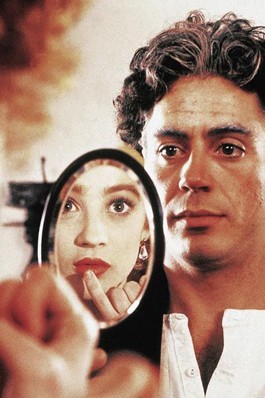
‘Chaplin: 15th Anniversary Edition’ Richard Attenborough’s 1992 biopic is thoroughly knowledgeable about the sometimes enigmatic, sometimes self-pitying cinema genius Charlie Chaplin. But the movie’s old-fashioned insistence on the secret to the man—that maddening mainstream film tendency to try to sum up a life in one sentence—finds no there there. Chaplin is one of the most honorable and well-researched Hollywood biopics and, curiously, also one of the flattest.

In the title role, Robert Downey Jr. gives it his all. The premise is that in an old-age home in Switzerland, Chaplin is interviewed by a reporter (Anthony Hopkins) who asks probing, unlikely questions. You get distracted in this interrogation by some of the interesting actresses around in the flashbacks, playing the women in Chaplin’s life and career: Marisa Tomei as Mabel Normand, Moira Kelley as both Hetty Kelly and Oona O’Neill, and Diane Lane as Paulette Goddard. Dan Aykroyd steals the movie, having just the right amount of salt and grit to be Mack Sennett, and Geraldine Chaplin plays her own grandmother in an affecting madhouse scene.

This oddly titled special edition (shouldn’t that be 16th anniversary?) includes featurettes about the film and Chaplin’s career (most interestingly, Attenborough suggests that the reporter character was added late in the game and “buggered” the movie) and a short home movie taken by Alistair Cooke in 1933 showing Chaplin clowning aboard his yacht.

‘Thomas Kinkade’s Christmas Cottage’Back in the 1970s, Michael Campus, the director of this movie, put my life in peril. His film The Passover Plot played at the Pacific Beverly Hills Theater where I worked. We were threatened by the usual fundamentalist crackpots, ready to bomb that grand edifice if we didn’t ditch the blasphemous film suggesting that Jesus (soft-core porn czar Zalman King!) only slumbered on the cross rather than dying, having been slipped a Mickey in the famous vinegar-soaked sponge. I could have died because of his very bad movie! And now Campus is trying to kill me again, this time with boredom.

In only the most Hallmarkian terms, this purports to be the story of how Morgan Hill’s Thomas Kinkade began his career, painting his sinisterly glowing houses of horrors. Apparently, Jared Padalecki’s Kinkade learned to paint good in order to help his mom (Marcia Gay Harden) keep her house. As a young man, he was mentored by real-life artist Glen Wessler (Peter O’Toole, in an act of sunset-years prostitution equivalent to Laurence Olivier taking a role in The Betsy). Creating a false dichotomy between art that critics like and that which ordinary people enjoy, O’Toole coughs up lines like “A mural of Placerville! It’s your chance to illuminate what you love.”

Includes commentary tracks, deleted scenes and “Home for Christmas: A Conversation with Thomas Kinkade,” 10 minutes of the artist arguing for his art. Apparently, the reason why his houses appeal is that “the lights are always on.” It’s worked for Motel 6.


New and upcoming film releases.

Browse all movie reviews.

Holidays on Wine

0

Nearly every out-of-town visitor can be enticed by the lure of picturesque vineyards and wineries. But you don’t want to geek out on folks who have only a casual interest in wine any more than confirmed connoisseurs want to wade through crowds of buzzed tourists for a desultory pour of the bottom tier. It’s time to think custom-tailored tour.

C’mon, Newbie! Small doses of wine and information produce a mildly pleasant sensation, but imagine how a discussion of lactic bacterial secretions might sound to someone who’s just trying to have a good time. If they learn that terroir makes the wine taste better, fine. The key here is to have fun while avoiding the crowds, so pony up for the guided tour.

Korbel Champagne Cellars is a perennial favorite, or take in the view from Domaine Carneros and linger over sparkling wine and caviar. Show fairy-tale castle fans to Castello di Amorosa; nearby, Schramsberg Vineyards’ tour of its historic caves and candlelit bubbly tasting is an informative, special treat.

Go West, Young SnobYour East Coast relatives prefer the best years from Chambolle-Musigny, but are open to anything scoring in the mid-’90s. Awe them with your easy familiarity with the nondescript Santa Rosa industrial park where Siduri Winery turns out Parker-approved, small-lot Pinot. Just off River Road, taste them through hedonic Zin at obscure, friendly Woodenhead Vintners. Stride knowingly around the back of the cellar where Russian River Pinot history lives at Joseph Swan Vineyards and then casually remember your tasting appointment at Merry Edwards Wines. Conclude at upstart Sheldon Wines‘ cute little Sebastopol tasting caboose. “How lucky you are,” they’re guaranteed to gush, “to live here!” Make them pick up the bill at the Starlight.

Full Circle If it’s news to someone that there are Mexican-American families who started out pruning vines and now own vineyards—and premium wineries—drive right in the courtyard of Robledo Family Winery, where the music is ranchero, the decor is hand-carved Michoacan and the wine is excellent. From the rancho to the disco, check out Ceja Vineyards‘ urban, stylish salon in downtown Napa, with salsa dancing on Saturday nights.

Sonoma Scions Adults and children agree: Who wants bored, restless kids scampering about, raiding the cracker bowl with their grubby fingers at a boring, grownup winetasting? Mindful wineries offering a few diversionary options include Larson Family Vineyards with its hula hoops, petting llama and even wagon rides on special days. At Cline Cellars‘ California Mission Museum, fourth graders may be inspired to build a better mission model, or explore the pond grounds where pheasants and turtles roam. In Kenwood, eclectic Kaz Vineyard & Winery offers free juice, a play table and light sabers for kids of all ages.

Hipster Havens They can’t understand how you survive the crushing boredom here, no matter how recently they moved away. Jet-lagged and restive, they quickly exit the tasting room to smoke, peering in from behind dark glasses with detached bemusement. Go to Petaluma. On weekend nights, there’s a quickening, urban feel to chicken town’s gentrified borough, the Theater District, where La Dolce Vita Wine Lounge serves tasty small plates and the wine list ranges from diverse international producers to local young turks. This dimly lit, modish bar is not too cool for school—they’re super friendly here. End the night with cocktails under the glassy eyes of ancient stuffed game at Andresen’s, and it’s a wrap.


View All

Noodles and Heat

0

12.17.08

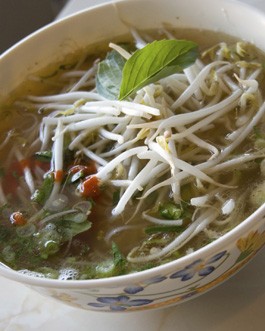
Pho, a brothy soup of rice noodles and beef, was created about a hundred years ago in northern Vietnam. It’s pronounced like “fur” without the r, though it’s often mistakenly pronounced “faux.”

The word “pho” is probably a twist on the French feu, meaning “fire,” as in pot-au-feu, or “pot on the fire,” a soup that influenced pho during France’s colonization of Vietnam. While commonly described on English-language menus as “Vietnamese beef noodle soup,” it’s appropriate that “fire” is the more literal translation for this unique brand of wet heat.

I first fell for pho one hot night in Bangkok, in an alley where several food carts were serving nothing but Thai-style pho, aka guoi tiao, or “noodle soup.” Charmed by the fragrant smell, I took a seat on a folding chair. A vendor called out to me. I nodded.

She delivered a caddy of sauces to my table, and a plate piled with bean sprouts, chili peppers, basil, cilantro, mint, green onions and a lime wedge. This side salad represents an evolution of traditional pho that began in Hanoi, where pho was transplanted by northern hill folk fleeing south, away from the communists.

Although some northern Vietnamese purists consider the salad-in-your-soup thing something of a pho-paux, if you will, I think that adding a plate full of fragrant herbs and crunchy sprouts to your steaming bowl is a spectacular development.

The vendor placed a huge bowl before me, and its contents steamed my face as I stripped the leaves from their stalks and dropped them into the bowl along with bean sprouts, a squeeze of lime and a splashing of the sauces at my disposal, which were hot, sour, sweet, spicy and fishy in flavor.

As I slurped through that soup, I became aware that the back of my neck was cool, thanks to the evaporation of the sweat that had gathered there. When my pho was gone, I noticed that my nose was running and my shirt was drenched.

The hot soup had heated and hydrated my body, while the chili opened my arteries and got the adrenaline flowing, giving me a refreshing, cleansing sweat.

Since its invention in northern Vietnam and tweaking elsewhere in southeast Asia, pho has had a restless career, migrating to the far corners of the globe and welcoming local ingredients wherever it lands. In the United States there are chains of Vietnamese beef noodle soup restaurants, including Pho King, Pho 2000 and my favorite, What the Pho? These places generally have large menus featuring many pho variations including beef tendon, or slices of raw, tender beef that cook in your bowl at the table. There’s also chicken, seafood, pork and vegetarian pho.

Here’s a basic recipe for a traditional pho of beef flank (or some other tough cut). Those who want alternate meats or vegetarian options can modify accordingly.

Parboil some beef bones for 10 minutes to release the scum and particles, then dump that water and put the bones in 6 quarts of clean water (this step will keep your broth delicate and clear). Bring the pot to a boil and then simmer with 8 star anise pods (either whole or in pieces), 1 tablespoon of cardamom pods, a three-inch cinnamon stick, 6 cloves, 4 tablespoons of fish sauce, 1 tablespoon of salt, a half-cup of sugar and 1 pound of tough red meat, cut into two-inch chunks.

Andrea Nguyen, who’s written extensively about pho (and whose mother is from North Vietnam), insists on the importance of adding char-roasted onions and ginger to the broth. To do this, slowly cook two medium yellow onions and a four-inch piece of ginger over an open flame until lightly burned—charred, blistered and fragrant. Allow these to cool, remove the blackened parts under the faucet, or with a knife, and add whole to the broth.

When the meat is falling-apart tender, remove it. The stock should simmer for three hours total.

Close to serving time, blanch some rice noodles (for 10&–20 seconds) in boiling water. Rinse the noodles to remove starch, drain and set aside. The noodles should be just a little soft but still al dente (the noodles will finish cooking when the broth is added).

Meanwhile, assemble your side salads with bean sprouts, chopped scallions, sliced or crushed chili peppers, leafy herbs of your choice and lime wedges. Make sure your condiments are in place, including hoisin sauce and red chili sauce, such as the ubiquitous Huy Fong sriracha, in the squeeze bottle with the rooster on it. These condiments found their pho niche in Hanoi, along with the side salad. Some people like to dip hot chili peppers in their pho and add heat that way, heat being essential to the full-on hot-flash experience. (I’ve been known to add mayo, which makes pretty much anything taste better.)

Place some noodles in the bowls, but not too many, as they will absorb broth; about a third of a bowl of noodles is a good rule of thumb. Place cooked meat atop the noodles, along with fresh, seasonal, raw veggies, like thin-sliced carrots, peas, onions or broccoli. Ladle broth into the bowls and serve.

You should have a handkerchief—or plenty of napkins—on hand as you as you sip and sweat your way through this meal you won’t quickly pho-get.

Pho Faves


Get your soup on the run

Annalien
1142 Main St., Napa. 707.224.8319.

Mai Vietnamese Cuisine
8492 Hwy. 116 (in Buffalo Billiards lot), Cotati. 707.665.9628.

La Maison de la Reine
346 Corte Madera Town Center, Corte Madera. 415.927.0288.

Pho Vietnam
711 Stony Point Road (at Highway 12), Santa Rosa. 707.571.7687.

Simply Vietnam
 966 N. Dutton Ave., Santa Rosa. 707.566.8910.

Saigon Bistro
 420 Mendocino Ave., Santa Rosa. 707.528.3866.

Saigon Village
720 B St., San Rafael. 415.453.3505.

Quick dining snapshots by Bohemian staffers.

Winery news and reviews.

Food-related comings and goings, openings and closings, and other essays for those who love the kitchen and what it produces.

Recipes for food that you can actually make.

The Roots of Razor-Pop: Toya’s “I Do”

A footnote to my article this week in the Bohemian about the current rush of razor-pop singles is this largely-forgotten jam, Toya's "I Do." It's singlehandedly responsible for forcing me to give pop radio another chance back in the dark days of 2001; while large-scale productions from the Backstreet Boys and Cher clogged the airwaves, this confection of minimalism...

Does Aretha Franklin Make Up For Rick Warren?

This is what we've been waiting for. Forget the Cabinet picks. The real question has been: Who will Obama pick to perform at his inauguration? The inauguration schedule is in, and the winner is Aretha Franklin. Does the Queen of Soul make up for Obama's pick for the ceremonial invocation? Rick Warren, anti-gay, pro-life, co-conspirator in the fake "cone of silence"...

Tarnished Gold

12.17.08 Born in 1858 on a Santa Rosa cattle ranch, Al Chamberlain just couldn't find his way into the 20th century, even when it found its way into him. He kept his horses on Sonoma Avenue where the courthouse now stands until the city cited him for unsanitary maintenance and did the ol' eminent domain grab on...

Current Events

I Still Make Tapes

12.17.08I still make tapes. Step into my car, and there are cassette tapes all over the floor. I suppose that's weird, but weirder still is that they're not just from older artists of the golden cassette era, like Bruce Springsteen and Huey Lewis. The sight of modern band names like Deerhunter and Girl Talk written on cassette spines always gets...

Letters to the Editor

12.17.08Um, But it's the Mormons who Did ItRe: "Outlawed Love" (Dec. 3): I am so proud of these fine gentlemen. They have opened their homes to children that others have closed their doors to—how can that be wrong? How is it wrong to love? Others would like to take the gay lifestyle and compare it to the extreme; i.e.,...

Past Is Present

12.17.08 Knowing Chester Aaron has been one of the genuine pleasures of my life, one I surely share with dozens of folks around the country. The charismatic Occidental writer and garlic king has lived an extraordinary life and, at 85, remains one of our best writers and storytellers.I met Aaron in the early '70s at St. Mary's...

Home for the Hols

12.17.08Bill Douglas Trilogy' An alternative title to the films collected in this set—My Childhood (1972), My Ain Folk (1973) and My Way Home (1978)—could be How Bleak Was My Valley. In these short films, Douglas follows the adventures of his surrogate Jamie (Stephen Archibald, a highly talented nonprofessional who died before he was 40). Like Douglas, Jamie grows...

Noodles and Heat

12.17.08Pho, a brothy soup of rice noodles and beef, was created about a hundred years ago in northern Vietnam. It's pronounced like "fur" without the r, though it's often mistakenly pronounced "faux."The word "pho" is probably a twist on the French feu, meaning "fire," as in pot-au-feu, or "pot on the fire," a soup that influenced pho during France's...
11,084FansLike
4,446FollowersFollow
6,928FollowersFollow