Into the Wild

0

03.11.09

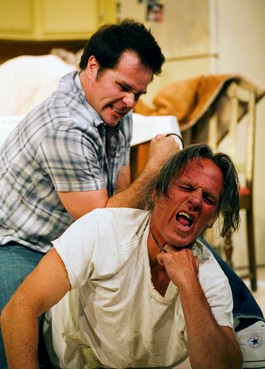
Sam Shepard plays are a little like electric fences; by their very reputation they keep some people at arm’s distance, while luring in those with a taste for electrifying entertainment. In Double E Productions’ engagingly intense, darkly hilarious new staging of True West (an encore presentation of the production they mounted last June at Spreckels Performing Arts Center), actor-producers Eric Burke and Ed McCloud—with director David Lear—take masterful advantage of the intimate, enclosed environment of Sixth Street Playhouse’s Studio Theater, literally inviting the audience into the play by placing a screen door at the entrance of the theater. You step inside and cross into the domestic battleground of two brothers, Austin (a brilliant McCloud, above left), a Hollywood screenwriter holed up at his mother’s house in the midst of a SoCal heat wave and Lee (Burke, nearly combusting with hostility and envy), a bullying, beer-guzzling thief and drifter who has dropped in suddenly after a five-year absence. As the two brothers, Burke and McCloud are nothing short of amazing, building onto and delving deeper into the characters they developed last June, creating a play that is even tighter, funnier and more riveting than the first time out. The cast includes Al Liner as Saul, the producer of Austin’s project, who becomes swayed by Lee’s con man swagger to instead develop a story improvised by the near-illiterate interloper, and Lennie Dean (replacing Carol McRae), as the boy’s domineering, mentally unstable mother, who can’t understand why her sons hate each other so much, when it’s clear that she’s the reason.

The power of Shepard’s work resides in his understanding of human nature and his skill at creating characters who reveal their inner natures slowly but clearly. In True West, Shepard has constructed more than just a stand-off between two frustrated men; he’s created a veritable road map of self-destruction, and has somehow made getting from points A to B as funny as it is harrowing.

Since the play first premiered at San Francisco’s Magic Theater in 1980, critics have argued that the play is about sibling rivalries, the poisonous nature of America’s Western mythology, and the duality of human nature, while audiences see it as a rip-roaring, knock-down, drag-out fight between two brothers who are much more like each other than they’d prefer to believe. As presented by Lear, Burke, McCloud, Liner and Dean, this True West is all of that, bold, visceral and unforgettable.

True West runs Friday&–Sunday through March 22 in The Studio at the Sixth Street Playhouse, 52 W. Sixth St., Santa Rosa. $15&–$20. 707.523.4185.


Museums and gallery notes.

Reviews of new book releases.

Reviews and previews of new plays, operas and symphony performances.

Reviews and previews of new dance performances and events.

To Monsieur, with Love

03.11.09

In taking the pressure-cooker atmosphere of a high school classroom and making it absolutely compelling, Laurent Cantet’s The Class shows the excitement of doing a desperately important job. According to the journalist Sanche de Gramont (aka Ted Morgan), there was a time when a French education minister could look at the clock and instantly tell what subject was being taught in every classroom in his nation.

That’s changed, obviously. The Belleville-area école in Paris we see here isn’t old-school in any sense of the word. Students of every nationality in the old French sphere of influence attend: Tunisian Arabs, sons of Francophone Africa, a kid from Martinique or some other French island in the Caribbean—there’s even a Chinese illegal alien.

In some ways, what we see is like an “FSL” class instead of “ESL.” The class of the title is French, specifically grammar. The teacher in the class is leading students through imperfect tenses, and they prefer street argot. But it’s also his job to get them to read The Diary of Anne Frank, and to coax them to open up about their lives when they prefer to look as cool and streetwise as possible.

Another measure of how much French schools have changed since The 400 Blows is seeing how the students have a little control in matters. Student representatives are allowed to witness disciplinary hearings and exercise a bit of clout. This power leads to trouble in the conclusion of this tightly paced yet naturalistic docudrama. The focus on the schoolroom is intensive; the few night scenes are filled with parent-teacher conferences and other administrative problems. The classroom is small and packed with kids ages 14 and 15. Some of the few exteriors are high-angle shots of the schoolyard; it is prisonlike in its compactness, and it has high walls.

The French title of François Bégaudeau’s memoir, Between the Walls, must be deliberately meant to recall jail. In this restaging of events in his classroom, Bégaudeau plays what he is in real life: a correct, graceful, unflappable teacher who can handle what his always-chafing kids throw at him. One kid suggests that Bégaudeau is a “Camembert”—the slang for a Frenchy Frenchman, the suit-and-tie type, as opposed to the hip-hop-loving kids of the class.

 <

Naturally, a few of the students question François’ sexuality. He handles the gossip with a beautifully thrown rhetorical dart: Who wants to know? The heckling students show their spirit. Bégaudeau shows his spirit by giving without giving away everything he’s got. It makes him the kind of teacher you might have had, the ones who were more intriguing than the ones who shared everything. They were mysteries. What exactly did they do in their spare time, when they were so devoted to teaching?

The Class is another strong and worthwhile film by Cantet. He’s creating a specialty for himself, a focus on the workplace and overwork, just as he did in the excellent film Time Out. The Class is a specific type of labor movie, and it’s not the kind that’s being done much, if at all, in American movies. It’s a sympathetic film without being sloppy, and it is of equal fascination to students and teachers alike.

‘The Class’ opens on Friday, March 13, at the Rialto Lakeside Cinemas (551 Summerfield Road, Santa Rosa; 707.525.4840) and the Smith Rafael Film Center (1118 Fourth St., San Rafael; 415.454.1222).


New and upcoming film releases.

Browse all movie reviews.

Hunt for Red Oktober

0

03.11.09


One day, a curious wine was found on the shelves of Trader Joe’s. In candid reference to its contents, the label featured a bunch of grapes sketched with a dated pastel palette, declaring simply that it was a 2005 Rheingau Pinot Noir, with the cryptic designation “Edition Maximilian.” The pale ruby contents of that humble bottle provide a tinted lens through which an unfamiliar world of German wine may first be glimpsed. German Pinot? Mein Gott.

Really. Although Riesling is the premier fuel of the German wine export machine, more than a third of the nation’s vineyards are planted in red wine grapes. According to the German Wine Institute, Germany is now the world’s third largest Pinot Noir producer, after France and the United States. For centuries, local markets sopped up the traditionally light, sweet red wines, and wine books mentioned them in afterthought, if at all. Now, changing tastes and a changing climate have prompted a serious reconsideration of dry red wine.

Was that unassuming flask in Trader Joe’s the first ripple of a tide of “Red Nun”? Not likely, unless Germans come up with a particularly irresistible critter label in the vein of Australia’s Little Penguin. (In fact one winery, Lingenfelder Estate, does produce a cannily marketed collection of everyday wines called “Vineyard Creatures,” featuring whimsical labels designed by Santa Rosa artist Chuck House.)

The big producers mainly pump out semisweet hock—Riesling, as well as simple white wines like Pinot Grigio and Müller-Thurgau. But a new generation of winemakers, influenced by international styles, have trebled the planting of red grapes and dramatically increased the quality of wines, yet several factors have kept these overseas. For one, although long cast as a northern, beer-drinking nation in contrast to southern Europe’s wine belt, Germany is the world’s fourth largest retail wine market, making domestic sales solid. Also, smaller wineries often practice a rustic system of distribution; making an annual nationwide tour in a wine-stocked van, they personally deliver orders.

Another hurdle is the widespread consumer assumption that German wines are always sweet. It’s one of those German stereotypes that’s not entirely a fiction. German pocket wine guides color-code new releases on a scale from dry to very sweet. Dry wine bottles are labeled “Trocken,” the German word for “dry,” a distinction that would be redundant in most New World markets—especially for reds.

It’s no surprise that France and Germany, with shifting borders over the centuries, share grape varieties. The story goes that Charlemagne brought Pinot Noir to Germany, where it’s called Spätburgunder—literally, “late Burgundy.” Telling of the cool, continental growing season, the grape that elsewhere is among the first harvested is named for its late-ripening. Growers struggle to get fully colored grapes under the slate-gray autumn skies—even though Spätburgunder has a brother, Frühburgunder (“early Burgundy”).

The typical German Pinot Noir is translucent and bright cherry red, and has a subtle bouquet—maybe roses, sometimes caramelized—sweet or sour cherry fruit, and light tannin. Hiram Simon, owner of Oakland’s Vienna Wine Company, says that what he likes best is its “clarity of its expression and softness of texture. Unlike most serious Burgundy, a good Spätburgunder is approachable in its youth, but retains an ability to age well.”

That bottle from Trader Joe’s could very well warn off some Pinot fans from the Rhenish version for good, though the pale wine has a pleasant enough aroma of strawberry jam, candy and molasses and a light hint of bacon. Semisweet and the pale hue of a dawning horizon, it might make a lively companion to breakfast ham and waffles; given a chance, it does grow a certain charm.

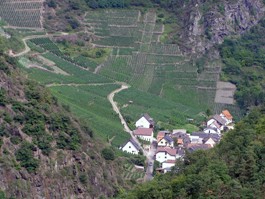
Counter to the maxim of red wines in southerly climes, one of Germany’s traditional red wine regions is in the north. The scenic Ahr Valley is a favored destination for day-trippers from Köln, as well as formidable armies of walking stick-armed retirees, and roadside stands make it easy for motorists to sample the light wines of the area. The narrow valley extends due east, lending the steep, painstakingly hand-farmed vineyards their crucial southern exposure.

Riesling reigns along the castle-studded banks of the Mittelrhein, while sharing some renown with Spätburgunder in areas of the Rheingau. In the rolling farmland of Rheinhessen, large quantities of highly processed supermarket wine are churned out by wine factories. Akin to the Lodi of Germany, it’s the original home of Liebfraumilch, although mom-and-pop cellars tucked away in the region’s villages make an untold number of small-batch reds.

In the Pfalz, Rainer Karl Lingenfelder makes quality, oak-aged Spätburgunder. Small barrels are still a big deal in Germany, such that premium bottles are often labeled to emphasize “barrique” aging. The Vienna Wine Company’s Simon claims that a 1990 Lingenfelder Spätburgunder he tasted “would have held its own with many Burgundies of the same vintage.” Lingenfelder, although family-run for centuries, stands out from the pack with its contemporary “Vineyard Creatures” brand. It’s mainly found in U.K. markets like Oddbins.

Baden is the warmest, most southerly wine region, dominated by the Kaiserstuhl, a hilly area in the Rhine Valley that was radically terraced during a 20th-century “rationalization” program to make hillsides easier to work, making it look like a gargantuan Mesoamerican pyramid. Here, Spätburgunder stars, and names like Salway, Heger and Zimmerlin have been leading the way in quality. The typical wine is still light-colored, if also packed with pleasant flavors of kirsch and plum, with an alcohol content as much as 14 percent. In some cases, that might be because it’s legal here to add sugar before fermentation (strictly verboten in California), resulting in New World&–style alcohol contents.

But is it only climate that’s at work? German vineyards produce what appear to be heroic yields. The German Wine Institute’s 2008 vintage report states that Baden growers brought in an average of 90 hectoliters per hectare, equaling nearly seven tons of grapes per acre, twice what’s typical in the North Coast. That’s actually on the quality side; yields can be double for the real plonk. California winegrowers might find it hard to sympathize with people who add sugar because they couldn’t ripen their crop while hanging seven tons of fruit in a continental climate, but then again, imagine enduring an August that rains nearly every day.

This brings us to an even darker side to the German wine industry. Though not as popular as Spätburgunder, traditional German reds like Lemberger, Saint Laurent and Portugieser ripen better and gain more color in the climate. Santa Rosa’s Traverso’s market recently selected a 2006 Lemberger from Württemberg for its eclectic wine club. It’s a medium-bodied, bone-dry wine with an initial aroma of a cool grotto, with grape jelly on the palate, that finishes with abrupt German efficiency.

Perhaps the most promising, richly colored red is, of course, the result of German Wissenschaft. The hybrid grape Dornfelder was developed in 1956 specifically to fulfill the function of ripening and coloring well in the short Rhenish season. Often made off-dry, it can be fruity, full-bodied wine—it’s not hard to imagine Dornfelder as the YellowTail of Germany. Alas, it’s also the least likely to show up on U.S. shelves.

But some American wineries have brought Dornfelder here, out of curiosity and a nod to family heritage. In Lodi, Mokelumne Glen Vineyards makes both Dornfelder and Lemberger. Huber Vineyards in the Santa Rita Hills makes a 2005 Dornfelder that’s opaque crimson and nearly stains the glass. After a few minutes of air, it reveals aromas of cedar and plum jam with flavors of sweet conserve and red vines. Nominally dry yet a lip-smacking balance of tart and sweet, it’s an unusual, viscous wine with personality.

If climate change, potentially a more powerful hand in the wine market than any other, warms the Rhine enough to predictably ripen German wines like that—who knows, we may ultimately watch the shelves in vain for a flood of critter-labeled Spätburgunder. But who could resist a $3.99 bottle of “Little Fledermaus”?


Quick dining snapshots by Bohemian staffers.

Winery news and reviews.

Food-related comings and goings, openings and closings, and other essays for those who love the kitchen and what it produces.

Recipes for food that you can actually make.

Earth’s Lovers

03.11.09

Literature is necessary to politics above all when it gives voice to whatever is without a voice, when it gives a name to what as yet has no name, especially to what the language of politics excludes or attempts to exclude. . . . Simply because of the solitary individualism of his work, the writer may happen to explore areas that no one has explored before, within himself or outside, and to make discoveries that sooner or later turn out to be vital areas of collective awareness.

—Italo Calvino, The Uses of Literature 

Of course, Calvino’s statement also applies to every creative form. Those of us—essayists, poets, painters, songwriters, cartoonists—who publicly air our private inspirations are a hopeful lot. Even in our darkest musings is the realization of what could be. No matter the odds we face, we continue to work to inspire a better world. We write, we paint, we sing to clean out the prisons of conventional wisdom that try to keep our creative thoughts in chains. Conventional wisdom seeks to blind us to what we know in our hearts is true.

When we’re faced with the destruction of a stream as the source of life for salmon, the passionate imagery of a poem can be more effective than reasoned and measured discourse. When we’re told that humans are violent and war is inevitable, a song can convey the dreams of those who experience bombs but yearn for peace. When we’re presented with arguments that ignore the humanity of the exploited, a photograph can unite our souls through the reflection of a face.

Creative forms passionately express the values close to one’s heart. Facts, figures, and reasoning are important—we need them—but something much deeper is required. Behind every governmental policy or party platform or corporate slogan is a set of values. When those values fail to serve the earth and humanity, we must search inside for those that do, and speak them more boldly—with our drums and our pastels and our bodies.

So I ask all of you who recognize your creativity and those who don’t (surprise! you just haven’t found it yet), in the course of your daily encounters, to take your readers-viewers-listeners to some place deep inside themselves—to some place they may have forgotten or have repressed in our cultural rush for reason and acquisition. Remind people who they were and are and, even more, who they can be. Let the personal be the path to the universal.

We find ourselves living in a parasitic culture, sometimes against our will and sometimes because we’ve abdicated responsibility. We find ourselves living in a culture in which war, exploitation and environmental degradation are the norms. We find ourselves living in a culture that sickens its host and could eventually kill itself. But we know better. I cling to the hope that humans are not intrinsically parasites. I cling to the hope that our words and images can change our course. We may never reach the utopia of symbiosis, in which we give back to the earth as much as it gives to us, but we can, at least, cease to so thoroughly destroy.

As children we were in awe of a caterpillar, a pond, a thunderstorm, a flower in a crack in the sidewalk. We need to rekindle that awe. Octavio Paz wrote that “nature speaks as though it were a lover.” We, who love her back, need to use our talents to translate her message for those who have become deaf. We need to use our skills to create a community in which we are all earth’s lovers.

And so I ask that we not shy away from relating our experiences of communion with the earth and her children. It is my hope that each time one of us speaks up, in whichever form we choose—in the forum of The Bohemian or elsewhere—that we invite and inspire others to do the same, so that we can give voice to what we all share. Pick up your brush! Pick up your pencil! Pick up your guitar! If we were all to do this, we could change the world. 

Susan Collier Lamont is a landscape designer, peace and social justice activist, a mother and a soon-to-be grandmother.

Open Mic is now a weekly feature in the Bohemian. We welcome your contribution. To have your topical essay of 700 words considered for publication, write op*****@******an.com.


Digital Dilemma

0

03.11.09

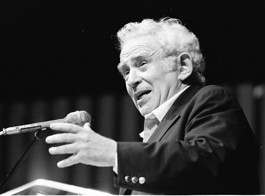
TOUGH GUYS DON’T… Should Norman Mailer’s email inbox be preserved for the public record?

Last December, a story emerged of difficulties in transferring all of the Bush White House electronic mail messages and documents to the National Archives. Government officials, historians and lawyers pointed to a variety of conflicting reasons why the transfer of information did not run smoothly.

An estimated 300 million messages and 25,000 boxes of documents were the sum total of the Bush years, yet concern focused on how electronic information would be archived and handled. In an article titled “Bush Emails May Be Secret a Bit Longer,” the Washington Post noted that the problems were exacerbated by the fact that “the administration began trying only in recent months to recover from White House backup tapes hundreds of thousands of emails that were reported missing from readily accessible files in 2005.”

A Federal Court judge was so incensed that by mid-January he felt the need to lambaste the Bush White House over the missing files. Following a search that reportedly cost more than $10 million to locate 14 million emails, Judge John Facciola said, “The records at issue are not paper records that can be [physically] stored, but electronically stored information that can be deleted with a keystroke. Additionally, I have no way of knowing what happens to computers and to hard drives in them when one administration replaces another.”

The changing manner in which we communicate has huge implications not only for presidential archivists, but also for those trying to document contemporary life. Consider the following: Should Norman Mailer’s email inbox be preserved for the public record? What about his mobile phone records, including voice and text messages? What should happen to Barack Obama’s BlackBerry? Can someone’s Facebook account be archived for future generations? How would they be stored? Salman Rushdie bequeathed four computers to a university library, so is it only a matter of time before a politician bequeaths his or her emails to an institution?

Archivists, already clamoring to catch up with the digital revolution, are now finding it extremely difficult to cope with changing communications practices. Faced with ever-demanding researchers, who expect access to information and expect it now, there is a fear that many public records are in danger of being lost in the melee.

“A feature of modern administration is that we expect instant responses to proposals and for decisions to be communicated quickly,” says archivist Tom Quinlan. “In the past, you might have had a manuscript which needed to be typed up and may have gone through several drafts. Now, with email, a draft may be sent to four colleagues. They in turn will make four separate copies, maybe saving some to their personal hard drives, and emailing back their revisions. So now there is a building electronic trail, and one of the issues we have is version control.”

If this issue is proving a headache for archivists, then spare a thought for the humble historian trying to make sense of the electronic era. Economist and social commentator David McWilliams says he’s not all that bothered by the vanishing paper trail. When we talk, he has been sitting in a cafe “people watching.” This, he says, is one of the best and most underrated forms of research. “My style would involve as much observation as possible and then going to primary sources and trying to substantiate what I have seen. What I try to do is to take a photograph of a moving object, so that I’m not faced with the same problem as historians.”

Dr. Michael Cosgrave is a history lecturer, and one of those charged with training the next generation of historians to be able to respond to changing source material. “The vanishing paper trail doesn’t have that large an impact on the work of the historian,” he says. “What we are really trying to do, when looking at any historical figure, be it Louis XVI or George W. Bush, is to understand why they made the decisions they made and to get inside their mind.

“Even if a huge amount of source material exists on paper, it may make it easier to get inside their mindset, but there are no guarantees,” Cosgrave continues. “The role of the historian is still about rigorous analysis of a narrow set of sources. Abundance of material can be deceptive. Personally, I don’t see the vanishing paper trail as a problem. Part of the thing is that we have always had to learn and teach students how to deal with incomplete source material—it’s what we do anyway as historians.”

Cosgrave says it’s probably only a matter of time before email inboxes are left to institutions, particularly when it comes to emailed drafts of important public documents.

“People have only had email in the past 10 years, and that hasn’t prevented historians from writing biographies since the start of time. I’m currently reading a biography on Alexander the Great; the fact that the fourth-century king didn’t have email or Twitter or a mobile phone does not prevent people from making reasonable evidence-based conclusions about his character.

“It’s all about people really, and while people do change with different cultural contexts, we’re still dealing with the same crooked timber of humanity.”


Magic Realist

0

03.11.09

BIDDEN: Joaquin Lopez is a servant to the force.

Although I’m not a particularly New Age-y guy, I’ve twice fallen under the spell of Sebastopol’s shamanistic poet Joaquin Lopez. With his small group, PanGaia Arts Ensemble, which includes Sonoma-based musician René Jenkins, and at times Lopez’s dancer wife, Amie, Joaquin has been inspiring audiences around Sonoma County for some time.

I first saw him at the Petaluma Art Center’s El Día de Los Meurtos celebration in late October. He led a large audience onto the street outside, had us form a vast circle, asked us to bring our authentic selves to the evening and proceeded to connect us to the earth and heavens through a chanted ceremony with the help of poet Jabez Churchill and Jenkins’ sublime playing on ancient wind instruments. I doubt if there were a handful of skeptics in the crowd of a hundred.

It was my first conversion experience, though I wasn’t sure what I’d been converted to. I felt a need to see if what I’d experienced was real, so I checked out PanGaia’s next performance, titled A Truth Be Told, at the Sebastopol Center for the Arts in November. Despite a more formal setting, Joaquin and his group captured me again.

A little later I made an appointment with Joaquin. I told him I wanted to write a profile of him, though my secret agenda may have been to find out what had happened to me the first couple of times in his presence.

Joaquin warmly welcomed me into the studio of his Sebastopol home. He asked if I minded his lighting some sage. After watching a thin coil of smoke rise for a moment, he offered a prayer and then invited me to do the same. I’ve never excelled at prayer on demand, but Joaquin’s had come across so genuinely, I did my best to be real.

I was drawn to Joaquin’s unique past and asked him to fill me in on his biography. He’d grown up in Alicante on Spain’s Costa Blanca and came to the United States with a tennis scholarship to study at the University of Texas, Arlington. He later transferred to the University of Arkansas in Fayetteville, where he was voted top student athlete.

After graduating, Joaquin returned to Europe and played professional tennis on a minor league tour. Although he was internationally ranked, there wasn’t a whole lot of glory on this tour. Joaquin describes his five years driving from tournament to tournament in his VW bus as “subsistence tennis.” The advantage he saw himself having over the star players was that rather than being handled and groomed, he was on his own, free to meet anybody he liked and to engage in a distinct quest that involved his curiosity about the wonders of the earth.

Joaquin eventually became a tennis pro at a German club, and met his future wife, Amie, an American dancer with a German company, at a sweat lodge.

The two returned together to the United States, where Joaquin graduated in 2002 from the Institute of Transpersonal Psychology in Palo Alto with a masters degree in counseling. He also has a masters in sports psychology from Spain’s Institute of Maslow Cattell. Joaquin now works as a psychotherapist, with an emphasis on trauma resolution. He’s also an associate coach with the men’s tennis team at Sonoma State.

I ask Joaquin how the creative process works for him. “Poetry,” he says, “begins when something moves me to a peculiar felt sense in my body and to a different state of consciousness. Poetry and words emerge out of that state. Then I bring this state and words to René and the musicians. With the added dimension of the music and the movement of my body, the poetry has a chance to take off.”


Asked about the connection between shamanism and art, Joaquin says, “Our art is meant to awaken certain primal consciousness, a state of connection. Art to satisfy my narcissistic needs does not interest me. I am a servant to the force, to the earth.”

You can experience the force of Joaquin Lopez when he reads on Sunday, March 29, at Maguire’s Pub, 145 Kentucky St., Petaluma. 5pm. Free. 707.762.9800. You can also sample PanGaia’s work at www.myspace.com-pangaiaartensemble.

Novelist Bart Schneider was the founding editor of ‘Hungry Mind Review’ and ‘Speakeasy Magazine.’ His latest novel is ‘The Man in the Blizzard.’ Lit Life is a biweekly feature. You can contact Bart at li*****@******an.com.


Museums and gallery notes.

Reviews of new book releases.

Reviews and previews of new plays, operas and symphony performances.

Reviews and previews of new dance performances and events.

Monopoly Money

0

03.11.09

Ticketmaster has been the bogeyman of the concert world for as long as I’ve been alive. And for the last four years, concert promotion giant Live Nation has lurked next to it under the bed. So it was with a trembling grip on the sheets that I learned that the two mega-companies now intend to merge into a single hydra-headed corporate beast that could haunt every aspect of the music world.

“Live Nation Entertainment” is the proposed name of this $575 million abomination, and unless the government steps in and smashes this egg before it hatches, that name may pop up on everything from concert tickets and T-shirts to CD cases and downloading websites.

Ticketmaster already controls 70 percent of event ticket sales in the United States, and Live Nation controls promotion rights to about 40 percent of the venues. And since Live Nation began signing artists like Jay-Z, U2 and Madonna to “360 deals,” which include everything from touring to T-shirts to recordings, its hand in the biz has increased frighteningly beyond its original market share.

To put a single entity in control of every step of the concert process is to usher in a new era of Rockefeller rule over an industry already polarized into bickering artists and greedy executives. It’s mergers like this that are the reason our country created antitrust laws, and it’s these safeguards that the music world is hoping will hold firm while the government investigates the deal.

Both the Senate and House judiciary committees have now had a crack at Ticketmaster CEO Irving Azoff and Live Nation CEO Michael Rapino during recent hearings in Washington. The two execs, whose companies are worth a combined $2.5 billion, sold themselves as struggling entrepreneurs whose only option for survival was to combine into a mega-company with tentacles stretching through every facet of the music business.

For the most part—thank goodness—lawmakers were skeptical. New York Democrat Charles Schumer and Republican Orrin Hatch of Utah led the opposition to the deal and proved that every now and then bipartisanship is possible on Capitol Hill. Others, like working-class rock hero Bruce Springsteen, have also come out against the merger, saying it would create a “near monopoly on ticket sales.”

If these two behemoth companies had some sparkling reputation for stellar customer service and fair business practices, the merger might be perceived with slightly less revulsion. But since Ticketmaster has long been viewed as charging unreasonable “convenience fees” for its tickets, especially when no inconvenient option is available, and Live Nation has been seen as bullying its way through several company acquisitions, their standing is suspect. Add that to Ticketmaster’s recent handling of Springsteen’s tour, in which fans seeking tickets to the sold-out show were told to visit TicketsNow, a Ticketmaster sister site, where tickets were being sold for up to five times original face value, and you have a textbook example of corporate gluttony gone wild.

Still, the House and Senate committees have released no decisions, and final say on the merger can be challenged by Obama’s Department of Justice. But for this music fan, the thought that one shady company could have its grubby paws touching nearly every major concert in the United States is the stuff of nightmares.

Scalping Stinks


Ticketmaster and Live Nation are among the most despicable companies in the world, but mergers are one thing; scalping’s another. Sadly, no amount of antitrust litigation is going to stop jerks from snatching up tickets in presales and selling them to the losers. Any idiot can do it. Even if Ticketmaster dropped its TicketsNow sales site, even if eBay dropped StubHub, Internet scalping would still be a fan’s No. 1 enemy.

And yet anyone could have predicted it a mile away. We made it easier to buy tickets, but where did it get us? Remember 10 years ago, when scalping was still considered illegal? That’s all changed. Now the ticket agencies and promoters are in on the profits. Who’s going to raise a stink? Who’s going to see commercials for StubHub and say, “Wait a sec, isn’t that wrong?”

—Gabe Meline


The New Fraternals

0

03.11.09

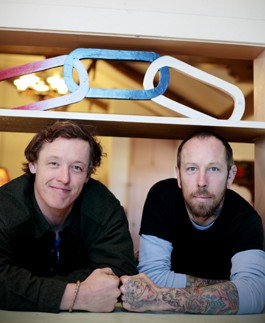
FRIENDSHIP, LOVE, TRUTH: Josh Howard and Neils Espenship represent the new era of brotherhood.

Out on the front porch, there’s a low, demonic rumbling of black metal music emanating from inside the house. Neil Espenship, who has worked for 14 years as a body piercer, jamming jewelry through every imaginable loin and groin in Santa Rosa, answers the door covered in tattoos, the smell of cigarettes and the screams of a band called Goblin Cock filling the air. He offers his hand, open and outgoing, yet there’s one thing about him many of his friends don’t know and almost no stranger would guess.

He’s a Mason.

Espenship is among a rare few who, under the age of 40, have become drawn to the secret handshakes and shrouded languages of fraternal orders, these clubs that seem to teeter on the gray-haired brink of extinction. We’ve all seen their buildings around town, their emblems on city-limits signs, their floats in hometown parades and names outside hotel conference rooms. Actually joining? That’s a different story.

In fact, there’s been concern since the late 1960s for the future of such organizations as the Odd Fellows, Masons, Druids, Elks and Moose. With scant few new initiates, only a handful have successfully answered the glaring question of survival. Just what is the benefit to the younger generation of sitting around in a conference room eating steamed beef, drinking stale coffee and cracking jokes about Eleanor Roosevelt every Tuesday night?

Espenship joined the Masons at age 36. He was raised in Harrisonburg, Va., the grandson of a man who asked of him only two things: that he bear a son to carry on the family name, and that he become a Mason. Even as early as junior high, Espenship knew that he might have trouble fulfilling the requests. “The people I hung out with more than anything else were all the Deadheads. I mean, they were still shitkickers. But they smoked pot,” he explains.

Espenship moved to Orange County and immersed himself in the punk scene. He got liberty spikes, a job at a punk-rock store and cleaned up after “scum dudes” at a tattoo shop before moving on. “The music scene down in Southern California was falling apart,” he explains, lighting up a Marlboro. “I was over that scene. From the whole punk-rock thing, I started getting into the Goth type of thing, and then from the Goth type of thing I started falling into this weird, new ’60s psychedelia thing. Started doing a lot of acid. So the natural movement for me was to start listening to the Grateful Dead again.” Espenship and his wife decided to get back to the land. They moved to Forestville.

An eventual divorce brought Espenship to Santa Rosa, where he started the growing-up process of blending all of his past phases into one. Joining the Masons, Espenship says, served to tether his wandering spirit to history. “I’m always looking for something to ground myself in,” he says, “and this is gonna sound weird, but if I can surround myself with all of the stuff from a certain era, when people were concrete and knew what they were doing—if I could somehow or other put myself into that kind of situation, there might be a possibility to ground myself and not feel so in 300 different directions.”

Around his old Victorian home, Espenship’s surrounded himself in furniture and décor almost solely from the ’50s and ’60s. Collections of old cameras and clocks line the walls next to pinup calendars and lounge accoutrements, and the entryway hosts a bright red mat with a sword, a crescent and a star—the symbol of the Shriners. This is where Espenship received his three random interviews. (Once an interested party applies to Freemasonry, officers come at unannounced times and ask questions about a potential applicant’s finances, sexuality, criminal record, drug use and other things that Espenship says he can’t talk about.) To his amazement, they called him back.

“When they actually let me in, I was like, ‘Oh, my God! Wait a minute! This really wasn’t supposed to happen!'” With this, he curls back on the couch and howls with laughter. “I thought it was gonna be a bunch of scary, black-cloaked, Republican banker dudes. Surprisingly enough, the Santa Rosa lodge has got some pretty hip guys in it. There are definitely a few ball-breakers, but for the most part they’re all amazing, incredible people.”

Philanthropy and brotherhood are important to Espenship, and he’s glad to point out that the lodge lets Metropolitan Community Church, which serves people of all sexual orientations, use its building. He’s also quick to rebuke conspiracy theorists. Though Masonic themes used by some of his favorite artists, like Robert Williams, Mitch O’Connell and Matthew Barney, may have edged him toward the compass and square, he soon realized that much of the outside world blindly subscribes to a myth that Masons rule the world. “As far as I can tell,” he muses, “we’re not placing people in positions of power in order to make a bazillion dollars and run the world and keep everybody under our thumb.”

When Espenship joined Santa Rosa Luther Burbank Lodge No. 57, he was the youngest member to do so in 10 years. He does caution those thinking about joining, however. “A lot of people go into it now thinking that they’re going to be handed the keys to the universe, and get to do all these clandestine, weird rituals,” he says. “It’s not that at all. It is gonna be you hanging out with a bunch of old men.”

The Moose Lodge in Petaluma was just a bunch of old men when John Crowley stumbled across it in 2005. They’d been doing the same thing for years, making the same Sunday brunch every week for the same members—the ones who were still alive. It was just like most other clubs across the country: riding a long, slow slide into irrelevance.

Crowley, the son of a Dublin pub owner, missed the sociality of the Irish pub. He started getting interested in ideas about social capital and community, and wondered how he could reverse the trend of society’s isolation in front of flickering screens. He saw the potential at the Moose Lodge, joined and immediately implemented new ideas like a weekly conversation cafe, a live music night, a classic-movie night and open mic. “It used to be known as an old man’s drinking club,” he says. “I had to rebirth it.”

Word got out. Within two years, the lodge’s membership more than tripled, from 200 to 700 members, making it the fastest-growing Moose Lodge in the entire country. Crowley was invited to deliver the keynote speech at that year’s convention, in which he advised staunch Moose traditionalists to adapt.

“The younger generation is a generation of nonjoiners and individualists,” he told them. “I believe that it is far, far better to be interdependent—interdependent on each other. I help you and you help me. Much of the younger generation has forgotten the value of this.”

The Moose Lodge now reflects its glory days of including people from all walks of life. Maria do Céu, owner of Petaluma’s Out West Garage, describes her preexisting bias against the Moose Lodge as “an old farts, old boys network, and nothing I’d want any part of.” But when she saw what was happening at the lodge, she couldn’t resist joining the fun. She even did something she hadn’t done in over 15 years—she wore a dress, a stipulation of her initiation.

Crowley has since opened his own place, the Aqus Cafe, but he continues developing new ideas at the Moose Lodge, such as a drum-circle night and vegan potluck night. Much of Crowley’s advice to fraternal old-timers is to discard ritual, which turns young people off, and to embrace an online presence. “The internet is wonderful, and I think it’s going to be our saving grace to pull us back out of our homes back into the common space,” he says.

Up in Santa Rosa, the Druids report that membership is on a slight rise as well. “In this past year, we have been getting some younger people,” says Al Fernandez, 68, who’s been a Druid for 25 years. The Druids had watched their numbers dwindle from about 600 members to 200 members in the last 10 years, and have recently had a couple people in their 30s joining, Fernandez says, in part because like many organizations they’ve emphasized friendship and toned down wacky rituals.

“Yeah, you have passwords and signs within the lodges that prove you’re a member,” agrees Ray Link, grand secretary of the Grand Lodge of California for the Odd Fellows. “But a lot of people have gotten to the point where they feel that sort of stuff is outdated. It’s nice to have the history and the basis for what we are, but sometimes you gotta close one eye and look at it and say, ‘Maybe we could make some changes here without losing what we’re here for or what our history is.'”

Link says that although certain lodges in California, such as those in San Francisco and Davis, have a healthy young membership, most enrollment figures remain down. “Down here at the main office, we’ve tossed that thing up against the wall a number of times to see what we could do to entice the younger members,” he says. “It’s a hard question to answer.”

How about giving them a beautiful place to live? 

One step into Odd Fellows Park is a step back in time. Tall redwoods surround the bingo hall, the soda fountain, the rental cabins and the outdoor theater. An old-time phone booth near the shuffleboard games leads down to the swimming hole, past the roadhouse restaurant and weekly activity board. It’s like being in the summer resort in Dirty Dancing, and it hasn’t changed since the Forestville compound was built in 1928.

Cottages are sewn into the hill like a string of rustic sequins, some of them perched on 20-foot stilts, others bolted onto natural rock slabs. Overwhelmed by the surreal time warp of this gated idyll, driving in through redwood darkness and rain, I’m flagged down by Josh Howard on the main road. We’ve never met, but he knows it must be me. No one else ever comes out here in the wintertime.

Howard, a 35-year-old construction worker, leads me up some two dozen concrete steps to his cabin, and points to an old outhouse. “That’s where the shower used to be,” he says, “and this fence here”—overlooking a 40-foot drop—”was just an 18-inch railing when we moved in.” Subsequent improvements included uncovering the cabin’s hardwood floor, installing a clawfoot tub and shower, putting in a wood stove, adding drywall and improving a second bedroom for the baby he and his wife are expecting. But life has not always been so cozy for Howard. Born in remote forest of Klamath, Calif., Howard moved with his dad to San Francisco after logging fell into decline. The Lower Haight was his stomping ground, and it stomped back.

“I definitely had my bouts,” he admits, settling on the couch, dog at his feet. “I got into so much trouble. The only thing that really saved me was getting arrested and realizing that I had to move out of the city.” He came to Graton, where his folks live, and straightened out. “It was the best thing I ever did,” he testifies somberly. “It was a life-saver.”

Howard got work from a neighbor doing carpentry and entered a new era of building, both physically and metaphorically, rather than leaving wreckage. Looking to plant roots in Sonoma County, he heard about a house for sale, for cheap, in Odd Fellows Park, but the bill of sale came with a unique requirement. In order to live in Odd Fellows Park, one must be a member in good standing of either the Masons or the Odd Fellows, and must further be invited by two residents of the park.

“I was building the Sebastopol Charter School,” Howard recalls, “and there were two guys on another roof across the street doing construction, too. So we got to talking, and I met one of ’em after work at Jasper O’Farrell’s. He was an Odd Fellow, and the owner of Jasper O’Farrell’s was an Odd Fellow, so they sponsored me. That’s how I became an Odd Fellow.”

Howard survived the interview process with officers at the park, and in the midst of the housing boom of 2003 bought this cabin for just $100,000. But he got far more than just a great real estate deal, uncovering what he stresses is priceless value in the tight-knit community of Odd Fellows. He’s now a Chaplain at his local lodge, and speaks highly of the morals, ideals and service works of the organization.

Howard might not seem like the likeliest person to be messing around with Noble Grands, Vice Grands, Past Grands and District Deputy Grand Masters, going through the Royal Purple degree of Encampment to attain Patriarchs Militant. But to him, the basic principles of the Odd Fellows are as simple as its three-ring symbol.

“Friendship, Love and Truth,” he says, rattling off the Odd Fellows motto, “that’s pretty much the basis of how most of us should live our lives. It’s not a bad deal. I mean, that’s what you do, you take care of your neighbors, right? It’s basic common decency.”


Free and Accepted Masons

When: Founded in the late 1500s–1600s.

Who: Notable members include Winston Churchill, Louis Armstrong, Harry Truman, Mark Twain, Oscar Wilde, John Wayne, Wolfgang Amadeus Mozart, Charles Lindbergh, Jesse Jackson, James Garfield, John Glenn, Henry Ford, Benjamin Franklin, Duke Ellington, Jack Dempsey, Nat King Cole and Aleister Crowley among many, many others.

What: Freemasonry is a highly complex series of symbols, degrees, oaths metaphysical ideals and ritual based loosely on the ancient stonemasons and the building of King Solomon’s Temple. One must first be a Mason before becoming a Shriner, a Knights Templar or a member of the Scottish Rite.

How: To join the Masons, one must be a man who believes in a Supreme Being and who has good moral character. A series of interviews leads to the initiation ceremony, after which one memorizes a book of secret symbols to attain the third degree. There’s a bunch of other top-secret stuff that no one can talk about but which has been the subject of controversy, conspiracy and speculation for centuries.

Why: Members cite everything from the Mormon church to The Da Vinci Code as reasons for becoming interested in Masonry. Master Mason Ralph Hoyal, of the Santa Rosa Lodge, describes Freemasonry simply as “a blueprint for personal integrity.”


The Benevolent and Protective Order of Elks

When: Founded in 1868.

Who: Notable Elks include John F. Kennedy, Clint Eastwood, Mickey Mantle, Vince Lombardi, Tip O’Neill, Casey Stengel and Gerald Ford.

What: The Elks were founded by New York actors and singers who wanted to keep drinking after the bars closed. Even now, the Elks are associated with booze; Hunter S. Thompson claimed he once joined so he could get a drink on Sundays.

How: Though ancient initiation rites included being blindfolded, squirted with water, shot with blanks and forced to ride a live goat around the Lodge, the Elks today have far less vigorous enrollments for any man or woman over the age of 21 who believes in God.

Why: The Elks have three college scholarship programs, veterans services and youth services. They also raise a toast at 11am each day to remember the dead and wear freaky elk teeth around their necks. 

Moose International

When: Founded in 1888.

Who: Notable members include Jimmy Stewart, Larry Bird, Warren Harding, Arnold Palmer, Rocky Marciano, Ernest Borgnine, Manute Bol, Earl Warren and others.

What: The Moose were formed by a physician in Louisville, Ky., basically as a way for men to hang out and drink. Membership dwindled down to 247 members until 1906, when James J. Davis joined and implemented a health-insurance-type system for members. Enrollment skyrocketed.

How: Joining seems to be fairly easy, as Moose International is a nonpolitical, nonreligious organization. The enrollment ceremony consists essentially of talking about how cool the Moose are and pledging to accept the obligation of Moosehood. Women can join.

Why: The Moose have extensive charity service programs, including Mooseheart, a school and village for troubled children, and Moosehaven, a retirement community. 

United Ancient Order of Druids

When: Founded in 1700s; spread to the United States in 1830.

Who: There’s a rumor that Winston Churchill might have joined.

What: The Druids claim to keep alive a mystic order dating back before recorded history. They were especially prominent in California, adhering to the Seven Precepts of Merlin and fancying themselves profound intellectuals. There are many offshoots and splinter groups, but their motto is “United to Assist.”

How: Candidates should have a belief in God and the immortal soul. To be a Druid, one must be blindfolded, swear to not reveal any ancient Druidic secrets and learn the passwords and handshakes associated with Druidism.

Why: Do you like hanging out at Stonehenge?

Independent Order of Odd Fellows

When: Founded in the 1700s.

Who: Notable Odd Fellows include Franklin D. Roosevelt, Charlie Chaplin, Ulysses S. Grant, Al Franken, Charles Lindbergh and others. Recently, the Odd Fellows began allowing women.

What: Originally formed to provide service and care to its members before health insurance, welfare, Social Security and the like, the Odd Fellows now provide housing programs, education funding and tree-planting. Promises to “educate the orphan” play out in programs for student grants and loans, and a tradition of burying the dead means that many cemeteries are owned and operated by Odd Fellows.

How: To join the Odd Fellows, one must be loyal to country and believe in a Supreme Being.

Why: Odd Fellows tend to be more working-class than Masons; they also use crazy stuff like skulls and skeletons in their ceremonies. Renting the Odd Fellows Hall for cheap is a bonus—the hall in Sebastopol has a dollar-beer vending machine—provided one can endure a lifetime of lame jokes about being an “odd fellow.”

Victory Over Violence

0

03.11.09

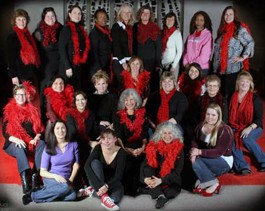
DOING IT FOR THEMSELVES: Commmunity members, including our own Mercedes Murolo  (seated, second row, second from left), take on the ‘Monologues.’

On one wall, there is a vibrant orange painting about healing and a tranquil black-and-white photograph of a female’s torso in water. On another, there are photos of dancing flowers and sketches of belly dancers and babies in wombs. The walls of Viva Cocolat are covered in colorful imagery of women, and Trisha Almond, the producer and organizer of V-Day Petaluma, sits at one of the tables, drinking coffee and proudly wearing a silver vagina necklace and earrings. She explains the V in V-Day as having several meanings, saying, “The V revolves around Valentine’s Day. Victory over violence—to end violence against women is another. And then vaginas. Ultimately, that is the source of life. We need to honor that source of life.”

Almond and her husband first saw the Vagina Monologues 10 years ago in San Francisco, and thought it was just a small play making its way around the country. “I didn’t know there was a whole movement behind it,” she says. Years later, she saw it again in Petaluma and decided she wanted to produce it herself. Almond had no previous producing experience except for putting on events for her Girl Scout Troop, so her dream started small. But after doing some research and going to a “Vagina Warriors” workshop in L.A. with Vagina Monologues playwright Eve Ensler, she decided to take Ensler’s advice to “think big” and put on V-Day in Petaluma.

V-Day, which takes place March 13–14, is a worldwide event that raises funds and brings awareness to ending violence against women with benefit productions of Ensler’s Vagina Monologues. Ninety percent of the funds go to the local community and toward efforts to end domestic violence against women. The other 10 percent goes to a group featured for that year.

This year’s V-Day focuses on women in the Congo. Soldiers in the Congo routinely rape women and young girls, not only to destroy their bodies, but to wreck their souls and culture; this act shames the whole community. The Congolese war is over such resources as the minerals in our cell phones, which Almond says “is like gold over there. You don’t think about it. Who would have ever thought that something in our cell phone is coming from there?”

Worldwide V-Day funds go to the Congo and toward a facility Ensler wants to build for women there. Her Vagina Monologues is made up of various first-person stories that focus on women and the difficult issues and tragedies many face. The show starts out with silly questions such as “If you could dress up your vagina, what would it wear?” and “If it could speak, what would it say?,” but switches to deeper questions as the performance progresses.

Almond explains that one monologue, “Burka,” was recently performed as a teaser at Pelican Art Gallery. “We had one actress reading the monologue and another actress was actually in the burka, so all you could see were her eyes,” Almond says. “The monologue was about imagining what it’s like being under here.”

Another short called “Baptized” is about an eight-year-old girl Ensler had met while in the Congo, who had internal holes torn in her body because of rape. “She had no control over urination,” Almond explains. “There are many women and young girls who are like that over there, and there’s not enough skin to repair the damage. They have to wait until they are more mature and have grown enough skin. In the meantime, no one wants to be around them,” Almond says grimly. “They’re lucky if their families want to be around them, so they’re not used to being touched.”

Ensler grew fond of this one girl, and on a return visit brought her a dress as a birthday present. Ensler wanted to hold the girl on her lap, but the girl tried to squirm away because she was afraid that she would lose control of her bladder. “Eve said that’s OK. The girl ultimately did pee on her, and Eve said she was now baptized,” Almond says.

Almond is quick to point out that the Congo isn’t the only place where women face violence, and that it’s just as important to focus on women who are being hurt in our own communities. “It’s not a matter of looking at it, like, ‘Well they’re in a worse situation than we are’—no, it all just needs to stop, the violence just needs to stop,” she says emotionally.

As a mother, Almond also finds it important for young girls to have an awareness of domestic abuse. “That boyfriend you’re dating right now who’s being verbally abusive is not just having a bad day,” Almond emphasizes. “That’s wrong, and you need to stand up to it and walk away from it, because if you stay in that situation, you’re allowing that to happen, you’re becoming co-dependent, and then it could escalate into physical violence. It’s emotional, it’s spiritual breakdown, and it’s wrong. It’s absolutely wrong. And it’s really no different than what’s going on in the Congo. It’s just a different extreme.”

The art showcased in Viva Cocolat shows that there are inspired people, young and old, who are aware of the violence women can face. Their pieces are meant to promote positive themes of rebirth, love and beauty. The youngest contributor is a 13-year-old boy and the oldest is 86-year-old sculptress Mary McChesney.


The event is “not about male bashing,” Almond says. There have been men who have misunderstood the message of V-Day, but the event is about celebrating women, not putting down men. She proudly mentions that her husband wears his own vagina jewelry, but on a manly black cord, despite odd looks at work. “We were a matriarchal society, way back when, and now it’s gone patriarchal. We need to bring back some balance,” Almond states. “We need to honor Mother Nature, because we’re destroying Mother Nature. By destroying women, you’re doing the same thing.”

V-Day Petaluma runs Friday–Saturday, March 13–14 at the Petaluma Community Center. Petaluma Mayor Pam Torliatt speaks on Friday; Congresswoman Lynn Woolsey, on Saturday. Both days include a performance of the ‘Vagina Monologues,’ a silent auction, community altar, belly dancers, musicians and tables with information on domestic-violence services. 320 N. McDowell Blvd., Petaluma. From 6:30pm. $15–$25. www.vdaypetaluma.org.


Museums and gallery notes.

Reviews of new book releases.

Reviews and previews of new plays, operas and symphony performances.

Reviews and previews of new dance performances and events.

Back To Basics: Stockholm Syndrome makes music in chicken coops

0

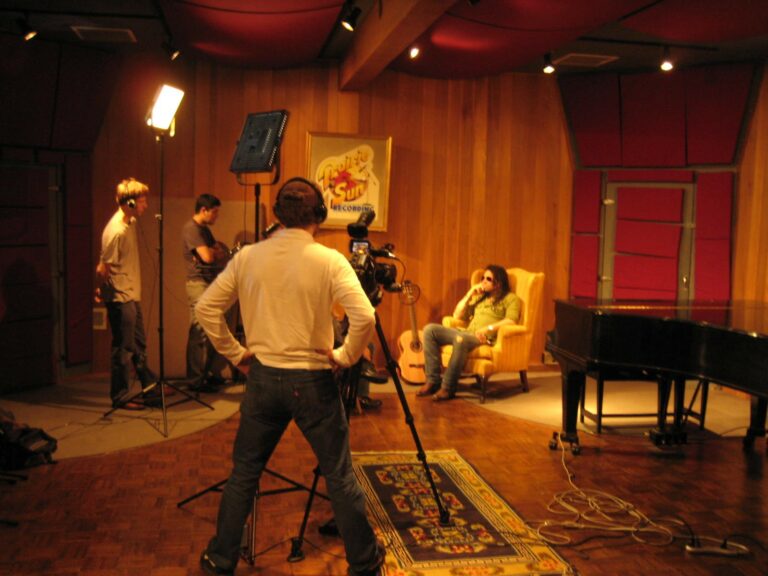
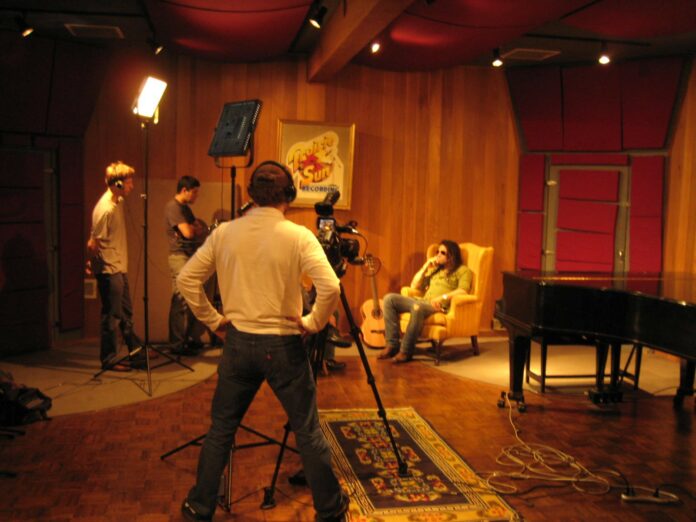
By Lindsay PyleIt’s all about vibe. It resonates through the refurbished chicken coops. All the band members smile. All the band members groove to it. They comment on the vibes in the air today. Even Mooka says he feels them. “It’s a good day to make music,” he says, smiling. The sun comes and goes, punctuated with rain clouds and light showers. It is day 12 of 15 for Stockholm Syndrome at Prairie Sun Recording, and the band is getting anxious to finish.

Getting them all together in one room seems impossible, and it’s no surprise they’re wandering like zombies. They’ve all been crashing on couches, either at the guest homes on the Prairie Sun grounds, or at friends’ and families’ houses. From their aimless chatter, too, it seems like the more successful recording sessions happen in the wee hours of the night, making this 1pm session feel like an early morning wake-up call. They are in the process of going back to songs they’ve already recorded and fixing the small glitches. Dave and Danny talk about the keyboard in one track. It’s all clav and organ, dovetails and Wurlitzers. It is a foreign language. They tap their feet to the beat and listen for the slightest falter in tone. Terry, the editor, goes back to fix each note on a computer screen displaying a series of patterns that resemble fish bones. He’ll highlight a small section, cut it out, and stretch the last note over the space until the glitch is inaudible. Danny, who is working on his keyboard notes, asks Terry to repeat a couple of seconds, fix the glitch, then moves on. He goes back into the studio to re-record a small piece then reemerges. While it’s clear that this part of recording is the least fun, this is what moves jamming closer to a finished product.

Into the Wild

03.11.09Sam Shepard plays are a little like electric fences; by their very reputation they keep some people at arm's distance, while luring in those with a taste for electrifying entertainment. In Double E Productions' engagingly intense, darkly hilarious new staging of True West (an encore presentation of the production they mounted last June at Spreckels Performing Arts Center), actor-producers...

To Monsieur, with Love

03.11.09 In taking the pressure-cooker atmosphere of a high school classroom and making it absolutely compelling, Laurent Cantet's The Class shows the excitement of doing a desperately important job. According to the journalist Sanche de Gramont (aka Ted Morgan), there was a time when a French education minister could look at the clock and instantly tell what subject...

Hunt for Red Oktober

03.11.09One day, a curious wine was found on the shelves of Trader Joe's. In candid reference to its contents, the label featured a bunch of grapes sketched with a dated pastel palette, declaring simply that it was a 2005 Rheingau Pinot Noir, with the cryptic designation "Edition Maximilian." The pale ruby contents of that humble bottle provide a tinted...

Earth’s Lovers

03.11.09Literature is necessary to politics above all when it gives voice to whatever is without a voice, when it gives a name to what as yet has no name, especially to what the language of politics excludes or attempts to exclude. . . . Simply because of the solitary individualism of his work, the writer may happen to explore...

Digital Dilemma

03.11.09 TOUGH GUYS DON'T… Should Norman Mailer's email inbox be preserved for the public record? Last December, a story emerged of difficulties in transferring all of the Bush White House electronic mail messages and documents to the National Archives. Government officials, historians and lawyers pointed to a variety of conflicting reasons why the transfer of information did not run smoothly.An estimated...

Magic Realist

03.11.09 BIDDEN: Joaquin Lopez is a servant to the force. Although I'm not a particularly New Age-y guy, I've twice fallen under the spell of Sebastopol's shamanistic poet Joaquin Lopez. With his small group, PanGaia Arts Ensemble, which includes Sonoma-based musician René Jenkins, and at times Lopez's dancer wife, Amie, Joaquin has been inspiring audiences around Sonoma County for some...

Monopoly Money

03.11.09Ticketmaster has been the bogeyman of the concert world for as long as I've been alive. And for the last four years, concert promotion giant Live Nation has lurked next to it under the bed. So it was with a trembling grip on the sheets that I learned that the two mega-companies now intend to merge into a single...

The New Fraternals

03.11.09 FRIENDSHIP, LOVE, TRUTH: Josh Howard and Neils Espenship represent the new era of brotherhood. Out on the front porch, there's a low, demonic rumbling of black metal music emanating from inside the house. Neil Espenship, who has worked for 14 years as a body piercer, jamming jewelry through every imaginable loin and groin in Santa Rosa, answers the door covered...

Victory Over Violence

03.11.09 DOING IT FOR THEMSELVES: Commmunity members, including our own Mercedes Murolo  (seated, second row, second from left), take on the 'Monologues.' On one wall, there is a vibrant orange painting about healing and a tranquil black-and-white photograph of a female's torso in water. On another, there are photos of dancing flowers and sketches of belly dancers and babies in wombs....

Back To Basics: Stockholm Syndrome makes music in chicken coops

By Lindsay PyleIt’s all about vibe. It resonates through the refurbished chicken coops. All the band members smile. All the band members groove to it. They comment on the vibes in the air today. Even Mooka says he feels them. “It’s a good day to make music,” he says, smiling. The sun comes and goes, punctuated with rain clouds...
11,084FansLike
4,446FollowersFollow
6,928FollowersFollow