Look Who’s Coming

Spring is anon, meaning festival announcements and venue bookings are being shot down the pipe faster than the flowers can bloom. In a quick overview, there’s Classics of Love (with Operation Ivy’s Jesse Michaels) at the Last Record Store (Mar. 28); bass-heavy knob twiddlers Crystal Method at the Phoenix Theater (Apr. 15); walking freak-folk embodiment Devendra Banhart at the Mystic Theatre (Apr. 17); fado sensation Mariza at the Napa Valley Opera House (Apr. 30); electronic visionary Bassnectar at the Hopmonk Tavern (May 4); soprano legend Kathleen Battle at the Marin Center (May 9); and Lucinda’s right-hand man Gurf Morlix at Studio E (May 16).
What’s that, you say? You like to watch TV more than you like to listen to music? Fear not! The Wells Fargo Center has the interminably funny Joel McHale, he of dryly absurd wisecracking on The Soup (Apr. 11); and hang on to your thong straps—the Sonoma-Marin Fair in Petaluma has glam-metal washup-turned-reality show “star” Bret Michaels (June 27) to attract a slutsational crowd good for copious dead-drunk bikini-clad hoochie watching beneath the ferris wheel. Look what the cat dragged in, indeed!
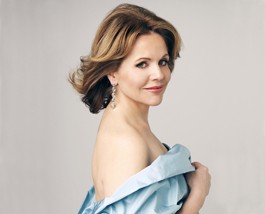
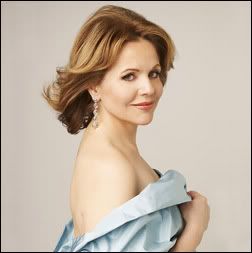
Sounding a different note entirely, Napa’s beautiful Festival del Sole steps forward this year with young violin sensation Sarah Chang (Jul. 18-19) and the return booking of Renée Fleming (pictured above, Jul. 23), who in the festival’s first year was forced to cancel her performance of Richard Strauss’ Four Last Songs due to illness. Iran’s most famous composer, Anoushirvan Rohani, will appear for a dinner and concert (Jul. 20), and the dashing Robert Redford—be still our throbbing hearts!—benefits his Sundance Preserve by narrating a piece to be announced (Carnival of the Animals? Peter and the Wolf? An interpretive tone poem of The Horse Whisperer?) at Castello di Amarosa (Jul. 21). Full lineup here.
In economic-crisis news, the Russian River Jazz Festival and the Russian River Blues Festival this year will be combined into one solitary September weekend as the Russian River Jazz & Blues Festival preserves a 30+ year tradition of great music on Johnson’s Beach in Guerneville. “This allows us to keep the Russian River festival tradition alive,” says Omega Events president Rich Sherman, “while enabling music fans to still enjoy their love of jazz and blues outdoors in this picturesque setting.” Saturday’s jazz lineup and Sunday’s blues lineup (Sept. 12-13) will be announced in April. Check here for updates.
After the Masada show at Yoshi’s, I overheard a guy talking to bassist extraordinaire Greg Cohen, who along with accompanying Ornette Coleman as of late was part of the great New York band on Rain Dogs, Frank’s Wild Years and Swordfishtrombones. “Hey, guess who I played with the other week?” the guy asked. “Waits. Went up to his place and rehearsed.”
“Oh?” asked Cohen. “New material?”
It seems so. In addition to finally releasing Orphans on vinyl soon, Tom Waits’ publicist confirms that he is writing, rehearsing, mangling, fixing and re-mangling new material for an album to be released in the sometime-maybe-this-year-who-knows future. Recording is anticipated sometime this summer. Waits, of course, was last seen snapping photos of the brimming crowd that gathered en masse at his daughter Kellesimone’s art show in Santa Rosa.
Despite a mission statement promising to “present and preserve jazz,” it’s probably time to just roll over and accept that the Sonoma Jazz+ Festival’s gonna book whoever they’re gonna book. We could say, you know, Lyle Lovett has some sax players in his band. Joe Cocker, you know, he might play some solos. And hey, they added that tiny little “+” to their name to represent past headliners like Steve Winwood, Boz Scaggs, Steve Miller, LeAnn Rimes, Michael McDonald, Bonnie Raitt and Kool & the Gang. Who are we to be snobs?
But look, since no other media outlet in the area seems brave enough to protect this American art form—and since local jazz programmers don’t want to be quoted saying “You mean that bullshit thing they call a jazz festival?” (actual quote)—it’s up to us. There are plainly no jazz artists headlining Sonoma Jazz+ 2009 this year. Around here, we’d even be cool if, like, Rick Braun was playing. But Chris Isaak?
Sonoma Jazz+ does many great things, not the least of which is providing support to music programs in area schools. They also have a second stage, and ‘Wine and Song in the Plaza’ with small combos. But in light of the PR assertion that they’ve already booked any jazz headliner who could fill a 3,800-seat tent, our suggestion is to honor jazz and please just call the festival what it actually is: the Sonoma Music and Wine Festival. Joe Cocker, Lyle Lovett and his Large Band, Ziggy Marley, Big Bad Voodoo Daddy, Shelby Lynne and Keb’ Mo’ come to Sonoma May 21-24. Tickets are on sale here.
Simultaneous with the creative definitions emanating from Sonoma is the encouraging news from the Healdsburg Jazz Festival announcing its initial lineup, and it looks great. John Handy, Randy Weston, Airto Moreira, Esperanza Spaulding, Dee Dee Bridgewater, Denny Zeitlin and Julian Lage head up a list-in-progress of bona fide jazz headliners appearing May 29-June 7 this year. For updates, check here.
Hey man, the Harmony Festival is full of good vibes this year! Michael Franti, India Arie, Matisyahu, Cake, Steve Kimock, ALO, Balkan Beat Box, and Sierra Leone’s Refugee All Stars head up the festival June 12-14 at the Fairgrounds. Barring any John Mclaughlin-esque guitar freakouts by Kimock, the weekend should be bereft of maniacal discord. Be harmonious.
The Santa Rosa Symphony announced its rough sketch for the 2009-2010 season today, including a finale performance by Ute Lemper singing Kurt Weill’s Seven Deadly Sins! Also on the slate: returning conductor emeritus Jeffrey Kahane playing Rachmaninoff’s Piano Concerto No. 3 (the one from Shine), performances of Beethoven’s 4th, 5th and 9th symphonies, Mozart’s Requiem, a program celebrating Chopin’s 200th birthday, the Red Violin concerto, and more. I always love the symphony’s Magnum Opus commissions, and Bahzad Ranjbaran’s new work will receive its world premiere next season as well.
On a semi-related note, I listened to Elliott Carter last night—an LP I found years ago, bought for the cover art and loved for the music. It’s his Sonata for Cello and Piano, and I still love it. Unbelievable that he’s 100 years old and still completely lucid about his work. I love the excerpt from this interview, which succinctly captures not only his sense of humor but the reason why I give such a damn about music:
Q: Could you imagine a day when people, concertgoers, would hear your music and walk out humming your music?
A: Well… it’d be hard on their throats!
Q: What would you want the listener to walk away with after hearing your music?
A: Happiness. And pleasure. One of the fundamental things always that music should do is not only give pleasure, but widen one’s horizons, and give new kinds of fantasies, and new kinds of pleasure, and new kinds of surprises, and new kinds of connections between things.

Live Review: John Zorn – Electric Masada at Yoshi’s

1

Behold the great and glorious wonder of music and its neverending mindbend. Behold works of greatness trailblazing and incomprehensible. Behold Electric Masada last night at Yoshi’s.
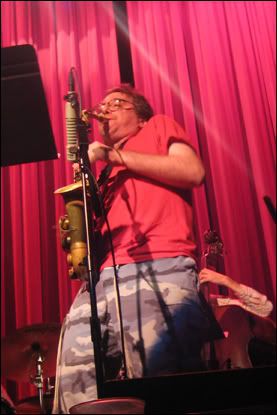
Last night, Zorn ended his five-day residency at Yoshi’s with an explosive band that made everyone in the San Francisco audience feel giddy and made his famous hardcore-jazz albums Naked City and Torture Garden seem like mere novelties in comparison. Electric Masada, an 8-piece grouping of John Zorn, Jamie Saft, Trevor Dunn, Kenny Wollensen, Joey Baron, Cyro Baptista, Ikue Mori and Marc Ribot is not something that can be easily described in words.
Here’s some: Celestial roadkill. Controlled chaos. Blatant intensity. Eruptive slaughter. Unbridled jubilation.
The hyper-prolific Zorn, aged 55 with no trace of mellowing out, spent the evening with his back to the crowd, “playing” the seven other musicians like instruments with a series of complex hand signals. He’d point to Saft to play a solo, then wiggle his outstretched fingers to Baron, who’d rattle on the cymbals; he’d pull his hands apart and chop the air, whereupon the band would fall on a series of whole notes; he’d shake his finger up and down for Ribot to trill two notes, swing his arms up to increase Wollensen’s volume or point rapidly to individual members in succession to create a stereo ping-pong effect before pointing at his head to take everyone back to the top.
It was an full-body galvanizing experience, somewhere between Alan Silva’s Seasons, Black Sabbath’s Masters of Reality and Andy Statman’s Jewish Klezmer Music. On Thursday, while watching the Masada Quartet, the crowd was enveloped inside Zorn’s music, trying to place its brain inside of his and meditating on how it might be mentally constructed. Last night there was no choice but to sit in the chair and let the waves of sound rush by.
Electric Masada is the great and ferocious culmination of jazz’s goal toward spontaneous composition in action. During the third song, Ribot took a solo, in fits and starts. After nothing really gelled he gazed up at Zorn with a look that said, “Well, I’m done.” Zorn ignored him, and kept working the rest of the band, pulling his hand at Ribot for him to keep going.
There’s a certain frustrated freedom that comes with doing something you’ve indicated that you don’t want to do, and it was with such freedom that Ribot’s solo immediately transformed from a standard-issue blues-rock housing to the totally unique Marc Ribot that Zorn well knows looms right under the surface.
Suddenly wailing, Ribot held it down while Zorn motioned around the room for certain sections to fall apart, to go half-time, to stop entirely for a few seconds. Each twist brought out even more invention and snake-like tenacity in Ribot, and soon he didn’t want to stop. Zorn bit his reed, leaned into the mic and growled his approval.
Baptista swung a plastic tube over his head. Zorn and Mori traded high-pitched saxophone and laptop tweets. Wollensen and Baron thundered in and out of time on two drum kits. Saft and Dunn held down what shards of groove were left on a vintage keyboard and bass. And then, Zorn banging his hand against Ribot’s shoulder, he swirled his palm around and brought the whole thing to a forceful, sudden, distorted end.
No one in the standing ovation that followed is likely to ever forget it.

Live Review: John Zorn’s Masada at Yoshi’s

0

How in the hell to describe the show I saw last night?
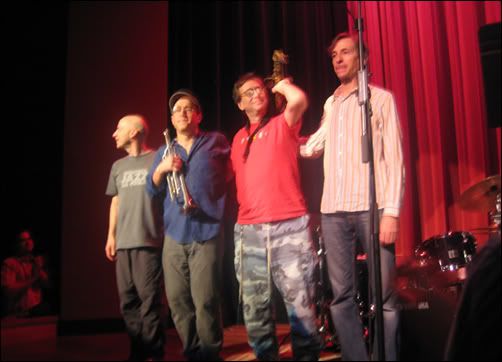
I could start by explaining that John Zorn plays “radical Jewish culture” jazz, though no socio-psychological theory applies. Not, at least, on the surface. What John Zorn has done with his Masada quartet is to essentially cohere the souls of four musicians and thrust them up as one giant, overwhelming force.
Intellectualizing it is about as useless as humping a flagpole.
John Zorn is not a very imposing man, nor a particularly recognizable one. A friend at Amoeba tells the story of his being denied a sale for not having ID to go along with his credit card (another employee recognized him, and intervened). He arrived on stage last night in camouflage pants, a red T-shirt, a black sweatshirt and tassels. He barely spoke to the crowd, other than to introduce the band, and to field a shouted “Thank you!” by shouting back “No, thank you! The worst part is, we’re not getting paid to do this. We’re getting paid to travel.”
Indeed, the $50 ticket price went largely toward the cost of flying 21 different musicians and instruments from the East Coast who are taking part in Zorn’s historic five-day residency here at Yoshi’s. Every night features a different band, with a different concept and approach. $50 might seem steep to some, unless one considers the rarity of his Bay Area performances. (Masada last played in Oakland ten years ago.) Here’s my advice. Beg, borrow or steal. Raise the $50. Go see John Zorn at Yoshi’s.
Yes, it sounds like a spiel from one of Zorn’s many diehard followers, who are glossy-eyed in their reverence for the man to the point of extreme narrow-mindedness. We’ve all known people who preach the gospel of Zorn, listen only to Zorn, and eschew other musics as lacking sufficient Zorniness. Do you want to join Heaven’s Gate, they ask? Zorn, Zorn, Zorn, they chant.
But the truth is that to see Masada last night was to be baptized in the blood. The opening: a slow, simple melody. A little flourish here and there, basic all around. It grew, slowly. The control and restraint, the fluid incremental rise into exhortation, the climbing atop of each other until the song’s peak with everything before it laid visible and small. Gliding, and out, and holy shit.
The songs, fine and modal as they are, didn’t matter; it’s what this band did with them. We caught the 10pm set, which featured compositions from Book II of the Masada songbook—songs that the group is not nearly as familiar with as Book I. Rather than an obstacle, this was a blessing of innocence and discovery.
Joey Baron smiles widely while playing incredibly, and his solos were among the most lyrical drum solos ever. Greg Cohen’s interplay with Baron couldn’t have been more prescient, as he’d anticipate where Baron’s playing stopped to slide into his own incisive solos. Dave Douglas and Zorn were just as in step with each other, listening for the slightest fluctuation to capitalize upon in each other’s eruptive bursts, with Douglas at times running around the stage.
And Zorn. Does he have an endless reservoir of tone? Does he carry the history of every saxophone player before him and take that history to new places of imagination? Does he play with his mouthpiece upside down? He bogglingly unleashed his circular breathing, rabidly dancing lines and his trademark growl throughout the hour-and-a-half with just a tiny sampling from his hundreds of compositions. Is he a genius, or merely possessed?
On the way out, we bought tickets for Sunday. Euphoria carried me home.

Billy Corgan, the Performance Rights Act, and Radio Stations

1

Billy Corgan made a less-than compelling case yesterday before Congress in support of the Performance Rights Act, which would force radio stations to pay royalties not only to the songwriters of the songs they play but to the performers on those songs as well. It’s a nice thought and all, especially considering stories such as Standing in the Shadows of Motown, but not a very nice thought when considering Billy Corgan, who is a multimillionaire.
Though I myself am a music performer who has been played on the radio, I’m against the Performance Rights Act and I’ll tell you why. It should have been enacted 60 years ago, when the “hit single” came into being and when radio had the prominence to absorb such payments. Corgan states the laws on radio compensation haven’t changed for 80 years. That’s the very reason radio can’t bear the undue burden.
The business model of radio stations has evolved around the long-held and reasonable idea that it’s the record labels’ responsibility to compensate their performers. Radio advertises the record, the public buys it, and the artist gets whatever deal the artist signed with the label for.
If the artist signs a shitty deal (all major label deals are shitty deals), or if the label is stiffing the artist, or—this one’s good—if the digital age comes along and destroys music sales, why go after analog radio? Simple: because people like Corgan can. Because it’s there. He can’t demand money from “sdream75,” an anonymous user who can’t stop uploading torrents of Siamese Dream, but he can go after radio stations, who are one of the few institutions left in the music business doing the relatively right and honorable thing.
The Performance Rights Act would misdirect understandable frustration with the self-cannibalization of the music industry at large toward a valuable—and similarly struggling—friend of the performer. It would absolutely kill small local stations like the KRSH. What we’d be left with is ClearChannel stations with corporate-issued playlists, prerecorded shows streaming from a computer, and DJs who may as well be programmed robots.
Incidentally, Corgan also spoke out a few weeks ago in support of the Ticketmaster / Live Nation merger (he’s managed by Ticketmaster CEO Irving Azoff), which officially makes him a mouthpiece of the devil.

Limitless Grasp

03.11.09

Recently, the United States launched a carbon observatory that fell from the sky, an ice-burned Icarus plunging into the seas of the South Pole. There were no lives lost, but as a lost effort it is worth at least the compassion we would offer that wax-winged Greek whose fatal mistake was flying too close to the sun. Our NASA satellite, rather, flew too close to the earth. Unable to shed its heavy jacket in order to attain orbit after launch, it sank to failure and freezing waters surrounding a poetically apt location for such a fall.

Want a proper sea burial for a major scientific loss? Antarctica is the place, site of the world’s first arms treaty and the only continent where military activity is banned and well-bundled scientists from any country are free to conduct research in peace.

It was certainly not peaceful science that first launched NASA. Our government threw money at space exploration during the Cold War because the Russians launched Sputnik, threatening our sense of superiority. We had to one-up them, and so we did. In 1969 for about $20 billion, we chanted the ultimate “neener-neener” by being the first and ultimately only country to reach the moon. I was a child in awe that summer day, watching on a black-and-white Zenith television. The screens were smaller and reception blurrier then, and my whole family crowded close to the vague and jerky movements of a moon-suited Neil Armstrong, stepping out of his spaceship with a well-rehearsed line, “One small step for man, one giant leap for mankind.”

Was it? The landing was an incredible sight, like the fantasy rides at Disneyland. But the thrill didn’t last. The next day it was back to reality—body counts from Vietnam, and protests against war, poverty and racism down here under the moon.

A mere 40 years later, NASA is making one giant leap I can respect. For under $275 million, it attempted Feb. 24 to launch the Orbiting Carbon Observatory, a device designed to measure carbon output and intake. The collected data were intended for building climate models. Japan got a satellite into orbit in January, which will also collect CO2 data in a manner different than how NASA’s satellite was designed to collect it. But having both sets of data would have been more valuable. NASA scientists spent eight years building their satellite, and its loss is a setback to climate-change missions that would benefit all countries of the world.


I am sad that our new satellite is sunken instead of orbiting the earth. But even under the seas of Antarctica, that piece of space technology means more to me than Armstrong’s dramatic landing ever did, because it shows how far we have come and tells a very different story about this country’s space-science efforts. In contrast to four decades ago, we seem no longer the maverick space hero in the moon suit conquering a sphere of rocks in a costly show of one-upmanship. I observe now that we contribute as space-science colleagues working with other nations on projects that serve an urgent planetary survival goal.

Now space science is no longer the servant of political whim. Instead, it is, well, universal. On the Jet Propulsion Laboratory blog site, one engineer described his sense of loss at the recent failure. “Knowing that the hardware I helped design and build had been destroyed on impact made the loss real,” Randy Pollack wrote. “I had this vision of the system orbiting the Earth—dead and mute—like a modern-day Flying Dutchman.”

Pollack’s loss is our loss. I hope they build another and launch again. Meanwhile, I’m grateful for NASA’s attempts to forward climate study. The race for the moon was an act of nationalism; the race against time to measure carbon is an effort binding all nations. No single country can triumph against global warming; in the effort to sustain life on earth, we all win and lose together.


War and Peace

0

03.11.09

For those of us who’ve found ourselves working in theater,” playwright Julie Marie Myatt says, “theater is how we try to make a difference in the world. It’s how we engage the issues that confront us in our lives, and if we do our job right, we take those issues and present them to society in a way that allows people to engage those questions in new ways. That was certainly my goal with Jenny Sutter.”

Next weekend, Sebastopol’s Sonoma County Repertory Theater presents the California premiere of Myatt’s powerful drama Welcome Home, Jenny Sutter, first performed last year as part of Ashland’s Oregon Shakespeare Festival. After a five-month run in Oregon, the play, with its original cast intact, moved to Washington, D.C., for a limited run at the Kennedy Center. About a wounded Iraq solider and mother of two who fears returning home to her children after losing her leg in battle, Jenny Sutter has incited significant dialogue among its audiences, many of whom are veterans.

Myatt, who lives in Los Feliz, Calif., is an award-winning writer with a string of plays tackling hard subjects, from homelessness (My Wandering Boy) to the Cambodian sex trade (Boats on a River) to the battle over abortion rights (Someday). Her work has been staged at some of America’s most esteemed theaters, including Minneapolis’ Guthrie Theater, Costa Mesa’s South Coast Repertory, L.A.’s Cornerstone Theatre Company and the Humana Festival in Kentucky. Her vision is at once intimate in focus and grand in scope, evidenced by Jenny Sutter’s primary setting in Slab City, a real-life transient “city” formed at a decommissioned military base near the Salton Sea.

Within the Wild West, tent-and-camper culture of Slab City, Jenny Sutter, freshly discharged from the military, finds herself clashing and connecting with the local misfits and dropouts as she confronts her own darkest demons, desperately grasping for the courage and sanity to finally make her way home again. Just after the play’s premiere in Oregon, I interviewed Myatt over breakfast, where the author was clearly energized by the initial responses to the piece.

“My dad was a Marine,” she says, sipping a cup of coffee. “He served two tours in Vietnam, so I grew up in a military atmosphere—and I grew up not talking about the war. Life goes on, that was the official family position on war. After Vietnam, my dad stayed in the military. He retired a two star general. So the military has always been a big part of my life, though I haven’t written about it until now.”

“What took you so long?” I ask.

“I don’t know,” she laughs. “To tell the truth, when I started writing this play, I hadn’t even thought about it as being about the military. I just thought I was writing from the perspective of someone who is, personally, very much against this stupid, never-ending war in Iraq. As someone who grew up with respect for the people who serve in the military, I feel like the troops are the real victims here. I think this war is different from Vietnam, because there was a draft then, and everyone in the country had family members, brothers and cousins and fathers and boyfriends that were going. The effects of the war were taking place in all of our homes. So in some ways it’s easier to feel distant from this war now because, unless you happen to know someone who’s over there, it’s just this thing that’s happening that we have no control over.”

“As you wrote the play,” I ask, “did you find yourself wrestling with how much of your own politics to put into the script?”

“I feel like my wrestling is the play,” she says. “The image of a wounded veteran is, all on its own, a highly political statement. It begs the question, ‘Is this war worth it?’ That’s why I wrote the opening scene the way I did, with Jenny waking up the last day of her military service, and getting dressed around her missing leg. I feel like the audience sitting there watching Jenny change clothes is an important moment. It’s saying, ‘Here. Take a look. This is what war is.'”

“How has writing this play changed your view of the world,” I ask. “And has it changed your view of war?”

“Well,” Myatt laughs, “I’ve suddenly become very interested in war, more than ever before. I think about war a lot—what it says about a country, what it does to the people who have to live with the effects of war on a daily basis. For most of us, we can’t fathom it; we’ve not experienced that kind of trauma. We have had trauma in other ways in our life, but you know, seeing someone blown up in front of you is a whole different problem.”

“The setting of Slab City is such an interesting location,” I say. “I assume you’ve been there?”

“Absolutely,” she says. “It’s a really fascinating place, this whole transient culture that has been built up out there. There are a lot of veterans out there, by the way. If I wanted to, I could write plays about the people of Slab City forever. I’m really attracted to that, the idea of people living on the fringes.”

“And it’s there on the fringes that Jenny finds what she needs to begin her healing,” I point out. “What are you saying with that?”

“In a way, all of these characters she meets are stuck in their own grief, they are all really stuck,” she says. “My point is that all of these people, they are just as damaged as Jenny Sutter, but they still all want to help her, they’re all trying to tell her, ‘Look, go home. Just, go home.’ Because she can go home. She has a home. They don’t have anywhere to go.”

The ending of the play leaves questions hanging, questions about what Jenny will do next. Nothing is neatly wrapped up, and Myatt says that was a very definite decision on her part, to end the play with uncertainty.


“I think that’s where we are as a country,” she says. “The process of dealing with all of this aftermath has only just begun. For me, the greatest tragedy is that these people, these young Americans, are sent off to do this very hard thing, and then they are brought home and just dumped back into their old lives as if nothing has happened. A lot of them feel that no one cares—and I think that that in most cases, they are right. Or maybe we care, but we just don’t know what to do with that caring. We don’t know how to start the conversation, we don’t know ho to ask these people what they need.

“For me that’s what this play is about,” Myatt concludes. “What do we do now? Should we just bake a cake and say welcome home, fill-in-the-blank, or is there something more we can do?”

‘Welcome Back, Jenny Sutter’ runs March 20&–April 19 at the Sonoma County Repertory Theater. $18&–$23; Thursday is pay what you can and veterans get in free. 104 N. Main St., Sebastopol. 707.823.0177.


Museums and gallery notes.

Reviews of new book releases.

Reviews and previews of new plays, operas and symphony performances.

Reviews and previews of new dance performances and events.

Let the Sun Shine In

0

03.11.09

Six days after taking office, President Obama issued a memorandum titled “Transparency and Open Government.” Just over a page in length, this document—made unusual by eight years of Bush administration obfuscation—lays out his goal for an administration openly beholden to its people. “Government Should Be Transparent” stipulates the first point. “Government Should Be Participatory,” deems the second. “Government Should Be Collaborative,” declares the third, the president vowing to direct his Chief Technology Officer to work with the Office of Management and Budget to create an Open Government Directive that will allow citizens to better know what their national officials and tax monies are doing on any given day on any given subject.

Of, by and for the people may be our groundwork, but government has not been much of an open secret in the centuries since those words were penned. The fluidity of documents and digitizing of communications should, and now actually will, change all of that if the Obama administration prevails.

But what about local government? How much do we know of the workings of our police and sheriff departments, our public works and mayoral offices, the county clerks and tax departments? Lyndon Johnson’s 1966 Freedom of Information Act (supplemented by Bill Clinton in 1996 to include electronic data) guarantees the rights of citizens to request and review public documents, but have you ever tried to get paperwork that a bureaucrat doesn’t want you to have? Indeed. While the burden is on the department being requested of, not the entity doing the requesting, it has been fallback in the last decade for bureaucrats to initially say no to record requests, causing the requester to state a use for them.

Begun in 2002, National Sunshine Week—this year slated March 15–21—seeks to alert citizens to our right to know what our government does, not only with our money but with our laws and paperwork, in their meetings and discussions. How easy it is to obtain records of nursing home or hospital inspections, bridge safety records, teacher certifications, bids on state projects? We’ll be collecting your stories as you try to make your way through the ordinary government maze, as well as sending our sweet, wide-eyed interns out into dusty government halls to try to pull a few docs of their own. Send word to us at bl***@******an.com and look for our results after March 21.


Look Who’s Coming

0

03.11.09

Spring is anon, meaning festival announcements and venue bookings are being shot down the pipe faster than the flowers can bloom. In a quick overview, there’s Classics of Love (with Operation Ivy’s Jesse Michaels) at the Last Record Store (March 28); bass-heavy knob twiddlers Crystal Method at the Phoenix Theater (April 15); walking freak-folk embodiment Devendra Banhart at the Mystic Theatre (April 17); fado sensation Mariza at the Napa Valley Opera House (April 30); electronic visionary Bassnectar at the Hopmonk Tavern (May 4); soprano legend Kathleen Battle at the Marin Center (May 9); and Lucinda’s right-hand man Gurf Morlix at Studio E (May 16).

What’s that, you say? You like to watch TV more than you like to listen to music? Fear not! The Wells Fargo Center has the interminably funny Joel McHale, he of drily absurd wisecracking on The Soup (April 11). And hang on to your thong straps—the Sonoma-Marin Fair in Petaluma has glam-metal-washup-turned-reality-show-“star” Bret Michaels (June 27) to attract a slutsational crowd good for copious dead-drunk, bikini-clad hoochie watching beneath the Ferris wheel. Look what the cat dragged in, indeed!

Sounding a different note entirely, Napa’s beautiful Festival del Sole steps forward this year with young violin sensation Sarah Chang (July 18&–19) and the return booking of Renée Fleming (pictured above, July 23), who in the festival’s first year was forced to cancel her performance of Richard Strauss’ Four Last Songs due to illness. Iran’s most famous composer, Anoushirvan Rohani, will appear for a dinner and concert (July 20), and the dashing Robert Redford—be still our throbbing hearts!—benefits his Sundance Preserve by narrating a piece to be announced (Carnival of the Animals? Peter and the Wolf? An interpretive tone poem of The Horse Whisperer?) at Castello di Amarosa (July 21).

And in economic-crisis news, the Russian River Jazz Festival and the Russian River Blues Festival this year will be combined into one solitary September weekend as the Russian River Jazz & Blues Festival preserves a 30-plus year tradition of great music on Johnson’s Beach in Guerneville. “This allows us to keep the Russian River festival tradition alive,” says Omega Events president Rich Sherman, “while enabling music fans to still enjoy their love of jazz and blues outdoors in this picturesque setting.” Saturday’s jazz lineup and Sunday’s blues lineup (Sept. 12&–13) will be announced in April.


Letters to the Editor

03.11.09

Blowing their own horns

In regards to the “Sonoma Jazz+” festival (Critic’s Choice, “The Bad Plus,” March 4), just a reminder: the Sonoma Valley Jazz Society is alive and cookin’! Twenty years strong, we keep free (did I say free?) world-class jazz alive with our summer series in the Plaza, open to all and supported by donations and a group of dedicated, nonpaid volunteers!

We keep crankin’ it up, and we do appreciate Sonoma Jazz+ and its school donations. But the big picture involves more than donations; it involves being involved in the community—not just the Big Tent (and all the elite inside).

Maybe the Sonoma Jazz+ festival would care to work with us, the locals and the Jazz Society, in bringing jazz acts into the Plaza venues to benefit our local businesses, and offer a chance to enjoy music at affordable prices. Everyone wins, and we’ll book the jazz for free!

The Bohemian awarded our Sonoma Valley Jazz Society a Boho Award for 2008 for the best music society in Sonoma County. Thank you for recognizing our efforts. Pass it along to the Jazz+ folks.

Bonnie Thomas
Public Relations for the Sonoma Valley Jazz Society

Clip ‘n’ Go

Concerning your last piece of advice (“Crepes of Wrath,” March 4), if you’re searching for coupons, the Sunday paper has a rather limited choice. Save the forests and your money by going online for a vastly broader selection of coupons with all manner of goods and services. It’s puzzling why Nelson plugs the Sunday paper when her own website has multiple links to electronic coupons. One of the best ones that comes to mind is MoneyMailer.com, where you just punch in your zip code for local coupons. They’ll even forward your selections to your cell phone so you can avoid printing entirely. No more cutting, saving, clawing through the drawer.

Ron Stinnett
Windsor

Savings Chuckles


This article (“Crepes of Wrath”) was hilarious and helpful at the same time. I loved it. It was filled with truth as well.

Loved it!

Jenna Cregan
Murray, Ky.

Matt Pamatmat Rules

Love the Zappa article (“Keepin’ It Greasy,” March 4). Dweezil! I have read Matt Pamatmat in the past and love his down-to-earth writing. Keep it up!

Keith Nielzine
Santa Rosa

No Whey!

Many years ago, it was revealed that the government had millions of pounds of cheese stored underground to be used in case of an emergency. Unless that cheese has already passed its pulled date, why wouldn’t the current economic/unemployment crisis be the perfect time to distribute that cheese to needy families? On the other hand, be wary, because the cheese may already be earmarked to go to large corporations as part of their bailout.

Neil Davis
Sebastopol 


&–&–>

Mellow Yellow

03.11.09

Color affects mood and emotions. Yellow can bring to mind bright, happy images of sun, early autumn, golden light, spring. Looking out at our fields of mustard is a reminder that spring and constant sunshine are just around the corner—and the Napa Valley Mustard Festival is already here.

Mustard used to be considered a medicinal plant that could be used to cure scorpion stings and toothaches, but also became used as a culinary paste by the early Romans. Mustard lovers have been adding it to their cooking creations ever since; the Mustard Festival celebrates such flavorful dishes. This month’s long midwinter festival reaches its pinnacle with the annual awards, this year titled “A Spicy Soiree!” and slated for Friday, March 13, at Napa’s Black Stallion Winery. This is a fancy wine-sipping affair where world champion mustard makers receive their awards and promises to delight guests with the most creative mustard recipes of the year.

Saturday&–Sunday, March 14&–15, mustard madness hits the Marketplace, a less expensive daytime event for mustard connoisseurs at the Robert Mondavi Winery featuring tastes of mustards from around the world, celebrity chef cooking demonstrations, live broadcasts of Dining Around with Gene Burns, taping of Martha Stewart Living radio shows, a Sunset magazine pavilion, plenty to eat and drink, and live music.

People attracted to the color yellow are said to be of a higher intelligence. Draw whatever conclusion from that you’d like.

A Spicy Soiree! is slated for Friday, March 13, at 7pm. Black Stallion Vineyards, 4089 Silverado Trail, Napa. $100&–$125. 707.253.1400. The Marketplace takes place Saturday&–Sunday, March 14&–15, from 11am to 5pm. Robert Mondavi Winery, 7801 Saint Helena Hwy., Oakville. $35&–$45. 707.259.9463.

Quick dining snapshots by Bohemian staffers.

Winery news and reviews.

Food-related comings and goings, openings and closings, and other essays for those who love the kitchen and what it produces.

Recipes for food that you can actually make.

Look Who’s Coming

Spring is anon, meaning festival announcements and venue bookings are being shot down the pipe faster than the flowers can bloom. In a quick overview, there’s Classics of Love (with Operation Ivy’s Jesse Michaels) at the Last Record Store (Mar. 28); bass-heavy knob twiddlers Crystal Method at the Phoenix Theater (Apr. 15); walking freak-folk embodiment Devendra Banhart at the...

Live Review: John Zorn – Electric Masada at Yoshi’s

Behold the great and glorious wonder of music and its neverending mindbend. Behold works of greatness trailblazing and incomprehensible. Behold Electric Masada last night at Yoshi’s. Last night, Zorn ended his five-day residency at Yoshi’s with an explosive band that made everyone in the San Francisco audience feel giddy and made his famous hardcore-jazz albums Naked City and Torture Garden...

Live Review: John Zorn’s Masada at Yoshi’s

How in the hell to describe the show I saw last night? I could start by explaining that John Zorn plays "radical Jewish culture" jazz, though no socio-psychological theory applies. Not, at least, on the surface. What John Zorn has done with his Masada quartet is to essentially cohere the souls of four musicians and thrust them up as one...

Billy Corgan, the Performance Rights Act, and Radio Stations

Billy Corgan made a less-than compelling case yesterday before Congress in support of the Performance Rights Act, which would force radio stations to pay royalties not only to the songwriters of the songs they play but to the performers on those songs as well. It’s a nice thought and all, especially considering stories such as Standing in the Shadows...

Limitless Grasp

03.11.09Recently, the United States launched a carbon observatory that fell from the sky, an ice-burned Icarus plunging into the seas of the South Pole. There were no lives lost, but as a lost effort it is worth at least the compassion we would offer that wax-winged Greek whose fatal mistake was flying too close to the sun. Our NASA...

War and Peace

03.11.09For those of us who've found ourselves working in theater," playwright Julie Marie Myatt says, "theater is how we try to make a difference in the world. It's how we engage the issues that confront us in our lives, and if we do our job right, we take those issues and present them to society in a way that...

Let the Sun Shine In

03.11.09 Six days after taking office, President Obama issued a memorandum titled "Transparency and Open Government." Just over a page in length, this document—made unusual by eight years of Bush administration obfuscation—lays out his goal for an administration openly beholden to its people. "Government Should Be Transparent" stipulates the first point. "Government Should Be Participatory," deems the second. "Government Should...

Look Who’s Coming

03.11.09Spring is anon, meaning festival announcements and venue bookings are being shot down the pipe faster than the flowers can bloom. In a quick overview, there's Classics of Love (with Operation Ivy's Jesse Michaels) at the Last Record Store (March 28); bass-heavy knob twiddlers Crystal Method at the Phoenix Theater (April 15); walking freak-folk embodiment Devendra Banhart at the...

Letters to the Editor

03.11.09Blowing their own hornsIn regards to the "Sonoma Jazz+" festival (Critic's Choice, "The Bad Plus," March 4), just a reminder: the Sonoma Valley Jazz Society is alive and cookin'! Twenty years strong, we keep free (did I say free?) world-class jazz alive with our summer series in the Plaza, open to all and supported by donations and a group...

Mellow Yellow

03.11.09Color affects mood and emotions. Yellow can bring to mind bright, happy images of sun, early autumn, golden light, spring. Looking out at our fields of mustard is a reminder that spring and constant sunshine are just around the corner—and the Napa Valley Mustard Festival is already here. Mustard used to be considered a medicinal plant that could be...
11,084FansLike
4,446FollowersFollow
6,928FollowersFollow