The Real First Responders

0

03.18.09

STOP IN THE NAME OF LOVE: CERT volunteer Zeke Britton has trained to help the community in case of emergency. Because she can.

Zeke Britton looked on in horror as a man lay face down in a busy street, speeding cars narrowly missing him. She and a few others ran to his assistance. As one of them, an EMT, took charge, Britton quickly assessed the situation. Realizing that an emergency vehicle would not be able to get through the traffic jam that had formed, she began directing traffic.

“I did the best I could without much experience,” Britton says. “I did fine for 20 minutes until I lost direct eye contact with the drivers in the line of traffic when I glanced back at the emergency situation. Then people started going around me the wrong way until a fireman came and took over. That was the moment I decided to take an advanced CERT course in traffic control, because I realized it would be very useful in situations like these.” After a three-hour class and practical experience with cars in a parking lot, Britton now holds a steady gaze while signaling cars with her white-gloved hands.

Community Emergency Response Team (CERT) training programs aim to prepare individuals in basic survival techniques after a catastrophic disaster, until first responders can come to their assistance. Earthquakes, floods or fires could affect the area with significant damage to the infrastructure of the communities. “The key to the CERT program is that the volunteers activate their services in their own neighborhood, to take care of themselves and their neighbors until first responders can get there,” says Jim Bray, Sonoma County CERT volunteer coordinator. “The biggest goal is to teach safety; it’s almost more about what not to do than what to do. It’s about how to prepare your home so that you don’t become a victim and you can survive, especially in isolated communities.” The CERT program started in L.A. after the Northridge earthquake in the ’90s. It grew from a citywide organization to a national program.

Britton became interested in 2006, after reflecting on the disastrous effects of Hurricane Katrina. “It became clear that no matter how hard the emergency people wanted to get through, they couldn’t always do that,” she says. “When there is a big disaster, there are so many things that emergency teams have to secure, like the water supply and clearing the streets. They may not get out to the neighborhoods for a few days, so there’s a need for citizens to take care of themselves and each other until help can come.”

Training in CERT is a combination of classroom work and practical exercises, focusing on skills such as disaster preparedness; fire safety, including use of an extinguisher; first aid and medical triage; light search and rescue, and extraction. Volunteers are also trained in deciding whether to enter a building or not and direction on how to get a person safely out.

After some 27 hours of training, the “final exam” is a simulated disaster, complete with “victims” in moulage, makeup that replicates injuries. Graduates are gifted a CERT “go kit,” a backpack which contains a hard hat, vest, whistle, flashlight, a wrench to turn off gas and other emergency supplies. Advanced CERT classes offered include ham radio use, dealing with terrorism, how to run a disaster shelter, moulage and urban wildfires.

The Sonoma County CERT teams have been established for about five years but haven’t dealt with any large catastrophes in the area yet. “The folks most likely to volunteer are those who live outside of towns in more isolated areas. They realize that they may be more cut off from help in times of disasters, so have a strong reason for preparedness,” Bray says. “Whenever a disastrous event occurs, interest peaks and more volunteers come out to be trained. People become fairly complacent otherwise,” he says wryly.


An all-volunteer organization, CERT works in conjunction with community fire departments. Volunteers are an equal mix of women and men, ages 18 and older. The program aims for its trainees to go back to their neighborhoods and help organize them, so the folks living there know how many people and pets live in each household, if there are specific medical needs to be aware of, and what skills (medical, building, etc.) or tools (chainsaws, generators, axes, etc.) people have that might aid in an emergency.

“The people we want to train are those who would be the least likely to get involved in emergency situations; the ones who are afraid to use a fire extinguisher or are worried about their ability to survive an earthquake,” Bray says. “The training gives them the confidence that they can survive and find their way out of a difficult situation. It’s a big advantage to teach those least likely to volunteer, because it limits those who would be victims.”

To learn more about CERT in Sonoma County, go to www.sccert.org; in Marin, www.xmrfire.org; in Napa, www.napavalleycert.com.

Road to Freedom

0

03.18.09

Legendary civil rights leader, social activist and intellectual firebrand Julian Bond comes to Sonoma State University on March 20. Bond has served as chairperson for the NAACP since 1998, but his activism stretches back to 1960, when he helped found the Student Nonviolent Coordinating Committee.

Bond’s name first splashed across national headlines in 1965. That year, in the wake of his first victory to elective office, the Georgia House of Representatives voted 184-12 to deny Bond a seat in its body. This denial was ascribed both to Bond’s opposition to the Vietnam War and for his supporting draft resistance. Bond filed suit. A unanimous U.S. Supreme Court ruled that the First Amendment to the Constitution required the Georgia House to seat Bond. He spent the next 20 years in the Georgia Legislature.

Recently, Bond was himself recast in a freedom-of-speech controversy. Last month, the NAACP held its annual meeting at the Hilton Hotel in New York City. Members stepped forward to condemn the infamous New York Post cartoon depicting a dead chimpanzee some claim was a racist and incendiary reference to President Obama. In response, Michael Meyers, formerly the NAACP’s assistant national director, attempted to portray the controversy as a free-speech issue, but Bond told Meyers, “Your views are not welcomed here,” and had Meyers’ microphone cut off. Bond then directed security to escort Meyers from the ballroom session.

In 1971 Bond became the first president of the Southern Poverty Law Center, which tracks and combats hate groups through published exposés and legal actions. Though best known for black civil rights efforts, Bond is also a staunch supporter of gay and lesbian rights. He refused to attend Coretta Scott King’s funeral when her children chose an anti-gay church for her services, against King’s own expressed feelings on the subject.

Media watchers know Bond through his many interviews, his guest appearances on shows like Saturday Night Live, and from his nationally syndicated column, “Viewpoint.” Bond hosted America’s Black Forum for close to two decades, and is a commentator for NBC’s Today Show. His books include A Time to Speak, a Time to Act: The Movement in Politics.

Julian Bond appears on Friday, March 20, at 7:30pm, as part of the Andrea and Barton Evans Social Justice Lecture Series. Evert B. Person Theatre, SSU, 1801 E. Cotati Ave., Rohnert Park. $10 public; faculty, staff and students, free. 707.664.2382.


Letters to the Editor

03.18.09

Hungry Minds are Grateful

I was delighted to find Bart Schneider’s column about the destiny of books in this week’s Bohemian (Lit Life, “State of the Book,” Feb. 25).

Bohemian readers may not know what a rich resource they have in Bart. His Hungry Mind Review and the far-reaching literary network it both stood for and nourished were deeply respected during its heyday. The fact of its having had to fold—along with too many similarly fine journals and independent bookstores—remains something that those who still love to read and write (and who still believe in books and need them like food) contemplate with amazement and sadness.

The Bohemian, to its great credit, remains one of the last strongholds, carrying articles and advertising about new literary works and independent booksellers. Long may it thrive.

Lovers of literature, please support your favorite local independent bookseller and your favorite local library, and teach your kids and grandkids to crave these sanctuaries, too. It’s a way of voting for the voices you want to read, new, old and yet to be discovered.

Joan Frank
Santa Rosa

Twangfest success!

The Redwood Empire Food Bank (REFB) heartily thanks the creators of Twangfest, held Saturday, March 7, at the Mystic Theatre! Compassion, talent and a commitment to end hunger in Sonoma County merged in a single night to raise $6,777 in cash and 2,085 pounds of nonperishable food. The event’s success was due to the amazing leadership of organizers Bill Bowker, David Gross and Brian Griffith from the KRSH; Frank Hayhurst from Zone Music; Susan Sulc and Gretchen Giles from the Bohemian; and the multitalented Sheila Groves of the Mystic. Appreciation is extended to the O’Donnell Family and the Mystic Theatre, as well as the array of local talent who graced the stage. Our gratitude, also, to event sponsors the KRSH, Zone Music, the Bohemian and Lagunitas Brewing Co. The many businesses and individuals who donated to the silent auction and raffle also deserve to be commended for their generosity and commitment to help people in need. Strengthened by the talent and determination of our community’s musicians, artists and businesses, the REFB will continue to provide food to 60,000 hungry people every month in Sonoma County. On behalf of the 60,000 people we serve, we deeply thank you again for your support and compassion.

Miriam Hodgman

REFB Food and Funds Drive Coordinator

University of Sakowicz

Soothsayer, clairvoyant, eyes to the future, John Sakowicz seems to say what many think (“Next Big Bubble,” March 4). Refreshing insight and forthright honesty brought “The Next Big Bubble” bursting forth to the printed page. The numbers are staggering, the whole complexity of the pension mess and its unending costs to the taxpayers are overwhelming. This article and others that Sakowicz has written should be considered for continuing education credits. Thank you for showcasing his writing about our economic mess. Looking forward to the next installment.

Sam Rose
Occidental

PASSIONATE AND ACCURATE

Thanks for the article by John Sakowicz regarding pensions. I follow his column and radio show/updates regularly. No one is more passionate and accurate about what is happening at the state and federal level with respect to past, present and future economic issues. 

While much of what Sakowicz is writing about is both disturbing and frustrating to me as a taxpayer, I applaud you for having him provide his detailed, insightful and historical reporting based on years of expertise and practice in the area of finance. 

I look forward to more articles of this kind and thank you for offering them to us.

M. K. Massey
Indianapolis, INd.


&–&–>

Hello, World!

0

music & nightlife |

TESTING 1-2-3: What if the bizarre rap song you wrote for your boyfriend wound up worldwide?

By Gabe Meline

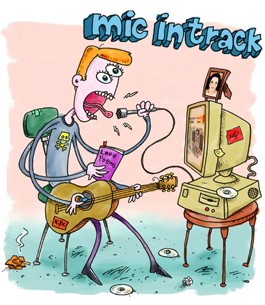
Why Is My Sister Such a Dumbass?” is the most compelling 46-second sound recording since the turn of the century, and yet its creator, an adolescent boy, is nowhere to be found. It’s safe to assume he never intended a beautifully meandering ramble about his sister’s underwear, her “lesbian school” and her “awkwardness in a world that is undescribable” to be heard by anyone but himself. But through a phenomenon known as “mic in tracks,” his stream-of-consciousness diatribe has been heard, and loved, by thousands.

Mic in tracks represent a unique time, 1999 to 2002, when many new PCs came packaged with software called MusicMatch Jukebox, allowing a user to record into the built-in microphone on the computer’s sound card. If that person forgot to name the file, as many did, it was saved under the default name “mic in track,” followed by a number. But if that person also happened to share his entire audio hard drive through widespread file-sharing programs like Napster, that small mp3 made in the privacy of one’s own room went out for the whole world to hear.

Naturally, in 2001, most Napster users were too busy downloading Eminem songs to care about anything labeled “Mic_in_track_033.” But to a select group of enthusiasts, including Cal Poly physics lecturer David Dixon, mic in tracks represented an incredible treasure trove of found art, a readymade curation of audio vérité both fascinating and funny. Dixon began rabidly hunting down mic in track files on file-sharing sites, and each one, he says from his home in San Luis Obispo, was like a little Christmas presents.

“Once I started collecting them, I just couldn’t stop,” he says. “You have no idea what to expect when you download the file and start listening to it. Most of the time, it’s nothing, it’s literally nothing. Sometimes it’s just people taping things off the radio. But every once in a while, you hear something like what I have on the site.”

The tracks Dixon has collected are unbelievable (www.stark-effect.com). A barbershop quartet sings a doo-wop version of Juvenile’s “Back That Ass Up.” A child bangs kitchen utensils against a mixing bowl and defends Willie Nelson to the tune of the Police’s “Every Breath You Take.” Two girls try to hold it together singing a Christian pop song while a barking dog keeps interrupting.

“Hi, this is Miriam Halstead talking,” announces a depressed-sounding teenage girl. “I like bunny rabbits. I like Satan. I like cheese and milk.”

“Some of them are just really sweet, little slices of life,” Dixon says. “It’s like you’re peeking in through someone’s window.” But it’s more than voyeurism that makes Dixon’s finds so compelling; they present an actual psychological projection, as every track drips with empathy, placing the listener right there in front of the creator’s computer, to imagine all sorts of context. What happened, for example, to the relationship so poignantly eulogized in “I Love You Holly”? What compelled Casey and Liz to laugh uncontrollably while dedicating a Backstreet Boys song to Steve? Why are kids so into Insane Clown Posse?

Dixon, who once recorded plays he wrote with his friends on a reel-to-reel recorder growing up in Waukesha, Wis., was sufficiently fascinated, and started recording songs based on mic in track samples under his studio name, Stark Effect. Some followed themes, such as the “kids screwing around” genre of “Stop! I’m Watching TV!” while others, like “That Darn Bovine,” sampled key phrases matched up to drumbeats, à la Steve Reich’s Different Trains. After they became hits on a fan forum for experimental sampling group Negativland, Dixon continued with his wealth of source material (he’s got a full GB of mic in tracks on his home computer) and made an album, Mic In Track, available for free download on his site, along with 87 original mic in tracks.


“I have been criticized online in a few places for invading people’s privacy by putting these things up,” he says. “And I admit that I kinda am. But some of these things just need to be shared. It is a little bit troubling sometimes, especially with stuff like ’14,'” referring to a vile harangue that Dixon says he was hesitant to put up online before deciding that people needed to hear how ruthless and cruel kids can be, “but I think the goods outweigh the evils in this case.”

Dixon has never found any of the creators of his mic in tracks, nor have any wannabe rappers or off-key singers come forward to claim their glory. They remain, like the boy behind “Why Is My Sister Such a Dumbass?,” an accidental celebrity, a nameless cross-section of American life. Is his sister really a dumbass? We’ll probably never know.

David Dixon’s Mic In Track project can be found at www.stark-effect.com.


FIND A MUSIC REVIEW

Put on a Happy face

0

03.18.09

Happy Birthday, Candide! Voltaire, that church-baiting, morally corrupt French philosopher and writer, published Candide, his best-beloved novel in the winter of 1759, making it a spry 250 years old this year. The novel follows the comic adventures of the trained optimist Candide as he is tossed into one disastrous calamity after another, including battles, desertions, monkeys, earthquakes, imprisonment, floggings, death sentences, shipwrecks and an unfortunate run-in with the Spanish Inquisition. Through it all, or least until the end, Candide maintains his belief that everything is for the best.

Such globe-trotting derring-do seems unlikely fodder for a lighthearted operetta, but in 1956 the great modern composer and conductor Leonard Bernstein (West Side Story, et al.) produced a deliriously melodious and upbeat musical version that won a closet-full of Tony awards and spawned an original soundtrack album still counted among the best ever produced. Yet, because of its massive, complexly elaborate plot, the show is seldom performed. Leave it to the daredevils at Cinnabar Theater to set aside such concerns, tackling Candide as part of their 2009 season. According to director Elly Lichenstein, the project has been a labor of love for her and musical director Nina Schuman.

“Oh, it’s a tremendously fun show, and I’m having such an amazing time with it!” she laughs. If the audiences have as good a time with Candide as Lichenstein and her cast have been having during rehearsals, it should end up being a hit for the lucky little playhouse on the hill. Will Hart Meyer and Sheila Willey are featured above.

Candide runs Friday&–Sunday and the occasional Wednesday through April 12. March 20&–21 and 27&–28, April 3 and 10 at 8pm; April 5 and 12 at 2pm; April 1 and 8 at 7:30pm. Cinnabar Theater, 3333 Petaluma Blvd. N., Petaluma. $32&–$35. 707.763.8920.


Museums and gallery notes.

Reviews of new book releases.

Reviews and previews of new plays, operas and symphony performances.

Reviews and previews of new dance performances and events.

Death by Corn

03.18.09

United States tax dollars that harm the poor are not only spent on wars; a portion goes toward government-sponsored death-by-corn here in this country. I’m not talking about heirloom corn from South America or the yummy sweet stuff we take home in late summer from North Bay farmers markets. That’s a kind of sacred food, one of the “three sisters” of the garden, and a ritual of summer barbecues. Fresh white or yellow corn is a whole food. Many years ago I first saw the term “killer corn” as light-hearted Val-speak on a roadside vegetable stand near Mill Valley. I did not stop to buy any, but I could almost hear the precise tone of the sales dude saying, “Man, this corn is killer!”

The second time I saw “killer corn” in print, I was reading a news article about Bt-Corn, genetically engineered to produce its own pesticides, a business idea that killed off many a monarch butterfly dusted by its poisoned pollen. Repeat after me: these are our tax dollars at work. Our USDA approved and heavily subsidized Bt-Corn.

But wait, I’m just getting to the nastiest and most literal use of the term “killer corn.” To appreciate it fully, watch King Corn, a home-grown documentary by two young guys, Ian Cheney and Curt Ellis, who found out why generations following the baby boom have a shorter life expectancy (corn); why obesity is epidemic (corn); why diabetes will hit one in three kids born the year my second-grader was born (corn); why farming families are losing farms to agribusiness (corn); why feedlot cows are immobilized, force-fattened and made sick only to be slaughtered just before they die from a high-carbohydrate diet (corn); and why the fat content of feedlot cows is nine times higher than that of grass-fed cows (corn).

They are not talking about the sweet corn we eat, but the unpalatable Frankencorn grown with government subsidies to become a disease-producing feed for cattle and the ubiquitous ingredient in processed foods and sodas. Just think, some of your tax dollars make it more profitable for soda companies to fatten children—mostly poor children.

One of the most memorable scenes in the King Corn documentary is an interview with Earl Butts, the former head of the USDA, who decades ago created the policy of overplanting farmlands. His big idea was that creating cheap food would leave Americans more money with which to buy stuff. Like what, Earl? Insulin? Syringes? Prostheses?

Butts himself had the good fortune of growing up on a family farm and not a ghetto where the cheap food and drink choices in the neighborhood store all contain corn syrup.

I don’t eat cheap food, which means I must have less to spend on stuff. This seems to work out fine for me, despite what the likes of Butts imagine to be core American values. I don’t want more stuff. I want more social justice, beginning with real food for all social classes. I spent a summer week in Iowa once, where corn is king. I was dazzled by the tall corn and terrified by the social conformity in which men worked and women kept house. To the Toto in my mind I whispered, “We’re not in the Bay Area anymore!” The Iowa I experienced 15 years ago was nearly the same Iowa depicted in King Corn . The fact that almost every person who appears in the documentary is a male didn’t surprise me a bit.

But what really does surprise me is a hopeful bit of Midwest news. The women who’ve inherited farms—about 20 percent of Iowa farmland, according to a report by the Christian Science Monitor —are beginning to speak up against agribusiness practices on their land, which is largely leased to men. The women landowners want things done differently. They see land in context of long-range stewardship, in complex terms. Hurray for those women! They are being ignored, not only because they are women in the corn belt, but because what they want for the land opposes state and federal policies. So I am speaking out with them: The way we are abusing American farmland, and the sick cows and corn sweeteners we are subsidizing, is an assault on our own people.

We need to stop the USDA’s secret war.


Sight Lines

03.18.09

There is reason to hope that an era of greater openness is coming. As we mark this fifth annual Sunshine Week, March 15–21, some of the recent clouds obstructing the public’s right to know are giving way to more transparency. The American people are beginning to get a better glimpse of how their government works—or sometimes doesn’t work so well.

Already there is some good news for the Freedom of Information Act (FOIA), the law that gives life to the public’s right to know. Within hours of taking the oath of office, President Obama issued a historic directive to strengthen the FOIA, turning a page after the overreaching secrecy of the last administration. He issued presidential memoranda on the FOIA and transparency and open government that will promote accountability and transparency in government, along with an executive order on presidential records that will give the American people greater access to presidential records. Under the leadership of the new attorney general, Eric Holder, the Justice Department in recent weeks has begun releasing to the public some of the legal memos that were used to greatly expand executive power in the name of security.

Congress this month approved the first budget for the Office of Government Information Services at the National Archives. Established in the 2007 OPEN Government Act that I authored with my longtime partner on open-government issues, Sen. John Cornyn of Texas, this office will house an FOIA ombudsman, charged with mediating interagency FOIA disputes and helping to ensure that the public’s FOIA requests are swiftly addressed. By including funds for this office in the omnibus appropriations bill, Congress is renewing its commitment to the provisions of the OPEN Government Act, which made the first major reforms to the FOIA in more than a decade.

Not all the clouds have been dispelled. It should concern every American that traditional sources of reliable reporting are shrinking or disappearing. Newspapers that have served their communities for more than a century are struggling, and some are closing their doors for good. It was investigative reporting by newspapers that ultimately forced the government to concede the existence of torture by our country and the shame of the mistreatment of our veterans at Walter Reed Army Medical Center.

Information is a freedom, but information also is a right and a requirement for effective self-government. Information is a pillar of our democracy. Without it, citizens are kept in the dark about key policy decisions that directly affect our lives. Without open government, citizens cannot make informed choices at the ballot box. Without the people’s access to public documents and a vibrant free press, officials can make decisions in the shadows, often in collusion with special interests, escaping accountability for their actions. And once eroded, these rights are hard to win back.

When the Congress unanimously passed the OPEN Government Act, Democrats and Republicans alike joined together in promising the American people a more open and transparent government. The FOIA’s defenders in Congress must work to ensure that that this was not an empty promise. I intend to build on the FOIA reform work that Sen. Cornyn and I began several years ago by proposing new legislation to further strengthen the FOIA. The bipartisan success with the OPEN Government Act and President Obama’s FOIA directive shows that open government is not a partisan issue. Open government is an American value and a virtue that all Americans can embrace.

Sunshine Week gives us the chance to celebrate our successes and size up the challenges that lie ahead. We can remind ourselves that a free, open and accountable democracy is what our founders envisioned and fought to create. The public’s right to know helps government learn from mistakes so they are not repeated.

It is the duty of each new generation to protect this vital heritage. At this difficult and historic time for our nation, we have the opportunity again to reaffirm a commitment to an open and transparent government on behalf of all Americans today, and which we have in our power to leave as an enduring legacy for future generations of Americans tomorrow. 

Sen. Leahy, D-Vt., was installed in the Freedom of Information Act Hall of Fame in 1996 and is the 2009 recipient of the Robert Vaughn FOIA Legend Award. He is the author of the Electronic FOIA Amendments of 1996 and coauthor of the OPEN Government Act.

Open Mic is now a weekly feature in the Bohemian. We welcome your contribution. To have your topical essay of 700 words considered for publication, write op*****@******an.com.


Greetings from Todayland!

0

Slummin’ at Home

0

03.18.09

Last month’s opening for the excellent art show “Home”—featuring work by Beth Mueller, Chris Wells, Daniel Glendening, Ethan Allen Davis, Guy Henry Mueller, Chris Wells and Kellesimone Waits—was a packed affair, with attendees walking through a maze of Glendening’s wooden framework to the main room of ArtSpace 404. The buzz surrounding Beth Mueller’s large-scale acrylics, Davis’ sumi ink drawings and Waits’ searing, empathetic portraits of the homeless was augmented by Wells’ video of late Santa Rosa bike enthusiast Leroy Tomei and a vinyl copy of the Grateful Dead’s Shakedown Street rotating on a plastic Fisher-Price record player in the corner. The night was so happening, in fact, that the attending throng had to be shuffled out to the sidewalk, last-call style, at the end of the night.

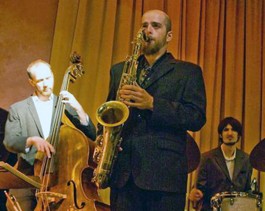
A similarly energized crowd is expected to be on hand for this weekend’s performance at ArtSpace 404 by Slumgum, an outstanding risk-taking jazz quartet from Los Angeles which calls to mind Wayne Shorter circa Speak No Evil fronting the Art Ensemble of Chicago. They are currently little-known, a status that won’t last long. A sense of constant discovery runs through the quartet’s songs; their soloing is masterful, their veneer metropolitan and their technical prowess top-notch.

On their eponymous recording, Slumgum play both “in” and “out,” whether in the tender 17-minute ballad “Long Shadows” or the jittery, meandering obstacle course “Black Diamond.” Tenor saxophonist Jon Armstrong flirts with the edge without compromising structure; bassist David Tranchina, a Forestville transplant, manages the upright bass with authority and warm tone. “Blooms in June” is a modal melody sweetly splayed by pianist Rory Cowal, and there’s a great moment in “Slummin'” where drummer Trevor Anderies’ stickwork goes bonkers right alongside a triumphant saxophone wail. Collectively, the members of Slumgum have shared the stage with Herbie Hancock, Ron Miles, Bennie Maupin, Art Lande and many others.

If you missed John Zorn’s incredible five-day residency last week in San Francisco, or want to help out Santa Rosa’s Homeless Services Center (the subject matter of Waits’ portraits, and which all proceeds from the performance benefit), or simply want to see and be seen until the inevitable single-speed caravan to the 440 Club, then you know where to be this weekend. Low-Five, with Guy Henry Mueller, and Lila vs. the Crizzler, with visuals by Wells, open the show. It’s like a little slice of Minna Street in downtown Santa Rosa on Friday, Mar. 20, at ArtSpace 404, 404 Mendocino Ave., Santa Rosa. 6pm. $10-$15 suggested donation. 707.579.2787.


Best of the North Bay 2009

0

The Real First Responders

03.18.09 STOP IN THE NAME OF LOVE: CERT volunteer Zeke Britton has trained to help the community in case of emergency. Because she can. Zeke Britton looked on in horror as a man lay face down in a busy street, speeding cars narrowly missing him. She and a few others ran to his assistance. As one of them, an EMT, took...

Road to Freedom

03.18.09 Legendary civil rights leader, social activist and intellectual firebrand Julian Bond comes to Sonoma State University on March 20. Bond has served as chairperson for the NAACP since 1998, but his activism stretches back to 1960, when he helped found the Student Nonviolent Coordinating Committee. Bond's name first splashed across national headlines in 1965. That year, in the wake...

Letters to the Editor

03.18.09Hungry Minds are GratefulI was delighted to find Bart Schneider's column about the destiny of books in this week's Bohemian (Lit Life, "State of the Book," Feb. 25).Bohemian readers may not know what a rich resource they have in Bart. His Hungry Mind Review and the far-reaching literary network it both stood for and nourished were deeply respected during...

Hello, World!

music & nightlife | TESTING 1-2-3: What if the bizarre rap song you...

Put on a Happy face

03.18.09Happy Birthday, Candide! Voltaire, that church-baiting, morally corrupt French philosopher and writer, published Candide, his best-beloved novel in the winter of 1759, making it a spry 250 years old this year. The novel follows the comic adventures of the trained optimist Candide as he is tossed into one disastrous calamity after another, including battles, desertions, monkeys, earthquakes, imprisonment, floggings,...

Death by Corn

03.18.09United States tax dollars that harm the poor are not only spent on wars; a portion goes toward government-sponsored death-by-corn here in this country. I'm not talking about heirloom corn from South America or the yummy sweet stuff we take home in late summer from North Bay farmers markets. That's a kind of sacred food, one of the "three...

Sight Lines

03.18.09There is reason to hope that an era of greater openness is coming. As we mark this fifth annual Sunshine Week, March 15–21, some of the recent clouds obstructing the public's right to know are giving way to more transparency. The American people are beginning to get a better glimpse of how their government works—or sometimes doesn't work so...

Slummin’ at Home

03.18.09Last month's opening for the excellent art show "Home"—featuring work by Beth Mueller, Chris Wells, Daniel Glendening, Ethan Allen Davis, Guy Henry Mueller, Chris Wells and Kellesimone Waits—was a packed affair, with attendees walking through a maze of Glendening's wooden framework to the main room of ArtSpace 404. The buzz surrounding Beth Mueller's large-scale acrylics, Davis' sumi ink drawings...
11,084FansLike
4,446FollowersFollow
6,928FollowersFollow