Not Your Average Wine Snob

0

07.01.09

On a recent Sunday morning in downtown Petaluma, 34-year old Geoff Kruth sits sipping a coffee and looking relaxed in a simple blue T-shirt and jeans. He has a boyishly handsome look to him, not at all what one might expect from one of the world’s most highly certified wine experts, and speaks with an easy cadence. He seems content, chatting about his recent move from Windsor and his two-year-old daughter, but as soon as the conversation drifts to his passion for wine, he’s quick to assure that his life wasn’t always centered around Rieslings and Zinfandels.

After graduating high school in Orange County, Kruth entered Sonoma State University with the intention of completing a degree in music (classical guitar, which he says he hasn’t touched in 15 years). Kruth switched gears midway through and pursued a degree in computer science instead, and smack in the middle of the dotcom boom, he did what many young techies did at the time. “I moved to Silicon Valley and lived in Menlo Park and worked in the tech business for about five years,” he says. “I had a good career, but I spent my spare time and money on wine. Wine was my hobby in college, and that was what I did for fun.”

In the back of his mind, however, Kruth had begun to toy with the idea of opening a wine bar or a restaurant. While working on a consulting project in Connecticut, he drove to New York to have dinner at L’Ecole, the restaurant of the French Culinary Institute. By the time the dessert courses arrived, Kruth had found a new gig.

“I decided I was going to quit my career and go to culinary school,” he says, with a slight shrug and a grin. “Everybody thought I was completely insane.”

Shortly after enrolling in the French Culinary Institute, he began working for the New York restaurant Balthazar for free, moving boxes in the cellar while concentrating on learning the most he could about the wine industry and hitting the books for his sommelier certification. The dream of owning a restaurant faded as Kruth realized his passion was in wine education instead, and he registered for the first level of the Court of Master Sommeliers classes.

Four years passed, and Kruth found himself back in Sonoma County. Having just passed the advanced level exam and studying for the master’s, he landed his current position as wine director of the Farmhouse Inn and Restaurant in Forestville (taking over for Jim Ralston, current wine director at Cyrus restaurant in Healdsburg).

As one might have guessed, this guitarist-turned-techie-turned-sommelier passed his master’s exam. Since its birth in 1969 in England, just more than 170 people in the world have passed this grueling, meticulous tastebud test. Kruth is now one of a small community of extremely dedicated wine connoisseurs who have been able to clear the three-part exam held once a year during which potential masters are grilled for three days straight on service, tasting and theory, in front of a panel. Kruth recalls being given 25 minutes to identify six different wines accurately—three reds, three whites.

“Vintage, varietal, region, su-region,” he recites. “You can’t just know what they are, you have to explain what they are, and why they are what they are, and how you know that’s what it is. The expectations are a lot higher.”

It’s an awful lot to put oneself through, Kruth admits, and that’s exactly why a deep-seated passion for wine and a certain intensity and focus is required. “What I’m personally interested in is the connection to farming and culture and life,” he says. “Wine can be a lot of different things, like a luxury lifestyle beverage, but I’m not really interested in that.”

He continues, “But, that’s obviously part of the service business. You need to be of service to people who are interested in wine from that perspective, because that can be a lot of your business.”

Watching a sommelier in action can feel a bit like watching a magic show or a palm reader, but the way Kruth lays it out makes it sound more like a math equation.

“Usually, when I pick up a glass of wine”—with this, he picks up his coffee cup, swirls it, and smells it like it’s a glass of red waiting to be pegged—”I’ll smell it and know what it is. The grape, country, region and a reasonable guess on the vintage. But if I were sitting in a master’s exam, I wouldn’t try to do that at all. You want to take your judgments out,” Kruth explains, adding that his approach to wine identification is highly analytical. “There are specific things I look for in the color, the aromas, the flavors or the structural elements of the wine. I basically try to get an extremely objective analysis, and that should tell you more or less what the wine is.”

Such arduous examination might take a half an hour for an average wine drinker to attempt before breaking down and asking for the answer or Googling the damn thing, but according to Kruth, it all comes down to practice.

“If you really understand all the classic wines of the world and how they’re built up—their alcohol, their acid, their tannin levels, the kinds of fruit flavors in the wines, the kinds of secondary flavors, the type of earthiness . . . once you paint that whole picture, most of time it points right to a wine,” he says.

Though it may seem so to an outsider, Kruth insists that he is not a “supertaster,” one of the few people who walk through life with an unusually sensitive palate, discerning every ingredient in a dish or a wine.

“I don’t believe that it’s some magical gift that only a small number of people have,” he says. “It’s training and commitment and having a good structure and good teachers.”

Kruth humbly acknowledges the barrage of clichés related to his work. All training and passion aside, say the word “sommelier” to a group of average people and reactions will most likely range from eye-rolling to looks of disgust. Why is it that even in wine country, “sommelier” conjures images of a pretentious suit and tie, condescension and perhaps an unhealthy obsession with a beverage?

Kruth insists that the perception of sommeliers is changing. “The stereotype that needs to be put to rest is the snobby sommelier looking down on other people,” he says. “If that’s not dead, it’s dying quick. I think things have really changed for the better.”

Kruth has finished his coffee and sits quietly for a minute, capturing all the last bits of latté foam on his finger.

“You know, sommeliers are there to be used,” he says. “I feel like people are sometimes afraid to engage a sommelier because they feel like it looks like they don’t know enough, but if they realize the level of knowledge and passion that sommeliers have to have, and utilize that more, I think they would have a better experience.”

It’s about moving past feeling looked down on, Kruth emphasizes, and seeing that it’s a sommelier’s obligation to be there for the customer. “It’s not about your ego as a sommelier, it’s not about showing someone what you know. I don’t have anything to prove,” he says. “So you have to listen more than you talk and understand what someone’s interest is. It’s really understanding the customer, figuring out what’s going to make them happy.”

For Kruth, being a master sommelier is not all wine pouring and educating the masses on oaky undertones. In addition to acting as wine director for the Farmhouse, he is the director of the Guild of Sommeliers, an instructor for the Professional Culinary Institute, an instructor for the Court of Master Sommeliers and the wine consultant for the Kapalua Wine and Food Festival in Maui. He insists he has no life, but acknowledges that every business has its helping of grunt work.

“It’s just like chefs,” he says, smiling and shaking his head. “Everyone wants to be a celebrity chef, but no one wants to peel onions for 10 hours.”

Quick dining snapshots by Bohemian staffers.

Winery news and reviews.

Food-related comings and goings, openings and closings, and other essays for those who love the kitchen and what it produces.

Recipes for food that you can actually make.

Dr. Manhattan

07.01.09


The love of the last word is the province of comedians; when you put someone down, you want them to stay down. In this fashion, Groucho Marx sings “Hello, I Must Be Going” over the now-traditional white-on-black titles of Whatever Works, the newest Woody Allen movie, a weird mix of Ibsen and Doc Simon.

Whatever‘s main character is Larry David’s Boris Yellnikoff. Though he’s Jewish and from the outer boroughs, really he’s a Scandinavian / Germanic-style misanthrope, addressing an audience only he can see and sporting a terrible limp from his suicide attempt years previously. Formerly a physics professor short-listed for the Nobel Prize (“It was all politics, just like any award,” he says), today he’s retired, a free-range castigator brutally teaching chess to children and living in a brick-lined vault in Manhattan’s Chinatown.

One evening, Boris finds a girl curled up on a piece of cardboard under his fire escape. The waif is Melodie St. Anne Celeste (Evan Rachel Wood), a former Mississippi beauty queen who fled the Deep South and has no plans. Boris reluctantly puts her up while treating her to copious insults, yet takes her to the New York sites she wants to see. Cinematographer Harris Savides, a Gus Van Sant veteran and the vintage-lens cinematographer on Margot at the Wedding, brings up an even danker, smoggier version of the tropic humidity in New York than Zhao Fei provided for Allen in Small Time Crooks. It’s permanent summer in this film, all the better to use Wood for her decorative qualities.

Melodie takes Boris’ imprint completely—his rants, his phobias and his dislike of sex—and marries him. A year afterward, the in-laws arrive for a first visit. Marietta (Patricia Clarkson) believes that she has tracked her runaway daughter down and is outraged to find the girl married to a neurotic man old enough to be her grandfather. Soon thereafter, Marietta’s estranged husband (Ed Begley Jr.) shows up in the apartment.

Clarkson is good, of course, as a scratching post for Boris the grouch, a hybrid sort of Margaret DuBois or Blanche Dumont. She advances the action by introducing Melodie to a younger, better-looking and seemingly more suitable man, Randy (Henry Cavill), as flat as the handsome prince in a prep-school play.

Whatever Works is based on a script Allen had in his drawer for several decades, and it shows. But despite some canned corn, Allen knows how to make a civilized comedy even when denouncing civilization.

David’s sneer is as effective here as it is on Curb Your Enthusiasm, yet it’s hard to handle the eventual humanizing of Boris. If he sees the universe as a violent machine that’s running down, why is he warmed by the miracle of unlikely birth? What does a miracle matter, if it only leads to disaster?

This wonder-of-life argument is the same argument that led the icy physics professor Dr. Manhattan back to humanity in Watchmen, and it’s not any more believable here. When we’re meant to feel for Boris after he wakes up the building with a panic attack in the middle of the night, screaming “The horror, the horror!” Allen presumes that the audience doesn’t know their Conrad. Didn’t Kurtz cause his own horror, through his own blind acceptance of ideas that dehumanized everyone around him? 

‘Whatever Works’ opens Friday, July 3, at Rialto Cinemas, 551 Summerfield Road, Santa Rosa. 707.525.4840.


New and upcoming film releases.

Browse all movie reviews.

Letters to the Editor

07.01.09

Dutra dontcha

Lindsay Pyle interviewed me on the Dutra Asphalt Plant proposal (the piece was presented to me not as a personal commentary but as an article). I am shocked that the Bohemian printed the column (“Tit for Tat,” Open Mic, June 17), since it is inaccurate. Dutra does not have the contract for the Highway 101 widening project as far as public knowledge goes. Ms. Pyle implies that since Petaluma caused the traffic jam, we should breathe toxic air and degrade our park as punishment.

Dutra is a newcomer to the county; they bought the Petaluma Quarry in 1995. They sold it eight years later in December 2003, operated as a tenant on the sold property for one year, and then operated a temporary asphalt plant for two years (from 2005 to 2007) at a different location across Petaluma Boulevard. During their relatively few years in Petaluma, they were issued multiple air-quality violations (NOVs) by the Bay Area Air Quality Management District. They have operated without a permit, and were shut down for failure to use Best Available Control Technology. Their EIR states that they have gone as far as to engage in grading work at Haystack Landing without a permit, damaging the wetlands. Since they do not currently operate an asphalt plant, it’s a mystery how they can claim to be “relocating” their defunct and out-of-compliance plant to Haystack Landing.

Their spokesperson, Amy Dutra, was asked questions about the Dutra Group’s record in Petaluma in front of county supervisors at the formal hearing on Feb. 3. On June 9, at the next formal hearing, Supervisor Zane publicly chastised her for less-than-complete answers that failed to mention the formal NOVs issued on their operation.

Is this the kind of local company Ms. Pyle wants us to embrace for asphalt production? Yes, asphalt will be laid to widen 101, and the company with the lowest bid and best track record will get the job. Which company that is remains to be seen. What can now be seen is Dutra’s local and national record. And it isn’t pretty.

Joan Cooper
Petaluma

When Lindsay Pyle was first assigned the Dutra piece, it was indeed intended to be an article, not an Open Mic commentary. Due to deadline constraints and other unforeseen events, it changed to Open Mic status.

Erections of yore

Jessica Lussenhop’s feature article “Inside the Pornocopia” (June 24) leaves yet unanswered the basic question of what accounts for the persistent and ongoing appeal of porn for this particular generation of teens. The perennial affinity of the young for the “forbidden fruit” cannot suffice to address the matter, because the latter proposition gets tired once the novelty fades. 

When we were kids (sometime around when the polar ice cap was forming), porn was considered ancillary support for “dirty old men.” Such assistance was hardly necessary, though, for an adolescent. Good God, at that age it was all I could do to keep it down . . .

Michael Zebulon
Cotati

Steampunk funk?

Our post-oil future needn’t be as grim and apocalyptic as portrayed in Alastair Bland’s Transition article (“Cheer Up, It’s Going to Get Worse,” June 17). Consider the late 19th century. Railways criss-crossed the nation. Seaports were full of ships. The trains and ships burned coal to generate steam power.

Coal is a foul pollutant, and should be banned from use in power plants and heating. Yet it’s abundant, and could fuel our post-oil transportation network. A train trip from San Francisco to New York took about four days in 1895. A steamship took about the same time to travel from New York to Europe.

Philip Ratcliff
Cloverdale

Dept. of Way-Hey

It is with cream-fed feline pleasure that we announce that our 2008 Arcadia issue won a national award in the Special Issues category from the Association of Alternative Newsweeklies at last week’s annual convention. This is our eighth national award in six fleeting years and, meow, are we proud.

The Ed.
Fairly purring


Robert Hunter Winery

0

As playgrounds of the rich, famous and notable go, quiet Sonoma Valley seems nearly in retirement, full of names ripped from yesteryear’s headlines and long since senesced into the landscape. Take Arnold Drive. Who’s Arnold? That’d be “Hap” Arnold, the five star general who, along with other WW II brass, was a guest of former art model and famed sugar heiress Alma de Bretteville Spreckels. “Big Alma” greeted guests with a martini in one hand and wasn’t keen on the bumpy, dusty road leading to her 3,000-acre Sobre Vista ranch. So she had a seven-mile stretch paved and named for the general.

That’s the type of trivia learned during a tour of this 40-acre estate carved out of Spreckel’s old ranch in the early 1970s, hidden away off Arnold Drive. Here Robert Hunter, a retired banker with a fondness for the wines of Epernay, has been quietly producing méthode champenoise sparkling. The small staff offer a limited schedule of tasting and tours of gardens designed by 20th-century landscape architect Thomas Church.

Our guide breathlessly related a century of history, and then introduced the unusual flora planted to green up Church’s design. An unassuming shrub turns out to be rare, 200-year-old dwarf sequoia, and if the landscaping seems familiar, it’s because Church was the father of the now ubiquitous “California” landscaping style.

At the patio tasting, Mr. Hunter himself, at better than 80, is an energetic host, graciously passing the dump bucket, collecting glasses, and engaging us on the finer points of Champagne. The star is the 2000 Brut de Noirs Sonoma Valley sparkling wine ($45). Is that getting on a bit for a white wine? Not so for those with a structure that helps them improve with age; with Champagne, the practice is called extended tirage. Bready, flakey pastry aromas introduce but don’t dominate delicate citrus and pear flavor; the lean, clean center of acidity and fine bubbles are refreshing, not scoury. Surprise—fine sparkling wine hails from the warm “banana belt” of Sonoma Valley—and that’s not just the phenomenon of “tasting room palate” talking. I found the previous vintage of this bubbly quite by random a few holiday seasons ago, and to my memory it still bests anything since.

The full-bodied and languid 2007 Chardonnay ($35) perked up a little with coconut and Meyer lemon notes. A comparison tasting found the 2005 Pinot Noir ($45) imbued with brown spice and cranberry-grape jelly fruit; limpid but not heavy or hot, it finishes with a brief, satisfying astringency, while the 2003 Pinot Noir ($50) was lithe, silky and aromatic of smoky strawberry jam. Plus, an olallieberry scented, juicy and polished Cabernet Sauvignon ($50) with soft tannin in the background. Cab next to Pinot? Here in Glen Ellen, yes.

Missing was the requisite méthode champenoise demonstration, but for resident tourists or visiting relatives with a taste for the intimate rather than glitz, here is a hidden gem on the wine road less traveled.

Robert Hunter Winery, 15655 Arnold Drive, Sonoma. Tours of private estate by appointment only, $25. 707.996.3056.


View All

Pop Boom Pow

0

07.01.09

Hell yes, we love to blow stuff up. Here’s a roundup of what’s crackin’ in the North Bay this weekend.

July 1&–5: Marin County Fair and Fireworks There’s nothing like watching the fireworks reflect off the lagoon in this nightly display. Marin County Fairgrounds, 10 Avenue of the Flags, San Rafael. July 1&–5, 11am&–11pm. $12&–$14. 415.499.6400.

July 3: Windsor Fireworks Spectacular Live music and a local artisan food fair in the Town Green lead into fireworks at dark, viewable at Windsor High School. Windsor High School, 8695 Windsor Road, Windsor. Fireworks at 9:30pm. Free. 707.838.1260.

Annual Third of July Fireworks They always do it one day early in Sebastopol, with food, live music and more. Analy High School, 6950 Analy Ave., Sebastopol. Gates open, 5:30pm; fireworks, dusk. $3&–$7. 707.823.1511.

Fireworks Over the Bay Enjoy fireworks soaring over the water of Bodega Bay. Westside Park, 2400 Westside Road, Bodega. 9:30pm. Free. 707.875.3866

July 4: Red, White & Boom! Live music from Wonderbread 5, Pat Jordan Band and High Speed Wobble. Sonoma County Fairgrounds,1350 Bennett Valley Road, Santa Rosa. Gates, 4pm; fireworks, 9:30pm. $5 entry; $5 parking. 707.545.4200.

Napa County Fair and Silverado Parade Fireworks at 9:30pm culminate a day of music and fun. The fair continues through July 5 at the Napa County Fairgrounds, 1435 N. Oak St., Calistoga; parade, down Lincoln Avenue on July 4 at 11am. 707.942.6333.

Old-Fashioned Fourth of July Fireworks Display Sponsored by local veterans of the American Legion for the 19th year. Healdsburg High School Athletic Field, 1024 Prince Ave., Healdsburg. Fireworks at 9:30pm. Free. 707.433.3059.

Fourth of July on the Plaza Enjoy live music, a parade, vendors, clowns and more. Sonoma Plaza, First Street East, Sonoma. Parade, 10am; patriotic ceremony, 11:45am; fireworks, dusk. Free. 707.938.4626

Bicycle Santa Rosa Festival Hop on a bike for a moderately easy ride followed by games, raffles and the Trailer Park Rangers. Juilliard Park, 227 Santa Rosa Ave., Santa Rosa. Ride, 9am; festival, 11am&–3pm. Free. 707.545.0153.

Cloverdale Fireworks Fireworks begin at dusk. Sponsored by the Cloverdale Lions Club. Cloverdale High School football field, 509 N. Cloverdale Blvd. Dusk. Free. www.cloverdalelions.com.

Petaluma Fireworks Live music, food and other entertainment lead into the big boom. Sonoma-Marin (Petaluma) Fairgrounds, entry on East Washington Boulevard and Ellis Street. Gates, 3:30pm; play, 3:45pm. $2. 707.769.0429.

Guerneville Fireworks Crafts Faire in the Plaza at 10am, then BBQ at Oddfellows Hall at 1pm and block party until fireworks at dark. Downtown Guerneville. 10am-dark. Free. 707.869.9000.

44th Annual Corte Madera-Larkspur Fourth of July Parade With the theme “Magical Moments,” the parade includes floats, drill teams, classic cars and marching bands. Begins at Redwood High School, 395 Doherty Drive, Larkspur. 10:30am. Free. 415.924.0441.

Second Annual Novato Fourth of July Races Tamalpa Runners present a “4 on the 4th” four-mile road race and a “Mayor’s Mile” one-mile family walk/jog. Downtown Novato, Seventh and Grant streets. Starts, 7:20am. Entry, $15-$20. 415.246.1390.

Fourth of July Woodacre Parade and Country Flea Market In its 20th year, a pancake breakfast at the Woodacre Fire Department precedes a noontime parade. Later, enjoy games, barbecue, flea market and live music. Woodacre Fire Station, 33 Castle Rock Road. Parade begins at noon at the Woodacre Improvement Club, 1 Garden Way. Flea market, 9am&–4pm. $3&–$7. 415.488.0370, ext.102.

Fireworks Over the River and Parade of Lights Boats covered in lights parade past the ‘water curtain’ from the bridge in this great hometown fest. Fireworks display at night. Monte Rio Community Beach, Monte Rio. 7pm. Free. 707.865.9956.


Skate park puzzle

0

07.01.09

Santa Rosa is prepared to allow a guerrilla addition made to its skate park in the middle of the night by local skateboarders—if those behind the concrete work can provide plans showing that it was formed and poured in accordance to the city’s building code.

City workers discovered the newly dried concrete ledge Monday morning last week. With stretched budget resources to jackhammer the concrete, the city instead hung a flyer to the skate park’s fence promising the ledge can stay if documentation is given showing how it was tied into the existing structure.

Such user-generated additions are rare, says Parks and Recreation superintendent Lisa Grant. “If we don’t know if it’s constructed in a way that’s safe for the users, we have an obligation to remove it,” she says. “But it appears to be constructed quite well, it appears to be a feature that the skateboarders are using and want. We want the users to be happy. It’s their park.”

Built in 1994, Santa Rosa’s 17,000-square-foot skate park holds a special place in the hearts of local skaters. Pro skater Tony Trujillo began his career as a regular, and Tony Hawk once stopped by to skate the park in 1995. But nine other skate parks have since been built in the North Bay, and Santa Rosa’s is considered out of date.

Brian Henderson of Brotherhood Board Shop in Santa Rosa says the local skateboarding community has embraced the new ledge. “It’s rejuvenated the skate park for a lot of people,” he says. “For the last 15 years, ledges have been a huge part of progression in skateboarding and tricks in general. Pretty much any skate park that’s worth its weight in recent years has ledges and blocks—even though to the normal person, it just looks like a block of cement. But it’s a huge thing for skateboarders.”


Grant says she hopes someone comes forward soon with plans, while acknowledging that it’s an unusual situation. “In the future, if there’s a desire to change or add on to the park, we’d like to work with those people. We don’t want to be blindsided and have it happen by the midnight masqueraders; we want to be a part of it and give them credit for it,” she says. “So we’re trying to work with them—we just don’t know who it is we’re working with.”

Those with information about the skate park addition are encouraged to call the Santa Rosa Parks and Recreation Department at 707.543.3292.


Eating Well

07.01.09

There is a growing consciousness,” says Steve Costa of Point Reyes Books, “of how good quality food that is sustainably grown and produced is integral to human life, community and world.”

In this same spirit, Point Reyes Books has partnered with Marin Organic to create the Food for Thought author series. Through October, native Marin authors will share their work at Point Reyes Books or at Toby’s Feed Barn across the street. All are welcome to attend the free readings.

The Food for Thought series offers perspectives that help put food into perspective, asking the important question of what it means to live and eat well. On Saturday, July 11, Nicolette Hahn Niman (above), author of Righteous Porkchop: Finding a Life and Good Food Beyond Factory Farms, will speak to the problems of industrialized livestock production and how to move beyond depending on these farms. On Saturday, July 25, Deeply Rooted: Unconventional Farmers in the Age of Agribusiness author Lisa Hamilton focuses on the stories of agriculture farmers.

On Saturday, Sept. 5, David Mas Masumoto speaks on his Wisdom of the Last Farmer: Harvesting Legacy from the Land, Epitaph for a Peach and others, bringing to the discussion organic farming techniques. Sunday, Oct. 4, brings Edward Espe Brown, accomplished chef, Zen Buddhist priest, and author of The Complete Tassajara Cookbook: Recipes, Techniques and Reflections from the Famed Zen Kitchen. He will share his perspective and will actually cook with guests.

“It is important that these authors educate and challenge peoples’ food practices,” Costa says. Through this wonderful opportunity to meet up close with the pubic, these authors do just that.

The Food for Thought author series runs through October at Point Reyes Books and Toby’s Feed Barn. 11315 State Route 1, Point Reyes. Free. 415.663.1542

Quick dining snapshots by Bohemian staffers.

Winery news and reviews.

Food-related comings and goings, openings and closings, and other essays for those who love the kitchen and what it produces.

Recipes for food that you can actually make.

‘Cat’ Nap

07.01.09


Cat on a Hot Tin Roof is, without a doubt, one of the greatest plays ever written by an American playwright. Its characters—the grandly dying Big Daddy, the self-hating alcoholic Brick, the sexy-fierce Maggie the Cat—were already stage icons before they were respectively stamped onto the conscious of the country by Burl Ives, Paul Newman and Elizabeth Taylor in the 1958 film. These are the kinds of characters that actors dream of playing, so it’s no surprise that the show is often used by drama schools and theatrical training programs. One can’t help but grow as an actor when faced with the massive challenge that is Cat on a Hot Tin Roof.

But make no mistake: this is not a play that works without a cast at the absolute top of its game. As beautifully written as Williams’ text is (“Life has to go on when the dream of life is over!”), this dialogue does not sing itself. For Cat to work, the actors must find all the right notes and play them with pitch-perfect authenticity. This, after all, is a play about “mendacity,” Brick’s oft-stated reason for drinking so much. It is Williams’ exploration of the ways that lies, both small and large, undermine the human condition. There can be no false notes in a production of Cat, or the whole show crumbles.

Summer Repertory Theater’s current production, part of its annual five-show season, is an unfortunately good example of this crumbling. Directed by James Newman with the laudable goal of shaking up and challenging its audience’s expectations, the production fails due to its inconsistent grasp of authenticity, beginning with the casting of Grace Gealey as Maggie. Normally a proponent of color-blind casting, I kept waiting for Newman’s direction to reveal some defensible reason for showing an African-American Maggie in a rocky marriage to Brick (David Hayden), the son of a white plantation owner. Set in 1954 in Mississippi, in the very heart of the KKK’s stomping grounds, it isn’t enough to merely ask the audience to overlook the fact that Maggie is black, since the racism and intolerance of the era, time and place are so deeply seared into our minds. The result is that the choice of Gealey is distracting and inherently false—a major fault in a play about falseness. A knockout performance might have been reason enough, but Gealey, who demonstrated herself to be a fine and agile actress with her delightful shape-shifting work on The Wedding Singer (reviewed here last week), doesn’t bring enough fire to the part of Maggie for the show to work. Though natural enough in her otherwise fluid performance, Gealey falls short of delivering the calculating, deeply feeling force of nature that is Maggie the Cat. She’s more Maggie the Kitten.

As the self-destructive Brick, Hayden also falls significantly short of the mark. We should be able to see the pain and self-imposed shame, the underlying homophobia, that has driven Brick to sit in silence, drinking until he hears that click that allows him some peace of mind. But Hayden only sits and stares blankly, as if he were trying to remember something that isn’t that interesting anyway. To make things worse, his idea of inebriation is bizarre; after something like 15 drinks guzzled in the course of what’s supposed to be a three or four hours, a mortal man would be slurring and stumbling, if not dead. Hayden, instead, just looks a little tired, as if worn out form all that passive staring.

Tim Hayes, as the imposing Big Daddy, fares better, but he falls victim to the show’s lackadaisical pace. Set during one night, as the members of Big Daddy’s family celebrate his birthday while secretly maneuvering to inherit his estate when he dies, the show should have a building intensity that is ratcheted up with each new verbal conflict. The pace set by Newman instead is meandering, more like watching an ice cube slowly melt in one of Brick’s numerous highballs.

Programs like SRT are vital in the development of actors and theater professionals, but with plays as exalted as this, it is not enough to simply go through the paces. The audience deserves a Cat that puts as much heat on the stage as Williams put in he script, at least as much heat as there is up there on that imaginary tin roof.

‘Cat on a Hot Tin Roof’ runs through Aug. 1 at Newman Auditorium on the Santa Rosa Junior College campus, 1501 Mendocino Ave., Santa Rosa. $10&–$25. 707.527.4343.


Museums and gallery notes.

Reviews of new book releases.

Reviews and previews of new plays, operas and symphony performances.

Reviews and previews of new dance performances and events.

The Valley Revisioned

07.01.09

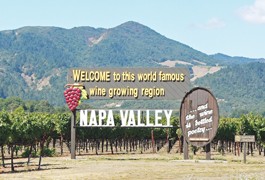
UNCORKING YE OLDE BOTTLED POTTERY: The bucolic Napa Valley is poised for some major urban changes.


Napa County is having growing pains—billions of dollars’ worth of them. The nation’s first county to preserve vast stretches of contiguous farmland, Napa’s future is shaping up to look immensely more urban, developed and congested than its celebrated and faux-idyllic recent past.

Today, a dozen or more major projects are either drawn up, under construction or have recently been completed in the county. Projects on tap for the area’s outlands include an eco-village, uncounted sprawling mountain estates and a 100-unit housing development. Expected to rise from the valley floor are thousands of homes, hotel rooms and commercial spaces. At least one project will encroach upon 83 acres of sanctified Napa County Agricultural Preserve vineyards. Each of these developments promises either to enhance or threatens to destroy the well-cultivated character and natural beauty of Napa County—depending upon who’s voicing an opinion.

With development comes shifting alliances and changing demographics. Ginny Simms is a long-standing member of the tempered-development group Get a Grip on Growth. She sums up Napa’s challenges by saying, “What is really at stake here is whether or not there’s going to be a political majority, pro or con, for development in the city and in the county.”

One question begging to be answered is whether these development projects will solve existing problems or simply create new ones. Unlike other regional jurisdictions, Napa County fancies itself the model of visionary rural preservation. Its preservation has roots in a contentious debate that goes back 42 years.

During the Summer of Love in San Francisco, Napa Valley was a sparsely populated boondocks lolling in existential discontent. A report had forecast Napa’s population eclipsing 200,000 people by the year 2000. Its last census counted less than one-third that number, and this prediction scared the hell out of Napans.

Spurred to action by sprawling developments leveling orchards from Santa Clara north to Novato (as well as the world’s largest seed farm turned into something called Rohnert Park), a Napa coalition formed to protect their valley. Winery and vineyard owners led the effort with the tacit support of county assessor George Abate, who recognized that massive development brings massive public costs. The preservationists urged Napa’s Board of Supervisors to act, incurring the wrath of local landowners who claimed rights to subdivide holdings, particularly to build homes for their children. Pro-development farmers and landowners were joined by powerful money interests, including Inglenook heir and banker John Daniel, along with would-be developers and local real estate agents.

In 1968, the Napa County Board of Supervisors voted 4–0 to establish Napa Valley as the nation’s very first agricultural preserve (AP), thus handing the preservationists a hard-fought victory. While the size and scope of the acreage has changed over time, Napa’s AP today protects roughly 38,000 acres. Minimum lot sizes are 40 acres, and only one house can be placed on each lot. Judging from voter-approved measures strengthening the protected designation over the years, the AP is now near universally supported by Napans. Adding together the AP, the Land Trust of Napa County and various government-administered lands, close to 140,000 Napa County acres currently enjoy some form of legal protection.

Even so, there’s plenty left to develop. And there are plenty of reasons to do so.

It’s no surprise that Napa County is a pricey place to live. Masters of every industry, high-tech nouveau riche and lucky spermers alike all find Napa irresistible. Building a county-designated-minimum 160-acre estate high in the hills, owning one’s own vineyard and “cult” wine label—that’s effete society’s ultimate cache. Referencing one’s own Napa Cabernet is pure cotillion gold. But with hyperexpensive wines paired with über-rich masters, all gobbling and pumping up real estate prices, just where do Napa’s “regular” people fit in?

For the most part, of course, they don’t. Napa is the Bay Area’s No. 2 tourist destination, behind only San Francisco. The latest wave of upscale hotels and resorts, restaurants, retail shops and tasting rooms will doubtless create hundreds of new jobs. Service sector positions, however, do not provide adequate wages to compete for local market-rate housing. Thus comes the class-war rub.

The Association of Bay Area Governments (ABAG) mandates housing numbers for each Bay Area county. The aim is to fairly spread demographics and population throughout the Bay Area by providing homes not just for those who can afford them, but for those who most need them, too. Because Napa must adhere to ABAG protocols, incremental population growth is inevitable. But before any “low cost” or “affordable” housing can be built it must run the county’s legal, bureaucratic and public gauntlets.

With all the massive development taking place outside the Ag Preserve it’s easy to overlook smaller, but significant challenges to the AP itself. Already, at least one successful waiver has gone forward. Its legal cudgel, the 1974 Subdivision Map Act, is expected to be increasingly deployed in efforts aimed at circumventing stringent AP restrictions. Recently, vineyard owner Will Nord used the act to win a ruling allowing him to subdivide his 83-acre vineyard near Yountville, and to build six new homes there.

Two weeks ago, a proposal to allow deed-restricted “affordable” second homes on AP properties was unanimously rejected by the supes. St. Helena’s attempt to annex 101 AP acres for use as a wastewater treatment spray field was likewise turned back, but with each chink in the armor, more money and more developers are bound to join the fray.

Like Ginny Simms says, “Napa County has been in the sights of developers for a very long time.” Expect more sightings. Here are just a few:

Coming Down the Pipe
Project: Napa Pipe
Where: Just outside the southeast city limits
Cost: $1 billion
Opposed by: Get a Grip on Growth
Current status: Developer is preparing a draft environmental impact report, expected to be released this August or September. Meanwhile, the county is holding monthly public meetings.

Napa Pipe is a 152-acre former industrial site located below the southeast border of the city of Napa. The most expensive project the county has ever considered, Napa Pipe could go a long way to satisfy state and regional demands that the county provide its fair share of housing—affordable, yes, but mostly not. From a preservationist’s perspective, green-lighting Napa Pipe could take pressure off calls for housing development in the Ag Preserve.

San Francisco developer Keith Rogal hopes to build more than 200 housing units annually over a 10-year stretch. Napa Pipe has met stiff resistance from individuals and local groups like Get a Grip on Growth, who tick off a laundry list of project negatives. Rogal has whittled his project down from 3,200 units to its present 2,580 townhouse affair, replete with four- to seven-story buildings, park acreage, a hotel, restaurants, office and light industrial spaces.

Downtown Napa Now!

New projects: Avia Hotel, Riverfront, Napa Square, Westin Veresa, River Promenade, Oxbow Public Market and the Gasser Foundation Transitional Homeless Housing

Combined costs: About $280 million

Current status: Gasser’s a go; all else is open or will soon be

Napans know precisely how previous attempts to raise the city’s status have failed miserably, COPIA being their most recent painful reminder. Recently, an influx of development capital has provoked a new, albeit cautious, optimism.

The $100 million, 180-room Westin Veresa opened on McKinstry Street last August. On July 1, the five-story Avia hotel opens it doors, touted as “a posh urban oasis.” This 141-room First Street hostelry offers upscale accommodations from $200 to $400 a night and a first floor primed to showcase retail and restaurants (yet to be leased).

Napa Square’s new Spanish-themed 68,000-square feet of office and restaurant space is already 70 percent leased to what developers promise is a “bevy of financial companies and two high-end restaurants.” At full occupancy, CDI Development partner Larry Nelson expects Napa Square businesses to employ 150 people.

Michael DeSimoni’s Riverfront, on the other hand, has caused some concern. Its 70,000 square feet of new commercial space stands virtually empty. Fifty luxury condominiums with price tags topping $1.5 million fill out the Riverfront project. DeSimoni attributes vacancies to being picky about the quality of his targeted tenants. “We’re not going to yield to junkies,” DeSimoni is quoted saying. For now, Riverfront’s sole lessee is Morgan Stanley Smith Barney.

Putting Off the Ritz
Projects: Ritz-Carlton and the St. Regis
What: Five-star hotel  – resorts
Where: East and south ends of the city of Napa, respectively
Luxury units: About 600
Cost: Ritz-Carlton, $270 million; St. Regis, unknown at press time
Current Status: Financially challenged and in the works

Both the Ritz-Carlton and the St. Regis hotels would greatly enhance Napa’s city image as a world-class destination, but they’ll be anything but boutique in size and scope. About a half-billion dollars is expected to be poured into the two separate ventures. In addition to unsurpassed overnight accommodations, expect luxury condos, retail, conference and banquet facilities, spas, underground parking, acres of vineyards and a 25,000-case winery.

The St. Regis marks the second attempt to build a resort on the Stanly Ranch Carneros property. A proposed 600-home, 300-room resort, retail and golf course monstrosity was withdrawn in the late 1990s after the city threatened to put it up to the citizens for a vote. The latest slimmed-down 245-unit St. Regis is expected to fare better.

The Ritz, meanwhile, has run into financial snags due to the recession. Its Florida-based developer hasn’t pulled the plug, but the project appears in limbo.

Out Yonder

Projects: Angwin’s Eco-Village, Villa Berryessa, Lake Luciano and various and assorted 160-acre mountain estates

Combined costs: $1 billion and counting

Lake Luciano’s golf course and housing development suffered an early June blow from the board of supes, but challenges are expected. Pope Canyon’s Villa Berryessa is tentatively approved, with 100 homes slated to be built on 97 acres across the hills from Napa Valley.

Aside from Napa Pipe, no development proposal has met such blustery opposition as Pacific Union College’s 380-unit Eco-Village in Angwin. Even Robert Redford has joined efforts to quash it. A recent decision by the supervisors has breathed new life into the project, and, moreover, it may benefit should former Napa police chief Dan Monez gain a seat on the board in the next election cycle.

Ghisletta
Project: 1,000 single family homes on 142 acres
Where: Off Foster Road, west of, but expected to be incorporated into, the city of Napa
Cost: Half a billion dollars at a $500,000 per-home average
Opposed by: Save Foster Road
Current status: Wending through the public process

A City of Napa annexation application was approved two years ago, but was later withdrawn when a tax agreement could not be reached between the city and the county. The project is presently on hold.


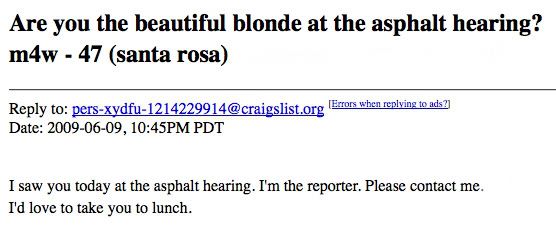
The Luxurious Life of a Reporter

0

(Incidentally, not one of ours.)

Not Your Average Wine Snob

07.01.09On a recent Sunday morning in downtown Petaluma, 34-year old Geoff Kruth sits sipping a coffee and looking relaxed in a simple blue T-shirt and jeans. He has a boyishly handsome look to him, not at all what one might expect from one of the world's most highly certified wine experts, and speaks with an easy cadence. He seems...

Dr. Manhattan

07.01.09  The love of the last word is the province of comedians; when you put someone down, you want them to stay down. In this fashion, Groucho Marx sings "Hello, I Must Be Going" over the now-traditional white-on-black titles of Whatever Works, the newest Woody Allen movie, a weird mix of Ibsen and Doc Simon.Whatever's main...

Letters to the Editor

07.01.09Dutra dontchaLindsay Pyle interviewed me on the Dutra Asphalt Plant proposal (the piece was presented to me not as a personal commentary but as an article). I am shocked that the Bohemian printed the column ("Tit for Tat," Open Mic, June 17), since it is inaccurate. Dutra does not have the contract for the Highway 101 widening project as...

Pop Boom Pow

07.01.09Hell yes, we love to blow stuff up. Here's a roundup of what's crackin' in the North Bay this weekend.July 1&–5: Marin County Fair and Fireworks There's nothing like watching the fireworks reflect off the lagoon in this nightly display. Marin County Fairgrounds, 10 Avenue of the Flags, San Rafael. July 1&–5, 11am&–11pm. $12&–$14. 415.499.6400.July 3: Windsor Fireworks Spectacular...

Skate park puzzle

07.01.09 Santa Rosa is prepared to allow a guerrilla addition made to its skate park in the middle of the night by local skateboarders—if those behind the concrete work can provide plans showing that it was formed and poured in accordance to the city's building code. City workers discovered the newly dried concrete ledge Monday morning last week. With stretched...

Eating Well

07.01.09 "There is a growing consciousness," says Steve Costa of Point Reyes Books, "of how good quality food that is sustainably grown and produced is integral to human life, community and world."In this same spirit, Point Reyes Books has partnered with Marin Organic to create the Food for Thought author series. Through October, native Marin authors will share their...

‘Cat’ Nap

07.01.09Cat on a Hot Tin Roof is, without a doubt, one of the greatest plays ever written by an American playwright. Its characters—the grandly dying Big Daddy, the self-hating alcoholic Brick, the sexy-fierce Maggie the Cat—were already stage icons before they were respectively stamped onto the conscious of the country by Burl Ives, Paul Newman and Elizabeth Taylor in...

The Valley Revisioned

07.01.09 UNCORKING YE OLDE BOTTLED POTTERY: The bucolic Napa Valley is poised for some major urban changes.  Napa County is having growing pains—billions of dollars' worth of them. The nation's first county to preserve vast stretches of contiguous farmland, Napa's future is shaping up to look immensely more urban, developed and congested than its celebrated and faux-idyllic recent past. Today, a...

The Luxurious Life of a Reporter

--(Incidentally, not one of ours.)
11,084FansLike
4,446FollowersFollow
6,928FollowersFollow