Old Discoveries

0

07.08.09

W hen Ahna Adair found an abandoned cardboard box in the lobby of her S.F. apartment building, she looked inside. The box contained the full makings of a woman’s suit, circa early 1960, replete with paper pattern and a particularly vicious brown, orange and green tweed fabric. Adair has since exhaustively examined her neighbor’s unwanted clothing, laying it and photographing its components, unraveling and re-weaving the thread onto sterling silver spools, using the remade thread to trace the pattern’s pattern onto the wall, felting components of the dreaded tweed into discs, making sterling silver buttons from “extra” tweed, separating the suit’s grim spectrum into disparate color piles, making cardboard cutouts of the original pattern pieces. . . phew.

Adair’s thorough investigation is one part of “(RE)Consider,” a group exhibit of recent MFA graduates working with found items curated by artist Cameron Kelly and showing at ArtSpace404 through July 16. On Saturday, July 11, Kelly and co-exhibitors Adair, Alicia Escott, Julia Goodman and Amy Keefer host a slumber party in the exhibit space. Exhorting those who are game to bring unfinished projects in all media and even long-neglected mending jobs, the artists intend to sit up all night working before hitting the floor with sleeping bags.

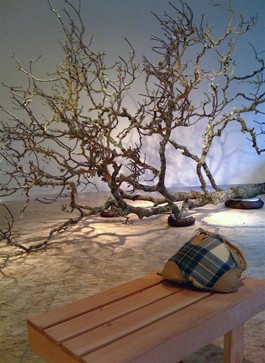
Those who are tempted to this party will be rewarded by spending time in the gallery space. Kelly takes the language of fashion and applies it to a tree limb she rescued from the side of the road and placed on leather and satin pillows (above). Rocks she has found are cosseted in remade fabric “packages,” zippered or buckled up and placed on hand-hewn benches or wheeled platforms—all accompanied by zippy text lampooning our serious devotion to frivolous human endeavors and neglect of the ripe beauty of the natural world.

Julian Goodman has documented her grief over her father’s death by using the 11 months’ worth of junk mail his address continued to receive after his passing and pulping it into sculpture. On an adjacent wall, Alicia Escott has drawn images of wild animals taken from old National Geographic magazines onto mattress bags and Stella McCartney corn-based shopping bag, the art guaranteed to disintegrate before the baggies do. Amy Keefer obsessively crochets her boyfriend’s used tank tops into their own private language when she’s not crocheting metal in response to the rise and fall of the gold market. These women are smart.

ArtSpace404 hosts “Unfinished Projects” overnight on July 11 from 4pm. 404 Mendocino Ave., Santa Rosa. Free. 707.579.2787.


Museums and gallery notes.

Reviews of new book releases.

Reviews and previews of new plays, operas and symphony performances.

Reviews and previews of new dance performances and events.

Shock & Awe (Accounting)

07.08.09

C alifornia State University (CSU) is facing a $583.8 million dollar budget cut for the 2009-10 fiscal year. CSU faculty are being asked to take 10 percent less pay by accepting two days of furloughs per month for 2009-10. Justification for this request is to protect 3,700 full time equivalent lecturer positions (9,000 instructors) from lay offs.

The CSU faculty, like state workers, are being asked to bail out the state by accepting less pay because of massive budget deficits. State worker unions and the California Faculty Association must stand firm against the CSU administration and state government officials. Giving concessions undermines the wages for working people across the board. It also means protecting the incomes of the rich and of the most powerful corporations in California.

The budget crisis in California has been artificially created by cutting taxes on the wealthiest people and corporations. The current “crisis” is a shock and awe process designed to undermine wages and unions in the state and force labor concessions to protect corporate profits.

According to the California Budget Project, tax cuts enacted in California since 1993 cost the state $11.3 billion dollars annually. Had the state continued taxing corporations and the wealthy at rates equal to those 15 years ago, we would not have a budget crisis today. Even though a budget crisis was evident last year, California income tax laws were changed in February of this year to provide corporations with even greater tax savings—equal to over $2 billion per year.

Half of all state revenue comes from personal income taxes paid by working people; another third comes from sales and use taxes. The result is that as a percent of income, taxes hit lower-paid workers the hardest. Corporations only pay for about one-tenth of the state budget. The rest of us are bailing out the rich by accepting massive budget cuts at a time when less spending will only exacerbate the economic situation.

Unions and working people need to say no to massive state budget cuts and fight for every service and job possible. We must say no to voluntary furloughs and push for new taxes on the wealthy and on the largest corporations. CSU professors should be the leaders for working people in the state. We must stand firm on no concessions, no furloughs and no cuts in classes for our students.

Over 25 CSU faculty have responded to my call for a negative vote on furloughs. Responses are running 5 to 1 opposing the furlough plan. The common negative response seems to be mostly that if we don’t give in to furloughs, a lot of our colleagues will be laid off. Unfortunately this is true, but over 1,000 lecturers have already been laid off in the past year, and many more will face layoff whether we approve furloughs or not.

The massive cuts to the CSU are not here just because of the recession. The recession had been long predicted. As working class faculty it is up to us to declare that there has been a deliberate effort to create an artificial fiscal crisis in order to force massive givebacks by unionized state workers.

Several faculty have declared that given the cost of living in California, they are barely making it and a 10 percent cut will mean that they are unable to meet their basic expenses. Many lecturers, like my friend Larry Bensky, a 19-year veteran at CSU East Bay, have been told they will not be back in the fall. Under the artificial state fiscal crisis, we will continue to see a systematic laying off of lecturers as we have in the past year.

The CSU system will not be able to immediately lay off 9,000 lecturers and still offer adequate classes for students currently enrolled. If the unions bail out the state with voluntary wage reductions, we are only delaying the inevitable without challenging the capital class in California. We must stand together in partnership with students to both challenge our elected officials and, if need be, move to a more open withdrawal of our labor to protect our lecturer colleagues and our students.

We have yet to hear that anyone is proposing a graduated progressive furlough plan for which management personnel and presidents would have the highest percent salary declines, and the lowest-paid faculty-employees the least or none at all. When such a move happens, then perhaps we should support a temporary suspension of our agreed salary increases under the union contract.

In the meantime, we haven’t seen the state honoring our hard-won contract with promised cost of living increases, and instead we are being asked to take reductions. It is time to say no, enough is enough!

Peter Phillips is a professor of sociology at Sonoma State University.

Open Mic is now a weekly feature in the Bohemian. We welcome your contribution. To have your topical essay of 700 words considered for publication, write [ mailto:op*****@******an.com” data-original-string=”1HN9KrpP/of2YU4jVvd43Q==06a1y/632fElq2mVCOa5EvsgPa4jKMGAks0YIb9iAUq0Xo4Z7fhgJKE6Eej+yc1F1oqTwW5SFIGjKDg3BLy0Rzq2wABoGWTCHPQ95pVkFdiqjU=” title=”This contact has been encoded by Anti-Spam by CleanTalk. Click to decode. To finish the decoding make sure that JavaScript is enabled in your browser. ]op*****@******an.com.


Fête Nationale

07.08.09

T here were only seven prisoners, none of them particularly political, housed in the Bastille on that hot July day in 1789 when the populace stormed the prison walls to liberate the unjustly jailed and help themselves to plenty of firearms and ammo. But no matter the inmates, the action prompted the French government to shortly establish the Rights of Man and Citizen and, not incidentally, launched the first great party that has since come to define le quatorze juilliet .

Far from the land of skinny women and garlicky snails, Bastille Day is celebrated in the North Bay with food and song. In Mill Valley, the 142 Throckmorton Theater hosts the cheeky orchestra and dancers of Chez Kiki in its ‘Cabaret D’Amor’ featuring the songs of Piaf, Chavelier, Brel and Baker with the nous sommes Française Moana Diamond and other Francophiliac performers on Saturday, July 11, at 8pm. 142 Throckmorton Ave., Mill Valley. $25-$35. 415.383.9600.

In Napa, the liberation of prisoners and citizenry is exemplified in fromage, accordions and le vin vieux. Cheese man Francis Sistiague has nimbly termed the celebration Napastille Day , organizing it around the many vendors gathered at the Oxbow Public Market for a celebration suitable for les enfants that features the SF Frisky Frolics outside at 6pm, French songs and dance all day, French cooper masters involved in live barrel making and oui, even French fries. Toni Cordioli holds down the squeezebox from 3pm while Allison Lovejoy tickles the ivories on Tuesday, July 14, from 2pm. Oxbow Public Market, 610 First St., Napa. Free. 707.963.1345.

Meanwhile, the Costeaux Bakery in Healdsburg promises that Tuesday will swell with a full day of events that are “just like Paris . . . but the servers are nicer” with a slate of activities including pétanque using bread bowls, can-can dancers and (quel dommage) a mime as well as French country dancing, an Eiffel Tower cookie decorating contest avec games for the kids, a goofy reenactment of the 1976 “Judgement of Paris” wine-tasting, an appearance by Mme. Marie Antoinette herself and, in a nouveau twist, a waiter’s race. The tomfoolery commences at 9am on July 14 and stretches until 4pm, with plenty of yummy lovely food not surprisingly for sale. Costeaux Bakery, 417 Healdsburg Ave., Healdsburg. Free. 707.433.1913.


Quick dining snapshots by Bohemian staffers.

Winery news and reviews.

Food-related comings and goings, openings and closings, and other essays for those who love the kitchen and what it produces.

Recipes for food that you can actually make.

Letters to the Editor

07.08.09

Yay-nay? good-bad?

I was really impressed by the depth of the reporting for this article (“Inside the Pornocopia,” June 24). This was comparable with the New York Times or any paper!

However, as I read to the end, I was hoping for answer: Yay or nay, what is good, what is bad? I guess there are no easy answers in life—and the data is not there yet.

Sophia Yen
Atherton

Decoders of b.S. is more like it

Paul Davis’ “Grow a Spine!”  (July 1) illustrates how hard and fast we’ve fallen for this dame called the internet.  Now, like reintroducing ourselves to the dog who’s been sitting by the door all this time, waiting for our return, Davis thinks we’ll have to retrain ourselves to read.       

What the hell?  If it’s true that we’ve become “mere decoders of information,” then a timeless yarn like Tom Sawyer becomes just so much undisciplined data to organize, file away, and forget. 

After all, there is no need for recall if we can electronically re-package a meandering Mississippi River narrative as a characterless hyper-story geared for those who think they might die in the next minute or two.

Oh sure, we’ll still have our share of delightful summer days curled up on the hammock with a glass of iced tea, but we won’t be flipping pages.  More likely we’ll be texting a cyber-friend about that new animated flick, Huck Finn’s Day Off , loosely based on a novel by some guy named Twain.  Supposed to be an author or something.

Tim Rudolph  
Santa Cruz

Get outside and play!

Thank you to Paul Davis for his honest and informative article. As an educator for 30 years, mostly at the college level, I strongly advise parents to not waste their money on technological gadgets for their children. Invest in musical instruments, art supplies, books, playtime in nature, dance, hikes, month-long summer camps, etc. Your children will be happier, healthier and better educated instead of bored and restless with user-friendly technology. The choice is stimulation or education.

After designing and teaching online courses, providing tech support and system administration as a director of online education, I see computers as tools with lots of data storage space. Computer usage is mundane and my technological learning curve is becoming a plateau. Sitting at a computer is mind- and butt-numbing. Fortunately, I grew up when education was more holistically challenging. I savored reading an entire book and used my imagination. I developed depth of focus, intellectual curiosity and the ability to ponder.

Please ignore all the frantic internet-media frenzy. Children need to use their whole bodies and brains to learn then expend their energy in play.

Larysa Tanya Shmorhay
Sebastopol


Corporate farming responds

As a sixth generation U.S. farmer, I fully understand the romance of yesteryear’s food production systems, but a reality check is in order.

As filmmaker Robert Kenner is making the circles promoting the release of Food, Inc. (“What’s Cooking?” June 17), his message about the modern food production system is nothing but a circle as well. The most glaring example is the mention that food shortages are looming, yet the solution is reverting back to food production methods of the 1930s when one farmer fed 10 people. Today’s American farmer feeds 164 people annually with the safest, most reasonably priced food the world has ever seen.

Today’s food system is safe, “green” and efficient. Cornell University just released a study indicating that today’s food system emits 63 percent less carbon per unit of food produced than the same unit of food produced in 1954. Science and technology combined with human initiative has allowed the U.S. farmer to provide food, fiber, fuel and pharmaceuticals more efficiently than ever before imagined.

With all of that said, I am willing to make a deal. If Kenner is willing to show his film in black and white and silent as movies were in the 1930s, I’ll go back to my grandfather’s era of food production.

Trent Loos
Loup City, NE


Fruit for Thought

0

07.08.09

U nhappy Pear is heartbroken after finding out her partner, Banana, is having an affair with Kumquat. A mug with the words “I love you” written on it tells the story of young couple’s shallow and doomed relationship, and the salvaging of self that comes from its ending. Apple, desperate for a vacation, leaves for Florida on his own where he spends a magical evening with the band The Hot Pocketz. He returns home to write them e-mails filled with lonely longing. When he gets the response he has been waiting for, it is a generic fan newsletter.

Cartoonist Melanie “Minty” Lewis of PS Comics and her cartoonist husband Damien Jay of The Natural World will be at the Charles M. Schulz Museum and Research Center on Saturday, July 11. As part of the museum’s ongoing artist-in-residence program, the two will be drawing, available to chat and sharing their creative and interesting work.

Lewis, who says that she “enjoys Peanuts very much,” has come to appreciate the darkness of Schulz’s work. Speaking by phone from her Berkeley home, she says, “I can appreciate a goofy story, but comics take so much effort and time. It is important to me to make a connection with people.” Her endearing characters, though usually nonhuman, reflect the complexities of the shared human experience.

Lewis creates art that is playful and fun, lovable and heartbreaking. She taps into who we are by paying attention. Her stories, she says, come “from different places. I take dialogue from things I over hear, by observing how people think about themselves. One kernel gets me thinking.”


When a friend secretly submitted one of Lewis’ comics for the prestigious Ignatz Award for outstanding mini-comic, she won. She remembers, “It felt good. Cartooning is a lonely craft. I get so engaged with the paper and stories, it felt good to know people are enjoying and reading them.”

A saltshaker learns the trick to happiness, a quiet receptionist is stirred by the attention of a coworker and an apple writes to deal with loss—these short stories are poignant, thoughtful and important.

Melanie “Minty” Lewis and Damian Jay appear on Saturday, July 11, at the Schulz Museum. 2301 Hardies Lane, Santa Rosa. 1pm to 3pm. Free with $5-$8 admission. 707.579.4452.


Museums and gallery notes.

Reviews of new book releases.

Reviews and previews of new plays, operas and symphony performances.

Reviews and previews of new dance performances and events.

Rockin’ the Middle Reach

0

07.08.09

P ark in a gravel parking lot and walk up steps covered in herbs, crushed with each visitor’s foot. Take in the gardens, where everything is planted to evoke a certain taste or smell found in wine. On the back deck of the estate’s guest house, find a . . . rock musician?

This is Live at the Middle Reach, the summertime music series at C. Donatiello Winery, which provides further antidote to the old-guard notion of tasting rooms as stuffy parlors of condescension. The concerts have been well-attended, especially after Gomez frontman Ian Ball stopped by last year—on his 33rd birthday. (Casual and loose, Ball invited the audience up from the scattered tables onto the stage, where dancing and singing “Happy Birthday” ensued amongst the Russian River Valley views.)

“We believe that all these things go together—fine wine, music, art,” says C. Donatiello’s Robert Conard. “All of these things are intertwined into the lifestyle that wine is all about. I don’t think they’re too far removed from one another.”


This year’s series kicked off with Maria Taylor, one-half of the Saddle Creek Records duo Azure Ray, and includes upcoming appearances by Summer Mencher, a fine indie songwriter from San Diego (pictured above); Nashville’s Carey Ott, signed to Dualtone records; the Dani Paige Band, fresh from opening for George Thorogood; Jason Damato, a feel-good Jack Johnson type; and Barba Shassus, a great band from Seattle that sounds a little like . . . well, Gomez, actually. A half-dozen or so other performers round out the summertime schedule, running through September. “Stylistically, we wanted to focus on music that was a little more of our generation,” Conard says, “that was approachable to Gen Xers and Millenials and not exclusive of Baby Boomers.”

The “Middle Reach” descriptor—an old miner’s term—was unearthed by Donatiello from the history books to designate a more specific winegrowing region in the large Russian River AVA, says Conard. Amongst the C. Donatiello gardens and the guest house—which doubles as the green room for performers—the setting is quintessentially wine country. This Sunday brings Fred Odell, a sandpaper-voiced songwriter influenced by Neil Young and the Byrds, and who plays the hell out of “Gallows Pole.” Buy a glass or three when he performs on Sunday, July 12, at C. Donatiello Winery. 4035 Westside Road, Healdsburg. 1pm. Free to patrons. 800.497.3376.


Mod Couple

07.08.09

A ll playwrights, including the great ones, have one thing in common: a first play. For Tennessee Williams, it was Candles to the Sun . For Arthur Miller, it was They Too Arise . With very few exceptions, most playwrights don’t make a mark until their third, fourth or fifth plays, with the early work all but entirely forgotten and rarely, if ever, performed. Neil Simon is the exception. Though one could argue he is not on the same level as Williams or Miller, Simon has it over them in that he struck a chord with his very first play, Barefoot in the Park . And, while he’s gone on to write dozens of other plays, many of them quite famous and loaded with awards, that first play has hardly been forgotten, and is still performed with remarkable regularity today, 48 years after it was first staged. It is easy to see why.

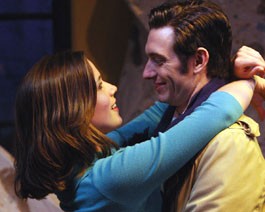
As evidenced in its funny, fast-paced production as part of Summer Repertory Theater’s current five-show season, Barefoot is not just a play about newlyweds grappling with the manic-depressive promise of a full new life, it is itself full of promise, heralding the arrival of a playwright with a lovingly skewed view of the modern human condition. In the SRT production, friskily directed by Shad Willingham, this promise is fully embodied by Nicole Erb as the newlywed Corie Bratter. Corie, after just six days married to rising attorney Paul Bratter (Joshua Roberts) has taken to matrimony the way happy cultists take to religious conversion, reveling in every mundane detail of domestic life as she waits for the phone to be installed in the tiny fifth-floor walk-up she will share with Paul.


In that opening scene, with a nice turn by Kit Grimm as the wise phone technician, the apartment itself (kudos to scenic designer Kerry Lee Chipman) is established as a full character in the comedy, with its own set of quirks and idiosyncrasies. As Paul, Roberts gives a pleasantly baffled performance, hilariously blending stiff uptightness with wide-eyed amazement.

The story is slight, as Corie’s overly-optimistic embrace of her new life hits some snags when she realizes that her new husband isn’t as free and wild as she is, but as a showcase for the work of a talented director and cast—and especially Erb—this “promising” work by Simon is a sweet-hearted delight. 

‘Barefoot in the Park’ runs through Aug. 5 at the Newman Auditorium on the SRJC campus, 1501 Mendocino Ave., Santa Rosa. $10-$25. 707.527.4343.


Museums and gallery notes.

Reviews of new book releases.

Reviews and previews of new plays, operas and symphony performances.

Reviews and previews of new dance performances and events.

Goodbye to Red’s

07.08.09

Kathleen was sittin’ down in Little Red’s Recovery Room in her criminal underwear bra / I was naked to the waist with my fierce black hound/And I’m cookin’ up a Filipino Box Spring Hog —Tom Waits, “Filipino Box Spring Hog”

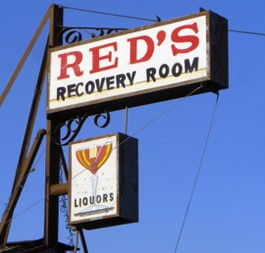
Immortalized by Waits in 1999, it’s a place to celebrate and mourn, a place where you can go by yourself and find old friends or meet new ones, and yes, a place where regulars really do know your name. It’s Red’s Recovery Room in Cotati, and sadly, after losing its lease, the roadhouse bar is closing later this month, probably on July 26.

“We’re not happy; Red’s should stay here forever,” says co-owner Maria Romani, wearing a roller derby T-shirt while sipping a drink at the bar. She hopes to reopen Red’s at another Cotati location.

The ramshackle wooden bar, on Highway 116 about a half a mile west of Highway 101, opened in 1976. Owners Bob (known as Red for his hair color) Lehan and Maureen Lehan took turns tending the bar, which became a place for celebrations ranging from turning 21 to divorcing.

“We welcomed everyone who walked through that door. They became our friends and regulars,” Maureen says, nostalgically surveying the bar last week. “A gathering place is being lost.”

The Lehans sold Red’s in 2003, and Red died in 2004. But Red’s Recovery Room soldiered on, giving people a place to play pool and buy stiff drinks at fair prices.

“It’s a dying, dying dive,” says Michael Mudd, sipping a beer on Red’s outdoor deck. “This is a historic moment.” The burly Mudd works as an electrician and says that one reason he loves Red’s is that anyone can go there straight from work. “Even if you’re sweaty or grimy, no one cares.”

Mudd recalled bringing his elderly mother to Red’s for a drink on a Sunday some 15 years ago. “I know what your Mom needs,” Red said to Mudd before making his mother a perfect martini. “It wasn’t a sin to have a cocktail back then,” Mudd adds.

Red was “a big, six-foot-tall redhead, a beautiful person,” Mudd remembers. “He could handle a bar and stop a fight—he was very polite, but big enough to escort you out the door.”

Like all great old bars, Red’s is filled with stories (liquor was distilled in the basement during prohibition, says one legend). Romani even swears that a ghost appears after hours. “Everyone who’s ever worked here has seen it,” she asserts. Is the ghost Red? Romani says no, adding: “It’s a good ghost.”

Red’s hosts a closing bash on Saturday, July 11, from 2pm to 2am. 8175 Gravenstein Hwy., Cotati. 707.795.4100.


Quick dining snapshots by Bohemian staffers.

Winery news and reviews.

Food-related comings and goings, openings and closings, and other essays for those who love the kitchen and what it produces.

Recipes for food that you can actually make.

Older and Better

07.08.09

In the opening moments of Rick Reynolds’ enjoyably self-obsessed one-man show, Only the Truth is Funny: Mid-Life at the Oasis, the semi-reclusive stand-up comic-turned-performance artist deftly relates his three rules for a happy and contended life.

No. 1: The knowledge that you were loved as a child.
No. 2: The belief in a benevolent God.
No. 3: Participation in a loving romantic relationship.

Possession of all three of these elements, Reynolds says, is a guaranteed shot at a life filled with good things; two of them is still better than most people; and even one of them gives you a step-up toward some semblance of contentment and happiness. Without any of these, Reynolds believes, you are pretty much screwed. This established, he goes on through the bulk of a brisk and funny 90-minute show—currently running at Cinnabar Theater in Petaluma—to relate why none of these all-important ingredients exist in his own life: he was unloved as a child, is solidly atheistic and was divorced almost a decade ago (and hasn’t gotten laid for six years). Yet he still goes on to end his show on a huge up-note, with a common-sense road map to finding true and lasting happiness—no matter how screwed up one’s childhood might have been.

The original Only the Truth is Funny, the show that made Reynolds moderately famous in the 1990s, was a then-pioneering blend of stand-up comedy and frank personal confession. The show played for years in San Francisco before moving on to Hollywood and Broadway. Reynolds followed it up with another show, All Grown Up . . . and No Place to Go, which was adapted into a short-lived television series. For the last decade or so, Reynolds has been writing screenplays and television pilot scripts, keeping a low profile at his Petaluma home. Several months ago, on off-nights at the Cinnabar Theater, Reynolds began workshopping a new version of Only The Truth is Funny, folding in new material with the aim of taking the revamped show on the road again, perhaps even back to Broadway. This summer, he’s back at Cinnabar with another run of an even tighter, funnier and more philosophical script, with a name that reveals the ongoing evolution of the show (the addition of the catchy, if slightly too-cute Mid-Life at the Oasis).

Leaner and meaner, the new show has further honed Reynolds’ patented comic-laid-bare monologue style, delivering a show that almost seamlessly flows from stand-up shtick (like his classic lounge-singer-paralyzed-from-the-neck-up bit) to true-life storytelling (Reynolds displays one of the ski masks his bank-robbing step dad knitted while in prison) to snarkily intriguing philosophical observations (if you think Reynolds is pretty good looking, you are probably not such a prize yourself). This new show is also brisker and performed without intermission. Fans of the original show will welcome the news that all the most talked-about bits are still in place, but the show is much fresher with the additional new material, smidgens of which have been borrowed from some of his other shows. The highlight of the night, and its surprisingly uplifting heart, is the moment where Reynolds lists all of the things that make his life worth living. It’s an inspiring roster, reminding us that in order to enjoy our lives, we need not have grand daily adventures or achieve great things. We need only recognize those things that give us pleasure.


Always adept at thinking on his feet, Reynolds keeps loose enough on stage to sometimes improvise, reacting to front row facial expressions with wry commentary on the make-up of his audience. On a Thursday night last week, he even turned a slip-of-the-tongue (replacing the word “partner” with “FARTner”) into a hilarious tangent (“It’s sad when the biggest laugh of your show is a mistake!”).

Wherever this new funny and thoughtful evolution takes Reynolds, it’s good to know he’s still in the game, good to see he’s still outspoken and cynical—but maybe a little more hopeful—and still finding the funny in life’s everyday truths.

‘Only the Truth is Funny: Mid-Life at the Oasis’ runs Wednesday-Thursday through Aug. 6 at the Cinnabar Theater, 3333 Petaluma Blvd. N., Petaluma. 8pm. $20-$25. 707.763.8920.


Museums and gallery notes.

Reviews of new book releases.

Reviews and previews of new plays, operas and symphony performances.

Reviews and previews of new dance performances and events.
My Beef With Meat

0

07.08.09

Last month, the federal government released a much-anticipated report on global climate change. It paints a chilling picture of what will happen if global warming continues unabated. “This report is a game-changer,” said the new director of the National Oceanic and Atmospheric Administration, Jane Lubchenco, at a press conference last week. “I think that much of the foot-dragging in addressing climate change is a reflection of the perception that climate change is way down the road, it’s in the future and it only affects certain parts of the country. This report demonstrates in concrete scientific information that climate change is happening now, and it’s happening in our back yards.”

The report, issued by the U.S. Global Change Research Program, compiles work from 13 different government agencies. In a refreshing break from the science-averse Bush administration, the report states unequivocally that climate change is human caused. The report details changes scientists are already seeing and predicts how the climate will change if greenhouse-gas emissions aren’t curtailed. The report also discusses how decisive policies can roll back the impending doom. (Read the report at globalchange.gov.) Here are two of the key findings:

• Climate changes are under way in the United States and are projected to grow. These include increases in heavy downpours, rising temperature and sea level, rapidly retreating glaciers, thawing permafrost, lengthening growing seasons, lengthening ice-free seasons in the ocean and on lakes and rivers, earlier snowmelt and alterations in river flows.

• Agriculture is considered one of the sectors most adaptable to changes in climate, but increased heat, pests, water stress, diseases and weather extremes will pose adaptation challenges for crop and livestock production.

There have been many reports on global warming and dire predictions from respected scientists. So far not much has changed. I hope that President Obama uses the power of his position to spur the dramatic and speedy action needed to reduce the profound impacts of the crisis. The challenge Obama faces is convincing people that the time to change our ways is today, not tomorrow. The trouble is, we don’t usually realize we’re in trouble until the roof starts caving in. For example, only when we faced global financial meltdown did world leaders act. A global recession is real and painful, but compared to the apocalyptic effects of unchecked global warming, it’s but a pinprick.

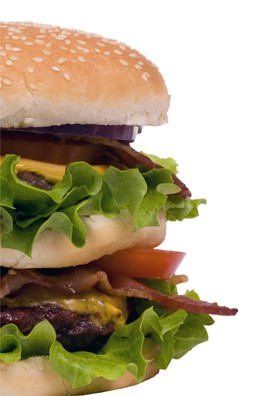
What does all this have to do with food? Well, while the U.S. government appears to be finally getting serious about acting against global warming, we the people need to do as much as we can. Food strikes me as particularly target-rich as we seek to reduce global warming. I see reducing our consumption of meat as the single most important action we can take as individuals. I’ve come to view a double bacon cheeseburger as the culinary equivalent of dumping dirty motor oil into a clear mountain lake. If eating burgers was only detrimental to those who eat them that would be one thing, but the production of meat and dairy across the world is an environmental catastrophe.

I’m a firm believer in spending more for quality, food included. But eating well shouldn’t be prohibitively expensive. I guess it’s all in how one defines “eating well.” For me, that means little or no processed food and plenty of fresh produce in season. Food is of course a necessary expense, but there’s a lot of discretion on how to spend your food dollar. But the ironic thing about food when you buy fresh, unprocessed ingredients and cook for yourself rather than opening a can or box, eating well generally costs less. At least that’s my belief.

According to the United Nations’ Food and Agriculture Organization (FAO), livestock production generates nearly a fifth of the world’s greenhouse gases, more than transportation. Animal agriculture is the leading source of methane and nitrous oxide emissions, which–combined with carbon dioxide–are the primary causes of global warming. Livestock production accounts for more than 8 percent of global human water use, the FAO says. Evidence suggests that it is also the largest source of water pollution thanks to animal wastes, antibiotics, hormones, fertilizers and pesticides used for feed crops, and sediments from eroded pastures. An estimated 30 percent of the Earth’s ice-free land is involved in livestock production. Approximately 70 percent of previously forested land in the Amazon is used as pasture, and feed crops cover a large part of what’s left.

Eating organically raised, grass-feed beef is a far better option than the factory-farmed garbage that most of us eat. But organically raised or not, livestock still sucks up scarce natural resources and contributes to global warming. I’m not saying we should give up meat entirely. Just eat less of it. Given the severity of the climate crisis, reducing our consumption of meat is a painless step everyone can take. What if President Obama declared he was willing to go without meat a few days a week for the sake of the planet? I’m not holding my breath for that one, but more often than not I’m going to hold off on eating meat.


Quick dining snapshots by Bohemian staffers.

Winery news and reviews.

Food-related comings and goings, openings and closings, and other essays for those who love the kitchen and what it produces.

Recipes for food that you can actually make.

Old Discoveries

07.08.09 W hen Ahna Adair found an abandoned cardboard box in the lobby of her S.F. apartment building, she looked inside. The box contained the full makings of a woman's suit, circa early 1960, replete with paper pattern and a particularly vicious brown, orange and green tweed fabric. Adair has since exhaustively examined her neighbor's unwanted clothing, laying it...

Shock & Awe (Accounting)

07.08.09C alifornia State University (CSU) is facing a $583.8 million dollar budget cut for the 2009-10 fiscal year. CSU faculty are being asked to take 10 percent less pay by accepting two days of furloughs per month for 2009-10. Justification for this request is to protect 3,700 full time equivalent lecturer positions (9,000 instructors) from lay offs. The CSU...

Fête Nationale

07.08.09 T here were only seven prisoners, none of them particularly political, housed in the Bastille on that hot July day in 1789 when the populace stormed the prison walls to liberate the unjustly jailed and help themselves to plenty of firearms and ammo. But no matter the inmates, the action prompted the French government to shortly establish the...

Letters to the Editor

07.08.09Yay-nay? good-bad? I was really impressed by the depth of the reporting for this article ("Inside the Pornocopia," June 24). This was comparable with the New York Times or any paper!However, as I read to the end, I was hoping for answer: Yay or nay, what is good, what is bad? I guess there are no easy answers...

Fruit for Thought

07.08.09 U nhappy Pear is heartbroken after finding out her partner, Banana, is having an affair with Kumquat. A mug with the words "I love you" written on it tells the story of young couple's shallow and doomed relationship, and the salvaging of self that comes from its ending. Apple, desperate for a vacation, leaves for Florida on his...

Rockin’ the Middle Reach

07.08.09 P ark in a gravel parking lot and walk up steps covered in herbs, crushed with each visitor's foot. Take in the gardens, where everything is planted to evoke a certain taste or smell found in wine. On the back deck of the estate's guest house, find a . . . rock musician?This is Live at the Middle...

Mod Couple

07.08.09 A ll playwrights, including the great ones, have one thing in common: a first play. For Tennessee Williams, it was Candles to the Sun . For Arthur Miller, it was They Too Arise . With very few exceptions, most playwrights don't make a mark until their third, fourth or fifth plays, with the early work all...

Goodbye to Red’s

07.08.09 Kathleen was sittin' down in Little Red's Recovery Room in her criminal underwear bra / I was naked to the waist with my fierce black hound/And I'm cookin' up a Filipino Box Spring Hog —Tom Waits, "Filipino Box Spring Hog"Immortalized by Waits in 1999, it's a place to celebrate and mourn, a place where you can go...

Older and Better

07.08.09In the opening moments of Rick Reynolds' enjoyably self-obsessed one-man show, Only the Truth is Funny: Mid-Life at the Oasis, the semi-reclusive stand-up comic-turned-performance artist deftly relates his three rules for a happy and contended life.No. 1: The knowledge that you were loved as a child. No. 2: The belief in a benevolent God.No. 3: Participation in a loving...

My Beef With Meat

07.08.09Last month, the federal government released a much-anticipated report on global climate change. It paints a chilling picture of what will happen if global warming continues unabated. "This report is a game-changer," said the new director of the National Oceanic and Atmospheric Administration, Jane Lubchenco, at a press conference last week. "I think that much of the foot-dragging in...
11,084FansLike
4,446FollowersFollow
6,928FollowersFollow