Watch the Right Thing

0

Spike Lee has been challenging filmgoers since the release of his first movie, Joe’s Bed-Stuy Barbershop: We Cut Heads, in 1983. After the 1989 box office breakthrough Do The Right Thing, Lee proved his staying power by addressing racial and political issues in films that make many viewers uncomfortable but always seem to teach something new.

Lee celebrates the release of 36 films, or “joints” as he terms them, on March 29 at City Winery in Napa. Attendees will be treated to selections from his movies—great for those who only know him from Malcolm X or the classic Jungle Fever—and six wines paired with the screenings. Additionally, there will be a Q&A sessions with Lee, an exclusive look at his latest film, Da Sweet Blood of Jesus, and a surprise musical guest. Expect this one to sell out.

An Evening of Music, Film and Wine
with Spike Lee happens March 29 at City Winery, 1030 Napa. 8pm. $60–$75. 707.260.1600.

Durst’s DUI

Robert Durst, the eccentric heir to a Manhattan real estate fortune now awaiting murder charges in California for the alleged execution-styled killing of his confidante Susan Berman in December 2000, has become an overnight criminal celebrity.

But for all the media attention being paid to Durst—he’s been the subject of a major motion picture (All Good Things), a six-part HBO documentary series (The Jinx), more than a dozen books and tens of thousands of newspaper and tabloid articles—one criminal incident has gone overlooked: in May of 1995, Durst, then 52, was arrested in Mendocino County on suspicion of drunken driving.

Taken by itself, Durst’s arrest 20 years ago in Mendocino County means little. But assessed in terms of geography and chronology, it fills in a significant missing piece of the puzzle regarding Durst’s activities in Northern California during the 1990s and early 2000s.

According to archives of the Ukiah Daily Journal, officers from the Mendocino County Sheriff’s Office arrested Durst on suspicion of “driving under the influence” on Highway 1, near the Lansing Street exit just north of Mendocino at 10:05pm on May 10, 1995. Durst provided no address, though by that time he had a home in the quaint village of Trinidad, 165 miles north on the California coast, in Humbolt County.

There was no further report of how the case was disposed. The timing of the arrest, however, is critical in terms of Durst’s criminal biography. According to an interview given to the New York Times earlier this year by Douglas Durst (Robert Durst’s estranged younger brother who oversees the family’s real estate empire), Durst appeared in New York City at the hospital bed of his dying father, Seymour Durst, only a few days after his arrest in Mendo County.

Seymour Durst died on May 15, shortly after his eldest son’s visit.

What the arrest shows—counter to what Robert Durst alleges in an interview with filmmaker Andrew Jarecki in The Jinx—is that he possessed a bicoastal mobility in spite of living in a rural Humboldt County outpost.

It’s believed that Hurst arrived in Trinidad in the fall of 2000, weeks before the murder of Berman in her Beverly Hills bungalow.

Authorities have evidence that Durst removed his car from the Arcata-Eureka Airport on Dec. 19, 2000. The following day, he placed calls from Garberville, 90 miles to the south. At 10pm on Dec. 23, he was on a flight to New York City out of San Francisco. Berman’s body was found in a pool of blood the following day.

When confronted by Jarecki with this timeline in The Jinx, a twitching Durst asserted, “The timing on all of this gets very tight because it’s a long way from Trinidad to Los Angeles—not much time to do all of that.”

Google Maps says the 660-mile drive can be made in about 10 hours. The timing is not as tight as Durst wanted Jarecki to believe.

Moreover, Durst’s arrest in Mendocino also shows that he was active in Northern California two years before teenagers Kristen Modafferi and Karen Marie Mitchell went missing from San Francisco and Eureka respectively. He is currently being investigated by authorities in both of those cases.

Rites of Spring

0

In the title chapter of Stalking the Wild Asparagus, Euell Gibbons describes a fishing trip along the banks of the Rio Grande when he was 12 years old. On his way to the fishing hole, he was distracted.

“Happening to look down,” he writes, “I spied a clump of asparagus growing on the ditch bank, with half a dozen fat, little spears that were just the right size to be at their best.”

The thrill of spotting edibles in the wild is well known to foragers who make a practice, as Gibbons puts it, of “reaping where they didn’t sow.” To me, the sight of wild asparagus shoots poking out of the ground is akin to the spectacle of morel mushrooms on the forest floor. They remain all but invisible until you spot your first. Then, once you get your eyes adjusted to the shape—in both cases a stalk capped with a funky crown—they start materializing out of the landscape.

Both wild and domestic asparagus are the same species, Asparagus officinalis, and harvesting cultivated asparagus is, like stalking wild asparagus, a magical experience. Although much easier to find than its wild counterpart, harvesting cultivated asparagus still involves a token hunt. Even in a farm field, the stalks remain all but invisible until the first one is spotted. Then more appear.

I once joined a spring asparagus harvest at the farm of my friend Jane Kile, who has since passed away. All of the previous year’s mature plants had been removed from the asparagus patch in Dixon, Mont., leaving a brown field that appeared totally barren. But as I approached, I realized it was full of fast-growing stubble.

“It will grow six inches in a day, if it’s warm enough,” Kile told me on that chilly April day. “But today it probably only grew a 10th of an inch.”

Although it’s more closely related to grass, asparagus requires the long-term commitment of someone who plants an orchard of fruit trees. A good patch will produce for 20 years or more, but the asparagus grower must wait years before harvesting any shoots, giving time for the roots to establish themselves. After a five-week harvest, quit picking and let the shoots grow into plants, which can supply the roots with the necessary energy to make it through the winter.

Here’s Kile’s recipe for asparagus soup. It will help you make it through the spring. And if you freeze enough, it will take you through summer too.

Peel a head of garlic and oven-roast the cloves at 350 degrees until completely soft. Meanwhile, trim one and a half pounds of fresh asparagus by cutting off the woody sections at the thick end of the shoot.

Break off the tips and cut the remaining stalks into one-inch pieces. Heat four tablespoons of butter in a pan, and sauté two chopped leeks until tender. Add the asparagus stalks, roasted garlic and enough chicken stock to cover them.

Cook until stalks are tender. In another pan, boil the tips for five minutes.

Allow the asparagus and garlic to cool, and purée it. Return the puréed mixture to the pan, add three more cups of stock and bring to a simmer. Remove from heat and season with salt and pepper. Add the boiled tips, and stir in three tablespoons of lemon juice.

It’s Raining Bacon

0

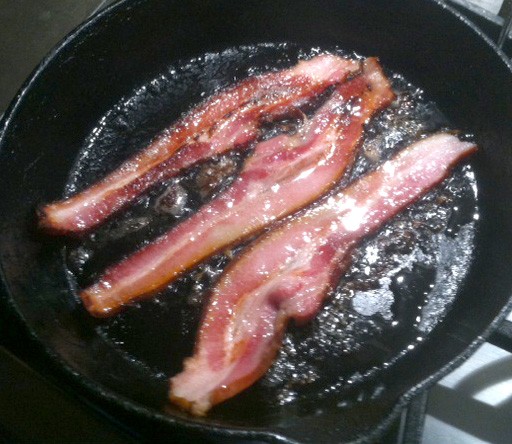
You know you live in a great place when there is an abundance of local bacon to choose from. There’s Victorian Farmstead and Black Pig Meat Co. from Sebastopol. Napa has its superb Fatted Calf bacon. In the super-ultra-premium category, there’s Mangalitsa pork from Windsor’s Winkler Wooly Pigs.

My new favorite is the excellent bacon from Santa Rosa’s one-year-old Sonoma County Meat Co. The thick-sliced bacon sells for $6.99 a pound in their shop and a bit more elsewhere, and it’s an example of restraint, not a word generally associated with bacon. The folks at SCMC know that good pork belly is best when it isn’t overpowered by too much smoke flavor or salt. I tried the “classic” bacon, slow-cured and smoked over hickory. It’s lightly seasoned with maple sugar and red pepper flakes, but it’s the sweet pork flavor that comes through. There are a few other secret ingredients, but they’re not giving them away. Whatever it is, it’s great stuff. They also make a delicious-sounding honey-lavender bacon.

In the pan, the bacon yields a fair amount of water. Cook it slowly on medium heat to get it nice and crisp but to prevent the sugars from burning. Sonoma County Meat Co.’s bacon is available at Oliver’ Markets, Big John’s Market in Healdsburg, the the West End Farmers Market and SCMC’s retail shop at 35 Sebastopol Ave., Santa Rosa. 707.521.0121. www.sonomacountymeatco.com

Crop Circles

The push to eliminate genetically modified organisms from our food has finally broken the surface of mass consumer complacency. Occupying a slot of infamy once reserved for trans fats and nitrates, GMOs are today’s reigning symbol of the Evil Empire of Big Ag, and the latest target of a health-conscious public.

Genetically modified organisms are those whose genetic materials have been altered by laboratory technology. Such biotech alteration is experimental, and the fear among GMO opponents is that changes of this sort, on a genetic level, produce substances that the human body is not designed to process. Those can lead to cancer, allergies or other health problems.

One unexpected byproduct of the fight over GMOs is the confusion arising over GMOs and organic labeling.

The confusion is in part courtesy of the U.S. Department of Agriculture, whose standards for what constitutes “organic” are far below, for example, the Marin County standard under that county’s Marin Organic Certified Agriculture (MOCA) program.

The USDA bar is set so low for the “organic” label that even China can clear it—”Which is just crazy,” says Jeffrey Westman, executive director of Marin Organic, a Point Reyes Station–based nonprofit that promotes organic agriculture and food access in Marin County.

Organic angst is nothing new, says Westman; it’s what prompted the nonprofit he runs into existence, about 15 years ago. “A group of farmers said what the USDA said was organic wasn’t good enough,” he recalls.

Now, 15 years later, everybody’s jumping on the organic and GMO-free wagon. Even General Mills Inc. has gone “GMO-free” on Cheerios, the popular cereal which enjoyed sales of more than $365 million in fiscal year 2013.

The corporate push over organic-friendly labeling has left organic growers with the fear that consumers will leap-frog over the “organic” label and purchase the often cheaper products that tout non-GMO status.

Such confusion could be devastating for farmers who have earned the USDA “certified organic” label by forgoing toxic fumigants such as methyl bromide—or for those who have earned local organic certifications that are beyond the USDA standard.

The organic label certifies the method of farming; it is not a verification of the final product. “Our farmers are probably a lot less freaked out than others, because they are certified by MOCA,” says Westman.

But Westman sees an unfolding irony as “organic” moves into its second decade as a corporate-embraced buzzword, and loses its power and meaning in the process.

He fears younger farmers might forgo the certification process entirely, since the locals who are buying their crops already know where it’s coming from, and how it was farmed.

“There’s a whole bunch of cool, young growers out there who are really walking the walk” when it comes to true-blue organic farming, says Westman. But they’re working with tough margins already, and not necessarily putting a priority on being certified organic or interested in going through the process, on the logic that, as Westman describes it, “I’m selling locally to people who know my product, so there’s no reason to get certified.”

“The problem there is that there’s no accountability,” Westman says. In other words, if the really hard-core “organic” farmers forsake the labeling protocols, then Big Ag retains its dominance at the labeling table. Westman says he was at a recent conference attended by a staffer from Secretary of Agriculture Tom Vilsack’s office. He was asked why it was so hard to create organic standards that have teeth. “The answer is, show up. They’re listening, but we’re not telling them very loudly.”

[page]

IT’S COMPLICATED

Even if you start with non-GMO seed and farm organically, it’s still possible for compromise to occur if your farm is located near acreage farmed in the “conventional” chemically enhanced method, or for GMOs to sneak into a crop due to cross-pollination. Today, more than 80 percent of U.S. corn, soybean and cotton crops are genetically modified, and at least 90 percent of the sugar beets grown in the U.S. are genetically modified.

The issue is even more complicated than that. The Petaluma Seed Bank doesn’t sell certified organic seeds because it works with small growers and producers from all over the world, says store manager Paul Wallace. The operation is just not big enough to ensure that, say, seeds coming from Africa are certified organic, so their seeds are not certified.

What the seed bank can guarantee, he says, “with our hands on our hearts,” is that all the seeds available are non-GMO, not treated with chemicals and non-patented.

So, how to avoid GMOs—besides by buying non-GMO seeds?

A big question, it turns out, as I discovered attending a GMO panel at last month’s EcoFarm 2015 conference at Asilomar in Pacific Grove. The USDA organic certification—which is a higher standard than the “Made with Organic Ingredients” label—and the Non-GMO Verification Project seal are brands to look for when seeking to avoid genetically modified organisms in foods. The Non-GMO Verification Project’s standards ensure that GMOs are avoided in all aspects of production.

Due to the risk of contamination in processing, however, no product can claim to be 100 percent “GMO free.” As the Non-GMO Verification Project’s website reminds consumers, “the Non-GMO Project only verifies meat and processed foods. Due to the lack of verification for fresh produce, buying certified organic produce is the only way to avoid GMOs in your fresh foods.”

The North Bay puts an emphasis on GMO labeling and supported Proposition 37, the 2012 California ballot initiative which would have required GMO products to be labeled as such, and prohibited such products from using the label “Natural.”

The measure was defeated
(51 to 49 percent), after Monsanto Co, Pepsi Co., Coca-Cola, Kraft Foods, Dow AgroSciences and other corporations spent a combined $47 million opposing it (compared to the $9.2 million spent by supporters).

Consumers continue the push for GMO labeling. Whole Foods Market, according to senior media relations specialist Liz Burkhart, says “people have a right to know what’s in their food. That’s why we have set a deadline to provide full GMO transparency on all of our food products by 2018.”

ORGANIC VS. NON-GMO

For the Seed Bank’s Wallace, emphasizing what is “organic” and what isn’t moves the issue beyond where it should be—which is with local farmers and local consumers who trust their produce. If you’re standing in Walmart perusing the produce and angling for the “organic,” you’re selling yourself short as a consumer.

“It’s important to eat locally and seasonally,” Wallace says. But if you’re going to shop at the big box, he says the emphasis should be on the nutritional value of the food. “The organic red pepper at Walmart is probably better than the non-organic red pepper at Walmart, but those shouldn’t be the only two choices. There are so many opportunities to vote with your fork these days. You want a red pepper? Go to a ‘mindful’ operation, go to a farmers market, grow it yourself on your roof or join a community garden.”

If a seed, vegetable or product such as granola has gone through the years of planting, development and testing to earn “organic” status, it can also be considered as GMO-free as is possible. But there’s no denying that genetic engineering of many things, including seed for large-scale corn and soy crops (keyed to work with toxic herbicides such as glyphosate), has become both more sophisticated, more prevalent. The integrity of “organic” as a non-GMO food source requires that watchdogs such as the Center for Food Safety never sleep.

“Our main concern is making sure that GMO foods are regulated and that health risks are assessed,” says the center’s West Coast director Rebecca Spector.

The problem is that mandatory GMO labeling has run afoul of powerful agriculture and manufacturing lobbyists, who have spearheaded disinformation campaigns such as the one that helped to defeat Proposition 37.

“The FDA made a political decision in 1992 that GMO foods were not materially different than any others,” Spector told EcoFarm panel attendees. “So we work for voluntary labeling such as the non-GMO Verification Project, and lobby at the state level for mandatory labeling laws.”

In October, Consumer Reports described the “fierce opposition to GMO labeling from many seed manufacturers and big food companies, which have spent nearly $70 million in California and Washington state alone to defeat GMO-labeling ballot initiatives.” Vermont is the only state so far to require such labeling and already there have been legal challenges.

But Spector compares the GMO-labeling battle to controversial issues like same-sex marriage and marijuana legalization that faced huge opposition before gaining acceptance.

“It can take many years,” she says.

[page]

ORGANIC CHALLENGES

After 10 months at the helm of the Santa Cruz–based national Organic Farming Research Foundation (OFRF), Brise Tencer sees momentum both in the larger market share that certified organic products gain each year, and the fact that “price difference between organic and conventional produce is also getting smaller.”

Tencer says the three-year transition required to go from conventional to organic is “a challenge for farmers. They have to grow organically for three years, during which time they can’t label their harvests as organic.” Those who know how organic crops are produced, she contends, know that there’s much more diversity in the organic label than the non-GMO label.

Tencer says organic farmers are tackling the problem of accidental GMO pollination head-on. “We are working with varieties that won’t cross-pollinate with GMO varieties. One such project—organic-ready maize—is going really well,” she says. “Non-GMO integrity is still a work in progress, but the results are really exciting.”

Mark Lipson, a Santa Cruz County farmer and former policy program director at OFRF, spent the past four years in Washington as the organic and sustainable agriculture policy advisor at the USDA. He says the non-GMO brand has gained a lot of momentum in the last decade.

“The consumer-safety aura of the non-GMO claim, abetted by social-media chatter, has led many organic producers and processors to include a non-GMO statement on their labels,” he says.

But at the same time, “consumer ignorance has been exacerbated by misleading marketing,” he says, giving a pass to conventional farming “dependent on herbicides, neonicotinoid insecticides and synthetic fertilizers, but not using GMO seeds—at the expense of organic farmers.”

FEEDING THE FUTURE

The choices we confront—”organic” and “non-GMO”—may turn out to be luxuries we can no longer afford. Almost half the land area on earth is used for farmlands and pastures, and fully 70 percent of the earth’s available fresh water goes to provide the food that more than 7 billion humans need to survive.

In a lecture in November, UC Santa Cruz biology professor Lincoln Taiz reminded the audience of the long lineage of agriculture that has led to today’s depletion of space and resources. We need a second “green revolution,” said Taiz, after reviewing the grim facts of population pressures, climate change, drought and starvation. Obesity in the first world is ironically overbalanced by accelerating malnutrition in Asia and Africa.

“Crop yields must double to meet the predicted population increases by 2050,” Taiz warns. “Agriculture is a Faustian bargain. Every expansion involves great ecological costs and loss of biodiversity.” Yet Taiz remains optimistic that “molecular tools” can increase plant productivity.

Yes, GMOs. Genetic engineering, some scientists believe, is the only means of future survival in a world of disappearing natural solutions.

“Gene transfer for crop improvement,” says Taiz, “can engineer new traits that will enable plants to survive climate change, drought and floods.”

But many farmers resist this vision of the future. Organic pioneer Jeff Larkey of Santa Cruz County’s Route 1 Farms reports that organic growing has expanded in the United States “to about a $35 billion slice of the agricultural pie”—still only 5 percent of the total, but growing.

“Along the Central Coast, which some consider ground zero for the movement, it’s grown from a handful of farmers to now include some of the largest organic vegetable growers in the country,” says Larkey.

But he’s concerned about GMO-seed-supply contamination.

“Once these things get out there, there’s no way to remove them. Even pesticides will eventually degrade, but this has the potential to be with us forever,” says Larkey. Unlike Taiz, he sees organic farming and resistance to GMOs as the key to ecological sustainability, and he doesn’t plan on giving up that fight.

“The vast majority of the GMO crops have been created to be resistant to herbicides so that they can be used with impunity,” Larkey explains. “We are looking at water aquifers and soil biology in a huge part of our country becoming negatively impacted from long-term use of the herbicide glyphosate, and that should be of concern to everyone.”

Tom Gogola contributed to this story.

Dirty and Rotten

0

When singer Kurt Brecht and guitarist Peter “Spike” Cassidy started the punk band Dirty Rotten Imbeciles (better known as D.R.I.) back in 1982, they never imagined the band would be going strong after 33 years.

Besides an extended hiatus between 2006 and 2013 when Cassidy spent time treating and recovering from colon cancer, the band has been touring incessantly, playing places as far-reaching as South America and Indonesia.

“We just recorded a new EP that has three new songs and two re-recorded ones from years ago,” Brecht says, by phone from his home in Houston, Texas. “We don’t have a name for it yet and still no release date planned, but it will be released on Beer City records. We also have a few other new songs, and we’ve been working in our new drummer, Brandon Karns, who joined us last summer.”

Although a contract with Slim’s in San Francisco from a previous booking agent had prevented the band from playing in the North Bay, Cassidy now books all D.R.I. dates, and the band will finally do a proper Sonoma County show on Thursday, April 2, at 755 Afterdark in Sebastopol with Slandyr, Twisted Psychology, Thought Vomit, Trecelenc and Phantasm. 755 Petaluma Ave., Sebastopol. 7pm. $17 advance; $20 at the door (all ages). 707.861.9190. www.755afterdark.com.

Local Boy

0

‘I really do love playing in small spaces,” says multi-instrumentalist Gabriel Kahane, describing the difference between playing enormous shows to thousands of people and doing smaller shows, like the 100-seat fundraiser he’ll be playing this week in Sebastopol.

“With a small show, it’s more fun to ‘run the room,’ as they say in the biz. I’m really looking forward to the Sebastopol show, for a whole number of reasons—and getting to play a focused, intimate show for a few people, that’s just one of them.”

For another, the show at the French Garden—a fundraiser for Main Stage West Theater—is a kind of a homecoming for Kahane. Twenty years ago, he was a student at Santa Rosa High School, best known then as the son of classical pianist Jeffrey Kahane, former conductor of the Santa Rosa Symphony. Today, the younger Kahane is a star in his own right.

As a composer, he’s written original pieces for the Los Angeles Philharmonic, Kronos Quartet and the Orpheus Chamber Orchestra. His own recordings, bearing a style similar to Rufus Wainwright, have made him someone to watch among fans of alternative music. His recent CD, The Ambassador—a sparkling collection of songs inspired by 10 different building in Los Angeles—was proclaimed one of the best albums of 2014 by Rolling Stone magazine. NPR called it a CD that “needs to be heard.”

Currently, Kahane is on tour with the experimental country-bluegrass-classical band the Punch Brothers, working their way across the country. But Kahane will be taking a night off on March 29 to play for just 100 people, tops. It’s a favor to his old friend and mentor, Kahane’s former high school drama teacher John Craven, whose wife Beth Craven is now artistic director of Main Stage West.

“John was one of the more influential figures in my life, as far as my early creative development is concerned,” says Kahane, on the phone from New York where he now resides. “A few months ago, John and Beth came to see a concert of mine in Seattle.” Afterward, Beth Craven contacted Kahane and asked if he’d be open to doing a fundraiser for Main Stage West.

“I got back immediately, telling her I’d be honored,” he says. “I’m delighted to be doing this show, in part as a way of giving back to the community that raised me, in a sense.”

The hot-ticket event on Sunday includes an elegant dinner, auctions and more. Local actor Jeffrey Weissman (Back to the Future II and III, Pale Rider) will be the host and auctioneer.

“I do a lot of big shows now,” says Kahane, whose theatrical roots are still active. He composes regularly for the theater and collaborated with Broadway director John Tiffany (Once,
The Glass Menagerie) to create a full-on theatrical staging for his concert tour of The Ambassador. “But in between New York and L.A., my audience is still very much developing. In the context of the tour I’m doing with Punch Brothers, I’m opening for them, and, yes, those are bigger rooms—a thousand or 2,000 people—but those are the Punch Brothers’ audiences, not mine.

“In a small space like the French Garden,” he continues, “it’s easier to make the audience feel as if they are all having the same experience at the same time. That doesn’t happen when there are 2,000 people in the audience.”

Asked what he learned from Craven, the Art Quest program and the whole Santa Rosa high school experience, Kahane wastes no time in answering.

“For me there was a real rigor and purity to the work that we were doing. It’s pretty improbable that at a public high school we could be doing plays by Chekhov and Oscar Wilde, Caryl Churchill and Tony Kushner. That’s not your typical high school drama fare. And we really dug deep into those plays! It was a pretty extraordinary experience.”

That said, the show Kahane plans for this weekend will be relatively stripped of theatricality, focusing on the drama of the songs themselves, which—as anyone knows who’s listened to Kahane’s work—will be plenty full of drama, comedy and narrative power.

“I will do a sort of tasty menu, sampling various aspects of my work,” he says, playfully nodding to the fact that he’ll be performing in a restaurant. “I’ll do a number of songs from The Ambassador, a couple of songs from Where Are the Arms, my previous album—and probably a classic or two.”

Kahane’s affection for the indelible tunes of the American Songbook is part of his growing reputation.

“That’s just one of the things I learned from John,” he says. “An appreciation for the classics.”

Mar. 20: Man at Work in Napa

0

Best known as the vegemite-sandwich-eating lead singer for down-under ’80s band Men at Work, frontman-turned-solo-artist Colin Hay still has his nose to the grindstone, and is making some of the strongest music of his career. Written and recorded in his Los Angeles home studio, his latest album, Gathering Mercury, is Hay’s most personal effort. The passing of his father spurred the creation of the album; Hay shares these emotionally packed songs and more when he makes his way to Napa as part of a national tour on Friday, March 20, at City Winery Napa, 1030 Main St., Napa. 8pm. $30–$45. 707.260.1600. 

Mar. 21: Haunted Showman in Monte Rio

0

If you like 3-D movies, you should have seen them in the 1950s; 3-D was invented then after all. But the fun didn’t stop at 3-D. For The Tingler, theaters installed vibrating seats, and flying skeletons circled patrons at screenings of The House on Haunted Hill. These innovations, and many others, were the product of one man, filmmaker William Castle. As strange as his methods were, they worked, and his films are considered classics. Castle gets the book treatment from author Joe Jordan, who comes to the North Bay on Saturday, March 21, to read from Showmanship and talk about Castle and his Haunted Hill—film clips included! Things get spooky at the Rio Theater, 20396 Bohemian Hwy., Monte Rio. 2pm. $5. 

Mar. 21-23: Russian Glory in Rohnert Park

0

Moscow-born, New York–based classical pianist Olga Kern returns to the Santa Rosa Symphony after a spellbinding performance in 2013 for the orchestra’s latest performance, ‘Blaze of Russian Glory.’ This time, Kern sits in with conductor Bruno Ferrandis and the symphony for several fiery, passionate piano concertos written by Russian masters. First, the vivacious Piano Concerto no. 1 from Rachmaninoff lights up Weill Hall with spirited scales and unusual time signatures, then Prokofiev’s own Piano Concerto no. 1 heats up with experimental melodies and abundant creativity. Stravinsky’s Firebird Suite caps off the program taking place Saturday through Monday, March 21–23, at the Green Music Center. 1801, East Cotati Ave., Rohnert Park. Saturday and Monday, 8pm; Sunday, 3pm. $76 and up. 707.546.8742. 

Watch the Right Thing

Spike Lee has been challenging filmgoers since the release of his first movie, Joe's Bed-Stuy Barbershop: We Cut Heads, in 1983. After the 1989 box office breakthrough Do The Right Thing, Lee proved his staying power by addressing racial and political issues in films that make many viewers uncomfortable but always seem to teach something new. Lee celebrates the release...

Durst’s DUI

Robert Durst, the eccentric heir to a Manhattan real estate fortune now awaiting murder charges in California for the alleged execution-styled killing of his confidante Susan Berman in December 2000, has become an overnight criminal celebrity. But for all the media attention being paid to Durst—he's been the subject of a major motion picture (All Good Things), a six-part HBO...

Rites of Spring

In the title chapter of Stalking the Wild Asparagus, Euell Gibbons describes a fishing trip along the banks of the Rio Grande when he was 12 years old. On his way to the fishing hole, he was distracted. "Happening to look down," he writes, "I spied a clump of asparagus growing on the ditch bank, with half a dozen fat,...

It’s Raining Bacon

You know you live in a great place when there is an abundance of local bacon to choose from. There's Victorian Farmstead and Black Pig Meat Co. from Sebastopol. Napa has its superb Fatted Calf bacon. In the super-ultra-premium category, there's Mangalitsa pork from Windsor's Winkler Wooly Pigs. My new favorite is the excellent bacon from Santa Rosa's one-year-old Sonoma...

Crop Circles

The push to eliminate genetically modified organisms from our food has finally broken the surface of mass consumer complacency. Occupying a slot of infamy once reserved for trans fats and nitrates, GMOs are today's reigning symbol of the Evil Empire of Big Ag, and the latest target of a health-conscious public. Genetically modified organisms are those whose genetic materials have...

Dirty and Rotten

When singer Kurt Brecht and guitarist Peter "Spike" Cassidy started the punk band Dirty Rotten Imbeciles (better known as D.R.I.) back in 1982, they never imagined the band would be going strong after 33 years. Besides an extended hiatus between 2006 and 2013 when Cassidy spent time treating and recovering from colon cancer, the band has been touring incessantly, playing...

Local Boy

'I really do love playing in small spaces," says multi-instrumentalist Gabriel Kahane, describing the difference between playing enormous shows to thousands of people and doing smaller shows, like the 100-seat fundraiser he'll be playing this week in Sebastopol. "With a small show, it's more fun to 'run the room,' as they say in the biz. I'm really looking forward to...

Mar. 20: Man at Work in Napa

Best known as the vegemite-sandwich-eating lead singer for down-under ’80s band Men at Work, frontman-turned-solo-artist Colin Hay still has his nose to the grindstone, and is making some of the strongest music of his career. Written and recorded in his Los Angeles home studio, his latest album, Gathering Mercury, is Hay’s most personal effort. The passing of his father...

Mar. 21: Haunted Showman in Monte Rio

If you like 3-D movies, you should have seen them in the 1950s; 3-D was invented then after all. But the fun didn’t stop at 3-D. For The Tingler, theaters installed vibrating seats, and flying skeletons circled patrons at screenings of The House on Haunted Hill. These innovations, and many others, were the product of one man, filmmaker William...

Mar. 21-23: Russian Glory in Rohnert Park

Moscow-born, New York–based classical pianist Olga Kern returns to the Santa Rosa Symphony after a spellbinding performance in 2013 for the orchestra’s latest performance, ‘Blaze of Russian Glory.’ This time, Kern sits in with conductor Bruno Ferrandis and the symphony for several fiery, passionate piano concertos written by Russian masters. First, the vivacious Piano Concerto no. 1 from Rachmaninoff...
12,118FansLike
4,924FollowersFollow
6,928FollowersFollow