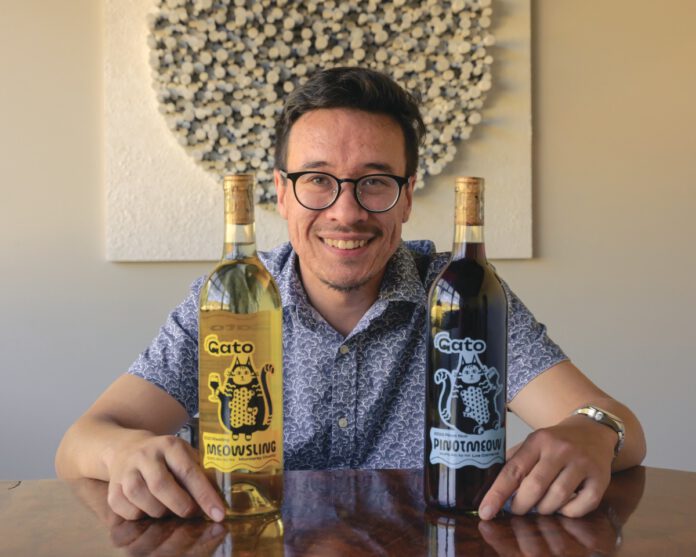
For Eric Wright, it all started with a black cat named April. She had been living at We Care Animal Rescue in St. Helena when Wright met her.
Black cats often spend the longest time in shelters before adoption, a phenomenon known as “Black Cat Syndrome,” either due to lasting cultural superstitions or the fact that it is more difficult to photograph them. It was an instant love connection that led to adoption. Wright brought April home, and they have been thick as thieves ever since.
“Every day, I go to work and get my butt kicked,” says Wright. “Then I come home, and my cat is there.”
Wright is a third generation citizen of the Napa Valley, with a long line of immediate and extended family working in the wine industry. For him, working in wine felt like a foregone conclusion. “I knew I was destined to make booze,” he proclaims. “I’m pretty sure one of my first words was ‘riesling.’”
Wright has spent the past 12 years in the industry, learning everything he can about the science and business of wine. He has helped to produce wine locally, as well as in regions such as Oregon and New Zealand. A previous team he worked with had the distinctive honor of creating 30 different 100-point wines, which is an industry term for a wine that has attained a perfect score among critics. When he talks about wine, he does so with the fervor of a man possessed. “All I want is to make the best I possibly can,” he says.
As anyone in the area, provided they haven’t been in some sort of coma for the past years, already knows, the wine industry is experiencing a good deal of tumult. Sales are down, younger generations aren’t as interested in drinking, and the wine industry at large is having a sort of identity crisis regarding where and how it fits in a changing zeitgeist. It would seem a strange time to start a wine business, but Wright claims he found opportunity in the shuffle.
“A winemaker will make a wine, and then it takes like three years for it to go to market,” he explains, “and during that time, the market can totally shift. Making it so that wine is no longer a viable product.” With his curiosity sparked, Wright started exploring sales registers for bulk wine lots. Bulk wine, to put it simply, is leftover wine that has not been bottled or distributed.
Oftentimes, these excess lots are sold to food production behemoths, who blend it and stock it on the shelves of retail giants like Costco. Within this market, however, are smaller lots of premium-made wine that, for one reason or another, are not going to be bottled. Wright started reaching out to these wineries to inquire about the smaller lots. According to him, he tasted more than 25 different wines as he investigated, until he landed on two, a riesling from Monterey and a pinot noir from Los Carneros, that stood out to him as exceptional.
“I had the idea to rescue these wines that were just sitting in tanks with no plans to move,” Wright notes. He reached out to a friend and entrepreneur, Wyatt Johnson, and pitched him the idea of a wine brand that rescued small lots of premium wines and sold them in limited-release batches. With the wine industry experiencing record levels of surplus, there would be little difficulty in sourcing quality lots, and buying from bulk markets would help to keep the overhead low. The idea felt viable, and the two decided to cofound a wine brand.
While Wright was workshopping what the identity of this brand would be, he thought back to April, the black cat. Here was a wonderful creature, a member of his family unit, that spent years in a shelter being overlooked. Something in that moment clicked for him; wasn’t he doing something similar with these wine lots? It felt like there was an opportunity to combine two things he loved and make a difference in the process. Thus, Chateau Gato was born.
“Drink wine, save cats,” says Wright. “That is Chateau Gato’s motto.”
Aside from the cat-related branding, with their first two releases being dubbed a meowsling and a pinot meow, Chateau is also dedicated to supporting animal rescues. As Wright was working on getting the brand off the ground, he reached out to We Care Animal Rescue, the place where he adopted April three years prior, and asked if they would be interested in a partnership. “We [Johnson and Wright] decided that there needed to be some level of financial support,” he says. “It was really important that there was a charitable component.”
“Eric [Wright] walked right through our door, said, ‘You guys are the inspiration for this,’ and pitched his idea,” recalls Molly Abers, volunteer and community engagement manager for We Care. “We were immediately excited,” she continues. “It felt like such a good way to bridge these two worlds of animal rescues and the wine industry.”
Chateau Gato held its release party in partnership with We Care in August. There was music, food, wine and onsite adoptions. Abers reports there was one adoption at the event and three more in the week that followed. “Our goal was to give the first $10,000 we made directly to We Care,” says Wright. “We exceeded that before the party was over and were able to hand them a check before we even paid off our credit card bills.”
The financial goal was hit so quickly that Wright and Johnson were caught a bit off guard. They are now working on a model for ongoing contributions to the shelter through a percentage of every bottle sale. Wright is also hoping to expand this framework for partnership and is currently talking with three other local rescues.
Currently, Wright and Johnson aren’t trying to compete with more established wineries for shelf space in the area. “Every shelf and tasting room in the valley is competition,” he explains. Instead, bottles and cases of the limited-run lots, or “rescues,” as Chateau Gato has dubbed them, can be bought through their website or in person at partnered events with animal rescues. Once they sell out, the rescues are gone forever.
Perhaps this is, in a small part, an answer to the larger shifts in the wine industry. It’s no longer enough for a wine to have a story; it should have a message as well. It should collaborate and participate in the betterment of its community. It should have a picture of a cat holding a wine glass on its label. As a young brand, only time will tell how viable Chateau is for the long haul, but with a tagline like “Drink wine, save cats,” how could anyone not root for them?
More at chateaugatowines.com.