
Super fires and super storms; mega droughts and mega floods. The loneliness of the youth, the isolation of the elderly, the grinding cost of living. Mad consumerism; mass extinction. Broke local governments, overstretched emergency services. General distrust and general anxiety; loss of empowerment, loss of hope, loss of a shared political vision. Authoritarian rule. Malaise—breathe it out.
The Problem Is the Solution
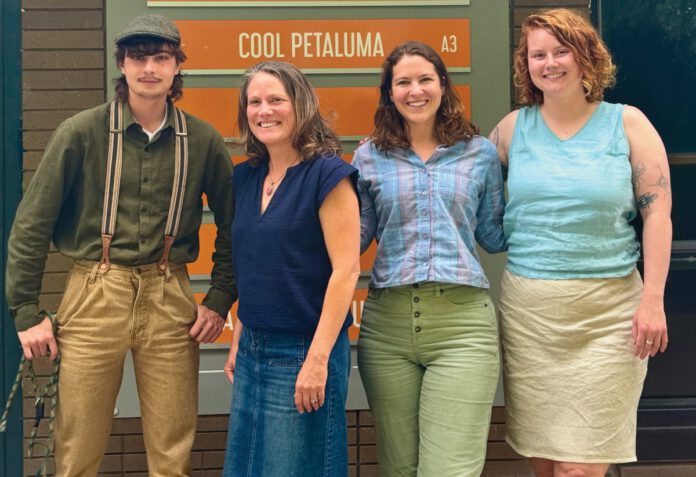
Reader, what if these problems could just … solve each other? Read that again: What if the problems of the world could be resolved so as to resolve each other? That, if nothing else, is the golden principle to take from this reading. It is the potential that illuminates the heart of a pilot program in Petaluma, Cool Future—now set to scale.
That list of problems can be cut and divided into two sets—the crises of climate change, and the breakdown of civil society (across generations). They are, on their surface, unrelated problems, but the Cool Future program resolves them to solve each other—undertaking to turn our neighborhoods into real communities by organizing them for emergency preparedness and climate action.
Yes, readers—the block is back. And that is reason for dancing in the streets. For Cool Future has affirmed (in surveys) that political right and left can be unified—by a shared vision (of a better world). And that vision centers on a scene set just outside the front door.
A street with less traffic. With children playing and laughing in safety. In the distance, the sound of musical scales being rehearsed, of home improvement projects; the scent of fresh herbs and cooking carries on a playful breeze. Bees buzz and birds sing from tall trees and rich floral plantings. Well-known and well-loved neighbors are walking by with pets, and wave. Some stop to chat idly for a spell. Or perhaps to lend a tool or extend an invitation to a block party. There is no rush on this street, just drowsy peace. Breathe it in.
For four years, reader, I have watched Cool Petaluma make mistakes and learn from them. I have seen them hone methods into home action plans hardened by experience. I have watched for the ripening and waited for them to declare themselves ready to exceed their own city limits and expand into the burning world.
They are ready. As of this month, they are “Cool Future.” And after a review of what they have achieved (on next to no money), I now regard them as one in a platform of ideas (including restorative justice, nonviolent resistance, co-housing, regenerative agriculture, etc.) made to brace the polycrisis.
Still, I must caution that it remains to be seen whether this home-grown program can survive its transplantation into the foreign culture of new soils.
Emergency
Within the Cool Future plan, the reorganization of a neighborhood into a community begins with a pair of residents stepping up to lead the effort. But truly, it begins with a hesitant knock on a little-seen neighbor’s front door.
It’s exciting. It’s daunting too—there is a reason we just don’t do that anymore. But the free Cool Future training equips its self-starting leaders with a reason to knock. And it’s a reason more wholesome than banana bread and more urgent than a noise complaint: disaster preparedness. It is an offer to do the vital but oft-delayed work of preparation together (bringing in fun and accountability). And it is an offer to make shared plans to support each other when the problems I listed hit the fan.
That is an overlooked but critical aspect of surviving a natural disaster: the neighbors.
I had a call with community preparedness program manager Dr. Nancy Brown. As part of the Sonoma County Department of Emergency Management, she is responsible for Petaluma … and eight other towns. While the region has thousands of emergency response assets coordinated by disaster-tested plans, it is critical that they be supplemented with the preparedness of households (Brown mentioned “go bags,” evacuation plans and maintaining five ways to receive emergency alerts; socoemergency.org).
“It’s not that emergency responders can’t help people. It’s that they can’t help everyone,” noted Brown. 911 is simply overwhelmed in a large-scale disaster. “The goal,” she told me, “is that everybody that can help themselves has a plan to do so.
“The other piece that’s really important is that neighbors make the difference. They absolutely do. I can say, perhaps 99% of the time, when someone dies in a wildfire, or other-type disaster, their neighbors got out safely. And it’s not that their neighbors didn’t care. It’s that they didn’t have an agreement in place to support each other,” Brown said. “Nobody wants to be that neighbor that left somebody behind to die. If you know and make arrangements at least with the people on either side of you, you have elevated the safety of your family to a whole new level.”
Her words resonated. In my own circle, I have heard stories from our own fires in which a neighbor banging on the front door made the difference between life and death.
Cool Future is on its face a response to the worsening climate crisis. It is brilliant for them to begin their community-building with emergency preparedness instead. It is an urgent and apolitical topic—with many segues into climate change. But more importantly, the offer at a neighbor’s doorway contains the community spirit of the program disguised as a pragmatic offer: Let us take care of each other when the worst happens. That’s a truly disarming offer. Its unexpected warmth (from relative strangers) animates all the preparations that follow.
That preparation takes place over a series of neighborhood meetings guided by the volunteer “block leaders.” “Meeting” is too formal a word. Because these gatherings involve rarely used patio furniture, home tours, conversations over beer and wine about sports and pets and kids, and of course, banana bread. These are the half-forgotten forms of neighborhood life. And they perpetuate themselves as new relationships bloom.
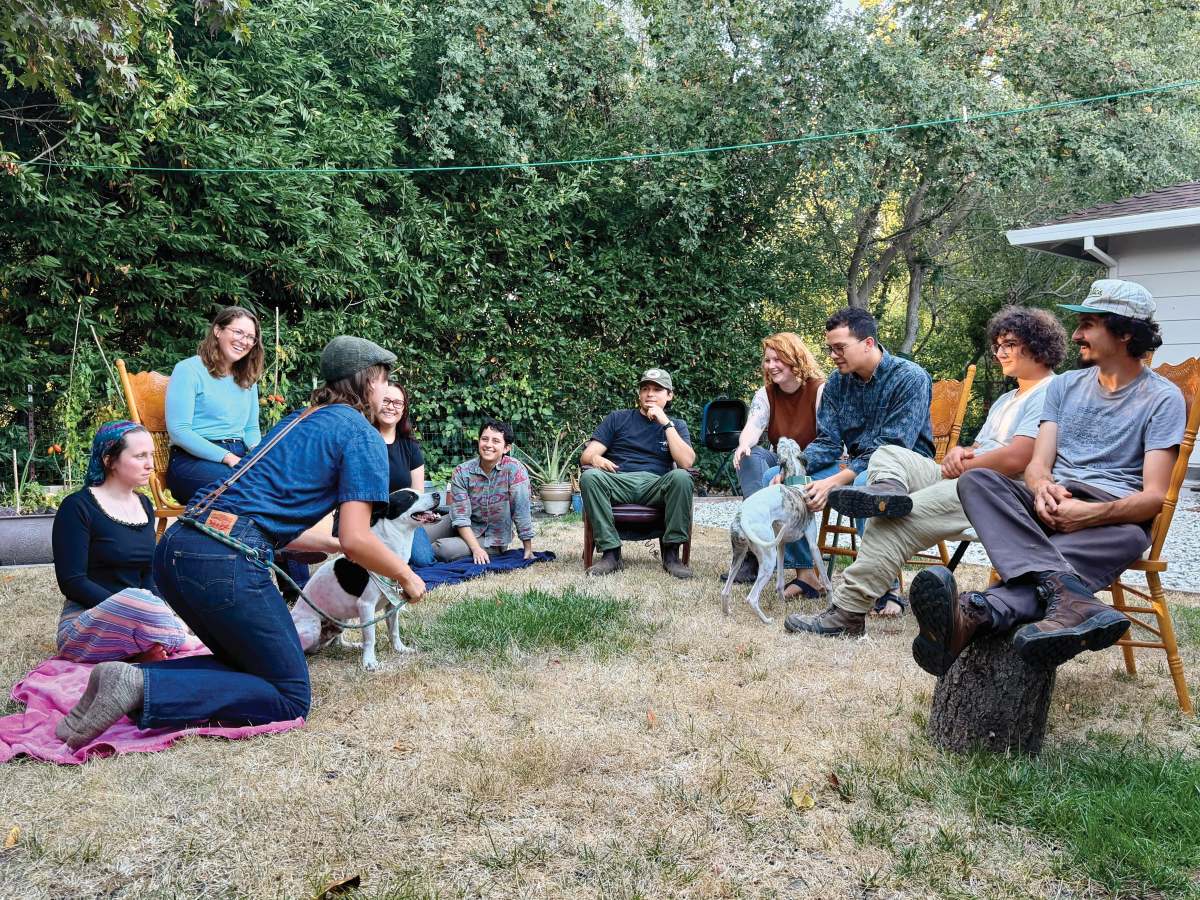
The initial program-guided gatherings end with a shared list of residents— emails, phone numbers, ages, emergency skills and supplies, pets, critical medications, special needs. And, quite often, a block party.
To date, Cool Future has trained some 250 leaders in their free half-day training sessions. Thirty neighborhood communities, each averaging 30 households, persist four years into the program.
A Change of Climate
I first sat down with Cool Future co-founder and executive director Natasha Juliana at her workplace, opposite the tall palms of Penry Park. I found Juliana to be lush as those plantings in her role. I asked the questions. She told stories.
And as we discussed the steps and stages of a neighborhood’s reorganization, I began to sense qualities growing up with this program of potlucks, expanding like generalizing fields of potential. Like a new mood taking root in these neighborhoods. A new atmosphere. What I sensed, sociologists (blandly) call “community goods” or (vaguely) describe as a new neighborhood “culture” coming into being.
Although I couldn’t name them that day, but I can name them now. And I can order the qualities—as inputs to psychologist Abraham Maslow’s hierarchy of human needs. They address many of society’s problems.
I could see in Cool Future’s process of community building a quality of security growing up on these blocks—the sense that there are people all around you, looking out for you, having your back—of being held within wider circles of protection, in a time defined by uncertainty and fear. I wrote in my notebook: “This is what we need right now.”
At the same time, a new atmosphere of abundance in a new culture of sharing. It’s initiated by sharing space, and sharing information, and sharing plans, and breaking bread. In our second conversation, Juliana described a text thread formed by moms on one “cool block.” Mention the need for diapers, school art supplies or that emblematic cup of borrowed sugar, and quite likely it will be carried to one’s door within the hour.
And again, I see a potentiated new culture of collaboration rising up, where collective efforts suddenly become possible: the planting of an eyesore median with pollinator plants, fundraising for a neighbor in need of rent money, the filling of potholes, the coordination of a street-long yard sale that makes the newspaper—all examples from block leaders.
Then there are the higher needs. The need to be known. The need to have a place. The need to be needed. The need to be held within a social matrix of strong relationships. All these goods can only exist within a true community.
One Cool Block co-leader, Kim Nielsen-Glynn, described to me the morning of her block’s Fourth of July brunch—now a neighborhood tradition. She was looking out her window and fretting whether any of her neighbors would show up, when she saw first one and then two, then three and four neighbors cross her lawn, carrying trays and pans laden with rich breakfast foods. She shared that as the moment that community began for her.
Grassroots
After a new Cool Block finishes its emergency preparations, it continues into climate action. That broad topic is divided by Cool Future into action plans on “rethinking consumption,” “transforming habits of transportation,” “improving buildings” and “restoring local nature.”
The transition into the politicized topic of climate change is perhaps progressing more than one might expect. The changes Cool Future suggests are in line with science and the international goals for mitigating climate change, but the focus is not on individually “meaningless” contributions to vague national efforts. Cool Future’s focus is on immediately realized improvements to one’s own quality of life (that vision).
These improvements play out in the cozy context of neighbors having neighbors over for a demonstration of a newly installed greywater system or induction stove, wine nights, documentary movie nights, skill-sharing workshops, work trades, labor pooling, carpooling, sewing and repair nights, or food garden exchanges.
This emphasis on immediate benefits in savings, health and happiness is necessary for climate skeptics. And it is necessary, I would argue, even with climate change believers, many of whom are despondent—at major Trump-era reversals—and paralyzed by the seeming inevitability of a burning, dying planet.
Cool Future is re-empowering. And it does not simply organize blocks; it raises new climate leaders up from the block. Cool Block co-leader Maria Ray, a former event planner, describes how everyone now calls her when there’s big news in the neighborhood, laughing with surprise and delight that she sometimes feels like she’s the mayor. Perhaps when she stops laughing she will actually run for mayor. Ray or any of the leaders of the 30 Cool Future neighborhoods. Several have already run for Petaluma City Council.
Some new-found leaders arise with cool new ideas. “Cool Businesses” is a new program within Cool Future that baby-steps cohorts of local business leaders through the arduous process of becoming a certified California State Green Business. It came about when local block leaders (and small business owners) Naomi Crawford and April Frederick had the idea to adapt the program to businesses (which converged with an intention of City Climate Action Manager Deb Fox). Cool Business’ first cohort more than doubled the number of certified green businesses in Petaluma to 17. Frederick is leading a second cohort this year.
That had me in mind of something retired carpentry union organizer (and Cool Block co-leader) Phil Cohen told me: “When you organize, you know you have done a good job when people take over the organization.”
Cool Future now works in close collaboration with the City of Petaluma. If unintended, political power is almost an inevitable byproduct of an organization like Cool Future—an activist leadership training program with hundreds of energetic new leaders representing 1,500 coordinated households (in a context of broken down civil society). It had a major role in Petaluma’s adoption of a zero-carbon goal.
This unlooked-for development raises the tantalizing question: If this organization and training program is duplicated in other towns, might political pressure at county or state levels—where climate action is token—demand the recognition of Sacramento, and eventually even Washington, DC?
From Block to World
As I sat down with Natasha Juliana for a third interview, that question was in my final set concerning how Cool Future intended to expand. They will be hosting their methods and curriculum on their website, and opening their Petaluma Block Leader trainings to people from anywhere—but what else?
Some of my questions were charged with excitement, others with anxiety—and doubt.
Was their game plan the creation of a county, district or statewide organization with dozens of towns and thousands of block leaders, putting pressure on government, and even raising up candidates from the blocks (from block party to political party)?
Would they harness the power of town identity, town pride and (especially) town rivalries—the profound tap root of professional sports competitions—creating competitions for emergency preparedness, or green economies? (E.g., is Cool Oakland really going to let Cool San Francisco certify more green businesses to win “Greenest City” two years running?)
Then there was the question of whether a single, isolated block in a new host city could persist without the guidance and support of its own local parent organization, as in Petaluma.
For that matter, can Cool Petaluma be transplanted into the ground of different town cultures? Petaluma is a town of 60,000—economically diverse, white, aggie, lefty, with vestiges of small-town familiarity and friendliness to work with. How would it grow in a big city?
Across a series of unanswerable questions, my Cool Future fever broke, and gradually, I came back down to Earth. Juliana’s eyes, normally starry, clouded over as she tried to look into the future.
To scale Cool Future, her team is currently focused on sharing their programs with established national organizations of resource and reach. She is hopeful about limited adoption by AmeriCorps (young persons paid for public service) and possibly Third Act (retired persons seeking meaningful projects). I suggested her adoption by the dynamic Indivisible network, or the rudderless Democratic Party, both of which would (overtly) politicize the movement.
Appropriate to her role, Natasha Juliana favors organic metaphors and organic methods. Talking it over, we settled on the metaphor of broadcasting. It is the method of this newspaper, and a method of nature. A host plant casts its seeds into the open air. Some seeds thrown out by Cool Future will land on hard rock and wither; others will land on rich soil and burst with new communal life.
And while the chances of each seed are uncertain, broadcast is the method by which nature propagates endless green forests.
Learn more: Juliana asks readers to invest their time—join the network of Cool People and share the website coolfuture.earth far and wide—and their money, through tax-deductible donations to nurture growth. Tickets for their Nov. 5 Gala are now available. About the author: linktr.ee/cincinnatushibbard.