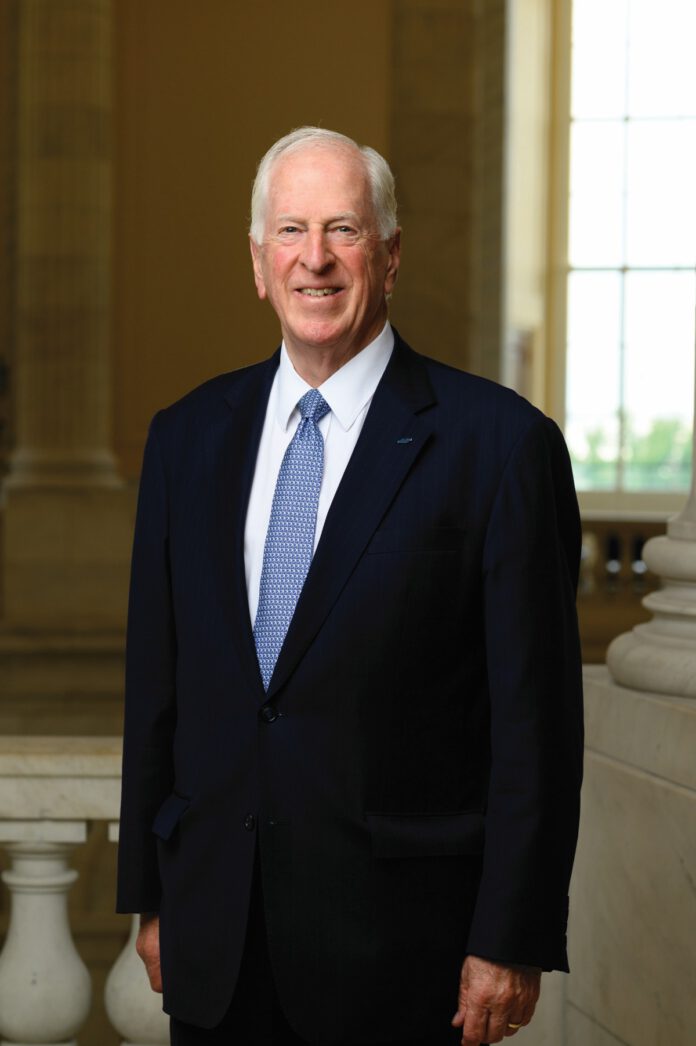
After nearly three decades in Congress, Rep. Mike Thompson is campaigning for a 15th term—and, thanks to California’s latest round of redistricting, he is doing so in a substantially altered district.
The St. Helena Democrat represents California’s 4th Congressional District, which encompasses all or parts of Lake, Napa, Solano, Sonoma and Yolo counties. He serves on the House Committee on Ways and Means, where he is the ranking member of the Subcommittee on Tax and a senior member of the Health Subcommittee.
Thompson faces fellow Democrat Eric Jones in the Nov. 3 general election. When he appeared with me recently on “Civics 101” on The Drive 95.5 FM, our conversation followed four questions relevant to that race: Was California right to fight Republican redistricting with a partisan map of its own? Should federal programs have expiration dates? What could Congress realistically do about affordability? And what happens when wildfire survivors are taxed on settlements intended to help them rebuild?
Approved by 63.8% of California voters in 2025, Proposition 50 temporarily replaced the congressional map drawn by the state’s independent redistricting commission with a legislatively drawn map intended to help Democrats gain as many as five House seats. The new map applies to elections through 2030. It was California’s response to a Republican redistricting effort in Texas—an openly partisan maneuver intended to neutralize another openly partisan maneuver.
Against that backdrop, I asked Thompson whether Prop. 50 was a necessary but openly political response to Texas. He showed little ambivalence.
“Prop. 50 was in response to the state of Texas, behind closed doors in the proverbial back room, drawing up a map and then passing it without any public hearings, without voter approval, to, in the words of the president, steal five congressional seats,” he said.
California’s process, Thompson argued, was conspicuously public. The Legislature held hearings and debate, the governor signed the measure and voters rendered the final verdict.
“I supported Prop. 50, and truth be known, my district changed the most as a result of that,” he said. “I felt that it was important to beat back that stealing of the five seats in Texas, and I know that I’ll be able to represent this new district well.”
Then came the campaign-ready dagger: “I supported it. I don’t flip-flop.”
I characterized Prop. 50 as a fight-fire-with-fire moment. The tactic was transparent, and the objective was never disguised. Thompson said the process was conducted in “full sight,” pointing to televised hearings and debate before voters made the final decision.
The next question concerned proposals to require federal agencies and programs to periodically prove their effectiveness or face expiration. On paper, “sunsetting” can sound like sensible accountability. In Washington’s present climate, however, allowing programs to expire before Congress acts could place essential services in recurring political jeopardy.
“There are provisions that currently exist to review programs, [to] make sure they’re working appropriately, [to] make changes where needed,” Thompson said. “But sunsetting is just a ridiculous idea.”
The congressperson’s foremost concern is that such a requirement could endanger Social Security and Medicare. Thompson also cited veterans’ benefits, crop insurance and agricultural disaster relief—all particularly consequential in a district of veterans, farmers and communities repeatedly scorched by wildfire.
“Veterans can’t watch their programs sunset every year or every two years and hope they come back,” he said.
Likewise, if crop insurance or disaster programs expired when an agricultural calamity struck, he said, farmers would be “out of luck, and that would be just devastating to our region.”
Of course, none of the above is an argument against scrutiny. Thompson called for restoring inspectors general dismissed by the current administration and conducting continual oversight of federal programs.
“We should constantly be doing oversight and review of every program,” he said, “but not something this extreme.”
When something sunsets in Washington, I suggested, the sun has an unfortunate tendency not to rise again.
From there, we moved to the cost of living.
“People are paying too much for everything,” Thompson said. “That’s the one constant I hear no matter where I am in my district, is how expensive things are.”
Thompson introduced the American Affordability Act, a broad tax-policy package aimed at reducing the cost of housing, transportation, energy, childcare, education and healthcare. The bill applies the tax-code approach used in earlier renewable-energy legislation to household expenses that voters encounter every month.
“Dignity shouldn’t be a luxury,” Thompson said. “People should be able to work and buy the things they need. You need a roof over your head, food on the table. You need to be able to turn the lights off and on. You need healthcare, and you need childcare.”
Thompson added: “How many times do we see people who put on the uniform and fought for our country, and then they have to come home and fight for healthcare and fight for a roof over their head? That’s just not right.”
He said he expects Democrats to make the affordability proposal a priority if they retake the House. It was an optimistic forecast, but he pointed to his work on renewable-energy tax policy as evidence that ambitious legislation can become law.
The most tangible evidence of Thompson’s legislative method, however, may be his work for wildfire survivors.
Settlement payments can still leave survivors far short of the cost of replacing a home. Taxing those payments compounds the injury. Thompson worked with the late Republican Rep. Doug LaMalfa and Florida Republican Rep. Greg Steube to force disaster-tax legislation onto the House floor through a discharge petition after House leadership declined to schedule a vote.
The petition gathered the required 218 signatures. The bill subsequently passed the House and Senate and became law, removing federal tax liability from qualifying wildfire settlements. Thompson said the change produced approximately $500 million in tax savings for victims in his district.
He added that Congress has since extended that protection through 2027.
“These fire victims had to sue, so they got a settlement,” Thompson said. “It wasn’t enough to replace their house, but it was something. And then to turn around and have to pay taxes on top of that—it just wasn’t right.”
Getting the original measure signed into law, he said, was “one of the proudest moments of my time in Congress.”
The four subjects reveal Thompson’s larger campaign argument. He portrays himself as a legislator willing to defend partisan action when he considers it necessary, protect longstanding programs from political brinkmanship, use tax policy to lower costs and cross party lines when a practical result is within reach.
Whether voters in a newly configured district accept that argument will be determined Nov. 3. Thompson, unsurprisingly, sounded certain.
“I will win my reelection,” he said, “and I will represent this new district as well as I have represented my current and my past districts.”