Letters: May 3, 2015

Potholes and Pitfalls

Maybe Pat O’Halloran’s penchant for A’s might equate to an “A” in math (Letters, May 20), but I would give him an “A” in gullibility also. Either that or he has something to gain personally by the new tax.

The June 2 election isn’t the end of the world for road repairs. If we’ve suffered five, 10 or however many years of neglect of road repair, a few months or years isn’t going to make much of a difference. Look on the bright side. Tire dealers are happy. Towing companies are happy. Our supervisors are spreading the wealth around. What’s not to be happy about? Nine hundred dollars is chicken feed.

Imagine the stress and anxiety supervisors will feel if Measure A bombs. The taxpayers might remember who came up who came up with the monstrosity in the next election when their incumbency and competency are at stake.

You, by now, should have figured out where all the potholes are. Oh, the new ones? Why don’t we have a “pothole buddy” app to inform us daily of where they’re popping up?

Since the government stopped selling military-assault equipment to the cops, you should be able to get a good deal on an M1 Abrams tank to traverse your daily battlefield commute on the cow paths of Sonoma County.

You should feel sorry for the supervisors if we don’t approve Measure A. They had plans to each get one of those new Aero-cars from Europe (paid for by the 1/4 percent increase) so they wouldn’t have to travel the roads with us taxpayers—they’d just fly over us. Defecation up there will be no problem. They’re doing that on us already.

I’m hoping the majority of us will have a better sense of smell than O’Halloran and a little less gullibility.

Windsor

Talking Bock

Carneros Bock? (“Horn of Plenty,”
April 29). Hmm. Maybe I missed something on my many visits to this terrific addition to the microbrewery scene in Sonoma County. I actually don’t recall a bock at Carneros Brewery. Carneros IPA, maybe? Wait. I suspect Chupacabra was playing tricks on Mr. Knight’s taste buds—or his memory. Ya think?

Via Bohemian.com

James Knight responds: The Carneros Bock is a seasonal brew, and it does not have its own tap handle like the Negra IPA and Morena seen in the photo. But it’s still on tap now, as a representative of Carneros Brewery affirmed to me over the phone. I highly recommend that you check it out.

Dept. of Corrections

Last week’s Arts & Events listings had the wrong dates. All of them. We regret the error.

But didn’t it feel like February?

Write to us at le*****@******an.com.

Bottlerockers

0

More than 100,000 attendees descended on the Napa County Expo and Fairgrounds for this year’s BottleRock Napa Valley Music Festival last weekend to enjoy three days of music, food, beer and wine.

This year’s sold-out weekend cemented the festival as a successful and likely permanent fixture in Napa.

BottleRock held true to its tradition of starting the festival with a local band by kicking off the main stage with reggae-rock outfit Pion 2 Zion. From there, the main stage was entirely an indie rock ramble, with a pair of young songwriters in Zella Day and Courtney Barnett and a trio of “command sentence” bands with Cage the Elephant, Foster the People and Imagine Dragons.

Day two brought in both the old-school crowds and the kids, as Saturday boasted headliner Robert Plant as well as a crop of young acts like Passion Pit and Capital Cities. North Carolina family folk rockers the Avett Brothers were a personal favorite, blending heartfelt ballads and stomping revival rock. Guitarist Seth Avett jumped into the crowd at one point for a blazing solo, and Scott Avett brought the masses to the edge of an emotional cliff with his rendition of “Murder in the City.”

Robert Plant performed a worldly blend of tunes. At 68 years old, his signature vocals are surprisingly fresh. Plant revisited classic Led Zeppelin songs like “Black Dog” and “Whole Lotta Love” with a slightly slowed arrangement. He also covered tunes by classic blues man Howlin’ Wolf and spoke openly about his continual fascination with American (read: Mississippi Delta) music, giving the late B. B. King a shout out.

On Sunday, psychedelic jam band Moonalice retuned to take the stage for an early set, while across the fairgrounds L.A. hip-hop group People Under the Stairs brought an old-school flavor to their set. Sunday’s headliner was No Doubt, and Gwen Stefani and company played a sizzling selection of their most popular hits, yet the general consensus was that everyone was there to see one man, Snoop Dogg.

The culinary options at this year’s event were an expanded assortment of quality local vendors, though I skipped booths like White Guy Pad Thai and Gerard’s Paella, which had lines around the block. When I’m at a huge outdoor event, I need something fried and greasy to soak up those $10 glasses of Lagunitas IPA.

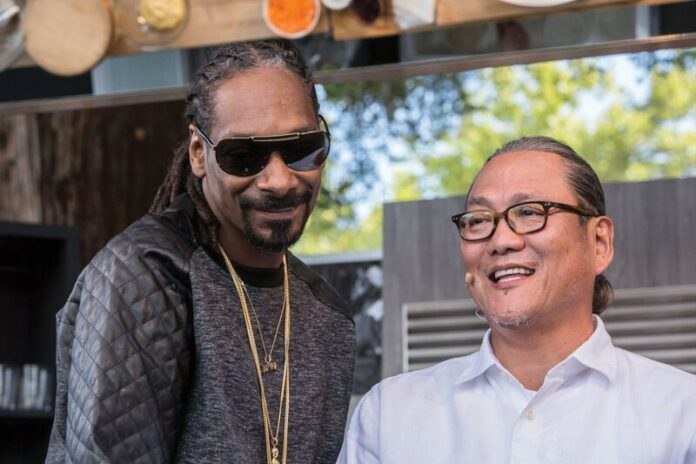
This year’s newest stage was the Culinary Stage, where renowned chefs and artists from the fest got together. No pairing was better than that of Snoop Dogg and Iron Chef Masaharu Morimoto, who taught the D-O-double-G how to roll sushi, while Snoop offered his fried chicken recipe to the famed chef, including his own blend of herbs and spices. (Insert weed jokes here).

With another successful event behind them, BottleRock has already announced that limited tickets are on sale for next year’s fest, which will take place
May 27–29, 2016 over Memorial Day weekend.

Small but Mighty

Bounded by the cluttered shelves of a mid-century, one-car garage, his laboratory for the time being, Tim McCormick tinkers with the 64-square-foot cube he hopes will “hack the housing crisis.”

As he envisions it, an 8-by-8-by-8-foot skeleton of perforated square steel tubes, small enough to fit in a parking spot, could become an “erector set” suitable for home or workspace. From there, one could build up or out—as spartan as a post-apocalyptic bomb shelter or as elaborate as a several-story dwelling. Modules could be separate or stacked, side panels swapped, dimensions complementing existing urban spaces, like a small yard or a garage.

“It’s about creating systems to solve a very wide set of potential needs in the built environment,” he says, “analogous to how Linux or Android [and other open-source software] are used in a wide variety of computing contexts.”

McCormick calls the low-cost, open-source units Knight Houses, a reinvention of the home as a product that consumers could order online or build themselves. Under the aegis of Houslets, the alternative housing research effort he’s spearheading, McCormick won a $40,000 grant from the Knight Cities Challenge.

“If we do this right,” McCormick says, “we can transform [the] urban ecosystem.”

Tiny homes are nothing new. If anything, they’re part of an age-old tradition of carving out space, of squatting and occupying, of highly adaptive living systems. Sebastopol’s Jay Shafer has put forth a plan for a micro-home village outside the city limits. Bolinas’ Lloyd Kahn literally wrote the book on small homes with his Tiny Homes.

Last year, in San Jose, city officials floated the idea of building micro-cottages to shelter the homeless: 150-square-foot, $5,000-apiece pods that could hunker down on unused public land or empty warehouses as transitional housing options.

“We studied the idea and found that we didn’t have the public land to make this work,” says Ray Bramson, San Jose’s homelessness response manager.

“There’s a global archetype: faced with the hierarchy and status of the environment, the little man wants to carve out a piece of it—trailers, rooms, attics, cottages, in-law units,” McCormick says. “That’s what we can do, design and implement a fleet of movable housing units, which can be quickly deployed, moved around and potentially combined into larger units.”

The concept has gained more traction in recent years as soaring housing costs continue to price middle-class families out of urban job centers.

“So our challenge is how to bring the cost down,” says McCormick, who spent the past few years living in a 200-square-foot converted garage in Palo Alto.

The best way to do that, he posits, is to cut down on size. Americans have learned to equate square footage with value, making the notion of downsizing an insurgent idea.

McCormick is a relative newcomer to the tiny-home movement. Early pioneers in the 1970s advocated for scaled-back homes in reaction to widespread suburbanization that normalized excessive living spaces. The average size of a single family home four decades ago hovered around 1,780 square feet. Each new U.S. Census Bureau count broke another record, the latest in 2013 when the average home size stopped just shy of 2,600 square feet, despite a concurrent decrease in the size of the average family. The housing market’s free-fall in 2007 galvanized McCormick and others’ push for smaller living quarters.

“We had this huge breakdown, where the housing system is stammering,” he says. “All of a sudden, regular, middle-class people can’t find housing. It became a First World problem, so to speak.”

McCormick has lived in plenty of small, sometimes improbable spaces. Growing up in London, his parents lived in a 1,000-square-foot home. His bedroom, called a “box room,” was no more than 48 square feet—intended as a storage space, really. His father’s job as an architect moved the family to various urban hubs, always settling into economical living quarters.

“That was a key, informative influence,” he says. “As long as I could remember, I was going to building sites, low-income housing projects.”

McCormick wants to see more of that self-sufficient ingenuity applied to housing in urban spaces. Given that he plans to work with pre-assembled modules, he thinks he could work within an even tighter budget.

The pushback often comes from neighbors who worry about parking supply and property values. Other issues: how to hook up units to plumbing and comply with zoning rules. McCormick says one way to make the idea of incorporating tiny homes within the urban landscape palatable to the public is to incentivize property owners. One model he’s looking at is a fairly new state law that give tax breaks to property owners who lease to an urban farm. McCormick suggests the same idea could be applied for micro-homes.

“Fearing people encroaching on you is human, but so is building, adapting, being able to change your environment,” McCormick says. “It’s all in how you present it.”

Debriefer: June 3, 2015

STILL $HORT

Just in time for the Sonoma County Board of Supervisors’ vote Tuesday on a $15-an-hour “living-wage,” the National Low Income Housing Coalition (NLIHC) this week released its annual report, Out of Reach: Low Wages & High Rents Lock Renters Out Across the Country.

The report comes as localities around the state and country grapple with a laudable national movement to raise the minimum wage to $15. The “Fight for $15” campaign was prompted in large part by President Obama’s bully-pulpit push on the issue.

San Francisco plans to phase-in minimum wage spikes so earners there are making $15 an hour by 2018; Los Angeles plans to do the same by 2020. Just this week, the California Senate put its weight behind a $13-an-hour state minimum wage (it’s now $9 an hour and heading to $10; the federal minimum wage is $7.25). Sonoma County has failed to get on board yet.

Problem is, $15 an hour is least $10 shy of what the NLIHC says is needed to swing the rent.

According to the NLIHC study, California as a whole averages $1,386 a month for a two-bedroom apartment; Santa Rosa and Petaluma combined come in a little below average, at $1,370—but Sonoma County rents are on the rise, according to Real Facts, a Novato-based research firm. The latest data from Real Facts reveals that the countywide average is $1,624 for a two-bedroom.

Using the California average, NLIHC doped out the math: To pay that rent without dropping more than 30 percent of your income on rent and utilities, you’d need to be making $26.65 an hour in the state.

Napa County? You’ll need to make $29.10 an hour to pay the $1,513 average for a two bedroom, according to NLIHC. And Marin County workers need to earn $39.65 an hour to keep up with skyrocketing rents. For further evidence, go check out Craigslist rentals for a sobering dose of reality.

DOSE OF REALITY

Speaking of, Debriefer was cruising around the Bay Area Craigslist the other night and stumbled on a casting call for a new reality show called Best Bottle. The gist is simple enough; the program is “looking for established and aspiring winemakers who can prove they have what it takes to make an amazing bottle of wine.”

There are a bunch of eligibility requirements for Sonoma County winemakers, and respondents need to create a three-minute video and post it on YouTube. Fun!

But the nameless producers also insist that respondents “cannot have a prior history
of or currently receive treatment for substance abuse.” Hmmm . . .

The U.S. Equal Opportunity Commission reports that under the Americans with Disabilities Act, “an employer may not discriminate against a person who has a history of drug addiction but who is not currently using drugs and who has been rehabilitated.”

Cave Talk

0

If an impressive facade is what you’re after, you can do better in the Napa Valley than Chateau Boswell, as faux chateaux go. The better part of Boswell is hidden underground.

The face the winery presents to the Silverado Trail is quaint enough. Founder R. Thornton Boswell was no fool. In 1979, he figured that since the best wines on the market had a chateau on their labels, he would darn well build one for himself. Later, vines were planted on the steep hillside behind the winery, and a cave was carved out of rock 65 feet below them.

There’s not much to see inside the winery, packed with tanks and equipment, besides a hot little number they call “Bettina,” I believe, an Italian-built pump that’s especially gentle on the wine—hot for anyone who’s got some of that 60-degree cellar-rat blood in their veins.

The journey continues into an atmospheric cave, where voices pop out of alcoves and between racks of barrels. Here and there, small groups are having quiet chats over the barrelhead. Several wineries share this space, which has served as an incubator for up-and-coming brands over the years—Arietta and Realm Cellars being current. Making the Boswell wines for three years is Russell Bevan, a rising Napa star with west Sonoma County cred, as evidenced at Sebastopol’s Zazu Kitchen, which named a porterhouse steak “the Bevan.”

A lot about winemaking is just moving the stuff around, from tank to barrel and back again, before finally shipping it off to the consumer. But that’s not enough for this winery’s fans, as Boswell’s Khristopher Lund tells me at the end of the tour. “I love that clients bring wines back to us,” says Lund. They want to share those older vintages with the winery.

What inspires fandom like that, in a valley chockablock with similarly blended Cabernet? The Cabs I tasted were good—in a charred, waxy, oaky, brooding plum and licorice kind of way—but the Chardonnay surprised me. Boswell sources Chardonnay from Dutton Ranch and other Sonoma County vineyards, and transforms them into a distinctive varietal expression that’s perfumed with waxy oak, shows sweet baked-apple elements and has an elegant saline quality.

Or maybe it’s because Chateau Boswell is about a conversation. Sure enough, a couple of visitors walk in, their manner a bit stiff at first. But when we peer down into the cave a few minutes later, they’re gesticulating and talking around a barrelhead. That Boswell wine kicks in fast.

Chateau Boswell, 3468 Silverado Trail, St. Helena. Tasting by appointment, $60. 707.963.5472.

Clean Living

0

In two brilliant, unconventional plays, the subjects of death, infidelity, cancer and the violent overthrow of the U.S. government are improbably played for laughs while giving our heads some juicy new thoughts to chew on.

In Sarah Ruhl’s 2004 comedy The Clean House, directed with energy and sensitivity by JoAnne Winter, Brazilian comedian-turned-house-cleaner Matilde (Livia Demarchi) confesses that cleaning houses makes her depressed. Unfortunately, her overstressed employer Lane (an excellent Sylvia Burboeck) is a surgeon who likes things clean. Meanwhile, Lane’s sister, Virginia (Tamar Cohn, also wonderful), isn’t happy unless she’s cleaning, so an arrangement is made wherein Virginia cleans Lane’s house while Matilde relaxes and tries to think up the perfect joke, which, she says, will be “somewhere between an angel and a fart.”

When Lane’s husband, Charles (Steve Price), an oncologist, announces that he’s fallen in love with Anna (Sumi Narendran, marvelous), the older woman on whom he’s just performed a double mastectomy, life takes on a series of turns proving that sometimes things just get messy.

Rating (out of 5): ★★★★

Jason Wells’ North Plan, on the other hand, directed with an eye for farce by Rick Eldridge, finds outrageously broad humor in the midst of a disconcerting not-too-distant future. A shadow government has taken over the White House and declared martial law, and a fugitive government employee, Carlton (Sam Coughlin, excellent) has stolen a secret list of likely “government enemies.”

When Carlton winds up in a rural Missouri jail awaiting the arrival of government agents (John Browning, Jared Wright), he tries to enlist the help of his jailers: patient police chief Swenson (John Craven) and bored administrator Shonda (Miranda D. Lawson, superb). When he strikes out there, he has no choice but to get through to his agitated, foul-mouthed fellow prisoner Tanya (Sharia Pierce, a hoot), an unhinged local.

What happens shouldn’t be funny, but in this cleverly crafted fable of fermenting revolution, the end of the world miraculously becomes wildly, inspiringly—and a bit frighteningly—hilarious.

Rating (out of 5): ★★★★

‘The Clean House’ runs Thu–Sun through June 14 at Ross Valley Players. 30 Sir Francis Drake Blvd., Ross. Thu at 7:30pm; Fri–Sat at 8pm; 2pm matinees on Sunday. $13–$26. 415.456.9555. ‘The North Plan’ runs Thu–Sun through June 21 at Main Stage West. 104 N. Main St., Sebastopol. Thursday–Saturday at 8pm; 5pm matinees on Sunday. $15–$27. 707.823.0177.

American Booty

0

When it comes to the Grateful Dead—man, what a long, strange cha!-ching! it’s been.

Twenty years after the band played its last show, they’re back this summer for what are promised to be the very last Grateful Dead shows ever, in honor of the 50-year anniversary of their formation in 1965.

The shows are more than a musical victory lap. Whether you’re a Deadhead of not, they offer a window into a cultural phenomenon that seems more pervasive than ever.

Interest, to say the least, has been high. The reunion was announced in January, and by early March, CNN breathlessly reported that a three-day pass to the Fare Thee Well event in Chicago was being offered on the online ticket broker StubHub for an eye-popping $116,000.

David Meerman Scott didn’t pay that much, but the marketing expert, author and veteran Deadhead says he did “pay through the nose” for his Chicago tickets through Ticketmaster. He’s psyched for the shows, even if the rollout was rough going and left lots of loyal fans in the dust, as the band has acknowledged.

Scott lives outside of Boston and is co-author of Marketing Lessons from the Grateful Dead. He’s been a Deadhead since the late 1970s and says the lesson the band forgot this year is just how popular they still are when they announced the three-night stand at Soldier Field.

“I think they misjudged demand,” says Scott. “They put the tickets on sale thinking that they might have trouble selling out Soldier Field for three nights.”

Au contraire. The shows sold out in veritable nanoseconds, and thousands of tickets wound up on the resale market, with little concern for that legendary fan outside the gate with outstretched palms, seeking the miracle ticket.

Scott notes that season-ticket holders to Chicago Bears games were given dibs on Dead tickets, and that as many as 10,000 passes might have entered the resale market that way. While the Dead find appeal in many cultures and subcultures, Scott is perhaps correct in asserting that a Venn diagram of Bears fans and Deadheads wouldn’t find much crossover.

The Chicago shows were promoted as an offering to fans after the abrupt demise of the Dead, two decades ago this summer. The Grateful Dead’s last show was at Soldier Field on July 9, 1995—but the band didn’t know it at the time. The tour ended, everyone went home, and Jerry Garcia died of a heart attack a month later at a Forest Knolls rehab center.

The ensuing years saw surviving members tour under monikers including the Dead, Furthur, the Other Ones, RatDog, and Phil Lesh and Friends. Band members went into the nightclub business. Terrapin Crossroads and Sweetwater Music Hall became live-music destinations in Marin County as the band slipped into a comfortable, post-spectacle late-adulthood.

But there was always that phantom limb of a last show to contend with, the band avers on its site, and a 50th anniversary synced up nicely with the 20–year-gap between Grateful Dead shows. So why not?

“I think the energy is all coming together, and it’s wonderful,” says Greg Anton, a Sebastopol musician who used to play in the Heart of Gold Band with Keith and Donna Godchaux, former members of the Grateful Dead from the 1970s.

“When the Grateful Dead come together, they bring with them a whole culture, not just the music,” says Anton, who has also co-written dozens of songs with Garcia collaborator Robert Hunter. “I’m happy they are doing it. I just wish they’d do it more often,” he says.

Anton’s not going to make the shows (he’s a touring musician and the freshly minted author of the rock and roll novel Face the Music), but ticket prices have come somewhat down to earth since the first rush of interest in the Dead reunion, to a more manageable high-end offering of $32,000 for an up-front seat at Soldier Field, according to the latest StubHub information available. The most recent news from the Dead is that they’ve bought back some of the Soldier Field tickets and plan to make them available to fans.

Scott says there’s no way the Soldier Field snafu could have been avoided, given that the band had announced that those shows would be the last ones ever, and that popular Phish guitarist Trey Anastasio would sit in the Jerry chair. That’s a double-whammy of demand. “They misjudged how many people were going to want tickets,” says Scott, “and it meant that a lot of hardcore fans got left out.”

The vagaries of capitalism require that, theoretically anyway, the market determines the price for these highly in-demand tickets. But the market does not, and can’t possibly account for this question: Twenty years down the road, who or what sets the value of a Grateful Dead ticket beyond its price?

Is it even worth asking which “countercultural” values are being represented in this extended exercise in groove-culture redux? Is it the Grateful Dead value of the temporary autonomous zone within which to twirl, trip and choogle along until properly blissed out? Or the ground-breaking, open-source ethic embodied in the band’s tolerance and support for its tape-sharing community?

Tape-sharing was a huge marketing coup for the band, says Scott, and one that’s rippled through to our digitized new millennium.

“Free-sharing foreshadowed what we see on the web,” says Scott. “The idea of letting people tape the shows—this was a social network before Mark Zuckerberg was even born.”

Twenty years after the last Grateful Dead show, now you can find eBay offerings of vintage Dead cassettes recorded off the soundboard. One batch of two-dozen tapes ranging from 1970 to 1994 had a bid that hovered around $60 before it closed over the weekend. To bring it all home: eBay itself launched in September 1995. Time flies.

‘The band has always been very innovative with everything,” says Anton, “and the music reflects that. Everything about the band is uniquely Grateful Dead, and it’s based on innovation, creativity and kindness.”

But there’s another value that may be getting promoted here that springs to mind, embodied in this John Barlow lyric that Bob Weir sings in the song “Money Money”: “Money money, money money money / Money money, money money money.”

[page]

Call it a split ticket of values: the resurrected Dead, minus Jerry, highlights class divisions among fans that have gone on down their own road over these past two decades.

There was always a discussion about money and the Dead, given the fan-base demographic of, generally speaking, white college students. And now an entire generation of fans has come into its own since the band last played under the Grateful Dead banner. That’s a big gap, and most fans probably don’t even recall that it was Weir himself, for example, who famously did advertisements for Izod Lacoste shirts in the late 1980s. You reap what you sow.

The split between the stereotypes—hippies in the bleachers, baby boomer lawyers in the front row—was never lost on the band, says Anton. “I know from way back they used to really try to figure it out,” he says. “One of the last times I talked to Garcia, I asked him, ‘How are you doing, what have you been doing?’ He tells me, ‘I don’t play the guitar any more—all I do is go to meetings. Everything is a big meeting.’ He said he’d rather play the guitar than go to a meeting. And who wouldn’t! That being said, they do try to figure out the best ways to do things onstage.”

But Jerry’s gone. And one veteran Deadhead I talked to, who said he’d be going the webcast route instead of Chicago, put it this way: “On the one hand, if somehow the spirit of a real Grateful Dead show is summoned, I’d be very sorry to have not been there. However, from the Other Ones shows, I know what to expect: an old and affluent crowd who have forgotten how old they are and thus drink and drug way more than they can handle. Lots of rich day-trippers who want to be able to say they saw the Grateful Dead. Young’uns who don’t know proper Grateful Dead show etiquette with no elders or tour for them to learn from. And most of all, constant chatter while old friends catch up on the last 20 years since Jerry died.”

Ouch.

Scott highlights another stroke of marketing genius on the band’s part, which may have sort of bitten the band in the ass as it was putting together the farewell gigs: The Grateful Dead system for getting tickets into listeners’ hands was a historically fan-friendly portal that also served as an iconic and ongoing visual celebration of the Dead community.

Dead fans are long-known for sending elaborately designed envelopes to the home Dead office—and getting tickets sent back to them in those envelopes.

But that was a long time ago, and Deadhead Al Gore invented the internet in the meantime.

It’s a whole new world out there. Ticketmaster is now online, and so thousands of hand-drawn envelopes seeking Chicago tickets went unfilled.

The band noticed, felt bad and added the Santa Clara shows for the hardcore. The band also put 300 tickets up on eBay last week; those sales will go to a charity of the band’s choosing.

This upcoming blowout may well combine the scope of a WrestleMania event with the aroma of the High Times Cup. The sudden emergence of a bona fide and pleasingly anachronistic Grateful Dead moment this summer occurs along a convergence point of legacy, spectacle, entitlement and enjoyment. It occurs amid the unwelcome specter of a verticalized music industry, and a counterculture that has all but bowed to the ersatz lure of a Google-provided technocratic vista. And, right on time this time, the Dead website offers some fresh apps for sale.

After the Chicago ticket-grab debacle—that’s how the marketing wiz Scott describes it—the band took to its website to tell fans that two California shows had been added. “Santa Clara helped,” says Scott.

The California tickets have been pushed out mainly through traditional Grateful Dead ticketing channels—all those colorful Steal Your Face envelopes are getting filled, and if you want to see the show, chances are you can, and it won’t take a miracle. Poke around on the internet, and heads can easily find online brokers that have slashed ticket prices for Levi’s Stadium. Tickets that were $110 are now $55—for seats behind the stage.

The band note directed at the Deadicated fan base was as interesting as it was earnest—and reflected an ongoing neo-familial relationship the Dead emphasize. Many fans had gone the old Dead route of mail-ordering for their tickets—only to find out that their elaborately decorated envelopes would not be sent back stuffed with tickets for Chicago. Sounds like they had to have a meeting about it.

“We have tried to do the right thing wherever we could for the Chicago shows by honoring the roots of where we came from, while dealing with the realities of the current times,” the band posted on its website. “But that’s hardly comforting when you’re shit outta luck for tickets and your only option is inflated prices on secondary ticketing websites. That would piss us off too.”

Sure enough.

Loyal fans want to catch these last shows to get that one last bit of Grateful Dead magic. The magic is by no means an assured experience, but you take your chances. The culture supported the band when it had an off night, or a year full of them. And the band has set low expectations for the upcoming farewell shows, on the logic that the Grateful Dead never played a good show when it was some sort of special occasion.

An old head I got in touch with for this story backs this up. He notes how the band’s New Year’s Eve show was never as good as the Dec. 30 warm-up. And the Dead legendarily blew it at Woodstock. So they are going into Soldier Field, or at least Bob Weir is, with the sort of language you hear from doctors about “managing expectations.”

Good, bad or mixed, Scott is convinced that the band is not doing this for the money. According to a reliable online celebrity-wealth cheat-sheet—hey, it’s where billionaires go to compare piggy banks—the total net worth of the Grateful Dead members is around $150 million.

Scott says he has heard roughly the same estimated profits for the band—and that the band’s wealth indicates exactly why they are not doing Chicago for the money. The band, Scott notes, makes millions a year from merchandise and licensing, and he rejects any idea that the band set out to play Chicago as a last chance to make bank. We’re not talking about John Entwistle selling his bass guitars on the side of the road.

“I don’t believe that at all,” says Scott, who notes that the band sold licensing rights to Warner-Rhino in 2011, “and that deal meant that the band members were able to live quite nicely.” He estimates they are each bringing in millions a year, just for being the old guys from that band everyone loves (or loves to hate).

Oh, and by the way, these shows might not actually be the last we hear from the Dead this year.

Billboard recently reported that Weir and John Mayer just might be doing some crazy fingers business this fall, but that talk is, of course, premature—and we hear from the grapevine that there’s no way Phil Lesh wants to hit the road again. So whatever happens later this year, it won’t be called the Grateful Dead.

The band is holding firm on its website: “We will not be adding any more Fare Thee Well shows. The three Chicago shows will still be our final stand. We decided to add these two Santa Clara shows to enable more of our fans to celebrate with us one more time. But this is it.”

Believe it if you need it.

Crazy for ‘Me’

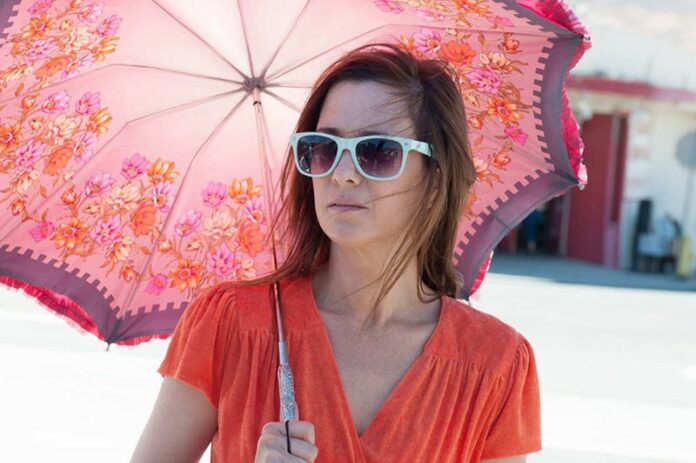
In her new dramady, Welcome to Me, Kristen Wiig transcends hilarity as she over into a twilight zone between sketch comedy and performance art.

The ever-surprising Wiig plays a woman called Kleig, like the light. Alice Kleig lives in a desert town just outside Los Angeles. She is a borderline personality disorder case, who spends her time sitting alone in her studio apartment surrounded by a ceramic swan collection, watching Oprah. Despite the warnings of her shrink (Tim Robbins), she’s gone off her meds in favor of a high-protein diet that she has read will calm her many moods.

After hitting it big with an $86 million lottery ticket, Alice, a longtime fan of nutrition infomercials, decides to produce her own daytime TV show. She burns up a fortune creating what an over-enthusiastic media student (Thomas Mann) later describes as “the first narrative infomercial.” It’s two hours of whatever she wants—blurted confessions, reenactments of difficult past experiences she hasn’t been able to process, and painfully awkward silences.

Wiig is an insane smolderer. Her acting in Welcome to Me recalls Catherine O’Hara, circa 1983, as SCTV songbird Lola Heatherton, performing “You’re All Just Parasites Draining Me of Love,” silently whinnying from the effects of too many amphetamines.

It’s better if the roots of Alice’s illness are more mysterious—it’s not always the One Big Trauma that disturbs brain chemicals. Wiig gets closer to the reality of such a malady than you’d get in a serious, actorly film. She suffers from the humiliation of her disease—wrath, breakdowns and a naked walk of shame. But she’s also been given untroubled exhibitionism, a hypnotic sultriness and a completely unfettered libido.

‘Welcome to Me’ is playing at Summerfield Cinemas, 551 Summerfield Road, Santa Rosa. 707.525.8909.

Eat Like Marco

0

The popular rule of thumb is that the more local the food, the better it is, and we’ve all heard of the many purported benefits that eating locally has on local economies, the environment and even one’s health.

The discussion is often framed in terms of the greenhouse gas emissions created by food transport, with the presumption that local foods result in less carbon being burned, but there are many instances where importing something from a faraway market is more climate-friendly than trying to produce it locally.

One category of food that’s pretty hard to justify shipping is food from a different hemisphere that’s out of season at home, such as tomatoes and berries during the wintertime. This isn’t simply a matter of the carbon footprint of these goods. When you demand to eat them year-round, you are abandoning your relationship to where you live.

Climate activist Bill McKibben once told me his personal rule of thumb for making food-purchasing decisions. It’s called the Marco Polo Exception, and it states that if a food is non-perishable enough that Marco Polo could have brought it home from China in a sailboat, then we don’t need to worry about eating it, even if it’s not local. But if a food is so perishable that it must be shipped refrigerated, and shipped quickly, then it’s off the table.

We can’t know, of course, whether or not a package of dried noodles was flown across the ocean by plane. Most likely it was carried by a cargo boat, which burns a lot less carbon than a plane. Even so, maritime shipping is responsible for about 4 percent of global carbon emissions, on par with the carbon footprint of Japan. But the pasta could have been shipped by sailboat, with virtually no carbon cost.

Pursuing a local-foods diet, with flexibility provided by the Marco Polo Exception, prepares your eating habits for a day when certain foods from around the world might be shipped carbon-free, by boats similar to Polo’s. That day might be closer than you think.

Jorne Langelaan co-owns a shipping company with a fleet of two vessels, and plans for two more. For someone whose income is derived from shipping and trade, Langelaan has a surprising take on the practice.

“It is complete nonsense that we are transporting anything and everything across the planet,” he said in an interview with Port of Rotterdam Perspectives. 

But Langelaan, whose company is called Fairtransport Shipping, would also be the first to point out that not all ships emit equally. One of his ships, the Tres Hombres, just traveled to Europe laden with coffee, rum and chocolate from the Caribbean. No carbon was burned in the transport of these indulgences, because the Tres Hombres is a sailboat—the only engine-free transatlantic cargo ship in the world.

While the Tres Hombres and its sister sailboat the Nordly’s are inspirational and beautiful ways to ship cargo, Langelaan and his partners at Fairtransport harbor no illusions that such old-fashioned technology is the key to countering global warming. But the folks at Fairtransport have their sights set on a goal that’s both more realistic and more ambitious. They are designing a new, hybrid cargo ship that will run primarily on wind-filled sails, but will also have an engine for use when necessary. Dubbed the Ecoliner, the boat will travel as fast as a conventional cargo ship, while using only half the petroleum.

Despite these promising improvements over conventional cargo ships, Langelaan looks at the Ecoliner as more of a crutch than a real solution. He fears that a more fuel-efficient vessel would simply encourage more long-distance shipping.

“Only products that are not available locally should be transported,” he said, “and in a sustainable way.” The rum, chocolate and coffee on board the Tres Hombres are perfect examples of such products. They can’t be produced in Europe, and they can handle a slow passage on a sailboat.

In the grand scheme of things, the greenhouse gas emissions from food transport are not a massive threat to the climate. Transportation of food only makes up between 4 and 10 percent of the total carbon emissions created by the food system, and adds up to much less than the carbon burned in the production, processing and packaging of food. Animal products tend to have especially large carbon footprints, which dwarf the amount of carbon used in their transport.

Keeping track of the impacts of various foods on a case-by-case basis can be overwhelming, but I would argue that thinking about your food choices like this is akin to a meditation practice that makes you a better person, similar to recycling or riding your bike instead of driving or volunteering on a wind-powered cargo ship. None of these actions will save the world by itself, but they add up, are contagious, and get you into good habits.

As you remove some foods from your diet, they will be replaced by new ones, and sometimes an accompanying lifestyle shift.

May 28: Deserve This in Napa

0

Napa’s own We Are Invisible Monsters possess both a youthful passion and nuanced approach to making their emotive hard-hitting rock. Formed two years ago, they’ve released a string of singles and a debut EP last year, but those were just previews. This week, the band celebrates the release of their first full-length album, What You Deserve, with a show in the heart of their hometown. It’s the perfect primer for a weekend of rock in Napa and a great chance to see an up-and-coming act born and bred in the North Bay. We Are Invisible Monsters performs with opener Alec Lee on Thursday, May 28, at Silo’s, 530 Main St, Napa. 7pm. $5. 707.251.5833.

Letters: May 3, 2015

Potholes and Pitfalls Maybe Pat O'Halloran's penchant for A's might equate to an "A" in math (Letters, May 20), but I would give him an "A" in gullibility also. Either that or he has something to gain personally by the new tax. The June 2 election isn't the end of the world for road repairs. If we've suffered five, 10 or...

Bottlerockers

More than 100,000 attendees descended on the Napa County Expo and Fairgrounds for this year's BottleRock Napa Valley Music Festival last weekend to enjoy three days of music, food, beer and wine. This year's sold-out weekend cemented the festival as a successful and likely permanent fixture in Napa. BottleRock held true to its tradition of starting the festival with a local...

Small but Mighty

Bounded by the cluttered shelves of a mid-century, one-car garage, his laboratory for the time being, Tim McCormick tinkers with the 64-square-foot cube he hopes will "hack the housing crisis." As he envisions it, an 8-by-8-by-8-foot skeleton of perforated square steel tubes, small enough to fit in a parking spot, could become an "erector set" suitable for home or workspace....

Debriefer: June 3, 2015

STILL $HORT Just in time for the Sonoma County Board of Supervisors' vote Tuesday on a $15-an-hour "living-wage," the National Low Income Housing Coalition (NLIHC) this week released its annual report, Out of Reach: Low Wages & High Rents Lock Renters Out Across the Country. The report comes as localities around the state and country grapple with a laudable national movement...

Cave Talk

If an impressive facade is what you're after, you can do better in the Napa Valley than Chateau Boswell, as faux chateaux go. The better part of Boswell is hidden underground. The face the winery presents to the Silverado Trail is quaint enough. Founder R. Thornton Boswell was no fool. In 1979, he figured that since the best wines on...

Clean Living

In two brilliant, unconventional plays, the subjects of death, infidelity, cancer and the violent overthrow of the U.S. government are improbably played for laughs while giving our heads some juicy new thoughts to chew on. In Sarah Ruhl's 2004 comedy The Clean House, directed with energy and sensitivity by JoAnne Winter, Brazilian comedian-turned-house-cleaner Matilde (Livia Demarchi) confesses that cleaning houses...

American Booty

When it comes to the Grateful Dead—man, what a long, strange cha!-ching! it's been. Twenty years after the band played its last show, they're back this summer for what are promised to be the very last Grateful Dead shows ever, in honor of the 50-year anniversary of their formation in 1965. The shows are more than a musical victory lap. Whether...

Crazy for ‘Me’

In her new dramady, Welcome to Me, Kristen Wiig transcends hilarity as she over into a twilight zone between sketch comedy and performance art. The ever-surprising Wiig plays a woman called Kleig, like the light. Alice Kleig lives in a desert town just outside Los Angeles. She is a borderline personality disorder case, who spends her time sitting alone in...

Eat Like Marco

The popular rule of thumb is that the more local the food, the better it is, and we've all heard of the many purported benefits that eating locally has on local economies, the environment and even one's health. The discussion is often framed in terms of the greenhouse gas emissions created by food transport, with the presumption that local foods...

May 28: Deserve This in Napa

Napa’s own We Are Invisible Monsters possess both a youthful passion and nuanced approach to making their emotive hard-hitting rock. Formed two years ago, they’ve released a string of singles and a debut EP last year, but those were just previews. This week, the band celebrates the release of their first full-length album, What You Deserve, with a show...
12,118FansLike
4,924FollowersFollow
6,928FollowersFollow