The fight to save majestic coastal redwood groves in California has been waged for more than a century, starting with the campaign that created Big Basin State Park in 1902.
In 1978, the Sierra Club dubbed its successful campaign to expand Redwood State and National Park the “last battle” of “the redwood war,” but the battles to protect this globally recognized icon of nature would only intensify.
In 1985, a junk-bond dealer named Charles Hurwitz engineered a hostile takeover of Humboldt County’s most respected logging company, Pacific Lumber, and folded it into Houston-based investment company Maxxam. Meanwhile, Louisiana-Pacific, a Georgia-Pacific spin-off, was cutting its more than 300,000 acres in Mendocino and Sonoma counties at roughly three times the forest’s rate of growth.
“We need everything that’s out there,” Louisiana-Pacific CEO Harry Merlot told the
Press Democrat in 1989 “We log to infinity. Because it’s out there and we need it all, now.”
This unruly phase of the story involves the birth of radical environmentalism on the North Coast, complete with tree sits and road blockades, and culminates in the campaign to save the largest remaining area of unprotected old-growth redwoods in California, and thus the world: the Headwaters forest, located between Fortuna and Eureka. President Bill Clinton made saving Headwaters an election pitch in 1996, and in 1999 the state and federal governments purchased 7,500 acres to establish the Headwaters Forest Reserve.
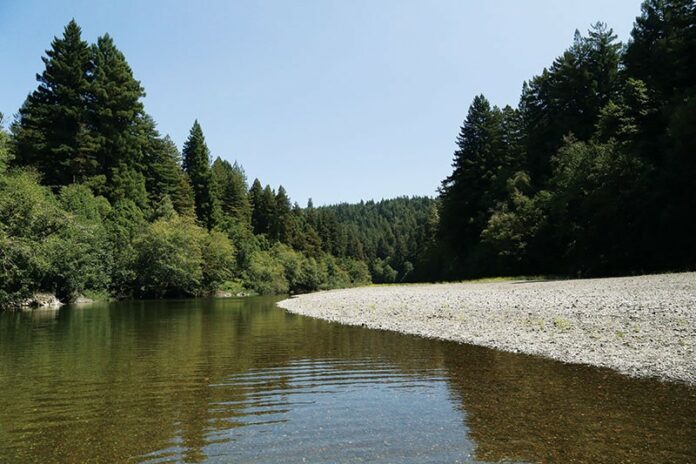
This year, a new redwood battle has emerged, this time in northwestern Sonoma County. Gualala Redwoods Timber (GRT), owner of 29,500 acres in northwestern Sonoma and southwestern Mendocino counties, plans to log hundreds of large second-growth redwoods in the Gualala River’s sensitive floodplain. The “Dogwood” plan encompasses 320 acres, making it the largest Gualala River floodplain logging plans in the modern regulatory era, while the “Apple” plan features 121 acres of adjacent logging and 89 acres of clear-cuts.
Project critic Peter Baye, a coastal ecologist affiliated with Friends of the Gualala River and a former California Department of Fish & Wildlife regulator, says the style of logging GRT has planned is liable to batter the watershed’s badly impaired “off-channel” salmon and steelhead habitat. He also fears it will jeopardize endangered species such as the marbled murrelet and northern spotted owl, and set a dangerous precedent that erodes the intent of modern environmental statutes that are supposed to protect floodplains.
“This is basically the last mature riparian forest refuge in the watershed,” Baye says. “All of the 80- to 100-year-old trees in the watershed are gone, except these. And it’s in the critical part, next to the river and in the floodplain. Nothing else impacts salmon like this does.”
Defenders of the plan include the state regulator who signed off on the logging proposal.
“It may be a larger floodplain-logging plan than most others, but the Gualala River also has a uniquely wide floodplain,” says Jim Burke, a North Coast Regional Water Quality Control Board hydrologist who OKed the plans in an agency review process earlier this year. “After looking at it, we determined that the plan meets our requirements.”
The outcry from environmental organizations, including Friends of the Gualala River and Forests Unlimited, as well as more than 80 public comment letters by local residents, has led to an intervention by State Sen. Mike McGuire and U.S. Rep. Jared Huffman. The lawmakers asked that the agency that reviews timber harvest plans (THPs), the California Department of Forestry and Fire Protection (Cal Fire for short), to order that Dogwood and Apple be resubmitted due to reported administrative errors.
Meanwhile, Sonoma County’s regional parks district has eyed the area as a possible river park site for more than 50 years, while a consortium of conservation groups is seeking to buy the land and create a “working community forest” characterized by a lighter-touch approach to logging.
There are other elements of this story that recall past redwood battles. Earlier this year, the property was purchased by the Burch family of San Jose, whose West Coast timber franchise spans three states and variously goes under the names Redwood Empire and Pacific States Industries. To tell this tale fully, you also have to mention a man named Henry Alden, who, as GRT’s forestlands manager, designed the Apple and Dogwood plans.
Certainly no stranger to sagas of upheaval and controversy in redwood country, Alden was Maxxam’s lead forester in the late nineteen-nineties as it sought to fell the Headwaters forest.
As founder of a state-funded watershed history database known as the Klamath Resource Information System, which covers most of northwestern California, Arcata-based fisheries biologist Patrick Higgins is a leading expert on the historical impacts of logging along the Gualala River. While growing up in the 1960s, he made frequent fishing trips to the river, describing it as “a veritable Shangri-La for fishermen.”
“Nothing in the last 10,000 years, probably a million years, has ever duplicated the degree of disturbance in the Gualala River watershed as has occurred since World War II,” Higgins says.
To understand what he means, it’s necessary to go back to the arrival of European Americans on the West Coast, and also to become acquainted with the unit of measurement that represents a forest’s potential financial value in lumber, known as “board feet.”
At the time of Euro-American settlement on the West Coast, the board foot volume of coastal redwood forests averaged 100,000 to 150,000 per acre, according to estimates by biologists. Exceptional stands, such as those that grow in rich alluvial soil deposits in areas like floodplains, contained more than one million per acre (enough to build about 50 houses with five rooms each).
But the settlers quickly sought to capitalize on the enormous forests stretching around them. The government seized lands from native peoples without compensation and converted them to private property through giveaways and auctions. From the Gold Rush through the early 1920s, settlers hacked half of the original redwood population, with a big chunk of that wood going to rebuild San Francisco after the 1906 earthquake. At the turn of the 19th century, 100 percent of redwood forestland was privately owned.
By the 1990s, the board-foot volume of Louisiana-Pacific’s heavily cut-over Mendocino and Sonoma county properties averaged a paltry 10,000 per acre—less than 10 percent of their original volume. Environmental activists and some foresters have embraced the term “liquidation forestry” to describe Louisiana-Pacific’s practices, which remained prevalent in most areas of redwood country well into the 1990s, and continues to be practiced in some areas.
The most heavily criticized logging technique has been clear-cutting, which involves razing every tree in a large swath, an ecological trauma that perhaps only a tsunami or volcano can match. These methods, critics say, allow big timber companies to get their money out of the forest as quickly as possible while rapidly degrading the forest and yielding less revenue and fewer wood products over the long-term.
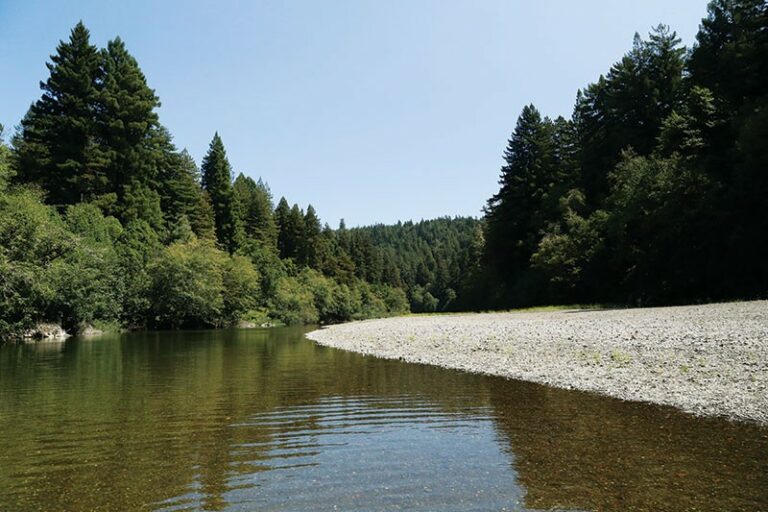
The Gualala River watershed includes the redwood-studded mountains above Fort Ross, Stewarts Point, the Sea Ranch and the town of Gualala. Louisiana-Pacific owned 7,000 acres of the watershed, which have been purchased by Mendocino Redwood Co., a firm owned by the billionaire Fischer family, owners of The Gap.
Willits lumberman Rich Padula, owner of a 79,000-acre tract spanning the Gualala and Garcia river watersheds, took liquidation forestry the furthest in the watershed, diminishing his lands to less than 4,000 board-feet per acre before attempting to convert a large portion of his holdings to wine grapes.
Before the Burches purchased their land in March it was known as Gualala Redwoods Inc. (GRI). GRI’s owner has degraded its lands but not to the same extent as Padula. But the company has drawn criticism from environmentalists for its rapid cutting rates and reliance on clear-cutting. According to a 2010 Cal Fire report on sustainable forest management, the average annual California timberland harvest covers 1.64 percent of private timberland acres. By contrast, GRI’s total logging since 2004 has covered about 30 percent of its land, which translates to a harvest rate of nearly 3 percent per year—almost twice the state average.
Company representatives contend that their logging practices are not environmentally harmful and deny that they have had a detrimental impact on the watershed. They point to road upgrades that reduce soil erosion into streams, as well as stream restoration work they have conducted in collaboration with a group called the Gualala River Watershed Council.
“Harvest of coastal redwood and Douglas fir actively occurs today, but with substantially improved practices,” the Dogwood timber harvest plan states. “While some areas of the watershed experienced more improvement than others, an overall trend toward improvement. . . was observed.”
Not long after I met Friends of the Gualala River president Chris Poehlmann outside of Gualala Point Regional Park in August, I noticed habitats for live termite colonies on the backseat of his 1982 Mercedes Benz—which he converted to run on vegetable oil.
Poehlmann, who lives in Annapolis and builds museum displays for a living, constructed his first termite displays for a client several years ago, as part of a larger museum exhibit project, and soon discovered that the much-maligned wood-consuming insect is an effective means of promoting a sense of wonder about the natural world. He was about to mail the displays in his car to eager “termitophiles,” as he explained to me, in other parts of the country as part of a new product line he is developing.
“When people hear about termites, they don’t initially have them in a category of something they are interested in,” says Poehlmann, a soft-spoken but articulate man in his 60s, “But when they find out how interesting termites are, and that they play a vital role in ecosystems by recycling waste material, it helps awaken them to the importance of preserving biodiversity in a completely new way.”
Poehlmann got his start as a forest advocate when GRI sprayed jellied gasoline (aka, napalm) on land they had clear-cut just beyond the eastern edge of the Sea Ranch in 1989, prompting a surrounding section of forest to catch fire. The idea was to clear brush to give sunlight to the new redwood seedlings that would be planted. Alarmed by these practices, Poehlmann started his work monitoring and critiquing timber havests in the area and joined with Friends of the Gualala River soon after.
A timber harvest plan (THP) serves as a scaled-down version of an environmental impact report. Members of the public can file comments on THPs, but only certain agencies, not individuals, can appeal them under state law. Poehlmann and others began working to oppose GRI’s logging plans based on what they saw as cumulative impact on the Gualala River ecosystem.
There is no escaping the inexorable judgment of weather and time. Every year, the rain renders its verdict on historic logging activities in watersheds like the Gualala. By removing vegetation that anchors hillsides, and constructing spider-web road patterns, logging causes erosion that contributes to the degradation of rivers and fish habitat. Sediment smothers fish eggs and disrupts the reproductive cycle. Fish, especially salmon and steelhead, require pools where they can rest and feed. Erosion fills in those crucial pools.
In 1998, the U.S. Environmental Protection Agency listed the Gualala River watershed as “impaired” due to excessive sediment under the Federal Clean Water Act. The EPA stated that “significant reductions in human-induced erosion are needed to protect aquatic habitat and cold water fish.”
The EPA later listed the watershed as impaired due to elevated temperatures.
In the 2000s, the Conservation Fund, a land trust based in Virginia, purchased Padula’s former Gualala and Garcia river lands, tens of thousands of acres of young-growth redwood and fir in the coastal mountains. This free market, nonprofit experiment—”working community forests”—calls for limited, sustainable logging as the land slowly recovers.
The Fund now owns more than 57,000 acres of contiguous forest in the Gualala and Garcia river watershed, and their land abuts Gualala Redwoods’ property—in a suggestive manner, say environmentalists. Partly as a result of these purchases, the Garcia River, which is directly north of the Gualala and roughly the same size, “has been slowly recovering from its years of damage from logging,” says Alan Levine of Coast Action Group, an environmental organization in Point Arena.
Through their involvement in these efforts, North Coast environmentalists have quietly built a legacy of successful conservation campaigns that equal or exceed any other part of redwood country. When GRT’s former owner, New Orleans-based physician Ollie Edmunds, put the land up for sale earlier this year, many were hopeful that the Conservation Fund would once again emerge with the land.
The Sonoma Land Trust joined the Conservation Fund’s consortium, as did Sonoma County Regional Parks and other entities. While the environmental groups are not affiliated with the organizations trying to buy the land, they are supportive of of these organizations’ “working community forests” approach and the idea of a riverside park.
County parks Acquisition Director Steve Ehret would not reveal the terms of the bid they offered but called it a “very competitive offer.” In the end, the Burch family’s bid won out.
Because the Burch family’s company is privately held, information about them is difficult to come by. The Burches rarely grant interviews, and Sean Burch, the company’s general manager, did not respond to several requests for comment on this story.
“They’ve been in this area for a while, but we don’t know a lot about them,” Ehret says.
A review of background materials, including county assessor records, provides a thumbnail sketch. Company patriarch Roger Burch, who lives in Morgan Hill, worked as a police officer in San Mateo County in the 1960s before making it big in timber. He wound up the owner of timberland spanning five California counties, and three mills. Among them is the conspicuous Cloverdale redwood mill at the intersection of highways 101 and 128. Pacific States Industry is the parent company and Redwood Empire is its California division.
Apart from its new Gualala holdings, the company owns redwood and Douglas fir timberland throughout northwestern Sonoma County. According to data from the Sonoma County Permit and Resources Management Department, 63,178 acres in the county are currently zoned for timber production. Now that they own GRT, the Burches own more than a quarter of that.
But the company’s battles with environmentalists have almost exclusively occurred in Santa Cruz County. In an area above Watsonville, called Gamecock Canyon, they logged some of that county’s only remaining unprotected old-growth and, as a California Superior Court would later rule, illegally used a resident’s easement road to haul logs in the process. A more harrowing incident occurred in 2002, when a tree sitter named Brian Connolly, 31, plunged to his death while occupying a tree Redwood Empire later logged in an area called Ramsey Gulch.
“When they first got here they were just awful,” says Jodi Frediani, long-time forestry consultant for the Central Coast chapter of the Sierra Club.
One flare-up came down in environmentalists’ favor. For eight years, a small grassroots campaign delayed the company’s plans to log 425 acres in the headwaters of a creek near Big Basin State Park north of Santa Cruz. The Sempervirens Fund eventually purchased that land for $5.6 million and set it aside in a conservation easement. In an interview, the local resident who led that campaign, Kevin Collins, said that “Redwood Empire never seemed especially concerned about negative publicity, unlike a lot of other logging companies.”
Redwood Empire’s largest land-holding is actually in Mendocino County, where it bought 45,000 acres of cut-over former Louisiana-Pacific land above the remote town of Covelo for $300 an acre in the late-1990s. Their immediate neighbor happens to be former Cal Fire director Richard Wilson, 81, a prominent environmentalist who is also a forester.
“Roger’s been a good neighbor up here,” Wilson says. “He is basically sitting and waiting for the timber to come back.”
Perhaps nobody knows more about the politics of liquidation logging than Wilson. A Republican appointed by then-governor Pete Wilson, he was the director of Cal Fire from 1991 to 1999, the decade when the Humboldt timber wars burned the hottest. He also helped craft the 1973 California Forest Practice Rules, designed to strengthen protections against streamside logging and compel timber companies to harvest selectively, with something called “maximum sustained production” of timber in mind.
As the Headwaters forest became a flashpoint of protest, the subject of sustainable logging became a household topic. In response, Cal Fire started requiring that timber companies file 100-year management plans for sustaining merchantable timber stands in their forests, called “sustained yield plans.”
In 1999, federal and state monies were used to purchase the 5,600-acre Headwaters tract for a whopping $532.27 million in cash and assets—more than half of the roughly $850 million in inflation-adjusted dollars Hurwitz had paid for his acreage as a whole.
As a condition of the sale, Maxxam was required to receive Wilson’s approval of its sustained yield plan. The cut rate that Hurwitz and the federal politicians eventually agreed on was 179 million board-feet per year for the first decade after the signing. The number was based on a computer model created by a private Redding-based company named Vestra Resources.
Wilson could not get his hands on the report, although he directed the most important timber-regulating body involved in the deal. Pacific Lumber later claimed the report was proprietary.
A decade later, Wilson and a Cal Fire forester named Chris Maranto brought a whistleblower suit against Hurwitz and Maxxam, alleging that Hurwitz had falsified the sustained yield plan to facilitate the Headwaters sale and to enable the ongoing liquidation logging of its land.
The lawsuit against Hurwitz, which included the state and federal governments as plaintiffs, was finally heard in 2009 in Oakland. On the stand, Maranto described how he had discovered the deception several years after the fact. The annual cut rate that Hurwitz consented to in the government negotiations—179 million board-feet—was based on a particular number of trees.
But on the acreage he surveyed, Maranto didn’t find anything close to the number of redwoods the company had told the government it had. He soon learned that Pacific Lumber had included a second tree in its computer modeling for all of its holdings: tan oaks, which are almost never used to show marketable inventory because they’re more like weeds in the eyes of the timber industry.
Plaintiff witness Paul Harper, of the ecosystem consulting firm Baldwin, Blomstrom, Wilkinson & Associates, said this on day six of the trial: “The level of growth that’s achieved at the end is what dictates what you can cut right now in the first decade of the planning, so the result was that it allowed a much higher cut in the beginning because it was projecting that much higher growth near the end.”
Hurwitz’s legal team never denied that the company had used tan oaks in the stocking reports; they simply argued that doing so was legal, and that Hurwitz had no personal knowledge of the situation.
After six days, the plaintiffs decided the Bush administration–appointed judge had put too many limits on what they could enter into evidence, so the odds weren’t good that they would convince nine jurors the tan-oak situation was a scam—and that it came from the top. Wilson and Maranto settled for $4 million from Pacific Lumber, which was distributed among the plaintiffs’ law firm and the state and federal government.
Exhibits from the trial reveal that the Pacific Lumber employee who worked most directly with Vestra Resources to prepare the suspect sustained yield plan was Henry Alden, the forester in charge of the current THPs along the Gualala River.
Alden has declined multiple requests to comment for this story.
Around the time that Alden joined Gualala Redwood Inc. (GRI) in 2000, as the company was called before it was sold to the Burches and renamed GRT, the company proposed to harvest approximately 148 acres in the floodplain adjacent to the fish-bearing North Fork and Little North Fork branches of the Gualala River. The plan, located in the exact same area where the Dogwood THP is proposed, was on track for approval until the National Marine Fisheries Service (NMFS) sent a lette2 2001 to Cal Fire in 2001 opposing the plan.
NMFS biologist Charlotte Ambrose wrote that the floodplain logging plan would “not provide adequate protection for federally listed salmonids which feed, rear, shelter and migrate in the complex floodplain ecosystem.”
She added, “There is continuous sediment input from road use and maintenance and a demonstrated rate and type of harvest in the watershed since 1988 that is a concern to the NMFS.”
The Board of Forestry and Fire Protection, a nine-member board appointed by the governor that composes the policymaking branch of state forestry, rejected the plan. It’s rare for an agency to appeal a THP and rarer still for the board to uphold it. Timber industry representatives make up three members of the board, a livestock representative fills one seat and a California Foresters’ Association typically fills another.
Until Huffman and McGuire intervened, GRT’s much larger current floodplain logging plan passed through the regulatory process without opposition from regulators.
“These two proposed projects could have significant impacts on Gualala Point Regional Park and the Gualala River watershed,” McGuire wrote in an email. “This is why—after requests came in from Sonoma County Regional Parks and organizations out on the coast—we brought county and community leaders together to discuss concerns with the state agencies. We’re grateful for the conversation and for Cal Fire, who will be recirculating the timber harvest plans.”
Dan Wilson, acting North Coast branch supervisor for NMFS, says there are two differences regarding his agency’s position on GRI’s previous plans and GRT’s current one. One is that Cal Fire has strengthened its watershed-protection guidelines, called the Anadromous Salmonid Protection Rules, which ostensibly strengthen protections of endangered fish. The other is that GRT is doing more to mitigate its potential damage to streams, “especially by placing wood in streams to help create spawning pools and shelter for fish,” he says. This time, his agency has declined to comment on the plan.
A 200-foot buffer between the river and logging area is also required, but the floodplain is much wider than that in many places. According to Baye and other critics of the THP, recent science on salmon survival and recovery emphasizes the critical importance of floodplains and assigns a reduced role to woody debris.
The proposed THP areas have not been logged since the adoption of modern environmental legislation in the early-1970s. Scouring winter floods have periodically rushed through the river canyons, naturally thinning the lush forests and giving the groves an expansive, cathedral-like appearance reminiscent of other redwood parks such as Prairie Creek Redwoods, or even parts of Armstrong Redwoods State Natural Reserve.
GRT and Pacific States Industries declined to comment for this story, so the best available representations of their perspective are in the Dogwood and Apple plans themselves. In the Dogwood plan, overseen by Alden, argues that scuttling the logging plans would only defer the felling of floodplain trees to a later time, while forcing the company to harvest an equivalent volume of timber somewhere else.
“The only way to avoid the impacts would be to never harvest any of the alluvial flats [i.e., the floodplains] on the land, which the landowner is not willing to do,” the plan states. “By harvesting elsewhere, any potential impacts would not be altogether avoided, but would be shifted to another location.”
For his part, Sonoma County Parks planning director Ehret is enthusiastic about an expanded Gualala River Redwood park—even if the logging will continue on land adjacent to the park. “People don’t always realize that, as time marches, there’s some opportunities you never get back,” he says.
Amy Chesnut, acquisitions director of Sonoma Land Trust, says her organization took part in negotiations with the previous owners, as part of the conservation consortium that attempted to buy the property, and that she would “jump at the opportunity” to negotiate with the Burches. The idea is that the Conservation Fund and other conservation groups would complete the largest contiguous area of nonprofit working forestland in the history of the redwood region.
When the Burches purchased the property, the harvest plans were already queued up, but Alden waited until after the purchase went through to submit them. The Dogwood THP addresses the possibility of selling the land—a move some observers see as a negotiating ploy.
“The landowner is optimistic about the future value of this timberland and would be unwilling to consider selling it at current fair market value,” the plan states. “It would be unlikely for a public agency to be able to offer more than fair market value.”
Yet GRT’s previous owners showed interest in selling the property to the public agency. A draft of the 1999 Sonoma County general plan noted that the “owners of Gualala Redwoods proposed to make available to County Parks the opportunity to construct and operate a loop trail that could be moved by logging operations as required.”
Poehlmann is more pointed in his remarks than McGuire and other parties with concerns about the logging plans.
“GRT is looking to clean the last meat off the bones of this watershed,” he says. “But if this community is smart, they’ll realize this is their big chance. With some help we can set this land aside and economically uplift this entire region by creating a truly remarkable park.”