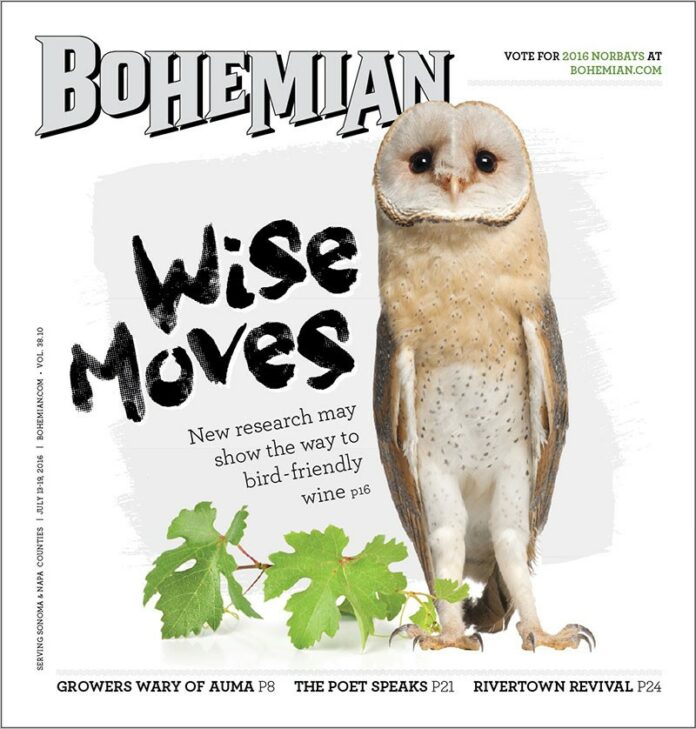
Julie Johnson delights in pointing out bluebirds whenever one alights in her certified organic Napa Valley vineyard. To encourage the colorful avians to stick around, she’s put up more than 20 nest boxes, and she instructs her vineyard workers to recognize and spare the nests of other songbirds when they are working in the vines.
“People get excited about seeing these birds do good things,” says Johnson, who owns Tres Sabores winery in
St. Helena.
The good these birds are doing in this and the scores of other organic and sustainable winery operations that have installed nest boxes for them, however, has until recently remained somewhat anecdotal.
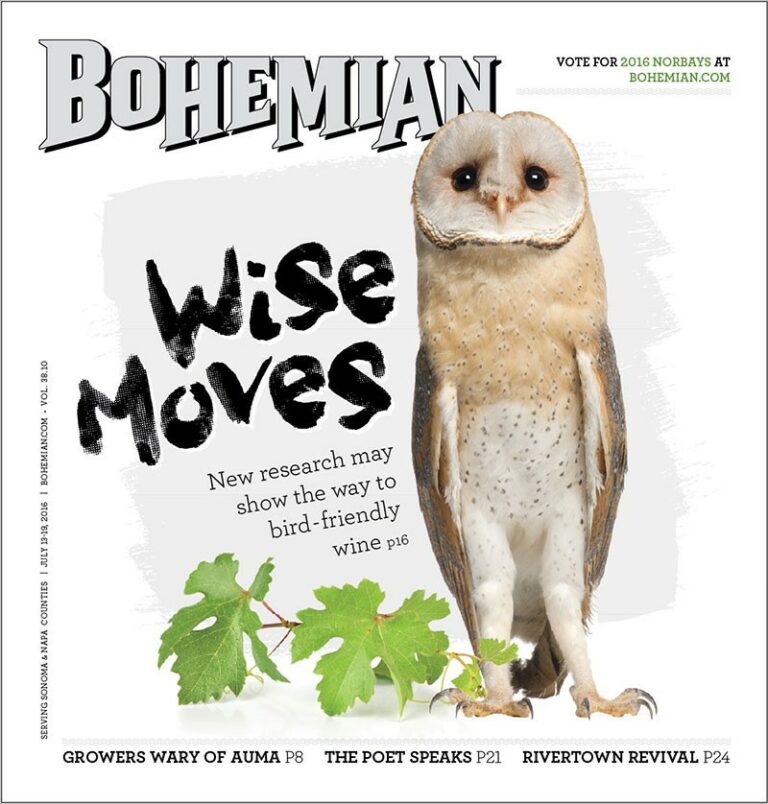
Johnson has also placed several nest boxes for owls at Tres Sabores. The nearly ubiquitous owl box mounted high on a pole almost functions like a totem these days; on many a vineyard tour, the guide will point to these boxes as evidence of the winery’s environmentally friendly bona fides—be they certified organic, sustainable or merely well-intentioned.
“They’re like superstars of the vineyard,” Johnson says of the owls. “We know that barn owls are among our nighttime predators that are really crucial for vineyards, capable of eating an incredible amount of rodent pests.”
But vineyard operators like Johnson can’t say for sure whether the owls are performing their superstar feats in their own vineyard, whether a vineyard is even a particularly good place to site the nest, from the owl’s point of view, or if they’re simply talking from their tail feathers. And while no cynic might tag a box for pretty songbirds or majestic owls with the term greenwashing, “feather dusting” does have a ring to it.
To answer questions about the efficacy of owl boxes, graduate student researchers from Humboldt State University have begun a first-of-its-kind study, painstakingly mapping the interaction between owls and vineyard habitat in the Napa Valley.
“Finally, we’re starting to get some really great research,” says Johnson, who hopes that the findings will help her to develop a program for “bird-friendly” farming or wine, similar to Fish Friendly Farming, based in Napa, and the Smithsonian Migratory Bird Center’s bird-friendly coffee program.
“They are very interested in looking at vineyards,” Johnson says of the Smithsonian, “because similar habitat exists here. The idea is that these beneficial birds can coexist quite nicely.” But first, research is needed to quantify that idea. “We know what the research needs to look like,” says Johnson, “we just need to take it to the next step.”
RESEARCH TAKES FLIGHT
Under the shade of the oaks at Tres Sabores last summer, Carrie Wendt takes a break from that very research to explain the owl study she began in February. A graduate student pursuing a masters degree in natural resources and wildlife at Humboldt State University, Wendt studies the ecosystem services that wildlife can provide in agricultural systems. Her advisor, Dr. Matthew Johnson, instigated the project by pointing out that, although owl boxes have been used in vineyards for several decades, there is little to no scientific literature about them. Many of the oft-cited statistics on owls come from studies done in England and elsewhere.
To start, Wendt cold-called hundreds of vineyard managers up and down Napa Valley for permission to monitor their owl boxes. With a list of nearly 300 boxes in hand, she visited them all three times at 10-day intervals.
“It took five days to check all 300 at first,” Wendt says, adding, “I’ve driven over 10,000 miles this year already!”
But only one-third of those boxes attracted a pair of breeding owls, so Wendt next concentrated on 91 boxes that did, 69 of which produced at least one chick that year. She’s at Tres Sabores to check up on three chicks that are almost ready to fledge and begin exploring the world outside.
After a short hike to the box, Wendt hands her laptop to her undergraduate assistant, Breanne Allison, and plugs her improvised owl cam into the computer. Commandeered from a digital overhead projector, the camera is taped, with a flashlight, to a telescoping pole.
Wendt carefully pokes the camera into the owl box, while Allison monitors the screen. “You see those feathers right there?” Allison says. “Oh, no,” Wendt replies. “Dammit. That’s a dead chick.”
It’s not a happy introduction to their work, but they reluctantly tilt the screen for me to view. Inside the box is a wasted scene. Crumpled heaps of feathers lay scattered about—it’s a failed nest.
“That’s really unfortunate,” says Wendt. “I’m sorry. Total downer!”
[page]
Nest boxes fail for a variety of reasons, says Wendt: opportunistic mammals may climb into them (although she doesn’t think that’s the cause here, Wendt notes that boxes with openings over five inches in diameter are less safe), or red-tailed hawks and great horned owls may hunt the parent owls while they fly to and from the box.
Widely used poison bait for rodent control is also a hazard for raptors: owls may be poisoned when consuming stricken rodents. But sometimes it’s just for lack of available prey that owls abandon their nest.
There’s another chance to see a fledgling owlet. I follow the students’ well-bumperstickered truck across the valley to Saint Helena Winery, off the Silverado Trail. This box is located in the middle of a vineyard, and was last seen containing one healthy, surviving chick. As Wendt maneuvers the swaying camera pole into the box, his image appears out of the darkness.
Still a fuzzball of downy feathers, he’s almost grown-up, and looking downright surly as he sways and bobs in front of the camera—the slightly comical threat display that the somewhat defenseless owlets typically put on. This lone owlet will be one of the 239 chicks successfully fledged from the nest boxes that Wendt studied, but the dark side of his success is that, most likely, he consumed his siblings—not uncommon in the unsentimental world of the barn owl.
PEST CONTROL
What the owls are eating, besides each other, may be crucial information for people like Jon Ruel, CEO at Trefethen Family Vineyards. With a background in research ecology, Ruel has helped Trefethen earn sustainability awards—and to tolerate a few more weeds in the more than 400-acre vineyard.
Ruel holds up a pellet that was at the base of an owl box as evidence that the birds are active here. After owls eat rodents, birds or other small prey, their stomach acids digest all but the bones and fur, which are then regurgitated instead of excreted. This pellet is loaded with tiny skulls with outsized teeth.
But another sustainable winegrowing technique that Ruel likes to employ is growing cover crops to naturally balance the vigor of the vines growing in deep, Oak Knoll District soil. In a particular Merlot block one year, he took that to an extreme. “It looked like wildlife habitat,” Ruel says. “And it was.”
After the cover crop died out, some vines began to die—victims of gnawing and root nibbling by hungry rodents. Ruel thinks that the rodents went wild because the owls could not easily find them in the dense cover.
With their second year of research, Humboldt State students may be able to confirm such questions.
Following up on Wendt’s work, Humboldt State graduate student Xeronimo Castaneda has been tagging adult owls with GPS transmitters. The work must be done within a demanding time frame: Castaneda has to find owls while they’re in the nest box with chicks 14 to 21 days old. Afterward, the adults roost elsewhere while continuing to feed the increasingly large chicks.
Scooping owls out of a box isn’t as hard as it sounds—the boxes have hinged doors to facilitate cleaning. But it’s not for amateur ornithologists. The team had to apply to two agencies, the Bird Banding Laboratory, a division of the United States Geological Survey, and the Institutional Animal Care and Use Committee, to obtain permission to capture and tag owls.
Somewhat like a miniature CamelBak strapped to the owls’ back, the transmitter has a regulated weight that doesn’t interfere with their flight. A hand-held radio receiver allows Castaneda to locate the bird, and the GPS data can be scanned remotely. The units are designed to safely fall off the bird within a tried-and-tested period of time.
Castaneda has a map of preliminary results that shows an owl’s erratic daily travels over Napa Valley, with each day color-coded. After the season, when the students crunch the data, they’ll superimpose a layer of habitat and vineyard designations developed by Wendt, and a picture will emerge as to whether owls prefer to actually hunt in one type of habitat over another.
“We see a lot more owls in organic versus conventional vineyards,” Castaneda says. In general, according to Wendt’s data, the population of owls in Napa Valley is concentrated in the southern part and Carneros, where there are still areas of open grassland as well as vineyards. The vineyard-choked northern Napa Valley don’t see nearly the same rate of occupied nest boxes.
Castaneda mentions a small experiment conducted by an undergraduate that has yielded some very interesting preliminary results. The student created a set of sandboxes, burying 100 sunflower seeds in each, and placed some in areas known to be populated with owls, others not.
“It’s interesting that across the board,” says Castaneda, “those little bait stations where there were no owls—all the seeds were gone. But where there were owls, a portion of those were still left.”
[page]
While further study needs to be done, says Castaneda, this suggests that even if owls aren’t actively hunting within the vineyard, their very presence may affect the behavior of rodents in the vineyard—perhaps a sort of mirror in miniature of now-famous reports that wolves, when reintroduced to Yellowstone National Park, modified the browsing habits of elk to the benefit of waterways.
SHARPSHOOTERS
At Black Stallion Winery in Napa, Bob Johnson (no relation to Julie Johnson) is worried about the browsing habits of a much smaller creature. Standing by a motley collection of small vines in the winery’s demonstration vineyard by the patio, Johnson explains that dozens of vines had to be replanted after falling victim to Pierce’s disease, a bacterial infection spread by an insect vector.
As viticulturist for Delicato Family Vineyards, which owns Black Stallion, Johnson has bigger vineyard blocks to worry about. But he worries that it’s symptomatic of a larger trend: the culprit wasn’t the dreaded glassy-winged sharpshooter, which has thus far been prevented from entering North Bay wine country by monitoring programs; it’s the common blue-green sharpshooter, which growers are used to managing closer to its traditional habitat along riparian areas, but which has caused damage farther afield in recent drought years. The Napa River is hundreds of yards from this site.
A program funded by the industry has come up with promising, if expensive and commercially dubious solutions, like disease-resistant hybrid grapevines. Meanwhile, Johnson says that Black Stallion may join other growers along the river in trying out one of the best natural controls available. “Now growers are planting bluebird boxes,” Johnson says. “It’s a tool to help the problem. It’ll be very interesting to see what [Pierce’s disease] does this year.”
The growers aren’t flying blind on this, thanks to recent findings from Julie Jedlicka, a postdoc UC Berkeley researcher. Jedlicka’s doctoral research in Sonoma and Mendocino County vineyards showed that providing western bluebirds with specific nesting requirements resulted in a tenfold increase in insectivorous songbirds, without increasing the population of birds that eat grapes.
“Then I really zoomed in on one grower in St. Helena, Spring Mountain Vineyard,” Jedlicka says. “They have several hundred acres, so I could get a lot of fecal samples of birds and bring them to the Berkeley laboratory a short distance away.”
Jedlicka, who is now an assistant professor at Missouri Western State University and hopes to create a bird-friendly campus there, says that answering the simple question of what bluebirds are eating was a messy, bird-unfriendly task until new technology became available in the last few years. It’s called molecular scatology, though less technical terms work just as well for Jedlicka. “We extracted DNA from the poop to see what insect had been eaten,” she says, “and matched DNA to exactly that species of insect.”
The birds were eating sharpshooters—a lot of them. The current system can’t tell a blue-green sharpshooter apart from any number of other, non-vector sharpshooters. But a formerly bad Pierce’s disease problem has already been suppressed in that vineyard. “The next step would be to track them in infested vineyards,” Jedlicka says.
BIRDS AND GRAPES
If there’s a hitch in Julie Johnson’s plan for bird-friendly wine, it may be growers’ attitudes toward birds during harvest. Grape-pecking birds can cause both quantitative and qualitative damage during harvest, and Wendt points out that even passive protection like bird netting ends up killing some songbirds, which are supposedly protected under the Migratory Bird Treaty Act.
“It’s a catch, in my mind,” says Wendt. “In my opinion, bird-friendly farming is friendly to all birds.”
Whether bird-friendly farming becomes a label on its own, or part of a sustainability program like Napa Green—which does not now require anything bird-related from its members—Johnson is glad to see the research being done in vineyards.
Meanwhile, anyone with a bit of property can help the birds by giving back to their habitat. “Bluebirds are what we call an obligatory cavity nesting species,” Jedlicka explains, “which means they must have a cavity to build their nest.” But bluebirds like the oak woodlands and savannah that continue to disappear due to commercial development, according to Jedlicka.
“Putting up nest boxes is a really good substitute for that habitat.”
See the North American Bluebird Society at nabluebirdsociety.org for bird information and nest box designs.