Mar. 18: Mozart for Kids in Rohnert Park

0

Chicago-based nonprofit Classical Kids Music Education enriches the lives of children everywhere by collaborating with professional orchestras around the country in its Classical Kids Live concert series. This month, the series teams with the Santa Rosa Symphony for a kid-friendly classical journey into the life and works of the world’s most famous composer. ‘Mozart’s Magnificent Voyage’ is an all-ages appropriate program of Mozart’s most enduring works, such as The Magic Flute, and the afternoon performance includes a pre-show instrument petting zoo on Sunday, March 18, at Green Music Center’s Weill Hall, 1801 East Cotati Ave., Rohnert Park. 3pm. $12–$17. srsymphony.org.

Mar. 21: Dinner Jazz in Healdsburg

0

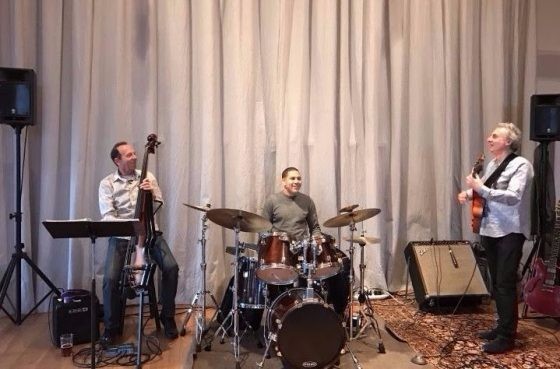
For the last two decades, the Healdsburg Jazz Festival has brought world-class music to local venues as well as into local schools with its far-reaching music-education programs. Those programs get a major boost this month at the eighth annual Jazz on the Menu fundraiser, which celebrates delectable dining and lively music. This year’s musical menu features the Dry Creek Trio, boasting Healdsburg Jazz Festival staples in guitarist Doug Lipton, bassist Chris Amberger and drummer Lorca Hart, paired with a menu prepared by Shed chef Perry Hoffman on Wednesday, March 21, at Healdsburg Shed, 25 North St., Healdsburg. 6pm. $100. 707.431.7433.

Spotlight on Cotati/Rohnert Park

Craft-brew craze comes to Rohnert Park and Cotati

In a county that’s increasingly known for its craft-beer scene, a new crop of beer fanatics are making waves in Rohnert Park and Cotati that can be tasted in the towns’ recent outpouring of top-quality taprooms and award-winning microbreweries.

Rohnert Park’s origins in the craft-beer movement can be traced back to an unassuming block of storefronts on Commerce Boulevard between Golf Course Drive and the Rohnert Park Expressway. That’s where Beercraft, founded over five years ago by brothers Matt and JT Fenn, sells hundreds of hard-to-find beers from across the country and pours from over a dozen rotating taps in the taproom.

“It was borne out of our love for beer,” says Matt Fenn. “We try to find the best beer we can on any given day. That’s pretty much all we do, all day, is keep our ear to the ground and pay attention to what people are excited about, and get that beer.”

It’s not always easy to get their hands on the beers, which often come from micro- or nano-breweries not yet on the map, but Fenn estimates the bottle shop receives 10 to 20 new beers a week.

In bottle and on tap, Beercraft strives to have something for everyone. “We try to figure out what people are craving and go from there, but we try to keep a blend of everything,” Fenn says.

“We take it seriously, but we don’t take it too serious and turn beer into something other than beer,” Fenn continues. “It’s lived in our society as something that brings people together and makes them happy. That’s the most important thing.”

While Beercraft delivers a world of beer to Sonoma County, a local brewer is crafting homegrown beers at Cotati’s first brewery, Grav South Brewing Company.

Formed by award-winning brewer and Sonoma County native Greg Rasmussen, the name was inspired not only by the Gravenstein apples that Rasmussen grew up around on his grandfather’s farm, but for the brewery’s location along the Gravenstein Highway in Cotati, just west of Highway 101. Inside the taproom, several Grav South beers are available straight from the source, with classically balanced American ales and fresh IPAs.

Another homegrown story in Cotati is Flagship Taproom, established in late 2016 by five local friends with a lifetime of food-service experience among them. They took advantage of an empty location, the site of the former Cotati Yacht Club, and turned it into a family-friendly taproom.

“We all grew up in this area, we all have friends and family in this area, so we wanted to start this dream of ours and make our community even better than it has been,” says co-owner Matt Inlow. “We want to build relationships and have people want to come back tomorrow to continue the conversation we had today.”

While Flagship offers a full menu and hosts events like trivia night to bring people in, Inlow says that craft beer is Flagship’s focus, and they host bimonthly tap takeovers with local brewers and constantly rotate their 20 taps with as wide a variety of beers as possible.

Rohnert Park’s newest brewpub is actually from one of the county’s longest-running brewers. Bear Republic Brewing Company makes the most of its new taproom’s backdrop at Roberts Lake, next to the Foxtail Golf Club. Open since last summer, Bear Republic Lakeside features two bars, lots of restaurant seating and an outdoor area overlooking the water that’s perfect for parties.

[page]

LOCAL KNOWLEDGE

Redwood Cafe’s Michael McCullaugh shares his joy for Cotati and Rohnert Park

Describe your perfect day?

Obviously, we live in a beautiful place—a perfect day would be the sun shining, people coming into downtown Cotati on bikes, some live music playing somewhere. I love the accordion festival that happens in the summer. It’s been a tribute to the town for years, and they’ve done an amazing job, especially the last five years.

Where is your favorite place to eat and why?

For me, I actually like to go to that little place across from Sonoma State University, Shangri-La Cafe & Grill, especially if we catch a show at Sonoma State. It’s a little mom-and-pop place and they do a great job. Of course, my partner also runs Cafe Salsa. That’s always wonderful.

Where do you take first-time visitors?
Going to Spreckels Performing Art Center is always great. I also love going to see shows at the Green Music Center—that’s wonderful. And I love supporting the SOMO Village when they have the summer shows out there by Sally Tomatoes. That’s a lot of fun. We also have a lot of natural beauty around here, from wetlands to mountains. I like to take people hiking on Sonoma Mountain, up in the hills. That’s a great place to bring children. Crane Canyon is also a lovely place to go to.

What do you know about the area that others don’t?

I’m really happy with what Rohnert Park and Cotati have done recently as far as making bike paths and creek trails. I wish more kids would ride their bikes around town from the university and such.

If you could change one thing about Rohnert Park/Cotati what would it be?

You know, I’ve been in Cotati for 27 years and it’s a wonderful little gem, and it’s evolving really slowly. If there’s anything I would promote, it is creating the infrastructure where we can grow behind the strip on Old Redwood Highway, to grow a little more downtown area. I would love to see Rohnert Park and Cotati be more of a live music hub in Sonoma County. That’s one of the reasons why I got into the music scene with Redwood Cafe—to help promote that. I think the area could just blossom tremendously over the next few years.


Coming Home

0

While time may heal all wounds, a little human kindness along the way doesn’t hurt.

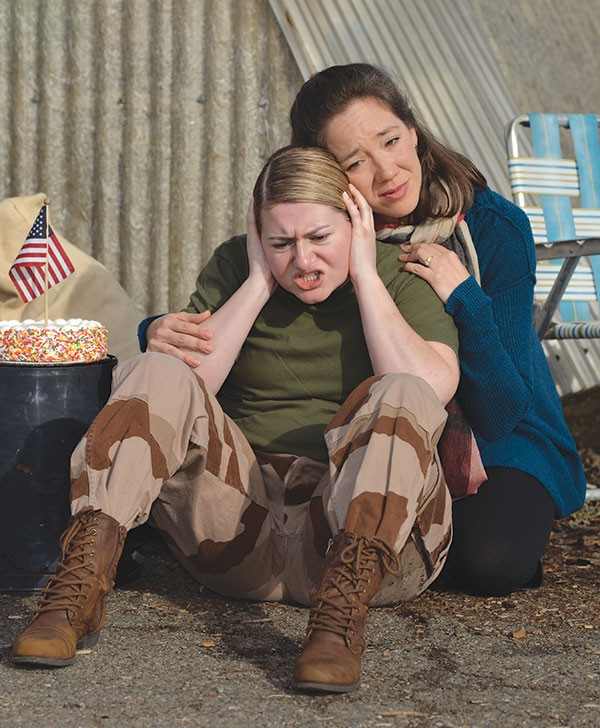
That’s the takeaway from the Santa Rosa Junior College production of Julie Marie Myatt’s Welcome Home, Jenny Sutter. Originally produced in 2008 at the Oregon Shakespeare Festival, it was one of the first works to address the issues faced by returning veterans of the Iraq/Afghanistan conflicts.

Recently discharged Marine Jenny Sutter (Jenna Rechsteiner) has returned to California after being physically and emotionally wounded in the service of her country. Avoiding home for fear of her family’s reaction to her wounds, a happenstance meeting at a bus station leads her to join Lou (Maureen O’Neill) on a trip to Slab City, Calif.—a place in the Sonoran Desert where squatters and campers have reclaimed an abandoned military base and turned it into a sort of off-the-grid commune.

Jenny soon finds herself surrounded by people struggling with their own damaged lives. There’s Lou, who is dealing with addiction problems (gambling, smoking, sex); Buddy (Geoffrey Nixon), an abuse survivor who fancies himself a preacher (his ordainment came free with a credit check); and Donald (Dylan Kupper), an anti-social jeweler with anger issues. They are all looking for someone or something to believe in, but they—and especially Jenny—need to begin with themselves.

With only six roles to fill from a school full of theater students, director Wendy Wisely has double-cast every role and has the two casts alternating performances. The opening night cast was fine, with particularly warm performances from O’Neill as Jenny’s guide to recovery and Nixon as the sermon-delivering preacher.

With the Burbank Auditorium under renovation, the somewhat lacking Newman Auditorium hosts this production, which translates to minimal set and lighting designs. That’s a shame because the story’s locale provides interesting opportunities for both, though lighting designer Vince Mothersbaugh does manage to do something with the limited resources.

A slide presentation noting the military service of some of the cast, crew and SRJC staff precedes the show, and the program notes that there are over a thousand currently enrolled members of the student population who are active duty, reservists, veterans or their dependents. Welcome Home, Jenny Sutter is a nice salute to them and their families.

Rating (out of 5): ★★★½

Gather Round

0

With St. Patrick’s Day upon us, the North Bay shows off its Irish side this weekend at several concerts and community events on March 17, and for fans of traditional Irish folk, new Sonoma County ensemble Cularan provide a perfect melodic pairing for several rounds of Guinness and gaiety.

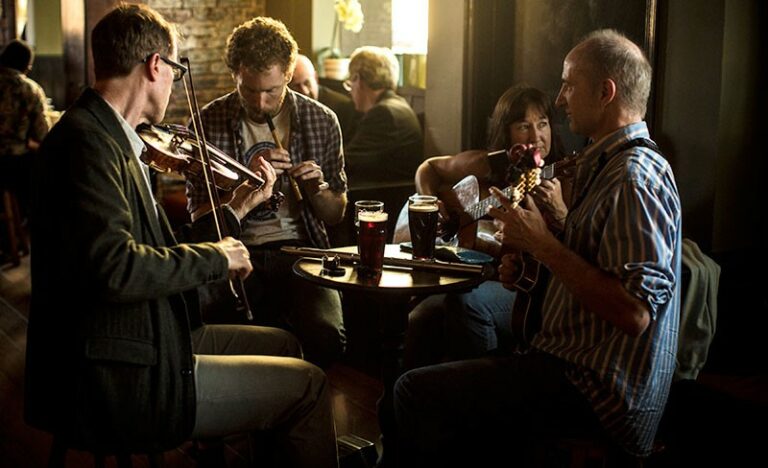
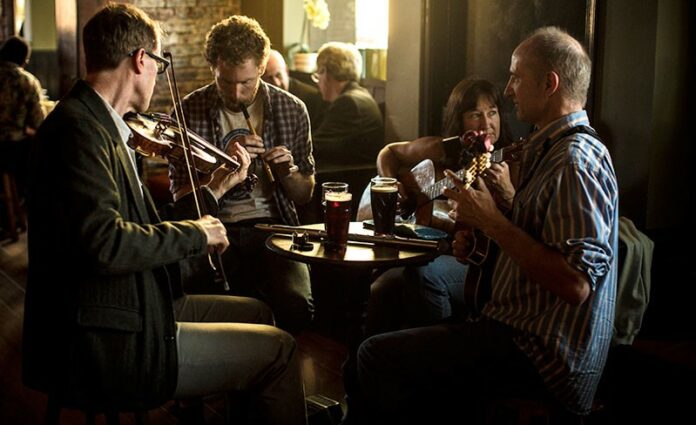
Formed last year by guitarist Megan McLaughlin, mandolin player Randall McNeill, violinist Rufus Gondardi and percussionist and flutist Christopher Dillingham, the band was born out of weekly Irish jam sessions at Berkeley pub the Starry Plough.

In Ireland, a

cúlarán is a wildflower, commonly known as a pignut in Irish Gaelic. “The boys in the band wanted to call ourselves Pignut, and I said absolutely not,” laughs McLauglin. “So we came up with Cularan.”

McLaughlin herself is a veteran songwriter, best known around the Bay Area as part of folk-rock band the Musers, and for her three solo albums. Last summer, McLaughlin moved from her longtime home of Oakland to Sebastopol.

“I love it up here. I spent a wonderful 28 years in Oakland, but it was time to live out in the country,” says McLaughlin. “The musical community here is fantastic.”

In Cularan, McLaughlin and her bandmates cover a wide swath of traditional Irish music, including jigs, polkas, waltzes and both rowdy and heartfelt folk jams.

“The repertoire is huge,” says McLaughlin. “I started in on this music about 10 years ago. The more you listen, the more you pick up. It’s very much in the oral tradition where people just listen and learn by ear.”

In addition to performing classic compositions, Cularan also plays some of McLaughlin’s originals mashed up with Irish tunes, and offers up three-part harmonies as well as intricate acoustic arrangements.

While the group is planning on a new album, the only way to hear Cularan this week is to see them live. On March 15, the band gets the weekend off on the right foot with a set at Redwood Cafe in Cotati. On March 17, the group takes over McNear’s Saloon in Petaluma for the restaurant’s 31st annual St. Patrick’s Day Bash, performing their Irish folk amid pints of green beer and Irish-inspired food.

“Most often, we get people dancing,” says McLaughlin. “The Irish dance community has got their own ways of communicating, so we’ll show up and people will be ready to dance. It’s amazing to watch.”

Resilient Hope

0

‘Harriet Tubman was a wilderness leader,” says Rue Mapp. “She traversed the wilds without a GPS.”

Tubman, an abolitionist and spy for the Union Army, is a role model for Mapp, the founder of Outdoor Afro and one of the headliners at this year’s Geography of Hope (GOH) Conference, running
March 17–18 in Point Reyes Station. The theme is “Finding Resilience in Nature in Perilous Times.”

If that sounds familiar, it should. North Bay survivors of last fall’s fires have been talking about nature and resilience for months. Still, the conference promises to deliver new insights and strategies.

In 2016, just as the Black Lives Matter movement spread across the country, Mapp put her fledgling organization on the map when she launched a series of outdoor events called “Healing Hikes” that resonated widely.

“The hikes came along in tandem with Black Lives Matter,” says Mapp. “Synchronicity was at work.We need to lay our burdens down by the riverside. Streets are a hard landscape to find release from trauma.”

The hikes have swelled the ranks of Outdoor Afro, which started as Mapp’s own personal blog. Now the organization has members in 30 states with a hundred leaders who guide inner city residents through forests and meadows where they breathe clean air, identify medicinal plants and appreciate natural beauty.

In spite of the group’s name, Mapp says, all races are welcome.

Mapp aims to strengthen communities and make up for lost time. A rare opportunity slipped through the cracks of history in 1964, says Mapp, when the wilderness cause and the Civil Rights cause might have been linked and weren’t.

That year witnessed the passage of the Wilderness Act and the
Civil Rights Act, both of which President Lyndon B. Johnson signed into law. In the half-decade that followed, African Americans moved toward “Black is beautiful” and black liberation, while whites moved toward Earth Day.

“Unfortunately, we now have two siloed movements,” says Mapp. “One is for people, and the other is for land.”

At the GOH conference, Mapp and fellow presenters will suggest ways to fuse them.

The event is made to order for local environmentalists, community activists and citizens who crave a brave new vision of the world. Mapp will be joined at GOH by Peter Forbes, the founder of the Center for Whole Communities, and by Caleen Sisk, the Tribal Chief of the Winnemem Wintu Tribe based in Northern California.

The event includes vocal improvisation led by David Worm, a founding member of Bobby McFerrin’s Voicestra. The conference wraps up with an outdoor restoration project with Peter Wohlleben, author of The Hidden Life of Trees.

For more information go to gohconference.org

Rise Up

This is an open letter to the so-called cannabis community, a community that is unable to stand together and express any political power; that is unable to see that the regulatory regime isn’t really about cannabis, but rather economic control, blind ideology and loss of civil liberties; and that pretends to have the moral high ground, but lacks the moral courage to claim it.

There are a lot of good people in the cannabis industry and there are some responsible businesses and corporations, but there is no cannabis community. There are a few brave (or foolhardy?) souls and marginal organizations fighting the battle for crumbs, that nevertheless don’t engage in political freedom and cultural integrity. There are also a lot of self-righteous, identity-politics “victims” unable to look beyond their narcissistic neediness.

People who really care about the free and creative use of cannabis as a social health and safety benefit have two albatrosses around their necks: the oppressive, arrogant and treacherous government apparatus, and the passive, frightened and atomized cannabis community itself.

We face two ongoing struggles. The first is a running series of skirmishes to claw back rights lost to corporate behemoths that own the control-fraud rackets (and the governments administering them); the second is a decades-long cultural-values war as medical facts supplant the reefer hokum ideologies and the overall structure of suppression and regulation. Truly, cannabis acceptance advances one funeral at a time.

We must engage both simultaneously and continuously with some dynamic combination of soul-numbing bureaucratic confrontation and high-integrity civil disobedience against the hypocrisy, extortion and abuse of process by our “leaders” and their owners. Cannabis growers and suppliers have decades of experience working with integrity outside the law, which will continue in a black market made inevitable by the regulatory excesses.

Both the content battles and the acceptance war will advance with a series of test cases in the courts, combined with a general refusal to play the regulatory game designed from the beginning to destroy the existing cannabis culture and violate our natural human right to maintain our health and sanity.

I challenge, invite and encourage all people who have any stake in this matter and the financial wherewithal to fund the skirmishes and the war itself. Decide what’s really important to you and which side you are on, and whom you really serve. Enroll your peers in the community to step up their engagement and build political power through weight of aligned numbers. Finally, put your time, money and personal energy where your mouth is.

‘Oaky Joe’ Munson is a Forestville cannabis grower.

Letters to the Editor: March 14, 2018

Byrne After Reading

It is election season once again, and Congressman Jared Huffman allowed the Bohemian to follow him around for a few hours on the campaign trail (“On the Road With Jared,” March 7). Overall, Huffman’s political positions have much to commend—with the exception of his strong opposition to the Boycott, Divestment, Sanctions (BDS) movement, which is having a positive impact on Israeli oppression of the Palestinians and deserves support. It’s an important topic that, sadly, did not make it into the story, which bordered on hagiography.

Nor did the story report that Huffman’s largest campaign donor this season is Honeywell International—yes, that Honeywell, the multinational conglomerate that pollutes our natural resources drilling for oil and gas and has billions of dollars in war industry contracts. And in fourth place as a Huffman donor is CBRE Group, the real estate behemoth with billions on federal contracts that is owned by the family of Sen. Dianne Feinstein.

Is there a moral compass guiding Huffman’s career? Maybe, but as the Bohemian reported, his “childhood political hero” is Harry Truman, stalwart of the Kansas City Prendergast Machine, member of the Ku Klux Klan and the man who ordered the dropping of atom bombs on tens of thousands of Japanese children.

Petaluma

C Is for Conservation

We are very happy that Napa County’s Watershed and Oak Woodlands Protection Initiative has been approved for inclusion as Measure C on the June ballot. We particularly like that this was named Measure C, as “C,” to us, stands for conservation, which we favor because our natural resources are not infinite. Those of us who have come together now have a name: Growers/Vintners for Responsible Agriculture. We want to communicate to the citizens of Napa County that there are many of us in the grower and vintner community who support this initiative. Our focus is on stewardship of our watershed, and we recognize that Measure C gives the voters the opportunity to ensure that our watershed is protected now and into the future.

The Agricultural Preserve came into existence in 1968. Its 50th anniversary is being celebrated in many ways this year. Though it was considered very controversial and legally uncertain, it has weathered all tests and has protected Napa Valley for agriculture for the last half century.

Measure C aims to offer protection to our agricultural watershed. Our watershed is the source of most of the water we use. We, as members of the vintner and grower community, understand how important a healthy watershed is to the citizens of Napa County, to our natural environment and to the perpetuation of sustainable agriculture. To the latter point, we know that we have a right to farm, but it is our obligation to farm responsibly.

As with the Ag Preserve, the question to be asked is: Will the Napa Valley itself be better if this measure is passed? We strongly think so.

Napa County

Write to us at le*****@******an.com.

Zero Out Emissions

0

Transportation remains the biggest challenge to clean air and climate protection in car-dependent California. Fortunately, Phil Ting, assemblyman from San Francisco, has proposed a game-changing piece of legislation, Assembly Bill 1745, also known as Clean Cars 2040.

Vehicles that run on fossil fuels are responsible for nearly 40 percent of California’s total greenhouse gas emissions, so electrification of transportation is crucial for the health of our people and the planet. Assembly Bill 1745 would unleash market forces by requiring that all new passenger vehicles registered in California would be zero-emission starting in 2040.

The Center for Climate Protection is leading an all-out effort first to get AB 1745 voted into law. This will take a statewide effort. The campaign kicks off locally with a Call to Action meeting in Santa Rosa at the Glaser Center on March 22.

The bill is in the Assembly Transportation Committee right now and is due to be voted on in mid-April. The top priority is to get eight yes votes from the transportation committee so that the bill advances to the Assembly floor. Cecilia Aguiar-Curry, who represents parts of Sonoma, Napa, Lake and Yolo counties, may be a swing vote on the committee. Her constituents need to let her know that they want her to vote yes on AB 1745.

What else can you do? Show up and bring your friends to the launch and rally on March 22. We need everyone who supports clean air and climate protection to be there. You can also sign and share the Center for Climate Protection’s online petition in support of AB 1745 at climateprotection.org.

To RSVP for the kick off meeting or for more information, contact jo**@***************on.org.

Jane Bender served on the Santa Rosa City Council for 10 years, including service as mayor from 2004–06. While in office, she championed the greenhouse gas emission targets, among other climate-protection initiatives.

Open Mic is a weekly feature in the ‘Bohemian.’ We welcome your contribution. To have your topical essay of 350 words considered for publication, write op*****@******an.com.

Winter Greens

0

Ten years ago, “locavore” was anointed the 2007 word of the year by the New Oxford American Dictionary.

Since then the idea of wanting to eat closer to home and in season has only gained traction, which has naturally invited skepticism. Number crunchers have found enough cases of it being more carbon-friendly to purchase food from far away that, if saving the world is the goal, the locavore case could be sunk.

Pierre Desrochers, co-author of Locavore’s Dilemma: In Praise of the 10,000-Mile Diet, argues that it’s more energy-efficient to ship a tomato thousands of miles in winter than to grow one in a heated greenhouse close to home. His calculations miss an important X-factor: few locavores have much interest in a fresh tomato in the middle of winter. They tend to taste like red snowballs. Best to wait until July.

But if it’s a salad you want, you don’t have to wait until summer for local produce. Once upon a time, a winter salad didn’t even contain leaves, much less tomatoes, and was made of shredded roots that had been squirreled away during warmer times. Such a meal was originally made possible by the advent of root cellars and other winter storage facilities that kept certain crops cool but not frozen. Today at grocery stores and winter markets, it’s easy to acquire a rainbow of tubers and greens. I just returned from the winter market with carrots, purple and white daikon radish, Brussels sprouts and onions.

Nowadays, a winter salad can mean more than roots and cabbage. Greenhouse innovations have ushered in a winter-salad revolution on par with that brought on by the advent of root cellars. And in coastal California, Brussels sprouts are hitting their prime now in the waning days of winter.

This recipe comes fron consummate gastronome Allen Broach of Greensboro, S.C.

Brussels
Sprout Salad

1 yellow onion, thinly sliced

3/4 c. white balsamic vinegar

1/4 c. olive oil

1 clove garlic, minced

salt and pepper

1 pound Brussels sprouts leaves torn from the sprouts

1/2 c. toasted walnuts

3 tbsp. finely grated pecorino Romano cheese

3 tbsp. extra-virgin olive oil or to taste

1/2 tsp. kosher salt

1 tbsp. freshly ground black pepper or to taste

balsamic vinegar reduction

pomegranate seeds

Marinate onions in 1/4 c. vinegar, olive oil, garlic and salt and pepper for at least 30 minutes.

The inner core of the sprouts, which haven’t yet differentiated into leaves, can be thin-sliced.

Coarsely grate the cheese.

For the balsamic reduction, heat a half-cup of balsamic on low, allowing it to slowly thicken to about half the volume. Toss with pomegranate seeds and the onion dressing. It’s special. And local enough.

Mar. 18: Mozart for Kids in Rohnert Park

Chicago-based nonprofit Classical Kids Music Education enriches the lives of children everywhere by collaborating with professional orchestras around the country in its Classical Kids Live concert series. This month, the series teams with the Santa Rosa Symphony for a kid-friendly classical journey into the life and works of the world’s most famous composer. ‘Mozart’s Magnificent Voyage’ is an all-ages...

Mar. 21: Dinner Jazz in Healdsburg

For the last two decades, the Healdsburg Jazz Festival has brought world-class music to local venues as well as into local schools with its far-reaching music-education programs. Those programs get a major boost this month at the eighth annual Jazz on the Menu fundraiser, which celebrates delectable dining and lively music. This year’s musical menu features the Dry Creek...

Spotlight on Cotati/Rohnert Park

Craft-brew craze comes to Rohnert Park and Cotati In a county that's increasingly known for its craft-beer scene, a new crop of beer fanatics are making waves in Rohnert Park and Cotati that can be tasted in the towns' recent outpouring of top-quality taprooms and award-winning microbreweries. Rohnert Park's origins in the craft-beer movement can be traced back to an unassuming...

Coming Home

While time may heal all wounds, a little human kindness along the way doesn't hurt. That's the takeaway from the Santa Rosa Junior College production of Julie Marie Myatt's Welcome Home, Jenny Sutter. Originally produced in 2008 at the Oregon Shakespeare Festival, it was one of the first works to address the issues faced by returning veterans of the Iraq/Afghanistan...

Gather Round

With St. Patrick's Day upon us, the North Bay shows off its Irish side this weekend at several concerts and community events on March 17, and for fans of traditional Irish folk, new Sonoma County ensemble Cularan provide a perfect melodic pairing for several rounds of Guinness and gaiety. Formed last year by guitarist Megan McLaughlin, mandolin player Randall McNeill,...

Resilient Hope

'Harriet Tubman was a wilderness leader," says Rue Mapp. "She traversed the wilds without a GPS." Tubman, an abolitionist and spy for the Union Army, is a role model for Mapp, the founder of Outdoor Afro and one of the headliners at this year's Geography of Hope (GOH) Conference, running March 17–18 in Point Reyes Station. The theme is "Finding...

Rise Up

This is an open letter to the so-called cannabis community, a community that is unable to stand together and express any political power; that is unable to see that the regulatory regime isn't really about cannabis, but rather economic control, blind ideology and loss of civil liberties; and that pretends to have the moral high ground, but lacks the...

Letters to the Editor: March 14, 2018

Byrne After Reading It is election season once again, and Congressman Jared Huffman allowed the Bohemian to follow him around for a few hours on the campaign trail ("On the Road With Jared," March 7). Overall, Huffman's political positions have much to commend—with the exception of his strong opposition to the Boycott, Divestment, Sanctions (BDS) movement, which is having a...

Zero Out Emissions

Transportation remains the biggest challenge to clean air and climate protection in car-dependent California. Fortunately, Phil Ting, assemblyman from San Francisco, has proposed a game-changing piece of legislation, Assembly Bill 1745, also known as Clean Cars 2040. Vehicles that run on fossil fuels are responsible for nearly 40 percent of California's total greenhouse gas emissions, so electrification of transportation is...

Winter Greens

Ten years ago, "locavore" was anointed the 2007 word of the year by the New Oxford American Dictionary. Since then the idea of wanting to eat closer to home and in season has only gained traction, which has naturally invited skepticism. Number crunchers have found enough cases of it being more carbon-friendly to purchase food from far away that, if...
11,084FansLike
4,606FollowersFollow
6,928FollowersFollow