Documentary on Saving Native California Languages Airs on KRCB Television

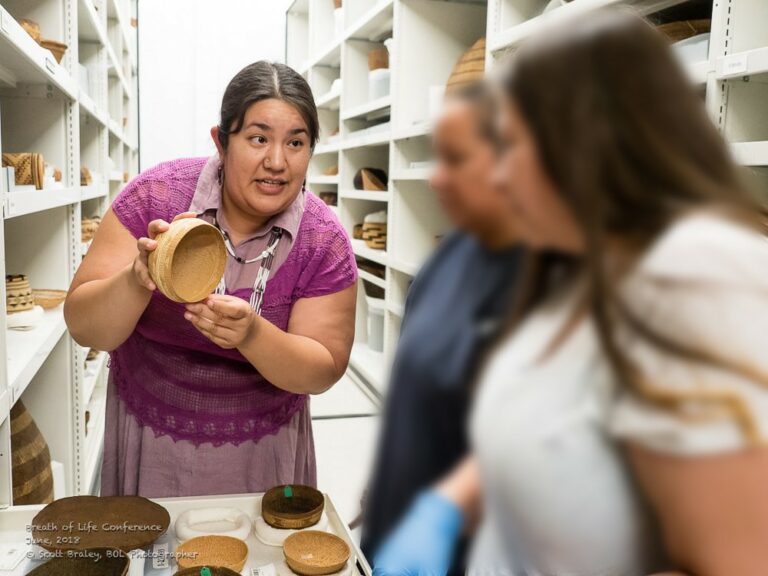
For decades, a group of Native activists and language experts have convened at the University of California, Berkeley, to help preserve and revitalize more than 100 individual native Californian languages.

Hosted by the nonprofit organization Advocates for Indigenous California Language Survival (AICLS), this biennial gathering is dubbed the ‘Breath of Life’ conference, and while the event could not take place this year due to Covid-19, the public can get an in-depth look at the painstaking work that Native Californians do to keep their tribal languages alive in the half-hour documentary film, Breath of Life: Revitalizing California Languages.

The film airs in the North Bay on Northern California Public Media’s KRCB-TV for Native American Heritage Month on Sunday, Nov. 8, at 2:30pm. The film also airs in the South Bay on KPJK-TV on Nov. 11 and Nov. 14 at 9:30pm and 5:30pm respectively.

Breath of Life is the sixth self-funded film from Emmy Award-winning independent producer Rick Bacigalupi, who has partnered with the Oakland Museum of California to create the film. Bacigalupi is best known for his work on programs and films like “Bay Nature on the Air” and “Only in the Castro with Trevor Hailey” that highlight the region’s ecological and cultural diversity, and his credits also include contributing to NorCal PublicMedia’s monthly “Bay Area Bountiful” program.

In this film, Bacigalupi covers past Breath of Life conferences and the AICLS’s other work in telling Native peoples’ stories in their own tongues.

AICLS board member Vincent Medina (Chochenyo Ohlone) opens the documentary by stating, “We haven’t had a native Ohlone speaker in about 70 years. That’s not to say we don’t have speakers now—I consider myself to be one of the first new generation of fluent speakers in our language, which is exciting.”

Today Native California peoples’ story is emerging as one of persistence, revitalization and pride. Yet, no accounting of their experience is complete without acknowledging the atrocities of the recent past, and the film follows the Breath of Life group on a field trip to nearby Mission Dolores in San Francisco and a tour of the adjacent cemetery containing 5,000 unmarked native graves.

Despite showing the pain of past persecution, the tone and outlook of Breath of Life remains optimistic. The film shows how the conference participants work with noted visiting linguists like Professor Pamela Munro from UCLA, and Professor Catherine Callaghan from Ohio State, a foremost authority on Miwok languages since publishing her thesis in 1963.

The film also demonstrates the challenging and emotional experience that native speakers go through in rediscovering and speaking their cultural languages, and it also takes time to watch presentations given “in language” on topics that range from hilarious personal stories to singing the “Hokey Pokey” translated into Tongva, a Southern California language.

The next Breath of Life conference will take place in 2022. Until then, the AICLS will continue to host events and activities on online platforms such as Zoom, Facebook and YouTube.

‘Breath of Life’ airs on Sunday, Nov. 8, at 2:30pm on KRCB-TV via antenna on UHF Channel 22, on digital channels 22-1, 22-2 and 22-3; and on Comcast Cable channel 22 in Sonoma, Marin and Napa County. Norcalpublicmedia.org/television.

Sonoma City Council Selects Interim City Manager

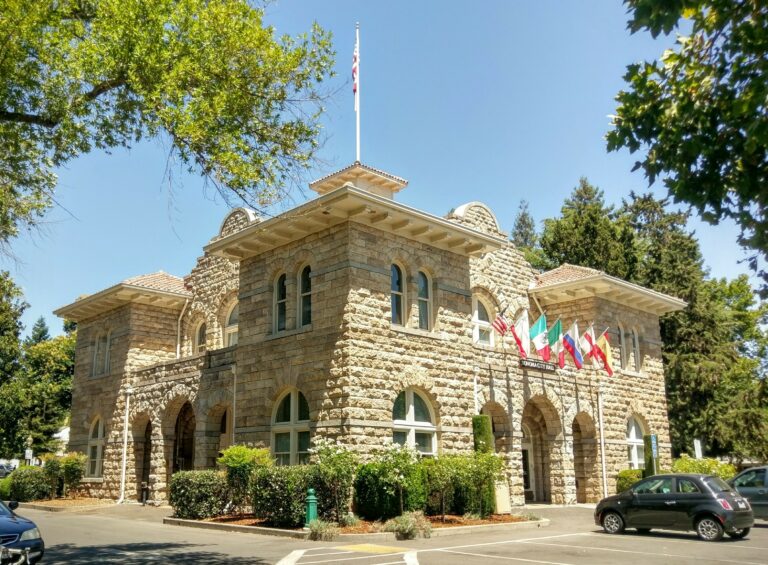
Dave Kiff has been selected as interim city manager of Sonoma, the City Council
decided Monday.

Kiff is currently interim city manager of Healdsburg and will continue in that role until the end of December, when he will replace current Sonoma City Manager Cathy Capriola, who is retiring at the end of the year.

Before taking the interim post in Healdsburg, Kiff was interim city manager of Huntington Beach for four months.

Kiff’s experience includes 20 years with the city of Newport Beach, nine of those as city manager.

Kiff grew up in Healdsburg and recently returned to retire in Sonoma County.

“David Kiff brings a wealth of knowledge and experience to the table,” said Sonoma Mayor Logan Harvey. “He knows Sonoma County and has successfully led Healdsburg’s COVID-19 response assisting businesses and residents alike. David’s experience and knowledge of the relevant county partners will ensure a smooth and stable transition period as the council works to hire a permanent city manager.”

Capriola said she has worked with Kiff on county issues for the past six months, saying he “knows how to roll up his sleeves and get to work and with his excellent experience, he will be able to take the reins with little ramp up.”

“These are challenging times that require all of us to look at innovative ways to sustain city government, businesses, non-profits and community groups, and all of the programs and activities that make Sonoma special,” Kiff said. “While I doubt any one of us alone has the silver bullet to solve this crisis, if we can work together as residents, the council, the community, the management team, and the business community, we’ll get through this.”

Sedgley Set to Win Napa City Mayoral Race, Unofficial Election Results Say

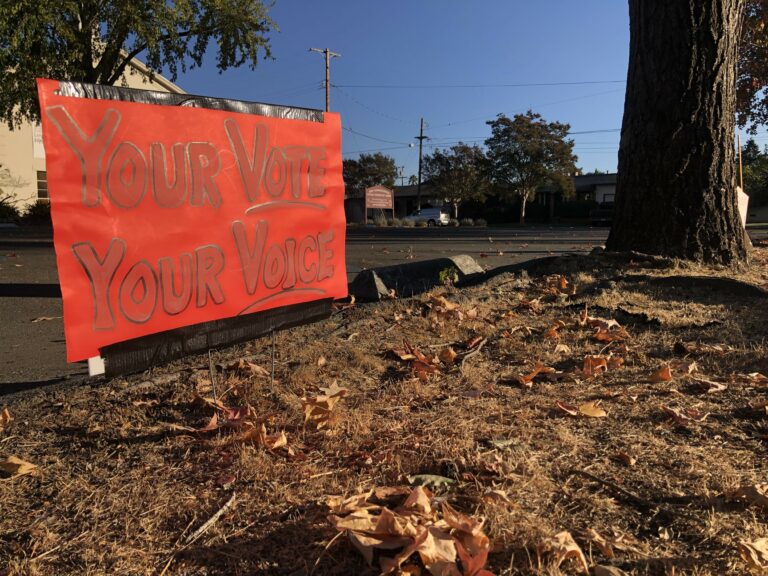
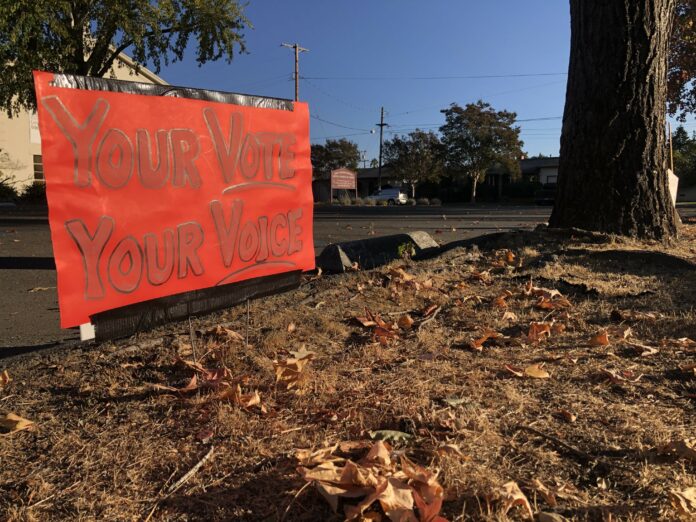
Napa City Councilman Scott Sedgley appeared to be winning the city’s mayoral race in a rout, according to unofficial election results released Tuesday night.

With all 97 of the city’s precinct’s reporting, Sedgley had garnered just over 64 percent of the vote, with a raw vote total of 16,319 out of the 25,436 votes initially reported in the race.

Sedgley netted three times the votes of challengers Doris Gentry, a city councilwoman and the city’s vice mayor, and Gerardo Martin, the former president of the Napa County Hispanic Chamber of Commerce.

Early results showed Gentry in second with around 20 percent of the vote while Martin mustered slightly more than 15 percent.

Sedgley, 68, entered the race as the longest-serving member of the Napa City Council, having first been elected in 2012 and serving two terms.

Once in the race, he quickly gained the endorsement of Jill Techel, who served four terms as Napa mayor before announcing she would not run for re-election in 2020.

The Napa County Registrar of Voters released some 44,000 votes Tuesday night, with more votes expected to be reported on Friday as well as next week. County Registrar John Tutuer said Tuesday night that he intends to release around 8,000 more votes on Friday.

Incumbent Democrats Claim Victory in Bay Area House Races

By Tony Hicks, Bay City News Service

Unlike the presidential race, which raged on the day after Election Day, there was very little drama in Bay Area congressional races Wednesday.

Incumbent Democrats ruled the day in all 12 House races involving Bay Area congressional districts.

District 2 Representative Jared Huffman (D-San Rafael) won his fifth term, beating Republican Dale K. Mensing with 78 percent of the vote.

Mike Thompson (D-St. Helena) won his 12th term in Congress, easily defeating Scott Giblin with 78.6 percent of the vote.

The only race in which a significant number of ballots were still being counted 12 hours after the polls closed at 8 p.m. Tuesday night was in District 9, where incumbent Democrat Jerry McNerney led Republican Antionio C. Amador with 61.7 percent of the vote, to Amador’s 38.3 percent, with 55 percent of precincts reporting.

The closest contest was in District 3 – covering much of Solano County and areas north of the Bay Area – in which John Garamendi defeated Republican Tamika Hamilton with 58.1 percent of the vote.

House Speaker Nancy Pelosi easily won her 18th term in Congress, defeating fellow Democrat Shahid Buttar with 79.2 percent of the vote in San Francisco’s District 12.

Contra Costa County’s Mark DeSaulnier breezed by Republican challenger Nisha Sharma with 75.3 percent of the vote, sending him back to Congress for the fourth time.

Former Democratic presidential candidate Eric Swalwell beat Republican Alison Hayden with 72.8 percent of the vote, retaining his District 15 seat, which covers most of eastern and southwestern Alameda County, as well as part of Contra Costa.

Barbara Lee (D-Oakland) dominated Republican Nikka Piterman in District 13, winning her 12th term with 91 percent of the vote. Lee’s district covers western Alameda County, from Albany to San Leandro and includes Oakland and Berkeley.

Democrat Jackie Speier beat Republican Ran S. Petel in District 14, winning her fifth term in the House with 80.5% of the vote. Speier’s district covers San Mateo County and a small part of San Francisco.

Incumbent Ro Khanna (D-Fremont) defeated Republican Ritesh Tandon with 74.1 percent of the vote, winning his third congressional term, representing California’s District 17, which covers parts of Santa Clara and Alameda counties.

Democrat Zoe Lofgren won her 14th congressional term, easily defeating Republican Justin James Aguilera with 74.1 percent of ballots cast. Lofgren represents most of San Jose, Gilroy and Morgan Hill.

Democrat Anna Eshoo won her 15th term in Congress, beating fellow Democrat Rishi Kumar in District 18 with 65.7 percent of the vote. Eshoo’s district covers parts of Santa Clara, San Mateo, and Santa Cruz counties.

Two Incumbents, Two Newcomers Poised to Win Seats on Santa Rosa City Council

Voters in Santa Rosa appeared ready to elect two new City Council members and welcome back two incumbents based on unofficial vote tallies from the Sonoma County Registrar of Voters Wednesday afternoon.

With all precincts reporting on Wednesday afternoon, voters were favoring Eddie Alverez, who was running against three other candidates for the District 1 seat, with 44.68 percent of the vote.

In the District 3 race, incumbent Harrison Tibbetts was leading his opponent Keith Rhinehart, with 9,888 votes to Rhinehart’s 13 votes with all precincts reporting.

District 5 incumbent Chris Rogers was leading his opponent, Azmina
Hanna, with 70.28 percent of the vote with all precincts reporting.

In District 7, Natalie Rogers was narrowly leading her two opponents with roughly 43 percent of the vote. Eric Christensen was keeping the race tight, however, with 39.61 percent of the
vote.

North Bay Activists Persevere During Pandemic

North Bay communities will continue to have urgent needs which aren’t always solved by filling in the right bubbles once every few years.

So, while the election results come out in the days and weeks ahead, we wanted to highlight the work of North Bay activists who have been advocating for social change over the past six months.

How Activists Hold Each Other Up

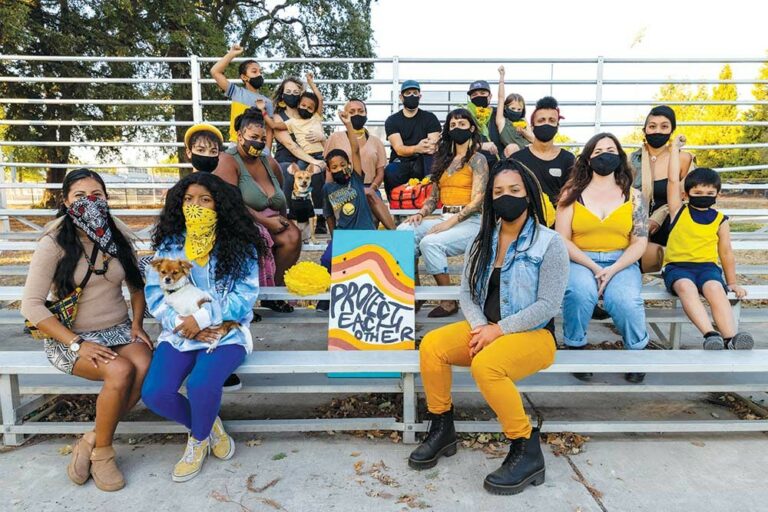
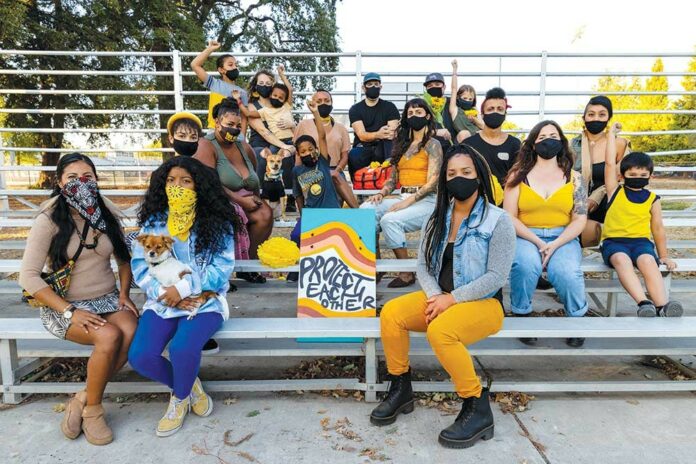
In the five months since Minneapolis police killed George Floyd, activists throughout Sonoma County have organized sustained protest efforts against police brutality and in support of racial justice for Black and Indigenous people of color (BIPOC). Protests and mutual aid events—sometimes multiple events on a given day—have been held nearly every week for the 20 weeks since Floyd’s May 25 death. Marches, rallies, vigils and community care days persisted despite August’s LNU Lightning Complex Fire, September’s Glass Fire and the ongoing Covid-19 pandemic.

Floyd’s death and other instances of police brutality nationwide catalyzed Sonoma County’s own protest movement, but aren’t its only focus. Local demands also include increased police oversight, shelter and other resources for unhoused people, and mental healthcare.

The duration and breadth of this year’s protests are remarkable for the semi-rural county. Strong support networks and deep friendships are critical factors contributing to the organizers’ success.

“To be effective with community organizing, it takes a relentless effort that consumes a lot of physical, mental and emotional energy,” says Evan Phillips, a Santa Rosa parent and activist. To maintain that energy, it’s crucial to maintain a support network, Phillips and other Sonoma County activists told the Bohemian.

Organizers Tavy Tornado, 32, and Joy Ayodele, 19, met in late May after separately organizing two of Santa Rosa’s first Black Lives Matter protests of 2020. Tornado says they quickly realized they had a strong connection and common goals of catalyzing progress. The two now describe each other as sisters. When they aren’t sharing a megaphone, they’re often showing care for one another in quieter ways, whether it’s Tornado cooking for Ayodele or Ayodele taking Tornado’s child to a pumpkin patch.

“Joy is a leader of her generation and I, mine,” Tornado says. “We bridge gaps. Culturally and with community.”

Jelly Washington, a Black mother, says her five-year-old son Kamari urged her to take him to local protests after he heard what happened to Floyd.

“I come from a rough background and was often ignored or turned down for things that would have given me a better chance at life,” Washington says. “I don’t want my son to be criminalized for his lack of needs met … I want him to know how to use his voice.”

Washington says that she and Kamari were pretty much alone before the community came together around them. She says her fellow activists have supported her and Kamari physically, emotionally and through crowd-funding, without which she says she doesn’t know how she would have made it through the pandemic.

Kimmie Barbosa, a Latinx woman who grew up in Fresno, says she has been organizing in Sonoma County for 10 years but has never, before this summer, developed the deep friendships and BIPOC community support that now surround her.

Of the years leading up to this movement, Barbosa says, “It felt so isolating being in a predominantly white space that has a narrative predominantly pushed by older white people.”

Barbosa is amazed that this year’s protests have brought vast numbers of racially diverse teenagers into the streets. She calls the job loss and school closures prompted by Covid-19 an unfortunate chain of events that have been devastating in many ways, but says that they have also brought a lot of beautiful people together to fight hard for their community. She expresses gratitude for the people working behind the scenes, describing people who excel at marketing, fundraising, rounding up equipment for a rally or collecting material goods for people in need.

Despite the fatigue many feel, everyone the Bohemian spoke to wants to see the movement continue beyond the 2020 election.

Tornado says, “My hope is that this movement changes the humanitarian blueprint of Sonoma County to acknowledge what it means to keep BIPOC safe.”

Marin Activist Fights for Racial Justice

A group of young Marin activists from Police-Free Schools Marin recently had a huge racial justice win by successfully lobbying the San Rafael Board of Education to remove sworn police officers, known as school resource officers (SROs), from all San Rafael campuses. The group’s ongoing efforts now focus on urging the Novato Board of Education, where they recently organized a sit-in, and the Tamalpais Union High School District to also scrap the controversial SRO program, which disproportionately targets people of color and people with disabilities.

Zianah Monroe, 18, is one of the group’s activists working to achieve racial equity in a predominantly white county.

The Fairfax resident’s desire for change comes from her own experience of being a woman of color raised in Marin. While her father is of European descent and was born in the United States, her mother is Malay and grew up in Singapore. Monroe was raised as a follower of Islam; however, she no longer identifies with a particular religion.

“It’s quite impossible to grow up in Marin and not be discriminated against,” Monroe said. “A lot of people like me have had the experience of trying to find power and security in what makes them different.”

The young leader recently helped found the Marin Antiracist Coalition, an umbrella organization for 14 local advocacy groups fighting for racial equity in schools, policing practices and countywide policies. The grassroots and mostly youth-led groups support each other and share resources. The network includes Police-Free Schools Marin, Youth for Racial Equity, ICE Out of Marin, Marin City Cooperation Teams and more.

Most of Monroe’s efforts, however, go toward her volunteer work with Police-Free Schools Marin, the grassroots campaign to remove SROs from Marin County schools and reallocate the funding to equitable, trauma-informed resources. It might sound like a good idea to have an SRO on campus to protect students, but it is not, according to Monroe.

“People think SROs provide safety to schools,” Monroe said. “That’s the typical narrative even if there’s no data to support it. There is hysteria around mass school shootings. During some of the biggest school shootings in the country, the SROs waited for backup to respond. It’s what would happen if the SROs weren’t there.”

Instead of protecting students, SROs may cause harm. For people historically traumatized by police for their ethnicity, gender or race, having an SRO on campus feels threatening.

“A lot of people are afraid of police,” Monroe said. “I don’t think they [the police] have any business being in our schools.”

In addition, many students receive their introduction to the juvenile and criminal justice systems when they are arrested at school. These arrests disproportionately affect people of color and people with disabilities, Monroe says.

Monroe’s collaborative article about the school-to-prison pipeline appears in the current issue of Marin Lawyer magazine, a publication of the Marin Bar Association. In it, she writes that Black students are more likely than their white peers to be suspended, expelled or arrested for the same behaviors. A former San Rafael student was arrested for allegedly stealing five dollars, according to the article.

Rather than punitive measures, Monroe advocates for restorative justice, which consists of determining the root of the problem and having all parties involved decide together how to handle it. It’s not often practiced in Marin schools, but the program has been effective in Oakland.

Monroe, who graduated from High School 1327 (formerly Sir Francis Drake High School) this year, says her work is just beginning. She plans to continue pouring energy into advancing race equality.

“Marin is the most racially disparate county in California,” Monroe said. “We’re supposed to be more progressive, more liberal and more environmentally conscious, but we’re not even a sanctuary county. Immigrants are handed over to ICE. Marin City has been abandoned by the rest of our affluent county. The Marin Board of Supervisors ignores us.”

Monroe would like to see more participation from white people in the community to help resolve these issues. Engagement means more than placing a Black Lives Matter sign on the lawn, she says.

“It’s about showing up in non-performative ways and lending efforts in more tangible ways,” Monroe said. “It’s not only about money, because there are other resources we need, like political influence and legal support.”

Monroe suggests taking direct action by getting involved in activities, such as marches, Zoom meetings and emailing elected officials.

Luckily for residents of Marin, Monroes’ youth-led groups welcome people of all ages.

“We are always happy to bring on more people,” Monroe said.

Local Wineries Survive and Thrive Despite Fires

0

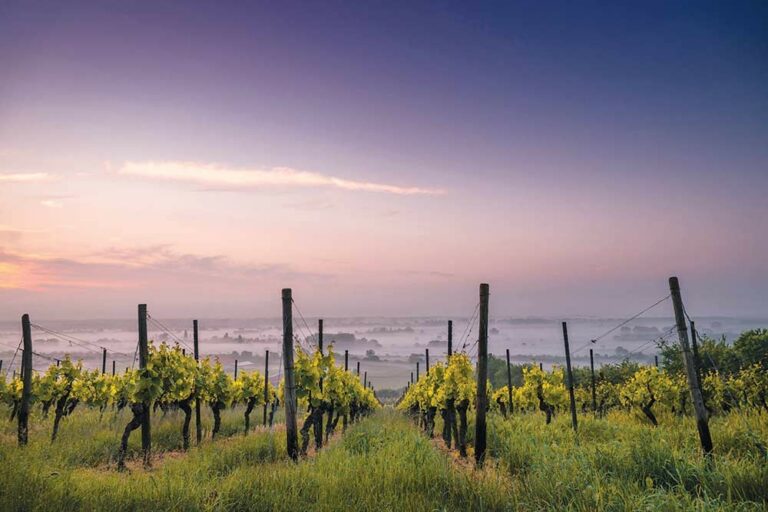
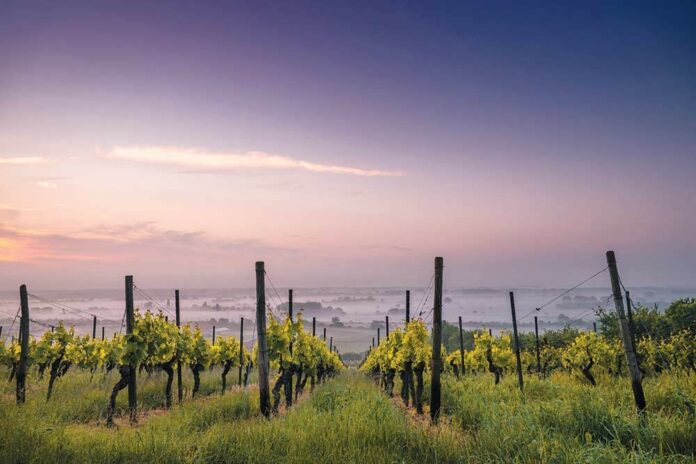
Wildfires are nothing new to California, but the devastation they wreak on the local wine industry seems to grow every year. 2020 has proved no different.

Even after the lightning-sparked fires were contained, air quality remained terrible in almost every part of the Bay Area, which made it additionally hard for wineries and other dining businesses to stay open. Since Covid, most restaurants are only open for outdoor seating, and the poor air quality often prevents them from doing business. This has been especially hard for wineries that now can’t even conduct tastings outside.

The poor air quality also affected the grape harvest, meaning next year’s wine sales will be affected, too. Laina Brown from St. Clair Brown Winery & Brewery said their winery was not affected directly by the fires, but warned that this is going to be a taxing harvest season for many of their neighbors.

“Our vineyards are predominantly in the Coombsville region, which was not affected by the fires,” Brown said. “We feel for all of the growers and vintners in the fire-impacted areas, as we dealt with that in 2017. Our thoughts are with everyone during this challenging harvest season.”

Shadybrook Estate Winery is one of the wineries affected. Part of the North Bay landscape since 2010, it experienced the 2017 fires. The main difference in how the 2017 fires and this year’s fires have affected the wineries is their timing in the harvest season. The 2017 fires occurred later in the harvest season, when most wineries had already harvested all of their crop. Because this year’s fires occurred in the middle of the harvest, they will have a much greater impact. 

Yet Eric Felton, director of sales at Shadybrook Estate Winery, commented on how the current fires are, overall, not as devastating as the 2017 fires.

“This fire was much slower moving because the winds were modest and average as opposed to violent, and the fire in Napa right now stayed on the outside of Napa,” Felton said. “It stayed in the Valley and it stayed around Lake Berryessa and it stayed to the east. It never really came too close to the Valley itself.”

While most of California is dealing with the worst fires they’ve ever seen, for most of Napa right now the biggest issue is dealing with smoke. 

“The winery has had to suspend tastings and close our doors due to hazardous, smokey conditions,” Felton said. “Because of the combination of Covid and the smoke issue, we can’t host any tastings indoors, and if everything’s outside and the smoke conditions are hazardous, then we have to stop our operations.”

Once the smoke clears, wineries will reopen for outside tastings. And for anyone concerned about the quality of the harvest and the wine that will be bottled for next season, Shadybrook and other wineries vow not to put quantity over quality.

“It’s a little too soon to say whether the smoke will have any effect on the quality of our harvest,”  Felton said. “Shadybrook and most wineries like Shadybrook, we’re not going to put anything in the bottle that is not up to the level of what we’ve come to expect.”

The Other Me

The Mayan expression, “In Lak’ech” translates as, “You are the other me.” Our humanity is shared, our Source the same. The Golden Rule must apply. I’ve been straying off the mark. 

For instance, I like solo nature walks, keeping a mask handy. Recently, a guy pops onto the narrow dirt road I’m on, headed towards me, staring intently into his phone. He comes up close, no mask in sight! I veer off to the shoulder, indignant: might he be a viral spreader-shredder?!

My dodging reactivity is becoming automatic—a new knee-jerk fight-or-flight syndrome. Distancing from others as if they’re potentially toxic, objects to avoid at all costs. Reflection tells me I’m “othering” them, estranging myself, alienating you and me. And vice versa. We’re looking past or through one another, ignoring our common humanity.

I’ve often decried “phubbing,” how preoccupation with smartphones makes fellow humans  non-existent, unimportant, invisible. Now I have a new knee-jerk dehumanizing talent of my own.  

On August 20, under Walbridge fire evac warnings, I was running quick errands in Windsor when my car quit on me. No cell phone with me either. CVS Pharmacy helped me call a tow for 6:30 pm, a four-hour wait. I raised the car hood so the truck could locate me. Many people walked by me, looking away uneasily. Until a gracious Muslim husband and wife went out of their way to help and stand by me. She handed me her cell phone, offered a ride home, a drink. He tried to get old Bluebell the Buick started. Thanking them profusely, they remarked, “Of course!”  Adding that ”not everyone would accept our help…” This Jewish lady sympathizes readily with the othering of Muslims, too, in our country, the failure of “In Lak’ech” sensibilities.

My mindfulness practice can help me stay more present and available in encountering other people. Even if I’m shopping briskly, I can reduce robotic, stressful dodging, darting, distancing. I want to breathe easier, even in my mask. To be available to once again register another as someone who like myself, needs recognition, respect, appreciation. Especially “in these times.” 

Marcia Singer’s Love Arts Foundation offers classes in mindfulness and meditation from her Zoom Womb in Sonoma County.

The Healer Is In

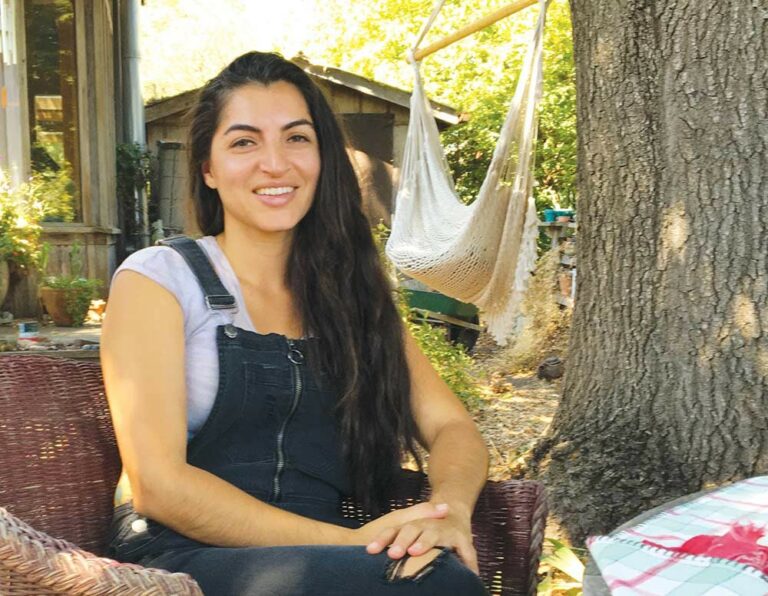
“Who’s the chica?” my nosy neighbor asked when he saw Natasha Khallouf climb into her car and take off. I wanted to tell him to mind his own business. Instead, I said, “She’s a doctor.” No doubt about it, Dr. Khallouf stood out in my backyard. Her cannabis brand, “Mindzright,” also stands out in Sonoma County, as does her cannabis farm,“Agricola Flower.”

A Doctor of Acupuncture and Chinese Medicine (DAOM), and an L.Ac, Khallouf runs a Sebastopol clinic, On Point Integrative, where she integrates acupuncture with herbs and helps educate patients about nutrition and healthy lifestyles.

I think of her not only as a doctor of Chinese medicine and a marijuana grower, but also as a curandera, which translates from Spanish to English as “healer.” Curanderos often provide the first line of defense against aches, pains, colds and the blues throughout Latin America and in parts of the U.S. In some ways, Western medicine is still catching up with curandero lore and folk remedies, including the use of cannabis.

Raised in a trilingual home in SoCal—her mother was born in Nicaragua, her father in Lebanon—Khallouf cut her eye teeth on the streets of L.A. She began to use cannabis at an early age and was fortunate, she tells me, to encounter and explore many of the city’s alternative communities, hear all kinds of music—including reggae and classic rock—and rub shoulders with intellectuals.

Along the way to becoming a doctor, she learned cannabis has been cultivated for thousands of years. Indeed, it shows up prominently in Shen Nong Ben Cao Jing, the classic Chinese text on herbs, agriculture and acupuncture which was written nearly 2,000 years ago and is still used as a reference guide.

In 1996, when California voters approved Prop. 215, which ushered in the era of medical marijuana, Khallouf stepped into the breach to link cultivators, patients and health care providers, and offered helpful suggestions about the best strains for particular ailments, how much to use and how often and what methods were the most effective.

When the pandemic arrived this winter, followed by fires, heat and smoke, Khallouf refocused her practice and began to devote herself to the care of the undocumented and farm workers at risk.

As a single woman with two children, she says she can feel marginalized in Sonoma County, even among the cannabis crowd. She draws strength from her inner reserves and the communities she serves. I’d go to her clinic and ask for acupuncture and herbs, both of which I have made use of for decades. One day my nosy neighbor might say, “You rock, chica.”

Jonah Raskin is the author of “Dark Past, Dark Future: A Tioga Vignetta Murder Mystery.”

Sonoma County Voters Pass Measure to Strengthen Oversight of Sheriff’s Office

A Sonoma County measure to strengthen the office that oversees the Sheriff’s Office seemed on the way to approval based on the unofficial vote tally from county elections officials Tuesday night.

At 1:15pm, with 668 of 668 precincts reporting, 66.5 percent of voters had cast their ballots in favor of Measure P.

The measure grants the Independent Office of Law Enforcement  Review and Outreach, IOLERO, increased access to Sheriff’s Office personnel  records and body camera footage during investigations involving deputies’ use  of force, alleged bias, sexual harassment and assault, among other things.

Supporters hailed the measure as an important step in ensuring  accountability and transparency from the county’s law enforcement officials  by giving IOLERO the staff and budget it needs to property fulfill its  intended function.

“Oh man, I couldn’t be more excited,” Sonoma County Board of  Education Member Herman Hernandez, one of the measure’s main backers, said on Tuesday night.

“Since the George Floyd tragedy there has been an uprising of  communities saying we need change, we need more transparency we need to  collaborate with the community and I think Sonoma County spoke strongly with  their vote,” Hernandez said.

Measure P also authorizes IOLERO to receive whistleblower  complaints and audit racial profiling data and would give it the authority to  independently review all “sources of investigative evidence, directly contact complainants and witnesses, contact custodians of evidence, and independently  subpoena records or testimony,” according to an analysis from the county  counsel’s office.

Measure P also sets IOLERO’s annual budget at 1 percent of the  Sheriff’s Office budget.

The Board of Supervisors voted unanimously to place the measure  the ballot over the objections of Sheriff Mark Essick and the Sonoma County Deputy Sheriffs’ Association.

Neither Essick nor SCDSA President Michael Vail responded to  requests for comment but both submitted arguments against Measure P in the county’s voter information guide saying, in part, that it creates unnecessary red tape and was placed on the ballot without input from law enforcement.

Documentary on Saving Native California Languages Airs on KRCB Television

'Breath of Life' debuts in the North Bay on Sunday, Nov. 8.

Sonoma City Council Selects Interim City Manager

Dave Kiff has been selected as interim city manager of Sonoma, the City Council decided Monday. Kiff is currently interim city manager of Healdsburg and will continue in that role until the end of December, when he will replace current Sonoma City Manager Cathy Capriola, who is retiring at the end of the year. ...

Sedgley Set to Win Napa City Mayoral Race, Unofficial Election Results Say

Napa City Councilman Scott Sedgley appeared to be winning the city’s mayoral race in a rout, according to unofficial election results released Tuesday night. With all 97 of the city’s precinct’s reporting, Sedgley had garnered just over 64 percent of the vote,...

Incumbent Democrats Claim Victory in Bay Area House Races

By Tony Hicks, Bay City News Service Unlike the presidential race, which raged on the day after Election Day, there was very little drama in Bay Area congressional races Wednesday. Incumbent Democrats ruled the day in all...

Two Incumbents, Two Newcomers Poised to Win Seats on Santa Rosa City Council

Voters in Santa Rosa appeared ready to elect two new City Council members and welcome back two incumbents based on unofficial vote tallies from the Sonoma County Registrar of Voters Wednesday afternoon. With all precincts reporting on Wednesday afternoon, voters were favoring Eddie Alverez, who was running against three other candidates for the District 1...

North Bay Activists Persevere During Pandemic

North Bay communities will continue to have urgent needs which aren’t always solved by filling in the right bubbles once every few years. So, while the election results come out in the days and weeks ahead, we wanted to highlight the work of North Bay activists who have been advocating for social change over the past six months. How Activists...

Local Wineries Survive and Thrive Despite Fires

Wildfires are nothing new to California, but the devastation they wreak on the local wine industry seems to grow every year. 2020 has proved no different. Even after the lightning-sparked fires were contained, air quality remained terrible in almost every part of the Bay Area, which made it additionally hard for wineries and other dining businesses to stay open. Since...

The Other Me

The Mayan expression, “In Lak’ech” translates as, “You are the other me.” Our humanity is shared, our Source the same. The Golden Rule must apply. I’ve been straying off the mark.  For instance, I like solo nature walks, keeping a mask handy. Recently, a guy pops onto the narrow dirt road I’m on, headed towards me, staring intently into his...

The Healer Is In

“Who’s the chica?” my nosy neighbor asked when he saw Natasha Khallouf climb into her car and take off. I wanted to tell him to mind his own business. Instead, I said, “She’s a doctor.” No doubt about it, Dr. Khallouf stood out in my backyard. Her cannabis brand, “Mindzright,” also stands out in Sonoma County, as does her...

Sonoma County Voters Pass Measure to Strengthen Oversight of Sheriff’s Office

A Sonoma County measure to strengthen the office that oversees the Sheriff's Office seemed on the way to approval based on the unofficial vote tally from county elections officials Tuesday night. At 1:15pm, with 668 of 668 precincts reporting, 66.5 percent of voters had cast their ballots in favor of Measure P. The measure grants the Independent Office of Law Enforcement...
12,122FansLike
4,933FollowersFollow
6,928FollowersFollow