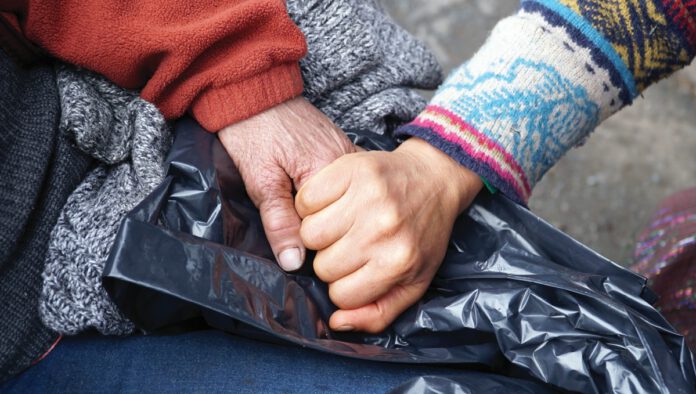
The 200-plus population of unhoused people who set up their community on Santa Rosa’s Joe Rodota Trail (JRT) between Dutton and Santa Rosa avenues and along Highway 12 in and around 2020 provided not only a flashpoint for the myriad issues surrounding the unhoused but also highlighted the complex nature of the situation.
Local filmmaker Eliza Q. Hemenway documented the situation and created the documentary, Thy Neighbor, which will be showing in Sonoma County for the first time at 7pm, Thursday, Oct 15, at the Sebastiani Theater, 476 1st St. E., Sonoma. A matinee showing screens at 2pm, Saturday, Oct. 17, at the Santa Rosa Junior College Student Activities Center, 1501 Mendocino Ave. Hemenway will be present for a Q&A at both screenings.
When asked what inspired Hemenway to take a leap into documenting a cross-section of people who have been deeply misunderstood and relegated to the fringes of society, she says, “I was living in Sebastopol, and driving along the JRT, [and] I felt compelled to do something to help. It was the cold and rainy season, on the heels of the Kincade fire. I couldn’t imagine what people living on the trail were going through, and I wanted to do something concrete to help, but I wasn’t sure what.”
From there, Hemenway says she “attended a community meeting, and as folks went around the circle with the various gifts, talents and resources they could provide, I decided to use my experience as a doc filmmaker to bear witness.”
The community coming together to help the unhoused who took up residence along the trail is how Thy Neighbor opens, with a long take of a community volunteer pulling a wagon down the muddy trail, offering soup and tea to the residents. This sets the scene for the heart of the film, which is the many people who stepped in to help where they could.
However, the scene comes to an end as local law enforcement are shown walking the trail en masse in the opposite direction, a clear directorial nod to the impending community blow-up. Locals already know how this part of the story ends, as the trail was cleared in spring 2024.
Annie Falandes has been an advocate for the unhoused in Sonoma Valley for more than 10 years. She founded Homeless Action Sonoma and built the Home and Safe Village in Boyes Hot Springs. Currently, she leads the Angel Project, a small advocacy group focused on supporting chronically, mentally ill unhoused individuals who have few to no options for permanent housing.
She says the situation on the JRT is “a microcosm of the larger crisis. With over 2,000 unhoused individuals in Sonoma County, the trail makes the issue visible—and when people are visible, they can no longer be ignored. While some see them as a disruption, for advocates they represent a vital mission. The upcoming film offers an opportunity to build empathy across different perspectives and spark the community-led dialogue needed to drive real change.”
Thy Neighbor utilizes a “fly-on-the-wall” style wherein Hemenway isn’t on camera and instead uses this tool to capture moments, some sad, others touching. Then there’s the anger from local residents who let their frustrations get the best of them at local supervisor meetings.
The result is a near-perfect encapsulation of the issues facing how we in Sonoma County as well as those beyond address how we treat some of our most vulnerable neighbors. In terms of this, Hemenway notes, “What I think was unique about the JRT was that what was hidden became visible, and we all, as a community, had to not only look but respond.”
Heneway has since moved out of Sonoma County, and as most people who have seen the film will ask, she is unsure what has become of the residents who we get to know in the film. She says, “I have wondered how several people from the trail are doing now, and am hopeful they will be able to attend one of the screenings. We specifically chose the SRJC afternoon screening, pay what you can, to make it as accessible as possible to our unhoused neighbors.”
For more information on Hemenway and her work, visit hemenwayproductions.com.