Talking Pictures

0

Sweet Truth


Kihn Ya Dig It? Greg Kihn testifies about “That Thing You Do” experience.


Greg Kihn recognizes the truth in Tom Hanks’ ‘That Thing You Do!’

By David Templeton

Writer David Templeton takes interesting people to interesting movies. This time out, he joins former chart-topping rocker and new novelist Greg Kihn to see Tom Hanks’ nostalgic rock-‘n’-roll flick That Thing You Do!

IHAVE A CONFESSION,” announces my guest, Greg Kihn, as our waitress swings by to pour more coffee. “I was shaking the ketchup, and the lid flew off, and a big cascade of ketchup landed all over the booth–next door. But we already kinda cleaned it up.”

“That was sweet of you,” she says. “No one ever cleans up their own messes.”

“Well, we just saw a Tom Hanks movie,” Kihn explains happily. “So now we’re all full of good cheer and human kindness.”

The movie he’s just referred to is That Thing You Do!, written, directed, and starring Hanks. It’s the sweet, authentically presented tale of four guys in a rock-‘n’-roll band who enjoy one brief taste of fame during the summer of 1964. Hanks plays the cynical record company exec who guides them, and who understands that some bands are destined to have only one great moment.

Kihn, a rocker whose career has taken him through several such moments, has had Top 10 hits with a number of songs, including “The Breakup Song (They Don’t Write ‘Em Like That Anymore)” and “Jeopardy.” After a highway full of bumps and curves, Kihn’s own rocky road has led him to his current position as morning DJ on one of the Bay Area’s major radio stations (KFOX-FM 94.5). Much to Kihn’s delight, he has also published a novel, the deliriously weird Horror Show (Tor, 1996), a crafty send-up of of B-grade horror movies. Then there is his new album, also titled Horror Show (Clean Cuts), a mature, melodic departure, mostly acoustic, featuring some of Kihn’s best writing in years.

“You know that scene where the band hears their record and they all dance around the appliance shop?” Kihn says, recalling one of the film’s more infectious moments. “I’ve lived that one. My first record, the first time we were ever played on the radio was on KSAN.

“I was driving down Telegraph Avenue in Berkeley, listening to the radio, and suddenly there it was. It was just like in the movie. A magical moment in the life of any professional musician, the first time you hear yourself on the radio. It’s really a kick.

“For me, just recently, seeing my first novel in print was a lot like that,” he grins. “I went to the bookstore and saw it there, and I just flipped out! I ended up buying one, for karmic reasons. It felt pretty damned good.”

A bit later on, Kihn offers, “Rock ‘n’ roll is really a happy accident. You write a song and you play it one way, and it’s OK, but then you play it faster and–whoa!–you have a hit.

“Look at ‘Louie Louie,'” he laughs. “Those guys weren’t trying to create a phenomenon. They were covering a calypso song they didn’t know the words to, and it just happened to come out so garbled that people thought it was dirty lyrics, and one thing led to another, and all the frat guys bought it ’cause they thought it was talking about sex stuff. Next thing you know the FBI has a copy of what they claimed were the dirty lyrics, a conspiracy to subvert the youth of America. That’s rock ‘n’ roll.”

“The twists and turns of fame are a mysterious business,” he continues. “I had my first hit record, and it was almost like I’d been handed a script. ‘Here’s your script, kid!’ I look through it and go, ‘Oh look! We’re gonna be on Saturday Night Live! We’re gonna tour Europe. We’re gonna make tons of money. I’m gonna marry a blond model.’

“So here I am flipping ahead now. ‘Oh, geez. We get divorced. I go through a drug period. There’s a bankruptcy! Oh, my god, its horrible!’ But you keep reading and then, ‘Oh look, I start coming back. I get my wits about me, I write a novel, it gets published, I get a radio show. Wow! There’s a happy ending!’

“I look at these young bands starting out now and I wonder what kind of script they’re being handed. Do they have the same future that I did? Who knows? Why did I do all the shit I did? I guess it was in the script. Maybe my whole rock-‘n’-roll career was just fodder for my future career as a novelist.

“If I’ve learned anything,” Kihn adds, “I’ve learned that our lives are just random events that somehow connect. There are lines of destiny that cross in the oddest of ways. It’s unpredictable, but it’s kinda cool.”

From the October 24-30, 1996 issue of the Sonoma Independent

This page was designed and created by the Boulevards team.
© 1996 Metrosa, Inc.

Carolyn Baker

Dark Star

By Gretchen Giles

AIN’T IT GREAT to be a gal? Women, those fortunate creatures who start out as sugar and spice and everything nice, are experiencing a vogue as gosh-darn goddesses, near immortals walking among us, buying the groceries, suckling the babies, and exalting in the mysteries of the menstrual cycle. They meet in moon circles, run with the wolves, love too much, and yet still keep the floors clean and the children fed while bringing home a paycheck. As for the men? Well, they really know how to work that TV remote.

‘Nuff’s ’nuff, imputes Santa Rosa author Carolyn Baker. The deification of one gender to the detriment of the other isn’t doing any of us a whole heap of good. What women need, she suggests, is to take a page from the mythopoetics of the men’s movement as articulated by such leaders as poet Robert Bly. If we would but look into the archetypal stories written by the Grimms and grimly retold by Carl Jung, we might find that all is not rosy in the women’s room. In fact, there is more than just a blush of black.

Taking the story of Rapunzel as her framework, Baker has written a book–Reclaiming the Dark Feminine: The Price of Desire (New Falcon; $12.95)–weaving the compelling argument that the stridency of the early feminist movement is no longer necessary, and that women, too, have more than their fair share of complicity in the patriarchal structures that she believes are strangling us all. If men and women could only drop the negative aspects of our male selves, and recognize and surmount the negative aspects of our female selves, well–it makes one giddy to even consider.

“On the level of the sacred and the unconscious, we’re very much the same,” shrugs Baker.

CAST BACK NOW to bedtimes and consider the story of Rapunzel. Conceived as a result of her mother’s rapacious desire for greens growing in an adjacent garden, the as-yet-unrealized Rapunzel is promised by her father in exchange for the salad. Once born and given in a deal to an awful crone, Rapunzel is locked away high in a tower upon attaining majority, letting down her braids each day as a ladder for the crone. One day, the sound of the girl singing attracts a passing prince, who cajoles her into letting her braids down for him as well. The girl is happy: like a demented popular song of yore, she has the hag in the morning and the prince at night. Of course, the couple is found out–Rapunzel expelled, the prince thrown bodily from the tower and blinded, both forced to separately wander forest and desert. Of course, the girl gives birth alone. Of course, the couple, now a family, are reunited, and the sweetness of the girl’s tears restores sight to her lover’s mangled eyes. The end. Go brush your teeth.

For Baker, however, this is just the beginning, and she tells the story down to its bones. Rapunzel is a story assailed by feminist criticism for its archetypal woman-as-prisoner motif. Baker refuses that thesis, assaying it along affirmative lines that closely question the actions of the female characters, according them all of the rights and responsibilities of the prince. Of particular note is her restructuring of the hag figure, one that the goddess movement and others have claimed in an overwhelmingly positive sense, emphasizing the wisdom and beauty of age.

“Generally the dark feminine shows up like this hag figure: she’s a devourer, she’s possessive,” Baker says, seated in her Santa Rosa office. “She feeds off of the vitality of this younger person, but she isn’t just there for no reason. She has a purpose, and the crone in literature is there to help with transformation. It’s through her formidability that people can make a new relationship. She’s there as a healing force also. Sometimes I think that we tend to prettify her, thinking that oh, she’s just this old wise woman who is there to teach us, and she is, but I believe that there’s a process that we need to go through, like [Rapunzel’s father] who goes over the fence in the story and has to face [the hag with whom he deals for the greens]–that we all have to face her and we have to face that ugliness and that formidability and struggle with it.”

According to Reclaiming the Dark Feminine, every couple conceives a child, whether that child is flesh or no. Once the creativity of that conception is realized, the crone is always there hoping to claim it. This, then, is the price of desire–fought only by a couple’s recognition of and defeat of the dark feminine that lurks within each. Unmatched and unattended to, this dark force negates and kills, and the divorce statistics continue to rise.

Baker, whose regular correspondence with Bly enlivens them both, reports that a letter just received from the Iron John author muses on just that proposition. “The hag gets stirred up as a result of desire,” she paraphrases from his last missive. “It’s kind of scary that every time you do something creative, a desire comes forth, she’s right there waiting for you. She’s not the driving force of desire, but when desire comes forth, there she is.

“The price of desire for both women and men, I think, is to have to deal with this dark feminine force,” Baker continues, speaking for herself. “And I don’t think that it’s any more or less in women or men.

“But I do think that if we don’t deal with some of these issues like the dark feminine and the dark masculine that we can become ‘princess victims,'” she continues, referring to a term coined by author Elizabeth Herron, “with the idea that what is really wrong is just the men, and that if they would change, then we would be fine. That really puts us in a victim status; that really leaves us immature and undeveloped.

“Part of becoming a mature woman is beginning to take responsibility for yourself,” she smiles, “and that’s hard work.”

Carolyn Baker discusses Reclaiming the Dark Feminine on Monday, Nov. 4, at 7 p.m. Copperfield’s Annex, 650 Fourth St., Santa Rosa. Free. 545-5326.

From the October 24-30, 1996 issue of the Sonoma Independent

This page was designed and created by the Boulevards team.
© 1996 Metrosa, Inc.

Tipping

0

Tipper Lore


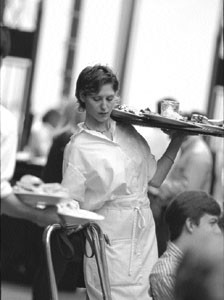
Percentage Wise: Wait staff who wish to increase their tips should kneel, smile, and make eye contact.

Photo by Chris Gardner


Is it service or custom that tips the scales?

By David Templeton

I WAS AT a coffee counter one time,” relates Kris, a Penngrove computer programmer, who describes himself as a frequent diner-outer. “There was a little sign on the tipping jar that said, ‘It’s true! Your karma is improved when you tip!’ I want good karma as much as anyone, so I left a dollar.” This, for a single cup of coffee–to go.

“In restaurants in general,” he continues, “even in sit-down restaurants, I’ve never been clear how much is really an appropriate amount to leave. So I’ve begun to leave a higher tip, 20 percent or more, thinking, ‘If I shoot high, I don’t have to know what I’m doing.'”

What Kris’ tale indicates is that the etiquette of modern tipping, if there is one, has become so vague and indistinct on this service-hungry cusp of the 21st century that consumers are routinely confused about what is expected, and why. There are even voices mumbling that the whole tipping system amounts to little more than the publicly subsidized stinginess of employers, and should be abolished.

Since the late 1970s, the going rate has been 15 percent. Although that’s still the norm, it is steadily edging up toward 20 percent. An informal survey of West Coast eateries revealed a majority of servers quoting “15 to 20 percent” as the accepted norm, while only a handful left it at a simple 15. Internationally, the rules become even more disparate: in most of Europe tourists are expected to tip for many services, such as directions around town, that are considered freebies in America. In China, on the other hand, tipping your waiter or bellman is considered rude.

Consumers of yesteryear left no more than 10 percent on fountain counters. A decade ago, it was rare for tips to be brazenly solicited for counter service, but in today’s coffeehouses and juice joints, with their “tip jars,” it has become de rigueur.

THE HISTORY of tipping is as clouded in mystery as the rules that currently govern it. There is some evidence that tipping has its roots in the decadent Roman Empire. An oft-repeated story is that tipping–supposedly an acronym for “to insure promptitude”–became common in the “penny universities” (coffeehouses) of 16th-century England.

Another explanation is that “tips” of gold were thrown by horse-bound feudal lords to the unsavory peasants in the streets, as payment for safe passage. English etymology would support this theory in its suggestion that the word was originally medieval street talk for “hand it over.”

Tipping denigrators have predecessors in the Anti-Tipping Society of America, an alliance of 100,000 traveling salesmen who from 1905 to 1919 managed to have the custom abolished in seven states. Practitioners of tipping once honed the custom to a kind of high art, carrying separate billfolds and change purses expressly intended for service payment. Today the custom has degenerated to simple mathematical computations (e.g., twice the tax, rounded out), the result often left on the table in crumpled bills or artlessly added to the credit card bill.

“People are always putting emphasis on money,” explains Michele Maussion Wilson, an etiquette consultant who conducts popular table manners classes in Scottsdale, Ariz. “I think that in that run for the money we lose something that is gracious and elegant. Tipping is an act of kindness in a world that has become too fast and rude. It is an antidote to rudeness.” Put more directly, Wilson adds, “Waiters are not your dogs. You can treat them with respect.”

Wilson advocates never leaving less than 15 percent. She usually leaves more. “Tipping is part of your pleasure. It makes you feel good,” she says. “And you must never simply leave the money on the table and walk away. You don’t wave the money about. You discreetly leave it beneath the bill. Then you gain their eye contact, and you say, ‘Thank you for your kind attention this evening.’ It’s so easy to do and it means so much.”

Recent studies reveal that the amount of a tip often reflects factors other than the tipper’s generosity or the server’s ability. According to a Cornell University report, servers who introduce themselves by name receive an average tip 53 percent greater than the tip for those who do not; servers who squat next to the table while talking with customers–thereby improving eye contact–up their tips from 15 percent to 18 percent; those who write “Thank you” on the back of the check receive about an 18 percent tip, the same amount female servers get by drawing a happy face, whereas males who do so decrease their tips by 3 percent; the use of tip trays bearing credit card logos increases tips by up to 25 percent, even when customers pay cash; tips soar by 140 percent for servers who simply smile; and those who casually touch customers (e.g., once on the shoulder, twice on the palm of the hand when giving change) add to their tips by 42 percent, women customers being a bit more generous than men.

“IF YOU TIP less than 15 percent, it’s assumed that you felt the service was well below expectations,” says David Bynum, assistant director of Food Services at Santa Rosa’s Flamingo Hotel, who adds that he’s seen a slight shift upward from 15 percent. The currently acceptable rate for tipping a bellman, by the way, is a dollar per bag, and more if services beyond the norm are required, such as helping with a wheelchair or conveying a pet to the customer’s room. Bynum’s largest tip came when he offered to fix a guest’s television set. He received $100.

“The thing about tipping is, we may expect it, but it’s not obligatory,” he says. “It’s a gift you make to someone who deserves it.”

Pitra, a waitress at Aram’s Cafe in Petaluma, puts it another way.

“I love it when someone tips big, sure,” she says. “But I’d rather they left 15 percent and said, ‘Thank you, have a nice day,’ than to leave a big tip and act like I’m not human. Kindness is conveyed in more ways than just money.”

From the October 24-30, 1996 issue of the Sonoma Independent

This page was designed and created by the Boulevards team.
© 1996 Metrosa, Inc.
Ben Aronoff

0

Swan Songs


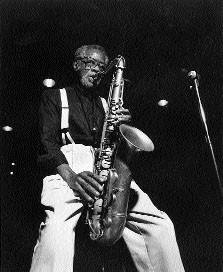
Dead Man Singing: Former prison guard turned troubadour Ben Aronoff walks the walk, talks the talk.

Photo by Janet Orsi


Songwriter brings death row to life

By Zack Stentz

THERE WERE about 10 godzillion young guitarists living in Marin County in the late ’70s and early ’80s, eking out a living while honing their musicianship. But only one of them got up one morning and thought to himself, “What I’d really like to do is work with death row inmates at San Quentin.”

Now a Sebastopol resident, Ben Aronoff is that person. Since he began in 1982, he’s spent his time traveling the nation lecturing and performing his one-man show My Piece of Sky, a series of songs and stories about the nine men on death row he has known in the last 14 years. Aronoff’s own piece of sky will rain down Oct. 28 at Santa Rosa Junior College.

Acknowledging the unusual nature of his chosen vocation, Aronoff says: “I know, not a lot of artists go around witnessing executions,” as he did most recently when infamous “freeway killer” William Bonin was put do death earlier this year.

Aronoff, an exceptional guitarist who’s performed with the likes of Doc Watson and Mississippi John Hurt, explains that he started down his peculiar path back in 1982, when he first received a grant to teach guitar to death row inmates through the Bread and Roses Foundation, folk singer Mimi Farina’s Marin-based organization devoted to bringing entertainment to shut-ins of all kinds. “I just kept getting more and more involved with their lives,” Aronoff recalls.

Wishing to experience another aspect of life in San Quentin, Aronoff went so far as to enroll himself in California’s Correctional Academy during 1983-84, becoming the guard at San Quentin in charge of the prisoners’ hobby program. “It was an unforgettable experience,” he says. “The first day I was there, they put me on weapons duty with a pistol, shotgun, and Mini-14 [assault rifle] after having had a total of 20 minutes of firearms training at the academy. And another time, I went upstairs where there had just been a race riot, and they had 10 prisoners who had been involved lined up facing the wall. When they were led away, the prisoners left 20 perfect handprints behind on the wall, all in human blood. I’ll never forget that.

“San Quentin guards are like anyone else,” Aronoff continues. “There are some very special people among them, and some real dogs, too.”

In the end, Aronoff lasted only a year in his prison guard position until “they threw me out,” he says, an experience he declines to discuss in detail, other than to acknowledge that the humanist guitar player and the strait-laced culture of San Quentin were not a good fit.

Nevertheless, Aronoff continued his extensive contact with the death row inmates he had come to know and in some cases befriend, visiting them on a voluntary basis and developing his one-man show around the stories of their lives. In performances of My Piece of Sky extensively around the nation, Aronoff’s mix of music, storytelling, and increasingly vocal arguments against the death penalty has touched many listeners, while making others uncomfortable. “I’ve gotten mixed reviews,” Aronoff admits. “But typically the critics will attack my beliefs and not my performance.”

As Aronoff explains it, he isn’t out to turn his audiences into a gaggle of anti­death penalty crusaders. “But they are going to leave the auditorium understanding the prison system a whole lot more than when they came in,” he says. “And they’ll have had human faces put onto these people they hear so many things about from their politicians.”

As for his larger goal of turning around the public’s overwhelming support of the death penalty and other harsh anti-crime measures, Aronoff remains doggedly optimistic. “I’m completely hopeful,” he says, “because I talk to right-wing groups all the time, and I’m able to turn them around. Morality aside, it cost $23 million to execute Bob Harris [Robert Alton Harris, who in 1992 became the first prisoner to be executed in California since the state reinstated the death penalty], while it would have cost $600,000 to keep him in prison for the rest of his life. And as for ‘Three Strikes and You’re Out’–just wait until the taxpayers start having to pay for 100,000 65-year-old men with heart ailments. They’ll see that this revenge cycle we’re in isn’t working.

“I mean, I understand the motivation toward revenge,” he adds. “And I have nothing against putting a gun in [murder victim Polly Klaas’ father] Marc Klaas’ hand and letting him do what he wants to do. But, ultimately, how does that work toward solving the crime problems we all face?”

Ben Aronoff appears on Monday, Oct. 28, at noon at Santa Rosa Junior College, Burbank Auditorium, 1501 Mendocino Ave., Santa Rosa. Admission is free. 527-4266.

From the October 24-30, 1996 issue of the Sonoma Independent

This page was designed and created by the Boulevards team.
© 1996 Metrosa, Inc.
Talking Pictures

0

Yuck Factor


Andy Schwartz

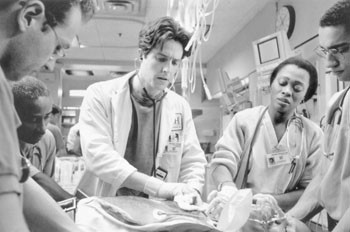
Body of Evidence: A chastened (if not chaste) Hugh Grant performs.

Forensic expert Sarah Lovett on violent voyeurism

By David Templeton

Writer David Templeton takes interesting people to interesting movies in his ongoing quest for the ultimate post-film conversation. This time out, he calls up forensic investigator and author Sarah Lovett to discuss the classy medical thriller Extreme Measures.

THE MODERN THRILLER, as a cinematic genre, tends to be powered by a gleeful employment of certain grisly images–heads in boxes, faceless corpses tumbling into elevators, severed appendages, scars, stitches, pools of blood–as much as by the pacing and plot that identify it as a thriller. As I recall such movies as Seven and Silence of the Lambs, it is Gwyneth Paltrow’s predictable demise and Hannibal’s impromptu facial surgery on a guard that first leap to mind.

That and the feeling of having been relentlessly, though stylishly, assaulted.

“I love thrillers,” laughs author Sarah Lovett, a former forensics specialist turned crime novelist, with whom I have been discussing Extreme Measures, the latest example of mainstream mayhem. “I love scares and that kind of thing. But I often come out with a kind of burned-out feeling. You know that feeling? When you’ve just seen meaningless violence for two-plus hours, and you come out feeling tawdry, and dirty, and kind of hung-over?”

I know the feeling.

Measures stars Hugh Grant as a New York emergency-room doctor who discovers an unsettling conspiracy to kidnap homeless men and use them for surgical experiments. It uses a minimum of in-your-face shock shots, relying instead on the aforementioned use of pacing and plot and a parade of stimulating philosophical questions, coming off as pleasantly light, while still managing to serve up its quota of lovingly photographed dead or dying bodies.

“It did make an effort to deal with issues,” concedes Lovett, who saw the film in her home town of Santa Fe, N.M. “And I didn’t come out feeling as . . . ,” she pauses, searching for another synonym for burned-out, tawdry, and hung-over. “I didn’t come out feeling yucky, to use a really sophisticated term,” she laughs. “The old ‘yuck factor.'”

Lovett’s own novels, the brand-new Acquired Motives (Villard, 1996) and the subtle, unsettling Dangerous Attachments (Villard, 1995), rate similarly low in ‘the yuck factor,’ while still scoring big with gripping stories and intelligent characters, a fair number of tasty ethical dilemmas, and, of course, the random severed body part. Featuring the resourceful Dr. Sylvia Strange, a forensic psychologist who tracks down folks who have a murderously shaky grip on reality, Lovett’s novels draw on her own experiences as a forensic researcher at a New Mexico penitentiary.

In response to my suggestion that the cinema’s increasingly close-up-and-personal approach to on-screen death might reflect a cultural obsession with watching people die, Lovett hesitates.

“If you’re right about that,” she offers, “I think it’s tempting to tie it into the fact that we’ve become so removed from the death process, just in the last 50 or 100 years. A generation ago–my mother’s generation–it was different.

“My mother is in her mid-’80s. In her youth, families were tending to their own dead. Now we don’t tend to our dead. We pass them on to professionals. It used to be that women would wash the bodies of their dead and put pennies on their eyes. We’ve let that go. So it makes sense that we might have an obsession that we are acting out voyeuristically.

“But you know, [humans] have always been fascinated with death. I remember being a kid and driving by accidents. I remember being really acutely aware when we’d pass a fatal collision, the gore and everything. That has never changed in human nature. We are curious about disasters. I think probably other primates are, too.

“Still, it is strange that we push our dead away as fast as we can, cremate them, and then come home and watch all these images of death for entertainment.

“There was a woman here about a year ago,” Lovett continues. “I remember reading about her. She had cancer or AIDS, I forgot which, but she was dying. And she was trying to have a relationship with her own death. So she picked out her own coffin. She worked out the funeral ceremony. She planned ahead for her death. I remember thinking, ‘How healthy of her.’ This was not morbid obsession, though it may have looked like it to others. To me it was, well,” she laughs, “to me it was rather thrilling!”

From the October 17-23, 1996 issue of the Sonoma Independent

This page was designed and created by the Boulevards team.
© 1996 Metrosa, Inc.
California Small Works Exhibit

0

Thinking Small

By Gretchen Giles

PHIL LINHARES STANDS looking at a portrait of a dog. Behind him pass staff of the California Museum of Art, carrying artworks in their cotton-gloved hands, holding the pieces with all of the tremor normally accorded the movement of plutonium.

Pieces of art are hung on the walls and laid on every available flat surface. Wrought from materials as disparate as acrylics and seaweed, they all share one commonality–not a one of them is over 12 inches tall, from base to stern, from frame to corner. Not a one of the 650 of them.

Linhares, the chief curator of the Oakland Museum, is surveying the dog as a result of having come this morning to the CMA to judge its annual California Small Works show. His day has included looking at and really seeing each of the 650 pieces, reducing that number to some 153 he deems excellent enough to be included in the exhibit. The result is an uneven collection of work from both the outstanding and the wha’ huh? strata, his choices ranging from fine abstract and realist paintings and sculpture to cheerfully framed depictions of garden tomatoes and small houselike dwellings curiously glued over with pretty rocks and twine. One wonders if this big-city curator isn’t bending down just a bit for us country folk.

“It’s just a very good, very impressive, and expressive portrait of a dog,” Linhares explains of the thickly painted canine portrait–a special award winner. “It’s a really lively painting.” As he speaks, a close second look reveals the forcefulness and technique of the work. “The good stuff really calls itself out; you don’t really have to agonize,” he says, stepping back to survey the works on the walls. “They make themselves apparent.”

What is also apparent is that such seemingly simple artistic approaches as assemblage–examples of which lie tagged on various museum tables–are in fact as difficult as to create as it would be to define a tiny world suitable for all of those whom you honor most, outfitting it in perfect harmony with every single element of itself.

“This landscape here,” Linhares says, gesturing to another special award winner, an undulating green landscape that seems to pulse from the canvas, “is just really powerful. And, in fact, at first I didn’t really see it, but it’s very intense and emotional.”

Installing this kind of complex exhibit involves cleverly grouping the works where “they need to be,” according to CMA director Gay Shelton. Avoidance of what she terms the “encyclopedia” effect–organizing by landscapes or by themes–is paramount. “You really have to fight the tendency to group everything together that’s familiar,” she says. Instead, she and installer Paul Yergeau will let the pieces find their own ways, painting down the walls softly to highlight the works and grouping as naturally as possible.

“Something good can be done in 12 inches square,” pronounces Linhares. “Photography has proved that. A definitive work doesn’t have to be overwhelming in size or scale.”

Small Works opens with a reception on Friday, Oct. 18, from 5 to 8 p.m., and continues through Dec. 22. CMA, Luther Burbank Center, 50 Mark West Springs Road, Santa Rosa. Hours are Wednesday and Friday, 1 to 4 p.m.; Thursday, 1 to 7 p.m., and weekends, 11 a.m. to 4 p.m. $2, non-members. 527-0297.

From the October 17-23, 1996 issue of the Sonoma Independent

This page was designed and created by the Boulevards team.
© 1996 Metrosa, Inc.
$10 Wines

0

Spo-Dee-O-Dee

By Steve Bjerklie

YOUR INDULGENCE, please, for a short statement of the obvious: Great wine costs too damn much. And cheap jug wine is best applied as deck stain (red) or silver polish (white). Colliding into these immutable facts is another truth I hold to be self-evident: No evening meal is truly enjoyable without wine.

So what to do–ride the debt bull or become a crank? Fortunately, a string of good wine values at or below the $10 mark–a kind of methadone for private-reserve addicts–solves the problem, fitting today’s real-life lifestyles. What wine, for example, best suits The X-Files? What does one serve with burritos? What’s appropriate for the kids’ soccer-team picnic? These are the questions to which the drinking public demands cogent, informative answers. And these we will provide.

St. Supery 1995 Napa Valley Sauvignon Blanc, Dollarhide Ranch. A good just-home-from-work quaff. You need something cool and light in your hand as you shitcan the day’s junk mail and choose which pasta sauce to open over the noodles. This is the stuff. Mind you, it’s not for the pasta, but for earlier, when you’re cattle-prodding the kids into hanging the morning’s damp towels. Astringent, but without an overdose of the grassiness dominating other sauvignon blancs. If you leave it in your mouth long enough–and I almost never do, rushing toward the more personal and meaningful act of swallowing–you can taste a hint of apricot, maybe even marmalade. Finish the bottle with a hearty salad and/or a significant other. Being a destitute writer, I had it with a bowl of Top Ramen. Excellent. Two and a half stars. $5.99 at Cost Plus.

Rodney Strong 1993 Sonoma County Cabernet Sauvignon. The true test of a good cabernet is not whether it can make a piece of steak stand up and sing “America the Beautiful” in your mouth, but if and how the wine enhances the subtleties of such foods as fettuccine Alfredo and Kraft macaroni and cheese dinner. You want a cab that makes you light the candles for meatloaf. Here is such a cab. Surprisingly complex in flavor (anise, licorice, and good ‘ol burnt toast), with a nose as noble as Cary Grant’s–all for less than eight bucks. Republicans buy this wine secretly and rebottle it with LaTour labels. Being a bit short of fettuccine, and too poor to have any real Alfredo fixings anywhere in the house, I made this wine accompany jack cheese on crackers and one of the baseball playoff games on the radio, which it did with admirable panache and patience. Three and a half stars. $7.99 at Trader Joe’s.

Rosemount Estate 1995 South Australia Shiraz. Year in, year out, the best red-wine deal on the planet. A few years ago the Wine Snobtator ranked Rosemount Shiraz among the top 10 wines in the world. Considering that a bottle of it costs about 1/30th what a bottle of Petrus runs, this is a dangerous accomplishment. A fruity syrah grape without a lot of pretense, I find the ’95 a little less complex than those of previous years, but it still tastes like excellent sex with satin at the edges. Try it with a caesar salad or, maybe, lamb. In fact, definitely lamb. Being a destitute writer–did I mention this?–I had it with bologna on sourdough dabbed with just a hint of off-brand Dijon mustard. Very, very nice. Then I phoned up women I used to know, but to no avail. Three and a half stars. $9.99 at Cost Plus.

Appearing on a regularly irregular basis, Spo-Dee-O-Dee will explore $10-and-less wines fitting today’s real-life lifestyles, without bias toward snob appeal, rarity, or source. And then we’ll microwave the burritos to go with ’em.

From the October 17-23, 1996 issue of the Sonoma Independent

This page was designed and created by the Boulevards team.
© 1996 Metrosa, Inc.

Jerry Brown

0

How Jerry Got His Soul Back


Four years after their viciously fought battle in the 1992 Democratic presidential primary, Bill Clinton is in the White House while Jerry Brown lives in a west Oakland warehouse-turned-left activist lair. But guess who’s the happier man?

By Zack Stentz

“LET JERRY SPEAK.” OK, so it doesn’t rate up there with “Tippecanoe and Tyler, too” or “Fifty-four forty, or fight!” as an immortal phrase in the American political lexicon. But the oft-repeated chant at the 1992 Democratic Convention in New York still serves as a reminder of the formidable power wielded at one point in that year’s political cycle by none other than California’s own, er, interesting former governor, Jerry Brown.

Running a shoestring campaign on maximum $100 donations, sleeping in supporters’ guest bedrooms, and throwing well-aimed rhetorical grenades at rival Bill Clinton (at one point calling the then-chief executive of Arkansas a “union-busting, wage-depressing, scab-inviting environmental disaster of a governor”), Brown managed to shape profoundly the parameters of debate during the Democratic primary season, despite his eventual loss. And his once-derided flat-tax plan to radically alter the American income tax code is now a mainstream tenet of the Republican Party amongst the likes of Jack Kemp and Steve Forbes.

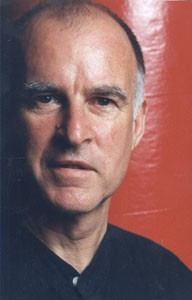
The four years since his last race have been kind to Brown the man. His now-buzzcut silver-and-black hair has receded to near-nonexistence, but the familiar hawklike nose and focused gaze make him a still formidably intense presence, a bit like Captain Picard crossed with your favorite college professor. It’s also clear that his political passions from the 1992 season remain undimmed. Asked whether his 1992 assessment of Clinton still holds after the president’s four years in the White House, Brown replies: “What I said in 1992 remains true today. Clinton is exactly as I perceived him to be.”

But though his former rival may have grabbed the political brass ring of the White House with all the power and responsibility it entails, while Brown is now ensconced in a converted warehouse living the life of an activist college undergrad, which man is leading the more fulfilled life?

Imagining Clinton, a man always more comfortable campaigning than leading, as happily dealing with Whitewater, welfare reform, and Bosnia seems difficult at best. But removed from the centers of power and influence–whether by fate, hubris, or his own design–Jerry Brown seems to be thriving as a born-again populist crusader.

Because of his Jesuit training and sometimes ascetic lifestyle, it’s become a cliché to compare Brown to some sort of monk (St. Francis to his admirers, Rasputin to his detractors). But watching him in his new home, petting a dog and smiling broadly while describing the world’s plight and the state of American politics in the bleakest terms possible, the analogy that comes more readily to mind is to Camus’ Sisyphus, happy and contented as he pushes his stone up an impossible hill for all eternity.

Mocking Clinton’s claim that life in America has improved during his term in office, Brown continues: “For Clinton, things are getting better. He’s making $200,000 a year, and the people spend half a million dollars each time he gets on a plane to give a speech. He’s living in the lap of power and luxury, and so are the members of Congress and their contributors and hangers-on.

“But for a huge number of the American people–whether its 40 or 60 percent isn’t important, it’s a lot of people–their quality of life, their economic security, the prospects for their children are diminishing, and have been diminishing for the last 20 years. That’s a fact. Take, for example, the failure to raise the minimum wage for nearly four years, and then to raise it 90 cents, to ensure that someone who works at the minimum wage of $5.15 an hour stays below the poverty line. That’s intolerable in a society this rich, when the Dow is near 6,000. It’s criminal. And yet, because [Republican presidential candidate Bob] Dole is the captive of the Right, Clinton is able to cozy right up to the Right, and the vast majority of Americans are left with symbolism and deceptive propaganda as the only things they get from their leaders.”

Brown even goes so far as to characterize Clinton’s presidency as being worse for the nation than a second Bush term might have been in its place. “It’s far worse,” he says. “Not even close. Clinton has imposed the most drastic cut in America’s commitment to poor children, since . . . well, we’ve never had it since Roosevelt. Not even Nixon or Reagan attempted to force the needy to fend for themselves, in an economy that, since it’s globalized, will force people into the streets, to huddle over grates to keep warm in the winter. The welfare bill that Clinton signed, in terms of its effect on children, on immigrants, is absolutely reprehensible and a moral blot that will become clearer in the years ahead.

“And No. 2,” Brown adds, banging on a table for emphasis, “the crime bill and the anti-terrorist bill are both aimed at increasing police state powers of surveillance, wiretapping, and numbers of armed bureaucrats wandering about the country. All of that is a centralization of power, and divergent from the Jeffersonian ideal of a more decentralized democracy. Clinton has brought this about. And the adoption on the international level of NAFTA and GATT, with no real protection for the environment or the falling wage standards for so many Americans, is something that I believe a Democratic Congress would have blocked Bush from doing.

“So Clinton has in effect been able to destroy the vestiges of progressive politics and co-opt the global business perspective at the cost of American social stability and justice.”

Brown isn’t pleased, either, with the tattered state of the Democratic Party’s progressive wing. “The Left is totally co-opted, and Clinton’s domesticated them,” he says. “He had Jesse Jackson giving spin after the Hartford presidential debate and Cuomo praising him, but for what? They didn’t even get to speak in prime time at this year’s Democratic Convention. There was no debate at the convention. The Democratic Party is like the politburo in Russia. It’s strictly run by pollsters to curry the favor of campaign donors.

“It’s quite remarkable, the state of moral bankruptcy of the Democratic Party.”

Sounding closer to Noam Chomsky and Alexander Cockburn in 1996 than to his former Democratic comrades Dianne Feinstein and Dick Gephardt isn’t what one might have predicted for a man who, as governor of California from 1973 to 1981, once likened his job to paddling a canoe, “sometimes paddling on the left, sometimes on the right,” to keep the boat of state afloat. But while many cynics predicted that Brown’s 1992 run was a quixotic aberration that would quickly be followed by a servile return to the Democratic fold, Brown has instead moved ever further away from the political mainstream. He’s kept the 1/800 number he incessantly flogged in debates (1/800/426-1112 for the curious), but moved the daily radio show he started at the same time from the commercial ABC network to the venerable leftish Pacifica radio stations (Brown’s show runs locally from 4 to 5 p.m. on KPFA, 94.1 FM).

Brown, who during his stint as governor spurned the official mansion in Sacramento for a small apartment with a futon on the floor, has likewise sold the plush, converted fire station he once called home in San Francisco and moved into a warehouse turned live/work space across the street from Oakland’s Amtrak station, where he now hosts biweekly potlucks, discussion groups, tai chi classes, and community meetings on such topics as “The CIA Contra Crack Connection” and “Beyond Politics and Media as Usual.”

SO FIERCELY did Brown embrace his outsider status in 1992–champion the cause of political reform and rail against the corrosive role of money in politics–that it became easy to forget that this was the same man who, scarcely two years before, had been chairman and chief fundraiser for the California Democratic Party, not exactly a bastion of reformism and progressive activism.

But before an interviewer can ask a pointed question about his lightning switch from party hack to crusading outsider, Brown’s already there, making the connection himself. As he explains it, while there wasn’t a Saul-on-the-road-to-Damascus moment of clarity and conversion, the stint as Democratic Party chair played a major role in Brown’s disillusionment with politics as usual.

“I certainly had the experience of being party chairman and raising a lot of money,” he recalls, “and then the general reception by the party insiders was ‘Oh, you didn’t raise enough money, so Feinstein didn’t beat Wilson.'”

Clearly, Brown was stung by the widespread blame he received for failing to mobilize resources in Dianne Feinstein’s hard-fought gubernatorial race against Pete Wilson. “Forget whether victory was possible–I don’t think it was, I think Wilson would have won regardless,” Brown says, pointing instead to the larger implications of the criticisms. “What their statement implies is that I wasn’t corrupt enough, I didn’t do enough to buy and sell and engage in this form of bribery by currying favor with enough special interests. I thought I had done enough of that [fundraising] already, but they said you have to dive deeper into the pools of corruption. And at that point I said that doesn’t work. That was the point at which I decided to run for president and set the $100 limit, so the elite couldn’t participate in it.

“A hundred dollars won’t even pay for valet parking,” Brown snorts, with all the disgust of a man who’s attended one too many $1,000-a-plate fundraising feeds. “That created the gulf between myself and the Democratic Party establishment. And that’s where I am today.”

Brown motions around the room, set off in a corner of his year-old home and headquarters for We the People, the political reform organization he founded from the remnants of his presidential campaign. Padding around the airy, sky-lit space in his battered running shoes and casually shaving himself with an electric razor while talking to staffers, a photographer, and this reporter, the Brown of 1996 displays a lack of pretense and a sly, earthy wit that’s disconcerting coming from the former governor of 23 million people and the world’s eighth largest economy–even an ex-guv with Brown’s reputation.

When I mention the name of a college friend whose wedding Brown recently attended, he grins and declares: “Oh, you must have gone to UC Santa Cruz. One of those pot-smoking environmentalists, are you?”

And Brown’s comment isn’t the only thing around to remind me of Santa Cruz. With its long, communal eating tables, rooftop organic garden, bulletin board full of study session and political rally listings, and retro-’60s, comradely vibes, the We the People building resembles nothing so much as one of that college town’s numerous activist-oriented collective living houses, only with a lot more money and a better architect behind it. All it lacks is a corporate crime-fighting lab in the basement and an alternative fuel-powered Batmobile parked out back to be every lefty crusader’s ultimate dream domicile.

Brown also keeps busy on the lecture circuit–he’ll be at Sonoma State University on Oct. 21–and writes a monthly column on politics for Spin magazine. Ironically enough, Brown’s column is illustrated by Winston Smith, the same artist who provided visual accompaniment for the Dead Kennedys’ 1980 anti-Brown anthem, “California Über Alles,” which imagined the then-governor as a “Zen fascist” president, forcing children to meditate in school and sending the un-cool off to concentration camps to be exterminated by “organic gas.”

But even the Dead Kennedys’ lead singer, Jello Biafra, later changed his mind about Brown, saying in 1992: “I’m considering endorsing him for president,” as did Chicago columnist Mike Royko, who retracted the “Governor Moonbeam” sobriquet he’d once coined.

Waiting for the photographer to set up, Brown wanders over to the office end of We the People headquarters to discuss some matter with Sarah Wellinghoff, one of his group’s three paid staffers. Just how charmingly shoestring an operation this is becomes clear when Brown extends me an invitation to an upcoming speaking event. “Whom do I call to make arrangements with?” I ask, expecting to be foisted off on an aide or camp follower. “Oh, just me,” replies Brown.

So much for the trappings of power. I take the lull in the conversation as an opportunity to poke around the building’s conversation space/entertainment center, looking atop the massive big-screen television (used no doubt only for screening earnest political documentaries about exploited Third World peasants, and never for lighter explosion-fests like Terminator 2) at the former governor’s CD collection, hoping to glean insights into his character. Music taste often provides a window to the listener’s soul, and it’s tempting to equate the Beethoven and Bach with Brown’s Jesuit-trained, Yale-educated analytical side, the Kate Bush with his sensual, Esalen workshop­attending and Linda Rondstadt­dating side, and American Music Club with . . . oh, never mind. The records probably belong to someone else, anyway.

And before I can make it to the kitchen space to surreptitiously inspect the cupboards for contraband Hostess products and Coco-Puffs hidden behind the brown rice and barley, Brown is back, speaking about the experiment in communal living and working he’s engaged in as a living embodiment of the values he supports. “That’s why we’re here,” he says, “that’s why we’re living and working together, and why we have the radio show.

“We want to be sustainable, convivial, and working for a just future.”

Brown admits that We the People is still a work in progress. “Definitely,” he says. “There is not a blueprint at this point for what we’re trying to do. But I believe that as the ugliness of the current regime becomes manifest, individuals will be inspired, throughout America and throughout the world, to organize an effective resistance.”

Actually, admits isn’t the right word. One of Brown’s more appealing traits has always been his willingness to say openly that he doesn’t have all the answers, as when he describes the difficulty of fighting the hydra-headed corporate beast he rails against: “It’s very hard, but it may be that as the supply lines expand, space may open for local initiative.

“It’s true that McDonaldization is spreading throughout the world, namely a centralized, uniform distribution system. Is there room amongst all that for a local hamburger shop anymore? We’ll see. At the very moment when a large structure seems to have triumphed, cracks appear and preferences arise that demand something more human, more original, more face to face, more creative.”

So amid all the gloom, does Brown see any signs of effective struggle and resistance? “Many signs,” he replies. “People engaging in home schooling. People doing socially responsible business. Cooperative communities. Alternative media. Organic permaculture. There are green plans different cities are creating. People fighting the rape of the Headwaters, where a thousand were willing to get arrested. Those are very hopeful signs that people are fighting against an inhuman structure that does not reward virtue. Return on investment is not a valid criterion for civilization.”

PRESSED TO DESCRIBE positive aspects of the state of mainstream politics in 1996, Brown has a more difficult time. “Pathetic,” is how he describes campaign ’96. “Dangerously irrelevant. Exhibit A would be the failure to discuss the state of race relations in the country, and the failure to honestly address the falling standard of living for vast numbers of American people, and the failure to confront the ecological disasters that are building up for all humanity.”

But what about the newly revived AFL-CIO and its efforts to influence countless House races through a massive advertising and get-out-the-vote blitz? Surely that’s a hopeful sign for a labor-friendly lefty like Brown, isn’t it? “You can look at that glass as half full or half empty,” Brown replies, sounding as though he’d rather ask why one would use something as primitive as a glass at all. “If they unleash their organizing skill at Clinton to demand accountability and push him toward labor law reform after the election, it’ll be fine, but if they think that simply by electing Democrats they’re accomplishing something, then it’s just status-quo politics.”

Ambivalence toward the Democratic Party is certainly an emotion Brown is familiar with, and he empathizes with progressives like Jesse Jackson who have opted to stick with the “Party of the Ass,” as British politico singer Billy Bragg once called it, and attempt to reform the Democrats from within. “Clinton’s convinced people that Dole will be worse, and that’s an intellectual debate you can have,” he says. “Jackson thinks that the people who he cares about will be better off under a Clinton presidency, and you can make the argument that if Clinton is re-elected, progressive people and groups can put pressure on him to achieve things that wouldn’t be possible in a Dole presidency. Opening up the CIA, pressing for more labor reform, pressing environmental issues, rebuilding the cities–Clinton will have a hard time resisting that, if there’s a progressive power base that gets ignited.

“I just feel that to go to that convention and lend one’s integrity to what’s essentially a lie doesn’t feel right.”

BROWN DESCRIBES his current ties to the party for which he thrice sought the presidential nomination–in 1976, 1980, and 1992–as “just the ties of who I am, what I’ve done, and what I might do in the future,” and leaves open the perennial possibility of joining third-party politics.

“Whatever will work,” Brown says. “A new party for a new millennium? That sounds very attractive. Whether it will work or not remains to be seen, or whether this 170-year-old horse called the Democratic Party can have new life breathed into it. I’m dubious, but I’ll leave it as an open question for now.”

Eschewing direct participation in electoral politics for the moment, Brown prefers to continue working on grassroots, We the People projects. “Expanding the radio show to new cities and launching the We The People law firm” are what Brown describes as his top priorities. “We’re about to file a lawsuit against some wrongdoers. And we’re scheduling more events, and working to join with other groups who want to create an alternative power base to the two-party scam.

“You could call what we’re after a call for perestroika in the American context,” Brown adds. “But I hope what happened to Gorbachev doesn’t happen to me.”

Brown pauses a moment, maybe considering the fate of another slightly aloof intellectual/political leader who led his homeland through hardships, only to be muscled aside by a puffy-faced, more cutthroat rival, then to eventually find redemption and renewed purpose in the activist arena.

“Or perhaps,” he adds, “it already has.”

Jerry Brown will speak at Sonoma State University on Monday, Oct. 21, at 8 p.m. in the Evert B. Person Theater. Tickets are $7 general/$5 students presale, $10 general/$7 students at the door. Call 664-2382 for more information. There is also a We the People website.

From the October 17-23, 1996 issue of the Sonoma Independent

This page was designed and created by the Boulevards team.
© 1996 Metrosa, Inc.

Rosencrantz and Guildenstern

0

Bit Players, Bit Parts

By Gretchen Giles

REMEMBER those two fellows who went to school with the crazy prince of Denmark and then got hauled in by his folks to betray him? Neither can the royal court. Given their elaborate names, one would think that Rosencrantz and Guildenstern would stand out a bit more, demand a skosh more respect, be more memorable. But in fact, their heavy polysyllabic names hang equally well with one as with the other, and their own mothers might be pressed to tell them apart.

But could someone please tell them where they are? And why? These weighty questions of placement, time, and purpose are all tangled up in verbal fireballs when playwright Tom Stoppard centers his extraordinary abilities on this hapless couple in Rosencrantz and Guildenstern Are Dead–playing through Oct. 27 at SSU–creating a wonderful existential what-ifer about these two most peripheral of all tragic characters. Remembered by most as a lark, Rosencrantz is in fact a serious meditation on time and space à la Beckett’s absurdist masterpiece Waiting for Godot, with some chuckles thrown in to lighten the shock of recognition.

Set in the nebulous world of the offstage, the two toss coins and quarrel, meet their royal patrons and their buzzed-about friend, conspire to bind him up in a metaphoric nutshell, and then lose their lives by giving away their names. Their onstage time is spent off the scene of Hamlet, their offstage time spent on. Making sense, keeping up?

And to make matters more deliciously absurd, guest director Mary Coleman’s production at the Evert Person Theatre features a stage that is literally hung in the air, underscoring the idea that the characters themselves are suspended. “When [designer Evan Olsen] showed it to me, I thought, wow!, this is a pretty extreme choice,” Coleman says of the set idea, “but I thought that it worked because Stoppard takes this idea of looking at Hamlet in a different way to every possible extreme.”

On staff at San Francisco’s innovative Magic Theatre, Coleman leaves her day job at the theater to march out and go right back into the theater, moon- and afternoon-lighting as a freelance director for experimental companies, often working directly with playwrights to develop plot and action. Grounding her direction in movement-based theories, Coleman approached Rosencrantz with the intent of happily knocking her actors around.

“It has a kind of swirling chaos in it,” she says of the play. “The characters don’t know why they’re there or what’s going on; they get their information from those who are racing on and off stage, so they have to grab what they can. I took this idea of swirling information and tried to find with our entrances and exits that sense of movement and chaos, doing a lot of improvisation exercises with the actors. We did one where they were almost pinballs, bouncing off obstacles in order to get that style of movement, and now our challenge is to put it on this floating platform. There’s an edge of danger to this play: you never really know–and they never know where they stand–and that’s a dangerous thing for them.

“I love this play,” Coleman affirms later. “I guess that one thing I love about it is that one of my jobs at the Magic Theatre is reading new plays, and I’ve noticed that most of these plays would be better suited to television or film, and I miss people writing for the theater. I think that Stoppard really loves writing for the theater. Part of it is being bolder and more playful with language, and the writers who are hoping to land jobs on TV are really honing their skills at natural dialogue. I think that that’s great; that’s a skill I admire. But I really enjoy theater that has heightened language, and the wordplay in this is so intricate and it can make you dizzy in a great way, where you feel as an audience that it’s keeping you up on your toes. You can feel the play pulling you along where there’s a pace and a rhythm, and the play assumes the intelligence of the audience instead of playing down to them. It has not only a love of language, but a love of theatrical convention; and sometimes he’s turning theatrical convention on its head, but it’s meant for the stage.

“I rented the movie,” she smiles, “and really felt, boy, is this piece meant for the stage! The dynamism in the play is with the words and with this idea that every exit in the play is an entrance someplace else. That’s something that you can really only play with on the stage. It just makes a lot of sense on the stage.”

Rosencrantz and Guildenstern Are Dead plays Thursdays-Sundays, Oct. 17-27. Oct. 17-19 and 24 at 8 p.m.; Oct. 25 at 7:30 p.m.; Oct. 20, and 26-27 at 2 p.m. Sonoma State University, Evert Person Theatre, 1801 E. Cotati Ave., Rohnert Park. $5-$12. 664-2353.

From the October 17-23, 1996 issue of the Sonoma Independent

This page was designed and created by the Boulevards team.
© 1996 Metrosa, Inc.

Pumpkin Time

0

Good Gourd!


Janet Orsi

Fresh from the vine: Sous-chef Carol Hubinger of Bistro Ralph pauses at the Petaluma Pumpkin Patch to size up the ingredients for a savory soup.

The scoop on how local chefs squish their squash

By Gretchen Giles

WITH THE DREAMY changing of the seasons, we at the Independent decided that it was high time to bully several local chefs into answering a few tough questions about their profession and its relationship to the world of the pumpkin.

You heard right–that which makes Thanksgiving dessert worth living for as well as providing the kids with some terrific potential fire hazards at the end of October.

As one who once willingly spent three hours tromping local pumpkin patches to find the Cinderella variety specifically called for in a pumpkin-infused risotto recipe, finally returning triumphant to the kitchen only to cut, scoop, roast, and purée the devil until it exactly resembled the canned stuff, I find my pumpkin sympathies a bit trauma-scarred. But though the end result may have resembled its tinny cousin, I had to admit that it tasted different, like something truly wrested off the vine.

ROBERT STEINER, the chef and owner of Petaluma’s fine De Schmire’s restaurant, gets a hearty chuckle from the notion of anyone being silly enough to waste that much time hunting along the ground for a particular type of gourd. “I just use a jack-o’-lantern,” he offers cheerfully. Stifling down ugly feelings, I enquire as to how he uses it.

As with many other respondents, Steiner favors soup. “We do a couple of things,” he says. “We do a pumpkin soup cooked right inside the pumpkin, with the lid cut off. Fill it up with chicken stock, butter, seasonings, put the pumpkin on a sheet pan and bake it, scrape it, add cream, blend, roast the pumpkin seeds and garnish with them. Serve the pumpkin right on the table.”

Chefs speak in the shorthand of their profession, a jargon that seems never to include such pedestrian words as “cups” or “tablespoons.”

BROUGHT WIPING her hands from the kitchen of Healdsburg’s Bistro Ralph, where she and others are smack in the middle of preparing for the dinner shift, sous-chef Carol Hubinger manages to maintain her good cheer. “My favorite is roasted pumpkin soup with garlic, rosemary, and marscapone cheese,” she answers immediately. Hubinger cuts a cleaned pumpkin in half and places the halves on a greased sheet with several whole heads of garlic and sprigs of fresh rosemary nestled on the squash flesh.

Baking it at 375 degrees until it’s done (the nebulous state of “done” is the Zen secret of cooking), Hubinger then removes the pan from the oven, discards the rosemary sprigs, scrapes the flesh from the skin, and squeezes the now-soft and delectable roasted garlic into the hot pumpkin. Thus subdued, the pumpkin proper is thoroughly mashed and introduced into a pot of chicken stock, blended, and served with a goodly topping of Italy’s answer to cream cheese, the marscapone.

Hubinger–whose previous lives have included a stint as a dessert chef, and who owned a San Francisco restaurant, Tisan–also likes to sneak pumpkin into crème brûlée served up with a crunchy pistachio and cranberry biscotti cookie. She also admires roasted pumpkin plumped into raviolis and seasoned with sage. And now she has to get the heck back into the kitchen.

MICHAEL SMITH, the chef and co-owner of Graton’s Cafe Dahlia, is too busy to come to the phone. “I just like pumpkin pie,” he shouts across the kitchen. “I know it’s boring, but that’s what I do.” We leave it at that.

Up in Duncans Mills, Blue Heron chef Cliff Loffler brings a sweet boy-next-door enthusiasm to the humble ribbed orb. “Make a pumpkin butternut soup,” he suggests. “Um. Yummy. Lots of nice winter spices. You could probably serve it hot or cold, topped with either crème fraîche or eggnog.” Proposing a pumpkin mousse for dessert (“It’s yummy!”), Loffler then rhapsodizes about the seeds. What, I wonder, does a real chef add to the seeds to prepare them? “Oh,” he replies, “salt and pepper.”

OVER IN SONOMA, Depot Hotel Restaurant owner and chef Michael Ghilarducci states authoritatively, “The most obvious [option] is pumpkin pie.” He is only slightly taken aback that only one other chef has even mentioned such a pie, but rather that most have ladled up plenty of recipes for squashy soup. “Pumpkin soup is a funny thing,” he muses. “It’s more popular than it used to be, but I find that a good, old-fashioned minestrone sells better anytime.”

Ghilarducci also suggests whipping pumpkin in with mashed potatoes, as well as mixing the pulp with stiff egg whites, butter, salt, pepper, and nutmeg as a creamy filling for a hollowed-out butternut squash. His most immediate ideas exhausted, Ghilarducci admits, “There’s not much you can do with a pumpkin.”

You could, I suggest reasonably, turn one into a carriage.

“I’m not that good a cook,” he laughs.

From the October 10-16, 1996 issue of the Sonoma Independent

This page was designed and created by the Boulevards team.
© 1996 Metrosa, Inc.

Talking Pictures

Sweet TruthKihn Ya Dig It? Greg Kihn testifies about "That Thing You Do" experience.Greg Kihn recognizes the truth in Tom Hanks' 'That Thing You Do!'By David TempletonWriter David Templeton takes interesting people to interesting movies. This time out, he joins former chart-topping rocker and new novelist Greg Kihn to see Tom Hanks' nostalgic rock-'n'-roll flick That Thing You...

Carolyn Baker

Dark Star By Gretchen GilesAIN'T IT GREAT to be a gal? Women, those fortunate creatures who start out as sugar and spice and everything nice, are experiencing a vogue as gosh-darn goddesses, near immortals walking among us, buying the groceries, suckling the babies, and exalting in the mysteries of the menstrual cycle. They meet in moon circles, run with...

Tipping

Tipper Lore Percentage Wise: Wait staff who wish to increase their tips should kneel, smile, and make eye contact.Photo by Chris GardnerIs it service or custom that tips the scales?By David TempletonI WAS AT a coffee counter one time," relates Kris, a Penngrove computer programmer, who describes himself as a frequent diner-outer. "There was a little...

Ben Aronoff

Swan SongsDead Man Singing: Former prison guard turned troubadour Ben Aronoff walks the walk, talks the talk.Photo by Janet OrsiSongwriter brings death row to lifeBy Zack StentzTHERE WERE about 10 godzillion young guitarists living in Marin County in the late '70s and early '80s, eking out a living while honing their musicianship. But only one of them got...

Talking Pictures

Yuck FactorAndy SchwartzBody of Evidence: A chastened (if not chaste) Hugh Grant performs.Forensic expert Sarah Lovett on violent voyeurismBy David TempletonWriter David Templeton takes interesting people to interesting movies in his ongoing quest for the ultimate post-film conversation. This time out, he calls up forensic investigator and author Sarah Lovett to discuss the classy medical thriller Extreme Measures.THE...

California Small Works Exhibit

Thinking SmallBy Gretchen GilesPHIL LINHARES STANDS looking at a portrait of a dog. Behind him pass staff of the California Museum of Art, carrying artworks in their cotton-gloved hands, holding the pieces with all of the tremor normally accorded the movement of plutonium. Pieces of art are hung on the walls and laid on every available flat surface. Wrought...

$10 Wines

Spo-Dee-O-Dee By Steve BjerklieYOUR INDULGENCE, please, for a short statement of the obvious: Great wine costs too damn much. And cheap jug wine is best applied as deck stain (red) or silver polish (white). Colliding into these immutable facts is another truth I hold to be self-evident: No evening meal is truly enjoyable without wine. So what to...

Jerry Brown

How Jerry Got His Soul Back Four years after their viciously fought battle in the 1992 Democratic presidential primary, Bill Clinton is in the White House while Jerry Brown lives in a west Oakland warehouse-turned-left activist lair. But guess who's the happier man?By Zack Stentz"LET JERRY SPEAK." OK, so it doesn't rate up there with "Tippecanoe and Tyler, too"...

Rosencrantz and Guildenstern

Bit Players, Bit PartsBy Gretchen GilesREMEMBER those two fellows who went to school with the crazy prince of Denmark and then got hauled in by his folks to betray him? Neither can the royal court. Given their elaborate names, one would think that Rosencrantz and Guildenstern would stand out a bit more, demand a skosh more respect, be more...

Pumpkin Time

Good Gourd!Janet OrsiFresh from the vine: Sous-chef Carol Hubinger of Bistro Ralph pauses at the Petaluma Pumpkin Patch to size up the ingredients for a savory soup.The scoop on how local chefs squish their squash By Gretchen GilesWITH THE DREAMY changing of the seasons, we at the Independent decided that it was high time to bully...
11,084FansLike
4,606FollowersFollow
6,928FollowersFollow