

Toxic Vineyards

0

Too Much?


Michael Amsler

Poisoned Legacy?: Patty Clary of Californians for Alternatives to Toxics.

New report claims pesticide overuse on local vineyards

By Paula Harris

WHEN PATTY CLARY gazes upon the picturesque vineyards of Sonoma and Napa counties, she sees beyond the rustic scenery of the popular tourist magnet and desirable real estate into what she warns is “a dirty little secret” the wine country keeps from its legions of admirers.

“You can see these beautiful vineyards, but you may as well be in a factory town with smokestacks pumping out, because the area is full of pesticides that are invisible and odorless,” she says. “Methyl bromide, for example, is completely odorless and completely invisible, but it’s a neurotoxin that can, in subtle ways, permanently damage the nervous system.”

Clary, a member of Californians for Alternatives to Toxics (CAT), an Arcata-based environmental organization, has authored a new report that highlights some startling, and scary findings about pesticide use in wine country vineyards. The report–based on figures supplied by the growers themselves–claims that toxic chemicals are being used dangerously close to schools, homes, and winery tasting rooms.

The report, “Time for a Change: Pesticides and Wine Grapes in Sonoma and Napa Counties,” details pesticide use farm by farm, focusing solely on premium wine grapes. It relies on government documentation, such as pesticide-use reports supplied by growers to agricultural commissioners in each county, reports that are public information in California. “What emerges is a portrait of a lucrative industry heavily reliant on industrial poisons,” Clary says.

An earlier report, “Rising Toxic Tide: Pesticide Use in California, 1991-95,” released September 18 by the Pesticide Action Network, found that in that five-year period pesticide use statewide increased 31 percent. At 49 pounds of pesticides per harvested acre, Sonoma County vineyards ranked sixth in the state overall in the intensity of use, twice the state average.

State agricultural officials have dismissed both reports as “misleading.”

The 42-page CAT report further identifies patterns of use, including agricultural trends and public health risks. For example, one grower may use an abundance of pesticides for a grape crop, whereas a neighboring grower–faced with identical pests–may use fewer for the same crop. “One farmer may be better at controlling with fewer pesticides while another is overly reliant,” explains Clary. “There’s no uniform amount. It’s totally up to the vineyard manager.”

The most common pesticides used in Sonoma County vineyards during 1995–and not counting sulfur (which is the least toxic product) and methyl bromide (which is not applied regularly)–were mancozeb (25,167 pounds applied) and dimethoate (20,990 pounds applied), according to the CAT report. “These are among the most toxic pesticides allowed in the United States,” says Clary. “Both are known cancer-causing chemicals that contaminate the air and are seriously bad.”

Another finding, she adds, indicates that many pesticides are being used near the Russian and Napa rivers, primary sources of drinking water.

The report also found that, when looking at neighborhood clusters of vineyards in Sonoma County, at least 14 public schools–including preschools, elementary schools, and high schools–are located within a quarter or half mile of vineyards that use high rates of pesticides. “We discovered that methyl bromide has been used on school days, and that [the fumigant] comes out of the soil for a week after application,” says Clary. “To find out that this is being used near schools is really upsetting.”

Methyl bromide–already the subject of a ban that takes effect in the next few years–is an acutely toxic gas that is pumped into a vineyard to kill harmful soil organisms. Sonoma County rancher Lee Martinelli last month decided not to apply methyl bromide to a vineyard near Apple Blossom School in Sebastopol after mounting pressure from concerned parents and school officials.

However, Veda Federighi, a spokeswoman for the state’s Department of Pesticide Regulation, downplays the CAT report, and calls it “misleading” because “proximity does not equal risk.” She says the issue of pesticide use near schools is “problematic because people want zero risk for kids,” and she adds that California has the strictest rules on methyl bromide use in the country. While the state has not studied the effects on the nervous systems or intelligence of students whose schools are near vineyards where toxins are sprayed, Federighi insists that pesticide use is tightly regulated.

“We control pesticides not by pounds used but by the toxicity,” she says. “These kind of reports ignore the most important element of risk, which is exposure. Growers can only use what’s allowed on the label–the choice is theirs, but they can’t apply it without controls. And if it’s a restricted substance, they have to get a permit from the county agricultural commissioner.”

According to Federighi, after pharmaceuticals, pesticides are the most closely regulated chemicals in the state. “That’s why we say they can be used safely,” she says. “The adverse health effects demonstrated are always on animals that have been exposed to very high doses. These don’t relate to exposures on people,” she adds.

But Clary says that efforts to trace pesticide damage in the body have proved difficult and expensive. “Doctors are very poorly prepared to recognize pesticide illness,” she explains. “But signs can include flulike symptoms, asthma, dizziness, nervousness, stomach problems, and lung problems. We do know that the rate of cancer among children nationwide is increasing 1 percent per year, and experts say it’s because of chemicals in the environment.”

Clary also points to recent research done in Lompoc Valley that suggests a correlation between drifting agricultural pesticides and increased respiratory illnesses among Lompoc residents. “Now, we’ve shown the main pesticides being used in Sonoma County are very toxic, so let’s have a little common sense,” she comments. “There are people living close to these vineyards, and there’s going to be more suburban development. People want to live near vineyards and don’t realize they’re at risk.”

Clary also charges that the lucrative wine-grape industry contributes little of its profits to research on alternatives to hazardous chemicals. She suggests that winegrowers form a commission, tax themselves, and hire experts to help eliminate pesticides. “The biggest pesticide users are in denial,” says Clary. “But with very little effort, the industry could change all this and remain a viable money-making enterprise.”

One Sonoma County grower, who declined to be named, called the CAT report “an out-and-out lie” and “a misrepresentation.” And Pete Opatz, vice president of the Sonoma County Grape Growers Association and manager of Alexander Valley Vineyards, says that some of the figures used in the report don’t jibe. “We’re trying to figure out why some materials are overstated,” he adds. Clary responds that all figures came from the county agricultural department. But Opatz says usage figures can be misleading.

“Growers don’t target an entire insect population at once, but use products that specifically target one type of bug, but that must be used more often,” he says. “Also, we’re also using a higher quantity of sulfur, which complies with organic farming practices.”

Although Opatz admits there are a “small amount of bad apples” in the industry, Opatz says most growers recognize their accountability. “Many growers are researching integrated pest management,” he says, adding that a Sonoma County Grape Growers Association forum in January will include an educational program called “Agriculture’s Responsibility in an Increasingly Urban Environment.”

Federighi says the state is encouraging farmers to use integrated pest management. “But we can’t mandate that,” she says. “We can just make a climate where farmers can develop their own solutions.” Noting that the state has awarded $1 million in grants for farmers to find alternatives to pesticide use, she adds, “The wave of the future is integrated pest management, but it has to be homegrown. Farmers say there are immense risks involved in doing something different–it could mean a crop failure. So they are very slow to change.”

From the Nov. 13-19, 1997 issue of the Sonoma County Independent.

© Metro Publishing Inc.
Timber Harvest Plans

0

Timber Wars


Michael Amsler

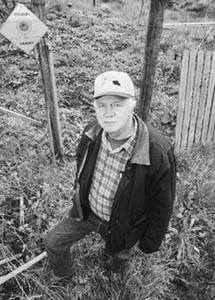
Standing Tall: In a battle that has pitted neighbor against neighbor, the Rev. Randy Hurley is fighting plans to log fir trees that rise majestically behind his house.

Anatomy of a timber harvest plan: How the logging industry pushed hard on an Alpine Valley neighborhood

By Dylan Bennett

Upstream from everywhere in the Sonoma County basin, the evergreen mountains of Alpine Valley are home to spotted owls, towering Douglas firs, spawning salmon, and privacy-loving humans. St. Helena Road winds like a serpent through the valley.

The remote, winding road, shaded by a romantic canopy of trees, roughly traces the rambling path of Mark West Creek. Just a few minutes drive from Rincon Valley northeast of Santa Rosa, Alpine Valley residents live on large parcels of land, enjoying remarkable quietness and natural beauty. Neighbors in the area include a concert-promoting reverend, an eclectic scientist and artist, a merchant marine, a nature-products retail store owner, a Quaker commune, a San Francisco attorney, a winemaker, and a school superintendent. In recent months, this idyllic forest setting has become a volatile battleground.

A timber harvest plan (THP) filed in March with state forestry officials proposing logging on the property of local resident Robert Harper marked the first shot fired in a dramatic clash between the timber industry-state forestry complex and neighbors intent on preserving local community values.

The plan to selectively log 27 acres of mature Douglas firs at the origins of Mark West Creek has outraged Harper’s neighbors. At least six families have formed the grass-roots Indian Rock Alliance to oppose the project, due to be approved in mid-December by the California Department of Forestry.

If the project is approved, the alliance may sue the CDF to stop the logging for what they say is a lack of a fair review process. “People on this road have children, have jobs, they’re retired. There’s a great cross-section up here,” says the Rev. Randy Hurley, a local resident since 1979 and Harper’s next-door neighbor. “What’s in common is our attraction to this area, the nature here. It fulfills something in each person who lives here. So it’s radical to see the desecration of it.”

Harper, superintendent of the Kenwood School District, says he wants to selectively clear just the congested forest and cut down “an occasional tree.” The logging should give him only enough capital to improve a dirt road to the top of the mountain, he says, where he wants to build his dream house.

“I’m a member of the Sierra Club,” explains Harper. “We’re not going to do something that’s harmful.”

His neighbors disagree.

While highly publicized timber wars in Humboldt County focus on the state and federal deal to purchase ancient Headwaters Forest from Pacific Lumber, and plans by E&J Gallo to log environmentally sensitive lands in west county grab local headlines, this relatively small cut in a rural residential area introduces a no-less-pressing local question: How can citizens respond when their neighbor wants to cut down his trees?

It’s known as the problem of “urban interface”–when quiet country living and the roar of chain saws collide.

Conservationists hope to protect oak woodlands.

THPs on the Rise

THE CONTROVERSIAL St. Helena Road plan is just one of several local timber wars creating political gunfire as Sonoma County feels the heat of a rapid increase in logging. In 1993, 33 timber harvest plans were filed to cut 5,483 acres of forest. By 1996, that figure had jumped nearly 20 percent as 47 THPs called for the cutting of 6,921 acres.

Activists and timber insiders alike say Louisiana-Pacific and other Mendocino County loggers have literally “cut themselves out of business” by logging far beyond sustainable limits. Late last month, L-P’s announcement that it will sell off its redwood timber operations on the North Coast seemed to dramatically confirm the depletion of Mendocino County’s timber reserves.

Now timber companies are looking to Sonoma County’s many small landowners and their abundant local supply of timber to fill the void.

“We have this plague of out-of-state big operators,” says Helen Libeu, the matriarch of timber activism in Sonoma County. “Assessors’ rolls are being combed to find people to approach to buy up the timber or the timberland. The out-of-state timber owners generally have no ongoing interest in the future of the property. Their forester is generally instructed to ‘let her rip.’ And that is exciting more neighbors than it used to.”

THPs that are meeting stiff resistance locally include 174 acres of California oaks and other trees on the Gallo property on Westside Road in Forestville, 35 acres of old-growth redwoods on Fitzpatrick Lane in Occidental, and another 89 acres near Hulbert Creek in Guerneville. A plan to cut 66 acres on a steep hill in a densely populated Monte Rio neighborhood was stopped recently by persistent community activists. In each case, residents fight the CDF on a now-familiar list of environmental and procedural grievances, including wildlife habitat and flooding.

On St. Helena Road, alliance members say the Harper THP is bad science, bad government, and bad behavior. The neighbors argue that the logging plan is unacceptably harmful to the environment and local drinking water supplies; that the CDF has disregarded the legal rights of neighbors; and that the THP originates from an unaccountable nexus of landowners, timber brokers, logging operators, foresters, and state officials.

Erosion and increased runoff in the aftermath of the logging plan, they say, will irrevocably damage the sensitive environment of Mark West Creek, with its 100-plus degree summer heat, extensive winter rainfall, and unique wildlife habitat.

“Remember the flash flood on January 15 of this year in Windsor in which Highway 101 was closed?” asks Michael Gates, a self-described technocrat who lives downstream from Harper. “This is where the flood came from. This is the source. Within two to four hours, we had over four to six inches of rain. And I’m a technical authority on weather measurements.”

Gates, a 26-year resident of St. Helena Road, owns 60 acres of wilderness valued conservatively at $750,000. He lives in a self-built custom home just meters from the creek. “[Harper’s] cut is at the apex of Sonoma County. He’s on the west side of the top of the ridge. Everything from there down will be changed. The water and air temperature, the sediments. The shade canopy will be gone, and the dew-gathering abilities; the percolation and accumulation of water from the clouds … that won’t be happening.”

Water from winter rains, mud-filled and no longer restrained by trees and vegetation, will not only flood Windsor again, Gates says, but destroy the salmon habitat in Mark West Creek.

The anticipated damage to the riparian habitat would come at time when both coho and steelhead salmon have been listed as threatened species, and when salmon fingerlings have been spotted in the creek for the first time in many years. Rare spotted owls also live in the area. “I could live wherever I choose,” say Gates, who has traveled the world from the Amazon to Siberia. “This is the most diversified environment I have experienced by far.”

He says the local forests are home to the Pacific gray salamander, incandescent insects, giant moths, pygmy owls, and snails with salmon-colored, cube-shaped shells. “There’s the shade canopy up there,” explains Gates. “On days like today, that hillside, instead of being a radiator for the 100-degree temperature, will be blatantly reflecting all that, heating up the dirt, heating up the water, heating the air. As the air rises, it brings less cool air down into the canyon, so [logging] will change the entire ecology of the canyon.”

But Harper disagrees with that assessment. “As for loss of habitat, there’s just not anything being stripped off or cleared away,” he responds. “The only place there are trees taken is where it’s already crowded. It’s extremely crowded up there. The trees are fighting each other for growth room. So the habitat will remain, and I don’t believe it will be damaged.”

Hurley, a veteran political activist, perceives the proposed cut as a direct physical threat to his well-being. His drinking water comes from two spring boxes located on Harper’s property. Hurley has access to the spring by way of a formal water easement that has legally guaranteed him a right to the water since 1979, when he purchased his 18-acre property. Harper plans to cut down selected trees on all sides of the spring boxes.

The potential negative effect on Hurley’s water supply make Hurley anxious and angry–and add insult to injury. He says the spring boxes were already badly damaged in 1992, when Harper hired a bulldozer to cut a road to the top of the hill. Since then, he says, he has experienced declining water quality and has lost water for two to three weeks at a time in both summer and winter.

“My friends loved the taste of the water,” says Hurley. “They used to bottle it to take home. It was clean, life-giving water. Now it’s brown, blue-brown sometimes. It’s disgusting.”

Harper’s new dirt road was “red-tagged,” or condemned, by the county Planning Department for lack of a grading permit. An approved state THP would lift the red tag. “The truth of the matter is, the rock fell down and broke the spring box and introduced some dirt into the system,” says Harper. “But it doesn’t rely on any surface water. It’s underground water, and the spring production is variable depending on the climate. It’s a cyclical thing. We have done nothing to affect the volume of the water; Mother Nature has.”

State geologist Tom Spitler says rock boulders crushed the cover of one spring box, which was “substantially filled with sediment” and “significantly damaged.” He says there’s “good evidence the system was affected by the damage.”

CDF official Chuck Abshear, chair of the THP-review team, says the spring boxes were “a real mess,” and must be fixed for the logging plan to be approved. Abshear, however, says he has “no expectation” that Hurley’s water supply will be further affected by the proposed logging. Spitler also believes the cut won’t hurt Hurley’s water supply, but admits “water is not an exact science.”

Hurley remains unconvinced.

He insists that nobody really knows what the effect will be, and that he should not be put at risk. In addition, he cites recent reports about the gasoline additive MTBE in California’s new gasoline being known for polluting water supplies. He says MTBE will certainly be present in the logging vehicles driving over the watershed that feeds his spring.


Michael Amsler

Forest Matriarch: Longtime timber activist Helen Libeu blames out-of-state timber interests for fanning the flame of local greed.

Politics of Wood

THE ENVIRONMENTAL CONCERNS of Hurley and the Indian Rock Alliance have been nearly overshadowed by their crash course in the politics of wood. Residents are angered at how the THP carries tremendous bureaucratic momentum from the CDF. They argue that the review process–in which about 94 percent of all THPs are easily approved–is weighted in favor of the applicant and question the CDF’s protocol for considering the interests of local residents.

“I found, through this process,” says Hurley, “that the people who I thought protected the resources of the people in trust, the Department of Forestry, are nothing but a rubber-stamp agency capable of only aiding those with money, and trying to keep our mills going, rather than seeking alternatives, demanding alternatives, and protecting the precious resources.”

Indeed, even CDF’s Abshear acknowledges that the mission of the CDF is to mitigate environmental impacts below a significant level while promoting the harvest of conifer trees. He says that although THPs can be severely restricted by environmental conditions, there exists no formal mechanism to prevent logging permits.

But the alliance says its environmental and legal concerns have been either ignored or handled in bad faith. A review of the official THP on file at the CDF office in Santa Rosa reveals a thick stack of letters from a large cast of neighbors in Alpine Valley. There are polite, articulate letters of concern, copies of famous Native American quotes about the environment, and enraged hand-scribbled notes. The letters have lain mute in their folder without any response from CDF officials.

In October, the relationship between the CDF and the alliance exploded into controversy during the final THP review meeting, when Abshear ejected Hurley from the meeting after Hurley reportedly called Abshear “a toll-taker for the capitalist system.”

Hurley concludes: “You pay taxes, but you have no right to open your mouth. It’s taxation without representation.” As well, alliance members who tape-recorded the meeting say that Abshear blatantly disrespected public comments, even laughing at the concerns of 75-year-old Alpine Valley resident Ann Donnels, whose land has been included in the THP for use as a loading zone without her consent. Also, Neal Creek Road, a private dirt road used by Donnels and resident Bill Woods, is written into the THP for use by logging trucks without the consent of either Donnels or Woods.

“I see so many things that are not honest with them,” says Donnels of the CDF. “I’m mad as hops,” snaps the 36-year Alpine Valley resident.

According to Hurley, Abshear said, to the horror of those in attendance, that “with the stroke of a pen,” he can do anything he wants. “He was rude. He was unprofessional. He was undignified,” says Hurley. “And our lives and property are on the line.

“I’m just sick of the whole process.”

Rick Coates, executive director of Forests Unlimited, a forestry-practices watchdog group, is watching the Harper application at the request of his friend, Alpine Valley resident David Bannister, who owns the Nature Store in Coddingtown Mall. Bannister is past president of the Sonoma County chapter of the Sierra Club.

Coates delivers a scathing appraisal of the CDF and the official measures to curtail environmental damage. “The mitigations are by and large insufficient. And, in fact, contrary to law,” claims Coates. “Particularly the endangered species [mitigations] are often contrary to law. [CDF officials] have done what they could to pretend to be addressing those issues. But the fact of life is that this plan, like every other [THP], will be approved. …

“They use phony logic and absolutely laughable non sequiturs at times,” he adds, “and the public really has no recourse. CDF has a set of boilerplate answers they use over and over.”

One problem, Coates says, is that the CDF’s official response to citizens’ complaints comes only at the end of the review process, when the THP already is approved.

“Junk science is practiced at CDF like root beer-float making is practiced at Foster Freeze,” he says. ” Junk-Science-R-Us is who they are. It would be funny if it weren’t for the fact that it’s really a way of stealing resources and stealing other people’s property values and the public’s resources [in the creek and the river].. After all, they’re talking about, like, fisheries. Those resources belong to everybody. They are destroying a whole industry for the narrow benefit of multinational timber companies.”

Outside Interests

FOR ALLIANCE MEMBERS, environmental anxieties and frustrations with the CDF are worsened by a lack of neighborly discussion over the matter, and by a business backdrop that includes out-of-town timber brokers.

Harper sold the timber rights on his property to Southern Californian timber project manager Brian Ivener, who does business from a Phoenix, Ariz., firm. Ivener, in turn, retained the services of local logger Miles Dupret, who Ivener says does a “fine job.”

But Dupret is a logger with his share of legal problems. He is being sued by St. Helena Road resident Bill Wood, who had hired Dupret in 1992 to log three acres of forests, for allegedly neglecting to clean up the “slash” left after the logging operation or to pay Wood $25,000 [for harvested timber]. Dupret, who says he was “scapegoated” in the Woods case, also faces five lawsuits involving timber harvests in Cazadero, where he allegedly failed to pay the landowners for their trees.

County court records show that in 1995 Dupret settled a $75,000 lawsuit brought by Eric and Janet Ziedrich of Healdsburg for a 1992 logging contract. They claimed that Dupret “so negligently carried out his logging activities, in general, and so negligently maintained his reputation in the industry, and negligently misrepresented his qualifications and reputation,” that they withdrew from the contract lest their timber harvest application be hampered or delayed.

Others have sued Dupret for cutting trees on private property adjacent to a site approved for timber harvesting.

“I’m not against a project like [the Harper THP],” says Alpine Valley neighbor Jim Doerkson, a retired civil engineer who selectively logged about 500 acres in the 1970s. “The only thing I’m against is that I think they’re going to do some overcutting. Miles Dupret, you know, he’s out there raping the land, and I’m just against things like that. I’ve looked at his projects. They’re a mess. This is what’s so unfortunate, because if people log correctly–selectively cut, clean up their slash–there isn’t a problem. It’s like growing a crop.

“When people just go out there and just get wild with bulldozers and rip things down, damage other trees, and leave huge piles of slash around, drive into the creek with their bulldozers–it’s just garbage.”

Dupret says the lawsuits are limited to minor cleanup issues, and that in 26 years he has never been cited for violations. For Donnels, the elderly neighbor on Neal Creek Road, the prospect of Dupret cutting trees near her property, where a proper survey has not been done, is unsettling. Donnels and others in the area also suspect that the logging revenues will disappear into Ivener’s Arizona escrow account, where they cannot be “attached” by court order in the event of civil litigation.

Most alliance members believe Harper–who Hurley contends is contractually obligated to sell his timber to Ivener–could get burned on the deal and may be left with considerable liability. Also, they complain about the manner in which they were contacted by Ivener’s registered professional forester Mark Stewart, and not approached directly by Harper.

“Rather than have a dialogue with your neighbor when you want to introduce something to your community, we have to do it in a formalized way to respond to official requests,” says Hurley.

Last month, at the behest of the alliance, county Supervisor Mike Cale tried to mediate between Harper and his neighbors, winning a promise from Harper that he would meet with alliance members to iron out their differences.

“It’s just words,” says Hurley. “So far, not one person has seen any action.

“It boils down to one thing: One man takes out a license, and many neighbors all surrounding that person spend time, money, resources–feelings pouring out–just to protect the property they have and in the hopes that person will leave it alone.

“If there is freedom, somewhere there is a loss of it by this technique.”

From the Nov. 13-19, 1997 issue of the Sonoma County Independent.

© Metro Publishing Inc.

Steven Harrison

0

No Way!


Good for Nothing: Seeker Steven Harrison discovered that nothing is grand.


How nothing changed author Steven Harrison

By David Templeton

STEVEN HARRISON was stuck. After a quarter of a century of spiritual exploration, the former Quaker, Buddhist, Hindu, Yoga practitioner, meditator, and seeker-of-truth had come to the painful realization that the harder he searched for enlightenment, the less enlightened he felt. He’d traveled the world, made a fortune creating and selling a successful investment company, and established a commune in Santa Rosa. He’d done it all. But nothing he did relieved the emptiness he’d spent his life desperately attempting to fill.

So, having chalked his 25 years of spiritual experience to, well, experience, he made the decision to simply do nothing.

Nothing is a tricky concept to describe. What Harrison apparently found was that by letting go of every conscious attempt to grasp fulfillment, by taking the focus off himself and his spiritual pain, the terrible emptiness had somehow ceased to be the center of his life. Since he did nothing to arrive at this conclusion, Harrison is careful not to let it be like some process that he followed.

“There is no process toward enlightenment,” he often says, “and enlightenment does not exist.”

Back to being stuck.

A few years ago, Harrison was stranded in a tiny Indian village called Bodh Gaya–ironically, the location of the famous bodhi tree under which the Buddha was enlightened. “I was there at the wrong time of year,” Harrison laughs, chatting by phone from his part-time home in Boulder, Co. “It was extremely hot. There happened to be an election going on, so they’d closed down the transportation–buses, trains, everything. I couldn’t leave, and the streets were empty because of the heat.”

Unable to do anything, Harrison began to muse playfully on the oxymoronic phrase “doing nothing,” and realized he had the title of a book.

“I began writing that day,” he says. Back in the states, he continued writing, eventually producing the slim little tome, Doing Nothing: Coming to the End of Your Spiritual Search (Crossroad; $9.95), which he will read and discuss at several area bookstores this month.

An intriguing, unabashedly odd book, Doing Nothing is comprised of short, Zen koanlike chapters in which Harrison effectively conveys something of this non-grasping, silence-seeking, actionless approach to life, managing to make almost no intellectual sense at all while filling the pages with maddening conundrums: the notion that our spiritual emptiness is caused by our search to end our spiritual emptiness; and nearly impenetrable trains of thought–“What emptiness holds is reality. Reality is the movement of energy itself. Energy is not empty, nor is it concrete. It is dynamic possibility.”

After rereading the first chapter three times, this reporter–suspecting that he might have missed the Doing Nothing point–gave up trying so hard to understand the words, and read the rest of the book in one sitting. Admittedly, it conveys a distinct mood and feeling without imparting much in the way of actual information. Perhaps this is what Jesuit priest George Maloney–quoted in the book’s promotional material–means when he says, “You can’t read this book with your mind.”

Harrison himself says that if he could, he’d have published a book of blank pages.

“In a sense, that would have been the purist expression, wouldn’t it?” he laughs. “Not to even get involved in language. Language is a problem. It often creates even more concepts.”

In a world of self-help guides featuring glib insights and easy-to-follow, practical steps to happiness, such deliberate opacity is certainly refreshing, as is Harrison’s refusal to be seen as a teacher or guru or New Age huckster–he has donated all revenues from his writing to a charity aiding street orphans in Nepal. But what about spiritual seekers who, like Harrison, have delved into many waters and still come up thirsty? Might they not seek to find the right way to “do nothing,” in order to find some form of fulfillment?

“If a person does make doing something out of this book, or anything else I say, they’ll find out that it doesn’t bring about anything,” he replies. “They’ll be right back at the beginning. What I’m trying to describe is that you don’t need to expend your energy, at least not in the spiritual realm.

“I can say with great certainty,” he continues authoritatively, “that each and every human being has available to them the entirety of the mystical experience, the direct access to the actuality of their existence, right now in this moment.

“Without,” he concludes, “anything that leads up to it–without any search, any philosophy, any anything.”

Steven Harrison does nothing for free at two locations. On Thursday, Nov. 20, he speaks at 7 p.m. at the Copperfield’s Books’, 140 Kentucky St., Petaluma. 762-0563. On Friday, Nov. 21, he speaks at 7:30 p.m. at Readers’ Books, 127 E. Napa St., Sonoma, 939-1779. He also hosts dialogues Nov. 23, 25, 30, and Dec. 1 at various locations. Call 579-5363 for details.

From the Nov. 13-19, 1997 issue of the Sonoma County Independent.

© Metro Publishing Inc.
Talking Pictures

0

Master Race

By David Templeton

Writer David Templeton takes interesting people to interesting movies. This time out, he meets with a team of genetic bioethicists to discuss the disconcerting new techno-thriller Gattaca.

THE THREE BUILDINGS that house the Stanford University Center for Biomedical Ethics resemble nothing so much as a pleasant suburban apartment complex from the 1970s. What goes on inside, however, may end up guiding our society’s choices through the 21st century.

Labeled simply “A,” “B,” and “C,” these buildings are home to a world-class research facility devoted to studying the cultural effects of the increasing number of innovations within the medical and scientific industries.

Building A–my destination–is the headquarters of Stanford’s Program in Genomics, Ethics, and Society. This program–with its international assemblage of doctors, scientists, ethicists, philosophers, lawyers, and psychologists–was established three years ago to study the far-reaching implications of applied genetic research, including the controversial fields of genetic testing and engineering.

Last week, a band of PGES researchers went out on an unofficial field trip to see the new film Gattaca. Set in the near future, this provocative film imagines a world in which human genetic engineering has created a two-class social system, with an upper class of laboratory-manufactured citizens called “valids,” who get all the good jobs and perks, and a lower class made up of “in-valids,” those poor slobs unfortunate enough to be born by means of that genetic crapshoot called sex. The story follows one such in-valid (Ethan Hawke) who, longing to become an astronaut, uses the borrowed DNA–blood samples, loose hairs, dead skin cells–of a disabled valid in order to enter Gattaca, a corporate-sponsored school for genetically pure future space travelers (set in Frank Lloyd Wright’s Marin Center).

I am met by Dr. Sally Tobin, a renowned molecular geneticist and PGES senior research fellow who is developing an exhaustive CD-ROM tool to educate physicians about the Human Genome Project, an international undertaking that seeks to build a genetic map of the human species. As we make our way toward the bright, book-lined conference room, Tobin is joined in turn by lawyer and PGES fellow Margaret Eaton, administrative assistant Heather Silverberg, PGES coordinator Laura McConnell, and Anne Moyer, a Ph.D. in social and health psychology. As we seat ourselves, it becomes clear that the consensus on Gattaca is split, with a few claiming to have found it to be an uplifting film, and the rest having found it merely scary.

“Scary in that you walk into a genetically engineered society, where parents can create fertilized eggs that are genetically tested to select the best,” Eaton explains. “The valids are intelligent, tall, good-looking, athletic–perfect. That’s the scary part. The uplifting part is that someone who doesn’t have those genetically produced attributes is able to succeed despite the fact that he’s discriminated against. It’s not a hopeless world.”

“One of the ways you could view this movie,” says Silverberg, “is as a commentary on our striving for perfection.”

“Good point,” Tobin continues. “Think about it. If the world is made up of perfect people, there’s still going to be number two and number three.”

“Even the fellow with the genetic pedigree that allowed him to be in the Gattaca program admits at one point that he has a fear of heights,” says Moyer. “That may be a commentary on the idea that, even with your best efforts, you’re not going to get it quite right, you’re not going to take everything into account.”

“Was that something the genetic engineers missed?” I ask. “There’s no gene for acrophobia, is there?”

“We don’t know that,” Tobin replies. “There might be.”

“The other thing I thought about the movie,” Eaton says, “is it created a context I’m not sure is going to exist. The point of all the biotechonology research going on today is that we want to learn about your genetic makeup so we can prevent you from getting sick or can treat your illnesses. Here is our hero with all these predilections for disease, but they don’t talk about treating it. They didn’t talk about the use of genetics for positive purposes; the only context in which it was shown was as discriminating against defective people.”

“I think that, generally speaking, the public is going to look at this movie and they’re going to be afraid,” McConnell suggests. “Afraid that genetics is going to reduce us all to this. It’s going to take a lot of secondary thinking to arrive at the conclusion that these are the problems of a genetically engineered society. That this is how it’s not going to work.

“And its underlying point,” SIlverberg adds, “is that if we don’t address some of these issues, we may end up there.”

“It’s not that big a jump, is it, from what we’re doing now?” I ask. “We routinely use amniocentesis to determine a genetic predisposition.”

“That’s just reproductive freedom,” Moyer points out. “There is an ethical debate about how far we’ll take that. If we select out those kinds of diseases, will someone come along and select out other traits?”

“See, but I don’t think that’s the future,” Eaton insists. “And I don’t think this film is the future. I have more faith in our ability collectively, as a society, to watch out for the negative stuff. Look at cloning. Someone clones a sheep and instantly there are worldwide moratoriums on cloning research. We can control ourselves.

“Though I’m not saying we don’t have the potential to do monstrous things,” she adds, as–around the table–heads nod. “The potential is definitely there. I just believe we’ll rise above it.”

From the Nov. 6-12, 1997 issue of the Sonoma County Independent.

© Metro Publishing Inc.

Johnny Otis

0

Soup’s On!


Table Manners: Johnny Otis samples his Greek egg-lemon soup in his Sebastopol kitchen.

Photo by Michael Amsler


At table with the incomparable Johnny Otis

By Gretchen Giles

JOHNNY OTIS’ kitchen isn’t much different than the well-lived-in hearth of any other Sebastopol grandparent’s home. Living with wife Phyllis and grandson Lucky, as well as hosting several friends, kids, grandkids, and great-grandkids on a regular basis, Otis lives in a clean clutter. There are cases of soda stacked up on the counter, a bowl of fruit on the table, gardening gloves lying next to the telephone answering machine, a bunch of dried lavender in a vase, a recorked half-bottle of red wine, and olive oils, Parmesan cheese, canned foods, and other comestibles lining the counters.

Then, one’s eye glances lazily at the Rolodex standing open to a card inscribed “Alvin, Dave–The Blasters,” with Alvin’s home telephone number printed neatly below.

Oh. We’re at Johnny Otis‘ house. Rhythm and blues legend, Rock and Roll Hall of Famer, former candidate for state assembly, preacher, painter, sculptor, cartoonist, organic-apple farmer, bird fancier, avid fisherman, KPFA radio-show host, children’s advocate, samaritan, and now–published cookbook author: Johnny Otis.

This ain’t no regular grandpa.

“OK, kids, time to go to the pig-out room,” Otis intones in his distinctive voice. Wearing a dark windbreaker and blue apron, he lifts up a steaming pot of soup and nods his head toward the dining room. It’s lunchtime.

Today, in honor of his newly published cookbook, Red Beans & Rice and Other Rock ‘n’ Roll Recipes (Pomegranate; $16), Otis is kindly hosting a reporter and photographer at his table, as well as serving up the soup for long-standing chum Cam Parry, the second voice on Otis’ popular Saturday morning KPFA 94.1 FM show. Although an extra hour has been added to the show (it now extends from 9 a.m. to noon), other projects in Otis’ ambitions have shrunk. The church he established at the Luther Burbank Center earlier this year has closed for lack of funds; his long-hoped-for community center, the Johnny Otis Center for the Arts–with its emphasis on health care for underserviced children–is on hold; and his long-standing Saturday night gig at Santa Rosa’s downtown club the Funhouse has been suspended on Otis’ orders. He’ll be appearing regularly at another venue early next year, at a place whose name Otis enjoys keeping shrouded in mystery.

Because even at age 73, Otis is not a man to slow down. With another partner and Parry, Otis is writing You Made Me Love You, a Broadway musical. Set around the Golden Gate Fields horse track in the heyday of the ’40s, this frothy costume comedy spotlights a society gal trying to heal her heart after breaking off with Gary Cooper. A cast album of You Made Me Love You, slated to be recorded with members from the long-running San Francisco production of Phantom of the Opera this fall, features some 24 songs written by Otis.

Johnny’s recipe for Greek Egg-Lemon Soup

IN THE DINING ROOM, Phyllis, Otis’ wife of 42 years, declines to eat, but has laid a table with fresh garden roses and a pink cloth, lovely china, and gleaming cups. Ever the lithe young thing, I clumsily push down on the tabletop as I rise up from my chair and, with a lurch of the vase and a sickening sound, the table breaks. We catch it and the photographer squats under the tablecloth tinkering until a bolt is reapplied. Order restored, we sit once again, unfolding our napkins in our laps.

Ladling out the Greek egg-lemon soup with chicken that he’s prepared the night before, Otis, who is of Greek descent, denies any expert culinary ability. “Hey, let’s back all the way up,” he says with a chuckle. “I’m no chef, I just like to cook when someone comes over.” While discussing book ideas with an editor at Rohnert Park’s Pomegranate Books publishing house, the idea for Red Beans & Rice just popped out of his head. When the editor jumped, Otis had to, too. Calling on friends and family, he devised a 120-page tome to rock-‘n’-roll cooking on the road and friendly, easy eating at home.

“Those are not all my recipes, you understand,” he says, taking a bite of the salad with Kalamata olives, baby corn, fresh greens, and cherry tomatoes that Phyllis has prepared. “But through my trips through the South [in the ’40s-’50s with his all-African-American band], if the town wasn’t big enough to support a black hotel, we had nowhere to stay. Nowhere to eat.”

Carefully drizzling olive oil over a slice of feta cheese, he continues. “The promoters would arrange for us to stay in black homes. And when that happened, very often it was in a rural area, where we’d be in a farmhouse and there’d be all kinds of good smells coming from that kitchen, and I’d just go into that kitchen and hog that kitchen and ask them [about the food].

“Because there’s no one that can cook that pastry and that soul food the way that they do down in the South.”

Unless, of course, they happen to be in a hotel room–anywhere in the United States. Living tight, Otis and his band quickly grew tired of the high prices and low satisfaction of restaurant food while on the road. That’s when transportation manager William “Blik” Avant took over. Traveling with two suitcases devoted to nothing but hot plates, pots, pans, and seasonings, Blik cooked nightly for the band, wet towels pressed against the door to keep the illicit smells of room-cooking from seeping into hotel hallways.

“Blik didn’t have to stay up until 3 in the morning playing a gig,” Otis explains, supping his delicately flavored, yellowy soup. “So, he’d get up early and prepare a lot of nice things.” In a Red Beans & Rice aside, Otis reports the instance when an angry hotel manager became so swayed by the smells of the steak smothered in onions, fresh collard greens, and apple cobbler Blik had prepared in one of his rooms that instead of booting the band out, he stayed for dinner–every night for the following two weeks.

We eat for a long time. Garlic toasts appear and are eaten. Herb-inflected feta cheese is offered, fresh lemon slices passed, and more chicken proffered to complement the soup. Dessert is “jive pie,” an apple wonder in a homemade crust that this songwriter, whose ’50s hit “Hand Jive” has out-clapped many other songs of the era, had made earlier in the week and then protected fiercely from his household tribe. Of course we have ice cream.

Otis’ property includes the aviary where he keeps his 100 or more fancy pigeons (he used to tend some 800 birds and now considers himself frugal in his collecting); the koi pond protected by statues of the Three Tons of Joy–former backup singers whom Otis, a painter and sculptor with a fiercely primitive appeal, has immortalized in kinetic plaster–the life-sized figures frozen in mid-dance, naked and huge and bearded with cobwebs; the recording studio; the art studio; the apple orchard; the rehearsal space; and that small hillside just to the west of the house where two ostriches are kept.

As we wander outside after the still-stable table has been cleared, Parry points with a laugh to the large fishing boat that dominates Otis’ back driveway. “Tell her about when you bought this,” he prompts. Otis chuckles.

The dealer had an itch in his brain about Otis’ name. He knew that he was Someone. Was he involved in the music industry? Yes, Otis nodded modestly. “‘Oh, I know,'” Otis now mimics, wagging his finger in mock excitement. “‘I know! ‘Dock of the Bay!’ That’s my favorite song!'”

Clapping his hands together and digging his heels into the warm gravel of his Sebastopol spread–surrounded by family, friends, pets, his orchards, and his art–Johnny Otis lifts his face to the sun and laughs.

From the Nov. 6-12, 1997 issue of the Sonoma County Independent.

© Metro Publishing Inc.

African-Americans in Early California

0

Free at Last

By Gretchen Giles

How does it feel to be a problem? I answer seldom a word. And yet, being a problem is a strange experience.
–W.E.B. Du Bois, 1902

AH, THE GOLDEN STATE. Imagine California in the late 1700s: our tawny hills laid down like great sleeping hands, sloping from knuckles to tips into green valleys shaded by oaks. Creeks run sweet, berries proliferate, poison oak grows glossy and unfettered, and lumbering bears paw honey and grubs out of trees. Climb to the top of this hill and see the San Francisco Bay glittering in the clear, clean air. Make camp near that watering hole and know that you won’t see another human for days.

Nary a microwave tower nor a strip mall desecrates the scene into which rides a large, dusty group of men straddling road-weary horses. But this is where the scene shifts, the focus racks, the camera pulls in tighter. Because this party doesn’t have the squinting white faces of a Clint Eastwood western, Caucasian riders elegantly filthy in Italian-designed leather chaps.

These men are from Mexico, Spain, the West Indies, and Africa. These men are the explorers, the landlords, and the titans of the land called California. “We’re talking about cowboys. They truly were black cowboys,” says Sonoma County Museum curator Evangeline Tai, standing in the upstairs offices of the Santa Rosa-based museum. Investigating such historical figures as a tracker known simply as El Negre–one of California Governor Gaspar de Portolá’s explorers who, in 1769, is credited with being the first of the party to spot San Francisco Bay–and Pio Pico, the last Mexican governor of California, whose heritage was almost as much African as Mexican, Tai on Nov. 7 begins displaying “Rivers of Hope, Rivers of Change: The African-American Experience in Sonoma County.”

Using historical artifacts from area families, records from the local chapter of the NAACP, and items culled from other Bay Area museums, Tai and guest presenter Darius Spearman–a graduate student of history at Sonoma State University with a focus on the local African-American community–have scoured the North Bay looking for clues to the local black experience.

What Tai terms “the black west” probably didn’t make it all this far north until streams of freed slaves and others came here searching for freedom, land, and that shiny dust that caused so much of a ruckus in ’49. The migration probably “stopped in Marin County, evidently around the Headlands,” says Tai. “That’s where the documentation gets kind of fuzzy. Some say that they made it all the way up to Sonoma County; others say that is not correct, that they made it north to Point Reyes, but didn’t come east to Sonoma County.”

Fuzzy or no, by the full flower of the 20th century, parts of Sonoma County were beginning to attract African-American settlers, most notably one John Richards, who is credited with founding the South Park area of Santa Rosa, a portion of the city still welcoming to recent arrivals, and most commonly today, to Eritrean refugees.

Other prominent past citizens are Mary Ellen Pleasant, the former bordello owner and abolitionist whose last request was honored when her gravestone was inscribed with the words “I was a friend of John Brown’s.” Settling on the Beltane Ranch, this Bay Area land baroness comfortably nested on the estimated $30 million she amassed between 1860 and 1890 through a series of shrewd investments, both personal and financial.

Healdsburg resident Smith Robinson, a This Is Your Life honoree, is also highlighted for his efforts during the Korean and Vietnam wars to bolster the spirits of American soldiers and to rally support at home.

“What we’re looking at,” says Spearman, a records technician at Santa Rosa Junior College, “is the different ways that people have stepped up to answer the question of how you mainstream yourself.

“This has been a very interesting journey for me,” Spearman muses of the time that it’s taken to research this project. “It’s really demonstrated the ways that blacks have stepped from the
margins.”

“Rivers of Hope, Rivers of Change: The African-American Experience in Sonoma County” opens with a reception on Friday, Nov. 7, from 6 to 8 p.m., and runs through Feb. 22. A docents’ orientation begins that day at 10 a.m. Darius Spearman speaks on his research on Saturday, Nov. 15, at 1 p.m. Sonoma County Museum, 425 Seventh St., Santa Rosa. 579-1500.

From the Nov. 6-12, 1997 issue of the Sonoma County Independent.

© Metro Publishing Inc.

Spins

0

Still Unique


Voodoo Chile, Slight Return: Pyrotechnic wizard Jimi Hendrix.


Restorations of Hendrix’s mastery

Jimi Hendrix
South Saturn Delta
(MCA)

THE RECENT REISSUING of
Jimi Hendrix’s recordings through his family’s supervision continues with stellar results on South Saturn Delta. This batch of rare cuts and loose ends complements First Rays of the New Rising Sun, which was released earlier this year in an attempt to assemble what Hendrix’s fourth studio album would have been (like Cry of Love and Voodoo Soup) if Hendrix’s untimely 1970 death hadn’t cut his career short. South Saturn Delta takes in demos with the Experience as well as restored mixes of work with his later funk-rock ensembles, such as Band of Gypsys, and–as usual –the annotated booklet is superb. Hendrix’s mastery of blues vocabulary was always full of pop instincts, abstract flare, and screaming guitar dynamics. The title track, with sax, horn, and guitar interplay and odd rhythms, is still unlike anything we’ve heard since.
–Karl Byrn

Richie Havens
Live at the Cellar Door and the Santa Monica Civic Auditorium
(Five Star)

FEW PERFORMERS emerging from the ’60s folk revival display as much raw instrumental power or the uncanny ability to interpret songs as singer, songwriter, and guitarist Richie Havens–the Woodstock-era icon often heard on TV jingles. This new CD, featuring for the most part previously unreleased material from 1970 and 1972, captures Havens in his prime, forcefully rendering works by Bob Dylan, Fred Neil, and George Harrison, among others. The earlier Cellar Door sessions–driven by his percussive, strummed-guitar style and slightly hoarse voice–spawned the hit single “Here Comes the Sun,” the Harrison composition from Abbey Road. But the rest of these live tracks–including a soulful version of Billie Holiday’s “God Bless the Child”–languished for more than 25 years. Today, they cast a warm glow that, while echoing the social and political turbulence of the times, blankets the listener in a comforting, sonorous aura. Great stuff.
–Greg Cahill

Everclear
So Much for the Afterglow
(Capitol)

EVERCLEAR SHINES among the many one-hit wonders left by the ’90s alt-rock explosion. The catchy abandon of their 1996 hit “Santa Monica” (with its rollicking chorus of “I don’t wanna be the . . . baaaaaad guy!”) drove the disc Sparkle and Fade to platinum sales, but oversaturation on radio and MTV quickly made the group objects of hip disfavor. Sparkle and Fade was meatier than that sharp hit, as frontman Art Alexakis expressed a compelling, explosive, and highly personal version of the post-Nirvana punk/grunge formula. Everclear’s not-so-subtly titled So Much for the Afterglow blares a bit more gingerly down that same path: The songs are less confessional stories than accusatory portraits, and the crescendoing fervor of delivery is now a more even pop-punk shuffle. The jerky, two-note riff from “Santa Monica” appears again in “I Will Buy You a New Life” and “Father of Mine,” and even surfaces in the metallish instrumental “El Distorto de Melodicas.” Banjos, organs, and nods to the Beach Boys don’t quite freshen the sound, and as if to acknowledge the difficulty in making a dynamic follow-up, the band delivers the song “One Hit Wonder” as though it were an anthem. If So Much for the Afterglow isn’t Everclear’s glory moment, Alexakis’ ragged quest to break from a lost past into a brighter future still gives Everclear its kernel of truth.
–K.B.

From the Nov. 6-12, 1997 issue of the Sonoma County Independent.

© Metro Publishing Inc.

The Scoop

Colorful CIA

By Bob Harris

MY BUDDIES MATT and Heidi recently sent along an interesting Help Wanted ad, occupying almost a whole page of the October Ebony magazine.

The ad promises the “ultimate overseas experience . . . for the extraordinary individual” possessing “an adventurous spirit, a forceful personality, and the highest degree of integrity.”

It’s a want ad from the CIA.

That’s right–the Central Intelligence Agency has begun openly recruiting from U.S. minority communities for covert operations in the Third World. Right there in Ebony, the CIA bluntly states: “We are particularly interested in candidates with backgrounds in Central Eurasian, East Asian, and Middle Eastern languages . . . foreign language proficiency, previous residency abroad are pluses.”

And they’re not recruiting for the semi-respectable part of intelligence–the grunt work of reading foreign newspapers, developing contacts, then assembling and analyzing the data so our leaders can make informed decisions. The Ebony ad is for what the CIA calls “Clandestine Service” –the breaking-laws-and-overthrowing-leaders stuff that can start wars–or as the CIA describes it: “a way of life that will challenge your deepest resources . . . including fast-moving, ambiguous and unstructured situations.”

Um, that’s one way of putting it, I guess.

Sounds good to you? Great. Sign yourself right up, although you’ll first have to pass a psychiatric exam, a polygraph interview, and a thorough background check. So if you don’t mind asking the CIA to crack open your head and examine your life with a fine-toothed comb, go for it.

There is one catch: The starting salary is only about $40K. So forget any daydreams about Sean Connery and Jill St. John sipping claret on a yacht off Capri. Picture yourself more like, oh, Tom Arnold driving a Skoda around the potholes of Bratislava. And imagine a minority Tom Arnold, since the CIA already has plenty of white people.

Still interested? Just send the CIA your résumé. And if you forget the return address, don’t worry. If they want you, they’ll find you.

I OFTEN RESEARCH these little tirades on the Internet.

Unfortunately, some folks think the Net is only gossip and pornography, but that’s just what they show on TV–which is itself mostly gossip and pornography. So there you are.

Actually, most every major newspaper is online. So are reference libraries on everything from high-energy physics to Shakespeare. Hey, you want to know who paid for your senator’s latest campaign? You can find out online in a matter of minutes.

And the best part is you can use computerized search engines to do most of the work. You type a few words summarizing what you’re looking for, and in seconds, bang! you’re there.

I’ve always been a little curious to see what other people are searching for: serious stuff or pictures of Jenny McCarthy fondling a tractor? As of last week, one search engine, Metacrawler, now has an option where you can sit back and watch other people’s search requests go by.

I took a peek. It’s really cool.

The first search I saw was for “Wallflowers tour dates”–OK, that’s the band headed by Bob Dylan’s son. Respectable enough. Then came “Volvo 240 plug gap”–some rich guy is tuning up his car. Hey, this feels like an eavesdropping version of Jeopardy! Next was “Tiger Woods and Buddhism”–hmm.

I don’t see the connection. Sounds like an Al Gore fundraiser.

Yeah, people do look for naked pictures, maybe one search in 10. Somebody out there the morning I was tuned in had a major thing for “Dawn Wells,” Mary Ann from Gilligan’s Island. Somebody needs to find something to do.

But the good news is that’s precisely what most of the planet seems to be up to–and I do mean the planet. In less than five minutes, I also saw searches for “École ingénieur” (French for “school engineer”); “trabajo y secretaria” (Spanish for “job and secretary”); and “Stahleisenprüfblatt Arbeit,” which I think is German for “sheet metalworking job” (or maybe it’s some kind of foamy lager; mein Deutsch ist sehr furchtbar).

Granted, this polyglot job quest might indicate the global economy ain’t all it’s cracked up to be, but that’s another story.

The point is, most people do seem to be using the Internet responsibly.

Now if only we could use TV and other media the same way.

From the Nov. 6-12, 1997 issue of the Sonoma County Independent.

© Metro Publishing Inc.

Sonoma Rainfall

Muddy Waters


David Licht

A River Romps Through It: Debris-choked flood waters spilled over River Road in 1995 after storms killed one person and caused several million dollars in property loss, destroying or damaging 1,500 homes. River residents worry that steep-slope planting of vineyards, development, and siltation could compound problems.

Climatologists predict record rainfall this year as Russian River residents brace for nature’s wrath–and what some say is the backwash of man’s fallacies

By Christopher Weir

WITH THE RESURGENTEl Niño already being blamed for virtually everything from hurricanes to the Oakland Raiders’ dismal record, one thing seems certain: The rogue phenomenon will unleash a troublesome dose of flood-instigating rainstorms upon Sonoma County this winter. Or will it?

As the local daily proclaimed in a recent subhead, “The North Coast could be in for severe weather–or it may escape unscathed.” Never has something so speculative been met with such morbid anticipation by local, regional, and national news media. But if El Niño does, indeed, live up to its billing, then there will likely be hell to pay on the local front. And since everyone is in such a speculative mood these days, perhaps it’s time to dredge up the unpopular question: Why? That is, why do flood events in Sonoma County appear to be intensifying even under apparently normal weather conditions?

Some suggest that this perception is just misperception. The historical record, after all, reveals that the Russian River has crested above flood stage 40 times over the past 41 years. Meanwhile, as more people have moved into the floodplains, the human toll has become more acute. Throw in the recent 7-year drought, and suddenly the watershed’s natural inclinations seem the stuff of anomalous catastrophe. The flood issue, however, is not that simple. Because while historical records show peak flows and flood frequencies, they don’t reveal the Russian River watershed’s spatial and behavioral changes over time for a given volume of water.

“Nobody’s really looking at how flood levels are changing according to the size of the floods,” says Laurel Marcus, a local hydrologist. “For example, is a 10-year flood creating more problems than it used to? There are all sorts of variables, so that’s not a simple question.”

Those variables are receiving increased attention in the wake of last January’s floods, which many county residents felt were excessive, rising faster than in recent memory and in the absence of saturating precipitation, at least relative to the rainfall amounts. And of those variables–everything from watershed development to allegedly misguided flood-control projects–siltation remains the most provocative.

“If you’ve got a river channel with a certain capacity and silt material comes out of the water and settles in the bottom of that channel, it’s going to decrease the capacity of that channel,” says Dennis Wilson, an independent civil engineer based in Forestville. “When this happens over many years, that decrease is significant. Is this happening or not? Common sense tells me that, yes, it is happening, because that silt doesn’t just disappear, and it all doesn’t flow into the Pacific Ocean.”

Wilson says he’s not armed with hard data, just intuition, anecdotal reports from riverfront residences, and personal experience. For example, he has seen survey monuments no more than 20 years old buried beneath eight feet of silt in the Steelhead Beach area. And he suggests that the accumulation of municipal development and certain agricultural practices–especially steep-slope planting of vineyards on former forestland–is the primary culprit.

“When I see this degree of siltation, it just seems obvious to me that it’s going to cause flooding,” he says. Others, however, are not convinced that siltation is a major flood factor in the main stem of the Russian River.

“You can certainly say that there’s more sediment running through the system,” says Joan Vilms, president of Friends of the Russian River. “There’s no question about that. Whether it’s being built up in some places and depleted in others, or whether it’s a consistent buildup, I can’t say. . . . Sediment is somewhat like sand dunes, in that it’s dynamic. It’s really hard to get a handle on it. You can’t really say just because somebody’s fence is covered up that the whole plain is now at that level.”

Noting that the Russian River system is “disturbed and altered,” Marcus says that determining the capacity impacts of siltation would be an exceedingly complex proposition. Silt is not only “highly mobile,” but also very responsive to both the natural and the unnatural dynamics of the river system.

“When you pave an area, you create so much more runoff . . . that you can gully a creek and move out more silt than is coming in,” she says. “And you can have an increased silt load below a grading site that may sit there one winter but be completely flushed downstream and out to sea the next winter.”

Nevertheless, Wilson’s intuitions are being confirmed in some river tributaries and floodplains, including the Laguna de Santa Rosa. While maintaining that siltation is not a flood issue in the river’s main stem, George Hicks, deputy chief engineer at the Sonoma County Water Agency, adds that “the Laguna de Santa Rosa has been silting up, and the source is in the upper watershed areas.”

The Laguna de Santa Rosa is crucial to local flood mitigation and holds as much water attenuation capacity as Warm Springs Dam. The water agency is currently conducting a study to assess the amount and impacts of siltation in the laguna.

Erosion and siltation are also playing supporting roles to another element of the flood equation: accelerated storm-water runoff from developed lands and drainage systems. While the degree to which accelerated runoff is exacerbating flood events remains a matter of debate, it’s clear that continued watershed development and related erosion-control measures are increasing the rapidity and volume of water flowing from the watershed and into the river system.

THE CONVERSION of sloping wildlands to vineyards is the current flashpoint in the development angle, with the 500-acre Gallo project on Westside Road drawing the most fire. With sediment and silt increasingly recognized as significant Russian River pollutants causing harm to steelhead trout populations, agricultural developments–especially hillside vineyards–are compelled to establish efficient drainage systems to minimize the erosional impacts of storm-water runoff.

But while such drainage reduces sediment loads, it intensifies the runoff that is already accelerated by the removal of native vegetation. According to Dr. Martin Griffin, local conservationist and owner of the Hop Kiln Winery, the Gallo project will have a serious impact on the water loads in nearby tributaries. “The water drops into these big pipes at the end of each vineyard row on the slopes, and then it goes right into Porter Creek and into the river,” he says. “It’s an industrial drainage system that’s equivalent to what’s used in cities.”

Included in Gallo’s plans is the cutting and conversion of 174 forest acres. In such cases, Griffin says, “You’ve lost the vegetation that slows the impact of the water. . . . Trees drip water for days, for weeks, and the soil absorbs it through root systems. Then it gradually moves downhill, and that’s what keeps the river and creeks full in the summer: the slow release of water from the watershed.”

Last week, Gallo announced plans to hold off on the project for a year. Though the winery has not yet withdrawn its application to cut down the trees, doing so would make anEIR legally unnecessary.

He adds, “Gallo is just one of the biggest conversion problems. It’s happening all up and down the river, on the ridges. Every time they clear an acre up on the steep hillsides, they’re just increasing the flood potential for Guerneville.”

Vilms agrees, saying, “Every time you drain an area faster, it does two things: It eliminates the ability of that land to hold water, and it races that water more quickly downstream.”

Griffin and Vilms both maintain that while gravel mining has created in-stream pits that ostensibly increase the river’s capacity, the resultant channelization of the banks has simply heightened the pace at which water is delivered downstream.

That floodplain development and subsequent stream channelization is the most insidious factor in the changing flood dynamic, Vilms adds. The channelizing of Santa Rosa Creek, for example, “was successful in eliminating the flooding from that area, but by doing so, you just caused it someplace else. It’s a zero-sum game. There’s only so much water and only so much land, and if you build on one floodplain and eliminate its capacity to hold water, then you’re taking that water and delivering it downstream to somebody else who already has their own load to deal with.

“We should be finding places to retain water rather than accelerating drainage.”

Others, however, are not convinced that development is having a measurable impact on local flood events. “You have 1,500 square miles in the Russian River watershed,” says Mike Thompson, a civil engineer with the Sonoma County Water Agency. “And when you look at the developed areas, it’s really minor with regard to the entire watershed.”

Hicks suggests that development in the lower watershed may even be mitigating flood impacts. “You want to retain water in the upper watershed and get water out of the lower watershed,” he says. Lake Sonoma and Lake Mendocino enhance water retention in the upper regions, while development can accelerate drainage in the lower regions, he says. “So you take the volume and you’re spreading it out. Your volume is the same, but the impact on people and property is significantly reduced if you can spread it out.”

He adds, “Generally speaking, the development in Sonoma County is beneficial, or at least not additive” to local flood scenarios.

ACCORDING to Marcus, however, development and urbanization manipulate the volume, timing, and intensity of runoff to a degree that has yet to be fully ascertained. “This is a million-acre watershed, with most of it draining into the river by the time you’re in Guerneville,” she says. “So you have all this land upstream that’s affecting the flood levels down there.

“Now the question that’s not really been answered is, ‘Given different scenarios of buildout in the urban core, what’s the difference in the flow for different sizes of floods?'”

She notes that while a single hillside vineyard project or residential development will not have an appreciable impact on flood potentials, the cumulative effects of such activities should not be underestimated. “There are a lot of questions that relate urban growth to flood levels,” she says. “But to my knowledge, they have not been looked at. There are no storm-water retention ordinances in Santa Rosa, but a lot of places with flood problems require developers to retain storm water on-site or work with the city [on retention], rather than dumping it into the nearest conduit and giving it to somebody else.”

Why hasn’t a comprehensive analysis of possible development-related flood impacts been conducted in Sonoma County? Because the jurisdictional and financial implications have yet to be fully explored.

For example, the Sonoma County Water Agency’s authority in the watershed is surprisingly minimal. “Our business is maintaining the inventory of flood-control channels and some natural creeks that we’ve been empowered to maintain,” Hicks says. “And I’d estimate that it’s between 5 and 10 percent of the county’s waterways.”

Hicks adds that the water agency has no jurisdiction over development patterns and infrastructures.

Meanwhile, county agencies and municipalities have yet to establish a cohesive flood-control relationship. “The county desperately needs an overall flood-management program,” Griffin says. “It has flood-control programs for specific cities, which just pass their floodwaters on as fast as they can get them out of there by draining them into the Russian River and on down to Guerneville.”

Hicks, however, cautions against extrapolating broad flood-management lessons from highly localized scenarios. “With flood control, there’s the small scale and the large scale. Things tend to apply differently, and more intuitively, on a small scale.”

Adds Thompson, referring to last January’s floods, “People looked at the record and said, ‘We didn’t have much rain in Santa Rosa but we got this horrendous flood.’ But a lot of that was due to the nature of the storm.” That storm, he says, was concentrated in the northern watershed, yielding a tremendous amount of water that was subsequently dispatched downstream.

“Each storm has its own personality,” Thompson says, “and it’s going to react differently depending on the intensity of the rainfall, where it rains, and the timing of it. It’s a very complex system.”

And in major flood events, the difference between pavement and wildlands is narrowed as supersaturation takes hold.

“In 1986, it rained for several days,” Hicks says. “It got to the point that there was a sheet of water even on undeveloped lands. The longer it rains, the closer it gets to mimicking developed runoff conditions.”

THE WATER AGENCY analysis in the wake of the 1986 flood determined that the water peak would have been six to nine feet higher without the watershed’s two major dams, Hicks add.

But Vilms says that “the flood-control aspects of Warm Springs Dam are greatly overrated” and that the best approach to flood mitigation is the preservation of natural river ecosystems. “Allowing streams to flush themselves and maintain their own floodplains is really the only solution,” she insists. “Any other solution is temporary, and ultimately nature will override it.”

If developmental forces are indeed exacerbating flood problems for downstream communities, then mitigating actions should be taken. But the only way to determine overall impacts is to do the math, a process that has yet to be undertaken on a broad scale.

“You have to look at changes in peak flow,” Marcus says. “For so much rainfall in the drainage basin, is the water higher in Guerneville vs. the same size storm previously? Then you need to look at the different tributaries and see how they might have changed in their flow characteristics. These are not simple questions, but they’re the kind that need to be grappled with in a way that focuses on data, not finger pointing.

“Let’s look at the problem in an objective fashion and try to really resolve whether this is a real perception or not.”

From the Nov. 6-12, 1997 issue of the Sonoma County Independent.

© Metro Publishing Inc.

Forestville Asphalt Plant

0

No ‘Phalt

By Bruce Robinson

ASPHALTVILLE? Credit Vince Welnick with coining that one. Testifying against an asphalt plant proposed by Canyon Rock quarry owner Wendel Trappe, the former Grateful Dead keyboardist told the Sonoma County Planning Commission, “We live in Forestville. We don’t want to have to change the name to Asphaltville.”

While a name change is improbable, a sizable segment of this riverside hamlet in west county is worried that Trappe’s plans could dramatically change the character of the town.

“The community doesn’t want it,” says Roz Johnson, whose home and small vineyard overlook the quarry. Johnson has mobilized much of the resistance that has coalesced against the proposal, because, she says, “it’s going to affect Forestville. It’s not about the properties next door, it’s about the village.”

Conversations with an attorney have already been held, in case the application is approved.

Canyon Rock, which has mined gravel on the 57-acre site for decades, is seeking a permit to install a prefabricated, self-contained batch plant near the rear of the quarry yard. Rock from the quarry would be mixed with hot oil to make the asphalt for job sites in the west county.

A similar application was submitted four years ago, but Trappe withdrew it when strong community opposition emerged. This time, however, he says he will see it through.

While the main beef is the potential for odors and increased heavy-truck traffic throughout central Forestville, additional objections include the use of toxic or carcinogenic compounds in the manufacturing process, increased dust and noise, and possible declines in the surrounding property values.

Trappe says that representatives of the manufacturer have assured him that the operation would be odorless and pose no threat to local air quality or to Green Valley Creek, which runs alongside the quarry.

As for traffic, Trappe concedes “there will be more trucks, but hopefully not that much of a difference.”

Nearby residents aren’t buying that. Challenging the traffic studies that were not updated since the initial 1993 application, a group of neighbors conducted their own traffic survey one midsummer Monday, counting 250 trucks going in and out of the quarry. County planner Ken Ellison has said the average truck count should be “approximately 100” per day.

To reconcile those disparate figures, county officials ordered a new traffic survey, as well as additional technical information about the plant, before making a decision. The application is due back before the Planning Commission Oct. 2.

In the meantime, opponents are on the move. Forestville Citizens for Sensible Growth, the local environmentalist group that has battled other urban intrusions, has weighed in against the application. FCSG published a four-page newspaper last week attacking the asphalt plant. “The benefits–presumably more profits–would accrue to just one person,” noted one article. “But the costs . . . are borne by the people of Forestville.”

THAT IS AS CLOSE as anyone has come to personally attacking Trappe, an affable man who is well regarded personally by many of the people who are strongly opposed to his business plans. Canyon Rock has made a separate application for permission to mine an additional 30 acres of adjacent hillside, while a second quarry just a half mile away has recently changed ownership and is reportedly preparing to expand, too.

The two could eventually face each other across a road that has been designated a state Scenic Highway.

“This has galvanized the community in a way we haven’t seen in a decade or more,” says FCSG spokesman Roger Karraker.

“It’s gotten a lot of attention,” agrees west county Supervisor Mike Reilly, who lives nearby and may ultimately have to vote on the matter. He views it in the larger context of the county’s Aggregate Resources Management plan.

“I’m willing to support the expansion of quarries in order to get the gravel companies out of the river on the schedule we’ve set out,” Reilly says. “We haven’t had any new quarry mines started in Sonoma County since the ARM plan was adopted, so probably expansion of the current sites is the only way we’re going to be able to effect that transition.”

At the same time, “I don’t think there’s any direct linkage between the ARM plan and the siting of an asphalt plant at a quarry,” Reilly continues. “There’s a tenuous economic link that one could argue,” but it’s not enough to persuade him.

“The plant is going to have to stand on its own merits, pro or con.”

From the Nov. 6-12, 1997 issue of the Sonoma County Independent.

© Metro Publishing Inc.

Toxic Vineyards

Too Much?Michael AmslerPoisoned Legacy?: Patty Clary of Californians for Alternatives to Toxics.New report claims pesticide overuse on local vineyardsBy Paula HarrisWHEN PATTY CLARY gazes upon the picturesque vineyards of Sonoma and Napa counties, she sees beyond the rustic scenery of the popular tourist magnet and desirable real estate into what she warns is "a dirty little secret" the wine...

Timber Harvest Plans

Timber Wars Michael AmslerStanding Tall: In a battle that has pitted neighbor against neighbor, the Rev. Randy Hurley is fighting plans to log fir trees that rise majestically behind his house.Anatomy of a timber harvest plan: How the logging industry pushed hard on an Alpine Valley neighborhoodBy Dylan BennettUpstream from everywhere in the Sonoma County basin, the evergreen mountains...

Steven Harrison

No Way!Good for Nothing: Seeker Steven Harrison discovered that nothing is grand.How nothing changed author Steven Harrison By David TempletonSTEVEN HARRISON was stuck. After a quarter of a century of spiritual exploration, the former Quaker, Buddhist, Hindu, Yoga practitioner, meditator, and seeker-of-truth had come to the painful realization that the harder he searched for enlightenment, the less enlightened he...

Talking Pictures

Master RaceBy David TempletonWriter David Templeton takes interesting people to interesting movies. This time out, he meets with a team of genetic bioethicists to discuss the disconcerting new techno-thriller Gattaca.THE THREE BUILDINGS that house the Stanford University Center for Biomedical Ethics resemble nothing so much as a pleasant suburban apartment complex from the 1970s. What goes on inside, however,...

Johnny Otis

Soup's On!Table Manners: Johnny Otis samples his Greek egg-lemon soup in his Sebastopol kitchen.Photo by Michael AmslerAt table with the incomparable Johnny OtisBy Gretchen GilesJOHNNY OTIS' kitchen isn't much different than the well-lived-in hearth of any other Sebastopol grandparent's home. Living with wife Phyllis and grandson Lucky, as well as hosting several friends, kids, grandkids, and great-grandkids on...

African-Americans in Early California

Free at LastBy Gretchen GilesHow does it feel to be a problem? I answer seldom a word. And yet, being a problem is a strange experience.--W.E.B. Du Bois, 1902AH, THE GOLDEN STATE. Imagine California in the late 1700s: our tawny hills laid down like great sleeping hands, sloping from knuckles to tips into green valleys shaded by oaks. Creeks...

Spins

Still UniqueVoodoo Chile, Slight Return: Pyrotechnic wizard Jimi Hendrix.Restorations of Hendrix's masteryJimi HendrixSouth Saturn Delta(MCA)THE RECENT REISSUING of Jimi Hendrix's recordings through his family's supervision continues with stellar results on South Saturn Delta. This batch of rare cuts and loose ends complements First Rays of the New Rising Sun, which was released earlier this year in an attempt to...

The Scoop

Colorful CIABy Bob Harris MY BUDDIES MATT and Heidi recently sent along an interesting Help Wanted ad, occupying almost a whole page of the October Ebony magazine. The ad promises the "ultimate overseas experience . . . for the extraordinary individual" possessing "an adventurous spirit, a forceful personality, and the highest degree of integrity." It's a...

Sonoma Rainfall

Muddy WatersDavid LichtA River Romps Through It: Debris-choked flood waters spilled over River Road in 1995 after storms killed one person and caused several million dollars in property loss, destroying or damaging 1,500 homes. River residents worry that steep-slope planting of vineyards, development, and siltation could compound problems.Climatologists predict record rainfall this year as Russian River residents brace for...

Forestville Asphalt Plant

No 'PhaltBy Bruce RobinsonASPHALTVILLE? Credit Vince Welnick with coining that one. Testifying against an asphalt plant proposed by Canyon Rock quarry owner Wendel Trappe, the former Grateful Dead keyboardist told the Sonoma County Planning Commission, "We live in Forestville. We don't want to have to change the name to Asphaltville."While a name change is improbable, a sizable segment of...
11,084FansLike
4,606FollowersFollow
6,928FollowersFollow