
Spins

0

Dis ‘n’ Dat

Hip-hop nation: Members of the Roots boast a new CD and a local concert this weekend.

New CDs by the Roots, Steve Earl, Ricky Skaggs, Built to Spill, Tom Russell

The Roots Things Fall Apart MCA

WITH EX-FUGEE Lauryn Hill’s solo debut CD The Miseducation of Lauryn Hill taking hip-hop’s first Album of the Year award at the Grammies last week, the nod to so-called alternative-rap seems to be at its peak. What is it? The groove connecting alt-rap groups like A Tribe Called Quest, Digable Planets, and Outkast has been called “intellectual rap” in that it favors live instruments over samples, jazzy textures over party funk, and self-reflection over gangster gruffness. On closer view, however, this is a white rationale for enjoying rap–those familiar with hip-hop history know that Dr. Dre pioneered live instruments on The Chronic, that the work of the Geto Boys is loaded with self-evaluation, and that the samples behind many hardcore raps come from ’70s jazz. Alt-rap is a blurry line, and the real deal is still MC and DJ skills. Thus, Philadelphia’s rap/jazz group the Roots is not, as it’s been called, “hip-hop’s best band” so much as the hip-hop band the white press most loves to hype. They acknowledge this on their third disc Things Fall Apart, but that’s about as brave as they get on a work whose title and five different gripping album covers promise something more apocalyptic and compelling. Their live drums, stand-up bass, and keyboards provide some creative sounds–full cymbal crashes on the aptly titled “Ain’t Sayin’ Nuthin’ New,” a simulated Philly-soul sound on “Act Too (the Love of My Life),” drummer ?uestlove actually playing techno’s drum ‘n’ bass rhythm behind the Erykah Badu cameo, a dialogue of vocals and scratches on a hidden track. But the content of the disc is unfocused, the raps are run-of-the-mill boasting that don’t tell stories, and on “Adrenaline” they make a gangsta shoot-’em-up call that alt-rap is supposedly beyond. Early on the disc, lead rapper Black Thought says, “Instead of trying to take you under/ I make you wonder.” I wonder why hip-hop, as profound as it is, has to act intellectual. Still, the Roots are known as a tremendous live act, so save your money on this disc and catch them Saturday, March 6, at the Phoenix Theatre in Petaluma. –KARL BYRN

Various Artists 32 Gems from 32 Jazz 32 Jazz

UNDER THE CAREFUL guidance of longtime jazz producer Joel Dorn, this much-welcomed New York- based jazz and blues reissue label over the past two years has released discs chock full of rarities and long out-of-print recordings–all at bargain prices. In that time, critics have sung the praises for 32 jazz tracks by post-bop saxophonist Rahsaan Roland Kirk, Charles Mingus, Les McCann, and many others. This three-CD sampler shows what all the fuss is about–and true to its word, these are indeed 32 bona fide gems from the likes of pianists Horace Silver and Red Garland, reedmen Charlie Rouse and David “Fathead” Newman, soul jazz pioneer Richard “Groove” Holmes, and many more. Not just a great introduction to a great label, but also a sizzling selection of some of the genre’s shining stars. –GREG CAHILL

Built to Spill Keep It Like A Secret Warner

BUILT TO SPILL won’t change the face of rock, but they have changed themselves. The Seattle trio makes effortless emo-core (an outgrowth of indie lo-fi and grunge in which yearning vocal/melodic emotions strain through cascading guitar dynamics) that is trad-rock in its noisy desire to make sense and alt-rock in its sweet insistence that nothing makes sense. They lean to the former here, as they abandon the complex structures that were almost a breakthrough on 1997’s Perfect from Now On. Instead, these songs are linear four-minute bursts, not their previous eight-minute meanderings through chord and tempo changes. This should be a change for the better–more direct structures equaling more direct statements, but Built to Spill now sound less eventful. Still, their new alt-rock normalcy isn’t bad–from out of the whirl and clatter of guitars emerges a smart rhythm section. –K.B.

Steve Earl and the Del McCoury Band The Mountain E Records

Ricky Skaggs and Kentucky Thunder Ancient Tones Skaggs Family/DNA

AT THE START of Nashville renegade Steve Earl’s latest CD, the singer can be heard singing the opening of the “The Mickey Mouse Club” theme song and informing the band that its time to don their hats. It’s a typically self-effacing moment from the newly reformed bad boy of country music–here in a tribute to late Bluegrass pioneer Bill Monroe–but there’s nothing Mickey Mouse about these sessions. Earl has teamed up for with ex-Monroe sideman Del McCoury and his band–arguably one of the best in the genre–and a guest list that includes Emmylou Harris, Iris Dement, Gillian Welch, and John Hartford for 14 heartfelt interpretations from the heartland. Kinda miss the bad-boy ruminations, but this is one helluva an outing. Meanwhile, country superstar Ricky Skaggs has released the followup to last year’s Grammy-nominated bluegrass album. Ancient Tones is a sweet, soulful front-porch session from one of the best mandolinists and guitarists in a field overgrown with talent. Most of the tunes are by Bill Monroe and Ralph Stanley. All the pickin’ is seriously fine. High and lonesome? You betcha! –G.C.

Pick of the Week

Tom Russell The Man from God Knows Where Hightone

SINGER/SONGWRITER Tom Russell–a neo-folkie with close ties to ex-Blaster Dave Alvin, Nanci Griffith, and others– plumbs his roots on this concept album tracing the migration of his kinfolk in their search for a new life. This earnest, often compelling song cycle–with guests that include the ubiquitous Iris Dement–follows the paths of his Irish and Norwegian ancestors to what Russell calls “a rawer, more primitive America,” far from the star-spangled suburban wonderland that harbors the modern middle class. “We sing here of the triumph of individuals in the face of isolation, rootlessness, disease, madness, and suicide,” Russell writes in the liner notes, In the face of all that hardship (Russell’s own father, Charlie, a gambler and horse trader, died poor and alone in 1997 in a California nursing home), Russell celebrates survival. And isn’t that what life in America is all about? –G.C.

From the March 4-10, 1999 issue of the Sonoma County Independent.

© Metro Publishing Inc.

Wild Mussels

0

Mussel Beach

By Marina Wolf

TODAY’S THE DAY. You can see it in the pale blue sky, you can smell it in the thin late-winter air. You’ve already picked up the fishing license, checked the tide tables online, called about possible bacterial quarantines. You snagged an old pickle bucket from the grocery store in anticipation of your haul. The universe is perfectly aligned to sharpen your appetite for wild mussels. You want them so fresh that you can taste a little grit.

For that you have to hunt them yourself.

On a whim, you and your girlfriend pull over at a fish and tackle shop. Inside, a fresh-faced young woman preps the sandwich counter. She looks as though she’s been wandering the beaches since she washed ashore as a merbaby. She knows where the starfish dance, where the surf is perfect, where the big rocks let you have sex or a bonfire or both without anybody seeing. And yes, she knows where the good mussels are.

Following her directions, you head up the coastal highway for a few miles and pull over at the one conspicuously unmarked beach. Out on the sand, the sun bounces off the waves and warms your skin right away. The tastes of sweat and brine collect on your upper lip. Around a smaller patch of sand on the other side of the rocks, you see the tell tale chalky blue of dried mussel shells above the tide line.

This is the place. …

Pulling the mussels off of their perch is always a struggle. The little strands, or beards, that attach them to the rock are just elastic enough that they seem to break reluctantly. Sometimes, when the mussel just won’t let go, you leave it. It has won the battle. The first time you went out, four years ago, you felt bad about tearing the shellfish away from their home. But then you realized that if you want mussels, someone has to do the uprooting, someone has to keep tugging against the dumb stubbornness.

The collecting is further complicated by razor-sharp barnacles that poke out like crusty fingers among the blue-black mussels. You used to think that the barnacles were a sort of sea disease, or a chemical reaction between a ship hull and seawater, like rust. But barnacles are actual creatures, tender slugs outside of their razor-sharp shells. There’s clearly a symbiotic relationship between barnacles and mussels. The barnacles seem to guard vulnerable gaps between the mussels, which in turn protect the soft barnacle flesh, at least until a determined gatherer breaks the chain.

As you wander among the rocks, a honeymooning couple pauses in their romantic stroll to watch you in amazement. “Are those good eatin’?” the woman asks doubtfully. There’s always some couple from the heartland that cannot believe what you are doing. You laugh to yourself about the stories they must carry back: “Well, Maryanne, you wouldn’t believe what those Californians do! They pull things right off the rocks and eat them!”

AFTER AN HOUR or so, you have 60 or 70 mussels, enough for a real feed for two. Before you clamber back over the rocks, you tap the mussels that are open to make sure they’re still alive. Most of them shut, slowly. The ones that don’t respond you throw back into the surf. On the way back you stumble across the honeymooners, making out in a little cove that isn’t quite isolated enough for their purpose (obviously they didn’t talk to the fishing-shack mermaid).

Back home, you wash the mussels in a tap-water bath. They’re all closed up tight, no surprise. As nasty as seawater is to us freshwater-drinking mammals, so must a basin of tap water be truly vile to these creatures who have lived in the crashing surf all their lives.

The cooking medium is a big pan with two to three inches of liquid. The books say wine or water; you think the leftover of last night’s champagne is a fair interpretation. A pat of butter, a bay leaf. You heat the fluid to a boil and spoon the mussels in, then cover and cook for about five minutes. The mussels are done when their shells all crack open.

Setting the table for this meal is easy: the tray heaped with mussels, a pan for the shells, plates to drip over, two little cups of melted butter seething with crushed garlic, plates to drip over. A loaf of crusty sourdough, bought on the way home. The broth from the pan you ladle out to drink on the side.

Forks lie idle at the side of the plates. This feast is for the fingers: rip the bread, pry open the shells, pull out the lipped orange flesh and extract the beards, then dip them in the garlicky butter. The dull orange flesh is tender and rich, melting together with the butter in your mouth.

Your girlfriend shells half a dozen at once and throws them all into her butter–“to swim around in”–then lays them out one by one on pieces of bread. Your chins get shiny from the butter. An old chardonnay from the fridge washes down the briny mouthfuls until your plates are empty and the shell pan is full.

Sigh …

From the March 4-10, 1999 issue of the Sonoma County Independent.

© Metro Publishing Inc.
Wine Prices

0

For Sale

Thoughts on wine prices

By Bob Johnson

THE MOST COMMON question I get when speaking to high school or college journalism students is: “Why did you decide to become a writer?” My answer: “Because I sucked in math.” Algebra and I got along OK, but geometry was like a foreign language. It must be genetic because my older brother parlayed an aptitude for math into a lucrative career in the computer world. It’s obvious he got all of the Johnson family’s math genes. Perhaps because of my numerical deficiency, I’ve never been able to understand why a $50 bottle of wine seldom is five times better than a $10 bottle. Or why some $12 bottles are actually more enjoyable than some costing $24.

When it comes to determining a wine’s quality, price does not provide the answer, but rather merely a clue.

Why is this so? Because there are so many factors that influence the price ultimately charged for a bottle of vino …

Size counts. A tiny, family-owned winery that produces a few thousand cases a year is probably going to charge more than a multibrand mega-winery for a bottling of similar quality. According to my brother, the mathematician, smaller wineries need to make more money per bottle in order to make ends meet and show a profit, while larger wineries enjoy certain economies of scale.

Grape expectations. You’ll never hear the term “dirt cheap” in Sonoma County. Vineyard land is pricy and so, too, is planting and maintaining a vineyard. Viticulturists (a fancy name for grape farmers) who plant and prune in such a way as to produce yields of lesser tonnage but greater quality push the price up as well.

Eat a tree. Do you enjoy the creamy vanillin flavor and spice nuances common in wines aged in oak barrels? Those taste sensations come with a cost. Quality French oak barrels command a minimum of $500 apiece, and they work their flavor-enhancing magic for only a few years before they’re put out to pasture and turned into planters.

The reviews are in. When a bottling receives a five-star, four-cork, or 90-plus rating from a wine critic, or a gold medal in a prestigious wine competition, a certain amount of consumer demand is created. When this happens, you can bet that the price will go right up in some retail outlets, and the following vintage’s wholesale price will increase as well–even if the quality lags and the accolades subside.

Perception is reality. A Sonoma County winemaker who shall remain nameless once told me that the easiest way to sell wine and make lots of money would be to introduce a new bottling and price it at 75 or 100 bucks. “At that price,” the vintner said, “people will assume the wine must be fabulous and collectors will gobble it up before the critics have a chance to taste it.”

IN SHORT, determining the price to charge for a bottle of wine is a real crapshoot. And for us consumers, finding a truly wonderful wine at a price we consider reasonable also can be challenging.

My advice: Determine a price point with which you’re comfortable, stick with brands you’ve liked in the past, ask your friends for suggestions … oh yeah, and follow the guidance of your friendly neighborhood wine critic.

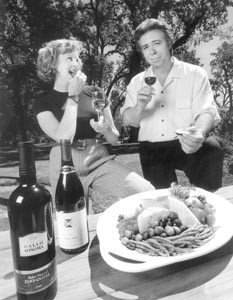
Speaking of which, here are two homegrown bottlings that represent excellent quality and value:

Preston Vineyards 1997 Faux Dry Creek Valley

When the time comes to grill a burger and smother it with onions and ketchup, this is the wine to uncork. Vintner Lou Preston calls this blend of estate-grown mourvedre, syrah, carignane, cinsault, and grenache “fun to drink,” and we agree. There’s nothing pretentious about Faux; it’s quite fruity, pleasingly juicy, and, we might add, somewhat addicting. And at $11 per bottle, you can afford to cook up two burgers. Rating: 3 corks.

Mark West 1996 Pinot Noir Russian River Valley

Although the suggested retail price is a few bucks higher, this wine has been seen on some shelves for less than $10. And at that price, it ranks among the best single-digit pinot noirs on the market today, brimming with strawberry and raspberry aromas and flavors. Try it with grilled or broiled salmon, or simply pour a glass and cozy up to the fireplace with a good book. Rating: 3 corks.

Cork ratings: 1, commercially sound; 2, good; 3, very good; 4, outstanding.

From the March 4-10, 1999 issue of the Sonoma County Independent.

© Metro Publishing Inc.
Hamlet: Bloody, Carnal, and Unnatural Acts

Bloody Good

Hamlet.

Fred Curchack’s one-man ‘Hamlet’ is both irreverent and poignant

By Daedalus Howell

WHAT ART THOU that usurp’st this time of night? The ghost of Hamlet’s murdered father? Or Fred Curchack’s stirring one-man show, Hamlet: Bloody, Carnal, and Unnatural Acts, at the Cinnabar Theater? The answer is both. A dynamic crossbreed of theater, dance, music, and video, Curchack’s Hamlet is a deft whittling down of Shakespeare’s five-act behemoth of madness and fratricide into a 90-minute tour de force.

Curchack portrays the entire cast, at once forging brilliant caricatures and earnest personalities–his Polonious, almost rabbinical, boasts a Yiddish accent; usurper uncle cum stepfather Claudius is a cigar-chomping lecher; Laertes is as a revenge-seeking castoff from The Godfather; and the actor’s Hamlet borders on the sublime. Curchack is in his element as a soloist. He has earned the entire stage and the audience’s attention, having thoroughly honed his dramatic craft in over 60 original theater works, a third of which are one-man shows.

Curchack teases out the subtle humor embedded in Shakespeare’s text–gags and double entendres usually glossed over in more academic productions. He accentuates bawdy puns with cartoonish ribaldry as when he’s playing Ophelia in a stringy wig, strumming a guitar with heavy-metal fervor, and lamenting that Hamlet “will not come again.” It is asinine, yes, but hilarious and characteristic of Curchack’s delightful irreverence.

Likewise, Curchack plays Horatio in a Day-Glo fright wig and goon goggles, and bookends the play with the character’s signature soliloquy–“So shall you hear of carnal, bloody, and unnatural acts. … All this I can truly deliver.” And deliver Curchack does–his videotaped climax is a bloodbath on par with the gory work of film-violence pioneer Sam Peckinpaw.

Many of the actor’s video sequences owe a debt to groundbreaking television comedian Ernie Kovacs, whose work, like Curchack’s, constantly challenges the medium. Curchack performs a number of sight gags in lock-step with video sequences seamlessly interwoven into the work despite the remote control he wields onstage to cue them. At times, Curchack appears to reach into the idiot box: he accomplishes costume changes and character switches through it, and characters touch, play patty-cake, fence, and die together as the thespian interacts with the screen.

But for all its paring, sparing, and daring, Curchack’s Hamlet maintains the integrity of its original, including its complicated story arc. Many stage-borne interpretations attempt to personalize the play, but few actually succeed in making it personal, which Curchack achieves with aplomb.

Curchack’s Hamlet is bloody good theater and is as much required viewing for scholars of Shakespeare as it is a punchy on-ramp to newcomers of the bard’s oeuvre.

Hamlet: Bloody, Carnal, and Unnatural Acts plays at 8 p.m., Friday and Saturday, March 5-6, at the Cinnabar Theater, 3333 Petaluma Blvd. N., Petaluma. $10-$12. 763-8920.

From the March 4-10, 1999 issue of the Sonoma County Independent.

© Metro Publishing Inc.
William Burroughs

Power Lunch

Dead beat: Before his 1997 death, beat-era author William Burroughs shook the writing establishment with such provocative prose as Naked Lunch and Junky.

New book examines early works of beat-era author William Burroughs

By John Sinclair

WRITERS ARE, in a way, very powerful indeed,” William Burroughs once noted. “They write the script for the reality film. Kerouac opened a million coffee bars and sold a million pairs of Levi’s to both sexes. Woodstock rises from his pages. Sometimes, as in the case of Kerouac. the effect produced by a writer is immediate, as if a generation were waiting to be written.”

But despite–or is it because of?–their enormous impact on the cultural life of the second half of the 20th century, the great American author William Seward Burroughs and his contemporaries Jack Kerouac and Allen Ginsberg were despised and reviled by the literary establishment for most of their creative lives.

Even now, the vast body of innovative literature created by this holy trinity of the Beat Generation is scorned by the academy and mainly denied its seminal influence on the course of creative writing since 1950, let alone its central role in the development of modern consciousness.

But the enlightened legion of Beat literature enthusiasts is nothing if not persistent, contributing massive biographies like Ginsberg, Memory Babe (Kerouac) and Literary Outlaw (Burroughs), and stunning collections of excerpts from their works designed to introduce contemporary readers to the high quality, artistic scope, and apocalyptic intensity of their writing.

Now we must add the newly published Word Virus: The William S. Burroughs Reader (Grove Press, $27.50), lovingly assembled by James Grauerholz and Ira Silverberg, to The Portable Jack Kerouac, the thrilling compilation edited by Ann Charters, and The Collected Poems of Allen Ginsberg, as essential texts for understanding the modern era, the cultural revolution of the ’60s and the postmodern nightmare prophesied in their writings.

Slowly emerging against the barren cultural landscape of America in the ’50s, the iconoclastic early works of Kerouac and Burroughs did not reach publication until several years after their composition. On the Road, Kerouac’s sensational portrait of America at the turning point, was set in the late ’40s, written in 1952, but not published until 1957. Naked Lunch, Burroughs’ visionary tour de force begun in 1954-55, didn’t see the light of day in the United States until 1962. Neither would have met their wildly responsive public without the tireless efforts of Allen Ginsberg, who persisted in presenting the manuscripts of his friends to publisher after publisher until success was finally assured.

Burroughs met Ginsberg and Kerouac in the early ’40s, when the younger men were students at Columbia University and Burroughs an anomalous inhabitant of the seedy underbelly of Manhattan who had left behind an upper middle-class upbringing in St. Louis and a Harvard degree for the life of a petty hustler and dope fiend without a single literary ambition. Only through the constant urging of Kerouac and Ginsberg, both committed from an early age to writing as a means of immediate personal expression, was Burroughs finally persuaded to take up pen and typewriter around 1949.

“Until the age of thirty-five, when I wrote Junky, I had a special abhorrence for writing, for my thoughts and feelings put down on a piece of paper,” he wrote in “Lee’s Journals” (1955). “Occasionally I would write a few sentences and then stop, overwhelmed with disgust and a sort of horror. At the present time, writing appears to me as an absolute necessity.”

Burroughs may have started late, but once he committed himself to writing he enjoyed a long and productive literary life until his peaceful demise at age 83 in 1997. His first novel, Junky: Confessions of an Unredeemed Drug Addict, a straightforward account of his experiences as a heroin addict in the small-time criminal underworld of ’30s and ’40s America, was published as a garish paperback (coupled with an anti-narcotics tract). His second, Queer, reported the author’s adventures in the homosexual underground of the period and was deemed unpublishable.

Hereafter, Burroughs’ writing would be obsessed with seeking solutions to the fundamental problems of modern life. He would juxtapose direct reporting of present conditions with fantastic passages satirizing human degeneracy and futuristic depictions of scenes from an intergalactic life-and-death struggle between the forces of intelligence and the agents of evil and greed. Sections of the novel that Kerouac named Naked Lunch–“a frozen moment when everyone sees what is on the end of every fork”–were retyped and assembled by Ginsberg and Kerouac into a package of pure literary dynamite that exploded the boundaries of modern fiction upon its publication in 1962.

“This novel is a scenario for future action in the real world,” Burroughs wrote in “Ginsberg Notes” (1955). “Junky, Queer, ‘Yage [Letters]’ reconstructed my past. The present novel is an attempt to create my future. In a sense it is a guidebook, a map.”

By the time Naked Lunch was completed, Burroughs had intuited that the sickness at the heart of Western civilization seemed to be rooted in the very language itself, a fairly recent development–say 10,000 years at best–in the 500,000-year evolution of the human species. With the painter Bryon Gysin he invented what he called the “cut-up method,” literally scissoring diverse texts and taping them together at random to create new passages that could be eerily prescient or incomprehensibly banal, but unmistakably added a new edge to his writing.

Word Virus provides generous samples of Burroughs’ mature work, from Naked Lunch, Soft Machine, and Nova Express to Cities of the Red Night, The Place of Dead Roads, and The Western Lands–the latter three being the Red Night Trilogy, completed in 1987, that was his final major achievement as a writer. Excerpts from The Job, The Adding Machine, The Wild Boys, Exterminator!, and the remarkable late works The Cat Inside and My Education: A Book of Dreams complete the picture first sketched out in Burroughs’ earliest writings–a pair of collaborations with Kells Elvins (“Twilight’s Last Gleaming,” 1938) and Jack Kerouac (“And the Hippos Were Boiled in Their Tanks,” 1945)–and the first two novels, Junky and Queer.

Perhaps most spectacularly, Word Virus presents us with the opportunity to follow the progress and development of one of the most brilliant minds of the 20th century as its ceaseless workings manifest themselves in his writing. Particularly illuminating are Burroughs’ mid-’50s musings, collected in The Yage Letters, “Lee’s Journals,” and “Ginsberg Notes,” where he begins to understand his mission as a writer and to accept the awful consequences of its pursuit, which will be evidenced in the pages of his mature works, such as “Remembering Jack Kerouac” (1969): “[W]riters are trying to create a universe in which they have lived or where they would like to live.

“To write it, they must go there and submit to conditions that they may not have bargained for. In any case, by writing a universe, the writer makes such a universe possible.”

THE BIOGRAPHICAL passages written by James Grauerholz to title and introduce each section of Word Virus provide an extremely useful exegesis of Burroughs’ life and work, rooting the writing in the details of geography and circumstance that shaped the writer’s peculiar consciousness. And Burroughs himself makes the writings come alive on the bound-in 23-minute CD of excerpts from John Giorno’s magnificent four-disk compilation for Mouth Almighty Records’ The Best of William Burroughs.

There was nothing quite like hearing the old master inhabit his bizarre characters and bring them to life in his concert performances and readings, but this is just as close as you can get now, and the recordings are going to last a long, long time.

His novels and other writings, too, will be around as long as there is literature, and Word Virus will lead you without fail into the complicated universe created for us by William Seward Burroughs.

In 1965, poet, deejay, and bandleader John Sinclair wrote his master’s thesis on Naked Lunch for Wayne State University.

From the March 4-10, 1999 issue of the Sonoma County Independent.

© Metro Publishing Inc.

Talking Pictures

0

True Grit

Office Space, the new Dilbert-meets-Kafka office-worker comedy

By David Templeton

Writer David Templeton takes interesting people to interesting movies in his ongoing quest for the ultimate post-film conversation. This column is not a review; rather, it’s a freewheeling tangential exploration of life, alternative ideas and popular culture.

A cold, February snow is falling in Cincinatti, Ohio. Heather Shea–dancer, actor, CEO, consultant, and first-time author–is on the line, ready to talk about Office Space, the witty but taste-impaired new live-action comedy from Mike Judge, the witty but taste-impaired creator of King of the Hill and Beavis & Butthead.

After a few intitial pleasantries, Shea warms right up to the topic at hand.

Office Space was fun,” she allows, “in spite of it’s being really bad. It was bad. But it made some good points about working in an office that is stealing your soul–and who hasn’t been there?”

Part Dilbert and part Kafka, the film is about three friends who hate their jobs. One of them, Peter (Ron Livingston), is stressed-out and unmotivated. When he seeks help from an occupational hypnotherapist–who keels over in mid-session–Peter is blissfully stuck in relaxation-mode. Suddenly, his don’t-give-a-damn, never-tell-a-lie attitude changes his life. He even gets a promotion. Then his friends are laid off. Revenge occurs.

By the way, the movie’s fictional corporation seems to employ almost no women–with the exception of one secretary with a very annoying voice.

“Wasn’t that interesting?” Shea says. “Wasn’t that SIllicon Valley?”

Before relocating to Ohio, Shea spent several years in Palo Alto, as president and COO (her business cards read “Playground Director”) of Tom Peters Group. She’s currently the CEO of Inspiritrix, a training and consulting firm, and vice president of Pope & Associates, the Ohio-based company that pioneered the concept of diversity training. A classically trained dancer and actresss (she studied with actor and drama coach Lee Strassberg, who trained Marlon Brando and others), Shea has parlayed her performance skills into a successful side career as a sought-after motivational speaker.

“The managers in the movie were pretty hellish,” I point out. “They played deliberate mind-games on their employees, all of whom they clearly despised. The employees, therefore, were all on the brink of a serious psychotic break. Was this far fetched?”

“Well, do you have a copy of my book?” she replies.

“Right here,” I say, flipping open my copy of Dance Lessons (Berrett-Koehler, $24.95). Co-authored with Chip Bell, the new book is a nifty antidote to all those other motivational business books that use sports metaphors to pump up the reader. Shea’s decidedly quirky, entertainingly-composed volume, side-steps all the testosterone-fueled “dont-drop-the-ball” lingo, employing instead the graceful metaphor of dance. And it works.

“Open up to page 134,” I am instructed. “There’s a wonderful quote in the sidebar. ‘To dance, put your hand on your heart and listen to the sound of your soul.'” The quote is attributed to Eugene Luigi Facciuto, I notice, waiting to see how this relates to my observation about emotional distress on the job.

“I love that quote,” Shea says. “Luigi was one of my mentors, a dancer. He’d been crippled in a horrible car accident when he was relatively young. He was told he’d not only never dance again, he’d never move again. But he believed that if he could somehow keep on moving, he’d be okay. And he went from being crippled to being one of the greatest dancers and choreographers of early Hollywood. He talked a lot about the soul. He said that if you believe in something, if you have passion about something, then you can move.”

“So when Peter was hypnotized,” she continues, “he was put back in touch with his soul. And when he listened to his soul, everything fell in line. Because the person who listens to his soul has something that others are desirous of. The Bobs [the smarmy, Michael Bolton-loving efficiency experts in the film] didn’t know what was going on, but they knew this guy was listening to his soul. He was being completely honest with them, and so they kept promoting him. The other guys–remember the one who lied about liking Michael Bolton–he got fired.

“If you come from your soul, you will begin to succeed. People might not understand what you’re about, but they will promote you, they’ll stay with you, and you’ll get ahead.

“So, yes,” she returns to my point, “it was accurate, because the modern workplace is full of people who have lost touch with their own souls. Turn to page 103.”

Flip. Flip. Flip.

Shea has gided me to the chapter that lists “the protocols,” unofficial rules that she and Bell discovered at the heart of every good business realtionship they could identify. The protocols work as a kind of Six Commandments for the dance of partnership.

” ‘Expect the best. Stay on purpose,” she reads. “Honor your partner. Assert the truth. Keep your promises. Be all there.’ Think about it. When those guys were at the office, were they really all there? When the office comes together to sing happy birthday to their awful boss, were they all there? No. But when they were just hanging out together drinking beer, or smashing the fax machine with a baseball bat–then they were all there. They were there–100 percent present.

“Now, let’s be real,” Shea says with a laugh. “This move was not that deep. But Peter was all about learning to stay on purpose. Once he got very clear about what his purpose was, he said, ‘I want to be true to myself,’ and everything started working for him.

“Once we know what dance we want to dance–are you a ballet dancer, a break dancer, a tap dancer? Do you want to be a programmer, or would you rather be a construction worker clearing up burned-out buildings?–once you’ve found your dance, then you can start dancing–and guess what? Life will be easier, and people will follow you.

“Because people who are true to their souls are very attractive people.”

Web extra the March 4-10, 1999 issue of the Sonoma County Independent.

© Metro Publishing Inc.
Low-Income 401k Plan

0

IDA Ideal

Eye on the prize: David Johnson of the Community Baptist Church is helping to lay the groundwork for the low-income 401k plan.

Is Sonoma County ready for 401k plans for the poor?

By Janet Wells

MARTHA MICELI once had a piece of the American Dream: a house, a truck, a business. Then 15 years ago her husband had a heart attack, and they lost everything. “There was no happy ending in sight. My state of mind was chaotic, full of anxiety,” the mother of two recalls.

Then Miceli heard about Individual Development Accounts, an innovative savings program for the poor that raises money from community groups or government grants to match every dollar she put into the bank.

Miceli and her husband started saving $40 a month toward owning a home. “Now we’re looking forward to something,” the upstate New York resident writes in a newsletter on the IDA program. “We finally have goals. This is the first time we’ve had savings in 20 years.”

Sonoma County community leaders are pursuing a similar program for local residents who, like Miceli, can’t even begin to dream when they are scrambling to cover rent and food. “This is a very exciting concept,” says Tula Jaffe, advocate for the homeless and a member of Family Action of Sonoma County. “In spite of the wonderful economic boom we’re feeling in the nation and in Sonoma County, there are many families here that are living on very, very small wages.”

Even the one in five Sonoma County families that has trouble making ends meet can save money–if they have incentive, Jaffe says. “This is a way for low-income people to build assets so they can be economically self-sufficient.”

IDA accounts are designed to help low-income families accumulate a few thousand dollars to put toward owning a home, opening a small business, or getting higher education. Participants save monthly over a one- to four-year period, and banks, foundations, churches, and grants provide matching funds, usually from one to four dollars for every dollar saved.

“We’re trying to make a point about who the poor are and what they are capable of,” says Robert Friedman, one of the leaders in organizing IDA programs around the country. “Just because you’re poor doesn’t mean you can’t participate in the American Dream. There are people who are poor who have tremendous drive, talent, energy, and vision. IDA accounts leverage that.”

Friedman, founder and chairman of the board of the Washington D.C.-based Corporation for Enterprise Development, says that IDAs are the most innovative financial development for the poor since the Homestead Act or the GI Bill.

“The structure of welfare, Social Security, and disability [benefits] give shelter and food and clothing. But it seems to me that the limits of that approach are equally obvious now,” he says. “They mitigate the pain of poverty, but it doesn’t offer a way out, and often is a disincentive to moving forward.”

THERE ARE almost 100 IDA programs in the country serving hundreds of individuals, with another 100 in the pipeline, Friedman says. The North Bay IDA Collaborative stems largely from efforts by a group that was initially mainly from the Peace and Justice Center of Sonoma County. David Johnson of the Community Baptist Church and a former board member of the center challenged the group to do something about economic development for the county’s poor. Johnson, along with a small group including Jaffe, Petaluma Valley Hospital physician Earl Herr, and Exchange Bank administrator Buffy Dyess, is spearheading efforts to find partner groups willing to help fund and manage an IDA program in Sonoma County.

IDAs are not just a feel-good program for the community groups and foundations that participate, Friedman told a group of about 25 representatives from various local agencies, businesses, and social service groups who attended an information meeting in Santa Rosa in February. The short-term benefits include good publicity and tax credits, he says. And if the program expands the way Friedman hopes, the potential long-term market is huge.

“You’re talking $33 billion a year leveraging the savings, and millions of accounts,” he says.

A year-old IDA program in the East Bay has almost 100 individuals saving $10 to $80 a month, with most of the participants planning to use their money to buy a home. The program has almost reached its target of $400,000 in matching funds, to be distributed over four years, at a rate of $2 paid for every $1 saved. All of the East Bay’s matching funds have come from community groups and foundations, rather than government grants.

“People have called us to say they can’t pay the rent, but they want to contribute to their IDA,” says Candace Acevedo of Consumer Credit Counseling, which provides financial training to East Bay program participants. “The program changes people’s spending habits so they really look where every penny goes. We’ve found that it’s not that hard to cover rent and come up with an extra $25 to $50 for the IDA program.

“Everybody sees what the promises are,” Acevedo adds. “This is the first time these people have invested in themselves.”

To help support and help further the development of the IDA program, call the North Bay IDA Collaborative (100 E St., Suite 212, Santa Rosa) at 578-5904.

From the March 4-10, 1999 issue of the Sonoma County Independent.

© Metro Publishing Inc.
Durst’s Law

0

Otz of Luck

By Will Durst

OH LAWDY, Lawdy, Lawdy–like we don’t have enough in the world to worry about, USA Today has declared a “What Do We Call the Next Decade?” emergency. “Brnngh! Brnngh! Brnngh! People, we’re going to Def-Con 4. Move it. Move it. Move it. Gunderman!

Of course, you might want to take this crisis with a grain of salt the size of Rudy Giuliani’s ego, since USA Today is to journalism what a double bacon cheeseburger is to nutrition. Popular, but a steady diet often proves fattening. The lambada: dance of the millennium, my ass.

The usual suspects have been nominated, but no clear winner has emerged. The Zeroes. The Zips. The Nadas. The Preteens. The Pre-tens. The Oh-Ohs. The Double Ohs. And my favorite: Fred.

The author maintains no one knows what the 1900-1909 decade was called either, then quotes Ronald Grele of the Oral History Research Office at Columbia University (don’t we poor twitching scribes paid by the word love those titles?). He said World War II “became such a turning point in American life, the teens and aughts faded into ‘before the war.’ “

Ding Ding Ding Ding! No more calls, we have a wiener. People, it’s the aughts. And since we are so hip and so tragically choke-on-our-radicchio-pesto au courant, it is incumbent upon us to put our own little post-neo-modernist calliope spin on it.

The Otz. There you go. Crisis averted. Go back to your lambada lessons.

Y2K Sharing

HEY, GUYS, guess what? The Good Samaritan law that passed earlier this fall to goose corporate firms into sharing information and technology with one another to help fight the Y2K problem has been deemed a failure.

Who would have thunk?

Next you’ll tell me the Republican congressional leadership didn’t shell out the big bucks in contributions to the Clinton impeachment defense fund.

The Y2K glitch, for those of you who have spent the last couple of years as Ted Kascinsky’s weird hermit neighbor, is where computers get stupider than a rejected Jerry Springer guest and think that when the date changes to the year 2000, it’s actually the start of a four-month period in the 15th century and try to hide their operating systems in the south of France in order to avoid the Spanish Inquisition.

Or something like that.

But nobody wants to share information, because lawyers have warned them they’ll be liable in case they pass on bad info even though the bill says they won’t.

Of course, nobody will really know if it is or isn’t a problem until the millennium rolls around. And then we’ll be able to see exactly what’s going down by watching the countries across the International Dateline.

So for the first time in our history, we’ll be able to say, “As goes New Zealand, so goes the world.”

You Can’t Make Stuff up Like This

Doctors in Louisville performed the first hand transplant, but it won’t be considered a real success until the patient picks up the bill.

Is it just me, or was Teddy Kennedy strangely silent during the whole Clinton thing? And he was the perfect guy to offer up expert testimony.

Q: What do you call Al Gore leaning on a podium?

A: A wood pile.

The good news is Whoopi Goldberg is going to host the Oscars. The better news is production on Hollywood Squares will shut down for at least a week.

The city of Los Angeles has limited gun purchases to one a month. I wonder if you can get a waiver if you can produce a note from your principal.

During the impeachment proceedings, members of Congress kept saying they were voting their conscience. Yeah, right, Congresspeople voting their conscience is a lot like a turtle flexing its wings.

Disney recalled videocassettes of The Rescuers because it contained two frames showing naked breasts. It will be repackaged and re-released at a higher price.

In Washington, D.C., a mayoral assistant used the word niggardly in front of people who didn’t know what it meant, were offended, and forced him to resign. If this internal word pejorative-seeking becomes the vogue, we’ll never be able to say the word country again.

San Francisco comic Will Durst is an occasional contributor to the Independent. Columnist Bob Harris is lost in the ozone.

From the March 4-10, 1999 issue of the Sonoma County Independent.

© Metro Publishing Inc.
Playwright Emily Shihadeh

War and Peace


Emily Shihadeh comes to town with her intensely personal one-woman show

By Patrick Sullivan

TEARS AND LAUGHTER seem at war in Emily Shihadeh’s voice. Again and again, emotion rises to color her words as she discusses her intensely personal one-woman show, Grapes and Figs Are in Season: A Palestinian Woman’s Story. “It’s a real story, my story, nothing make-believe,” she explains, speaking by phone from her home in San Francisco. “It’s what happened in Palestine through my eyes.”

Her upcoming appearance at Sonoma State University is far from the first time Shihadeh has been onstage with this intimate material. For eight years now she has toured the country, and indeed the world, performing in San Francisco, at Harvard and Yale universities, and in Tel Aviv, touching and entertaining audiences with Grapes and Figs. Part comedy, part drama, part musical act, the work is rooted in Shihadeh’s immigration to the United States in 1958 and eventual return to visit her family in her hometown of Ram Allah in the West Bank. But despite her years of experience performing the one-hour piece, it clearly still affects her deeply.

It’s not hard to understand why.

The work mixes stories of her childhood–snippets from a life that began in the midst of one of the most enduring conflicts of the century–with the reflections of a mature woman who has weathered the effects of war, immigration, and divorce.

But humor is also a big part of Grapes and Figs. After all, Shihadeh got her start on the stage by performing stand-up comedy in San Francisco clubs, and that shines through both in her quirky sense of humor and in her eclectic performance piece. In one segment, she uses a rap song to satirize the widespread ignorance she says she has encountered in America about Arabic people.

“It goes, ‘Where is your turban, where is your tent?,’ ” she raps out over the phone. “‘If you live in the desert, do you still pay rent?’ “

That’s not to say that Shihadeh doesn’t like the United States. In fact, she says, she fell in love with America before she ever set foot in the country. A group of Quakers from the states settled in Ram Allah and exposed the village to such pop culture icons as Doris Day and Rock Hudson. “They came and they liked our town, so they stayed and built homes and schools,” she says. “My grandfather liked them so much that he became a Quaker.”

BUT SHIHADEH’S childhood spent among Quakers and the fruit trees in her father’s yard (which gave her piece its title) was shattered by the onset of war. When she was 7 years old, a nearby hotel was blown up in the fighting, and her father decided the family had to flee the village. Later, at age 17, Shihadeh moved with her husband to the United States, where she saw her first traffic light and encountered a confusing new world.

“I loved the Americans, loved their culture,” says Shihadeh, now 57. “So I came to America expecting to find my second mother. But no one knew me in the streets of San Francisco. It took me many years to understand America. I’ve been here 40 years, and I just began to understand Americans three years ago.”

Above all, Shihadeh hopes that her show promotes understanding and reconciliation of the Palestinian-Israeli conflict. To that end, she holds a half-hour discussion after every show. Despite the focus on this controversial issue, she says, her piece has been well received by a wide variety of audiences.

“Everybody loves the show,” she says. “It’s a universal story. We all want to love and be loved.”

Grapes and Figs Are in Season plays Tuesday, March 2, at 8 p.m. at the Warren Auditorium at Sonoma State University, 1801 E. Cotati Ave., Rohnert Park. Tickets are $5. For details, call 664-2382.

From the February 25-March 3, 1999 issue of the Sonoma County Independent.

© Metro Publishing Inc.
Gourmet Newsletters

0

Zine Scene

By Marina Wolf

I’M BORED with glossy food magazines. Oh, I still subscribe to Food & Wine and let my eyes drift across the food section at the local newsstand. But lately I’ve been fighting off a certain overwhelmed world-weariness, the inevitable result of constant exposure to the glare of slick pages, the whirl of globetrotting gourmands. I’ve got altitude sickness in reaction to high prices, attitude sickness in reaction to high noses.

Then recently I stumbled across a lovely piece archived in the Electronic Gourmet about food newsletters by Lynn Kerrigan. After putting a check in the mail for her catalog, A Smorgasbord of Cooks’ Periodicals, I ended up sending away for enough sample copies to curve the spines of a squadron of mail carriers. The thin little periodicals that came in response renewed my desire to keep reading about eating.

Quite a few food newsletters exist–Kerrigan counts more than 80 in her most recent catalog–but they are published in obscurity, and marketed and distributed in a way that could be called labyrinthine if it were more organized. As a result they can be disconcertingly ephemeral; Kerrigan doesn’t even bind the Smorgasbord anymore because the list changes so frequently. And yet, these newsletters constitute the most exciting body of food literature available today. Of course, there will always be a place in my heart for the kings of the genre–Bon Appetit, Saveur, Fine Cooking. But it is up to newsletters to present an alternate culinary reality.

For starters, food newsletters are personal, almost iconoclastic. They may be written by a team, but the 8- or 16-page format, usually illustrated with quirky clip art, retains the flavor of some lone individual bent over the keyboard or stove. The first-person perspective is implicit. Many of them emerged from a personal discovery or experience: a spouse’s heart attack (The Gorgeless Gourmet), for example, or life on the back lines of the restaurant industry (Chew from Madison, Wisc.). Other newsletters offer more explicit reminiscences woven among the recipes, interviews, and the address of the Idaho Potato Commission. But whether fueled by underlying motivation or blow-by-blow experience, these intensely personal tracts make it seem entirely appropriate, for example, to recount the specifics of one’s sad dining-out experiences (Convivium) in all their depressing detail, or to lavish 500 words on building a dug-out earthen kitchen, following the example of infantry soldiers in the Civil War (Food History News).

That passion is something that the conventional gourmet glossies can only dream of. Being products of a team effort, mandated by the marketing directives of a corporation, magazines lack the energy behind one person’s desire. Sure, they satisfy the basic needs of the widest number of readers, but even that seems incidental at times to channeling product information. The slick photos stir up lust for stoves, dishware, curtains, and truffle oil, while the captions tell where, when, and at what cost you can satiate that lust. Advertising cameos of cars, vacation spots, and watches put in more plugs for the good life. The pressure to consume pervades the ostensible message of good eating, which leaves passion to dry out on a slate-topped counter under the relentless blaze of the photographer’s lights.

Newsletter writers, on the other hand, get to keep that passion and combine it with love of words, supplying their readers with compelling and literate prose that is rarely found in mainstream magazines. The writing is eloquent and thoughtful (Edward Behr’s The Art of Eating), or bright and schwingy (in the irresistibly retro Hungover Gourmet), or just plain earnest (The Wild Food Adventurer).

COLLECTIVELY, the newsletter genre ends up covering a much wider range of writing styles and topics than you will ever find in the mainstream. Newsletter authors are the voice of their individual efforts, so they don’t have to do anything. They can go off on a literate rant about legalizing pot (as did editor Johann Mathieson of Food Words, a catalog/newsletter out of Portland), or indulge in genteel snipery about clueless volunteers at soup kitchens (featured in the holiday issue of the Yountville-based Curmudgeon’s Home Companion).

Newsletters don’t really need to worry about offending: most don’t have ads (which is why some of them cost as much or more than a glossy magazine). Anyway, since the writing is so personal, the objects of the writing rarely assume such importance that brand names and prices are needed. As John Thorne points out in a recent issue of Simple Cooking, it doesn’t matter what brand of ramen you buy as long as you know that Vietnamese noodles are best.

All the writers have their own little tricks and tips, but only a rare few opinionated souls care enough to write them down, offering a different view of the dominant culinary culture, like comments scribbled in the margins of society’s cookbook. Food newsletters can stretch our consciousness beyond the newest roast-goat variation of some remote Moroccan tribe into a whole new realm of interpersonal discourse: What do you like to talk about at the dinner table? What interests you in the kitchen cupboards of your friends? What was the last good dessert you had, and who fed it to you spoonful by loving spoonful? What are the food habits that you would never have the guts to share with a thousand strangers on a mailing list? Hmph, you say. Even I could write that down.

Well, go ahead. That’s what newsletters–zines of the food culture–are all about.

To receive a copy of Lynne Kerrigan’s thorough list, A Smorgasbord of Cooks’ Periodicals, send $6.95 to Food Writer, P.O. Box 156, Spring City, PA 19475-0156.

From the February 25-March 3, 1999 issue of the Sonoma County Independent.

© Metro Publishing Inc.

Spins

Dis 'n' Dat Hip-hop nation: Members of the Roots boast a new CD and a local concert this weekend. New CDs by the Roots, Steve Earl, Ricky Skaggs, Built to Spill, Tom Russell The Roots Things Fall Apart MCA WITH EX-FUGEE Lauryn Hill's solo debut CD The Miseducation of Lauryn Hill taking hip-hop's first...

Wild Mussels

Mussel Beach By Marina Wolf TODAY'S THE DAY. You can see it in the pale blue sky, you can smell it in the thin late-winter air. You've already picked up the fishing license, checked the tide tables online, called about possible bacterial quarantines. You snagged an old pickle bucket from the grocery store in anticipation of...

Wine Prices

For Sale Thoughts on wine prices By Bob Johnson THE MOST COMMON question I get when speaking to high school or college journalism students is: "Why did you decide to become a writer?" My answer: "Because I sucked in math." Algebra and I got along OK, but geometry was like a foreign language. It must...

Hamlet: Bloody, Carnal, and Unnatural Acts

Bloody Good Hamlet. Fred Curchack's one-man 'Hamlet' is both irreverent and poignant By Daedalus Howell WHAT ART THOU that usurp'st this time of night? The ghost of Hamlet's murdered father? Or Fred Curchack's stirring one-man show, Hamlet: Bloody, Carnal, and Unnatural Acts, at the Cinnabar Theater? The answer is both. A dynamic crossbreed of theater, dance,...

William Burroughs

Power Lunch Dead beat: Before his 1997 death, beat-era author William Burroughs shook the writing establishment with such provocative prose as Naked Lunch and Junky. New book examines early works of beat-era author William Burroughs By John Sinclair WRITERS ARE, in a way, very powerful indeed," William Burroughs once noted. "They write the script...

Talking Pictures

True Grit Office Space, the new Dilbert-meets-Kafka office-worker comedy By David Templeton Writer David Templeton takes interesting people to interesting movies in his ongoing quest for the ultimate post-film conversation. This column is not a review; rather, it's a freewheeling tangential exploration of life, alternative ideas and popular culture. A cold, February snow is falling in...

Low-Income 401k Plan

IDA Ideal Eye on the prize: David Johnson of the Community Baptist Church is helping to lay the groundwork for the low-income 401k plan. Is Sonoma County ready for 401k plans for the poor? By Janet Wells MARTHA MICELI once had a piece of the American Dream: a house, a truck, a business. Then...

Durst’s Law

Otz of Luck By Will Durst OH LAWDY, Lawdy, Lawdy--like we don't have enough in the world to worry about, USA Today has declared a "What Do We Call the Next Decade?" emergency. "Brnngh! Brnngh! Brnngh! People, we're going to Def-Con 4. Move it. Move it. Move it. Gunderman!" Of course, you might want to...

Playwright Emily Shihadeh

War and Peace Emily Shihadeh comes to town with her intensely personal one-woman show By Patrick Sullivan TEARS AND LAUGHTER seem at war in Emily Shihadeh's voice. Again and again, emotion rises to color her words as she discusses her intensely personal one-woman show, Grapes and Figs Are in Season: A Palestinian Woman's Story....

Gourmet Newsletters

Zine Scene By Marina Wolf I'M BORED with glossy food magazines. Oh, I still subscribe to Food & Wine and let my eyes drift across the food section at the local newsstand. But lately I've been fighting off a certain overwhelmed world-weariness, the inevitable result of constant exposure to the glare of slick pages, the whirl...
11,084FansLike
4,606FollowersFollow
6,928FollowersFollow

