
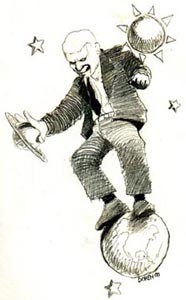
Sonoma Museum of Visual Art

0

Last Call

Bone deep: Sculptor Ronald Garrigues’ Dr. Frankenloner is part of the upcoming Día de los Muertos exhibit at the Sonoma Museum of Visual Art.

Death is the life of the party at the new SMOVA art exhibit

By Paula Harris

“WE MUST remember them,” say the Zapotec elders about the Dead. “They want us, they love us. See how that flame danced high before it died? It is the Dead, letting us know we are not to forget them.”

Benjamín Lopez, 56, an artist and seasonal vineyard worker, holds these ideas dear as he crouches forward to drape and smooth a snowy linen cloth across an expansive altar, which he will soon decorate with small angels, flickering candles, and garlands of fresh white flowers.

Lopez, who migrated to the United States in 1977 and now resides in Healdsburg, learned the art of altar-making and decorating as a teenager growing up in a tiny village in the Mexican state of Oaxaca.

“When I was 16 years old, my godfather, who was a decorator in my village, asked me to be his assistant without compensation just to learn the trade,” recalls the shy artist in Spanish, communicating with the assistance of a translator.

Using colorful tissue paper, card stock, foam boards, fabrics, natural woods, and fresh or dried flowers, Lopez created nativity scenes, floats for parades, funeral altars, and decorations for weddings and birthday parties in his village.

“Each occasion was different, a different fiesta,” he explains. “I really enjoyed making different representations of biblical and cultural themes.”

Now widely recognized as an artist, Lopez created an elaborate, multitiered altar for the Oakland Museum of Art last year in memory of the more than 180 people who died crossing the U.S.-Mexican border in 1998.

His latest work, Homenaje a los Angelitos (Tribute to the Little Angels), a community altar dedicated to children and infants who have passed away, will be featured in the Sonoma Museum of Visual Art’s upcoming Día de los Muertos (Day of the Dead) exhibition.

During the annual Day of the Dead festival, embraced by many Latin American cultures, death’s morbid side is buried under a joyous celebration that includes feasting, frivolity, and fond remembrances.

According to ancient tradition dating back to the Aztecs, who believed death was merely a portal to another existence, departed souls journey back from the netherworld each year to visit loved ones. Hailing from Heaven, Hell, and Purgatory, the Dead descend upon their families, and for two days–Nov. 1 and 2–everyone rejoices together.

“In Mexico’s indigenous cultures, we firmly believe that our relatives and friends who have passed away come back to earth in early November,” explains Lopez. “The altars I make are an expression of art, an extension of me. . . .When I make altars now I have great memories of my youth and my village.”

The altars are often elaborately embellished with an array of earthly delights in the hope of luring departed spirits. Ofrendas (offerings) may include bottles of beer or tequila; platters of rice, beans, chicken, or meat in mole sauce; candied pumpkin or sweet potatoes; and the traditional sweet loaves. It is widely known that the Dead love sugar. The offering may also include a pack of cigarettes for the after-dinner enjoyment of former smokers, or a selection of toys and extra sweets for deceased children.

Lopez’s altar for the children will be one of three community altars featured at the SMOVA Day of the Dead bilingual exhibition titled Homenaje a Nuestros Antepasados (A Tribute to Our Ancestors). Other altars will pay tribute to the ancestors of this community and to those who have died in the struggle for equality. The SMOVA presentation is a collaboration between local schoolchildren, Latino artists, and community groups.

“The exhibition becomes so much richer with all this input rather than if one person just sits down and tries to figure out what we’d show,” says museum director Gay Shelton.

THE EXHIBITION WILL also feature a 10-foot octagonal sand painting sprinkled with colorful pigment created by Zapotec artists from Oaxaca as an homage to their deceased teacher, bronze skull sculptures from the Endangered Species series by Mill Valley artist Ronald Garrigues, a silk-screening demonstration by Calixto Robles of Oaxaca, and Saturday afternoon puppet shows.

The Dead will be full of life–frolicking, in fact. Shelton says original skeleton puppets (such as a shopkeeper with her rib cage exposed above her full skirt, and a skeleton mama and her bony baby) will clatter about poking fun at death. Art by local schoolchildren will include Barbie dolls painted like skeletons and ceramic bones dangling from the ceiling.

Clearly, certain Latino cultures have no qualms about getting up close and snugly with the Grim Reaper. In fact, the inevitability of death is accepted rather than feared.

“It’s really interesting–the whole tradition is about making friends with death,” says Shelton, adding that, during Day of the Dead, Latino children often crunch down on candy skulls inscribed with their own names.

“You imagine yourself as a skull,” she says with a laugh. “It’s a friendly approach to death–it’s nothing about fear and denial like we experience in our culture.”

The Homenaje a Nuestros Antepasados exhibit opens Thursday, Sept. 16, and continues through Nov. 2 at the SMOVA, Luther Burbank Center, 50 Mark West Springs Road. Puppet shows will take place each Saturday at 3 p.m. On Oct. 3, Calixto Robles demonstrates the silk-screening process. On Oct. 30, the public is invited to contribute to a community altar. Regular exhibit hours are Wednesdays and Fridays, 1 to 4 p.m., Thursdays, 1 to 8 p.m., and Saturdays and Sundays, 11 a.m. to 4 p.m. Admission is $2/general; free for those under 16. For details, call 527-0297.

From the September 9-15, 1999 issue of the Sonoma County Independent.

© Metro Publishing Inc.

Spins

0

Ramblin’ Man

Voice of America: Singer/songwriter Woody Guthrie.

New box set celebrates folk icon

By Greg Cahill

Woody Guthrie The Moses Asch Recordings, Vol. 1-4 Smithsonian Folkways

BRITISH AGIT-POP singer Billy Bragg scored one of 1998’s surprise hits with Mermaid Avenue, his rousing collection of lost Woody Guthrie songs, tunes written by but never recorded by the prolific folk singer and songwriter.

This exceptional specially priced four-CD box set, recorded between 1944 and 1949 for Folkways label chief Moses Asch, makes a convincing argument that Guthrie–the man who reinvented the American folk ballad as a vehicle for social comment and protest, and whose “This Land Is Your Land” is the unofficial anthem for many Americans–should top any list of the century’s most influential musicians.

While Guthrie performed extensively starting in 1929 and throughout his wayward travels, not until 1940 did the Oklahoma native sit down with Alan Lomax to make his first recording, several hours of talking and singing for the Library of Congress. But it was Asch who recorded 85 percent of Guthrie’s material, the bulk of that during a marathon session in March-April of 1944, while Guthrie was on shore leave from the merchant marines.

Guthrie died in 1967 after a long and debilitating bout with Huntington’s chorea, a degenerative nerve disease. Since then, many have sung Guthrie’s legacy: Everyone from Bob Dylan to Bruce Springsteen has worshiped the man who rode the rails as a hobo during the Great Depression, chronicling the dust-bowl era, and who was denied membership to the Communist Party for refusing to renounce his religion.

The songs themselves–still bristling with a rustic vitality that echoes the hopes and dreams of a nation–bear testimony to Guthrie’s extraordinary skills as a folk artist. Here, the Smithsonian Institution has split these 105 tracks into a series of themed anthologies that reflect the spirit of his times.

“This Land Is Your Land” features 27 of Guthrie’s best-known songs, including a version of the title track with never-before-issued lyrics.

“Muleskinner Blues” is comprised of 25 tracks from the original 160 songs that Guthrie recorded with his friend Cisco Houston and other musicians for Asch in 1944. The CD focuses on non-original songs that Guthrie covered, including American folk standards, many of which became a part of the folk music canon through Guthrie’s influence. It includes three previously unreleased tracks

“Hard Travelin'” presents 27 mostly topical songs written by Guthrie. Written during the 1930s and 1940s, the songs serve as a musical time capsule, commenting on the war, the dust bowl, labor martyrs, and other topics. The tracks range from such well-known Guthrie ballads as “Mean Talkin’ Blues” to more obscure and unfinished projects like his remaking of the “Rubaiyat of Omar Khayyam.”

“Buffalo Skinners” delves into Western themes, 26 recordings that emphasize Guthrie’s Oklahoma roots and the restless sprit that sparked the great Western expansion shortly before and after World war II.

In the end, the man that many American officials despised for his ability to express the feelings of the broke and downtrodden, may be the best friend America ever had.

From the September 9-15, 1999 issue of the Sonoma County Independent.

© Metro Publishing Inc.

Hellraiser

0

Hellraiser

Meet the feisty nun who rocked the Diocese of Santa Rosa

By Janet Wells

SISTER JANE KELLY is a most unlikely whistle blower. With her flowered skirt, simple blouse, white huaraches, and wedding finger sporting a ring with a cross stamped into the gold, she looks every inch the gentle nun. She’s a bespectacled woman with a halo of short, wavy, gray hair who can be found outside in the heat of Ukiah’s blistering summer watering the flowers at St. Mary of the Angels School. But don’t be fooled by appearances.

Sister Kelly also ripped the lid off the Santa Rosa Diocese recently, opening the local Catholic administration to national scrutiny in the face of a far-flung scandal involving allegations of embezzlement, sexual misconduct, and coverups.

In the wake of Kelly’s unrelenting questions, outraged letters, and feisty opinions, the powerful have fallen far: Bishop Patrick Ziemann resigned in July, and the Santa Rosa police are investigating him for charges of criminal sexual misconduct involving another diocese priest, Jorge Hume Salas. Salas himself is under a black cloud, after admitting to stealing from the St. Mary’s parish collection. The latest casualty is Monsignor Thomas Keys, who resigned two weeks ago as vicar general, the No. 2 position in a diocese that ranges over six Northern California counties, ranging from Petaluma to the Oregon border.

And now the diocese itself is under fire, facing charges from Salas of defamation and infliction of emotional distress, as well as longtime allegations of financial impropriety involving the use of church donations to settle sexual misconduct cases.

To some, Kelly is little more than a troublesome gossip, used by the diocese as a mouthpiece to blab about a priest and deflect attention from the deeper questions involving the bishop and the diocese.

But to far more people she is a hero, a brave beacon willing to stand up to the male-dominated Catholic church hierarchy.

“For this lady to do what’s she’s done is mind-boggling,” says Don Hoard, whose son is one of several local youths who were sexually molested by a local priest in a scandal that rocked the diocese a couple of years ago. “If you don’t have a Catholic background, I don’t think you can conceive of the amount of courage it took.”

Or, as Tanya Brannan of the Purple Berets says, “Sister Jane Kelly for bishop!”

AT AGE 17, while a Catholic schoolgirl in Oakland, Kelly decided to enter the Convent of the Sisters of the Presentation of the Blessed Virgin Mary in San Francisco. Now 69, Kelly just celebrated her golden anniversary in the church, with 26 of those years as a nun in the Ukiah parish.

Kelly spent her years quietly working with students at St. Mary of the Angels school and the Plowshares Community Dining Room, which offers food services, as well as health and psychiatric counseling to the poor and homeless in Ukiah.

Kelly admits that she heard stories over the years about local priests having sex with young boys, even before the hundreds of cases nationwide exploded onto newspaper headlines and court dockets in the early 1990s. But that was before the era of California’s mandatory reporting laws, which now requires anyone–including clergy–with information about child sexual abuse to report it to law enforcement officials. That law was passed two years ago in the wake of the child molestation cases in Santa Rosa.

It wasn’t until a young Costa Rican, Jorge Hume Salas, came on the scene that Sister Kelly started down the path of rabble-rouser. In 1992, Bishop Ziemann asked Kelly to be Salas’ supervisor while he trained for the priesthood.

“I said, ‘No, I don’t understand Spanish, and I don’t know how much English he understands,'” recalls Kelly, sitting in her Ukiah office, surrounded by student artwork and shelves of Catholic educational videos and religious prints. “[Ziemann] pressed me, so I did. Then I began to see things happening.”

While most men training for the priesthood have at least four years of graduate-level schooling, Salas had no records of theological or seminary study, Kelly says, adding that Salas did not undergo the rigid psychological screening for would-be priests.

Kelly was never sure how much Salas understood during their weekly sessions to discuss his spiritual journey. Nevertheless, he was ordained to the priesthood in a practically unheard-of 15 months.

Once a priest, Salas suddenly had an expensive new car with custom license plates, a personal computer, and a TV set, notes Kelly. She says she heard from parishioners unhappy that the new priest apparently was profiteering from his position, demanding a minimum payment of $20 for himself to perform baptisms, confirmations, and weddings, and then allegedly failing to report the income. There were allegations that he had young men in his room overnight and complaints from several parishioners of sexual molestation, Kelly says.

Pastor Hans Ruygt and Bishop Ziemann confronted Salas about the alleged sexual misconduct, says Kelly. In 1996, when Kelly and Ruygt noticed that money was missing from the parish collections, and suspected it was going toward Salas’ lavish purchases, the two set up a sting.

“Jorge was caught in the act,” Kelly says. “Hans [Ruygt] had a policeman at the rectory to arrest Jorge. He begged and cried, so Hans called Bishop [Ziemann], who came up and said we couldn’t prosecute because there wasn’t enough evidence.”

In a letter to the bishop that August, Kelly asked that Salas make public restitution for his alleged theft, which she estimates at $10,000 from her parish alone. “Bishop,” the letter said, “I believe that Jorge is a pathological liar and was ordained under false pretenses.”

The bishop’s reply? To let Salas fade from view for almost two years, then quietly reassign him to St. John’s parish in Napa, she says. Aghast, Kelly admonished the bishop in a March 1998 letter. “Appointing Jorge to another parish is only perpetuating the real possibility of repeating his scandalous actions,” she wrote. “I am still of the opinion that Jorge is a ‘con artist’ and will steal again if he has not already done so.”

Indeed, Santa Rosa Police Sgt. Brian Davis says that as part of their criminal investigation, they are looking into allegations against Salas involving theft and sexual misconduct in the Napa parish. Salas has not been charged of any crime.

Salas’ transfer was the last straw, Kelly says.

“For two and a half years I have had to live with this. I tried to get him removed,” she says. “I lost weight, I couldn’t sleep.”

No quarter: Sister Jane Kelly is taking on the Diocese of Santa Rosa after charging that the church is using school funds to pay off settlements stemming from sexual misconduct cases involving North Coast priests.

SALAS WASN’T the only priest on Kelly’s mind. She thought of Gary Timmons, who is serving an eight-year jail sentence for repeated sexual abuse of boys in the Diocese of Santa Rosa. Four other local priests have been publicly implicated in similar sordid cases.

“If Gary Timmons had been prosecuted 20 years ago, how many people would not have been hurt?” Kelly wonders.

“We’re all human, we’re all weak, we all give in sometimes to temptation,” she says. “The biggest sin is not necessarily in the action of a priest who is a pedophile, stealing money, or having sex with women. The biggest sin is that it was covered up, that it was allowed to go on.”

In January, Kelly, frustrated by the lack of response from diocese officials, contacted a local reporter. “It was the hardest, scariest decision I made in my life,” she says. “I couldn’t live with my conscience if I didn’t.”

Kelly says that at the time, she knew nothing of Ziemann’s sexual relationship with Salas, although she suspected that the priest “had something on the bishop.”

The bishop wasn’t ensnared by the scandal until Salas dropped a bomb this summer in the form of a lawsuit. Months of secret talks between attorneys for the diocese and Salas had failed, and, in July, Salas filed a complaint in Sonoma County Superior Court charging that Ziemann forced sexual favors in exchange for silence about the theft.

The lawsuit, which misspells the bishop’s name throughout, is full of salacious claims, with Salas accusing Ziemann of arranging repeated–and unwanted–sexual encounters. One particularly bizarre allegation describes a 1996 visit Ziemann made to St. Louis, where Salas was undergoing two weeks of psychological evaluation following the discovery of his embezzlement from St. Mary’s.

“Zeimann forced Salas to engage in sexual activity with him at the hotel where Zeimann was staying (after which Zeimann bought him an ice cream and tucked $80 in Salas’ pocket despite Salas’ attempts to refuse it),” the lawsuit charges.

Salas alleges in the suit that the sexual harassment started just after he was removed from St. Mary’s for taking collection funds.

“Zeimann summoned Salas to his home under the pretense to talk about how Salas was feeling,” the suit alleges. “During this private meeting Zeimann grabbed Salas and began to kiss him, to remove his clothes and to fondle his genitals. When Salas told Zeimann to stop and asked him what he was doing Zeimann told him that it was not wrong and that he should just relax because, he said, ‘We are brothers.'”

Days after the lawsuit was filed, Ziemann resigned, first denying all charges, then, one day later, admitting to a consensual sexual relationship with Salas. Ziemann and Salas both remain in seclusion, refusing to grant interviews. Just after Ziemann’s resignation, his attorney, Joseph Piasta, issued a statement lambasting Salas’ allegations as “motivated solely out of greed.”

“It is unfortunate that Father Salas and his attorneys are now using this consensual relationship as a weapon against Bishop Ziemann and the Diocese,” Piasta said in the statement. “We are confident that the Bishop will be fully exonerated.”

Salas’ attorney, Irma Cordova, proffers an interesting twist in defending her client: Kelly, she says, simply was a pawn in the diocese’s plan. “Although Sister Jane Kelly gets credit for bringing this out into the open, the diocese actually orchestrated this,” Cordova says.

“Sister Kelly had never in the past been permitted by the bishop to even speak of this. She may have had private grumblings about it, but either through action or inaction, the bishop allowed her to speak to the press,” Cordova says. “The diocese and the bishop allowed this information to go out to smear Father Jorge and put the kibosh on his complaining.”

While the headlines have focused on Salas’ allegation of sexual coercion, the lawsuit also charges the diocese with defamation of character “because of the [church’s] allegations that [Salas] molested three men,” Cordova says.

“These allegations apparently were made back in 1996 . . . but it’s not until 1999, after we have gone through five months of negotiations and we are telling [the diocese] that they need to do something, that they decide they are going to make it public and smear Father Jorge. And they use Sister Jane Kelly to do it.”

“These allegations of molestation were never proven,” Cordova adds. “My client denies any of this.”

A look at radical Catholic reform solutions

KELLY IS CRITICAL of Salas, but she reserves her harshest words for Ziemann and former Vicar General Keys, for perpetuating what seems to be the Church’s entrenched code of collusion regarding priestly misconduct.

“For someone like the bishop, the shepherd of the flock, to allow a wolf into the sheep’s fold, then when the wolf starts to devour the lambs, he takes the wolf and puts it into another sheepfold to do the same thing . . . ,” Kelly’s voice trails off, then becomes indignant.

“The scandal lies with a bishop or archbishop who would cover up the misconduct of the priest.”

Attorney Piasta refutes the idea of a coverup conspiracy. “It’s not true,” he says. Salas was transferred to another parish as part of the Church’s tenet of forgiveness. “For priests who have made a mistake, if they go through the right rehabilitation,” Piasta says, “they can have a second chance if they show that they can perform.”

Kelly says that last fall she revealed her concerns about Salas to Keys, who assured her that he would personally talk to the bishop. “He had no intention of doing so,” she concluded after waiting three weeks for a response.

“It’s a male chauvinistic denial hierarchy,” she says. “They feel they are above the law.”

IN AN AUG. 6 letter to San Francisco Archbishop William Levada, who has taken over temporary stewardship of the Diocese of Santa Rosa, Kelly complained about Keys remaining in the post of vicar general, in charge of the diocese’s finances.

“Tom Keys . . . seems to have no conscience regarding the victims of the priests who have sexually abused boys, young men and women; not to mention those priests who have stolen large sums of money from church collections,” she wrote. “Tom Keys would settle with the injured parties so that they would not prosecute.”

Keys’ resignation Aug. 25 seemed to vindicate Kelly’s charges, while intensifying speculation that diocese money was the funding source to settle local cases involving child and adult sexual abuse.

Mirroring church officials nationwide, Keys and other Diocese of Santa Rosa administrators have repeatedly denied that operating funds and parishioner donations were ever used to cover the local share of what some experts estimate to be $1 billion in sexual misconduct settlements nationwide.

Kelly scoffs at the denials. “Any money in the diocese is church money,” she says.

In an astounding admission two weeks ago, Keys’ replacement, Monsignor John Brenkle of St. Helena Church in Napa, agreed.

In his first day on the job, Brenkle stated in published reports that the diocese is in a financial crisis, in part because of cash outlays to settle sexual misconduct cases involving priests.

Keys remains as chief executive officer of the National Scrip Center, the $450 million annual program for funding church and other non-profit programs. A clearing-house for merchandise gift certificates bought at discounted prices, Santa Rosa’s scrip program is the largest such money-making plan in the country, and is legally separate from the diocese. However, most of the center’s board members are affiliated with the diocese. Rumors continue to swirl that scrip money has also been used to cover settlements, although diocese officials have continued to deny that. Keys did not return calls for comment.

REMOVED from the inner turmoil of the diocese, Sister Kelly is busy in Ukiah preparing for the new school year at St. Mary’s. Popping out of her office to offer a hug to returning students and volunteers, she comes back in to confide her prediction that the scandal will only deepen with the conclusion of the Santa Rosa Police Department’s criminal investigation, now in its third month.

But in the end, she adds, forcing the diocese into the glare of the spotlight is a “very good thing.”

“Evil survives because good people don’t speak out,” she says. “Like anything that is painful, like lancing a boil, once you get all that poison out, we can start healing.”

From the September 9-15, 1999 issue of the Sonoma County Independent.

© Metro Publishing Inc.

Spins

0

Legends

Soft-spoken: Iggy Pop commits the cardinal sin of rock–he’s gotten boring.

New CDs by Iggy Pop, Stevie Ray

By Greg Cahill

Iggy Pop Avenue B Virgin

Those who know Iggy Pop as the proto-typical punker may be turned off by his subtle side. Iggy teams up with Gen-X soul-jazz stars Medeski, Martin, and Wood, and intersperses several spoken-word pieces into the fabric of this convoluted recording, which ranges from the gloomy “Nazi Girlfriend” to the B-grade Zappa-esque musings of “Ya Yo Habla Español.” The highlight is Iggy’s cover of the Who classic “Shakin’ All Over.” Otherwise there’s not much memorable material on the mellow side of the Iggy’s street. Unless you’re a diehard Iggy fan, steer clear of Avenue B . . . .

Albert King with Stevie Ray Vaughan In Session Stax

Sixty-four minutes of pure blues bliss from two late blues legends. Recorded in 1984, just a year after then-rising star Stevie Ray Vaughan debuted his hot solo album Texas Flood, this newly released CD finds veteran axeslinger Albert King in a mentoring role–and loving every minute of it. At one point, during a pep talk, King even tells Vaughan, “You’re good, but you aren’t that good  . . . yet!” For fans thirsty for something new from Stevie Ray (Epic Records has been incredibly stingy about emptying its vaults), this is a welcome surprise.

The John Sebastian Band Chasin’ Gus’ Ghost Hollywood

During the ’60s, folk-rock star and Lovin’ Spoonful head honcho John Sebastian led his jug band to the Top 40 with a series of pop hits, including “Summer in the City” and “Do You Believe in Magic?” Those songs are now car commercials, but Sebastian has returned to his jug-band roots with one of the season’s sleeper hits. Blues legend Yank Rachell joins in for a couple of tracks, and overall the result is a laid-back front-porch jug-band jam among friends–not a care in the world and all of those Top 40 pressures are a world away.

Fleetwood Mac Shrine ’69 Rykodisc

Before Stevie Nicks and company set the pop world on fire with their witchy ways, Fleetwood Mac–guitarist Peter Green, drummer Mick Fleetwood, bassist John McVie, guitarist/pianist Jeremy Spencer, and guitarist/vocalist Danny Kirwan–were one of England’s top white-boy blues bands (McVie and Fleetwood were the rhythm section for John Mayall’s Bluesbreakers during Eric Clapton’s tenure). On the road, roadie and sound engineer Stuart “Dinky” Dawson taped this 1969 date at the Shrine Auditorium in Los Angeles. And thank the rock gods that he did. This first in a planned series of similar releases featuring other ace British Invasion bands finds guitarist Green in top form–his lamenting interpretation of Little Willie Johns’ “Need Your Love So Bad” is simply sublime. Stunning stuff that has held up well over the years.

Spin of the Week:

Bill Monroe Live from Mountain Stage Oh Boy!

Bluegrass pioneer Bill Monroe unleashes that high, lonesome sound for which he became famous in this 1989 live recording from the popular American Public Radio show. The father of bluegrass music and his Bluegrass Boys cover all the bases in an inspired set that is the sweetest sound this side of tomorrow. As writer Jim Rooney notes, this disc contains what the Irish term “the pure drop,” a distillation of 50 years of shows by the recently departed country legend. Drink liberally from this fiery draft.

From the September 2-8, 1999 issue of the Sonoma County Independent.

© Metro Publishing Inc.
Ecoburials

0

Ecoburial

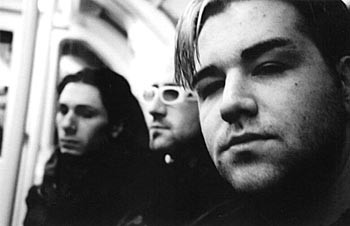
Heaven’s gate: Sebastopol funeral-rights activist Karen Leonard.

Recyling dem bones: The Jessica Mitford Memorial Project

By Stephanie Hiller

HOME TO SO MANY visionaries, idealists, and New Age alternatives, Sonoma County would seem to be an appropriate setting for life’s last innovation: ecoburial, a controversial plan that calls for the use of biodegradable caskets and an end to the practice of embalming. But it’s not a transformation that the funeral industry is likely to embrace. This radical approach to the disposition of our beloveds’ remains has been initiated by none other than Karen Leonard, Sonoma County’s tireless advocate for the grieved, and no friend to the mortician.

Leonard has been calling funeral home directors on their abuses since 1992 when she founded the Redwood Funeral Society to protect the public from exploitation by an industry whose high prices and misrepresentations are endemic despite the late Jessica Mitford’s brilliant 1963 exposé of its excesses, The American Way of Death, recently revised and republished in 1998 as The American Way of Death Revisited (with Leonard’s assistance).

And, indeed, it is in her name that the new Jessica Mitford Memorial Project has been conceived.

Now dominated by three international corporations, the mortuary industry controls every aspect of death care from transportation to cemetery lawn maintenance. And costs keep rising. Although the society had found one independent funeral director whose services were reasonable, Leonard encouraged people to avoid morticians altogether by caring for their own dead, a movement which Jeri Lyons’ Natural Deathcare Project has done much to foster here. Families saved money in the process, but even then, they had to use standard facilities for cremation or burial.

“Then we started seeing a ‘non-funeral director handling fee’ showing up on the price lists,” Says the indomitable Leonard.

“We didn’t know how to protect consumers in the future unless we entered the market ourselves,” she says, and so they have undertaken to “create that which is not“–simple services in a park setting, with low fees.

ASTANDARD AMERICAN funeral with the sleek brass-handled coffin can cost $10,000 or more, and the environmental costs are also high. Packed graveyards with stone markers and vaults clutter the landscape. Embalming, contrary to what we have been told, does not preserve the body so much as extend its decomposition; the process releases the blood-borne pathogens into the sewer systems, while the disintegrating remains eventually drip down through the soil toward the water table. Even cremation, which saves space, releases pollutants into the air, especially when the body has been embalmed and placed in a casket, as morticians are prone to insist.

The alternative is simple, as Leonard and friends explained at an Aug. 22 gathering in the San Francisco home that Mitford shared with her husband, Bob Treuhaft. To bring it to fruition, the society has teamed up with Jeri Lyons and a new company, Memorial EcoSystems. The project will offer reasonably priced burial and cremation services in a lovely setting–a private nature preserve–without embalming, using simple, biodegradable caskets and small markers identified with the use of a global positioning system, to create a “living legacy” that preserves and restores the surrounding landscape for generations to come.

In the process, they hope to transform our attitudes about death, for “death is a part of life,” says Funeral Society board president Ann Tompkins. The memorial park will be a place people visit to attend theatrical performances and concerts in the Memorial Theater, or even a wedding, and enjoy a stroll along park trails, for 90 percent of the land will not be used for burials.

According to Leonard, “Those fortunate to choose to be buried there will be leaving a living legacy to their inheritors. Only the relatives of these people will be able to hike the trails, wade the streams, climb the rocks, and picnic on land that will be forever preserved in its natural state.”

LIKE SO MANY good ideas–organic farming, home birthing, herbal medicine–this new approach is as ancient as it is revolutionary. As Dr. Billy Campbell, owner of the Memorial Ecosystems, reminds us, the biblical “dust to dust” did not include embalming. His South Carolina-based company already has one memorial park back home, the Ramsey Creek Preserve. Campbell, a family doctor, started thinking about death care back in medical school, where he often found himself “hanging out with cadavers for eight hours at a time.”

Dedicated to land preservation, he realized that “if we spent half the money we spend right now in this wasteful industry, we could save a lot of land.” And if people were linked to that land by the bones of their ancestors, “it would become a sacred space,” as burial grounds have always been for native peoples.

Memorial Ecosystems, a for-profit company, will not be the owner of the preserve. To ensure its protection, the company hopes to team up with the Nature Conservancy, which has expressed interest in this endeavor as a way to support land stewardship. They are looking at 420 acres in Franz Valley (between Calistoga and Santa Rosa), but negotiations have not yet begun. Says Leonard excitedly, “We could be up and running within a year.”

All agree that Jessica Mitford would have loved it.

From the September 2-8, 1999 issue of the Sonoma County Independent.

© Metro Publishing Inc.
Talking Pictures

0

Love and Hate

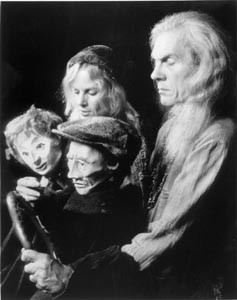
Cinema shuffle: Steve Martin and Eddie Murphy make their move in Bowfinger.

Zade Rosenthal

Writer John Ridley hates Hollywood but likes the satirical ‘Bowfinger’

By David Templeton

Writer David Templeton takes interesting people to interesting movies in his ongoing quest for the ultimate post-film conversation. This column is not a review; rather, it’s a freewheeling discussion of life, alternative ideas, and popular culture.

JOHN RIDLEY hates Hollywood. It says so right there in the disclaimer at the start of Ridley’s entertainingly harsh new crime novel, Everyone Smokes in Hell (Knopf), the compelling, adrenaline-addictive tale of a befuddled one-time screenwriter who, by the time the last bullet flies at the end of the book, also hates Hollywood.

“This book is a work of fiction,” writes Ridley, an award-winning director and screenwriter (Cold around the Heart) and the author of two previous novels (Love Is a Racket, and Stray Dogs, which he adapted to the screen for Oliver Stone’s film U-Turn). “Any similarities between the miscreants in this story and the actual insipid degenerates who populate the city I hate more than cancer is purely coincidental. Anyone claiming to be represented in this novel is suffering from severe closet-psychotic issues that would best be dealt with immediately.”

Though Ridley may hate Hollywood–his home for the last nine years–he did like Bowfinger.

Starring Steve Martin and Eddie Murphy, the recently released semi-satire is about a particular insipid degenerate named Bobby Bowfinger (Martin). Bobby loves Hollywood and so desperately yearns to be part of it that he will resort to anything to become a director. Kit Ramsey (Murphy) is one of Hollywood’s closet psychotics, a famous but unhinged movie star who unwittingly becomes the star of Bowfinger’s Z-grade, sci-fi schlock-flick Chubby Rain. Bobby’s miscreant cast and crew–including Heather Graham as a not-so-innocent actress wannabe–relentlessly stalk Ramsey through L.A., secretly filming his terrified reactions as he responds to knife-wielding vixens and grotesquely melting aliens.

Bowfinger, one of a recent spate of “filmmaker movies”–including The Blair Witch Project and the brand-new The Muse–is an oddly paradoxical film, part of a long tradition of movies that demonstrate Hollywood’s strange love-hate relationship with itself. Sunset Boulevard, The Player, The Bad and the Beautiful, Hollywood Shuffle, Blake Edwards’ S.O.B., and even The Valley of the Dolls all had the same conflicting messages: “Hollywood will destroy you” and “Don’t you just love Hollywood?”

Bowfinger’s script (written by Martin) is keenly critical of Hollywood–the town that Raymond Chandler once described as “a degraded community whose idealism even is largely fake.” On the other hand, Bobby Bowfinger’s Hollywood is still a place where dreams, of a sort, can come true.

“Sure, the movie is saying that Hollywood does not easily reward dreamers,” Ridley agrees, “that Hollywood doesn’t care about little people with little dreams. And yet, the movie says that, at the end of the day, if you believe in yourself, maybe you will be rewarded.

“It’s an Ed Wood-type story. All these people want to do is to make movies, to be a part of the magic, and maybe they’re finally going to get to do that, because they believe in themselves.

“I think that’s a good message,” he says. “It did thumb its nose at Hollywood,” he continues, “saying that all executives are pigs who care more about their cars than their children, that stars are often paranoid and shallow. It shows Kit with his crew of drooling sycophants all around him because it makes him feel like a star. It’s thumbing its nose at all that. But it’s also saying something kind of sweet.

“It’s saying, ‘Pick your own dream and have that dream on your own terms. Don’t buy into anyone else’s version of the dream. Buy into your version of the dream.'”

“In your book, the people who follow their dreams all end up dead,” I point out.

“Well, yeah. I’m a lot more cynical than the people who made Bowfinger,” Ridley says with a laugh. “Dreaming is not enough. If you come to this town expecting to make it big just because you have these wonderful dreams of fame and fortune, this town will beat the crap out of you. You’ll be like a Quaker in the ring during a prizefight. You won’t stand a chance.

“Bobby Bowfinger, though, isn’t about fame and fortune,” he says. “I thought it was a smart observation that this guy’s big dream was having the Fed Ex truck stop at his house. That’s the status symbol, the mark of having arrived in Hollywood; the Fed Ex guy walks in and hands you a special envelope. ‘Wow. I must be important now. A guy in a nice uniform just brought me this letter. And what’s inside? Someone wants me to go make a movie for them in Thailand or somewhere.’ Bowfinger’s dreams aren’t about being rich, or being famous, or having lunch at Morton’s–that typical Hollywood stuff–but it’s the little things that will make him believe he’s a success.”

THE MARKETING GUYS at Fed Ex should hear this. “Federal Express: the next best thing to fame and fortune.”

“The problem with Hollywood,” Ridley adds, “is that after a while, it grinds the dream out of you. It does become all about the car you drive and the money you make and where you eat lunch. It stops being about keeping alive those things that are important to you, keeping close to you the things you treasure most.

“Even so, I gotta say, I would never want to discourage people from trying,” Ridley adds. “If you have a dream, you should come out and try for it–but you should be realistic about how truly tough it is to make it here.”

Ridley’s advice to the dreamers is to remember the message of Bowfinger.

“If you buy into someone else’s dream for you, it’s never going to pay off,” Ridley preaches. “If you persevere long enough in your own dream, eventually it will.”

From the September 2-8, 1999 issue of the Sonoma County Independent.

© Metro Publishing Inc.

Eva Norvind

Lust for Life

Blonde bombshell: Eva Norvind began her career in Mexican cinema, but her unconventional life has taken a few strange turns since then, as a new biopic reveals.

The outrageous story of starlet Eva Norvind

By Diane Anderson-Minshall

WHEN SHE WAS still a teenager, Norwegian-born Eva Norvind took a bus from New York to Mexico with a mere 10 bucks in her pocket. Within months she was transformed into Mexico’s version of Marilyn Monroe–a flamboyant and buxom blonde starlet who appeared in numerous ’60s-era films, including Juan Pistola, Blood Pact, and Este Nocho No.

But Norvind didn’t stop there. She turned tricks, she introduced birth control to Mexico’s Catholic women, she smuggled electronics, she had a daughter out of wedlock, she worked with Mother Teresa, and she became one of America’s leading dominatrixes.

However, the cultural chameleon’s true starring role comes in the new First Run Features art-house biography Didn’t Do It for Love, recently released to video, which chronicles the now gray-haired 54-year-old grandmother’s sexual compulsions as well as her eclectic sources of fame.

Filmmaker Monika Treut shows viewers why Norvind was and still is an unconventional sexual pioneer. Treut, a German feminist filmmaker whose explorations into the erotic life of women include Virgin Machine and Female Misbehavior (which featured interviews with the likes of author Camille Paglia and performance artist/porn star Annie Sprinkle), takes an unflinching look at Norvind’s obsession with sexuality.

While it’s clear that the filmmaker views Norvind with some degree of admiration, Treut never lets her subject’s rather intimidating personality off the hook. Viewers may experience a basic sentimentalism as Norvind talks with some family members, but they’ll feel squeamish at other personal interactions Norvind has in the film.

In one scene, for instance, Norvind berates her younger black male lover so harshly that the man is left tongue-tied and stammering. In another, she lasciviously caresses a limbless male harmonica player. In yet another, she recounts a lesbian S&M scene that went awry. The scenes are not played full tilt with too much emotion; they’re actually recounted very matter of factly.

While the frantic pace of Didn’t Do It for Love may make the film seem like an assemblage of talking heads, it’s the fact that Norvind has lived so many different lives that makes the film seem disjointed.

Tough stuff: Eva Norvind became one of America’s leading dominatrixes.

She was born Eva Johanne Chegodayeva Sakonskaya, the daughter of an émigré Russian prince (who now spends his days collecting bottles) and a Scandinavian sculptress (who blithely paraded her 15-year-old daughter nude past French filmmakers). Norvind, who currently runs a dominatrix dungeon in midtown New York, has reinvented herself at least five times and is heading for the next career change. She speaks 11 languages. She sat next to Hillary Clinton at the Beijing Women’s Conference. She had an entourage in the ’80s that included Nancy Friday, Erica Jong, and Milos Foreman. She is estranged from her own daughter, who ran away at 12 and now calls mom a “whore.”

The film (whose video-to-tape transfer actually improves on the small screen) may be provocative to some; a whiff of fresh air to others. Treut passes up pop psychology and lets Norvind speak for herself without analysis. It’s clear Norvind has her demons to deal with. Her anger with her own mother is hardly concealed, and it doesn’t take Sigmund Freud to surmise that the root of Norvind’s hypersexuality may lie somewhere close to the surface of that maternal relationship.

Like any good documentarian, Treut turns the camera on Norvind’s family and on the actress-cum-dominatrix’s inner monologues (which, for Norvind, appear to never end). Norvind is frank and free of guilt, and Treut’s view of her makes for a fascinating addition to the oeuvre of a transgressive female filmmaker who defies easy categorization.

Treut sets out to explore the banality of perversion in all her films, and Norvind makes for a good pop-culture subject. So what if she dreams of urinating next to Madonna? When the aging Norvind turns to the camera and asks, “What the heck am I doing?,” one thing, at least, is clear. The answer to that question is a very interesting one indeed.

Didn’t Do It for Love is available locally on video at Bradley Video in Santa Rosa (538-7752). Or buy it directly from First Run Features (for $39.95) by calling 800/488-6652.Note: The film offers very complex adult themes and one scene of actual S&M; it’s not for the kiddies.

From the September 2-8, 1999 issue of the Sonoma County Independent.

© Metro Publishing Inc.

John Hawley

0

Hands On

Enjoying the fruits of his labor: Winemaker John Hawley used his skills to bolster Clos du Bois and to catapult Kendall-Jackson into the viticultural stratosphere. Now he’s returned to hand-crafting his own wines.

John Hawley helped industrialize the wine biz. Now he’s happy to be a craftsman again

By Bob Johnson

JOHN HAWLEY has attained a winemaker’s equivalent of scaling Mt. Everest, swimming the English Channel, winning a Super Bowl. After graduating with honors from the University of Vintners, otherwise known as UC Davis, Hawley served a one-harvest apprenticeship at Preston Vineyards before being hired as the first winemaker at Clos du Bois.

During the ’80s, he oversaw the growth of the Healdsburg-based Clos du Bois from fewer than 20,000 cases to more than 200,000, picking up a ton of wine competition hardware along the way. In 1990, he accepted the position of chief winemaker for Kendall-Jackson, and over the next six years led K-J’s expansion from around 600,000 cases to more than 2.5 million cases annually.

Hawley is largely responsible for what has been called the “industrialization of winemaking,” and as he looks back on the 16 years he spent transforming wines into mega-brands, he admits to experiencing some pangs of regret. “I don’t think the people doing the work in the big wineries have the kind of fun that those in the little wineries have,” he says. “In the little wineries, it’s a different job every day. When you get in the highly mechanized places, it becomes an assembly-line procedure, and those people don’t get to enjoy the diversity or feel like they’re in the wine business. They’re just working a factory job.”

Hawley describes his tenure at K-J as “exciting,” but also “stressful.” And after a while, he adds, the long days and tremendous responsibility began to take their toll. “I had a lot of fun, dealt with virtually every grape variety from multiple appellations, learned all about the different barrel types, and was part of a dynamite team,” he says. “But I got tired of managing paper and people, and really wanted to get back to hands-on winemaking.”

Crafting his own wine had been Hawley’s lifelong goal, but he never had the wherewithal to make it happen. Not until he started earning the big bucks at K-J and holing away as much of each paycheck as possible.

Finally, in 1996–after 16 years of working for others–Hawley was ready both mentally and fiscally to take that giant step.

Goodbye, Kendall-Jackson. Hello, Hawley Wines.

A few words on Hawley wine.

UP FROM HIS OWN 10-acre vineyard a thousand feet up Bradford Mountain in Dry Creek Valley, as well as those owned by a handful of other local farmers, Hawley released his first pair of bottlings: a viognier and a merlot.

For the 1997 vintage, those two varietals were joined by a cabernet sauvignon. Total case production for all three wines: 1,928. Or, approximately 29,976,864 fewer bottles than he had been making at Kendall-Jackson.

Hawley says he enjoys being able to once again take a “hands-on approach” to winemaking. “It’s going back to my roots–to what I did at Preston and even before that with my home winemaking,” he asserts. “I’m working closely with my vineyard manager, crushing the grapes, racking the barrels every three months, tasting every step of the way, and making decisions at various intervals to make an individual wine the best it can be.”

It is akin to the difference between prints rolling off a press and an artist’s original painting. Or shoes assembled in a factory vs. those formed to one’s unique foot dimensions by a cobbler.

“It’s about attention to detail and levels of control,” Hawley says. “The bigger you are, the more levels of control you lose. I was never comfortable with delegating duties, and now I don’t have to be. I enjoy doing it all myself, and I can have the confidence that each step is being done the way I want.”

And that, Hawley adds, translates into a greater degree of inner peace with the process and personal satisfaction with the final product. While working for Clos du Bois and then Kendall-Jackson, Hawley developed and adhered to a number of rules designed in large part to protect the owners’ huge investments.

Now on his own, Hawley says he doesn’t miss the regimentation. He answers only to himself, and follows only one rule. “The only rule,” he says, “is to make the best wines that I can.”

From the September 2-8, 1999 issue of the Sonoma County Independent.

© Metro Publishing Inc.

NudeFest ’99

0

Get Naked

Hangin’ out (literally) at NudeFest ’99

By Chris Wright

I’m leaning my elbows on a bartop, sipping Fosters Lager from a plastic cup. Nothing unusual about that. Two middle-aged guys beside me are having a boisterous conversation: “He shoulda kept his damn mouth shut!” Just regular guys talking regular guy stuff. Less regular is the fact that the two guys are naked. Come to that, so am I. Usually this realization would mark the point where I’d wake up, sweat beading my brow. But not today.

The really strange thing is, it’s OK.

By this point, I’ve already been hanging out (literally) at Berkshire Vista for a good few hours. Berkshire Vista is a nudist resort located in the mountains of Massachusetts; I’d arrived early that morning, eagerly anticipating NudeFest ’99, the 52nd annual convention of the Eastern Sunbathing Association .

What I hadn’t anticipated was my initial discomfort at the sight of the teeming, tawny nakedness all around me–or having to stand around waiting for my hosts, studiously averting my eyes, making small talk with a partly clad T-shirt vendor.

“Are those T-shirts for sale?” I ask. The vendor smiles and nods. After 10 excruciating minutes, my hosts arrive: Susan Weaver, public-affairs chair for the American Association for Nude Recreation, and Linda Pace, AANR marketing director. Both are wearing sarongs.

The big question comes almost right away: “Do you want to take your clothes off?”

In the interest of journalistic integrity, I’d already decided to say yes. So I do it–shirt, socks, shorts–and there I am, standing in the middle of a field, wearing nothing but a pair of red Converse sneakers and carrying a black briefcase. As if I don’t already feel awkward enough, a passing woman points at my ass, proclaiming, “Look! A cottontail!” Great.

Laughing, Weaver and Pace strip, and the three of us jiggle down a small hill, on our way to my first stop of the day. I’d been hoping for something a bit racy to start with–the conven-tion agenda includes Olympic training, a seniors’ swim, and nude bacon and eggs breakfast–but those had taken place earlier.

What I get is an ESA membership-committee meeting.

About 50 people in various stages of undress sit and stand under a wooden structure in a section of the resort known as the Ghetto. I honestly don’t know where to look–or, more important, where not to. Particularly unsettling, for some reason, are the guys who aren’t quite nude, their todgers peeking out below the hems of their T-shirts.

As Susan introduces me to the meeting, announcing that I am a “first-timer,” the delegates give me a big round of applause, which is actually more disconcerting than the cottontail incident. Clutching my briefcase before me, I scamper to the nearest table and settle down to watch the proceedings.

For the next hour I nod thoughtfully, gaze intently into the face of each speaker, and scribble notes such as “the power of public advertising” and “Jesus, they’re huge.”

When I think nudism, I generally tend to think nude beach. So how did I come to find myself in the middle of the mountains, attending a legislative assembly, listening to talk of budget proposals and outreach strategies?

Since its inception in 1931, AANR has grown into a massive organization boasting 50,000 members, 236 clubs, and seven regional branches. In fact, the organization is experiencing growing pains. At the meeting, discussions about where to put the proliferating legions of nudists generate almost as many solutions as there are delegates.

The task of bringing all this diversity together falls to Greg Smith, the AANR’s national president. Smith has something of a young Hunter S. Thompson look about him. Slim, tanned, with a shaven head and sunglasses, he serial-smokes mini cigars and presides over the meeting with cool authority. Even though I am still in the omigod stage, when Smith speaks it’s quite possible to forget the pecker beneath the mike. And Smith speaks quite a lot.

At one point, as the president takes center stage yet again, a delegate sings under his breath: “Here he comes to save the day!”

AFTER THE MEETING, Smith sits across from me, rests his elbows on the table, and says, almost immediately, “I have nothing to hide.”

Quite.

A retired naval officer, Smith currently drives a school bus in Bethel Park, Pa. He’s less interested in talking about his professional life, however, than in touting an annual nudist volleyball tournament he arranges. “Last year,” he says proudly, “we had 95 to 100 teams, 2,000 people.”

As with many of the people I meet today, nudism is not merely an interest for Smith, nor even a lifestyle. It’s a vocation, a creed. He seems particularly proud of his record as AANR’s leader, speaking of how nudism is “becoming more and more mainstream every day,” of how he has helped the organization “enter into the 21st century,” of the constant barrage of e-mail and faxes he receives, the twice-weekly meetings he must attend.

Smith admits that the logistical headaches of bringing a nation of nudists together can make the president’s role a tough one. “You can’t afford to get upset,” he says. “If you do, you’re in the wrong job.” The AANR has presidential elections slated for the year 2000, and I ask Smith who his main challenger is.

“When the president is doing a good job, there is no competition,” he says, lighting up another cigar. “I expect to be re-elected.”

And so there we are: two men, buck-naked, discussing institutional politics. At one point, Marci Lott, Smith’s fiancée, glides over. The couple are planning a nude wedding sometime this year, they say (“at least the bridesmaids will all match”). Lott–a trainee flight attendant–is blond, large-breasted, and wears a sheer white wrap around her waist. I am mortified–helplessly so–to note that she is very sexy.

Sex, however, plays little part in your average nudist camp. And that’s not only because many nudists resemble your grandparents.

When you come down to it, the symbolic link between nudity and sexual intercourse rests on a pretty banal concept: I’m ready. But when everyone is nude, that link is somehow broken. Sex has no place at a nudist resort precisely because the guests are naked.

As the saying goes: “We’re nude, not lewd.”

Indeed, the only hint of prurience I get the whole day is from a guy who admits to having gotten interested in nudism when, in his teens, he bought a copy of Sunshine & Health. Which doesn’t necessarily mean that sex is far from the minds of nudists–at least in an institutional sense. While the terms respect, acceptance, and wholesome are thrown about by AANR representatives like rice at a wedding, the word sex is tirelessly avoided.

But, as always, it looms all the larger for its absence.

Aware that many people view organized nudity with a suspicious eye (or worse, think Wey-hey-hey!), the organization goes to extreme lengths to project a socially responsible, clean-living image. It organizes blood drives, clothing drives, and beach cleanups. So conscious is the organization of its public image that Weaver runs media-training sessions during which AANR workers learn to fend off salacious and cynical media inquiries with quotable epigrams (“Shed your cares with your clothes”).

Weaver will also turn down media requests from potentially unfriendly sources.

“Why would we deal with someone who’s going to make fun of us?” she asks.

WHAT IS MOST surprising about today’s gathering, however, is that despite all the wholesomeness, most of the nudists are far from being the crunchy, touchy-feely bunch I had anticipated. When I arrived at Berkshire Vista, I tucked my cigarettes away, fearing a lynching if anyone saw them.

But fellow smokers abound, and the clubhouse bar does a thriving business. There’s barely a hint of sanctimony.

Indeed, rubbing elbows with the guys in the bar feels like being back in the city–that is, if elbows were all we were rubbing. Some of the nudists even indulge in saucy banter when Linda Pace gingerly steps into the club’s swimming pool. “It’s cold!” she says. “Love those bumps.”

“So do we,” replies one man, arousing bursts of laughter all around. To say that Linda Pace is a good sport would be to understate the matter. A full-figured woman far too young-looking to be the mother of three 20-something children, Pace is energetic, witty, and as prolific a smoker as I am. As a group of us sit on a deck having lunch, Pace laments the fact that she can’t finish her burger. “My eyes were bigger than my stomach,” she says. Then, without skipping a beat, she looks at her stomach and says, “I guess you can only say that when you have clothes on.”

PACE used to run a halfway house for troubled teens; now she is a full-time nudist. I knew I was at ease with the AANR’s marketing director when I stopped not noticing her breasts, when I was able to run my eyes over them as easily as I would a lapel. Many people espouse the old “body acceptance” nugget during my time at the convention, but Pace really brings it home for me.

“As a woman who has three kids,” she says, “my body is a road map that leads back to my children. Me without clothes on is not going to make the cover of Cosmo, but with this group I feel beautiful.”

So do I.

As one who enjoys the odd pint, my body is a road map that leads back to the Sam Adams brewery. But here–and not only because the majority of the people are in worse shape than I am–I feel completely comfortable. Or at least I’m beginning to. Most of the time.

Nearly.

During a game of volleyball, every now and then I think, “Hey, that person who just spiked me is naked.” Or worse, when saying hello to a passing kid: “Hey, I’m naked.” At one point, a guy says something about the government being “hard on” nudists and I think, “Hard on!” as if the very words could trigger a disastrous bout of tumescence. And it does feel a little weird to be showering beside Susan Weaver. Then again, after you’ve soaped up beside a publicist, you’re pretty much ready for anything.

As the day draws to a close, I’m very nearly at ease, dangling my tackle in a variety of settings as if it’s the most natural thing in the world.

And, of course, it is.

As I prepare to leave my newfound nudist friends, a poolside wine-and-cheese reception is in full swing, and I feel a little stab of regret. Later tonight they’ll be having a disco dance, complete with DJ. I have visions of a hundred nudists doing the Macarena. But I have stuff to do back in the city and a long drive ahead of me, so I decamp.

People I’ve met over the day hug me, give me little presents, assure me we’ll meet again.

I’m a sentimental guy–I hate goodbyes–but there’s something else bothering me. It’s strange, but after a day in the buff, I am appalled by the prospect of putting my clothes back on. Then again, maybe it’s not such a bad idea.

As I stand beside the pool, a guy comes over to inspect my backside, bending slightly for a better look, and inhales sharply through his teeth.

“Put some tea bags on that,” he says. “Or some vinegar. You’re going to need it.” I twist and take a look. He’s right. According to people I’ve met today, Thoreau was a nudist. Ben Franklin was a nudist. FDR was a nudist. Jesus was a nudist. Now, it seems, so am I.

And I have the sunburned butt to prove it.

From the September 2-8, 1999 issue of the Sonoma County Independent.

© Metro Publishing Inc.

Violent Femmes

0

Femmes Fatale

Preaching to the choir: The Violent Femmes, including Gordon Gano, center, are set to perform Sept. 7 at the Mystic Theater in Petaluma.

Violent Femmes put career back on track

By Greg Cahill

“WHY CAN’T I get just one fuck?” Gordon Gano pondered on the Violent Femmes’ landmark 1982 self-produced indie single “Add it Up.” The rhetorical answer to that remark: “Guess it’s got something to do with luck.”

Lucky or just plain clever, that angst-ridden comment struck a chord. The song became a staple on the then-fledgling college radio circuit and attracted frustrated teens by the scores. It also launched the career of one of the most original trios–and best live bands–of the ’80s.

Since then, these Milwaukee-based post-punk phenoms have scored plenty and lost more than their share during a roller-coaster ride that until recently had stalled after a major label for four years refused to release any of their new recordings.

Now the Violent Femmes–whose 1983 revenge-of-the-nerds DIY debut album sold a million copies without ever charting or receiving a lick of promotion–have re-emerged on a pair of soundtracks: South Park: Bigger, Longer & Uncut, and Mystery Men, on which the band plays a stellar cover of the Stranglers’ “No More Heroes.”

“We’re a group that plays all the time and goes all around the world,” explains Violent Femmes singer/guitarist/songwriter Gano, during a phone interview from his New York home, “but about once a week I run into somebody who asks, ‘Yeah, so what’s up with you guys? Do you play anymore ever?’

“The answer is, ‘Yeah, that’s what I do.'”

TO SAY that the Violent Femmes–who blend choppy guitars and bare-bones arrangements, punchy riffs, and self-effacing lyrics with often Captain Beefheartesque experimentalism–have had an up-and-down career is an understatement. Gano, the son of a preacher, has flirted with Christian messages in such tunes as “Country Death Song” and “Jesus Walking on the Water,” a seeming contradiction to his penchant for penning teen anthems dealing with masturbation, rebellion, and chicks (“36-24-36”).

Critics often scratched their heads in confusion over the band’s musical direction and issued some quite unkind assessments of Gano’s religious inclinations. “A lot of people have a hard time with different viewpoints or different ideas coming from the same writer,” says Gano, chronicler of a twisted Americana–like Aaron Copland on acid. “In rock, songwriters are supposed to be speaking to you from their heart, meaning what they truly believe. Critics like artists to be simple and straightforward.

“That’s a problem we constantly have with this business.”

Still, the Violent Femmes have had their share of success. Their eponymous 1983 debut LP on Slash/Warner stands as one of the first and most successful alternative rock releases. Its 1984 follow-up, Hallowed Ground, while critically panned, is a post-punk classic. Producer Jerry Harris of the Talking Heads produced the band’s third and most commercially successful album, 1986’s The Blind Leading the Naked, before the band split temporarily, with Gano and bassist Brian Ritchie releasing a series of solo projects. The band regrouped three years later only to crash and burn with 1989’s stylistically jumbled 3 and 1991’s nostalgia-fueled Why Do Birds Sing?, which included an insipid cover of Culture Club’s insipid “Do You Really Want to Hurt Me?”

A 1993 greatest hits and live rarities compilation, Add it Up (1981-1993), is a strong representation of the band’s most creative output.

AT ELEKTRA RECORDS, the band gained more artistic freedom, releasing a pair of darker discs that died on the racks. A subsequent deal with Interscope Records–home to Primus and Limp Bizkit–looked promising, but for four years the label declined to release any of the band’s tapes.

The Violent Femmes languished in rock-‘n’-roll oblivion.

“We got away from there,” Gano explains. “It wasn’t with any nastiness, which was nice, but it just wasn’t working. And we were able to take the recordings with us.”

Those long silent tapes will finally get an airing in February on the smaller Beyond label. And a live concert CD, Viva Wisconsin, is due out in November.

“If that all works, it will be great,” Gano adds. “It will start to make up for all the years of not having anything come out when we were doing a lot of good work.”

Meanwhile, the vagaries of the music business have done nothing to dim Gano’s enthusiasm for his craft. “From day one, the band had a ‘sound’ that is still recognizable,” he says. “But we are better musicians, and we keep finding more and more ways as a trio to bring more colors and more instruments into the live shows.

“We’re always looking for ways and places to bring in other colors.”

As for what excites Gano after all these years: “The improvisations,” he says without hesitation. “We keep getting better at it. We have sections of certain songs that are set aside for free improvisation, where anything can happen anytime we play it. Hopefully, you play and listen at the same time, and each person is connected to the others, to a degree that you don’t know who’s leading and who’s following.

“And that’s something that is very exciting.”

The Violent Femmes perform Tuesday, Sept. 7, at 9 p.m. at the Mystic Theater, 23 Petaluma Blvd. N., Petaluma. Tickets are $24. For info, call 765-2121.

From the September 2-8, 1999 issue of the Sonoma County Independent.

© Metro Publishing Inc.

Sonoma Museum of Visual Art

Last Call Bone deep: Sculptor Ronald Garrigues' Dr. Frankenloner is part of the upcoming Día de los Muertos exhibit at the Sonoma Museum of Visual Art. Death is the life of the party at the new SMOVA art exhibit By Paula Harris "WE MUST remember them," say the Zapotec...

Spins

Ramblin' Man Voice of America: Singer/songwriter Woody Guthrie. New box set celebrates folk icon By Greg Cahill Woody Guthrie The Moses Asch Recordings, Vol. 1-4 Smithsonian Folkways BRITISH AGIT-POP singer Billy Bragg scored one of 1998's surprise hits with Mermaid Avenue, his rousing collection of lost Woody Guthrie...

Hellraiser

Hellraiser Meet the feisty nun who rocked the Diocese of Santa Rosa By Janet Wells SISTER JANE KELLY is a most unlikely whistle blower. With her flowered skirt, simple blouse, white huaraches, and wedding finger sporting a ring with a cross stamped into the gold, she looks every inch the gentle nun....

Spins

Legends Soft-spoken: Iggy Pop commits the cardinal sin of rock--he's gotten boring. New CDs by Iggy Pop, Stevie Ray By Greg Cahill Iggy Pop Avenue B Virgin Those who know Iggy Pop as the proto-typical punker may be turned off by his subtle side. Iggy teams up with...

Ecoburials

Ecoburial Heaven's gate: Sebastopol funeral-rights activist Karen Leonard. Recyling dem bones: The Jessica Mitford Memorial Project By Stephanie Hiller HOME TO SO MANY visionaries, idealists, and New Age alternatives, Sonoma County would seem to be an appropriate setting for life's last innovation: ecoburial, a controversial plan that calls for...

Talking Pictures

Love and Hate Cinema shuffle: Steve Martin and Eddie Murphy make their move in Bowfinger. Zade Rosenthal Writer John Ridley hates Hollywood but likes the satirical 'Bowfinger' By David Templeton Writer David Templeton takes interesting people to interesting movies in his ongoing quest for the ultimate post-film conversation. This column...

Eva Norvind

Lust for Life Blonde bombshell: Eva Norvind began her career in Mexican cinema, but her unconventional life has taken a few strange turns since then, as a new biopic reveals. The outrageous story of starlet Eva Norvind By Diane Anderson-Minshall WHEN SHE WAS still a teenager, Norwegian-born Eva Norvind took a...

John Hawley

Hands On Enjoying the fruits of his labor: Winemaker John Hawley used his skills to bolster Clos du Bois and to catapult Kendall-Jackson into the viticultural stratosphere. Now he's returned to hand-crafting his own wines. John Hawley helped industrialize the wine biz. Now he's happy to be a craftsman again By...

NudeFest ’99

Get Naked Hangin' out (literally) at NudeFest '99 By Chris Wright I'm leaning my elbows on a bartop, sipping Fosters Lager from a plastic cup. Nothing unusual about that. Two middle-aged guys beside me are having a boisterous conversation: "He shoulda kept his damn mouth shut!" Just regular guys talking regular...

Violent Femmes

Femmes Fatale Preaching to the choir: The Violent Femmes, including Gordon Gano, center, are set to perform Sept. 7 at the Mystic Theater in Petaluma. Violent Femmes put career back on track By Greg Cahill "WHY CAN'T I get just one fuck?" Gordon Gano pondered on the Violent Femmes' landmark...
11,084FansLike
4,606FollowersFollow
6,928FollowersFollow