Newsgrinder

0

Important events as reported by daily newspapers and summarized by Daedalus Howell.

Saturday 11.04.00

University of California plant pathologist Matteo Garbelotto is seeking a weapon with which to wage war against the raging sudden oak death epidemic that has affected hundreds of thousands of trees in Marin, Sonoma, and Napa counties. According to the Marin Independent Journal, Garbelotto has been conducting tests to determine whether certain fungicides and phosphorus compounds will do the trick. If not, a more radical treatment, jocularly dubbed “The Axe,” will be used.

Sunday 11.05.00

Despite the rampant e-failures dotting the Internet business community, San Rafael’s Dominican University has added a new e-business major this semester to teach students whether they’re dot-coming or -going. Boris Porkovich, dean of the university’s School of Business and International Studies, boasted to the Marin IJ, “No one else in the Bay Area does a full undergraduate degree that is really specifically focused on e-business.” Perhaps because most accredited colleges adhere to the antiquated Old Economy notion that real business schools should study real businesses with real business models rather than churn out diplomas as worthless as yesterday’s hi-tech stock options. “To me, the leading edge right now is mixing reality with online,” says instructor Americ Azevedo, whose online neural map may have taken too many hits.

Monday 11.06.00

Therapist Shannon Simonelli spent five years at a secure facility in Utah working with repeat youth offenders, convicted of armed robbery, rape, and murder. There, she got “a lot of attitude.” Now established in Marin County, she can expect to get a lot of dough from parents whose teens need a taste of Simonelli’s “gentle persuasion” (yes!), reports the Marin IJ. The therapist is starting a stress-reduction group for teens at the Stress Management Center of Marin in Larkspur. “I create a safe container, a safe place, to explore [personal] issues,” says Simonelli. “Kids need structure, they need containment. . . . They’re careening from side to side trying to find where the parameters are.” Like rats in a cage, baby.

Monday 11.06.00

Napan Henry Michalski has amassed 40 years, worth of political memorabilia, some of which were on display at the Napa City-County Library through election day, reports the Napa Valley Register. “I dream of having my own museum,” said Michalski. “I could fill a good-sized room with my collection.” Indeed, Michalski could own a good-sized room if he had been amassing another form of presidential collectible–the greenback. If Michalski had put away a dollar a day for 40 years with compounded 8 percent annual interest, he would have $107,327.93 But then he wouldn’t have all those cool buttons. No word on what an “Anderson for President” bumper sticker fetches these days.

Tuesday 11.07.00

Taking the lead from Mel Brooks, Santa Rosan David Ramirez set out to live Robin Hood: Men in Tights by embezzling $225,000 over two years from his employer and donating it to the now-defunct Redwood Empire Ballet. Ramirez, a 50-year-old senior claims supervisor for the California State Automobile Association in Santa Rosa, pleaded no contest in Sonoma County Superior Court to grand theft and tax evasion on Monday, reports the local daily. “I’ve never handled a case like this. Normally, bad guys steal money and do bad things,” said prosecutor Bruce Enos. “This guy stole money and did good things.” That is, if you consider amateur ballet a good thing. The Redwood Empire Ballet hung up its tutus in 1998, when it ran out of money. No word if a second embezzlement investigation has been launched. Says Ramirez’s attorney, “He felt a need to help the arts. He’s a real ballet fan. He couldn’t control his behavior.” Sometimes, you just gotta dance.

Tuesday 11.07.00

In an area renowned for its water woes, residents of an unincorporated area south of West College Avenue in Santa Rosa have a veritable tsunami of troubles gushing from their taps, reports the local daily. State health officials have confirmed that drinking water in dozens of wells is contaminated with tetrachloroethylene, a deadly chemical that is used in dry cleaning and causes birth defects and cancer. “Every time I turn on the tap, I think about it. Every time we shower, we’re afraid to breathe,” said one resident, who did not comment on whether or not her teeth were whiter or well-pressed. State officials have told residents any level above five parts per billion of the chemical is a health risk. Several wells have registered above 300 ppb, and one unlucky resident, Tina Vassar, has a well that tested at 572 ppb. “Right now, I’m at ground zero,” said Vassar, who apparently has no plans to go into the dry cleaning business. “I’m devastated.”

Tuesday 11.07.00

The Argus-Courier website reports that the Petaluma Police Department is looking for a man who rode a bicycle onto the St. Vincent Elementary campus the morning of Oct. 26 and “yelled, behaved strangely, and rode away.” The suspect was described as a white male with brown hair cut in a “shaved-bowl” style–the exact coiffure of noted performance artist Hans Gelbing who was scheduled to perform his “spoke-and-word” poem cycle Ich bin ein Liegerad (“I am a recumbent bicycle”) on the campus.

From the November 9-15, 2000 issue of the Northern California Bohemian.

© Metro Publishing Inc.

Designer Babies

0

A Colorado couple ups the ante on genetic engineering of children

By Christopher Kemp

Photographs by Michael Amsler

ANYONE WHO has read Aldous Huxley’s Brave New World will remember the Embryo Store, just down the corridor from the Social Predestination Room of the Central London Hatchery and Conditioning Center. There, row upon row and gallery upon gallery of embryo-filled glass jars recede into the distance, awaiting classification as intellectual Alphas or brainless Gammas.

Sounds a bit weird, right?

But Huxley’s 1932 vision inched a little closer recently with the news that a Colorado couple designed a baby using genetic tests–a baby who would, in turn, help save their desperately ill daughter. Overshadowed by the fast-approaching presidential elections, this news has passed unnoticed in many quarters, but it provides a chilling backdrop to the political season for those who understand its implications.

Jack and Lisa Nash thought 6-year-old daughter Molly had few clinical options when she was born with Fanconi’s anemia, an inherited bone-marrow deficiency. The genetic disorder disrupts bone-marrow cell production, compromising the immune system and often leading to leukemia. Sufferers rarely survive beyond the age of 7 without a bone marrow transplant. Molly was ill and her parents knew it.

Eager to have more children, but reluctant to risk passing on the disorder, the couple used in vitro fertilization, testing embryos for Fanconi’s anemia before any were implanted. But while doing so, researchers also tested embryos for compatibility with Molly’s cells. Late last year, Jack and Lisa were the proud parents of 15 embryos, of which two were free from Molly’s condition and also compatible with her cells.

Implantation was successful, and a baby was born Aug. 29, after the couple’s fourth attempt at in vitro fertilization. Doctors infused Molly’s circulatory system with cells collected from the baby’s umbilical cord, a tissue rich in the healthy stem cells that Molly needed. Now free from the effects of Fanconi’s anemia, Molly is expected to survive, and her prognosis is good.

THIS example of medical intervention should worry us all. It raises many questions about the capricious use of embryo selection to satisfy the preferences of parents. To many, this case sets a precedent for screening embryos, using the information gained, and making a selection on the basis of particular traits. For instance, will parents choose embryos with a decreased chance of dyslexia, or select against embryos with genetic markers for obesity or substance abuse? Will they choose against an embryo with a greater chance of developing Alzheimer’s disease in its old age? If scientists discover genetic markers for homosexuality, will they use genetic embryo screening to select against that trait? What about children with below-average intelligence? What about children with annoying speech impediments?

According to press reports, the couple decided on the name Adam for their new son, a choice with enough biblical symbolism to satisfy just about everyone. But the question is, Why bother naming the child at all? Why not just keep him in the garage with the lawn fertilizer and the jump cables? Just in case he’s needed again. Survival of the fittest. It’s instinctive. He’ll do fine.

To others, the Nash case isn’t an indication of worse to come.

“I just don’t see how this particular case really adds anything new to the ethical debate,” says John Bickle, associate professor and head of the philosophy department at the University of Cincinnati. “There’s nothing particularly new about this technology. The ethical issues we start raising now are what constitutes a capricious choice.”

The selection of an embryo that might provide a medical benefit is not a capricious choice, Bickle says, and doesn’t set any precedents. Anyone who supports contraceptive devices but opposes embryo screening has some explaining to do, he says.

But according to an Oct. 4 Reuters news report, Professor Jacques Montagut, a pioneer of in vitro fertilization, told the newspaper Le Parisien that the case set a dangerous precedent if the child were born to save Molly.

“It would inaugurate a new form of biological slavery,” he says.

Along similar lines, a Scottish couple is planning to use the European Convention of Human Rights to win the right to choose the gender of their next child. Parents to four sons, the Mastersons lost their only daughter after an explosion in their home, and now they want to use new laws to select only female embryos for in vitro fertilization.

This is a question no one is equipped to answer, but someone will be charged with the responsibility of doing so. To many, these are the first tentative steps onto the slippery slope of bioethics, a slope characterized not by what we can do but by what we should do.

With the Human Genome Project nearing completion, genetic information soon will become a commodity, and commodities can be both used and abused. Scientists finally will be in a position to quantify and label the genetic components of personality traits. For instance, at this time we know human intelligence is determined by nature and nurture in roughly equal parts, but we can neither locate nor quantify either portion. If scientists can pinpoint the genes that determine the genetic fraction of intelligence, we will all be faced with the question of whether or not lower-than-average intelligence is a sufficient handicap on which to base embryo selection.

And as long as Congress continues to debate the use of embryo stem cells, even from discarded embryos, research on Parkinson’s disease and other neurodegenerative disorders will remain stalled. Meanwhile, it’s only a matter of time before doctors take another step onto the slippery slope of bioethics, allowing embryo screening for less deserving reasons than those presented by Molly and her family.

And maybe its also only a matter of time until we can all just place a request down at the Embryo Store and pick it up when it’s ready.

From the November 9-15, 2000 issue of the Northern California Bohemian.

© Metro Publishing Inc.

‘Chicken Run’

0

Poultry Slam

The Surreal Gourmet looks back on the year’s strangest hit

Writer David Templeton takes interesting people to interesting movies in his ongoing quest for the ultimate post-film conversation. This is not a review; rather, it’s a freewheeling, tangential discussion of art, alternative ideas, and popular culture.

BOB BLUMER doesn’t get to a lot of movies these days. As one would expect from a man with so many hyphens in his title, the energetic author-chef-journalist-teacher-artist-designer-sculptor-television host and bon vivant is way too busy for movies, this year especially.

With the major release of a trippy new book–Off the Eaten Path: Inspired Recipes for Adventurous Cooks (Ballantine; $20)–and the massive 11-month tour to promote it, Blumer’s been a busy boy. So it’s something of a miracle that he found a bit of spare time, right in the middle of his tour, to go see the film Chicken Run.

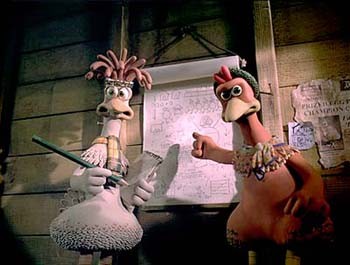
An unexpected hit, the Claymation effort from Nick Park and Dreamworks has lingered in theaters around the world since its debut in June, and will probably still be playing somewhere when it’s released on video and DVD Nov. 11. A weird blend of The Great Escape and a Foster Farms commercial–the ones with the suicidal chicken puppets–Chicken Run brings us the story of a doomed flock of English chickens who’ve just learned they’ll be turned into chicken potpies if they don’t lay enough eggs. A broasted, excuse me, a boastful American rooster named Rocky (voiced by Mel Gibson) flaps in to attempt a rescue and add some spice to the animated stew.

“I saw the movie Chicken Run in a theater that was packed with kids,” reports the affable Blumer, whom I’ve managed to reach at a budget hotel somewhere in the state of Georgia. “Based on the looks of horror on the faces of those kids–mainly during the scenes where the chickens are almost sliced and diced and made into meat pies–I wouldn’t be surprised if a lot of those kids had a very hard time eating chicken from now on.”

“So, is that the effect it had on you? I suddenly wonder.

“Oh, not at all,” Blumer replies. “I had chicken for lunch.”

THE HOLLYWOOD-based Blumer, best known to Food Network fans as “The Surreal Gourmet,” is a spiky-haired 20-something for whom food exists mainly as another way to express one’s inner wackiness. And Blumer is wacky indeed. In his world, a bed of polenta must be fashioned to resemble an actual bed, with a crisp sheet-pasta blanket and matching ravioli pillows. A shellfish appetizer should be served in a plastic beach bucket with matching plastic shovel. And pound cake, instead of being offered up on a plate, can be cut into strips and served in a French fry container–with raspberry catsup on the side.

Blumer is equally fond of extraordinary cooking methods. In Off the Eaten Path, Blumer includes detailed instructions on how to steam salmon in your dishwasher, how to cook trout and shrimp on the engine of your car, and even how to melt a cheese sandwich . . . with your electric iron. There are also directions on how to throw Home Video Dinner Parties, in which Blumer imagines entire menus to accompany movies like The Godfather and Like Water for Chocolate.

But let’s get back to Chicken Run.

“You know, once it hits video, I think this movie really might end up doing for chickens what Babe did for pigs,” Blumer says, “which was to save a few from the old meat factory.” He pauses. “On the other hand, it could have the opposite effect. It could create a resurgence of chicken potpie consumption, a chicken potpie renaissance, as it were.”

“And why not?” I jump in. “I mean, chicken potpie is a dish so traditional it’s almost sacred, yet most gourmands seem to have relegated it to the ranks of such white-trash cuisine as possum stew and R.C. Cola. What’s so bad about chicken potpies?”

Blumer is amused at this outburst.

“There’s nothing bad about chicken potpies,” he says, patiently. “It’s just that they’re usually made with very mediocre ingredients. If I hosted a Chicken Run video night, the obvious thing would be to serve chicken potpies. I’d make it a really great chicken potpie, with really fresh, crisp vegetables, fresh peas, fresh carrots, and some really special gravy.

“But I’d take it one step further. I’d serve the pies in boxes, creating a piece of conceptual artwork in the form of boxes that match the pie boxes that the crazy farmer woman in the movie planned to package her pies in. And I’d serve wine in custom-made goblets that had little plastic chicken legs for stems.”

“I don’t know,” I queasily counter. “You said it yourself. Chicken Run is, in essence, a kind of defense of chickens, isn’t it? Wouldn’t serving chicken at Chicken Run be a little like serving ham at a screening of Babe?”

“Well, what about egg salad sandwiches then. Is that a decent halfway point?” He counters. “And for dessert, chocolate eggs, maybe. Or something with a good egg cream.”

“You forgot the appetizer.”

“Right,” he acknowledges. “For an appetizer there’s always chicken fingers and stuff like that. And the chickens in the movie actually have fingers, so chicken fingers would fit in very well.”

ALL OF THIS chicken talk is making me hungry. Which leads to the most important question of all.

“Of all the chicken characters in the movie,” I ask, “which one do you think would taste the best?”

“Good question,” he observes, then falls silent to consider it. “Hmmm. Do you remember if any of the chickens drank beer?”

“Uh, not that I can recall. Why?”

“Well, there’s this fabulous recipe that has been sweeping the nation,” he says. It’s ‘Beer Can Chicken.’ Have you ever heard of that? It started off as an Internet thing, and I’ve never seen a recipe move so quickly.

“You take a tall can of beer–a Bud or something–and you drink half of it,” he continues. “Then you take a whole roasting chicken and you rub it down with salt. Now you grab it by the legs, and you pull the cavity of the bird down over the beer can, so the chicken is literally sitting on top of the beer can, using its legs to prop it up, like a tripod. You put it on your grill, in indirect heat, for an hour and a half. And that’s it.”

“Is it good?”

“It’s fantastic!” Blumer insists. “It cooks perfectly. The beer steams up into the cavity and keeps the interior of the bird very moist. And the beer can keeps the bird upright, exactly the way an expensive upright roasting rack would do.”

“So, if Rocky were a beer-drinking rooster,” concludes the Surreal Gourmet, “and I had the spare time, that’s the recipe I’d use to cook him up.

“And I bet he’d be delicious.”

From the November 9-15, 2000 issue of the Northern California Bohemian.

© Metro Publishing Inc.

Dan Hicks

0

Modern Hicks

Dan Hicks gets a new lease on life

By Bill English

DAN HICKS is wearing a new hat he picked up in New Orleans. It’s a jaunty red yachting cap that gives the impression everything is clear sailing. But nothing in Hicks’ 30-year-plus career has ever been easy. At 58, he’s a surviving member of San Francisco’s ’60s music scene. Only a unique talent and sheer endurance have kept him around long after many of his peers have dropped out of sight.

“Sheer endurance,” Hicks repeats as he lounges in a booth at Marin Joe’s. “I like the sound of that. You know it’s a short list of people who were doing it back then, who are still doing it.”

Back then was the psychedelic ’60s and early ’70s. Hicks, a longtime Mill Valley resident who grew up in Santa Rosa in the ’50s and graduated from Montgomery High, got his start in the music business as a member of the colorful Charlatans, a proto-underground rock band. From there he founded Dan Hicks and the Hot Licks, a campy outfit that dished up quirky country swing-inflected tunes, and recorded a debut album of the same name in 1969.

That first record was quickly followed by 1971’s Where’s the Money? and 1973’s Last Train to Hicksville. That same year Hicks appeared on the cover of Rolling Stone and announced he was burnt out and planning a slow comeback.

“It was a sequence of events,” Hicks explains. “I broke up the Hot Licks, and then Warner Brothers sort of cleaned house and dropped me. I started the Acoustic Warriors, but the good companies didn’t know what to do with me, and the little companies didn’t have any money.”

Now Dan Hicks and the Hot Licks have returned with Beatin’ the Heat (Surfdog), their first studio album in over 25 years. It features the likes of Bette Midler, Rickie Lee Jones, Elvis Costello, and Tom Waits, all helping out on vintage Hicks’ tunes and arrangements.

Surfdog founder Dave Kaplan was 12 years old when he first saw Hicks on the Tonight Show. “I stayed up late one Friday night and saw this wild band,” Kaplan writes in the liner notes on the new album. “They played totally unique music and at the same time had a radical and dangerous edge.”

THE COOL of Dan Hicks has never been in question. With his slightly seedy, surfer boy good looks and hipster Mose Allison vibe, Hicks has always been an inventive performer and legendary writer of otherworldly tunes. But how did he get all those amazing people to agree to sing on his album?

“I made a list of some of my contemporaries,” Hicks says, “people I thought I’d sound good with. I wrote each of them a little letter. Tom Waits came first. Then I did “I Scare Myself” with Rickie Lee. Later I did the songs with Elvis and Bette.”

The result is an album that seems as fresh and exciting as when Dan Hicks and the Hot Licks first came to Sonoma County back in the late ’60s.

Nobody writes lyrics quite like Hicks. The man takes a James Joycean delight in language and wordplay that clearly sets him apart. Songs like “I’ve Got a Capo on My Brain” and “I Scare Myself” are timeless classics.

” ‘I Scare Myself’ was based on feelings I had,” Hicks says. “You know, it was sort of a love song, but I think I was just driving in the car, and I thought: ‘I scare myself.’ I don’t really want to talk about it or I’ll scare myself all over again.”

Hicks has cleaned up his notorious act of excess in recent years and says that, besides the few pounds he’d like to shed, he’s feeling pretty good.

“Starting tomorrow I’m going low-fat,” Hicks says as he eats a plate of hamburger and onions. “Starting tomorrow I’m going to run every day.”

Starting tomorrow? Hey, that sounds like a Hicks’ tune. “Starting tomorrow‚” Hicks picks up the cue and begins to croon. “Starting tomorrow I’m going low-fat‚ starting tomorrow. Yeah, that might work.”

Hicks says he has hundreds of tunes already written. At the moment writing anything new has taken a back seat to touring and promoting Beatin’ the Heat.

“I’m going on Conan O’Brien this month,” Hicks says. “Maybe I’ll wear this hat. You know, Count Basie had a hat like this. I’m happy that I can do this for a living. I just wish I was a little wealthier.”

Hicks is philosophical about his uphill career path, but also seems saddened that he doesn’t have more fame and fortune.

“I can’t be in a place where I expect it all right now,” Hicks says. “But I work harder than guys making 20 times as much as I do. My real priority has always been my music. I want to make a good sound. Something with an up attitude.”

Hicks is getting his fair share of packed houses and standing ovations on his tour across the country. And he’s selling more albums than ever before.

“I’ve gotten a great response,” he says. “You can’t really think about how many people are going to show up at the Mystic Theater to see you. You’ve got to think about putting on the best show you can.”

While all the Hot Licks and musicians are new in the band’s most recent incarnation‚ none of the old appeal has been lost. The sound is still a soaring ride of violins, guitars, and vocals.

“I’m taking my singing more seriously,” Hicks says. “Now that I’ve stopped drinking and drugging, I can depend on myself more on stage and in the studio.”

From the November 9-15, 2000 issue of Metro, Silicon Valley’s Weekly Newspaper.

© 2000 Metro Publishing Inc. MetroActive is affiliated with the Boulevards Network.

For more information about the San Jose/Silicon Valley area, visit sanjose.com.

Jakob Dylan and the Wallflowers

0

Jakob Dylan gets personal on latest CD

By Alan Sculley

When Jakob Dylan and his band, the Wallflowers, were making their second CD, Bringing Down The Horse (Interscope), they weren’t thinking about hitting it big. Instead, the goal was much more modest. “When you’re a band that’s not successful, you’re always looking for the next break, you’re looking for the next step,” Dylan said. “That doesn’t mean massive success as much as it means you’re fighting to keep your job, you’re fighting to pay your bills or you’re fighting to do a little better than you did the last time so you can stay on a record label. You’re fighting to keep your band together because people leave when you’re not successful. They’ve got to move on. And it was a struggle.”

Dylan’s not being dramatic in putting Bringing Down The Horse into this perspective. The fact is, the Wallflowers’ self-titled 1992 CD had been a fairly spectacular flop, topping out at about 40,000 in sales. Seeking a new start, Dylan and the Wallflowers asked out of their contract with Virgin Records–a request the label was more than happy to honor. But offers from other labels didn’t pour in, and by the time the Wallflowers eventually got a new deal with Interscope Records, three of the band members had left the group, leaving guitarist/singer Dylan and keyboardist Rami Jaffee as the only original Wallflowers. Even Dylan admits Interscope’s expectations for Bringing Down The Horse were not that high.

“When I made that record, I was concerned with getting 12 more songs on a CD and doing a little better, or getting further, than I had the time before,” Dylan said, further explaining his mindset heading into that album. “My idea was not to conquer the world. It never has been. I want to achieve more each time I do these things than I had last time. And that doesn’t necessarily mean sales or exposure. I was interested in making a much more complete record last time around than I had on my first record.”

Dylan and the Wallflowers not only took a step forward artistically, they took a huge leap in popularity. By the time Bringing Down The Horse finished its run, it had spawned four hit singles–“6th Avenue Heartache,” “One Headlight,” The Difference” and “Three Marlenas”–and worldwide sales had hit six million. So obviously, Dylan, Jaffee and the other members of the Wallflowers–bassist Greg Richling, guitarist Michael Ward and drummer Mario Calire–approached their new CD, Breach, in a completely different situation than the one that preceded Bringing Down The Horse. But Dylan’s comments suggest that the focus he brought to the new CD had not shifted much from where it had been four years earlier when the Wallflowers were virtually unknown and Dylan’s chief claim to fame was that he was the son of music legend Bob Dylan.

“My main concern was just in the songs,” Dylan said, noting how the Wallflowers sought to keep any thoughts of following up to the success of Bringing Down The Horse out of the equation while writing and recording “Breach.” “I wanted to explore different styles of songwriting that I hadn’t really done before. And that involved actually being simpler than I had been before and I wrote more direct.”

Indeed, the lyrics to certain songs on Breach may provide the greatest contrast to “Bringing Down The Horse.” On a musical level, the new CD retains much of the rootsy pop feel of the previous CD. And like Bringing Down The Horse, Breach has its share of songs that reveal Dylan’s notable talent for memorable melodies.

For instance, the opening song, “Letters From The Wasteland” catches its spark from a short moody guitar lick that infiltrates the verses. Rockers like “Sleepwalker” and “Some Flowers Bloom Dead” have hooks as insistent as their tempos, while “Murder 101” echoes the punky pop of the Replacements, as Dylan shares vocals with Elvis Costello.

When the Wallflowers settle into a mid-tempo groove, the results are just as satisfying, whether the group is flavoring a tune like “Witness” with some winsome horns or spicing the Tom Petty-ish “Hand Me Down” with some tasty slide guitar. Lyrically, though, there are notable contrasts. While Dylan said he has always invested plenty of feeling into his songs (“I don’t think the (new) record’s any more personal than I’ve been before, he said), the shift toward more of a direct, first-person perspective heightens the emotional tension of several songs.

This is bound to raise the curiosity of fans who have always searched Wallflowers’ lyrics for clues about Dylan’s relationship with his famous father. On past records, any such references were tenuous at best. But Breach has a pair of songs–“Hand Me Down” and “I’ve Been Delivered”–that could easily be interpreted as chronicles of the challenges that can come with living in the shadow of someone whose impact has been as profound as Bob Dylan’s.

“Hand Me Down” is a stinging look at trying to live up to the expectations of others. With lines like “You feel good and you look like you should/but you won’t ever make us proud,” or “Living proof that evolution is through/We’re stuck with you,” the song invites speculation about Dylan’s relationship with his father. Of course, the song could just as easily be about the demands of any parent or friend, or the failures of any public figure to live up to expectations of others. And it should be noted that in various interviews, Dylan has praised the parenting skills of his father and his mother, Sara. The couple divorced in 1977, but both spent time raising Jakob, now 30, and his four older siblings.

“I’ve Been Delivered,” could be seen as Dylan tracing the struggle to be seen as his own man and judged with no regard to his father’s accomplishments and legacy.

For his part, Dylan doesn’t want to reveal the intent or context behind either song. He spoke of “Hand Me Down” in particular.

“To be honest, I haven’t confirmed or denied that that song is about me or anybody that I know,” he said. “But I think that writers have had an easy time assuming that it is because they’re looking for it. If someone else had written the song, they may not make the connection that it was personal at all. But I put all the songs out there for interpretation. I got very exhausted on my other records trying to stay clear of anything that could be interpreted as personal.

“But I suppose with me, if you’re looking for those connections in songs, then it’s easy to find them right there,” Dylan said. “It’s not interesting to me to correct people. I think songs are for interpreting. That’s kind of what’s entertaining about songs and that’s what’s interesting to me when I listen to other peoples’ songs. I really like the process of trying to figure out what the point is. And I’m not necessarily trying to figure out what his point is or her point is as much as what I can get out of peoples’ songs.

“That’s what’s important to me, that the songs relate to people in any fashion. It doesn’t have to be my point.”

The Wallfowers perform Monday., Nov. 13, at the Luther Burbank Center, 50 Mark West Springs Road, Santa Rosa. The show is sold out.

From the November 9-15, 2000 issue of the Northern California Bohemian.

© Metro Publishing Inc.

Open Mic

0

Open Mic

Dog Wars

By C. D. Payne

IT’S NOT EXACTLY Bosnia, but I live in the middle of a war zone. In my neighborhood, windows are flung open at 3 a.m. and anguished voices can be heard screaming, “Stop that damn barking!” In dog language this must mean, “Yes, do add your vigorous voice to the nighttime chorus that is so pleasing to the sleeping humans.”

It used to be that when people bought a home in the country, real estate agents would leave a celebratory bottle of champagne in the frig. Now I think they must chain several large and vociferous canines in the backyard.

Dogs out here are like sex lives. Even the most unlikely people have one.

Down the road, two of my neighbors–formerly friendly–are now warring over their pets. Threats have been hurled and allusions to guns have been made. Curiously, both have throngs of yap-happy canines. You’d think having so much in common would bring them together.

Another neighbor, when confronted with noise complaints, responds in three ways: (1) She denies that her dogs bark; (2) she states they bark to protect her property; and (3) she informs other neighbors that the complainant has pepper-sprayed her dogs. She obviously believes that the best defense is a strong offense.

The good news is that there’s an easy solution to this problem. And no, it doesn’t involve any pie-in-the-sky strategy like requiring pet owners to act responsibly.

My solution: we can all have as many dogs as we want, but we’d be limited to one breed–Boston terriers.

Scooter, my Boston, doesn’t bark. Oh, he may give out with a feeble yelp when the doorbell rings. And he may voice his objections if a cat dares to jump on a car he’s occupying. But other than those provocations, he’s as silent as a goldfish.

Boston terriers are intelligent, ecological (they eat less than big dogs), loyal, and cute. They’re also 100 percent all-American, being the only breed that originated in the United States. They do have a shortish intestine, so you may want to open a window when confined with your Boston to a small room.

But that’s a small price to pay for all that peace and quiet.

Sebastopol novelist and dog lover C. D. Payne recently published ‘Frisco Pigeon Mambo,’ hailed by the author’s agent as “the great American pigeon novel.”

From the November 9-15, 2000 issue of the Northern California Bohemian.

© Metro Publishing Inc.

Modern Feminism

0

A manifesta for Third Wave feminism

By Tamara Straus

IT IS EASY to be cynical about feminist activism today. The quest for equality–in the workplace, at home, on the street, and particularly in the corridors of power–is far from what advocates of the 1970s women’s movement, the so-called Second Wave, fought for. There are few women in government; a glass ceiling in the workplace, although wearing thin, still looms overhead; and perhaps most important of all, American women–though mostly free of the centuries’ long economic dependence on men–are now hamstrung between the pressures of making money or pursuing a profession and raising children.

Go to the magazine shelves, pick up any glossy rag–Redbook, Mademoiselle, Cosmo–and there you will read one benumbing article after another in reaction to (though rarely insightful about) the hackneyed belief that “you can’t have it all”; that Second Wave feminism, with its derogation of marriage and emphasis on social and economic justice, has sold out a whole generation of women, who can’t get hitched in the booming marketplace of sexual liberation.

It’s no wonder that people aren’t even familiar with the term “Third Wave feminism.” The more general assumption is that feminism is dead, that the Second Wavers did their work –and not particularly well–and now we’re stuck with a bucket-load of unsolvable problems.

But hark! Feminism is not dead, nor has it ever found itself in the throes of final expiration. It just, like all movements, has mutated and transformed.

Girl, You’ll Be a Woman Soon: ‘Girlies’ create a feminism of their own.

JENNIFER Baumgardner and Amy Richards know this implicitly, which is one of the reasons they wrote Manifesta: Young Women, Feminism, and the Future (Farrar, Straus & Giroux, 2000), a book that argues for the continued importance of feminism in politics, education, and culture. The other reason they spent five years dissecting the state of the women’s movement is to define the controversial ascendance of “girlie culture,” a phenomenon of female self-empowerment that emerged in the 1990s with movies like Buffy the Vampire Slayer, activist groups like Riot Grrrl, and books like Elizabeth Wurtzel’s Bitch.

Baumgardner and Richards advocate girlie culture. They have done so as journalists (both 30-year-olds got their start at Ms. magazine) and as activists (both are leaders of the Third Wave, an activist group for young women). But their main problem is that Second Wave feminists, and especially Second Wave politicians and journalists, are largely against their advocation. Women like former New York Times columnist Anna Quindlen have argued that equating lipstick with empowerment, however playful or ironic, and reclaiming such words as bitch and slut make a mockery of feminism’s longtime and still unachieved goals of social and economic equality.

So it seems an intergenerational struggle has sprung forth between mothers and daughters. On the one side are Second Wavers who lashed out against their sexually limiting roles as wives and mothers in exchange for equal pay and egalitarian partnerships. And on the other are Third Wavers who, perhaps dismissive of the battles fought and often won by their mothers, aspire to be Madonna, the woman who rose to fame as the ultimate virgin whore. Third Wavers, say Baumgardner and Richards, want to continue the fight for equal rights, but not to the detriment of their sexuality. They want to be both subject and object.

As the following interview and accompanying excerpt disclose, Baumgardner and Richards believe the generational struggle over feminism marks a new era: the tapering off of the Second Wave and the growing pains of Third.

The question you must ask yourself as a reader is: Can a Third Wave that tries to push forward urgent feminist issues–such as national heath care and child care as well as the passage of the Equal Rights Amendment–also champion girlie power with its penchant for adolescent role playing and baby-doll T-shirts? Can Baumgardner and Richards’ Third Wave manifesto be taken seriously not only by the Second Wave but also by young American women in general?

Bohemian: Why is sex or sexual self-esteem so important for this generation rather than issues of economic and social equality? Why has so-called lipstick or girlie feminism emerged?

Richards: What people don’t understand is that talking about sex and sexual self-esteem is talking about equality. When I meet with high school students and they want to discuss sex, I realize we are talking about equality. It’s just a different path to the same goal. In our book, we put emphasis on the “Do-Mes,” the lipstick feminists, because that’s been our culture. I think we’ve seen women in our generation–Bust magazine is a great example of this–who say, adamantly, “I’m going to be female, and being female is just as valuable as being male.” I don’t think these women are saying, “I’m going to be female, going to be objectified, going to wear sexy clothes and so on, and be part of the backlash against feminism.” I think they’re saying, “I’m going to do all these things because I want to embrace my femininity.”

Baumgardner: They’re also not saying, “I am inherently female. I am essentially female.” They’re saying, “I am not going to put on this female dress, role, what have you, because I do not want this thing that’s called female to be considered stupid. And I like it!” What we were responding to [in Second Wavers’ accusations that girlie culture is not real feminism] is that they are doing to younger women what men have done to them. Second Wavers are saying to us, “You’re silly. That isn’t an important issue. What you talk about is dumb. Let me tell you what real feminism is. It’s what we talk about.” We focus on the intergenerational issue because we think it has gone unexamined.

Bohemian: You embrace several new, and for some, outrageous feminist epithets: girl, bitch, slut, and cunt. What does the use of these words by Third Wave feminists mean?

Richards: Well, I think it stems from the perception that the discussion of sex was shut off to feminists, except if it involved violent or invasive sex. But I think there’s also a question of who is in control of those words. For so long those words were used against women. Now using them is women’s attempt to reclaim them and to say, “Yes, I am difficult. I am a bitch. Call me a bitch. I’m going to reclaim bitch and make it my own word, because the word has more hostility when it’s being used against me than when it’s being used by me.” Slut, too. Slut is just a girl with a libido, whereas a boy with a libido is just a boy.

Baumgardner: You also have to remember that the word feminist is used against us and is entirely different when we use it ourselves. Often women, younger women especially, refuse to use the term “feminist” to describe themselves. They do this for really good, self-protective reasons, because they see the term being used against women and perhaps they see it as too confining. In our chapter on girlie culture, “Barbie vs. the Menstrual Kit,” we argue that young women’s primary expression these days is a joy and ownership of sexuality and that’s a form of power, a type of energy.

Bohemian: Why is competition so difficult for women who see themselves as feminists? And is the recent focus on preadolescent girls’ self-esteem–by Harvard psychologist Carol Gilligan in particular–a way for feminists to address the issue of female power, to teach girls to be competitive and not feel uncomfortable about it?

Richards: What’s difficult for feminists is that competition implies a winner and a loser. Since for so long women have been the losers in society, the notion of competition is very threatening. But I think young women are giving older women an alternative. We do not say, “Get over your differences,” but we show them that there can be disagreement that’s productive. I was on a panel recently for a documentary called The Strength to Resist, based on Jean Kilbourne’s book on women and advertising, and the question posed to me was: “What would your advice be to girls to help them find their strength?” I said, “Play sports. Be athletic.” And all of these older women jumped on me because they thought I implied competitive sports and that’s not what we should be teaching girls. So there’s fear of competition.

Baumgardner: I don’t think feminists talk about self-esteem in terms of competition, and maybe that’s a mistake because girls should know what we really mean. Competition would be a very good word for the struggle for self-esteem. But Amy is right: competition isn’t so much a feminist word, because it implies a winner and a loser, and so it runs counter to feminist cooperation. I’m in an intergenerational feminist activist group, and the women in it, many of whom are prominent writers, fight constantly, and competition is one of the issues that comes up. They say, “God, we never had these conversations in front of each other.” And even though these fights are hard for me to watch, I can appreciate that they’re trying to work out demons from 30 years ago. What used to happen in feminist activism was that there was a fight and women would form different groups and keep dividing because it was too painful to disagree.

Bohemian: In this way, do you think Second Wavers did not come to grips with the power of their sexuality, that since it had been practically the only source of their power, they had to repress it in order to fight for economic and social justice–and now what has been repressed is resurfacing?

Richards: Yes, I think it’s also that we realize there’s more than one way to be sexual. Historically, there was only one way, at least it was perceived that way, and that’s what people were resisting. And I think now there are many ways to be sexual–athleticism is sexy, different body types are sexy, androgyny is sexy.

Bohemian: Does defining Third Wave feminism raise problems?

Baumgardner: Yes. If we had defined Third Wave activism in strict terms in the book, we would have been criticized for it. People always ask us what the most important issue is, and my response is: “Name an issue. If that’s what you’re interested in, then it’s the most important, whether it’s eating disorders, sexual harassment, child care, etc.” This insistence on definitions is really frustrating because feminism gets backed into a corner. People keep insisting on defining and defining and defining and making a smaller and smaller definition–and it’s just lazy thinking on their part. Feminism is something individual to each feminist.

Bohemian: Does the Third Wave movement need a leader, someone like Gloria Steinem?

Richards: Steinem didn’t make herself a leader, the media did, which is more and more the case. We live in a culture dominated by a cult of celebrity, in which leadership is based on who gets the most face time and who gets the most PR time. But a leader is made because she or he does something different. This is muddied now–leadership is dependent on who gets the most press. Hollywood actors are treated like leaders because they get the most PR. I’m constantly screaming: “What did Leonardo DiCaprio ever do?” And so while it’s wonderful that certain celebrities put their money and personality behind a certain cause, it masks who really is fighting for that cause.

Baumgardner: The other way I’ve always read the quote Amy mentions is: The people who in one generation are totally singular because they were brave enough to challenge the system, in the next inherit their victories. We are all Gloria Steinems now–without the fame, of course–because we all have the rights that she fought for: to be single and financially independent and so on. So we are the private citizens who have the same rights as yesterday’s public heroines.

From the November 9-15, 2000 issue of the Northern California Bohemian.

© Metro Publishing Inc.

Bill Evans

0

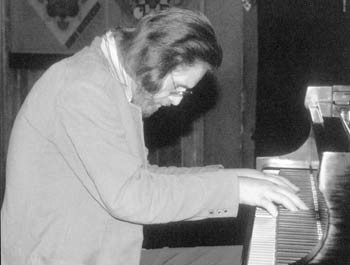
Agony & Ecstasy

New CD box set chronicles pianist Bill Evans’ final days

By GREG CAHILL

BIOGRAPHER Peter Pettinger once described the life of jazz pianist Bill Evans as “a slow suicide.” Racked by drug abuse and weakened by liver disease, Evans–renowned for his long lyrical lines and introspective style–displayed an unmistakable sense of urgency during the sessions heard on the newly released Bill Evans Trio: The Last Waltz (Fantasy), recorded just a week before his death in 1980 at age 51.

The eight-CD set, recorded over a nine-night engagement at the now-defunct North Beach jazz spot Keystone Korner, shows that Evans never gave up on his music, never lost his creative spark.

The box set is testimony that, as liner-note writer Derk Richardson points out in quoting Pettinger’s biography Bill Evans: How My Heart Sings, Evans’ personal “agony was defied to the end by his artistic ecstasy.”

There is little doubt that Evans knew he was dying when he performed these sessions. After the San Francisco dates, he returned to New York for a planned weeklong run at Fat Tuesdays. Evans managed just two nights onstage, staying home for three more and then succumbing to a hemorrhaging ulcer and bronchial pneumonia.

His death marked the end of a short but illustrious career that began in the early ’50s. Starting as a sideman for Charles Mingus, Miles Davis, and other notable jazz players, he established himself as a solo artist with the 1956 album New Jazz Conceptions. He went on to lead two celebrated trios under his own name and to record on several landmark jazz albums, including Davis’ Kind of Blue, Mingus’ East Coasting, George Russell’s Jazz in the Space Age, and Oliver Nelson’s The Blues and the Abstract Truth.

A quiet, somewhat nerdish figure, Evans didn’t integrate easily in the hip jazz world. In his 1989 autobiography, Miles Davis recalled the hazing he inflicted on Evans when the pianist took over Red Garland’s coveted spot at the keyboards in Davis’ band. One day, just to mess with his head, Davis told Evans that to stay in the band he would have to sleep with all the other band members, all males. Evans gave it serious consideration for 15 minutes before returning to Davis to say that he’d like to please everyone but that was something he couldn’t bring himself to do.

“I looked at him and smiled and said, ‘My man!’ And then he knew I was teasing.”

One thing Evans couldn’t resist at that time was heroin, a habit he picked up while playing in Davis’ band. Yet Evans left an indelible mark on Davis and the trumpeter’s influential work. Davis credited Evans with bringing the classical influences that underscored much of Davis’ finest work, including what Marin jazz writer Grover Sales once characterized as Davis’ “Debussy-like lyricism and reflective romantic delicacy.”

And despite the demons that dogged him throughout his troubled life, the artfulness of Evans’ improvisational work–so apparent in The Last Waltz sessions–was a driving force throughout his career. “There is a Japanese visual art in which the artist is forced to be spontaneous,” he once wrote in an essay on improvisation. “He must paint on a thin stretched parchment with a special brush and black water paint in such a way that an unnatural or interrupted stroke will destroy the line or break the parchment. Erasures or changes are impossible. These artists must practice a particular discipline, that of allowing an idea to express itself in communication with their hands in such a direct way that deliberation cannot interfere.

“The resulting pictures lack the complex composition and textures of ordinary painting,” he concluded, “but it is said that those who see will find something captured that escapes explanation.”

From the November 2-8, 2000 issue of the Northern California Bohemian.

© Metro Publishing Inc.
Open Mic

0

Yes on I

By Mark Green

IT IS A SAD TRUTH that in 13 years of working professionally to advance environmental protection, I have never seen as nakedly dishonest a campaign as the one being conducted by the opposition to Measure I, the Rural Heritage Initiative.

The No on I campaign is led by the Sonoma County Farm Bureau, which has fought strenuously against the creation of parks in the lands affected by Measure I for over 30 years. Yet it has erected signs throughout the county reading “Save Our Parks.” Measure I is, of course, supported by every major parks group and parks advocate in the county.

Measure I, which would impose a 30-year limit on sprawl, exempts farm family and farmworker housing, and it allows farmers to change crops, build structures, and do all the things they need to do to continue farming. If economic conditions changed, Measure I allows the Board of Supervisors to change the permitted activities within the land-use categories affected by Measure I to permit new uses and keep the land in farming–just not to allow increased development and subdivision. Yet the Farm Bureau’s campaign has asserted that these uses would not be allowed and has claimed that Measure I “would destroy farming in Sonoma County” . . . just as the bureau claimed four years ago that urban growth boundaries would “destroy farming.”

Measure I is supported by every environmental organization in Sonoma County and crafted by local citizens who have led the fight against sprawl. Yet the opposition campaign has claimed, quixotically, that the measure would “increase sprawl.”

Meanwhile, hundreds of Yes on I signs have been systematically stolen by teams of people working by night out of a pickup truck. In many cases, No on I signs have been put in exactly the same places that the Yes on I signs used to be–and they go up the same night that our signs disappear.

So voting for Measure I is now about more than protecting Sonoma County from the voracious economic pressures that have destroyed so many other wonderful places in the American West. Voting for Measure I is a statement that you believe that truth in politics means something, that the kind of cynical tactics that the leaders of the No on I campaign have embraced have no place in our local politics.

Vote for our future. Vote for the qualities we love about Sonoma County. Vote for integrity. Vote yes on Measure I.

Mark Green is executive director of Sonoma County Conservation Action, the county’s largest environmental organization.

From the November 2-8, 2000 issue of the Northern California Bohemian.

© Metro Publishing Inc.
Thanksgiving Wines

0

What a Turkey!

The annual vino conundrum of the Thanksgiving holiday feast

By Bob Johnson

COLUMBUS discovered America, Nixon was not a crook, and Clinton did not have sexual relations with “that woman.” Myths abound in American history, and they are perpetuated early in our lower institutes of learning. What grade school kid hasn’t been exposed to the image of Pilgrim settlers and Native Americans sitting down to a bountiful and harmonious feast billed as “the first Thanksgiving dinner”?

If you find it difficult to picture 17th-century Native Americans welcoming newcomers to their shores with open arms, you’re not alone. Well-documented accounts indicate that initial encounters between the two groups were far from friendly, and the Western range wars that would follow decades hence weren’t exactly symbols of a successful melting pot.

Still, the “first Thanksgiving” image lingered, and as the 20th century dawned, it was perpetuated through patriotic murals in town squares, calendar drawings, and illustrations in Saturday Evening Post­esque publications.

In 1920, when the 300th anniversary of the Pilgrims’ alleged philanthropy was celebrated, their place in history–erroneously depicted as it may have been–became permanently etched in the American psyche . . . and in the schoolbooks of America’s children.

While “the first Thanksgiving” may be a myth, the occurrence of harvest celebrations in colonial New England was not at all unusual. Sourcing an array of historical documents and family letters, a Massachusetts restaurant once attempted to replicate a “typical” harvest feast and included unnamed “wine, beer and cider” on the bill of fare.

Among the delicacies it concocted were bread of Indian corn, seethed fish, roast fowl (goose, swan, or turkey) with sauce, boiled sallet, dish of Jerusalem artichokes, boiled onions, furmenty, and, for dessert, a prune tart.

In other words, in at least one way, it was much like a modern Thanksgiving feast: it was a wine-matching nightmare.

The most talented vintner in the world, working with the most expressive clonal selections grown in the most ideally situated and meticulously tended vineyard, would not be able to craft a wine, be it purely varietal or a blend, that would match both seethed fish and a prune tart. Ain’t gonna happen.

However, clever Thanksgiving hosts have learned how to deal with the annual vino conundrum of the holiday feast. Rather than seeking that one unattainable bottle that would go sublimely with every dish–be it Jerusalem artichokes or green beans, furmenty or candied yams–they extend the bountiful theme to the beverage tray as well.

And rather than sticking to “safe” staples such as chardonnay or pinot noir, they push the culinary envelope by uncorking lesser-known and underappreciated varietals.

Fortunately, there is no shortage of such bottlings in the Y2K wine marketplace, especially for those who live so close to the source: the region generically referred to as “North Coast Wine Country.”

By uncorking these five bottles on the fourth Thursday of this month, one can accommodate virtually every flavor-matching challenge that the typical holiday feast–circa the 17th century or the 21st–could present.

Windsor Vineyards 1999 Private Reserve Semillon, Mendocino County ($15). Barely a semillon by definition, this blend also includes generous dollops of muscat canelli, sauvignon blanc, and chardonnay. With so many ingredients, its complexity is no surprise; vanilla, pear, smoky oak, and various baking spices jump out of the glass and linger in the after-flavor. This is a wine that will engage those who don’t normally drink vino, and at the same time won’t disappoint the chardonnay groupies. Rating: 3.5 corks (out of 4).

Shenandoah Vineyards 1998 Barbera, Amador County ($14.95). This “Cal-Ital” bottling is fruity from start to finish, with a distinct berry character and hints of coffee beans and coconut. A wine that should keep the pinot-philes satisfied. Rating: 3 corks.

Haywood Estate 1997 Zinfandel, Los Chamizal Vineyard, Sonoma Valley ($25). Some zins are big, some are enormous, and some are elegant. This one falls in the last category, with a subtle pepper aroma leading to flavors of blackberry jam, cedar, and cherry. Because it defies the in-your-face style of bigger zins, this is an extremely versatile food wine –ideal for the holiday table. Rating: 4 corks.

Fife 1998 “Redhead” Carignane, Redwood Valley ($18.50). The perfect companion to game meats or fowl, this smooth yet powerful wine is not at all subtle. Its aroma and flavor spectrum includes leather, white pepper, and various fruit flavors (plum, cherry, citrus), and its deep purple color is stunning against the backdrop of a white tablecloth. A wine that tastes good and looks good. Rating: 3.5 corks.

Husch Vineyards 1998 Postre, Mendocino ($20 per 375-ml. bottle). En español, postre means dessert, and this late-harvest sauvignon blanc would be a wonderful way to wrap up the Thanksgiving feast–with pumpkin or mincemeat pie, or solo. Nearly as much fun to smell as it is to drink, it conjures violets, orange peel, exotic spices, and even bananas Foster. Rating: 3.5 corks.

When historians summarize the wines available for Thanksgiving meals in the year 2000, they’ll likely do so with heaping helpings of praise.

And that assessment will be no myth.

From the November 2-8, 2000 issue of the Northern California Bohemian.

© Metro Publishing Inc.

Newsgrinder

Important events as reported by daily newspapers and summarized by Daedalus Howell. Saturday 11.04.00 University of California plant pathologist Matteo Garbelotto is seeking a weapon with which to wage war against the raging sudden oak death epidemic that has affected hundreds of thousands of trees in Marin, Sonoma, and Napa counties. According to...

Designer Babies

A Colorado couple ups the ante on genetic engineering of children By Christopher Kemp Photographs by Michael Amsler ANYONE WHO has read Aldous Huxley's Brave New World will remember the Embryo Store, just down the corridor from the Social Predestination Room of the Central London Hatchery and Conditioning Center. There, row...

‘Chicken Run’

Poultry Slam The Surreal Gourmet looks back on the year's strangest hit Writer David Templeton takes interesting people to interesting movies in his ongoing quest for the ultimate post-film conversation. This is not a review; rather, it's a freewheeling, tangential discussion of art, alternative ideas, and popular culture. ...

Dan Hicks

Modern Hicks Dan Hicks gets a new lease on life By Bill English DAN HICKS is wearing a new hat he picked up in New Orleans. It's a jaunty red yachting cap that gives the impression everything is clear sailing. But nothing in Hicks' 30-year-plus career has ever been easy. At...

Jakob Dylan and the Wallflowers

Jakob Dylan gets personal on latest CD By Alan Sculley When Jakob Dylan and his band, the Wallflowers, were making their second CD, Bringing Down The Horse (Interscope), they weren't thinking about hitting it big. Instead, the goal was much more modest. "When you're a band that's not successful, you're always looking for the ...

Open Mic

Open Mic Dog Wars By C. D. Payne IT'S NOT EXACTLY Bosnia, but I live in the middle of a war zone. In my neighborhood, windows are flung open at 3 a.m. and anguished voices can be heard screaming, "Stop that damn barking!" In dog language this must mean, "Yes, do...

Modern Feminism

A manifesta for Third Wave feminism By Tamara Straus IT IS EASY to be cynical about feminist activism today. The quest for equality--in the workplace, at home, on the street, and particularly in the corridors of power--is far from what advocates of the 1970s women's movement, the so-called Second Wave, fought for. There...

Bill Evans

Agony & Ecstasy New CD box set chronicles pianist Bill Evans' final days By GREG CAHILL BIOGRAPHER Peter Pettinger once described the life of jazz pianist Bill Evans as "a slow suicide." Racked by drug abuse and weakened by liver disease, Evans--renowned for his long lyrical lines and introspective style--displayed an...

Open Mic

Yes on I By Mark Green IT IS A SAD TRUTH that in 13 years of working professionally to advance environmental protection, I have never seen as nakedly dishonest a campaign as the one being conducted by the opposition to Measure I, the Rural Heritage Initiative. The No on I campaign is...

Thanksgiving Wines

What a Turkey! The annual vino conundrum of the Thanksgiving holiday feast By Bob Johnson COLUMBUS discovered America, Nixon was not a crook, and Clinton did not have sexual relations with "that woman." Myths abound in American history, and they are perpetuated early in our lower institutes of learning. What...
11,084FansLike
4,606FollowersFollow
6,928FollowersFollow