Julian Lage

0

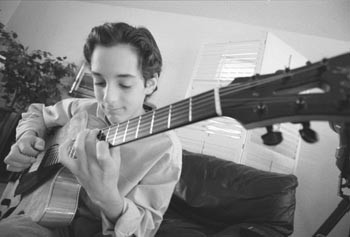
Youth brigade: Twelve-year-old Santa Rosa jazz guitarist Julian Lage improvises with the skill and grace of a seasoned performer. He performs Oct. 29 at the San Francisco Jazz Festival.

Young Gun

Preteen guitarist Julian Lage takes center stage

By Bill English

SOME SAY soul takes time–that you have to pay your dues to play the blues. But maybe soul has nothing to do with time. Maybe it resides in a place beyond age and reason.

Julian Lage of Santa Rosa began playing guitar when he was 5 years old. Now 12, he has already recorded with David Grisman, played in front of a international audience at the 2000 Grammy Awards telecast, and had an Academy Award-nominated documentary made about his precocious talents.

“I really wanted to start playing when I was 4,” Julian says as he sits on a leather chair in his family home. His handmade Manzer guitar seems like part of his body as he accents his words with gentle and serene jazz riffs. There is nothing flashy or contrived about his efforts–they’re easy and smooth.

“I saw my father playing the guitar, and I wanted to join him,” he continues. “But my mom and dad made me wait until I was 5.”

His parents, Mario and Susan Lage, both felt that Julian’s desire to take up the instrument at such a young age might be a passing fancy.

“We thought there might be physical constraints,” Mario explains. “Perhaps Julian’s hands wouldn’t be large enough. When I first took him to a music store, and showed him some small guitars, he didn’t like them. He said their tone wasn’t right. That tipped me off that maybe he had an ear.”

Within a year of getting his first guitar Julian was already playing in front of audiences. His father often took him to music stores, where he would jam with other musicians.

“As a parent it’s difficult to judge your child’s talent,” Mario says. “But I was immediately impressed with Julian’s work ethic. He’d practice five or six hours a day. Teachers would ask us if we were forcing him to practice. We told them, ‘We have to force him to stop.’ ”

Julian–who performs Oct. 29 at the San Francisco Jazz Festival–accepts his talent with little fanfare. He’s been playing the guitar for almost as far back as he can remember, and the act seems like a natural extension of his personality.

“If I have a gift, it’s the chance to make music and play with other musicians,” Julian says. “I never really think about why it comes so easy. To me it has never been about technique. It’s more about the feeling I get from the music. I’m just trying to be the best musically that I can be.”

Although Julian’s musical interests began with the blues, his current passion is jazz. His influences include pianist Bill Evans, saxophonist Sonny Rollins, and guitarist Pat Metheny but also embrace people like the late jazz violinist Stephan Grapelli and Indian sitar player Ravi Shankar.

“I think as you play you eventually discover a spiritual element in the music,” Julian says. “I meditate, and I find that this centers me and allows things to happen. You can’t force the music. You can’t force yourself into a groove.”

Nevertheless, Julian seems able to fall under the spell of his own music almost at will. Watching him play up-close is a transforming experience. There’s no awkwardness or hesitation. His fingers dance along the frets as if guided by some hidden force. He clearly loves playing and says he wasn’t intimidated performing at the Grammy Awards.

“I really enjoyed the experience,” Julian says. “I wasn’t nervous. I knew what I was there to do. It wasn’t like they were asking me to play the saxophone. I was there to play the guitar. It was very simple.”

Julian improvises with the grace of a seasoned performer. His ability to go beyond merely cloning the licks of older musicians has gained him respect and afforded him the opportunity to jam with the likes of Carlos Santana.

“If you take a song like ‘Autumn Leaves,’ ” Julian says, “and start improvising on a solo, what makes it interesting is the contrasts you create with the song’s basic form. You have fun with it.”

Because of a demanding rehearsal and appearance schedule, Julian has a home tutor provided by Santa Rosa’s Mark West Springs School District. He also studies music with Sonoma State University instructor Randy Vincent (with whom he’ll be performing at the S.F. Jazz Fesiival). Although Julian plays a number of different instruments, including an Indian drum called a tabla, his primary focus remains the guitar.

“I went to the dentist and they had this form to fill out,” Julian says with a smile and a riff. “They wanted to know if I played any instruments. I just filled in everything I’d ever touched until I ran out of space on the form.”

From the October 26-November 1, 2000 issue of the Northern California Bohemian.

© Metro Publishing Inc.

2000 Elections

0

Sprawl Brawl

Behind the big lie, and other North Bay issues. Plus select endorsements for local races

By Greg Cahill

DULLSVILLE. That’s how most North Bay residents wrongly view the upcoming general election. Indeed, the local races, for the most part, are a snorefest compared to last spring’s heated primaries. At that time, Sonoma County voters were treated to a knock-down drag-out fight between county Supervisor Tim Smith (amid allegations that Smith used campaign funds to purchase perfume and panties at Victoria’s Secret for his secretary) and Santa Rosa City Councilmember Noreen Evans; the bitter judicial battle worthy of MTV’s Celebrity Deathmatch.; and don’t forget the last-minute withdrawal of Sonoma County Conservation Action’s endorsement of golden boy Joe Nation because Nation (a member of the Marin Municipal Water District board of trustees) supports pro-development water policies.

This time around: No dirty laundry hanging at the Board of Supervisors’ chambers (silky or otherwise), no judicial jugular assaults, and as for Joe Nation, well, he’s amassed a huge $300,000 war chest in his quest for power.

At the Polls: The Bohemian’s select endorsements.

But the most important decision on Nov. 7 is the future of North Bay sprawl and protection of the environment. That’s especially true in Sonoma County, where Marin land-use policies–or more precisely, the lack of usable land in Marin–has led to a northward exodus of workers and businesses, squeezing environmental resources and pressuring Sonoma County communities to transform pristine farmlands into acres of suburban cul-de-sacs.

And that leads us to the most important question: Will you fall for the big lie being propagated by opponents of Measure I?

If approved, Measure I–or the so-called Rural Heritage Initiative–would require voter approval for the next 30 years of any amendment to the Sonoma County General Plan calling for significant development of agricultural land.

Proponents of the initiative–the most contentious issue on the current North Bay political landscape–point out rightly that the measure supports urban growth boundaries passed by an overwhelming majority of voters in several Sonoma County municipalities and enforced in unincorporated areas of the county adjacent to those cities. The RHI also supports the goal of compact, city-centered development, where services are most efficiently available and mass transit is most readily accessible.

The RHI is modeled after a similar initiative–Measure J–adopted 10 years ago by Napa County voters. That measure effectively helped preserve Napa County agriculture by halting the construction of a mega-resort and major housing subdivisions of 100 or more units. Measure J proved that a region can retain its natural heritage while accommodating growth.

The RHI can achieve the same goal.

It has the support of every major environmental organization–including the Sierra Club (both the Sonoma and the Napa County chapters) and Greenbelt Alliance–as well as west county Supervisor Mike Reilly and environment-friendly city councilmembers from five communities throughout the county.

The initiative would help save open space that contributes to the scenic beauty of the county and helps draw tourists to the region to the tune of nearly $1 billion a year. It would help protect the county’s agricultural heritage–which contributes $3 billion to the local economy, one-fifth of the region’s overall economy–and would help forestall the kind of nearly unchecked sprawl that has marred Silicon Valley. Proponents emphasize that the Sonoma County Agricultural Preservation and Open Space District estimates that 60 percent of land in the county is at risk from urban sprawl and that growth pressures could overwhelm Sonoma County within the next 30 years.

At the same time, the initiative accommodates steady growth and housing needs for all economic sectors of the county by requiring that future growth be focused within city limits as intended under UGBs approved by voters in Santa Rosa, Sebastopol, Petaluma, Healdsburg, Windsor, and Cotati. On Nov. 7, voters in Rohnert Park (which already approved a limited UGB) and Sonoma will decide on new UGBs.

Opponents of the initiative–which include the politically powerful Farm Bureau (which fought Measure J in Napa County) and some of the wine industry’s biggest and most aggressive agribusinesses–are running a well-funded and deceptive campaign charging that the initiative would be bad for farms and eliminate new parks. Actually, the initiative would protect farmlands for future generations–especially the precarious dairy industry–and it makes allowance for new parks as well as fire, police, and other public service facilities.

One of the loudest opponents of the initiative is the Press Democrat, the Santa Rosa-based daily that relies heavily on real estate advertising and often serves as the mouth organ for the development community.

The paper’s Oct. 15 endorsement of RHI opponents is little more than a hollow defense of speculators and future developers posing as farmers. The PD arguments can be characterized as fear of the unknown, sowing fear, uncertainty, and doubt about unspecified “unintended consequences” (repeated four times in the editorial) and “ambiguities” (read the text of the measure–it’s clear enough); attacking the authors, their competence, process, and motives, especially the supposedly “poor preparation,” and regurgitating the oft-cited complaint that the RHI was “written by a San Francisco law firm” without any input from farmers in a fashion intended to create “full employment for lawyers,” always an easy mark; and claiming that the measure is unnecessary because county residents can take it as “an article of faith . . . that future development will occur only within existing urban boundaries.”

Yet the editorial fails to name a single specific bad or terrible thing that would result if the measure is approved. Instead, it takes cheap shots at lawyers and asks residents to trust the good intentions of developers without explaining the mounting pressures for sprawl and the worsening traffic congestion on Highway 101 and the county’s secondary roads.

Without strict controls in place to check sprawl, there will always be a reason to develop farmlands: In Silicon Valley, powerful forces have managed to push through development in recent years by claiming economic necessity–either the area is slumping and needs tax revenue, or it’s booming and citizens need housing and entrepreneurs will go out of business without more development.

The PD–and other RHI opponents–would have you believe that there is “no immediate threat” and “no big developments waiting in the wings.” Don’t buy into the big lie–vote yes on Measure I.

From the October 26-November 1, 2000 issue of the Northern California Bohemian.

© Metro Publishing Inc.

Newsgrinder

0

Newsgrinder

Important events as reported by daily newspapers and summarized by Daedalus Howell.

Tuesday 10.18.2000

The Argus-Courier reports that a Petaluma police officer investigated a charge of assault by a woman whose husband had burned her with a cigarette butt during an argument. The firebug hubby said that his wife had thrown a drink on him (boohoo), so he threw a lit cigarette at her. The cop, doing the math in his head, determined the woman to be the “primary aggressor,” perhaps because, statistically, more people are harmed in liquid-related incidents (i.e., drowning) than in those that involve flame. The wife was arrested for domestic violence, and progress continued unfettered.

Sunday 10.22.2000

Petaluman Kathie Hewko knows how to stroke. Voted the most likely local to escape from Alcatraz, Hewko braved the murky waters of San Francisco Bay when she swam from Fort Point in San Francisco to Lime Rock in Sausalito for the 25th time last weekend, reports the Press Democrat. The perks? Seeing the underside of the Golden Gate Bridge while doing the backstroke. The 54-year-old Hewko swam the mile span in just under 40 minutes. No word if she’ll next brave the H20-way of her hometown slough, the Petaluma River.

“We Have Issues,” blared a sign spied at the first Sonoma County Youth March on Saturday that ended with a rally at Courthouse Square in downtown Santa Rosa. When interviewed by the PD the teenager toting the sign recapitulated her plight, “I have a lot of issues.” By far the youth with the most issues, however, was the lone Republican problem-child adrift in the sea of aspiring Democrats (just gotta be different, don’t ya?). The 16-year-old, bedecked with a Bush/Cheney pin on an epaulet of his crisp brown shirt, pulled a swath of blond hair behind his ear, fixed his piercing blue-eyed gaze, and decried his classmates for being “liberal by default.” The drone added, “In California, young people are supposed to be liberal.” At least young people who expect to become old people–the PD failed to report whether or not the Bush Youth droid survived the suffusion of positive energy wafted his way by his peer group. Though turnout was a far cry from the 200 expected, the event’s 17-year-old organizer wasn’t fazed. “I believe apathy is a habit,” she said. Apparently, most of her comrades had the jones. Rep. Lynn Woolsey, D-Petaluma, was on hand to siphon some of the young blood, commenting that “young people have so much to add to our political life.” Like another four years in office–when they can vote.

Napa skate rats can exhale a collective bong-hit of relief–their skate park was spared becoming a much-needed parking garage for an expanded Cinedome because it’s too expensive to move a sewage pump station that shares the park’s block, reports the Napa Valley Register. Interestingly, before civic-minded city officials recognized that skaters had needs too, “parking garage” in local skaters’ jargon roughly translated as “skate park.” “Sewage pump station,” however, still means “the big shit machine we blithely frolic near.”

Monday 10.23.2000

The Santa Rosa daily reports that beachcombers looking for a cheap high are advised to forgo Bodega Bay clams, which state officials believe are contaminated with a natural strychninelike toxin that can cause drunklike symptoms–and death. A quarantine of the shellfish has been in place since September, but may be lifted as soon as scientists figure out a way to make money off of them. A director of environmental health services for the Sonoma County Health Department says clam imbibers will often “feel funny,” though most “weather through it, and there’s nothing more to it.” Except the telltale shells of a clam habit.

Strange habits die hard, continued: Terra Linda High School Trojans tight-end Steve Carter admits he tucked a miniature chocolate football into the waistband of his pants at the start of the 2000 season, reports the Marin Independent Journal. The little brown pellet had been sitting in a glass on Carter’s dresser since a victory over a rival team at the end of last year’s season. “I don’t think I’m going to be eating it–I’m holding on to this one,” Carter said of the talisman after recently besting the same rival team. Donations for Carter’s psychological counseling fund can be sent in care of Terra Linda High School.

Tuesday 10.24.00

Thin-skinned Naderistas, who have a hissy fit every time this publication breathes so much as a word about Green Party presidential candidate Ralph Nader’s impact on the upcoming general election, will love this Associated Press item that ran in the PD. In an article that advises, “The race in California is less stable than anyone expected,” the AP notes that “Nader’s effect on the re-election has not been lost on GOP strategists.” Indeed, California Republican Party spokesman Stuart DeVeaux proclaimed in a recent news release, “Go Nader Go.” Sure, you can vote your conscience, just don’t whine too loudly when your conscience suffers a setback after eight years of Bush-league governance.

From the October 26-November 1, 2000 issue of the Northern California Bohemian.

© Metro Publishing Inc.

‘Lear’s Shadow’

0

Bright ‘Shadow’

Fred Curchack reworks ‘King Lear’ with dazzling results

By Daedalus Howell

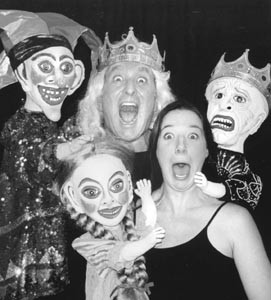
“A PESTILENT GALL!” Shakespeare purists may cry upon seeing Fred Curchack and Shannon Kearns’ riveting redux of King Lear, the Bard’s paean to family dysfunction–brought to Petaluma’s Cinnabar Theater as Lear’s Shadow. But what fools they would be! This “Daddy Dearest” is a sublime theatrical alchemy of acting, video, movement, puppetry, original texts, and profound invention.

Depicted as the lunatic musings of a salty theater impresario with a waning memory, Lear’s Shadow is cast over a professional and romantic relationship that shipwrecks on an unanticipated pregnancy. When the cigar-gnawing Scully (one of several roles exquisitely executed by Curchack) learns that his collaborator and lover, Binky (played with tragic allure by Kearns), is pregnant, he forbids her to have a child for fear of losing their investment in a staging of King Lear.

Curchak and Kearns use this Chinese-box device like a booby trap to ensnare their audience in a web of verisimilitude and artifice that delightfully confounds even as it explores to the hilt the myriad relationships that might exist between a man and a woman.

Imagine Jorge Luis Borges’ short stories onstage, with a tip of the hat to Broadway golden boy Bob Fosse’s autobiographically inspired All That Jazz. Then mix in equal parts Monty Python and Antonin Artaud and down it all with a Woody Allen chaser and you have a fair approximation of the intoxicating delights of Lear’s Shadow.

Curchack’s Cinnabar appearances are usually one-man atomic explosions, but this time he is aided and abetted by an accomplished accomplice–the equally combustible Kearns. No mere magician’s assistant, Kearns proves she is more Curchack’s partner than protégé–she offers a canny cocktail of talent, verve, and a chameleonlike ability to transform absolutely into her various characters. The stage-borne magnetism that crackles between her and Curchack is one of the production’s greatest assets.

Lear’s Shadow brims with Curchack’s characteristic one-liners, as when he croaks, “I still give myself a hard-on!” while watching himself dressed in drag as one of Lear’s daughters in a projected “rehearsal video.”

Throughout, Curchack and Kearns create compelling stage-pictures: for instance, Kearns (as Lear’s wayfaring daughter Cordelia) crosses her shadow into a projected close-up of the caterwauling Lear’s gnashing teeth. The interplay between video and live action (a mainstay in Curchak’s solo work) also includes slapstick bits that are feats of comic timing.

By far the most haunting (and hilarious) image appears when Binky, lamenting her unborn children, cries, “They keep trying to be born and we keep killing them,” while a pair of skull-headed kewpie-doll puppets with pink and blue wings chirp, “Mama, Dad-da.” Kearns belts out an earsplitting scream, and the scene is burned indelibly into one’s memory.

Lear’s Shadow is an inspiring experiment that buoys the soul while illustrating its limitations. As a character counsels, “We that are young will never see so much or live as long.” But no worries, theatergoers, Curchack and Kearns have brought the Cliff notes.

‘Lear’s Shadow’ continues on Friday-Saturday, Oct. 27-28, at 8 p.m. at the Cinnabar Theater, 3333 Petaluma Blvd. N., Petaluma. Tickets are $12-$15. For details, call 707/763-8920.

From the October 26-November 1, 2000 issue of the Northern California Bohemian.

© Metro Publishing Inc.

Spins

0

Boss Tones

Springsteen tribute re-examines a masterwork

by Greg Cahill

AT HIS BEST, Bruce Springsteen’s songs are mini morality plays, chronicling the lives of what music writer Robert Santelli has called “good people . . . poisoned by bad luck and malice.” For these misfits–whose hard-luck tales, shattered dreams, and broken lives resonate with Sprinsteen’s legion of fans–it is a hard road to the promised land.

As a rock-and-roll working-class hero and plainspoken visionary who rode the downbound train to fame and fortune, Springsteen plumbed his darkest side as a songwriter and storyteller on 1982’s Nebraska, a noncommercial solo acoustic set of 10 songs that serve as the focus of a newly released big-name tribute featuring Los Lobos, Aimee Mann and Michael Penn, Dar Williams, and Ani DeFranco, among others.

The stark original, recorded at home on a four-track tape recorder, was fraught with losers, desperadoes, and killers caught in the cold glare of the headlights and recounted in stripped-down folk arrangements and with no apologies.

Badlands: A Tribute to Bruce Springsteen’s Nebraska (Sub Pop) never tops the original, but plenty of highlights make this worthwhile for any rock fan. (The 13-track CD adds three songs–including two from Born in the U.S.A., Springsteen’s hyper-commercial 1984 release–originally recorded during the Nebraska sessions.)

Some artists manage to reinterpret the songs in interesting fashion–as should the best of any tribute album–bending and reshaping the original songs to their own distinctive style. Others–the Crooked Fingers version of “Mansion on the Hill,” for instance–leave you wondering if the Boss himself wasn’t behind the mic.

Chrissie Hynde and Adam Seymour of the Pretenders kick off the tribute with a dreamy and somewhat dreary rendering of Nebraska‘s title track, a first-person account of mass murderer Charlie Starkweather’s killing spree–filmmaker Terrence Malick had told the same tale in his 1973 film Badlands (a name later used as a Springsteen song title).

But arguably the best track on the CD is Hank Williams III’s take on “Atlantic City,” a full-blown hillbilly reverie replete with country fiddle and passages from Hank Sr.’s oeuvre. In fact, the successful countrified transformation of these Americana classics–Hank III’s aforementioned showstopper, Deanna Carter’s “State Trooper,” Son Volt’s “Open All Night,” Ben Harper’s “My Father’s House,” and Johnny Cash’s “I’m on Fire”–makes you wonder why Nashville has been slow to drink from Springsteen’s well in the past.

Indeed, it’s the songs at the core of these remakes that shine throughout Badlands. As heartland rock, this tribute succeeds in showing why Nebraska remains one of the most challenging recordings ever released by a major rock act.

From the October 26-November 1, 2000 issue of the Northern California Bohemian.

© Metro Publishing Inc.

Green Scene

0

BRAVING cloudy skies and brief drizzle, a large crowd of music lovers and journalists gathered Oct. 20 to watch Sonoma State University President Rubin Armiñana break ground for the construction of the much-anticipated Donald and Maureen Green Music Center.

Some might have taken the stormy weather as a bad omen, but Armiñana was looking on the sunny side: “In Greece, rain during a ceremony means success,” he quipped as the shower forced him to cut short his opening speech.

The rain dried up as telecom millionaire Donald Green (for whom the center is named) took the stage. Green–who, along with his wife, Maureen, donated $10 million to the project in 1997–reminded his audience that fundraising for the $43 million center is far from complete. About $18 million is needed to complete the capital campaign.

“We have a number of millions of dollars still to raise, so you will continue to be touched by this project,” Green told the crowd. “But we’re confident we will succeed.”

The ceremony also featured brief performances on the makeshift stage by the Santa Rosa Symphony Brass Quintet and the SSU Chamber Singers. The rudimentary production values during the performances stood in stark contrast to the state-of-the-art concert hall that will soon occupy this 53-acre field at the intersection of Rohnert Park Expressway and Petaluma Hill Road.

With construction now under way, the project–which promoters describe as a “cultural hub for the North Bay”–is expected to be completed in the fall of 2003. Explicitly modeled on the world-famous Tanglewood Music Center in Massachusetts, the Green Music Center is the result of a collaboration between SSU and the Santa Rosa Symphony, which will move its performances there from the Luther Burbank Center.

There were plenty of jokes and smiles on and off stage during the ceremony, but the project does have a few quiet critics in the university community.

It’s tough to find anyone willing to say so publicly, but some faculty and students express fears that the music center–along with other large construction projects at SSU like the Schulz Information Center–could permanently transform the school’s quiet atmosphere by delivering such problems as traffic woes. Indeed, the groundbreaking itself was marred by a serious traffic accident that occurred as an SSU student was waiting to turn off Rohnert Park Expressway into the construction site.

Other members of the SSU community privately express a concern that the Green Music Center is too oriented toward classical music. They wonder if the concert hall–which is principally designed for acoustic acts–will be able to pay its operating costs without featuring pop acts to draw a larger crowd.

But the Green Music Center will probably play host to a wide array of acts and events, ranging from jazz to lecture series to business conferences to dance acts, according to Floyd Ross, the music center’s executive director. “We’re not excluding anything at this point,” Ross explains.

The center will feature a 1,400-seat concert hall, a small recital hall for choral and chamber music, and an outdoor sound system to permit open-air concerts in a space that allows a 3,000-member audience direct sight of the stage.

From the October 26-November 1, 2000 issue of the Northern California Bohemian.

© Metro Publishing Inc.

Open Mic

0

It’s a Library!

By Jonah Raskin

IN UNDERSTANDING Media , Marshall McLuhan– “Mr. Mass Media”–persuaded me that we live in the “Information Age,” and in deference to McLuhan, I suppose I ought to accept the fact that we now have “Information Centers,” including the new Jean and Charles Schulz Information Center at SSU. The trouble is, I’m troubled by the idea of an “Information Center” in a way I was never troubled by the idea of a “library.”

“Information Center” sounds like the sort of buzz term that’s used to pry money from tight-fisted Sacramento politicians. “Library” sounds old-fashioned–a relic of ancient times. Of course, I’m attached not only to the concept of the “library”–which has served humanity for ages–but to my own memories of libraries all over the world, from New York and London to Mexico City and Hanoi.

I love libraries, and I love the smell, the look, and the feel of books.

You can imagine, then, how peeved I was that no one said a word about books–at least not from the podium–at the recent ceremony to mark the opening of the Jean and Charles Schulz Information Center, though there was talk of computers and though SSU President Ruben Armiñana spoke eloquently about the lowly, ubiquitous pencil, as itself and as a metaphor for things much bigger. Sonoma County’s Poet Laureate Don Emblen, who attended the ceremony along with dozens of other notables, noticed the omission of books from the speeches, and it troubled him as it troubled me.

Of course, like Emblen, I’m bookish.

I write books, read them, review them, and assign them to students who, increasingly, don’t bother with books. Students are on the Web, of course, and while the Web is a wonderful place to be, it doesn’t beat books. I’ve searched online and I’ve gone hunting in books, and books are still the best source of information.

It’s too bad no one said that at the ceremony.

I suspect it’s too late to lose the name “Information Center” and go back to “Library.” And it’s probably too radical to stage a “read-in” to remind the campus that books are indispensable. But maybe students will come for the computers and stay for the books, without a “read-in.”

As far as I’m concerned, the new building will always be the Jean and Charles Schulz Library. I’m sure Marshall McLuhan would want it that way, and I bet Snoopy would, too.

From the October 19-25, 2000 issue of the Northern California Bohemian.

© Metro Publishing Inc.

Molly Giles

0

New book applies familial angst with a trowel

By Yosha Bourgea

KAY MCLEOD needs therapy. Her father, Francis, is a successful architect and a world-class alcoholic. Her mother, Ida, has just had her second leg amputated because of gangrene, and she’s an alcoholic as well. Kay is married to Neal, a humor-impaired vegetarian who forgets anniversaries, steals inheritance money, and can’t get it up in bed. None of these people are nice to Kay, who, in addition to being an alcoholic, is a lifelong doormat.

This is the bleak setup for Molly Giles’ Iron Shoes (Simon & Schuster; $22), another dysfunctional-American-family story. As a perusal of the racks in any bookstore will show, this genre is alive and well. The best examples are, naturally, the ones that surprise and enlighten us with insights into character and variations on the form.

Iron Shoes is not one of those. Although it has flashes of original style, it is maddeningly obvious on the whole. Heavy on the pop psychology terms, it unfolds with the sincerity and predictability of an Alcoholics Anonymous pamphlet.

Ida, the caustic matriarch of the family, is dying. She has hallucinations of a blue horse that stands outside her hospital window and talks to her, but she’s still lucid enough to torment Kay, her easiest target, with a shrewd combination of guilt and insult. Some of the most bracing moments come early in the book, during Kay’s visits to the hospital, as when she contemplates her mother’s amputated limbs: “This new stump was rawer. Ruder. More butchered-looking. Meat, Kay thought. That’s what we’re made of. No wonder Neal won’t touch me.”

Passages like these are alive with energy and risk, but many others suffer from clichéd phrases and awkward puns (“another day, another dolor”) or simply work too hard to impress.

Part of the problem is the use by Giles (a former North Bay resident and author of the Pulitzer Prize-nominated short-story collection Rough Translations) of a third-person perspective that shifts among Kay, Francis, and Ida–a technique that permits a view into the mind of each key character.

Here, it softens the emotional impact by reminding us that the private thoughts we’re reading have been paraphrased by an intermediary. To make matters worse, these secondhand interior monologues are weakened by stretches of stagy exposition that render the characters less believable.

Neal in particular is a caricature, a composite of male hang-ups. He is critical and dismissive of Kay (“Don’t spiral,” he sniffs when she gets upset); he stops in the middle of sex to take out the trash; he wears the same socks three days in a row. In short, he has no redeeming value.

As a device to elicit sympathy for the novel’s heroine, Neal backfires; he’s so spectacularly awful that we begin to question the intelligence of a woman who would choose to stay with him. Kay endures so much emotional abuse, with so little insight into her experience, that it becomes deeply frustrating to watch her.

There is redemption, however–that’s a prerequisite of the form. After a particularly self-destructive night, Kay confronts her family and her husband, makes peace with herself, and quits drinking. But the climax comes without a buildup, and the aftermath feels tacked on.

The novel’s title comes from a fairy tale Kay tells her son, Nicky, about an evil troll who tricks a king and queen into putting on heavy iron shoes they can’t remove. It’s a good metaphor for the burdens Kay endures. But it also works for the book, which is heavier than it needs to be and goes nowhere. ®

Molly Giles reads from ‘Iron Shoes’ on Friday, Oct. 20, at 7 p.m. at Copperfield’s Books, 140 Kentucky St., Petaluma. For details, call 707/762-0563.

From the October 19-25, 2000 issue of the Northern California Bohemian.

© Metro Publishing Inc.

Millennial Anarchy

0

Rage Against the Machine

The millennium marks the return of anarchy

By James MacKinnon

OVER THE WIRE comes a report of an anarchist punching a police officer in the face, “repeatedly,” during a street protest in Philadelphia. I imagine that little clot of information exploding outward through the endless fractals of the Information Age. I picture it reaching the suburban dinnertime conversations of a hundred million American Beauty households, and if I listen closely, I can hear America tut-tutting.

But then, there is something shocking about some punk putting one up in a cop’s face. In a culture that can absorb, without flinching, the fact that certain individuals can afford to order takeout for the world’s poorest billion without losing their seats in the Billionaire’s Club, punching a cop remains a genuine shock. If you make an effort to understand it, your internal pop-psychologist kicks in: I’m getting the sense that you’re angry. More than likely, you give in to an almost gut-level feeling that this is very, very wrong: In America, One Does Not Punch an Officer of the Law.

Sitting in a shady urban park, I bring this up with Closet Punk (“I’m kind of a punk, but I’m in the closet”). He has been sitting cross-legged with an almost Gandhian stillness, but now he stands and begins to act out the climax of a 1999 protest in Montreal, when riot police sealed death-penalty protesters in an alley before they had even begun to march.

“You could just feel this panic building,” he recalls. “Suddenly they ran at us–a totally unprovoked police charge.”

As people scrambled to escape up a single-file staircase, the cops closed the gap. Closet Punk mimes the way a baton to the face knocked his friend down onto the bike she was pushing. He stepped in as a human shield, felt the jarring pain of a truncheon to the thigh, then managed with one hand to grab the officer’s weapon.

“I just looked him in the eye and . . .”

He gropes for a way to describe the complexity of an epiphany. “The state is going to crush you if it doesn’t agree with you,” he says finally.

THE PROTEST in Montreal ended when the police destroyed the activists’ signs, then allowed them to leave, two by two, like animals off Noah’s ark. And so, in Closet Punk’s world, news of people striking back against police has a much different effect than it does on a person watching the nightly news and thinking that all these balaclavas and bandanas have grown a little stale.

In 1969, Carl Oglesby wrote about the effect in The New Left Reader: “The policeman’s riot club functions like a magic wand, under whose hard caress the banal soul grows vivid and the nameless recover their authenticity.” Closet Punk wraps up his story of cops and rebels. “That was really like a life-changing thing for me,” he says, then laughs lightly. “It’s ironic. They’ve unwittingly created a radical anarchist.”

Anarchist. (Pause; roll of timpani, clash of cymbals.) Yes, the capital-A Anarchist is back, and he’s wearing a big black gas mask and breathing like Dennis Hopper in Blue Velvet. He’s cursing the hippies and climbing the walls of the gated community. He’s throwing bricks and lighting fires, and when he rolls out at midnight in his long black car, you’d better believe that he’ll have Jesus in the trunk. This is an all-points bulletin, and in Anytown, America, good citizens are scrambling to hide the booze and lock up their daughters.

That’s the easy definition. Taking a truer measure of anarchy is puzzlingly difficult, as David Samuels found when he reported on the infamous radicals of Eugene, Ore., for Harper’s magazine. Samuels concluded, in concerned tones, that the anarchists suffer “the absolutist psychology of children whose parents split up or sold out or otherwise succumbed to the instability inherent in modern marriage.”

However wrong or right about his sample study, Samuels was opening a historical wound. Lenin himself declared anarchism an “infantile disorder” (best cured, added Trotsky, with an “iron broom”), and critics ever since have suggested that anarchists, as one historian put it, “project onto the State all the hatred they felt for parental authority.”

It is just as easy, of course, to explain a person’s faith in authority through the psychology of a child with a burden in his pants. If only anarchists suffer such Freudian analysis, it’s because journalists are conditioned to expect tight limits on public behavior, argues Jason McQuinn, an anarchist for 30 years and editor of Anarchy magazine. “Rather than taking into the light the idea that there are some people who believe they can change power in a structural way,” he says, “mainstream media wants to believe that these people are in some way acting out their sickness.” To many, that will sound paranoid, like the complaint of a nudist who just doesn’t get why the rules are against her.

But, like the nudist, the anarchist is just so different that you’re all too prone to stare at the obvious. At best, you might try to guess what makes her tick. There are a lot of gaps to jump before you finally think: Maybe this person makes sense.

IF YOU WANT to stare into an anarchist den, you might start on Earl Street, in a mixed neighborhood of Toronto. The building itself is Romanesque Italian, rising in stone and stained glass. This is Our Lady of Lourdes, a Jesuit parish, and the place of worship of poet, author, and professor Albert Moritz.

Moritz is an anarchist and Catholic, or as he puts it, “a Catholic among anarchists, and an anarchist among Catholics.” It’s a difficult and deeply personal balance that Moritz describes as a refusal to reject any influence that resonates with his sense of humanity. “I’m a palimpsest,” he says. “My life is a matter of maintaining contradictions and attempting reconciliations.”

Anarchists like Moritz are easier guides into what might be called “the anarchist conversation” than, say, a vegan squatter who goes by the single name “Kronstadt.” As Moritz would be the first to declare, though, “easy” does not mean “more legitimate.” It’s a question of starting points, and the anarchists interviewed for this story–including a warehouse worker, a youth-care advocate, a “boss,” and a computer coder–start somewhere nearer to the house-in-the-suburbs, 2.5-child norm than my (fictional) Kronstadt. Moritz, for example, recommends anarchism as, to begin with, a way “to lighten up your thought.”

In its immediate impression, anarchism is the intellectual equivalent of the place the socks go when they vanish from the laundry. Consider, for example, the disappearance of outrage. Earlier this year, The Filth and the Fury–a documentary about the seminal punk band the Sex Pistols–hit audiences with an opening collage of 1970s Britain. Pneumatic models hawk vacuums on TV; black-tie swells drive past squalid housing projects; the Queen looks as if she smells something nasty that she can’t possibly mention. It’s a setup, designed to make sure you understand that, once upon a time, it made sense to scream, like Johnny Rotten, “Anarchy! Get pissed! Destroy!”

What might strike the viewer, though, is that nothing much has changed. Imagine a collage for the year 2000: virtual fly-fishing, “doggie day-care,” the cult of Oprah, 2 million in prison in the USA, the greatest gap between rich and poor in living memory. Somehow, though, all that punk rage seems passé. Are these just “different times”? Or do the same forces that virtually prohibit ripped jeans (so ’80s!) also convince us that anger’s uncool?

OUTRAGE fell from fashion, so much so that even our most visible radical groups–like Earth First!, the Ruckus Society, and the Direct Action Network–seem restrained. Most have settled into media-savvy campaigns of nonviolent direct action (many of their members, it has to be noted, are anarchists). But within the anarchist conversation, outrage is a warming fire around which to debate the unmentionable questions. Right now, a new consensus is attracting a limited following, best known through the Black Bloc street radicals that believe corporate media to be a monster that isn’t worth feeding, that property damage isn’t violence unless living things are wounded, and that enduring police violence may be the same as accepting it.

Without this debate, people like Albert Moritz would condemn the Black Bloc anarchists out of hand. Within the debate, he refuses to rebuke them. “I wish them well,” he says. In fact, Moritz, the good Catholic, refuses to reject even the possibility of a morally defensible offensive attack on the police.

“These are real questions,” he says. “After the Second World War, the United States was perhaps the chief enforcer of the notion in the Nuremberg trials that you are demanded to adhere to a higher standard than the laws and ideals of the country that you happen to be in, the organization that governs that country, or the military body that gives you orders. You were held guilty unto death if you didn’t dissent from them unto a higher standard. But, within our own political discourse, it’s usually considered absolutely verboten to invoke that same principle.”

The submerged conversation that connects people like Moritz to a teenager building a fiery barricade out of a Dumpster is the reason anarchism, and not only “the anarchist,” creates such a furor each time it rises near the mainstream. To government and corporate authorities, no good can come if Jo Coffeecup discovers that this thing called “anarchism” is like an ongoing talk-radio program where the unspoken is always the topic of the day.

YOU’RE listening to Circle A Radio, folks, and the question today is “Are there times when it’s OK to attack the police?” We’ve got Caleb Williams on the line from Boise. Hi, Caleb.

Hello out there, I just want to say that I love your show. . . .

You can almost hear the truncheons thumping on the riot shields, the stern murmurs in the White House, the family counselors helping parents figure out if their children are hanging out with anarchists.

“I sometimes have the feeling that many of these people suspect there is a kind of Berlin-Wall-in-1988 quality to the supposedly massive satisfaction and confidence of the late capitalist system,” says Moritz. “They react with rage because there is some fear behind it.”

We are slowly circling the anarchist beast, but there’s no other way to approach a 200-year-old philosophy that is still absent from most political science reading lists. Its “experts” reject the term, and insist that if their words aren’t fixed and true, then that’s exactly the truth they’re shooting for.

“The first anarchist was the first person who felt the oppression of another and rebelled against it,” writes Peter Marshall in his hefty history of anarchy, Demanding the Impossible. In effect, anarchism lays claim to the root of grassroots.

A few things can be said for certain about anarchist philosophy. Anarchists reject the legitimacy of external government, political authority, corporate power, hierarchy, and domination. They believe that, through social rebellion, society can become a voluntary association of free and equal individuals. “Mind your own business” has been an anarchist motto, but the emphasis on equality separates the anarchist from any free marketeer. Anarchism imagines the maximum individual freedom that is compatible with freedom for all others, and it is along this line that anarchists fiercely debate and divide. There’s an old joke: “What do you get if you lock two anarchists in a room? Three splinter groups.”

The movement that emerged with the “Battle in Seattle” has been publicly linked to anarchism, says Cindy Milstein, a faculty member at the Institute for Social Ecology in Vermont, but the association isn’t as strong as it should be. “I have never seen a movement that included so many anarchists, whether they were dressed all in black or not,” she says.

“The direct action part of it–from the affinity groups to the puppeteers to independent media–has either been strongly influenced by anarchism or is initiated by anarchists.”

The new movement building out of Seattle is at least “proto-anarchist.” It is radically decentralized, largely leaderless, tolerant of a wide range of expression–and ready to party whenever power takes a tumble.

These are essential elements of anarchist history. The Zapatistas in Mexico are anarchistic: sovereign, self-governing, structured without hierarchy, intensely local, and in direct confrontation with government and corporate power. Green politics, with its rejection of leader-worship and centralized power, borrows heavily from the concept that “anarchy is order” (the root of the “circle A” symbol).

At a time when nuclear holocaust seemed only a matter of time, punk rock urged us to ruin this doomed world and see what emerged–an echo of anarchist Michael Bakunin’s 1842 statement, “The urge to destroy is also a creative urge.”

THE NEW LEFT of the 1960s argued for decentralization and direct democracy, and against the power of the police, the state, the military, and even “the tyranny of culture.” From self-governing communes to yippie sloganeers (“Revolution for the Hell of it!”), a largely unrecognized anarchism bored deep into Americana. The Black Panthers resembled current radical anarchists in their dual commitment to self-defense against police and “active community” in the form of free medical clinics and food services. And anarchism was at the heart of the 1968 riots and general strike that brought France to the brink of revolution at a time when, like now, the word seemed ridiculously naive.

The Situationists–radical critics who formed an anarchist resistance to consumer society–fought police from behind barricades, believing that their sudden glimpse beyond the spectacle of the commercial glut had created a mindshift that state and commerce could never again co-opt.

Anarchism has also had its peace: the anti-nuclear movement was deeply inspired by Gandhi, who had studied the pacifist anarchist Leo Tolstoy, who admired history’s first self-declared anarchist, the French revolutionary Pierre-Joseph Proudhon. It has had its brief and requisite fame: anarchism is linked to the assassination of U.S. President William McKinley, and in 1892, popular anarchists Alexander Berkman and Emma Goldman conspired to attempt the murder of Henry Clay Frick, chair of Carnegie Steel. (Frick’s use of Pinkerton strikebreakers had resulted in the death of 10 workers and three guards.) Anarchists can also claim at least one historic foresight: they denounced communism before it could even be called a movement. Back through time the anarchist reels. Back to Jesus (“The first anarchist society was that of the apostles,” wrote one anarchist thinker); back to Lao Tzu, who argued that, to the free person who gives others their freedom, “what room is there left for government?”

“When you offer people a chance to create their own lives, it’s incredibly powerful,” says Milstein. “The ideas are strong enough that people will come to them.”

IF ANARCHISM is resonating throughout the new politics, it is in large part because there is just so much to resist: Britney Spears and Tommy Hilfiger, e-commerce and media mergers, tweedledum politics and police-sanctioned protest. The traditional left has produced Bill Clinton and Tony Blair, while the right enjoys an exclusive claim on freedom, responsibility, and individuality.

The physicist’s term “potential energy” seems a good description of the times, and anarchism is the wrecking ball waiting to swing.

If history is any measure, though, it is the anarchist and anarchism that will be misunderstood, denounced, and driven again into their deep underground. One anarchist, writing for the Independent Media Center at the outset of the early-August protests in Philadelphia, predicted an impending storm. “The media simultaneously demonizes and discredits the protesters, turning them from citizens with legitimate concerns that aren’t being heard into an unruly mob with no cause that wants to find any excuse to trash buildings and beat up cops. Then, the general public is willing to look the other way as police invade civil rights.”

Just days later, Philly Police Commissioner John Timoney, himself jostled during protests surrounding the Republican National Convention, called for a crackdown. “Somebody who has nationwide jurisdiction has got to look into these groups,” he said. “I intend on raising this issue with federal authorities.”

Closet Punk can already feel the heat. He asked to be named only by his graffiti tag; he works on a politically sensitive inner-city project and worries that city officials could use the weight of his label–anarchist–to shut down the operation. “It’s a philosophy that’s really undergone a lot of oppression over the past 100 years,” he says.

He hopes, without expectation, that the public will come to see beyond the balaclava. Closet Punk has become an anarchist advocate; most recently, he’s organized a reading circle that meets in a public park. They’re checking out Goldman and Chomsky, and the gentle Peter Kropotkin is coming up on the list. It’s an interesting image: 10 allies of the dreaded Black Bloc reading, as Oscar Wilde put it, “a man with a soul of that beautiful white Christ.”

From the October 19-25, 2000 issue of the Northern California Bohemian.

© Metro Publishing Inc.

‘Girlfight’

0

A female fighter goes a few rounds with ‘Girlfight’

Writer David Templeton takes interesting people to interesting movies in his ongoing quest for the ultimate post-film conversation.

“The very first time I hit a man,” recalls Kate Sekules, “it wasn’t really very significant. In fact, I can barely remember it. On the other hand, the first time I hit a woman–now that was a big moment for me.”

Sekules, her lilting British accent and soft-spoken demeanor running counter to all this talk about hitting and being hit, is discussing Girlfight, the art-house drama directed by Sundance sensation Karen Kusama. It’s the story of Diana Guzman (played by buffed-up newcomer Michelle Rodriguez), an angry, semi-delinquent teen from the streets of New York whose future seems destined to go bad until she stumbles upon an unexpected talent as an amateur boxer.

Currently the travel editor for Food & Wine Magazine, Sekules has an idea of what Diana Guzman feels the first time she enters the ring with another female fighter. A seasoned boxer herself, Sekules began training in 1992 at New York’s legendary boxing gym Gleason’s, eventually becoming one of the first women in the world to lift gloves in a professional prizefight.

She tells the story in her lyrical new book The Boxer’s Heart: How I Fell in Love with the Ring (Villard; $23.95). Taken alongside Girlfight and the recent documentary Shadowboxer–“A wonderful piece of work that it isn’t getting the attention it deserves,” says Sekules–The Boxer’s Heart completes a kind of female-fighter trilogy.

Speaking of fighters. I wonder if it’s true that Sekules, having engaged in professional pugilism, cannot legally hit another human outside the boxing ring?

“Well, that’s the story,” she says with a laugh. “It might be only hearsay, but I’ve been told that if you’re a professional boxer, your fists are seen as a lethal weapon.”

“So if I asked you to punch me in the head, you couldn’t do it,” I assume.

“Well, of course I could,” Sekules replies. “And if you decided to sue me, you’d have a very good case.”

Uh, right. Anyone whose seen Sekules’ trim, fighter-stance photo on the cover of her book will realize I’m in no hurry for a practical demonstration of her point. As a guy whose been in only one real fight his whole life (Matt McGruyer kicked my ass in seventh grade), I’m reasonably certain that Sekules would kill me.

So could Michelle Rodriguez, for that matter. Or Karen Kusama, each of whom, by the way, has trained at Gleason’s alongside Sekules.

“I remember Michelle Rodriguez, her first day training at the gym,” Sekules says. “It was two or three years ago when it was still unusual to see a girl fighter who was good. I saw Michelle and said, ‘Hey who’s that? She looks good. She looks like she’s been training about four months.’ But no. It was Michelle’s first day training at the gym. She was amazing.”

Thinking back to the moment in the film when Diana’s trainer patiently wraps her fists in those creamy, canvas bandages, preparing her for her first workout, I ask Sekules if becoming a boxer had altered her own relationship with her hands.

“My hands?” she repeats. “What a strange question.”

She pauses, considering it. “At the beginning, my hands kept getting cut and bruised,” she says finally. “Once you scrape all the skin off your knuckles and then hit them again, your hand never heals. It was interesting, because there’s this unspoken requirement that every woman in New York must have an expensive manicure. So here I was with long manicured nails and these greatly scarred knuckles.

“But I was proud of that,” she continues. “Otherwise, the hand is really just the end of the punch. The force comes up from the ground and goes through your whole body. It was my relationship with my body that was completely transformed, gradually and probably for good. And thank God for that, because it just drags you down, that body stuff that women have to cope with.”

“Speaking of what women have to cope with,” I say. “You were saying that the first time you hit a woman, it was a significant moment?”

“Very significant,” Sekules murmurs.

“Did you feel guilty about it?”

“It wasn’t guilt, exactly,” she replies. “But it wasn’t easy. It felt more like having to push through glue to hit her. There was this invisible impediment, almost like someone was holding my elbow. I did hit her, eventually, in that first session. I hit her a lot, but I didn’t really lay into her. I never got in a really good shot.”

Sekules’ female opponent, however, got in a few good shots of her own.

“It’s weird. When I first started boxing and a guy hit me, it outraged me,” Sekules remembers. “It was a very simple reaction. I thought, ‘That’s not right. What are you doing? How dare you?’ But when I was hit by a woman, my reaction was much more complicated. I’d think, ‘What are you doing that for? This is my territory. I’m supposed to do the hitting. Don’t you know I’m better than you?’

“Getting hit by a woman the first time, though, was still much easier for me than was my hitting another woman. I still struggle with it. I have trouble sparring all-out. Of course, the more I spar, the less trouble I have, but I’m still not all that great at just laying into someone, male or female.”

This is quite unlike Diana, who takes her ambitions as far as a “gender-blind” bout with a male boxer she just happens to have fallen in love with.

“In the context of the film it works brilliantly and I loved it–but it’s completely ridiculous,” Sekules says. “There’s no such thing as a ‘gender -blind’ event. It wouldn’t be allowed.

“Besides,” she continues, “I would never get in a ring with my boyfriend.”

“Why not?” I ask.

“Well, he doesn’t box,” Sekules laughs. “So I’m afraid I’d have too great an advantage on him.”

From the October 19-25, 2000 issue of the Northern California Bohemian.

© Metro Publishing Inc.
Julian Lage

Youth brigade: Twelve-year-old Santa Rosa jazz guitarist Julian Lage improvises with the skill and grace of a seasoned performer. He performs Oct. 29 at the San Francisco Jazz Festival. Young Gun Preteen guitarist Julian Lage takes center stage By Bill English SOME SAY soul takes time--that...

2000 Elections

Sprawl Brawl Behind the big lie, and other North Bay issues. Plus select endorsements for local races By Greg Cahill DULLSVILLE. That's how most North Bay residents wrongly view the upcoming general election. Indeed, the local races, for the most part, are a snorefest compared to last spring's heated primaries. At...

Newsgrinder

Newsgrinder Important events as reported by daily newspapers and summarized by Daedalus Howell. Tuesday 10.18.2000 The Argus-Courier reports that a Petaluma police officer investigated a charge of assault by a woman whose husband had burned her with a cigarette butt during an argument. The firebug hubby said that his wife...

‘Lear’s Shadow’

Bright 'Shadow' Fred Curchack reworks 'King Lear' with dazzling results By Daedalus Howell "A PESTILENT GALL!" Shakespeare purists may cry upon seeing Fred Curchack and Shannon Kearns' riveting redux of King Lear, the Bard's paean to family dysfunction--brought to Petaluma's Cinnabar Theater as Lear's Shadow. But what fools they would be!...

Spins

Boss Tones Springsteen tribute re-examines a masterwork by Greg Cahill AT HIS BEST, Bruce Springsteen's songs are mini morality plays, chronicling the lives of what music writer Robert Santelli has called "good people . . . poisoned by bad luck and malice." For these misfits--whose hard-luck tales, shattered dreams, and broken...

Green Scene

BRAVING cloudy skies and brief drizzle, a large crowd of music lovers and journalists gathered Oct. 20 to watch Sonoma State University President Rubin Armiñana break ground for the construction of the much-anticipated Donald and Maureen Green Music Center. Some might have taken the stormy weather as a bad omen, but Armiñana was looking on the...

Open Mic

It's a Library! By Jonah Raskin IN UNDERSTANDING Media , Marshall McLuhan-- "Mr. Mass Media"--persuaded me that we live in the "Information Age," and in deference to McLuhan, I suppose I ought to accept the fact that we now have "Information Centers," including the new Jean and Charles Schulz Information Center at SSU. The...

Molly Giles

New book applies familial angst with a trowel By Yosha Bourgea KAY MCLEOD needs therapy. Her father, Francis, is a successful architect and a world-class alcoholic. Her mother, Ida, has just had her second leg amputated because of gangrene, and she's an alcoholic as well. Kay is married to Neal, a humor-impaired vegetarian...

Millennial Anarchy

Rage Against the Machine The millennium marks the return of anarchy By James MacKinnon OVER THE WIRE comes a report of an anarchist punching a police officer in the face, "repeatedly," during a street protest in Philadelphia. I imagine that little clot of information exploding outward through the endless fractals of...

‘Girlfight’

A female fighter goes a few rounds with 'Girlfight' Writer David Templeton takes interesting people to interesting movies in his ongoing quest for the ultimate post-film conversation. "The very first time I hit a man," recalls Kate Sekules, "it wasn't really very significant. In fact, I can barely remember it. On...
11,084FansLike
4,606FollowersFollow
6,928FollowersFollow