Will Durst

0

Durst Delights

Will Rogers with fangs returns to the Mystic

WHATEVER else the historians end up saying about the year 2000, one thing is for damn sure: when we common folk weren’t crying or grimacing in disgust, we were laughing our butts off. It’s true. From Janet Reno’s outrageous Keystone Cop routine at the start of the year–remember the whole Elián Gonzalez affair?–to Al Gore’s revolving-door personality and George W. Bush’s valiant attempts to string three words together without hurting himself, to the never-ending Ping-Pong game of an election and all that scandalous talk of lost ballots and illegitimate chad pregnancies. . . hey, politics has never been funnier. Consequently, there’s never been a better time to be a political humorist.

Ask Will Durst. Possibly the funniest, and certainly the hardest-working, political humorist/standup comic today. Over the last year, the San Francisco-based Durst has been in constant demand, traveling the country from club to club, frequently appearing on CNN and Fox News to make wryly reasoned sense of the latest crazy governmental shenanigans–or at least to reassure us for being so confused.

“Yeah, I’ve had a very good year,” says Durst, calling from Austin, Texas. “I’m in the Belly of the Bush beast,” he boasts, about to conclude a lively weeklong engagement at the Capitol City Comedy Club.

“The whole Florida election mess is way cool. I thought my fun would end on November 8th, so this has all been gravy. Five weeks of gravy.”

Durst plans to serve up some of that gravy when he joins up with wife, Debi, and a cadre of friends for the third annual Big Fat Year-End Kiss-Off Comedy Show, an increasingly popular multivenue event that will land at the Mystic Theater in Petaluma on Wednesday, Dec. 27.

“It’s mostly a kind of company picnic,” he says of the free-form show that will include comics Johnny Steele, Deb & Mike, Steve Kravitz, Ken Sonkin, and the mythic Special Surprise Guest. “It’s always a blast. The whole reason we do it is to have fun, and we do have fun.”

The show is a mix of improv, standup, and wacky stunts, with Deb & Mike doing what Durst calls “their Siskel and Ebert routine,” and the motor-mouthed Johnny Steele doing, well, his Johnny Steele routine. And somewhere along the way, Durst will take the stage to put the year in some satisfying satirical context.

“I’ll even tell my horror story about how I screwed up on Who Wants to Be a Millionaire,” he teases, refusing to elaborate. He promises to also explain why George W. Bush reminds him of a stripper–“A stripper with hairy legs”–and to offer a few cogent observations about Gore.

“I believe everything Al Gore says,” he reveals, “until he says it.” Speaking of Gore, Durst does admit to being impressed with the way the VP handled himself during one incident on the campaign trail in New Hampshire.

“I saw the whole thing,” tells Durst. “Gore was in a crowd, holding this 2-year-old kid that somebody had handed to him, when the kid just throws his head back and falls over backward. But Gore had the kid’s legs, and he managed to get him upright again. He was so calm and cool. He never panicked. Can you imagine what would have happened if Gore had dropped the kid on his head? On the concrete? The campaign would have been over right then and there.”

Durst is similarly amused that Florida–“A state where people lose ballots and later find them under someone’s sink”–has been such a prominent player in the year 2000.

“The news this year has all been Florida,” he says. “We had Elián at the beginning and the election at the end. It’s like bookends.

“I think we’ll end up calling 2000 ‘The Year of the Penis,’ ” he goes on, “because Florida is the penis of America. Look at a map. Think about it. It’s hot, wet, and wrinkled. Personally, I think we should just circumcise Florida and kick it into the Caribbean.”

Bet the Texans loved that one.

Laugh with Will Durst at the Big Fat Year-End Kiss-Off Comedy on Dec. 27 at 8 p.m. at the Mystic Theater, 23 Petaluma Blvd. N. Petaluma. Tickets are $15. 707/765-2121.

From the December 14-20, 2000 issue of the Northern California Bohemian.

© Metro Publishing Inc.

North Bay Regional Gift Guide

0

Time of the season: Barry Gamble of the Cotati-based ChronoArt has created innovative timepieces that have struck a chord with clockwatchers everywhere.

Homeward Bound

Our annual guide to great gifts made close to home

OK, it smacks of bumper-sticker sentimentality, but these days more and more people are seeking ways to think globally and shop locally. You don’t have to be an impassioned WTO activist to see the benefits of supporting independently owned businesses. So, hey, pass the eggnog and seek out the perfect gift made close to home. From the local color of the North Bay showcase calendars by photographer Robert Janover (marketed by True Images; $10.99) to those bright yellow Zappy Jr. electric scooters ($495) manufactured by Sebastopol-based Zap!, from the comfort of Mishi Apparel’s natural cotton fashions (201 Western Ave., Petaluma) to the rich bounty of locally produced wines and gourmet delicacies, there is something here for every taste and budget.

Here are a few new ideas, and a couple of old favorites, to start you on your merry way. Text by Paula Harris, David Templeton, and Greg Cahill.

Art for Life

Putto & Gargoyle Everything in Putto & Gargoyle is created locally with oodles of character by owners Gerrie Walker and Peter Lu. Look here for whimsical garden angels and gargoyles (made of cement), fence-post filials, candleholders, cube pillows, handmade stationery, planters, vases, wall sconces, and colorful dishware, such as their colorful two-tone tumblers and bowls. Many items cost less than $20. One popular gift idea is the “amorini” little ceramic faces designed to be hung on the wall ($8 each). 7202 Bodega Ave. (across from the library), Sebastopol. 707/829-8701.

Wood He Could Bubinga, wenge, paduak, and zebra are not all exotic animal species–they are, in fact, unusual woods from Brazil, South Africa, and beyond. For years now, Healdsburg resident Carl Hegerhorst of Pine Fall Ranch has crafted these beautifully hued woods (along with others, such as African mahogany, birch, and oak) into all manner of household and garden items–everything from butcher blocks to bat houses. This is one gift idea with some staying power. A small bread board runs $5, a custom picnic table will set you back a bit more. Or how about a redwood birdhouse for $20? Hegerhorst can be found at local crafts fairs or at his workshop. 8349 W. Dry Creek Road, Healdsburg. 707/433-2913.

Terra Mira Jewelry “Terra Mira,” explains Anna Holstedt, “is a Latin phrase. It means Miraculous Earth.” Gazing upon row after row of Holstedt’s one-of a-kind jewelry creations–on display this bright fall morning at the Marin Farmers’ Market–it’s clear why she’s chose Miraculous and Earth for the name of her thriving business. Each earring, pin, and pendant is a tiny miracle, a colorful collage of found items (antique watch parts, foreign coins, sterling silver fairies, and starfish) and treasures from Nature (pearls, semi-precious stones, bones, and metals).

“In designing and making these pieces, I try to have fun,” says Holstedt, a graduate of the California College of Arts and Crafts, and an accomplished fine artist as well, “I try to be as playful and creative as possible.”

That is fairly clear. Examine Holstedt’s “Wine Lovers Earrings.” Tiny purple clusters of grapes and glowing green leaves, made of European glass, are linked together, almost randomly, with multicolored beads, sterling silver charms, and unusually shaped stones. Every pair of earrings is unique.

It is somewhat fitting that Holstedt’s handmade artworks are sold, almost exclusively, by hand. Every Thursday and Sunday, she can be found peddling her wares at the Marin Farmers’ Market, and also at the Napa Farmers’ Market when it’s in season. Though she’s preparing to begin selling her jewelry on the Internet, Holstedt prefers the personal one-on-one experience of the open-air markets. “I like to meet people in person,” she says with a laugh. “I like to talk with people about my work. I love watching people’s eyes as they stop and look at these pieces, and then look closer and closer. I like to think people discover something about themselves in my work.”

For more information, call Holstedt at 415/519-9230.

Plush Comfort If you harbor visions of sinking into a plump, inviting custom-made chair as a comforting antidote to holiday mania–oh, or providing that experience for a loved one–read on. At R.S. Basso you can order an overstuffed chair or sofa for half of what you’d normally pay elsewhere in the Bay Area. Founded by the husband-and-wife team of Mary Li and Ron Basso, the showcase stores are filled with handsome finished furniture in all styles. It’s all here: resplendent throw pillows, lush fabrics, and elegant living-room fixtures. With stores in Sebastopol (186 N. Main St.), Healdsburg (115 Plaza St.), St. Helena (1219 Main St.), and the Corte Madera Town Center–Basso’s has come a long way from its humble beginnings as a reupholstering business. A sofa has a base price of $895, and customers pick the fabric, modify the depth and height, and vary the firmness with the amount of down and feathers they choose. 707/829-1373.

A Crack Up The smoothness, solidity, and infinite fragility of glasswork seems to have a universal appeal. Maslach Art Glass in Greenbrae specializes in hand-blown and specialty cut glass. This year’s glassy gift ideas include hand-blown marbles, glass eggs, and Italian hearts–all priced between $12 and $100. 44 Industrial Way, Greenbrae. Call for showroom hours. 415/499-6400.

Over in Sonoma County, HomeBlown Glass Co. of Sebastopol features glassworks by local artists, including unique perfume bottles ($45), paperweights ($14 to $100), ornaments, hummingbird feeders, and artful martini glasses. 7108 Bodega Ave., Sebastopol. 707/824-8242.

Clockwatchers For many years now Barry Gamble has been quietly designing and creating unique contemporary clocks that are crafted in Cotati and sold worldwide. Under the label ChronArt, Gamble’s strobe clocks, binary clocks, Roman digital clocks, and others feature digital art and polarized light–such as the TimeWave clock for $450. For smaller budgets, Gamble offers the Eventide clock for $99. His timepieces also appeal to celebrities. One of the favorites among celebs, ranging from former Tonight Show host Johnny Carson to the late Star Trek creator Gene Roddenberry, is the unusual Audocron clock, which softly and sweetly chimes to the minute when touched while emitting a band of light–“like a spaceship taking off.” It’s available in 24K gold for $159 and silver plate for $129. “Chime clocks are very gifty,” say Gamble. “These are things that people love giving other people.” 1/800 328-1895.

Chickaluma What could be more down-home Petaluma, former Eggbasket of the World, than a craft outlet named Chickaluma? Or maybe the name reflects that the outlet features work by local chicks (talented women artists from Petaluma). This new, eclectic craft mecca is located off the beaten track, in downtown Petaluma’s waterfront answer to San Francisco’s SOMA district (according to some locals, anyway). Chickaluma features locally crafted kids’ furniture, chenille pillows, cuddly toys, art glass, jewelry, pottery candles, and other gifts. Stuck for an idea? How about a unique watercolor of the Petaluma Valley. 260 Water St., Petaluma. 707/763-7477.

Bright idea: Handcrafted candles from the Napa Valley Candle Factory and Gift Shop can light up the holidays .

All Lit Up Imagine filling your home with the holiday-licious scents of bayberry, cinnamon, pine, and nutmeg. The Napa Valley Candle Factory, which for 20 years has made some of the finest pillar-style candles in the area, right on the premises, has a winter selection that’s sure to warm hearts and homes. In addition, the company has holiday packs of three tiny floating candles ($5.95 per set) in seasonal themes like miniature poinsettias, pine cones, and holly sprigs. If you’d prefer a candleholder, they have painted votive cups. Or how about a Santa Claus candleholder ($6.95)? Let a little flickering into your life. 3037 California Blvd., Napa. 707/255-0902.

Body and Soul

Polish That Bod In the interest of science and skin care, Sebastopol entrepreneur Karen Ciesar took hundreds of baths laced with all manner of experimental additives that may have been natural but weren’t always aesthetic before she came up with her patented Body Polish. “Some were great and some were gross,” she recalls with a laugh. One day, she finally hit on an age-old combination that could be adapted for modern use in the tub or shower: a blend of aromatic concoctions of essential oils, organic oils infused with herbs, and sea salt–in one jar to be scooped out by the handful and slathered onto moist skin. The sensual goop also boasts such intoxicating ingredients as eucalyptus, rose geranium, ginger, lavender, and tangerine (depending on the blend). Body Polish is blended and packaged in Sebastopol. Available in three ayurvedic blends: for calming; for cooling; and for enhancing circulation. Individual eight-ounce jars cost around $16, or around $45 for a three-pack for the holidays, including one of each blend. Available at Milk and Honey, Whole Foods Market, Community Market, Oliver’s Market, Petaluma Natural Foods, and Petaluma Market. 707/575-3609.

Say ShiKai Santa Rosa-based ShiKai has developed natural skin and hair products for 20 years–all formulated and produced on-site at its local facility. The philosophy of owner Dr. Dennis Sepp, an organic chemist, is to emphasize high-quality, safe ingredients while giving consideration to the environment and animal rights. Pamper yourself–oh, yeah, or a friend–with fragrant lotions, such as Yuzu (Japanese citrus scent), loaded with aloe vera, vitamin E, and wheat-germ oil. Or add some moisturizing bubbles, in fragrances like French Vanilla and Cucumber-Melon, to your bathtub or shower ritual. ShiKai also makes gentle nonsoap shampoos and conditioners to get your mane in shining health for the holiday parties. The company’s latest product line is a selection of anti-aging skin care that promises to improve texture and appearance. Available locally at Trader Joe’s, Longs Drugs, and Whole Foods Market. For details, call 800/448-0298.

Osmosis Some folks just relish being packed up to their chins in warm wood chips and enzymes. The unique Japanese heat treatment offered at Osmosis keeps ’em rushing back for more. The relaxing dry bath uses fragrant cedar fiber, rice bran, and enzymes. The unusual body treatment may be just what your boss needs to unwind. Osmosis–which Travel & Leisure magazine recently named one of the best day spas in America–also offers full-body massages, either indoors or outside in Japanese-style pagodas at the facility’s location in Freestone. It’s like receiving a massage–Swedish/Esalen, shiatsu, polarity, acupressure, or deep-tissue massage–in your own private greenhouse. The 75-minute outdoor massage takes place in one of two fully enclosed light-filled pagodas. An enzyme bath and outdoor pagoda massage is $155, just a bath is $65, and just a massage is $90. In addition, Osmosis has recently begun offering aromatherapy facials using Jurlique, an organic line of products from Australia, for $90. Gift certificates are available for individual treatments and combinations. 209 Bohemian Hwy., Freestone. 707/823-8231.

Lavender Hill Spa Why not give yourself and your sweetie both a relaxing treat? Lavender Hill is a spa garden for couples that’s promises to unknot all those niggling tensions and relax minds and spirits. With bathhouses nestled into a terraced garden hillside, the spa offers massages, bath treatments, and facials in a serene environment. For something unusual, try the new La Stone Therapy massage ($75 for an hour). This massage technique uses heated and cooled polished stones to stimulate and condition the circulatory system and to enhance relaxation; and the warmth of these hot rocks is just perfect for those rainy winter days. 1015 Foothill Blvd., Calistoga. 707/942-4495.

Rubber Ducky Soap Co. They’re soft and sudsy. They’re creamy and clean. But the hand-made soaps of the Rubber Ducky Soap Co. are also so delightfully aromatic, so lusciously colorful, they often inspire people to actually salivate with hunger. Made in flavors like Orange Spice, Lemon Chamomile, and Bubblegum, these candy bar-like soaps–not to mention the peppermint lip balms and pear-scented lotions–truly look and smell good enough to eat. “I wouldn’t recommend it, though,” laughingly says owner Kelly Smith, who began making her all-natural soaps five years ago because, in her words, “it looked like fun.” Previous to that she worked for an advertising agency, never dreaming she’d one day become a full-time soap-making entrepreneur. “It was like the heavens opened up. A big finger pointed down at me, and a voice said, ‘You. You right there. You will be . . . a soap maker.” Smith now distributes through her web site (rubberduckysoap.com), as well as hand-selling her products at various farmers’ markets around the area. Though the soaps are technically cooked up in San Francisco, most of the herbal ingredients are literally made in the North Bay, grown out on the coast, in Pt. Reyes and Tomales. Made from olive, palm kernel, hemp, and coconut oils, the soaps are excellent for people with dry skin. So what about that name, the Rubber Ducky Soap Co.? Where’d that come from? “I have a youthful mind, I guess,” says Smith, “which might explain soap that smells like bubblegum.” 415/564-9935.

Rosemary’s Garden The term herbal apothecary conjures up all kinds of delicious aromas and healthful home remedies, and that’s just what Rosemary’s Garden, a fragrant little store in Sebastopol, has been offering since 1972. Many of the herbal products are grown in Sonoma County–and there’s a lot of choice, from essential massage oils to herbal teas to aromatherapy bath products. Let your nose be the judge. Current gift ideas include teapots, aromatherapy diffusers, essential-oil gift packs, eye pillows, candles, and hydrosol mists. 132 N. Main St., Sebastopol. 707/829-2539.

Fashion

Mishi Apparel Is there a woman on your gift list who loves warm, comfortable cotton clothing that feels good, looks stylish, and wears well? Silly question. So, get thee to Petaluma’s Mishi Apparel, the local outlet with the great window displays that is still producing the simple, well-priced natural cotton garments that have earned the store a nationwide reputation. Mishi Apparel started with a simple “Field of Dreams”-type idea in 1981: Create comfortable women’s cotton clothing with a stylish edge and buyers will follow. They sure did. All of Mishi’s cotton clothing, including jackets, pants, tops, and dresses, is designed and hand-dyed in an abundance of colors in Petaluma. Designs are cut from shrink-to-fit patterns. Most of Mishi’s clothing is sewn in Sonoma County. The local outlet features the latest designs plus past-season discounted merchandise. Mishi is also a terrific place to pick up accessories–the selection of earrings alone is worth the trip. 201 Western Ave., Petaluma. 707/778-1441.

Weave It “When people come in here they go crazy and want to buy everything,” raves one staffer at Susan Hayes Handwovens. Established in 1982, this working studio (you can watch the weavers in action) offers Marin’s largest selection of handwoven clothing and accessories for women. Customers can help custom-design items, such as jackets, shawls, and scarves, selecting from more than 100 colors. The fabrics are silk blends or luxurious chenille. Hats are $32, scarves are $78 to $86, and clothing ranges in price. The priciest item is a jacket for $365. For the home, the store also carries handwoven pillows costing $37 to $39. 80 Fourth St., Pt. Reyes. 415/663-8057.

Le Boudoir Petaluma designer Annette Marie Juilly has created an artful retail oasis on Petaluma’s Kentucky Street, where she showcases her custom-designed and off-the-rack range of casual and sophisticated fashions. She will guarantee your outfit will have a great fit and tons of coordination possibilities. She does special-occasion outfits for weddings and other events, using high-quality fabrics from around the world. People who own her clothing don’t have to worry about someone showing up in the same thing. 122 Kentucky St., Petaluma. 707/781-9350.

Food Stuff

Virgin Nuts Olives aren’t the only oil-producing crop of the wine country. The California Press, a Rutherford-based biz, produces virgin toasted nut oils from the first pressing of the fall harvest to enliven many a salad or pasta preparation. Choose from toasted walnut, almond, filbert, pistachio, or pecan. Or select the ceramic gift collection ($120), which features a wax-topped bottle of each oil packaged in handmade earthen bottles crafted by a Napa Valley potter and cradled in a gift box with recipe cards. Or consider the holiday gift collection with five packaged oils in eight-ounce glass bottles ($89). For details, call 707/944-0343.

Photograph by Michael Amsler

Chocolate Wine Brother and sister team Brent Madesen and Anette Yazidi still can’t believe they now own the same chocolate factory they used to enjoying visiting as children. In 1991, the pair bought the Napa Valley Chocolate Factory, established some 40 years ago, and turned it into a wine and chocolate mecca. Now called Anette’s Chocolate Factory, the business excels in chocolate wine sauces created by blending fine wines (and now also liqueurs) with the very best chocolate for a decadent dessert topping. Individual bottles of Cabernet Chocolate Wine Sauce, Classic Port Chocolate Wine Sauce, Amaretto Chocolate Liqueur Sauce, and Orange Chocolate Liqueur Sauce are $16. A gift of four is $36. For kids and those in AA, there’s an alcohol-free Belgium Dark Chocolate Sauce. They also make ice creams and a line of candy, including nougat, caramels, wine truffles, beer brittle made with Mendocino Red Tail Ale, and a new line of chocolate bars ($2.50 to $3.50 a bar). Mmmm. 1321 First St., Napa. 707/252-4228.

Hot-Pepper Jams Red and green, the traditional Christmas colors, are also colors of the county’s best pepper jams. You might have to chase these down at a local farmers’ market, but they’re worth the search. A sassy gift to send to a friend or bring to a party. Perfect for friends who love chilies, dancing, all things from New Mexico, and cream cheese and bagels, too. William Adamson, the owner of Happy Haven Ranch in Sonoma, has been making and marketing his spicy red and green hot-pepper jams since 1984. “It has a different flavor than jelly,” Adamson explains. “It’s all natural, and I don’t use any food coloring.” A 11-ounce jar is $3.50; three jars are $10. Make an appointment to visit the ranch by calling 996-4260 for mail order.

Splendid Bites Steaming latte is good. Steaming latte accompanied by a dunkable delectable is even better. Petaluma-based Splendido Biscotti (whose anise biscotti recently won a major taste test award) has eye-catching carnival box and beribboned gift sets for the holidays. The variety packs, containing flavors like almond orange, pistachio cranberry, and various hand-dipped chocolate-coated lovelies. Gift boxes range from $15.50 to $24.90. Also, Splendido has just introduced a new concoction called Bocciolo, tasty biscotti morsels containing layers of bittersweet chocolate. Fire up the espresso machine! Available in fine markets. For details, call 888/778-6399.

Local flavor: Cheryl Richburg, owner of Napa Valley Traditions, offers a unique line of bottled wine jellies.

Wine Jellies Cellarmaster’s Wife brand wine jellies let you taste a bit of Napa County wherever you happen to be. The jellies come in six varieties: cabernet, merlot, charbono port, chardonnay, sauvignon blanc, and Gewürtztraminer. They are conocted by Cheryl Richburg in a commercial kitchen within Napa Valley Traditions, a store that specializes in locally made items. Richberg recommends using the wine jelly as a condiment: Spread it onto crackers as an hors d’oeuvre, scoop onto scones. or even use it as a meat glaze for your next roast. Large jars are $5.50, small are $2.50; a gift set contains four jars in different varieties for $10. Available at Napa Valley Traditions, Main and Pearl streets, Napa. 707/226-2044.

For Kids

Robotic Riot Young experimenters and budding roboticists will appreciate Marin County’s Mondo-tronics’ Robot Store Web Catalog, which features more than 300 robot kits, books, and software. In its own workshop, the company produces Muscle Wires–which actually shorten in length and contract like real muscles when electrically powered, and can lift thousands of times their own weight. A Space Wings kit, a small electrical package, features Muscle Wire in two giant wings, at a cost of $19.95–way cool! Or go the whole way and get the kit, all the necessary wiring, and a book on muscle wire, containing more than 15 different projects that will keep your bored kids busy for weeks, for $59.95. 1/800-374-5764.

A-Mazing Puzzles It would be more than accurate to call Larry Evans and Nancie Swanberg “multitalented” or “multidimensional,” since these long-associated Petaluma artists have their fingers in multiple metaphorical paint pots–and in multiple dimensions as well. As for Evans, the award-winning architectural artist is also something of a legend as a creator of mazes. He’s crafted more than three dozen books over the last 20 years, fashioning eye-boggling mazes that are far beyond the usual two-dimensional boundaries of most similar books. His work is often compared to that of the optically eccentric M. C. Escher, though Evans began drawing his labyrinthine visions long before the Escher craze hit America. His newest is appropriately named The Super-Sneaky, Double-Crossing, Up, Down, Round & Round Maze Book (Klutz; $12.95). It’s a great gift idea that will appeal to anyone who enjoys having his or her mind bent around backwards and twisted like a balloon animal.

Ceramic Critters Petaluma sculptor David Furger has created a fanciful world filled with ceramic critters that act as tiny ocarinas. Brightly glazed and wonderfully whimsical, these affordable (mostly $20)–and interactive–sculptures are a real hit with kids. A great way to buy your children one-of-a-kind knickknacks while teaching them that fine art can be fun. For adults, Furger also offers a variety of sculptures–including clay, metals, wood, and stone–and custom pieces. 707/762-8916.

Cubbyhouse Former Healdsburg Mayor Carla Howell, longtime owner of Cubbyhouse children’s store in Healdsburg, opened her second Cubbyhouse (this time in Santa Rosa) last year. The stores serve as unofficial outlets for handmade baby quilts. The heirloom-quality embroidered, pieced, or tied quilts, backed with cotton flannel, are a must for that special infant on your holiday gift list. Prices range from $50 for a wall hanging quilt on up. Call ahead for availability. Cubbyhouse also offers a selection of baby blankets, bibs, festive kids’ clothing for the holidays, and baby’s first Christmas ornament. 107 Plaza St., Healdsburg (707/433-6861); and 2410 Magowan Drive, Santa Rosa (707/568-6568).

Stocking Stuffers Searching for a little something extra to tuck into that sock or pillowcase? How about a ticket for a show at the Luther Burbank Center for the Arts (707/527-7006) or the Marin Center (415/499-6400)? For those seeking some live-entertainment action, both these venues offer a wealth of choices, from stand-up comedy to stylish symphony to drop-dead famous celebs. LBC also features a special dinner preceding some shows. Call for prices.

Budding chefs and those in search or a little Wine Country ambiance might be turned on by a gift of cooking classes at Ramekins cooking school in Sonoma. For an even yummier gift, throw in a night or two’s stay at the school’s quaint bed and breakfast (707/933-0451).

Finally, a gift certificate for a soothing local spa–such as Alles European Day Spa in Santa Rosa (707-573-3068), Mount View Spa in Calistoga (707/942-5789), or Renaissance in San Rafael (415/453-0225)–will always be most appreciated. And face it, who couldn’t use a deep, muscle-melting massage, especially during holiday mania?

From the December 7-13, 2000 issue of the Northern California Bohemian.

© Metro Publishing Inc.

Newsgrinder

0

Important events as reported by daily newspapers and summarized by Daedalus Howell.

Wednesday 11.29.00

The Fairfax Town Council (aren’t they in a Nathaniel Hawthorne story?) will examine Marin Alliance for Medical Marijuana, a cannabis buyers’ club, after commissioners determined it had violated a host of regulations governing its operations, reports the Marin Independent Journal. To wit, a man was recently arrested after allegedly buying marijuana at the club, then offering the drug in exchange for sex to a couple of 13-year-old girls–unaware that in Marin County it’s traditionally cocaine that is traded for sexual favors. A grotesque violation of criminal etiquette. Operators of the club were accused by neighbors of running a “retail entertainment establishment.” Neighbor Patricia Pearson said that the club was growing such a massive cannabis crop that seeds drifted onto her property. “I found a cannabis plant growing in my backyard.” Pearson added that it presents an extreme fire hazard. Only if you smoke it in bed, baby.

Thursday 11.30.00

Marin Horizon School teachers Maureen Poxon and Mark Sherburne, apparently bereft of startup ideas to augment their incomes, assigned their science students to create Rube Goldberg-esque devices. Successful inventions include the “Hot Chocolate Topper,” which puts marshmallows in cocoa; the “Makin’ Bacon” bacon fryer; and the “Pumpkin Trajectory Inducer 2000,” which is apparently to be used as light artillery in border skirmishes. “The SAT Stress Reliever,” a contraption that breaks a pencil, showed some marketability, unlike another device that launched a Barbie doll into a pool. “Science education has come a long way,” Poxon said to the Marin Independent Journal–straight-faced. “These projects weren’t as controllable as a textbook, but I do think that probably a lot of learning went on.” You think that probably some learning went on? Oh, dear. And people criticize student performance at public schools. May I be excused?

Saturday 12.02.00

Scientists from the Buck Institute on Aging’s brain trust described their breakthrough research in yesterday at the Novato center’s 13th annual meeting, reports the Marin Independent Journal. Faculty member Simon Melov astutely observed that “aging is really a little bit like good art. We all know it when we see it, but it’s very difficult to describe, particularly at the molecular level.” Or, apparently, any level. Melov’s work to prolong the lifespan of nematode worms won national acclaim last summer. One of the institute’s goals is to conduct research that will enable physicians to tell people, based on their genes, what disease dispositions they might have–the better to “put off disease.” Or, as critics point out, to exterminate the patient and clean out the gene pool, if society deems that desirable. In an unrelated story, the International Eugenics Society honored the memory of thrill-killing übermensch-wannabes Leopold and Loeb and bean-sprouts genetics pioneer Gregor Mendel by ordering from the L.L. Bean catalog.

Sunday 12.03.00

Four Sonoma Plaza chickens were found dead and their carcasses mutilated this Sunday morning, reports the local daily. A fifth chicken was badly injured but is expected to recover, so don’t call the Colonel–yet. Officials did not dispel rumors the violence was committed by space aliens. Sonoma resident Bob Cannard, who raised the chickens, said, “To have this kind of thing happen is very, very disturbing.” In an unrelated matter, Sonoma State University officials would not comment as to whether or not they chemically alter the ducks in their ponds to render them unfit for human consumption.

Sunday 12.03.00

With an eerie nod to Lord of the Flies, Napa County teenagers are now playing judge and jury in Peer Court, an alternative law experiment designed to keep hooligans out of juvie. Peer Court follows all the formalities of traditional court (but without the bribes), with teen defendants being represented by teen lawyers. A couple of weeks ago, a 17-year-old boy had pleaded guilty to petty theft of a wallet from a department store. In stunning court transcripts reprinted in the Napa Valley Register, a teen defense attorney, mustering his best Johnny Cochran, argued: “The defendant walked into the store and left without paying for it. Why? Why, because, he saw the wallet, wanted the wallet, and took it.” The junior barrister told the jury that his client had been grounded for two months. The defendant echoed his attorney, “I couldn’t go nowhere for two months.” After a short deliberation, the jury sentenced the boy to community service, forgoing tougher peer punishment, which may have included shaving his head, sending him to school naked, and making him agree never to utter a double negative for the rest of his life.

Monday 12.04.00

Mad about chads? John Ahmann, Napa rancher and voting-equipment patent holder, who designed the voting equipment used on some of the contested Florida ballots, was called on to testify in the case at a Tallahassee courtroom, reports the local daily. Ahmann, who was brought to the courtroom as an expert witness for Gov. George W. Bush, testified under cross-examination that hand recounts are advisable in very close elections, an argument that supported contentions by the Gore campaign. That fact apparently fell on deaf ears, as folksy, conservative Circuit Court Judge N. Sanders Sauls, a Democrat, ruled that Gore’s high-priced New York attorney David Boies had failed to present credible evidence that the voter-machine problems affected the outcome of the contested election. Back to the drawing board–or back to law school, perhaps.

From the December 7-13, 2000 issue of the Northern California Bohemian.

© Metro Publishing Inc.

Aimee Mann

0

Man to Mann

Fan mail: An end to the discussion

By Rick Levin

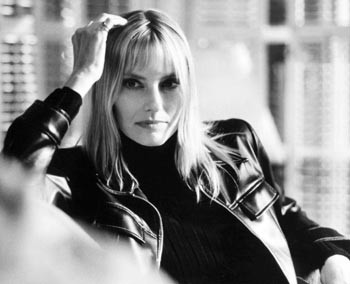
DEAR AIMEE Mann: In the end, I suppose you’ll find this an even more querulous fan letter than those sappy, gut-wrenching ones I’m sure an artist of your caliber is accustomed to receiving all the time.

It’s the kind of troublesome epistle that pleads a sort of symbiotic emotional and psychological, and, if one is honest about such things, romantic identification with what the letter’s author assumes is a privileged view into your psyche through the concrete evidence of your lyrics, your music, your albums.

I’ve written a few of those bummers myself, and I’m not proud.

Such fan mail takes on, ipso facto, an air of nauseating neediness masquerading as confessional doppelgänger of spiritual purport. You know, as though those absolutely compelled to write letters praising you for your brilliant, heartbreaking songwriting must automatically prove they are in fact capable of such autobiographical feats of genius themselves, emotionally or poetically speaking. Which in turn places upon you an undue and not to mention anonymous burden of responding to them as though they were indeed not only familiar but completely cozy with the private workings of your subtle mind.

Like a lover or something.

So let me begin, then, by apologizing, because this letter is bound to encounter some of the same formal/personal/spiritual conundrums of the confessional style of missive I’ve heretofore mentioned.

You see, in my tenuous capacity as an amateur music critic, I’ve agreed to attempt a sort of personal deconstruction of the idea of heartbreak as it pertains directly to your work on the Magnolia soundtrack (I would even include in this reckoning your amazing cover of “One” by Three Dog Night). Actually, my editor put the assignment in these general terms: Write in a personal vein about a song or album released within the last year that breaks your heart.

Of course, when he told me of the idea, I endorsed it enthusiastically. I had no idea what I was getting into. And, believe me, attempting such an analysis has been a sorrowful nightmare of epic proportions.

IT GOES without saying that this (my troubles with writing) has nothing to do with your work, which, in my humble opinion, is totally without parallel in contemporary music. It’s not as though once I commenced writing about your songs in an exclusively autobiographical manner, they all of a sudden began to dissolve under actual critical scrutiny, or anything like that.

Actually, quite the opposite.

I discovered (with a deadline looming, no less) that once I tried to seriously describe exactly how your songs (especially “Driving Sideways” and “Save Me”) broke my rather breakable heart, I had absolutely nothing to say. All I really could do was simply and faithfully transcribe your lyrics, song by gorgeous song, and leave it at that.

Period.

I suppose the original point or idea or theory, if you will, of the whole exercise was to show the internal impossibility and technical arrogance of obtaining or trying to obtain objectivity in the already questionable realm of criticism, while also offering a kind of touching first-person portrait of the supposedly cold-hearted asshole critic as just one more average, fallible person who is completely capable of having his/her fragile heart broken by good or even great or possibly ingenious (as in your case) music.

Little did I suspect that this would have the alarming and dispiriting effect of unraveling quite violently my psychological underpinnings, and leaving me, as it were, paralyzed by the very suppositions that lurk beneath the act itself of writing about music.

Ha! Ha, ha! Dancing about architecture, indeed!

Perhaps you will perceive more clearly what I’m trying to say if I simply quote to you a passage from my first frustrated attempt at an essay on the impact of your very fine and quite perfectly melancholy music (forgive, please, the implied hubris of me quoting myself):

“Aimee Mann knows, deep down, that knowing and doing are two very different things. In her songs, she is continually juxtaposing the voice of acute self-awareness with the very thing self-awareness cannot prevent, which is, of course, the circular tragedy of desiring. Like the great novelist Marcel Proust, Mann seems to believe that, in matters of the heart, we are all of us doomed to repeat the exact same mistake, to fuck up over and over and over again in our own peculiar way.

“Mann’s vision of fate, then, is essentially romantic; her songs portray an isolated intellect swamped by the claustrophobic dictates of an unyielding emotional need. There are also those rare moments when she suddenly frees herself from this claustrophobia just long enough to glimpse it from the outside. In these instances, Mann adopts the far-reaching perspective of the universal confidant offering warnings that are doomed to fall upon deaf ears, as in her song ‘Driving Sideways’:

At least you know You were taken by a pro I know just how you feel She talked the perfect game Deflecting all the blame You took the jack And changed the flat And got behind the wheel Now you’re Driving sideways Taken in by the scenery As you’re propelled along And your companion Will not help you to navigate For fear she may be wrong.

Perhaps, in reading this, you can decipher the tangential manner in which your sadly beautiful music and lyrics seem at once to uncover and give shape to all those subterranean, amorphous sorrows of my own past.

I choose the word decipher instead of understand because in the act of spelling out my feelings as they relate to your music, cause and effect become impossibly jumbled, and I find myself spiraling into an enervating vortex of fragmented emotions that are part mine and, artistically speaking, part yours.

What really strikes me about the passage above is how, under the charmed influence of your songs, I disguise or not so ingeniously couch practically the whole condensed psychological history of my own romantic failures, and also how those failures have completely and ineradicably informed my present vision of love, and therefore my ideas of heartbreak.

Such writing, if it has any merit at all, belongs only in the privacy of my own journals.

In closing, Ms. Mann, I wish only to assert that I believe it was the absolute brilliance and technical perfection of your highly emotional songwriting that hastened the inevitable (i.e., the utter collapse of my belief in the expressibility [sic] of even the simplest subjective/critical insight into truly heartbreaking music).

I suppose, in my own way, I am paying you the highest compliment. I can only hope you take it as such. And far from depressing me, this whole agonized and protracted situation has actually had an altogether liberating effect.

I understand only now that, in the realm of songs that “break your (i.e., my) heart,” there is a kind of psychosomatic erasure that secretly takes place between the listener and what he/she is listening to. Music, and especially sad music, is to be experienced and felt, not analyzed and talked about.

The best sad music, I believe, works the miracle of articulating all those heartbreaking but ultimately salvational and gorgeous truths that cannot–indeed, should not–be articulated by one so enveloped in this or that sad song.

The inscrutable laws of the heart forbid it to be otherwise.

Thank you for listening.

Yours, Rick Levin

Amy Mann performs Monday, Dec. 11, at 8 p.m. at the Mystic Theatre, 21 Petaluma Blvd. North, Petaluma. Tickets are $22. 765-2121.

From the December 7-13, 2000 issue of the Northern California Bohemian.

© Metro Publishing Inc.

Global Warming Negotiations

0

Hot Air

How the U.S. deflated the global climate talks

By Bill McKibben

DEPENDING on how you spin it, the collapse two weeks ago of the climate negotiations in The Hague, Netherlands, could leave you confident that much progress has been made, despairing that a Bush presidency may doom the future of new talks, or convinced that this is simply a problem too big for human beings to get their heads around.

I think, though, that it really leaves us in pretty much the same position we were in three weeks ago, before the conference began: We’re waiting on the weather.

Exhaustive and exhausting negotiations tend to leave all involved with a severe case of tunnel vision. Inside the mammoth meeting hall, everyone came to believe their own hype: that they were on the verge of an agreement that would truly change the way people used energy, and hence kick-start the process of reducing carbon dioxide emissions into the atmosphere.

Indeed, the Kyoto treaty did represent a kind of triumph of implacable bureaucratic optimism. At each potential breakdown point, someone came up with yet another fix. After six large-scale conferences, the document resembled one of those late-Ptolemaic maps of the universe, with a bewildering variety of epicycles and adjustments added to somehow make the model comport with the real world. There were Clean Development Mechanisms to allow the rich world to purchase easy credits and to buy off the poor world; there were Hot Air provisions and complicated Baskets of Gases; and there were the Carbon Sinks, also known as trees, designed to make the whole package easy on Americans.

That is, instead of a straightforward plan to wean the world from coal and oil and gas, there was a Rube Goldberg machine that attempted to meet every national interest. And it might, just possibly, have worked–that is, it might have provided enough incentives to get the energy industry serious about researching and developing alternative technologies, and those technologies might have taken off so spectacularly that they would have provided us energy junkies with the methadone we seem to require.

But in the end–in the waning hours of Saturday morning–the Europeans decided they couldn’t sell this particular contraption at home. It was simply too easy on the Americans, who, arrogantly, had never really believed anyone would call their bluff. The French did, and shortly thereafter the cleaning crew arrived to cart away the tons of thin carbon sinks known as sheets of paper that rose daily like an ever-higher tide.

Even if the Europeans hadn’t stood tough, though, the document wouldn’t have made it through the U.S. Senate. Not with George W. Bush as president, and not with Al Gore as president. And the reason is simple: The American public still does not believe with the necessary passion that climate change represents a problem serious enough to require any compromises in our way of life.

ONE OF THE IRONIES of the entire global-warming debate is that America–chief contributor to the problem–is geographically situated in such a way that it will be one of the last places to feel the pain. With the exception of Florida (take that, Katherine Harris!) and a few other parts of the Gulf Coast, our shorelines are not especially vulnerable, nothing like Bangladesh or the small island states or the Nile Delta. Sure, we’ve had some floods and hurricanes, but we’re a vast and rich land and we recover easily, at least for now. Drought over one set of fields is usually offset somewhere else in the grain belt. That won’t help us much when the temperature really climbs, as every computer model now predicts, but so far the public is not scared enough to make it an issue, something that our politicians instinctively realize.

Europeans care–or at least enough of them care that in a parliamentary system they can exert sufficient pressure to move their governments. Americans don’t, not yet.

For those of us who have been working on this issue for a decade or more, it’s sometimes hard to imagine that there could be anyone anywhere who does not realize that the freaking earth is coming to an end. But, of course, the guy I sat next to on the airplane home–a perfectly decent engineer who had voted Democratic–greeted the news of where I’d been with only the most casual interest. “Oh yeah, I’ve heard about that,” he said when I mentioned global warming. “So tell me, is that stuff for real or not?” It’s a strong indictment of the insider, deal-making, tech-talking American environmental community–and of the Clinton-Gore administration, which blew almost a decade it could have spent educating the citizenry.

The day will come when Americans will be convinced of the reality of climate change–probably the day after a really big hurricane. When that day comes, we will badly need all the ideas that have been patiently hammered out in places like The Hague. But until that day comes, events like the collapse of these talks may be (sadly) less momentous than they seem.

Bill McKibben is the author of ‘The End of Nature’ and ‘Maybe One,’ among other books.

From the December 7-13, 2000 issue of the Northern California Bohemian.

© Metro Publishing Inc.
Open Mic

0

This year, I’ll be presenting my friends with the same gift we employees used to receive from the grateful catalog company: a nice warm handshake.

By C. D. Payne

LIKE MILLIONS of other Americans, I’m an alumnus of McDonald’s. Back when I was flipping burgers for high school pocket change, I discovered that this preparation dramatically reduced my fondness for said sandwich. After two weeks on the job, I couldn’t look a burger in the buns.

Don’t get me wrong, it was a superb burger for its modest price of 15 cents. I was just sick of them. No doubt makers of candy and doughnuts feel the same, although in the case of the latter confection I don’t really see how that’s possible.

Fast forward a decade or so.

Now I’m writing copy for a well-known San Francisco catalog company that sells electronic gadgets and pricey executive toys. It’s my job to write the product description that sends you screaming to your phone with your credit card to order that nifty combo golf putter and tanning lamp. The pay is better than McDonald’s and I get much less grease splattered on my tie.

But again, overfamiliarity breeds a problem: Now I can’t bring myself to buy stuff. Especially the stuff people like to receive as gifts around this time of year.

After 15 years in the catalog game, I got sensitized to hype.

Consider how I used to write copy. Sometimes all I had to work with was a blurry Polaroid of a prototype and the phone number of an engineer in Taiwan who spoke English about as well as I spoke Chinese. So how did I write my 600 words of benefit-rich sales copy?

I made it all up.

Yup, it’s a dirty little secret only we copywriters are supposed to know. That’s why I approach the purchase of gifty-type stuff with fear and loathing.

Hey, I’m not cheap. I’m just skeptical.

“A revolutionary new breakthrough!”

Sorry, I think I’ll pass.

“Certain to thrill everyone on your guest list!”

Care to submit that claim to the Federal Trade Commission?

This year, I’ll be presenting my friends with the same gift we employees used to receive from the grateful catalog company: a nice warm handshake. Everyone appreciates a little human contact and there’s no gift-wrapping required.

On second thought, maybe I’ll splurge and get some gift certificates from that popular burger chain.

Sebastopol writer C. D. Payne’s first novel, ‘Youth in Revolt,’ is being dramatized this month on Germany’s SWR2 radio.

From the December 7-13, 2000 issue of the Northern California Bohemian.

© Metro Publishing Inc.

The Wide-Eyed Gourmet

Neither gourmet nor gross

By Marina Wolf

‘TIS THE SEASON to be snarky, fa la la la la. It must be Christmastime because the food-drive barrels are out and the jokes-in-passing are getting tossed around as carelessly as boxes of off-brand macaroni and cheese: “They’re going to be eating better than we do.”

Yes! I’ve heard this, and even then I couldn’t believe I was hearing it. Sure, the barrels are overflowing, but all that stuff gets divvied up among hundreds of boxes. And when it comes out of a single box, the daily menu is as narrow and pinched as an empty change purse. Crackers. Canned peaches. Tomato chunks. Dry pinto beans. Some food is better than nothing. A body’s got to eat, right? But what the hell do you do with this stuff? Would you know?

All I know is, disentangling privilege from provisions is difficult, more difficult than one might think. Look at my basic procedure for a simple pot of beans, the kind I make when I’m “feeling poor”: heat up some olive oil in a big pot, chop an onion and throw that in, press in some garlic through a garlic press, and, um . . . See what I mean? I haven’t even gotten to the cheddar cheese on top, and already the recipe contains at least five different ways to knock a completely underequipped pantry out of the loop.

If you’re not used to cooking this way, it’s a real puzzle (though not as much of a challenge, of course, as actually getting used to cooking this way on a regular basis). If you’re up for it, visit www.OnTheRail.com, a restaurant industry site that’s sponsoring the Dare to Care Recipe Challenge. Recipes submitted will be tested for food-box or food-bank compatibility, and then passed on to Dare to Care, a Kentucky-based food bank that hopes to get its forthcoming cookbook out to low-income households and shelters around the country. Deadline for entries is Dec. 20, and a randomly selected entrant will receive $500 from On the Rail, plus publication of the recipe on its site.

SO WHAT CAN you put in your potentially winning recipe? Not much. Items in a typical food box may include canned juices, crackers, canned fruit, canned soup, canned tuna or meats, canned vegetables, tomato products, dry beans, pasta (yes, including that orange mac ‘n’ cheese), rice (instant), powdered milk, and maybe peanut butter or sardines. Shelter or group-home cooks have a little more leeway, with such extravagant ingredients as sugar, dried eggs, frozen vegetables, potatoes, limited seasonal produce, and a sprinkling of basic seasonings.

Complete rules are on the Web, but basically you need to be thinking inside the box. Cooks at shelters can spend maybe $1 per person per meal, and food-box recipients may not even know how to cook. On the Rail gave this recipe as one example of the genre:

Chicken and Rice

1 can cream of chicken soup 1 can water 1 1/2 cups instant rice (Minute Rice)

Put the soup and water in a pot and bring to a boil. Add the rice and cover. Cook over low heat for 5 minutes and serve. (Add cooked vegetables like broccoli or peas, if available. Other cream soups like mushroom or cheese may be substituted.)

Simple, with some basic elements of nutrition: it’s something to eat, but not much. If this is, in fact, better than what you’re eating, talk to your local food bank. But if it’s not, then stop joking about it. Because it’s not funny.

From the December 7-13, 2000 issue of the Northern California Bohemian.

© Metro Publishing Inc.
‘Amargosa’

0

Desert Dance

‘Amargosa’ tells mesmerizing tale of eccentric ballet dancer

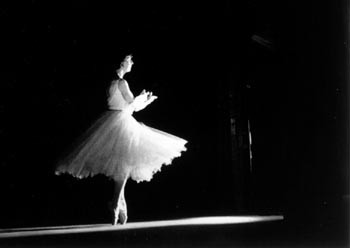
TODD Robinson’s Amargosa is a mesmerizing cinematic surprise, an offbeat, often-moving tale of a singularly odd woman. Marta Becket, age 76, is a semi-reclusive painter and ballet dancer who resides in a remote ghost town: Death Valley Junction, population 10, a slowly crumbling collection of shacks located at the edge of California’s Death Valley.

For decades, Becket has been out there in the middle of nowhere, performing inexplicable “dance-mime” shows for anyone willing to drive the necessary hundreds of miles. Her venue is the grandly named Amargosa Opera House, a once-deteriorating meeting hall that Becket named the Amargosa after the former mining town’s original name.

Crowds were scarce at first, so Becket painted her own audience on the interior walls of the theater. For no apparent reason, she painted them as Renaissance Italians. Filling the theater, these silent peasants and courtiers cavort merrily and watch the stage, beautifully crafted characters in an intricate al fresco fairy tale.

Amargosa, the movie, of course, is nothing if not a fairy tale. It’s a story of loss and redemption, in which an eccentric dreamer attempts to lose her demons in the desert and half-succeeds. It’s also an inspirational tale in which a lone soul bravely pursues her art for the sheer pleasure and blissful salvation of the artistic act.

If this were fiction–if Marta Becket were not a real person–then the whole oddball-in-the-desert scenario might seem like something dreamed up by David Lynch. Or Sam Shepard. But Becket is very much the real thing, and she has made quite a name for herself out there in the desert. The performances she continues to give–twice a week, every month from October to May–now sell out every show. The theater’s murals have made the building a candidate for landmark status.

Robinson’s respectful, knowingly tangential documentary–a finalist for last year’s Best Documentary Oscar–explores Becket’s enigmatic existence with equal parts affection and amusement.

Scenes of Becket toe-dancing on stage, sinewy and lithe despite her years, are intercut with segments that initially seem to have little to do with anything: Becket leading a midnight tour of the town’s “haunted” hotel; Tom Willet–Becket’s swaggering, semi-toothless stage-partner–tearing through the desert on his three-wheeled motorcycle or showing off a model train track he’s run through every room of an abandoned house; Becket feeding wild horses from her back porch, or weeping softly as she remembers her father’s disdain for her artistic inclinations, or firmly detailing her plans to be buried in the horse graveyard behind her house.

The film is poetically narrated by Mary McDonnell (Dances with Wolves), and intercut with lively interviews by such Amargosa fans as science-fiction writer Ray Bradbury. Indeed, it is Bradbury who sums up Becket’s importance when he says, putting the message of her life and work into words, “If you want to do something, don’t talk about it. For God’s sake, do it.”

In the end, the film, like Becket herself, is both whimsical and a little bit baffling–but, like Becket, it is also moving and quietly astounding.

‘Amargosa’ opens Friday, Dec. 8, at the Rafael Film Center, 1118 Fourth St., San Rafael. For details, see Movie Times, page 31, or call 415/454-1222.

From the December 7-13, 2000 issue of the Northern California Bohemian.

© Metro Publishing Inc.
‘Angels in America, Part Two’

Angels in America.

Heaven Sent

Impure paradise at AT’s ‘Angels in America, Part Two’

By Daedalus Howell

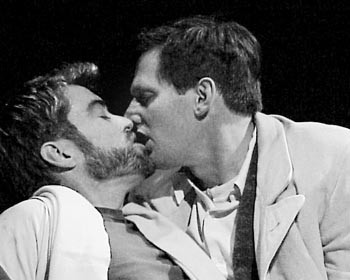
ALL RIGHT, angel freaks, choose your weapon: Charlie’s Angels, that retread TV jiggle-fest assaulting pie-eyed peepers at the local cineplex, or Pulitzer Prize-winning playwright Tony Kushner’s epic endnote to his “Gay Fantasia,” Angels in America, Part Two: Perestroika, currently on the boards at Actors Theatre.

Both have their purposes, both share a noun, but only one will save your soul.

Perestroika, a pre-millennial tangle of subplots mired in the AIDS epidemic and GOP-centric politics of the late 1980s, is a kinder, gentler version of its predecessor, supported by a raft of unforgettable performances expertly shepherded by director Argo Thompson.

Owing to a few Miltonic visitations from, as one character puts it, “a mixed-up reactionary angel” (silky-voiced Bronwen Shears), AIDS-infected Prior Wallace (Peter Downey) has dubbed himself a prophet. His ex-lover, Louis (Steven Abbot), navigates an ill-begotten relationship with a married Mormon law clerk. Both endure heartbreak on the ever-forking road to redemption.

Those reprising their roles from last year’s stunning AT production of Angels in America, Part One: Millennium Approaches (restaged this year in rotating repertory with Part Two) include an electric Danielle Cain as the Valium-addicted Mormon housewife Harper, Armond Dorsey as gayer-than-thou nurse Belize, Joe Winkler as the despotic real-life attorney Roy Cohn, and Shears as the Angel.

Interestingly, Downey returns this season as Prior, leaving his original role of Prior’s lover Louis happily available to Abbot (which makes Downey one of the few actors to have ever played his own lover).

Drifting across the stage like a spectral vision swaddled in a black scarf, coat, and Jackie O. sunglasses, Downey’ s Prior is a revelation–every line is an honest discovery, his earnestness is heart-wrenching, his ability to convey courage in the face of tragedy is riveting. Downey’s characterization is absolutely realized–from Prior’s off-the-cuff wit to his sudden bent toward prophecy.

As Prior’s wayfaring lover Louis, Abbot, too ,turns in a topnotch performance. Watch for his seduction of Cohn’s lackey, Joe Pitt (aptly played by John Shillington): it’s a disarming study of attraction imbued with a delicious olfactory conceit. Abbot’s delivery of Kushner’s text is exquisite, including such ear-boxing lines as “If you have to talk, talk dirty.”

Winkler’s Cohn is theatrical genius. The actor effortlessly dispatches the onerous task of making the loathed Cohn an endearing portrait of an ego gone awry (Winkler could play Hitler at a children’s party and shame Mr. Rogers). Winkler’s conception of Cohn is impenetrable–not one crack reveals the actor’s artifice behind the character.

As his nurse and conversational foil Belize, Dorsey turns in a well-hewn comic performance as when, to account for his erratic behavior, he quips, “I’m trapped in a world of white people–that’s my problem.”

AT’s Perestroika is truly a gift to its audiences. One needn’t see both Angels to enjoy either play, but it’s highly recommended in order to understand the scope of both Kushner and AT’s awesome talents.

‘Angels in America, Part Two: Perestroika’ continues through Feb. 10 at Actors Theatre, 50 Mark West Springs Road, Santa Rosa. Tickets are $18. No one under 15 admitted; those under 18 must be accompanied by a parent. For details, call 707/523-4185.

From the December 7-13, 2000 issue of the Northern California Bohemian.

© Metro Publishing Inc.

Wine and Bowling

0

Lane Change

Days of wine and 10 pins

By Bob Johnson

LET’S PLAY word association. C’mon–it’ll be fun. I’ll list a word or two, and you say the first beverage that comes to mind. That’s right, I want you to say the drink type out loud; depending on what you say and where you’re reading this, it could be a new way to meet people . . . or get arrested. Ready to discover on which side of normal you reside? Here goes:

1. Gin and . . .

2. Oreo cookies and . . .

3. Bowling and . . .

Seeking America’s best and brightest for this highly scientific study, we surveyed only Florida residents who voted for Buchanan but meant to vote for Gore.

The most popular answers gleaned from this brain trust, in order:

1. Tonic.

2. Milk.

3. Beer.

Given the answer to word-association item No. 3, it may surprise you to learn how your faithful chronicler of all things vino got into wine.

It was through bowling.

Yup, the very sport/recreation/way-to-kill-a-few-hours-on-a-Saturday-night that prompted syndicated sports radio blabbermouth Jim Rome to recently rant: “Anything that you get better at as you get blasted can’t be a sport.”

We’ll save the “bowling-as-sport” debate for another time. For now, I’m here to tell you that were it not for bowling, you would not be having the pleasure of reading this wine-themed story.Since you’re dying to know, here’s how it happened . . .

Fourteen years–and even more moons–ago, a group of bowling writers (please don’t laugh) from the southern half of our fair state was transported to a Bay Area bowling center by a manufacturer of synthetic lanes. Reason: to examine, toss a few balls on, and presumably subsequently write about these high-tech substitutes for maple and pine.

That’s right, a paid junket for bowling writers (I asked you not to laugh).

Following the festivities at the bowl, our host treated us to dinner at a Yugoslavian restaurant. We were instructed to order anything we wanted and to select a few bottles from the wine list.

A couple of the older writers immediately went into a panic, simultaneously realizing there were no wines named Bud, Miller, or Coors. (They have since retired to Florida.)

So it was left to us younger guys to make the appropriate vino selections. Not wanting to appear uncouth or uninformed, we stood up the hardcover wine list on the table in an attempt to camouflage our blindly pointing at a selection on a randomly opened page.

Neither the varietal nor the vintner meant anything to us until we took our first sips of wine after our first bites of meat.

We didn’t know why, but we did know that we were consuming perhaps the greatest meal of our lives. Fortunately, neither of us hailing from America’s southeast quadrant, we were smart enough to realize that the wine had something to do with it. (We certainly had no idea that we had stumbled upon perhaps the most revered brand of merlot being made at the time.)

Back at the swank bowling writers’ hotel that night (you’re laughing again; that’s not polite), we perused the Rand McNally atlas and noticed that the Napa Valley was less than an hour away. So instead of heading back south the next day, we trekked northward.

What we found was heaven on earth: dozens and dozens of wineries, and almost all of them pouring free wine! Good thing my buddy’s wife was along to serve as chauffeur, because by 11 a.m., we were feeling no pain . . . swaying in the breeze . . . completely snockered . . . OK, I’ll stop sugar-coating it: we were shit-faced.

But that didn’t stop us. No, sir (or madam). After a quick stop at the A&W on Highway 29 for a Papa Burger and a frosty mug, we were back at it. By the end of the day–which turned out to be 4:30 p.m., the latest we could find a still-open tasting room–we had hit 14 wineries and sampled 86 different wines.

As wine newbies, we were not familiar with the concept of sipping, swirling, and spitting. Furthermore, we considered it impolite not to finish a free sample. (What kind of guest would insult a host in such a way?)

It’s entirely possible that our wine adventure that day in 1986 is responsible for the tasting fees now commonly charged at tasting rooms up, down, and across the Napa Valley. (You’re welcome.)

In the nearly decade and a half since that wild bowling-and-wine weekend, we’ve learned quite a few things. Among them:

1. All things in moderation.

2. Spitting is a good thing.

3. Nothing, but nothing, beats an Oreo dipped in milk.

From the December 7-13, 2000 issue of the Northern California Bohemian.

© Metro Publishing Inc.

Will Durst

Durst Delights Will Rogers with fangs returns to the Mystic WHATEVER else the historians end up saying about the year 2000, one thing is for damn sure: when we common folk weren't crying or grimacing in disgust, we were laughing our butts off. It's true. From Janet Reno's outrageous...

North Bay Regional Gift Guide

Time of the season: Barry Gamble of the Cotati-based ChronoArt has created innovative timepieces that have struck a chord with clockwatchers everywhere. Homeward Bound Our annual guide to great gifts made close to home OK, it smacks of bumper-sticker sentimentality, but these days more and more people are seeking...

Newsgrinder

Important events as reported by daily newspapers and summarized by Daedalus Howell. Wednesday 11.29.00 The Fairfax Town Council (aren't they in a Nathaniel Hawthorne story?) will examine Marin Alliance for Medical Marijuana, a cannabis buyers' club, after commissioners determined it had violated a host of regulations governing its operations, reports the Marin Independent Journal....

Aimee Mann

Man to Mann Fan mail: An end to the discussion By Rick Levin DEAR AIMEE Mann: In the end, I suppose you'll find this an even more querulous fan letter than those sappy, gut-wrenching ones I'm sure an artist of your caliber is accustomed to receiving all the time. ...

Global Warming Negotiations

Hot Air How the U.S. deflated the global climate talks By Bill McKibben DEPENDING on how you spin it, the collapse two weeks ago of the climate negotiations in The Hague, Netherlands, could leave you confident that much progress has been made, despairing that a Bush presidency may doom the future...

Open Mic

This year, I'll be presenting my friends with the same gift we employees used to receive from the grateful catalog company: a nice warm handshake. By C. D. Payne LIKE MILLIONS of other Americans, I'm an alumnus of McDonald's. Back when I was flipping burgers for high school pocket change, I discovered that...

The Wide-Eyed Gourmet

Neither gourmet nor gross By Marina Wolf 'TIS THE SEASON to be snarky, fa la la la la. It must be Christmastime because the food-drive barrels are out and the jokes-in-passing are getting tossed around as carelessly as boxes of off-brand macaroni and cheese: "They're going to be eating better than we do." ...

‘Amargosa’

Desert Dance 'Amargosa' tells mesmerizing tale of eccentric ballet dancer TODD Robinson's Amargosa is a mesmerizing cinematic surprise, an offbeat, often-moving tale of a singularly odd woman. Marta Becket, age 76, is a semi-reclusive painter and ballet dancer who resides in a remote ghost town: Death Valley Junction, population 10,...

‘Angels in America, Part Two’

Angels in America. Heaven Sent Impure paradise at AT's 'Angels in America, Part Two' By Daedalus Howell ALL RIGHT, angel freaks, choose your weapon: Charlie's Angels, that retread TV jiggle-fest assaulting pie-eyed peepers at the local cineplex, or Pulitzer Prize-winning playwright Tony Kushner's epic endnote to his "Gay Fantasia," Angels...

Wine and Bowling

Lane Change Days of wine and 10 pins By Bob Johnson LET'S PLAY word association. C'mon--it'll be fun. I'll list a word or two, and you say the first beverage that comes to mind. That's right, I want you to say the drink type out loud; depending on what you say...
11,084FansLike
4,606FollowersFollow
6,928FollowersFollow

